China’s new literary star had 19 jobs before ‘writer’ – including bike courier and bakery apprentice

Source: The Conversation – Global Perspectives – By Wanning Sun, Professor of Media and Cultural Studies, University of Technology Sydney

Wavie/Unsplash

Delivering parcels is just one of the 19 different jobs Hu Anyan cycles through over 20 years, as tracked in his Chinese bestseller I Deliver Parcels in Beijing. He also tries his luck working as a convenience-store clerk, a cleaner and in a bike shop, a warehouse, a vegetable market and even an anime design company – always at the very bottom of the ladder.


Review: I Deliver Parcels in Beijing – Hu Anyan (Allen Lane)


Some jobs last weeks, some days, some barely survive the training shift. Bosses disappear, wages evaporate, contracts turn out to be imaginary and rules are invented on the spot. With a blend of hope and resignation, Hu repeatedly comes to realise the true qualifications for survival in the city are a strong back, a flexible sense of dignity and a high tolerance for absurdity.

A smiling man in a hoodie
Hu Anyan.
Penguin

Hu, now aged 47, grew up in Guangzhou, a major city in south China. He has worked in cities big and small, including a brief stint across the border in Vietnam.

They are “places with apparent unlimited potential for development, yet I seemed to have gotten nowhere,” he writes. They promise opportunity, then charge rent on his naivety and optimism. He seems to move through the world with a certain innocence about how it truly works, yet possesses an uncommon capacity for deep, searching reflection.

He writes with dry humour and an eye for the absurd – security guards guarding nothing, managers creating chaos and delivery algorithms ruling lives with godlike indifference. But he also writes like a field researcher issued a hard hat instead of a research grant. His prose has a forensic, documentary precision – wages counted to the cents, shifts timed, fines itemised, and injustices recorded without melodrama.

When he completed his trial as a parcel deliverer, he writes:

an assistant foreman […] told me that although the probationary period wasn’t paid, he would make it up by giving me three extra days of vacation. […] But it wasn’t even a month before the same guy had a dispute with the other foreman and quit. No one mentioned those paid days off ever again.

China’s ‘development didn’t suit me’

This reporting of everyday injustice at work is peppered with occasional philosophical reflections on human nature and the meaning of work. He calmly observes of mean and unhelpful co-workers: “Selflessness may be a noble virtue, but I suppose it isn’t fundamental to being human.”

The real charm is his tone. Even when dealing with exploitation, Hu delivers it with light-footed sarcasm, letting absurdity do the heavy lifting. Writing about heavy workload in the delivery company he works for, he simply comments “capitalists aren’t known for sympathising with workers”.

At times, he reveals his battles with social anxiety, depression and occasional bouts of illness. In one memorable scene, he describes going back and forth between hospitals, community clinics and small medical offices, carefully comparing prices before settling on where to get an IV drip to bring his fever down.

That kind of careful penny-pinching, being unable to justify spending even on one’s own health, feels painfully familiar to anyone trying to survive on very little.

Hu’s story is a personal one about structural inequality and everyday injustice. But he doesn’t sound resentful that China’s economic growth hasn’t benefited him. He just states, matter-of-factly, that China’s “development didn’t suit me”.

His personal account also functions as a practical lesson in the political economy of labour. In that sense, the lesson is not uniquely Chinese. Rather than relying on theories of profit and value, he uses his experience as a courier to show how the gig economy of late capitalism operates globally.

He meticulously calculates how the supposed average monthly pay of 7,000 yuan a month (around A$1,435) he could expect to earn translates in reality. It means working 26 days a month, 11 hours a day – to earn 30 yuan (A$6.16) an hour and 0.5 yuan (ten cents) a minute.

I had to complete a delivery every four minutes in order not to run at a loss. If that becomes unworkable, I would have to consider a change of job.

‘Oddly soothing’

For urban educated readers, both in China and elsewhere, who are crushed by emails, mortgages, childcare and performance anxiety, it can be oddly soothing to read about a life lived under more precarious conditions.

Hu’s calm endurance could work like a psychological release valve – things are hard, yes, but not this hard. The result lets middle-class readers feel ethically awake without feeling accused. This makes the book as reassuring as it is unsettling.

A book cover with an illustration of a man carrying a large pile of parcels

I Deliver Parcels in Beijing is also popular with Hu’s social peers – the urban underclasses and rural migrant workers: it shows that their struggles and small victories are worthy of being recorded and remembered.

A key, albeit implicit, theme circulating the book is unequal access to social mobility. Each of the 19 jobs Hu cycled through may look different on the surface, but rather than climbing a social ladder, he merely shuffles horizontally, stagnating on the same rung: “twelve years have passed, and with the same workload as before, my pay was somehow still lower”.

There is much musing about the meaning of freedom in the book. But freedom, for Hu, is not about the right to vote, but to choose who one wants to be, rather than what society expects one to become.

There’s no cataloguing of human rights abuses – the familiar trope of English-language coverage of China. Nor is the book a sociological exercise by an intellectual, for whom Hu’s world might be an object of study. And it certainly isn’t some diasporic Chinese writer’s rendition of China, often calibrated to the expectations of festival-going, liberal middle-class readers abroad.

Instead, the book speaks from inside the experience it describes, with no apparent desire to translate itself – at least initially – into the moral or political idioms readers might expect. That’s precisely where its quiet power lies.

It doesn’t tell you what to think about China – it shows you a life you would otherwise almost never get to see. The translation, superbly done, helps enhance this objective.

The luxury of being noticed

Like worker-poet Zheng Xiaoqiong and worker-photographer Zhan Youbing, Hu the worker-writer becomes a self-appointed “surrogate ethnographer”, patiently recording rules, rhythms, hierarchies, and survival strategies from the inside. He produces not theory, but something more valuable: reality, rendered with authenticity and credibility.

“I often sat in Jingtong Roosevelt Plaza after finishing my deliveries and watched the passers-by and the salespeople in stores, and the different delivery drivers back and forth,” he writes. “Mostly I supposed they were numb, thinking nothing at all, mechanically going about their days like I once did.”

Social researchers outside China dream of accessing the trove of evidence-based, granular, situated knowledge this book contains – but they rarely do.

Hu is one of the millions of internal labour migrants in China who struggle to survive at the bottom of the social ladder – and a rare case of a worker who became a recognised writer. He has published two books since this one.

His rise was not the result of structural change, but exceptional literary talent and sharp intellectual acuity. Meanwhile, the great majority of China’s urban underclasses and rural migrant workers remain locked in the kind of precarious, exhausting existence Hu describes – without the chance to turn their experiences into art, and without the luxury of being noticed at all.

The Conversation

Wanning Sun does not work for, consult, own shares in or receive funding from any company or organisation that would benefit from this article, and has disclosed no relevant affiliations beyond their academic appointment.

ref. China’s new literary star had 19 jobs before ‘writer’ – including bike courier and bakery apprentice – https://theconversation.com/chinas-new-literary-star-had-19-jobs-before-writer-including-bike-courier-and-bakery-apprentice-272447

Winter Olympic security tightens as US-European tensions grow

Source: The Conversation – Global Perspectives – By Keith Rathbone, Senior Lecturer, Modern European History and Sports History, Macquarie University

Since the murder of 11 Israeli hostages at the 1972 Munich Summer Olympics, security has been fundamental for games stakeholders.

The 2024 Paris games set new benchmarks for security at a mega-event, and now the presence of American security officials in Milan Cortina threatens to darken this year’s Winter Olympics before they even start.

Security at the games

The scale of security at the games has magnified considerably since the 1970s.

For the 2024 Olympics, the French government mobilised an unprecedented 45,000 police officers from around the nation.

For the opening ceremony, these forces cordoned off six kilometres of the Seine River.

Advocates point to Paris as an example of security done correctly.

Milipol Paris – one of the world’s largest annual conferences on policing and security – pointed to lower crime across the country during the games and a complete absence of any of the feared large security events. It stated:

The operation demonstrated the effectiveness of advanced planning, inter-agency cooperation and strong logistical coordination. Authorities and observers are now reflecting on which elements of the Paris 2024 model might be applied to future large-scale events.

However, critics complained the security measures infringed on civil liberties.

Controversy as ICE heads to Italy

Ahead of the Milan Cortina games, which run from February 4-23, Italian officials promised they were “ready to meet the challenge of security”.

A newly established cybersecurity headquarters will include officials from around the globe, who will sift through intelligence reports and react to issues in real time.

As well as this, security will feature:

  • 6,000 officers to protect the two major locations – Milan and Cortina d’Ampezzo
  • a no-fly zone around key sites
  • a constant restricted access cordon around some sites (as seen in Paris).

Some of the security officers working in the cybersecurity headquarters will come from the United States.

Traditionally the US diplomatic security service provides protection for US athletes and officials attending mega-events overseas. It has been involved in the games since 1976.

Late last month, however, news broke that some of the officers will be from “a unit of US Immigration and Customs Enforcement (ICE)”.

US and Italian officials were quick to differentiate between Homeland Security Investigations (HSI), which handles cross-border crime, and Enforcement and Removal Operations, the department responsible for the brutal crackdown on immigrant communities across the US.

The HSI has helped protect athletes at previous events and will be stationed at the US Consulate in Milan to provide support to the broader US security team at the games.

But the organisation’s reputation precedes them, and Italians are wary.

In Milan, demonstrators expressed outrage. Left-wing Mayor Giuseppe Sala called ICE a “a militia that kills” while protests broke out in the host cities.


Read more:
Shooting of Alex Pretti in Minneapolis has put America’s gun lobby at odds with the White House


US-European relations are stretched

The presence of ICE has also illuminated fractures within Italian Prime Minister Giorgia Meloni’s governing coalition.

Foreign Minister Antonio Tajani defended the inclusion of the US officers, saying “it’s not like the SS are coming”, referring to the Nazis paramilitary force in Germany.

However, local officials, including those from Meloni’s centre-right coalition, expressed concerns.

The tension inside Meloni’s government reflects broader concerns on the continent about US-European relations.

US Vice President JD Vance and Secretary of State Marco Rubio will attend the opening ceremony in Milan, despite some Europeans viewing Vance as the mouthpiece for US President Donald Trump’s imperial agenda.


Read more:
The Making of an Autocrat: podcast out now


Trump’s desire to take over Greenland has undermined American and European support for trans-Atlantic amity and the NATO alliance.

Just ahead of the Olympics, Danish veterans marched outside the US Embassy after Trump disparaged NATO’s contribution to US-led operations in Iraq and Afghanistan. These protests added to Danes’ fears about Trump’s Greenland ambition.

Tensions in Denmark remain high as the Americans and the Danes gear up to play ice hockey in the opening round robin of the men’s competition.

Elsewhere, politicians in the US on both sides have raised concerns that Trump’s bombastic rhetoric will make it harder for American athletes to compete and win.

A double standard?

Critics argue there is an American exception when it comes to global politics interfering in international sport.

Under Trump, the US has attacked Iran and Venezuela, called on Canada to become its 51st state, threatened to occupy Greenland and engaged in cross-border operations in Mexico.

Despite this, US competitors can still wear their nation’s colours at the Olympics.

Compare this to Belarussian and Russian athletes, who are only eligible to compete as Individual Neutral Athletes after the Russian invasion of Ukraine, and only under the condition they have not been publicly supportive of the invasion. An International Olympic Committee (IOC) body assesses each competitor’s eligibility.

Israeli athletes have also been under the spotlight amid geopolitical tensions in the region.

Following the Israeli invasion of Gaza in October 2023, a panel of independent experts at the United Nations urged soccer’s governing body FIFA to ban Israeli athletes, stating:

sporting bodies must not turn a blind eye to grave human rights violations.

But FIFA, and the IOC, have recently defended Israeli athletes’ right to participate in international sport in the face of boycotts and protests.

Competitors from Israel can represent their country at the Winter Olympics.

The political developments which have caused ructions worldwide ironically come after the IOC’s 2021 decision to update the Olympic motto to supposedly recognise the “unifying power of sport and the importance of solidarity”.

The change was a simple one, adding the word “together” after the original three-word motto: “faster, higher, stronger”.

It remains to be seen whether the Milan Cortina games live up to every aspect of the “faster, higher, stronger – together” motto, not just the first three words.

The Conversation

Keith Rathbone does not work for, consult, own shares in or receive funding from any company or organisation that would benefit from this article, and has disclosed no relevant affiliations beyond their academic appointment.

ref. Winter Olympic security tightens as US-European tensions grow – https://theconversation.com/winter-olympic-security-tightens-as-us-european-tensions-grow-274530

Increasing math scores: Why Ontario needs early numeracy screening

Source: The Conversation – Canada – By Michael Slipenkyj, Postdoctoral Fellow, Math Lab, Department of Cognitive Science, Carleton University

Ontario’s 2024-25 Education Quality and Accountability Office (EQAO) standardized test results were recently released, and almost half (49 per cent) of Grade 6 students in English-language schools didn’t meet the provincial standard in mathematics.

These unsatisfactory results should not come as a surprise, and they cannot be attributed to lost time during COVID-19.

Ontario students have been struggling in math for many years. For instance, in 2018-19 and 2015-16, respectively, 52 per cent and 50 per cent of Grade 6 students failed to meet the provincial standard. What can be done to change this situation?

Setting stronger foundations in early math

We know from research in mathematical cognition that children’s early number knowledge (for example, at four-and-a-half years old) predicts their mathematical achievement later in school.


Read more:
New research shows quality early childhood education reduces need for later special ed


Because later learned skills build on earlier ones, kids who fall behind early may never catch up. Just as children need to get comfortable putting their face in the water before they can learn the front crawl, they need to become proficient with counting before they can learn addition and subtraction.

The best ways to support math learning are to:

  1. Provide lessons with clear skill progressions;

  2. Conduct regular assessments so teachers know what their students are learning; and

  3. Ensure that students get plenty of targeted practice on skills they have not yet mastered.

We should equip our students with solid foundational numeracy skills in the early years and check that they are on track before the first EQAO tests in Grade 3.

Roots of the problem, solutions

Clearly, policy initiatives like the $60 million “renewed math strategy”, making new teachers pass a math test and the “back to the basics” math curriculum, have done little to improve low math achievement.

Young children with educators seen in a classroom at tables doing various activities with building blocks and other materials.
The skills that children learn later are scaffolded upon earlier learning.
(Allison Shelley/The Verbatim Agency for EDUimages), CC BY-NC

After the 2024-25 results were announced, the Elementary Teachers’ Federation of Ontario released a statement calling for EQAO funding to be redirected to classrooms, saying “EQAO assessments shift accountability from the government’s chronic underfunding of public education to educators.”

The province agrees that math scores are too low. In the aftermath of the results release, Ontario Education Minister Paul Calandra held a news conference to say the results weren’t “good enough.” He announced the formation of a two-person advisory committee to review the situation and provide “practical recommendations that we can put into action.”

Early universal numeracy screening

As researchers studying mathematical cognition and learning, we have an evidence-based recommendation to help improve children’s math scores: schools should use universal screening to identify and track students’ numeracy learning much earlier than Grade 3 (when the first EQAO tests are given).

Screeners that assess foundational numeracy skills and other forms of assessment are critical for evaluating gaps in students’ numerical knowledge and providing them with targeted supports before they start to fall behind.

Instead of waiting for provincial results at the end of Grade 3 to identify struggling learners, we need to equip students with necessary skills and knowledge earlier.

Measuring foundational skills is critical for mathematics because more advanced skills like geometry, algebra, calculus require students to have fluent access to foundational knowledge. For example, fluent division skills support converting fractions to decimals (for instance, one quarter equals 0.25).

A page showing children's colouring covering various squares coloured to express different fractions.
More complex skills like fractions are assessed in later grades.
(Jimmie Quick/Flickr), CC BY

Extensive store of knowledge needed

Children who lack foundational skills will continue to struggle across grades as the expectations become more advanced. Research has found that kindergarteners with lower counting skills are more likely to under-perform in math in Grade 7. These basic skills have also been linked to other metrics of academic success.

For example, children with strong foundational numerical skills are more likely to take advanced math classes in high school or pursue post-secondary education. Importantly, students who acquire foundational skills also develop more confidence in their mathematics abilities and are less likely to develop math anxiety.

By Grade 6, students need to have acquired a rich and extensive store of knowledge for learning the more complex math required in later grades.

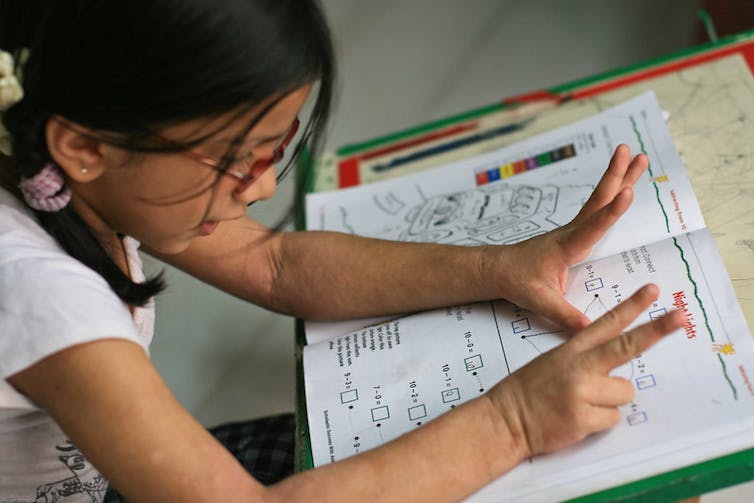
A child at a desk looking happy doing work.
Students who acquire foundational skills develop more confidence in their math abilities.
(Bindaas Madhavi/Flickr), CC BY-NC

The right to calculate

Human rights commissions have called for changes in education to ensure the “right to read” is protected for all students, including those with reading disabilities. We believe all students also have a right to high-quality math instruction — the right to calculate.

In efforts to connect math researchers and educators, we established the Assessment and Instruction for Mathematics (AIM) Collective. The AIM Collective is a community of researchers and educators, from universities and school districts across the country, committed to improving early math education in Canada.

Universal screening is one of the topics that AIM members have discussed in depth, because teachers often have mixed reactions to policies on screening.

However, educators we’ve partnered with have found that early math screening is a helpful teaching tool that helps educators target instruction to support children’s math learning.

Reaching full potential in math

Alberta now mandates universal numeracy screening. The Math Lab at Carleton University, where we are engaged in research, was involved in constructing grade-specific numeracy screeners for students in kindergarten to Grade 3 now in use in Alberta as well as other provinces.

Universal literacy screening is already mandated for students in Ontario from senior kindergarten to Grade 2. Initiating early universal numeracy screening is one step towards ensuring Ontario students reach their full potential in math.

Critically, screening must be accompanied by targeted support. Helping students reach their full math potential will contribute to a thriving Ontario.

As such, we call on the government to invest more in numeracy screening and earlier educational supports for struggling students.

The Conversation

Michael Slipenkyj is partly supported by a Mitacs internship with Vretta Inc., a Canadian educational technology company.

Heather P. Douglas has developed an early numeracy screener that is being used in four provinces in Canada. She collaborates with Vretta Inc., an educational technology company on a project to develop a digital version of the early numeracy screener. The project is funded by a Micas Accelerate grant.

Jo-Anne LeFevre has developed an early numeracy screener that is being used in four provinces in Canada. She collaborates with Vretta Inc., an educational technology company on a project to develop a digital version of the early numeracy screener, funded a Mitacs Accelerate grant.

Rebecca Merkley collaborates with Vretta Inc., a Canadian educational technology company. The project is funded by a Mitacs Accelerate grant titled: “A Research-Driven Approach to Assessment in Early Math Education”.

ref. Increasing math scores: Why Ontario needs early numeracy screening – https://theconversation.com/increasing-math-scores-why-ontario-needs-early-numeracy-screening-273339

Hey Trump: Here’s how Canada punched above its military weight in Afghanistan — from someone with a front-row seat

Source: The Conversation – Canada – By Eugene Lang, Interim Director, School of Policy Studies, Queen’s University, Ontario

“We’ve never needed them. We have never really asked anything of them. You know, they’ll say they sent some troops to Afghanistan, or this or that. And they did — they stayed a little back, a little off the front lines.” So said United States President Donald Trump recently, referring to America’s NATO allies, including Canada.

The comments have provoked outrage. British Prime Minister Keir Starmer called them “frankly appalling,” especially the insinuation that soldiers from other NATO states avoided the front lines in Afghanistan, leaving the most dangerous heavy lifting to American forces.

Anyone moderately familiar with NATO’s involvement in Afghanistan knows Trump’s insult is rubbish — especially when it comes to Canada.

The Canadian Armed Forces were deployed in some of the most dangerous regions and complex situations in Afghanistan for more than a decade, paying a heavy price in casualties — the heaviest since the Korean War in the early 1950s, when Canada also supported the American-led war effort and more than 500 Canadians died doing so.

What is less commented upon is Trump’s claim: “We’ve never needed them. We have never really asked anything of them.” This, too, is rubbish as far as Canada is concerned.

A front-row seat to Rumsfeld’s request

Twenty-three years ago, in fact, the U.S. asked Canada for something substantive and specific in Afghanistan. And Canada delivered substantively.

The ask came from U.S. President George W. Bush’s secretary of defense, the late Donald Rumsfeld, in January 2003. Famous for being sharp and precise with language, Rumsfeld invited Canada’s defence minister at the time, the late John McCallum, to the Pentagon to make a request.

I was in the room that day, and I heard the ask from Rumsfeld’s own lips (I later wrote about this historic meeting in The Unexpected War: Canada in Kandahar in 2007 and again in 2025 in Chretien and the World: Canadian Foreign Policy from 1993-2003.

Rumsfeld asked Canada to lead the International Security Assistance Force (ISAF), a multi-national stabilization mission then confined to Kabul, the war-torn capital city of Afghanistan. Rumsfeld’s request was an extremely significant one for Canada to digest. It meant providing the largest contingent of troops — about 2,200 — as well as a brigade headquarters and command of the operation.

Rumsfeld emphasized how critical the leadership of that mission was from his perspective, and how in his view Canada was better suited to take on the role than any other American ally. Gen. Richard Meyers, chairman of the U.S. Joint Chiefs of Staff at the time, was also present at the meeting and reinforced Rumsfeld’s point that ISAF was key to the Kabul region and Canada was the preferred nation to lead it.

American forces, the defense secretary argued, needed Canada to stabilize Kabul, which was awash in war lords and militia and had no real functioning government at that point.

American forces, meantime, would be otherwise engaged in the invasion of Iraq (which began a few weeks later) and holding the line in southern Afghanistan, where U.S. troops were concentrated.

The Canadian military was needed to hold Kabul together and pave the way for scheduled Afghan elections in 2004, Rumsfeld said. Kabul was an extremely important and vulnerable flank in the American war effort, and Rumsfeld needed Canada to cover that flank.

Canada answered the call

The U.S. needed Canada. The American military needed the Canadian Armed Forces. So Rumsfeld asked Canada for help. Following that meeting, McCallum returned to Ottawa and dutifully presented Rumsfeld’s ask to then Foreign Minister Bill Graham, Prime Minister Jean Chretien, Canada’s military leadership and ultimately the federal cabinet.

It was not an easy ask for Canada to fulfil in terms of military capability, capacity and risk. Canada had never done anything like this before. It was, therefore, not an easy decision to make for the government of Canada and for the Canadian military to deliver.

But Canada answered the call from its closest ally, giving the U.S. exactly what it asked for and what it needed from Canada. And for the next couple of years, more than 2,000 Canadian Armed Forces soldiers were deployed into the dangers and instability of Kabul in what was known as Operation Athena Phase 1 Kabul, where they acquitted themselves exceptionally well — as Rumsfeld predicted they would. Three Canadian soldiers gave their lives during this phase from 2003 to 2005.

Trump needs to be briefed on Canada’s military heroism before he opens his mouth again on this file. And Americans should understand that in the case of Afghanistan, they needed Canada’s help, their government asked Canada for help — and Canada delivered.

The Conversation

Eugene Lang is affiliated with Canadian Association of Defence and Security Industries

ref. Hey Trump: Here’s how Canada punched above its military weight in Afghanistan — from someone with a front-row seat – https://theconversation.com/hey-trump-heres-how-canada-punched-above-its-military-weight-in-afghanistan-from-someone-with-a-front-row-seat-274901

Peter Mandelson steps down from the House of Lords – but he still has his title

Source: The Conversation – UK – By Stephen Clear, Lecturer in Constitutional and Administrative Law, and Public Procurement, Bangor University

Peter Mandelson has stepped down from the House of Lords over fresh revelations about his links to deceased sex offender Jeffrey Epstein. These now include emails suggesting thousands of pounds were sent to Mandelson’s husband, that Mandelson lobbied against US bank reforms on behalf of Epstein while he was a UK government minister, and that he shared sensitive information with him. The prime minister, Keir Starmer, had signalled that he wanted him out of the Lords “by hook or by crook”.

He is lucky that Mandelson took the hint and resigned because the prime minister doesn’t currently have the power to remove members of the Lords. And while Mandelson is leaving the House, he will keep his title. He remains Lord Peter Mandelson of Foy and Hartlepool, even though the prime minister has said he does not think it right that he should use the title.

Prior to reforms brought in by the Conservative and Liberal Democrat coalition government in 2014, removing a member of the House of Lords was virtually impossible. Erskine May (the authoritative guide to parliamentary practice) states that membership of the House was effectively for life.

Prior to the changes, life peers could not resign, and could, in theory, stop attending indefinitely without losing their seat in the Lords. Even imprisonment did not, technically, end their membership of the house. The House of Lords couldn’t expel its own members. It could only, temporarily, suspend them.

Death was the only automatic membership termination. Peers who wanted to retire could not, those who never attended remained, and those guilty of serious crimes or misconduct could not be permanently removed.

The 2014 reforms brought in some options, including voluntary resignation or retirement by giving written notice, automatic removal if a peer fails to attend the House at all during an entire parliamentary session (unless they have approved leave of absence) and expulsion if convicted of a serious criminal offence and sentenced to more than one year in prison.

Further reforms in 2015 also made it possible to expel or suspend a peer following a report by the Lords’ Conduct Committee for serious misconduct.

But as it stands, removal from the House of Lords cannot be instigated by the prime minister, UK government, or the king.

This was all a grave concern for the government as allegations continued to flow about Mandelson. Had he not stepped aside – or been convinced to step aside behind closed doors – there would have been little Starmer could have done to remove him through government powers alone.

What about the title?

The issue surrounding Lord Mandelson’s title is more complex. Removal from the chamber does not automatically mean removal of the title. As described in Gadd’s Peerage Law, once the Crown has granted a peerage it is “very difficult to deprive the holder of it” .

Unlike membership of the House of Lords, a peerage title cannot be relinquished. Not even the Crown has the power to cancel one once created by “letters patent” – a legal document issued by the sovereign and adorned with the Great Seal.

The government confirmed last year that an act of parliament is required to remove a peerage title once conferred. This has happened before, under the Titles Deprivation Act 1917, which removed the peerages of members who had aided Brtain’s enemies during the War. The need for an Act of Parliament has also been reaffirmed recently with the removal of Andrew Mountbatten-Windsor’s titles.

Given these complexities, it has been reported that the prime minister’s office believes it is “exceptionally constitutionally difficult” to remove Mandelson’s title, even with a large Commons majority. Even though Starmer has called for action to be taken, it’s not entirely clear how this will happen.

Mandelson’s resignation enables the Lords and government to avoid having to take action to expel a peer for now, but it’s worth noting that the 2024 Labour manifesto promised to make it easier to remove disgraced members.

That said, this needs to be a matter for the Lords first to consider internally. If the prime minister tries to award himself the power to remove members, this could further weaken constitutional safeguards in the future and jeopardise the system of check and balance that the House of Lords offers against the power of the UK government, albeit in a subordinate way.

Any future reform in this area must be mindful of the precedent it creates, and what that might mean for future governments’ decisions surrounding who sits in the House of Lords, and, importantly, who is forced out.

The Conversation

Stephen Clear does not work for, consult, own shares in or receive funding from any company or organisation that would benefit from this article, and has disclosed no relevant affiliations beyond their academic appointment.

ref. Peter Mandelson steps down from the House of Lords – but he still has his title – https://theconversation.com/peter-mandelson-steps-down-from-the-house-of-lords-but-he-still-has-his-title-275023

Why are scientists calling for urgent action on amoebas?

Source: The Conversation – UK – By Manal Mohammed, Senior Lecturer, Medical Microbiology, University of Westminster

Naegleria fowleri, the brain-eating amoeba. Kateryna Kon/Shutterstock.com

Scientists are calling for urgent action on free-living amoebas – a little-known group of microbes that could pose a growing global health threat. Here’s what you need to know.

Free-living amoebas are single-celled organisms that don’t need a host to live. They are found in soil and water, from puddles to lakes.

What makes them remarkable is their ability to change shape and move using temporary arm-like extensions called pseudopodia – literally “false feet”. This allows them to thrive in an astonishing range of environments.

What is the ‘brain-eating amoeba’ and how dangerous is it?

The most notorious free-living amoeba is Naegleria fowleri, commonly known as the “brain-eating amoeba”. It lives naturally in warm freshwater, typically between 30°C and 40°C – lakes, rivers and hot springs. But it is rarely found in temperate countries such as the UK, due to the cold weather.

The infection happens when contaminated water enters through the nose, usually while swimming. From there, the amoeba travels along the nasal passages to the brain, where it destroys brain tissue. The outcome is usually devastating, with a mortality rate of 95%-99%.

Occasionally, Naegleria fowleri has been found in tap water, particularly when it’s warm and hasn’t been properly chlorinated. Some people have become infected while using contaminated tap water to rinse their sinuses for religious or health reasons.

Fortunately, you cannot get infected by drinking contaminated water, and the infection doesn’t spread from person to person.

A woman doing a nasal rinse.
Nasal rinsing with contaminated tap water is risky.
Zaruna/Shutterstock.com

Why are these amoebas so difficult to kill?

Brain-eating amoebas can be killed by proper water treatment and chlorination. But eliminating them from water systems isn’t always straightforward.

When they attach to biofilms – communities of microorganisms that form inside pipes – disinfectants like chlorine struggle to reach them, and organic matter can reduce the disinfectants’ effectiveness.

The amoeba can also survive warm temperatures by forming “cysts” – hard protective shells – making it harder to control in water networks, especially during summer or in poorly maintained systems.

What is the ‘Trojan-horse effect’ and why does it matter?

Free-living amoebas aren’t just dangerous on their own. They can also act as living shields for other harmful microbes, protecting them from environmental stress and disinfection.

While amoebas normally feed on bacteria, fungi and viruses, some bacteria – like Mycobacterium tuberculosis (which causes TB) and Legionella pneumophila (which causes legionnaires’ disease) – have evolved to survive and multiply inside them. This helps these pathogens survive longer and potentially become more dangerous.

Amoebas also shelter fungi such as Cryptococcus neoformans, which can cause fungal meningitis. It can also shelter viruses, such as human norovirus and adenovirus, which cause respiratory, eye and gastrointestinal infections.

By protecting these pathogens, amoebas help them survive longer in water and soil, and may even help spread antibiotic resistance.

How is climate change making the problem worse?

Climate change is probably making the threat from free-living amoebas worse by creating more favourable conditions for their growth.

Naegleria fowleri thrives in warm freshwater. As global temperatures rise, the habitable zone for these heat-loving amoebas has expanded into regions that were previously too cool. This potentially exposes more people to them through recreational water use.

Several recent outbreaks linked to recreational water exposure have already raised public concern in multiple countries. These climate-driven changes – warmer waters, longer warm seasons, and increased human contact with water – make controlling the risks more difficult than ever before.

Are our water systems adequately checked for these organisms?

Most water systems are not routinely checked for free-living amoebas. The organisms are rare, can hide in biofilms or sediments, and require specialised tests to detect, making routine monitoring expensive and technically challenging.

Instead, water safety relies on proper chlorination, maintaining disinfectant levels, and flushing systems regularly, rather than testing directly for the amoeba. While some guidance exists for high-risk areas, widespread monitoring is not standard practice.

Beyond brain infections, what other health risks do these amoebas pose?

Free-living amoebas aren’t just a threat to the brain. They can cause painful eye infections, particularly in contact lens users, skin lesions in people with weakened immune systems, and rare but serious systemic infections affecting organs such as the lungs, liver and kidneys.

What’s being done to address this threat?

Free-living amoebas such as Naegleria fowleri are rare but can be deadly, so prevention is crucial. These organisms don’t fit neatly into either medical or environmental categories – they span both, requiring a holistic approach that links environmental surveillance, water management, and clinical awareness to reduce risk.

Environmental change, gaps in water treatment and expanding habitats make monitoring – and clear communication of risk – more important than ever.

Keeping water systems properly chlorinated, flushing hot water systems, and following safe recreational water and contact lens hygiene guidelines all help reduce the chance of infection. Meanwhile, researchers continue to improve detection methods and doctors work to recognise cases early.

Should people be worried about their tap water or going swimming?

People cannot get infected with free-living amoebas like Naegleria fowleri by drinking water, even if it contains the organism. Infection occurs only when contaminated water enters the nose, allowing the amoeba to reach the brain. Swallowing the water poses no risk because the amoeba cannot survive or invade through the digestive tract.

The risk from swimming in well-maintained pools or treated water is extremely low. The danger comes from warm, untreated freshwater, particularly during hot weather.

What can people do to protect themselves?

People can protect themselves from free-living amoebas by reducing exposure to warm, stagnant water. Simple steps include avoiding putting your head underwater in lakes or rivers during hot weather, using nose clips when swimming, choosing well-maintained pools, and keeping home water systems properly flushed and heated.

Contact lens users should follow strict hygiene and never rinse lenses with tap water. For nasal rinsing, only use sterile, distilled, or previously boiled water.

Awareness is key. If you develop a severe headache, fever, nausea, or stiff neck after freshwater exposure, seek medical attention immediately – early treatment is critical.

The Conversation

Manal Mohammed does not work for, consult, own shares in or receive funding from any company or organisation that would benefit from this article, and has disclosed no relevant affiliations beyond their academic appointment.

ref. Why are scientists calling for urgent action on amoebas? – https://theconversation.com/why-are-scientists-calling-for-urgent-action-on-amoebas-274455

Hey Trump: Here’s how Canada has long punched above its military weight — from someone with a front-row seat

Source: The Conversation – Canada – By Eugene Lang, Interim Director, School of Policy Studies, Queen’s University, Ontario

“We’ve never needed them. We have never really asked anything of them. You know, they’ll say they sent some troops to Afghanistan, or this or that. And they did — they stayed a little back, a little off the front lines.” So said United States President Donald Trump recently, referring to America’s NATO allies, including Canada.

The comments have provoked outrage. British Prime Minister Keir Starmer called them “frankly appalling,” especially the insinuation that soldiers from other NATO states avoided the front lines in Afghanistan, leaving the most dangerous heavy lifting to American forces.

Anyone moderately familiar with NATO’s involvement in Afghanistan knows Trump’s insult is rubbish — especially when it comes to Canada.

The Canadian Armed Forces were deployed in some of the most dangerous regions and complex situations in Afghanistan for more than a decade, paying a heavy price in casualties — the heaviest since the Korean War in the early 1950s, when Canada also supported the American-led war effort and more than 500 Canadians died doing so.

What is less commented upon is Trump’s claim: “We’ve never needed them. We have never really asked anything of them.” This, too, is rubbish as far as Canada is concerned.

A front-row seat to Rumsfeld’s request

Twenty-three years ago, in fact, the U.S. asked Canada for something substantive and specific in Afghanistan. And Canada delivered substantively.

The ask came from U.S. President George W. Bush’s secretary of defense, the late Donald Rumsfeld, in January 2003. Famous for being sharp and precise with language, Rumsfeld invited Canada’s defence minister at the time, the late John McCallum, to the Pentagon to make a request.

I was in the room that day, and I heard the ask from Rumsfeld’s own lips (I later wrote about this historic meeting in The Unexpected War: Canada in Kandahar in 2007 and again in 2025 in Chretien and the World: Canadian Foreign Policy from 1993-2003.

Rumsfeld asked Canada to lead the International Security Assistance Force (ISAF), a multi-national stabilization mission then confined to Kabul, the war-torn capital city of Afghanistan. Rumsfeld’s request was an extremely significant one for Canada to digest. It meant providing the largest contingent of troops — about 2,200 — as well as a brigade headquarters and command of the operation.

Rumsfeld emphasized how critical the leadership of that mission was from his perspective, and how in his view Canada was better suited to take on the role than any other American ally. Gen. Richard Meyers, chairman of the U.S. Joint Chiefs of Staff at the time, was also present at the meeting and reinforced Rumsfeld’s point that ISAF was key to the Kabul region and Canada was the preferred nation to lead it.

American forces, the defense secretary argued, needed Canada to stabilize Kabul, which was awash in war lords and militia and had no real functioning government at that point.

American forces, meantime, would be otherwise engaged in the invasion of Iraq (which began a few weeks later) and holding the line in southern Afghanistan, where U.S. troops were concentrated.

The Canadian military was needed to hold Kabul together and pave the way for scheduled Afghan elections in 2004, Rumsfeld said. Kabul was an extremely important and vulnerable flank in the American war effort, and Rumsfeld needed Canada to cover that flank.

Canada answered the call

The U.S. needed Canada. The American military needed the Canadian Armed Forces. So Rumsfeld asked Canada for help. Following that meeting, McCallum returned to Ottawa and dutifully presented Rumsfeld’s ask to then Foreign Minister Bill Graham, Prime Minister Jean Chretien, Canada’s military leadership and ultimately the federal cabinet.

It was not an easy ask for Canada to fulfil in terms of military capability, capacity and risk. Canada had never done anything like this before. It was, therefore, not an easy decision to make for the government of Canada and for the Canadian military to deliver.

But Canada answered the call from its closest ally, giving the U.S. exactly what it asked for and what it needed from Canada. And for the next couple of years, more than 2,000 Canadian Armed Forces soldiers were deployed into the dangers and instability of Kabul in what was known as Operation Athena Phase 1 Kabul, where they acquitted themselves exceptionally well — as Rumsfeld predicted they would. Three Canadian soldiers gave their lives during this phase from 2003 to 2005.

Trump needs to be briefed on Canada’s military heroism before he opens his mouth again on this file. And Americans should understand that in the case of Afghanistan, they needed Canada’s help, their government asked Canada for help — and Canada delivered.

The Conversation

Eugene Lang is affiliated with Canadian Association of Defence and Security Industries

ref. Hey Trump: Here’s how Canada has long punched above its military weight — from someone with a front-row seat – https://theconversation.com/hey-trump-heres-how-canada-has-long-punched-above-its-military-weight-from-someone-with-a-front-row-seat-274901

How giant ‘Blobs’ of rock have influenced Earth’s magnetic field for millions of years – new research

Source: The Conversation – UK – By Andrew Biggin, Professor of Geomagnetism, University of Liverpool

Kyrylo Glivin/Shutterstock

While we have sent probes billions of kilometres into interstellar space, humans have barely scratched the surface of our own planet, not even making it through the thin crust.

Information about Earth’s deep interior comes mainly from geophysics and is at a premium. We know it consists of a solid crust, a rocky mantle, a liquid outer core and solid inner core. But what precisely goes on in each layer – and between them – is a mystery. Now our research uses our planet’s magnetism to cast light on the most significant interface in the Earth’s interior: its core-mantle boundary.

Roughly 3,000km beneath our feet, Earth’s outer core, an unfathomably deep ocean of molten iron alloy, endlessly churns to produce a global magnetic field stretching out far into space. Sustaining this “geodynamo”, and the planetary force-field it has produced for the past several billions of years (protecting Earth from harmful radiation), takes a lot of energy.

This was delivered to the core as heat during the Earth’s formation. But it is only released to drive the geodynamo as it conducts outwards to cooler, solid rock floating above in the mantle. Without this massive internal heat transfer from core to mantle and ultimately through the crust to the surface, Earth would be like our nearest neighbours Mars and Venus: magnetically dead.

Enter the Blobs

Maps showing how fast seismic waves (vibrations of acoustic energy) that traverse Earth’s rocky mantle change in its lowermost part, just above the core. Especially notable are two vast regions close to the equator beneath Africa and the Pacific Ocean, where seismic waves travel more slowly than elsewhere.

What makes these “big lower-mantle basal structures”, or “Blobs” for short, special is not clear. They are made of solid rock similar to the surrounding mantle, but may be higher in temperature, or different in composition, or both.

Strong variations in temperature at the base of the mantle would be expected to affect the underlying liquid core and the magnetic field that is generated there. The solid mantle changes temperature and flows at an exceptionally slow rate (millimetres per year), so any magnetic signature from strong temperature contrasts should persist for millions of years.

From rocks to supercomputers

Our study reports new evidence that these Blobs are hotter than the surrounding lower mantle. And this has had a noticeable effect on Earth’s magnetic field over the last few hundreds of millions of years at least.

As igneous rocks, recently solidified from molten magma, cool down at Earth’s surface in the presence of its magnetic field, they acquire a permanent magnetism that is aligned with the direction of this field at that time and place.

It is already well known that this direction changes with latitude. We observed, however, that the magnetic directions recorded by rocks up to 250 million years old also seemed to depend on where the rocks had formed in longitude. The effect was particularly noticeable at low latitudes . We therefore wondered whether the Blobs might be responsible.

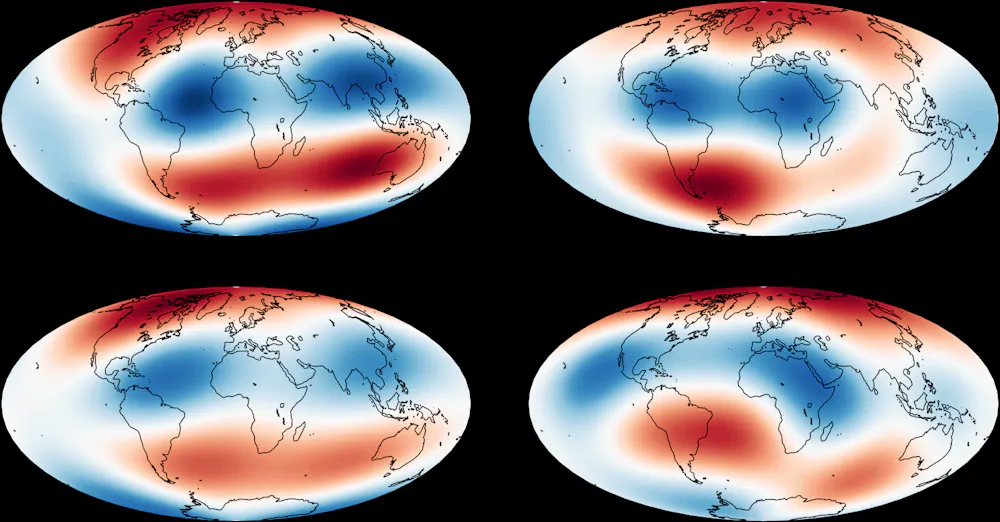
Simulated maps of Earth's magnetic field (left) can only be made to look like those of the real field (right) if Earth's core is assumed to have hot blobs of rock sitting directly on top of it.
Simulated maps of Earth’s magnetic field (left) can only be made to look like those of the real field (right) if Earth’s core is assumed to have hot Blobs of rock sitting directly on top of it.
Andy Biggin, CC BY-SA

The clincher came from comparing these magnetic observations to simulations of the geodynamo run on a supercomputer. One set was run assuming that the rate of heat flowing from core to mantle was the same everywhere. These either showed very little tendency for the magnetic field to vary in longitude or else the field they produced collapsed into a persistently chaotic state, which is also inconsistent with observations.

By contrast, when we placed a pattern on the core’s surface that included strong variations in the amount of heat being sucked into the mantle, the magnetic fields behaved differently. Most tellingly, assuming that the rate of heat flowing into the Blobs was about half as high as into other, cooler, parts of the mantle meant that the magnetic fields produced by the simulations contained longitudinal structures reminiscent of the records from ancient rocks.

A further finding was that these fields were less prone to collapsing. Adding the Blobs therefore enabled us to reproduce the observed stable behaviour of Earth’s magnetic field over a wider range.

What seems to be happening is that the two hot Blobs are insulating the liquid metal beneath them, preventing heat loss that would otherwise cause the fluid to thermally contract and sink down into the core. Since it is the flow of core fluid that generates more magnetic field, these stagnant ponds of metal do not participate in the geodynamo process.

Furthermore, in the same way that a mobile phone can lose its signal by being placed within a metal box, these stationary areas of conductive liquid act to “screen” the magnetic field generated by the circulating liquid below. The huge Blobs therefore gave rise to characteristic longitudinally varying patterns in the shape and variability of Earth’s magnetic field. And this mapped on to what was recorded by rocks formed at low latitudes.

Most of the time, the shape of Earth’s magnetic field is quite similar to that which would be produced by a bar magnet aligned with the planet’s rotation axis. This is what makes a magnetic compass point nearly north at most places on Earth’s surface, most of the time.

Collapses into weak, multipolar states, have occurred many time over geological history but they are quite rare and the field seems to have recovered fairly quickly afterwards. In the simulations at least, Blobs seem to help make this the case.

So, while we still have a lot to learn about what the Blobs are and how they originated, it may be that in helping to keep the magnetic field stable and useful for humanity, we have much to thank them for.

The Conversation

Andrew Biggin receives funding from the Natural Environment Research Council.

ref. How giant ‘Blobs’ of rock have influenced Earth’s magnetic field for millions of years – new research – https://theconversation.com/how-giant-blobs-of-rock-have-influenced-earths-magnetic-field-for-millions-of-years-new-research-272378

Climate ‘fingerprints’ mark human activity from the top of the atmosphere to the bottom of the ocean

Source: The Conversation – UK – By Ed Hawkins, Professor of Climate Science, University of Reading

buradaki/Shutterstock

The world is warming. This fact is most often discussed for the Earth’s surface, where we live. But the climate is also changing from the top of the atmosphere to the bottom of the ocean. And there is a clear fingerprint of humanity’s role in causing these changes through greenhouse gas emissions, primarily from burning fossil fuels.

Over the last several decades, satellites have monitored the Earth and measured how much heat enters and leaves the atmosphere. Over that time, as greenhouse gas concentrations have increased in the atmosphere, there has been less heat escaping to space, causing an imbalance with more heat being retained.

The consequence is a rapidly heating planet.

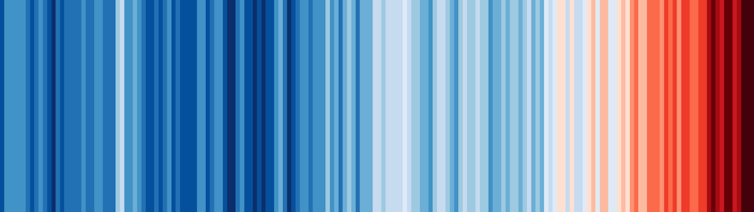
The “warming stripes” are one striking and simple way of visually highlighting the resulting variations in Earth’s surface temperature using shades of blue and red for cool and warm, with one stripe per year.

One billion individual measurements of a thermometer combine to produce the clearest picture of our warming planet from 1850 to 2025. The last 11 years have been the warmest 11 years on record and this sequence is unlikely to end anytime soon.

Warming stripes
Warming stripes representing changes in global average surface temperatures from 1850 to 2025.
Ed Hawkins / University of Reading, CC BY

We recently extended this concept upwards through the atmosphere and downwards into the ocean, although the available datasets are shorter.

Satellites have monitored the temperature of different layers of the atmosphere since 1979. The warming stripes for the troposphere (the lowest layers of the atmosphere, within which commercial flights operate) are very similar to the warming stripes of the surface, with the warmest years predominantly occurring over the last decade. Instead of using surface temperature measurements from thermometers, the atmospheric temperature is measured by instruments on satellites called radiometers that detect how much infrared radiation is emitted from air molecules. These satellite-based estimates help corroborate the surface warming that we have already observed.

Higher up in the atmosphere, the picture changes.

The warming stripes over the upper atmosphere (the part called the stratosphere that’s above typical airline cruising height) reveal a cooling trend, with the warmest years around 1980 and the coolest years over the past decade. This feature may appear surprising. If the atmosphere is gaining heat, shouldn’t the stratosphere be warming too?

Actually, this feature is a clear fingerprint of how human activities are the direct cause of our changing climate.

Global temperature change from the top of the atmosphere to the bottom of the ocean.
Ed Hawkins / University of Reading, CC BY

Why is there this pattern of temperature change? The concentrations of greenhouse gases have increased throughout the atmosphere, making the atmosphere more efficient at absorbing and giving off heat. In the lower atmosphere, this effect acts as a blanket, retaining more heat and warming the surface.

Higher up, where the air is thin and very little heat arrives from below, extra carbon dioxide allows the stratosphere to lose more heat to space than it gains, so the stratosphere cools. Another factor is the destruction of stratospheric ozone by substances known as chlorofluorocarbons (CFCs), which produces cooling in the lower stratosphere.

This human-caused fingerprint of a warming troposphere and cooling stratosphere was first suggested by scientists as a consequence of increasing atmospheric carbon dioxide levels in the 1960s, long before the cooling stratosphere was observed. Importantly, this pattern would not be seen if, for example, changes in the sun’s brightness were the primary cause of global warming, which instead would lead to warming throughout the atmosphere.

Beneath the surface

Warming stripes for different depth levels in the ocean reveal a broadly similar warming trend as at the surface, with the warmest years occurring over the past decade. The timing of the warming also suggests the heat moves downwards into the ocean from the surface, again consistent with a human influence.

This uptake of heat by the ocean is important, as otherwise there would be a much greater rise in surface air temperature. Globally, the ocean accounts for around 90% of the extra heat stored by the planet. We also see sea levels rising due to sea water getting warmer and expanding, and because land ice is melting and entering the ocean as extra water.

All these observations tell a very clear story. The burning of fossil fuels increases the amount of greenhouse gases in the atmosphere. The physics of why such an increase should warm the surface was understood in the 1850s, before the warming was observed. And the pattern of change observed from the top of the atmosphere to the bottom of the ocean indicates that greenhouse gas emissions are the dominant cause.

Past and future ‘warning’ stripes showing changes in global temperature for two different choices for the future.
Ed Hawkins / University of Reading, CC BY

But, what happens next? Because our emissions are causing the climate to change, our collective global choices about future emissions matter.

Rapid action to reduce emissions will stabilise global surface temperatures but delayed action means worse consequences. Which choice will we make?


Don’t have time to read about climate change as much as you’d like?

Get a weekly roundup in your inbox instead. Every Wednesday, The Conversation’s environment editor writes Imagine, a short email that goes a little deeper into just one climate issue. Join the 47,000+ readers who’ve subscribed so far.


The Conversation

Ed Hawkins receives funding from UKRI NERC grants and is supported by the National Centre for Atmospheric Science.

Ric Williams receives funding from UKRI NERC grants and works at University of Liverpool.

ref. Climate ‘fingerprints’ mark human activity from the top of the atmosphere to the bottom of the ocean – https://theconversation.com/climate-fingerprints-mark-human-activity-from-the-top-of-the-atmosphere-to-the-bottom-of-the-ocean-274659

What new twins study reveals about genes, environment and longevity

Source: The Conversation – UK – By Bradley Elliott, Reader in Ageing Physiology, University of Westminster

Digital Media Pro/Shutterstock.com

Why do some people live to 100 while their sibling dies decades earlier? Is it luck, lifestyle, or something written into their DNA?

Relative to many other species, humans are particularly long lived, but there is an ongoing argument about how much of our long lifespan is shaped by our genes and how much to our environment. It’s the old “nature versus nurture” debate.

Researchers have repeatedly used large population studies to estimate how much genetics influences longevity. Historically, these studies have found relatively modest effects, typically around 25% to 33%, with some estimates as low as 6-16%.

A recent study published in Science challenged this trend, revising the estimate upward to about 50% by accounting for changes in external causes of death – such as accidents and infectious diseases – and separating the effects of genetics and environment in large historical cohorts of twins.

We know that individual genes affect lifespans in different species. A single mutation in the gene coding for the insulin sensor of worms would cause them to double their lifespan. Since that 1993 discovery, scientists have experimentally extended the lifespans of flies and mice, and even found hints of similar effects in long-lived humans.

However, the effect of this single gene variation seems to be lessened as the species becomes more long lived, so don’t expect a single gene mutation to suddenly cause 200-year human life expectancies. Also, these were gene mutations affecting the sensitivity of insulin and insulin-like growth factor hormones – in other words, the mutations seem to mimic the metabolic effects of a healthy diet and regular exercise.

Perhaps an obvious statement to make, but many of our body’s traits, including longevity, are the sum of all our inherited genes, not just a single gene. But how much is genetics and how much is lifestyle is the open question.

This amount is more than an interesting number. If genetics mostly controls how long we live, then new anti-ageing treatments and lifestyle changes won’t help much. But if genetics plays a smaller role, then what we do and the treatments we use could make a bigger difference in how long we live.

Nature’s perfect experiment

To tackle this question, the authors of the Science paper used data from the Swedish Adoption/Twin Study of Ageing. Because it includes a rare set of twins raised apart, the data makes it easier to tease apart the effects of genes and environment, creating something close to a natural experiment in humans.

By studying monozygotic (“identical”) twins, or people with identical genomes born between 1900 and 1935 and attempting to correct for rapidly changing external influences of health and mortality during this period, the authors conclude that the inherited influence of lifespan is about 50%.

Put another way, about 50% of your potential lifespan is given to you by your parents, and the other 50% is the environment you live in. Things such as exercise, nutrition, sleep, stress, pollution and infectious disease exposure all fall into this external category.

Identical female twins sitting on a wall, their feet in the water.
Identical twins, followed over a lifetime, can reveal a lot.
JGA/Shutterstock.com

The researchers then validated their models using data from populations in Denmark and the US. However, this also means the study populations were largely white, wealthy and European. Including more diverse populations will be important for determining how well these findings apply to humanity as a whole.

The reason that the authors put forward for their number being so much higher than others is their accounting for the effects of changing external influences on longevity, things such as improving sanitation and medication.

Indeed, if they don’t correct for external causes of death, their model finds numbers in the 20-30% range, or much closer to prior estimates. As the authors note, many health traits seem to be about 50% heritable, so there’s an internal logic of longevity as a trait following this trend.

These estimates could still change. Longevity studies in humans are time consuming, relying on historical records or following populations over roughly 100 years as people live their normal lives. As the authors note: “Heritability is a statistic that applies to a particular population in a particular environment at a particular time.”

This doesn’t mean that your personal actions aren’t helping you – this debate probably isn’t over yet. This is the largest estimate of the effect of genetics on longevity to emerge recently in the scientific literature, but even if genes account for about half our lifespan’s story, the other half is still being written every day.

The Conversation

Bradley Elliott receives funding from the Physiological Society, the British Society for Research on Ageing, the Altitude Centre, and private philanthropic individuals, and has consulted for industry and government on longevity research. He is on the Board of Trustees of the British Society for Research on Ageing.

ref. What new twins study reveals about genes, environment and longevity – https://theconversation.com/what-new-twins-study-reveals-about-genes-environment-and-longevity-274763