Connecting home solar and electric vehicle batteries to the grid could boost South Africa’s clean energy and strengthen the electricity system

Source: The Conversation – Africa – By David Richard Walwyn, Professor of Technology Management, University of Pretoria

South Africa has committed to reaching phasing out human-caused carbon pollution by 2050. To get there, it needs to push as much renewable energy as possible into the national grid.

The country is the world’s 15th largest carbon polluter. It’s one of only a handful of countries still heavily dependent on burning coal to generate electricity. The country’s transport system is totally reliant on crude oil and its derivatives.


Read more:
What’s stopping sunny South Africa’s solar industry? Court case sheds light on the wider problem


One of the keys to the transition to net zero is decarbonising household energy consumption. This means finding ways for homes to reduce the greenhouse gases that cause global warming. At the moment, household energy use contributes up to 40% of total emissions.

I am an engineer and technology management specialist who recently researched how South Africa could use excess clean power from rooftop solar systems on homes if it was fed into the grid. I also studied how battery electric vehicles could be used to store solar energy at home, and feed this into the grid too.

The following analogy explains the idea: think of South Africa’s current solar energy potential like a leaking rainwater tank. It has plenty of “rain” (sunlight). But because it lacks the “pipes” (bidirectional meters) and “extra buckets” (electric vehicle batteries), half of that “water” (clean energy) spills onto the ground unused.


Read more:
How South Africa can spread renewable energy to low income areas


Instead, a system could be built that captures every drop of sunlight. This solar energy could be shared between the house, the car, and the neighbours to ensure the whole community has enough. Commercial projects based on this approach are already operational in China, Japan and Germany.

The biggest obstacle to this idea in South Africa is that both small-scale solar and electric vehicles are too expensive for most households, as we showed in two recently published studies on solar electricity for homes and electric vehicles.


Read more:
Electric vehicles in South Africa: how to avoid making them the privilege of the few


Fortunately, there is a solution: the aggressive use of two technologies. The first would be giving every home with solar power a bidirectional (two-way) meter. This is a meter that allows homeowners to sell their excess solar power back to the grid. The second would be giving electric vehicle owners a vehicle-to-grid device so that they could store excess solar power in their electric vehicle batteries and sell it back to the national grid.

We believe that a synchronised effort between two novel technology adoptions – infrastructure modernisation (installing bidirectional smart grids and vehicle-to-grid devices in homes) – could dramatically increase the country’s clean energy production.

Energy from small-scale embedded solar systems

Rooftop solar systems installed on residential buildings are estimated to generate about 40% more energy than the residences need. This is because most rooftop solar systems are set up to generate enough energy to power a house during winter when the demand is greatest – people run heaters and tumble driers – and sunlight is at its weakest.


Read more:
Home solar systems in South Africa: more will be installed if households are given loans, free maintenance and security


If these homes were fitted with bidirectional meters, which are already widely available, they could sell their unused solar power back to the grid.

Municipalities could also benefit by buying the excess renewable energy generated by homes and reselling it. In Cape Town alone, the city would generate an estimated R144 million (US$8.8 million) per year from doing this, equivalent to an additional 3% in profit, if the bidirectional meters were in place. At the same time, it would be supporting a more inclusive energy transition and reducing the amount of greenhouse gas produced by burning coal to generate power.

Vehicle-to-grid devices

My research also found that home solar systems could be integrated with battery electric vehicles using vehicle-to-grid devices. These are systems that allow batteries from electric vehicles to be integrated with electrical devices in a home (fridges, geysers and heaters) and with the national grid. In other words, electric vehicle owners would use their vehicle-to-grid device to sell power to the national grid.

This would benefit the grid and the vehicle owners, but most importantly would reduce the yearly costs of running an electric vehicle (the combined cost of the electricity the vehicle needs to run, the cost of the vehicle itself and the annual operating costs).

In practice, this would need electric car owners to charge their cars between 10am and 4pm every day when solar power generation is at its peak. This would mean that the car owners could subsidise their travel costs using “free” excess solar energy.


Read more:
Electric vehicles in Africa: what’s needed to grow the sector


This would be ideal for people who worked from home or used their vehicles for transport to and from work or school in the early morning and late afternoon. Charging stations at workplaces would also achieve this.

The vehicle battery (typically 40–100 kWh) could then be used by people to power their homes during peak night periods or sell energy back to the grid, while leaving sufficient energy in the battery for the morning travel. Again, this would offset the yearly costs of owning an electric vehicle and boost the national grid by peak shaving.


Read more:
Battery swapping stations powered by solar and wind: we show how this could work for electric vehicles in South Africa


If homeowners managed this well, by generating enough green energy and avoiding the use of energy from the grid, home and vehicle owners should be able to pay no more than they would if they were driving internal combustion engine vehicles that run on petrol, and using electricity from the national power utility, Eskom. In other words, switching to a renewable energy option would be possible without additional cost.

What needs to happen next

Net Zero by 2050 is not an aspiration of a small group of environmental activists; it is a legal obligation under South Africa’s Climate Change Act. Despite what climate change denialists may claim, it is not a preferred option – it is the only option.

Bidirectional meters and vehicle-to-grid charging stations would help the country reach this goal.

However, the question of who pays for home bidirectional meters, their installation and having them certified has become highly contested. I argue that the state-owned electricity provider, Eskom, and the municipalities should cover the cost of both registration and metering. It shouldn’t be paid by the homeowners.


Read more:
Satellite images reveal the dark side of household solar power – South Africa’s green transition is only for a few


This is because the benefit for electricity distributors is at least five times the cost of the meter itself. Distributors get cheap energy and sell it to other customers. The grid also benefits from having more renewable energy being fed into it.

Without technology like this, the cost of transitioning to a green energy future remains too high for individual households. But with the technology, the transition becomes economically competitive.

The Conversation

David Richard Walwyn receives funding from the National Research Foundation for this research.

ref. Connecting home solar and electric vehicle batteries to the grid could boost South Africa’s clean energy and strengthen the electricity system – https://theconversation.com/connecting-home-solar-and-electric-vehicle-batteries-to-the-grid-could-boost-south-africas-clean-energy-and-strengthen-the-electricity-system-274990


Mozambique floods: why the most vulnerable keep paying the highest price

Source: The Conversation – Africa – By Ricardo Jorge Moreira Goulão Santos, Research Fellow, World Institute for Development Economics Research (UNU-WIDER), United Nations University

When floods submerged parts of Mozambique after heavy rains in 2000, a baby girl was born in a tree, where her mother clung as the Limpopo river waters rose. The baby was nicknamed Rosita in the press. Her survival became a symbol of the country’s grit.

But her story, once a symbol of hope, now frames a harder truth.

Sadly, Rosita’s life was cut short on 12 January 2026. She reportedly died of anaemia in a provincial health centre. This condition might have been treatable in a stronger, better-resourced health system.

Her death coincided with a new wave of severe flooding. Southern Mozambique was under water again in late January 2026. Weeks of heavy rain affected more than 600,000 people. Residual flooding persists in low-lying areas because of upstream inflows and high dam discharges. Towns such as Xai-Xai and Chókwè have faced repeated inundation as the Limpopo swells.

We work for Inclusive Growth, a longstanding research and capacity development initiative in Mozambique. Our work is designed to support evidence-based policymaking to foster inclusive and sustainable economic growth in the country.

Rosita’s story mirrors what our research on Mozambique’s socio-economic development shows at scale: vulnerability persists where poverty, weak public services and deep-rooted inequalities intersect.

The same communities that experience the highest levels of multidimensional poverty, stagnant progress and widening inequalities are also the ones repeatedly exposed to shocks, with limited access to the health, education and infrastructure needed to recover. When floods strike, these disadvantages compound: incomes collapse, assets are lost. Already poor households fall even further behind, making each shock harder to escape and reinforcing long-term deprivation.


Read more:
The three big reasons why Mozambique is not adapting to climate change and what needs to be done


As Mozambique faces more frequent and more severe disasters, cycles of vulnerability will be exacerbated. To break this vicious cycle – and prevent future stories like Rosita’s – Mozambique must invest in rapid, well targeted post-shock support, swift livelihood restoration, and sustained, equitable public investment that builds long term resilience.

The fault lines beneath the floodwaters

Research produced under the Inclusive Growth in Mozambique programme shows clearly that the geography of deprivation matters.

Our paper, Evolution of multidimensional poverty in crisis-ridden Mozambique, shows that progress in addressing multidimensional poverty stalled after 2015. Since then the absolute number of poor people has increased, especially in rural areas and in the country’s central provinces.


Read more:
Extreme weather is disrupting lives in southern Africa: new policies are needed to keep the peace


Inequality trends tell a similar story. Real consumption rose for all groups until 2014/15. But it rose much faster for richer households. Relative gaps widened further from 2015 onwards.

There has also been an increase in between‑group, or “horizontal”, inequalities. These include:

  • a widening of the wealth gaps tied to province, ethnolinguistic identity, and the urban-rural divide between 1997 and 2017

  • an increasing disconnect between how cities and rural areas develop: average living conditions in urban areas have improved much faster, while, relatively, improvements have stalled in rural areas

  • limited internal migration, preventing convergence.

These widening spatial and socioeconomic divides mean that floods don’t strike evenly. They fall hardest on the communities already facing the steepest disadvantages, shaping who is exposed, who loses the most, and who struggles longest to rebuild.

At the household level, Baez, Caruso and Niu (2020) show how quickly welfare collapses when flooding strikes. Cyclones, floods and droughts reduced per capita food consumption by 25%-30%. Consequently, the percentage of people in poverty increased.

Our study on Mozambique’s vulnerability to natural shocks found that affected households saw short-term consumption losses between 11% and 17%. Rural poor households were hit hardest.

This corresponded, at the time, to a 6 percentage points increase in the poverty rate, as a result of the flooding.

These findings show that once incomes fall and assets are depleted, households slip further from access to adequate health, education, or nutrition – the very gaps that contributed to Rosita’s death.

Acting on the evidence

First, protecting consumption in the aftermath of a shock is essential to prevent structural poverty traps. Once emergency support has been provided, temporary, well-targeted, timely and predictable cash support for flood-affected households must be delivered. Recent evidence uncovered that extended delays in transfer payments have materially weakened households’ resilience.

Second, livelihood recovery depends on restoring earning capacity quickly. Evidence from Cyclone Idai in 2019 in Mozambique shows that small enterprises recover more rapidly when the most affected receive immediate liquidity tied loosely to damage severity and sector.

In flood-prone districts, the same logic applies. Families dependent on informal production or trade cannot wait for long bureaucratic procedures. Their resilience depends on rapid access to the means of restoring work.

Third, building resilience before the next flood requires confronting structural inequalities. Patterns of poverty and inequality show that the areas repeatedly suffering the most damage are also those where public investment in health, education, water and local infrastructure lags behind.

Rosita’s life began in a moment of national tragedy and solidarity. Her death reminds us that resilience cannot rely on courage alone. It must be built through sustained, inclusive development and public investment, so that when the Limpopo rises again, more Mozambicans stand ready – with secure livelihoods, functioning clinics, and the possibility of a different outcome.

The views expressed in this piece are those of the author(s), and do not necessarily reflect the views of the Institute or the United Nations University, nor the programme/project donors.

The Conversation

This article was produced under the project “Inclusive growth in Mozambique – scaling up research and capacity”, financed through specific programme contributions of the governments of Sweden and Switzerland.

Ricardo Santos does not work for, consult, own shares in or receive funding from any company or organisation that would benefit from this article, and has disclosed no relevant affiliations beyond their academic appointment.

Elina Penttinen does not work for, consult, own shares in or receive funding from any company or organisation that would benefit from this article, and has disclosed no relevant affiliations beyond their academic appointment.

ref. Mozambique floods: why the most vulnerable keep paying the highest price – https://theconversation.com/mozambique-floods-why-the-most-vulnerable-keep-paying-the-highest-price-274759

East Africa’s dismal football record doesn’t match its passion – what needs to happen

Source: The Conversation – Africa – By Wycliffe W. Njororai Simiyu, Professor and Chair of Allied Health Studies, Stephen F. Austin State University

A new book explores the deep historical roots of the game in Kenya, Tanzania and Uganda. Justin Lagat/Unsplash, CC BY-SA

East Africa loves football. From the streets of Nairobi and the markets of Kampala to the beaches of Dar es Salaam, the passion for soccer is an undeniable current running through the region. Yet, despite fan support, Kenya, Uganda and Tanzania haven’t translated this enthusiasm into sustained international success.

A new book that draws on the career-long research of Wycliffe W. Njororai Simiyu explores the deep roots of the game in the region. It also examines the structural and gender challenges and the immense opportunities that lie ahead. We asked him about it.

How was the modern game introduced?

The sport is linked to the region’s colonial past. Britain established the East Africa Protectorate (which became Kenya) in 1895 and formally declared it a colony in 1920. Germany colonised mainland Tanzania (as German East Africa) in the 1880s, and control shifted to Britain after the first world war. Uganda became a protectorate in 1894 when Britain consolidated its control after a treaty with the Kingdom of Buganda.

So the game took root in the early 1900s, introduced by British settlers. Missionaries apparently introduced football to Uganda in 1897. At first it was a leisure activity for colonials and a tool for social control of the local population. It took up spare time and instilled British values and ideals.

The game was already popular in Britain. Institutionalised through the education system, sport was deemed to instil a sense of discipline and work ethic in young people. The competitiveness of sport in the British culture was exported to the colonised territories.

How did it change over time?

In east Africa, the game quickly took on a life of its own. Most east African societies valued physical activities like dance or wrestling. They found it easy to embrace sports. Football became a favourite.

The game transcended its colonial purpose to become a medium for regional interaction. Later it would also be a vehicle for nationalist expression as teams were formed along ethnic lines (something the British had used to divide and rule).

Fanatical support for local clubs and regional teams was replicated for national teams as they started playing in international matches. The inaugural international match between Kenya and Uganda was played in 1924. This was named the Gossage Cup in 1926 after a British soap manufacturer donated a trophy for the occasion.

Later Tanzania and Zanzibar joined to make it an east African tournament. The Gossage Cup not only fostered a sense of rivalry among the countries, it created a unique regional sporting identity that lives on today through its successor, the Cecafa Cup.

A man painted in yellow, black and red with a red vests holds a plastic horn and blows into it, standing at the top of the seating in a large football stadium.
A Ugandan fan. Football soon became a nationalist pursuit.
Museruka Emmanuel/Wikimedia Commons, CC BY-SA

As east Africa gained independence in the early 1960s, football became fully integrated into the political and social fabric of the new nations. Football matches were even part of independence celebrations.

East African countries were quick to affiliate with the Confederation of African Football (Caf) and global football body Fifa. Before independence, clubs were already active and engaged in invitational tournaments. But after independence, national leagues were launched. These set out to identify the best players to represent each country.

Today, the sport’s deep connection to collective belonging is evident in rivalries between clubs like Kenya’s AFC Leopards and Gor Mahia, which often symbolise shared political underdog status and profound communal identity.

The football pitch is, in essence, an extension of the political landscape.

What have the challenges been in the sport’s development?

The most striking feature of football structures in Kenya, Tanzania and Uganda is not their difference. It’s their shared organisational shortcomings. While each country maintains its own league and administrative body, their mediocre international performance stems from common, deep-seated issues.

The recent qualification of Kenya, Uganda and Tanzania’s youth teams for the Fifa Under-17 World Cup marks a turning point for east African soccer. This is a direct result of strategic, targeted investment – mainly from Fifa’s development programmes – that’s finally bearing fruit. But the senior teams continue to struggle, even on the continental stage.


Read more:
East African footballers are a rarity on the global stage: we analysed why


To date only Uganda has managed to reach the finals of the Afcon tournament (in 1978). No east African country has come even close to qualifying for the Fifa World Cup.

What’s gone wrong?

The challenges are a direct result of the three nations’ shared colonial and post-colonial experiences.

The main organisational issues plaguing football include:

  • Poor governance and leadership. Political intrigue and corruption within football federations undermine long-term development.

  • Weak financial management. Inefficient and opaque handling of funds leads to underfunding of development programmes.

  • Lack of resources. These include infrastructure, facilities, equipment and trained technical personnel.

These challenges create a cycle of short-sighted planning and administrative chaos. This hinders the development of elite talent and explains the region’s perpetual failure to consistently qualify for major tournaments. Kenya, for example, had to play most of its 2026 World Cup qualifying matches away in other countries with better facilities.

Where does the women’s game find itself?

The women’s game faces the same headwinds, often magnified by gender disparities. Although women have shown the capacity to perform and compete, chronic underfunding and weak governance are typically more pronounced than in the men’s game.

However, the recent successes of teams like the Harambee Starlets (Kenya) and the Crested Cranes (Uganda) in qualifying for continental tournaments signal immense untapped potential.


Read more:
Women football players in Africa have overcome enormous barriers – new book tells the story


The growth of women’s football is an opportunity for the region to avoid the historical baggage that weighs down the men’s leagues – if there’s dedicated investment and governance reform.

The continued support for the women’s game from Fifa is already paying dividends. East African teams have qualified for age group competitions at the global level.

How can passion be turned into future success?

The greatest opportunity lies in the very thing that makes the sport strong in the region: its passionate and popular foundation.

It requires a focus on two areas:

  • Reform and professionalisation. Managing finances transparently and rooting out political interference. Focusing on long-term, merit-based leadership within federations. Professionalising the domestic leagues to keep and develop local talent.

  • Investment in youth and infrastructure. Dedicated funding is needed for grassroots and youth development programmes. Building and maintaining quality training facilities must be a priority.

East Africa’s football destiny does not have to be perpetual failure. By calling on the region’s shared identity and addressing the deep-seated organisational flaws, east Africans can finally begin to translate their profound love for the game into the international success their fans deserve.

The Conversation

Wycliffe W. Njororai Simiyu does not work for, consult, own shares in or receive funding from any company or organisation that would benefit from this article, and has disclosed no relevant affiliations beyond their academic appointment.

ref. East Africa’s dismal football record doesn’t match its passion – what needs to happen – https://theconversation.com/east-africas-dismal-football-record-doesnt-match-its-passion-what-needs-to-happen-270479

Winter Olympians often compete in freezing temperatures – physiology and advances in materials science help keep them warm

Source: The Conversation – USA – By Cara Ocobock, Assistant Professor of Anthropology, University of Notre Dame

The 2026 Milan Cortina Winter Olympics promise relatively mild – but still chilly – temperatures compared to past games. Alex Pantling/Getty Images

The Winter Olympics and Paralympics are upon us once again. This year the games come to Milan and Cortina d’Ampezzo, Italy, where weather forecasts are predicting temperatures in the upper 30s to mid-40s Fahrenheit (1 to 10 degrees Celsius).

These temperatures are a good deal warmer than one might expect for winter, particularly in a mountainous area. They’re warm enough that athletes will need to adjust how they are preparing their equipment for competition, yet still cold enough to affect the physiology of athletes and spectators alike.

As a biological anthropologist and a materials scientist, we’re interested in how the human body responds to different conditions and how materials can help people improve performance and address health challenges. Both of these components will play a key role for Olympic athletes hoping to perform at their peak in Italy.

Athletes in the cold

The athletes taking part in outdoor events are no strangers to cold and unpredictable weather conditions. It is an inherent part of their sports. Though it is highly unlikely the athletes this year will be exposed to extreme cold, the outdoor conditions will still affect their performance.

A group of athletes wearing thick jackets, hats and face coverings take a picture together.
U.S. Olympians bundle up during a welcome event at the 2018 Winter Olympics.
Loic Venance/AFP via Getty Images

One concern is dehydration, which can be less noticeable, as sweating is typically less frequent and intense in cold conditions. However, cold temperatures also mean lower relative humidity. This dry air means the body needs to use more of its own water to moisten the air before it reaches the delicate lungs. Athletes breathing heavily during competition are losing more body water that way than they would in more temperate conditions.

When cold, the body also tends to narrow its blood vessels to better maintain core body temperature. Narrower blood vessels lose less heat to the cooler air, but this results in the body pushing more fluid out of the circulatory system and toward the kidneys, which then increases urine output.

Though the athletes may not be sweating to the same degree as they would in warmer temperatures, they are still sweating. Athletes dress to improve their performance and protect themselves from cold. The layers of clothing and material used in conjunction with the heat produced from physical activity can lead to sweating and create a hot, wet space between the athlete’s body and what they are wearing.

This space is not only another site of water loss, but also a potential problem for athletes who need to take part in different rounds or runs for their competition – for example, the initial heats for skiing or snowboarding.

These athletes are physically active and working up a sweat, and then they wait around for their next heat. During this waiting period, that damp layer of sweat will make them more vulnerable to body heat loss and cold injury such as frostbite or hypothermia. Athletes must stay warm between rounds of competition.

Science of winter apparel

Staying warm is all about materials selection and construction.

Many apparel companies adopt a three-layer system approach to keep wearers warm, dry and comfortable. Specifically, there is a bottom layer – in direct contact with the skin – that is typically composed of a moisture-wicking synthetic fabric such as nylon or a natural fabric such as wool.

The second layer in winter apparel is an insulating one that is generally porous to trap warm air generated by the body and to slow heat loss. Great options for this are down and fleece.

The final layer is the external protection layer, which keeps you dry and protected from the elements. This layer needs to be waterproof and breathable to keep the inner insulating layers dry but to simultaneously let out sweat. Polyester and acrylic are good options here, as they are lightweight, durable and resist moisture.

A snowboarder wearing a puffy jacket, snow pants and an Olympic rings bib, grips his board as he flies through the sky.
Many athletes, like this snowboarder in the 2014 Sochi Olympic Games, must bundle up to compete in chilly temperatures.
Javier Soriano/AFP via Getty Image

The gear athletes wear can be customized to their needs. For example, the synthetic fabrics used on the innermost layer are versatile, and engineers can introduce new properties and functionalities for users. Adding a specific coating to a fabric like nylon can give it new properties – such as wind and water resistance.

Frequently, both the synthetic fibers and the coatings materials scientists add to them are made up of polymers, which are long chains of molecules. They can be human-made and petroleum-based, like polyethylene trash bags, polyester and Teflon. But polymers can also be natural and derived from nature. Your DNA and the proteins in your body are examples of polymers.

In addition to polymer technology, conventional battery-powered heating jackets are also an option.

Smart materials

As an added bonus, there is also a class of smart materials called phase change materials that are made of polymers and composite materials. They automatically absorb excess body heat when too much is created and release it again to the body when needed to passively regulate your body temperature. These materials release or take in heat as they transition between solid and liquid states and respond to the body’s natural cues.

Phase change materials are less about warming you up. Instead, they work by keeping your temperature balanced.

While these aren’t commonly used in the gear athletes wear, NASA has been experimenting with them for a long time, and many commercially available products leverage this technology. Cooling fabrics, such as bedding and towels, are often made of phase change textiles because they do not overheat you.

Risks to the rest of us

Athletes are not the only ones at risk for cold injury.

While most of us will be watching the Games with the comfort of indoor heating, thousands of people and support staff will be watching or working those outdoor events in person. Unlike the athletes, these individuals will not have the added benefit of their bodies producing extra heat from exercise. The nonathletes in attendance will be at greater risk in the cold.

A stand full of cheering fans wearing winter gear and Russian colors.
Spectators put on jackets, hats and layers to watch the biathlon race at the 2014 Olympics in Sochi, Russia.
Alberto Pizzoli/AFP via Getty Images

If you’re planning to spectate or work at an event this winter, drink more water than usual and time your bathroom breaks accordingly. Plan to wear several layers of clothing you can add and remove as needed, and pay special attention to the more vulnerable parts of the body, such as the hands, feet and nose.

Colder temperatures elicit a variety of metabolic responses in the body. One example is shivering, caused by tiny muscle contractions that produce heat. Your body’s brown adipose tissue – a type of fat – also becomes active and produces heat rather than energy.

Both of these processes burn extra calories, so expect to be more hungry if you’re out in the cold for a while. Trips to the bathroom or to get food are a welcome opportunity to warm up – especially those hands and feet.

It is easy to think of Olympians as exceptional athletes at the mercy of Mother Nature’s cold wrath. However, both the human body’s natural physiology and the impressive advances scientists have made in winter apparel technology will keep these athletes warm and performing at their best.

The Conversation

The authors do not work for, consult, own shares in or receive funding from any company or organization that would benefit from this article, and have disclosed no relevant affiliations beyond their academic appointment.

ref. Winter Olympians often compete in freezing temperatures – physiology and advances in materials science help keep them warm – https://theconversation.com/winter-olympians-often-compete-in-freezing-temperatures-physiology-and-advances-in-materials-science-help-keep-them-warm-275070

Why walking in a national park in the dark prompts people to turn off lights at home

Source: The Conversation – UK – By Jenny Hall, Associate Professor in Tourism and Events, York St John University

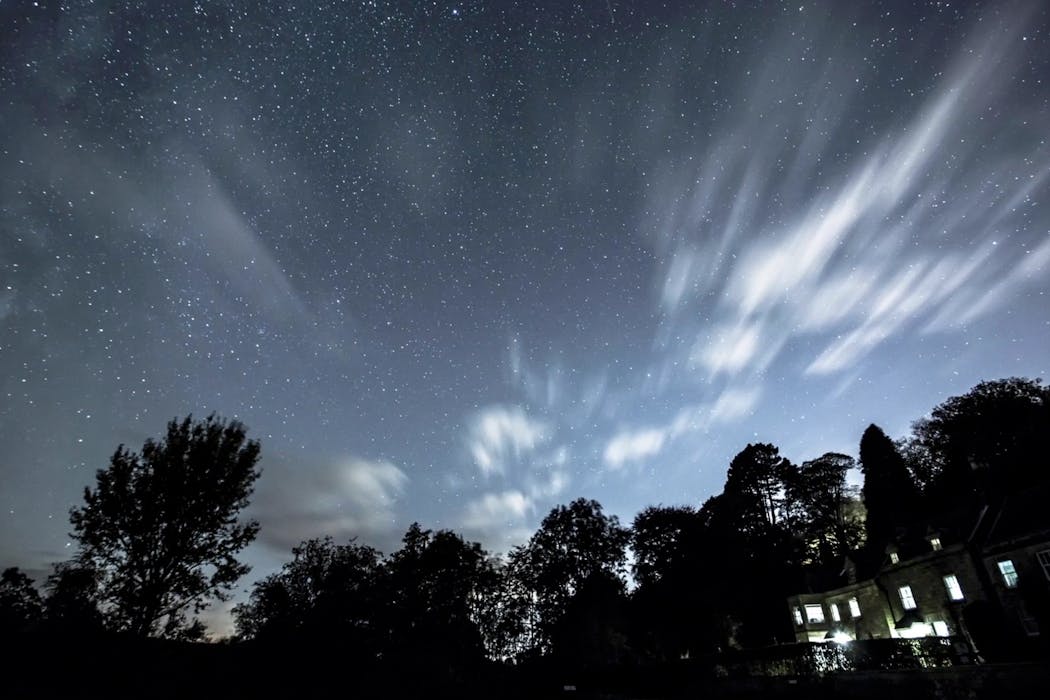
Andy Burns

As soon as you drive over the top of the Peak District and down into Sheffield you can see the light pollution – and it’s horrible, said a participant in a research project into darkness and light pollution.

In the last 100 years, the places where people can experience darkness have reduced dramatically. Now only 10% of the people living in the western hemisphere experience places with dark skies, where there is no artificial light. And the starry skies they can see are limited by artificial light. The number of stars that people can see from most of the western hemisphere is getting fewer and fewer.

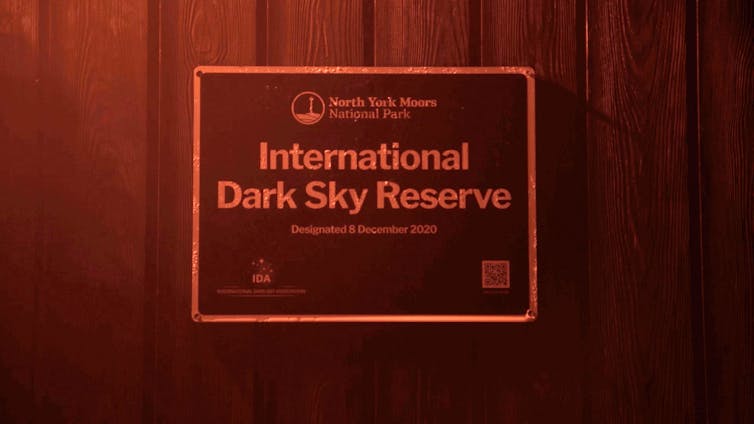
Researchers trying to find out about public attitudes to darkness attended events over three days in the North York Moors National Park. Here, in one of the UK’s seven dark sky reserves (where light pollution is limited), the researchers explored how immersive and fun experiences, such as guided night walks and stargazing and silent discos, reshaped public perceptions of natural darkness and sparked ideas of what they might change in their lives.

Working with a professional film-maker, the research team recorded how people responded to taking part in events in darkness. Participants in the research included five tourism businesses, two representatives from the park and 94 visitors.

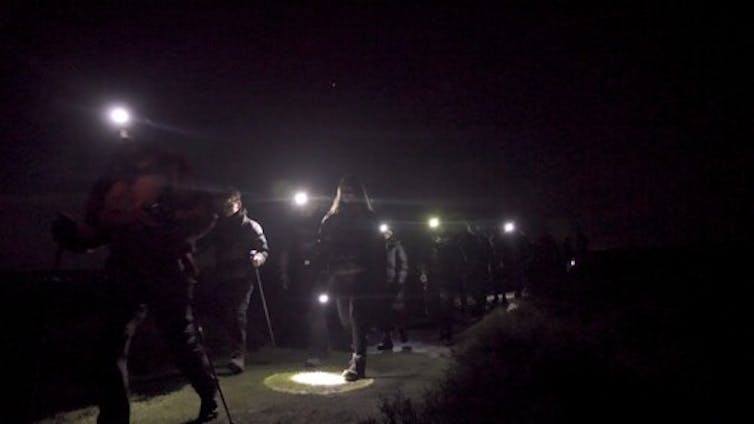
People in the dark walking with head torches during a dark sky event.
People walking with head torches in a dark sky event in North Yorkshire.
Andy Burns.

Darkness disappears

Light pollution is increasing globally by approximately 10% per year (estimated by measuring how many stars can be seen in the sky at night), diminishing night skies and disrupting ecosystems.

But increasing awareness of light pollution has led to an increase in national parks hosting events to explore this issue, according to my recent study.

A sign saying international dark sky reserve.

Andy Burns., CC BY-SA

The study’s findings indicated that participants in the North York Moors Dark Sky Festival events not only started to feel more comfortable in natural darkness but also talked about changing their own lifestyle, including using low-impact lighting in their homes, asking neighbours to switch off lights in their gardens at night, and monitoring neighbourhood light levels.

The research team used filming and walking with visitors to capture not just what people said, but what they did in darkness. During guided walks, participants experimented with moving without head‑torches, cultivating night vision, and tuning into sound, smell and learning how to find their way around without artificial light.

Walking in silence helped visitors build a deeper connection with the nocturnal environment. One visitor said that being in the dark just for that moment of peace, and just to listen and tune in to the environment was a privilege and something to conserve.

One said: “I remember as a child I’d see similar stuff from a city [and that] sort of thing, and now we’re doing whatever we can do to save things like this.”

Visitors reported leaving with new skills, greater awareness and commitment, such as putting their lights at home on timers, and working on bat protection projects. These actions demonstrate that this kind of experience in nocturnal environments can change behaviour far beyond festivals.

Dark Sky activists, such as those in the North York Moors National Park, have learned that the public connect with the issues around light pollution and become more engaged if the activities are fun.

Shared experiences help people understand complex messages about climate, biodiversity, and responsible lighting, and help people feel more confident about walking in the dark. Several participants commented that walking without light was good and wasn’t as bad as they thought. Another said: “I find walking at night with a full moon is really quite a magical experience.”

By the end of the walk, some visitors (when on relatively easy ground) were happy to switch head torches off and enjoy feeling immersed within the nocturnal landscape.

Dark‑sky festivals show how joy and fun can build public awareness and an understanding of why darkness matters.

However, limited public transport to rural night events as well as safety concerns about walking in darkness, and the cost of festivals all restrict participation.

Why light is a problem

Research shows that artificial light at night disrupts circadian rhythms, impairs some species ability to find their way around and is a cause of declining populations of insects, bats and other nocturnal fauna.

There is also evidence that outdoor lighting generates needless emissions and ecological harm that is intensifying at an alarming rate.

North Yorks dark skies discussed.

To rethink this shift, the study argues that darkness could be considered a shared environmental “good”, requiring collective care to prevent overuse, damage and pollution.

Small changes in lighting shielding (which controls the spread of light), warmer coloured lights, and half lighting (switching street lighting off at midnight) can be significant and less damaging to animal life.

The national park’s next major step has been to establish a Northern England Dark-Sky Alliance to halt the growth of light pollution outside the park boundaries, particularly along the A1 road in northern England, which would help restore natural darkness for nocturnal migratory species, such as birds like Nightjars.

If we can make living with more darkness in our streets, and in our leisure time, feel more normal and more comfortable, then nighttime becomes not something that needs to be fixed, but a shared commons to be restored.

Jenny Hall is a speaker at an upcoming discussion on Cities Under Stars: Tackling Light Pollution in Cities, in conjunction with The Conversation, as part of this year’s Dark Skies Festival. Find out more, and come along.

The Conversation

Jenny Hall does not work for, consult, own shares in or receive funding from any company or organisation that would benefit from this article, and has disclosed no relevant affiliations beyond their academic appointment.

ref. Why walking in a national park in the dark prompts people to turn off lights at home – https://theconversation.com/why-walking-in-a-national-park-in-the-dark-prompts-people-to-turn-off-lights-at-home-272321

Melania: how the role of US first lady has changed over the years

Source: The Conversation – UK – By Sarah Trott, Senior Lecturer in American Studies and History, York St John University

The first lady of the US, a title typically held by the wife of the president, has never been a fixed cultural figure. Instead, she has functioned as a screen on to which the nation projects its ideals, anxieties and evolving ideas about womanhood and power.

With the release of Amazon’s new Melania documentary, which details Melania Trump in the 20 days before her husband’s second presidential inauguration in January 2025, that long tradition of reinterpretation is once again visible. It reminds us that the first lady is as much a cultural symbol as a political presence.

The earliest first ladies largely framed themselves as extensions of domestic virtue. Martha Washington, who became the nation’s inaugural first lady in 1789, set the tone as what some people have called a hostess-in-chief. She established her role as one of duty and moral stability, not ambition, helping prove the US could have national leadership without monarchy.

The Washington family.
George Washington (far left) and Martha Washington (far right).
Everett Collection / Shutterstock

Throughout the 19th century, first Ladies like Dolley Madison (wife of James Madison) expanded the role subtly. They used social gatherings and personal charm to shape public opinion and support presidential authority. Madison used social spaces like drawing rooms as informal diplomatic zones, making it socially acceptable – and even expected – for political rivals to mingle politely.

These first ladies achieved this while still being publicly understood as guardians of home and civility. Cultural representations – from portraits to newspaper sketches – emphasised grace, femininity and restraint. This reinforced the idea that women’s power should remain indirect.

Embracing advocacy

In the 20th century, Eleanor Roosevelt marked a decisive shift by embracing advocacy. She became an active moral voice during the New Deal era, a period that saw President Franklin D. Roosevelt enact various programmes and reforms to combat the great depression. Eleanor Roosevelt spoke openly about civil and women’s rights, labour and poverty.

Culturally, she was portrayed not as a decorative spouse but as a reformer and the conscience of the nation. This redefinition opened space for later US first ladies to navigate their public roles more openly.

Jackie Kennedy, for instance, professionalised the role of first lady. Kennedy, who spoke multiple languages and adapted her style to different audiences, used her first ladyship as a legitimate political tool of cultural diplomacy. Foreign leaders and the press were disarmed by her charm and elegance, with President John F. Kennedy jokingly introducing himself as “the man who accompanied Jacqueline Kennedy to Paris” on an official visit to France in 1961.

She also led a project to restore the White House, turning it into a symbol of American civilisation and not just politics. These efforts led to a televised tour in 1962, in which Kennedy invited Americans into the White House and showcased her work in restoring its history. It also humanised Kennedy and made her the first in the role to truly master television.

By the late 20th century, the role of first lady became a site of ideological debate. Hillary Clinton openly engaged in policy work, especially healthcare reform. She led ultimately unsuccessful efforts to pass the Health Security Act in 1993, which aimed to restructure the American healthcare system to ensure universal coverage.

Cultural responses to Clinton were polarised. She was celebrated as a feminist trailblazer by some and criticised for overstepping an unelected role by others. Satire, late-night television and news commentary increasingly treated the first lady as a political figure subject to scrutiny, not merely a symbolic companion to the president.

Like Clinton, Michelle Obama was a visible policy advocate. She used media and popular culture strategically, promoting causes such as support for military families, healthy eating or higher education through social media challenges and television appearances. Obama also spoke candidly about race and identity, framing her position as an active platform for social change and to inspire future first ladies globally.

She looked to position young people – especially girls – as agents of change through her Reach Higher and Let Girls Learn education initiatives. And Obama’s 2020 documentary, Becoming, offered the American public an expanded insight into what a former first lady’s political influence can look like after the White House.

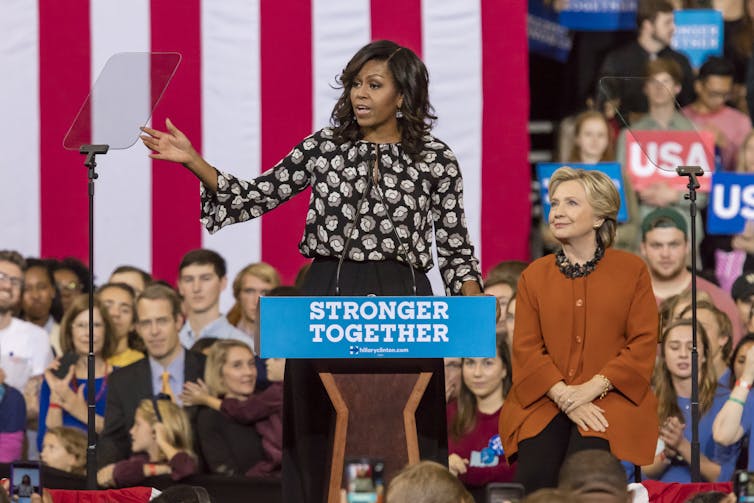
Michelle Obama introduces 2016 Democratic presidential candidate Hillary Clinton at a campaign event.
Michelle Obama introduces 2016 Democratic presidential candidate Hillary Clinton at a campaign event in North Carolina.
Joseph Sohm / Shutterstock

While holding no formal authority, the US first lady occupies one of the most visible platforms in American public life. This makes the role especially revealing of what Americans expect from women and leadership. First ladies have historically been expected to embody the nation’s moral tone, demonstrate unity above partisanship and act as ceremonial “mother” to the nation.

However, since initially becoming first lady in 2016, Melania Trump has largely maintained distance both from the role and traditional advocacy. Her public image has instead leaned heavily on visual symbolism such as fashion, posture and reserve. She has also been widely seen as partisan. In 2018, for example, she wore a jacket emblazoned with “I really don’t care, do you?” during a trip to a migrant child detention centre on the US-Mexico border.

The behind-the-scenes Amazon documentary, which coincides with two West End plays about former first lady Mary Todd Lincoln, comes at a moment of active cultural engagement with how female figures in political spheres are perceived and narrated. It offers the current first lady a chance to shape her own public narrative rather than being defined by the press.

Melania Trump’s editorial control of the documentary suggests she wants the public to see her as a distinct entity from the president, with her own agenda and vision. In the documentary itself, she also hints at having ambitions that extend beyond the traditional ceremonial aspects of the first ladyship.

From references to reinventing the office of first lady to thinking about how lawmakers could do their jobs better, it appears Trump is aiming to cultivate a narrative in which she is seen both as independent and influential enough to shape political culture. Whether she evolves the first lady role in any meaningful way will become clear in the years ahead.

The Conversation

Sarah Trott does not work for, consult, own shares in or receive funding from any company or organisation that would benefit from this article, and has disclosed no relevant affiliations beyond their academic appointment.

ref. Melania: how the role of US first lady has changed over the years – https://theconversation.com/melania-how-the-role-of-us-first-lady-has-changed-over-the-years-274662

The truth about energy: why your 40s feel harder than your 20s, but there may be a lift later on

Source: The Conversation – UK – By Michelle Spear, Professor of Anatomy, University of Bristol

Some of us remember having more energy in our 20s. We could work late, sleep badly, have a night out, recover quickly and still feel capable the next day. By our 40s, that ease has often gone. Fatigue feels harder to shake. It’s tempting to assume this is simply the ageing process – a one‑way decline.

The truth is that the 40s are often the most exhausting decade, not because we are old, but because several small biological changes converge at exactly the same time that life’s demands often peak. Crucially, and optimistically, there is no reason to assume that energy must continue to decline in the same way into our 60s.

Energetic 20s

In early adulthood, multiple systems peak together.

Muscle mass is at its highest, even without deliberate training. As a metabolically active tissue, muscle helps regulate blood sugar and reduces the effort required for everyday tasks. Research shows that skeletal muscle is metabolically active even at rest and contributes substantially to basal metabolic rate (the energy your body uses just to keep you alive when you’re at rest). When you have more muscle, everything costs less energy.

At the cellular level, mitochondria – the structures that convert food into usable energy – are more numerous and more efficient. They produce energy with less waste and less inflammatory byproduct.

Sleep, too, is deeper. Even when sleep is shortened, the brain produces more slow‑wave sleep, the phase most strongly linked to physical restoration.

Hormonal rhythms are also more stable. Cortisol, often described as the body’s stress hormone, melatonin, growth hormone and sex hormones follow predictable daily patterns, making energy more reliable across the day.

Put simply, energy in your 20s is abundant and forgiving. You can mistreat it and still get away with it.

Exhausting 40s

By midlife, none of these systems has collapsed, but small shifts start to matter.

Muscle mass begins to decline from the late 30s onwards unless you exercise to maintain it. This in itself is a top tip – do strength training. The loss of muscle is gradual, but its effects are not. Less muscle means everyday movement costs more energy, even if you don’t consciously notice it.

Mitochondria still produce energy, but less efficiently. In your 20s, poor sleep or stress could be buffered. In your 40s, inefficiency is exposed. Recovery becomes more “expensive”.

Sleep also changes. Many people still get enough hours, but sleep fragments. Less deep sleep means less repair. Fatigue feels cumulative rather than episodic.

Hormones don’t disappear in midlife – they fluctuate, particularly in women. Variability, not deficiency, disrupts temperature regulation, sleep timing and energy rhythms. The body copes better with low levels than with unpredictable ones.

Then there is the brain. Midlife is a period of maximum cognitive and emotional load: leadership, responsibility, vigilance and caring roles. The prefrontal cortex – responsible for planning, making decisions and inhibition – works harder for the same output. Mental multitasking drains energy as effectively as physical labour.

This is why the 40s feel so punishing. Biological efficiency is beginning to shift at exactly the moment when demand is highest.

A business woman hard at work at her desk.
Midlife is often a time of maximum cognitive load.
Krakenimages/Shutterstock.com

Hopeful 60s

Later life is often imagined as a continuation of midlife decline; however, many people report something different.

Hormonal systems often stabilise after periods of transition. Life roles may simplify. Cognitive load can reduce. Experience replaces constant active decision‑making.

Sleep doesn’t automatically worsen with age. When stress is lower and routines are protected, sleep efficiency can improve – even if total sleep time is shorter.

Crucially, muscle and mitochondria still adapt surprisingly well into later life. Strength training in people in their 60s, 70s and beyond can restore strength, improve metabolic health and increase subjective energy within months.

This doesn’t mean later life brings boundless energy, but it often brings something else: predictability.

Good news?

Across adulthood, energy shifts in character rather than simply declining. The mistake we make is assuming that feeling tired in midlife reflects a personal failing, or that it marks the start of an unavoidable decline. Anatomically, it is neither.

Midlife fatigue is best understood as a mismatch between biology and demand: small shifts in efficiency occurring at precisely the point when cognitive, emotional and practical loads are at their highest.

The hopeful message is not that we can reclaim our 20-year-old selves. Rather, it is that energy in later life remains highly modifiable, and that the exhaustion so characteristic of the 40s is not the endpoint of the story. Fatigue at this stage is not a warning of inevitable decline; it is a signal that the rules have changed.

The Conversation

Michelle Spear does not work for, consult, own shares in or receive funding from any company or organisation that would benefit from this article, and has disclosed no relevant affiliations beyond their academic appointment.

ref. The truth about energy: why your 40s feel harder than your 20s, but there may be a lift later on – https://theconversation.com/the-truth-about-energy-why-your-40s-feel-harder-than-your-20s-but-there-may-be-a-lift-later-on-274250

Climate storytelling often ignores young people – arts-based research can change that

Source: The Conversation – UK – By Bobby Smith, Associate Professor of Theatre and Performance, University of Warwick

One autumn evening in 2021, I was co-facilitating the first of ten creative sessions with young people in the Daimler Warehouse, Coventry. It’s home to Highly Sprung Physical Performance, a partner in a pilot project called With One Breath. I was there to use theatre, photography and creative writing to explore the climate crisis.

My collaborator, Becky Warnock, a socially engaged artist, ran an exercise to take stock of how the group were feeling about the issue. She asked them to place themselves on a continuum in response to a series of statements – one end of the room meant they agreed with the statement, while the other end meant they disagreed.

It became clear that many young people are incredibly knowledgeable about the climate crisis. However, when Warnock asked them to respond to the statement, “I have a voice in climate change debates”, most of the group huddled on one side of the room, showing that they “disagreed”.


The climate crisis has a communications problem. How do we tell stories that move people – not just to fear the future, but to imagine and build a better one? This article is part of Climate Storytelling, a series exploring how arts and science can join forces to spark understanding, hope and action.


My research examines what happens when artists engage directly with communities through the co-creation of art. Since 2019, I have worked in collaboration with Rachel Turner-King. We have worked in a range of settings and partnerships including schools, community centres, parks and performance spaces in Coventry, Kampala and Nairobi.

We have called this work Acting on Climate. Underpinning our projects are techniques which engage young people in discussion and act as prompts to explore local environments and share stories. We are also interested in exploring the impact of climate crisis in other parts of the world, and the perspectives of people living in these places.

Young people are often overlooked in discussions about the climate crisis. And yet they stand to be most profoundly affected by it. With One Breath sought to place young people at the heart of this discussion through collaboration across borders.

The project included the use of games and techniques adapted from drama practitioner Augusto Boal’s Theatre of the Oppressed. We tasked young people with using photography and film to document and reflect on the areas they live in. We encouraged them to shape the work and decide what to focus on. Three themes were identified: investigating power and responsibility; reflecting on processes of globalisation; and producing positive visions for alternative futures.

The project prompted dialogue across the two locations. While many young people in the UK felt insulated from the immediate impacts of the climate crisis, hearing from Ugandans already living with and adapting to environmental disruption made those unequal realities impossible to ignore.

Our work highlighted that young people often feel a lack of agency to make change, but also feel simplistically portrayed and tokenised as beacons of hope and change. This tokenisation places responsibility on young people to adapt to, and transform, a problem that they have had little role in creating.

Communities in countries like Uganda are frequently excluded and marginalised when it comes to conversations and action on the climate crisis, so the young people we worked with in that country faced a double bind. They are both marginalised due to their age and where they are from.

As such, this transnational project provided an opportunity to amplify voices not typically heard.

Complexity and collaboration

My research took on new dimensions through Fair Play Kenya 2025, a festival at the National Theatre in Nairobi as part of the British Council’s Kenya 2025 season.

The festival considered relationships between climate crisis, conflict and land justice. One strand involved connecting three groups of young people from Nairobi, Derry/Londonderry and Birmingham through in person and online workshops. To do so, a partnership was formed involving Amani People’s Theatre and ZamaleoACT in Kenya, The Gap Arts Project in Birmingham and The Playhouse in Northern Ireland.

During this short project, young people met online, sharing discoveries and testing ideas. The process is documented in a short film sharing their work and views.

The short film following the young people’s partnership.

In Derry/Londonderry, participants decided to explore land and ancient Celtic culture and the rights of nature, leading them to focus on the mismanagement of Lough Neagh.

Alternatively, in Birmingham young people were concerned by the lack of access to nature, and how this intersects with the climate crisis. Participants in Nairobi explored land justice and what land means to them in their everyday lives. A particularly striking aspect of this group’s work was the reflection on Carbon Credit deals forcing Kenyans off of their land under unjust terms and conditions.

From projects such as Fair Play, we have come to understand that working creatively across borders is inherently messy, complex work. The choices that we all make on a daily basis implicate us in causing environmental harm, but an individualised approach to climate action is unlikely to succeed on its own.

Through artistic projects like ours, such nuance can be engaged with in fun, open-ended ways. For those of us in countries like the UK, the history of industrialisation and colonialism mean we are entangled in processes of exploitation and resource extraction – these must place the burden of responsibility on such countries.

Meanwhile, our work in Uganda highlighted experiences where young people are having to move away from areas that are no longer able to find jobs and how, in Kenya, climate change is one factor fuelling conflict between communities.

For the young people we have worked with, and for us as researchers, arts projects help to make visible the effects of both of this history and the climate crisis in ways that connect and resonate.

The Conversation

Bobby Smith received funding for With One Breath from the Arts and Humanities Research Council. Fair Play Kenya 2025 was funded by the British Council and the University of Warwick’s Arts and Humanities Impact Fund.

ref. Climate storytelling often ignores young people – arts-based research can change that – https://theconversation.com/climate-storytelling-often-ignores-young-people-arts-based-research-can-change-that-272529

How husbands and wives try to find a balance between beauty and status – new research

Source: The Conversation – UK – By Joanna Syrda, Assistant Professor in Business Economics, University of Bath

Off to the gym. Kyryk Ivan/Shutterstock

The idea of a “trophy” wife or husband may not sound like a very romantic basis for marriage. It implies one half of a couple brings physical attractiveness to a relationship, while the other half brings status and money.

But the lack of romance in this idea does not mean that attractiveness and wealth don’t both play a part in many real relationships. Sociologists call it “beauty-status exchange”, and it has traditionally reflected the gendered idea that men prioritise physical attractiveness in the search for a spouse, while women opt for wealth or earning potential.

While it might seem like an old-fashioned concept, my research suggests that, after marriage, some heterosexual couples still try to find a balance between money and attractiveness – but now it may be common for this to affect both sexes in more similar ways.

I found that increases in one spouse’s share of household income were strongly linked to reductions in the other spouse’s body mass index (BMI). It appeared that when the share of household income earned by the wives in my sample rose, their husbands tended to exercise more and slim down.

And when the husbands’ income share rose, their wives tended to respond in a similar way. So the beauty-status exchange lives on – only now it appears to be more equal.

My research used 20 years of US data about more than 3,700 dual-earning heterosexual couples, comparing the share of total household income with changes in both partners’ BMI and how often they exercised.

What was once widely thought of as a gendered, one-sided exchange, may have become a mutual process of balance, maintained in part through deliberate changes in fitness routines. These effects are largely symmetrical, holding true for both men and women.

BMI is, of course, an imperfect measure of physical attractiveness. It has many limitations and captures only one dimension of a person’s appearance and fitness.

But it is one of the few measurements consistently available for both partners in large and detailed data sets. It has also been linked with perceptions of attractiveness in previous research, which makes it widely used in studies about couples and relationship dynamics.

Equilibrium

Economists and psychologists have long described relationships as systems that strive for equilibrium. Each partner can compare what they give and receive and adjust when things feel out of balance.

Building on this idea, my study introduces the concepts of “static” and “dynamic” beauty-status exchange.

The static version refers to the one-off trade between attractiveness and status that shapes who marries whom. This is a pattern documented in previous research showing that higher-earning men are, on average, more likely to partner with women with lower BMI – a proxy for “socially defined physical attractiveness”.

The dynamic version captures how this exchange continues within marriage, as couples adjust to shifts in income and resources to maintain balance over time.

Relationships, in other words, evolve. As incomes rise or fall, people respond not just financially but physically, subtly reshaping themselves to preserve what feels like fairness or desirability within the relationship

This search for balance aligns with the fact that in some of the world’s wealthiest countries – including the US, the UK and parts of Europe – the share of households in which wives earn as much as or more than their husbands has increased.

As this financial equality grows, so too does cultural equality in expectations about appearance. The rise of male grooming markets and the normalisation of skincare and body image conversations among men all signal a shift: men now invest far more in how they look than previous generations did.

Man and woman jogging together.
Racing towards balance?
PeopleImages

Dynamic beauty–status exchange captures this broader trend at home. Economic parity between partners is matched by a new form of aesthetic parity, where both men and women feel motivated to maintain attractiveness in response to changes in status or income.

What was once a one-way cultural expectation appears to have quietly become a two-way performance of equality. The beauty–status exchange hasn’t disappeared; it has simply evolved.

Where once men’s income and women’s appearance were traded asymmetrically, today’s dual-earner couples may engage in a more reciprocal form of exchange. Beauty–status exchange is, of course, only one of many ways couples adjust to maintain balance, alongside emotional support, housework and childcare for example.

But it offers a clear window into how economic change can reshape behaviour within marriage.

Overall, shifts in income share are mirrored by shifts in behaviour and body weight. Marriage, it turns out, remains a dynamic marketplace of mutual adjustment.

The Conversation

Joanna Syrda does not work for, consult, own shares in or receive funding from any company or organisation that would benefit from this article, and has disclosed no relevant affiliations beyond their academic appointment.

ref. How husbands and wives try to find a balance between beauty and status – new research – https://theconversation.com/how-husbands-and-wives-try-to-find-a-balance-between-beauty-and-status-new-research-269303

Why do disasters still happen, despite early warnings? Because systems are built to wait for certainty

Source: The Conversation – UK – By Jeff Da Costa, PhD Researcher in Hydrometeorology, University of Reading

After major disasters, public debate often treats them as unexpected or unprecedented. This reaction is not necessarily about the absence of warnings. It reflects how societies process shock – and how authorities often explain disruption as unavoidable, rather than the result of earlier choices.

Extreme weather is rarely unpredictable. Days, sometimes weeks, in advance, scientists are able to warn of an increased risk of storms, floods, droughts or other hazards. Yet the cycle repeats.

To understand why this is, colleagues and I reconstructed the scientific warnings and the official responses to major floods in Luxembourg in July 2021 – my home country’s most damaging disaster on record. Those floods caused far more damage than they would have done if early action was taken, but Luxembourg isn’t an outlier: many other countries suffer from the same problems we identify.

As the UN targets “early warning for all” by 2027, it’s worth noting the issue is not that warnings were missing. It is that warning systems are often designed to act on certainty rather than probability – and that’s not how forecasting works. By the time warnings become visible to the public, it is often too late.

Weather forecasts may look definitive on your phone, but they are probabilistic by nature. They are created by running a series of computer simulations of the future weather. The level to which the outcomes of different simulations agree with each other provides the likelihood of hazardous conditions, not guaranteed outcomes. These allow forecasters to identify elevated risk well before impacts occur, even if the precise location of an event and their size remain uncertain.

Crucially, uncertainty is usually greatest further ahead, when preventative action would be most effective. Acting early therefore almost always means acting without certainty. This is not a weakness of science, but an inherent feature of anticipating complex systems under changing conditions. The real challenge lies in how institutions are organised to interpret, trust and act on those probabilities.

Acting on certainty

Most warning systems rely on predefined procedural thresholds: alert levels, activation protocols and emergency plans that kick in once specific criteria are met. Forecasting may indicate that flooding is increasingly likely, for example, but measures such as evacuations or road closures can only be triggered after formal thresholds are crossed.

Before that point, risk information passes through many layers of interpretation and judgment, where early signals are often noted but not acted upon.

Scatter graph of rainfall
Historic precipitation in one flood-affected region on the border of Belgium and Germany. The size of the dots directly represents the amount of precipitation each day; the circled orange dot is for 13 July 2021 and the circled red dot is for 14 July 2021.
C3S/ECMWF (Data: ERA5), CC BY-SA

Thresholds serve important purposes. They help coordinate response, clarify chains of command and reduce unnecessary disruption. But they also embed a structural preference for certainty. Action is authorised only once risk is framed as imminent, even when credible evidence already points to escalating danger.

This attitude was apparent in the days leading up to the July 2021 floods. Our study shows that multiple forecasts at European and national levels indicated a high probability of extreme rainfall and flooding, in some cases up to a week in advance. This information was available across different parts of the warning system. At that stage, uncertainty about precise impacts remained, as would be expected. What mattered was how the system was designed to handle that uncertainty.

Too early for warning

Because Luxembourg’s response measures were tied to procedural thresholds, early signals could not translate into anticipatory action. The country’s water administration and its national weather service had access to relevant information, but they operated within a framework that did not authorise a collective interpretation of what was happening or encourage action before thresholds were crossed.

This was not a scientific miscalculation, nor was it necessarily an operational mistake by individual agencies. Meteorological and hydrological services most likely did as much as their mandates allowed. The decision to wait for formal triggers was human and institutional rather than technical,
reflecting a system designed to prioritise procedural certainty over sound decision-making.

Annotated map
Across affected areas of Germany, Belgium and Luxembourg, many rivers (in purple) reached their highest levels since records began in 1991.
Copernicus EMS/ECMWF, CC BY-SA

By the time action was authorised, for many people it was too late. Evacuations or installing flood gates became far more difficult, particularly for communities with limited experience of such severe floods. From the perspective of those affected, warnings appeared late or did not arrive at all – even though the risks had been identified earlier throughout the system.

Luxembourg is a particularly instructive illustration of what can go wrong, because it is a small, wealthy and well-connected country. The issue was not necessarily a lack of resources or scientific capacity, but of institutional design and societal readiness to act on risk.

Learning and resilience

The effectiveness of early warning systems over time depends on their ability to learn from extreme events. This requires open, independent analysis of what worked, what did not work and why. In several neighbouring countries affected in 2021, such as Germany and Belgium, formal inquiries and external reviews were carried out. In Luxembourg, they were not.

When expert critique is discouraged or avoided, learning slows. Questions about system performance remain unresolved and the same structural vulnerabilities are likely to persist. This creates a systemic risk in its own right: societies become less able to adapt warning systems, interpret uncertainty and act earlier on emerging threats.

As someone who has worked within these systems and continues to research disaster risk governance, I have seen how asking difficult questions can be treated as destabilising rather than constructive. Resilience depends on confronting uncomfortable truths, not avoiding them.

The risk of extreme weather is increasing across Europe and beyond. Early warning systems are rightly central to disaster risk reduction. But their effectiveness depends on how societies authorise action under uncertainty. This is a choice, not an inevitability.

Uncertainty cannot be eliminated. The challenge is to decide how much uncertainty is acceptable when lives and livelihoods are at stake. Systems designed to wait for certainty – for procedural, organisational, financial or reputational reasons – are more likely to deliver warnings that arrive too late to feel like warnings at all.

If resilience to future climate risks is to be sustainable, warning systems must be designed to learn, adapt and act earlier on credible risk.

The Conversation

Jeff Da Costa does not work for, consult, own shares in or receive funding from any company or organisation that would benefit from this article, and has disclosed no relevant affiliations beyond their academic appointment.

ref. Why do disasters still happen, despite early warnings? Because systems are built to wait for certainty – https://theconversation.com/why-do-disasters-still-happen-despite-early-warnings-because-systems-are-built-to-wait-for-certainty-275021