Critical mineral supply faces risks if local communities aren’t consulted enough: the case of lithium in Ghana

Source: The Conversation – Africa – By Clement Sefa-Nyarko, Lecturer in Security, Development and Leadership in Africa, King’s College London

Clean technologies depend on critical minerals such as lithium and cobalt. Over 65% of the world’s cobalt is mined in the Democratic Republic of Congo. Nearly 40% of the world’s manganese is mined in South Africa. Substantial deposits of lithium are found in Zimbabwe. Ghana is emerging as a miner of that mineral of lithium too.

What’s less well understood is how the supply chains of these minerals are assessed and managed. The dominant view is that only three players matter: the mineral-mining industry, the host state where the minerals are found, and the wider geopolitical equation.

But there’s a fourth piece of the puzzle: the role of communities.

I am an academic researching justice and equity in critical minerals governance and energy transitions. In a recent paper, I examined the role of communities and the presence or absence of a social licence to operate. In other words, community “approval” that allows a project to proceed.

I focused on Ghana’s emerging lithium sector. Communities here are already feeling livelihood and social pressures following the commercial discovery. My research shows that weak and opaque governance around critical-mineral projects create early friction between communities, companies and the state. I found that delays in legal and regulatory processes, exclusion from decision making, and inadequate compensation routinely disrupt livelihoods in lithium rich communities.

These governance failures heighten local tensions. When communities feel sidelined or harmed, the risk of social conflict rises sharply. It can result in project delays, shutdowns and higher costs for both states and companies. These pressures are not incidental. They directly affect the stability of global supply chains.

I argue that effective risk governance must move beyond geopolitics. It must embed the fundamentals of social legitimacy. These include:

  • free, prior and informed consent

  • fair and transparent benefit-sharing

  • sustained, meaningful engagement with affected communities.

Without these basics, no amount of technological innovation or diplomatic negotiation can secure the minerals needed for the energy transition.

As global competition intensifies over access to strategic minerals, the governance of mining sites in the global south becomes important for supply chain assurance.

Why local participation matters

My argument is that local participation is one of the strongest predictors of whether mining projects gain or lose legitimacy, and therefore whether supply chains remain stable or face disruption.

When communities are involved early and meaningfully in decisions about land access, water use, environmental safeguards and compensation, they are more likely to see mining not as an imposed threat but as a negotiated partnership. This reduces uncertainty, builds trust and lowers the likelihood of conflict. Those conditions are essential for predictable mineral flows.

Research in sustainable mining consistently shows that communities are not passive recipients of mining impacts. They are active agents whose consent, cooperation or resistance can determine the lifespan of entire supply chains. Participation creates the space for communities to articulate their needs. It shapes benefit‑sharing mechanisms and ensures that mining does not undermine local livelihoods. When people have no voice in decisions that affect their land, water or social well-being, grievances accumulate and protests, legal challenges or operational blockages become far more likely.

Findings from my research further demonstrate that participation is a practical risk-management tool. It is not a symbolic gesture. In mining communities, weak engagement and unclear communication about land restrictions and compensation create perceptions of dispossession. They intensify tensions that threaten project timelines. Conversely, when engagement is consistent and meaningful, concerns are addressed early. This reduces the likelihood of costly shutdowns and strengthens the long‑term security of mineral supply chains.

Participation anchors mining projects in social legitimacy. It shifts extraction from something done to communities towards something negotiated with them. It turns potential flashpoints into points of cooperation. In a world where a single protest can disrupt global supply chains, community participation is no longer optional. It is a fundamental safeguard for the energy transition.

Way forward

Reducing the risk of supply-chain disruptions is not easy, but there is a clear path to it.

First, future global meetings like the COP climate summits and UN processes should explicitly include critical minerals, sustainable mining and community protections as formal agenda items. This will close the long-standing governance gap that leaves mineral supply chains exposed.

Second, international bodies should develop shared indicators for meaningful participation, benefit-sharing and community legitimacy. Social licence must be treated as a material risk factor that can halt mines and disrupt global markets.

Instead of resisting regulation, mineral-producing countries should help shape global environmental, social and governance expectations. They should reflect local priorities, environmental conditions and value-addition goals, while ensuring stable, responsible mineral flows.

Governments and companies should establish shared governance arrangements covering water use, land access, benefit-sharing and grievance processes. This will build trust early and prevent local conflict.

Also, mineral-rich countries should align on minimum social and environmental standards, free, prior and informed consent requirements, and value-addition policies. These will ensure diversification does not encourage weak oversight or exploitation.

The Conversation

Clement Sefa-Nyarko receives funding from UK Research and Innovation (UKRI) through a Future Leaders Fellowship for a project on justice in critical minerals governance and energy transitions. He also occasionally consults for Participatory Development Associates on international development in Africa, but this work is not related to mining.

ref. Critical mineral supply faces risks if local communities aren’t consulted enough: the case of lithium in Ghana – https://theconversation.com/critical-mineral-supply-faces-risks-if-local-communities-arent-consulted-enough-the-case-of-lithium-in-ghana-275723

Migraine is more than just a headache. A neurologist explains the 4 stages

Source: The Conversation – Global Perspectives – By Lakshini Gunasekera, PhD Candidate in Neurology, Monash University

Karolina Grabowska/Pexels

A migraine attack is not just a “bad headache”.

Migraine is a debilitating neurological condition which can cause nausea, vomiting, and sensitivity to light or sound, in addition to severe headaches.

Migraine affects roughly five million Australians, but few people understand the different stages of a migraine attack.

Knowing the four distinct phases can help you recognise the symptoms and manage pain at each stage.

Phase 1: Premonitory

The first phase of migraine development is the “premonitory” or “prodrome” phase. It functions like a warning period which begins 24 to 48 hours before a migraine attack fully sets in.

The premonitory phase has a lot to do with the hypothalamus. The hypothalamus is the part of the brain which regulates key functions such as body temperature, appetite, mood and sleep.

When a person experiences a migraine attack, their hypothalamus becomes abnormally activated. The hypothalamus is connected to other parts of the brain with different functions, so this abnormal activation can also disrupt how those parts function.

This can lead to symptoms such as poor concentration, food cravings, irritability and insomnia. If you notice these early signs, you’re more likely to “catch” the start of a migraine attack and be able to treat it early.

Phase 2: Aura

The second phase of a migraine attack is called “aura”. Aura refers to various neurological symptoms which affect your vision, speech or ability to feel sensations. Visual auras, which mainly affect your vision, are the most common kind.

Visual aura symptoms can include seeing flashing lights, swirling shapes or blind spots. A sensory aura can lead to numbness or tingling in your face or limbs. In severe cases, people may even have trouble speaking.

Research suggests a process called cortical spreading depression contributes to aura symptoms. During this process, a wave of electrical activity spreads very slowly through the brain and can impact how certain brain regions function.

Only 30% of people experience migraine with aura.

Phase 3: Headache

The third phase of a migraine attack is the headache. This is when people typically experience a throbbing or pulsating headache, alongside other symptoms like nausea and sensitivity to light and sound.

This phase usually lasts between four and 72 hours if untreated.

When different brain networks become activated during a migraine attack, other symptoms can develop in addition to headache.

When the medulla or “vomit centre” of the brain is abnormally activated, it can lead to nausea and vomiting.

The trigeminal nerve, the nerve which allows you to feel sensations on your face, can also become abnormally activated. This causes the release of chemicals which may be perceived by the brain as pain.

One of these chemicals is a protein called calcitonin gene-related peptide (CGRP). Some injectable types of migraine medication block this protein to reduce pain.

Phase 4: Postdrome

The fourth and final phase is the “postdrome”. It is also known as the “migraine hangover”.

During this recovery phase, your brain is working hard to return to its normal functioning. That is why you may feel even more fatigued or have difficulty concentrating after a migraine attack.

So, how can I manage a migraine attack?

It helps to know the symptoms and stages of migraine development.

If you have predictable symptoms, particularly during the premonitory phase, it’s best to carry pain medications or anti-nausea tablets with you. That way you can treat early symptoms as soon as they arise. It can also be a sign to rest, ideally before the headache phase sets in.

In the aura phase, taking migraine-specific pain medications such as triptans, aspirin or anti-inflammatory pain killers may stop the headache phase from starting.

If you have more than four migraine attacks each month, you may also consider taking preventive medications. These are usually daily tablets which help control the baseline level of head pain you experience. Injectable options are also available.

Finally, don’t ignore the postdrome phase. If you push yourself too hard during this recovery period, you may experience overlapping migraine attacks. This is when one migraine attack starts before the last one resolves itself. Overlapping migraine attacks are much harder to treat.

You may also experience other symptoms related to the migraine attack. These can include dizziness, neck pain, or ringing in the ears. If you have any of these additional symptoms, you should consult your neurologist to check they are not caused by a more serious underlying condition.

And if you are a woman who experiences migraine with aura, speak to your doctor before starting hormone-based contraception. This is because you may need different treatment than someone who does not experience aura symptoms.

By understanding the different phases and symptoms of migraine, you will be better equipped to tackle any future attacks that come.


Read more:
Why is migraine more common in women than men?


The Conversation

Lakshini Gunasekera receives funding from the Victorian government’s Catalyst grant program to investigate hormonal therapies for menstrual migraine, and she has received royalties from Pain Management Today.

ref. Migraine is more than just a headache. A neurologist explains the 4 stages – https://theconversation.com/migraine-is-more-than-just-a-headache-a-neurologist-explains-the-4-stages-267973

A few weeks of X’s algorithm can make you more right-wing – and it doesn’t wear off quickly

Source: The Conversation – Global Perspectives – By Timothy Graham, Associate Professor in Digital Media, Queensland University of Technology

A new study published today in Nature has found that X’s algorithm – the hidden system or “recipe” that governs which posts appear in your feed and in which order – shifts users’ political opinions in a more conservative direction.

Led by Germain Gauthier from Bocconi University in Italy, it is a rare, real-world randomised experimental study on a major social media platform. And it builds on a growing body of research that shows how these platforms can shape people’s political attitudes.

Two different algorithms

The researchers randomly assigned 4,965 active US-based X users to one of two groups.

The first group used X’s default “For You” feed. This features an algorithm that selects and ranks posts it thinks users will be more likely to engage with, including posts from accounts that they don’t necessarily follow.

The second group used a chronological feed. This only shows posts from accounts users follow, displayed in the order they were posted. The experiment ran for seven weeks during 2023.

Users who switched from the chronological feed to the “For You” feed were 4.7 percentage points more likely to prioritise policy issues favoured by US Republicans (for example, crime, inflation and immigration). They were also more likely to view the criminal investigation into US President Donald Trump as unacceptable.

They also shifted in a more pro-Russia direction in regards to the war in Ukraine. For example, these users became 7.4 percentage points less likely to view Ukrainian President Volodymyr Zelenskyy positively, and scored slightly higher on a pro-Russian attitude index overall.

The researchers also examined how the algorithm produced these effects.

They found evidence that the algorithm increased the share of right-leaning content by 2.9 percentage points overall (and 2.5 points among political posts), compared with the chronological feed.

It also significantly demoted the share of posts from traditional news organisations’ accounts while promoting or boosting posts from political activists.

One of the most concerning findings of the study is the longer-term effects of X’s algorithmic feed. The study showed the algorithm nudged users towards following more right-leaning accounts, and that the new following patterns endured even after switching back to the chronological feed.

In other words, turning the algorithm off didn’t simply “reset” what people see. It had a longer-lasting impact beyond its day-to-day effects.

One piece of a much bigger picture

This new study supports findings of similar studies.

For example, a study in 2022, before Elon Musk had bought Twitter and rebranded it as X, found the platform’s algorithmic systems amplified content from the mainstream political right more than the left in six out of the seven countries.

An experimental study from 2025 re-ranked X feeds to reduce exposure to content that expresses antidemocratic attitudes and partisan animosity. They found this shifted feelings towards their political opponents by more than two points on a 0–100 “feeling thermometer”. This is a shift the authors argued would have normally taken about three years to occur organically in the general population.

My own research offers another piece of evidence to this picture of algorithmic bias on X. Along with my colleague Mark Andrejevic, I analysed engagement data (such as likes and reposts) from prominent political accounts during the final stages of the 2024 US election.

Our findings unearthed a sudden and unusual spike in engagement with Musk’s account after his endorsement of Trump on July 13 – the day of the assassination attempt on Trump. Views on Musk’s posts surged by 138%, retweets by 238%, and likes by 186%. This far outstripped increases on other accounts.

After July 13, right-leaning accounts on X gained significantly greater visibility than progressive ones. The “playing field” for attention and engagement on the platform was tilted thereafter towards right-leaning accounts – a trend that continued for the remainder of the time period we analysed in that study.

Not a niche product

This matters because we are not talking about a niche product.

X has more than 400 million users globally. It has become embedded as infrastructure – a key source of political and social communication. And once technical systems become infrastructure, they can become invisible – like background objects that we barely think about, but which shape society at its foundations and can be exploited under our noses.

Think of the overpass bridges Robert Moses designed in New York in the 1930s. These seemed like inert objects. But they were designed to be very low, to exclude people of colour from taking buses to recreation areas in Long Island.

Similar to this, the design and governance of social media platforms also has real consequences.

The point is that X’s algorithms are not neutral tools. They are an editorial force, shaping what people know, whom they pay attention to, who the outgroup is and what “we” should do about or to them – and, as this new study shows, what people come to believe.

The age of taking platform companies at their word about the design and effects of their own algorithms must come to an end. Governments around the world – including in Australia where the eSafety Commissioner has powers to drive “algorithmic transparency and accountability” and require that platforms report on how their algorithms contribute to or reduce harms – need to mandate genuine transparency over how these systems work.

When infrastructure become harmful or unsafe, nobody bats an eye when governments do something to protect us. The same needs to happen urgently for social media infrastructures.

The Conversation

Timothy Graham receives funding from the Australian Research Council (ARC) for the Discovery Project, ‘Understanding and Combatting “Dark Political Communication”‘.

ref. A few weeks of X’s algorithm can make you more right-wing – and it doesn’t wear off quickly – https://theconversation.com/a-few-weeks-of-xs-algorithm-can-make-you-more-right-wing-and-it-doesnt-wear-off-quickly-276153

Ads are coming to AI. Does that really have to be such a bad thing?

Source: The Conversation – Global Perspectives – By Ilayaraja Subramanian, Lecturer in Marketing, University of Canterbury

Matthias Balk/Getty Images

American artificial intelligence (AI) company Anthropic this month attracted applause – and a surge in users – for clever advertisements poking fun at its competition.

In the commercials, an AI assistant awkwardly breaks away mid-conversation to push products such as shoe insoles and dating services. “Ads are coming to AI”, the Super Bowl-tied spots warned, but not to Anthtropic’s own chatbot Claude.

The campaign quickly generated buzz because it played to peoples’ worries that inviting advertising into AI platforms which many of us now rely on – and confide in – risks blurring the line between helpful advice and paid influence.

But that anxiety, while understandable, overlooks how advertising already works across much of the digital world.

In many ways, ads based on our interactions with AI aren’t such a big leap from the kinds of targeted advertising that already dominate search engines, social media feeds and e-commerce platforms.

And if transparent and well-designed, the shift could help people complete tasks faster and keep these tools widely accessible.

AI’s access and equity headache

This month, OpenAI’s ChatGPT began testing adverts with users in the United States. The company assures us any ads will be clearly labelled, kept separate from answers and accompanied by privacy protections and user controls.

The stakes are high: ChatGPT now boasts 800 million weekly users and ranks as the internet’s fifth most visited website. It has operated largely ad-free since its launch three years ago and only about 5% of users pay a subscription.

With room to grow, OpenAI has strong incentives to find a sustainable model that protects trust without undermining what made the service so popular.

If indeed transparent and optional, its advertising could help solve a basic funding problem. In practice, a small paying group cannot carry the full burden forever.

One of Anthropic’s new advertisements touting the “ad-free” status of its chatbot Claude.

A light, clearly labelled ad model is one way the wider user base could contribute indirectly – much as they already do via television, YouTube, search engines and many news websites.

That matters for access. Around one in six people worldwide already use generative AI, but adoption is uneven and a digital divide is widening between richer and poorer countries.

If wealthier nations move faster, sustainable business models can help spread access by keeping costs down for students, job seekers and small organisations in emerging economies.

The convenience of ‘contextual’ advertising

For everyday ChatGPT users, the main upside of ads is that they can reflect what is needed in the moment, rather than what a tracker infers from past browsing.

Traditional digital ads use cookies and cross-site tracking to guess people’s interests over time. Contextual advertising, by contrast, targets what is happening on the page or in the moment and is often seen as a more privacy-friendly alternative.

OpenAI says ads will be matched to the conversation and may use past chats and ad interactions. Users will be able to dismiss ads, see why they were shown one and delete ad data.

If those controls work as promised, relevance would come from the question being asked, not from tracking across other websites. Imagine asking: “I’m hosting friends. What are two easy Mexican dishes, and what ingredients do I need?”.

ChatGPT could give the recipe guidance first, then show a clearly labelled ad option, such as a local supermarket delivery link for the exact ingredients, or a sponsored meal kit that fits the budget and dietary needs. Instead of jumping between tabs, the user moves straight from decision to action.

For consumers, that is convenience. For advertisers, it is also efficiency, because the ad appears at the moment of genuine intent rather than being sprayed across the internet.

Another benefit is smoother communication. Conversational ads have the potential to function more like a shop assistant than a static banner. Instead of clicking away, opening tabs and filling in forms, follow-up questions can be asked in the same chat and personalised details returned quickly.

OpenAI suggests this could include sponsored listings that users can interact with in the chat. For instance, while planning a trip, a sponsored accommodation option might appear, allowing questions about availability, cancellation, location and total cost for specific dates and group size to be handled in one place.

Done well, this could reduce frustration and curb misleading advertising, because people can challenge vague claims and ask for specifics before spending money.

Trust, transparency and limits

None of this removes the risks. Advertisements should not be allowed to change what a trusted AI tool such as ChatGPT recommends. And because ads are currently being tested with only a small group of users, the full extent of those risks cannot yet be observed or properly assessed.

That is why transparency and separation are not cosmetic. They are safeguards.

For now, it may be tempting to treat “ad-free” as the only ethical position, as Anthropic’s new campaign implies. But the world is still early in this shift. These systems should be judged by what happens in practice – especially on transparency, user control and real protections against manipulation.

If those guardrails hold, it is worth considering the upside too: ads in AI tools could support access, reduce friction and help more people benefit from this powerful technology.

The Conversation

Ilayaraja Subramanian does not work for, consult, own shares in or receive funding from any company or organisation that would benefit from this article, and has disclosed no relevant affiliations beyond their academic appointment.

ref. Ads are coming to AI. Does that really have to be such a bad thing? – https://theconversation.com/ads-are-coming-to-ai-does-that-really-have-to-be-such-a-bad-thing-274955

Age verification online can be done safely and privately. Here’s how

Source: The Conversation – Global Perspectives – By Marten Risius, Adjunct Senior Fellow, School of Psychology, The University of Queensland

Richard Williams/Unsplash

Online chat service Discord has announced it will begin testing age verification for some users, joining a growing list of platforms trying to work out who is actually behind the screen.

The move comes as governments around the world push for stronger protections of young people online. The United Kingdom and France have imposed age verification for visitors of adult content pages. Australia now mandates that social media platforms ensure their account holders are older than 16.

Many people feel immediately uneasy about online age or ID checks. Will the log-in process become more time consuming? Will proving how old we are mean giving up anonymity and force us to hand over sensitive documents to private tech firms?

Will mandatory age verification impact our ability to browse, speak and participate online, making us “transparent citizens” tracked by corporations or the government?

These concerns are not unfounded. In fact, research points to even more risks. Sharing identity-related data makes breaches or identity theft more likely. Age verification systems could be abused for surveillance or lead to discrimination, especially for marginalised groups.

However, our research shows it is possible to provide truly anonymous, safe age checks online.

Not all age assurance works the same

Age assurance is the umbrella term for all kinds of methods that can help determine someone’s age online. This includes age verification – proving the user’s age, often with an official ID.

How age assurance is put into practice differs vastly across jurisdictions and platforms. The Australian government demands firms must take “reasonable steps” to prevent kids from making social media accounts, but the age assurance methods can vary.

The government of France provides more guidance, but still leaves implementation of age proofs to third parties. The European Union is actively preparing a reference implementation for an age verification solution, albeit it has not put age restriction policies in place yet.

To keep things simple, platforms are increasingly turning to facial age estimation. Users are asked to scan their face so an algorithm can guess how old they are.

At first, this may sound less intrusive than showing a government-issued ID. In practice, it often requires handing over highly sensitive biometric data to private companies. Unlike a password, your face can’t be changed if the data is stolen. Such age estimation is also prone to errors.

There is a plethora of alternative age assurance tech. These include user behaviour analysis, payment-based verification, document scans (such as government-issued IDs), video-based verification services involving these documents, and electronic attestations – such as the electronic passports familiar from border control at airports.

There’s no need to share sensitive data

One highly secure approach allows users to prove a single fact – such as being over 18 – not only with high certainty, but without revealing their name, address, or even date of birth. It’s based on cryptographic digital attestations.

For example, the German eID exchanges data directly between a microprocessor in a person’s plastic “eID card” and the platform. The microprocessor proves it belongs to a government-issued eID via a cryptographic key, which is shared with 9,999 other eIDs. This means the only thing a platform learns is that one of 10,000 potential people signed up.

When the service sends the current date and minimum age required to the eID, the microprocessor uses the date of birth, computes the current age and simply responds whether the user is old enough.

The EU digital identity and Google wallets are working on a slightly different approach. It doesn’t rely on special microprocessors built into physical cards, but on hardware components common in mobile phones.

This makes the approach more broadly applicable. These solutions involve highly advanced cryptography that communicates to the platform that a person possesses a digital document proving they’re older than 18, but without revealing any further details.

As you can see, age verification systems can be designed with unlinkability at their core. That means neither the government nor the platform can track a user’s activities despite being able to accurately verify their age.

The real issue isn’t age verification – it’s who runs it

If any government is serious about age assurance, the technical design will matter more than the policy itself.

Privacy-friendly age verification is complex and expensive. It will require governments to invest in the technical details, ensuring the age verification is robust while meeting privacy expectations.

And the software code will need to be open-access to allow for peer review. Transparency is the strongest safeguard against false promises made by the government or hidden attacks by cyber criminals trying to steal the data.

Government involvement must also convincingly resist looming threats of “function creep”, where the scope of data capture through an age verification infrastructure can quickly be changed through political decisions. There is no technical safeguard against such abuse – and governments need to earn their citizens’ trust in future legislation.

Indeed, the stakes are high: a single data breach can easily destroy public trust. If citizens don’t trust the age verification tool, they may just circumvent age controls altogether, as has happened in France.

The bigger picture

The internet is entering a new phase. For years, platforms avoided knowing the age of their users. That appears no longer politically or socially sustainable.

The real choice is not between safety and privacy. It is between two very different technical paths. One path normalises biometric (face, fingerprint and similar) checks, expanding the amount of sensitive data handed to private companies.

The alternative uses advanced cryptographic solutions that confirm age while protecting anonymity.

Age verification does not have to end anonymous participation online. Done properly, it could be the technology that protects it.

The Conversation

Marten Risius receives funding through the Distinguished Professorship Program via the Bavarian Hightech Agenda from the Bavarian Ministry of Sciences and Arts. Marten was recipient of the Discovery of Early Career Researchers Award by the Australian Research Council.

Johannes Sedlmeir receives funding from WE BUILD, one of the two second-round large-scale pilot projects on the European Digital Identity Wallets launched by the European Commission. During his PhD and PostDoc, Johannes worked on digital identity-related research projects with Ministries in Germany and Luxembourg.

ref. Age verification online can be done safely and privately. Here’s how – https://theconversation.com/age-verification-online-can-be-done-safely-and-privately-heres-how-276104

Israel is accelerating its creeping annexation of the West Bank. Can Donald Trump stop it?

Source: The Conversation – Global Perspectives – By Amin Saikal, Emeritus Professor of Middle Eastern Studies, Australian National University; The University of Western Australia; Victoria University

While the world is focused on the fate of a ruined Gaza, Israel has accelerated its creeping annexation of the West Bank.

Israeli legislative moves, security operations, settlement expansion and support of settlers’ violence are forcing the Palestinians out of their lands at an unprecedented rate.

US President Donald Trump has publicly opposed Israel’s annexation of the occupied territory, but he may not be able to stop it – unless he acts now and acts decisively.

Creeping annexation

Last July, the Israeli parliament (Knesset) passed a resolution in support of the annexation of the West Bank. It was non-binding, but clearly signalled where the legislative body stood on the issue.

Then, when US Vice President JD Vance was visiting Israel in October, the Knesset approved two bills calling for the formal annexation of the territory. Vance called the move a “very stupid political stunt” intended to embarrass him.

The bills were aligned with Israeli Prime Minister Benjamin Netanyahu’s avowed opposition to the creation of an independent Palestinian state on his watch.

Then, earlier this month, the Israeli security cabinet approved a series of measures that furthered the de facto annexation of the West Bank.

The measures, pushed by the far-right finance minister, Bezalel Smotrich, and Defence Minister Israel Katz, are designed to remove any “legal obstacles” to the expansion of Israeli power across the territory, in violation of international law.

The measures provide more immunity for Israelis – the settlers, in particular – to purchase and own land in the West Bank.

They also give the Israeli state control over some historical and religious sites and limit further the Palestinian Authority’s administrative functions in the zones that are supposed to be under its jurisdiction under the 1993 Oslo Accords.

Netanyahu’s broader ambitions

The moves came at a crucial time in US-Israel relations. In January, the Trump administration announced the start of phase two of the US-brokered ceasefire in Gaza. Immediately after the measures were approved, Netanyahu made his sixth visit to the United States in a year to ensure Trump remains aligned with his course of action.

Netanyahu wants the fate of the Gaza Strip to be shaped according to his vision of Israel’s interests. He has been very vocal about his ambition for a “Greater Israel” stretching from the Jordan River to the Mediterranean Sea.

Netanyahu also remains adamant Israel stays the most powerful actor in the region. Israel has already degraded the capabilities of Hamas and Hezbollah, the two main regional proxies of its chief adversary, the Islamic Republic of Iran. It has also widened its military footprint in both Lebanon and Syria.

Now, Netanyahu is determined to see a favourable regime change in Tehran. While Trump wants a deal with Iran over its nuclear program, Netanyahu is significantly less supportive of such an outcome.

He has repeatedly stressed the need for a US-led military campaign to not only dismantle Iran’s nuclear program, but also degrade its missile capability and force it to severe ties with its proxies.

He regards this as the only way to remove the “existential threat” posed by the Iranian regime.

What will Trump do?

The new Israeli measures in the West Bank will no doubt embolden settlers to engage in more violent acts against the Palestinians. The stories coming out of the territory show how Israel is rapidly slicing away the Palestinians’ territorial, social and cultural existence.

The UN Office for the Coordination of Humanitarian Affairs (OCHA) says more than 37,000 Palestinians were displaced in the West Bank in 2025, with record-high levels of violence.

The United Nations and the European Union have strongly condemned the new Israeli measures and settler violence.

However, Netanyahu and his extremist ministers have, as usual, brushed aside international criticisms and ignored the illegality of Israeli occupation under international law.

They have instead accelerated efforts to make the internationally backed two-state solution an impossibility. The recent measures help establish deeper “facts on the ground” that render the annexation of the West Bank a fait accompli. This would give Trump no other option but to go along with it.

Yet, Trump has the power and leverage to restrain Netanyahu. And he can stand firm behind his own stated opposition to West Bank annexation.

As an unpredictable, transactional leader, the president may even go so far as to attack Iran on behalf of Netanyahu in return for Netanyahu holding back from formal annexation of the West Bank.

Trump now faces the biggest tests of his presidency. The first is how he will manage Netanyahu, whom he has praised as a “war hero”. The second is how he will settle the conflict with Iran – whether it will be a deal or yet another devastating war.

The Conversation

Amin Saikal does not work for, consult, own shares in or receive funding from any company or organisation that would benefit from this article, and has disclosed no relevant affiliations beyond their academic appointment.

ref. Israel is accelerating its creeping annexation of the West Bank. Can Donald Trump stop it? – https://theconversation.com/israel-is-accelerating-its-creeping-annexation-of-the-west-bank-can-donald-trump-stop-it-276074

FDA’s abrupt flip-flop on Moderna’s mRNA flu shot highlights growing risks to drug-makers of investing in vaccines

Source: The Conversation – USA (3) – By Ana Santos Rutschman, Professor of Law, Villanova University

Federal health officials have raised safety concerns about mRNA vaccines, although they have provided no credible data on health risks. NurPhoto via Getty Images

The Food and Drug Administration’s decision, made public on Feb. 10, 2026, to not review an application to approve Moderna’s proposed mRNA-based flu vaccine set off a firestorm of criticism from public health experts.

But just a week later, on Feb. 18, the FDA backtracked on its decision, saying that it will indeed review the vaccine, potentially in time for its approval for the 2025-26 flu season. The decision sent Moderna’s stocks soaring in a rebound from the earlier decision.

Even before the FDA’s decision to reject the application, Moderna and other drugmakers were beginning to pare back investments in vaccines due to concerns about the approval process. As a law professor who studies vaccine policy, I believe the FDA’s abrupt shift is unlikely to assuage those concerns.

What happens now that the FDA is willing to review the application?

The FDA said it will review the vaccine for use by people age 50 to 64 under the standard review pathaway, which is how it evaluates most drugs.

In declining the application originally, the FDA claimed that Moderna did not conduct an “adequate and well-controlled” study because it had not compared patients receiving its vaccine with patients receiving what the agency claimed to be “the best-available standard of care.” The agency’s decision to review it now is effectively a reversal of that position, which was not based on any legal standard .

For people age 65 and older, the FDA said it will now review the vaccine through a long-standing program called “accelerated approval,” which is used to more quickly review drugs that “treat serious conditions” and “fill an unmet medical need,” and that show promise.

Moderna stock rebounded after the Food and Drug Administration reversed its decision.

Under this faster process, the law allows the FDA to consider different data than under a standard approval. Instead of looking at final results, a company can submit results that use a proxy measurement to reflect that a drug is likely to achieve its clinical goal.

This means that if the FDA approves Moderna’s vaccine for this older age group, the company will have to conduct additional studies on it afterward. What’s unusual, though, is that the agency typically suggests the use of the accelerated approval pathway much earlier in the process, not after a company submits its application.

Is the agency’s reversal likely to calm vaccine manufacturers?

Federal health officials under Health and Human Services Secretary Robert F. Kennedy Jr., including at the FDA, have taken many steps over the past year that disrupt long-standing public health practices relating to vaccine access and approval. They have expressed particular skepticism toward mRNA-based vaccines, which were developed during the COVID-19 pandemic.

Kennedy and other health officials have raised concerns about safety while providing no credible data on health risks, and have defunded research on their development.

With so many areas in vaccine law and policy in turmoil, incentives for vaccine manufacturers to bring vaccines to market are shrinking. Recent changes in the FDA’s approach, including proposals on new standards for testing vaccines that many vaccine experts have called impossible to achieve, have raised major concerns.

Already, multiple vaccine manufacturers, including Moderna, have announced plans to scale back their investment in vaccine research and cut jobs.

By agreeing to review Moderna’s application for people age 50 to 64, the FDA is seemingly softening its stance on vaccines. But the agency’s unpredictable decisions – including the highly unusual way it invoked accelerated approval for Moderna’s vaccine – might not be enough to assuage manufacturers’ worries about the current state of regulatory uncertainty.

This article includes portions of a previous article originally published on Feb. 12, 2026.

The Conversation

Ana Santos Rutschman does not work for, consult, own shares in or receive funding from any company or organization that would benefit from this article, and has disclosed no relevant affiliations beyond their academic appointment.

ref. FDA’s abrupt flip-flop on Moderna’s mRNA flu shot highlights growing risks to drug-makers of investing in vaccines – https://theconversation.com/fdas-abrupt-flip-flop-on-modernas-mrna-flu-shot-highlights-growing-risks-to-drug-makers-of-investing-in-vaccines-276331

Tahoe avalanche: What causes snow slopes to collapse? A physicist and skier explains, with tips for surviving

Source: The Conversation – USA (2) – By Nathalie Vriend, Associate Professor of Thermo Fluid Sciences, University of Colorado Boulder

A deadly avalanche buried a group of backcountry skiers and guides near Lake Tahoe in California’s Sierra Nevada as an intense storm brought heavy, wet snow to the region on Feb. 17, 2026. Six of the skiers were rescued, but eight others didn’t survive and another was missing. The region had been under an avalanche warning that was rated high, according to the Sierra Avalanche Center.

Avalanche deaths are rare inside the boundaries of ski resorts, but the risk rises in the backcountry – 30 backcountry avalanche deaths were reported in the U.S. during the 2022-23 season, 14 the following year, and 19 in 2024-25. Nathalie Vriend, a skier and physicist at the University of Colorado Boulder who studies avalanches, explains what happens in an avalanche and techniques for surviving one.

What causes avalanches?

The behavior of an avalanche depends on the structure of the snowpack, but that’s only one ingredient. An avalanche requires all the wrong conditions at the wrong time.

The angle of the mountain slope is important. Slopes between 25 and 40 degrees run the greatest risk of avalanches. Those are also ideal for skiing, of course. If the slope is less than 25 degrees, there might be little slips, but the snow won’t pick up speed. If it’s over 40 degrees, the snow typically cannot accumulate, clearing away the avalanche risk.

Avalanche awareness for backcountry skiers.

Then there needs to be a trigger. A snowpack may be seemingly stable until a snowmobile or skier disturbs it enough that the snow starts to move. Strong winds or rock falls may also cause an avalanche. Blowing snow can create wind loading and build up into cornices, creating an overhang that can eventually fall and trigger an avalanche below.

What happens inside the snowpack during an avalanche?

Mountain snowpack isn’t uniform. Because it builds up over time, it is a snapshot of recent weather conditions and has both stable and weak layers.

When snow falls, it’s a fluffy crystal structure. But when the temperature rises and the snow starts to melt and then refreezes, it turns more granular.

That granular, icier snow is a weak layer. When a new snowfall dumps on top of it, the grains in the weak layer can shear, creating a surface for an avalanche to slide on. The weight of new snowpack can cause the entire face of a mountain to fall away almost instantaneously. As the avalanche picks up speed, more snow and debris are incorporated in the avalanche and it can become really big and violent.

A domed mountain with snow clearly slid down the full width of one side.
An avalanche takes down the side of a mountain near Winter Park, Colo., in 2021.
Colorado Avalanche Information Center via AP

In my lab at the University of Colorado at Boulder, I study small-scale laboratory avalanches. We use a technique called photoelasticity and create thin avalanches to reveal what’s going on inside the avalanche. We track photoelastic particles with a high-speed camera and can observe that particles bounce and collide really fast, within 1/1,000th of a second.

In a real avalanche, those violent collisions create a lot of heat through friction, which causes more melting. As the avalanche comes to a rest, this liquid can quickly refreeze again, locking the snowpack in place like concrete. People say “swim to the surface” in an avalanche, but you may not know whether the surface is up or down. If the avalanche is still moving and the granules haven’t frozen solid again, you might be able to move slightly, but it is really hard.

What can skiers do if they’re in an avalanche?

I’ve done fieldwork on real snow avalanches triggered intentionally in Switzerland. We were in a bunker in a valley, and they dropped explosives at the top of the mountain. Using radar, we could look inside the avalanche as it came toward us. It was easily going more than 110 miles per hour (50 meters per second).

Even if the avalanche is small, you can’t outski or outrun it easily. The big danger is when the snow is deep – you could be buried under several feet of snow. Basically, as the avalanche slows down, new snow keeps piling on top of you. People report this as being trapped in concrete without an ability to even move a limb. It must be a very frightening experience.

A yellow dog pulls on a tug held by a man in ski patrol outfit and goggles who is buried up to his waist in snow.
An avalanche rescue dog tugs on a ski patrol member during avalanche training at Copper Mountain in Colorado.
AAron Ontiveroz/MediaNews Group/The Denver Post via Getty Images

Backcountry skiers carry tools that can increase their chances of survival. Your best bet, though, is your peers – particularly in the backcountry, where emergency crews will take hours to arrive.

There are a few things you can do. First, carry a transceiver, which transmits a signal identifying your location. When you are caught in an avalanche, you are transmitting a signal. Your friends can switch their transceivers to the “receiving” mode and try to locate your beacon. It’s also important to have an avalanche probe and a shovel in the backcountry for when your friends do locate your position: The snow is like concrete, and it will be hard to extract you.

Avalanche air bags can also help – James Bond used an elaborate concept of one in “The World Is Not Enough.” With modern avalanche air bags, you pull a toggle on your back, and the air bag inflates behind your head, turning you into a bigger particle. Bigger particles tend to stay at the surface, making you easier to locate.

How is avalanche risk changing as winter temperatures rise?

It’s an important question, and it’s not as simple as warming temperatures mean less snow, so fewer avalanches. Instead, if mountains have more variation in temperatures, they may have more melting and refreezing phases during the winter, creating weaker snowpacks compared with historical records.

The historical conditions that communities have grown up around can change. In 2017, there was a big avalanche in Italy that took out an entire hotel. It was in an area where people didn’t expect an avalanche, based on historical data.

There are computer models that can calculate where avalanches are likely to occur. But when temperatures, snowfall and precipitation patterns change, you may not be able to truly understand cause and effect on natural hazards like snow avalanches.

This article, originally published Jan. 11, 2024, has been updated with a backcountry avalanche near Lake Tahoe.

The Conversation

Nathalie Vriend receives funding from the Moore Foundation, and in the past from the Royal Society and NERC among others.

ref. Tahoe avalanche: What causes snow slopes to collapse? A physicist and skier explains, with tips for surviving – https://theconversation.com/tahoe-avalanche-what-causes-snow-slopes-to-collapse-a-physicist-and-skier-explains-with-tips-for-surviving-276361

How Jesse Jackson set the stage for Bernie Sanders and today’s progressives

Source: The Conversation – USA – By Bert Johnson, Professor of Political Science, Middlebury College

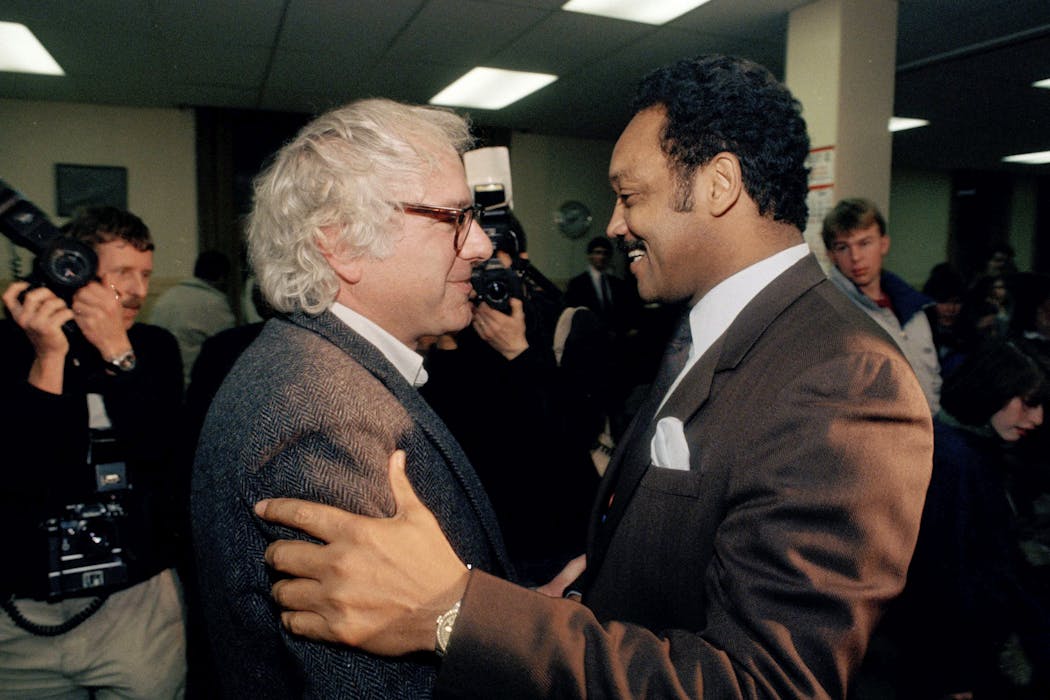
Bernie Sanders, then the mayor of Burlington, greets Jesse Jackson backstage at a 1988 Vermont rally where he endorsed Jackson’s presidential bid. AP Photo/Toby Talbot

Jesse Jackson’s two campaigns for president, in 1984 and 1988, were unsuccessful but historic. The civil rights activist and organizer, who died on Feb. 17, 2026, helped pave the way for Barack Obama’s election a generation later as the nation’s first – and so far only – African American president.

Jackson’s campaigns energized a multiracial coalition that not only provided support for other late-20th-century Democratic politicians, including President Bill Clinton, but helped create an organizing template – a so-called Rainbow Coalition combining Black, Latino, working-class white and young voters – that continues to resonate in progressive politics today.

Vermont, where I teach political science, did not look like fertile ground for Jackson when he first ran for president. Then, as now, Vermont was one of the most homogeneous, predominantly white states in the country. But if Jackson seemed like an awkward fit for a mostly rural, lily-white state, he nonetheless saw possibilities there.

He campaigned in Vermont twice in 1984, buoyantly declaring in Montpelier, the state capital, “If I win Vermont, the nation will never be the same again.”

He did not win Vermont, taking just 8% of the Democratic primary vote in 1984 but tripling his share to 26% in 1988. Appealing to voters in small, rural New England precincts was a remarkable achievement for a candidate identified with Chicago and civil rights campaigns in the South.

Jackson’s presidential ambitions coincided with a pivotal moment in Vermont politics: The state’s voting patterns were shifting left, with new residents arriving and changing the state’s culture and economy. In 1970, nearly 70% of Vermonters had been born there. By 1990, that figure had dropped by 10 percentage points.

The Vermont Rainbow Coalition, which was formed to support Jackson’s first campaign, organized a crucial constituency in a fluid time, establishing patterns that would persist for decades.

Setting the standard in Vermont

Jackson created a “People’s Platform” that would sound familiar to today’s progressives, calling for higher taxes on businesses, higher minimum wages and single-payer, universal health care.

In light of Jackson’s efforts, Vermont activists saw the potential for a durable statewide organization. Rather than disband the Vermont Rainbow Coalition after the 1984 primary, they kept the group going, endorsing candidates in campaigns for the legislature and statewide office in each of the next three election cycles. The coalition also endorsed Bernie Sanders’ failed bid for Congress in 1988.

Sanders served eight years as mayor of Burlington as an “independent socialist,” cultivating a core collection of local allies known as the Progressive Coalition who sought to wrest power away from establishment members of the city’s Board of Aldermen.

In 1992, the Vermont Rainbow Coalition merged with Burlington’s Progressive Coalition to form the statewide Progressive Coalition.

The Jackson-Sanders lineage

Sanders eventually went on to win election to the House as an independent in 1990, serving in the chamber until winning his Senate seat, also as an independent, in 2006. His presidential runs in 2016 and 2020 made him a prominent national figure and a leader among progressives.

Alexandria Ocasio-Cortez, who unseated a member of the House Democratic leadership in a stunning 2018 primary upset in New York, had been a Sanders campaign organizer and remains his close ally. On Jan. 1, 2026, Sanders swore in Zohran Mamdani – like Ocasio-Cortez, a Democratic socialist – as mayor of New York City.

Sanders had endorsed Jackson for president in 1988. Years later, Jackson returned the favor.

Sanders paid tribute to Jackson at the 2024 Democratic National Convention. “Jesse Jackson is one of the very most significant political leaders in this country in the last 100 years,” Sanders said. “Jesse’s contribution to modern history is not just bringing us together – it is bringing us together around a progressive agenda.”

Not just Vermont

In Vermont, Jackson performed surprisingly well in unlikely places – taking nearly 20% of the 1984 primary vote in working-class Bakersfield and Belvidere, for example.

Today’s Vermont Progressive Party, which emerged out of the old Vermont Progressive Coalition, is one of the most successful third parties in the nation, winning official “major party” status in the state shortly after its official founding in 2000. The party has elected candidates to the state legislature, city councils and even a few statewide offices, including that of lieutenant governor.

Congresswoman Alexandria Ocasio-Cortez stands at a lectern and appears to shout to a campaign rally crowd.
New York Democratic Rep. Alexandria Ocasio-Cortez exhorts the crowd at a 2019 Bernie Sanders presidential campaign rally in Long Island City, N.Y.
Invision/Greg Allen via AP

Vermont was not alone in experiencing the catalyzing effect of Jackson’s presidential runs. Jackson had a significant mobilizing impact on Black voters nationwide. In Washington state, the Washington Rainbow Coalition started in Seattle and spread across the state between 1984 and 1996. New Jersey and Pennsylvania had their own successful and independent Rainbow Coalitions. In 2003, the Rainbow Coalition Party of Massachusetts joined the Green Party to become the Green Rainbow Party.

In my own research, I’ve investigated the durability of the “Jackson effect” in Vermont. There is no better test of what differentiates the Vermont Progressive Party from the state’s Democratic Party than the 2016 Democratic primary race for lieutenant governor, which pitted progressive David Zuckerman against two prominent, mainstream Democrats.

Zuckerman beat the Democrats most handily in towns that had voted the most heavily for Jesse Jackson in 1984, an effect that persisted even when controlling for population, partisanship and liberalism.

Many people would point to Sanders as the catalyst for Vermont’s continuing progressive movement. But Sanders and the progressives owe much to Jackson.

The Conversation

Bert Johnson does not work for, consult, own shares in or receive funding from any company or organization that would benefit from this article, and has disclosed no relevant affiliations beyond their academic appointment.

ref. How Jesse Jackson set the stage for Bernie Sanders and today’s progressives – https://theconversation.com/how-jesse-jackson-set-the-stage-for-bernie-sanders-and-todays-progressives-276249

How sports betting is changing the way people watch sports

Source: The Conversation – Canada – By Liam Cole Young, Associate Professor of Communication and Media Studies and Co-Director of the School of Journalism and Communication, Carleton University

The Seattle Seahawks may have easily dispatched the New England Patriots on Super Bowl Sunday, but a more consequential battle unfolded off the field.

Sports betting companies vied with each other for fan attention, engagement and market share by flooding the broadcast with ads and promotions.

These will continue to crowd our social feeds and commercial breaks throughout the Winter Olympics. Want to wager on a curling match between Italy and Switzerland? Think someone will score in the first 10 minutes of a hockey game? In most parts of Canada, you can tap a wager into your phone from your couch in seconds.

Gamblers have already set their sights on the Olympics, but for many fans, the sudden proliferation of betting has felt disorienting. How did something once considered taboo become commonplace so quickly?

As a researcher working on a long-term project on sports gambling, I see these shifts as part of a broader transformation. Much like the forces shaping professional sport franchise sales and ownership battles, the proliferation of sports betting reflects deeper changes in the business, culture and technology of contemporary sport.

Fanatics Sportsbook’s 2026 Super Bowl ad.

Sports betting in Canada

The sports betting floodgates opened in Canada with Parliament’s passing of Bill C-218 in 2021. This legislation allowed provinces to introduce wagering on single events, including in-game live bets. Previously, only multi-game wagers, tightly controlled by public gaming and lottery corporations through Sports Select, were legal.

Parliament was reacting to pressure from industry and consumers that had ratcheted up after the United States Supreme Court struck down the Professional and Amateur Sports Protection Act in 2018, which opened the door to legalized gambling outside of Nevada.

Today, the landscape varies across Canada. Ontario has a regulated iGaming market that allows private operators like FanDuel and DraftKings. Alberta is set to adopt a similar approach in 2026.

Other provinces maintain tighter controls, offering online gambling through provincially run platforms such as PlayNow in British Columbia, Manitoba and Saskatchewan. Québec operates its own platform through Loto-Québec’s EspaceJeux.

The COVID-19 moment

The timing of legalization also coincided with another seismic disruption: the COVID-19 pandemic. In 2020, COVID-19 shut down stadiums and arenas.

Professional sports leagues suddenly found themselves without ticket revenue, concessions or live event income. Games played in empty arenas upended our assumptions about the resilience of professional sport business models. As financial losses mounted, leagues and teams needed cash.

Sports betting companies, buoyed by private investment, were waiting with open arms and open wallets. Companies like FanDuel and DraftKings were eager to push further into mainstream sports markets and willing to spend heavily to do it.

Partnerships were signed in rapid succession that once would have been ethically unthinkable due to potential conflicts of interest. Leagues aligned themselves with betting platforms, franchises inked sponsorship deals and star athletes fronted ad campaigns.

This reflected a longer economic trajectory. Franchise valuations have soared over the last 25 years. The US$10 billion sale of the Los Angeles Lakers in fall 2025 is the latest signal that global finance, private equity and non-traditional ownership groups have transformed sports into highly financialized assets.

The new stakeholders expect steady and substantial returns. With broadcast landscapes and consumer media habits changing, owners are increasingly hedging their bets. Partnerships with gambling companies are central to that diversification strategy.

Changing fandom, changing technology

Technology has fundamentally transformed how we observe, measure, track and analyze sport. Much has been written on the analytics revolution in sports management, sometimes called the “Moneyball” effect, which has seen teams increasingly apply quantitative methods borrowed from finance in their approach to franchise operations and roster construction.

Fantasy sports and video game “franchise mode” — gameplay formats that allow users to manage teams over multiple seasons — invite people to think in terms of analytics, probability and predictive modelling.

These platforms train users to break traditional “units” such as games and teams into ever smaller, quantifiable components that can be studied, compared and reconfigured. In fantasy sports, for instance, the performance of an individual athlete may matter more than the outcome of a game.

These behaviours align neatly with sports betting, and gambling apps are designed to capture and monetize them. They transform matches into a series of discrete events and outcomes that can be wagered upon, mirroring the logic of “derivatives” in the financial sector. Users are prompted to interact, analyze, predict and react to events in real time.

As TV increasingly becomes a “second screen,” betting apps keep people tethered to broadcasts through their phones, benefiting leagues, broadcasters and gambling companies alike.

Promises and perils of datafication

Modern sports generate enormous volumes of data. Tracking technologies measure ball trajectories, player movement, speed, force and spatial positioning with extraordinary granularity. Originally developed for performance analysis and officiating, this data now fuels an ever-expanding menu of betting options.

Betting platforms analyze data provided to them through league partnerships or via third-party data brokers in real time. These data operations are proprietary and not accessible to bettors.

Fans can now wager on everything from the outcome of the next pitch to the number of yards gained on a single drive or even the length of a national anthem. This real-time micro-wagering keeps fans engaged, but it also heightens the ethical stakes. As data flows expand, so do opportunities for misuse.

In recent years, several athletes and coaches have been disciplined for violating gambling rules — betting on games, sharing inside information or associating with third-party bettors.

These cases highlight larger systemic issues: that the rules governing these partnerships were assembled reactively, often hastily, and without a clear sense of how such relationships would affect competitive integrity.

The landscape is defined by uncertainty: unclear rules, inconsistent enforcement and ongoing debates about whether all of this is healthy — not just for the culture of sport, but society as a whole.

What kind of sports culture lies ahead?

The proliferation of sports betting ads signals a deeper realignment in how sports are financed, experienced and governed.

The forces driving this shift — changes in policy, economics and fan practices; technological innovation; data and financialization; emerging ethical considerations — are the same forces reshaping professional sport more broadly.

Leagues and teams are now more directly tied to gambling revenues than ever before, raising questions about their responsibility to protect players, preserve competitive integrity and support fans vulnerable to harm.

Governments and regulators, meanwhile, face mounting pressure to balance economic opportunity with meaningful consumer protections, including limits on advertising and stronger responsible gambling frameworks.

Sports betting isn’t going anywhere anytime soon. Understanding how we got here, who the players are and what’s at stake are necessary steps toward ensuring a future of sport that’s about more than the next wager.

The Conversation

Liam Cole Young does not work for, consult, own shares in or receive funding from any company or organisation that would benefit from this article, and has disclosed no relevant affiliations beyond their academic appointment.

ref. How sports betting is changing the way people watch sports – https://theconversation.com/how-sports-betting-is-changing-the-way-people-watch-sports-275303