How artists are tracking environmental change through poetry, film and sound

Source: The Conversation – UK – By Fiona Brehony, PhD Candidate, Department of Geography and Environmental Studies, The Open University

The Victoria North urban regeneration sits alongside newly flattened land in Manchester, UK. Fiona and Leon Brehony, CC BY-NC-ND

As Elaine, an artist in her 80s, stood at her window in north Manchester, she noticed new apartment blocks dominating the nighttime skyline: “The moon is no longer in view; I have to crane my neck out of the window in order to see it. Or to see the reflection of the moon.”

I have been meeting with the Many Hands Craft Collective – a group of older artists, knitters and poets – most Tuesdays for almost a year. The group has been gathering at the community room in Victoria Square, Manchester, for over a decade.

They have been reflecting on Manchester’s massive building boom as Victoria North – Britain’s largest regeneration project – transforms their neighbourhood with 15,000 new homes. City centre construction is also reshaping skylines they’ve known for decades.

Together, we have created a film tracking how urban regeneration transforms their world. The film explores their relationship with the elements through shifting light, redirected wind and changing rain.

People who have lived here for decades – reading wind patterns, tracking seasonal light, noticing atmospheric shifts – hold memories that city planners cannot see. Residents’ observations also reveal how wildlife experience urban change – birds, insects and nocturnal animals are all affected by altered light and wind.

Construction alters wind, blocks views of the moon and stars, and changes the subtle conditions residents have learned to read over lifetimes. Observations from these artists show that heritage is not just about preserved buildings or recorded rivers, but about the knowledge people carry.

As a film-maker and sound artist, I study the connections between people and the natural world. In 2008, when Manchester City Council rehoused my 82-year-old grandmother after she had lived in the same house for 60 years, she wrote poetry to process her loss.

“Bodies, not walls, carry memories,” she wrote. Her words inspired The Flowering (2020), my first poetic documentary exploring urban regeneration through the memories the body holds. This influenced my research into how cities transform.

In Manchester, the River Irk flows through Victoria North. New riverside properties rise while the river itself needs care. For two centuries it powered mills, was contaminated by dye works, then was eventually culverted (channelled into underground pipes, hidden from view). Yet the river flows on, and so does the memory it carries.

The artists at Many Hands carry intergenerational knowledge about how this urban environment has changed. Our conversations about riverside properties blocking sunlight led the group to reflect on how construction changes light in their own streets. Views of the moon disappeared, high-rise buildings shifted wind and rain, and the sound of water tapping against windows stopped.

My PhD project analysed atmospheric transformations alongside the river itself: how these numerous new buildings and developments change homes as well as waterways.

As climate change forces cities to adapt, observations accumulated over decades – how rain moves through streets, how wind patterns shift, how rivers sound differently with the seasons – could inform climate-responsive urban design. Yet regeneration often displaces the very people who carry this knowledge before it is even recognised.

Materials and memory

To retrace the Irk’s history, we worked with clay and natural materials from the river – silt, stones, industrial brick fragments. An artist called Dot recalled seeing blue pigeons from old dye works, with feathers stained from chemical colours.

As the clay stiffened as it dried, conversations turned to how cities are built. Victorian brick from the 1890s still stands solid, while new apartment exteriors are designed for 20-year lifespans.

Poetry emerged from the conversations: “Sand, soil, silt, leaves, clay, decaying plants, coal and dust, ash chemical waste” and “human hearts holding on to heritage, ours. Made of natural materials, hands, rain, wind, sunlight”. Different perspectives recognise people and rivers as bodies carrying memory through change.

Sound and poetry

As a group, we reconstructed waterwheels to explore how the Irk powered mills. One artist, Jean, suggested recording with hydrophones (special microphones that work underwater) in kitchen sinks. Water through household pipes connected us directly to the river, flowing through our fingertips. Playing hydrophone recordings for the first time, Jean said it sounded like being deaf – without her hearing aids, it was like being underwater.

This revealed a crucial insight: listening is shaped by our bodies. Jean’s deafness meant she heard the river differently, noticing frequencies and vibrations others might miss. Kitchen sink hydrophones create access where it did not exist, bringing culverted, fenced or distant rivers into homes through soundwaves in domestic pipes.

These conversations evolved into Two Worlds, a sound installation created with composer and sound artist Simon Knighton. This piece of sound design informs the film score and explores how people coexist with the environment. The Irk pulsates different rhythms depending on where you listen. Harsh urban concrete or gentler upstream flows are heard differently by each set of ears.

As we wrote poetry together after discussing how some long-forgotten waterways have been buried beneath streets, Rose asked: “What happens to a river when it becomes a road?”

woman holds white fabric with printed words, people sit on chairs in background
Editing poetry and screen-printing words on fabric was part of the collaborative process.
Fiona Brehony, CC BY-NC-ND

Rose’s question lies at the heart of my research: when cities develop, what environmental knowledge disappears?

Manchester has lost multiple rivers to culverting, development and roads. Older residents carry knowledge younger generations never knew existed. As climate change requires us to expose or “daylight” culverted rivers for flood management, these memories could guide restoration.

Many Hands’ Material River, a collection of films and poetry printed onto fabric, is on display within the River Stories exhibition until March 23 2026 in Manchester Histories Hub at Manchester Central Library.


Don’t have time to read about climate change as much as you’d like?

Get a weekly roundup in your inbox instead. Every Wednesday, The Conversation’s environment editor writes Imagine, a short email that goes a little deeper into just one climate issue. Join the 47,000+ readers who’ve subscribed so far.


The Conversation

Fiona Brehony receives funding from Arts and Humanities Research Council (AHRC).

ref. How artists are tracking environmental change through poetry, film and sound – https://theconversation.com/how-artists-are-tracking-environmental-change-through-poetry-film-and-sound-258838

Liverpool’s ‘blue people’: the older adults redefining what ageing looks like

Source: The Conversation – UK – By Krisztina Rudolf, PhD candidate , Liverpool John Moores University

Lucigerma/Shutterstock

Liverpool is not one of the “blue zones” – a term used for regions of the world where people tend to live unusually long lives, such as parts of Sardinia, Okinawa and Ikaria.

Healthy life expectancy in Liverpool is only about 56 years. However, overall life expectancy is much higher there, with many people living into their late 70s and beyond. This means many residents spend their final working years and a large part of retirement managing chronic illness or disability.

Ageing is inevitable but losing independence is not. As a PhD researcher studying muscle ageing, I work with adults in their 70s whose strength, mobility and resilience challenge common assumptions about later life – despite many of them living with long-term health conditions.

Jackie has three prolapsed discs in her spine and osteopenia, a condition where bone density is lower than normal and fracture risk is higher. Norma lives with a stoma following bowel cancer surgery. Mike jokes that his medical notes make him sound like “a wreck”.

But then you see the three of them train together five times a week.

During lockdown, when gyms closed and isolation threatened their health, they converted Mike’s garage into a makeshift training space so they could keep moving and stay independent. “We thought, we’ve got to do something,” Mike told me.

They embrace effort. They run parkrun, climb stairs deliberately, and value the feeling of being challenged – slightly breathless but capable. I think of them as Liverpool’s “blue people”. Their experience suggests that ageing well depends less on where you live, and more on how you live.


Read more:
Small improvements in sleep, physical activity and diet are linked with a longer life


I met them through Research Roasters, a science cafe connecting scientists and the public around health and ageing. They volunteered for studies on muscle health and physical function in later life, and helped shape how they were designed and delivered. They helped refine participant information and consent materials, introduced me to community groups and offered feedback on study design.

Their experiences reflect a core biological reality. Skeletal muscle is not just what helps us move. It is the body’s largest metabolic organ, essential for regulating blood sugar, maintaining body temperature and preserving independence.

Muscle maintenance

Muscle ageing starts earlier than many people realise. From our 30s, strength begins to decline – often faster than muscle size. People can look healthy while their muscle function is deteriorating.

One simple way to glimpse this is through movement. Try standing up from a chair and sitting back down five times as quickly as possible without using your hands. If it feels slow, difficult or unstable, it may signal reduced muscle quality.


Read more:
How low can you go (and still build muscle)? Why strength training matters at any age


This matters because muscle function predicts future health. Poor muscle quality increases fall risk, slows recovery and raises the likelihood of conditions such as type 2 diabetes.

At the microscopic level, muscle quality is shaped by proteins. These generate force, produce energy and repair damage. Unlike genes which remain relatively stable, proteins are constantly renewed. During physical activity, muscles rebuild and reorganise their protein machinery to meet demand. When muscles are not challenged, this renewal slows. The system becomes less responsive and function declines.

In my research, we use “dynamic proteome profiling” to track how thousands of muscle proteins are produced and renewed in older adults. This approach measures how quickly proteins are built, repaired and replaced inside muscle tissue.

Participants complete strength and mobility tests, wear activity monitors and provide small muscle samples, supported by a multidisciplinary team of researchers and clinicians. We analysed thousands of proteins and also grew their muscle stem cells in the lab, to understand how muscle adapts to activity.

The results do not show simple deterioration. Older muscle is different, but remains adaptable. Protein turnover may be slower and some repair processes less efficient, but muscles still respond to activity by building the proteins needed for strength, energy production and resilience.

Even later in life, muscles can adapt when they are used. This helps explain why our participants became stronger and more capable despite existing health conditions. Their experience highlights a crucial point. Ageing is strongly influenced by how muscles are used across the lifespan.

Blue people

Ray’s gym is a community fitness space in Liverpool where many of our participants train regularly. Not a formal research site, it is where the group work out, supporting each other and maintaining the strength and mobility that underpin their independence. The environment encourages effort, personal progress and accountability.

Members are not defined by their age. They are people working towards goals that matter to them – often, simply staying independent and in control of their lives.

This challenges common narratives about blue zones, which emphasise location, diet or lifestyle traditions as the main drivers of longevity. Those factors matter, but they can create the impression that healthy ageing is largely determined by where you live, rather than what you do. Liverpool’s “blue people” suggest something different.


Read more:
People in the world’s ‘blue zones’ live longer – their diet could hold the key to why


Their strength comes not from perfect health but ongoing adaptation. They challenge their muscles and stay engaged with their bodies. Muscle quality is not fixed – it reflects the demands placed on it.

The implications are significant. Healthy ageing does not require relocation to longevity hotspots or adherence to exotic diets. It begins with recognising muscle as the organ that underpins independence, and maintaining it through regular activity.

Research is helping us understand the biology behind this process. New studies and recruitment cycles reflect growing efforts to understand how muscle health can shape independence across the lifespan.

The people taking part are already showing what this looks like in practice. They are not reversing ageing, but they are maintaining capability. In doing so, they offer a realistic and accessible vision of growing older well.

Most of us can become a “blue person” by investing in the organ that most strongly shapes whether we age with independence as well as longevity: muscle.

The Conversation

Krisztina Rudolf does not work for, consult, own shares in or receive funding from any company or organisation that would benefit from this article, and has disclosed no relevant affiliations beyond their academic appointment.

ref. Liverpool’s ‘blue people’: the older adults redefining what ageing looks like – https://theconversation.com/liverpools-blue-people-the-older-adults-redefining-what-ageing-looks-like-276023

If I Had Legs I’d Kick You: Rose Byrne is raw, magnetic and unfiltered as a woman in crisis

Source: The Conversation – UK – By Laura O’Flanagan, PhD Candidate, School of English, Dublin City University

Director Mary Bronstein’s discomfiting new film, If I Had Legs I’d Kick You, is a compelling watch. Centred by a career-defining performance from Rose Byrne that has gained her an Oscar nomination, the film is a dark treatise on motherhood, swirling in blame, shame and an increasing sense of dread.

Byrne’s Linda is an exhausted and perpetually worried mother, wife and therapist harbouring both guilt and resentment. She is looking after her seriously sick child, who is almost never shown on screen. Linda is not a woman unravelling, she is unravelled – the remnant pieces disintegrating in front of our eyes through a series of escalating awful events.

Her life is literally falling apart: her daughter’s health is not improving, her work as a therapist is difficult and unfulfilling, her husband (Christian Slater) is away for work and barely interested. Then the ceiling of her apartment falls in.

Byrne is magnetic, searingly raw and unfiltered as a woman pushed to the edge. She is ferociously committed to her performance and has never been better onscreen. She moves with emotional precision, careful and considered, never slipping into cliched melodrama or histrionics.

Throughout the film, Byrne is shown in close-up – in all interactions, the camera is focused on her. In this way, the director brings the audience fully into Linda’s mind and point of view. Every unsympathetic dismissal (even from her own therapist, a grim-faced Conan O’Brien), every moment of blame, is keenly felt and depicted without apology.

Linda’s daughter’s doctor (played by Bronstein) has an impatient callousness which compounds the anxiety. Linda’s daughter is around ten years of age, and portrayed primarily through sound off-screen: grating, insistent and impossible to ignore. Her cries, her arguing, her screams and the beeping of her medical equipment create an uncomfortable and urgent soundtrack, which draws viewers even further into Linda’s intense and stressful reality.

Even welcome moments of levity are tinged with a darkness which restricts their impact. Linda’s therapy clients provide some light relief, but a pervading heaviness hangs in the air, particularly in disturbing scenes with Caroline (an excellent Danielle Macdonald). An anxious, needy and demanding patient, Caroline is also a struggling mother, like Linda.

An unfortunate incident with a hamster builds in dark hilarity, only for the laughter to curdle. Linda becomes locked in a battle of wills with a motel receptionist (Ivy Wolk), whose jobsworth insistence around the sale of wine is exaggeratedly maddening – and leads to Linda’s unlikely connection with a charming motel employee, James (A$AP Rocky in fine form).

This is an urgent, important and admirable cinematic portrayal of motherhood, but I can’t say I enjoyed watching it. Its treatment of maternal anger and ambivalence without softening the edges is confronting and somewhat triggering. But this may have been Bronstein’s directorial intention.

Modern cinema has become less interested in saccharine, idealised depictions of mothers and more concerned with their inner lives, however messy. Recent films such as Nightbitch and Die My Love forego maternal sentimentality and tidy redemption, instead showing mothers as complex and imperfect human characters raising children.

Based on some of Bronstein’s real-life experiences of caring for a sick child, If I Had Legs I’d Kick you shines a glaring and uncomfortable light on aspects of motherhood which are usually kept in the shadows: the thankless drudgery, the loss of selfhood, and all the resentment and resultant guilt these carry with them.

Linda is drowning in despair and shame, unable to find help, empathy or even a break. Her experience of motherhood is harrowing and messy, and the film dares its audience to confront the strain both of looking after a sick child and of fierce maternal attachment.

Like its depiction of Linda’s life, If I Had Legs I’d Kick You is imperfect and at times overwhelmingly chaotic. At its core, this is a dark and unsettling film which will start conversations about the complexities of motherhood. Byrne’s unrelenting and towering central performance makes it a compelling and unforgettable watch, albeit a challenging one.


Looking for something good? Cut through the noise with a carefully curated selection of the latest releases, live events and exhibitions, straight to your inbox every fortnight, on Fridays. Sign up here.


The Conversation

Laura O’Flanagan does not work for, consult, own shares in or receive funding from any company or organisation that would benefit from this article, and has disclosed no relevant affiliations beyond their academic appointment.

ref. If I Had Legs I’d Kick You: Rose Byrne is raw, magnetic and unfiltered as a woman in crisis – https://theconversation.com/if-i-had-legs-id-kick-you-rose-byrne-is-raw-magnetic-and-unfiltered-as-a-woman-in-crisis-275990

Bones of St Francis of Assisi go on display for the first time – here’s why it took 800 years

Source: The Conversation – UK – By William Crozier, Duns Scotus Assistant Professor of Franciscan Studies, Durham University

St Francis of Assisi, who founded the Franciscan order, is one of Catholicism’s most revered saints. After Christ and the Virgin Mary, he is the most depicted figure within Catholic art, literature and film.

The patron saint of the environment, St Francis is best known for his love of animals and the natural world. Famously, he preached to the birds and referred to all creatures – including the stars and planets – as his beloved “brothers and sisters”.

When Francis died in 1226, fears that his body would be stolen meant that it was placed in an iron cage and buried so deep beneath the basilica in Assisi, Italy, that its whereabouts remained a mystery for 600 years. Aside from his fame for miracles and holiness, and subsequent canonisation in 1228, the reason Francis’s body was hidden was what it contained.

Two years before his death, it is said Francis experienced a vision of a crucified Seraphim (a six-winged angel) which marked his body with the stigmata – the wounds of the crucified Christ. The first recorded case of stigmata, medieval sources tell us that unlike later stigmatics, Francis did not just have holes in his hands and feet, but rather growths resembling nails.

St Francis’s earliest biographer Thomas of Celano wrote: “His hands and his feet seemed to be pierced by nails, the heads of the nails appearing on the insides of his hands and the upper side of his feet, and their points protruding on the other side … [His torso] was scarred as if it had been pierced by a spear, and it often seeped blood.”

Finding the the missing body

Numerous efforts to locate St Francis’s body over the centuries all failed. In 1818, though, excavations deep within the basilica’s foundations finally revealed the iron cage and the simple coffin containing the saint’s bones.

These were examined by ecclesial and scientific authorities which affirmed their authenticity. The last time the bones were examined was in 1978, when they were placed inside a nitrogen-filled perspex box to aid their preservation. An underground chapel was constructed to allow pilgrims to see St Francis’ tomb, though crucially not the bones themselves.

To commemorate the 800th anniversary of his death – known as the transitus – St Francis’s remains will go on extended display for the first time. From February 22 to March 22 2026, the perspex box containing his bones will rest at the foot of the main altar in the basilica in Assisi.

Hundreds of thousands of pilgrims are expected to come and see the bones, with their display opening a year-long series of events – both in Assisi and around the world – honouring the anniversary. The date itself falls on October 4 2026.

The 800th anniversary also marks a moment of national celebration for Italy. Giorgia Meloni welcomed the Vatican’s decision to allow the remains to go on display, noting that, “St Francis is one of the foundational figures of Italian identity”.

St Francis’s Canticle of the Creatures – a hymn which he composed as he lay dying – is one of the earliest works of Italian literature, with the oldest surviving copy being found in a 790-year-old manuscript housed in the Franciscan convent in Assisi.

The legacy of a much-loved saint

St Francis’s teachings have exerted a profound impact on modern Catholicism, particularly its teaching on the environment.

Pope Francis – who took the name in honour of the Italian saint – made the Canticle of the Creatures the cornerstone of his 2015 encyclical Laudato Si. The Catholic church’s first “green encyclical”, it praised the natural world as our “beautiful mother” and affirmed the church’s commitment to promoting environmental justice.

Likewise, a major joint document issued last July by the bishops of Asia, Africa and South America drew heavily on St Francis’s thinking, rejecting what it called the “false solutions” advanced by many western governments to address the climate crisis.

At the press conference marking the document’s publication, one of its authors, the Franciscan Cardinal Jaime Spengler, said: “From the heart of the Amazon, we hear a cry: how can we allow a market without ethical regulations decide the fate of the planet’s most vital ecosystems?”

When St Francis’ bones go on display, they will serve as a powerful reminder not only of his enduring relevance for Catholic spirituality, but also the vital role he has played in helping the contemporary Catholic church to become one of the leading advocates for meaningful climate reform.

The bones of St Francis will be on display at the Basilica of St Francis of Assisi, Umbria, Italy, from February 22 to March 22 2026


Looking for something good? Cut through the noise with a carefully curated selection of the latest releases, live events and exhibitions, straight to your inbox every fortnight, on Fridays. Sign up here.


The Conversation

William Crozier does not work for, consult, own shares in or receive funding from any company or organisation that would benefit from this article, and has disclosed no relevant affiliations beyond their academic appointment.

ref. Bones of St Francis of Assisi go on display for the first time – here’s why it took 800 years – https://theconversation.com/bones-of-st-francis-of-assisi-go-on-display-for-the-first-time-heres-why-it-took-800-years-273600

How the royal family brand can weather Andrew Mountbatten-Windsor’s arrest

Source: The Conversation – UK – By Pauline Maclaran, Professor of Marketing & Consumer Research, Royal Holloway, University of London

In today’s fast-moving media world, brands are frequently required to respond to scandals that may tarnish perceptions of their products or services. Quick responses to quieten rumours or accept responsibility for missteps are crucial.

This becomes challenging when people themselves are the brand. Their behaviour is much harder to control than a press release. They present feelings and emotions that may disrupt any strategic response to scandal.

Britain’s royal family is a case in point – and with the arrest of Andrew Mountbatten-Windsor, their brand is facing one of its biggest tests of the modern age.

Consumers are known to form deeper, more emotional bonds with human brands than nonhuman ones – such as the passionate fans of Taylor Swift, who identify with her on a personal level. The flipside is that any perceived lapses or failures in judgment may also generate stronger emotions, reflecting more negatively on perceptions of that brand.

For years, the royal family has had to navigate publicity around the former Duke of York. Much of this is related to his long-term relationship with the late financier and convicted child sex offender, Jeffrey Epstein. Mountbatten-Windsor’s arrest under suspicion of misconduct in public office places the rest of the family in a position of protecting the brand from damage by distancing themselves from him.

The arrest follows the US government publication of documents that appear to show Mountbatten-Windsor sharing official information with Epstein during his time as a trade envoy. That period, from 2001-11, was not without scrutiny for the then-prince. But the palace generally kept a low profile in response – following the mantra “never complain, never explain” that was often attributed to the late Queen Elizabeth.

Mountbatten-Windsor stepped down from the trade envoy role in 2011, with the palace issuing a simple statement that, in future, he would “undertake trade engagements if requested”.

In the following years, public pressure mounted on the royal family to be more transparent in many respects, especially concerning Mountbatten-Windsor’s embroilment with Epstein.

The turning point from a low-profile brand management strategy to more overt actions appears to have been Mountbatten-Windsor’s Newsnight interview in November 2019, in which he claimed to have broken off his friendship with Epstein in 2010. He also denied allegations of sexual abuse that had been brought by Epstein victim Virginia Giuffre.

This moment provided a focal point that attracted public outrage. In response, the royal family began to take more decisive action to avoid the brand being contaminated or “infected” by the negativity surrounding the former prince.

Social contagion

The concept of social contagion helps us understand how this works.

According to social contagion theory, people are influenced by those around them. This helps explain how behaviour, attitudes or emotions can spread through a group or society, much like a virus. What you may call “cancel culture” occurs when disapproval and moral condemnation of an individual or group snowballs across social media as people feel compelled to join in.

The reaction to the Newsnight interview – memes, mocking headlines and charities and sponsors distancing themselves from Mountbatten-Windsor – would have made clear to the royal family that their brand was at risk from this social contagion.

Despite the late queen’s reported support for her son, the monarchy began taking formal measures to protect the institution. In November 2019, Mountbatten-Windsor stepped back from public duties “for the foreseeable future”. In January 2022, he was stripped of royal patronages and military titles, as well as the right to use His Royal Highness in any official capacity.

The following month, Mountbatten-Windsor settled out of court with Giuffre for a reported £12 million, with no admission of wrongdoing.


Read more:
Spare: how the soap opera around Prince Harry’s memoir will affect the royal brand


In May 2023, although he attended King Charles III’s coronation, he played no official role and was not included in the procession or royal balcony appearance. Since that time, King Charles and Prince William have made it known they do not want him back in public life.

The full removal of Mountbatten-Windsor’s title of prince in October 2025, following the publication of more Epstein-related documents, solidified his permanent exclusion from public life. Most recently, he has been forced to leave his royal residence and move to a more isolated home on the Sandringham Estate in Norfolk.

Both the king and William issued written statements to distance themselves in light of the newest Epstein files, expressing their “deep concern” for Epstein’s victims. The formality of making written statements signalled the seriousness with which they viewed the events, and also acted as a public record of their distancing from Mountbatten-Windsor. In showing their sympathy for the victims, they were aligning morally with them rather than defending him.

Once a brand is accused of criminal wrongdoing, this potentially escalates a crisis from a minor reputational issue into one that risks a complete breakdown of trust in the brand.

In a statement, the king said “let me state clearly: the law must take its course” and “my family and I will continue in our duty and service to you all”. His reference to “Andrew Mountbatten-Windsor”, as opposed to acknowledging him as his brother, makes clear Mountbatten-Windsor’s ostracisation from the rest of the family.

The royal family appear to have navigated their responses to the potential tarnishing of the monarchy in both official and unofficial ways. They have stripped Mountbatten-Windsor of all official roles and titles, excluded him from public royal events, shown public support for Epstein’s victims, and employed a media management strategy that shifts the focus to other royals.

But polling conducted before the arrest suggests the royal brand is still at risk.

Brands can weather scandals by making fast responses and accepting responsibility. But they may also need to build trust again by proving in the longer term that they have changed. Perhaps the royal family is due for a rebrand.

The Conversation

Pauline Maclaran does not work for, consult, own shares in or receive funding from any company or organisation that would benefit from this article, and has disclosed no relevant affiliations beyond their academic appointment.

ref. How the royal family brand can weather Andrew Mountbatten-Windsor’s arrest – https://theconversation.com/how-the-royal-family-brand-can-weather-andrew-mountbatten-windsors-arrest-276431

Trump has given Iran a ten-day ultimatum – but chances of an agreement look slim

Source: The Conversation – UK – By Sanam Mahoozi, Research Associate, City St George’s, University of London

Donald Trump delivered an ultimatum to Iran at the first board of peace meeting in Washington on February 19. He told Tehran to reach a “meaningful” deal with the US within ten to 15 days or “really bad things” will happen. White House press secretary Karoline Leavitt had earlier said there are many arguments for taking military action in Iran.

These comments came as reports indicated that the latest round of indirect talks between the two countries in Switzerland on February 17 had made at least some headway. Iran’s foreign minister, Abbas Araghchi, emerged from the negotiations hailing what he saw as “good progress”. He added that the US and Iran had reached an understanding on “guiding principles”.

The assessment of US representatives was less positive. Despite acknowledging that “in some ways” the talks went well, US vice-president J.D. Vance said Iran was refusing to acknowledge core US demands. The US wants Iran to dismantle its nuclear programme completely, reduce the number and range of its ballistic missiles and end its support for regional proxy groups.

Following the talks, the US has continued to reinforce its military presence in the Middle East. Cargo planes, fighter jets, refuelling tankers and an aircraft carrier have been moved to the region, with a second aircraft carrier expected to arrive soon. According to the New York Times, the buildup of US forces in the Middle East is now sufficient for Trump to order military action at any moment.

Iran appears to be gearing up for a confrontation. Its military held joint drills with Russia on February 19, days after the Strait of Hormuz was closed temporarily as Iran carried out live-fire exercises. And while emphasising that it “neither seeks tension nor war”, Iran has told the UN that if it were attacked it would consider “all bases, facilities and assets of the hostile force” in the region as “legitimate targets”.

These developments come less than a week after hundreds of thousands of people, largely from the Iranian diaspora, demonstrated in cities worldwide. They did so in solidarity with protesters who took to the streets of Iran in January to demand regime change.

In late December, protests that began over worsening economic conditions quickly spread nationwide in one of the most serious threats to Iran’s political establishment since the Woman, Life, Freedom protest movement of 2022. That protest wave began after the death of a 22-year-old women called Mahsa Amini in police custody.

This time round, the Iranian authorities imposed a near-total internet shutdown, creating a nationwide communications blackout in an effort to suppress the unrest. Human rights groups say thousands of people were killed, while many more were injured, detained or remain missing, in what was one of the most severe crackdowns in Iran’s modern history.

According to local police, around 250,000 people rallied on February 14 in the German city of Munich alone, where world leaders had gathered for Europe’s biggest security conference. Many of those in attendance waved flags bearing the lion and sun emblem of Iran that was used before the Islamic revolution in 1979 ended the Pahlavi dynasty.

Israeli and American flags were also visible at many of the rallies. This has widely been seen as a call for foreign intervention against Iran’s clerical leadership. Trump had raised the prospect of US military action during the unrest, urging the Iranian people to continue protesting and telling them that help was “on its way”. Such action now appears likely.

Brink of war

Iran’s fate is hanging in the balance. The deployment of US military assets to the Middle East suggests Trump may be preparing for imminent military action. However, despite making no secret of his desire to topple the Iranian regime, there is still a chance that Trump settles for a diplomatic agreement with the country’s leadership.

Iranian opposition voices, including exiled crown prince Reza Pahlavi, say such a deal would only prolong the survival of the Islamic Republic rather than address the demands of people in Iran for regime change. In an interview with American political commentator Glenn Beck on February 11, Pahlavi called the negotiations between the US and Iran “another slap in the face of the Iranian people”.

But the prospects that any deal will be reached look slim. The US and Iran remain in fundamental disagreement over Tehran’s nuclear programme and have been unable to reach a deal since the Trump administration withdrew the US from a previous agreement in 2018 that had been negotiated by the Obama administration.

Many people, including the US vice-president, are also sceptical that Iran’s authorities will budge on additional US demands around ballistic missiles and proxy groups like Hamas and Hezbollah – whether or not they are threatened with military action.

Iran’s future is murky. But one thing is for certain: with war or without war, the Iranian people have started a revolution that has extended beyond their country’s borders.

The Conversation

Sanam Mahoozi does not work for, consult, own shares in or receive funding from any company or organisation that would benefit from this article, and has disclosed no relevant affiliations beyond their academic appointment.

ref. Trump has given Iran a ten-day ultimatum – but chances of an agreement look slim – https://theconversation.com/trump-has-given-iran-a-ten-day-ultimatum-but-chances-of-an-agreement-look-slim-276125

Ethiopia and Eritrea are on edge again: what’s behind the growing risk of war

Source: The Conversation – Africa (2) – By Yohannes Gedamu, Senior Lecturer of Political Science, Georgia Gwinnett College

The histories of Eritrea and Ethiopia have long been closely intertwined. Once part of Ethiopia, Eritrea launched an armed struggle for independence in 1961 that resulted in its secession in 1993 following a referendum. But since Eritrea’s independence, relations between the two countries have evolved through many ups and downs, which include a devastating war from 1998 to 2000, followed by two decades of mutual isolationism.

The two countries appeared to have healed their broken relations when Eritrea’s Isaias Afwerki accepted the newly appointed Ethiopian prime minister Abiy Ahmed’s overtures for peace in 2018. Unfortunately, by early 2026, that started to feel like a distant memory with the re-emergence of the prospect of a return to war. Political science scholar Yohannes Gedamu explains the context and potential consequences.

What’s the history of conflict between the two countries?

A border dispute in 1998 ignited a deadly war between Ethiopia and Eritrea, which share a border of over 1,000km. The war started when Eritrean troops invaded Badme, a contested town in Tigray, the northernmost region of Ethiopia. It became one of the deadliest conflicts of contemporary Africa as tens of thousands lost their lives.

The war ended in June 2000 with the Algiers Agreement. It established a ceasefire, mandated the deployment of UN peacekeepers, and created a boundary commission to legally demarcate the disputed border. However, the fact that borders are yet to be demarcated means tensions could persist.

At the time, Ethiopia was ruled under a four-party political coalition created and dominated by Tigray People’s Liberation Front. The coalition, known as Ethiopian People’s Revolutionary Democratic Front, ruled the country between 1991 and 2018.

Eritrea’s ruling party was historically an ally of the Tigray People’s Liberation Front. That changed because the ally was in charge of Ethiopia when it won the war.

The resentment has never gone away.

Tensions have flared from time to time. The border is heavily militarised, with a no man’s land between the two armies serving as a security corridor.

Abiy Ahmed’s peace overtures to Eritrea in 2018 and the resulting peace agreement were lauded by many in the global community and locally. Most recognise that the countries have more in common than what sets them apart.

But the agreement did not lead to increased political and economic cooperation. It created only a short-lived marriage of convenience. Here is why.

After Abiy came to power in April 2018, the Tigrayan grip on Ethiopia ended. In November 2020, the Tigray war started. Eritrea blamed the Tigray People’s Liberation Front for its own economic and political fragility and isolation, and supported Abiy against the Tigrayans.

The Tigray war became a devastating conflict with allegations of war crimes committed by all parties – but most were attributed to the Eritrean troops.

The prospect of a new war in the ever volatile Horn of Africa would threaten a region already ravaged by the ongoing conflict in Sudan.

What’s driving the present tensions?

Despite the peace agreement in 2018 between the countries, fault lines persist. The biggest is access to the sea.

Eritrea’s independence in 2000 gave it control of a long coastline across the Red Sea, but left populous Ethiopia a landlocked nation. Addis Ababa now depends on the goodwill of its neighbours like Djibouti for port access.

In recent years, especially since the Tigray war ended in 2022, Abiy has brought up the topic of access to the sea, naming Eritrea and Somaliland as potential avenues. He argues that Ethiopia has a historical claim to Eritrea’s port of Assab, which is a mere 60km from the Ethiopian border.

Indeed, many Ethiopians consider the loss of access to the sea as a national tragedy. Abiy’s plea for a diplomatic solution that would give Ethiopia access to the sea has galvanised support at home.

This has angered Eritrea, which doesn’t accept Ethiopia’s claim to Assab.

The second fault line is Eritrea’s documented support to various Ethiopian rebel organisations and movements in recent periods. This support was evident before the peace deal in 2018. There are also new allegations of Eritrean military support for Tigrayan and other rebellions in Amhara and Oromia, especially since 2022.

The most important fault line, however, has developed in the aftermath of the Tigray War. Eritrea fought on Ethiopia’s side during the war. When the war ended, Eritrea complained that it was not consulted or invited by Ethiopia to be a party to the peace accord.

Ethiopia now claims that Eritrea has switched alliances. After the Tigray war concluded and a provisional administration was installed in Mekelle, the Tigray People’s Liberation Front and the government of Ethiopia failed to address their differences. And Eritrea extended its hand to its historic foe, the Tigray People’s Liberation Front.

This has angered Ethiopia and stoked cross-border animosities.

Is war inevitable?

In October 2025, Ethiopia’s foreign minister Gedion Timothewos wrote to the United Nations accusing Eritrea of making new incursions into Ethiopia’s territories and movement of its troops into Tigray.

He claimed that Eritrea’s collusion with the Tigray People’s Liberation Front had become “more evident over the past few months”. He also accused Eritrea of “funding, mobilising and directing armed groups” in Ethiopia’s Amhara region, where militiamen known as Fano have been battling the federal government.

In February 2026, Ethiopia also wrote to Eritrea demanding the withdrawal of troops from its territory. Eritrea fired back that the allegations were “patently false and fabricated”.

The danger of a return to war is real. And time is running out for diplomatic and political efforts to defuse tensions. In its letter to Eritrea, Ethiopia said it remained open to dialogue. Addis also indicated willingness to engage in broader negotiations, including maritime affairs and potential access to the sea through the port of Assab.

A dialogue could address Ethiopia’s desire for reliable sea access and Eritrea’s fears of an attack on its sovereignty.

Diplomacy now could prevent the onset of conflict. Just three years after the Tigray war – and with the Sudan war soon dragging into its fourth year – the region can ill afford another. Headquartered in Addis Ababa, the African Union especially needs to invite both countries to the negotiating table before time runs out.

The Conversation

Yohannes Gedamu does not work for, consult, own shares in or receive funding from any company or organisation that would benefit from this article, and has disclosed no relevant affiliations beyond their academic appointment.

ref. Ethiopia and Eritrea are on edge again: what’s behind the growing risk of war – https://theconversation.com/ethiopia-and-eritrea-are-on-edge-again-whats-behind-the-growing-risk-of-war-276424

Probability underlies much of the modern world – an engineering professor explains how it actually works

Source: The Conversation – USA – By Zachary del Rosario, Assistant Professor of Engineering, Olin College of Engineering

Probability can explain why a coin flip has a 50/50 chance of landing heads versus tails, but it also can be used for more powerful applications. Monty Rakusen/DigitalVision via Getty Images

Probability underpins AI, cryptography and statistics. However, as the philosopher Bertrand Russell said, “Probability is the most important concept in modern science, especially as nobody has the slightest notion what it means.”

I teach statistics to engineers, so I know that while probability is important, it is counterintuitive.

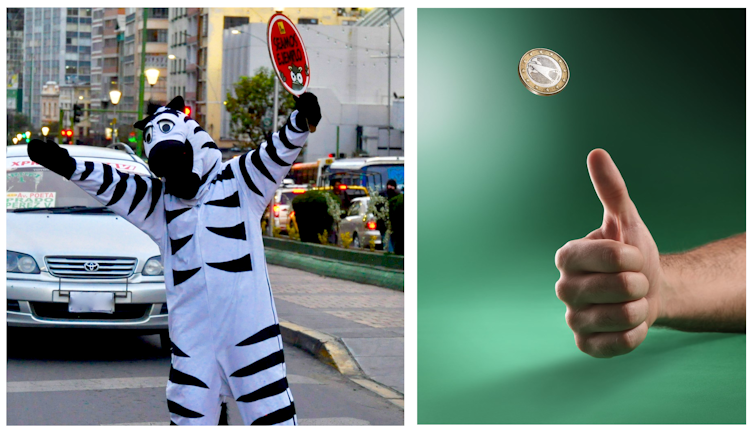
Probability is a branch of mathematics that describes randomness. When scientists describe randomness, they’re describing chance events – like a coin flip – not strange occurrences, like a person dressed as a zebra. While scientists do not have a way to predict strange occurrences, probability does predict long-run behavior – that is, the trends that emerge from many repeated events.

Left: A person in a zebra costume. Right: A coin in mid-air after being flipped. A hand is visible with thumb extended upward.
We may say ‘random’ to describe strange occurrences (person dressed as zebra), but probability describes chance events (a coin flip).
Zebras in La Paz, Bolivia by EEJCC, Own Work CC A-SA 4.0; https://commons.wikimedia.org/wiki/File:Zebra_La_Paz.jpg _ , CC BY-SA

Modeling with probability

Since probability is about events, a scientist must choose which events to study. This choice defines the sample space. When flipping a coin, for example, you might define your event as the way it lands.

Coins almost always land on heads or tails. However, it’s possible – if very unlikely – for a coin to land on its side. So to create a sample space, you’d have two choices: heads and tails, or heads, tails and side. For now, ignore the side landings and use heads and tails as our sample space.

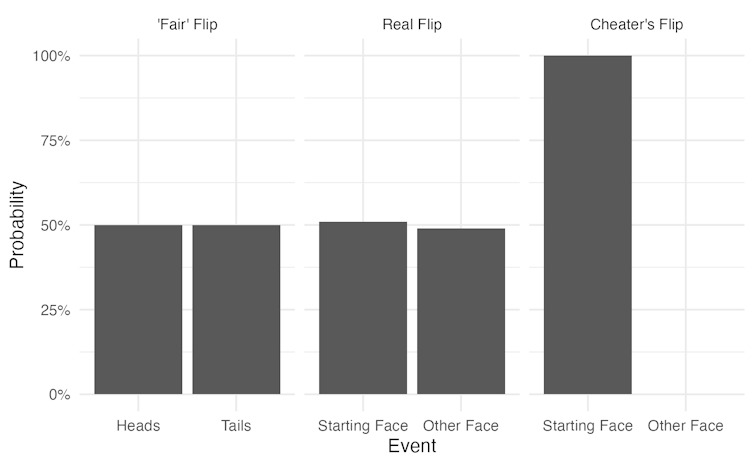
Next, you would assign probabilities to the events. Probability describes the rate of occurrence of an event and takes values between 0% and 100%. For example, a fair flip will tend to land 50% heads up and 50% tails up.

To assign probabilities, however, you need to think carefully about the scenario. What if the person flipping the coin is a cheater? There’s a sneaky technique to “wobble” the coin without flipping, controlling the outcome. Even if you can prevent cheating, real coin flips are slightly more probable to land on their starting face – so if you start the flip with the coin heads up, it’s very slightly more likely to land heads up.

In both the cheating and real flip cases, you need an appropriate sample space: starting face and other face. To have a fair flip in the real world, you’d need an additional step where you randomly – with equal probability – choose the starting face, then flip the coin.

Three bar graphs displaying probabilities for different outcomes. The 'Fair' Flip assigns equal probability (50%) to both heads and tails. The Real Flip assigns 51% to the Starting Face and 49% to the Other Face. The Cheater's Flip assigns 100% to the Starting Face.
The probabilities for different coin-flipping scenarios.
Zachary del Rosario, CC BY-SA

These assumptions add up quickly. To have a fair flip, you had to ignore side landings, assume no one is cheating, and assume the starting face is evenly random. Together, these assumptions constitute a model for the coin flip with random outcomes. Probability tells us about the long-run behavior of a random model. In the case of the coin model, probability describes how many coins land on heads out of many flips.

But instead of using a random model, why not just solve the coin toss using physics? Actually, scientists have done just that, and the physics shows that slight changes in the speed of the flip determine whether it comes up heads or tails. This sensitivity makes a coin flip unpredictable, so a random model is a good one.

Frequency vs. probability

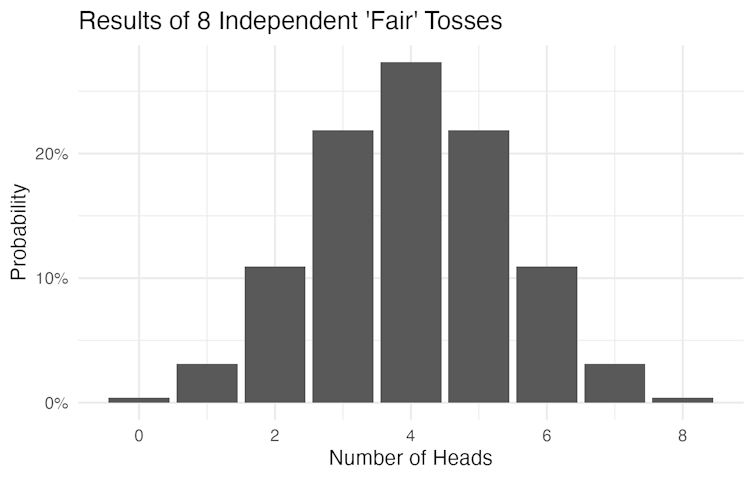
Probability differs from frequency, which is the rate of events in a sequence. For example, if you flip a coin eight times and get two heads, that’s a frequency of 25%. Even if the probability of flipping a coin and seeing heads is 50% over the long run, each short sequence of flips will come out different. Four heads and four tails is the most probable outcome from eight flips, but other events can – and will – happen.

Frequency and probability are the same in one special setting: when the number of data points goes to infinity. In this sense, probability tells us about long-run behavior.

A bar chart of probabilities for all possible outcomes of eight 'fair' coin flips. Four heads has the highest probability (~27%), and the distribution is symmetric around four heads.
Probabilities for all possible outcomes of eight ‘fair’ coin flips.
Zachary del Rosario, CC BY-SA

Applications to AI, cryptography and statistics

Probability isn’t just useful for predicting coin flips. It underlies many modern technological systems.

For example, AI systems such as large language models, or LLMs, are based on next-word prediction. Essentially, they compute a probability for the words that follow your prompt. For example, with the prompt “New York” you might get “City” or “State” as the predicted next word, because in the training data those are the words that most frequently follow.

But since probability describes randomness, the outputs of a LLM are random. Just like a sequence of coin flips is not guaranteed to come out the same way every time, if you ask an LLM the same question again, you will tend to get a different response. Effectively, each next word is treated like a new coin flip.

Randomness is also key to cryptography: the science of securing information. Cryptographic communication uses a shared secret, such as a password, to secure information. However, surprising randomness isn’t good enough for security, which is why picking a surprising word is a bad choice of password. A shared secret is only secure if it’s hard to guess. Even if a word is surprising, real words are easier to guess than flipping a “coin” for each letter.

You can make a much stronger password by using probability to choose characters at random on your keyboard – or better yet, use a password manager.

Finally, randomness is key in statistics. Statisticians are responsible for designing and analyzing studies to make use of limited data. This practice is especially important when studying medical treatments, because every data point represents a person’s life.

The gold standard is a randomized controlled trial. Participants are assigned to receive the new treatment or the current standard of care based on a fair coin flip. It may seem strange to do this assignment randomly – using coin flips to make decisions about lives. However, the unpredictability serves an important role, as it ensures that nothing about the person affects their chance to get the treatment: not age, gender, race, income or any other factor. The unpredictability helps scientists ensure that only the treatment causes the observed result and not any other factor.

So what does probability mean? Like any kind of math, it’s only a model, meaning it can’t perfectly describe the world. In the examples discussed, probability is useful for describing long-term behaviors and using unpredictability to solve practical problems.

The Conversation

Zachary del Rosario has received funding from the National Science Foundation and Toyota Research Institute.

ref. Probability underlies much of the modern world – an engineering professor explains how it actually works – https://theconversation.com/probability-underlies-much-of-the-modern-world-an-engineering-professor-explains-how-it-actually-works-273332

Enforcing Prohibition with a massive new federal force of poorly trained agents didn’t go so well in the 1920s

Source: The Conversation – USA – By Richard F. Hamm, Professor of History, University at Albany, State University of New York

Coast Guardsmen stand in front of two truckloads of liquor seized on April 14, 1931, after a battle between three policemen and several alcohol smugglers near Falmouth, Mass. AP Photo

As the actions of agents with U.S. Immigration and Customs Enforcement come under intense scrutiny, it’s worth noting that a little more than 100 years ago, another expansion of federal policing – to enforce national Prohibition – also sparked nationwide concern.

As a U.S. history scholar, I know both the government agencies charged with enforcing national Prohibition in the early 20th century and with mass deportation in the early 21st century were hastily expanded. They were asked to achieve difficult objectives and were staffed by sometimes poorly trained people who at times resorted to violence.

National prohibition enforcement

When Congress approved the Volstead Act in 1919 that outlawed the manufacture, sale and transportation of alcoholic liquors, it purposely limited the number of Prohibition enforcement officials due to pressure from powerful dry lobbying groups, which supported the prohibition of alcohol sales and consumption. These groups thought the majority of the Prohibition policing would be done by states.

The Volstead Act also exempted Prohibition agents from civil service laws, which would have required job applicants to pass certain minimum standards. The exemption was written into the law because the prohibitionist lobby only trusted committed “drys” – people resolutely dedicated to maintaining an alcohol-free society – to do the enforcing, and they thought that they would control the appointments.

For the first years of Prohibition, the Bureau of Prohibition belonged to a division of the Bureau of Internal Revenue – some were converted alcohol tax collectors. Then they became part of the Bureau of Prohibition in the Treasury Department. And in 1930, they moved to the Department of Justice.

These moves to various bureaus and departments reflected attempts to curtail corruption, reduce the influence of the prohibitionists on staffing, and increase effectiveness. Despite the moves, funding and training for Prohibition agents never improved. Additionally, in an effort to cut government spending during the Great Depression, the Herbert Hoover administration cut Prohibition agents’ per diem pay from US$6 to $5.

The initial group of Prohibition agents were either committed prohibitionists or “political hacks with little law enforcement experience,” according to author W. J. Rorabaugh. The hacks, Rorabaugh wrote, soon outnumbered the prohibitionists.

Several men dump beer from kegs into a lake.
Prohibition agents dump beer into Lake Michigan in Chicago on Oct. 9, 1919.
Bettmann/Getty Images

In 1927, Federal Circuit Judge William S. Keynon said that “three-fourths of the 2,500 dry agents are ward heelers and sycophants named by the politicians.” The assistant attorney general in charge of Prohibition enforcement, Mabel Walker Willebrandt, said that Prohibition agents were “as devoid of honesty and integrity” as those who violated Prohibition laws.

When Prohibition agents were placed under the civil service, 60% of them failed their civil service tests. In a six-year period beginning in 1920, 752 Prohibition officials lost their jobs for delinquency or misconduct. Drunkenness and bribery were the two main reasons for dismissal.

In 1930, the 1,450 front-line Prohibition agents dwarfed the 350 FBI field agents across the country. They were the largest federal law enforcement body, and they were busy.

From 1921 to 1930, they averaged over a half-million arrests per year. They seized over 45,000 automobiles, and by their own account, Prohibition agents killed 89 people.

However, the Association Against the Prohibition Amendment calculated that about 1,000 people were killed in enforcing Prohibition.

Endemic violence

Federal officials authorized Prohibition agents’ use of violence. One official told U.S. Sen. Wesley Jones, a strong prohibitionist, that some bootleggers “deserve a good killing, and I am not losing any sleep if now and then a bootlegger is killed.”

But Prohibition agents did not just shoot criminals. The Washington Herald detailed in 1929 a pattern of reckless use of force, with prohibition agents shooting at the tires of escaping cars and accidentally firing weapons. In 1924, within blocks of the U.S. Capitol, a Prohibition agent who was firing at a fleeing car carrying a bootlegger accidentally shot Sen. Frank L. Greene of Vermont. Greene, wounded in the head, never fully recovered the use of one arm.

The author Daniel Okrent illustrated the link between trigger-happy officers and shoddy recruitment and training when he detailed the case of “the first agent to kill a suspect bootlegger in the line of duty.” The Prohibition agent had been accepted into service under a false name. He was not a stranger to killing, as he had killed a man when he was 14. He had also served multiple prison terms. Indeed, he was given his badge when “still incarcerated at Dannemora State Prison,” according to Okrent.

A man dressed in military gear throws a tear gas canister in the air.
A federal agent lobs a tear gas canister toward protesters in Minneapolis on Jan. 24, 2026.
Kerem Yucel/ AFP via Getty Images

The parallels between Prohibition and the Trump administration’s mass deportation tactics are not identical. Prohibition was more unpopular in much of the country compared with mass deportation. And Congress was not willing to adequately pay for Prohibition enforcement, while it has generously funded ICE.

Several reports detail ICE’s recent massive expansion. In early January 2026, the agency announced it grew by 120%, adding 12,000 agents to the existing force of 10,000, which raised concerns among lawmakers about lowered training standards to meet recruitment targets. Other accounts reveal lax vetting, insufficient training and past officer misconduct.

But both efforts share important similarities. They were hastily built, with agents who were asked to do something very difficult, and staffed by sometimes poorly trained people who were authorized to use force.

The Conversation

Richard F. Hamm does not work for, consult, own shares in or receive funding from any company or organization that would benefit from this article, and has disclosed no relevant affiliations beyond their academic appointment.

ref. Enforcing Prohibition with a massive new federal force of poorly trained agents didn’t go so well in the 1920s – https://theconversation.com/enforcing-prohibition-with-a-massive-new-federal-force-of-poorly-trained-agents-didnt-go-so-well-in-the-1920s-276258

Individual donors provide only a small slice of university research funding – but Jeffrey Epstein’s ties with academics show why screening matters

Source: The Conversation – USA (2) – By Brian Herman, Vice President for Research, University of Minnesota

The recent release of Jeffrey Epstein’s emails shows a wide net of contacts – including academics at prominent universities. Brendan Smialowski/AFP via Getty Images

Yale University, Columbia University and the University of California, Los Angeles are among the schools that have recently placed professors on leave, seen faculty resign or made other changes over faculty members’ ties to Jeffrey Epstein.

The University of Arizona, for example, canceled a science conference scheduled for April 2026, following the news that several speakers and organizers were named in the Epstein files. Astrobiologist Stuart Hameroff, for example, wrote on the social platform X on Feb. 6, 2026, that he “obtained one-time funding” for a conference from Epstein.

Bard College’s president, Leon Botstein, is among other academic leaders and researchers who have said that they met with Epstein for fundraising purposes – though, as The New York Times reports, Epstein rarely delivered on the money he promised for research and other purposes.

“There is a tremendous drive to acquire money to support the work of faculty and staff. The pressure has always been there – but you can still approach that in an ethically and morally acceptable way,” said Brian Herman, a former vice president for research at the University of Minnesota, in an interview that has been edited for length and clarity.

Amy Lieberman, the education editor at The Conversation U.S., spoke with Herman to understand how philanthropy for colleges and universities works, and what standards and safeguards are in place to help ensure that this money is given in an ethical manner.

A graphic shows cartoon people building different things and standing on ladders, near a large dollar sign.
Universities across the country are under pressure to fund research – and, in return, improve or maintain their college rankings.
iStock/Getty Images Plus

How is research at universities typically funded?

Funding to support university research comes from a variety of different sources.

Most university research funding – approximately 53%-55% of that supportcomes from the federal government, like the National Institutes of Health and the National Science Foundation.

About 8% of total funding comes from a number of private foundations and nonprofits, like the American Cancer Society.

Universities can also request that state and federal legislators allocate funding in their yearly appropriations bills for research. This involves negotiations between universities and their state and federal legislators. State and local agencies provide about 5% of total university research funding.

Universities themselves fund between 25%-26% of research, and businesses give 6%.

Other sources of funding, including individual donors, account for about 3% of the money that funds university research.

These individuals might be alumni of the university, have another kind of connection to the school or are personally interested in a specific area of expertise of the university. Or, they could be grateful patients who had medical issues solved by the university’s medical school.

How do universities connect with private donors?

Universities typically have fundraising offices that oversee relationships with donors.

Donor and university partnerships involve significant negotiations about how the money will be invested. Universities typically will work with faculty members with expertise in the area of research a donor wants to support and put together a research proposal. The prospective donor then reviews the plan and decides whether they want to support the research.

After universities receive and invest a donation, they give donors a progress report on the investment.

Private donors give money to the university, and not to an individual faculty member. This allows proper accounting and controls on how the money is used, to make sure they support the intended research and adhere to university policies.

How do universities screen donors for conflicts of interest, for example?

All universities have compliance offices that set up a compendium of policies that guide how they accept private funding.

The schools try to make sure there is no financial conflict of interest for the donor, researcher or institution – or a conflict of interest between people performing the research and those providing the funding.

There is practically always a need to strike a balance between managing potential conflicts appropriately and being able to obtain the resources necessary for a university to conduct its work.

Do universities typically screen for donors who have committed a crime?

Most universities screen potential donors.

The larger the dollar amount in question, the more substantive the screening is. Many universities have policies on this issue. It is likely that universities will strengthen these policies based on recent events related to the Epstein case. They will want to become more stringent with screening to make sure that their donors are not morally compromised.

For example, universities can conduct background checks on potential donors.

But if the donation is small, it is possible that a university would not conduct a background check. So, a faculty member could seek $5,000 for a conference and approach a donor individually and not involve the rest of the university in the donation.

How could the Epstein case influence how universities screen donors?

I expect that universities will enact more policies and procedures that guard against a situation like what we are seeing in the Epstein files. Universities may require more substantive checks on all donations independent of size and source. They are also likely to carry out more training of faculty, staff and administrators on how to secure individual donor support.

If universities have not already done so, I think they should instruct faculty members not to directly contact a donor or legislator on behalf of the university. They should also increase the penalties for university employees who do not comply with this policy.

In some cases, researchers may have an idea that is not aligned strategically with how the university is raising philanthropic funds. They may go looking for their own money. This doesn’t happen a lot, but it does happen, and universities will have to become more vigilant about these types of situations.

In reality, money is necessary to do most everything at universities, including paying faculty and staff, purchasing research supplies and even keeping the lights on in the research labs. Money is also a metric that is used as a measure of success and the ranking of a university – meaning, getting more money can lead to a higher ranking.

University leaders are facing natural pressure to raise money. There is a tremendous drive to acquire money to support the work of faculty and staff. This can create significant pressure to acquire funding – but this must always be done in an ethically and morally appropriate way.

The Conversation

Brian Herman does not work for, consult, own shares in or receive funding from any company or organization that would benefit from this article, and has disclosed no relevant affiliations beyond their academic appointment.

ref. Individual donors provide only a small slice of university research funding – but Jeffrey Epstein’s ties with academics show why screening matters – https://theconversation.com/individual-donors-provide-only-a-small-slice-of-university-research-funding-but-jeffrey-epsteins-ties-with-academics-show-why-screening-matters-276345