Arrowhead marks found in Central Asia could prove the existence of ‘Homo sapiens’ 80,000 years ago

Source: The Conversation – France – By Hugues Plisson, archéologue spécialisé en tracéologie (reconstitution de la fonction des outils préhistoriques par l’analyse de leurs usures), Université de Bordeaux
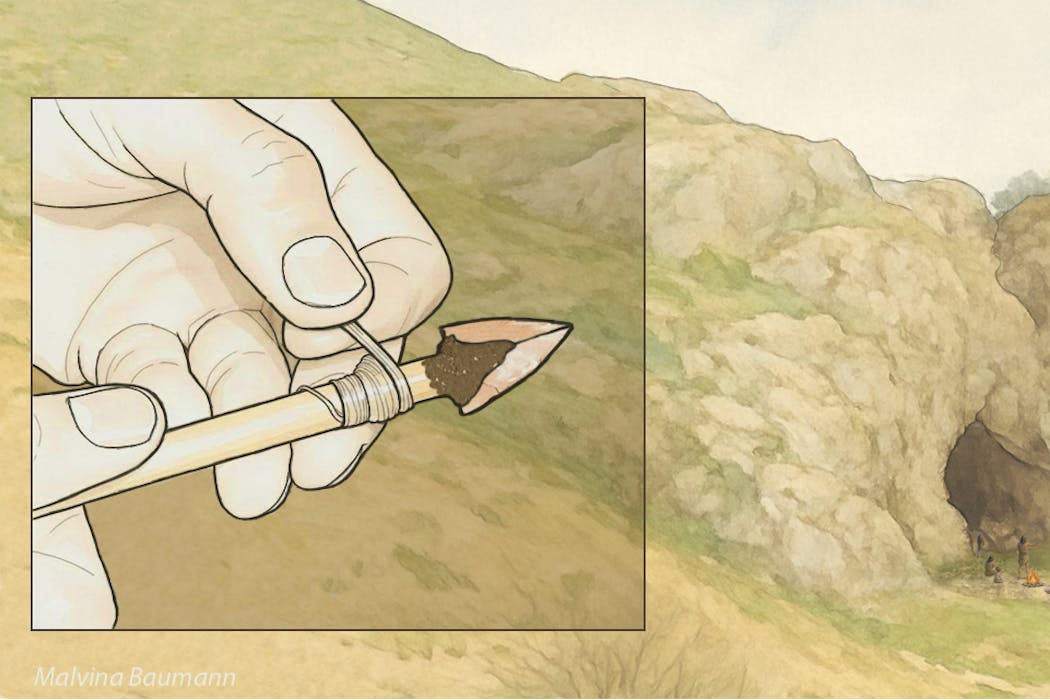
Obi-Rakhmat rock shelter in Uzbekistan, micro-point hafting and main game hunted around the site 80,000 years ago (artwork courtesy of Malvina Baumann). Malvina Baumann, Fourni par l’auteur

Unretouched triangular microlithic projectile points have been identified from their impact traces in the oldest occupation layers of the Obi-Rakhmat site in Uzbekistan, dating to 80,000 years ago. Their size corresponds to small arrowheads, which are directly comparable to those produced by Homo sapiens during an incursion into Neanderthal territory in the Rhône Valley, 25,000 years later. This new study, published in PLOS One journal, provides a strong argument that could rewrite history on Homo sapiens‘ first settlement in Europe.

The chrono-cultural and anthropological frameworks of prehistory, along with the evolutionary models they inspired, were first created in Western Europe, especially France, in the second half of the 19th century. They were initially linear and Eurocentric: Cro-Magnons (European early modern humans), descending from Neanderthals, laid the foundations for the civilisational superiority claimed by this part of the world at the time. It was not until a century later that the African origin of Homo sapiens, as well as the technological and social features that characterised the Western Upper Palaeolithic (symbolic productions, long-distance networks, and diversified lithic and bone tools and weapons), were recognised.

The earliest evidence of Homo sapiens in Australia, dating back around 65,000 years (Clarkson et al., 2017), predates that found in Europe by 10 millennia, while the ways in which our ancestors initially colonised Western Eurasia over 45,000 years ago remain contentious. The temporal alignment of the earliest European Upper Palaeolithic settlements with those in the Levant, which are considered the closest in terms of typology and technology, is still not satisfactory. This is either because the Levantine data comes from old excavations or because it does not fit into the supposed direct lineage. Despite its geographical proximity to Africa, the origins of the Initial Upper Palaeolithic in the Levant are themselves uncertain. This is why the possibility of a Central Asian origin suggested by archaeologist Ludovic Slimak in 2023 (Slimak, 2023) deserves attention.

A site in Central Asia
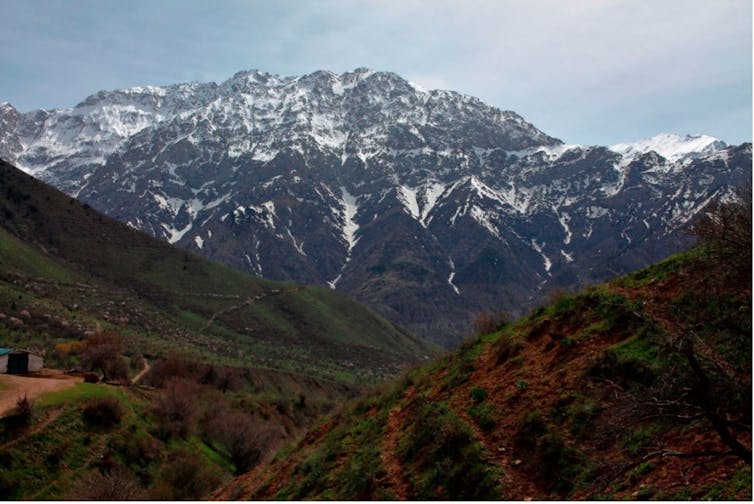
View from the Obi-Rakhmat rock shelter on the end of the Tien Shan. Hugues Plisson.
Fourni par l’auteur

Depending on climatic conditions, Central Asia has served as a corridor facilitating movement between the western and eastern parts of the continent or as a refuge zone. The archaeological record in this region is limited but includes several significant Palaeolithic sites.

Among them is the Obi-Rakhmat rock shelter in Uzbekistan, discovered in 1962, whose latest excavation campaigns were led by Andrei Krivoshapkin. At the south-western end of the Talassky Alatau range of the Tien Shan mountains, at an altitude of 1,250 metres, the settlement provides a remarkably consistent lithic industry, comprising points, large blades, and bladelets across a stratigraphic sequence spanning over 10 metres, dating from approximately 80,000 to 40,000 years ago. This industry was initially classified as part of the Initial Upper Palaeolithic but it appears to derive from the Levantine Early Middle Palaeolithic. The early Middle Palaeolithic, associated with archaic Homo sapiens at the Misliya cave (Hershkovitz et al., 2018), disappeared from the Near East around 100,000 years ago. At Obi-Rakhmat, the skull remains of a child found in a layer dating back ~70,000 years show features considered to be Neanderthal and others to be anatomically modern, a combination that could be the result of hybridisation.

Massive blades but microlithic points
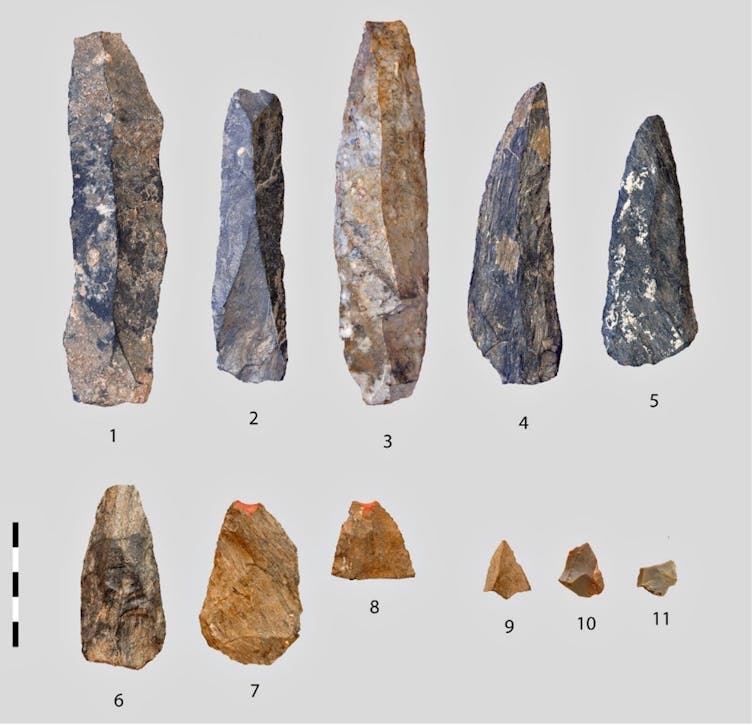
Elements of lithic industry from layer 21 at Obi-Rakhmat: unretouched blades (1-2), large retouched blade (3), pointed retouched blades (4-5), impacted retouched points (6-8), unretouched Levallois micro-point (9), unretouched impacted micro-points (10-11). Hugues Plisson.
Fourni par l’auteur

In this context, our international multidisciplinary team has identified tiny, unretouched, triangular projectile points within the lithic debris of the oldest stratigraphic layers. These points were distinguished based on their macroscopic and microscopic impact marks, which were compared to experimental reference data. Due to their small size (less than 2 cm in width and weighing only a few grams) and brittleness, they would have been unsuitable for mounting on heavy shafts. The width of their cutting edges corresponds to the diameter of arrow shafts documented ethnographically for low-poundage bows, consistent with transcultural invariants rooted in physical and ballistic constraints.
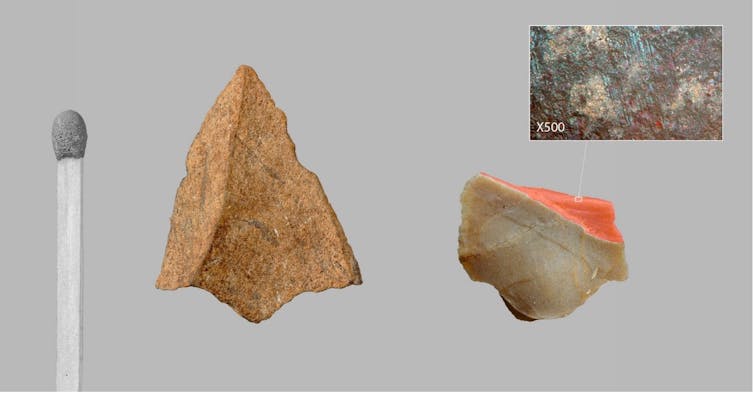
Two unretouched micro-points recovered from layer 21 of Obi-Rakhmat. One is intact, while the other is broken and shows scratches resulting from use as a projectile head. The matchstick illustrates their small size.
Fourni par l’auteur

A question of ballistics

Thrown piercing weapons are complex systems whose components are not interchangeable from one type of weapon to another, as they meet different requirements in terms of intensity and nature of stress.

The significant impact force of spears held or thrown by hand makes the robustness of the weapon an essential parameter, both in terms of effectiveness and the hunter’s survival, with mass ensuring robustness, impact force and penetration. In contrast, the penetration of light projectiles shot from a long distance depends on their sharpness, because their kinetic energy, which is much lower, comes mainly from their speed, which, unlike mass, decreases very rapidly along the trajectory and in the target. As this speed cannot be achieved by the extension of the human arm alone, it necessarily depends on the use of a throwing instrument. Arrowheads and spearheads or javelin heads are therefore not designed according to the same criteria and cannot be mounted on the same shafts, the dimensions and degree of elasticity of which are also essential in terms of ballistics. Thus, as in palaeontology, where the shape of a tooth reveals the type of diet and suggests the mode of locomotion, the characteristics of a point provide clues as to the type of weapon of which it is the wounding element.

Weaponry specific to ‘Sapiens’?

The tiny size of Obi-Rakhmat’s points cannot be regarded as a default choice, not only because there is no shortage of good-quality lithic raw material on site from which large blades were made, but microscopic examination of traces of use or wear also shows that within this same assemblage there are also much more robust retouched points (15 to 20 times heavier and 3 to 4 times thicker), similarly impacted by use as axial projectile points (the size of spearheads or javelin heads).

Returning to the bibliography and our own work on Middle Palaeolithic tools (Plisson et Beyries, 1998), we found that the presence in the same assemblage of various types of projectile points and inserts, some of which were microlithic and produced for this purpose, is only known at Homo sapiens sites. The oldest documented occurrences are in South Africa in the Pre-Still Bay (more than 77,000 years old) and later cultural layers of the Sibudu cave. In contrast, lithic points damaged by use as projectile heads are rare in the Neanderthal record. When present, they tend to be large and do not notably differ in size, manufacture or type from points used for activities other than hunting, such as gathering plants or butchery. This difference in the design of tools and weapons takes on anthropological significance.
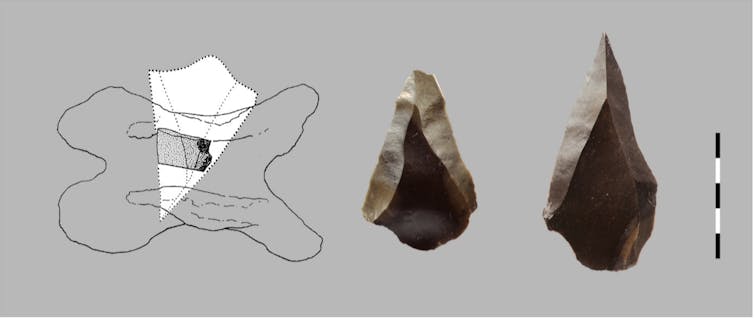
Levallois points from the Um El Tlel site in Syria, from the Late Middle Palaeolithic period in the Levant attributed to Neanderthals. From left to right: graphic reconstruction based on a fragment found embedded in a donkey vertebra, plant knife blade, butcher knife blade. These multipurpose points are 2 to 3 times wider than the micro-points from Obi-Rakhmat. Hugues Plisson.
Fourni par l’auteur

Given their respective dates, the distance between South Africa and Central Asia (14,000 km) and the difference in the manufacture of the Obi-Rakhmat and Sibudu weapon heads (unretouched knapped stone points vs. shaped stone points or retouched inserts, shaped bone points), the hypothesis of independent centres of invention is the most likely.

From the foothills of the Tien Shan to the Rhône Valley 25,000 years later

The micro-points from Obi-Rakhmat have no known equivalents in the Eurasian Middle Palaeolithic, except for identical projectile points identified by Traceology expert Laure Metz (Lewis et al., 2023) at the Mandrin site, in the Rhône Valley, France, in a layer dating to approximately 54,000 years ago – some ten thousand years before the disappearance of local Neanderthals. Notably, a Homo sapiens milk tooth was also recovered from this layer (Zanolli et al., 2022. The similarity between the micro-points from Obi-Rakhmat and Mandrin, despite being separated by more than 6,000 km and 25 millennia, is such that they could be interchanged without any detail other than the stone betraying the substitution.
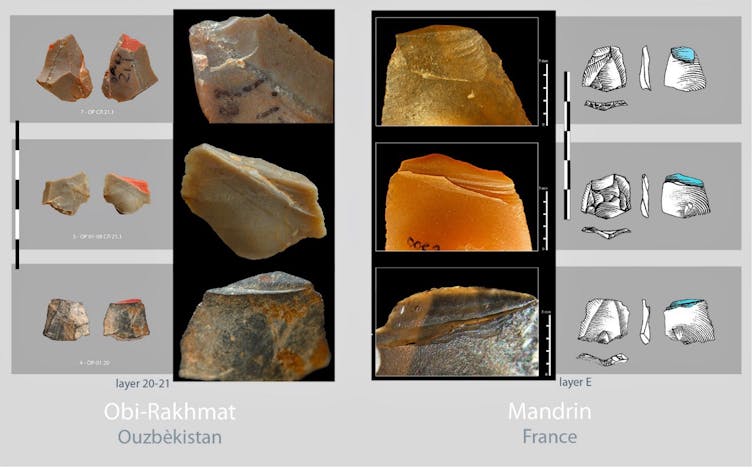
Morphological and functional similarity between the micro-points of Obi-Rakhmat and Mandrin, broken by their use as projectile head. The location and extent of their fracture (highlighted in red and blue and macroscopic detail) are indicative of axial impact. Hugues Plisson.
Fourni par l’auteur

Recent work published by paleogeneticists Leonardo Vallini (Vallini et al., 2024) and Stéphane Mazières (Mazières et al., 2025) defines the Persian Plateau, on the north-eastern edge of which Obi-Rakhmat is located, as a population hub where the ancestors of all present-day non-Africans lived between the early phases of expansion out of Africa – long before the Upper Palaeolithic – and the wider colonisation of Eurasia. This resource-rich environment may have provided a refuge conducive to demographic regeneration after the genetic bottleneck of the exit from Africa, interaction between groups and, consequently, technical innovations.

On either side of the Persian plateau (orange box), genetically identified as a refuge area for the concentration and demographic development of first Homo sapiens who left Africa, Obi-Rakhmat and Mandrin share the same micro-projectile points, 25,000 years and 6,000 km apart. Hugues Plisson.
Fourni par l’auteur

Obi-Rakhmat and Mandrin may represent two geographical and temporal milestones within the same process of dispersal, as suggested by Ludovic Slimak (Slimak, 2023), characterised by the dissemination of a key technological innovation unique to Homo sapiens. So far unnoticed because they are unretouched, tiny and fragmentary, it is likely that the micro-projectile points for which recognition criteria have now been defined will begin to appear at sites between Central Asia and the western Mediterranean.

Premises for a new scenario of the western peopling by ‘Homo sapiens’

This discovery is stimulating in several ways.

It validates the consistency of the research conducted at the Mandrin site, which came to the conclusion that Sapiens armed with bows made a brief incursion into Neanderthal territory. Several elements of this study had been criticised (Klaric et al., 2024)– which is, however, normal in science when a new proposal deviates too far from established knowledge – but its predictive dimension had not been considered at the time.

The similarity between Mandrin and Obi-Rakhmat’s micro-points cannot be a mere coincidence. It is not only their shape that is similar, but also the way they are made, which requires real expertise, as evidenced by the meticulous preparation of their striking platform and their function. One could debate the appropriate instrument for shooting arrows armed with such tiny tips, the bow being in filigree, or whether it is preferable to remain cautious and speak only of shooting, but this already contrasts with what we know about Neanderthal hunting weapons and their design.

Another remarkable aspect, which is still relatively uncommon, is the convergence and complementarity of data from material culture and from our genetic memory, which did not influence each other given the dates of the respective studies and publications. Together, they sketch out a rewriting of the scenario of Homo sapiens’ arrival in Europe: it was thought that he came directly from Africa by the shortest route 45,000 years ago, but we now discover that he had been established in the heart of the Eurasian continent for a long time, well before expanding in search of more territories.


A weekly e-mail in English featuring expertise from scholars and researchers. It provides an introduction to the diversity of research coming out of the continent and considers some of the key issues facing European countries. Get the newsletter!


The Conversation

Les auteurs ne travaillent pas, ne conseillent pas, ne possèdent pas de parts, ne reçoivent pas de fonds d’une organisation qui pourrait tirer profit de cet article, et n’ont déclaré aucune autre affiliation que leur organisme de recherche.

ref. Arrowhead marks found in Central Asia could prove the existence of ‘Homo sapiens’ 80,000 years ago – https://theconversation.com/arrowhead-marks-found-in-central-asia-could-prove-the-existence-of-homo-sapiens-80-000-years-ago-276550
A 2,850-year-old mass grave in Serbia reveals a shift in prehistoric violence

Source: The Conversation – UK – By Barry Molloy, Associate Professor, School of Archaeology, University College Dublin

The earliest mass graves in Europe date back just over 7,000 years. They reveal brutal evidence for violence beyond the simple act of killing. The motives for these events are probably diverse but consistently highlight an intention to kill large numbers of enemies across sex and age ranges.

Our study of a 2,850-year-old massacre and resulting mass grave at Gomolava (modern day Serbia) shows the nature of mass killings evolving. Comprised mostly of women and girls, the grave suggests a shift in prehistoric violence. Here, women and children were not collateral victims, but deliberate targets. Looking at who was killed and how they were related can tell us about changes in ancient attitudes to killing combatants – but also choices in targeting non-combatants.

The site at Gomolava, first excavated in 1971, is the second of two contemporary mass graves. It contained 77 people. Our recent study has uncovered the circumstances surrounding their death.

We found that the original theory – that an epidemic had killed people from a single settlement – is not supported by genetic and isotopic evidence. Our data instead showed that these people descended from the wider region but came from different settlements. Except for a mother and her two daughters, there were no close genetic relationships.

Archaeology and mass graves

Archaeology sheds light on the deep history of conflict. When killings are targeted, mass graves can tell us which members of a society were displaced and killed. Then, we pose the question – why them?

When we study violence in past societies, archaeologists seek to understand how and why things like discord, ambition, belief or rivalry could lead people to plan to kill others. While archaeology cannot provide ready solutions to modern crises, it helps us to better understand the immediate and longer term societal impact of violence, and how more peaceful times were achieved and managed.

Our detailed study of the bones of the dead in the Gomolava grave exposed a brutal story – these people were mostly killed through blows to the head.

All the bodies had been crammed into a repurposed old pit house. This structure, once part of a small village, consisted of a sunken pit with low walls and a roof. This hole provided a ready space to stow the dead.

It is unclear if that was expedient disposal, or putting them in what was once a home. However, these people were buried respectfully with some of their personal possessions and other offerings. Most of the dead were women and children. Studies of the children’s teeth revealed a disproportionate number were girls. In other prehistoric mass graves, children and young women are often underrepresented because of their value as slaves or for reproduction. Gomolava is a clear exception, inverting this pattern.

In comparison, the Neolithic sites of Asparn-Scheltz, Austria (which contains approximately 200 bodies), and Potočani, Croatia (41 bodies) also contained people with few genetic connections. However, children were underrepresented and males and females equally present.

At Koszyce, Poland, 15 genetically closely related women, young men and children were buried together. These events highlight larger scale conflicts and often relate to periods of exceptional social change, such as the spread of different material conventions and, at times, inward migration of genetically distinct people.

Why women and children?

Mass graves have long informed us of the scale of past violent events. Combining archaeology with newer genetic and isotopic methods better reveals demographics, which has revolutionised the ways we can access stories of the victims. At Gomolava, this enabled us to explore the nature, social context and strategic purpose of this mass killing event. In our study, we suggest the women and children in the Gomolava grave were not incidental victims on the periphery of conflict or its aftermath, but primary targets.

Selectively killing these women and children ended family lines and cut short the future of communities. Possible motives were retribution or establishing dominance in the region. This represents a sea change in the nature of violent conflict, potentially a case where previous taboos on killing were no longer exercised. Though this is only one site in one specific time and place, it demonstrates how the treatment of mass killings can highlight major changes in attitudes to violence as a social strategy.

There is a tension in archaeology between those who argue that violence was a commonplace means of exercising social power and those that concentrate more on characterising the many alternatives to violence for asserting control or authority. In our view, both likely coexisted. In the absence of formal legal systems, the ability to fight could itself function as a deterrent. Violent conflict was therefore an extreme – but ever-present – means of resolving inter-group disputes.

Man stood in a field by a river
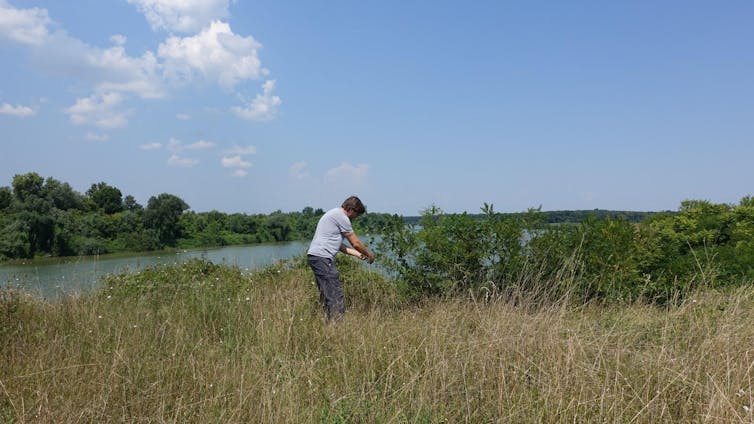
Gomolava and the Sava river.
Barry Molloy, CC BY-SA

The targeting of women and children in Gomolava by people from outside their community provides a bridge between perspectives, beyond a view of men enforcing violence over other men on the battlefield. It reveals how those who shaped social trajectories across many fields of social discourse were central to conflict resolution, whether that be peaceful or through dominance and extermination. We argued that different groups were competing over land ownership in this region, and mass killing of enemies was a strategic choice to assert dominance or hegemony over a community spread across many settlements, likely including Gomolava.

Whether such graves represent ethnically, culturally or socially different groups in conflict, the brutality of their selective killing remains a common thread. In seeking to understand how peace was brokered and managed, and how different forms of power played roles in this, working to better understand who was targeted and killed in episodes of violence is a crucial first step.

Our comparative approach takes mass graves beyond specific times and places and shows how we may have underestimated the scale, ferocity and purpose of short episodes of violence.

The Conversation

Barry Molloy receives funding from The European Research Council

Linda Fibiger does not work for, consult, own shares in or receive funding from any company or organisation that would benefit from this article, and has disclosed no relevant affiliations beyond their academic appointment.

ref. A 2,850-year-old mass grave in Serbia reveals a shift in prehistoric violence – https://theconversation.com/a-2-850-year-old-mass-grave-in-serbia-reveals-a-shift-in-prehistoric-violence-277115

Why do leaders go to war when it could damage their own people too?

Source: The Conversation – UK – By Becky Alexis-Martin, Lecturer in Peace Studies and International Development, University of Bradford

Ann in the UK/Shutterstock

Why do people start wars even though it hurts their country too – and they might lose?

Grace, 9, Belfast

Before governments, countries and writing, there was war. People have always fought with each other. Archaeologists have discovered skeletons with weapon injuries that are over 10,000 years old.

Wars are very serious because they hurt people and the environment. They happen for many different reasons, and each war is different. People who start wars often think that the short-term benefits of a war are worth the harm to their own people. But they don’t always understand the long-term consequences of their actions.

Experts use something called the “just war theory” to understand whether it’s ever OK to fight a war. This is a very old, but useful, set of ideas that help people decide if a war is fair, how soldiers should behave and how to protect people who are not fighting, like children and families.


Curious Kids is a series by The Conversation that gives children the chance to have their questions about the world answered by experts. If you have a question you’d like an expert to answer, send it to curiouskids@theconversation.com and make sure you include the asker’s first name, age and town or city. We won’t be able to answer every question, but we’ll do our very best.


Just war theory says that countries have a right to defend themselves from invasion when another country attacks them. However, it also says that the harm from war must not be worse than the problem, that someone must actually be able to win and that people should try talking, negotiating and making agreements before they fight.

It provides rules for countries at war to follow. The rules say that normal people and the things that they need, such as hospitals, power plants and schools, should never be attacked because they help everyone live safely.

These ancient ideas have become part of the modern international laws and agreements that help make our world more peaceful. Unfortunately, not all countries follow just war theory when they go to war. Thankfully, we have laws in place to punish the leaders or soldiers who break the rules.

Why do wars start?

Wars can start due to a disagreement, fear or a desire for more power. Unfortunately, some leaders will choose war because they don’t want to appear weak. Or they might go to war to distract their own people and stay in control, because they feel vulnerable and unpopular. They might make a bad decision, really believe that they are right, then underestimate how long the war will last. The best leaders do not start wars in this way, do not make these mistakes and care about their people’s long-term wellbeing.

Another reason why people start wars is because they think that invading another country will make them stronger or richer. As we use up things we cannot easily replace, such as fossil fuels for our cars and rare metals for our phones and computers, this increases competition between countries to own the remaining resources.

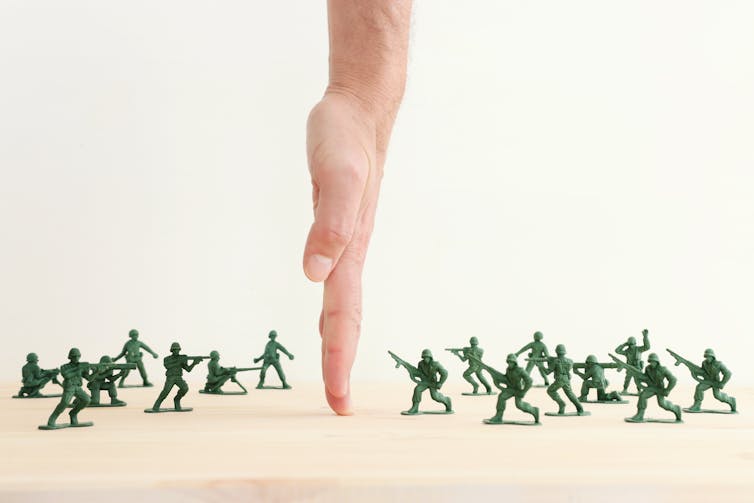
A hand separates toy soldiers on a table

Tomertu/Shutterstock

Peace experts like me also explain that climate change contributes to wars, as it makes it harder for people to access good water and farmland. It is so much better for everyone when countries bargain with each other and share resources, instead of starting wars.

Even though wars are happening now in countries like Ukraine, Afghanistan and Iran, most countries still solve their problems peacefully by talking and working together.

Many experts think that wars are evidence of failure, and that everyone loses when they fight instead of working together to create agreements and compromises. Pacifists believe that war is always wrong and that we must strive to find peaceful solutions. I think that they have the right idea, and that a more peaceful world is definitely possible.

The Conversation

Becky Alexis-Martin does not work for, consult, own shares in or receive funding from any company or organisation that would benefit from this article, and has disclosed no relevant affiliations beyond their academic appointment.

ref. Why do leaders go to war when it could damage their own people too? – https://theconversation.com/why-do-leaders-go-to-war-when-it-could-damage-their-own-people-too-277405

Why the Doomsday Clock has outlived its usefulness

Source: The Conversation – Canada – By Martin Hébert, Full Professor, Département d’anthropologie, Université Laval

The Doomsday Clock — a symbolic device to signal an array of existential threats to the world since 1947 — was recently moved to 85 seconds before midnight, the closest it has ever been to midnight. And that was before all-out war broke out in Iran.

Created by the Bulletin of Atomic Scientists, the Doomsday Clock first represented a slow descent into nuclear vulnerability, with midnight standing as the nuclear apocalypse. Nowadays, the clock includes other existential threats to humanity, including global warming, disruptive technologies or the erosion of the rules-based international order.


Read more:
Venezuela attack, Greenland threats and Gaza assault mark the collapse of international legal order


Mobilizing fear

Since its very beginning, the clock’s purpose was a call to action meant to shake world leaders — and the broader public by extension — awake from their complacency and indifference.

The aim of the Doomsday Clock was never to instil paralyzing anxiety. Quite the contrary, it sought to mobilize fear in a constructive way. It signals, implicitly, the hope that existential threats can be eradicated and the possibility that peril can be overcome, even if the odds are slim.

But over the years,, the Doomsday Clock has crept ever closer to midnight — first by minutes, then by seconds — heightening the sense of urgency while stopping short of the clock’s symbolic apocalypse.

Being mere seconds from catastrophe dramatically underscores the urgency of action, even as the shrinking margin to midnight heightens public anxiety.

We contend that this is the point where the narrative of imminent catastrophe becomes counter-productive: constant apocalyptic scenarios may dull perceptions of risk or be exploited to justify politics driven by urgency and fear.

Doomsday Clock flaws

The clock has long been subject to critics. Some have questioned its precision and called it showmanship. Others have described it as shaped by ideology.

But the first question we should ask of the Doomsday Clock is whether it fulfils its stated purpose: prompting transformative action to confront what are widely recognized as existential risks. It’s been argued that putting humanity on a permanent, blanket high alert isn’t helpful when it comes to formulating policy or driving science.

The narratives of nuclear war and impending apocalypse that underpin the Doomsday Clock have historically been used to project authority and justify dangerous politics of secrecy — legacies that have often come at the expense of public health and well-being.

For instance, during the Cold War, the U.S. strategically stoked a sense of urgency within its population against the potential threat of nuclear war with the Soviet Union.

During that time, education often blended with propaganda as schoolchildren were told to prepare themselves against potential nuclear attacks, learning from Bert the Turtle to “duck and cover.”

Worried citizens built bunkers in their homes as billions of dollars were pumped into the military industrial complex.

Those who criticized such preparedness measures faced accusation of anti-patriotism or of being communists underMcCarthyism and the Red Scare.

In the end, the sense of a looming apocalypse sacrificed the social and national security of Americans for a threat that never materialized. Ironically, in being fearful of being bombed, Americans exposed their own population to dangerous radioactive fallouts and material via nuclear tests and arsenal production.

How we define disaster

Obviously, complacency about the serious challenges the world is facing is not an option. But the idea that we are almost at the point of no return via the Doomsday Clock is no longer useful or helpful.

This is especially the case since the doom symbolized by the clock has become more abstract with time. Since it’s broadened beyond nuclear war, the clock struck midnight a long time ago for many people on the planet.

Recognizing the difference in experiences among privileged groups, for whom catastrophe remains a future prospect, and marginalized groups, who live in what has been described as a world of salvage, should prompt us to rethink how we measure and define impending disaster.

By calibrating the Doomsday Clock in ever-narrowing seconds, we construct an imaginative framework in which meaningful change is equated with turning the clock back. It may be more honest — and more useful — to acknowledge that we’re already living at the brink.


Read more:
How the Doomsday Clock could help trigger the armageddon it warns of


As militarism and fascism surged in 1935, Dutch cultural historian Johan Huizinga could have said Europe stood seconds from catastrophe. Instead, he took a different view: “We all know that there is no way back, that we have to fight our way through.”

The uncertainty and anxiety produced by being “seconds to midnight” via the Doomsday Clock can upset the balance between fear and hope. It risks normalizing the violence long endured by racialized and marginalized communities, while creating fertile ground for either opportunistic politics or irrational faith that events will simply resolve themselves.

At this point, action is stalled by the stubborn conviction that this cannot really be happening to us. Perhaps this is when the clock should strike 12 — not as an endpoint, but as a signal that the focus must shift from prevention to another mode of response. In many areas of life, acknowledging that a crisis has arrived is the first step toward recovery.

The Conversation

The authors do not work for, consult, own shares in or receive funding from any company or organisation that would benefit from this article, and have disclosed no relevant affiliations beyond their academic appointment.

ref. Why the Doomsday Clock has outlived its usefulness – https://theconversation.com/why-the-doomsday-clock-has-outlived-its-usefulness-275409

Warships as diplomats: how the South African Navy is tasked with building ties with other nations

Source: The Conversation – Africa (2) – By André Wessels, Senior Professor (Emeritus) and Research Fellow, Department of History, University of the Free State

A naval exercise off the South African coast in January 2026, dubbed Will for Peace and involving the warships of South Africa, China, Russia, the United Arab Emirates (UAE) and Iran, elicited international and domestic controversy. It also contributed to a further souring of relations between South Africa and the US.

Under pressure at home, South Africa’s defence ministry appointed a board of inquiry to investigate whether an instruction by President Cyril Ramaphosa not to involve Iran had been defied.

The exercise and its controversies have placed the spotlight on the South African Navy’s diplomatic role. André Wessels, who has extensively studied the history of the navy, unpacks this role.

What is the Will for Peace 2026 exercise and what is the controversy around it?

Navies traditionally take part in training exercises with other navies. This enhances interoperability and builds mutual trust.

Over time, many foreign warships have visited South African ports, including 23 in 1961, 50 in 1968 and 41 in 1973.

However, in reaction to South Africa’s domestic policy of apartheid, foreign warship visits almost dried up between 1977 and 1989. Once South Africa became a democracy in 1994, foreign warships poured back into the country’s ports, for example 35 from 15 countries in 1997.

New alliances allowed the country’s navy to take part in exercises with the navies of Argentina, Brazil and Uruguay, Germany, India and Brazil, and Russia and China.

The January 2026 exercise was branded as one of navies belonging to the expanded Brics intergovernmental organisation. But, strictly speaking, Brics+ is not a military alliance. It is significant that India, Brazil, Indonesia and Egypt, which are members, did not send ships to participate, probably so as not to offend the US. But it was the first-ever visit by a UAE warship to South Africa.

Iranian “grey diplomats” (a term used to describe navy warships) had previously visited South African ports in 1970, 1972, 1974, 1975, and in 2016-2017.

The current geopolitical situation is challenging. There are tensions between the US and Iran (for, among other reasons, the latter’s nuclear arms ambitions); the Russia-Ukraine war continues; and diplomatic relations between the US and South Africa are strained (partly because of the Trump administration’s unproven allegations of a white genocide in South Africa). Given this situation, the naval exercise should not have taken place.

South Africa should as far as possible stay neutral in international affairs to, among other things, safeguard its economic interests. Furthermore, its navy had very little to gain and can ill afford negative publicity, especially when it transpired that the government had apparently asked that Iran not participate. The facts in this regard, however, must still be determined by a government-appointed board of inquiry.

What role can and should a navy play in a country’s foreign policy?

The traditional exchange of diplomats between friendly countries, reciprocal visits by heads of states and cabinet ministers, and the holding of summit meetings are not the only means of strengthening relations between countries.

It has been, for example, the practice of seafaring countries to send warships to one another from time to time. The South African Navy is no exception.

Since 1922, South African warships have undertaken numerous flag-showing cruises (meaning diplomatic visits) to many countries. These visits have nothing to do with “gun-boat diplomacy”, which is diplomacy backed by the threat of military force.

Warships play a very important role in diplomacy. The presence of a warship can be the most tangible and visible sign of bilateral and multilateral friendships. When ships of a navy take part in combined exercises or international humanitarian and peacekeeping missions, those ships can generate mutual trust. The warships become diplomatic tools of the highest national value.

It is indeed one of the stated aims of the South African Navy: to conduct, among other things, assistance operations, including diplomatic support.

What phases can be identified in the navy’s diplomatic role?

In 1946, the South African Naval Forces were reconstituted as a permanent part of the Union Defence Force. In 1951, it became the South African Navy.

The period 1946 to 1973 was a phase of normal relations with most countries in the west. There were 37 flag-showing cruises. This included 16 visits to European colonial possessions in Africa, six transoceanic deployments (to South America, Europe and Australia), and visits to many ports during the delivery voyages of 26 new vessels for the navy.

Then followed a phase of growing isolation (1974-1979) because of the internal political situation in South Africa over apartheid. In these years the SA Navy only undertook four flag-showing cruises.

The 1980-1987 period was a phase of total isolation as far as foreign visits by South African warships were concerned. The navy was from time to time (since 1975) deployed in a supporting role for the other arms of the South African Defence Force during the Namibian War of Independence (1966-1989), a conflict that spilled over into Angola.

Then followed a transitional phase (1988-1993), with political negotiations taking place from 1990 onwards. Gradually, ports opened up and no fewer than 19 flag-showing cruises took place.

With the birth of a democratic South Africa in April 1994, the country was officially welcomed back as a respected member of the international community. Over a period of three years (1994-1996), South African warships visited at least 29 ports in at least 23 countries during eight flag-showing cruises.

So, after years of isolation, the navy played a major role in establishing ties of friendship. It also established several new ties with African, Asian and South American countries.

Unfortunately, in the years 2018 to 2025, not a single tailor-made South African Navy flag-showing cruise took place, mainly because of budgetary constraints.

However, in February 2026, the warship SAS Amatola sailed to India for an international fleet review and to participate in Exercise Milan, involving the Indian and other visiting navies.

What does the future hold for the navy’s ‘grey diplomats’?

The primary role of the navy must always be to conduct operations in defence of South Africa. But in times of peace, it has an equally important role to play. This includes search and rescue, relief operations, assistance to state authorities, regional assistance operations and flag-showing cruises.

A warship is both a reflection and projection of the state it represents. It is, therefore, important that the ships are not undersized or under-equipped. A South African warship is South African territory afloat, and its presence in foreign waters sends a signal of support to the country’s allies.

Hopefully the navy will in future have at its disposal the necessary funds – and ships – to meet all the demands of its mission statement.

The Conversation

André Wessels in the past received funding from the National Research Foundation, but not since 2017.

ref. Warships as diplomats: how the South African Navy is tasked with building ties with other nations – https://theconversation.com/warships-as-diplomats-how-the-south-african-navy-is-tasked-with-building-ties-with-other-nations-275830

A Plan B for space? On the risks of concentrating national space power in private hands

Source: The Conversation – USA – By Svetla Ben-Itzhak, Assistant Professor of Space and International Relations, Johns Hopkins University

Commercial providers like SpaceX contract with NASA to fulfill the agency’s rocket launch needs. Bill Ingalls/NASA via AP

Private companies are no longer peripheral participants in U.S. space activities. They provide key services, including launching and deploying satellites, transporting cargo and astronauts to the International Space Station, and even sending landers to the Moon.

Commercial integration is now embedded in U.S. space policy and shapes national space strategy. As someone who studies space and international security, I have watched the extraordinary rise of commercial space with awe – and with growing concerns about the structural vulnerabilities it creates.

Access to space, particularly for crewed missions, remains heavily concentrated in one company, SpaceX. While the United States has begun developing alternatives, in operational reality that concentration gives the company disproportionate leverage. If private power and public strategy were to diverge, would Washington have a credible Plan B?

Commercial integration is now official policy

On Feb. 4, the House Science Committee approved the NASA Reauthorization Act of 2026, directing the agency to partner with American commercial providers for operations in low-Earth orbit, lunar landings and the transition beyond the International Space Station. In critical areas such as lunar landers, the bill requires NASA to work with at least two commercial providers – a deliberate effort to avoid dependence on a single company.

President Donald Trump’s December 2025 executive order expressed similar preference for prioritizing commercial solutions in federal space activities and set a goal of attracting at least US$50 billion in additional private investment in space by 2028. The U.S. Space Force’s 2024 Commercial Space Strategy also emphasizes speed and innovation through private partnerships.

Congress, the White House and the military are aligned: The government sets objectives, then private industry builds – and increasingly operates – the space systems. This shift has been bipartisan and explicit, and it has delivered results.

From cost savings to structural dominance

Its origins trace back to a moment of vulnerability.

After the retirement of the space shuttle in 2011, the United States temporarily lost independent human spaceflight capability. For nearly a decade, NASA relied on Russian Soyuz spacecraft, paying up to $80 million per astronaut seat, roughly $4 billion in total.

NASA responded by turning deliberately to commercial providers through the commercial crew and commercial resupply programs. The goal was pragmatic: to reduce costs, restore domestic launch capability and accelerate innovation. Under these programs, NASA provided funding and oversight while companies built and operated their own systems.

It worked.

Launch costs fell by almost 70% in some cases. The pace of launches increased.

SpaceX, founded by Elon Musk, became central to this new architecture. Its Falcon 9 rocket now carries the majorityfive of every six – of U.S. launches to orbit. Since 2020, its Crew Dragon spacecraft has also routinely transported NASA astronauts, restoring the U.S.’s ability to launch people to orbit after a 10-year gap.

The top of a rocket with a conical capsule mounted on its tip.
SpaceX’s Crew Dragon capsule mounted on top of a Falcon 9 rocket. Dragon carries astronauts to the International Space Station.
Paul Hennessy/Anadolu Agency via Getty Images

In high-risk and capital-intensive space sectors such as launch and crewed transport, the development costs are enormous. Few companies can afford to compete. The company that makes reliable rockets first, and at a large scale, like SpaceX, wins contracts and consolidates its market share.

Efficiency and consolidation have given SpaceX dominance. This dominance, in turn, creates leverage – not because the company acts in bad faith but because alternatives are limited.

Market concentration is not inherently problematic. But strategic infrastructure – such as the access to space that underpins military operations, communications and critical national systems – is not a normal consumer market. When a single company controls most launches or operates the only crewed spacecraft, its financial troubles, technical setbacks or leadership disputes can disrupt the entire country’s strategic capabilities.

A table showing 3 columns: dimension, efficiency model and redundancy model. It compares the two models on cost, speed, structure, shock absorption and risk.
An efficiency model can maximize short-term performance, but it may leave the sector vulnerable to disruption if the leading player faces issues. A resilience model preserves the country’s long-term sovereignty.
Svetla Ben-Itshak and The Conversation U.S.

The Musk episode as a warning

In 2025, during a public dispute over government contracts and regulatory matters, Elon Musk briefly threatened to decommission the Dragon spacecraft – the vehicle NASA relies on to transport astronauts to orbit.

Musk quickly backed off his threat, and missions continued. No astronauts were stranded, but the moment was revealing.

At the time, Boeing’s Starliner capsule still faced technical delays. There was no fully operational alternative ready to assume the mission immediately. Even a short-lived threat exposed how tightly U.S. access to space had become linked to the stability of a single firm – and arguably a single individual.

Elon Musk standing in front of a vehicle with a 'SpaceX' decal.
SpaceX founder Elon Musk has grown more directly involved in politics since 2024. He once threatened to decommission his company’s Crew Dragon craft, which at the time NASA relied on for operations at the International Space Station.
AP Photo/Damian Dovarganes

So, is there a Plan B?

A credible Plan B for space does not mean abandoning commercial partnerships. It means ensuring that alternatives exist.

Historically, assured access to space has meant having more than one way to reach orbit. Today, that principle extends to crew transport, lunar logistics, satellite services and data infrastructure.

Congress appears aware of this. The current NASA reauthorization bill requires the agency to diversify providers in key programs, particularly lunar landers. The intent is to build redundancy deliberately into the system, making it more resilient to potential shocks.

But redundancy is expensive. Maintaining parallel systems, supporting multiple providers and preserving internal government expertise require long-term funding and political commitment. Markets alone likely will not guarantee diversification in these expensive sectors.

In February 2026, Congress moved to legislate greater diversification into U.S. space strategy. The intent is clear, but the timeline is not. It remains uncertain when, or if, the bill will become law.

For now, U.S. access to space, particularly for crewed missions, remains heavily reliant on SpaceX. Plan B exists on paper, but in reality it is still under construction.

Strategic permanence in space requires options

The stakes will only grow.

As the United States expands into cislunar space – the region between Earth and the Moon – and looks to establish a sustained presence on the Moon, its reliance on commercial providers will deepen.

Commercial dynamism has revitalized American leadership in space, but it has also revealed structural vulnerabilities. Durable systems rarely depend on a single center of power. In Federalist No. 51, James Madison, the fourth U.S. President, argued that stable political orders require competing forces so that “ambition must be made to counteract ambition.” His insight was political, but the logic can apply. Economic resilience emerges from balance, not concentration.

The United States has chosen a commercial path in space, and that choice has delivered extraordinary gains. But permanence beyond Earth will require a deliberate balance: multiple providers for critical services, overlapping capabilities, and alternatives robust enough to absorb shocks.

Commercial space can underpin American leadership in the new space age, but only if access to orbit, and beyond, never rests on a single, indispensable company.

The Conversation

Svetla Ben-Itzhak does not work for, consult, own shares in or receive funding from any company or organization that would benefit from this article, and has disclosed no relevant affiliations beyond their academic appointment.

ref. A Plan B for space? On the risks of concentrating national space power in private hands – https://theconversation.com/a-plan-b-for-space-on-the-risks-of-concentrating-national-space-power-in-private-hands-275618

Are heroes born or made? Role models and training can prepare ordinary people to take heroic action

Source: The Conversation – USA – By Catherine A. Sanderson, Poler Family Professor of Psychology, Amherst College

Do you have what it takes to be a hero in the moment? Klaus Vedfelt/DigitalVision via Getty Images

Three young Americans – Anthony Sadler, Alek Skarlatos and Spencer Stone – successfully tackled a gunman on a train in France, saving passengers.

The journalist Viktoriia Roshchyna reported on Ukrainian citizens held unlawfully by Russia; she was captured and died in detention in Russia.

Welles Crowther, often known as the “man in the red bandana,” was a 24-year-old equities trader who guided numerous people in the South Tower on 9/11 to safety before ultimately dying when the tower collapsed.

All of these people are clearly heroes. They engaged in courageous behavior – and risked physical peril – to benefit others or in service of a broader moral cause.

Psychologists like me describe heroes as people who take some type of intentional action to help other people, even when they may experience a personal cost for doing so. As Stanford psychology professor Phil Zimbardo put it, heroism involves taking a personal risk for the common good.

In some cases, people who take these risks experience potentially negative social consequences such as disapproval, ostracism and career setbacks. I describe people who show moral courage, meaning they are willing to speak up even when they may incur such costs, as moral rebels. Moral rebels are willing to take actions like tell a bully to cut it out, call out a friend who uses a racist slur, or report a colleague who engages in corporate fraud.

But when people think about heroism, they often focus on physical courage, such as jumping into a frozen pond to rescue a drowning child, leaping onto subway tracks to help someone who has fallen, or grabbing a gun from a shooter. What enables someone to engage in this type of physically risky – even life-threatening – behavior?

The characteristics of a hero

People tend to think of heroes as having particular traits: fearlessness, bravery, strength and altruism, along with selflessness, wisdom and resilience. Does the empirical research match up with that common conception?

Researchers in one study compared personality traits among three different groups of non-Jewish adults who lived during the time of the Holocaust: those who had rescued at least one Jewish person, those who had provided no help, and those who left Europe before the start of World War II. Their findings provide clear evidence that heroes stand out in important ways.

People who risked their own lives to help Jewish people scored higher on risk-taking, meaning they felt more comfortable with danger. They also scored higher on independence and perceived control; they felt comfortable making a decision and then taking action. They also rated higher in traits expressing concern about others, including altruism, empathy and social responsibility.

close-up of man's face holding up a ribbon medal in the foreground
Governments commend everyday people who act heroically, like Canadian Medal of Bravery recipient Robert Walsh, a teacher who stopped a vicious physical attack.
Jim Wilkes/Toronto Star via Getty Images

Although the Holocaust is obviously a unique situation, other research on heroic behavior reveals a similar constellation of traits. For example, one study compared the traits of people who had received the Canadian Medal of Bravery – a national award given to people who have risked their own lives to save another person – to a control group of people who were similar in demographic characteristics. The researchers found that people who engaged in heroism shared particular traits, including greater confidence in their ability to act, a stronger ability to put themselves in someone else’s shoes, and more positive feelings toward other people.

These findings reveal that heroism is at least in part determined by who you are, and that it’s not just a single trait that matters. People who engage in various types of bravery tend to show a particular combination of traits. They feel comfortable taking action even when it involves danger and they feel compassion for other people.

The power of modeling

Although some people may have a greater predisposition to heroism based on their personality, situational factors also play a key role in inspiring heroic behavior.

One study by sociologists examined what motivated members of the majority Hutu population to risk their own lives to help members of the Tutsi population during the 1984 genocide in Rwanda. This analysis of in-depth interviews with people who reported saving at least one person from this violence – often by hiding someone in their own home – identified several key factors predicting their behavior.

First, one of the strongest predictors of whether people helped refugees was having parents or grandparents who had done so during previous episodes of violence in their country. As one man noted, he chose to act because of “what my parents had done in previous years.” People who have seen physical courage modeled by others are more likely to act in heroic ways.

This is strikingly similar to what motivated heroism in Nazi Germany. Historian Mark Klempner’s study of Dutch people who rescued Jewish children revealed that nearly all reported having a parent or relative who had consistently gone out of their way to help other people in different contexts.

Perhaps not surprisingly, religious beliefs also played a role in motivating heroic behavior during the Rwandan genocide. More than half of those in the study who rescued people mentioned the role that their faith played in this decision.

The third factor motivating this type of heroic behavior was social ties. People were far more likely to help friends or neighbors. These personal connections likely fostered greater empathy for people in need, which in turn motivated action, even when doing so created considerable risk.

The role of training

Although people with particular personality traits may have an easier time being brave, as do those whose relatives who modeled such behavior, heroism can also be acquired through training, which is good news for us all. People who take CPR classes, for example, know they have the skills necessary to step up during health emergencies and are therefore more likely to do so.

Two of those three American men who stopped a man with an assault rifle on a train had some type of military training; one served in the Air Force, and another served in the National Guard. Military training is designed precisely to help people become brave – so they can take action, even at great personal risk.

Realizing that heroes can be built through training led psychology researcher Phil Zimbardo to create the Heroic Imagination Project, which focuses on helping people develop the skills needed to step up and act heroically – whether defending what’s right in a work meeting or intervening with a bully at school. For example, children who participate in heroism training become more courageous, suggesting that anyone can learn to be braver.

Most importantly, this approach is based in the belief that heroism does not require a unique set of personality traits; instead, heroism occurs when ordinary people choose to step up in dangerous situations, even when doing so involves considerable risk.

As Matt Langdon, the executive director of the Heroic Imagination Project, notes, “the opposite of a hero is not a villain, but a bystander.”

The Conversation

Catherine A. Sanderson does not work for, consult, own shares in or receive funding from any company or organization that would benefit from this article, and has disclosed no relevant affiliations beyond their academic appointment.

ref. Are heroes born or made? Role models and training can prepare ordinary people to take heroic action – https://theconversation.com/are-heroes-born-or-made-role-models-and-training-can-prepare-ordinary-people-to-take-heroic-action-274505

The inspiring and tragic story of Mabel Stark, America’s most famous female tiger trainer

Source: The Conversation – USA (2) – By Alessandro Meregaglia, Associate Professor and Archivist, Boise State University

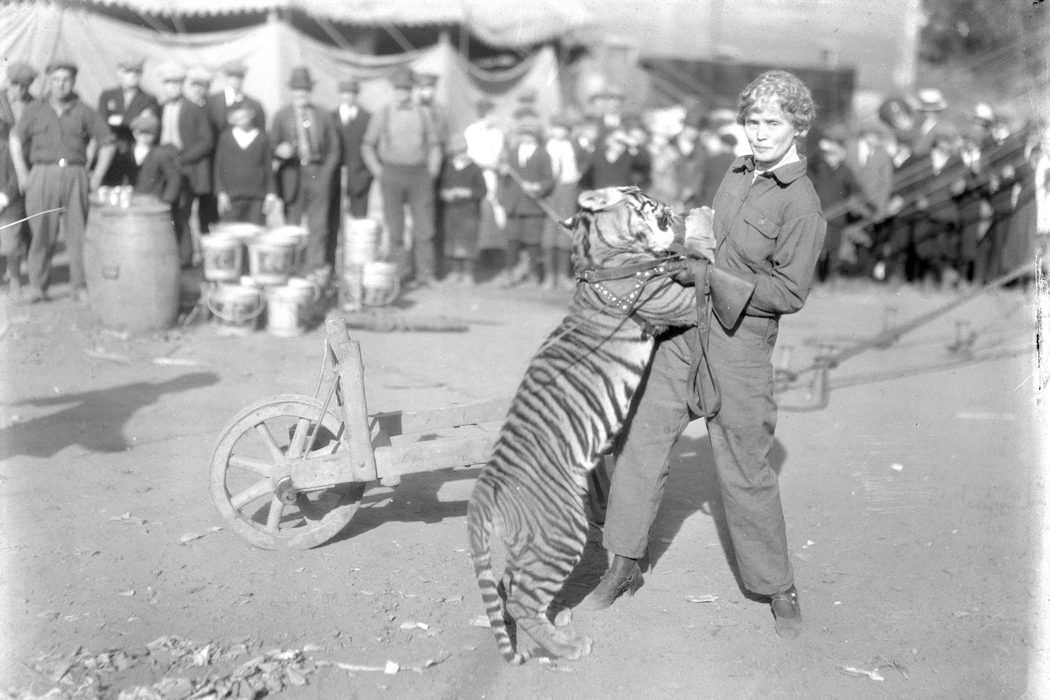
Mabel Stark tamed tigers – and even wrestled with them. Circus and Allied Arts Collection, Illinois State University’s Special Collections, Milner Library

For the sharpest minds in show business, there’s always another hustle.

Take Joe Exotic, whose 2020 conviction for a murder-for-hire plot and violations of the Endangered Species Act hasn’t kept the eccentric tiger trainer out of the headlines.

Since beginning his 21-year sentence, the “Tiger King” star has started a cannabis brand, hawked digital art and begun work on an album tentatively titled “Jungle Rhapsody: A Tiger King Experience.” His most recent gambit involves selling personal phone calls from his cell – “What better Valentines gift could you ever get your loved one,” he posted on Instagram in January 2026.

But before Joe Exotic, there was Mabel Stark. Often described as America’s most famous female tiger trainer, the Tiger Queen was renowned for her pluck and charisma.

While researching Caxton Printers, the publisher of Stark’s autobiography, I came across unpublished archival material about Stark’s long career training animals. Like Joe Exotic, Stark had a knack for the spotlight. But even more impressively, she did it under the scrutiny of being a woman in a male-dominated world, while caring for her animals with love rather than fear.

From nurse to tiger trainer

Born Mary Ann Haynie in 1888 or 1889 – the exact year has always been a mystery – Stark grew up in Princeton, Kentucky. When she was 8 years old, she attended her first circus, where she was awed by the performances of trained animals.

Two decades would pass before she got a chance to try her hand at animal training.

Taking a vacation in California from her job as a nurse, Stark met Al Sands, manager of the Al G. Barnes Circus. After learning of her interest in training animals, he hired her on the spot.

Stark started by riding horses and training goats. It would take several years before she started working with tigers. But once she did, her career took off.

Crowds gathered to watch the “Tiger Girl” wrestle with big cats and wow audiences by commanding a dozen tigers at a time to follow her lead. Her wrestling act with her favorite tiger, Rajah – in which the duo would roll three or four times on the ground – became one of the best-known cat acts in the U.S.

She leveraged that success to join the Ringling Circus – the largest circus in the U.S. – for twice the pay.

As her popularity grew, Stark collaborated with screenwriter Gertrude Orr to write her life’s story.

Hold That Tiger” hit bookstores in 1938. Caxton Printers, a small publishing company in rural Idaho, issued the book and marketed it primarily to young readers. It proved popular, selling well enough to warrant multiple reprintings.

Known for giving a voice to first-time writers and authors from underrepresented groups, Caxton Printers found a niche market for circus-related titles. It also published books about Stark’s first employer, Al Barnes, as well as the Ringling Brothers and renowned lion trainer Louis Roth, who also happened to be one of Stark’s ex-husbands.

Female power in the ring

Stark was acutely aware of the path she was paving.

“I deliberately chose a field in which no other woman had specialized,” she wrote in her autobiography.

The conventional wisdom at the time, she added, was that “tigers were considered too dangerous for a woman to handle.”

Stark’s willingness to defy convention mattered. As circus historian Janet M. Davis noted, “circus women’s performances celebrated female power” and represented “a startling alternative to contemporary social norms.”

In early-20th-century American life, women might not have been able to vote or to serve on juries in most states, but in the ring, they commanded the audience’s attention riding bareback on horses, displaying strength and stamina, and performing gravity-defying acrobatic feats.

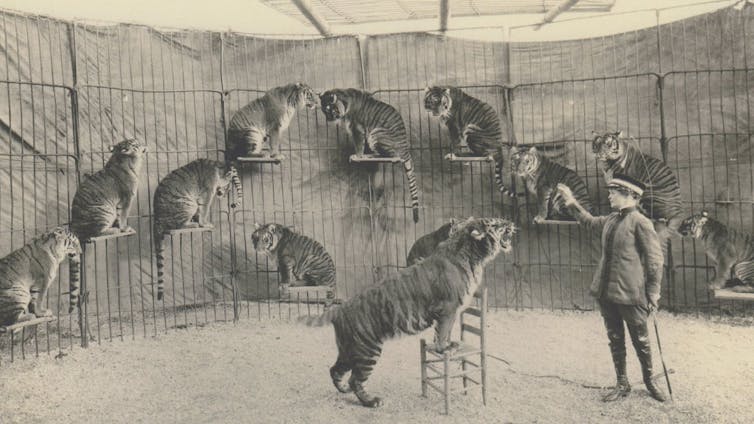
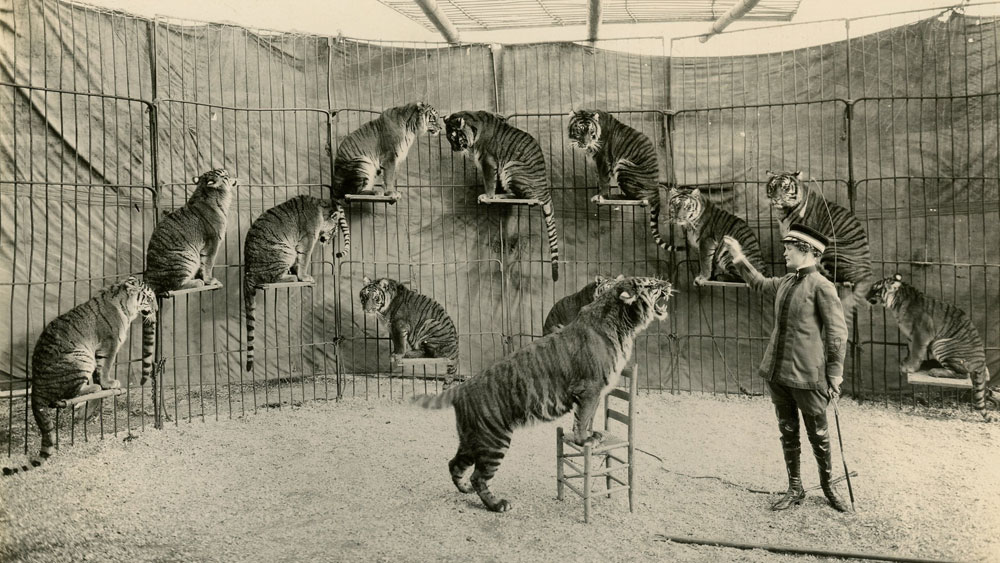
Stark’s schedule was relentless. She performed almost daily with traveling circuses, and she continually refined her act. In 1938, she worked with both tigers and lions at the same time, a first for a female trainer. She made history again working with 12 tigers in one cage.

A woman stands to the right of a tiger balancing on a chair with its front paws. In the background, a row of big cats pose on ledges.
Mabel Stark was able to work with 12 tigers in one cage.
Cinema Libre Studios

Whether it was due to the demands of her schedule or her preference for her cats, Stark’s relationships with men rarely worked out.

Over the course of her life, Stark married four times, three of which ended in divorce.

“I love these big cats as a mother loves her children,” she admitted to a friend. But “with husbands I was never happy.”

‘An animal trainer can’t have nerves’

Stark, aware of other trainers’ abusive behavior toward their tigers, took a different route.

“Kindness and patience are the biggest factors in training. … Trainers who try to beat animals into submission always get into trouble,” she said.

Yet her trade was not without danger.

“An animal trainer can’t have nerves. I haven’t had any since I gave up nursing,” she said in a 1922 New York Times interview. “They may be planting violets on me tomorrow, but while I have my health and strength, I’d rather take care of 10 tigers than a sick person.”

Stark had several serious accidents. Perhaps the worst was in 1928: After a circus train arrived late, Stark started her act without realizing her tigers hadn’t been fed for 24 hours. Two famished tigers attacked Stark after she fell in mud.

“As I lay there, helpless,” she wrote, “I wondered into how many pieces I would be torn, and how long it would take for the other tigers, growling and snarling restlessly on their seats, to finish me.” She suffered multiple broken bones, nearly lost her leg and required 300 stitches.

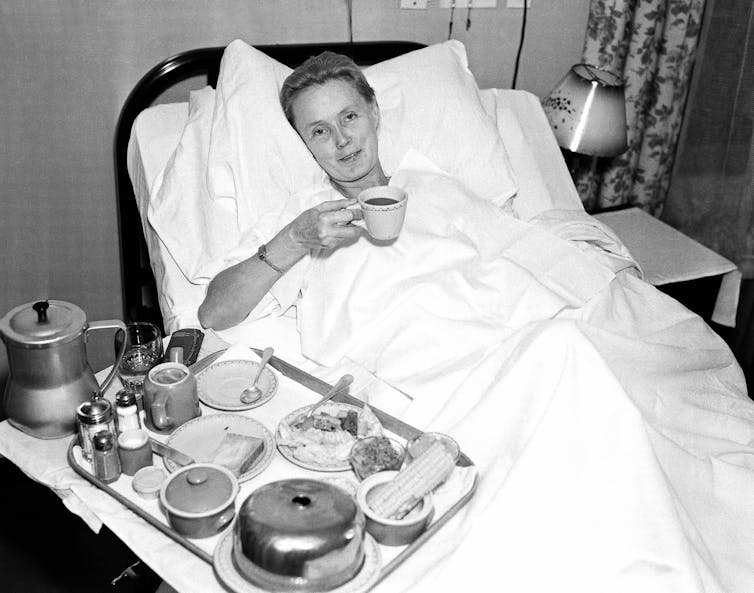
Woman holds a cup of tea while lying in a hospital bed.
Mabel Stark recovers in a Los Angeles hospital after her left arm was bitten by a tiger in 1935.
AP Photo/LMM

Another incident took place in 1950, when a tiger mauled her as she reached for its cub. Doctors initially thought they would have to amputate her arm but managed to save it.

Despite these close calls with her tigers, Stark maintained that “I am not afraid. I like the challenge of their roaring defiance.”

The stark reality

Stark toured with circuses until the late 1940s, when she was hired by Jungleland, a zoo located outside of Los Angeles.

Save for the three-and-a-half years she lived in Japan touring with her wild cat act, she spent the last 20 years of her career at Jungleland.

Stark never stopped drawing crowds to her show, nor did she shy away from the spotlight. She even appeared on the game show “What’s My Line?” in 1961 as a contestant whose profession the panel had to guess.

“Each year has left scars on my body, but it has also brought a full measure of happiness,” she recalled.
Stark worked at Jungleland until she was fired in 1967 after the park’s insurance company stopped covering her. Being away from her tigers devastated her, and she died by suicide just months later on April 20, 1968, at her home in Thousand Oaks.

The concluding paragraph of Stark’s autobiography anticipates the end of her life:

“The chute door opens as I crack my whip and shout, ‘Let them come!’ Out slink the striped cats, snarling and roaring, leaping at each other or at me. It’s a matchless thrill, and life without it is not worth while to me.”

The Conversation

Alessandro Meregaglia has received funding from the Idaho Humanities Council, the Bibliographical Society of America, and Boise State’s Institute for Advancing American Values for his research on Caxton Printers.

ref. The inspiring and tragic story of Mabel Stark, America’s most famous female tiger trainer – https://theconversation.com/the-inspiring-and-tragic-story-of-mabel-stark-americas-most-famous-female-tiger-trainer-276570

Formerly incarcerated Black men say they’re ‘doing OK’ while trying to cope with depression and PTSD

Source: The Conversation – USA (3) – By Helena Addison, Postdoctoral Fellow, Yale University

Community-based walk-in clinics and behavioral health centers can help men returning from jail or prison find support. Jacob Wackerhausen/iStock via Getty Images Plus

“People can assess me, interview me, incarcerate me, observe me, and they can think they know what I need,” said Shawn, a man in his early 50s who spent 15 years in and out of prison. “And that can be an educated assessment, but at the end of the day, I live inside of this body, inside of this head. I know what I need.”

Shawn is one of 29 formerly incarcerated Black men living in Philadelphia I interviewed as part of my research on coping with the mental health effects of imprisonment. His name and the names of other people quoted in this article are pseudonyms chosen to protect their privacy.

I study incarceration, mental health and access to health care. I’ve previously written about how confinement in jails and prisons leaves a lasting impact on mental health. But I also wanted to understand how the men I interviewed recognized and addressed their own mental health needs — through coping strategies, conversations with friends and family, and seeking mental health treatment.

Depressed but ‘doing OK’

Both research and clinical practice often fail to accurately capture how formerly incarcerated Black men identify their own mental health needs. That’s in part because implicit bias and anti-Black racism shape how mental health is assessed and treated in both correctional and community facilities.

Most of the men I spoke with said the mental health evaluations they received while incarcerated were designed only to “check the boxes” and conveyed a sense that no one really cared.

“They’d listen. They’d ask the pertinent questions,” Malcolm, 62, explained. “Then they’d talk down to you. And then they forget all about you.”

A few of the men received diagnoses they didn’t understand or believe. John, 29, described how a judge ordered him to have a mental health evaluation and that he was diagnosed as having post-traumatic stress disorder.

“I didn’t take it serious,” he said. “I didn’t start understanding mental health and believing it until I was locked up for a long period of time. I started reading up on it and studying it. …That’s how I started understanding therapy was important.”

Comparing the way participants described their mental health in their own words during the interviews with standardized screening tools revealed an important pattern. Most described themselves as “good,” “blessed,” “at peace” or “doing OK.” Yet nearly all reported symptoms of depression, anxiety or PTSD.

More than half reported three or more PTSD symptoms, such as trauma-related nightmares or feeling constantly on guard and easily startled.

These findings underscore that what appears to be resilience or well-being on the surface may mask underlying mental health needs, and the way those needs are expressed is shaped by culture and life experiences.

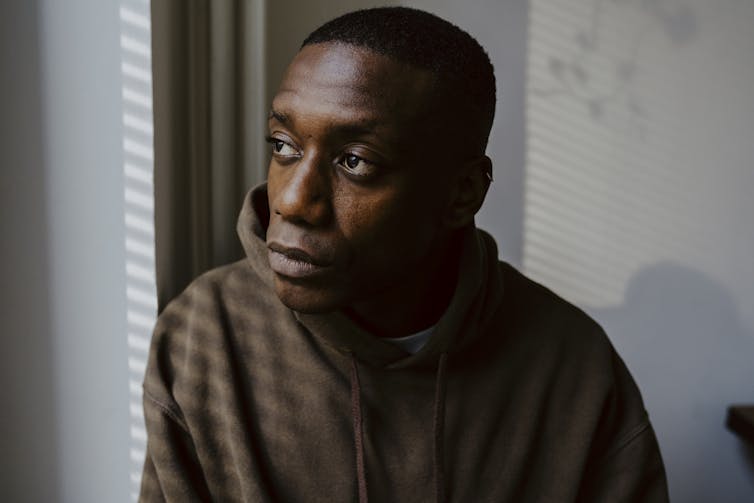
Young Black man wearing brown sweatshirt looks thoughtfully out of a window.
An appearance of resilience may mask underlying mental health needs.
Maskot/Maskot Collection via Getty Images

Coping mechanisms

Participants described self-reliance as essential to coping with incarceration and life after release. Physical separation from family and community, along with strained relationships and limited resources after release, left many feeling like they had to manage mental distress on their own.

“When you’re in prison, you learn to depend on yourself,” Ken, 56, said.

Some said incarceration reinforced existing coping strategies they’d had, such as exercising, praying, journaling, reading and meditation.

“I was always into being active,” said Tay, 31, who took part in a military-style bootcamp while incarcerated. “I learned how to use [exercise] to cope with my emotions.”

Others were introduced to new coping skills through educational, vocational and recreational programs inside their correctional facilities. Men spoke about how earning GEDs, taking college courses, learning trades and participating in other structured programs helped them manage stress and connect with others.

Unfortunately, the availability of such programs is limited.

Bottled-up feelings

Many of my study’s participants described wanting to “do things differently” after incarceration by expressing their emotions rather than suppressing them.

Some directly connected bottling up feelings to behaviors that had led to their incarceration.

“[You’ve] let a lot of stuff build up and then [you’ll] go outside and lash out on the first person you see,” David, 30, explained. “I’m getting more comfortable with expressing myself, whether it’s to my mom or if it’s to a friend.”

But finding the right people to confide in could be difficult.

“I try to express myself every day. People laugh and make a joke out of it,” Shakur, 21, said. “If I had somebody sitting one-on-one, talking to me about my problems, I’d feel better.”

Navigating romantic relationships was also difficult.

“We come back to them broken. And they trying to fix us, but they don’t know how to fix us. They’re broken too,” said Thomas, 44.

Mass incarceration doesn’t just fracture individuals – it erodes romantic relationships, as those left behind often navigate their own economic strain, limited resources and emotional distress.

Participants emphasized that speaking with people who shared similar experiences made it easier to express themselves and helped them navigate moments of distress.

Deep distrust of institutions

Many participants expressed deep distrust of mental health treatment within correctional facilities.

“Being a Black man living to 62 years old, I don’t trust the government from the Tuskegee experiment to the thing they had going on in Holmesburg prison,” said Carl. “How can you put your trust in that?”

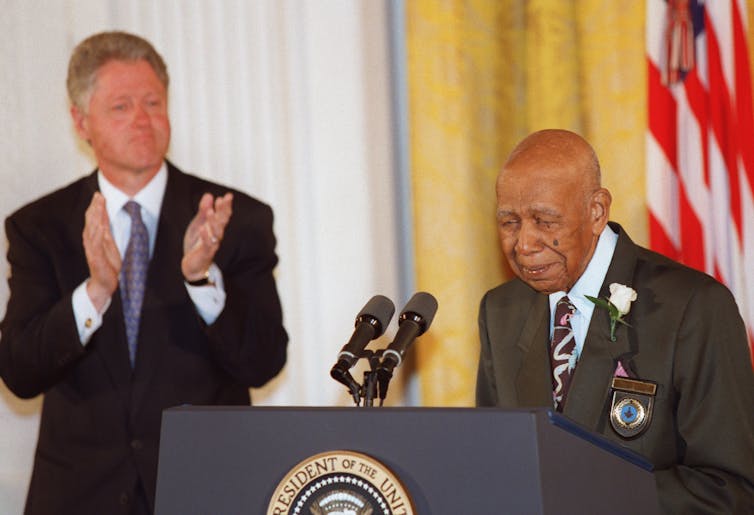
Older Black man in suit stands at presidential podium while grey-haired white man claps hands behind him
Herman Shaw, 94, shown here with former President Bill Clinton in 1997, was one of nearly 400 Black men who were part of a government study that began in 1932. The participants were told that they were being treated for syphilis, but they were actually given a placebo.
Paul J. Richards/AFP via Getty Images

The Tuskegee study was a research study conducted by the U.S. federal government from 1932 to 1972. It followed Black men with syphilis but withheld effective treatment, even after the cure was made widely available in the 1940s. This caused preventable suffering and deaths.

During the Holmesburg Prison experiments, conducted at a Philadelphia prison from the 1950s through the 1970s, University of Pennsylvania researchers tested pharmaceuticals and chemicals on incarcerated men, many of them Black, without adequate informed consent.

Some of the men I interviewed also reported experiencing or witnessing mistreatment after reporting mental health concerns, and they expressed fears that seeking help while incarcerated would lead to punishment rather than support.

Stigma and seeking help

After release, participants shared concerns that they would be seen as “weak” by their peers for talking about their problems. This mental health stigma served as a barrier to seeking treatment.

“It’s not normal for guys like us, as far as being Black, African American, to reach out to a therapist,” said David.

Some men, like Antonio, who described feeling “like walls was closing in on me,” were motivated to seek treatment due to significant mental distress. Others were driven by a desire to improve their relationships with their wives or children.

Nearly 70% of participants had used formal mental health services at some point. Some were mandated to receive treatment, while others sought help voluntarily – sometimes at local walk-in clinics and behavioral health centers such as Wedge Recovery Centers, a Philadelphia staple that was mentioned by several participants but closed in May 2025 due to financial losses.

Communities can work together to reduce stigma around seeking mental health support and formal treatment, take expressions of mental distress from formerly incarcerated men seriously, and create spaces where they feel safe being vulnerable.

Participants named visible, neighborhood clinics with walk-in behavioral health services as places they felt able to go in moments of need. Increasing the visibility of these services, conducting outreach and integrating formerly incarcerated men as peer navigators can help build trust.

Read more of our stories about Philadelphia, or sign up for our Philadelphia newsletter on Substack.

The Conversation

Helena Addison received funding from National Institute of Nursing Research of the National Institutes of Health under Award Number F31NR020434, the Substance Abuse and Mental Health Administration and American Nurses Association Minority Fellowship Program, the University of Pennsylvania’s Presidential PhD Fellowship, and Jonas Philanthropies to support this study and/or her PhD training.

ref. Formerly incarcerated Black men say they’re ‘doing OK’ while trying to cope with depression and PTSD – https://theconversation.com/formerly-incarcerated-black-men-say-theyre-doing-ok-while-trying-to-cope-with-depression-and-ptsd-275071

What is happiness? A philosopher looks for answers

Source: The Conversation – Africa – By Anné H. Verhoef, Professor in Philosophy, North-West University

When we seek happiness, what exactly are we searching for? And when we wish happiness on someone else, what is it that we truly desire for them?

Can happiness even be defined or is it an illusion, an impossible desire to fulfil? So then why are there so many happiness self-help books? What do they promise and can they be attained? Is it possible to measure happiness? If so, how do ordinary people and scientists do that?

To answer these questions, I explored different definitions of happiness in my book Happiness, Unhappiness, and Chance. The book is based on my PhD study in philosophy.

Happiness today is narrowly defined by some positive psychologists as a joyous state of mind or well-being.

The happiness sciences see it as something you can calculate and quantify. They developed a Happiness Index and the World Happiness Report. These basically measure happiness as satisfaction, with criteria like gross domestic product per capita (money) and life expectancy (health) as some of the factors considered.

But happiness is also defined by our capitalist, consumer-driven society as certain aspirational products, brands and lifestyles. These consumerist definitions are often exaggerated by influencers on social media, but also through the manipulation of consumers by the online algorithms behind the digital tools we use. Increasingly, this also happens through artificial intelligence.

All these different definitions of happiness create their own problem for happiness. In fact they can lead to more unhappiness than happiness.

Joy and pleasure are often short-lived and unsustainable; well-being can quickly be ruined by illness and fate; owning certain brands, products and lifestyles exposes us to the trap of the “hedonistic treadmill,” which causes one “to rapidly and inevitably adapt to good things by taking them for granted”.


Read more:
How much money do you need to be happy? Here’s what the research says


Happiness that’s reduced to a single and simple definition does not consider the complexity of being human, of the societies we live in, and the fragile relationship we have with the environment.

My book searches for a more inclusive and encompassing definition of happiness. A happiness that is more than just joy or well-being, more than an ethical or good life. More than just good and meaningful human relationships. More than just luck, the absence of pain or a by-product of consumption. More than just a meaningful, fulfilled and content life.

I wanted to find out if a better understanding of happiness can be formed and actually achieved. One that considers all cultures and also factors like justice and caring for each other and the environment.

Can this kind of understanding of happiness, I wondered, not be a powerful motivation to live and work for a better future for all?

Consumerism

To explore the potential of such a philosophical understanding of happiness, we first need to understand why the current dominant definitions of happiness don’t work anymore.

Today, consumerism and capitalism are the forces behind the digital technologies that manipulate our understanding of happiness. Consumerism, with its “you-must-have-this-or-that-to-be-happy” approach, became so powerfully enforced through today’s digital platforms that it became a question of whether we can still envision, hope, and live for something more than what the algorithmic ecologies we live in present to us.

Happiness sciences

Happiness sciences, as the power behind happiness within our contemporary global happiness culture, proclaim that happiness is something one must work for and must achieve. Happiness itself is becoming so all-consuming that it is like a new religion. US historian Darrin McMahon describes the situation thus:

At the dawn of the modern age, God was happiness; happiness has since become our God.

Consequently, happiness becomes and remains an exhausting and impossible task which paradoxically makes one more unhappy. In this process people give up on happiness and may even become cynical due to this impossible pressure to be happy in a certain way.

Religion

Globally, the strongest power behind certain forms of happiness, especially as “true and eternal” happiness, is religion.

The type of happiness some religions offer is one where the ideal is that unhappiness should be overcome or will be in an afterlife. Some religions teach that true happiness can only be achieved in the afterlife, in heaven or nirvana, for example. They proclaim it is impossible to find true happiness in this world, or in the here and now.


Read more:
Why leisure matters for a good life, according to Aristotle


It is a happiness where this life is not fully affirmed because happiness can’t be attained. It is still to come. In effect it is not only giving up on the possibility of happiness, but on “true” goodness and beauty in daily life.

Philosophy

As alternative to these problematic understandings of happiness, and the different driving forces behind them, I used well-known French philosopher Paul Ricoeur’s thinking to guide me. He argued that happiness should and could not be defined as the overcoming of unhappiness. Such an attempt will always be futile. It denies unhappiness as part of the fundamental reality and fullness of life, and leaves us with an impossible and unhappy task. Happiness and unhappiness are always in relation to each other, and the one does not mean the annihilation of the other.


Read more:
Lifetime trends in happiness change as misery peaks among the young – new research


Secondly, the relationship between happiness and unhappiness is situated within our fragile ability to work for happiness. Yet, at the same time, to be aware that receiving happiness is not just hard work but can be a result of chance. Unhappiness can be in the form of unexpected tragedy.

The tension between striving for happiness and receiving happiness unexpectedly should remain. We should continue to work at contributing to our own and others’ happiness. But if we try to always be in control we will become exhausted. So we should also keep on allowing space for chance – as luck and tragedy – in our lives.

Why this matters

The ability to think and dream again about a different kind of happiness, one that is connected to our lives (not the technological world of the present), our desires (not those manipulated by consumerism), and the needs of the world – which includes unhappiness and injustice – has become increasingly important today.

We need better definitions of happiness in a world where the term is constantly corrupted and used by consumerism, politicians, prosperity evangelicals, the self-help industry, and in algorithmic technologies.

Such happiness should be able to affirm our lives, here and now. Such affirmation will become more important as our lives are more manipulated and controlled by technology and consumerism.

I argue in my study that this affirmation of life allows for a happiness that can include and respond to unhappiness and chance. Life itself is one thing we should not give up on; otherwise, happiness will also become irrelevant.

The Conversation

Anné H. Verhoef does not work for, consult, own shares in or receive funding from any company or organisation that would benefit from this article, and has disclosed no relevant affiliations beyond their academic appointment.

ref. What is happiness? A philosopher looks for answers – https://theconversation.com/what-is-happiness-a-philosopher-looks-for-answers-276091