A culinary educator and local dining expert breaks down Michelin’s debut Philly list − and gives zero stars to the inspectors

Source: The Conversation – USA (2) – By Jonathan Deutsch, Professor of Food and Hospitality Management, Drexel University

Working in restaurants is physically, mentally and emotionally taxing and often thankless work. So it was wonderful to see so many hardworking friends in the Philadelphia dining industry recognized at the Michelin Guide’s 2025 Northeast Cities Ceremony in Philadelphia on Nov. 18, 2025.

Three Philadelphia restaurants each received a star: Provenance, Friday Saturday Sunday and Her Place Supper Club. In addition, 10 other food destinations received a Bib Gourmand for providing “exceptionally good food at moderate prices,” and 21 received Michelin-Recommended status. Pietramala was the sole winner of a green star for sustainability.

I’m especially proud that the Culinary Arts and Science program at Drexel University, where I teach, has had student co-ops and employees, as well as alumni, at all three starred restaurants.

As a classically trained chef, culinary educator and author of the textbook “Culinary Improvisation,” which teaches culinary creativity, I’ve been following the Michelin developments in Philadelphia closely. I am also a contributor to The Infatuation Philly, whose mission is to bring you honest and trustworthy opinions about where to eat. I spend a good amount of time experiencing and reviewing restaurants.

In “Culinary Improvisation,” my co-authors and I discuss the “ingredients” needed to foster culinary innovation: mastery of culinary technique, access to a diverse range of ingredients and flavors, and a collaborative and supportive environment to take risks and make mistakes.

I worried that Michelin, while good for bringing more tourist dollars and recognition to the city, would be bad for fostering some of the very qualities that already make Philadelphia one of the most innovative and high-quality dining cities in the country.

I was particularly concerned that the freedom to experiment, create and innovate would be stifled under the spotlight of outside inspectors.

According to the Michelin Guide, stars are awarded to outstanding restaurants based on: “quality of ingredients, mastery of cooking techniques and flavors, the personality of the chef as expressed in the cuisine, value for money, and consistency of the dining experience both across the menu and over time.”

The criteria do not mention innovation.

Man and women in formalwear kiss on a stage behind a podium that says '2023 James Beard Awards'
2025 Michelin star winners Hannah and Chad Williams, the husband-and-wife team behind Friday, Saturday, Sunday, accept the award for Outstanding Restaurant at the 2023 James Beard Restaurant And Chef Awards.
Jeff Schear/Getty Images for The James Beard Foundation

Some confounding snubs

The three Philly restaurants that were awarded stars are all deserving, but I believe there are so many oversights, especially on the creativity and innovation front. Reviewing the reviewers, I don’t think they deserve a star.

Within the city boundaries, Emmett, Fork, Vernick Fish, Ogawa, Rice and Sambal, Elwood, Alice, Fiore, a.kitchen, Perla, Bastia, Blue Corn, Little Fish, Mawn, Lacroix and Le Virtu all stand out to me as places that embody the creative energy of Philly’s dining scene and should be at least recommended.

While the guide refers to “Philadelphia and surroundings,” and a Michelin representative reportedly indicated that suburban restaurants would be considered, no restaurants outside the city limits were honored. Did the inspectors not want to battle rush-hour traffic to visit the comforting yet exciting things happening at Cornerstone, June BYOB, Hearthside, Zeppoli, Park Place, Ripplewood, Andiario, Lark and The Choice?

The three recommended cheesesteak places – Dalessandro’s, Del Rossi’s and Angelo’s – are arguably fine, but it’s a tourist stereotype to include so many.

In contrast, China Gourmet, Nom Wah, Bai Wei, E-Mei, Café Nhan, South Philly Barbacoa, Black Dragon, Doro Bet, Farina di Vita and John’s Roast Pork received no mention by Michelin – while all are on my short list to recommend to visitors looking for great food at a good value.

Philadelphians know that cheesesteak may be obligatory for visitors, but the roast pork sandwich – ideally with provolone, broccoli rabe and long hots – is the real reason to visit.

James Beard darling Mawn didn’t make the list, nor did the [omakase experience at Royal Sushi and Izakaya], which Philly food media thought was a given for a star. The casual izakaya part of the restaurant did receive a Bib Gourmand, but the review doesn’t mention the food at the omakase bar, leading chef-owner Jesse Ito and Philly food critic Craig LaBan to speculate that Michelin inspectors couldn’t get a reservation. If that’s the case, it’s inexcusable. When asked, a Michelin spokesperson said they don’t “reveal specifics.” Michelin inspectors should do the work to get into the critically acclaimed places.

As for Mawn: Wait in line for their no-reservation lunch like the rest of Philly.

Where to eat now?

As a strategy for building tourism, filling seats during lunch hours and early in the week, and recruiting out-of-town restaurant talent, Michelin makes a lot of sense for Philly. But many people don’t realize that Michelin is pay-to-play in the locations included in its guides, so Philly’s lack of Michelin stars before last month should not indicate that the city’s restaurant scene was not already Michelin-worthy. We just hadn’t paid for the privilege of being inspected.

Additionally, Michelin awards are just one of many awards and accolades that Philly restaurants can get.

The Philadelphia Convention and Visitors Bureau has not stated how much they paid to have an outside for-profit company come and confirm that Philly indeed has good restaurants. But in 2024, Houston reportedly agreed to pay the Michelin Guide $270,000 for the privilege. Assuming Philadelphia paid a similar amount, if not more, that averages to about 100K per star.

In Philadelphia, that money could have been used for scholarships for culinary students, workforce development training ahead of the city’s celebration of the nation’s 250th birthday or strengthening high school and community college culinary and hospitality programs. It could have gone to tax incentives or lowering hurdles for underrepresented or emerging restaurateurs – uses I believe would make Philly’s food scene even stronger.

Instead it was used to give restaurants that had already received prestigious James Beard awards and other recognition even more kudos – making them even more difficult to get into for Philadelphians and tourists alike.

In a city known for its grit, doing its thing whether you like it or not, and thumbing its nose at New York and Washington, D.C., this whole thing strikes me as very un-Philly.

I’m going to make it a point to visit all the restaurants I love that haven’t gotten the credit they deserve. With over 6,000 restaurants in Philadelphia, I’ll be busy. The tourists can have the Michelin places until the hype dies down.

Read more of our stories about Philadelphia, or sign up for our Philadelphia newsletter on Substack.

The Conversation

Jonathan Deutsch does not work for, consult, own shares in or receive funding from any company or organization that would benefit from this article, and has disclosed no relevant affiliations beyond their academic appointment.

ref. A culinary educator and local dining expert breaks down Michelin’s debut Philly list − and gives zero stars to the inspectors – https://theconversation.com/a-culinary-educator-and-local-dining-expert-breaks-down-michelins-debut-philly-list-and-gives-zero-stars-to-the-inspectors-271049

Buying a gift for a loved one with cancer? Here’s why you should skip the fuzzy socks and give them meals or help with laundry instead

Source: The Conversation – USA (3) – By Ellen T. Meiser, Assistant Professor of Sociology, University of Hawaii at Hilo

Fuzzy socks are a popular gift for people with a serious illness such as cancer. pepifoto/iStock via Getty Images Plus

The season of gifting is in full swing – a time when people scour the internet and shops of all kinds for items that appropriately symbolize their relationships with their loved ones.

Gift givers hope that their gift will appropriately communicate their feelings and bring the recipient joy. But that’s not always the reality. Gifts can be tricky and rife with hidden hazards. Relationships can even be ruined when the mismatch between the giver’s intention and the recipient’s perceptions of it is too vast.

The circumstances of the people involved also shape a gift’s meaning and the way it might be interpreted.

My research partner, Nathalie Rita, and I have been seeking to better understand gifting in one of life’s most dicey, distressing circumstances: cancer.

As sociologists, we use techniques such as in-depth interviews to study the experiences, feelings and motivations of specific groups of people. I focus on restaurant workers and my colleague on migrants and minorities. But in 2021, we were both diagnosed with cancer in our early 30s – breast cancer for me and endometrial cancer for her. This encouraged us to explore the experiences of other young women dealing with cancer.

By 2023, we had interviewed 50 millennial women diagnosed with cancer about a plethora of social and emotional topics related to their illness. Our own bouts with cancer revealed curious patterns in the gifts we very gratefully received from family and friends. So, we included a few questions about gifts in our research.

We expected some eccentric anecdotes similar to our own experiences. But our research, which isn’t yet published, revealed just how much of a mismatch there is between what people wanted and what they received – often driven by the marketing of specific gifts or care packages for cancer patients.

What loved ones give

One of our first questions was, what exactly do women diagnosed with cancer receive from their loved ones? Their answers ran the gamut. Our interviewees reported hundreds of gifts, from stuffed possums to child care help to Vitamix blenders. Friends and family were very eager to shower them in goods.

But from these hundreds of items and acts, 10 popped up over and over again. In order of frequency, they were:

  1. Fuzzy socks.
  2. Food and drinks, particularly herbal teas, groceries, gourmet goodies and Meal Trains.
  3. Money, GoFundMe donations and gift cards.
  4. Blankets.
  5. Fancy, spa-style self-care items.
  6. Written thoughts and prayers.
  7. Flowers and plants.
  8. Mugs, tumblers and bottles.
  9. Adult coloring books.
  10. Books.

The women we spoke with largely understood and appreciated the intentions behind these items in the context of their illness: books to distract, flowers to beautify. They viewed the gifts as material proof that their loved ones wanted to deliver comfort and support in a time of discomfort and helplessness.

But the frequency of certain items perplexed us. Why socks and coloring books instead of, say, Rollerblades and bongs?

The long shadow of online commerce and gift guides

We traced these gifting trends to two sources: premade cancer care packages and online gift guides.

Numerous women reported receiving some of the items from our top 10 list in premade care packages sourced from Etsy, Amazon or cancer-specific companies such as Rock the Treatment and The Balm Box. They noted that the contents of these packages felt predictable: spa-style self-care goods such as aromatherapy oils, lip balms and soy candles; herbal teas; a mug with a slogan or ribbon; and hard candies or throat lozenges.

Some received more opulent care packages, similar to Rock the Treatment’s large chemo care package for women, which adds adult coloring books, protein-rich snacks, a beanie and fuzzy socks. These additions mirror our interviewees’ top 10 received gifts even more closely.

Online gift guides published by magazines, news sites and stores may be influencing gifters’ behaviors, too. A Google search for “gift guide” yields countless lists for niche demographics – chicken lovers, mathematicians, even people who are always cold. Online viewership of these lists is prolific. For example, New York Magazine’s product recommendation site, The Strategist, received 10.7 million monthly views in 2021.

The top seven Google-ranked gift guides for cancer patients also contain suggestions that align almost perfectly with what our interviewees reported, with the addition of clothing and jewelry emblazoned with inspirational declarations such as “I’m stronger than cancer!”

These overlaps reflect the broader phenomena of the commodification and commercialization of cancer. As businesses seek to extract economic value out of all aspects of daily life, cancer has become a lucrative business opportunity and patients a source of profit.

Our research suggests that these market forces warp how gift givers perceive people with cancer and their desires. In turning cancer into something profitable, the ugly parts of illness are also glossed over to make cancer palatable to the market. Businesses then sell would-be gifters the idea that cancer can be assuaged by purchasing and giving a bejeweled, teal-ribboned Stanley tumbler.

Additionally, while premade care packages ease the labor of decision-making for gifters, they run a greater risk of disappointing recipients. These generic boxes, we found, can communicate a degree of thoughtlessness at a time when our study participants were aching for thoughtfulness.

Woman delivering groceries to a neighbor
Practical gifts, such as bringing groceries, can help relieve daily stressors for people coping with a serious illness.
SDI Productions/E+ via Getty Images

What to actually gift

So, what do women going through cancer treatment actually want to receive? Our interviewees recommended:

  1. Money in the form of cash or useful gift cards, such as for Door Dash, grocery stores and Petco.
  2. Meals and groceries, particularly if the recipient is a parent with mouths to feed.
  3. Help with errands and tasks such as babysitting, transportation, cleaning and lawn care.
  4. Cards and personal messages of love, which serve as check-ins and gestures of care and support.
  5. Practical self-care items such as thick lotions, face masks and soft soaps that don’t irritate skin.

Pragmatic. Simple. Even a little mundane.

There is some overlap between these recommendations and the frequently received gifts mentioned earlier. But notably, almost none of the women we interviewed expressed a desire for the nonessential items usually stocked in commercial care packages or those associated with profiting from cancer.

Instead, the gifts they felt touched them more deeply were ones that addressed ways in which they felt the disease incapacitated their abilities as a worker, woman, mother or caregiver.

Our interviewees spoke of financial strain from medical bills, fatigue preventing them from mothering in ways they used to, and mounting burdens that made it almost impossible to be present for partners or spouses. A monstera plant in a whimsical vase offered little reprieve from these pressures. However, a chat while folding laundry or a Pyrex of enchiladas did.

Perhaps most importantly, such offerings made them feel cared for and seen – their unvarnished circumstances recognized.

So, if a friend with cancer – or any other serious illness, for that matter – is on your list this holiday season, consider hanging those fuzzy socks back on the rack.

Instead, mull over their daily stresses, and choose an item – or a task – that provides a bit of relief.

The Conversation

Ellen T. Meiser does not work for, consult, own shares in or receive funding from any company or organization that would benefit from this article, and has disclosed no relevant affiliations beyond their academic appointment.

ref. Buying a gift for a loved one with cancer? Here’s why you should skip the fuzzy socks and give them meals or help with laundry instead – https://theconversation.com/buying-a-gift-for-a-loved-one-with-cancer-heres-why-you-should-skip-the-fuzzy-socks-and-give-them-meals-or-help-with-laundry-instead-268642

‘Yes’ to God, but ‘no’ to church – what religious change looks like for many Latin Americans

Source: The Conversation – USA (3) – By Matthew Blanton, PhD Candidate, Sociology and Demography, The University of Texas at Austin

A woman takes part in a Christ of May procession in Santiago, Chile, parading a relic from a destroyed church’s crucifix through the city. AP Photo/Esteban Felix

In a region known for its tumultuous change, one idea remained remarkably consistent for centuries: Latin America is Catholic.

The region’s 500-year transformation into a Catholic stronghold seemed capped in 2013, when Jorge Mario Bergoglio of Argentina was elected as the first Latin American pope. Once a missionary outpost, Latin America is now the heart of the Catholic Church. It is home to over 575 million adherents – over 40% of all Catholics worldwide. The next-largest regions are Europe and Africa, each home to 20% of the world’s Catholics.

Yet beneath this Catholic dominance, the region’s religious landscape is changing.

First, Protestant and Pentecostal groups have experienced dramatic growth. In 1970, only 4% of Latin Americans identified as Protestant; by 2014, the share had climbed to almost 20%.

But even as Protestant ranks swelled, another trend was quietly gaining ground: a growing share of Latin Americans abandoning institutional faith altogether. And, as my research shows, the region’s religious decline shows a surprising difference from patterns elsewhere. While fewer Latin Americans are identifying with a religion or attending services, personal faith remains strong.

Three women in white robes and caps stand outdoors at nighttime by a large wooden cross.
Women known as ‘animeras,’ who pray for the souls of the deceased, walk to a church for Day of the Dead festivities in Telembi, Ecuador.
AP Photo/Carlos Noriega

Religious decline

In 2014, 8% of Latin Americans claimed no religion at all. This number is twice as high as the percentage of people who were raised without a religion, indicating that the growth is recent, coming from people who left the church as adults.

However, there had been no comprehensive study of religious change in Latin America since then. My new research, published in September 2025, draws on two decades of survey data from over 220,000 respondents in 17 Latin American countries. This data comes from the AmericasBarometer, a large, region-wide survey conducted every two years by Vanderbilt University that focuses on democracy, governance and other social issues. Because it asks the same religion questions across countries and over time, it offers an unusually clear view of changing patterns.

Overall, the number of Latin Americans reporting no religious affiliation surged from 7% in 2004 to over 18% in 2023. The share of people who say they are religiously unaffiliated grew in 15 of the 17 countries, and more than doubled in seven.

On average, 21% of people in South America say they do not have a religious affiliation, compared with 13% in Mexico and Central America. Uruguay, Chile and Argentina are the three least religious countries in the region. Guatemala, Peru and Paraguay are the most traditionally religious, with fewer than 9% who identify as unaffiliated.

Another question scholars typically use to measure religious decline is how often people go to church. From 2008 to 2023, the share of Latin Americans attending church at least once a month decreased from 67% to 60%. The percentage who never attend, meanwhile, grew from 18% to 25%.

The generational pattern is stark. Among people born in the 1940s, just over half say they attend church regularly. Each subsequent generation shows a steeper decline, dropping to just 35% for those born in the 1990s. Religious affiliation shows a similar trajectory – each generation is less affiliated than the one before.

Personal religiosity

However, in my study, I also examined a lesser-used measure of religiosity – one that tells a different story.

That measure is “religious importance”: how important people say that religion is in their daily lives. We might think of this as “personal” religiosity, as opposed to the “institutional” religiosity tied to formal congregations and denominations.

A spotlight shines on a zigzag row of people wearing jackets, with the rest of the crowd hidden in the dark.
People attend a Mass marking the International Day against Drug Abuse and Illicit Trafficking in Buenos Aires, Argentina, on June 26, 2024.
AP Photo/Rodrigo Abd

Like church attendance, overall religious importance is high in Latin America. In 2010, roughly 85% of Latin Americans in the 17 countries whose data I analyzed said religion was important in their daily lives. Sixty percent said “very,” and 25% said “somewhat.”

By 2023, the “somewhat important” group declined to 19%, while the “very important” group grew to 64%. Personal religious importance was growing, even as affiliation and church attendance were falling.

Religious importance shows the same generational pattern as affiliation and attendance: Older people tend to report higher levels than younger ones. In 2023, 68% of people born in the 1970s said religion was “very important,” compared with 60% of those born in the 1990s.

Yet when you compare people at the same age, the pattern reverses. At age 30, 55% of those born in the 1970s rated religion as very important. Compare that with 59% among Latin Americans born in the 1980s, and 62% among those born in the 1990s. If this trend continues, younger generations could eventually show greater personal religious commitment than their elders.

Affiliation vs. belief

What we are seeing in Latin America, I’d argue, is a fragmented pattern of religious decline. The authority of religious institutions is waning – fewer people claim a faith; fewer attend services. But personal belief isn’t eroding. Religious importance is holding steady, even growing.

This pattern is quite different from Europe and the United States, where institutional decline and personal belief tend to move together.

Eighty-six percent of unaffiliated people in Latin America say they believe in God or a higher power. That compares with only 30% in Europe and 69% in the United States.

Sizable proportions of unaffiliated Latin Americans also believe in angels, miracles and even that Jesus will return to Earth in their lifetime.

In other words, for many Latin Americans, leaving behind a religious label or skipping church does not mean leaving faith behind.

A man in a colorful knit hat and bright sweater or jacket holds up a small doll in a white robe that is surrounded by wisps of smoke.
An Aymara Indigenous spiritual guide blesses a statue of baby Jesus with incense after an Epiphany Mass at a Catholic church in La Paz, Bolivia, on Jan. 6, 2025.
AP Photo/Juan Karita

This distinctive pattern reflects Latin America’s unique history and culture. Since the colonial period, the region has been shaped by a mix of religious traditions. People often combine elements of Indigenous beliefs, Catholic practices and newer Protestant movements, creating personal forms of faith that don’t always fit neatly into any one church or institution.

Because priests were often scarce in rural areas, Catholicism developed in many communities with little direct oversight from the church. Home rituals, local saints’ festivals and lay leaders helped shape religious life in more independent ways.

This reality challenges how scholars typically measure religious change. Traditional frameworks for measuring religious decline, developed from Western European data, rely heavily on religious affiliation and church attendance. But this approach overlooks vibrant religiosity outside formal structures – and can lead scholars to mistaken conclusions.

In short, Latin America reminds us that faith can thrive even as institutions fade.

The Conversation

This research was supported by grants P2CHD042849 and T32HD007081, awarded to the Population Research Center at The University of Texas at Austin by the Eunice Kennedy Shriver National Institute of Child Health and Human Development. The content is solely the responsibility of the authors and does not necessarily represent the official views of the National Institutes of Health.

ref. ‘Yes’ to God, but ‘no’ to church – what religious change looks like for many Latin Americans – https://theconversation.com/yes-to-god-but-no-to-church-what-religious-change-looks-like-for-many-latin-americans-266880

Far-right extremists have been organizing online since before the internet – and AI is their next frontier

Source: The Conversation – USA – By Michelle Lynn Kahn, Associate Professor of History, University of Richmond

Neo-Nazis, like these in Orlando, Fla., organize on social media today but were early adopters of precursors to the internet in the 1980s. Stephanie Keith/Getty Images

How can society police the global spread of online far-right extremism while still protecting free speech? That’s a question policymakers and watchdog organizations confronted as early as the 1980s and ’90s – and it hasn’t gone away.

Decades before artificial intelligence, Telegram and white nationalist Nick Fuentes’ livestreams, far-right extremists embraced the early days of home computing and the internet. These new technologies offered them a bastion of free speech and a global platform. They could share propaganda, spew hatred, incite violence and gain international followers like never before.

Before the digital era, far-right extremists radicalized each other primarily using print propaganda. They wrote their own newsletters and reprinted far-right tracts such as Adolf Hitler’s “Mein Kampf” and American neo-Nazi William Pierce’s “The Turner Diaries,” a dystopian work of fiction describing a race war. Then, they mailed this propaganda to supporters at home and abroad.

I’m a historian who studies neo-Nazis and far-right extremism. As my research shows, most of the neo-Nazi propaganda confiscated in Germany from the 1970s through the 1990s came from the United States. American neo-Nazis exploited their free speech under the First Amendment to bypass German censorship laws. German neo-Nazis then picked up this print propaganda and distributed it throughout the country.

This strategy wasn’t foolproof, however. Print propaganda could get lost in the mail or be confiscated, especially when crossing into Germany. Producing and shipping it was also expensive and time-consuming, and far-right organizations were chronically understaffed and strapped for cash.

Going digital

Computers, which entered the mass market in 1977, promised to help resolve these problems. In 1981, Matt Koehl, head of the National Socialist White People’s Party in the United States, solicited donations to “Help the Party Enter The Computer Age.” The American neo-Nazi Harold Covington begged for a printer, scanner and “serious PC” that could run WordPerfect word processing software. “Our multifarious enemies already possess this technology,” he noted, referring to Jews and government officials.

Soon, far-right extremists figured out how to connect their computers to one another. They did so by using online bulletin board systems, or BBSes, a precursor to the internet. A BBS was hosted on a personal computer, and other computers could dial in to the BBS using a modem and a terminal software program, allowing users to exchange messages, documents and software.

tan personal computer
After personal computers became commonplace but before the internet, people connected online via bulletin board systems.
Blake Patterson/Flickr, CC BY

With BBSes, anyone interested in accessing far-right propaganda could simply turn on their computer and dial in to an organization’s advertised phone number. Once connected, they could read the organization’s public posts, exchange messages and upload and download files.

The first far-right bulletin board system, the Aryan Nations Liberty Net, was established in 1984 by Louis Beam, a high-ranking member of the Ku Klux Klan and Aryan Nations. Beam explained: “Imagine, if you can, a single computer to which all leaders and strategists of the patriotic movement are connected. Imagine further that any patriot in the country is able to tap into this computer at will in order to reap the benefit of all accumulative knowledge and wisdom of the leaders. ‘Someday,’ you may say? How about today?”

Then came violent neo-Nazi computer games. Neo-Nazis in the United States and elsewhere could upload and download these games via bulletin board systems, copy them onto disks and distribute them widely, especially to schoolchildren.

In the German computer game KZ Manager, players role-played as a commandant in a Nazi concentration camp that murdered Jews, Sinti and Roma, and Turkish immigrants. An early 1990s poll revealed that 39% of Austrian high schoolers knew of such games and 22% had seen them.

Arrival of the web

By the mid-1990s, with the introduction of the more user-friendly World Wide Web, bulletin boards fell out of favor. The first major racial hate website on the internet, Stormfront, was founded in 1995 by the American white supremacist Don Black. The civil rights organization Southern Poverty Law Center found that almost 100 murders were linked to Stormfront.

By 2000, the German government had discovered, and banned, over 300 German websites with right-wing content – a tenfold increase within just four years.

In response, American white supremacists again exploited their free speech rights to bypass German censorship bans. They gave international far-right extremists the opportunity to host their websites safely and anonymously on unregulated American servers – a strategy that continues today.

Up next: AI

The next frontier for far-right extremists is AI. They are using AI tools to create targeted propaganda, manipulate images, audio and videos, and evade detection. The far-right social network Gab created a Hitler chatbot that users can talk to.

AI chatbots are also adopting the far-right views of social media users. Grok, the chatbot on Elon Musk’s X, recently called itself “MechaHitler,” spewed antisemitic hate speech and denied the Holocaust.

Countering extremism

Combating online hate is a global imperative. It requires comprehensive international cooperation among governments, nongovernmental organizations, watchdog organizations, communities and tech corporations.

Far-right extremists have long pioneered innovative ways to exploit technological progress and free speech. Efforts to counter this radicalization are challenged to stay one step ahead of the far right’s technological advances.

The Conversation

Michelle Lynn Kahn has received funding from the National Humanities Center, United States Holocaust Memorial Museum, American Historical Association, and American Jewish Archives.

ref. Far-right extremists have been organizing online since before the internet – and AI is their next frontier – https://theconversation.com/far-right-extremists-have-been-organizing-online-since-before-the-internet-and-ai-is-their-next-frontier-269271

Formula milk prices are not being cut as some claim – here’s what’s really happening

Source: The Conversation – UK – By Amy Brown, Professor of Child Public Health, Swansea University

New Africa/Shutterstock.com

If you’ve been celebrating the news that the government will save you £500 a year on baby formula, we’re sorry to be the bearer of bad news: that’s not what’s actually happening.

The UK government has just published its response to a Competition and Markets Authority (CMA) investigation into high baby formula prices, and media headlines suggested savings are coming. Unfortunately, the reality is more complicated – and far less generous.

This issue has been causing significant distress, with stories circulating of parents who are struggling to feed their babies. Some mothers have been driven to watering down formula milk.

The government response includes a commitment to make it easier for parents to decide which formula milk to buy, allowing loyalty points to be spent on formula, and a further investment in breastfeeding support.

However, the details of this announcement have unfortunately been misinterpreted across many social media accounts and news outlets. There have been suggestions that the government is introducing changes that will save families who use formula milk £500 a year.

This figure has understandably led to a lot of hope among families who are struggling to feed their babies. Sadly, this hope is misplaced.

The figure of £500 is based on the idea that if you buy one of the most expensive formulas, changing to the least expensive formula will save you money. The government says that clearer information and guidance on choosing formula could help some families switch to cheaper options and potentially make this saving within a year.

A woman looking at various containers of infant formula in a supermarket.
No, you won’t be saving £500.
Sia Footage/Shutterstock.com

You can already make this change, but this has been misinterpreted as the government promising £500 savings for everyone who buys infant formula.

Currently, the cost of different infant formulas varies considerably. Research has found that some marketing practices encourage families to buy more expensive products, even when the nutritional content is comparable.

This naturally leads some parents to believe that the ingredients of higher-priced products – and therefore their baby’s health and development – will be better. However, all infant formulas for sale in the UK, regardless of the brand, provide comparable nutrition due to strict production regulations.

There are no differences in impacts on health or development between brands.

The government has committed to ensuring that more families understand this through clearer signage, displays and information. The aim is to increase confidence to buy a less expensive milk.

What is changing is that you will now be able to use loyalty points to buy infant formula milk. Some supermarkets have previously blocked this because they believed the legislation designed to restrict marketing of infant formula also prevented loyalty points being used.

These regulations are not in place to make buying formula more difficult or expensive. They exist because organisations such as Unicef has raised concerns that offers and advertising can influence families toward more expensive products.

The UK government is going to issue guidance so that all supermarkets allow the use of gift cards, vouchers, coupons and loyalty points to pay for formula moving forward. However, some articles have misinterpreted this to mean there will now be discounts and offers on infant formula – but that is not stated in the report.

You will be able to use any accumulated loyalty points or store cards you have to buy infant formula, which may help some families in an emergency. However, in a recent research project we have conducted with families who are struggling to afford infant formula, although many welcome this extra help, they had lots of concerns that it wouldn’t help them anywhere near enough. The results of our study are yet to be peer-reviewed.

Points of concern

First, not everyone shops in places that have loyalty schemes. Shops that offer lower prices often don’t offer loyalty schemes, so people on the lowest incomes who shop there wouldn’t benefit.

Second, loyalty points take a long time to accumulate and can be spent on other items. So although it might occasionally help you if you have been able to accumulate enough points through spending but can’t afford to buy formula right now, for most families it won’t make an overall difference to your budget.

A press release from the government claims these measures will “most benefit lower-income families”. We disagree with this.

Families on the lowest incomes are often already buying the least-expensive brand of infant formula, and will therefore not make any savings from switching brands. Many, however, are struggling to afford the lowest-priced milks, with some unable to afford milk at all.

These families need more than loyalty schemes to enable them to purchase milk. Loyalty points are also more likely to benefit those with higher incomes because to accumulate enough points to make a difference, you have to spend more money.

Infant formula milk is an expensive product, and prices have risen greater than inflation. The CMA reports that average profit margins range from 50 to 75%, with a further 18 to 22% added through retail mark-ups.

When babies cannot be breastfed, infant formula is essential and there is no alternative, meaning you must pay these prices.

If the government really wants to make infant formula affordable, it should go further in intervening to bring down the price – babies and families depend on it.

The Conversation

Amy Brown receives funding from UKRI. She is a volunteer for the charity the Human Milk Foundation.

Aimee Grant receives funding from the Wellcome Trust and UKRI.

ref. Formula milk prices are not being cut as some claim – here’s what’s really happening – https://theconversation.com/formula-milk-prices-are-not-being-cut-as-some-claim-heres-whats-really-happening-271343

Bougainville independence process enters ‘final leg’ amid lingering uncertainty

Source: Radio New Zealand

PNG Prime Minister James Marape and Bougainville President Ishmael Toroama at the Joint Supervisory Body meeting in Port Moresby this week. December 2025

PNG Prime Minister James Marape and Bougainville President Ishmael Toroama at the Joint Supervisory Body meeting in Port Moresby this week. Photo: Autonomous Bougainville Government

A crucial, final leg of the process to decide Bougainville’s future political status has begun, but uncertainty remains over how it will play out.

Representatives of Papua New Guinea and Bougainville held talks this week in Port Moresby over the future of the autonomous region’s political status, and agreed that the issue will be taken to the PNG national parliament by June next year for deliberations on a final decision.

This week’s meeting of the Joint Supervisory Body (JSB) was the latest in a series of discussions over implementation of the process following Bougainville’s 2019 independence referendum. The non-binding referendum resulted in an overwhelming vote for independence, but ultimately it is up to PNG’s parliament to decide whether to ratify the result.

Concerns in Bougainville that PNG’s leaders were dragging the chain on whether, and when, to ratify the result were allayed somewhat this week with the JSB’s resolution, as announced by PNG Prime Minister James Marape.

“We are in the final leg in which the referendum result will go to parliament. We put a clear roadmap for the first six months of next year,” Marape explained.

Speakers and clerks from both the PNG and Bougainville parliaments will establish a secessional order to map out the formal process ahead.

“The technical specifications of the secessional order as well as what happens on the floor of parliament will be defined properly in the next three months. We anticipate that before the first half of 2026 has lapsed, parliament – possibly in the second sitting – would receive and deliberate on the result,” Marape said.

PNG's Minister for Bougainville Affairs, Sir Puka Temu.

Sir Puka Temu Photo: RNZ Pacific / Johnny Blades

Nationwide consultations

This week’s JSB meeting was the first since a PNG Parliamentary Bipartisan Committee concluded nationwide consultations on Bougainville’s political future. The committee’s findings will assist with the MPs’ deliberations.

One of the Committee members, Sir Puka Temu, said there was a range of views on the issue, but noted people in other parts of PNG were open to the idea of Bougainvilleans becoming independent.

“When we went to Morobe, one of the biggest provinces in the country, the leaders came out and said ‘give them independence’. When we went to East New Britain, they said ‘give them independence but give us autonomy’,” he said, while adding that national leaders in PNG are sensitive about setting a precedent for other parts of the country wishing to break away.

Sir Puka said the two governments have been adhering the Melanesian Agreement reached between PNG and Bougainville in New Zealand in June this year, in which both governments resolved “to craft and pursue a clear political pathway forward” on the referendum result as part of the Bougainville Peace Agreement.

However, he admitted that questions remain about the exact method by which PNG’s parliament will decide on the ratification.

“And that’s where the secessional order designed by the two speakers may clarify whether we vote or not, and if we vote is it a simple majority or a two-thirds absolute majority like we do with constitutional amendments.”

Sir Puka also said questions remain about what follows the vote.

“If parliament says yes, how do we manage the process towards independence? Because Bougainville hasnt got the institutional capacity or economy capacity to be given independence straight away.”

Papua New Guinea Prime Minister James Marape, on the left, attended the swearing-in of the fifth Bougainville House of Representatives.

Papua New Guinea Prime Minister James Marape, on the left, attended the swearing-in of the fifth Bougainville House of Representatives in October 2025. Photo: NBC Bougainville – Maus Blong Sankamap

Lingering tensions

The latest talks took place amid lingering tensions between the Autonomous Bougainville Government (ABG) and PNG’s national government, with President Ishmael Toroama telling Marape and others at the meeting about his concern that JSB resolutions were being rendered irrelevant.

He cited the example of the channelling of Restoration and Development Funds intended for Bougainville – around 100 million kina a year (approx. NZ$40m) – through the MP representing the region in the PNG national parliament, rather than directly to the ABG.

“It is therefore deeply concerning that in this matter, though initiated by the ABG through the courts, the Regional Member for Bougainville and your state Minister has chosen to actively defend against the implementation of JSB-endorsed decisions on this funding,” Toroama said.

“His public statements that the JSB Resolutions does not change the law, reflects a total disregard for the sanctity and constitutionality of the JSB as the legitimate body from which the Prime Minister’s Commitment funds originate. Such actions risk undermining the JSB’s authority. This is very dangerous and has the potential to be perilous to the peace process and to the constitutionality of the JSB itself.”

Toroama even warned that if the JSB continued to be sidelined, it could imperil PNG national elections elections taking place in Bougainville in 2027.

“I will state here that whilst national MPs from Bougainville may want to use any and all state resources at their disposal in preparation for the 2027 elections, let me go on record here and plainly state that there may not be national elections on Bougainville in 2027.”

But the JSB talks this week resolved this funding issue, Sir Puka said, with Marape assuring that the funds would now be freed up to go direct to the ABG as agreed.

Sources close to the ABG also confirmed to RNZ Pacific that the leadership was satisfied with PNG’s response to the president’s concerns and the outcome of the JSB meeting, that PNG’s parliament will be ready to the ratification decision by June next year.

However, the question of whether PNG approves of Bougainville’s independence remains very much open. But for Bougainvilleans, the question shouldn’t be delayed any more.

The need for a decision to happen before the end of the current parliament was underlined by Sir Puka who admitted that as new, younger MPs enter parliament there will be less institutional memory of the Bougainville crisis, its civil war and all the relevant history leading up to the peace process. Even among the current batch of MPs, there are gaps in knowledge of the unique context of Bougainville.

Sir Puka said a booklet was being prepared as an educational tool to raise awareness among the MPs about Bougvinaille’s history, in order to ensure there is informed decision-making on the major question that the national parliament is to address.

– Published by EveningReport.nz and AsiaPacificReport.nz, see: MIL OSI in partnership with Radio New Zealand

Hope and hardship have driven Syrian refugee returns – but many head back to destroyed homes, land disputes

Source: The Conversation – Global Perspectives – By Sandra Joireman, Weinstein Chair of International Studies, Professor of Political Science, University of Richmond

Displaced Syrian families form a return convoy to their destroyed village. Moawia Atrash/picture alliance via Getty Images

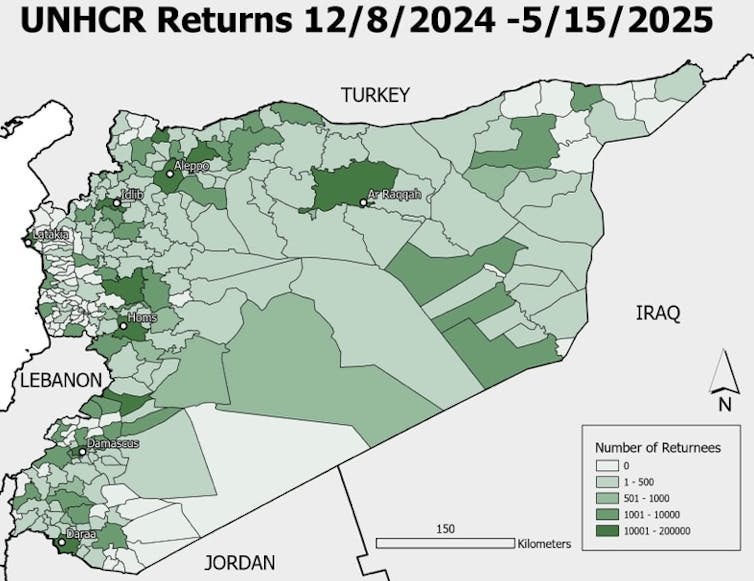
Some 1.5 million Syrian refugees have voluntarily returned to their home country over the past year.

That extraordinary figure represents nearly one-quarter of all Syrians who fled fighting during the 13-year civil war to live abroad. It is also a strikingly fast pace for a country where insecurity persists across broad regions.

The scale and speed of these returns since the overthrow of Bashar Assad’s brutal regime on Dec. 8, 2024, raise important questions: Why are so many Syrians going back, and will these returns last? Moreover, what conditions are they returning to?

As an expert in property rights and post-conflict return migration, I have monitored the massive surge in refugee returns to Syria throughout 2024. While a combination of push-and-pull factors have driven the trend, the widespread destruction of property during the brutal civil war poses an ongoing obstacle to resettlement.

Where are Syria’s refugees?

By the time a rebel coalition led by Sunni Islamist organization Hayat Tahrir al-Sham overthrew the Assad government, Syria’s civil war had been going on for more than a decade. What began in 2011 as part of the Arab Spring protests quickly escalated into one of the most destructive conflicts of the 21st century.

Millions of Syrians were displaced internally, and about 6 million sought refuge abroad. The majority went to neighboring countries, including Turkey, Jordan and Lebanon, but a little over a million sought refuge in Europe.

Now, European countries are struggling to determine how they should respond to the changed environment in Syria. Germany and Austria have put a hold on processing asylum applications from Syrians. The international legal principle of non-refoulement prohibits states from returning refugees to unsafe environments where they would face persecution and violence.

But people can choose to return home on their own. And the fall of Assad altered refugees’ perceptions of safety and possibility.

Indeed, the U.N. refugee agency surveys conducted in January 2025 across Jordan, Lebanon, Iraq and Egypt found that 80% of Syrian refugees hoped to return home – up sharply from 57% the previous year. But hope and reality are not always aligned, and the factors motivating return are far more complex than the change in political authority.


Sandra F. Joireman, CC BY-SA

Why are people returning?

In most post-conflict settings, voluntary return begins only after security improves, schools reopen, basic infrastructure is restored and housing reconstruction is underway. Even then, people often return to their country but not their original communities, especially when local political control has shifted or reconstruction remains incomplete.

In present-day Syria, violence continues in several regions, governance is fragmented, and sectarian conflicts persist. Yet refugees are returning anyway.

A major factor is the deteriorating conditions in neighboring host countries. Most of those who came back to Syria in the early months after Assad’s fall came from neighboring states that have hosted large refugee populations for more than a decade and are now struggling with economic crises, political tensions and declining aid.

In Turkey, for example, Syrians have faced increasing deportations and growing structural barriers to integration, such as temporary status without the possibility of naturalization and strict local registration policies.

In Lebanon, meanwhile, recent violence and a steep drop in international assistance have left Syrian refugees unable to secure food, education and health care.

And in Jordan, international reductions in humanitarian support have made daily life more precarious for refugees.

In other words, many Syrians are not returning because their homeland has become safer, but because the places where they sought refuge have become more difficult.

We do not have data on the religious or ethnic makeup of returnees. But patterns from other post-conflict settings suggest that returnees are usually from the majority community aligned with the new dominant political actors. After the war in Kosovo, for instance, ethnic Albanians returned quickly, while Serb and Roma minorities returned in much smaller numbers due to insecurity and threats of reprisals.

If Syria follows this trajectory, Sunni Muslims may return in higher numbers, as the country’s president, Ahmed al-Sharaa, led the Sunni rebel coalition that overthrew Assad.

Syrian minority groups, including Alawites, Christians, Druze and Kurds, may avoid returning altogether. Violent incidents targeting minority communities have underscored ongoing instability. Recent attacks on the Alawite population have triggered new waves of displacement into Lebanon, while conflicts between Druze militias and the government in Sweida, in southern Syria, have led to more displacement within the country. These episodes illustrate that while pockets of the country may feel safe to some, instability persists.

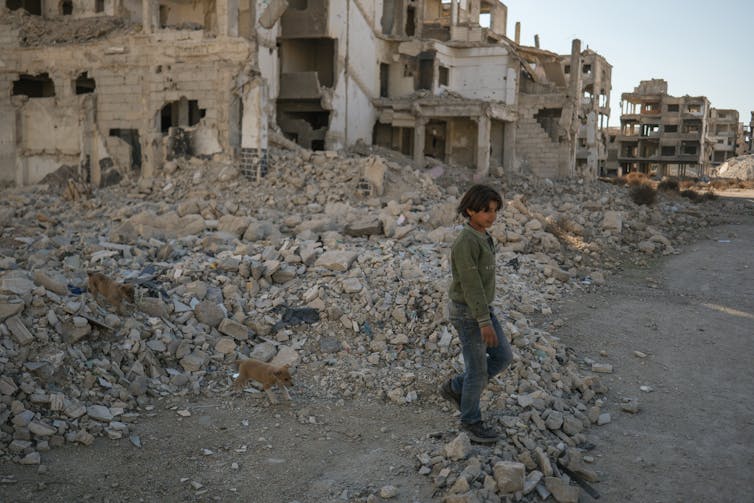
A child walks through rubble.
Thirteen years of civil war left much of Syria in ruin.
Ercin Erturk/Anadolu via Getty Images

Barriers to returns

One of the most significant obstacles facing refugees who wish to return is the condition of their homes and the status of their property rights.

The civil war caused widespread destruction of housing, businesses and public buildings.

Land administration systems, including registry offices and records, were damaged or destroyed. This matters because refugees’ return requires more than physical safety; people need somewhere to live and proof that the home they return to is legally theirs.

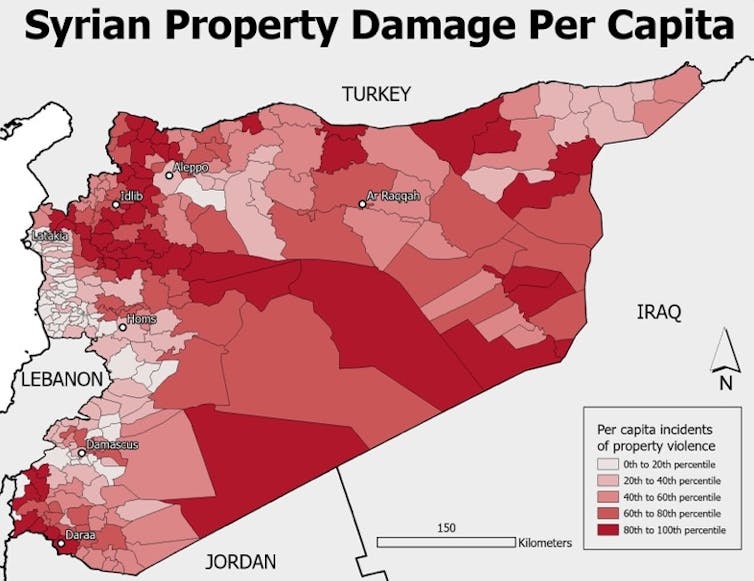
Analysis by the conflict-monitoring group ACLED of more than 140,000 qualitative reports of violent incidents between 2014 and 2025 shows that property-related destruction was more concentrated in inland provinces than in the coastal regions, with cities such as Aleppo, Idlib and Homs sustaining some of the heaviest damage.


Sandra F. Joireman, CC BY-SA

This has major implications for where return is feasible and where it will stall. With documentation lost, homes reoccupied and records destroyed, many Syrians risk returning to legal uncertainty or direct – and sometimes violent – conflict over land and housing.

Post-civil war reconstruction will require not only the rebuilding of physical infrastructure but also the restoration of land governance, including mechanisms for property verification, dispute resolution and compensation. Without all this, refugee returns will likely slow as people confront uncertainty about whether they can reclaim their homes.

Shaping Syria

Whether the wave of returns throughout 2025 continues or proves to be a temporary surge will depend on three main criteria: the security situation in Syria, reconstruction of houses and land administration systems, and the policies of the countries hosting Syrian refugees.

But ultimately, a year after the civil war ended, Syrians are returning because of a mixture of hope and hardship: hope that the fall of the Assad government has opened a path home, and hardship driven by declining support and safety in neighboring states.

Whether these returns will be safe, voluntary and sustainable are critical questions that will shape Syria’s recovery for years to come.

The Conversation

Sandra Joireman does not work for, consult, own shares in or receive funding from any company or organization that would benefit from this article, and has disclosed no relevant affiliations beyond their academic appointment.

ref. Hope and hardship have driven Syrian refugee returns – but many head back to destroyed homes, land disputes – https://theconversation.com/hope-and-hardship-have-driven-syrian-refugee-returns-but-many-head-back-to-destroyed-homes-land-disputes-269555

Should lynx and wolves be reintroduced to Britain and Ireland? Young people have mixed feelings

Source: The Conversation – UK – By Jonny Hanson, Environmental Social Scientist, Queen’s University Belfast

Bjorn H Stuedal/Shutterstock

There are many things people have love-hate relationships with in Britain and Ireland, from Brussels sprouts to cricket or sea swimming. Another item can now be added to this list: the reintroduction of lynx and wolves to the countryside.

Lynx and wolf reintroductions are ecologically feasible in parts of Great Britain and may be in parts of Ireland in the future. Such reintroductions may provide significant ecological benefits, especially through influencing deer numbers and behaviour.

However, no governments in either of the two islands or nations has yet approved any proposals to reintroduce the animals. And ultimately, it is human nature much more than nature that will shape the feasibility and viability of such proposals. That’s why it’s vital to understand how people think and feel about the idea.

As part of my ongoing research on the subject, I asked over 4,000 ten to 11-year-olds and over 1,000 16-year-olds in Northern Ireland about their attitudes to lynx, wolves and their potential return to the UK and the Republic of Ireland.

For political and ecological reasons, Northern Ireland appears the least likely part of either nation to see these happen in the future. But its unique geopolitical status means its population can provide insights into what British and Irish people think.

My research highlights the complexity of feeling among young people on this subject in four key ways.

man in bllue coat looks through binoculars
In his research, author Jonny Hanson searches for social solutions to carnivore coexistence.
Marty Stalker, CC BY-NC-ND

First, perspectives may vary. The strongest single result from the five main survey responses to proposed reintroductions was the “neither agree nor disagree” category across both species and age groups. This was chosen by approximately a fifth to a quarter of young people: 21% and 26% for lynx among children and teenagers, and 22% and 24% respectively for wolves.

This uncertainty is summarised by Freddie, a 16-year-old from rural County Antrim: “As a young farmer who keeps sheep and other livestock, I’d be pretty worried about bringing lynx and wolves back.”

Second, Little Red Riding Hood still has a lot to answer for, as there was less support for the return of wolves compared to lynx. In my survey, just under one-third (32%) of ten to 11-year-olds and just over one third (35%) of 16-year-olds “agreed” or “strongly agreed” with the idea of lynx reintroductions to parts of the UK and Republic of Ireland.

That figure was lower for wolf reintroductions, with 30% of ten to 11-year-olds and 31% of 16-year-olds supporting the idea.

young lynx in woods walking towards camera
Young people’s perspectives about the reintroduction of lynx vary.
Miroslav Srb/Shutterstock

These levels were notably lower than the range of 36-52% support among surveys of British adults that I outline in my recent book, and considerably lower than the 72% support for lynx reintroductions in a study from northern England and southern Scotland published earlier this year. As Clara, an 11-year-old from Belfast, said: “I would definitely encourage the reintroduction of lynx … with regards to wolves I am uncertain.”


Read more:
Farmers told me what they really think about reintroducing lynx and wolves to Britain and Ireland


Third, for many teenagers “lynx” is primarily known as a brand of deodorant. Despite the illegal release of four lynx into the Scottish Highlands in January of this year, there is still less awareness of the species than of wolves.

This was reflected in the survey results among both ten to 11- and 16-year-olds, with many more choosing “I don’t know” for lynx (29% and 25% respectively) than for wolves (19% and 17% respectively). Freddie continued: “I don’t actually know a lot about how these animals hunt, so I am not sure how much danger they would really be.”

Fourth, knowledge is not enough. Among the 16-year-olds, those who knew what nature restoration or, especially, rewilding were, were much more supportive of lynx and wolf reintroductions.

But among the ten to 11-year-olds, beliefs that lynx and wolves were “beautiful”, “good” or “scary” also linked to attitudes to their possible return. When it comes to coexisting with these species, as similar research from Germany has shown, feelings matter as well as facts.

Young people, like people of all ages, have complex attitudes about the return of these complex creatures because of our complex relationship with them. On any love-hate issue, and especially with something as socially complex as lynx and wolf reintroductions, treading carefully is a wise course of action. As Freddie wisely summed it up: “Overall, I’d need more information before I could make a proper judgement.”


Don’t have time to read about climate change as much as you’d like?

Get a weekly roundup in your inbox instead. Every Wednesday, The Conversation’s environment editor writes Imagine, a short email that goes a little deeper into just one climate issue. Join the 47,000+ readers who’ve subscribed so far.


The Conversation

Jonny Hanson has received research funding in the past from the Economic and Social Research Council, the University of Cambridge, the Snow Leopard Conservancy, the Co-op Foundation and the Nuffield Farming Scholarships Trust. He is an affiliate of the Snow Leopard Conservancy.

ref. Should lynx and wolves be reintroduced to Britain and Ireland? Young people have mixed feelings – https://theconversation.com/should-lynx-and-wolves-be-reintroduced-to-britain-and-ireland-young-people-have-mixed-feelings-269139

Kim Kardashian’s brain scan shows ‘low activity’ – a brain expert has questions

Source: Radio New Zealand

Discussing Kim Kardashian’s recent brain scan, her doctor pointed out “holes” that he said were related to “low activity”.

While this sounds incredibly sad and concerning, doctors and scientists have doubts about the technology used and its growing commercialisation.

I study brain health, including imaging the brain to look for early signs of disease. Here’s what I think about this technology, whether it can really find holes in our brains, and if should we be getting these scans to check our own.

Representation of the human brain.

There is no medical need for healthy people to have SPECT and MRI scans, says academic Sarah Hallewell.

Unsplash / Robina Weermeijer

– Published by EveningReport.nz and AsiaPacificReport.nz, see: MIL OSI in partnership with Radio New Zealand

Pops Mohamed mixed old and new to reinvent South African music

Source: The Conversation – Africa – By Gwen Ansell, Associate of the Gordon Institute for Business Science, University of Pretoria

Ismail Mohamed-Jan – better known by South African jazz fans as Pops Mohamed – has passed away at the age of 75. His life in music represented a struggle against narrow, oppressive definitions – of race, instrumental appropriateness and musical genre.

A few days before his death, a remastered version of his 2006 album Kalamazoo, Vol. 5 (A Dedication to Sipho Gumede) had been released on digital platforms ahead of an official launch.

Mohamed was born on 10 December 1949 in the working-class gold-mining town of Benoni in South Africa. By his mid-teens, the Group Areas Act – which divided urban areas into racially segregated zones during apartheid – had forced his family to move to Reiger Park (then called Stertonville).

The suburb was allocated to residents of mixed heritage: Mohamed’s father had Indian and Portuguese ancestry; his mother, Xhosa and Khoisan forebears.

Influences

Significantly for his musical development, Reiger Park was a stone’s throw from the Black residential area of Vosloorus and the remnants of the historic informal settlement of Kalamazoo, where people of all racial classifications had lived side by side. He told me in a radio interview about travelling in the area with his father:

I used to witness migrant workers from the East Rand Property Mines coming with traditional instruments to the shebeens (taverns) and playing their mbiras (thumb pianos) and their mouth bows … and at the same time you’d have jazz musicians playing Count Basie stuff on an old out-of-tune piano … and these traditional guys would be joining in, jamming on their instruments.

At home, Mohamed’s family played music from LM Radio – which defied apartheid by broadcasting from Mozambique – and Springbok Radio – the first commercial station in South Africa, owned by the state (“I got attracted to Cliff Richard and the Shadows”).

As he became more interested in music, but still at high school, he’d take trips to central Johannesburg, to Dorkay House and the Bantu Men’s Social Centre, both famous as cultural centres for Black artists and thinkers. There he found his first guitar teacher, whose name he remembered as Gilbert Strauss. He heard legends like saxophonist Kippie Moeketsi rehearsing.

His first teenage band was Les Valiants (The Valiants). And by the early 1970s he was with The Dynamics, influenced by the assertive Soweto Soul sound of groups such as The Cannibals and The Beaters (later Harari).

Partly to pay school fees and partly out of a sense of adventure, those teenage bands sometimes played in white clubs, enduring the bureaucracy of special permits and sometimes playing behind a curtain while white men mimed out front. Apartheid laws prohibited venues from allowing racial mixing.

Something musically very interesting, he suggested, was emerging at that time from “how we copied the Americans and couldn’t get it quite right”. He was teaching himself to play a Yamaha keyboard with a ‘disco’ pre-set, falling in love with the sounds of Timmy Thomas and Marvin Gaye. “But then I was also influenced by Kippie Moeketsi and those melodies”.

Challenging boundaries

Introduced by As-Shams label founder Rashid Vally to reedman Basil Manenberg Coetzee, and together with an old Dorkay House friend, bassist Sipho Gumede, that eclectic mix went down on record as the first album by the band Black Disco, which produced the popular hit Dark Clouds.

Mohamed wasn’t yet confident to call himself a jazzman, but:

Sipho and Basil told me: just play what your heart is telling you. They were my mentors.

The success of Dark Clouds led to a second album, this time with drummer Peter Morake, called Black Discovery/Night Express – until the officious white minority apartheid censors blue-pencilled the first two words.

And after that the Black Disco band, with shifting personnel, was very much in demand at more upmarket clubs in the coloured townships.

Already the music was challenging boundaries:

We were bridging between a Jo’burg and a Cape Town feel – but still keeping the funk alive … But it was always very important for us not to stay inside the classification.

He explained:

The regime divided us – people classified coloured (mixed race) had identity documents; Black people had the dompas (pass book). We didn’t accept that separation. Black Disco was our way of saying: we are with you.

With work precarious and earnings uncertain, Mohamed played across genres and in multiple bands. Playing pop covers with his band Children’s Society did not satisfy him, but it provided some income. And he scored an even more substantial hit with them in 1975 with the original song I’m A Married Man.

It had been Black Disco that established the politics of his music. And in the shadow of the anti-apartheid 1976 Soweto uprising, with drummer Monty Weber, he established the project Movement in the City – a name he said was code for fighting the system.

Traditional sounds

He began exploring traditional instruments too, fearing that this heritage would be taken away.

So he mastered various mouth-bows and whistles, berimbau, didgeridoo, a range of percussion and the Senegambian kora, a stringed instrument with a long neck. On the kora, his style was unique, combining West African motifs, South African idioms and his personal, plaintive, tuneful melodies. It became his favourite instrument, “telling me more about what’s happening in myself … about who I am”.

Mohamed had a prolific and diverse recording career from that time on, producing more than 20 albums. Five of them, titled Kalamazoo, revisited Khoisan and African jazz tunes. He established a close relationship with individual Indigenous Khoisan musicians, healers and their communities, taking frequent trips to visit and play music with them in the Kalahari Desert.

With former Earth Wind and Fire trumpeter Bruce Cassidy he recorded the duo set Timeless. He also toured Europe with the London Sound Collective and voice artist Zena Edwards. Sampling, he said to me, was “a nice way of educating young people about traditional sounds”.

He established a partnership with steelpan player and multi-instrumentalist Dave Reynolds: “We’re both committed to a South African musical identity,” Reynolds says, “and we both play instruments that we weren’t born to – Trinidadian pans and Senegambian kora – but were rather called to.”

Mohamed’s final video.

In late 2021, Mohamed was hospitalised, and his convalescence left him struggling to work for a period. He continued working. His most recent release, Kalamazoo 5, used digital remastering to extend the sound palette of earlier work.

It showed how, never content to stay within anybody else’s boxes, he held on to his mission of “taking the old and mixing it with the new. We’re not destroying the music: we’re giving it a way to live on.” Through his recordings, it will.

The Conversation

Gwen Ansell does not work for, consult, own shares in or receive funding from any company or organisation that would benefit from this article, and has disclosed no relevant affiliations beyond their academic appointment.

ref. Pops Mohamed mixed old and new to reinvent South African music – https://theconversation.com/pops-mohamed-mixed-old-and-new-to-reinvent-south-african-music-175710