AI is perpetuating unrealistic body ideals, objectification and a lack of diversity — especially for athletes

Source: The Conversation – Canada – By Delaney Thibodeau, Post-doctoral researcher, Faculty of Kinesiology & Physical Education, University of Toronto

What does it look like to have an “athletic body?” What does artificial intelligence think it looks like to have one?

A recent study we conducted at the University of Toronto analyzed appearance-related traits of AI-generated images of male and female athletes and non-athletes. We found that we’re being fed exaggerated — and likely impossible — body standards.

Even before AI, athletes have been pressured to look a certain way: thin, muscular and attractive. Coaches, opponents, spectators and the media shape how athletes think about their bodies.

But these pressures and body ideals have little to do with performance; they’re associated with the objectification of the body. And this phenomenon, unfortunately, is related to a negative body image, poor mental health and reduced sport-related performance.

Given the growing use of AI on social media, understanding just how AI depicts athlete and non-athlete bodies has become critical. What it shows, or doesn’t, as “normal” is widely viewed and may soon be normalized.

Lean, young, muscular — and mostly male

As researchers with expertise in body image, sport psychology and social media, we grounded our study in objectification and social media theories. We generated 300 images using different AI platforms to explore how male and female athlete and non-athlete bodies are depicted.

We documented demographics, levels of body fat and muscularity. We assessed clothing fit and type, facial attractiveness like having neat and shiny hair, symmetrical features or clear skin and body exposure in each image. Indicators of visible disabilities, like mobility devices, were also noted. We compared the characteristics of male versus female images as well as the characteristics of athlete and non-athlete images.

The AI-generated male images were frequently young (93.3 per cent), lean (68.4 per cent) and muscular (54.2 per cent). The images of females depicted youth (100 per cent), thinness (87.5 per cent) and revealing clothing (87.5 per cent).

The AI-generated images of athletes were lean (98.4 per cent), muscular (93.4 per cent) and dressed in tight (92.5 per cent) and revealing (100 per cent) exercise gear.

Non-athletes were shown wearing looser clothing and displaying more diversity of body sizes. Even when we asked for an image of just “an athlete,” 90 per cent of the generated images were male. No images showed visible disabilities, larger bodies, wrinkles or baldness.

These results reveal that generative AI perpetuates stereotypes of athletes, depicting them as only fitting into a narrow set of traits — lacking impairment, attractive, thin, muscular, exposed.

The findings of this research illustrate the ways in which three commonly used generative AI platforms — DALL-E, MidJourney and Stable Diffusion — reinforce problematic appearance ideals for all genders, athletes and non-athletes alike.

The real costs of distorted body ideals

Why is this a problem?

More than 4.6 billion people use social media and 71 per cent of social media images are generated by AI. That’s a lot of people repeatedly viewing images that foster self-objectification and the internalization of unrealistic body ideals.

They may then feel compelled to diet and over-exercise because they feel bad about themselves — their body does not look like AI-fabricated images. Alternatively, they may also do less physical activity or drop out of sports altogether.

Negative body image not only affects academic performance for young people but also sport-related performance. While staying active can promote a better body image, negative body image does the exact opposite. It exacerbates dropout and avoidance.

Given that approximately 27 per cent of Canadians over the age of 15 have at least one disability, the fact that none of the generated images included someone with a visible disability is also striking. In addition to not showing disabilities when it generates images, AI has also been reported to erase disabilities on images of real people.

People with body fat, wrinkles or baldness were also largely absent.

Addressing bias in the next generation of AI

These patterns reveal that AI isn’t realistic or creative in its representations. Instead, it pulls from the massive database of media available online, where the same harmful appearance ideals dominate. It’s recycling our prejudices and forms of discrimination and offering them back to us.

AI learns body ideals from the same biased society that has long fuelled body image pressure. This leads to a lack of diversity and a vortex of unreachable standards. AI-generated images present exaggerated, idealized bodies that ultimately limit the diversity of humans and the lowered body image satisfaction that ensues is related greater loneliness.

And so, as original creators of the visual content that trains AI systems, society has a responsibility to ensure these technologies do not perpetuate ableism, racism, fatphobia and ageism. Users of generative AI must be intentional in how image prompts are written, and critical in how they are interpreted.

We need to limit the sort of body standards we internalize through AI. As AI-generated images continue to populate our media landscape, we must be conscious of our exposure to it. Because at the end of the day, if we want AI to reflect reality rather than distort it, we have to insist on seeing, and valuing, every kind of body.

The Conversation

Catherine Sabiston receives funding from the Canada Research Chairs program

Delaney Thibodeau and Sasha Gollish do not work for, consult, own shares in or receive funding from any company or organisation that would benefit from this article, and have disclosed no relevant affiliations beyond their academic appointment.

ref. AI is perpetuating unrealistic body ideals, objectification and a lack of diversity — especially for athletes – https://theconversation.com/ai-is-perpetuating-unrealistic-body-ideals-objectification-and-a-lack-of-diversity-especially-for-athletes-268735

Apparent ancient artifacts are found in a B.C. thrift shop — and archeology faculty are on the case

Source: The Conversation – Canada – By Cara Tremain, Assistant Professor, Archaeology, Simon Fraser University

An unusual email arrived in the inbox of a faculty member at the department of archeology at Simon Fraser University in the spring of 2024.

This email was from a thrift shop, Thrifty Boutique in Chilliwack, B.C. — unlike the many queries archeologists receive every year to authenticate objects that people have in their possession.

The shop wanted to determine whether items donated to the store (and initially put up for sale) were, in fact, ancient artifacts with historical significance. Shop employees relayed that a customer, who did not leave their name, stated the 11 rings and two medallions (though one may be a belt buckle) in the display case with a price tag of $30 were potentially ancient.

Thrifty Boutique wasn’t looking for a valuation of the objects, but rather guidance on their authenticity.

Eclectic collection

As archeology faculty, we analyzed these objects with Babara Hilden, director of Museum of Archaeology and Ethnology at Simon Fraser University, after the store arranged to bring the items to the museum.

Our initial visual analysis of the objects led us to suspect that, based on their shapes, designs and construction, they were ancient artifacts most likely from somewhere within the boundaries of what was once the Roman Empire. They may date to late antiquity (roughly the third to sixth or seventh century) and/or the medieval period.

The initial dating was based largely on the decorative motifs that adorn these objects. The smaller medallion appears to bear a Chi Rho (Christogram), which was popular in the late antiquity period. The larger medallion (or belt buckle) resembles comparable items from the Byzantine Period.

The disparities between the two objects, suggesting different time periods, make it unlikely they’re from the same hoard. We expect they were assembled into an eclectic collection by the unknown person (as of yet) who acquired them prior to their donation to Thrifty Boutique.


Read more:
Melsonby hoard: iron-age Yorkshire discovery reveals ancient Britons’ connections with Europe


With the exciting revelation that the objects may be authentic ancient artifacts, the thrift store offered to donate them to SFU’s archeology museum. The museum had to carefully consider whether it had the capacity and expertise to care for these objects in perpetuity, and ultimately decided to commit to their care and stewardship because of the potential for student learning.

Officially accepting and officially transferring these objects to the museum took more than a year. We grappled with the ethical implications of acquiring a collection without known provenance (history of ownership) and balanced this against the learning opportunities that it might offer our students.

Ethical and legal questions

Learning to investigate the journey of the donated objects is akin to the process of provenance research in museums.

In accepting items without known provenance, museums must consider the ethical implications of doing so. The Canadian Museums Association Ethics Guidelines state that “museums must guard against any direct or indirect participation in the illicit traffic in cultural and natural objects.”

When archeological artifacts have no clear provenance, it is difficult — if not impossible — to determine where they originally came from. It is possible such artifacts were illegally acquired through looting, even though the Canadian Property Import and Export Act exists to restrict the importation and exportation of such objects.


Read more:
HBC’s artworks and collections help us understand Canada’s origins — and can be auctioned off


We are keenly aware of the responsibility museums have to not entertain donations of illicitly acquired materials. However, in this situation, there is no clear information — as yet — about where these items came from and whether they are ancient artifacts or modern forgeries. Without knowing this, we cannot notify authorities nor facilitate returning them to their original source.

With a long history of ethical engagement with communities, including repatriation, the Museum of Archaeology and Ethnology is committed to continuing such work. This donation would be no different if we’re able to confirm our suspicions about their authenticity.

Archeological forgeries

Archeological forgeries, while not widely publicized, are perhaps more common than most realize — and they plague museum collections around the world.

Well-known examples of the archeological record being affected by inauthentic artifacts are the 1920s Glozel hoax in France and the fossil forgery known as Piltdown Man.

Other examples of the falsification of ancient remains include the Cardiff Giant and crystal skulls, popularized in one of the Indiana Jones movies.

Various scientific techniques can help determine authenticity, but it can sometimes prove impossible to be 100 per cent certain because of the level of skill involved in creating convincing forgeries.

Copies of ancient artefacts

Other copies of ancient artifacts exist for honest purposes, such as those created for the tourist market or even for artistic purposes. Museums full of replicas still attract visitors, because they are another means of engaging with the past, and we are confident that the donation therefore has a place within the museum whether the objects are authentic or not.

By working closely with the objects, students will learn how to become archeological detectives and engage with the process of museum research from start to finish. The information gathered from this process will help to determine where the objects may have been originally uncovered or manufactured, how old they might be and what their original significance may have been.

Object-based learning using museum collections demonstrates the value of hands-on engagement in an age of increasing concern about the impact of artificial intelligence on education.

New course designed to examine items

The new archeology course we have designed, which will run at SFU in September 2026, will also focus heavily on questions of ethics and provenance, including what the process would look like if the objects — if determined to be authentic — could one day be returned to their country of origin.

The students will also benefit from the wide-ranging expertise of our colleagues in the department of archeology at SFU, including access to various technologies and avenues of archeological science that might help us learn more about the objects.

This will involve techniques such as X-ray fluorescence, which can be used to investigate elemental compositions of materials and using 3D scanners and printers to create resources for further study and outreach.

Mentoring with museum professionals

Local museum professionals have also agreed to help mentor the students in exhibition development and public engagement, a bonus for many of our students who aspire to have careers in museums or cultural heritage.

Overall, the course will afford our students a rare opportunity to work with objects from a regional context not currently represented in the museum while simultaneously piecing together the story of these items far from their probable original home across the Atlantic.

We are excited to be part of their new emerging story at Simon Fraser, and can’t wait to learn more about their mysterious past.

The Conversation

Cara Tremain receives funding from the Social Sciences and Humanities Research Council of Canada

Sabrina C. Higgins receives funding from the Social Sciences and Humanities Research Council of Canada.

ref. Apparent ancient artifacts are found in a B.C. thrift shop — and archeology faculty are on the case – https://theconversation.com/apparent-ancient-artifacts-are-found-in-a-b-c-thrift-shop-and-archeology-faculty-are-on-the-case-267064

Nigeria has jailed Biafra separatist leader Nnamdi Kanu: why it risks backfiring

Source: The Conversation – Africa (2) – By Onyedikachi Madueke, Teaching Assistant, University of Aberdeen

The terrorism conviction and life sentence handed down by the Federal High Court in Abuja on Nnamdi Kanu, leader of the Indigenous People of Biafra, brings an end to a ten-year legal battle. But it opens up a larger political and security question for Nigeria.

Kanu has long championed the secession of Nigeria’s south-east region, a demand the Nigerian constitution forbids. The last major attempt at secession, in 1967, triggered a 30-month civil war that killed over one million people, mostly Igbo civilians.

Kanu’s campaign for Biafra as an independent Igbo state is rooted in decades of perceived political marginalisation and unresolved historical grievances of the Igbo.

The Igbo are one of Nigeria’s three largest ethnic groups – the other two are the Hausa and the Yoruba. Yet no Igbo person has held the presidency or vice presidency since 1999.

Additionally, Igbos feel marginalised because of the way in which Nigeria has organised its regional political groups. The south-east geopolitical zone that the Igbo live in encompasses only five states. The Hausa and the Yoruba have geopolitical zones that are made up of at least six states each. This structural imbalance is widely seen to weaken the south-east region’s political influence and reduce its share of federal resources and representation.

Such perceived marginalisation is what has driven the Biafra separatist movement.


Read more:
What drives the Indigenous People of Biafra’s relentless efforts for secession


In protest against Kanu’s arrest in 2021, armed groups linked to the movement have imposed and violently enforced “sit-at-home” orders. A report shows that between 2021 and 2025 over 770 lives, including civilians and security personnel, have died in the subsequent violence.

This has contributed to the region’s transformation from one of Nigeria’s most peaceful zones into a centre of insecurity.

As a scholar researching security and separatist conflicts in Nigeria, I argue that a court judgement cannot resolve the political, economic and psychological grievances that underpin the Biafra separatist sentiment in Nigeria.

The region’s demands extend beyond any single personality. They include calls for greater political inclusion, equitable federal representation, improved infrastructure, economic revitalisation, and a national reckoning with the legacy of the civil war.

Until these issues are addressed, the ideology of Biafra will continue to resonate.

In fact, Kanu’s life sentence is more likely to escalate than de-escalate the Biafra agitation, for three reasons. Firstly, by providing an opening for more extremist leaders to emerge. Secondly, by turning Kanu into a martyr for the Biafran cause; and lastly, by potentially opening the door to greater violence.

Leadership removal rarely ends insurgencies

The expectation that harsh punishment will end the Biafra agitation misunderstands how separatist or insurgent movements behave. Decades of global research show that removing a charismatic leader, whether through imprisonment, exile or execution, does not necessarily weaken a movement. In many cases, it produces the opposite effect.

Nigeria’s own history with Boko Haram is an example. After the group’s founder, Mohammed Yusuf, was killed extra-judicially in police custody in 2009, Boko Haram did not collapse. Instead, it radicalised under Abubakar Shekau, who adopted a more extreme ideology and militarised the group’s structure.

The same pattern can be seen elsewhere. Research by Jenna Jordan and Ulaş Erdoğdu shows that Islamic State (ISIS) survived multiple leadership losses. Other terrorist groups like Al-Shabaab, the Taliban and the PKK have all endured and adapted despite strikes to remove leaders.

These cases demonstrate that leadership removal often fragments the organisation, empowers hardline commanders and intensifies violence.

Kanu’s life sentence risks producing similar dynamics. The Indigenous People of Biafra has already splintered into factions, some captured by criminal networks.

A life sentence may remove the last figure capable of restraining extremist or opportunistic actors. Before Kanu’s arrest, his organisation had no major factions, and south-east political leaders engaged directly with him to calm tensions.

Kanu alleged that he had set out conditions for ending the agitation, which the Nigerian government did not honour. His imprisonment removed this central point of contact. Meaningful engagement by the Nigerian government could become more difficult.

In addition, when movements lose central authority, they tend to fracture into smaller, less accountable groups, each pursuing its own agenda.

Elevation to martyrdom

Kanu is not the first leader of the Biafra agitation. Before the Indigenous People of Biafra emerged, Ralph Uwazuruike’s Movement for the Actualisation of the Sovereign State of Biafra, founded in 1999, had mobilised thousands using largely non-violent methods. In 2010, the Biafra Zionist Front was formed by Benjamin Onwuka.

The sentiment that fuels these movements has persisted for more than five decades. Leaders emerge, are repressed, and are replaced by new voices.

What Kanu’s sentencing may do, especially if he dies in prison, is to elevate him to the status of martyr, a symbolic role far more powerful than that of an active leader. Martyrdom transforms political grievances into moral ones. When a community perceives a leader as unjustly punished, that figure becomes a rallying point for collective identity and resistance.

For example, the Niger Delta environmental activist Ken Saro-Wiwa was extrajudicially executed by Nigeria’s military junta in 1995, and became a lasting symbol of regional marginalisation and injustice.

Many political stakeholders in the south-east now perceive Kanu’s sentencing as unjust, reinforcing existing grievances.

The ruling may worsen insecurity

The south-east is already experiencing its worst instability in decades. Armed groups, some ideological, others purely criminal, have used the emotive appeal of Biafra to justify assassinations, kidnappings, extortion and attacks on state institutions.

Kanu’s sentencing could intensify these trends.

Factions seeking to avenge him may escalate attacks on security forces or political figures.

Splinter groups may interpret the verdict as proof that peaceful agitation is futile.

Confusion surrounding Kanu’s future may weaken the few actors still capable of influencing extremists.

Criminals will likely expand operations under the guise of political resistance.

Pathways towards de-escalation

The conclusion of Kanu’s trial should have opened a window for political reflection. Instead, it risks deepening the mistrust between the south-east region and federal authorities.

Nigeria must consider three steps.

First, federal authorities should open structured political dialogue with south-east stakeholders.

Second, the government should develop a plan for the region that combines security and development. Development, not coercion, weakens separatist sentiment.

Third, Nigeria must confront the trauma of the civil war through a national truth-telling and reconciliation process. Without acknowledging past injustices, nation-building remains impossible.

The Conversation

Onyedikachi Madueke does not work for, consult, own shares in or receive funding from any company or organisation that would benefit from this article, and has disclosed no relevant affiliations beyond their academic appointment.

ref. Nigeria has jailed Biafra separatist leader Nnamdi Kanu: why it risks backfiring – https://theconversation.com/nigeria-has-jailed-biafra-separatist-leader-nnamdi-kanu-why-it-risks-backfiring-270643

Djibouti’s democracy takes another knock as ageing president engineers yet another term

Source: The Conversation – Africa (2) – By Federico Donelli, Associate Professor of International Relations, University of Trieste

Djibouti’s president, Ismaïl Omar Guelleh, pushed through constitutional changes removing presidential age limits in October 2025. The changes enable him to remain in power beyond 2026. He has already ruled for 26 years and is a shoo-in at elections in April 2026. Guelleh leads a country on the Horn of Africa where the Red Sea meets the Indian Ocean – one of the world’s most strategically important locations. Federico Donelli, who has studied Djibouti’s political landscape, unpacks the dynamics that have kept him in power.

Who is Ismaïl Omar Guelleh and what is his governance style?

Ismaïl Omar Guelleh, commonly known as IOG, has been the president of Djibouti since 1999. He succeeded the country’s first president, Hassan Gouled Aptidon, whom he served as chief of staff for more than two decades.

Now aged 77, Guelleh is one of the longest-serving leaders in east Africa.

He belongs to the majority Issa-Somali ethnic group, which has monopolised power since the country gained independence from France in 1977. Djibouti’s population is largely composed of two main groups – the Issa-Somali and the Afar. This demographic mirrors the context in Afar regional state of neighbouring Ethiopia. It’s mirrored even more closely in the de facto state of Somaliland due to clan and family ties.

Consequently, political dynamics in Djibouti frequently intertwine with developments in these neighbouring states. This is particularly true when it comes to security, cross-border mobility and clan-based networks.

In theory, Djibouti is a presidential republic with a multiparty system. In practice, however, political authority remains highly centralised, leaving little room for genuine political competition.

The ruling Popular Rally for Progress (RPP) party dominates parliament, holding 45 of the 65 seats. The broader pro-presidential coalition, the Union for the Presidential Majority (UPM), controls 58 seats in total, consolidating the executive’s influence over the legislative arena.

Opposition coalitions such as the Union for Democratic Change (UAD) and the Union for Democratic Movements (UMD) face significant constraints. They have occasionally boycotted elections. There have been five presidential elections and five legislative elections since 1999.

International organisations frequently highlight restrictions on the media and public dissent, with the majority of outlets being state-controlled.


Read more:
Media freedom and democracy: Africans in four countries weigh up thorny questions about state control


Guelleh also owes his longevity to a close-knit network of officials, family members and political allies who occupy key roles in government and business. The coalition around him is not always entirely harmonious. Subtle rivalries have emerged among political figures and members of his inner circle from time to time. But these dynamics do not pose a political threat.

What accounts for his longevity?

Guelleh’s tenure can be attributed to a combination of institutional changes, geopolitical factors and elite dynamics.


Read more:
From Algeria to Zimbabwe: how Africa’s autocratic elites cycle in and out of power


One such element is constitutional reform. Over the years, Djibouti’s parliament has eroded key democratic safeguards of the 1992 constitution.

First came the removal of presidential term limits in 2010. These changes enabled Guelleh to stand for re-election and reduced presidential terms from six to five years.

The November 2025 parliamentary vote to abolish the presidential age limit followed this pattern. This eliminated the last formal restriction on his eligibility for office come April 2026.


Read more:
Africa faces a new threat to democracy: the ‘constitutional coup’


A second factor is Djibouti’s strategic importance. Located at the entrance to the Bab el-Mandeb Strait, a vital shipping lane connecting the Red Sea and the Indian Ocean, the country is home to several foreign military bases. Represented here are the US, France, China, Japan and Italy. For many international partners, the stability of the Djibouti government has been viewed as a source of predictability in a volatile region.

Consequently, there has been limited external pressure for political reform. In turn this has reinforced the stability of the current leadership.


Read more:
Global power shifts are playing out in the Red Sea region: why this is where the rules are changing


Thirdly, the cohesion of the ruling elite has played a central role in domestic politics. A network of influential figures, including members of the president’s family, long-standing advisers, and economic figures, has formed around Guelleh’s leadership. This group controls key state institutions and sectors of the economy, providing strong incentives to maintain leadership continuity.

Djibouti’s economy relies primarily on port and logistics services, particularly its international port which serves regional trade, as well as on the revenues generated from hosting multiple foreign military bases.

At the same time, the absence of an openly designated successor has sparked quiet competition within this circle. The prospect of a post-Guelleh era has, in recent years, encouraged various individuals to seek to increase their influence. This has ranged from family members to senior advisers and political figures.

Emerging rivalries do not openly challenge the president’s authority. Nevertheless, they do illustrate the complex internal dynamics that underpin the current political order.


Read more:
Weaning African leaders off addiction to power is an ongoing struggle


What has he achieved; what does he promise?

Over more than two decades in office, Guelleh has presided over a period of relative stability in Djibouti. While neighbouring Somalia and Ethiopia have experienced ongoing insecurity and internal conflict, Djibouti has remained comparatively insulated.

The government frequently cites this stability as one of the defining features of his tenure.

Djibouti has also developed its position as a strategic hub. The presence of multiple foreign military bases, alongside port and logistics facilities, has generated significant state revenue.

Since 2016, Chinese investment and management have increasingly shaped the country’s main port infrastructure, further integrating Djibouti into global commercial networks. These factors have raised the country’s profile in international trade and security arrangements.

In addition, Djibouti has played a part in regional diplomacy. It is an important member of the Intergovernmental Authority on Development (IGAD). This is the regional organisation mandated to address conflicts rooted in resources, political competition and identity. Djibouti’s most recent engagement includes participation in the attempts to mediate the conflict in Sudan.

The government has also highlighted certain institutional reforms as markers of progress. An example is the abolition of the death penalty in 2010.

However, structural challenges remain significant. Djibouti has a very young population. Issues such as unemployment, high living costs and limited political participation persist.

What does the age-limit vote tell us about Djibouti’s politics?

The decision was adopted without public debate and with no dissenting votes among the 65 lawmakers present. This reflects the extent to which the National Assembly aligns with the executive.

The vote also highlights the central role of elite consensus in Djibouti’s political system. Key figures within the ruling coalition, including representatives from the Issa and co-opted Afar elites, supported the reform. For these groups, maintaining leadership continuity is often seen as a means of preserving access to economic and political resources. This is preferred to uncertainties associated with a change in leadership.

Bypassing a popular vote on the constitutional provision limits the opportunity to see the true levels of support or opposition. This has the effect of particularly excluding younger citizens who have only ever known one president.

Overall, the vote shows that constitutional provisions can be modified when they hinder leadership continuity. This reinforces a model in which formal rules adapt to political needs rather than constrain them. It also highlights the importance of elite cohesion in maintaining the current political order.

As the 2026 presidential election approaches, the government’s dominant narrative remains one of continuity, supported by those who view stability as essential to protecting national and regional interests.

However, socio-economic pressures and underlying concerns about the inevitable succession continue to influence public expectations, particularly among younger citizens.

The Conversation

Federico Donelli is affiliated with the Italian Institute for International Political Studies (ISPI), the Nordic Africa Institute (NAI), and the Orion Policy Institute (OPI)

ref. Djibouti’s democracy takes another knock as ageing president engineers yet another term – https://theconversation.com/djiboutis-democracy-takes-another-knock-as-ageing-president-engineers-yet-another-term-271009

Two people injured after jet boats crash in Wairarapa

Source: Radio New Zealand

Wellington Free Ambulance vehicle attended the scene of the incident.

Wellington Free Ambulance says two patients are in a moderate condition. Photo: Photo / Supplied

Two people have been taken to hospital after two jet boats crashed in the Wairarapa.

Wellington Free Ambulance said two patients were transported to Wairarapa Hospital in a moderate condition following the collision in the Tauwharenīkau River on Sunday morning.

The Jetsprint Association confirmed the crash happened during the round one of the New Zealand Jetsprint Championship in Featherston.

Police said they received reports of the crash at the river, near Tauherenikau Racecourse Road, at about 10.45am on Sunday.

Sign up for Ngā Pitopito Kōrero, a daily newsletter curated by our editors and delivered straight to your inbox every weekday.

– Published by EveningReport.nz and AsiaPacificReport.nz, see: MIL OSI in partnership with Radio New Zealand

Review: Jennifer Lawrence ‘spectacularly, fearlessly, uncompromisingly brilliant’ in Die My Love

Source: Radio New Zealand

Die My Love is a film by Scottish director Lynne Ramsay, whose reputation rests on just a handful of films over 25 years.

She’s probably best known for the chilling We Need to Talk About Kevin, though I was introduced to her in the mesmerizing Morvern Callar, which this film shares some DNA with.

Ramsay’s ace in the hole is her great ear for the absolutely appropriate music. This is far rarer skill than many directors think.

– Published by EveningReport.nz and AsiaPacificReport.nz, see: MIL OSI in partnership with Radio New Zealand

Two in moderate condition after jet boat crash in Wairarapa

Source: Radio New Zealand

Wellington Free Ambulance vehicle attended the scene of the incident.

Wellington Free Ambulance says two patients are in a moderate condition. Photo: Photo / Supplied

Two people have been taken to hospital after a jet boat crash in the Wairarapa.

Wellington Free Ambulance said two patients were transported to Wairarapa Hospital in a moderate condition following the collision in the Tauwharenīkau River on Sunday morning.

Police said they received reports of the crash at the river, near Tauherenikau Racecourse Road, at about 10.45am on Sunday.

Sign up for Ngā Pitopito Kōrero, a daily newsletter curated by our editors and delivered straight to your inbox every weekday.

– Published by EveningReport.nz and AsiaPacificReport.nz, see: MIL OSI in partnership with Radio New Zealand

What to watch: Succession star shines in tense psychological thriller All Her Fault

Source: Radio New Zealand

Set in Chicago – though filmed mostly in Melbourne (more on that later) – All Her Fault immediately pulls us into the tension.

Sarah Snook (Shiv in Succession), stars as Melissa Irving, a successful wealth manager whose life unravels in the opening minutes when she discovers her 5-year-old son Milo has been taken. Snook is brilliant as always – you can feel her panic and simmering rage.

We follow the police investigation and Melissa’s own discoveries, suspecting various family members and friends across eight tightly-wound episodes. Her husband Peter is played by Jake Lacy (Shane from season one of The White Lotus), who nails his portrayal of another entitled man.

There are three main threads that will keep you hooked. The spine of the series is the missing child mystery, complete with steady revelations and clever misdirection which keeps us guessing until the very end.

The second thread is the upper middle-class affluence. The characters inhabit stunning, large, minimalist homes and employ nannies. This privilege doesn’t shield them from judgment or tragedy, which brings us to the third theme of the story: the weight of motherhood.

This is where the title comes in. Melissa is vilified by the media, accused of complicity in her son’s disappearance, mainly because she’s a working mother. Another key player, Jenny (Dakota Fanning), a publishing executive and fellow mum, becomes entangled after discovering her nanny is involved in Milo’s disappearance. All Her Fault doesn’t fall into the trope of pitting these women against each other, instead it’s a welcome relief that they have each other’s backs.

If you know Chicago or Melbourne, here’s where the illusion falters. Lake Michigan’s shores don’t resemble St Kilda’s yellow sand, and the waves look more ocean than lake.

Some scenes were shot in Chicago, but it feels like they added filters to the brighter Australian environment. If I was from Chicago, I’d be pretty unhappy having my city faked in this way.

Then there’s the array of Australian actors (all nailing their American accents). It makes the series feel slightly dislocated – but definitely not enough to derail the drama.

Don’t watch if … location trickery triggers you.

The Beast in Me: Psychological thriller starring Matthew Rhys (the Americans) and Clare Danes (Netflix).

Playing Nice : Psychological thriller starring James Norton (Happy Valley) and Niamh Algar (Raised by Wolves) about two families whose lives implode after they discover their children were swapped at birth (3 Now).

Dark Winds: A gripping US crime thriller set in the 1970s in Navajo country in the US Southwest (Netflix).

– Published by EveningReport.nz and AsiaPacificReport.nz, see: MIL OSI in partnership with Radio New Zealand

Justice, trust and Sharia: why Malaysia must reform its Islamic home financing

Source: The Conversation – Indonesia – By Nuarrual Hilal Md Dahlan, School of Law, Universiti Utara Malaysia

Image of a abandoned property project at Bukit Beruntung Malaysia Provided by author, CC BY

Islamic home finance in Malaysia was introduced in the 1980s with high expectations. It promised to create a system free from riba (usury), gharar (harmful uncertainty), and ẓulm (injustice) for 20.6 million Malaysian Muslims.

Four decades on, the original vision of Islamic home finance as an ethical, risk-sharing alternative compliant to Islamic law Sharia is now being put to the test.

Ironically, Sharia-compliant home financing has been implicated in the government’s recent findings, which identified 15,553 homebuyers affected by 107 abandoned housing projects comprising 29,587 units as of 30 September this year.

Some Shariah-labelled home financing products closely resemble conventional loans, highlighting the need for clearer and more substantive differentiation to better guide and protect consumers — a concern that has already prompted calls for reform.

Consequently, many families continue to make monthly payments for homes that remain unfinished, are delivered long past their promised dates, or — in some cases — never materialise at all.

These perceptions have eroded public trust and confidence in Islamic home-financing instruments.

Reforms aim at enhancing fairness, transparency, and shared responsibility are gaining momentum.


Baca juga:
The government wants more of us living in high rises. Here’s why Australians don’t want to


Form over substance: The problem with contentious contracts

The most common Islamic home financing structures in Malaysia are Bayʿ Bithaman al-Ājil (BBA, or deferred payment sale) and tawarruq (a deferred purchase followed by a quick resale for cash).

Both are designed to avoid the direct payment of interest. Yet, their financial outcomes often resemble those of conventional loans.

In a typical BBA arrangement, for instance, the bank purchases the property and resells it to the buyer at a marked-up price to be paid in instalments.

While this structure formally avoids charging interest, its economics are almost identical. Banks lock in fixed returns, while buyers bear the risks of non-delivery, delays, or even project abandonment.

This goes against the principle of al-ghunm bi al-ghurm — that profit should come hand in hand with risk.

Prominent scholars, including Justice Taqi Usmani, have warned that such contractual manoeuvres risk undermining the ethical foundations of Islamic finance.

Many homebuyers continue to service loans for projects that are severely delayed, partially abandoned, or unlikely to be completed.

Such financial and emotional burdens run counter to the maqāṣid al-sharīʿah — the higher objectives of Shariah, which uphold justice, welfare, and the protection of wealth.


Baca juga:
Turning houses into homes: Community land trusts offer a fix to Canada’s housing crisis


Pressures from the Basel Accord and investor expectations

Islamic banks are under growing pressure from global regulations and investor expectations. The Basel Accord enforces stringent capital, liquidity, and risk-weight requirements to maintain financial stability.

These regulations, however, make debt-based contracts such as bayʿ bithaman al-ājil (BBA), murābaḥah (a cost-plus resale on deferred payment), and tawarruq more capital-efficient — and therefore more appealing to banks.

By contrast, genuine risk-sharing models such as mushārakah mutanāqiṣah (diminishing partnership) and ijārah (Islamic leasing contract) typically demand more capital and appear less profitable on paper.

This dynamic forces banks to prioritise balance-sheet “safety,” often shifting delivery risks onto homebuyers. In doing so, Basel inadvertently reinforces the “form over substance” dilemma that continues to shadow Islamic finance.

At the national level, neither the Shariah Advisory Council of Bank Negara Malaysia (SAC) nor the Shariah Committees (SCs) of individual Islamic banks are legally required to include consumer representatives.

To enhance fairness, Malaysia’s Islamic finance sector should ensure that Shariah Committees are appointed and remunerated independently — a move that would reduce potential conflicts of interest and strengthen public trust.

As a result, borrowers’ hardships — such as paying instalments for homes that are delayed or abandoned — often go unheard. Dispute mechanisms, meanwhile, tend to favour financiers, leaving affected families with little meaningful recourse.

Lessons from the Gulf

The Gulf Cooperation Council (GCC) countries face similar challenges — and have taken steps to guard against them.

Dubai, United Arab Emirates (UAE): A 2007 law mandates all buyer payments be placed in regulated escrow accounts to safeguard funds and ensure transparency.

Funds can only be released in line with verified construction progress. If a project stalls, the Dubai Land Department or a special tribunal may order refunds or transfer the project to another developer.

Bahrain: Established under a 2014 decree, the Stalled Property Committee is empowered to replace failing developers, merge projects, or liquidate assets to protect homebuyers.

Saudi Arabia: The Wafi off-plan sales programme and SAMA’s escrow regulations ensure that buyer payments are ring-fenced, with any liquidation handled through the Infath Centre.

Nonetheless, property development oversight and consumer protection in these GCC countries still require stronger safeguards and more consistent enforcement.


Baca juga:
The hidden costs of building a home: what every family should know


Pathways to reform

To restore public trust and uphold Shariah principles, Malaysia’s Islamic home financing should prioritise the Build-Then-Sell model — offering financing only for completed homes, thereby eliminating abandonment risks and avoiding harmful gharar (uncertainty).

Where the Sell-Then-Build model remains in use, developers should be required to provide insurance coverage and a clear rehabilitation plan within financing contracts. Shariah governance should also be strengthened through an independent consumer ombudsperson, third-party Shariah audits, and consumer representation on the country’s Sharia advisory council and committees.

Malaysia should also reform the Housing Development (Control and Licensing) Act 1966 (Act 118) to make financiers partially accountable when projects fail — creating a fairer balance of responsibility among banks, developers, and homebuyers.

To advance Malaysia’s goal of fully embedding Islamic principles in banking and finance, the country could expand sukuk-funded housing programmes and create a dedicated rehabilitation fund to revive distressed or abandoned projects.


Baca juga:
To end chronic homelessness, we must stop evictions


A National Islamic Housing Fund could adopt the Build-Then-Sell model and the profit-and-risk-sharing principle of al-ghunm bi al-ghurm, offering stronger protection for homebuyers.

Capital could be drawn from Khazanah Nasional Berhad, the Employees Provident Fund (EPF), the Retirement Fund (KWAP), Permodalan Nasional Berhad (PNB), and Tabung Haji. This could be reinforced through government guarantees, musharakah-based sukuk, and targeted contributions from waqf (Islamic endowments), zakat (mandatory almsgiving), and corporate social responsibility programmes.

If Malaysia and the GCC fail to reform Islamic home financing to make it more equitable and aligned with the principles of maqāṣid al-sharīʿah, the consequences could be severe.

Public trust in Islamic finance may likely to keep eroding without concrete action. Malaysia’s goal of addressing its one-million-home deficit by 2026 — through a mix of financing instruments including Islamic options — could also be at risk.

The Conversation

Nuarrual Hilal Md Dahlan tidak bekerja, menjadi konsultan, memiliki saham, atau menerima dana dari perusahaan atau organisasi mana pun yang akan mengambil untung dari artikel ini, dan telah mengungkapkan bahwa ia tidak memiliki afiliasi selain yang telah disebut di atas.

ref. Justice, trust and Sharia: why Malaysia must reform its Islamic home financing – https://theconversation.com/justice-trust-and-sharia-why-malaysia-must-reform-its-islamic-home-financing-268366

Supreme Court’s decision on birthright citizenship will depend on its interpretation of one key phrase

Source: The Conversation – USA – By Morgan Marietta, Professor of American Civics, University of Tennessee

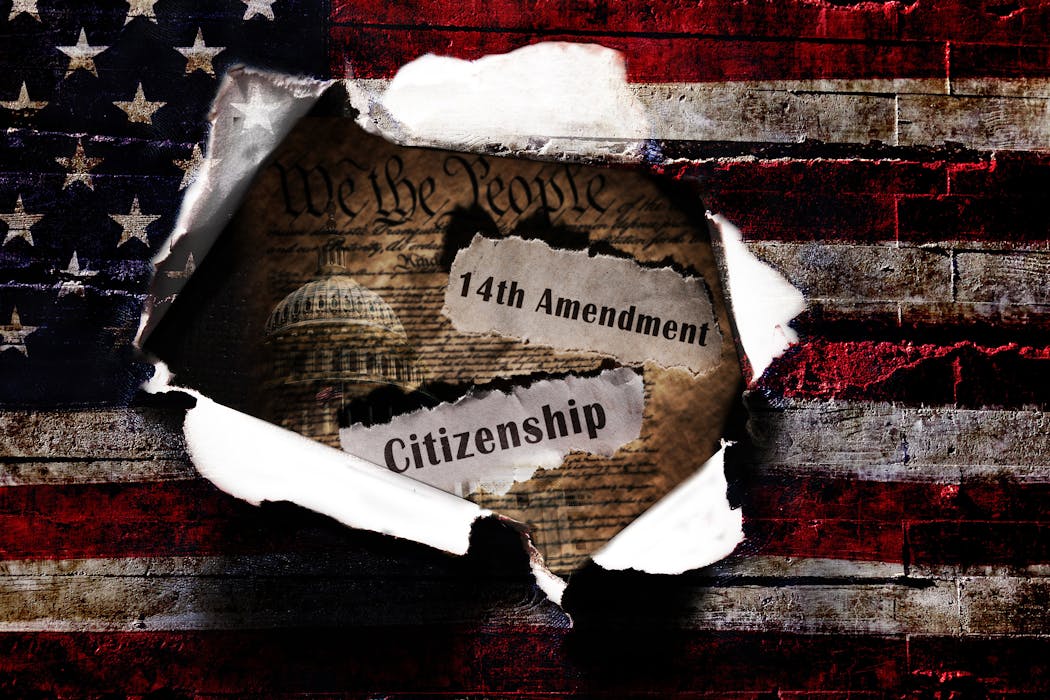
When the justices weigh the arguments, they will focus on the meaning of the first sentence of the 14th Amendment, known as the citizenship clause. zimmytws/Getty Images

The Supreme Court on Dec. 5, 2025, agreed to review the long-simmering controversy over birthright citizenship. It will likely hand down a ruling next summer.

In January 2025, President Donald Trump issued an executive order removing the recognition of citizenship for the U.S.-born children of both immigrants here illegally and visitors here only temporarily. The new rule is not retroactive. This change in long-standing U.S. policy sparked a wave of litigation culminating in Trump v. Washington, an appeal by Trump to remove the injunction put in place by federal courts.

When the justices weigh the arguments, they will focus on the meaning of the first sentence of the 14th Amendment, known as the citizenship clause: “All persons born or naturalized in the United States, and subject to the jurisdiction thereof, are citizens of the United States and of the State wherein they reside.”

Both sides agree that to be granted birthright citizenship under the Constitution, a child must be born inside U.S. borders and the parents must be “subject to the jurisdiction” of the United States. However, each side will give a very different interpretation of what the second requirement means. Who falls under “the jurisdiction” of the United States in this context?

As a close observer of the court, I anticipate a divided outcome grounded in strong arguments from each side.

Arguments for automatic citizenship

Simply put, the argument against the Trump administration is that the 14th Amendment’s expansion of citizenship after the eradication of slavery was meant to be broad rather than narrow, encompassing not only formerly enslaved Black people but all persons who arrived on U.S. soil under the protection of the Constitution.

The Civil War amendments – the 13th, 14th and 15th – established inherent equality as a constitutional value, which embraced all persons born in the nation without reference to race, ethnicity or origin.

One of the strongest arguments that automatic citizenship is the meaning of the Constitution is long-standing practice. Citizenship by birth regardless of parental status – with few exceptions – has been the effective rule since the time of America’s founding.

Advocates also point to precedent: the landmark case of United States v. Wong Kim Ark in 1898. When an American-born descendant of resident noncitizens sued after being refused re-entry to San Francisco under the Chinese Exclusion Act, the court recognized his natural-born citizenship.

If we read the Constitution in a living fashion – emphasizing the evolution of American beliefs and values over time – the constitutional commitment to broad citizenship grounded in equality, regardless of ethnicity or economic status, seems even more clear.

However, advocates must try to convince the court’s originalists – Clarence Thomas, Samuel Alito, Neil Gorsuch, Brett Kavanaugh and Amy Coney Barrett – who read the Constitution based on its meaning when it was adopted.

The originalist argument in favor of birthright citizenship is that the phrase “subject to the jurisdiction” was meant to invoke only a small set of exceptions found in traditional British common law. In the Wong Kim Ark ruling, the court relied on this “customary law of England, brought to America by the colonists.”

One exception to birthright citizenship covered by this line of rulings is the child of a foreign diplomat, whose parents represent the interests of another country. Another exception is the children of invading foreign armies. A third exception discussed explicitly by the framers of the 14th Amendment was Native Americans, who at the time were understood to be under the jurisdiction of their tribal government as a separate sovereign. That category of exclusion faded away after Congress recognized the citizenship of Native Americans in 1924.

The advocates of automatic birthright citizenship conclude that whether the 14th Amendment is interpreted in a living or in an original way, its small set of exceptions do not override its broad message of citizenship grounded in human equality.

Opposition to birthright citizenship

The opposing argument begins with a simple intuition: In a society defined by self-government, as America is, there is no such thing as citizenship without consent. In the same way that an American citizen cannot declare himself a French citizen and vote in French elections without consent from the French government, a foreign national cannot declare himself a U.S. citizen without consent.

This argument emphasizes that citizenship in a democracy means holding equal political power over our collective decisions. That is something only existing citizens hold the right to offer to others, something which must be decided through elections and the lawmaking process.

The court’s ruling in Elk v. Wilkins in 1884 – just 16 years after the ratification of the 14th Amendment – endorses “the principle that no one can become a citizen of a nation without its consent.” By making entry into the United States without approval a federal offense, Congress has effectively denied that consent.

Scholars who support this view argue that the 14th Amendment does not provide this consent. Instead it sets a limitation. To the authors of the 14th Amendment, “subject to the jurisdiction thereof” conveyed a limit to natural citizenship grounded in mutual allegiance. That means if people are free to deny their old national allegiance, and an independent nation is free to decide its own membership, the recognition of a new national identity must be mutual.

Immigrants living in the United States illegally have not accepted the sovereignty of the nation’s laws. On the other side of the coin, the government has not officially accepted them as residents under its protection.

A seated man in a suit and tie signs a document.
President Donald Trump signs an executive order on birthright citizenship in the Oval Office on Jan. 20, 2025.
AP Photo/Evan Vucci, File

If mutual recognition of allegiance is the meaning of the 14th Amendment, the Trump administration has not violated it.

The opponents of birthright citizenship argue that the Wong Kim Ark ruling has been misrepresented. In that case, the court only considered permanent legal residents like Wong Kim Ark’s parents, but not residents here illegally or temporarily. The focus on British common law in that ruling is simply misguided because the findings of Calvin’s Case or any other precedents dealing with British subjects were voided by the American Revolution.

In this view, the Declaration of Independence replaced subjects with citizens. The power to determine national membership was taken away from kings and placed in the hands of democratic majorities.

For opponents of birthright citizenship, the 14th Amendment does not take that power away from citizens but instead codifies the rule that mutual consent is the touchstone of admission. The requirement to be “subject to the jurisdiction” provides the mechanism of that consent.

Congress can determine who is accepted as a member of the national community under its jurisdiction. In this view, Congress – and the American people – have spoken: Current federal laws make entry into U.S. borders without permission a crime rather than a forced acceptance of political membership.

What might happen

The court will likely announce a ruling in summer 2026 before early July, just in time for the 250th anniversary of the Declaration of Independence. The court will ultimately decide whether the Constitution endorses the declaration’s invocation of essential equality or its creation of a sovereign people empowered to determine the boundaries of national membership.

The court’s three Democratic-appointed justices – Ketanji Brown Jackson, Elena Kagan and Sonia Sotomayor – will surely side against the Trump administration. The six Republican-appointed justices seem likely to divide, a symptom of disagreements within the originalist camp.

The liberal justices need at least two of the conservatives to join them to form a majority of five to uphold universal birthright citizenship. This will likely be some combination of Chief Justice John Roberts, Brett Kavanaugh and Amy Coney Barrett.

The Trump administration will prevail only if five out of the six conservatives reject the British common law foundations of the Wong Kim Ark ruling in favor of citizenship by consent alone.

America should know by July Fourth.

The Conversation

Morgan Marietta does not work for, consult, own shares in or receive funding from any company or organization that would benefit from this article, and has disclosed no relevant affiliations beyond their academic appointment.

ref. Supreme Court’s decision on birthright citizenship will depend on its interpretation of one key phrase – https://theconversation.com/supreme-courts-decision-on-birthright-citizenship-will-depend-on-its-interpretation-of-one-key-phrase-271064