Women Without Men: the feminist book that Iran’s regime has failed to silence since the 80s

Source: The Conversation – UK – By Hind Elhinnawy, Senior Lecturer, School of Social Sciences, Nottingham Trent University

For more than three decades, Iran tried and failed to silence Women Without Men (Zanan bedun-e Mardan in Persian). Shahrnush Parsipur’s novella exposed the brutality of Iranian patriarchy with rare clarity. It did so long before global audiences recognised that violence.

Published in 1989, the book was banned almost immediately and Parsipur was imprisoned twice for writing openly about women’s sexuality and autonomy – an act of artistic courage the Islamic Republic deemed intolerable.

Despite the regime’s attempts to erase it, the novella endured. It moved through underground networks and crossed borders with quiet determination. Today, Parsipur lives in exile in northern California after years of harassment. At 80, she remains one of Iran’s most fearless literary dissidents.

Women Without Men follows five women who flee violent marriages, stifling social expectations, and political chaos. Together, they build a sanctuary in a garden outside Iran’s capital, Tehran.

The book is now available in translation by Faridoun Farrokh in the UK for the first time. It still reads as a fierce, mystical act of feminist refusal, echoing the Woman, Life, Freedom movement – a Kurdish slogan that became a rallying cry for women’s rights when it was adopted during the 2022 Iranian protests. The book also lays bare, yet again, how violently regimes react when women claim the right to live unbounded.

When history tried to silence women but failed

Set against the turmoil of 1953, the novella unfolds in a charged political landscape. That year, a US- and UK-backed coup toppled Iran’s democratically elected prime minister, Mohammad Mosaddegh, and reinstalled the shah, Mohammad Reza Pahlavi, to protect western oil interests. That event reshaped Iran’s future and remains one of its most consequential political ruptures.

In the years leading up to the coup, Iranian women had been inching towards greater legal and social equality. But the political chaos and regime change set the stage for decades of instability. The tensions paved the way for the revolution 25 years later, and the Islamic Republic’s tightening grip on women’s lives. While these seismic events stay outside the novella’s frame, their presence is palpable in the background.

It is in the shadow of the 1953 coup that Parsipur exposes the intimate humiliations that patriarchy inscribes onto women’s bodies. Virginity becomes a weaponised measure of worth. Menopause is recast as an insult. Sexuality is monitored, contained and punished. Women’s desires are treated as destabilising forces that must be disciplined. Each character carries a different wound from this system.

Munis resists a brother who would rather kill her than allow her freedom. Faizeh absorbs the misogyny that confines her, and turns it inward. Zarrinkolah escapes a life in which her body is endlessly bought, sold and consumed. Mahdokht, pushed beyond the limits of social expectation, seeks literal rebirth as a tree. Farrokhlaqa endures an affluent marriage that strips her of dignity.

These violences mirror the misogyny embedded in the political order itself. That order disciplines women through shame, silence and constant surveillance of their bodies.

The women’s retreat to the garden outside Tehran is not an escape, but a feminist rupture that marks a refusal to live within a world that insists on defining them. It is a choice to build, however precariously, a space where those rules collapse.

Through mysticism and magical realism, the women’s transformations gain political force. Each metamorphosis becomes an act of resistance: women reclaiming autonomy, dignity and possibility in a society intent on erasing them.

From 1953 to Woman, Life, Freedom

The global cry of “zan, zendegi, azadi” (Woman, Life, Freedom) carries the same insurgent energy that animates Parsipur’s Women Without Men. The slogan rose during the 2022 uprising, after the death of Mahsa Jina Amini in police custody.

The beginning of this spirit of resistance can be seen in Parsipur’s narrative, decades earlier. Her novella advanced a vision of women actively confronting and exceeding patriarchal limits decades before the slogan gained global force.

Reading the book today, it is clear how accurately Parsipur mapped the machinery of state violence, gender policing and systemic oppression – the same forces now driving women into the streets in Iran.

What anchors the novel’s contemporary relevance is its central idea: women imagining and constructing a world outside patriarchal control.

The five women of Parsipur’s story carve out a space where they are no longer defined by violence or expectation. Their garden becomes a blueprint for refusal, one that aligns directly with the ethos of Woman, Life, Freedom: not to endure patriarchy but to reject it, rewrite it, and build a life entirely beyond its reach.

Iran is once again engulfed in turmoil. Women Without Men enters the UK at a moment when Iranian exiles, scholars and activists are issuing urgent warnings about escalating state violence. Public awareness of the daily repression faced by Iranian women is higher than ever, and global literary circles are increasingly spotlighting works that confront authoritarianism with resistance.

In this context, the novella’s English-language publication operates as a bridge between past and present. It makes visible how the structures that constrained women’s lives in the 1950s continue to shape Iran’s political realities today.

This is not simply a reissue. The UK publication marks a hard‑won return for a work that has outlasted bans, by a writer who has survived incarceration and forced displacement. Its re‑entry into global circulation arrives precisely when its analysis of gendered domination carries heightened relevance.

The Conversation

Hind Elhinnawy does not work for, consult, own shares in or receive funding from any company or organisation that would benefit from this article, and has disclosed no relevant affiliations beyond their academic appointment.

ref. Women Without Men: the feminist book that Iran’s regime has failed to silence since the 80s – https://theconversation.com/women-without-men-the-feminist-book-that-irans-regime-has-failed-to-silence-since-the-80s-276679

What Irish politician Thomas Gould’s accent going viral in Jamaica reveals about colonial history

Source: The Conversation – UK – By Jane Ohlmeyer, Erasmus Smith’s Professor of Modern History, Trinity College Dublin

Irish politician Thomas Gould has become a bit of star in the Caribbean after a video of him speaking in the Irish parliament drew comments for the surprising similarity of his Cork accent to the Jamaican one.

His viral speech is a powerful reminder of the shared histories of Ireland and Jamaica, which date back to the mid-17th century and lasted for the next 200 years. During this period Jamaica became an important destination for Irish people.

In the 1650s, Oliver Cromwell, Lord Protector of the Commonwealth of England, Scotland and Ireland, was on a mission to expand the British empire. Having completed the conquest of Ireland in 1653, he captured Jamaica from Spain in 1655.

During the later 1650s, the Cromwellians transplanted hundreds of Irish Catholics to Jamaica where they worked as indentured servants. This form of labour involved an investor who covered the cost of the indentured servant’s passage, food, clothing and shelter on the plantations in return for up to seven years of contracted labour (ten years in the case of convicts).

On termination of the indenture, masters were legally bound to offer “freedom dues”, roughly £10 to £12, in the form of a small parcel of land and a sum of money or its commodity equivalent. Unlike enslaved people, indentured servants had some legal rights, even if it proved difficult to exercise them. However, during the period of indenture the person was, like an enslaved person, at the mercy of their master.

During the 1660s, Irish men and women relocated from elsewhere in the Caribbean to Jamaica on the promise of up to 20 acres of land on the condition that they re-indentured themselves for two or three years.

The Irish poet, Seán Ó Conaill, memorialised these transplantees in The Dirge of Ireland when he wrote in a poem “Transport, Transplant go to Jamaica”.

Relegated to marginal areas in the interior of the island, these poor Irish were vilified and perceived to be unruly, rebellious and loyal to the French because of their Catholicism. They worked as domestic servants or as labourers cultivating sugar, indigo, cotton, cocoa and other commodities. Living in a tropical climate, where hurricanes and other natural disasters occurred regularly, and where deadly diseases were rife shortened life expectancies. Only one in three children reached the age of five.

By 1690 Irish men and women, Catholic and Protestant alike, formed a significant part of the white population, which numbered between 10,000 and 12,000 with around 40,000 enslaved people. While Catholic indentured servants laboured, Protestants from Ireland owned plantations and governed.

When Governor William O’Brien, second earl of Inchiquin, died of “the flux” (dysentery) in 1692, Coleraine-born John Bourden, who owned a plantation in the parish of St. Catherine, filled his shoes. Others included Sir George Nugent (1801 to 1804), Eyre Coote (1806 to 1808); and the earl of Belmore (1828 to 1832).

Migration from Ireland to Jamaica continued well into the 18th century. In 1731, the governor of the island complained that “native Irish papists … [were] pouring in upon us in such sholes [shoals]”. Some Irish remained on the margins, but others prospered as modest planters or as artisans, coopers, carpenters and merchants in Port Royal, Jago de la Vega (Spanish town), Irish town and Kingston.


Read more:
Entangled Islands exhibition explores the history of Irish people in the Caribbean – an expert review


Jane Fitzgerald, a garment trader, was listed in an inventory, as were Irish men like Michael Farrell, a millwright, John Casey, a tavern keeper, Michael Hanigan, a tailor, and Conn Connelly, a bricklayer and builder. The survival of a census dating from 1679 for St. John’s parish, Jamaica, shows that men with Irish names headed three (of 49) households: “Teag Macmarrow” with two white servants and eight enslaved Africans (including three children); Thomas Kelly with two enslaved Africans; and Gilbert Kennedy with a wife and two children, four white servants, and ten slaves (including four children).

Some left wills when they died. These paint pictures of close-knit Irish communities comprised of extended family members and reinforced by intermarriage. Many were upwardly mobile and well connected.

One of the best examples of an Irish family succeeding in Jamaica is the Kelly family, whose grand estates and sugar mills were painted by Isaac Mendes Belisario in 1740. Edmund Kelly became attorney general of Jamaica in 1714. Elizabeth Kelly, his granddaughter and heir, owned plantations of 20,000 acres and 360 enslaved Africans when in 1752 she married Peter Browne of Westport.

The Brownes became Ireland’s premier absentee (run from abroad) plantation owners in the Caribbean. When slavery was finally abolished in 1830s, around 400 people from Jamaica had Irish connections, including many who owned enslaved Africans.

Today Irish surnames – Kelly, Lynch, Murphy, McCarthy, O’Brien, O’Connor, O’Reilly, and O’Hara – are common on the island. Placenames also testify to the presence of early Irish settlers: Irish town, Irish Pen, Irish Road, Sligoville, Bangor Ridge Square, Leinster Road, Leitrim Avenue, Antrim Crescent, Longford Road, Kinsale Avenue, Waterford, and Portmore. Shared speech patterns, especially accents from Munster, are also common.

So with Jamaicans being surprised to hear aspects of their own accents in Thomas Gould’s it’s an opportunity to think about the culture’s complicated shared history and the lasting legacy of the Irish in Jamaica,

The Conversation

Jane Ohlmeyer receives funding from the European Union for an Advanced ERC.

ref. What Irish politician Thomas Gould’s accent going viral in Jamaica reveals about colonial history – https://theconversation.com/what-irish-politician-thomas-goulds-accent-going-viral-in-jamaica-reveals-about-colonial-history-277452

How people in the Gulf are reacting to the Iran war

Source: The Conversation – UK – By Mira Al Hussein, Research Fellow at the Alwaleed Centre for the Study of Islam in the Contemporary World, University of Edinburgh

Iran immediately responded to US-Israeli strikes on February 28 by launching coordinated missile and drone attacks against US military installations in the Gulf region. Since then, its targeting has expanded to airports, seaports, hotels and oil refineries. The debris from missile interceptions has produced several casualties.

The first official statements from governments in the Gulf, with the exception of Oman, refrained from condemning the US-Israeli strikes. Those strikes killed Iran’s supreme leader, Ayatollah Ali Khamenei, along with several senior Iranian officials and nearly 180 civilians. Many of these were schoolgirls killed in an attack on a school in southern Iran.

This lack of condemnation did not go unnoticed. Across social media, a wave of debate broke out, with many Gulf citizens asking how governments that style themselves as voices of measured multilateralism could fail to register the illegality of the US-Israeli aggression against Iran.

However, as the barrage continued and many Gulf citizens and residents found themselves stuck indoors, the initial sympathy for Iran’s position began to give way. For most Gulf citizens, the sound of explosions and aerial interceptions is new. The exception is Kuwait, whose population carries the memory of Iraq’s 1990 invasion and occupation.

Like many anxiously watching from a distance, I have been calling family and friends in the Gulf every day. They send voice notes offering insights on the conflict that rarely make it into official Gulf channels.

Those who had been through war before knew what to do. An Emirati friend described a message from her Lebanese colleague, who had lived through multiple cycles of conflict and passed along a piece of practical advice: “Keep your windows and doors slightly ajar, so that pressure from nearby explosions does not drive the glass to shatter inward.”

She went on to recount how a Serbian woman in Dubai, who had survived two wars and believed she had exhausted her capacity to do so again, had told her she found the sounds so triggering that she spent the night sleeping in her car in the basement of her apartment building.

The sight of a long queue outside an Emirates airline office in a Dubai mall offended at least one Emirati observer. Expatriates rerouting their lives away from a conflict that had not yet become catastrophic, by any measure, was something this person found “cowardly”, she told me in an indignant voice note.

A Qatari friend put the asymmetry differently. Western governments, she remarked, could be relied on to extract their nationals from the consequences of foreign policy decisions they had supported. In contrast, Gulf populations would be left to absorb them – including rising food prices that could strain household budgets if traffic through the strait of Hormuz remains disrupted.

To date, the casualty figures in the Gulf are relatively low. Three people have died in Kuwait, three in the United Arab Emirates (UAE), three in Oman and one in Bahrain. None were Gulf citizens. Two of those killed in Kuwait were members of the Bidoon, a stateless community that has existed in Kuwait for generations without formal legal recognition.

For now, the absence of citizen casualties has softened the psychological impact of the conflict, exposing the racial hierarchies that have long plagued Gulf societies. But it is possible the Gulf governments are managing disclosure carefully, wary of provoking panic.

The information environment there is tightly controlled. The UAE has warned the public against filming or sharing footage of strikes and interceptions, with violations carrying a fine of 100,000 UAE dirhams (roughly £20,000) and potential imprisonment.

Saudi Arabia, Kuwait, Bahrain and Qatar have also issued directives urging citizens and residents to rely only on official sources.

Regional security questions

The conversation has taken on a different register among Gulf scholars and commentators. Despite the narrow space for debate, the war has opened an unexpected aperture for introspective commentary.

Conspicuously absent have been Emirati voices. Scholars and commentators in the UAE operate under tighter constraints than their Gulf counterparts. Views that interrogate state policy also rarely find their way into public circulation.

Saudi analyst Sulaiman al-Oqaily, speaking on Al Jazeera on February 28, gave voice to a frustration that has also appeared in local media. He argued that the US, nominally a security partner to the Gulf, had revealed itself as focused overwhelmingly on Israeli security, with scant regard for the Gulf states.

Omani scholar Abdullah Baabood put it plainly in a social media post on March 3: “The Iran-US war is not the Gulf’s war, yet Gulf states have become sitting ducks – exposed by geography, constrained by alliances, and vulnerable to escalation they neither chose nor control.”

Qatari commentator Abdulrahman Al-Marri offered a more layered analysis. Also in a post on social media, he insisted any serious engagement with the crisis must begin from its most basic fact: this is a war of choice, manufactured by the US and Israel. But he was equally insistent that this should not obscure the Gulf’s own reckoning with Iran.

The US and Israel and also Iran, in Al-Marri’s framing, are respectively engaged in forms of “state terrorism” and “counter-state terrorism” that have cost the region dearly. Iran’s conduct is not absolved by US-Israeli aggression, he writes. Its support for armed proxies and interventions in Iraq and Syria have left a residue of enmity and distrust that are etched in collective memory across the Gulf.

Yet on one point, the commentary has converged: the Gulf states must stay out of the war. Restraint and diplomacy have been the consistent recommendations.

Alongside this, Al-Marri and others have pointed out that US military bases in the Gulf, long presented as guarantors of security, have revealed themselves as liabilities. They have made Gulf territories a target in a confrontation they did not initiate.

Fifty years after independence, the Gulf region has yet to build a security framework that does not depend on outsourcing its defence to external partners whose interests, as this war has shown, do not reliably align with its own.

The Conversation

Mira Al Hussein is affiliated with DAWN MENA- Democracy in Exile.

ref. How people in the Gulf are reacting to the Iran war – https://theconversation.com/how-people-in-the-gulf-are-reacting-to-the-iran-war-277566

Are women more safe today in England and Wales than they were in the past – or less? What the evidence shows

Source: The Conversation – UK – By Nicole Westmarland, Professor of Criminology, Durham University

Fedorovekb/Shutterstock

It’s easy to feel overwhelmed by the amount of violence against women and girls that we see in the news on a daily basis. Horrific cases such as that of survivor Gisèle Pelicot can make us wonder how such distressing crimes can still be happening.

Violence against women and girls accounts for almost 20% of all recorded crime in England and Wales. That’s more than one million crimes a year. At least one in every 12 women will be a victim in any given year. Child sexual abuse and exploitation crimes, which are more likely to affect girls, increased more than 400% between 2013 and 2022. Over one in four adult homicides is domestic related (partner, ex-partner or family member).

This is why police chiefs have declared violence against women and girls a national threat – on a par with terrorism.

The government strategy, published in December 2025, pledges to halve violence against women over the next decade. While this is the first time that an actual target has been put on reducing such violence, efforts to improve criminal justice responses have been increasing since the mid-1990s. But are women today any safer or freer now than they were back then?

While recorded increases in crimes such as rape and sexual assault are probably due to victims being more likely to report and improvements in police recording them, there are other factors at play. Certainly, more types of violence and abuse are crimes now – such as coercive and controlling behaviour (since 2015) and the sharing (or threat of) of intimate images without consent (since 2024).

Some forms of violence do appear to have decreased since self-report surveys began in the 1990s. As social attitudes have become less tolerant of physical forms of male violence against women, those physical acts of violence have reduced. Physical violence from a partner is now less common than emotional abuse, economic abuse, domestic sexual assault or domestic stalking. (Though physical violence remains high in domestic abuse by family members).

Likewise, the oft-quoted statistic that two women per week are killed by a partner or ex-partner is now out of date. The number is now around 90 per year – although that will be of little consolation to the family and friends of those who have died.

As well as new criminal offences such as coercive and controlling behaviour, there is now greater recognition of some forms of abuse such as economic abuse (controlling a partner’s finances or financial freedom). However, the numbers quickly quell any optimism of an increased awareness leading to a corresponding reduction in abuse. The number of female domestic abuse victims who kill themselves is now thought to be even higher than the number killed by their partners.

Non-fatal strangulation or suffocation, a criminal offence in its own right since 2021, has skyrocketed with nearly 50,000 offences recorded by the police last year. This is in part due to the normalisation of “choking” in mainstream pornography. Choking porn is now itself set to become a criminal offence.


Read more:
Sexual strangulation has become popular – but that doesn’t mean it’s wanted


New forms of violence

We often focus on whether violence and abuse is reducing – can we measure it and can we halve it? But the reality of the problem is that it is constantly changing. In my latest book I argue that violence and abuse “shapeshifts”.

We would never have imagined 30 years ago that the new mobile phones we were so impressed with would be used as a weapon of abuse, or that technological advances could “nudify” a women in an instant and be shared with the world.

Violence against women is not static. It is essential to get ahead of the problem. We now have a strong understanding of what survivors need. The resources to provide them is another matter – particularly for women with insecure immigration status and no recourse to public funds.

However, we still have a huge knowledge gap on how to actually reduce violence – by half or otherwise.

To be serious about halving violence against women we must get ahead of the problem in terms of prevention – starting with children and young people. Child-to-child violence now accounts for more than half of child sexual abuse offences reported to the police. We need to invest more effectively in better interventions and research these to understand more about how to stop perpetrators from continuing their abuse including in new relationships.

A well-functioning criminal justice system feels a long way off, with average rape trials now routinely taking more than two years to reach court. And outdated gender norms and misconceptions about rape still stop women from getting justice in court.

The argument for prevention – stopping violence against women before it starts or at the earliest opportunity to intervene if it has – has never been clearer. These parts of the strategy require a bolder focus if we are to actually see levels of violence against women start to fall.

The Conversation

Nicole Westmarland currently receives funding from the ESRC, Home Office and Cabinet Office. She is a trustee of Darlington and Co. Durham RSACC.

ref. Are women more safe today in England and Wales than they were in the past – or less? What the evidence shows – https://theconversation.com/are-women-more-safe-today-in-england-and-wales-than-they-were-in-the-past-or-less-what-the-evidence-shows-275973

Wit, courage and guile: ten literary heroines to inspire you on International Women’s Day

Source: The Conversation – UK – By Amy Wilcockson, Research Fellow, English Literature, Queen Mary University of London

Ever since pen was first put to paper, literary heroines have leapt off the page, often as literature’s most nuanced characters. Whether plucky and confident, pushing the boundaries of society, or increasingly empowered in their own quiet ways, it is no surprise that fictitious females reveal much about the world.

So, to celebrate International Women’s Day 2026, we’ve picked ten of our favourite literary luminaries (in no particular order) to uncover what they can teach us about living.

1. Jane Eyre (1847) by Charlotte Brontë

“I am no bird; and no net ensnares me: I am a free human being with an independent will.” So says Jane Eyre in one of literature’s most famous lines. She overcomes a dreadful childhood, impoverished circumstances and social inequality (as well as the indignity of finding out the man she loves is already married) through a strong sense of self-worth. Described throughout the novel as small and plain, Jane demonstrates an innate sense of endurance, independence and self-belief, no matter what she faces.

2. Joyce, The Thursday Murder Club (2020) by Richard Osman

Very fond of a slice of cake and known for being generous to everyone, Joyce Meadowcroft is a key narrative voice in Osman’s popular crime series. Like Miss Marple before her, Joyce has a keen sense of right and wrong, alongside razor-sharp observation skills. Not afraid to get stuck in, this 77-year-old former nurse reminds us not to underestimate older people.

3. Offred, The Handmaid’s Tale (1985) by Margaret Atwood

The dark events of The Handmaid’s Tale are recounted from the perspective of Offred, who is often considered a resigned and compliant narrator. Memories of her former life with her family, alongside the strong and often bleak narrative voice exhibited throughout, reinforce that quiet protests or simply overcoming silence can be a means of survival.

4. Wife of Bath, Canterbury Tales (c. 1400) by Geoffrey Chaucer

Recognised as the “first ordinary and real woman in English literature” by the University of Oxford’s Marion Turner, the Wife of Bath broke the mould back in 1400 by declaring that sexual freedom was a positive, and women should not be defined or constrained by their partners (five husbands in her case!). Advocating for the freedom to be (and be with) who you want, creating a 600-year legacy? Many would hope to be as influential.

5. Kahu, The Whale Rider (1987) by Witi Ihimaera

Named after her ancestor, an original whale rider, Kahu Paikea Apirana is our youngest protagonist. As she is female, the prejudices of society – particularly, and most poignantly, those of her influential great-grandfather – ensure she is not considered as the rightful heir to the chieftainship of her Māori community. But through her ability to communicate with whales, Kahu unites her family and the natural world. The Whale Rider is a profoundly moving story that reminds us our connection with the environment should always be harmonious.

6. Orlando (1928) by Virginia Woolf

Influenced by Shakespeare’s As You Like It, Orlando is potentially what Jeanette Winterson calls “the first English language trans novel”. Initially a 16th-century nobleman, Orlando awakes at the age of 30 in 1920s England, having been transformed into a woman. Thought to be based on Woolf’s lover and friend Vita Sackville-West, the character of Orlando reminds us that we must always be true to who we are.

7. Olivia, The Woman of Colour: A Tale (1808), Anonymous

The protagonist of this Regency drama is the first Black heroine in a European-set novel. Facing prejudice from her English relations, Olivia firmly alters preconceived notions and stereotypes about her skin colour, intellect and background. Upon learning of her new husband’s wrongdoing (like Jane Eyre’s Rochester, he is already married), Olivia dissolves the marriage and takes her dowry home to Jamaica, where she aims to improve the lives of her countrymen. Published just a year after the 1807 abolition of the slave trade across the British Empire, Olivia inspires us to take an interest in world events, foster empathy and stand up to prejudice.

8. Rosalind, As You Like It (1600) by William Shakespeare

Perhaps Shakespeare’s best creation (overall, not just female), Rosalind has the most lines of any of his female characters. And unlike many of the Bard’s other characters, Rosalind speaks throughout the play in prose, disparaging love poetry. Even more unusually, she has the last word in delivering the epilogue. Shakespeare’s bold heroine encourages us to be unafraid to speak our own minds.

9. Eleanor, Eleanor Oliphant is Completely Fine (2017) by Gail Honeyman

Facing a consistently empty existence, Eleanor is a character facing profound loneliness. It is not until her colleague Raymond becomes a firm friend, and accepts her as she is, that Eleanor begins to recognise her isolation. This novel’s heroine prompts us to remember the human need for connection, and the importance of having understanding friends.

10. Scheherazade, One Thousand and One Arabian Nights (circa 900), folk tale

Complex and multilayered, the first version of Scheherazade’s tale was a manuscript found in Cairo in the 9th century. Since then, her stories have woven their way through the centuries and across continents. Scheherazade is the new bride of a vindictive sultan whose first wife was unfaithful. He vows to take revenge on womankind by taking a new virgin bride every night and executing her the next morning.

But Scheherazade’s wit, intelligence and storytelling prowess enable her to tell enthralling, unfinished tales every night. This means she stays alive for 1,001 nights, saving herself and the women of the kingdom. Patience, persistence and selfless concern for the welfare of others are all tenets this original storyteller embodies.

The Conversation

Amy Wilcockson does not work for, consult, own shares in or receive funding from any company or organisation that would benefit from this article, and has disclosed no relevant affiliations beyond their academic appointment.

ref. Wit, courage and guile: ten literary heroines to inspire you on International Women’s Day – https://theconversation.com/wit-courage-and-guile-ten-literary-heroines-to-inspire-you-on-international-womens-day-277607

Today’s obsession with authenticity isn’t new – being true to yourself has troubled philosophers for centuries

Source: The Conversation – USA (3) – By Kenneth Andrew Andres Leonardo, Postdoctoral Fellow and Visiting Assistant Professor of Government, Hamilton College

Stressing over authenticity isn’t unique to the social media age. Qi Yang/Moment via Getty Images

Today’s youth cherish “authenticity,” but is it a virtue? According to a report from Ernst & Young, more than 9 in 10 Gen Z respondents indicated that being authentic and true to yourself is extremely or very important. In fact, most of them claimed authenticity is more important than any other personal value.

This finding is not all that surprising: All of us live in an age where we’re bombarded by social media and artificial intelligence – when striving to be your authentic self becomes an increasingly difficult task.

Yet, even if it has somehow become a common goal, it is unclear how many of us can truly define the “authenticity” that we say we are pursuing. I think it’s also worth asking whether sincerity and authenticity are perennial human virtues or just obsessions of this technological age.

As a scholar in the history of political thought and American political development, I think two philosophers can help us understand this problem and how to deal with it: Jean-Jacques Rousseau and Martin Heidegger.

Sincerity: A counter to modernity

Rousseau, the 18th-century philosopher from Geneva, arrived in the wake of earlier Enlightenment philosophers, such as Hobbes, Locke and Montesquieu.

These thinkers laid many of the foundations for how people understand liberal democracy today, especially the emphasis on individual natural rights – to paraphrase Thomas Jefferson’s later formulation, all human beings are “endowed” with these rights at birth or by nature. In particular, Hobbes popularized the idea of generating a commonwealth in order to escape the uncertainty in a state of nature where self-preservation is fundamental. Locke also emphasized the right to property, while Montesquieu saw the importance of international commerce, among other aspects, including the separation of powers.

But Rousseau became famous for his criticisms of the individualistic civil society born out of their thought. In the modern commercial republic, the fixation turned to luxury rather than duty. “Ancient politicians spoke incessantly about morals and virtue,” he wrote; “those of our time talk only of business and money.”

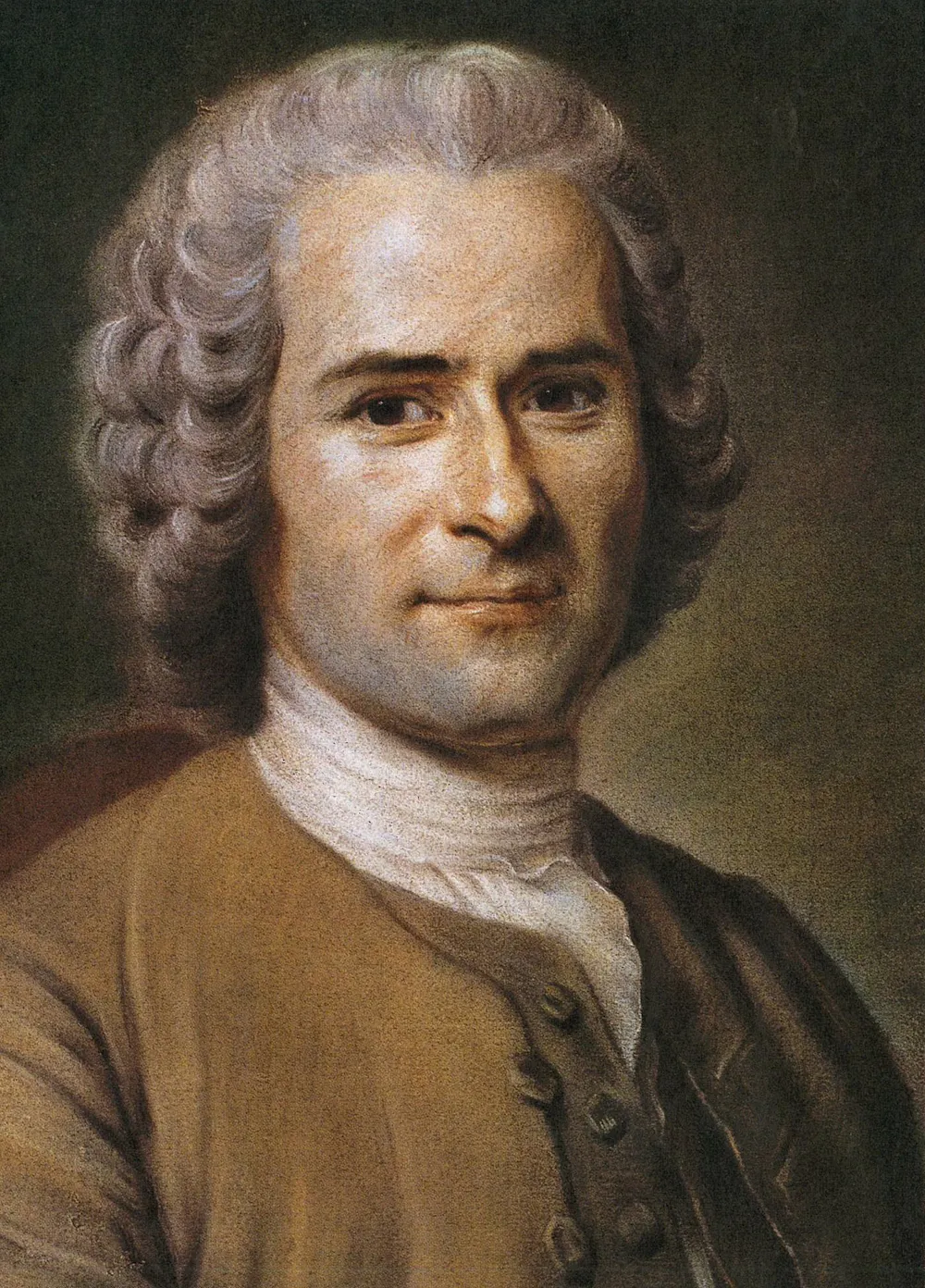
A man with dark eyebrows poses while wearing a gray wig and brown-yellow coat.
A portrait of Rousseau by Maurice Quentin de La Tour.
Musée Antoine-Lécuyer/Wikimedia Commons

For Rousseau, modern society was a conformist “herd” where everyone hides behind a “veil” of politeness. People wear masks to hide their selfishness, deceiving others in order to satisfy their own desires.

In this way, he argued, human beings are actually enslaved to each other: While each person pursues self-interest, success requires getting others to see some “profit” in helping each other. The rich need the “services” of the poor just as the poor need the “help” of the rich. Anyone who refuses to yield to this entire enterprise “will die in poverty and oblivion.”

Sincerity is the path to self-realization in Rousseau’s political philosophy, according to political science professor Arthur Melzer. As Melzer states, “We want, as fully as possible, to become what we are, to realize ourselves, to become as alive and actualized as possible, to really live.” For him, Rousseau considered sincerity to be what puts us on “the path” to true human excellence. It’s the “countercultural virtue” needed to oppose the hypocrisy found in modern society.

Authenticity: Uncovering the self

While Rousseau extolled sincerity, 20th-century German philosopher Martin Heidegger significantly influenced today’s understanding of a related idea: authenticity.

In his magnum opus, “Being and Time,” Heidegger considered how the self gets lost in the public world. In everyday life, individuals think and exist in terms of the other people they encounter – a way of being he called the “they-self.” He stated, “Everyone is the other, and no one is himself.”

Heidegger believed that people are inauthentic when they’re driven into “uninhibited hustle” within the world, tranquilizing themselves from anxiety about the true meaning of human life and its eventual end.

In his later work, Heidegger argued that everything and everyone in contemporary life had become technological, treated as raw material for “exploitation.” For example, in the technological age, the Rhine River is not a “river” but merely “something at our command,” a supplier of “water power.”

A stone relief etching of the face of a man with a mustache.
A memorial to Heidegger at the Heidegger House in Messkirch, Germany.
Andreas Praefcke/Wikimedia Commons, CC BY

“Everywhere everything is ordered to stand by, to be immediately at hand,” he claimed, “indeed to stand there just so that it may be on call for a further ordering.” This extends even to human beings themselves, now referred to as “human resources.”

By contrast, the authentic human being is called to choose and be the self, rather than being for the sake of others. They don’t flee death, and in discovering the world in this way, it feels like clearing away “concealments and obscurities.”

Still, Heidegger did not explicitly say that authenticity is human excellence or the “highest good.” As political philosophy professor Mark Blitz articulates, Heidegger’s authenticity is the “true understanding of what human beings actually are.” From this perspective, authentic human beings are able to confront and grasp the responsibility they have for their own existence.

Bound by justice

Despite the current obsession with sincerity and authenticity, I believe it’s important to put these concepts in perspective: They might be added to a list of classical virtues, including courage, moderation, justice and prudence, rather than completely replacing them.

There may be nothing intrinsically dangerous about pursuing authenticity. In many cases, it’s clear that people ought to be left to be who they want to be. But there are still a few obvious limits.

At the very least, authenticity must be bound by justice. What if someone being their “authentic self” harms the environment or others? Some people are “sincere” or “authentic” while committing all kinds of harmful actions.

While each of us may pursue authenticity, we should also remember that just and peaceful relations require the celebration of both difference and mutual respect.

The Conversation

Kenneth Andrew Andres Leonardo does not work for, consult, own shares in or receive funding from any company or organization that would benefit from this article, and has disclosed no relevant affiliations beyond their academic appointment.

ref. Today’s obsession with authenticity isn’t new – being true to yourself has troubled philosophers for centuries – https://theconversation.com/todays-obsession-with-authenticity-isnt-new-being-true-to-yourself-has-troubled-philosophers-for-centuries-262004

Venezuela’s fragile environment faces rising risks as US pushes for oil and critical minerals and illegal gold mining spreads

Source: The Conversation – USA (2) – By Antonio Machado Allison, Professor of Environment and Latin American Studies, Wesleyan University

Open pit gold mines have spread across large areas of the Orinoco Mining Belt in recent years. Magda Gibelli / AFP via Getty Images

Venezuela’s Orinoco River Basin is a wild land of lush forests, grasslands and a vast delta of jungle wetlands teeming with wildlife. River dolphins and endangered Orinoco crocodiles ply its waterways, and over 1,000 freshwater fish and bird species can be found there.

During the rainy season, the Orinoco is the world’s third-largest river by discharge. But this region – which Venezuelans rely on for water and hydropower – is facing a growing environmental disaster.

Warao Indians are leaving on a boat with other colorful wooden boats in the foreground.
A view along the Orinoco River, a crucial waterway in Venezuela.
Wojtek Zagorski/Moment via Getty Images

Over millions of years, organic and geological processes left the fragile region rich in both biodiversity and mineral resources, including the world’s largest proven oil reserve and valuable metals such as gold, iron and coltan, a source of niobium and tantalum for the tech industry.

Illegal mining that accelerated under former President Nicolás Maduro over the past decade is tearing up one of the most biodiverse regions of the world, with little sign of stopping. Now, the Trump administration is pushing to ramp up critical minerals mining and oil drilling in Venezuela, where the industry has a long history of oil spills and neglected equipment, with little discussion of protecting the environment.

Mining is expanding in the forests

Mineral exploitation in Venezuela is as old as the country. Historically, a few big mines were run by international companies and mining was controlled. But in the early 2010s, the government of former President Hugo Chávez nationalized the gold industry and hinted that the government would open small-scale mining to the public.

In 2016, Maduro, facing falling oil production and scrambling for revenue, followed through, declaring a large part of the Orinoco River Basin to be the Orinoco Mining Arc, where mining would be prioritized. The region encompasses about 12% of Venezuela, including national monuments, national parks and Indigenous communities.

Today, tens of thousands of people mine in the jungle, living in often squalid, violent and contaminated conditions.

Criminal gangs known as “colectivos” or “sindicatos” control many of the mining operations with little government intervention. Guerrilla groups from Colombia have also spilled over the border into the region.

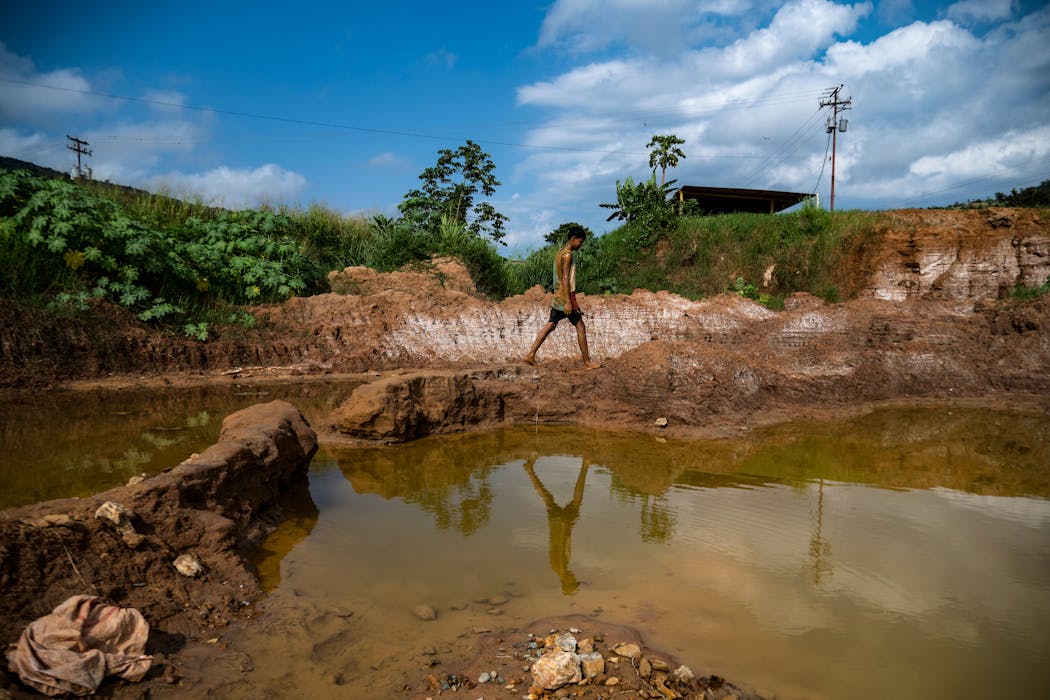
The mining operations cut down forests and remove soil. Toxic materials, including mercury used to extract gold from ore, pour into rivers, contaminating the water and harming the workers, wildlife and surrounding communities that rely on local fish and wildfire.

Images from satellite show show an area was stripped by gold mining.
An aerial view shows before and after photos (top) and close-up images of the impact of gold mining in the Cuyuni and Rio Amarillo regions of Bolivar state, Venezuela.
Charles Brewer Carias; Google Earth/Digital Globe

The mines also promote the spread of tropical infectious diseases and disrupt indigenous and rural communities. Evidence of environmental disasters and human rights violations, including human trafficking, child labor and sexual assault, have been documented by several public and private organizations.

Oil and the law

The same Orinoco River Basin holds part of the world’s largest proven crude oil reserves. After the Trump administration seized Maduro on Jan. 3, 2026, and arrested him on drug trafficking charges, it said the U.S would control that oil. But what exactly that will mean and how the oil industry will respond remains to be seen.

By law, oil and other natural and mineral resources belong to the state in Venezuela. Oil exploration, extraction and commercialization are carried out through a system called “concessions” – contracts between the government and national or foreign private companies. In exchange for access to resources, the country receives an income, or tribute, from the profits generated.

However, the Constitution of the Bolivarian Republic of Venezuela, approved in 1999, also clearly states that “the State shall protect the environment, biological and genetic diversity, ecological processes, national parks and natural monuments, and other areas of particular ecological importance.”

Analysts estimate that rebuilding the industry, which has been plagued by poorly maintained infrastructure and leaks and spills, would take years to decades. It would likely mean more roads in a region already losing pristine forest and put more of the environment and water at risk. The region’s heavy oil production has also led to water pollution.

A person walks past a mural of an oil rig with the colors of Venezuela's flag in the background.
A mural in Venezuela’s capital, Caracas, reflects the country’s long reliance on the oil industry.
AP Photo/Matias Delacroix

In the 1920s, oil drilling helped lift the economy of Venezuela, previously a very poor, largely agrarian country. The country had been plagued with malaria and other tropical diseases, the population was poorly educated, and there were continuous fights among military strongmen, known as “caudillos.” Oil brought in foreign investment, making Venezuela the second-largest oil producer in the world by 1928 and its largest exporter.

In 1976, with the country’s economy heavily dependent on oil, Venezuela nationalized the oil industry. Foreign industries could partner with the state oil company, but only if the government held the controlling share of the joint ventures. Boom times led to inflation, and oil price drops became disastrous for the economy.

The U.S. began imposing sanctions on Venezuela in 2015 over drug trafficking and human rights abuses, and those sanctions increased during the Trump administrations. Between the sanctions and mismanagement, Venezuela’s oil production collapsed, and with it, the national economy.

A person washes a fish out of murky water near shore where an oil slick covers debris.
Oil spills from Venezuela’s neglected industry contaminate Lake Maracaibo in northwestern Venezuela. Scenes like this are what environmental and Indigenous groups fear if oil drilling expands in the Orinoco Oil Belt.
AP Photo/Rodrigo Abd

Venezuelans’ future

With the removal of Maduro, former Vice President Delcy Rodríguez is in charge of the government.

In January, she signed legislation that eases state control over oil drilling but keeps ownership of the hydrocarbon reserves with the nation. She also met with U.S. officials in March and pledged to accelerate mining reforms that would give foreign companies access to Venezuelan minerals.

The shift in leadership does not guarantee other changes from Maduro’s regime, however. In her past roles, including as minister of foreign affairs and economy and as vice president, Rodriguez was involved in overseeing the Orinoco Mining Arc at a time when criminal activity and illegal mining were rapidly expanding there, environmental groups point out.

A satellite image shows mined areas in the bend of a river
Mining barges, noted in red, and mined areas are visible from satellite along the Orinoco River inside Canaima National Park. The green line is the park boundary.
SOSOrinoco

Studies of satellite data tracking deforestation suggest that Venezuela lost roughly 185 square miles (480 square kilometers) to gold mining alone from 2018 to 2025. Mining has moved into national parks, including Canaima, home to Angel Falls.

Venezuela, meanwhile, is still deep in an economic crisis that led to millions of people leaving the country.

The majority of the population lives in poverty, and inflation continued to skyrocket in early 2026. As the U.S. eases sanctions, that is likely to help, but the country has many problems to overcome.

The Conversation

Antonio Machado Allison does not work for, consult, own shares in or receive funding from any company or organization that would benefit from this article, and has disclosed no relevant affiliations beyond their academic appointment.

ref. Venezuela’s fragile environment faces rising risks as US pushes for oil and critical minerals and illegal gold mining spreads – https://theconversation.com/venezuelas-fragile-environment-faces-rising-risks-as-us-pushes-for-oil-and-critical-minerals-and-illegal-gold-mining-spreads-276859

Trump offered a restrictive deal to universities that almost all rejected – but the Compact for Academic Excellence in Higher Education may not be entirely dead

Source: The Conversation – USA (2) – By Fred L. Pincus, Emeritus Professor of Sociology, University of Maryland, Baltimore County

Only three universities agreed to the higher education compact, which offered benefits in federal funding in exchange for major policy and administrative changes at schools. Alina Naumova/iStock/Getty Images Plus

In October 2025, the Trump administration made a controversial proposal to nine major colleges and universities, including Dartmouth College and the University of Virginia. The administration offered them a deal: If they agreed to adopt certain policy changes, such as revising admissions and hiring practices, they would receive advantages in federal funding programs.

The administration later expanded the list of schools to more than 100 that could benefit from the deal, which it called the Compact for Academic Excellence in Higher Education.

The plan included a wide range of policy changes. For example, it would require schools to cap international student enrollment at about 15% and to use “legal force” against disruptive protesters.

Only three small schools not initially approached by the Trump administration agreed to sign the restrictive proposal: The New College of Florida, a public, liberal arts college in Sarasota; Valley Forge Military College, a private, two-year military college in Wayne, Pennsylvania; and Grand Canyon University, a private Christian school in Phoenix.

Although the proposed agreement has received little public attention in the past few months, as a sociologist who has studied race and inequality, I think it is important to understand what the document says.

The proposal reveals President Donald Trump’s vision for U.S. colleges and universities. In this vision, universities would have less ethnic and racial diversity, and people’s First Amendment rights would be weakened.

The proposal also suggests a stronger federal role in shaping how universities operate, which I see as a major departure from the long-standing U.S. tradition of academic freedom.

A university building with columns is seen against a gray sky.
The University of Virginia is one of the schools that rejected the Trump White House’s higher education compact.
simon’s photo/iStock/Getty Images

A second act?

Despite the compact’s lack of support among universities, the Trump administration has indicated it may revise the plan.

In an interview on Jan. 21, 2026, Secretary of Education Linda McMahon said the administration is working on an updated version.

“There was a draft version, preliminary version, that went out that was intended to be sent to universities to get their reaction from it. … We are working on developing the right kind of compact with some input that we’re already getting,” McMahon said in an interview with The Daily Signal.

The proposal’s broad scope

The original version of the compact included several major policy requirements.

First, universities would be prohibited from giving any preference to prospective students or faculty candidates based on their “sex, ethnicity, race, nationality, political views, sexual orientation, gender identity, religious associations.”

This aligns with a 2023 Supreme Court decision that colleges and universities cannot consider race as a factor in admissions decisions.

Second, the proposal would mandate that college student applicants take a widely used standardized test like the SAT – a requirement that an increasing number of schools have dropped in recent years.

Third, the compact calls on universities to “maintain a vibrant marketplace of ideas where different views can be explored, debated and challenged.”

Universities would also need to transform or abolish “institutional units that purposefully punish, belittle and even spark violence against conservative ideas.”

This follows the Trump administration’s push for more viewpoint diversity, or the exchange of a wide range of philosophical and political perspectives. Conservatives have frequently criticized what they see as a liberal political bias on college campuses.

Fourth, the proposal would require campus administrators to use “lawful force” against “demonstrators” on campus. This action could be directed toward someone disrupting class instruction and libraries, or blocking certain parts of campuses.

The proposal also doubles down on Trump’s 2025 executive order that there are only two sexes: male and female.

This language would provide support for some universities limiting how gender is taught.

Texas A&M University announced in January 2026 that it is ending its women’s studies major. In February, the state of Florida also announced that it is limiting how sex and gender can be taught in introductory sociology classes at public universities.

Academic freedom under threat

The proposal does not specifically say that faculty cannot teach certain subjects or discuss particular issues.

But as a retired sociologist who has taught diversity-related courses and published a diversity textbook, I was particularly struck by the following part of the proposal: “Academic freedom is not absolute, and universities shall adopt policies that prevent discriminatory, threatening, harassing, or other behaviors that abridge the rights of other members of the university community.”

This very broad language gives university administrators, or government officials, leverage over professors’ and researchers’ basic, daily work and their overall academic freedom – meaning, their ability to research, teach and publish whatever they want, without fear of censorship or retaliation.

A group of people are seen standing around a man wearing a suit at a large wooden table.
Education Secretary Linda McMahon, left, listens to President Donald Trump at the White House in September 2025.
Win McNamee/Getty Images

An ultimatum

None of the schools that the Trump administration initially approached signed on to the proposal.

The American Association of Colleges and Universities, one of the largest national higher education associations, described the compact as an ultimatum: Schools could sign the agreement and receive “multiple positive benefits,” including federal grants, or refuse and risk losing federal funding.

The American Association of University Professors, a national nonprofit that advocates for academic freedom, said that the plan “stinks of favoritism, patronage and bribery.”

Some conservative groups, including the Heritage Foundation, supported the administration’s attempt to address problems in higher education, such as rising tuition.

However, the organization also warned that “federal officials should avoid expanding the government’s role in higher education” while pursuing those goals.

It is unclear whether the White House will release a revised version of the compact. Still, the original proposal offers insight into how the administration hopes to reshape American higher education.

The Conversation

Fred L. Pincus does not work for, consult, own shares in or receive funding from any company or organization that would benefit from this article, and has disclosed no relevant affiliations beyond their academic appointment.

ref. Trump offered a restrictive deal to universities that almost all rejected – but the Compact for Academic Excellence in Higher Education may not be entirely dead – https://theconversation.com/trump-offered-a-restrictive-deal-to-universities-that-almost-all-rejected-but-the-compact-for-academic-excellence-in-higher-education-may-not-be-entirely-dead-275203

Family-friendly workplaces are great − but ‘families of 1’ get ignored

Source: The Conversation – USA (2) – By Peter McGraw, Professor of Marketing and Psychology, University of Colorado Boulder

Single people without kids are a growing share of the workforce. Luis Alvarez/DigitalVision via Getty Images

In 1960, 72% of adults were married, and over 90% would go on to marry. HR policies and management practices back then catered to nuclear families with a lone, male breadwinner.

Today, dual-career couples and working mothers are common, largely due to the growth of women in the workforce in the second half of the 20th century.

To recruit and retain talent, businesses have expanded family-friendly policies by offering flexible work hours, paid parental leave and subsidized child care. These are much-needed improvements, though many employers still lag in offering them.

Today, another demographic shift also demands employers’ attention: the growing share of the workforce that is single – particularly those without dependents. About 1 in 3 American adults haven’t gotten married by midlife.

More adults aren’t married

The workplace has always included recent grads, never-married professionals, divorced empty nesters and widowed retirees. But these categories now represent a far larger share of the labor force than they did a generation ago – and people move in and out of them throughout their lives.

As a behavioral economist and business school professor, I study what I call the “Solo Economy” – how institutions and markets are adapting, or failing to adapt, to this shift.

Workplace policy is one area where the gap is especially wide.

A growing mismatch

Today, 46% of U.S. adults are unmarried. Half of these unmarried Americans aren’t interested in dating. Population forecasters project that about 25% of millennials and 33% of Gen Z will never marry.

Around 29% of U.S. adults live alone – the most common household type in the country. Compare that to 1960, when the median age of first marriage was 20 for women and 22 for men, and single-person households were relatively rare.

The average age of getting hitched for the first – or only – time has risen by nearly a decade since then to 28.4 for women and 30.8 for men.

And yet, many HR policies have not adjusted to this new normal. Of course, there’s a word for this: amatonormativity. It’s the assumption that marriage and family are the ideal relationship model.

Amatonormativity underpins more than 1,000 legal benefits for married people, from tax breaks to Social Security payments. These disparities extend into the workplace when family-friendly policies don’t take the needs of the “family of one” into account.

In one survey, 62% of single workers reported feeling treated differently from married colleagues with children – and 30% said the disparity reinforced the message that their lives mattered less.

I believe that employers can do better by singles with no kids at home without putting anyone at a disadvantage.

A man stands atop a mountain.
You don’t have to belong to a nuclear family to need paid time off.
Ippei Naoi/Moment via Getty Images

Scheduling can seem unfair

Workers with spouses or who are raising children have real obligations that deserve support. But too often, single employees without dependents are expected to pick up the slack by working on holidays, traveling more for their jobs and taking vacations at less desirable times.

“My manager asked me to take on an extra responsibility, saying she couldn’t ask the teacher who handled it before because she ‘has four boys,’” Sarah Brock, founder of Sarah Bee Talent, posted on Linkedin. “I felt like my life didn’t have the same value because I wasn’t raising a family.” Brock received hundreds of similar stories in response to her post.

Researchers have found evidence that confirms these patterns: Single, childless employees are more often expected to travel, work longer hours and take less desirable vacation times than their married colleagues.

Krystal Wilkinson, a British human resource management professor, has written about finding that children and child care are considered far more legitimate reasons for placing boundaries on work than engaging in hobbies, fitness or dating. Even with policies such as unlimited paid time off, singles may hesitate to take vacations, fearing that their managers will see their reasons for taking time off as illegitimate.

Better benefits for married employees

Employee benefits often favor married workers – not by design, but by default.

The total compensation package is typically worth more for a married employee doing the same job as a single one. A 2021 Kaiser Family Foundation survey found that 95% of large employers extend health coverage to employees’ spouses, with employers subsidizing part of the cost. This is entirely reasonable – but single employees typically receive no equivalent value in return.

This gap extends to many life insurance policies, retirement plan features, wellness programs and employee assistance programs.

Leave policies reflect a similar pattern. The Family and Medical Leave Act grants up to 12 weeks of unpaid leave to care for a parent, child or spouse. Bereavement leave is typically limited to deaths of members of your immediate family. Yet singles without kids at home often have broader support networks that include their close friends and members of their “chosen family” – whom current policies don’t recognize. This tends to be especially true within the LGBTQ+ community.

The issue isn’t that married employees receive too many benefits. It’s that the system was built for one kind of lifestyle and hasn’t kept pace with how many people live today.

What employers can do

Employers can close these gaps without taking anything away from married employees – and in many cases, benefit everyone with these approaches.

Flexible benefits: A cafeteria-style model lets employees allocate a budget based on their own needs, covering everything from child care to gym memberships to pet insurance. Netflix already does this by offering up to US$16,000 per employee yearly to cover medical, dental and vision premiums – regardless of marital status – with unused portions partially refundable.

Broader leave policies: Bereavement leave could cover close friends. Employees might exchange one type of leave for another, based on need.

Fair scheduling: Rather than assuming single employees are more available, companies can adopt first-come, first-served vacation systems with seniority breaking ties. Or companies could adopt a points-based system, giving every employee an equal budget to bid on preferred time slots – ensuring those who value certain dates most get priority, regardless of relationship status.

Inclusive language and culture: Small changes signal who belongs. When employers use wording like “you and your loved ones” instead of “you and your family” in their communications with their staff, it acknowledges relationships beyond traditional structures.

Organizational values: Just as companies affirm diversity in age, gender, sexual orientation and ethnicity, they can explicitly commit to valuing employees regardless of relationship status.

A simple test

If employers want to see whether any of their personnel policies could put their married or single employees at a disadvantage, I suggest they use this litmus test: Would this policy harm a married employee who gets divorced? If so, the policy needs to change.

Many people shift between singlehood and partnership throughout their lives due to breakups, divorce and the death of their spouses or partners. A workplace built for a family of one is built for everyone – wherever they happen to be in their life journey.

The Conversation

Peter McGraw does not work for, consult, own shares in or receive funding from any company or organization that would benefit from this article, and has disclosed no relevant affiliations beyond their academic appointment.

ref. Family-friendly workplaces are great − but ‘families of 1’ get ignored – https://theconversation.com/family-friendly-workplaces-are-great-but-families-of-1-get-ignored-276260

Measuring poverty on a spectrum instead of an arbitrary line conveys a more accurate picture of inequality

Source: The Conversation – USA (2) – By Olivier Sterck, Associate Professor of Economics, University of Oxford

Does drawing a line make sense at any step of the way to wealth? fatido/iStock via Getty Images Plus

Michael W. Green, a Wall Street investor, created a buzz in late 2025 by arguing that the U.S. poverty line should be jacked up to US$140,000 for a family of four. Currently, a family of that size has to be eking by on $33,000 a year to qualify as poor in the federal government’s eyes.

His critique builds on a broader debate about how to measure poverty in the United States. The U.S. government has made few changes to how it officially calculates the poverty rate since President Lyndon B. Johnson launched the “war on poverty” in the 1960s.

Outlets such as The Washington Post, Fortune and Fox News covered Green’s assertions, sparking a flurry of public debate over a topic usually relegated to economists like me.

Having spent more than 15 years researching poverty as an economist, I believe that whether the government ought to draw this line at $33,000, $100,000 or $140,000 is not the real issue. Instead, I’ve been arguing that there is no magic threshold below which you are poor and above which you’re doing fine. Instead, poverty should be understood as a spectrum that can be measured without relying on arbitrary lines.

3 different poverty lines

Think about it: Living on $100 a day is better than $75 a day, which is better than $50, which is better than $25. Nothing magical happens when you cross some arbitrary line. People don’t suddenly escape the constraints and vulnerabilities of having low incomes when they make one dollar more than they used to.

And yet almost all public debates, research and policy treat poverty lines as legitimate – as if this threshold really exists.

Consider three very different poverty lines:

Moving the poverty line to $80 per person per day, which today amounts to roughly $140,000 for a family of four per year, as Green proposes, then 56% of Americans are poor according to World Bank data. So are most people in other high-income countries.

Drawing the poverty line at about $20 per person per day – approximately equivalent to the official U.S. poverty threshold for a family of four – the share of Americans who are below that line plunges to 6%, according to the World Bank data I analyzed.

The World Bank also has a definition of extreme poverty: $3 per person per day. If you put the line there, only 1% of Americans would be officially experiencing poverty.

Even among experts, there is little agreement on where the poverty line should fall. As a result, debates about poverty lines often reveal more about the choice of threshold than about poverty itself.

Measuring poverty without lines

Based on my research, I have proposed letting go of poverty lines to get a more meaningful view of how poverty evolved over time and in different countries.

Instead, I propose a new way to measure poverty, through what I call “average poverty,” which reflects the fact that having less income is always worse than having more.

Average poverty builds on a simple intuition. If someone I’ll call Alex earns half as much as someone else I’ll call Barbara, then Barbara is twice as rich as Alex and Alex is twice as poor as Barbara.

Similar inverse relationships are widespread in other fields: Pace is the reciprocal of speed in running as resistance and conductance are in electricity.

This means that poverty can be defined as the inverse of income, and its unit is simply inverted. If incomes are measured in dollars per day, poverty is measured in days per dollar.

Average poverty therefore captures something very concrete: the average number of minutes, hours or days that it takes to get $1 in income.

For these purposes, income includes earnings from work, government benefits and other sources of money, and it is averaged among all family members. It is expressed in international dollars, which account for inflation and global price differences. The time to get $1 refers to a day of life for anyone at any age and in any circumstance, not just the hours worked by someone with a job.

My proposed measure casts the U.S. in a strikingly different light from traditional poverty statistics. In the U.S., I’ve calculated that it takes 63 minutes on average to get $1 in income. That’s much slower than in many other high-income countries:

  • United Kingdom: 34 minutes

  • France: less than 31 minutes

  • Germany: about 26 minutes

This indicates that average poverty is substantially higher in the U.S., even though U.S. average incomes are higher than in most Western European countries. While average poverty declined over time in most other high-income countries, it has increased almost continuously in the U.S. since 1990 despite swift growth in average incomes.

There is one exception to this trend: during the COVID-19 pandemic, when the U.S. adopted several short-term anti-poverty measures.

The price of inequality

At first glance, this seems paradoxical. How can a rich country’s economy grow and yet get poorer?

The answer is simple: inequality.

Seeing poverty as a spectrum rather than a switch that’s on or off casts light on what traditional measures hide: Inequality matters no matter where you are on the poverty-prosperity continuum. Under this approach, poverty can change for two reasons: either incomes rise or fall on average, or the distribution of income may become more or less unequal.

And the U.S. has one of the most unequal economies in the world, and by far the most unequal among rich countries. Across all 50 states, inequality has risen sharply since 1990, regardless of political orientation, demographic composition or economic structure.

When inequality rises faster than incomes grow, average poverty increases even in a growing economy. This is why the U.S. appears poorer under a continuous measure than when there’s a simple line drawn at the $20-per-day mark: Its income distribution has been getting more unequal even as the average income has risen.

Seeing poverty as a spectrum changes the conversation. It reveals what poverty lines miss and why inequality matters so much.

The Conversation

Olivier Sterck receives funding from the Research Foundation Flanders (FWO). He does not work for, consult, own shares in or receive funding from any organization that would benefit from this article.

ref. Measuring poverty on a spectrum instead of an arbitrary line conveys a more accurate picture of inequality – https://theconversation.com/measuring-poverty-on-a-spectrum-instead-of-an-arbitrary-line-conveys-a-more-accurate-picture-of-inequality-271912