Iran protests: Trump stalls on US intervention leaving an uncertain future for a bitterly divided nation – expert Q&A

Source: The Conversation – UK – By Scott Lucas, Professor of International Politics, Clinton Institute, University College Dublin

A US intervention in Iran appeared imminent this week. US and UK troops were pulled out of several bases around the Middle East, US military assets had been moved into position and the US president, Donald Trump, had reassured protesters on the streets of Iran that “help is on its way”.

But then the US president told reporters on the afternoon of January 14 that he had received information from “very good sources” that “the killing has stopped” and that planned executions of protesters would not now proceed.

So where does this leave the protest movement in Iran? In two and a half weeks of protests across the country, more than 2,500 people are reported to have been killed and more than 18,000 people arrested. The theocratic regime which has ruled the country since the 1979 revolution has been shaken to its core, but – like on several occasions in the past 25 years – appears to have survived yet another nationwide wave of protest and dissent from a population that overwhelmingly rejects its oppressive governance.

We speak to Scott Lucas, an expert in Middle East politics at University College Dublin, who addresses several key issues.

Do you think a US intervention in Iran is now off the cards?

I hate to make this a story about Donald Trump. It should focus on the important people – the Iranians who are risking their lives to pursue rights and reforms – but here goes.

The logical approach for any US administration considering intervening in a situation like this is to consider both the situation inside Iran as well as the regional dynamics. But the US president does not act logically. He’s a mess of contradictions, wanting to be a bully and a “president of peace” at the same time.

So he blusters for days that he will unleash the US military on Iran’s regime. But he’s also seduced by signals from Tehran that it is willing to enter negotiations with him.

On Wednesday, Trump officials let European and Israeli counterparts know that US strikes are imminent. But Iran’s leaders send another signal: we have stopped killing protesters and we will not execute them. So Trump goes back into his “maybe they will speak to me as the president of peace” mode. So the strikes have been suspended.

Avoiding what could have been a disastrous confrontation between the US and Iran is a relief for the region – and the wider world. But the Iranians risking their lives on the streets will feel abandoned and discouraged.

There have been several waves of protest this century. Are things any different this time?

I think of these nationwide protests, going back more than 25 years, as waves hitting the Iranian shore. There was a first wave in 1999, which began in the universities, for political and social freedoms. Ten years later, there was a far larger wave – the largest since the 1979 Islamic Revolution – after the regime manipulated the 2009 presidential election.

In 2019, the protests were over economic conditions, particularly the prices of petrol, food and essential goods. It was only three years until the next wave, the 2022 marches which lasted for months for “women, life, freedom”.

On each occasion, through the combination of deadly force, detentions, cut-off communication and decapitation of the opposition’s leadership, the regime has quelled the public displays. But both the discontent and the desire for freedoms are below the surface, waiting to propel another wave.

That in December 2025 came the catalyst of the collapsing currency, which fed an inflation threatening both households and vendors. However, the wider aspirations of many Iranians soon expanded this into a renewed challenge to the regime’s legitimacy.

Ali Khamenei is already reportedly planning his retirement. How does the Islamic Republic adapt if it wants to survive?

Personally, I don’t think the supreme leader will quit until he is too ill to carry on. So while less prominent on a daily basis, he is still head of the regime for the foreseeable future.

The other question is even easier to answer because the regime has given its response. It does not adapt: it refers to the same political playbook which it has used since the first big wave of student protests in 1999. Intimidate the opposition and the protesters. Detain them. Abuse them. Force them to “confess”. Kill them if necessary. Restrict communications.

And then call out your supporters to the streets. Use state media and your spokespeople – one of them, the main unofficial English-language talking head, is a former colleague from the University of Birmingham, Seyed Mohammad Marandi – to insist that genuine Iranians back the regime and that the protesters are puppets of the US and Israel.

Israel and the Arab states advised Trump against a US intervention. Why?

While Israel, Saudi Arabia, the UAE and the other Gulf States benefit from a weakened Iranian regime, they do not want one which collapses without an obvious successor.

Paradoxically, they also know that US military intervention could strengthen the Iranian leadership. Since 1999, the regime has relied on portrayal of its opponents as American and Israeli agents. An American attack strengthens that narrative.

But the fundamental calculation is likely that a US assault will result in instability throughout the region. Iran might retaliate against American positions or those of the Gulf States. It could threaten the Strait of Hormuz, through which about 20% of seaborne LNG (liquefied natural gas) and 25% of oil passes. While its allies in the Middle East have been weakened, from Hezbollah to the Houthis, there still could be consequences in Lebanon, Yemen, and other countries.

Could Reza Pahlavi unify the country or provide an interim solution?

I’m sceptical about parachuting the late Shah’s son into Iran as its “leader”, whether on the throne or another seat of power. He left the country at age 18 in 1979. Since then, having declared himself Shah and leader of a government-in-exile, he has forged ties with monarchist groups, but has been rejected by others in the opposition.

Some Iranian diaspora groups and their overseas supporters are fervent proponents of Pahlavi, and some inside Iran no doubt would favour him as an option. But from talking to my personal contacts, and all the evidence you see reported in the media, and in surveys such as the one published in The Conversation on January 12, most Iranians are not looking for a return to the monarchy.

People also know from the experience of neighbouring Iraq in 2003, that imposing a leader from outside may not work out well. The US-supervised administration under Ahmad Chalabi, who – like Pahlavi – had spent more than 40 years outside the country, soon collapsed. Iraq went through an insurgency and civil war in which hundreds of thousands were killed.

That raises a wider, more important issue in which Pahlavi should be set aside. For all the scale and potential of the protests, the opposition does not have the organisation for its political, social and economic ambitions. The regime has seen to that with its decapitation strategy, imprisoning prominent activists from all spheres of Iranian society. How can protesters and the opposition be supported in developing that organisation?

The regime has imprisoned a number of popular democracy figures – could any of them be a credible leader?

I don’t think of this in terms of a “leader” but in terms of the organisation to which I just referred.

Long-time political prisoners include politicians such as Mostafa Tajzadeh, the former interior minister who has been behind bars for most of the past 16 years. Then there are human rights activists such as Nobel peace laureate Narges Mohammadi and Majid Tavakoli. There are also lawyers such as Nasrin Sotoudeh, as well as unionists, students and journalists.

Mir Hossein Mousavi was prime minister between 1981 and 1989 (when the regime abolished the role) and the man who reportedly led the first round of the 2009 presidential election, before the regime’s intervention. Mousavi has been under strict house arrest with his wife the artist, academic and activist Zahra Rahnavard, since February 2011.

Mousavi’s release would be important symbolically. Freedom for others would be a practical boost to the opposition: they could provide the makings of an organised movement which could engage the regime for the changes needed for political, economic and social space.

That is why, rather than headlining Donald Trump’s bluster about military action, I wish people would focus on releasing these prisoners as well as opening up communications within Iran, and between Iran and the outside world.

The Conversation

Scott Lucas does not work for, consult, own shares in or receive funding from any company or organisation that would benefit from this article, and has disclosed no relevant affiliations beyond their academic appointment.

ref. Iran protests: Trump stalls on US intervention leaving an uncertain future for a bitterly divided nation – expert Q&A – https://theconversation.com/iran-protests-trump-stalls-on-us-intervention-leaving-an-uncertain-future-for-a-bitterly-divided-nation-expert-qanda-273501

How AI-generated sexual images cause real harm, even though we know they are ‘fake’

Source: The Conversation – UK – By Alex Fisher, Society for Applied Philosophy Postdoctoral Fellow, University of Leeds

CandyRetriever/Shutterstock

Many women have experienced severe distress as Grok, the AI chatbot on social media site X, removed clothing from their images to show them in bikinis, in sexual positions or covered in blood and bruises. Grok, like other AI tools, has also reportedly been used to generate child sexual abuse material.

In response, the UK government has announced it will bring forward the implementation of a law, passed in June 2025, banning the creation of non-consensual AI-generated intimate images. Following bans in Malaysia and Indonesia, Grok has now been updated to no longer create sexualised images of real people in places where it is illegal, which will include the UK.


Read more:
What can technology do to stop AI-generated sexualised images?


X’s owner, Elon Musk, has claimed the UK government wants “any excuse for censorship”. The media regulator, Ofcom, is also conducting an investigation into whether X’s activities broke UK law.

Some X users have minimised the harm these “undressed” and “nudified” images cause, describing them as “fake”, “fictional”, “very realistic art at most” and “no more real than a Tom & Jerry cartoon”.

You might think that AI-generated and edited images only cause harm through deception – fake images mislead us about real events. But how can images that everyone knows aren’t real cause harm?

The sexualised content of undressed images is not real, even if they are based on genuine photos. But these images are highly realistic. This, along with the misogyny motivating their creation, is sufficient to cause significant psychological distress to victims.

How ‘undressed’ images harm

MP Jess Asato and other victims report an uncanny feeling at seeing undressed images of themselves: “While of course I know it’s AI, viscerally inside it’s very, very realistic and so it’s really difficult to see pictures of me like that,” Asato told the BBC.

Research in philosophy and psychology can help explain this experience. Think about looking down from a tall building. You know you are completely safe, but might still feel terrified of the drop. Or you watch a horror film, then feel on edge all night. Here, your emotions are “recalcitrant”: you feel strong emotions that clash with what you believe to be true.

Seeing oneself digitally undressed generates powerful recalcitrant emotions. People strongly identify with their digital appearance. And a “nudifed” image really looks like the subject’s body, given it is based on a real picture of them.

So, while knowing these images are fake, their realism manipulates the victim’s emotions. They can feel alienated, dehumanised, humiliated and violated – as if they were real intimate images shared. This effect may worsen as AI-generated videos provide ever more realistic sexual content of users.

Research shows that the nonconsensual sharing of nude or sexual images is “associated with significant psychological consequences, often comparable to those experienced by victims of sexual violence”.

Besides the psychological impact of undressed images, users also feel horrified at the very real motivations behind them. Someone felt entitled to sexualise your photo, directing Grok to strip away clothing and reduce you to a body without consent. Publicly bombarding women with these images exerts control over how they present themselves online.

Sexual deepfake videos and undressed images – whether of celebrities, politicians or members of the public – target women for humiliation. The misogynistic mindset behind these images is real and familiar, even if their content is not.


Read more:
Taylor Swift deepfakes: new technologies have long been weaponised against women. The solution involves us all


Virtual harms

The distress caused by “undressed” images resembles another prevalent form of digital misogyny: the assault and harassment of women in virtual worlds. Many women in online virtual reality environments report their avatars being assaulted by other users – a common issue in video games that is worsened as virtual reality (VR) headsets present an immersive experience of being assaulted.

Whistleblowers have claimed Meta has suppressed the lack of child safety on its VR platform, with girls as young as nine frequently harassed and propositioned by adult men. Meta denies these allegations. A company spokesperson told the Washington Post that Meta’s VR platform has safety features to protect young people, including default settings that allow teen users to communicate only with people they know.

Metaverse: Why it’s already unsafe for women | CNN.

Virtual assault is also often dismissed as “not real”, even though it can cause similar trauma to physical assault. The realistic appearance of virtual reality, strong identification with one’s avatar and the misogynistic motivations behind virtual assault enable it to cause serious psychological harm, even though there is no physical contact.

These cases show how misogyny has evolved with technology. Users can now create and participate in realistic representations of harm: undressed images, deepfake videos, virtual assault and the abuse of chatbots and sex dolls based on real people.

These forms of media cause significant distress, but are slow to be regulated as they don’t physically harm victims. Banning social media like X isn’t the solution. We need proactive regulation that anticipates and prohibits these digital harms, rather than enacting laws only once the damage is done.

Victims undressed by Grok or assaulted in virtual worlds are not being “too sensitive”. It is a mistake to dismiss the real psychological impact of this media just because the images themselves are fake.

The Conversation

Alex Fisher has received research funding from The Society for Applied Philosophy, the Leverhulme Trust, the Aristotelian Society, and the Royal Institute of Philosophy.

ref. How AI-generated sexual images cause real harm, even though we know they are ‘fake’ – https://theconversation.com/how-ai-generated-sexual-images-cause-real-harm-even-though-we-know-they-are-fake-273427

One uprising, two stories: how each side is trying frame the uprising in Iran

Source: The Conversation – Global Perspectives – By Ali Mamouri, Research Fellow, Middle East Studies, Deakin University

Since the outbreak of the current wave of protests in Iran, two sharply competing narratives have emerged to explain what is unfolding in the streets.

For the ruling establishment, the unrest is portrayed as a foreign-engineered plot. They argue it is an externally-driven attempt to destabilise the state through manipulation, infiltration, and psychological operations.

For the opposition, the same events are framed as a nationwide uprising rooted in long-standing grievances. They argue the protests signal a rupture between society and the political system.

How the “story” of a conflict is told is a key component in warfare. The Iran protest are offering two very different stories.

Narrative crafting as psychological warfare

In the digital age, psychological warfare has moved beyond conventional propaganda into the realm of what academics Ihsan Yilmaz and Shahram Akbarzadeh calls Strategic Digital Information Operations (SDIOs).

Psychological operations function as central instruments of power, designed not only to suppress dissent but reshape how individuals perceive reality, legitimacy, and political possibility. Their objective is cognitive and emotional:

  • to induce fear, uncertainty, and helplessness
  • to discredit opponents
  • to construct a sense of inevitability around a certain political scenario.

These techniques are employed not only by states, but increasingly by non-state actors as well.

Social media platforms have become the primary theatres of this psychological struggle. Hashtags, memes, manipulated images, and coordinated commenting – often amplified by automated accounts – are used to frame events, assign blame, and shape emotional responses at scale.

Crucially, audiences are not passive recipients of these narratives. Individuals sympathetic to a particular framing actively reproduce, reinforce, and police it within digital echo chambers. In this way, confirmation bias flourishes and alternative interpretations are dismissed or attacked.

Because of this, narrative control is not a secondary dimension of conflict but a central battleground. How an uprising is framed can shape its trajectory. It can determine whether it remains peaceful or turns violent, and whether domestic repression or foreign intervention comes to be seen as justified or inevitable.

The Iranian regime’s narrative

The Iranian regime has consistently framed the current uprising as a foreign-engineered plot, orchestrated by Israel, the United States and allied intelligence services. In this narrative, the protests are not an expression of domestic grievance but a continuation of Israel’s recent confrontation with Iran. This, it argues, is part of a broader campaign to overthrow the regime and turn the country into chaos.

Two weeks after the protests began, the state organised large pro-regime demonstrations. Shortly afterward, supreme leader Ayatollah Ali Khamenei declared these rallies had “thwarted the plan of foreign enemies that was meant to be carried out by domestic mercenaries”.

The message was clear: dissent was not only illegitimate but treasonous. Those participating in it were portrayed as instruments of external powers rather than citizens with political demands.

Demonising dissent serves a dual purpose. It is not only a method of silencing opposition, but also a tool for engineering perception and shaping emotional responses.

By portraying protesters as foreign agents, the regime seeks to manufacture compliance, discourage wavering supporters, and project an image of widespread popularity. The objective is not simply to punish critics, but to signal that public dissent will carry heavy costs.

To reinforce this narrative, pro-regime social media accounts have circulated content that blends ideological framing with selective factual material. Analyses arguing that events in Iran follow a familiar “regime change playbook” – have been widely shared, as have Israeli statements suggesting intelligence operations inside Iran. Cherry-picking expert commentary or isolated data points to justify repression is a common feature of this approach.

The timing and amplification of such content are also significant. Social media networks are deployed via “algorithmic manipulation” to make the regime’s framing go viral and marginalise counter views.

As this digital campaign unfolds, it is reinforced by more traditional forms of control. Internet restrictions and shutdowns limit access to alternative sources of information. This allows state media to dominate communications and thwart challenges to the official narrative.

In this environment, the regime’s story functions not merely as propaganda, but as a strategic instrument. It aims to redefine the uprising, delegitimise dissent, and preserving authority by controlling how events are understood.

The opposition narrative

Though the opposition is divided, but two main groups have appeared active in framing the opposition narrative: those who support an Iranian monarchy, and dissenting armed group Mojahedin-e-Khalq (MEK). Despite their differences, the two have contributed to the same story.

They have crafted a persuasive narrative, framing the uprising as a moral emergency requiring external intervention, particularly by the United States and Israel. This narrative does not represent all opposition voices, but it has gained visibility through social media, exile media outlets, and activist networks. Its core objective is to bring international attention to the conflict and put the case for, then bring about, regime change in Iran.

One central technique has been the legitimisation and encouragement of violence. Calls for armed protest and direct confrontation with security forces mark a clear shift away from demand-based, civilian mobilisation toward a violent uprising.

A high number of state forces casualties – reportedly more than 114 by January 11 – is an example of the effectiveness of this technique. This escalation is often justified as necessary to “keep the movement alive” and generate a level of bloodshed that would compel international intervention.

According to external conflict-monitoring assessments, clashes between armed protesters and state forces have in fact resulted in significant casualties on both sides.

A second technique involves the strategic inflation of casualty figures. Opposition platforms have claimed the death toll to be far higher than figures cited by independent estimates.

Such exaggeration serves a clear psychological and political purpose. It is intended to shock and sway international opinion, frame the situation as genocidal or exceptional, and increase pressure on foreign governments to act militarily.

A third element has been the use of intimidation and rhetorical coercion. In some high-profile media appearances, opposition figures have openly threatened pro-regime commentators, warning of retribution once power changes hands.

This language serves multiple functions. It seeks to silence alternative viewpoints, project confidence and inevitability, and present the situation as one of good versus evil. At the same time, such rhetoric risks alienating undecided audiences and reinforcing regime claims the uprising will lead to chaos or revenge politics.

These practices reveal how parts of the opposition have also embraced narrative warfare as a strategic tool. This narrative is used to amplify violence, inflate harm, and suppress competing interpretations. It aims to redefine the uprising not merely as a domestic revolt, but as a humanitarian and security crisis that demands foreign intervention.

In doing so, it mirrors the regime’s own effort to weaponise storytelling in a conflict where perception is as consequential as power.

In different ways, both narratives ultimately sideline the protesters themselves. They reduce a diverse, grassroots movement into an instrument of power struggle, either to legitimise repression at home or justify intervention from abroad.

The Conversation

Ali Mamouri does not work for, consult, own shares in or receive funding from any company or organisation that would benefit from this article, and has disclosed no relevant affiliations beyond their academic appointment.

ref. One uprising, two stories: how each side is trying frame the uprising in Iran – https://theconversation.com/one-uprising-two-stories-how-each-side-is-trying-frame-the-uprising-in-iran-273573

How is China viewing US actions in Venezuela – an affront, an opportunity or a blueprint?

Source: The Conversation – Global Perspectives – By Kerry E. Ratigan, Associate Professor of Political Science, Amherst College

China’s public response to the U.S. capture of Nicolás Maduro played out in a fairly predictable way, with condemnation of a “brazen” act of force against a sovereign nation and accusation of Washington acting like a “world judge.”

But behind closed doors, Beijing’s leaders are likely weighing the more nuanced implications of the raid: How will it affect China policy in Latin America? Can Beijing use the incident to burnish its image as an alternative global power? And what does the United States’ apparent disregard of international laws mean should China wish to make similar assertive moves in its own backyard?

As a scholar focusing on China’s global presence, I believe that these questions fit into a wider dilemma that President Xi Jinping faces in balancing two core Chinese tenets: the country’s long-standing commitment to noninterference in the domestic politics of other countries and its desire to strengthen strategic alliances and increase its presence in countries that, like Venezuela, provide it with crucial resources.

China’s LatAm ambitions

In recent years, China has become a more active and assertive player in international relations. And nowhere is this more true than in Latin America, where it has established deeper ties with countries like Venezuela.

China and Latin American countries have a mutually beneficial economic relationship. China needs natural resources, such as copper and lithium, that are abundant in Latin America, while China has been a ready source of infrastructure development.

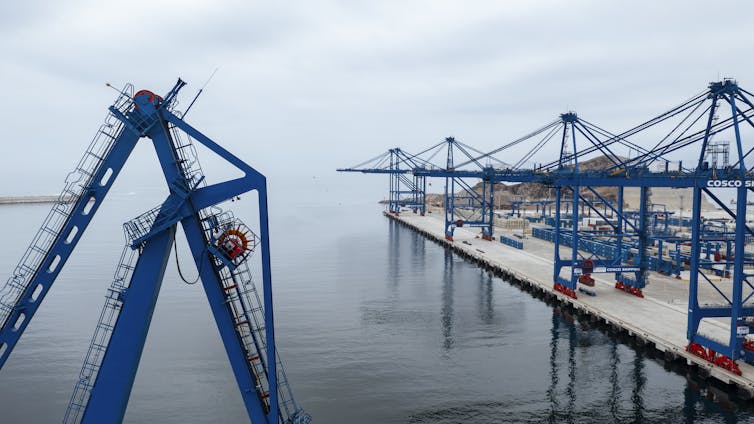
For example, China has a strong presence in Peruvian mining, and the Chinese state-owned enterprise COSCO recently opened the high-tech Port of Chancay in Peru.

A row of cranes are seen at a dock.
The Port of Chancay is 60% owned by the Chinese state-owned company COSCO Shipping Ports.
Hidalgo Calatayud Espinoza/picture alliance via Getty Images

And Chinese companies have been instrumental in upgrading public transportation to electric and hybrid systems across the region, such as the new metro line in Bogotá, Colombia.

China has become the second-largest trading partner across Latin America, behind the United States. For South America, it is the largest.

China’s relationship with Venezuela, as with other Latin American countries, took shape in the early 2000s. By 2013, China had lent Venezuela more energy finance than anywhere else in the world.

Even as mismanagement of Venezuela’s state-owned oil company and the country’s increasing slide into autocracy became apparent, China doubled down on lending. Throughout this process, China become the recipient of the vast majority of Venezuelan oil.

Accordingly, ties to the now-ousted Maduro remained strong to the end. Indeed, the last public act of Maduro before being snatched away from his bedroom by U.S. Delta Force commandos was reportedly a post on social media about his country’s strong bond with China.

But other than rhetoric and condemnations at the United Nations and elsewhere, Beijing can do little to directly counter the U.S. action.

Most likely, China will continue to condemn such policies, while quickly building up ties with Maduro’s successor and negotiating with Washington. China’s foreign ministry was at pains to stress commitment to Venezuela “no matter how the political situation may evolve,” following a Jan. 9 meeting between Beijing’s ambassador to Venezuela and Maduro’s successor, Delcy Rodriguez.

A woman in a green dress claps her hands while being surrounded by other people
Delcy Rodriguez met with the Chinese ambassador to Venezuela within days of being sworn in as acting Venezuelan president.
Jesus Vargas/Getty Images

More than anything, China will likely seek continued economic engagement with Venezuela. In 2024, Venezuela exported 642,000 barrels of oil per day to China — about three-quarters of the country’s production.

How the U.S. will now address Venezuelan oil — and by extension China’s ties to it — is not yet clear. President Donald Trump has pushed to redirect Venezuelan oil exports away from China and to the U.S, but he might not want to further escalate U.S.-China tensions.“

Broader than Venezuela

Even if Trump were to deprive China of Venezuelan oil, it is unlikely to change the trajectory of Beijing’s Latin America policy. After all, Venezuelan oil still only makes up 4% to 5% of China’s imported crude.

Indeed, China’s Latin America policy has not been discriminatory with regard to the political leanings of nations, even if Venezuela were to change course. China has well-established economic relations with almost every country in Latin America. For example, Argentina’s MAGA-aligned leader Javier Milei has courted China while in office and confirmed no intention to break ties now.

Nonetheless, Beijing is mindful of Trump’s reassertion of an aggressive Monroe Doctrine approach to the United States’ southern neighbors.

Unlike its own assertive military actions in its near waters, China has not meaningfully engaged in overt military or political influence in Latin America nations, in line with its noninterference stance.

And aside from China’s limited military support to allied nations through arms sales and joint-training exercises, some observers have been quick to note that China’s inaction following the U.S. attack on Venezuela exposes the hollowness of any security arrangement with Beijing.

Some may caution that Chinese projects like the Port of Chancay in Peru could be used for military purposes, or that Chinese control of utilities like electricity, as in Peru and Chile, presents a security threat to the host country and possibly to U.S. interests.

But for all of the Trump administration’s talk about how a country like China wants to intervene in Latin America, it is not Beijing that has suddenly renewed active military interventions in Latin America. And when push comes to shove, China likely has no wish to be involved militarily in Latin American affairs.

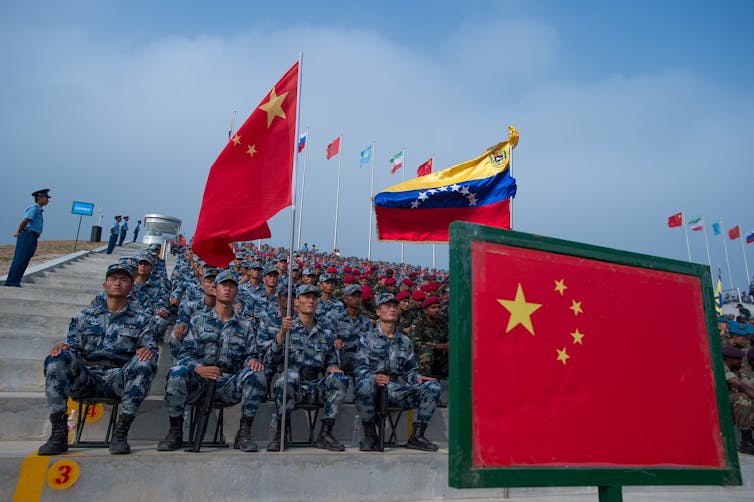
Men in army fatigues sit behind two flags.
China’s Air Force personnel take part in the International Army Games 2017 alongside teams from Iran, Kazakhstan, Morocco, Russia, South Africa and Venezuela.
AFP via Getty Images

China as an alternative global power

If anything, U.S. intervention of the kind seen in Venezuela risks pushing Latin America further into China’s orbit.

The Maduro operation has been met with staunch criticism from countries including Brazil, Chile, Colombia and Mexico. It plays into a growing sense of disillusionment with the U.S.-dominated global order.

And here, China might see an opportunity.

In recent decades, China has gone from a being a “rule taker” to a “rule maker” in international politics, meaning that Beijing increasingly sees geopolitics as the U.S once did: something ripe for remaking in its own image.

In addition to assuming leadership roles in major U.N. agencies, China under Xi has increasingly positioned itself as a leader of the Global South. It has developed international organizations that seem to offer an alternative to the institutions tied to the existing U.S.-led global order.

For example, Beijing created the Asian Infrastructure Investment Bank as an alternative lender to the World Bank and the International Monetary Fund. China also offers development finance through the New Development Bank and its two “policy banks” — the China Development Bank and the Export-Import Bank of China.

In international governance, China has emphasized multilateralism and dialogue as the basis for new global initiatives, pledging adherence to the principles of the U.N. charter and respecting sovereignty.

Skeptics may claim this as window dressing for strategic global ambitions. But if the intention is for China to remold international governance under its guidance, then the actions of the current U.S. administration pave the way for Beijing to promote its vision.

Under Trump, the U.S. has undermined global governance bodies, pulling out of a series of bodies and commitments, including the Paris climate accord, the World Health Organization and the U.N. Human Rights Council.

The Chinese government’s condemnations of the U.S. actions in Venezuela have highlighted the impact it had on certain international norms, notably law. But it has left it to sympathetic voices outside government to make the logical next jump.

Writing for the state-run China Global Television Network, Renmin University Professor Wang Yiwei argued that the international system suffers from American imperialism and that the “only nation capable of dismantling these three pillars [of imperialism, colonialism and hegemony] is undoubtedly China.” The article was published in Chinese and English on CGTN — a clear nod that it is intended for both a domestic and international audience.

Carving up the world?

While China has been quick to condemn the U.S. intervention in Venezuela, some observers have speculated that it could provide China a blueprint for potential action in Taiwan.

Regardless of China’s intentions toward Taiwan, Washington’s apparent pushing of a “spheres of influence” doctrine won’t automatically find unfavorable ears in Beijing.

At some level, China may actually accept U.S. dominance in Latin America — even as it protests such action — should this advance a longtime goal for Beijing in having its own “Monroe Doctrine” in its near waters.

The Conversation

Kerry E. Ratigan receives funding from the Wilson Center and the Chiang Ching-kuo Foundation for International Scholarly Exchange.

ref. How is China viewing US actions in Venezuela – an affront, an opportunity or a blueprint? – https://theconversation.com/how-is-china-viewing-us-actions-in-venezuela-an-affront-an-opportunity-or-a-blueprint-273076

Most of the 1 million Venezuelans in the United States arrived within the past decade

Source: The Conversation – USA – By Matt Brooks, Assistant Professor of Sociology, Florida State University

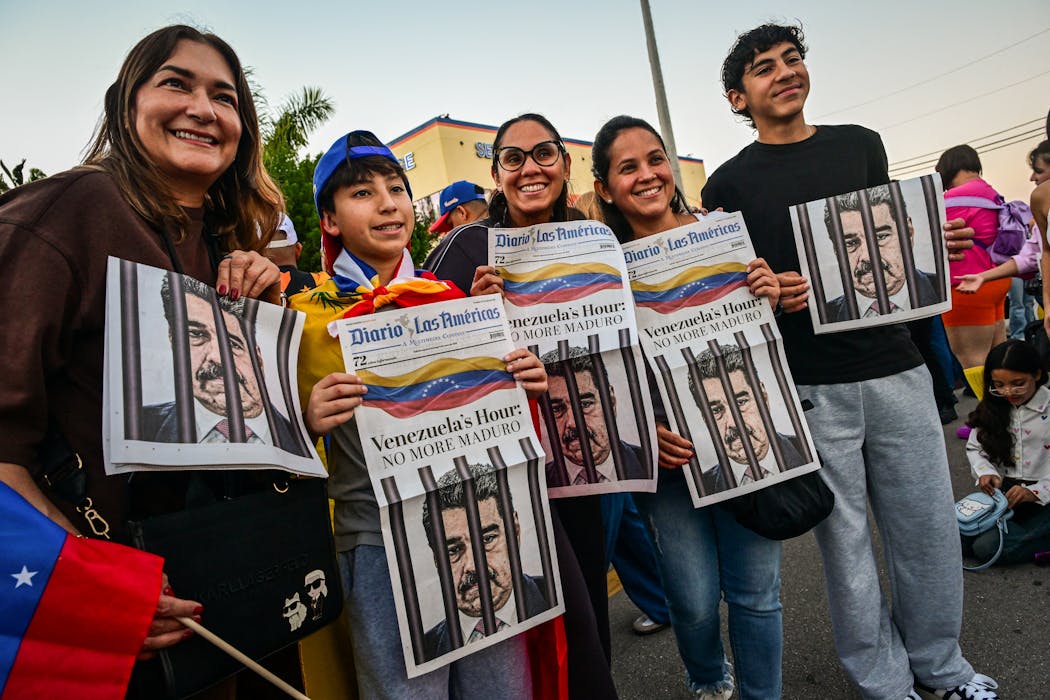
The extraction of Nicolas Maduro was welcome news to many Venezuelans living in the United States. Giorgio Viera/AFP via Getty Images

In 2024, the most recent year for which we have data, an estimated 1 million immigrants from Venezuela lived in the United States. According to the U.S. Census Bureau’s American Community Survey, these Venezuelans constitute about 2% of the total immigrant population.

We are demographerssocial scientists who specialize in understanding the changing U.S. population, including changes due to immigration.

With all the coverage of Venezuela in the U.S. news right now, we were interested in looking at the data to learn about this group of immigrants and where they live.

By the numbers

Notably, Venezuelan immigrants have lived in the United States for barely 10 years on average, considerably less than the nearly 23-year average for the total immigrant population. More than half of Venezuelan immigrants report arriving in the U.S. in the past five years, coinciding with the highly disputed 2018 Venezuelan election in which Nicolas Maduro retained power.

Data from the Office of Homeland Security Statistics illuminates this difference, pointing to recent dramatic growth in the Venezuelan population in the U.S. Annual counts of Venezuelans obtaining legal permanent residence permits, commonly called green cards, have more than doubled since 2018. Moreover, the number of green cards going to Venezuelans has increased 600% since 1999, when Venezuela’s previous autocratic leader, Hugo Chavez, took power.

A large number of Venezuelans living in the U.S. arrived within the past five years under temporary protected status. In 2021, just 21,000 Venezuelans were in the U.S. with this status. By the end of 2025, more than 600,000 Venezuelan immigrants had been granted this status, making them the largest nationality with temporary protected status. Of that number, more than 200,000 were living in Florida.

At the same time, the number of refugees and asylum-seekers has also spiked dramatically in recent years. More than 5,000 Venezuelans were granted these statuses in 2023.

In 2023 – the most recent year of data – fewer than 20,000 Venezuelans received green cards, making up less than 2% of all newly granted permanent resident permits. For comparison, over 180,000 green cards were granted to Mexican immigrants in that year.

While there is no reliable data on undocumented immigrants by nationality, the Office of Homeland Security Statistics reports that the federal government removed just 488 Venezuelans from the country in 2022 – a tiny fraction of all reported removals. This suggests to us that most Venezuelans living in the United States have legal status. However, there is no available data yet on removals during the second Trump administration.

At the same time, the share of Venezuelan immigrants who are U.S. citizens is relatively small. Data from the 2024 American Community Survey shows that just a quarter have become citizens, compared to over half of immigrants overall. Because U.S. law requires many green card holders to reside in the U.S. for at least five years before applying for citizenship, this difference likely reflects the fact that most Venezuelans arrived recently.

A highly concentrated population

Venezuelans stand out from other immigrant groups with respect to where they settle after arriving in the United States. The 2024 American Community Survey data indicates that 40% of Venezuelan immigrants live in Florida.

Indeed, Florida Gov. Ron DeSantis has asked the state’s Department of Justice to press additional charges against Maduro, claiming that Maduro’s policies are responsible for an outsize population of Venezuelan immigrants in Florida. DeSantis also claims Maduro has encouraged gang activity and drug running in the Sunshine State.

The state of Texas constitutes a distant second, home to 18% of Venezuelan immigrants.

Zooming in geographically, Venezuelans are highly concentrated in just a few cities nationally, with the Miami-Fort Lauderdale, Orlando, Houston, Dallas and New York City metro areas home to the majority of this population.

Like many recently arrived immigrant groups, Venezuelans in the United States tend to be low income. The 2024 American Community Survey tells us that 18% live in poverty, which is nearly double the national average of 10.4%. In addition, 6.9% of adults are unemployed, and 19% lack health insurance of any kind. However, 82% of Venezuelan immigrants speak at least some English, and 44% of adults have a college degree.

What now?

After Maduro’s removal was announced, Venezuelans celebrated in the streets of major U.S. cities, with many expressing the hope of returning to their homeland.

But when or whether that will be possible is unclear. Maduro may be gone, but his administration remains in power, which may make mass migration back to Venezuela difficult.

However, the U.S. government is encouraging Venezuelans to return home. Secretary of Homeland Security Kristi Noem revoked TPS status for more than 500,000 Venezuelan immigrants in October 2025, effectively immediately. At this point, it has not been reinstated.

Where the 1 million Venezuelan immigrants in the U.S. who hold various statuses may go next remains unclear. Florida in particular is likely to feel the impact of whatever comes next, given its large population of affected immigrants.

The Conversation

The authors do not work for, consult, own shares in or receive funding from any company or organization that would benefit from this article, and have disclosed no relevant affiliations beyond their academic appointment.

ref. Most of the 1 million Venezuelans in the United States arrived within the past decade – https://theconversation.com/most-of-the-1-million-venezuelans-in-the-united-states-arrived-within-the-past-decade-272988

Supreme Court likely to reject limits on concealed carry but uphold bans on gun possession by drug users

Source: The Conversation – USA – By Morgan Marietta, Professor of American Civics, University of Tennessee

The Supreme Court recognizes an individual right to self-defense with firearms in public spaces. wildpixel/Getty Images

The U.S. Supreme Court in early 2026 will hear oral arguments in two cases testing the limits of gun rights under the Constitution.

Can a state outlaw carrying a concealed weapon in businesses or restaurants unless the owners post a sign allowing it? And can the federal government criminalize the possession of firearms by a habitual drug user?

The plaintiffs in both cases claim that these laws violate their Second Amendment rights. As a close observer of the Supreme Court, I suspect the rulings will split. The court will likely strike down the limitation on concealed carry and uphold the law denying gun rights to drug users.

History will tell

The Supreme Court recognizes an individual right to self-defense with firearms in public spaces. But it has also upheld the power of the government to enforce legitimate limits on that right.

The question is how can Americans know which limits are constitutional and which are not.

In 2022, the Supreme Court answered that question in a ruling, New York State Rifle & Pistol Association v. Bruen, that struck down several states’ limitations on issuing what’s called “concealed carry” licenses. That ruling set a new standard for defining the boundaries on a constitutional right: if the right was allowed at the time of America’s founding and the early republic.

In the view of originalists, who see the meaning of the U.S. Constitution and the subsequent amendments as fixed by the understanding of its authors and ratifiers, the Second Amendment recognizes a preexisting individual right of self-protection. That self-protection right can be restricted but not removed. It can be limited but not eliminated.

In the Bruen ruling, Justice Clarence Thomas wrote that current laws must be “consistent with the Nation’s historical tradition of firearm regulation.” The appropriate method, he wrote, is to examine “how and why” the regulation functions, and see if the same kinds of laws were accepted by the founders.

If so, the current laws in question are legitimate limits to the right. If not, they are unconstitutional infringements.

The first test of the new standard for a constitutional regulation came in the United States v. Rahimi case in 2024. The court upheld the federal law criminalizing gun possession by someone subject to a domestic violence restraining order.

The court examined the historical record and found several examples of laws removing firearms from people who threatened others. The record revealed established law in four states at the time of the founding that fit the same general reason and mechanism as the current federal regulation targeting domestic abusers.

Concealed carry

On Jan. 20, the court will hear arguments in Wolford v. Lopez about what the historical record reveals regarding limitations on carrying concealed firearms in public.

After the Bruen decision, Hawaii and a few other states enacted laws restricting citizens from bringing a licensed firearm on private property held open to the public unless the owner gives permission. Usually that is accomplished by posting “clear and conspicuous signage at the entrance.”

The plaintiffs, Jason and Alison Wolford, argue that the Hawaii ban makes it “impossible as a practical matter to carry a firearm.” Most establishments will not post any sign, meaning it would be a criminal offense to conduct normal errands such as entering a grocery store or shop.

tktk
Hawaii Gov. Josh Green signs gun control legislation in Honolulu on June 2, 2023. The law prohibits people from taking guns to a wide range of places, including beaches, hospitals, bars and movie theaters.
AP Photo/Audrey McAvoy, File

The U.S. Court of Appeals for the 9th Circuit in 2024 upheld the Hawaii law on the grounds that a 1771 New Jersey law and an 1865 Louisiana law are historical “dead ringers” for the Hawaii law. The court found that those laws meet the requirement of “an established tradition” limiting citizens from carrying firearms onto private property without consent.

The Republican-appointed majority on the Supreme Court, I believe, is likely to conclude that this is a misunderstanding of Justice Thomas’ method described in Bruen.

The standard the court has set is not to find any one or two similar laws that were not struck down as unconstitutional. Instead, the standard is to demonstrate a clear pattern of a recognized form of accepted regulation. If the law existed for only a short period of time, in a limited geography, or for reasons we would now see as unacceptable, this does not demonstrate a tradition of legitimate legal limitation.

Advocates for the plaintiff argue that the New Jersey law from the 1770s was intended to deal with the problem of hunters using private land without permission. They say it did not apply to businesses open to the public.

The Louisiana law enacted immediately after the Civil War was part of the Black Codes designed to keep firearms out of the hands of freed slaves. The law was not intended to be enforced against whites but had the clear intent to restrict the civil rights of freedmen. The plaintiffs argue that it is wrong to cite an openly racist post-Civil War regulation as a justification for contemporary law.

A man stretches on a beach
Todd Yukutake, a director of the Hawaii Firearms Coalition, stretches before exercising in a beach park in Honolulu on June 29, 2023. The coalition sued to block a Hawaii law that prohibits carrying guns in sensitive locations, including parks and beaches.
AP Photo/Jennifer Sinco Kelleher

The court is likely to agree. The majority of the court will likely rule that these laws are exceptions and not a legitimate pattern of historical regulation.

The legal scholar Neal Katyal describes the objections to these two examples as “flyspecking” – nitpicking small details.

But the historical analogies have clear flaws. If the majority follows the doctrine laid out in Bruen and Rahimi over the past few years, the court will strike down the Hawaii law.

Drug use

The second challenge to gun regulations will be heard in March.

United States v. Hemani addresses the federal law criminalizing firearm possession by anyone “who is an unlawful user” or “addicted to any controlled substance.”

Ali Hemani argues that his prosecution is unconstitutional because U.S. tradition only disarms citizens who are currently drunk or high, not alcohol abusers or addicts who may be clearheaded at other times.

History does not seem to be on Hemani’s side. While illicit drugs such as cocaine or heroin were largely unknown at the time of the nation’s founding, drunkenness was common and alcohol consumption was dramatic.

An amicus brief submitted for the case by a group of Colonial historians argues that “at the Founding, alcohol consumption, unlike drug use, was commonplace, and the Founders were aware of the risk that alcohol could cause a lapse in judgment.”

More importantly, the historians argue that “numerous laws disarmed those under the influence, recognizing that alcohol, which impedes judgment and self-control, is a dangerous combination with guns.”

These laws also applied to habitual drunkards, the mentally ill and others determined to be dangerous to the public.

Given the conservative leanings of the current court, it seems likely that the majority will find these historical laws on alcohol and guns to be close enough in purpose and method to uphold the current federal law on drugs and guns.

These two rulings may come down at the end of term in June 2026, when the most controversial cases tend to be announced. The court’s historical focus seems likely to yield nuanced results, striking down some regulations and upholding others.

Perhaps most importantly, we will see what the historical emphasis reveals about the balance between the constitutional right to self-defense and the collective power to ensure public safety.

The Conversation

Morgan Marietta does not work for, consult, own shares in or receive funding from any company or organization that would benefit from this article, and has disclosed no relevant affiliations beyond their academic appointment.

ref. Supreme Court likely to reject limits on concealed carry but uphold bans on gun possession by drug users – https://theconversation.com/supreme-court-likely-to-reject-limits-on-concealed-carry-but-uphold-bans-on-gun-possession-by-drug-users-270122

One cure for sour feelings about politics − getting people to love their hometowns

Source: The Conversation – USA – By Sean Richey, Professor, Georgia State University

A young girl holds Old Glory at an Independence Day celebration. SDI Productions/E+ via Getty Images

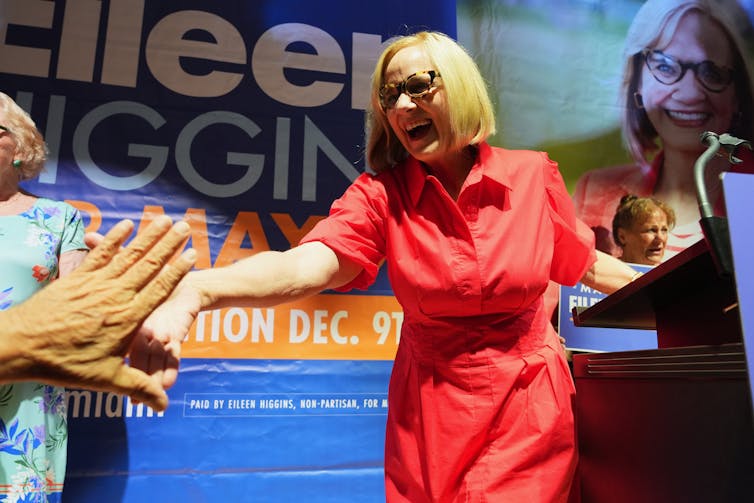
Eileen Higgins won a historic victory in December. She became the first woman ever elected mayor of Miami, as well as its first Democratic mayor since 1997.

Although the stakes in the city’s Dec. 9, 2025, runoff election were high, interest was not − 4 in 5 registered voters stayed home.

Low turnout is common in municipal elections across the country. While much of the nation’s political attention stays focused on Washington, the leaders who control the nation’s streets, schools and neighborhoods are typically chosen by a small fraction of citizens.

Although many Americans can identify their U.S. senators or members of Congress, far fewer can name even one of their local elected officials, such as a city council member. To cite one example, a North Carolina study, found that 86% of state residents could not identify their own elected leaders, including local government officials.

Turnout in local elections regularly falls below 20%, often leaving critical decisions in the hands of small, unrepresentative groups, creating an electorate that’s disproportionately white, elderly and affluent.

My research as a political scientist suggests an overlooked factor explains why some people engage with their communities while others tune out: local patriotism, or how they feel about their town.

The power of local patriotism

For my book “Patriotism and Citizenship,” I commissioned a nationally representative survey of 500 Americans. We asked a simple question: How do you feel about the town you live in? Those who responded could choose from five options, ranging from “hate it” to “love it.”

About half said they “liked” their town, 20% loved it, but a full quarter expressed no positive feelings whatsoever; 3% said they outright “hated” where they lived.

Such attitudes have real-world effects. Even after accounting for factors such as age, education, income and general interest in politics, loving one’s town strongly predicted participation in local politics.

People who loved their town were more likely to attend city council meetings, contact local officials, volunteer for campaigns and discuss local issues with friends. The same pattern held for civic participation – from volunteering with community groups to organizing neighborhood cleanups.

Local patriotism also correlated strongly with trust in local government.

Determining the stakes

To test whether these feelings actually change civic behavior, I ran two experiments.

Participants were first asked to identify the biggest problem facing their town. Some mentioned traffic congestion, others cited crime or homelessness. Then came the test: Would they donate $1 they’d earned for taking the survey to help solve that problem?

In the first experiment, one group was asked “Thinking about feelings of love or hate toward your town, would you like to donate this $1 to help your town solve the problem that you just listed above?” The other group received no such prompt about their feelings and was just asked to donate to solve the problem.

The results were striking. Among those primed to consider their feelings about their town, 18% gave away their payment. In the control group, just 3% donated – a sixfold difference.

A second experiment replicated this finding. When people were prompted to think about loving their town, 8% donated. Even asking them to consider feelings of hate led 5% to give. But in the control group with no emotional prompt? No one donated.

Why this matters for democracy

Local patriotism appears to address a fundamental puzzle in political science: why anyone participates in local politics at all. The time and effort required almost always exceed any tangible benefit an individual would receive.

Eileen Higgins, newly elected mayor of Miami, reaches out to grasp a supporter's hand.
Because election turnout was low, Eileen Higgins was elected mayor of Miami by just a small fraction of residents.
Lynne Sladky/AP

But when people care deeply about their community, the calculation changes. The emotional reward of helping a place you love becomes a plus. The sacrifice feels worthwhile not because it will definitely make a difference, but because you’re investing in something that matters to you.

This has important implications. The positive feelings people have toward their community translate directly into civic engagement, without the risk of increasing negative feelings such as jingoism or xenophobia.

For local leaders frustrated by low turnout and apathy, the message is clear: Before asking residents to show up, give them reasons to care. Build pride of place, and engagement will follow.

The good news is that local attachment isn’t fixed. My experiments showed that simply prompting people to think about their feelings toward their town could motivate civic action.

A few ways to foster local patriotism

Here are some strategies that can help foster local patriotism:

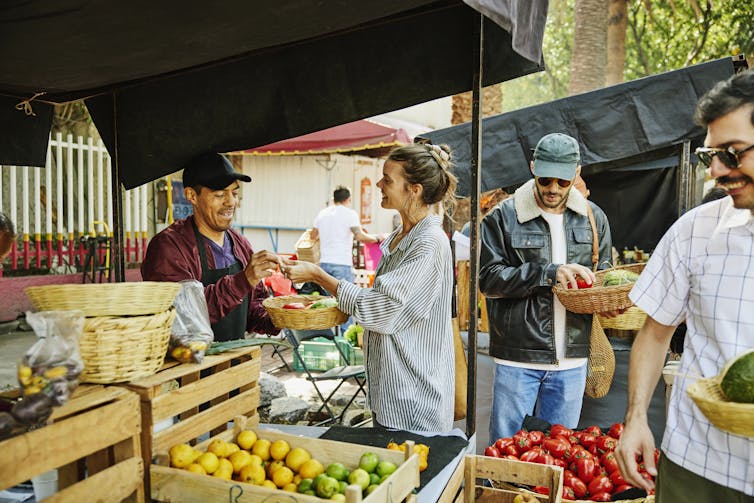
• Create civic rituals: Regular community events, from farmers markets to fireworks, build emotional ties to place.

• Celebrate iconic places: Whether it’s a waterfall, clock tower or mountain view, promote the landmarks that symbolize your community. These shared images give residents a common point of pride and visual shorthand for what makes their town special.

A fruit vendor talks with a customer by his display at a farmers market.
Holding local events such as farmers markets can foster a sense of community, increasing residents’ sense of attachment to their town.
Thomas Barwick/DigitalVision via Getty Images

• Bring children to community events and have them participate in local organizations: Parents who take their kids to town festivals, parades and events, or sign them up for youth art and sports programs, aren’t just keeping them entertained. They’re building the next generation’s emotional connection to place and creating civic habits that can last a lifetime.

The evidence shows that emotional connection to community is a powerful but largely untapped resource for strengthening democracy from the ground up.

In an era of declining civic engagement and deepening partisan divisions, fostering local patriotism might be exactly what the country needs.

The Conversation

Sean Richey does not work for, consult, own shares in or receive funding from any company or organization that would benefit from this article, and has disclosed no relevant affiliations beyond their academic appointment.

ref. One cure for sour feelings about politics − getting people to love their hometowns – https://theconversation.com/one-cure-for-sour-feelings-about-politics-getting-people-to-love-their-hometowns-272876

How mountain terraces have helped Indigenous peoples live with climate uncertainty

Source: The Conversation – USA (2) – By Stephen Acabado, Professor of Anthropology, University of California, Los Angeles

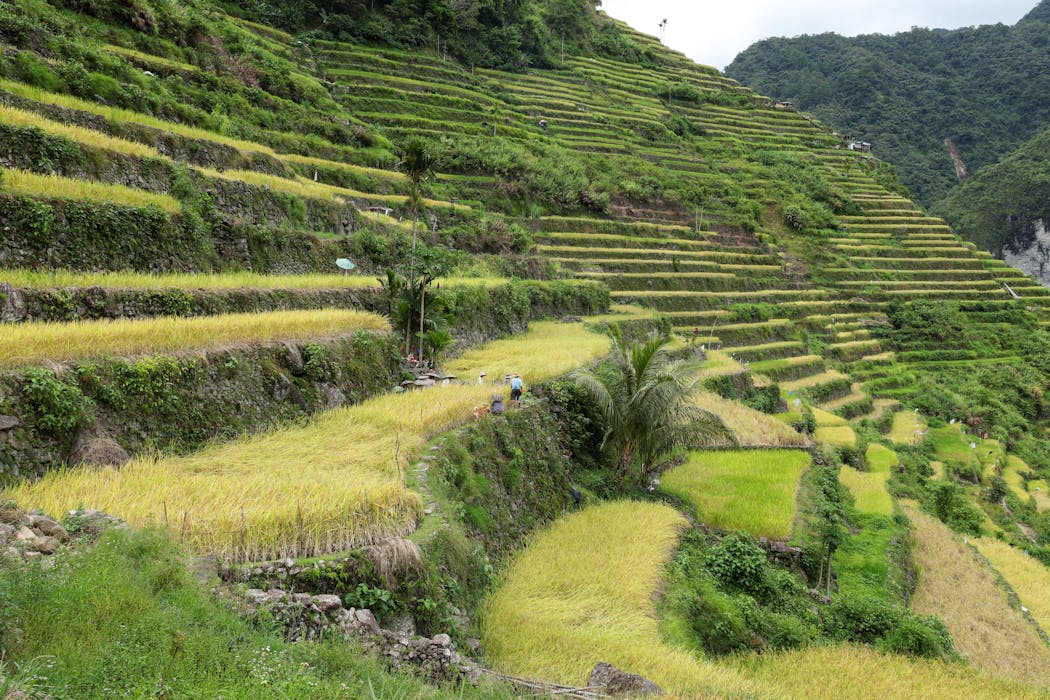
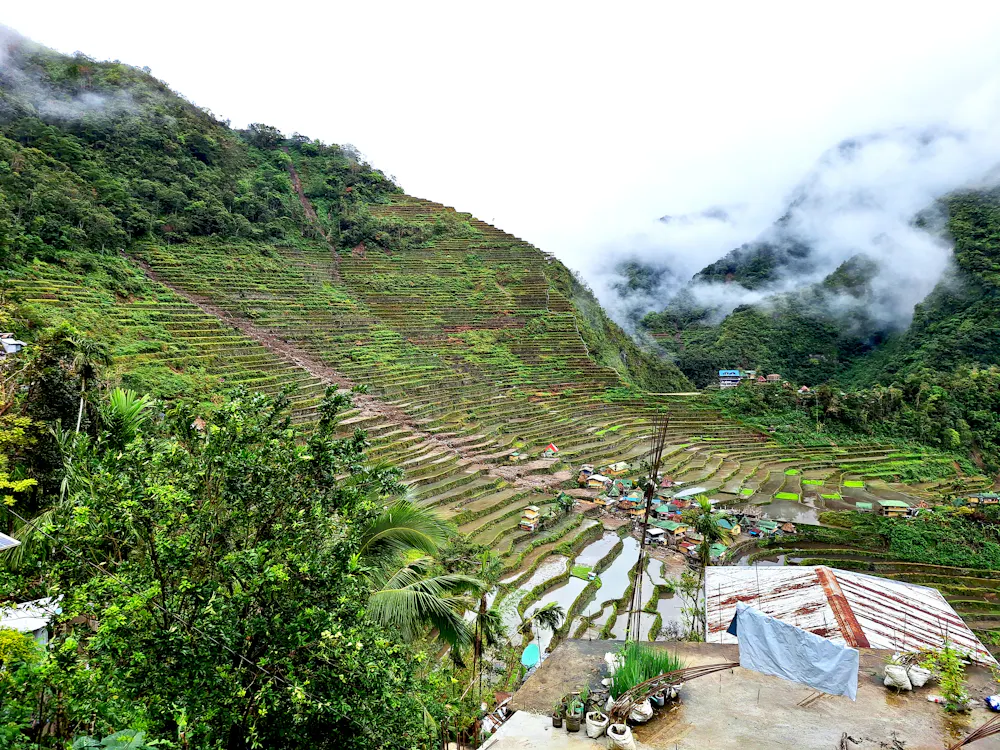
Farmers during harvest season in Batad, Ifugao, Philippines. Paul Connor and the Ifugao Archaeological Project, CC BY

Indigenous communities have lived with changes to the climate for centuries. Their adaptations over those many years are based on their close observation of weather, water, soils and seasonal change, and they have been refined through generations of learning.

That knowledge, though developed deep in the past, is increasingly useful in the modern world. As global temperatures rise, climate pressures are intensifying, with longer dry spells, stronger storms and more erratic rainfall. Terrace systems reflect Indigenous peoples’ long experience of living with environmental uncertainty in specific places and historical contexts. They offer ways of thinking about risk and long-term land use based on observation and intergenerational learning.

My research focuses on one particular strategy for adapting to a changing climate: terrace agriculture. It’s found in mountainous regions worldwide, where people have reshaped steep slopes into level steps that slow runoff and allow water to infiltrate the soil.

By slowing water without blocking its flow, terraces reduce erosion, keeping soil where crops can grow and preserving the moisture they need. They require constant maintenance, which leaves traces in the landscape, such as accumulated repair layers and sediment deposits associated with crops. I study those traces to learn how communities responded to environmental stress over time. The walls and soils are not only fertile agricultural land but also archives of adaptation, documenting past decisions about water, labor and crops.

Ifugao terraces and adaptation to wet and dry years

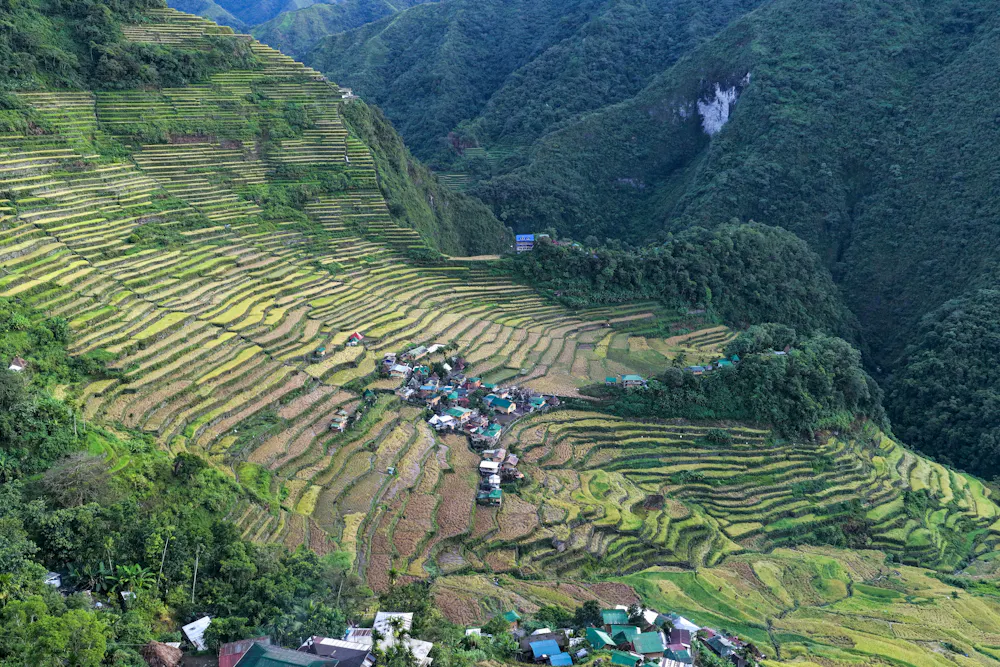
I have worked as an anthropological archaeologist in the Ifugao rice terraces of the northern Philippines for nearly two decades. These landscapes are often described as ancient and unchanging, but archaeological and historical research shows that most were constructed around the 17th century, during a period of political and economic pressure linked to Spanish colonial expansion. Highland communities modified their landscapes, expanded settlement and shifted rice farming to higher elevations, reconfiguring their societies to protect themselves.

A large hillside is covered in small parcels of flat land.
The Batad Rice Terraces in Ifugao are arranged in an amphitheater-like form and are recognized as part of a UNESCO World Heritage listing.
Paul Connor and the Ifugao Archaeological Project, CC BY

Rainfall in the Cordillera, the region where the terraces are located, varies widely. In some valleys, more than 6 feet (2 meters) of rain fall per year, while higher elevations commonly receive closer to 13 feet (4 meters). In both settings, rain comes down in short, intense downpours. Without intervention, water flows off the steep slopes in torrents, rapidly stripping away soil.

Terraces help avoid erosion by capturing rainfall on each level and allowing it to infiltrate gradually. Measurements contrasting terraced fields with nearby nonterraced soils find the terraces retain significantly more moisture – often 15% to 30% higher, and in some cases substantially more – than sloping fields. This increased moisture availability helps crops endure short dry spells between storms.

Crop choice is another example of adaptation. Ifugao farmers maintain multiple rice varieties suited to different microenvironments. One locally recognized group of traditional rice varieties, collectively referred to as Tinawon, is widely cultivated. The different farmer-selected tinawon varieties are adapted to varying elevations, temperatures and moisture conditions. Some perform better in cooler and wetter areas, while others tolerate shallow soils or brief dry periods.

By planting different, locally selected rice varieties on different terraces matched to specific conditions, farmers spread risk rather than relying on a single harvest strategy.

Farmers also read subtle environmental signals. When we talk with farmers, they describe year-to-year changes, such as springs flowing more slowly than usual in late winter and increased earthworm activity before the rains. These observations guide decisions about when to adjust terrace features – such as reinforcing walls, clearing canals or modifying water gates – or when to shift planting dates in response to delayed rains or shorter wet seasons. Over generations, these adaptations have allowed farmers to continue to grow crops despite difficult periods of flooding or drought.

Today, climate stress interacts with economic pressure. Major typhoons in 2018 and 2022 brought intense rainfall that damaged terraces across the Cordillera.

A muddy swath down the hillside shows where terrace walls were damaged.
A landslide during the peak of a super typhoon on Nov. 10, 2025, damaged the Batad Rice Terraces.
Courtesy of Rae Macapagal, CC BY

In the past, farmers responded to storm damage by adjusting water flow within irrigation canals and field-to-field outlet channels, and by staggering planting dates so that shared irrigation systems were not stressed all at once.

Today, fewer workers and a modernizing economy mean that government support has become increasingly important to sustain these systems, particularly funding for terrace and irrigation repair and programs that support farmer participation. Even so, these systems continue to show how coordinated water management and crop diversity can reduce risk under variable climates.

Climate history written into Moroccan terraces

New research in Morocco, which I’m working on with the Université Internationale de Rabat, focuses on terrace systems in the Anti-Atlas Mountains, where intermittent heavy rains and recurring droughts motivated people to build terraces to slow runoff and keep water in the soil.

Many of these terraces remained active from their construction in the late 16th to 17th centuries until the 20th century, when out-migration reduced the local labor force needed for routine maintenance.

Hillside slopes are marked by partitions making the otherwise steep ground level in sections.
Terraces in the town of Aouguenz, in Morocco’s Chtouka Aït Baha Province, show that nearly every slope that can be worked has been terraced, an example of long-term environmental modification.
E.J. Hernandez, CC BY

Even partially abandoned terraces record past responses to climate changes. Stone walls and leveled platforms demonstrate how people slowed runoff and retained moisture in dry environments. Collapsed edges and eroded channels mark episodes of heavy rainfall. Channel layouts and their alignment with terrace walls and natural terrain indicate how scarce water was directed toward priority fields.

These physical traces correspond with well-documented drought cycles in Morocco, including multiyear dry periods in recent decades that have reduced reservoir levels and lowered groundwater tables. Former terraced landscapes show how earlier communities coped with similar pressures.

A stone tower sits atop a rocky hill.
A fortified agadir (communal granary) is built on a rocky promontory and used for storing grain and valuables.
Stephen Acabado, CC BY

Crop selection was central to adaptation throughout the period when terraces were actively maintained, and it continues to shape farming decisions today. Farmers in Morocco relied heavily on drought-tolerant barley, which can germinate with limited moisture and mature before peak summer heat.

Research on barley varieties from North Africa and similar arid environments shows that these traditional variants can still produce a majority of their usual yields during severe droughts, while high-yield modern varieties, bred for irrigated or well-watered conditions and shorter growing cycles, often experience sharp yield declines or crop failure under the same conditions.

Dirt and low plants cover a group of terraced fields.
A terrace system lies seasonally fallow in Morocco’s Anti-Atlas Mountains, where long-standing land-use practices are now shifting toward cash crops such as onions and beans.
M. Yakal, CC BY

In oral histories and interviews, elders in these regions recalled collective maintenance practices, including annual cleaning of channels and coordinated planting after the first dependable rains. Communities adapted to the changing climate together, coordinating efforts and activities.

Lessons across continents

Although the Philippines and Morocco have different climates and histories, their terrace systems demonstrate common principles. In both regions, people focused on capturing water and minimizing the risk of soil loss or crop failure.

Where terraces remain intact, studies show they tend to retain more soil and moisture and produce more consistent harvests than nearby unmodified slopes.

Aerial views show aspects of the highland ecology of Morocco. Video courtesy of Anass Marzouki, UIR.

At the same time, terraces show limits. As labor availability declines because younger generations leave rural areas for cities or overseas work, and economic priorities shift toward wage labor and other nonagricultural livelihoods, even basic maintenance becomes difficult.

These cases show that Indigenous strategies for living with climate uncertainty are often shaped by long-term observation and cooperation. They do not provide simple solutions or universal models, but they do demonstrate the value of designing systems that spread risk and prioritize durability over short-term efficiency.

The Conversation

Stephen Acabado receives funding from the Henry Luce Foundation.

ref. How mountain terraces have helped Indigenous peoples live with climate uncertainty – https://theconversation.com/how-mountain-terraces-have-helped-indigenous-peoples-live-with-climate-uncertainty-271599

Science is best communicated through identity and culture – how researchers are ensuring STEM serves their communities

Source: The Conversation – USA (2) – By Evelyn Valdez-Ward, Postdoctoral Fellow in Science Communication, University of Rhode Island

Personal experiences can help foster a sense of belonging for aspiring scientists from underrepresented backgrounds. kali9/E+ via Getty Images

Lived experiences shape how science is conducted. This matters because who gets to speak for science steers which problems are prioritized, how evidence is translated into practice and who ultimately benefits from scientific advances. For researchers whose communities have not historically been represented in science – including many people of color, LGBTQ+ and first-generation scientists – identity is intertwined with how they engage in and share their work.

As researchers who ourselves belong to communities that have been underrepresented in science, we work with scientists from marginalized backgrounds to study how they navigate STEM – science, technology, engineering and math – spaces. What happens when sharing science with the public is treated as relationship-building rather than a one-way transfer of information? We want to understand the role that identity plays in building community in science.

We found that broadening the ways scientists work with the public can bolster trust in science, expand who feels they belong in STEM spaces and ensure that science is working in service of community needs.

STEM spaces as an obstacle course

Science communication involves bridging knowledge gaps between scientists and the broader community. Traditionally, researchers do it through public lectures, media interviews, press releases, social media posts or outreach events designed to explain science in simpler terms. The goals of these activities are often to correct misconceptions, increase scientific literacy and encourage the general public to trust scientific institutions.

However, science communication can look different for researchers from marginalized backgrounds. For these scientists, the ways they engage with the public often focus on identity and belonging. The researchers we interviewed spoke about hosting bilingual workshops with local families, creating comics about climate change with Indigenous youth and starting podcasts where scientists of color share their pathways into STEM.

Instead of disseminating science information through traditional methods that leave little room for dialogue, these researchers seek to bring science back to their communities. This is in part because scientists from historically marginalized backgrounds often face hostile environments in STEM, including discrimination, stereotypes about their competence, isolation and a lack of representation in their fields. Many of the researchers we talked to described feeling pressure to hide aspects of their identities, being seen as the token minority, or having to constantly prove they belong. These experiences reflect well-documented structural barriers in STEM that shape who feels welcome and supported in scientific environments.

Illustration of garbage dump site with 'discrimination' and 'stereotypes' written on tires and other objects. The caption reads 'Scientists from marginalized backgrounds often experience STEM spaces as an obstacle course'

Nic Bennett, CC BY-NC-ND

We wanted to see if a broader definition of science communication that incorporates identity as an asset can expand who feels welcomed in scientific spaces, strengthen trust between scientists and communities, and ensure scientific knowledge is shared in culturally relevant and accessible ways.

Transforming STEM communication

Prior studies have found that scientists tend to prioritize communication focused on conveying information, placing much less emphasis on understanding audiences, building trust or fostering dialogue. Our research, however, suggests that marginalized scientists adopt communication styles that are more inclusive.

Our team set out to create training spaces for researchers from communities that have been historically marginalized in science. Since 2018, we have been facilitating ReclaimingSTEM workshops both in-person and online, where over 700 participants have been encouraged to explore the intersections of their identities and science through interactive modules, small-group activities and community-building discussions.

Expanding what counts as science communication is essential for it to be effective. This is particularly relevant for scientists whose work and identities call for approaches grounded in community connection, cultural relevance and reciprocity. In our workshops, we broadly defined science communication as community engagement about science that could be both formal and informal, including through media, art, music, podcasts and outreach in schools, among others.

While some participants mentioned using traditional science communication approaches – like making topics concise and clear, as well as avoiding jargon – most used communication styles and methods that are more audience-centered, identity-focused and emotion-driven.

Illustration of people picking up trash in a dump site. Caption reads 'Marginalized scientists can better see these obstacles and bring unique styles and methods to their communication

Nic Bennett, CC BY-NC-ND

Some participants drew on their audience’s cultural backgrounds when sharing their research. One participant described explaining biological pattern formation by connecting it to familiar artistic traditions in her community, such as the geometric and floral designs used in henna. Using imagery that her audience recognized helped make the scientific concepts more relatable and encouraged deeper engagement.

Rather than portray science as something neutral or emotionless, participants infused empathy and feeling into their community engagement. For example, one scientist shared with us that his experiences of exclusion as a multiracial gay man shaped how he approached his interactions. These feelings helped him be more patient, understanding and attentive when others struggled to grasp scientific ideas. By drawing on his own sense of not belonging, he aimed to create an environment where people could connect emotionally to his research and feel supported in the learning process.

Participants found it important to incorporate their identities into their communication styles. For some, this meant not assimilating into the dominant norms of science spaces and instead authentically expressing their identities to be a role model to others. For example, one participant explained that openly identifying as disabled helped normalize that experience for others.

Many felt a deep sense of responsibility to have their science engagement be of service to their communities. One scientist who identified as a Black woman said she often thinks about how her research may affect people of color, and how to communicate her findings in ways that everyone can understand and benefit from.

Illustration of playground with 'belonging,' 'advocacy' and 'representation' inscribed on the play structure. Caption reads: 'And they wield science communication goals that transform STEM spaces for the better'

Nic Bennett, CC BY-NC-ND

Making STEM more inclusive

While the participants of our workshop had a variety of goals when it came to science communication, a common thread was their desire to build a sense of belonging in STEM.

We found that marginalized scientists often draw on their lived experiences and community connections when teaching and speaking about their research. Other researchers have also found that these more inclusive approaches to science communication can help build trust, create emotional resonance, improve accessibility and foster a stronger sense of belonging among community members.

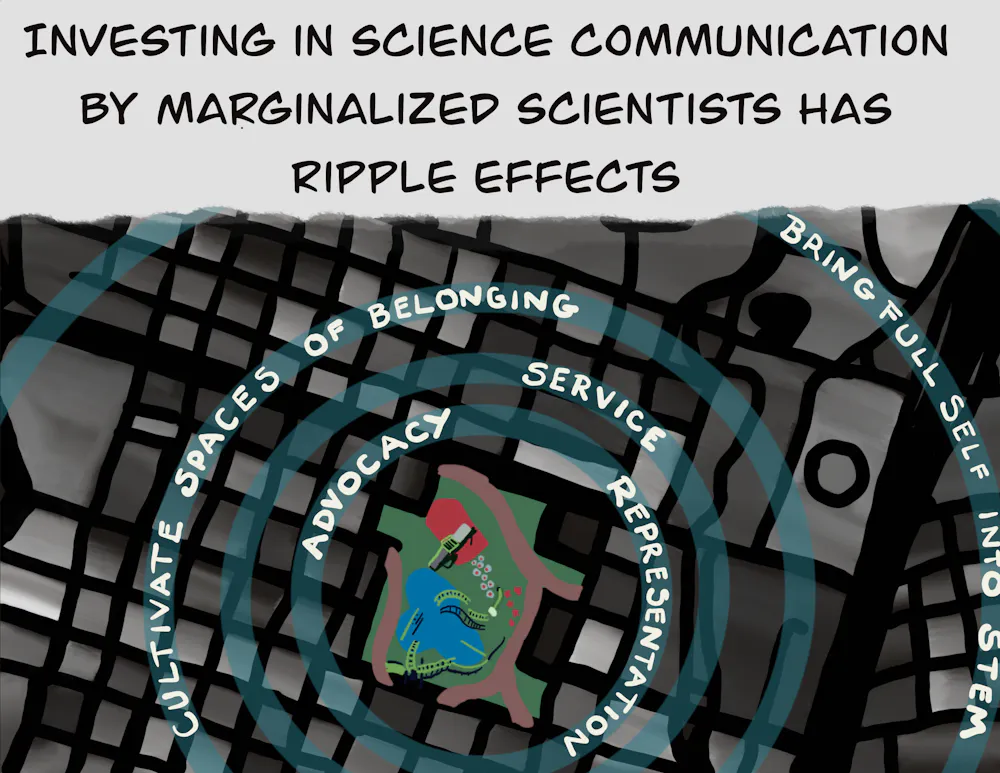
Illustration of a map with ripple effects superimposed. Caption reads 'Investing in science communication by marginalized scientists has ripple effects'

Nic Bennett, CC BY-NC-ND

Centering the perspectives and identities of marginalized researchers would make science communication training programs more inclusive and responsive to community needs. For example, some participants described tailoring their science outreach to audiences with limited English proficiency, particularly within immigrant communities. Others emphasized communicating science in culturally relevant ways to ensure information is accessible to people in their home communities. Several also expressed a desire to create welcoming and inclusive spaces where their communities could see themselves represented and supported in STEM.

One scientist who identified as a disabled woman shared that accessibility and inclusivity shape her language and the information she communicates. Rather than talking about her research, she said, her goal has been more about sharing the so-called hidden curriculum for success: the unwritten norms, strategies and knowledge key to secure opportunities, and thrive in STEM.

Identity for science communication

Identity is central to how scientists navigate STEM spaces and how they communicate science to the audiences and communities they serve.

For many scientists from marginalized backgrounds, the goal of science communication is to advocate, serve and create change in their communities. The participants in our study called for a more inclusive vision of science communication: one grounded in identity, storytelling, community and justice. In the hands of marginalized scientists, science communication becomes a tool for resistance, healing and transformation. These shifts foster belonging, challenge dominant norms and reimagine STEM as a space where everyone can thrive.

Helping scientists bring their whole selves into how they choose to communicate can strengthen trust, improve accessibility and foster belonging. We believe redesigning science communication to reflect the full diversity of those doing science can help build a more just and inclusive scientific future.

The Conversation

Evelyn Valdez-Ward is executive director of ReclaimingSTEM Institute.

Nic Bennett is a volunteer board member of Reclaiming STEM and People’s Science Network.

Robert N. Ulrich is the Associate Director of the ReclaimingSTEM Institute.

ref. Science is best communicated through identity and culture – how researchers are ensuring STEM serves their communities – https://theconversation.com/science-is-best-communicated-through-identity-and-culture-how-researchers-are-ensuring-stem-serves-their-communities-246475

Before Venezuela’s oil, there were Guatemala’s bananas

Source: The Conversation – USA (2) – By Aaron Coy Moulton, Associate Professor of Latin American History, Stephen F. Austin State University

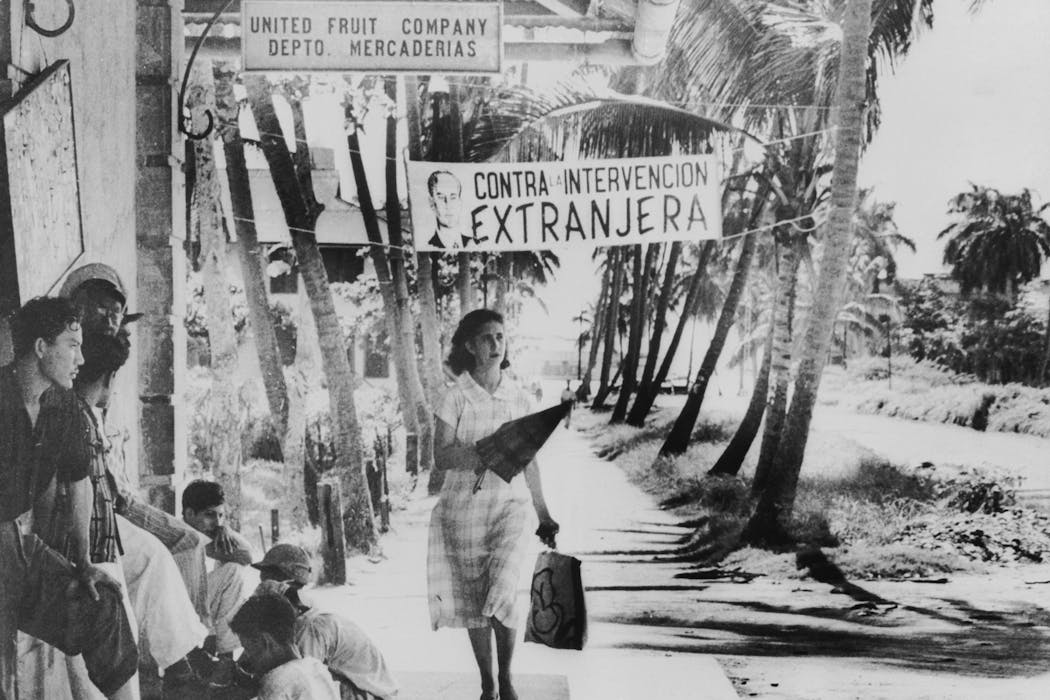
A woman walks past a banner that says ‘against foreign intervention,’ in Spanish, in Guatemala in 1954. Bettmann/Getty Images

In the aftermath of the U.S. military strike that seized Venezuelan President Nicolás Maduro on Jan. 3, 2026, the Trump administration has emphasized its desire for unfettered access to Venezuela’s oil more than conventional foreign policy objectives, such as combating drug trafficking or bolstering democracy and regional stability.

During his first news conference after the operation, President Donald Trump claimed oil companies would play an important role and that the oil revenue would help fund any further intervention in Venezuela.

Soon after, “Fox & Friends” hosts asked Trump about this prediction.

We have the greatest oil companies in the world,” Trump replied, “the biggest, the greatest, and we’re gonna be very much involved in it.”

As a historian of U.S.-Latin American relations, I’m not surprised that oil or any other commodity is playing a role in U.S. policy toward the region. What has taken me aback, though, is the Trump administration’s openness about how much oil is driving its policies toward Venezuela.

As I’ve detailed in my 2026 book, “Caribbean Blood Pacts: Guatemala and the Cold War Struggle for Freedom,” U.S. military intervention in Latin America has largely been covert. And when the U.S. orchestrated the coup that ousted Guatemala’s democratically elected president in 1954, the U.S. covered up the role that economic considerations played in that operation.

A powerful ‘octopus’

By the early 1950s, Guatemala had become a top source for the bananas Americans consumed, as it remains today.

The United Fruit Company owned over 550,000 acres of Guatemalan land, largely thanks to its deals with previous dictatorships. These holdings required the intense labor of impoverished farmworkers who were often forced from their traditional lands. Their pay was rarely stable, and they faced periodic layoffs and wage cuts.

Based in Boston, the international corporation networked with dictators and local officials in Central America, many Caribbean islands and parts of South America to acquire immense estates for railroads and banana plantations.

The locals called it the “pulpo” – octopus in Spanish – because the company seemingly had a hand in shaping the region’s politics, economies and everyday life. The Colombian government brutally crushed a 1928 strike by United Fruit workers, killing hundreds of people.

That bloody chapter in Colombian history provided a factual basis for a subplot in “One Hundred Years of Solitude,” an epic novel by Gabriel García Márquez, who won the Nobel Prize in literature in 1982.

The company’s seemingly unlimited clout in the countries where it operated gave rise to the stereotype of Central American nations as “banana republics.”

United Fruit included the Chiquita brand of bananas that it widely advertised, including with this commercial produced in the 1940s.

Guatemala’s democratic revolution

In Guatemala, a country historically marked by extreme inequality, a broad coalition formed in 1944 to overthrow its repressive dictatorship in a popular uprising. Inspired by the anti-fascist ideals of World War II, the coalition sought to make the nation more democratic and its economy more fair.

After decades of repression, the nation’s new leaders offered many Guatemalans their first taste of democracy. Under Juan José Arévalo, who was democratically elected and held office from 1945-1951, the government established new government benefits and a labor code that made it legal to form and join unions and established eight-hour workdays.

He was succeeded in 1951 by Jacobo Árbenz, another democratically elected president.

Under Árbenz, Guatemala implemented a land reform program in 1952 that gave landless farmworkers their own undeveloped plots. Guatemala’s government asserted that these policies would build a more equitable society for Guatemala’s impoverished, Indigenous majority.

United Fruit denounced Guatemala’s reforms as the result of a global conspiracy. It alleged that most of Guatemala’s unions were controlled by Mexican and Soviet communists and painted the land reform as a ploy to destroy capitalism.

Lobbying Congress to intervene

In Guatemala, United Fruit sought to enlist the U.S. government in its fight against the elected government’s policies. While its executives did complain that Guatemala’s reforms hurt its financial investments and labor costs, they also cast any interference in its operations as part of a broader communist plot.

It did this through an advertising campaign in the U.S. and by taking advantage of the anti-communist paranoia that prevailed at the time.

United Fruit executives began to meet with officials in the Truman administration as early as 1945. Despite the support of sympathetic ambassadors, the U.S. government apparently wouldn’t intervene directly in Guatemala’s affairs.

The company turned to Congress.

It hired the lobbyists Thomas Corcoran and Robert La Follette Jr., a former senator, for their political connections.

Right away, Corcoran and La Follette lobbied Republicans and Democrats in both chambers against Guatemala’s policies – not as threats to United Fruit’s business interests but as part of a communist plot to destroy capitalism and the United States.

The banana company’s efforts bore fruit in February 1949, when multiple members of Congress denounced Guatemala’s labor reforms as communist.

Sen. Claude Pepper called the labor code “obviously intentionally discriminatory against this American company” and “a machine gun aimed at the head of this American company.”

Two days later, Rep. John McCormack echoed that statement, using the exact same words to denounce the reforms.

Sen. Henry Cabot Lodge Jr., Sen. Lister Hill and Rep. Mike Mansfield also went on the record, reciting the talking points outlined in United Fruit memos.

No lawmaker said a word about bananas.

Lobbying and propaganda campaigns

This lobbying and communist talk culminated five years later, when the U.S. government engineered a coup that ousted Árbenz in a covert operation.

That operation began in 1953, when the Eisenhower administration authorized the Central Intelligence Agency to unleash a psychological warfare campaign that manipulated Guatemala’s own military to overthrow its democratically elected government.

CIA agents bribed members of Guatemala’s military. Anti-communist radio broadcasts and religious pronouncements about communist designs to destroy the nation’s Catholic church spread throughout the country.

Meanwhile, the U.S. armed anti-government organizations inside Guatemala and in neighboring countries to further undermine the Árbenz government’s morale.

And United Fruit enlisted public relations pioneer Edward Bernays to spread propaganda, not in Guatemala but in the United States. Bernays provided U.S. journalists with reports and texts that portrayed the Central American nation as a Soviet puppet.

These materials, including a film titled “Why the Kremlin Hates Bananas,” circulated thanks to sympathetic media outlets and members of Congress.

United Fruit’s quest to oust Guatemala’s democratically elected government got a boost from this anti-communist propaganda film.

Destroying the revolution

Ultimately, the record shows, the CIA’s efforts prompted military officers to depose their elected leaders and install a more pro-U.S. regime led by Carlos Castillo Armas.

Guatemalans who opposed the reforms slaughtered labor leaders, politicians and others who had supported Árbenz and Arévalo. At least four dozen people died in the immediate aftermath, according to official reports. Local accounts recognized hundreds more deaths.

Military regimes ruled Guatemala for decades after this coup.

One dictator after another brutally repressed their opponents and fostered a climate of fear. Those conditions contributed to waves of emigration, including countless refugees, as well as some members of transnational gangs.

Blowback for bananas

To shore up its claims that what happened in Guatemala had nothing to do with bananas, exactly as the company’s propaganda insisted, the Eisenhower administration authorized an antitrust suit against United Fruit that had been temporarily halted during the operation so as not to cast further attention on the company.

This would be the first in a series of setbacks that would break up United Fruit by the mid-1980s. After a series of mergers, acquisitions and spinoffs, the only constant would be the ubiquitous Miss Chiquita logo stuck to the bananas the company sells.

And, according to many foreign policy experts, Guatemala has never recovered from the destruction of its democratic experiment due to corporate pressure.

The Conversation

Aaron Coy Moulton’s research received funding from the Truman Library Institute, Phi Alpha Theta, the Society for Historians of American Foreign Relations, the Roosevelt Institute, the Eisenhower Foundation, the Massachusetts Historical Society, the Bentley Historical Library, the American Philosophical Society, the Dirksen Congressional Center, the Hoover Presidential Foundation, and the Frances S. Summersell Center for the Study of the South.

ref. Before Venezuela’s oil, there were Guatemala’s bananas – https://theconversation.com/before-venezuelas-oil-there-were-guatemalas-bananas-272973