Selling stolen art is tricky, so why even bother heisting it? An expert explains

Source: The Conversation – UK – By Anja Shortland, Reader in Political Economy, King’s College London

It took less than three minutes for an organised crime gang to steal a Renoir, Matisse and a Cezanne painting collectively worth around €9 million (£7.8m) from a private museum near Parma, Italy in March 2026. This is the second high profile art heist in recent months, after the theft of jewellery worth €9.5 million (£8.25m) from Paris’s Louvre in October 2025.

The items stolen are clearly valuable. But, as an expert in the governance of criminal markets, I can tell you acquiring the goods is only the first step. Turning this loot into cash is fraught with risk .

The Italian government takes the protection of its cultural heritage seriously, with a whole department of the Carabinieri (Italian police) devoted to the theft of arts and antiquities. This department scans the global art trade for forged, stolen and illegally exported treasures, demanding their return.

There is little chance of selling the stolen masterpieces on the international art market – even at a knockdown price. Whereas in the past dealers and auction houses might have turned a blind eye to the fishy origins of an outstanding artwork, over the past two decades the norms and procedures of the market have tightened considerably.

Anyone who buys art without checking whether a former owner has registered their interest in the object fails the bona fide (good faith) test. This means that they cannot obtain a good title and so the legal property right remains with the person or institution the artwork was stolen from. Also sales of stolen art where the seller sidestepped due diligence can be voided, meaning the money must be returned.

So reputable dealers and auction houses take their duty of care very seriously. At the very least they check the freely accessible Interpol database of stolen art before the sale. However, private databases – like that of the Art Loss Register – provide greater peace of mind, listing many more lost and stolen objects and limit searching to those with a legitimate interest in an object. When a register finds that someone is trying to bring a stolen artwork into the open market, they collect and pass on all information that could lead the police to its location or the people involved in its sale or storage.

Anything fresh from a museum wall is therefore unsaleable – unless it is jewellery that can be broken up and sold as (expensive) scrap. So, what might be the financial motivation behind this theft?

A Bond-style villain ordering favourite paintings to adorn their lair is an unlikely explanation. Yes, paintings could be stolen to order, but buying art on the open market to launder money is less risky. With high rewards for information or the return of stolen artworks, security and omerta (the code of silence) would have to be completely watertight when displaying stolen treasures.

On the other hand, “rewards for information” could be a motivation for theft in itself. In the middle of the last century, insurers regularly paid “finders” with so little scrutiny that high-value art theft became a profitable low-risk occupation. Institutions like the Art Loss Register broke that cosy coexistence and instead used any leads to help the police conduct recoveries and sting operations.

Nowadays, it is only safe to negotiate a deal over a “finder’s fee” when a stolen object has changed hands so many times that the line to the original thieves is lost in the mist of time. Even so, the ultimate “finder” would be lucky to realise more than 10% of the painting’s value, which they would also likely have to share with the thieves and various shady underworld owners along the way.

However, there is a third reason to steal artworks. Organised crime groups sometimes use stolen artworks as bargaining chips to negotiate more lenient punishment. For example, the Dresden jewellery thieves kept a few pieces of their haul aside to use their recovery to negotiate shorter sentences. Penitentos (“repentant ones”) who want to leave mafia organisations also sometimes provide information on the whereabouts of missing treasures. If there is a perception that stolen artworks can used to reduce a prison sentence or financial compensation package, their underworld value can grow far beyond the finder’s fee.

While it is difficult to verify the assertion that stolen artworks are used as collateral in drug deals, several unique treasures have indeed been retrieved from properties owned by senior mafiosi. These works have not been found in temperature controlled galleries, but rolled up in dank places that make museum curators weep with despair. Let us hope that the beautiful artworks from Parma are treated with respect until we see them again.

This article features references to books that have been included for editorial reasons, and may contain links to bookshop.org. If you click on one of the links and go on to buy something from bookshop.org The Conversation UK may earn a commission.

The Conversation

Anja Shortland does not work for, consult, own shares in or receive funding from any company or organisation that would benefit from this article, and has disclosed no relevant affiliations beyond their academic appointment.

ref. Selling stolen art is tricky, so why even bother heisting it? An expert explains – https://theconversation.com/selling-stolen-art-is-tricky-so-why-even-bother-heisting-it-an-expert-explains-279700

Javier Milei’s inflation ‘miracle’ in Argentina is a warning to the world, not a blueprint

Source: The Conversation – UK – By Can Cinar, Honorary Visiting Researcher, City St George’s, University of London

On paper, the numbers look astonishing. The annual rate of inflation in Argentina has plummeted from 211% in 2023 to 31.5% by the end of 2025.

President Javier Milei is taking plenty of credit for the drop. And he spent some time on Wall Street last month, pitching his “chainsaw” approach to public spending as a triumph against inflation.

But as a political economist who has tracked the cyclical history of economic crisis in Argentina, I see a much grimmer story unfolding.

For the drop in inflation is certainly not a victory for Argentine productivity. It’s a byproduct of a deliberate and engineered collapse in people’s wages.

Milei hasn’t fixed the engine of Argentina’s economy, he has simply turned it off. Since he took office in 2023, the country’s manufacturing output has dropped dramatically, with over 2,000 businesses shutting down and 73,000 jobs lost.

In the automotive sector, factories are operating at just 24% of capacity.

These aren’t just dry statistics. Real wages have been crushed so hard that demand for Argentine goods has evaporated. If a manufacturer is only using a third of its machinery because nobody can afford their goods, they lose their ability to put up prices, and inflation rates stop rising.

By drastically reducing demand, Milei has not solved the inflation puzzle. He has simply removed some of the pieces, by making the population too poor to participate in the Argentine economy.

On top of this, the fear of mass unemployment means workers have no choice but to accept an ever smaller share of the nation’s economic pie. Again, low wages serve to prevent the upward spiral of prices.

So the supposed victory over inflation is actually the institutionalisation of lower wages and a lower standard of living for most people.

A recently passed law (officially named “labour modernisation”) reinforces this new reality. It has effectively increased many workers’ hours and reduced their protections, making labour both cheaper and more disposable.

The new legislation has been criticised as a return to working practices of the 19th century. Far from modernising work, it is about normalising a lower wage share of GDP and ensuring that the shrinking slice of the national income for the Argentine worker isn’t just a temporary emergency, but a permanent feature of the model.

And while the government highlights 4% GDP growth forecasts for 2026, that growth is focused in sectors like agriculture, mining and lithium, which create very few jobs. For the average urban worker the economy hasn’t recovered – it has simply bottomed out at a new, lower standard of living.

Wages down, inflation down

That doesn’t mean that the drop in inflation counts for nothing. There has been a genuine sense of relief after the triple-digit chaos of 2023.

The simple ability to shop at a supermarket without the price of goods changing dramatically in days will mark a deep psychological shift for many Argentinians.

But that shift is not based on solid ground. Inflation hasn’t been tamed by a more efficient economy – it has been starved into submission.

Yet remarkably, Milei’s “miracle” is already being packaged for export. From the radical fiscal cuts proposed by Trump in the US to the nationalist platforms of Orbán in Hungary and the Vox party in Spain, Milei and his model are being touted as a blueprint for other economies struggling with inflation.

But what looks like a triumph to some is, in reality, a deepening social crisis. Milei’s Argentina is not a blueprint to be followed. It is a warning of what happens when the cure for inflation is more lethal than the disease itself.

For this level of wage suppression is a stark reminder of Argentina’s economic crisis of 2001, a period of total state failure, sovereign default, bank freezes and 20% unemployment that left a permanent scar on the national psyche.

To have surpassed that level of wage suppression today is a damning indictment of Milei’s approach. But while 2001 was a sudden collapse of a monetary system, the 2026 reality is a slow, institutionalised asphyxiation.

The question for the coming years is how such a model can possibly be sustained. Milei has left the country with no economic levers to pull for a genuine recovery.

With negative net reserves, a domestic market in ruins, and multi-billion dollar IMF and private debts hanging over the country, the government’s path is now dictated entirely by a desperate need for dollars that turns every domestic policy into a plea for foreign capital.

This has created an economic vacuum in which there is no credit for small businesses, no surplus for public investment and no consumer demand to entice private capital back into the real economy.

That is why the administration’s pitch to New York investors in March was essentially a desperate plea for capital to fill this void. But Wall Street is not generally in the business of building factories or creating jobs in Argentina.

If anything, its investors will be looking for easy short-term profits in a newly deregulated market. And what emerges then is an economically divided Argentina. On one side of this will be a thriving enclave of mining and agribusiness designed for the global market, and on the other, a vast urban industrial wasteland where millions of Argentinians struggle desperately to make ends meet.

The Conversation

Can Cinar does not work for, consult, own shares in or receive funding from any company or organisation that would benefit from this article, and has disclosed no relevant affiliations beyond their academic appointment.

ref. Javier Milei’s inflation ‘miracle’ in Argentina is a warning to the world, not a blueprint – https://theconversation.com/javier-mileis-inflation-miracle-in-argentina-is-a-warning-to-the-world-not-a-blueprint-278840

Iran war: what African countries can do to get through the crisis and emerge in a better place

Source: The Conversation – Africa – By Danny Bradlow, Professor/Senior Research Fellow, Centre for Advancement of Scholarship, University of Pretoria

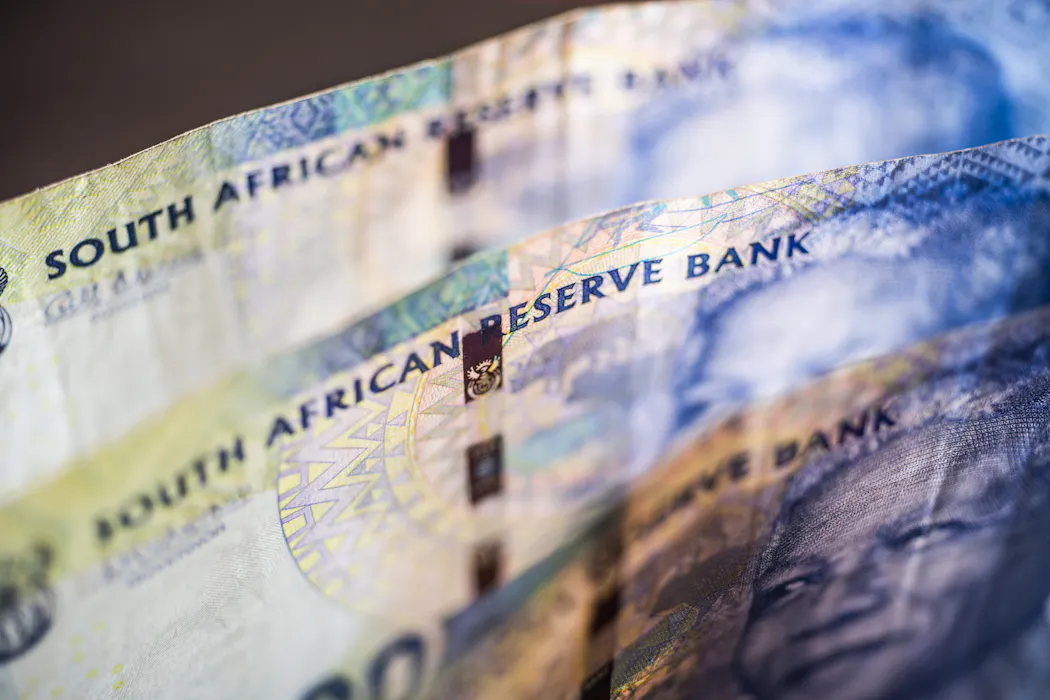
The South African rand is one of many currencies in Africa to have lost value against the dollar in the wake of the US/Israeli war against Iran. Waldo Swiegers/Bloomberg via Gettyimages

By Easter 2026 it was still not clear when – or how – the war initiated by Israel and the US against Iran would end. But what was already clear was that it would harm Africa in a number of ways.

Firstly, it would adversely affect the global supply and prices of oil and gas, fertilisers and food. Secondly, local currencies would be affected. More than a month after the war had started a number of African currencies had begun to lose value against the US dollar.

Thirdly, interest rates stopped falling and further rate increases were highly likely. Fourth, there will be a decline in access to affordable foreign financing.

How should Africa respond?

African countries cannot avoid being harmed by the current Gulf war. Nevertheless, based on my work in international economic law and global economic governance, I think there are two lessons that, if followed, can help the continent emerge from the crisis in a better place.

First, governments and societies need to be pragmatic. Their first priority must be to do whatever they can to mitigate the impact of the war, particularly on their most vulnerable citizens. This will require governments to make trade-offs.

They will have to reallocate budgets to at least maintain the level of imports necessary to meet the society’s basic needs. They will need to convince their creditors to help finance their necessary imports. They will also need to persuade them to be flexible enough that they leave governments with at least some policy space.

Second, states and societies need to identify opportunities within the crisis for actions that over the medium term can help them meet their financing, economic, environmental and social challenges. This requires collaboration between the state and its non-state stakeholders. Business, labour, religious groups, civil society organisations and international organisations all have something to contribute.


Read more:
Oil price surge is hurting African economies: scholars in Ethiopia, Kenya, Nigeria, Senegal and South Africa take stock


Action in the short run

The focus of Africa’s efforts in the short term must be on minimising the negative effects of the war and on managing the state’s external debts in the most sustainable and effective way.

This is easy to state, but hard to implement. This is particularly the case in the current international environment, in which it is not realistic to expect donor countries and other international sources of finance to be particularly generous.

African countries will need to convince their creditors to acknowledge that this crisis is beyond Africa’s control and that they should not compound the pain that’s being experienced. This will require, at a minimum, that the creditors agree to suspend debt payments for the next year.

Creditors have already accepted the principle that debt payments can be suspended when debt challenges arise from sources beyond the debtor’s control. Many of them have accepted clauses requiring such action under specific conditions in their most recent debt contracts. They also did this during COVID.

Second, African countries, which are already heavily indebted, should challenge their multilateral creditors to accept the consequences of being among the biggest creditors for the continent. This includes the World Bank, the International Monetary Fund and the African Development Bank. By custom these institutions are treated as preferred creditors. This means that they get paid before all other creditors. Instead of participating in any debt restructurings, they also make new loans to the debtor in crisis. This shifts the debt restructuring burden onto the debtor’s other creditors. It also increases the total amount owed to the multilaterals.

This cannot continue. These institutions need to be more creative in providing Africa to financing. This should include:

Third, governments should work with the Alliance of African Multilateral Financial Institutions to use these institutions more effectively to finance African development. For example:

  • They should require the institutions to only undertake transactions that are consistent with their development mandates. This means no more opaque transactions like the recent one that the African Finance Corporation concluded with Senegal.

  • African governments should take the necessary action to activate the African Financial Stability Mechanism that they agreed to establish last year. This would create a useful financial safety net for the continent.

Fourth, African governments must build on the efforts they began last year to become a more effective advocate for African development financing interests at the international level. Among these efforts was the initiative by African ministers of finance to develop common African positions on sovereign debt restructurings. Another was South Africa’s launch of the African Expert Panel that proposed a number of initiatives on African debt and development financing.

In the medium term

African countries should advocate for the IMF to review its governance arrangements so that it becomes more accountable and responsive to developing countries, including African states and societies.

They should also advocate for the IMF to more use its existing resources, including its gold reserves, more creatively to support Africa.

Second, Africa should call for a debate on the preferred creditor status of multilateral financial institutions. This has become particularly relevant because the members of the Alliance of African Multilateral Financial Institutions are claiming that, like all other multilateral financial institutions, they are entitled to this status.

It is not clear that there are good arguments for excluding these institutions from preferred creditor status while protecting the position of the legacy institutions. This suggests that there is a need for some general principles that help determine which institutions should be treated as preferred creditors. These should be acceptable to all multilateral financial institutions and other market participants.

Third, African societies must make every effort to demonstrate that they are taking control of their own development. They should demand that their governments and all other actors in African development finance behave responsibly in regard to the financial, economic, environmental and social aspects of these transactions.

Another medium term objective should be to limit the illicit financial flows that are so often associated with international trade and investment. This goal would be advanced by the successful conclusion of the current efforts to agree on a UN Framework Convention on International Tax Cooperation.

The Conversation

Danny Bradlow is s Senior Non-Resident Fellow, Global Development Policy Center, Boston University and a Senior Fellow, South African Institute of International Affairs

ref. Iran war: what African countries can do to get through the crisis and emerge in a better place – https://theconversation.com/iran-war-what-african-countries-can-do-to-get-through-the-crisis-and-emerge-in-a-better-place-279689

Counting trans people: Why better data collection is essential for better policy

Source: The Conversation – Canada – By Elizabeth Baisley, Assistant Professor, political studies, Queen’s University, Ontario

In the wake of Trans Day of Visibility, the risks of being seen are clearer than ever, from rising hate crimes and online harassment to the spread of anti-trans legislation.

But visibility alone is not enough. Trans people are still systematically under-counted or obscured in the data that shapes policy.

In an era when policy and even advocacy are increasingly data-driven, counting trans people properly in data remains essential — without it, inequality cannot be adequately addressed.

To do so, we need to improve data collection, analysis and sharing practices.

Current data collection methods fall short

Although governments and organizations are increasingly collecting data on trans people, current methods can lead to under-counting.

When Canada became the first country in the world to publish census data on trans and non-binary people, it collected that information using a household questionnaire. Parents of trans youth might have been the ones filling out the answers for their children.

This likely contributes to under-counting because younger people are typically more likely to identify as trans — except 15- to 19-year-olds, who often still live with their parents.

The drop-off is lower in countries like Scotland, which use private, individual questionnaires, offering a potential model for others.

But even when trans people are included in data sets, they can disappear during analysis.

Grouping LGBTQ2S+ data can be misleading

Trans people can disappear during analysis when grouped with other LGBTQ2S+ people, a pattern seen across both academia and community-based research.

For example, studies on political candidates that treat LGBTQ2S+ people as a single group often find little evidence of discrimination, yet studies examining trans candidates separately show that they face voter bias.

Similarly, while LGBTQ2S+ candidates overall raise less money than straight, cisgender candidates, the causes differ. For many sexual minority candidates, funding gaps stem from structural inequalities in incumbency, past political experience and district competitiveness, while trans candidates would still raise less money even if those inequalities disappeared.

Disaggregated analyses therefore show that targeted interventions — such as bias-reduction efforts and dedicated funds — remain necessary for trans candidates.

Some organizations have recognized the perils of aggregation and worked to produce research that makes trans people and their experiences visible. The Community-Based Research Centre (CBRC), Canada’s leading data collector on queer and trans health, offers a compelling example.

Initially focused on cisgender gay, bisexual and queer men, CBRC later expanded to include trans men, non-binary and Two-Spirit people. However, as samples broadened further to include all queer and trans identities, subgroup-specific findings risked being overshadowed unless data were disaggregated in reporting. In response, the organization began producing research that specifically examines trans experiences.

But even when data are collected and analyzed appropriately, access remains an obstacle.

Barriers to accessing trans-specific data

Sharing data can also pose barriers to trans-specific advocacy and policymaking when that data is inaccessible or only released in aggregate forms.

The 2021 census highlights this issue. Apart from Statistics Canada’s original release and a report showing poorer socioeconomic outcomes, we still know very little about trans people.

Statistics Canada usually only makes gender-based data from the 2021 census publicly available under the categories “Men+” and “Women+,” randomly assigning non-binary people to either group and not indicating whether anyone is trans.

If researchers want information about trans people, they must request access to a Research Data Centre through a lengthy process involving security clearance, fingerprinting, a credit check and long wait times, making it difficult to study these communities.

Steps to improve trans visibility

A few practical and co-ordinated changes in how data are collected, analyzed and shared would improve trans visibility. Here are four ways to start:

  1. Involve trans people in data collection, analysis and publishing decisions. Inclusion may strengthen both legitimacy and data quality, as trans people may propose questions that elicit better responses from their communities. Lived knowledge can therefore inform analysis and decisions about sharing results.

  2. Build disaggregation into reporting requirements for governments and organizations. If we care about gender-based inequalities, data must be disaggregated to identify distinct barriers and design targeted responses. Without it, policy and advocacy will miss those most affected.

  3. Design data collection procedures to include trans people. Gender or sex questions are widespread. The question is not whether we collect data on trans people — we already do — but whether we design collection procedures with everyone in mind, allowing accurate counting and disaggregated analyses.

  4. Look for opportunities to analyze and share data on trans people. Organizations often have statistical and ethical concerns around data on trans people. Although statistical analyses usually require large groups, it is still possible to analyze data on small groups when their patterns differ clearly from others. Alternatively, data can also be examined qualitatively.

Although we share ethical concerns around trans people’s privacy, there is often a way to share data without making individuals identifiable.

Visibility is complicated, but being counted in data is essential.

While better practices won’t fix everything, they are a good place to start. Because without better data, we cannot design effective policy or advocate for meaningful change. Let’s ensure trans people are counted, too.

The Conversation

Elizabeth Baisley has received funding from the Social Sciences and Humanities Research Council of Canada.

Francesco MacAllister-Caruso previously worked for the Community-Based Research Centre (CBRC) from 2020 to 2025.

Quinn M. Albaugh has received funding from the Social Sciences and Humanities Research Council of Canada.

ref. Counting trans people: Why better data collection is essential for better policy – https://theconversation.com/counting-trans-people-why-better-data-collection-is-essential-for-better-policy-278957

A global butterfly index could advance insect conservation worldwide

Source: The Conversation – Canada – By Federico Riva, Assistant Professor, Department of Biology, Carleton University

About 70 per cent of the species on Earth are insects. They are fundamental components of most ecosystems: they comprise half of the biomass on the planet, pollinate flowers, decompose dead organic matter and play multiple roles in food webs. They are quite literally everywhere, including in and around our homes, but they have also been declining at alarming rates in many places.

The societal implications of this potential “insectageddon” could be catastrophic, including losses in human food production. However, confirming suspicions of global declines is difficult because we lack reliable data on insect populations in many parts of the world.

We simply don’t have the infrastructure around the planet that would allow us to track insect populations altogether. That means we don’t know how insect populations are responding to different global changes, and we might be failing to design effective conservation policies and track whether current actions are working.

Efforts to rapidly generate global indicators of insect population trends are therefore crucial. In our recently published paper, colleagues and I explain how a global butterfly index could help track butterfly populations worldwide — and how we can reach this important objective.

Butterflies: The poster child of insects

a brownish beige butterfly on a while flower
Efforts to rapidly generate global indicators of insect population trends are crucial.
(Federico Riva)

One reason why insects have been neglected in conservation is that they are often ignored — if not feared — by many people. Many of us have been brought up to be cautious around insects, whether they’re bees, spiders or other critters.

There is, on the other hand, broad interest in vertebrate species. Bird-watching has been part of human societies for hundreds of years. The fact that larger animals capture public interest has arguably stimulated global efforts to calculate indicators of trends in their populations, like the Living Planet Index by the World Wildlife Fund and other organizations.


Read more:
What’s the difference between moths and butterflies? Look at their antennae


While insects have generally not benefited from the attention that other animals have received, butterflies are one exception to this rule. These insects, with their captivating patterns and colours, have long fascinated people and have been represented in many traditions across cultures.

Our love for butterflies is reflected in a substantial history of monitoring. In the 1970s, the British entomologist Ernest Pollard initiated the practice of recording butterfly populations on his butterfly walks in England. Fifty years later, hundreds of “Pollard walks” are done across Europe and in many other regions of the world.

Recording the presence of a species in an area is important work. However, equally fundamental are efforts that capture changes in insect populations over time. Nonetheless, a global synthesis of butterfly population monitoring programs has, to date, been missing.

A global butterfly index

Our recent paper fills that gap. We co-ordinated an international consortium with the goal of better understanding opportunities and challenges for calculating a global butterfly index that captures trends across butterfly populations worldwide.

Bringing together scientists from all continents except Antarctica, we were able to collate an incredible dataset including more than 45,000 population trends for over 1,000 butterfly species. We used this data set to:

a butterfly with blac and yellow wings and red, yellow and black body on a reddish pink flower.
Recording the presence of a species in an area is important work. However, equally fundamental are efforts that capture changes in insect populations over time.
(Unsplash/David Clode)
  1. Identify where current efforts stand in terms of taxonomic and spatial coverage of the global butterfly fauna.

  2. Calculate the first version of a global butterfly index.

  3. Evaluate gaps and limitations to address before moving forward.

Despite an unprecedented effort, we found that only populations of around five per cent of species worldwide have been monitored.

It’s important to note that the data set is mostly concentrated in Europe and North America and biased in favour of generalist species (those able to survive in diverse environments) as well as species easier to detect.

Nonetheless, we found that species are on average declining, and sensitive butterflies expected to suffer from global change tended to decline more steeply than the rest of our sample. Populations outside of Europe and North America were too sparse to support robust inferences.


Read more:
Butterflies declined by 22% in just 2 decades across the US – there are ways you can help save them


Global Butterfly Week

Developing this study left us with a few lessons learned. There is substantial work to do if we aim to calculate a truly global indicator of butterfly population trends.

For instance, many parts of the Global South will need support to swiftly develop national monitoring programs, and research in the tropics is needed to better understand what monitoring methods would work best in hyper-diverse regions.

The good news is that butterflies are already one of the most visible and monitored insect groups, which will ameliorate the challenges associated with developing indicators of insect populations. Existing monitoring schemes can provide a template upon which new initiatives can be developed.

Ultimately, developing a global butterfly index will be key to providing long-overdue tracking of insect population changes. Crucially, it could also act as a flagship for broader insect conservation.

Governments are expected to set measurable biodiversity targets in line with their commitments under international agreements such as the Kunming-Montreal Global Biodiversity Framework. However, insects remain largely overlooked in these targets, and it’s impossible to set meaningful targets without robust indicators.

Developing a robust butterfly index is therefore fundamental to help guide conservation and to better understand the scale of the biodiversity crisis, as well as to communicate it to the public.

Butterflies carry a strong emotional value. That can help build support for conservation in a way that less appreciated insects cannot achieve.

Our consortium is helping to create such momentum: this year, members of our team are kick-starting a Global Butterfly Week and conversations around formalizing an international organization are under way.

We are hoping that colleagues interested will join us for the next iterations of these projects. Please reach out.

The Conversation

Federico Riva has received funding from the Horizon program.

ref. A global butterfly index could advance insect conservation worldwide – https://theconversation.com/a-global-butterfly-index-could-advance-insect-conservation-worldwide-279408

Queen bumblebees can breathe underwater — for days. We discovered how

Source: The Conversation – Canada – By Sabrina Rondeau, Postdoctoral Researcher in Pollinator Ecology, L’Université d’Ottawa/University of Ottawa

A queen bumble bee builds up nutrition reserves in preparation for overwintering. (Lucas Borg-Darveau)

In most bumblebee species, the queens spend their winters buried underground in a tiny cavity the size of a grape. For six to nine months, they enter a deep sleep-like state called diapause, waiting for spring.

As climate change brings more intense rainfall in many regions, these overwintering queens face increasing risks of unstable underground conditions, including flooding.

It’s a good thing, then, that these insects can survive days underwater without drowning. Remarkably, our new research reveals they achieve this through a process of continually breathing while submerged for up to eight days.

It began with a lab accident

We initially discovered that overwintering bumblebee queens can survive submersion due to an accident.

During an experiment at the University of Guelph, some of the tubes in which queens were overwintering in the lab refrigerator inadvertently filled with water.

Initially, we assumed the queens had died. But after emptying out the water, they began to move and soon recovered. This suggested that bumblebee queens might be able to survive submersion.

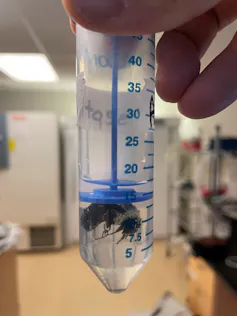
A bumblebee submerged in a test tube.
A queen bumblebee breathing underwater.
(Charles-Antoine Darveau)

So, we designed a follow-up experiment involving 143 common eastern bumblebee queens (Bombus impatiens).

This confirmed it was no fluke: the queens withstood complete submersion for up to a week.

This raised an intriguing question: how can this terrestrial insect pollinator survive underwater? Answering it required a different approach — we needed to study their physiology.

The heart of the colony

The queen is the heart of a bumblebee colony and its only chance of producing the next generation. While we often hear the buzz of workers visiting flowers during the summer, queens are rarely seen. They spend much of the season inside the nest, laying eggs that will become workers and, later in the summer, males and new queens.

When winter comes, most members of the colony die and only the newly produced queens survive. After mating, these new queens disperse and burrow underground, each settling into a tiny cavity where they enter diapause.

When spring finally returns, the queens that survived their long underground sleep emerge from their burrows and begin the important task of founding a new colony.


Read more:
Worker honey bees can sense infections in their queen, leading to revolt


Breathing underwater

To understand how these queens can survive submersion, we studied their breathing and metabolism in our lab at the University of Ottawa.

During diapause, queens are already in extreme energy-saving mode. The energy they need to stay alive (known as their metabolic rate) drops by more than 99 per cent. When submerged, energy needs drop even further. With such tiny oxygen demands, underwater breathing becomes possible.

But how did we determine whether queens are actually breathing underwater? One way is by measuring the gases exchanged with the surrounding water. We did this and the results were striking: queens continuously consumed oxygen and released carbon dioxide underwater throughout an eight-day period of submersion.

A bumblebee queen hibernating in mud.
A bumblebee queen in her hibernaculum (underground burrow).
(Sabrina Rondeau)

Many aquatic insects use a simple trick to breathe underwater. A thin layer of air clings to their body, allowing them to use their normal air-breathing system — the tracheal system. Oxygen from the surrounding water slowly diffuses into this air layer. Bumblebee queens likely rely on the same mechanism.

Still, underwater respiration alone does not fully meet the queen’s energy needs. To bridge the gap, queens also produce some energy through anaerobic metabolism — a process that does not require oxygen. This pathway produces lactic acid, which we detected in queens during submersion.

These physiological tricks allow queens to survive underwater, but come at a cost. After resurfacing, queens spend several days recovering, using far more energy than they would have if they had never taken the plunge.


Read more:
Below freezing but still moving: How salamanders stay active in winter


An unexpected resilience

Bumblebee queens spend the winters alone, buried underground and relying on stored energy to survive until spring. Their ability to tolerate days of submersion — and even breathe underwater — reveals an unexpected resilience to one of the hazards of life below ground.

This matters because bumblebee colonies depend entirely on the survival of overwintering queens. If a queen dies during winter, the colony she would have founded the following spring will never exist.

This ability to survive submersion could play an important — and previously overlooked — role in the resilience of threatened bumblebee populations.

Even in terms of familiar and comparatively well-studied insects like bumblebees, there is still so much to learn about the surprising ways they cope with environmental challenges.

The Conversation

Sabrina Rondeau received funding from the Natural Sciences and Engineering Research Council of Canada, the Fonds de recherche du Québec—Nature et technologies and the Weston Family Foundation.

Charles-Antoine Darveau receives funding from the Natural Sciences and Engineering Research Council Discovery Grants program.

Nigel Raine receives funding from the Natural Sciences and Engineering Research Council, the Horizon Europe ProPollSoil project, the Canada Foundation for Innovation Innovation Fund, the Ontario Ministry of Agriculture, Food and Agribusiness, the Canadian Wildlife Federation and the Weston Family Foundation.

ref. Queen bumblebees can breathe underwater — for days. We discovered how – https://theconversation.com/queen-bumblebees-can-breathe-underwater-for-days-we-discovered-how-278175

Why Donald Trump will try to declare victory in Iran well before November

Source: The Conversation – Canada – By John Duncan, Director of the Ethics, Society and Law Program; Academic Director of the Ideas for the World Program, University of Toronto

The Iranian regime is certainly brutal. But it’s also powerful as it continues to project its might after a month of illegal air strikes by the United States and Israel.


Read more:
Iran’s attacks drone on, with the U.S. at risk of losing the war


Iran is in the top 10 per cent of countries by size and population, has the third largest proven petroleum reserves and controls strategically crucial geography.

Furthermore, both the regime and many ordinary Iranians are prepared to defend the country. Since 1953, when the U.S. helped orchestrate a coup to overthrow Iran’s democratically elected Prime Minister Mohammad Mosaddegh, Iranians have understood they’re in America’s crosshairs.

This was especially true after the 1979 Islamic Revolution that overthrew the shah and during the U.S.-backed Iraq war against Iran that killed a million Iranians in the 1980s. As a result, Iran has spent decades beefing up and decentralizing its military capability.

In contrast, Dan Caine, chairman of the Joint Chiefs of Staff, warned U.S. President Donald Trump in February that the U.S. was short on both munitions and allied support for a war against Iran. Israel, America’s partner in war, is also short, especially in interceptor munitions. Trump and Israeli leader Benjamin Netanyahu dismissed the concerns, which suggests they planned a short war.

What are Trump’s options?

Critics have accused Trump of dragging the U.S. — or allowing it to be dragged — into a “forever war.” Those critics include those in his MAGA base, a problem for Trump as he anticipates November’s mid-term elections.

One unconventional option that might expedite victory, discussed during Trump’s first term, is to use nuclear weapons against Iran. Trump has said nukes won’t be used, but he’s well-known for erratic reversals.

A nuclear strike might expedite surrender, but it took two strikes on Japan in 1945 before the Japanese surrendered, and, failing an Iranian surrender, several strikes might be required to destroy the military capability distributed across Iran’s 31 provinces. Because many Americans would be appalled by a nuclear attack, putting the mid-terms at risk, the nuclear option is unlikely.

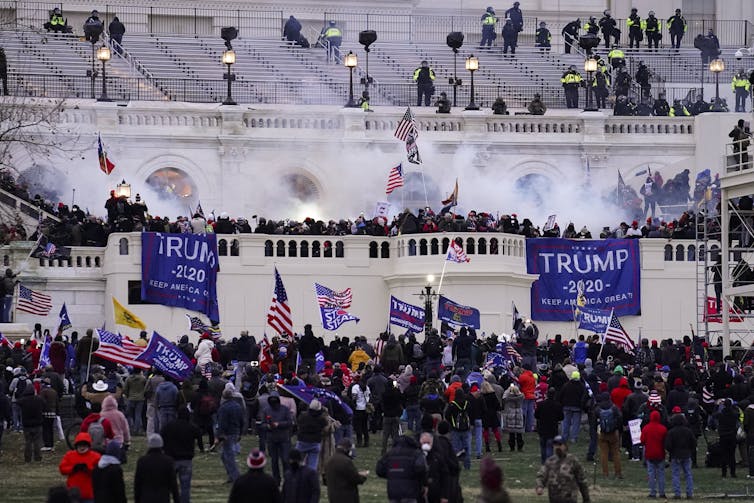
Much of the concern about Trump’s election machinations heading into the mid-terms is focused on the manipulation of procedures and officials. The legacy of the Jan. 6, 2021 attacks on the U.S. Capitol is one extreme possibility, as is manipulating the Iran war to achieve electoral gains.

Trump 2020 signs hang in front of the Capitol Building amid a riot.
Violent protesters, loyal to Donald Trump, storm the U.S. Capitol on Jan. 6, 2021.
(AP Photo/John Minchillo)

Trump will probably lean into his rhetorical strengths and try to convince Americans the U.S. has won when it hasn’t. Claiming victory in the face of its absence is not new to him. Even in his second term, Trump continues to push the false claim that he won the 2020 election.

Consider the bizarre drama that started on March 21 when Trump and Iran exchanged dire threats. Then, out of the blue, Trump declared the existence of peace talks, which Iran denied. Perhaps they are imaginary talks on the way to an imaginary victory for Trump.


Read more:
Why Donald Trump is such a relentless bullshitter


Mission accomplished?

It seems clear Trump is planning to declare victory well ahead of the mid-terms — and in part because of them. Such a strategy would involve baiting opponents into “forever war” criticisms, only to ridicule them in stump speeches, generating the image of a president who finishes his wars.

A declared victory in Iran and a timely exit, in addition to the liberation of Venezuela and a possible Cuban coup, might all coalesce into potent election messaging for the Republicans.

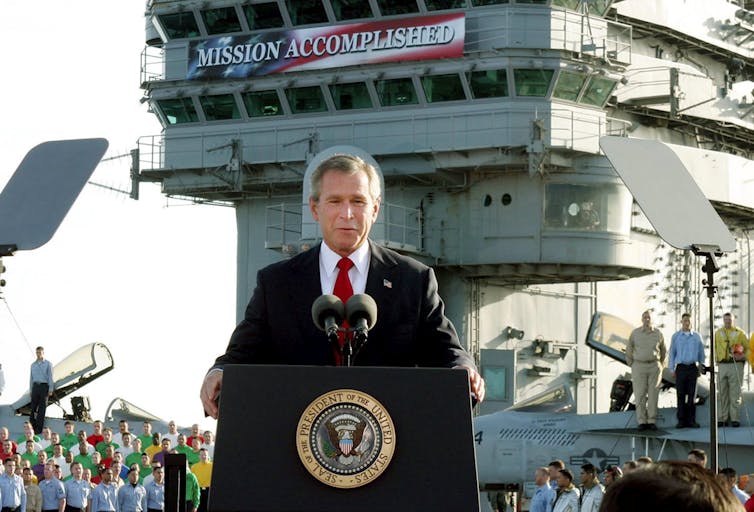
Soon enough, Trump may announce something akin to former president George W. Bush’s premature proclamations about the Iraq War in 2003 by saying something like this:

“Major combat operations in Iran have ended. The United States and Israel have prevailed. We do not know the day of final victory, but we have seen the turning of the tide.”

If successful, he will secure two more years “like nobody’s ever seen before” of Republican congressional dominance.

A grey-haired man stands a podium with the U.S. presidential insignia. Behind him a sign reads Mission Accomplished.
In this May 2003 photo, U.S. President George W. Bush declares the end of major combat in Iraq as he speaks aboard the aircraft carrier USS Abraham Lincoln off the California coast. The war dragged on for many years after that.
(AP Photo/J. Scott Applewhite)

Major obstacles

The battle for November will feature a few competing narratives in the U.S. But there are four major hurdles for Trump in particular.

  • Information: For voters to be convinced that Trump is a decisive crusader against evil rather than another “forever war” president, right-wing media must sell yet another big lie, mainstream media must continue to pull its punches and the Democrats must continue to flounder.
  • Affordability crisis: Trump also has to ensure he doesn’t “win” in Iran while losing on affordability at home. Most American oil comes from the U.S., Canada and Mexico, so the U.S. is protected from global supply disruptions, but global markets push up prices everywhere. Trump’s mere declaration of talks recently brought oil prices down, but only temporarily.
  • Allies needed: Because voters will want to see a significant military withdrawal, Trump needs other countries to manage the chaos he’s created. But after disrespecting allies for months, he is struggling to establish a “coalition of the willing” on which to offload the conflict.
  • Iranians must co-operate: But because the U.S. and Israel have twice attacked Iran during diplomatic negotiations, Iran needs other stakeholders in the process. Without them, Iran will not be incentivized to stop fighting and nothing will belie an imaginary Trump victory more than ongoing Iranian attacks.

Democracy waning

Whichever scenario prevails, Americans will likely lose. Their complete war costs could include repercussions from the unprecedented illegal bombing of Iran, as well as from unnecessarily turning regional allies into targets.

All of this is tied to what many Americans regard as increasing Israeli aggression, including the killing of 70,000 people in Gaza, which the U.S. has facilitated with funding, political cover and its widely mocked Board of Peace.

America’s democracy, economy and credibility are waning as Trump shamelessly pursues self-aggrandizement and self-enrichment.

That makes me smart,” he might say, but only a failed leader serves his own interests at the expense of his country.

The Conversation

John Duncan is affiliated with Science for Peace, a charitable organization dedicated to popular education and research on the intersections of demilitarization, decarbonization and social justice.

ref. Why Donald Trump will try to declare victory in Iran well before November – https://theconversation.com/why-donald-trump-will-try-to-declare-victory-in-iran-well-before-november-279059

Bobi Wine’s decision to flee Uganda points to a shrinking landscape for opposition politics

Source: The Conversation – Africa (2) – By Kristof Titeca, Professor in International Development, University of Antwerp

Bobi Wine’s escape from Uganda is not just a striking episode in itself, it also offers insight into the current state of the opposition – particularly his National Unity Platform party – and into the divergences within the Yoweri Museveni regime.

The Ugandan opposition leader had been in hiding for almost two months after the January 2026 presidential election, which Museveni won by 72%. Wine came second with 25% of the vote. Museveni, 81, has been in power since 1986.

Wine, born Robert Kyagulanyi, entered formal politics in 2017 when he won a parliamentary by-election.

He soon emerged as one of the leaders of the People Power movement, a loose, generationally charged mobilisation built around the slogan “People Power, Our Power”. It took shape in the aftermath of protests against the removal of presidential age limits in 2018. At the time, the opposition appeared largely exhausted and unlikely to unseat the regime. Bobi Wine and People Power therefore brought a new energy to Uganda’s opposition.

People Power later formalised into the National Unity Platform party, which Wine used to vie for the presidency in 2021. He secured about 35% of the presidential vote against Museveni’s 59%. National Unity Platform became the largest opposition force in parliament with 57 seats.

These results also highlighted the constraints of electoral politics in the face of extensive repression.

This is a pattern that would again become apparent in the 2026 elections.

As several human rights organisations noted, the 2026 elections took place in an environment marked by widespread repression and intimidation.

After the vote, Wine went into hiding. He posted photos and videos seemingly from Kampala, triggering roadblocks and searches across the capital city. On 18 March 2026, he resurfaced in the United States.

I have researched Ugandan politics for over 20 years, and recently published an article analysing the structural challenges Wine’s political party faces in Uganda’s authoritarian context.

Drawing on this work, my reading is that Wine’s escape reveals controlled tensions within Museveni’s regime, where different factions appear to disagree on how to handle the opposition – without signalling a full split. At the same time, it exposes a deeper dilemma for Wine and his party: how to balance international advocacy with maintaining grassroots legitimacy at home.

This moment matters because it highlights the structural constraints facing opposition politics in Uganda, and raises questions about whether meaningful political change can occur within the current system.

Frictions within the regime

The contrasting approaches within the Museveni regime are illustrated by events that followed the 2026 election. In the weeks following the vote, defence force chief Muhoozi Kainerugaba (Museveni’s son) issued a series of unusually explicit statements about Wine.

In a now-deleted tweet, he claimed that 22 members of the National Unity Platform – whom he labelled “terrorists” – had been killed. He added that he was praying that the next death would be Wine’s.

On 26 January, the defence chief escalated this rhetoric, stating that he wanted Wine “dead or alive”. These statements built on earlier threats, including about beheading Wine.

Taken together, they amount to sustained violent threats directed at the main opposition leader.


Read more:
Uganda’s autocratic political system is failing its people – and threatens the region


Set against this, however, is the fact that Wine was able to evade capture for nearly two months and ultimately leave the country.

It emerged that he did so with assistance from high-level state and security officials.

The same sources and regime insiders reported that intelligence services had informed Museveni about Wine’s whereabouts. The president chose not to act upon this information.

Taken together, these events suggest differences within the regime between factions in the security services, or more broadly between Muhoozi and other centres of power. Potentially even within the first family itself.

But these differences should not be overstated.

The episode does not indicate an open or consolidated split. Criticism of Muhoozi within the regime remains tightly constrained.

What this suggests is a regime where disagreements are contained within narrow limits. Wine’s escape, therefore, points less to a rupture than to an ongoing negotiation over power and strategy within the ruling elite.

And this is becoming increasingly important in light of the anticipated transition beyond Museveni.

Tensions within Wine’s party

Wine’s political strength has always come from where he came from.

He was rooted in the ghetto, and more broadly among urban youth who had long been mobilised by opposition politics but rarely felt represented by it.

Earlier figures like Kizza Besigye could appeal to this group, but Wine embodied it. He spoke the same language and made politics feel accessible to people often treated as outsiders.

That sense of authenticity was central to the early momentum of People Power. It also mattered that Wine broke with a long-standing pattern in Ugandan politics: he did not come from the western region, the core of the ruling elite.

But this “outsider” appeal has become harder to sustain over time. As People Power turned into a political party, and as Wine himself became more embedded in formal politics and international networks, parts of that original base began to feel that something had shifted.

What once felt like a movement of “one of us” increasingly risks being seen as something closer to the political establishment it set out to challenge.

As my research shows, this is not unusual. It is a core dilemma when protest movements turn into parties, especially under repression.

The social media backlash to Wine’s appearance in the United States needs to be read through that lens.

It not only echoes criticism from Museveni that Wine is an “agent of foreign interests”, but also from within the opposition where some radical voices argue that he should have stayed and faced the regime, even if that meant prison. Besigye, for instance, is facing treason charges after he was abducted and extradited from Kenya in 2024.

This criticism echoes a longstanding divide within opposition politics in Uganda: should opposition leaders embody defiance on the ground, or navigate politics through institutional spaces?


Read more:
The making and breaking of Uganda: an interview with scholar Mahmood Mamdani


Being in the US reinforces a growing perception that Wine is becoming more distant from the people who carried the risks on the ground.

If the party cannot connect its international advocacy and diaspora support back to the everyday struggles of its supporters in Uganda, this episode will likely deepen the feeling that the party has become more of the same.

What role remains for Wine?

There is an uncomfortable reality here. Wine serves a function for the regime. His presence helps maintain the appearance of political competition, particularly within the international community.

Wine now faces a choice. Engaging in electoral politics risks reinforcing the system he seeks to challenge. Stepping outside it risks isolation, repression or loss of political relevance.

How he navigates this tension will shape not only his political trajectory, but also that of his party.

The Conversation

Kristof Titeca does not work for, consult, own shares in or receive funding from any company or organisation that would benefit from this article, and has disclosed no relevant affiliations beyond their academic appointment.

ref. Bobi Wine’s decision to flee Uganda points to a shrinking landscape for opposition politics – https://theconversation.com/bobi-wines-decision-to-flee-uganda-points-to-a-shrinking-landscape-for-opposition-politics-279475

Brutal Mau Mau camps in Kenya were an extension of Britain’s colonial prison system – historian traces their roots

Source: The Conversation – Africa (2) – By Ian Caistor-Parker, PhD student, University of Warwick

During the Mau Mau uprising between 1952 and 1960, the British colonial government confined an estimated 150,000 Kenyans in a sprawling network of “emergency” detention camps.

None of those held in the camps had been found guilty in a court of law. Instead, they were detained on suspicion of supporting the uprising.

British control over Kenya was effectively declared in 1895. A distinctive feature of colonial rule was the decision to encourage white settlement. These settlers were granted vast tracts of Kenya’s most fertile land and pushed policy in an increasingly harsh and unequal direction.

By the early 1950s, many African Kenyans were facing severe land shortages in the countryside and desperate living conditions in urban areas.

In 1952, this situation erupted into the Mau Mau uprising, a broadly anti-colonial rebellion.

The British government responded with overwhelming force. It declared a state of emergency and suppressed the uprising militarily.

Revelations about the extreme violence employed in some emergency detention camps made the continuation of British rule untenable. Particularly key was the Hola massacre of 1959. Guards beat 11 detainees to death and the colonial government attempted to cover up the crime.

Outrage at these events shattered Britain’s grip on the colony, and Kenya achieved independence in 1963 under the leadership of Jomo Kenyatta.

A great deal is known about these detention camps. They were sites of neglect and brutal violence. Detainees were forced to go through a so-called rehabilitation system designed to make them renounce their support for Mau Mau.

In practice, they were subjected to brutal compulsory labour, were at risk of assault and lived in unhygienic conditions. Some of those who refused to cooperate ultimately faced systematic, state-sanctioned torture.

I am a historian researching punishment in Kenya, and I have been investigating the deeper history of detention camps. My research shows that this emergency detention system was shaped by an earlier network of “ordinary” detention camps. These were established in 1926 and processed more than 400,000 people before the uprising.

These camps, intended as a milder alternative to prison, evolved into a poorly regulated system characterised by exploitation, overcrowding and weak accountability.

These findings challenge the idea that the detention system of the 1950s was exceptional. Instead, it was rooted in long-standing colonial practices, shaped by economic incentives, administrative gaps and coercive labour systems.

Understanding this deeper history matters because it changes how we view the Mau Mau emergency. It proves that the brutal 1950s detention system didn’t just emerge from nowhere – it was built on a foundation of state violence and disorder that had been normalised for decades.

The roots

Influenced by a draconian-minded European settler minority, the Kenyan colonial government adopted a harsh approach to punishing the local population. Judges frequently imprisoned Africans for “technical” offences lacking criminal intent. These included failing to pay tax and minor violations of coercive labour laws.

By the 1920s, Kenya’s prisons were overcrowded and “technical” offenders inevitably mixed with hardened criminals.

In response, the colonial government introduced detention in 1926 as a supposedly milder alternative for technical offenders who had simply broken administrative rules. In theory, prisons were to be reserved for those who had committed crimes involving moral violation. In practice, however, these distinctions didn’t (or couldn’t) hold.

To visibly separate detention from imprisonment, the colonial government gave day-to-day control of detention camps to district commissioners (the powerful heads of local governments), not the prison department.

However, this separation was incomplete. Detainees were legally classified as prisoners (though they were not informed of this). The prison department retained ultimate authority over the camps.

This overlapping authority produced a gap in accountability, which ultimately proved disastrous.

In 1930, seeking to divert more people from formal prisons, government officials removed almost all sentencing restrictions on detention. Subsequently, the only limitations were that sentences had to be under six months and that those with more than one prior prison conviction were ineligible.

Numbers surged immediately, with more convicted offenders sent to detention than formal prisons almost every year until 1952.

Judges increasingly used detention for serious offences, including manslaughter. A limited criminal records system meant that individuals with prior convictions – sometimes as many as 16 – ended up in detention.

Conversely, the amendment did not stop harsh magistrates from continuing to send significant numbers of minor offenders to prisons.

This blurring of populations, combined with a lack of structural and legal separation, meant detention camps mutated into a parallel prison system, serving a different colonial master, district commissioners, but lacking fundamental distinction.

Detention camp living conditions were atrocious. Most district commissioners delegated almost all duties to Kenyan African “overseers”. Overseers were under-trained. Yet they were expected to be on duty constantly and often had to guard more than 60 detainees, making meaningful supervision impossible.

Camps were generally collections of temporary wattle-and-daub huts. Over time, these decayed but were not replaced, resulting in squalid conditions.

Furthermore, overcrowding was endemic. Food rations were poor and basic facilities were often absent. Sickness rates were significant. Detainees responded by escaping at a rate of more than one a day.

Failed reform

In 1937, a high-level committee condemned the system as dangerous and inefficient. Calls for reform from London also grew.

But nothing changed.

Why?

The primary reason was economic. Detainees were a vital reservoir of free labour for cash-strapped district commissioners. When camps were introduced, local governments’ labour budgets were cut. This made detainee labour crucial for maintaining government stations.

In the late 1930s, penal officials sought to reintroduce stricter eligibility criteria for detention. However, they abandoned this idea as it would add to overcrowding in the prison system.

Trapped by bureaucratic gridlock, underfunding and economic dependency, Kenya’s detention system limped into the 1952 emergency – unreformed.

Ultimately, “ordinary” detention camps persisted until the 1980s, far outliving their emergency counterparts.

The consequences

This history exposes stark continuities between the pre-emergency and Mau Mau penal systems. Furthermore, as they were under the control of district officials and lacked standard prison regulations, existing detention camps could, and did, easily become dumping grounds for Mau Mau suspects in the early months of the emergency. Ordinary detention was both a model and enabling mechanism for emergency detention.

The Conversation

Ian Caistor-Parker receives funding from the UK Economic & Social Research Council

ref. Brutal Mau Mau camps in Kenya were an extension of Britain’s colonial prison system – historian traces their roots – https://theconversation.com/brutal-mau-mau-camps-in-kenya-were-an-extension-of-britains-colonial-prison-system-historian-traces-their-roots-277856

What the government’s plan for social cohesion gets wrong about community division

Source: The Conversation – UK – By Adam Coutts, Senior Research Fellow, Department of Sociology, University of Cambridge

Alex Segre/Shutterstock

The government’s new social cohesion action plan, Protecting What Matters, is frank about its urgency: “Social cohesion is … not just a good in and of itself. It is also a vital front in the resilience of our national security.”

The 2024 Southport attacks and subsequent disorder, rising religious hate crime, unrest over migration policy and domestic extremism have all forced the issue of community division. Yet the government’s answer, built around integration, interfaith dialogue and civic ceremonies, mistakes the symptom for the disease.

“Cohesion” is vague, unmeasurable and elastic enough to mean whatever the government of the day needs it to mean. People describe the places they love as close-knit and safe, not “cohesive”.

A better framework would be community resilience: the measurable capacity of neighbourhoods to absorb shocks, resist divisive narratives and recover from crises. You cannot integrate people who are isolated, impoverished and without the infrastructure to bring them together. COVID laid bare what the evidence already showed: communities with stronger social infrastructure and higher levels of social capital demonstrated greater resilience to the pandemic’s social and economic shocks.

The government strategy does contain a chapter on “resilient communities”. However, it frames resilience narrowly, as emergency management of religious and political extremism, rather than as the everyday and routine fabric that makes any form of solidarity possible at all.

The missing piece

There is an extraordinary gap in Protecting What Matters. While there is acknowledgement of the effects of “visible deterioration of public services”, the word “poverty” does not appear once. The plan frames division through religion, identity and Islamophobia, which are outcomes and proxies, not root causes.

A study of over 15,000 residents across 839 English and Welsh neighbourhoods, validated by a 2024 analysis of the Understanding Society dataset, shows that deprivation, not diversity, erodes trust, participation and neighbourliness. Once you control for poverty, diversity is associated with higher volunteering and charitable giving. The crisis of solidarity is a crisis of resources, not cultural difference.

There is an undertone of nostalgia in the government’s plea for communities to “integrate”, a wistfulness for tight-knit mining towns where everyone knew their neighbour. But those communities were built on something material: secure jobs, union membership, working men’s clubs and shared economic fate.

More in Common’s 2025 polling finds that 44% of Britons sometimes feel like strangers in their own country – a figure that could be read as evidence of cultural division. But More in Common’s own analysis shows this alienation is concentrated in economically left-behind areas, not diverse ones. People do not feel like strangers because their neighbours look different. They feel like strangers because the institutions that once made them feel they belonged – clubs, pubs, unions and jobs – have gone.

A boarded-up pub with graffiti across the top reading 'I used to be the moon and bell'
The loss of social infrastructure has been devastating to communities across Britain.
chrisdorney/Shutterstock

The argument that more homogenous communities are more cohesive is seductive, but weak. Britain’s most ethnically diverse neighbourhoods are not its least cohesive – they are, as Manchester researchers found, its healthiest. Mining towns were cohesive despite being male-dominated, often racially exclusive and economically coercive. The lesson is to replicate not their demographics, but the material conditions: jobs, institutions and shared infrastructure that give people a reason to show up.

Work provides far more than income: it furnishes identity, routine and daily social connection. Unemployment is not merely an economic condition; it is an isolating one.

A recent randomised controlled trial by the Department for Work and Pensions found that structured group job-search workshops improved both mental health and employment outcomes among benefit claimants, precisely because they restored the social support, routine and shared purpose that work normally provides. Community resilience cannot be separated from economic development. Departments such as DWP and Jobcentre Plus have a direct stake in the social capital agenda.

Building resilient communities

Research I have conducted at the Independent Commission on Neighbourhoods (ICON) and a recent Joseph Rowntree report show that social infrastructure is key to resilience, but that different communities have different needs.

New housing developments need parks and primary schools from day one: accessible spaces that create early encounters and establish trust between newcomers. Established but deprived communities need to restore what has been stripped away, whether the pub, the library or the community centre. Sports facilities build bridging connections across difference, faith buildings deepen bonds within communities and civic spaces create the linking ties between residents and institutions. The task is to match the infrastructure to the social capital gap, not apply a single template everywhere.

The real test, which my colleagues and I call the “Wet Wednesday Night Test”, is whether your investment in social infrastructure gets 14 people to turn up for football (or cub scouts, or a book group) on a wet Wednesday in February. Nobody comes to “build social capital”. They come because the pitch is free, the lights work and there are hot showers. The pint afterwards does more for integration and social capital than any strategy document ever will.

Photo focused on a football sitting on grass while players celebrate in the background
People don’t show up to the football pitch to ‘build social cohesion’.
Natee K Jindakum/Shutterstock

ICON’s research, drawing on over 100 peer-reviewed studies, shows that social infrastructure generates £3.50 for every £1 invested. Every £10,000 invested prevents an estimated £105,000 in riot damages.

During the 2011 riots, 71% of incidents occurred in areas ranked among the most deprived 10% of England – the same year in which 287 community centres had closed. The government described this as a “social cohesion” problem; it was a social infrastructure problem.

The government’s £5 billion Pride in Place programme makes a start at investing in communities. But more investment is needed to address the challenges in our most deprived neighbourhoods, where people face life expectancy four years below the national average.

A serious approach would use existing schools, job centres and childcare settings as social hubs, and make public transport free for under-18s so that young people can move around their own towns. And, it would tackle the poverty, insecure work and collapse of institutions that once gave people a reason and the means to show up for each other.

Build those foundations and what politicians call “cohesion” will follow. Nobody will use that word to describe what they feel when they step outside of their front door. They will just say it is a good place to live. That is enough.

The Conversation

Adam Coutts does not work for, consult, own shares in or receive funding from any company or organisation that would benefit from this article, and has disclosed no relevant affiliations beyond their academic appointment.

ref. What the government’s plan for social cohesion gets wrong about community division – https://theconversation.com/what-the-governments-plan-for-social-cohesion-gets-wrong-about-community-division-278702