Babies: raw, nuanced, real – what this BBC drama gets right about recurrent miscarriage

Source: The Conversation – UK – By Susie Kilshaw, Professor in Medical Anthropology, UCL

I heard about the new BBC drama Babies the week before it aired and was keen to watch it, not least because miscarriage is so rarely portrayed on screen – particularly as a central storyline. I enjoyed it, insofar as that word can be applied to such a devastating subject. The series offers a raw, nuanced and deeply realistic account of recurrent miscarriage and it gets a great deal right.

Lisa (Siobhán Cullen) and Stephen (Paapa Essiedu) are a young couple in their thirties navigating the heartbreak caused by repeated miscarriages. The pacing of the show – at times almost painfully slow – mirrors the real experience of conception, early pregnancy and reproductive loss.

It allows the viewer to sit with emotional complexity – the shifting feelings, the uncertainty and the drawn-out liminality of making a family. Time appears suspended for the couple, even as life continues around them. We see Lisa returning to work increasingly detached, exhausted and withdrawn, while other pregnancies progress, babies are born and the world moves on.

Stephen’s insistence that they “must think positive” is familiar – the partner adopting a supportive role while masking their own grief. When Lisa challenges his suggestion that others don’t realise she has “been through so much,” reminding him that it has happened to both of them, the moment is ambiguous. Is she inviting him to share in the grief, or expressing frustration that he is not experiencing the loss in the same way? These tensions echo accounts shared by women I have interviewed through my work on fertility, reproduction and pregnancy endings.

Throughout the series, Lisa and Stephen navigate layers of distress – at times drawing close, at others remaining emotionally distant. Their oscillation between hope and despair, and between the need to “keep moving” and the pull of grief, reflects patterns commonly found in miscarriage stories.

Visceral realities of baby loss

I was most interested in how the physical experience of miscarriage would be portrayed. Early in the first episode, I felt a familiar disappointment. The miscarriages occur off-screen, with the focus placed almost entirely on emotional aftermath, with little attention paid to the reality of pain and bleeding. However, this shifts with Lisa’s third miscarriage, which is one of the most accurate portrayals I have seen.

We see blood, albeit briefly and only a very small amount. Lisa’s pain is audible in her cries and moans. The movement through different spaces – her place of work before returning home, then their bedroom, the bathroom, the living room – marks escalating levels of distress, capturing the duration and inconsistency of miscarriage.

This is not a quick or contained event, but an unfolding process. Stephen’s growing panic as he seeks help, culminating in the arrival of paramedics (seemingly against Lisa’s wishes), underscores the seriousness of the situation, the lack of preparation and the couple’s helplessness.

The series also conveys the diversity of miscarriage experience and response. Lisa’s first loss is a “spontaneous” miscarriage at seven weeks; the second, a missed miscarriage managed surgically; the third unfolds “naturally” after the onset of pain and bleeding. Importantly, the viewer witnesses these experiences in ways that may feel recognisable to many – this is not “just a heavy period”.

That said, I would have welcomed more detail on miscarriage management. While we learn that Lisa undergoes an “ERPC” (evacuation for retained products of conception) for her second miscarriage, the absence of discussion around her options and decision-making represents a missed opportunity to depict clinical care more fully, and to foreground women’s agency.

The series doesn’t shy away from the visceral reality of loss. Lisa’s anguished description of “my baby dripping into the toilet”, is confronting but important. Miscarriage is often sanitised in public debate, and frequently unfolds in private domestic spaces. Babies portrays the reality of miscarriage, including toilets, where most miscarriages occur and are disposed of. The drama also gives a sense of the range of feelings that accompany miscarriage: hope, fear, anger, frustration, optimism, sadness and grief.

While Babies succeeds in many respects, the portrayal of clinicians is more problematic. The first doctor’s casual “Yup, yup, yup, all gone” during a scan devastates, with no sense that for Lisa what is “gone” is her longed-for baby.

During the second pregnancy the sonographer refers to their “baby” and suggests they look at the screen before becoming excruciatingly quiet. The abrupt shift from shared excitement to silence and blunt disclosure, and the GP’s depiction is emblematic of an unfeeling NHS system, all contributing to a narrative of insensitive care.

Some viewers may recognise these experiences. Over 15 years of research in Qatar and the UK, I have encountered accounts of poor and insensitive miscarriage care. However, more recent research suggests that particularly within the NHS, care has improved significantly, with women reporting compassionate and sensitive support. During 20 months of fieldwork in a large NHS foundation trust in England, I consistently observed responsive and empathetic clinical care.

This is not to suggest uniformity across and within settings, but rather to question whether Lisa’s experience reflects the norm in many NHS contexts today. As I have argued elsewhere, an understanding of miscarriage as bereavement increasingly underpins NHS care, reflecting a broader cultural shift that recognises miscarriage as a significant loss.

While Babies contributes to this important recognition, it also reinforces a dominant narrative in which miscarriage is always experienced as traumatic and devastating. While this will resonate with many – and such validation is important – it risks marginalising those whose experiences fall outside this, including some of the women I have interviewed in my work.

The involvement of consultants from Tommy’s Charity contributes to the series’ sensitivity and accuracy, underscoring the value of such collaborations. Cullen and Essiedu deliver compelling performances, conveying emotional complexity and intimacy with subtlety and depth.

Babies is slow, thoughtful and often heartbreaking. Despite some limitations, it is a welcome and important contribution – one that lays bare the realities of miscarriage with honesty and compassion.

The Conversation

Susie Kilshaw receives funding from the Wellcome Trust as part of a University Award in the Social and Historical
Science (Award number: 212731/Z/18/Z) and also holds a AHRC Curiosity Award (Award number: UKRI1126)
She has also received funding from ESRC Impact Acceleration grant (Award number: KEI2024-01-53 ESRC IAA KEIF).

ref. Babies: raw, nuanced, real – what this BBC drama gets right about recurrent miscarriage – https://theconversation.com/babies-raw-nuanced-real-what-this-bbc-drama-gets-right-about-recurrent-miscarriage-280134

Credit and credibility: rating agency errors come with a cost

Source: The Conversation – Africa – By Misheck Mutize, Post Doctoral Researcher, Graduate School of Business (GSB), University of Cape Town

The rating agency S&P Global’s Africa Credit Rating Trends 2025 reviews the past year’s rating activities and analyses the continent’s prospects for 2026. It is an important document because it interprets underlying drivers of creditworthiness. It shapes how global investors and policymakers understand risk, opportunity and reform dynamics across the continent.

But the document had some serious flaws in it. As someone who has been researching Africa’s capital markets and the institutions that govern them for decades, I believe they are worth commenting on because mistakes like this can influence investor perceptions. In turn, this can reinforce existing biases and affect how African economies are priced in global financial markets.

Firstly, there were several basic errors. Burundi was mislabelled as Uganda. Sudan and South Sudan were merged into a single country despite being separated since 2011.

The report also displayed a non-existent lake in the Great Lakes region and the Republic of the Congo was casually referred to by its unofficial name, Congo Brazzaville. The agency also presented the continent as having 54 countries, excluding the Sahrawi Republic, which is recognised by the African Union.

At first glance, these errors may seem like minor technical mistakes or editorial lapses in a document focused on financial analysis. But that reading misses the deeper issue. These are not just errors on a map. Errors like this raise questions about the accuracy, depth and rigour of the research and analytical processes behind the credit rating reports that move billions of dollars across the globe.

Systematic risk overestimation is what has led to African countries being penalised with higher interest rates and limited financing options. In effect, seemingly small errors have translated into real economic costs for African economies.

Moody’s made such errors in the past. It issued speculative downgrades for Kenya and Nigeria that it reversed within six and 12 months, respectively. One speculative commentary by Moody’s cost Kenya over US$150 million in a derailed bond buyback programme.

The gaps

At the core of these research shortcomings is a simple but consequential reality – limited presence on the ground.

S&P Global has an office in South Africa from which the team is expected to cover the whole continent. In addition, most of its rating analysts are based in Europe and Asia. These analysts visit the countries they rate for a maximum of two weeks in a year. These short visits and inadequate consultations have resulted in risk assessments based on conservative assumptions, desktop research and publicly available information.

S&P Global has been rating Uganda since December 2008. Yet its researchers still confuse the country’s location on the map.

This matters because global investors who engage Africa from a distance often operate with a cautious instinct. They still, erroneously, perceive Africa as a single, homogeneous risk bloc rather than 55 distinctive sovereigns with different risk dynamics.

Such geographical inaccuracies inadvertently validate this flawed narrative and risk perception, feeding into the misperceptions that distort capital allocation and inflate borrowing costs.

Another flaw the mistakes in the report illustrate is weak internal controls.

In global institutions like S&P Global, it is assumed that every publication undergoes multiple layers of quality assurance and editorial scrutiny. If such fundamental inaccuracies can pass through these filters, what about an analyst’s own assumptions that are embedded in sovereign risk models?

Is it possible that such errors escape scrutiny?

What is also worrying is how S&P Global responded to this issue when it was raised. The errors were flagged repeatedly on S&P Global’s social media platforms after the report was published, yet they remained uncorrected for nearly two weeks.

That delay was telling. It is fair to argue that these inaccuracies did not trigger the required urgency or institutional reflex because they concerned Africa. The corrections would most likely have been immediate, accompanied by formal apologies and internal reviews, if they had involved more powerful or closely watched regions. For example, if such a report had a map combining North and South Korea as one country or mislabelled Germany as France.

The reputational stakes would have been too high for the rating agency to ignore.

Way forward

Africa should not remain on the sidelines while its narrative is being driven by institutions that keep demonstrating a superficial understanding of its fundamentals.

One clear solution, in my view, is the establishment of an African credit rating agency to rebalance the narrative.


Read more:
Africa’s new credit rating agency could change the rules of the game. Here’s how


But more needs to be done. Here are three solutions.

First, African governments must move from being passive recipients of ratings to active engagement with analysts. Where justified, they must contest assumptions, methodologies and errors. Engagement should not begin after a downgrade. It must be continuous, technical and evidence-based with credible and timely data about their economies.

Second, global institutions such as S&P Global must recalibrate their approach in dealing with Africa. Credibility is derived from consistent accuracy and timely responsiveness. They must invest in permanent senior research and analytical presence on the continent, not episodic visits. It means expanding consultation beyond a narrow set of stakeholders to include local economists, market practitioners and independent researchers. More important, strengthening internal quality controls so that basic errors do not undermine the integrity of complex analytical outputs.

Perception continues to move faster than data, and negative narratives travel further than positive fundamentals. That is why African countries must insist on analytical rigour, demand accountability and build their own capacity to interpret risk.

The Conversation

Misheck Mutize is affiliated with the African Union – African Peer Review Mechanism as a Lead Expert on credit ratings

ref. Credit and credibility: rating agency errors come with a cost – https://theconversation.com/credit-and-credibility-rating-agency-errors-come-with-a-cost-279672

Countries suffer when credit rating agencies lack data: how to fix the problem at source

Source: The Conversation – Africa – By Daniel Cash, Senior Fellow, United Nations University; Aston University

Some developing country governments spend years making the reforms that international financial institutions want – only to find that their efforts are not rewarded.

They may make budgets more transparent, publish their debt obligations, set up independent bodies to monitor government spending, and complete an International Monetary Fund programme, but still receive the same ratings from credit agencies. Borrowing costs remain high.

The gap between what countries have built and how that progress is reflected in credit ratings and market pricing is persistent and has consequences. It translates into higher borrowing costs, tighter fiscal space, and fewer resources for public investment.

The standard explanation points to bias in method – that credit rating agencies undervalue developing country institutions or rely on indicators that favour the global north.

There is some truth in this observation, and reformers have tried solutions like more agencies, methodology reviews and transparency codes. But these don’t tackle a deeper structural problem.

Based on my work as a researcher on the working of rating agencies, it’s clear that in practice, assessments of developing countries are often made on the basis of incomplete or fragmented information. Data sits in different institutions across the country, is not always produced to a common standard, and is frequently assembled under time pressure ahead of rating reviews. What reaches external assessors is therefore, at best, a partial view of the country’s institutional and fiscal position.

The issue was a major point of discussion at the United Nations in late March 2026 when delegates convened for the inaugural special meeting on credit ratings.

A recurring theme across the discussions was the need to look upstream – at what needs to exist before the rating process actually begins. Then assessments might more accurately reflect the infrastructure that developing countries have built.

That is a meaningful shift. It moves away from demanding that credit rating agencies behave differently, and towards asking what the system as a whole needs to provide. Upstream is where the problem originates and where the most concrete action is possible.

The debate suggests a shift in how key actors, including the United Nations, multilateral development banks and sovereign borrowers themselves, are approaching the problem. This could begin to change how institutional progress is translated into credit assessments and, over time, into borrowing costs.

Constructing a country’s credit story

A sovereign credit rating is not solely formed inside a credit rating agency. It takes shape in the months and years before an analyst arrives. It happens across finance ministries, central banks, statistical offices, debt management offices and audit institutions. It’s a process of data assembly, verification and presentation that most developing country governments have never had the capacity to manage systematically.

Before a rating is issued, a country’s credit story must be constructed. Fiscal data must be gathered, reform trajectories documented, institutional changes verified and contingent liabilities disclosed. A debt management office holds one part of the picture. A central bank holds another. A statistical office holds a third.

When those parts are properly coordinated, the credit story arrives at the assessment stage in verifiable form. When they are not, documentation has to be pulled together reactively before a rating deadline, and the story arrives incomplete.

Put simply, the analyst cannot reconstruct what was never assembled. Facing incomplete information, even where the core data required is broadly similar across countries, the rational response is often conservative assessment. The uncertainty premium stays elevated, and any reforms go unrecognised – not because they did not happen, but because the system required to make it visible was never built.

This upstream process can be understood as sovereign credit formation. If it’s weak, and external assessors can’t see what genuine progress has been made, there’s a formation gap. The formation gap does not mean that all low ratings are unwarranted. It simply means the system currently has no reliable way to tell the difference between a sovereign with weak fundamentals and one with strong yet largely invisible institutions.

No actor in the current system has the mandate or the incentive to build that upstream infrastructure on behalf of the countries that need it most. That is the problem.

On top of this, developing country governments are being asked to reform in ways that will take sustained investment in institutional capacity. Better data systems; coordinated institutions; clearer evidence. That investment takes years, diverts scarce resources, and demands political commitment across electoral cycles. It is being asked of governments that don’t have the fiscal space to do it – because their borrowing costs are high.

They are being asked to solve a problem they did not necessarily create, using resources that the problem itself is consuming.

The intervention that fits

Multilateral institutions, including the United Nations and multilateral development banks, cannot change what credit rating agencies do inside their own methodologies. Assessments are made independently. Interfering with the way they do it would undermine that independence.

Recent evidence in the multilateral development bank system shows that coordination is the prerequisite to movement.

Coordination across multilateral development banks and their shareholders led first to the creation of an emerging markets credit risk database, then to the formal review of multilateral development bank lending by an expert panel appointed during Indonesia’s presidency of the G20, and then to major credit rating agencies changing their methodological processes.

The infrastructure that makes governance reforms legible to credit markets is a public good. Public goods require public investment. This is not a call for a new institution. It is a reorientation of existing ones towards a gap that nobody is currently filling.

Every sovereign that has undertaken genuine reform and watched its credit conditions remain unchanged knows the problem this article describes. They are being assessed before a full appreciation of their credit worthiness is possible. Building the upstream infrastructure to close this gap is the multilateral system’s most important contribution to sovereign credit reform.

The Conversation

Daniel Cash does not work for, consult, own shares in or receive funding from any company or organisation that would benefit from this article, and has disclosed no relevant affiliations beyond their academic appointment.

ref. Countries suffer when credit rating agencies lack data: how to fix the problem at source – https://theconversation.com/countries-suffer-when-credit-rating-agencies-lack-data-how-to-fix-the-problem-at-source-279671

Canada’s cybersecurity sector has a pipeline problem — and a glass ceiling

Source: The Conversation – Canada – By Sepideh Borzoo, Postdoctoral Fellow, Toronto Metropolitan University

Canada is facing a well-documented shortage of cybersecurity workers, with estimates suggesting a shortfall of 25,000 to 30,000 qualified professionals — a figure projected to grow to 100,000 by 2035. The persistence of this labour shortage weakens Canada’s capacity to defend itself against cybersecurity threats.

One possible way to address the shortage is to expand the recruitment of skilled foreign workers.

Although Immigration, Refugees and Citizenship Canada (IRCC) announced in 2025 that the Express Entry system will shift its focus from the technology sector toward fields like health care and francophone immigration, cybersecurity remains one of the few technology occupations still considered in high demand for foreign applicants.

Meanwhile, organizations are developing diversity initiatives to attract a broader workforce, including women and racialized women, to the sector. While racialized immigrants account for the majority of information technology sector workers in Canada, they remain underrepresented in cybersecurity.

Cybersecurity historically originated from the military and has been shaped by national security priorities; as a result, it remains a field predominantly composed of white men. The problem is more acute in the upper echelons of security leadership.

In 2023, non-white men made up only 15 per cent of the global cybersecurity workforce. Racialized women are even less represented. Only two per cent of racialized women are in senior management positions.

As researchers who study the experiences of immigrant tech workers in cybersecurity in Canada, we have found that while racialized immigrant women are vital to the workforce, they continue to encounter barriers that limit their integration and career progression.

Ensuring equity and improving retention will require more than superficial diversity initiatives; the sector must adopt deeper, systemic changes that meaningfully support immigrant employees.

Strong qualifications, constrained careers

To understand how this labour shortage is experienced on the ground, we conducted 55 in-depth interviews between 2023 and 2025 with foreign-born cybersecurity professionals in Canada. Participants represented 13 countries, with most orginating from India, Iran, Brazil and Venezuela. The majority had attained Canadian permanent residency and had at least two years of experience in the Canadian cybersecurity sector.

These interviews help explain how the structural dynamics play out in everyday work.

Most of these cybersecurity professionals came to Canada with strong educational backgrounds in technology and skills that are highly transferable. While high human capital facilitated their entrance into the cybersecurity labour market, their career progression was often constrained by the absence of mentorship and professional networks, by language and cultural adjustment challenges, as well as a disproportionately heavy workload.

These barriers are even more difficult for immigrant women to navigate in an industry shaped by traditionally masculine principles, where competition and aggressive growth have long been celebrated as markers of success. The complexity of all these barriers often keeps immigrants, and racialized immigrant women in particular, in entry-level positions.

Interviewees described daily work experiences structured by systemic barriers and stereotypical expectations.

Many reported struggling to achieve a balance between their professional and personal lives as their roles require working long hours and constant investment in updating their technical knowledge. Experiences of discriminatory behaviour from male colleagues toward women were common. Women with foreign accents, in particular, discussed feeling interrupted or unheard during team meetings.

The layered realities of exclusion

Participants in our study described facing challenges shaped by overlapping forms of discrimination.

Some highlighted that their citizenship status played a role in limiting their access to certain positions. For example, participants on temporary work visas — specifically those from countries experiencing geopolitical tensions with Canada, such as Iran — reported greater difficulty entering the sector.

When they did find work, they were often placed in the most arduous positions, such as incident response and security operations centres, with minimal control over their schedule or tasks. Foreign accents or cultural backgrounds often led to exclusion from non-technical roles that require interaction and relationship-building connections with clients in the cybersecurity sector and contributed to marginalization in day-to-day work interactions.

For women participants, these experiences were often compounded by an industry defined by masculine norms — characterized by heavy workloads, long hours and an implicit requirement to avoid any display of weakness. They described experiencing strain in having to prioritize work over family while navigating workplace relationships in which they were frequently talked over and silenced.

The burden of being a minority in an overwhelmingly white, male-dominated workplace varied depending on the women’s race and ethnic background.

Asian and white immigrant women often felt compelled to speak more assertively and loudly to challenge assumptions that cast them as submissive or unassertive. And Black women described having to carefully manage their frustration and tone of voice to avoid triggering stereotypes that label them as inherently angry.

The weight of stereotypes often left them feeling isolated or uncertain about their place.

Change requires a collaborative approach

Removing the barriers that hinder immigrants in their career progression means addressing both the stereotypical behaviours and the systemic factors holding them back.

This would involve changing the workplace culture and adjusting policies at both immigration and organizational levels. Changing hiring, training and mentoring processes can shift how competency is defined and evaluated within organizations.

Our findings suggest that while diversity programs may reduce overt discrimination and encourage the hiring of women and ethnically diverse employees, this doesn’t guarantee that minority groups will be treated equally or have the same career advancement opportunities as other employees.


Read more:
How hiring more women IT experts improves cybersecurity risk management


Encouragingly, our findings also show that employees treat one another fairly in workplaces where leaders demonstrate fairness in their behaviour. Women in leadership positions, particularly, play an important role in changing workplace culture and advocating for underrepresented groups.

Enhancing diversity in the top leadership positions may also contribute to a more equitable work environment.

Hiring more gender and racially diverse people, and integrating them in leadership positions, can help create a workplace where every employee has access to mentorship that reflects their identity.

Federal and provincial governments can support these changes by embedding equity goals into immigrant selection and labour standards. Strengthening early and predictable pathways to permanent residence would also reduce immigrants’ vulnerability to precarious work and exploitation.

Together, these measures can help ensure diversity initiatives translate into genuine inclusion rather than merely masking persistent inequities. But without addressing the structural issues, Canada risks relying on immigrant talent to fill labour shortages while systematically limiting their success.

The Conversation

This project receives funding from SSHRC

This project was supported in part by the Social Sciences and Humanities Research Council (SSHRC), the Canada Research Chair (CRC) program, Canada First Research Excellence (CFREF) through the Bridging Divides program.

Rupa Banerjee does not work for, consult, own shares in or receive funding from any company or organisation that would benefit from this article, and has disclosed no relevant affiliations beyond their academic appointment.

ref. Canada’s cybersecurity sector has a pipeline problem — and a glass ceiling – https://theconversation.com/canadas-cybersecurity-sector-has-a-pipeline-problem-and-a-glass-ceiling-270764

Pakistan, Turkey, Egypt and Saudi Arabia emerge as a new regional power bloc amid Iran war

Source: The Conversation – UK – By Natasha Lindstaedt, Professor in the Department of Government, University of Essex

Pakistan’s prime minister, Shehbaz Sharif, announced that a two-week ceasefire had been agreed between the US and Iran in the early hours of April 8. Delegates from both sides are expected to attend further talks in the Pakistani capital of Islamabad on Friday.

This comes less than two weeks after Pakistan hosted talks with Saudi Arabia, Egypt and Turkey in which the four countries called for an end to hostilities in the Gulf. The meeting established the quartet as the primary negotiating channel between Tehran and Washington, and may signal the beginning of a new regional order designed to curb Israeli and Iranian dominance after the war.

Even before the war began in late February, Israel and Iran were both isolated in the region. There is no chance of any rapprochement between Israel and Saudi Arabia, which was the original goal of the 2020 Abraham accords. These accords sought to normalise relations between Israel and other countries in the Middle East.

The United Arab Emirates and Bahrain signed agreements with Israel as part of the accords. But the Saudis have long said they will not normalise ties with Israel before the establishment of a Palestinian state, which was ruled out by the Israeli parliament in a 2024 vote. Reports suggest that Saudi Arabia now wants to replace Israel with Syria as the transit country for a fiber-optic cable connecting the kingdom to Greece.

Turkey also halted its relationship with Israel in 2024 over the conflict in Gaza. And relations between Israel and Qatar soured in September 2025 after an Israeli strike on Hamas leaders in Doha, which drew unanimous condemnation from the UN security council.

Iran’s only main allies are Russia and, to a much lesser extent, China and the Houthi rebel group in Yemen. Since the conflict with the US and Israel began, China has distanced itself from Iran. The Houthis recently became involved in the war in support of Iran, but they have been weakened by Israeli attacks in recent years.

The solid relationship between Qatar and Iran has been severed after Iranian missiles struck the country’s main gas facility, Ras Laffan, on March 18. And Iran’s partial detente with Saudi Arabia, which was brokered by China in 2023 after years of hostility, has now been destroyed following Iranian attacks on Saudi energy facilities.

It is against this backdrop, in which both Iran and Israel are considered regional pariahs, that Pakistan, Saudi Arabia, Turkey and Egypt have ramped up their efforts to secure stability in the Middle East.

A new order?

These four countries share some common areas of interest that help explain their desire to reshape the region. They all have political and economic ties with the US and are members of Donald Trump’s Board of Peace. Established in 2026, the board aims to tackle global conflicts and achieve lasting peace and reconstruction in Gaza.

Each country also brings important contributions to their burgeoning alliance. Pakistan possesses nuclear weapons, Saudi Arabia has the world’s second-largest oil reserves, Egypt controls access to the vital Suez canal waterway and Turkey is a member of the Nato alliance. All have fairly advanced defence industries and a combined population of 500 million people. Taken together, they represent the most politically and militarily influential Muslim-majority countries in the world.

But these four nations are not necessarily natural allies, and their relationships have experienced turbulence over the years. Egypt’s relationship with Saudi Arabia, for example, has often been described as a “difficult marriage”. Egypt was once the driver of pan-Arab nationalism, a movement that promotes a secular and unified Arab political identity.

The Saudi kingdom has historically viewed this movement as a threat. But since Abdel Fattah el-Sisi came to power as Egypt’s president in 2014, their differences have been overcome. Sisi offered political and military support to the Saudi operation against the Houthis in 2015, with Egypt and Saudi Arabia subsequently deepening their defence ties.

Particularly under the leadership of Recep Tayyip Erdoğan, Turkey has positioned itself as a regional leader and problem solver. But Turkey, too, has endured periods of frosty relations with other regional powers. Ankara’s relations with Cairo deteriorated sharply after the Egyptian president, Mohammed Morsi, a close ally of Turkey, was ousted in a 2013 coup.

Similarly, tensions between Turkey and Saudi Arabia became particularly acute following the 2018 murder of journalist Jamal Khashoggi in the Saudi consulate in Istanbul. A 2021 US intelligence report found that Saudi crown prince Mohammed bin Salman approved the murder, though he denies this allegation.

A process of rapprochement took place between Turkey and Saudi Arabia in 2022, and then between Turkey and Egypt in 2025. Erdoğan visited Cairo and Riyadh in February 2026 and has proposed several different geoeconomic frameworks to connect Asia with Europe. These include the so-called Middle East Corridor, a planned economic corridor aimed at fostering economic integration between Asia, the Persian Gulf and Europe.

Pakistan, meanwhile, has so far not come to Saudi Arabia’s aid when it has come under attack from Iran in the current conflict. This is despite the signing of a strategic mutual defence agreement between the two countries in 2025.

Saudi Arabia, Egypt, Pakistan and Turkey have not always seen eye to eye. But their relationships of convenience are now becoming increasingly significant as Israel and Iran’s regional isolation grows.

The Conversation

Natasha Lindstaedt does not work for, consult, own shares in or receive funding from any company or organisation that would benefit from this article, and has disclosed no relevant affiliations beyond their academic appointment.

ref. Pakistan, Turkey, Egypt and Saudi Arabia emerge as a new regional power bloc amid Iran war – https://theconversation.com/pakistan-turkey-egypt-and-saudi-arabia-emerge-as-a-new-regional-power-bloc-amid-iran-war-279782

Mutual aid and self-sufficiency are key to life near USSR’s contaminated nuclear test zone in Kazakhstan

Source: The Conversation – USA – By Magdalena Stawkowski, Associate Professor of Anthropology, University of South Carolina

Four decades of tests had a total explosive yield of 2,500 Hiroshimas. Magdalena Stawkowski

About a year into my field research in Kazakhstan, I went to the city of Kurchatov, once the secret command center of the Soviet nuclear program, to make some photocopies. On the ground floor of an apartment building I found a store whose owner had a copy machine as well as several glass display cases selling souvenir stickers, magnets and other objects featuring hammers and sickles, stars and mushroom clouds.

pin with yellow background with black and white Cyrillic script
‘I am a radioactive mutant.’
Magdalena Stawkowski

These kinds of trinkets were not particularly surprising to me. You can find them in many places. But a bright yellow button about the size of my palm stopped me in my tracks: “I am a radioactive mutant” (“Ya radioaktivnyy mutant”), read its simple message.

I laughed to myself, thinking that the button was meant to be funny, that a tourist would buy it to wear ironically and tell stories about having been near a nuclear test site.

But the button’s message is also true for the thousands of people who live in this area. Residents actually say, “I am a mutant,” when they talk about their bodies, their family histories and their radioactive environment.

As a cultural-medical anthropologist, I study health and illness as life experiences. I’ve spent many months in villages around the Soviet-era Semipalatinsk test site in Kazakhstan, known locally as the Polygon.

In my book “Atomic Collective: Radioactive Life in Kazakhstan,” I explore how the people here have created new forms of mutual aid and camaraderie in the shadow of nuclear catastrophe. Their stories weave together fallout, the Cold War and secret government agencies, international aid workers and scientists, and everyday life in the Anthropocene.

Scale of nuclear testing in Kazakhstan

The Polygon is a roughly 7,000-square-mile (18,000-square-kilometer) area, close to the size of New Jersey, that was the Soviet Union’s primary nuclear testing ground for 40 years.

silhouetted man walks in foreground of dusty landscape with a large metallic object poking out of crater
People have dug around structures believed to be former missile silos, salvaging scrap metal.
Magdalena Stawkowski

Between 1949 and 1989, more than 450 nuclear tests took place here with a total explosive yield of 2,500 Hiroshima bombs. The most devastating were the above-ground tests, 116 of which were detonated between 1949 and 1963. I’ve seen the archival footage: mushroom clouds rising over the steppe, shock waves knocking people down dozens of miles away.

Today, this history is etched into a landscape pockmarked with deep craters and atomic lakes, contaminated with radioactive isotopes cesium-137, strontium-90 and plutonium-239 that can remain dangerous for thousands of years.

older man approaching door of small house with wide open landscape around it
Burkut’s house, with the test site on the horizon.
Magdalena Stawkowski

I brought the mutant button to show Burkut. At 78, he was the oldest resident in the village of Koian. A pensioner, he was once a tractor operator on a massive Soviet state farm. He and others of his age watched bombs going off in the distance as they worked.

He laughed at the button, and we sat down for tea. His wife boiled the water longer than needed – as was explained to me as a matter of fact, everyone in the village does this “for the radiation.”

When nuclear testing ended and the Soviet Union collapsed in 1991, the Polygon was closed and then simply abandoned. Kazakhstan became an independent nation stuck with legacies of nuclear testing. No cleanup, no warnings, no evacuations – just a vast, contaminated landscape left to nature, metal scavengers and whoever called it home.

This abandonment has never been formally addressed: As of today, there is not a single international body with a mandate to assist communities like Koian. What residents experience as personal abandonment is also a global policy failure.

When I talk about my fieldwork, many Americans are shocked to find that “living on a nuclear test site” is even a logical statement. But thousands of people do still live in scattered villages and homesteads around the test site’s borders or inside the official perimeter, with some settlements just a thousand feet from atomic craters that have become watering holes for livestock.

pool of water ringed by grasses in a depression in a dusty landscape
Craters left by nuclear bomb detonations collect water where livestock drink.
Magdalena Stawkowski

A landmark 2025 report released by Norwegian People’s Aid estimates that atmospheric nuclear tests are on track to cause at least 2 million additional cancer deaths worldwide, a figure that includes the region around the Polygon.

What is particularly devastating about the Polygon’s story is that Soviet state institutions knew about the health impacts of radiation exposure early on. In the late 1950s, secret medical clinics monitored nearby populations, under the pretext of treating animal-borne diseases as they cataloged radiation-induced illnesses and tracked death rates. This went on for almost 40 years and affected mostly ethnic Kazakhs.

Burkut is one of many people around the Polygon I came to know who lived through it all – the mushroom clouds, the shaking house. He buried neighbors and family members who died of strange cancers or what doctors called “mysterious illnesses.” The same doctors blamed their problems on “unsanitary lifestyles” and never mentioned nuclear fallout.

Only during the Soviet policy of glasnost (openness) in the 1980s did information begin to appear.

truck with metal piled in back parked on open landscape, salvaged metal is on the ground around it
Salvaging scrap metal is one way to get by around the Polygon. Identifying marks on truck have been blurred.
Magdalena Stawkowski

Embracing radiation

Health studies, albeit partial, document elevated cancer rates throughout the region, and the Kazakh state officially recognizes Burkut and over 1 million others as radiation victims. So the state has enshrined victimhood in law, even though the science remains contested.

Bodies respond to radiation exposure differently, and decades of secrecy mean that exposure documentation is partial at best. Science can’t draw a clear line between residents’ headaches, dizziness, intestinal issues and kidney problems, let alone the cancers and radiation. Burkut and the rest have local antidotes for the problem. Boiling water is but one.

My first question about life in the Polygon was always, “Why do people stay?”

As Burkut and others explained without jest, “Our organism is different now.” They would tell me, “Clean air is our death,” meaning that the radioactive environment as they know it has changed them so they now depend on it.

I found that people live in what I call an “atomic collective” – a community bound together by contamination and cultural, political, economic and social abandonment. Their logic for staying is not rooted in denial but in affirmation and adaptation. Decades of shared experience in a place where scientific uncertainty runs deep has galvanized local perceptions. “People who move to the city can survive only two years – maximum,” Burkut told me. “Only two are still alive of those who left.”

Those who have tried relocating to cities faced discrimination as “people of the Polygon,” or were thought of as backward peasants who end up cleaning floors and living in moldy apartments. Where Burkut focuses on the dead, Ainur, a 40-year-old woman who grew up in the shadow of the test site, focuses on staying put. “At least here we can grow our own food, raise animals, and the air is clean,” she explained.

They’re affected by their ecosystem, Koian’s residents will say, but they’ve survived. “We’re used to it,” many people told me.

Person in foreground walking toward sheep, shepherding them toward buildings in the distance
Bringing sheep back from pasture.
Magdalena Stawkowski

Refusal to be victims

When I lived in Koian, I watched neighbors share everything from gasoline to food to medicine. Everyone helps cut grasses in the fall and build towering piles of it on the village’s barns for winter feed. Together, their herds of horses, cows and sheep number in the thousands. Networks are everything when alternatives don’t exist.

Some of the younger men work in mines in the region, some even within the Polygon itself. Others have scavenged metal from grown-over nuclear sites. These prospects are dwindling, though. “We can survive on our livestock,” one herder explained, rejecting how outsiders see their impoverished life. These descendants of Kazakh nomadic herders, who once moved freely across the steppe with their animals, now speak of staying put as a mark of strength rather than constraint.

man's arm points to animal silhouettes on a big rock
Ancient petroglyphs, thousands of years old, depict people, horses and dogs.
Magdalena Stawkowski

No one is asking for paved roads, new schools, emergency services or clean land. When electricity is knocked out by the common winter blizzards, they light candles. Outsiders may see apathy. During my time in Koian I understood this as their collective refusal – a community’s decision to reject systems that had abandoned them and instead create their own terms for survival.

“I am a radioactive mutant” isn’t just a darkly humorous button – it is a declaration of collective strength that emerged from collective abandonment.

Today’s policy debates about resuming nuclear testing largely ignore these stories. But the atomic collective is the living present, not ancient history – and a future that any new testing will necessarily produce.

“Radioactive mutant” is not some abstract concept – it’s what human beings call themselves after surviving what strategists deemed necessary. Kazakhstan’s Polygon offers a warning: There is no such thing as a limited nuclear test, only communities left to become self-sufficient by abandonment, on their own by necessity, enduring what others decided was worth the cost.

The Conversation

Magdalena Stawkowski received funding from the Wenner-Gren Foundation, IREX, Social Science Research Council Eurasia Program, The Danish Institute for International Studies (Danish Council for Independent Research).

ref. Mutual aid and self-sufficiency are key to life near USSR’s contaminated nuclear test zone in Kazakhstan – https://theconversation.com/mutual-aid-and-self-sufficiency-are-key-to-life-near-ussrs-contaminated-nuclear-test-zone-in-kazakhstan-260862

Philadelphia’s 40-year history of protecting undocumented immigrants began with churches hiding refugees from El Salvador

Source: The Conversation – USA – By Menika Dirkson, Associate Professor of History, Morgan State University

Supporters visit Javier Flores, right, while he lived in sanctuary at Arch Street United Methodist Church in downtown Philadelphia in 2017. Bastiaan Slabbers/NurPhoto via Getty Images

In the midst of a civil war, married couple Ernesto and Linda Fuentes fled their home country of El Salvador and headed for Philadelphia, via Mexico, in November 1983.

Ernesto was an activist who dispensed food and medicine in Salvadoran refugee camps. Linda was a union organizer for banks and clothing factories.

The Salvadoran government viewed activists, especially suspected guerrilla fighters and union leaders, as threats to its regime. It placed activists’ names on “death squad hit lists.” The couple decided to leave after receiving threatening letters and phone calls.

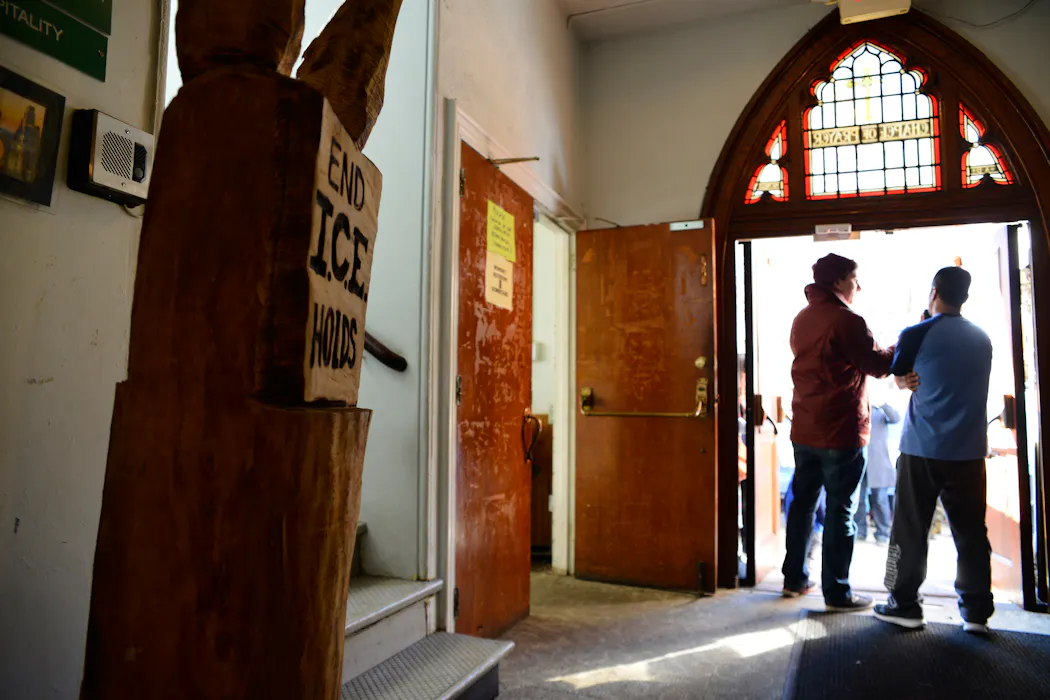
With false documents and the help of a humanitarian church group, they arrived at the Tabernacle United Church in West Philadelphia on May 12, 1984. The congregation declared itself a public sanctuary for undocumented refugees from El Salvador and Guatemala. An estimated 500,000 undocumented Salvadorans lived in the U.S. around that time.

The Fuenteses used the pastor’s office as their bedroom. Church members were instructed to keep the doors locked and not admit strangers, including the Immigration and Naturalization Service.

As a historian of race and policing in Philadelphia after the Civil Rights Movement, and the daughter of an immigrant, I’ve been exploring Philly’s history of sanctuary and how religious congregations, activists and city officials have supported local refugees over the past 40 years.

Four children of various ages stand together, two of them wiping face with hand or arm
Accompanied by elected officials, clergy and community activists, the four undocumented children of Carmela Apolonio Hernández step out of sanctuary at the Church of the Advocate in North Philadelphia in 2018.
Bastiaan Slabbers/NurPhoto via Getty Images

A ‘welcoming city’ for immigrants

Philadelphia Mayor Cherelle Parker has emphasized since May 2025 that Philadelphia is a certified “welcoming city.” She notably does not call Philadelphia a “sanctuary city.”

Welcoming cities have immigrant-friendly initiatives that make education, housing, workers’ rights, legal aid and language services accessible to immigrants and refugees without using the term “sanctuary city” in their laws and policies.

The presumed goal of this phrasing is to keep Philadelphia off the Trump administration’s radar and protect its US$2.2 billion in federal funding for health and human services.

However, Philly was, at various points, an official sanctuary city.

In 2014, then-Mayor Michael Nutter signed an executive order detailing that local police were not required to assist Immigration and Customs Enforcement unless the case involved a warrant or violent felon.

Nutter later rescinded Philadelphia’s sanctuary city status in an effort to dissuade congressional Republicans from passing a House bill that would deny sanctuary cities federal money earmarked for law enforcement and recidivism reduction. However, the next mayor, Jim Kenney, reinstated the order on Jan. 4, 2016.

Throughout 2017, President Donald Trump and Attorney General Jeff Sessions used executive orders, speeches and the immigration raid Operation Safe City to force Philadelphia officials to assist ICE or lose federal grants.

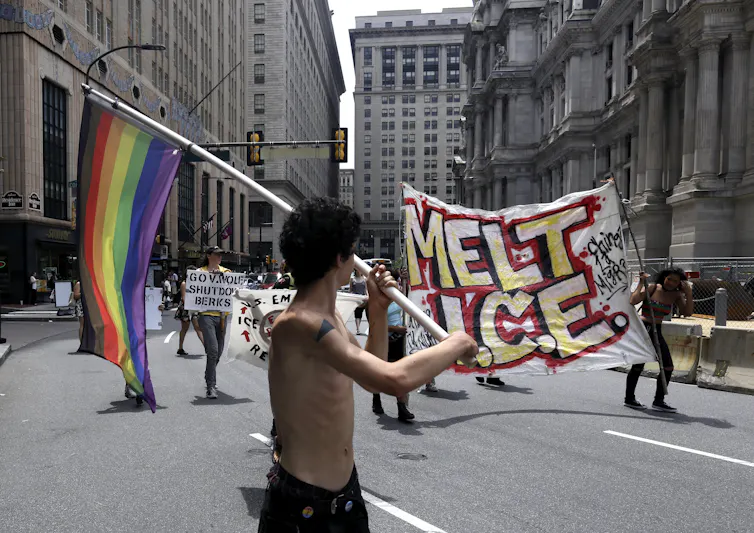
In 2018, Philadelphia won a lawsuit against the Trump administration that denied ICE access to police databases to find undocumented immigrants and prohibited city employees from assisting ICE.

Young shirtless man holds rainbow flag while protesters behind him carry banner that says 'Melt ICE'
Protesters camped outside Philadelphia City Hall march in July 2018 after Mayor Jim Kenney announced that Philadelphia would stop giving ICE access to a real-time arrest database. Kenney accused the agency of misusing the information to target people who were in the country illegally but were otherwise not accused of any crimes.
AP Photo/Jacqueline Larma

Roots of sanctuary cities

The sanctuary movement started back in the 1960s. But it wasn’t immigrants who were seeking sanctuary. It was Americans.

Around 1968, drafted resisters who were opposed to fighting in the Vietnam War sought refuge in churches in the U.S. Northeast. One of the earliest cases involved Robert Talmanson, who received sanctuary in Boston’s Arlington Street Unitarian Church. He was later arrested by U.S. marshals and local police and incarcerated in Virginia for three years.

In November 1971, Berkeley, California, became the first sanctuary city in the country when 12 local churches inspired the City Council to pass a resolution offering sanctuary to draft resisters. It also banned city employees from “assisting in the investigation or arrest of any sanctuary seeker.”

In the two decades that followed, several Quaker, Presbyterian, Catholic and Jewish congregations across America and Canada used their houses of worship as sanctuaries for Central American refugees who were fleeing civil war, government repression and genocide.

Philly joins national movement

Frustration and outcry over the United States’ low acceptance rates of Central American asylum-seekers sparked Philadelphia’s sanctuary movement.

In January 1984, members of Tabernacle United Church, where the Fuentes couple would soon take refuge, voted to join the national sanctuary network. As the Rev. James MacDonald explained at the time, the congregation chose to “violate a human law in order to respond in obedience to God’s law.”

By May, the First United Methodist Church of Germantown also became a sanctuary church. A few months later, the church sheltered a young Guatemalan couple, Joel and Gabriela, and their 3-year-old daughter, Lucy. Joel, an activist who worked with unions and student groups, had been tortured by Guatemala City police.

On Jan. 14, 1985, INS staged nationwide raids of sanctuaries and arrested 60 undocumented immigrants and 16 sanctuary workers – including pastors, nuns and priests – for violating immigration laws. Joel and his family were among those seized. They were released when church members bailed them out as they awaited deportation hearings.

A new pathway to citizenship

By the mid-’80s, 42,000 people from 2,000 religious institutions in 60 cities nationwide had joined the sanctuary movement.

On Nov. 6, 1986, President Ronald Reagan signed into law the Immigration Reform and Control Act. It granted undocumented immigrants who arrived in the U.S. before 1982 one year to apply for amnesty. If eligible, they would begin a five-year pathway to citizenship.

Approximately 3 million people successfully became naturalized citizens through the amnesty program.

In the Philadelphia area, at least 5,000 to 7,000 people were undocumented in 1986. Advocates at the nonprofit Nationalities Service Center and American Friends Service Committee noted that many immigrants wanted to apply for amnesty but feared the program was a trick.

A decade later, immigration enforcement got tougher.

Local police assist ICE

In 1996, Congress passed Section 287(g) of the Immigration and Nationality Act. This granted local police the right to assist immigration officials in arresting and detaining unauthorized immigrants.

As of April 2026, over 1,600 law enforcement agencies in 39 states and two U.S. territories have a 287(g) agreement with ICE. The program offers local police free training in ICE procedures along with funding for equipment, vehicles and overtime pay.

While the Philadelphia Police Department has never signed a Section 287(g) agreement, about 68 Pennsylvania agencies have, including in neighboring Delaware County.

But these agreements aren’t always long-lasting. Between January and March 2026, two departments in Bucks and Chester counties rescinded their agreements with ICE to make residents feel safe after American-born protesters Renée Good and Alex Pretti were killed during ICE operations in Minneapolis.

Man in blue shirt holds a child as woman hugs him from behind
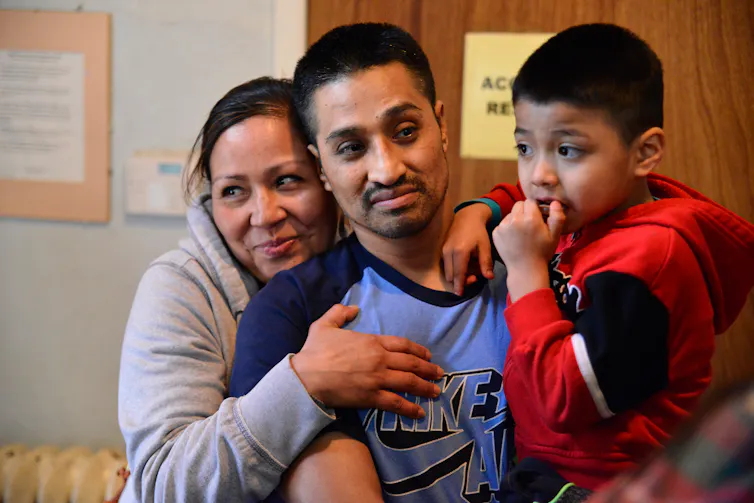
After a 16-month detention, Javier Flores, a father of three, went into sanctuary at Arch Street United Methodist Church in Philadelphia in 2016. He spent nearly a year in sanctuary before his visa request was approved and ICE waived his previous removal orders.
Bastiaan Slabbers/NurPhoto via Getty Images

Community activism continues

According to Pew Charitable Trusts, nearly 16% of Philadelphia’s 1.6 million residents are immigrants, largely from Asia and the Caribbean.

The exact number of undocumented immigrants in Philadelphia is unknown. However, the Migration Policy Institute estimates that 250,000 immigrants in Pennsylvania – 1.5% of the state’s total population – are undocumented.

Since January 2025, ICE crackdowns in sanctuary cities such as Los Angeles, Portland, Chicago and New York have resulted in the number of people held in ICE detention jumping from 40,000 to 73,000 people in January 2026.

Citizens and advocacy groups have stepped up to protect immigrants from ICE. The Party for Socialism and Liberation and the AR-12-toting members of the Black Lion Party for International Solidarity participated in protests in Philadelphia. Public school students from Northeast and Edison high schools have led anti-ICE walkouts.

On Jan. 29, 2026, City Council members Kendra Brooks and Rue Landau introduced an “ICE Out” package. The bills aim to codify the right of police to not share immigration, citizenship and personal data with ICE, or detain and hand over arrested individuals to the federal agency.

The legislation also proposes a ban on ICE agents who wear masks or hide their badges, use unmarked cars and city vehicles, or use municipal spaces as staging areas for enforcement and raids. And it would prohibit city employees from giving ICE access to libraries, shelters, health centers and recreation centers without a judicial warrant.

Community activists have long used civil disobedience and humanitarian aid to protect undocumented immigrants who are searching for a fresh start in the U.S.

An interfaith network inspired Philadelphia to become a sanctuary city. Today, churches such as Center City’s Arch Street United Methodist Church and North Philly’s Church of the Advocate, along with other congregations, uphold this tradition while a multicultural community across the city continues that fight.

Read more of our stories about Philadelphia and Pennsylvania, or sign up for our Philadelphia newsletter on Substack.

The Conversation

Menika Dirkson does not work for, consult, own shares in or receive funding from any company or organization that would benefit from this article, and has disclosed no relevant affiliations beyond their academic appointment.

ref. Philadelphia’s 40-year history of protecting undocumented immigrants began with churches hiding refugees from El Salvador – https://theconversation.com/philadelphias-40-year-history-of-protecting-undocumented-immigrants-began-with-churches-hiding-refugees-from-el-salvador-278756

Why Americans are buying $22 smoothies despite feeling terrible about the economy

Source: The Conversation – USA (2) – By Yuanyuan (Gina) Cui, Assistant Professor of Marketing, Coastal Carolina University

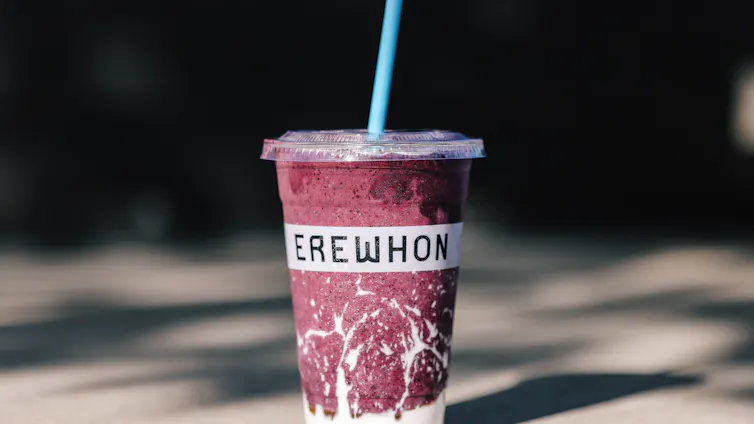
A selection of smoothies are listed in front of the high-end grocer Erewhon in Culver City, Calif., on July 17, 2024. Photo by Dania Maxwell/Los Angeles Times via Getty Images

Americans are skipping restaurant dinners, delaying car purchases and scouring for grocery deals. Amid tariff anxiety and broader stress over affordability, consumer confidence has dropped to levels not seen in over a decade, according to The Conference Board, a business think tank. At this point, it’s wealthier consumers who are powering the bulk of spending in the U.S. economy.

So what explains the success of Erewhon’s US$22 smoothie?

The Los Angeles grocery chain selling these fancy concoctions is doing so well, it opened three new stores in 2025 – its biggest expansion since 2011. The chain reportedly generates $1,800 to $2,500 in sales per square foot, up to five times what a typical U.S. supermarket earns.

These aren’t ordinary blended drinks; they include ingredients such as high-grade sea moss gel, adaptogenic mushrooms and collagen peptides. Often they come with a celebrity’s name attached.

It’s all part of the broader boom in the U.S. specialty food market, which has surpassed $219 billion – up nearly 150% in a decade, according to the Specialty Food Association. That far outpaces the roughly 47% growth seen in overall U.S. grocery sales over the same period.

Independent retail data from the market research firm Circana also confirms this growth: Even as inflation-weary consumers have traded down to store brands in many categories, premium and specialty products held up and even grew their dollar share of the market through 2025. On TikTok, creators who once filmed designer-bag hauls now post $12 tinned fish boards. Craft chocolate bars that cost $8–$12 are being marketed as, without irony, “self-care.”

So if consumers are this anxious, why are they still splurging? In fact, these aren’t contradictions – they’re two expressions of the same psychological reaction.

When people feel life is out of control, they reach for something small, expensive and signaling virtue. This is the real reason premium food is booming while some traditional luxury brands struggle, say consumer psychologists.

We are professors of consumer behavior and marketing who study how people make purchasing decisions amid economic uncertainty, and ask what explains the gap between how consumers feel and how they actually spend. Our work points to a consistent finding: When people feel they’ve lost control over the big things, they seek it in the small ones.

A photo of a chilled Erewhon smoothie that includes kefir, blueberries, honey, raw beef, bananas, sea salt and maple syrup.
Dr. Paul’s Raw Animal-Based Smoothie, photographed outside Erewhon in Culver City, Calif., on July 17, 2024.
Dania Maxwell/Los Angeles Times via Getty Images

A quick detour through the makeup drawer

Economists have seen this before.

In 2001, Estée Lauder Chairman Leonard Lauder coined the term the “lipstick index” after he saw that lipstick sales rose 11% following the Sept. 11 attacks. When big luxuries feel out of reach, consumers find a small substitute. A $60 lipstick is extravagant for a cosmetic, but next to the Hermès handbag it psychologically replaces, it feels like a bargain.

Then, as now, people seek agency wherever they can find it. Consumer psychologists call this “compensatory consumption”: buying things to feel in control when life feels out of control.

While even beauty sales are softening, that impulse hasn’t disappeared. It has just found better hosts – such as food.

In many ways, food is an ideal product for this compensation. It’s experiential – something you taste, smell and savor. It’s also emotional – carrying associations with comfort, care and home. And it’s visible, because if you’re on social media, what you eat is now as public as what you wear. Premium food isn’t just eaten – it’s filmed, posted and performed.

Most importantly, it’s still relatively accessible. Twenty-two dollars may be an absurd price for a drink, but it’s cheap compared with a $400 wellness retreat.

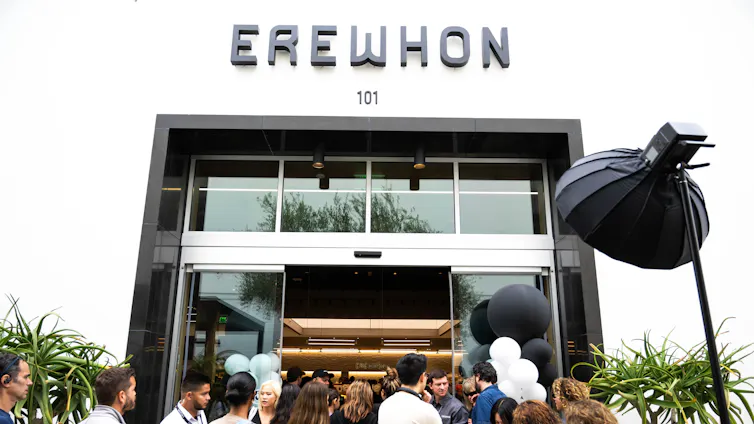
Shoppers enter and exit the crowded high-end grocery store Erewhon in Pasadena, Calif.
Shoppers enter and exit the high-end grocery store Erewhon during its Pasadena, Calif., opening on Sept. 13, 2023.
Sarah Reingewirtz/MediaNews Group/Los Angeles Daily News via Getty Images

Indulgence with a side of virtue

Here is what separates this moment from Lauder’s lipstick index. That example was purely about pleasure, as consumers sought indulgence as consolation. Today’s premium food purchases carry an additional layer: They are coded as virtuous.

An Erewhon smoothie isn’t just a treat. It’s organic, superfood-enriched and wellness-aligned. By the same logic, a $20 bottle of single-estate olive oil isn’t just cooking fat; it’s a commitment to craft and health. Premium tinned fish isn’t convenience food; it’s sustainably sourced protein caught in the wild with packaging beautiful enough to display.

This “virtue coding” does the most important psychological work in the sales transaction: It transforms indulgence into self-investment. You’re not splurging during a downturn; you’re doing something for your health. You’re not being frivolous; you’re supporting small producers. Research shows that people need reasons to justify pleasurable purchases, especially during financial anxiety – and premium food is powerful because the justification is built into the product. The organic label, the sustainability story, the wellness framing – they all dissolve guilt before it even kicks in.

Consumed in the kitchen and again on the feed

There’s a reason this trend is accelerating now. Many premium food purchases are consumed twice – once physically and once digitally. The Erewhon smoothie purchase isn’t really about the drink; it can be as much about the content as the drink. The tinned fish board is plated for Instagram before anyone takes a bite.

Social media doesn’t just amplify the trend; it completes it. When you post a photo or video of the smoothie, you’re broadcasting that you value wellness, quality and intentionality. In a cultural moment when flaunting a designer bag feels tone-deaf, food provides perfect cover. It’s the safest flex there is. It’s no surprise that one YouTube video of an Erewhon haul by food creator @KarissaEats has drawn over 14 million views.

All of this raises a fair question: Does the growing focus on the “K-shaped economy” explain this boom? As many economists see it, low- and middle-income shoppers are increasingly pulling back, as they face an affordability squeeze from health care to housing and education. But wealthier consumers are picking up the slack and then some, splurging on luxury and powering gross domestic product growth.

In this scenario, premium food thrives because it’s still affordable for the people who are doing fine, even as everyone else cuts back. That’s partly true. But this explanation doesn’t account for another shift – why affluent consumers are foregoing splurges on items like designer handbags in favor of premium groceries.

This is why the virtue framing matters so much. If the question was purely about having money to spend, traditional luxury would be booming as well. It isn’t. A case in point is LVMH, the conglomerate behind Louis Vuitton and Dior, which saw its fashion division’s profits decline 13% across all of 2025.

Even consumers who are flush with disposable income need psychological permission to spend during anxious times. The premium food phenomenon is about why food has become the thing they choose – not about who can afford to splurge.

And when a smoothie becomes a status symbol, it tells us something about economic security more broadly. Food prices have climbed nearly 30% since 2019, outpacing 23% for overall consumer prices, according to the Bureau of Labor Statistics. For a family stretching a tight grocery budget, $22 isn’t a smoothie. It’s dinner.

The need for control, the desire for identity, the comfort of virtue permission — these are universal. A single mother working two jobs feels the same craving for agency as the influencer filming her grocery haul. It’s just that the purchases that satisfy those needs are increasingly constrained by price. The justification only works if you can afford your indulgence.

What’s really in the cart

The next time you’re in a grocery store and you reach for something a little more expensive than what you might need, you should pause – not to put it back, but to think about what you’re actually reaching for.

Chances are it isn’t really about the product. It’s about the feeling of choosing something when the world feels out of hand.

A $22 smoothie is never just a smoothie. It’s what people seek out when they need permission to feel OK.

The Conversation

The authors do not work for, consult, own shares in or receive funding from any company or organization that would benefit from this article, and have disclosed no relevant affiliations beyond their academic appointment.

ref. Why Americans are buying $22 smoothies despite feeling terrible about the economy – https://theconversation.com/why-americans-are-buying-22-smoothies-despite-feeling-terrible-about-the-economy-279425

Iran ceasefire has brought a sudden fall in oil prices – but this pause underscores the volatility in the market

Source: The Conversation – UK – By Adi Imsirovic, Lecturer in Energy Systems, University of Oxford

Who is Danny/Shutterstock

Before the temporary ceasefire in the Gulf, the world had been experiencing the biggest oil price shock ever, surpassing even the crises of the 1970s. The scale and speed of movements were comparable to some of the most disruptive episodes in modern energy markets.

At the centre of the disruption was the US-Israel conflict with Iran and the effective closure of the strait of Hormuz. The strait is a choke-point through which roughly one fifth of the global oil supply typically flows. Under the terms of the ceasefire, it is now expected to reopen.

The use of energy as a geopolitical weapon is not new. Sanctions imposed by the US and its allies on countries such as Cuba, Venezuela, Iraq, Russia and Iran have long contributed to oil market volatility. These measures reduce the pool of freely marketable oil and increase uncertainty.

More recently, European, UK and US sanctions on Russia also reshaped trade flows and pricing dynamics. And the G7 has imposed its own price caps on Russian crude.

When it comes to the Gulf, there are alternative export routes out to open sea but their capacity is limited. Saudi Arabia’s east-west pipeline can transport around five million barrels of oil per day to the Red Sea. And the UAE’s pipeline to the city of Fujairah can move around 1.5 million barrels per day, bypassing the strait. Throughout the hostilities, Iran continued to export an estimated 1.5 million barrels of oil per day.

But even accounting for these alternatives, any disruption in the strait implies a loss of roughly 10% of the world’s oil supply. In comparison, the oil shocks of the 1970s represented around 5-7% of the world’s supply.

The effects of this supply crunch propagated rapidly through global markets. They initially hit Asian buyers before spreading to Europe and beyond. Price premiums for physical crude have surged, and prices for the three main benchmark crudes (Brent, Dubai and West Texas Intermediate (WTI)) have all risen sharply.

Crude oil and heating oil prices from December 2025 to April 2026.

At the same time, volatility in the market has also increased dramatically. Implied volatility in Brent futures has climbed from below 30% in December to around 90% more recently. Put simply, this means the price of oil was expected to change by no more than 30% in December last year, but this expectation rose to 90% recently.

In part, it reflects a fundamental imbalance between scarce physical supply and a largely unchanged volume of financial (“paper”) trading and hedging activity.

In the spot market (where purchases are made “on the spot”), prices have reflected the acute scarcity. Here, prices for physical Brent reached US$140 (£106) per barrel. Some grades have been trading at premiums exceeding US$10 above this.

Saudi Arabia’s official selling price for its flagship “Arab Light” crude has risen steeply for Asian buyers. This underscores the tightness in markets for immediate delivery and the extent of short-term pressure on demand.

But futures markets tell a different story. As the name suggests, these are where buyers agree a price for later delivery. These prices are significantly lower. This suggests that traders still expected the disruption to be temporary, with the possibility of a relatively rapid price correction should geopolitical conditions stabilise.

These expectations are not without foundation. While some refining infrastructure (such as Ras Tanura and Samref in Saudi Arabia, Ruwais in the UAE, Mina Al-Ahmadi and Mina Abdullah in Kuwait and Bapco in Bahrain among others) have been damaged, much of the core oil production capacity in the region remains intact. In theory, exports could resume within days or weeks.

In addition, a large number of tankers known as very large crude carriers (VLCCs) have been stranded in the Gulf. This deescalation should quickly release significant volumes of oil back on to the market.

Optimism or caution?

This gap between short-term panic and longer-term expectations is a key feature of the current market. It reflects the wide range of possible geopolitical outcomes.

But there are reasons to be cautious about such optimism. Control of the strait of Hormuz is one of Iran’s most powerful strategic tools. Further disruption may serve both Iran’s economic and political objectives, particularly after it has suffered such significant infrastructure damage.

The cessation of hostilities and reopening of the strait should ease immediate supply concerns. But it could also signal a deeper shift in the global security architecture that has underpinned energy markets for decades. In particular, a reduced role for the US as a security guarantor in key shipping lanes could introduce a more persistent risk premium into oil prices. This would raise consumer costs across the world for a huge variety of goods.

In such a world, the primary constraint on energy markets may shift from the availability of resources to the security of production and transport infrastructure. This could potentially embed higher volatility into oil markets over the longer term.


Read more:
Could this energy crisis be worse for the global economy than COVID?


The negotiations will be difficult, and diverging objectives among the key actors complicate the outlook. For Iran, the conflict has been existential. For Israel, weakening Iran may be a long-term objective. And US policy goals remain less clearly defined. The widening regional dimension just adds more uncertainty.

A pause in the conflict does not mean the end of hostilities. The temporary truce may enable the oil tankers to leave the Persian Gulf, but will they dare to go back in? The uncertainty only amplifies the market volatility.

There is still the option of more releases from strategic petroleum reserves – and governments may choose to do this. However, this would be a temporary relief and would risk leaving global reserves depleted, creating vulnerabilities to future shocks. Markets would be likely to anticipate this and it would limit the effectiveness of the move in stabilising prices.

A renewal of the conflict represents the worst scenario. Sustained high prices would bring back the spectre of inflation, high interest rates, economic slowdown and growing unemployment. In a global economy already burdened with debt from the COVID crisis, there are few levers left for central banks to tackle this predicament.

The Conversation

Adi Imsirovic does not work for, consult, own shares in or receive funding from any company or organisation that would benefit from this article, and has disclosed no relevant affiliations beyond their academic appointment.

ref. Iran ceasefire has brought a sudden fall in oil prices – but this pause underscores the volatility in the market – https://theconversation.com/iran-ceasefire-has-brought-a-sudden-fall-in-oil-prices-but-this-pause-underscores-the-volatility-in-the-market-280076

Water conservation works, but climate change is outpacing it: Phoenix, Denver and Las Vegas offer a glimpse of the future

Source: The Conversation – USA (2) – By Renee Obringer, Assistant Professor in the Earth and Environmental Systems Institute, Penn State

The Denver suburb of Castle Rock, Colo., limits water use in future developments. Homeowners are embracing water-efficient yards. RJ Sangosti/MediaNews Group/The Denver Post via Getty Images

When a drought turns into an urban water crisis, a city’s first step is often to limit lawn watering and launch a campaign to encourage everyone to conserve. It might raise water-use rates or offer incentives for installing low-flow devices.

While demand management techniques like these have had a lot of success in reducing water use, our new research suggests that they may not be effective enough in the face of climate change.

We looked at three cities in the Colorado River Basin – Phoenix, Las Vegas and Denver – to understand what each could do to increase demand management amid water shortages and how far those methods could go as temperatures rise and the Colorado River’s flow weakens.

The results suggest the region needs to be thinking about bigger solutions.

Colorado River states’ immediate challenge

The Colorado River provides drinking water to nearly 40 million people and irrigation for over 5.5 million acres of cropland. But it has experienced a significant drop in water availability in recent decades due in part to rising demand for water and a long-running megadrought in the Southwest.

To ensure that water is shared across boundaries, the seven states within the basin agreed to the Colorado River Compact in 1922, setting limits on water withdrawals from the river. Since then, the region has adopted additional rules, agreements and policies, collectively termed the “Law of the River.” But despite this compact, which the states are renegotiating in 2026, the basin’s water supply is shrinking.

Research shows that the region is likely to experience more intense, frequent droughts that last longer due to climate change, putting the water supplies for farms, people and energy systems at risk.

As researchers who study the impact of climate change on water systems, we wanted to see if demand management techniques could help under these intensifying conditions.

Getting people involved can change attitudes

Many demand management policies are reactive and only go into effect when sources run low.

These reactive policies can be successful during the scarcity period, but there is often a rebound effect: Water consumption can actually increase afterward.

We integrated survey data with a computer model of water availability and demonstrated that there can be long-term benefits to the local water supply if communities encourage positive attitudes toward conservation.

A woman in a reflective vest checks a plant along a street. Behind her, an SUV has the words 'Water Patrol' on the side.
Las Vegas has water investigators who can issue tickets for illegal water use.
Jim West/UCG/Universal Images Group via Getty Images

The survey focused on how people think about water conservation and climate change, drawing on a large body of research that shows people who care about the environment often take eco-friendly actions. Building off these ideas, we segmented the population into groups that shared similar views on water conservation and found that a large proportion of residents supported water conservation but weren’t actively participating in conservation programs within their communities.

We then used the computer model to explore how changing attitudes, and subsequent conservation behavior, could affect water supplies under climate change.

When participatory demand management works

Our research shows that individual actions, when implemented by a lot of people, can measurably improve water supplies’ reliability.

A great example of the benefits of long-term behavioral changes is Las Vegas.

Las Vegas is in many ways viewed as a city of excess; however, since 2002, the city has reduced its per-capita water use by nearly 60%, even as the population grew by more than 50%. It reached these savings through efforts to reduce seasonal irrigation, replace water-intensive landscaping and require new developments to be sustainable, along with the treatment and reuse of wastewater. Today, Las Vegas recycles nearly all of the water used indoors and returns it to Lake Mead.

Phoenix, another desert city, also runs successful conservation programs. These programs focus on converting grass lawns to desert-friendly landscaping and encouraging owners to fix leaks and install smart meters and low-flow devices. These programs led to a 20% reduction in water use over 20 years, while the population grew by about 40%.

Demand management is not always enough

These cities have shown that demand management can work, but there are limits on how much these techniques can do as water supplies dry up.

When we added projections of future climate change to our model, we found that conditions could lead to so little water being available that these demand management methods won’t be able to keep up.

In other words, climate change may create situations where water supplies are still severely limited, even after people reduced their consumption by up to 25%.

For example, under a plausible, moderately high emissions scenario, Phoenix’s available surface water supply was forecast to drop below the historical average by 2060. Even when we simulated higher participation in conservation programs, there was no noticeable change in the water availability, suggesting that any savings from reducing demand were counteracted by losses from upstream flow reductions. Encouraging people to use less water is a start, but there is a limit to how much people can conserve.

We found similar results in Denver under a moderate emissions scenario and in Las Vegas under a moderately high emissions scenario, indicating that even moderate climate change could lead to extreme scarcity conditions that are not manageable through demand-side changes alone.

What else cities can do

In these cases, it may be necessary to find other creative water sources, such as water reuse, desalination or limiting consumption in other sectors, such as agriculture or energy, to maintain the municipal supply.

These solutions, however, take time and money to implement. Desalination is incredibly expensive. A recently built desalination plant in Carlsbad, California, cost US$1 billion – four times the initial estimate.

A woman in a hardhat walks past stacks of tubes for making saltwater drinkable.
Carlsbad, Calif., on the Pacific Ocean in San Diego County, built a desalination plant to make seawater drinkable. It produces 50 million gallons a day, but that water is among the costliest in the region.
Allen J. Schaben/Los Angeles Times via Getty Images

Other solutions, such as reducing agricultural water use, require significant buy-in from local farmers and could result in producing less food.

Reducing the water consumed for electricity generation would require significant investment in renewable energy technologies that have lower water requirements than fossil fuels and nuclear energy.

While large-scale solutions like water reuse systems and desalination can be expensive, these costs might be necessary to maintain adequate water supply in the region, because simply encouraging people to use less won’t be enough.

The Conversation

Renee Obringer received funding from the National Science Foundation.

Dave White received funding from the National Science Foundation.

ref. Water conservation works, but climate change is outpacing it: Phoenix, Denver and Las Vegas offer a glimpse of the future – https://theconversation.com/water-conservation-works-but-climate-change-is-outpacing-it-phoenix-denver-and-las-vegas-offer-a-glimpse-of-the-future-279837