Can the Middle East ceasefire hold?

Source: The Conversation – UK – By Jonathan Este, Senior International Affairs Editor, Associate Editor, The Conversation

This is the text from The Conversation UK’s World Affairs Briefing email. Sign up here to receive weekly analysis of the latest developments in international relations, direct to your inbox.


It’s still not clear who will turn up in Islamabad tomorrow for the first round of talks aimed at turning the 14-day ceasefire in the Iran war into a permanent end to the crisis. Indeed, it’s not at all certain that the ceasefire will still even exist by then.

To anyone following events, there seemed little, if any, gap between reports that Pakistan had brokered a truce between the warring parties and news that Israel was continuing to attack Hezbollah in Lebanon. But from then the story followed a depressingly familiar path. Iran – backed by Pakistan – claimed that the ceasefire also covered Lebanon. Israel said that it didn’t and it would continue to pound Hezbollah targets there.

For his part, the US president, Donald Trump, said that as far as he was concerned, Israel’s assault on Lebanon was a “separate skirmish”, albeit one of considerable brutality in which 1,400 people were either killed or wounded.

We asked Scott Lucas, of the Clinton Institute at University College Dublin for his take on some of the most important issues which may affect the talks.


Read more:
Why is Israel continuing to attack Lebanon, despite the ceasefire? Expert Q&A


The ceasefire was always going to be fragile, even without Israel’s intervention. There’s clearly no goodwill or trust between the warring parties. Trump was less than two hours away from launching an attack on Iran’s civilian infrastructure, including its power plants and its bridges – a bombardment so monumental that, as he put it: “A whole civilisation will die tonight, never to be brought back again”.

Tehran, for its part, was spitting defiance back at Washington, while calling on its people to form human chains across bridges and around power plants.

Nicholas Wheeler, an international relations expert at the University of Birmingham who has been investigating the role of trust in diplomacy, believes there’s a big difference between a mutual lack of trust between warring parties, and active distrust. In the former situation there is the potential for trust to develop. But in this case – as Iranian foreign minister, Abbas Araghchi noted recently, the US has now twice attacked Iran during ongoing negotiations, so – he says – there is “zero trust” in the US from Tehran’s point of view.

Trump’s failure to bring the Israeli prime minister, Benjamin Netanyahu, to heel over Israel’s continuing bombardment of Lebanon can only make matters worse.


Read more:
Iran ceasefire: trust will be vital but it’s in short supply right now


And so Iran has not opened the Strait of Hormuz, which was America’s most important demand. We must wait to see what events, both in the Middle East and at the negotiations in Islamabad, will bring. The ceasefire had allowed both Tehran and Washington to declare a victory – which certainly seemed to be something in which the Trump administration placed a great deal of value. Both the US president and his defense secretary, Pete Hegseth, were trumpeting that line on Wednesday – Hegseth going so far as to say that the Iranian military was rendered completely ineffective and that the country’s leadership “begged” for a ceasefire.

Iran also declared victory. And Bamo Nouri and Inderjeet Parmeer of City St George’s, University of London, believe that Tehran has more reason to do so. For one thing, the Islamic Republic has demonstrated resilience in the face of the might of US and Israeli firepower that aimed to destroy it. It has shown that it can use its control of Hormuz to thrown global energy markets into considerable disarray. And, under the terms of the ceasefire accepted by the US president, it is Iran’s ten-point plan which will form the basis of negotiations.


Read more:
Middle East conflict: this ceasefire may have made Iran stronger


Changing world order

The US president, meanwhile, has repeated his criticisms of America’s Nato allies and, according to German news magazine Der Speigel, has issued what European diplomats are calling “an ultimatum” for European member states to send military assistance to the Strait of Hormuz within days.

Trump has been highly critical of Nato as a whole – and several of its member states specifically – because he believes they haven’t done enough to help the US and Israel against Iran. On April 1, he raised the possibility of the US quitting Nato altogether.

But he’s unlikely to pull America out of its transatlantic alliance, writes Paul Whiteley, who gives us three reasons why it’s either not in the US president’s interests or America’s to turn his back on the alliance it has led for nearly eight decades.


Read more:
Three reasons Donald Trump won’t pull the US out of Nato


The emergence of Pakistan as a key interlocutor in all this will have come as something of a surprise to many. But the country has emerged, along with Saudi Arabia, Egypt and Turkey, as part of an important power bloc with influence in the Middle East, writes Natasha Lindstaedt, professor in the Department of Government at the University of Essex.

Lindstaedt argues that these countries want an end to the dominant roles played by both Israel and Iran in the region. The war in Gaza has appalled the Islamic world and put paid to any hopes – certainly for the near future – of any normalisation of relations of the sort envisaged by Donald Trump’s Abraham Accords. And all are also tired of the force for tensions and destabilisation that Iran has represented for nearly five decades.

As Lindstaedt points out, they’re a powerful bunch: Pakistan has nuclear weapons, Saudi Arabia has loads of oil, Egypt controls access to the Suez Canal and Turkey is a member of Nato: “Taken together, they represent the most politically and militarily influential Muslim-majority countries in the world,” she concludes.


Read more:
Pakistan, Turkey, Egypt and Saudi Arabia emerge as a new regional power bloc amid Iran war


Meanwhile in Hungary

Hungarians head to the polls on Sunday for elections which will determine who is to be the country’s next prime minister. The long-time incumbent, Viktor Orbán, faces a stiff challenge from his former political ally, Péter Magyar. Polls show he is seriously up against it.

So the US president dispatched J.D. Vance to campaign alongside the prime minister in a bid to mobilise the country’s far-right eurosceptics. Zsofia Bocskay, of Central European University, sets the scene for what she believes could be a turning point for Hungarian politics.


Read more:
Hungary election: how a new opponent has forced Viktor Orbán into the first genuinely competitive race in 16 years


Birmingham University’s Stefan Wolff, meanwhile, believes that the fall in support for Orbán despite all the help from Washington, reflects a Europe-wide disenchantment with Trump, especially in light of the US president’s apparently warm relationship with Vladimir Putin, a leader many feel poses a very real threat to their security.


Read more:
Hungarian election exposes tensions at the heart of Donald Trump’s plans to boost the far-right in Europe


Sign up to receive our weekly World Affairs Briefing newsletter from The Conversation UK. Every Thursday we’ll bring you expert analysis of the big stories in international relations.


The Conversation

ref. Can the Middle East ceasefire hold? – https://theconversation.com/can-the-middle-east-ceasefire-hold-280307

Drinking water contaminated with ‘forever chemicals’ during pregnancy linked to an increased risk of childhood asthma – new study

Source: The Conversation – UK – By Annelise Blomberg, Associate Researcher in Occupational and Environmental Medicine, Lund University

MVelishchuk/Shutterstock

Pfas, or per- and polyfluoroalkyl substances, are a group of human-made chemicals found in everything from food packaging to firefighting foam. Often called “forever chemicals” due to their persistence in the environment, they can affect our health and disrupt our immune system.

Pfas cross the placenta, so that when a woman is pregnant, she shares some of the Pfas in her body with her unborn child. While most of us are routinely exposed to low levels of Pfas, some communities are exposed to far higher levels from nearby pollution sources, like factories and military fire training areas.

Our new study shows that in one of these at-risk communities, children were more likely to develop asthma if their mothers were exposed to very high Pfas levels during pregnancy.

In 2013, water testing in Ronneby, a town in the southern Swedish county of Blekinge, uncovered extremely high levels of Pfas in one of the town’s two municipal water supplies – more than 200 times higher than the other supply.

swedish town and river
Ronneby, Sweden.
Antony McAulay/Shutterstock

The source of the contamination was a type of fire-fighting foam called aqueous film-forming foam. This chemical mixture containing Pfas is used to extinguish fuel fires. It had been used in firefighting training at a nearby military airbase since the 1980s. Contaminated runoff from the airbase had eventually reached the drinking water. This resulted in high concentrations of two forever chemicals known as PFOS (perfluorooctane sulphonic acid) and PFHxS, among other Pfas.

After that discovery, residents were switched to the town’s other water source. But even though residents now had clean water, their past Pfas exposure could not be reversed. By measuring Pfas directly in the dried blood spots of newborn babies whose mothers had lived in Ronneby, we have shown that Pfas contamination was already present in these children in the mid-1980s. This exposure persisted, undetected, for over 30 years. When the mothers in our study were pregnant, they had no idea that they were exposed.

Connecting contamination to childhood asthma

In Sweden, all residents are given a unique personal identity number. This can be used to link government registry information like place of birth, residential history, annual income and family relations to hospital records. This enables population-level health research that might not be possible in most other countries.

Using Swedish national health and population registers, we followed 11,488 children who were born between 2006 and 2013 in Blekinge county through to the age of 12. We estimated whether and when children would develop asthma using a combination of medical diagnoses and prescription drug records. Healthcare is free of charge for children and easily accessible throughout Blekinge county, so most children with asthma receive treatment.

We didn’t have a blood sample from all 11,488 children, so we couldn’t measure their Pfas exposure directly. This lack of measured exposure usually limits how we can study Pfas health effects in children.

But because Pfas exposure in Ronneby depended so strongly on their drinking water source, we could link mothers’ address history to the municipal water distribution records. This enabled us to identify which mothers received contaminated water at their home in the years before they had a child. Presumably, those women had higher Pfas in their body as a result.

We divided mothers into four groups, from background exposure (living outside of Ronneby) to very high exposure (living at a contaminated address continuously for the five years preceding delivery).

Next, we compared the rates of childhood asthma across the four prenatal exposure groups. We also accounted for other factors that could influence asthma risk, including maternal smoking during pregnancy, the child’s birth order and several measurements of socioeconomic status.

child using asthma inhaler
Children whose mothers had very high Pfas exposure during pregnancy were about 40% more likely to develop asthma than children in the background exposure group.
SeventyFour/Shutterstock

We found that children whose mothers had very high Pfas exposure during pregnancy were about 40% more likely to develop asthma than children in the background exposure group. Children in the intermediate exposure groups did not have higher risk. We then directly compared very high-exposed children to a carefully matched group of similar background-exposed children. We found that 27% of the very high-exposed group developed asthma by age 12, compared to 16% of the background-exposed group.

This study is one of the first to identify a link between Pfas exposure and asthma in childhood. Unlike earlier research, we were able to include children with very high Pfas exposure before birth – and we only saw an effect in this very high group, which may explain the inconsistent results of previous studies.

One possibility is that the potentially harmful effects of Pfas on lung function only occur at very high exposure. Another possibility is that, even if Pfas has an effect at lower levels, it only becomes serious enough for a diagnosis at very high exposure.

Ronneby is not an anomaly. There are more than 13,000 sites across Europe where firefighting foam contamination is likely. Our research offers important insights into the potential health effects of this contamination in affected communities. Asthma is one of the most common chronic diseases in children. If high Pfas exposure contributes to this public health burden, it is a burden that has gone largely unrecognised until now.

The Conversation

Annelise Blomberg receives funding from European Union’s Horizon Europe program under the Marie Skłodowska-Curie Postdoctoral Fellowships (grant number 101058697) and the Swedish Research Council for Health, Working Life and Welfare (FORTE, grant number 2024-00748). Views and opinions expressed are those of the authors only and do not necessarily reflect those of the European Union or the European Research Executive Agency (REA), and neither the European Union or the REA can be held responsible for them.

Anna Saxne Jöud receives funding from the Swedish Research Council for Health, Working Life and Welfare (grant number 2020-00112).

Christel Nielsen receives funding from Formas – the Swedish Research Council for Sustainable Development, the Jan Hain Foundation for Scientific Clinical Medical Research, the Crafoord Foundation, and the Royal Physiographic Society in Lund.

ref. Drinking water contaminated with ‘forever chemicals’ during pregnancy linked to an increased risk of childhood asthma – new study – https://theconversation.com/drinking-water-contaminated-with-forever-chemicals-during-pregnancy-linked-to-an-increased-risk-of-childhood-asthma-new-study-278736

80 years later, scholarship is breaking silence on women’s suffering and strength at Treblinka – including their role in its uprising

Source: The Conversation – USA (3) – By Chad S.A. Gibbs, Assistant Professor of Jewish Studies, College of Charleston

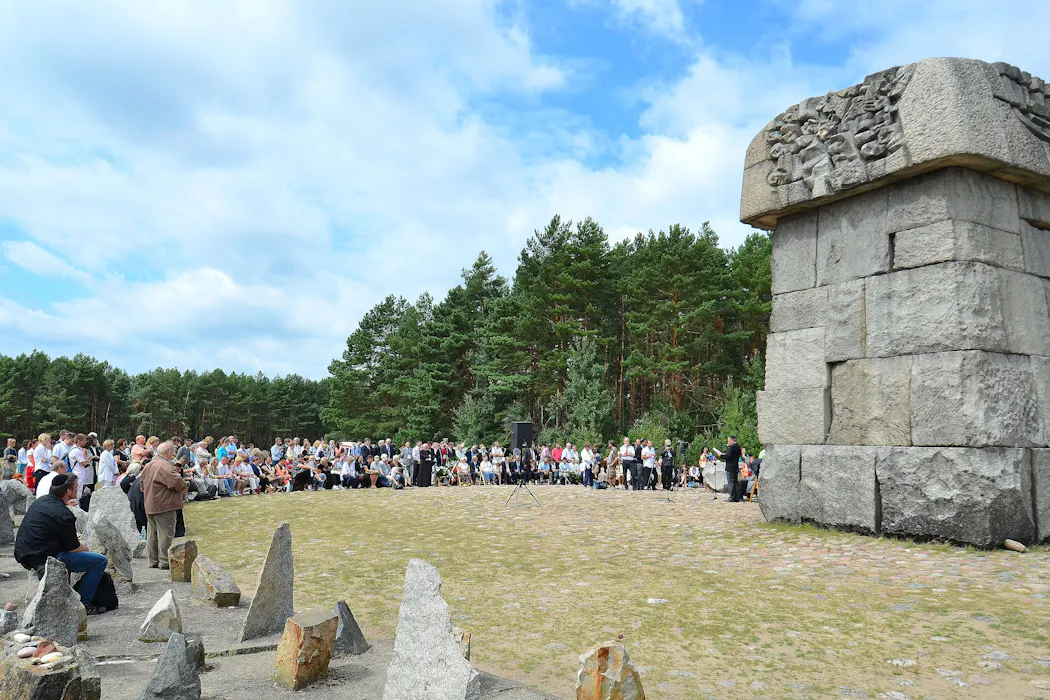
A commemorative ceremony in 2013 marks the 70th anniversary of the revolt in the Treblinka death camp. Adrian Grycuk/Wikimedia Commons, CC BY-SA

Adek Stein – a Holocaust survivor from Bialystok, Poland – looked anxiously about the room, struggling with the question he’d just been asked. As his eyes searched his small audience, it was clear he was nervous. That itself wasn’t new. But the interviewer had asked about sexual violence during the Holocaust, and Stein’s face seemed to betray a pain and worry he had lived with for years.

The USC Shoah Foundation, which filmed its interview with Stein at his home in Australia in 1995, tries to interview survivors one-on-one, without distraction. But that day, several young women, presumably members of Stein’s family, stayed in the room as he gave testimony – including his experiences as a forced laborer at the Treblinka extermination camp, where more than 900,000 Jews were murdered. Then it came time to talk about how some Germans had taken Jewish women, in his words, “to make fun.”

He stopped and looked at each of those present. Speaking to his interviewer, Stein said he did not want to go on, worried that the story was “too drastic” to recount “in front of these girls.” Stein’s interviewer told him to continue, but he changed the subject and moved on. That was it. Whatever more he knew about the fate of those women went untold.

Sexual violence and exploitation of women during the Holocaust, as well as LGBTQ+ people’s experiences, are some of the many topics that survivors have often struggled to discuss, even decades after the war. In many cases, it has taken years for even the broadest histories to emerge. As ever, what readers can learn about the past is limited by what witnesses were willing to say or write down, and what historians are willing to research.

Women’s lives and resistance at Treblinka

In work for my 2026 book, “Survival at Treblinka,” I came upon Stein’s testimony and many other hints and fragments of women’s lives in that Nazi extermination camp. What I found for this project is important, but I also came to realize it was just one example of wider issues in Holocaust history.

A black and white photo shows a crowd of people, many of them women and children, gathering outside rickety wooden train cars.
Polish Jews were deported to Treblinka extermination camp from the ghetto in Siedlce in 1942, when Poland was under German occupation.
Wikimedia Commons

Treblinka, located along the rail line northeast of Warsaw, was actually the name of two different camps. The first, Treblinka I, was one of Nazi Germany’s forced labor camps. Treblinka II, about a mile away, was an extermination camp. It had no function other than mass killing by poison gas and, because of this, never held much more than about 1,000 Jewish prisoners at a time.

SS guards and their helpers forced these inmates to maintain the camp, process goods stolen from those killed, and to bury – and later burn – the bodies. Women prisoners, never more than about 40 in number, were employed as launderers, cleaners, kitchen staff and tailors.

On Aug. 2, 1943, prisoners carried out a long-planned uprising, burning much of the camp. The revolt allowed as many as 300 Jews to escape – at least temporarily – although many were soon found and killed. In “Survival at Treblinka,” I uncover how Jewish women were pivotal to resistance planning, working as couriers, informants and to steal and hide weapons. They also took part in their own everyday acts of resistance, right up to the moment of the revolt.

At every turn, Jewish women and men held in this camp took advantage of the guards’ beliefs about women. Simply put, the German SS did not fear Jewish women, so guards did not supervise them or scrutinize them as much as they did male prisoners. Women cleaned the SS barracks and used these jobs to keep track of the Germans’ comings and goings. They staffed the kitchens and, using the fact that they were not feared, hid stolen weapons there.

A black and white photograph shows a large smoke cloud rising over a field.
A clandestine photograph taken by Franciszek Ząbecki shows Treblinka II burning during the prisoner uprising on Aug. 2, 1943.
‘Treblinka II – Obóz zagłady’ via Wikimedia Commons

German guards created a camp brothel at Treblinka where certain guards and senior prisoners were allowed to assault Jewish women. Again, the Nazis did not fear or suspect those they compelled to endure that place. However, the women held there stole as many as eight rifles from guards to arm the revolt. That pivotal act of resistance and the entire existence of the brothel have not been discussed or remembered before my book.

Working in the 1970s, an earlier historian uncovered the same evidence of sexual exploitation and its outcomes at Treblinka, taken from trial investigation testimony evidence. He chose to cut that quote short and may not have had access to other testimony that proves the existence of a brothel.

As I show in “Survival at Treblinka,” not writing about the brothel also meant not speaking of how these women armed the uprising.

Silence and lost stories

The damaging silence of many male survivors on this topic is worsened by others’ decisions to deny or erase what happened, though that may be understandable. When that earlier historian wrote in the 1970s and ’80s, some of the women forced to endure that brothel were still living. Revealing what they had been through could have destroyed years of careful work to rebuild their lives and distance themselves from what was done to them in the wake of the Holocaust.

In one somewhat shocking example, a male survivor of Treblinka was asked during a 1996 interview by the USC Shoah Foundation whether he knew any women in the camp. That alone was a rare question in interviews between the 1970s and ’90s. The survivor’s answer, “There was no women,” was unequivocal – but not true.

Studying the prisoner revolt at Treblinka led Chad Gibbs to uncover more information about women’s experiences at the camp.

Maps show how male prisoners would have seen women in the camp several times a day, especially at mealtimes. If we plot the paths male workers would take to and from their jobs and account for their likely interactions with women in the kitchens, it is clear that all men had to know women were present at Treblinka.

Left to wonder why witnesses and writers tended to leave out these women and their stories, we must consider whether it was, at times, out of a need to preserve their own sense of masculinity – an unwillingness to discuss what they saw these women endure, which male prisoners could not stop. Of course, some survivors’ sense of culpability might run deeper if they participated in the abuse themselves.

Fearful and self-preserving silence, nervous and embarrassed avoidance, and even willful erasure kept stories like these in the dark. What we know of history is, again, a matter of what scholars and witnesses are ready to discuss, and what sources are prepared to write down, record or say aloud.

More than 80 years after the fact, these stories are coming to light just as many survivors are dying. That, I believe, is not entirely coincidental. As survivors leave us, the stories we tell and the questions we are comfortable asking of sources change. Historians’ own diversity today is also helping to bring attention to the lives of women, people with disabilities, the elderly, queer people and still other voices long obscured.

Distance from the event is sometimes what finally allows us the space to open new doors and hear new voices. That will certainly mean a reassessment and a broadening of Holocaust histories as time goes on. It is a process long overdue, for too much is lost when we look away.

The Conversation

Chad S.A. Gibbs does not work for, consult, own shares in or receive funding from any company or organization that would benefit from this article, and has disclosed no relevant affiliations beyond their academic appointment.

ref. 80 years later, scholarship is breaking silence on women’s suffering and strength at Treblinka – including their role in its uprising – https://theconversation.com/80-years-later-scholarship-is-breaking-silence-on-womens-suffering-and-strength-at-treblinka-including-their-role-in-its-uprising-276851

The Cascadia Subduction zone isn’t shutting down – but it’s more complicated than we thought

Source: The Conversation – Canada – By Alexander Lewis Peace, Associate Professor, Structural Geology, McMaster University

Recent seismic imaging off Vancouver Island has revealed something extraordinary: a tear in the subducting oceanic plate beneath the Cascadia Subduction Zone.

The finding briefly raised the public’s hopes that Cascadia might be “shutting down,” potentially lowering earthquake risk in North America’s Pacific Northwest.

A subduction zone is a boundary where tectonic plates collide, forcing a heavier plate to dive, or subduct, below a lighter one. Recent research suggests that part of the Cascadia Subduction Zone, just off the coast of Vancouver Island, may be slowing down due to a newly identified tear in the subducting plate.

It’s an eye-catching idea: a major plate boundary winding down, perhaps even reducing earthquake risk, would be a comforting thought for millions of people living with seismic hazards in the Pacific Northwest, particularly given the challenges of predicting earthquakes.

But while the discovery is real, the interpretation that the subduction zone is winding down gets ahead of the science.

What the new research actually shows is far more complex — and more interesting. But before we can understand what this tear means, we need to go back to plate tectonic theory.

Understanding the science

a graphic showing the cascadia subduction zone along the coasts of B.C. Washington State, Oregon and northern California.
The Cascadia Subduction Zone along the coast of North America’s Pacific Northwest.
(Federal Emergency Management Agency)

Plate tectonic theory, first formalized in the 1960s and 1970s, revolutionized our understanding of the planet.

In this framework, which was built on the earlier concept of continental drift, there are two types of crust: the lighter continental crust and heavier oceanic crust. Oceanic crust forms at large underwater mountain chains that transect the oceans, known as mid-ocean ridges.

After millions of years of cooling and becoming denser, the oceanic crust sinks back into the Earth at subduction zones. Traditionally, this cycle has been framed as relatively straightforward, but recent work continues to reveal exceptions and complexities.

Continental interiors are not the stable, rigid places they were once thought to be. Microcontinents, small pieces of the Earth’s outer shell, continue to be identified, and even the simple distinction between oceanic and continental crust is being challenged through the discovery of hybrid and transitional type crusts.

A new example of this ongoing refinement of plate tectonic theory comes from the Cascadia Subduction Zone, a major piece of North America’s western plate boundary.

What researchers recently discovered

The oceanic plate beneath North America is not a single, intact slab. Instead, it appears to be fragmenting and tearing apart. This is not something that plays out over human timescales — it unfolds over millions of years. Still, it challenges long-held assumptions about how the Cascadia Subduction Zone works.

For decades, the subduction zone was treated as a relatively continuous plate boundary. Mounting evidence now shows that it is segmented and divided into smaller, structurally complex parts.

The new seismic imaging off Vancouver Island’s Pacific shore sharpens this picture, revealing that fragmentation is not only present but ongoing. The plate boundary is more complex than a classic textbook image of one plate smoothly sliding beneath another.

A tear in the subducting plate does not mean the plate boundary stops functioning. Instead, it means a tectonic reorganization is underway. And this is not only expected, but inevitable. Subduction will likely continue on either side of the tear and deformation may become more distributed across the region.

In other words, rather than of a single, coherent system, we may end up with multiple smaller pieces interacting with one another. This evolution may make the system more dynamic and its future behaviour harder to predict.

What this could mean for earthquakes

A city with skyscrappers, tall snowcapped mountains in the background
The North Shore Mountains backdrop downtown Vancouver. Increased structural complexity in tectonic plates can make earthquakes harder to predict.
(Unsplash/Anthony Maw)

The recent finding has important implications for seismic hazards in the region, which continue to be a major concern. Large earthquakes in the Cascadia Subduction Zone are determined by how strain accumulates and is released along the boundary between the plates and associated faults.

Studies show that parts of this boundary remain strongly locked, meaning that strain is still building and could be released in future large earthquakes. A tear in the plate may influence where ruptures start and stop, or how far they propagate, but it does not remove the underlying seismic hazard.

If anything, increased structural complexity can make behaviour harder to predict. Segmentation may limit the size of some earthquakes, but it could also concentrate deformation in unexpected ways.

Smaller plates and microplates can rotate, interact and transfer stress across a region. These are processes geoscientists are still working to understand in the Pacific Northwest and elsewhere.

Over millions of years, this evolution will reshape the entire plate boundary, perhaps transforming it into a more diffuse system of smaller interacting plates. But for people living in the Pacific Northwest, this long-term trajectory does not change the near-term reality.

Cascadia remains an active subduction zone capable of producing large earthquakes. Rather than signalling the end of Cascadia, this discovery highlights just how dynamic and complex it really is — and how much more there is to learn.

The Conversation

Alexander Lewis Peace receives funding from the Natural Environment Research Council of Canada and MITACS.

ref. The Cascadia Subduction zone isn’t shutting down – but it’s more complicated than we thought – https://theconversation.com/the-cascadia-subduction-zone-isnt-shutting-down-but-its-more-complicated-than-we-thought-279730

What are motor skills? Evidence-based ways to support children’s fine and gross motor development

Source: The Conversation – Canada – By Sophie M Phillips, Post-Doctoral Associate, School of Occupational Therapy, Western University

Motor skills are foundational for a lifetime of movement. For children, they play a vital role not only in facilitating physical activity levels but also for cognitive and socio-emotional development and school readiness.

Motor skills are broadly separated into two groups: fine and gross motor skills. Fine motor skills are movements that use smaller muscles, specifically related to the hand, like grasping a pen. Gross motor skills are movements that use larger muscles, and these can be categorized into three main groups:

1) Locomotor skills, which include movement co-ordinated in a specific direction, to transport the body from one location to another (like walking, running, jumping, hopping);

2) Object control skills, or manipulative skills, which involve controlling, manipulating or moving objects with the body (like throwing, kicking, catching);

3) Stability skills, which entail maintaining balance of the body when still or in motion.

Motor development experts recommend that children should have adequate competency in motor skills by around the age of seven. This supports children’s full engagement in school, from developing fine motor skills for writing to physical activities that require more specialized skills. However, many young children are not achieving adequate motor skill proficiency by this age, with rates declining in the past few decades.

While adults recognize the importance of motor skills for children’s participation in everyday activities, there is evidence that many parents don’t feel knowledgeable about how to help their children develop these skills.

Some parents have reported perceiving that motor skills will develop naturally. But children develop motor skills through practice, and they require opportunities for this.

Informed by our work, and that of others, and in co-operation with early childhood educators, parents and children, we offer strategies and suggestions to support parents and educators in helping the young children in their care develop motor skills.

Equipping adults with knowledge

Parents and early childhood educators serve as important role models for young children. There are numerous ways adults in children’s lives can help support motor skill development.

Researchers have shown that parents taking part in motor skill practice through everyday activities and play alongside their children can improve children’s competence.

This may include development of fine motor skills through activities like drawing, colouring or cooking together, or gross motor skills through activities like playing catch or kicking a ball back and forth.

Given that many young children spend much of their week in child care, early childhood educators also play an important role in influencing children’s overall development, including their motor skills.

The TEACH e-learning course (TEACH stands for Training EArly CHildhood educators in physical activity) has been shown to improve educators’ knowledge about physical activity opportunities for young children, as well as their confidence and plans to support this.

Young children whose early childhood educators received training via the TEACH e-Learning course had significantly improved locomotor skills compared to children whose educators hadn’t received this training.

This means ensuring early childhood educators are equipped with the knowledge, skills and confidence to provide motor skill development opportunities for the children in their care is paramount to helping children acquire these competencies.

Engaging in physical activity

Children acquire gross motor skills through physical activity. This can include providing opportunities for children to engage in physical activities of a moderate-to-vigorous intensity, like brisk walking, running, cycling and skipping.

Active travel, involving walking, cycling or using a scooter as a method of transport, can provide opportunities for children to be physically active and develop their motor skills.

Our analyses of data from children attending child care have shown that children spending more time in moderate-to-vigorous physical activity, relative to lower-intensity activity, demonstrate better overall gross motor skills and in particular, object control skills.

Other approaches include children participating in sports, where they can practise their motor skills, for example by kicking a soccer or football.

Active outdoor play

While interventions that directly target specific motor skills through structured activity have shown substantive benefits for motor skill development, active outdoor play is another way parents and educators can help children acquire motor skills.

A child squatting in grass observing a dandelion.
The outdoors is a perfect playground for children.
(Nappy)

The outdoors is a perfect playground for children to develop motor skills. Trails and grassy or forestry areas provide naturally occurring, uneven ground where children can improve their stability and balance. The ample space allows children to run around and develop locomotor skills, while naturally occurring objects like bark and sticks can be used to enhance motor creativity by playing games such as building dens.


Read more:
From obesity to allergies, outdoor play is the best medicine for children


Swap out screen time

Increased screen time reduces opportunities for the development of motor skills. Research links young children’s excessive screen time with negative effects on motor development both during early childhood and into later childhood.

This includes a particular focus on manual dexterity (being able to co-ordinate hand and finger movements).

Recent evidence suggests that while all screen use is associated with poorer fine motor skill development, newer media like smartphones and tablets are linked to worse outcomes than traditional media such as TV viewing.

Creative, motor-enhancing activities

Manipulative play (building blocks, bead threading), arts and crafts (cutting with scissors, colouring and drawing) and tactile play (using playdough or clay) can have benefits for children’s fine motor skills and object control.

These forms of play, like children’s free play, are also enriching for other aspects of development.

Everyday activities such as helping with preparing and cooking food, using cutlery at mealtimes, as well as buttoning or zipping clothes, can improve key skills.

Reducing screen time and replacing screen-based activities with something physically active or other beneficial sedentary activities can help children develop object control and finer motor skills. This said, understanding that we live in a digital world, the Canadian Paediatric Society has provided guidance about how screen time can be intentionally used.

Moving bodies for happy and healthy lives

Providing young children with the opportunity to develop motor skills is as simple as practice makes perfect.

Practising key motor skills in the ways suggested can help ensure young children are equipped with the competencies and abilities to move and use their bodies, preparing them to lead happy and healthy lives.

The Conversation

Sophie M Phillips receives funding from the Canadian Institutes of Health Research.

Dan Jones received funding from NIHR for a research project exploring young children’s use of interactive electronic devices.

Trish Tucker receives funding from the Canada Foundation of Innovation, Canadian Institutes of Health Research, Social Sciences and Humanities Research Council, and the Children’s Health Research Institute.

ref. What are motor skills? Evidence-based ways to support children’s fine and gross motor development – https://theconversation.com/what-are-motor-skills-evidence-based-ways-to-support-childrens-fine-and-gross-motor-development-278645

Why is Israel continuing to attack Lebanon, despite the ceasefire? Expert Q&A

Source: The Conversation – UK – By Scott Lucas, Professor of International Politics, Clinton Institute, University College Dublin

The ceasefire in the Middle East is on shaky ground. Israel continued its bombardment of Lebanon on Wednesday, claiming its activities there are not part of the deal with Iran. These attacks killed at least 254 people across Lebanon and injured over 800 more in what was Israel’s largest offensive of the war so far.

Iran responded by closing the Strait of Hormuz again and threatened a “regret-inducing response” if the strikes continue. Donald Trump subsequently warned that US strikes on Iran would resume if it did not comply with the ceasefire. We spoke to Scott Lucas, an expert in Middle East politics at University College Dublin, who addresses several key issues.

Why is there confusion about whether Lebanon was included in the ceasefire?

Part of the problem is the nature of diplomacy in 2026. The Trump camp and Pakistan’s prime minister, Shahbaz Sharif, who has been a key mediator between the US and Iran since the start of the war, both issued statements on social media instead of coordinating the release of an agreed text.

That said, there should be no confusion. Sharif’s social media post made clear that the ceasefire also applies to Israel’s campaign in Lebanon. He wrote: “I am pleased to announce that the Islamic Republic of Iran and the United States of America, along with their allies, have agreed to an immediate ceasefire everywhere including Lebanon and elsewhere, EFFECTIVE IMMEDIATELY.”

Trump also accepted that later peace talks in Pakistan would be based on Iran’s ten-point plan, which he described as a “workable basis on which to negotiate”. One of Iran’s demands is for “an end to attacks on Iran and its allies”. This includes the Israeli strikes against Hezbollah in Lebanon.

Why then is Israel still attacking Lebanon?

Israel’s prime minister, Benjamin Netanyahu, does not have an interest in ending the war until he establishes something he can claim as a “victory”. Israel’s objective in Iran is regime change. At the start of the war, Netanyahu announced that the “goal of the operation is to put an end to the threat from the Ayatollah regime in Iran”.

Trump’s goals in Iran are less clear. He entered the war pledging to prevent Iran from obtaining a nuclear weapon, destroy its missile capability, break its regional proxies, eliminate its navy and create an opening for regime change. But Iran’s regime is still in place and the Trump camp now appears willing to enter into negotiations with it.

So Netanyahu’s focus shifts to Lebanon and expansion of the Israeli occupation in the south of the country. Attacks will continue until that is achieved. The situation is similar to Gaza, where Israel now occupies 53% of the territory after its two years of attacks.

By presenting a victory over the threat of Hezbollah, pushing the group further from the Israeli border, Netanyahu can try to bolster his support at home despite any disappointment over the inconclusive outcome of the war in Iran.

Will Israel’s actions push the Gulf states closer to Iran?

For the first time since the start of the US and Israel’s war on February 28, the Iranian and Saudi Arabian foreign ministers have spoken by phone. In a statement following the call on April 9, the Saudi foreign ministry said the two men “reviewed the latest developments and discussed ways to reduce tensions to restore security and stability in the region”.

However, this is only a tentative beginning to repair the damage of the past six weeks. Gulf states are unhappy that the US exposed them to Iran’s retaliation by embarking upon the war, but that does not erase their anger with Tehran over the extent of the damage Iranian attacks have caused to energy infrastructure in the region.

Reports suggest that Saudi Arabia and the United Arab Emirates have in recent weeks even been pressing the Trump camp to “finish the job” in Iran with ground operations to vanquish the regime. That option appears to have been paused for now. However, it is not off the table if the US-Iran negotiations collapse.

Where does all of this leave Donald Trump?

Angry, frustrated and uncertain what to do next. Trump’s bluster on April 7, in which he said “a whole civilization will die tonight” unless Iran reached a deal, was always an expression of weakness rather than strength. The plan A for regime surrender, with the killing of the Iranian supreme leader Ali Khamenei and dozens of commanders and officials, did not have a plan B for when the remaining leaders refused to concede and instead struck back.

With Iran controlling the Strait of Hormuz and choking off Gulf shipping, including of oil and gas, the Trump camp was reduced to either ground operations or talks. Trump snatched at the latter amid military advice of the difficulties of a ground assault and domestic opinion that is largely opposed to further escalation.

But he did so by handing Iran the diplomatic initiative. Now the White House is trying to pull it back, including by giving Israel the green light to continue its assault in Lebanon. The US is now denying that Lebanon was ever included in the ceasefire deal, with Trump calling it a “separate skirmish”.

The situation in the Middle East thus remains extremely volatile as delegates from the US and Iran head to the Pakistani capital of Islamabad for crunch talks on April 10.

The Conversation

Scott Lucas does not work for, consult, own shares in or receive funding from any company or organisation that would benefit from this article, and has disclosed no relevant affiliations beyond their academic appointment.

ref. Why is Israel continuing to attack Lebanon, despite the ceasefire? Expert Q&A – https://theconversation.com/why-is-israel-continuing-to-attack-lebanon-despite-the-ceasefire-expert-qanda-280302

Fashion Becomes Art: a deliciously decadent journey through the surrealist world of Elsa Schiaparelli

Source: The Conversation – UK – By Naomi Braithwaite, Associate Professor in Fashion and Material Culture, Nottingham Trent University

“Nobody has been able to pronounce my name properly … but everybody knows what it means,” Elsa Schiaparelli once said, with typical self-assuredness.

A protagonist of surrealism, the Italian-born fashion designer was an extraordinary couturier who pushed the bounds of creativity, leaving her mark on Paris fashion and beyond. Dazzling, theatrical, witty and avant garde, her creative genius is the subject of the V&A’s latest blockbuster exhibition Fashion becomes Art in London.

More than 400 objects have been brought together by a fashion, art and photography curatorial team for the first exhibition of its kind in the UK to showcase her unique contribution.

It is Schiaparelli’s connection to the Surrealist movement that she is most renowned for, through her creative collaborations with the artists Salvador Dalí and Jean Cocteau.

One of the most iconic designs is Schiaparelli’s lobster dress, created in 1937 in collaboration with Dali, which demonstrates how her work blurred the lines between fashion and art – a theme articulated throughout the show. The lobster dress is on display in the room titled Creative Constellations, next to Dali’s famous lobster telephone which was created a year after the dress.

Schiaparelli was a designer who transformed what fashion could be, and who saw dress designing not as a profession but as art. Her autobiography, Shocking Life, highlights her innovative approach. She was the first to use shoulder pads and animal print, and will forever be known as the woman who created the colour of shocking pink. The exhibition showcases these themes including her strength as a colourist, beautifully illustrated by the Harlequin-style coat from her 1939 Modern Comedy Collection.

Schiaparelli transformed herself from an untrained designer to become the most discussed designer in Paris during the interwar period. The silhouettes, materials, embellishments, use of colour and accessories are curated beautifully against a mesmerising soundtrack, making this a fitting exhibition to showcase Schiaparelli’s extraordinary life.

From Rome to Paris

Elsa Luisa Maria Schiaparelli was born in a Roman palazzo to a family of aristocrats and intellectuals on September 10 1890. She left Italy for Paris at the age of 23, where she began to embrace a less conventional life.

Her first collection was launched there in 1927 – the same year she opened her atelier, where the more daring woman could buy knitwear featuring geometric black-and-white trompe l’oeil designs. These pieces remind us that in her early career, Schiaparelli was known for designing clothes for sport and leisure as a response to modern society’s growing interest in these pursuits.

As her creative style flourished, she transformed the everyday wardrobe through suits embellished with the most extraordinary buttons and unusual pocket placement. This is wonderfully illustrated in a coat designed for British socialite and star of the stage Pamela Carme, with buttons in the shape of Greek comedy/tragedy masks.

From extraordinary daywear to exquisite evening gowns, the exhibition delights with an array of creations that narrate Schiaparelli’s creative journey and radicalisation of the ordinary to the extraordinary.

The evening wear collections (Pour le Soir) embody her use of innovative materials such as cellophane, and her love of striking silhouettes. These drew the attention of socialites and celebrities, and established her as a leading designer of the 1930s who transformed the traditions of haute couture fashion.

Blurring the lines of fashion and art

The exhibition’s senior curator, Sonnet Stanfill, defines the 1930s as the era when Schiaparelli started to experiment with the boundaries between art and fashion.

Examples include the wonderful Circus Collection from summer 1938, which features the bone dress with its unique padded construction and visible zips. It stands as perfect example of Schiaparelli’s affinity with surrealist ideals and an innovative approach to materials and construction.

The surrealistic philosophy is further encapsulated through the display of lavish Schiaparelli jackets, where a shifting spotlight draws attention to embellishments and embroidery by the renowned Parisian embroidery house Maison Lesage.

There is a spectacular array of accessories on display, most notably Schiaparelli’s upside-down shoe hat – showcased in a circular glass bubble through which is framed, in the background, the lobster dress. Glimpsing further into the distance, the glass bubble reveals the 1937 evening coat designed with Cocteau with mirrored kissing faces beneath a cascade of pink roses. The display technique is a surrealistic spectacle in itself.

Beyond Paris

Other highlights include Schiaparelli’s creations for stage and screen. Featured work includes a trouser suit for Hollywood star Marlene Dietrich, who herself challenged the conventional ideals of femininity and female style.

Schiaparelli had a great passion for British textiles and in 1933 opened her London salon in Mayfair. According to her autobiography, London was the most masculine city in the world, and of the English she said: “They are profoundly honest, but mad, mad, mad.” Although her time in London was short-lived with the salon closing in 1939, she came to the attention of some notable clients including Lady Alexandra Haig, whose plum jacket is on display.

Schiaparelli retired and closed her fashion house in 1954. It lay dormant until its resurrection in 2019 under the creative direction of Daniel Roseberry. Many garments on display illustrate how Roseberry maintains the Italian designer’s vision by combining innovation with unpredictability.

Schiaparelli’s creative legacy continues, her aesthetic enthusiastically embraced by high-profile celebrities. The show includes Roseberry’s 2025 red Oscars gown, created for Ariana Grande who was nominated for best supporting actress in Wicked. Stanfill describes this as one of the exhibition’s highlight pieces.

Fashion Becomes Art takes visitors on a deliciously decadent journey through the world of Schiaparelli, where nothing was ever ordinary. While the correct pronunciation of her name may continue to confound (it’s Skaparelli), this exhibition ensures her creative genius is never in question.

The Conversation

Naomi Braithwaite does not work for, consult, own shares in or receive funding from any company or organisation that would benefit from this article, and has disclosed no relevant affiliations beyond their academic appointment.

ref. Fashion Becomes Art: a deliciously decadent journey through the surrealist world of Elsa Schiaparelli – https://theconversation.com/fashion-becomes-art-a-deliciously-decadent-journey-through-the-surrealist-world-of-elsa-schiaparelli-279878

My Undesirable Friends: Part I – an extraordinary portrait of young Russian journalists fighting to report the truth

Source: The Conversation – UK – By Julie Curtis, Professor of Russian Literature (Emerita), University of Oxford

Director Julia Loktev’s “undesirable” friends are women, mostly in their 20s or early 30s, who live in Moscow. They all work for TV Rain (Dozhd’) founded in 2010 as a lively, optimistic channel with cool programmes for a young audience, which also addressed more serious issues.

The Russian authorities tolerated the existence of TV Rain for over a decade, despite denouncing several of their programmes, which brazenly challenged Vladimir Putin’s increasingly reactionary stance on social and political issues.

The society TV Rain was hoping to shape was a democratic world in which opposition leaders such as Boris Nemtsov (murdered in 2015) and Aleksei Navalny (poisoned with novichok in 2020, died in prison in 2024) would have been able to flourish. In this documentary, we watch as the possibility of that world moves further away.

Using an iPhone, Julia Loktev filmed her friends over four months in late 2021 and early 2022. The resulting documentary, lasting five and a half hours, provides an intimate picture of these young journalists’ lives as they share their apprehensions about the worsening political situation, their struggles to cover what is happening in an environment of increasing censorship and their utter horror when Russia finally invaded Ukraine on February 22 2022.

Loktev’s narration opens the film in 2021 as she drives through Moscow and announces that: “The world you’re about to see no longer exists. None of us knew what was about to happen.” Her concluding text from early 2022 reports that:

All our characters left Russia in the first week of the full-scale war. […] Most independent journalists and most of Russian civil society fled, […] over one million people have left, […] most with no plans to return so long as Putin remains in power. For now, their foreseeable future is in exile.

In the film, we move from the TV Rain studios and clips of their news reports and talk shows, out into the streets, waiting outside police stations and prisons, and up into the women’s apartments. Loktev records their ceaseless discussion of Russia’s plight, the state’s failure to respect people’s constitutional rights, and abuses of power by the police and the judiciary.


Read more:
Meduza: Berlin exhibition highlights the publication speaking truth to Putin while in exile


The journalists react in 2021 with dismay to the extension of a law intended to make it virtually impossible for journalists to work with any foreign organisations, let alone receive any funding. Those who are found to be working as such are officially designated a “foreign agent”, a designation that TV Rain and some of the women are hit with in August 2021.

A “foreign agent” must provide full accounts of all financial transactions, however trivial. They are also effectively banned from participation in political activity, or in any type of education. They also suffer a whole range of financial restrictions and penalties.

Every publication or mention in any media of a “foreign agent” must be accompanied by a lengthy, large-font label identifying them as such. This law has so far succeeded in gagging and disempowering over a thousand human rights organisations, media groups and individual citizens.

But even as these young journalists doggedly pursue the truth, we also share their everyday lives. We see them with their pets and bright nail varnish. They are shown baking cakes and with their kids and mums. They are constantly witty and inventive in their defiance of the authorities, proudly wearing their “foreign agent” T-shirts or concocting a subversive 2021 New Year’s Eve broadcast to run alongside Putin’s dreary and bellicose message to the Russian people.

All of this facetious defiance makes their white-faced reaction to the news that the invasion has begun all the more shattering. Almost immediately, they are informed that even to use the word “war” in relation to the Ukraine conflict is illegal, and that only official reports of events can be broadcast.


Read more:
Aleksei Navalny: new film about jailed dissident who dared to defy the power of Putin


Things get worse. The remarkable Ksenia Mironova’s fiance the journalist Ivan Safronov is arrested on trumped-up charges after he investigates Russian defence contracts (for which he later receives a 22-year sentence). There is an exceptional strength of solidarity among Mironova and her friends, and they share her tears, as well as supporting her to continue her journalistic work.

Younger women, their mums, and older, hardened female human rights activists alike all share wise words and jokes, even as their world seems to be falling apart. This extraordinary film has garnered numerous awards, and immerses us in the lives of those who know they are on the brink of catastrophe.

As an expert on subversive and dissident Russian writers, I find it fascinating to see how satirical brilliance and deep courage can both emerge from the everyday messiness of young lives. The film poses urgent questions for the viewer about how to resist an oppressive state, how to support your family, friends and colleagues, and how best to judge the moment when it’s time to run.

My Undesirable Friends: Part I is available to watch on Mubi

The Conversation

Julie Curtis does not work for, consult, own shares in or receive funding from any company or organisation that would benefit from this article, and has disclosed no relevant affiliations beyond their academic appointment.

ref. My Undesirable Friends: Part I – an extraordinary portrait of young Russian journalists fighting to report the truth – https://theconversation.com/my-undesirable-friends-part-i-an-extraordinary-portrait-of-young-russian-journalists-fighting-to-report-the-truth-280188

You Are the Führer’s Unrequited Love by Jean-Noël Orengo is a masterful take on Nazi memory, myth and moral reckoning

Source: The Conversation – UK – By Barry Langford, Professor of Film Studies, Royal Holloway, University of London

Writing a biographical novel about one of modern European history’s most skilled liars – whose fame rests almost entirely on his own self-crafted stories – is, to say the least, a difficult task.

So it’s not surprising that Jean-Noël Orengo has approached this challenge by making his superb novel about Nazi architect and war criminal Albert Speer, You Are the Führer’s Unrequited Love, a work of metahistory. This means the book, translated from French by David Watson, is not just a historical narrative – it also reflects on the act of storytelling itself. Orengo examines the who, when and especially the why of the stories we tell about history.

For a decade Speer enjoyed a unique position as courtier and protege to Adolf Hitler. He may in fact have been the closest Hitler ever came to an actual friend – or, as Orengo’s title suggests, even a romantic partner in some strange, asexual way.

Speer flattered the dictator’s self-image as a frustrated artist, indulging Hitler’s fantasies of a thousand-year Reich. Later, as minister for armaments from 1942, Speer was responsible for supplying the military equipment that allowed Germany to carry on fighting its doomed struggle against the allies to the bitter end.

He became one of the regime’s most powerful figures. Yet in the popular imagination, Speer has never occupied quite the same place in the public imagination as Hitler’s other leading henchmen, such as Göring, Goebbels and Himmler.

If anything, for many years Speer enjoyed a wholly undeserved postwar reputation as a “good Nazi” – almost entirely through his own deft manipulation of unreliable memory and selective confession. At the Nuremberg trials his disingenuous and partial “confessions” helped him escape the hangman’s noose. Subsequently, his bestselling but deeply unreliable “memoir” Inside the Third Reich, written between 1946 and 1966 as he served a 20-year sentence for war crimes, recounted his relationship with Hitler as a kind of Faustian tragedy of blind ambition.

Speer’s self-mythologising

Orengo does not focus on exposing Speer’s many evasions and bare-faced lies. Historians have long established that despite his claims to the contrary, Speer was fully aware of Nazi crimes, including the Holocaust. As overlord of munitions production, his hands were steeped in the blood of a multitude of enslaved concentration-camp workers.

Orengo’s principal concern, rather, is Speer’s endless self-mythologising itself. He draws an implicit parallel between Speer’s spectacular orchestration of the Nuremberg rallies – the grand, impressive but ultimately hollow architectural spectacles that first made him famous – and the elaborate web of excuses and self-justifications Speer built to rehabilitate his image after the war. The novel is also shaped by the ideas of philosopher Walter Benjamin, a witness to and victim of Nazism, who warned against reducing politics to aesthetics.

Orengo maintains a critical detachment from his protagonist. He fully anatomises Speer’s ambitions and desires as he carefully charts the stages of his descent into the Nazi maelstrom. Yet he never invites us to identify with this fundamentally shallow figure, a stranger to himself who can only manifest through others’ reactions to his own refracted image.

There is little dialogue. Most encounters between Speer and Hitler in particular are reported speech. Speer himself is most often referred to simply as “the architect” (and later, enjoying his celebrity, “the star”). Hitler is “the guide” – a literal translation of führer.

In the novel’s last third, Gitta Sereny, the German-British writer who tried over many years’ enquiry to see through Speer’s moral evasion and self-deceit, is “the historian”. By rendering his principal characters in these archetypal terms, Orengo underscores the studied elusiveness in which Speer shrouded his crimes and depersonalises his story to explore its wider implications.

A BBC interview with Albert Speer from 1971.

The novel is structured in layers of perspective. For the first two-thirds, we see the world through Speer’s eyes. Then the focus shifts to Sereny, as she attempts to uncover Speer’s moral evasion and self-deception. Yet Orengo shows that Sereny, too, has her own blind spots. Finally, the narrative adopts Orengo’s own viewpoint, that of a 21st-century writer reflecting on what the horrors of Nazism still mean for us today.

Orengo’s real subject is the struggle over memory itself. Who remembers, what is included, what left out and how and why some ways of remembering prevail over others. In genre terms, You Are the Führer’s Unrequited Love might be regarded not as a whodunnit but a “whotoldit”; and as in any good mystery the question “who benefits?” is key.

Like a mystery, the novel is concerned with guilt and accountability. Orengo’s stylistic elegance and complex perspective never collapse into the relativism Speer himself – a postmodernist in life if never in architecture – deployed. The novel also never loses sight of its real subject, the urgency of moral reckoning.

The reader of this lucid, elegant novel is left to reflect on the many ways in which, in the wrong hands, art and memory can conspire to obscure as well as to illuminate.

This article features references to books that have been included for editorial reasons, and may contain links to bookshop.org. If you click on one of the links and go on to buy something from bookshop.org The Conversation UK may earn a commission.

The Conversation

Barry Langford does not work for, consult, own shares in or receive funding from any company or organisation that would benefit from this article, and has disclosed no relevant affiliations beyond their academic appointment.

ref. You Are the Führer’s Unrequited Love by Jean-Noël Orengo is a masterful take on Nazi memory, myth and moral reckoning – https://theconversation.com/you-are-the-fuhrers-unrequited-love-by-jean-noel-orengo-is-a-masterful-take-on-nazi-memory-myth-and-moral-reckoning-280083

Hungarian election exposes tensions at the heart of Donald Trump’s plans to boost the far-right in Europe

Source: The Conversation – UK – By Stefan Wolff, Professor of International Security, University of Birmingham

The world will be watching on April 12 when Hungarians head to the polls in parliamentary elections that will determine the country’s next prime minister. This may sound exaggerated, but these parliamentary elections are about much more than simply whether the incumbent prime minister, Viktor Orbán, will serve another term as Hungary’s leader.

His main challenger, Péter Magyar, was until two years ago a close ally of the Hungarian prime minister. On some key issues – future oil purchases from Russia, resisting fast-track EU accession for Ukraine – Magyar is a continuity candidate who, at best, signals moderation, rather than radical change.

If he fails to win a two-thirds majority, which would allow him to change the constitution and undo many of the deeply undemocratic changes Orbán has made to Hungary’s political system, Magyar’s hands will also be tied domestically and he may not even be able to deliver on his key campaign promise – to clean up the systemic corruption that has thrived under Orbán.

But – while important in itself – the outcome of the elections is almost secondary in a bigger picture of an election campaign that has revealed much about the broader, and increasingly fraught, geopolitical dynamics of European politics.

Orbán has been leaning into his close relationship with the US president, Donald Trump. At one level, this is not surprising. Trump has publicly endorsed him twice this year alone – first in February and then again in March. The US president also dispatched both his secretary of state, Marco Rubio, and vice president, J.D. Vance, to Hungary to add weight to his candidacy.

Vance, visiting Hungary just days before the elections, praised Orbán’s governance and leadership style as a model for Europe and attacked the EU for trying to influence the outcome of the vote.

Such blatant election interference by the US in a Nato and EU member state is as unprecedented as it is worrying. It signals a new level of determination by the White House to shape alliances with other far-right populists predicated on the vague notion of “moral cooperation … and the defence of western civilisation”, as Vance put it during his visit to Budapest on April 7.

But while Orbán revelled in Washington’s endorsements, his unconditional embrace of Trump is no longer the dominant approach to Washington among many of Europe’s rightwing populist parties. The appeal of the Maga movement is rapidly diminishing in Europe.

While fulsome in their support for Donald Trump for more than a decade, many European rightwing populists have begun to realise the fraught nature of their association with Trump. “America first” is exactly what it says on the tin. Moreover, Trump’s interpretation of what it means makes it even worse for some of his erstwhile supporters.

For Poland’s president, Karol Nawrocki, Trump’s cosy relationship with Russian president Vladimir Putin runs counter to the almost universal perception of Russia as the main threat to Polish security. For the Danish People’s Party, which sits with the far-right Patriots for Europe faction in the European parliament, Trump’s designs on Greenland were so unpalatable that one of its members, Anders Vistisen, told the US president to “fuck off”.

For others, like the French Rassemblement National (National Rally), Trump’s tariff threats have affected some of their core constituencies among farmers. Even more so, Trump’s illegal war against Iran, hugely unpopular across European electorates, highlights the electoral liabilities of an association with the US president.

This does not make these rightwing populist movements more liberal. They still share a broad resentment of liberalism and what it stands for: open societies, open borders and a commitment to global institutions. But many of these parties have staked their political legitimacy on the defence of the sovereignty of their individual nation states. They are now asking themselves whether this sovereignty is perhaps more threatened by Washington – and Moscow – than by Brussels.

The answer to this question will partly be determined by the outcome of Sunday’s elections in Hungary.

What an Orbán victory would mean

A win for Orbán would, at a minimum, indicate sufficient desire for an autocratic and illiberal model of governance and at least some residual appeal of an alignment with Trump. But that logic may not prevail for long in the face of the conflict in the Middle East and Russia’s continuing onslaught on Ukraine.

Orbán’s close relationship with Putin – and his persistent obstruction of the EU’s Ukraine policy – is likely to leave him increasingly isolated, even among otherwise ideologically close rightwing populists. This vulnerability became apparent as early as 2022 when Orbán’s long-time ally Jaroslaw Kaczynski, then Polish deputy prime minister, publicly bashed his pro-Russian leanings.

Divisions over the EU’s Russia policy have exposed one significant faultline among rightwing populist movements across Europe between those seeking accommodation with the Kremlin and those seeking deterrence and containment. The far-right Sweden Democrats, for example, threatened to leave the European Conservatives and Reformists parliamentary bloc if Orbán’s Fidesz party had been allowed to join. This is precisely because the Hungarian prime minister was seen as too close to Russia.

For these Russia-sceptical parties, Orbán’s alignment with Putin is clearly anathema. Trump’s apparently warm relationship with the Russian president is likely to deepen their unease about aligning too closely with the White House. Geographical proximity to Russia and a long history of confrontation with Russia will remain powerful drivers for these parties’ foreign and security policies.

Trump’s endorsement of Orbán may thus more effectively accelerate Orbán’s isolation among rightwing populists in Europe. This will undermine his agenda of building a powerful coalition of like-minded illiberal leaders eroding the EU from within.

These tensions and contradictions at the heart of a supposedly ideologically well-aligned transatlantic populist right movement predate Hungary’s parliamentary elections and they will outlast them. At a time of almost unprecedented global disorder and uncertainty, the battle for Hungary is both an election campaign and, more broadly, a key episode in the ongoing debate over the meaning of the west as a geopolitical project.

The Conversation

Stefan Wolff is a past recipient of grant funding from the Natural Environment Research Council of the UK, the United States Institute of Peace, the Economic and Social Research Council of the UK, the British Academy, the NATO Science for Peace Programme, the EU Framework Programmes 6 and 7 and Horizon 2020, as well as the EU’s Jean Monnet Programme. He is a Trustee and Honorary Treasurer of the Political Studies Association of the UK and a Senior Research Fellow at the Foreign Policy Centre in London.

ref. Hungarian election exposes tensions at the heart of Donald Trump’s plans to boost the far-right in Europe – https://theconversation.com/hungarian-election-exposes-tensions-at-the-heart-of-donald-trumps-plans-to-boost-the-far-right-in-europe-280065