From bodybuilding to the local gym: how performance-enhancing drugs can damage the heart

Source: The Conversation – UK – By David Oxborough, Professor of Echocardiography and Cardiovascular Physiology, Liverpool John Moores University

Gym-goers who use IPEDs may not be aware of their heart harms. Andrii Iemelianenko/ Shutterstock

Image and performance-enhancing drugs (IPEDs), such as steroids and human growth hormone, can harm the heart – and it isn’t just elite bodybuilders who are at risk.

With a growing number of everyday gym-goers taking these drugs to improve their fitness or enhance their appearance, what was once a niche issue in competitive sports is quickly becoming a wider public health concern.

For decades, bodybuilders and athletes have used IPEDs including anabolic steroids, human growth hormone, peptides and selective androgen receptor modulators (SARMs), to increase muscle size, boost strength and improve physical appearance.

But in recent years, the number of regular gym-goers using IPEDs has become a growing concern. Estimates from 2014 suggested around 3% of regular gym-goers globally used IPEDs. These figures are now more than ten years old and probably underestimate current use.


Read more:
Peptides: performance-boosting, anti-ageing drugs or dangerous snake oil?


Although the demand to have an unrealistic, idealised body has existed for generations, social media has amplified these pressures. Social media has also made it easier to access IPEDs. These factors might help to explain why people who use apps such as TikTok and Instagram are more likely to use anabolic steroids.

But while social media may be normalising the use of IPEDs to achieve the perfect physique and peak fitness, it’s important gym-goers know about the serious costs these drugs can have on heart health.

Research from Italy shows that competitive male bodybuilders who use IPEDs have a ten-times higher risk of sudden cardiac death compared with athletes who don’t use performance-enhancing drugs.

Studies have shown that female athletes who use IPEDs also have a higher risk of sudden cardiac death compared to non-users – though their risk is slightly (7%) lower compared to men.

These deaths are linked to a range of heart conditions caused or worsened by IPED use. These include cardiomyopathy (disease of the heart muscle), myocardial fibrosis (scarring of the heart), abnormal thickening of the heart wall, early-onset coronary artery disease, heart rhythm disturbances and stroke.

Research shows anabolic steroids can alter cell signalling pathways involved in heart growth and remodelling, disrupt hormonal regulation and increase blood pressure. Steroids can also cause adverse changes in lipid (fat) levels that cause plaques (fatty deposits) to form in the arteries.

Together, these changes weaken the heart and make it less efficient at supplying the body with blood. Even in people who appear fit, this hidden damage can leave the heart more vulnerable to failure, rhythm problems and sudden cardiac events.

A fit man injects a small needle into his bicep.
It’s not just elite bodybuilders anymore who are putting their heart at risk.
George Rudy/ Shutterstock

These findings are deeply concerning – not just for elite bodybuilders, but for regular gym users who may be taking unregulated drugs with little awareness of the risks.

Heart changes

At Liverpool John Moores University, we have spent the past six years studying heart health in people who use IPEDs. Our research looked at around 100 users, most in their early 30s, ranging from elite bodybuilders to recreational gym users. These users were then compared against non-users.

We used electrocardiography (ECG), which records the heart’s electrical activity, and echocardiography, an ultrasound scan of the heart. These tools allowed us to assess all four chambers of the heart and detect early signs of heart problems that may not yet be causing symptoms.

We found that IPED users had a larger and heavier left ventricle (the main pumping chamber of the heart). This was due to having a bigger cavity and thicker heart muscle. Notably, these differences in heart shape and structure still existed, even after accounting for increased body size.

Importantly, these changes are linked to reduced heart function. Using advanced imaging techniques, we were then able to show subtle but significant impairments in how the left ventricle contracted and relaxed.

Our research has also identified increased stiffness of the left atrium (the chamber that receives blood from the lungs). This feature is often only seen in the early stages of heart disease.

Similar harmful effects are also seen on the right side of the heart, which plays a key role in pumping blood to the lungs – showing that IPED use affects all chambers of the heart.

Most of the participants in our studies had used a median weekly dose of 1108mg for around seven years – a dose consistent with the typical doses used by the bodybuilding community. The higher the dose and the longer these drugs are used are linked with more negative changes in the heart.

The next step of our research is to examine how a typical four to five month drug “cycle” – a period where users progressively increase the dose and number of substances they use to reach a peak in physique or dose – affects heart structure and function. We especially want to know how it affects the way the heart responds during exercise.

We also plan to look at female IPED users, a group that has largely been overlooked in previous research.


Read more:
More women are using steroids – and many don’t know the risks


Reducing risk starts with stopping IPED use – or avoiding them to begin with. While this is the most effective way to reduce risk, harm-reduction approaches such as reducing dose, avoiding black-market drugs, addressing psychological drivers of use, and regular heart screening may help limit damage and encourage safer choices.

However, we still know very little about whether heart damage improves after cessation, particularly after years of use. To address this, our research group plans to follow a group of users for the next ten to 20 years.

With more than one million IPED users in the UK, this is rapidly becoming a significant public health issue. Raising awareness of the harms of IPED use is critical.

The Conversation

The authors do not work for, consult, own shares in or receive funding from any company or organisation that would benefit from this article, and have disclosed no relevant affiliations beyond their academic appointment.

ref. From bodybuilding to the local gym: how performance-enhancing drugs can damage the heart – https://theconversation.com/from-bodybuilding-to-the-local-gym-how-performance-enhancing-drugs-can-damage-the-heart-273273

How diverse voices are transforming the UN’s climate science

Source: The Conversation – UK – By Hannah Cloke, Professor of Hydrology, University of Reading

Olena Illustrations/Shutterstock

An environmental expert from Nigeria, a climate policy consultant from Kenya, an oceanographer from Indonesia and an Indigenous social development specialist from the Philippines will are among dozens of experts in the UK this month as the UN’s top climate body meets to rewrite the the rules for compiling the world’s most important climate reports.

The workshops at the University of Reading from February 10 to 12 will lay the groundwork for bringing diverse knowledge into the next report by the UN climate science body, the Intergovernmental Panel on Climate Change (IPCC). The seventh assessment report, known as AR7, will be published in 2028 and finalised the following year.

There are two big themes under discussion. One workshop examines how artificial intelligence (AI) tools can help scientists review growing volumes of climate research. AI is revolutionising scientific research, with its ability to conduct faster analysis of complex data than traditional computer models. AI weather and climate models are already becoming integrated into the information provided through meteorological services such as the Met Office.

Another workshop explores how Indigenous and local knowledge can be integrated into these assessments alongside standard scientific findings. For decades, IPCC reports have been built primarily on peer-reviewed scientific papers from academic institutions, mostly in the world’s wealthier nations. These workshops explore how to better include Indigenous knowledge, local observations and expertise from communities that are experiencing climate change first hand.

This could not come at a more important time. A few weeks ago, the US withdrew its participation from the IPCC process. Now, a new cadre of experts from across the world are coming to the UK to make climate science more inclusive and AR7 preparation continues with 195 member countries. The work goes on, but the US absence leaves gaps in emissions reporting and funding.

graphic with colourful background, people of all races holding hands
Indigenous knowledge is being integrated into the UN’s climate reports.
melitas/Shutterstock

Credible, yet unconventional

Bringing in diverse voices is essential to the report’s success. If IPCC reports reflect only one way of understanding the world, they can miss crucial insights. As other sectors have found again and again, a lack of diversity in the workforce leads to a lack of insight. The environment sector remains one of the least diverse, with only 3.5% of people working in environmental jobs identifying as being from an ethnic minority. Diverse voices and critical discussions are key to making robust, inclusive and future-proof decisions.

Through my work developing flood forecasting systems across Africa, Asia and Latin America, I’ve learned this directly. After Cyclone Idai hit Mozambique in 2019, the Global Flood Awareness System, a service that provides openly accessible information about upcoming floods across the world, was used to help target relief where it was most needed.

In Uganda, working with the humanitarian agency Uganda Red Cross and the Red Cross Climate Centre, our forecasts helped 5,000 people evacuate before roads were cut. In Bangladesh’s river basins, improving forecasts meant understanding how communities interpret flood risk. In Kenya, choosing the right forecasting approach required learning from the people who have lived with these rivers for generations.

Climate science has traditionally valued certain types of expertise. Peer-reviewed papers and university credentials do matter. But expertise also comes from generations of farmers building up understanding of local weather patterns or Indigenous knowledge about the land, forests and rivers. Scientific models, combined with community knowledge, produce better outcomes than either alone.

For the result of its latest report to be credible, the IPCC needs the best evidence from all sources, because that is what produces the best science.

The Conversation

Hannah Cloke advises the Environment Agency, the European Centre for Medium-range Weather Forecasts, the Copernicus Emergency Management Service, local and national governments and humanitarian agencies on the forecasting and warning of natural hazards. She is a member of the UKRI Natural Environment Research Council and a fellow of the European Centre for Medium-range Weather Forecasts. Her research is funded by the UKRI Engineering & Physical Sciences Research Council, the UKRI Natural Environment Research Council, the Foreign, Commonwealth & Development Office and the European Commission.

ref. How diverse voices are transforming the UN’s climate science – https://theconversation.com/how-diverse-voices-are-transforming-the-uns-climate-science-275259

The brilliant and bizarre ways birds use their sense of smell – from natural cologne to pest control

Source: The Conversation – UK – By Joey Baxter, PhD Candidate in Biosciences, University of Sheffield

Blue tits sniff out herbs to line their nests with. taviphoto/Shutterstock

When we think about birds, we often picture their colourful plumage: the iridescence of a peacock’s tail or the electric blue flash of a kingfisher. Or we might consider how they use voices, from the song of the nightingale to the coo of a dove or the shriek of a jay.

So it’s easy to imagine that vision and hearing must be the senses these birds use to explore their environment and interact with each other. However, smell is also vital to birds for navigating, foraging and even communicating. Yet this sense is often underestimated or ignored entirely.

Some of the blame for this long-standing underestimation can be assigned to influential 19th century naturalists like John James Audobon, whose early experiments on turkey vultures led him to conclude that they could not smell and must use sight to locate their carcass suppers.

He presented vultures with paintings of dead sheep, which they pecked away at. But when he shrouded putrid carrion with plant material the vultures ignored it. However, later work revealed flaws in Audobon’s research – these birds prefer fresher meat and locate it using scent, even when it is visually obscured.

The turkey vulture’s keen sense of smell was put to use by oil company engineers in 1930s California. Workers were having trouble with leaks along a 42-mile-long natural gas pipeline but noticed that vultures would often congregate around these leaks. Natural gas alone is odourless, but a chemical called ethyl mercaptan is added so humans can detect its distinctive eggy smell at close range. Ethyl mercaptan is also released by decomposing meat, so vultures associate it with food. The engineers used this to their advantage, intentionally pumping through large doses of ethyl mercaptan and observing the vultures to pinpoint and repair leaks.

Image of small round bird with long tail perched on a twig.
Long-tailed tits are known for their family bonds.
SanderMeertinsPhotography/Shutterstock

More recently, research has explored the many ways that birds use their sense of smell in the wild. At the University of Sheffield, I am investigating whether long-tailed tits, a small UK garden bird, might use their sense of smell to recognise family members. Like we humans often help close family with childcare, long-tailed tits will feed chicks belonging to siblings, parents and children during the breeding season. How these little birds identify who is and isn’t a close relative is not entirely clear yet, but their scents may hold the key.

Starlings and blue tits, meanwhile, use scent to seek out aromatic plants such as yarrow, hogweed and elder, which they weave into their nests. The strong-smelling compounds in these plants defend their chicks against parasites, in the same way that we might use citronella to ward off mosquitoes.

Bird with big fluffy crest feeding chicks in tree.
Hoopoe chicks have a distinct pong.
Piotr Krzeslak/Shutterstock

Hoopoe chicks manufacture their own chemical defences. These are colourful birds with a long, curved bill and a distinctive orange crown of feathers. Young hoopoes produce a thick, dark, foul-smelling substance called preen oil from a gland just above their tail that contains bacteria. These beneficial bacteria break the preen oil down into pungent chemicals that keep germs at bay.

New Zealand’s national icon, the flightless kiwi, is mostly nocturnal and feeds on worms and insects found underground, so cannot rely on vision when foraging. Instead, kiwis have nostrils at the very tip of their long bills, which they probe the earth with to sniff out their subterranean prey.

Small fluffy bird with long beak,
Kiwi birds have nostrils at the end of their bills.
Mastak80/Shutterstock

Crested auklets are small, black seabirds that smell like tangerines. This odour is produced by special feathers and is involved in social communication. Both male and female auklets will rub their bills into the nape of another bird’s neck to get a good whiff, using this smell to assess their quality as a potential mate. So, it pays to produce a good strong dose of this natural cologne.

Petrels and shearwaters fly across hundreds of kilometres of open ocean in search of sustenance, using their sense of smell to detect dimethyl sulfide (DMS), a chemical produced by phytoplankton (microscopic plant-like organisms). The odour of this chemical, often compared to that of boiled cabbage, signals where in the sea is likely to be rich with food. Additionally, the varying intensity of this chemical allows them to create an olfactory map in their heads for navigating back to their nests on land.

Black birds with crest and orange beak perch on rock.
Can anyone else smell tangerine?
tryton2011/Shutterstock

Sadly, this impressive olfactory ability can land these birds in trouble. Ocean plastic causes blooms of phytoplankton, which pump DMS into the air in unusual quantities. Seabirds can be confused by these chemicals that are usually associated with food and will often consume the plastic, which can be fatal. Because of their reliance on scent for foraging, DMS-sensitive birds, which also include albatrosses, are nearly six times more likely than other species to ingest plastic.

Like birds, humans have been historically underappreciated when it comes to smell. An idea that – again – largely stems from the pontifications of 19th century scientists.

Humans, however, are sensitive to an enormous range of odours. One experiment showed that, when blindfolded, human participants could track the scent of chocolate across a field. We use our sense of smell all the time in our daily lives – sometimes without fully realising it – in avoiding danger (noticing the smell of smoke), selecting food (passing up off milk or picking a particularly ripe orange) or even choosing a partner. Research suggests people are often drawn to the odour of those with a very different set of immune genes to their own.

So, even for animals that don’t have a dominant sense of smell, odours form a key part of the way they interact with the world.

The Conversation

Joey Baxter receives funding from UK Research & Innovation (UKRI), via the Engineering and Physical Sciences Research Council (EPSRC).

ref. The brilliant and bizarre ways birds use their sense of smell – from natural cologne to pest control – https://theconversation.com/the-brilliant-and-bizarre-ways-birds-use-their-sense-of-smell-from-natural-cologne-to-pest-control-274571

Farcical peace talks in Abu Dhabi resolve nothing as Ukraine shivers under Russia’s winter onslaught

Source: The Conversation – UK – By Stefan Wolff, Professor of International Security, University of Birmingham

Russia, Ukraine and the US met for a second time this week for trilateral talks to discuss a possible cessation of hostilities. Once again little was resolved apart from a prisoner swap, something that has happened several times over the four years of the full-scale conflict between the two countries.

The lack of any substantive breakthrough was fairly predictable, given the circumstances. This week’s meeting got off to the same depressing start as the first one had the week before. On February 3, the night before the three sides gathered in Abu Dhabi, a massive barrage of 521 drones and cruise missiles once again targeted critical civilian infrastructure in Ukrainian cities, including the capital, Kyiv.

And while the talks were in full swing, Russia followed up on its nighttime strikes by deploying cluster munitions against a market in Druzhkivka, one of the embattled cities in what remains of Ukraine’s fortress belt in the Donetsk region.

Not the most auspicious start to talks that aim to stop fighting between the two sides. Add to that the fact that the basic negotiating positions of Moscow and Kyiv remain as far apart as ever, and any prospect of an imminent breakthrough to peace in Ukraine quickly evaporates.

The more technical discussions on military issues, including specifics of a ceasefire and how it would be monitored, appear to be generally more constructive. Apart from a prisoner exchange, no further agreement was reached. But even such small confidence-building steps are useful. And even where no agreement is feasible for now, identifying likely issues and mapping solutions that are potentially acceptable to Moscow and Kyiv is important preparatory work for a future settlement.

However, without a breakthrough on political issues it does not get the conflict parties closer to a peace deal. These political issues remain centred on the question of territory. Russia insists on the so-called “Anchorage formula”. Ukraine withdraws from those areas of Donetsk it still controls and Russia agrees to freezing the frontlines elsewhere.

Kyiv has repeatedly made clear that this is unacceptable. US mediation efforts, to date, have been unable to break this deadlock.

The political impasse, however, clearly extends beyond territory. Without naming any specific blockages to a deal, Yury Ushakov, a key advisor to the Russian president, Vladimir Putin, recently noted that there were other contested issues holding up agreement. Very likely among them are the security guarantees that Ukraine has been demanding to make sure that Russia will not renege on a settlement.

These future security guarantees appear to have been agreed between Kyiv and its European and American partners. They involve a gradual escalating response to Russian ceasefire violations, ultimately involving direct European and US military involvement.

Potholes in the road to peace

The Kremlin’s opposition to such an arrangement is hardly surprising. But it casts further doubt on how sincere Putin is about a durable peace agreement with Ukraine. In turn, it explains Kyiv’s reluctance to make any concessions, let alone those on the current scale of Russian demands.

What complicates these discussions further is the fact that the US is linking the provision of security guarantees for Kyiv to Ukrainian concessions on territory along the lines of the Moscow-endorsed Anchorage formula.

This might seem a sensible and fair compromise, but there are some obvious problems with it. First, it relies on the dependability of the US as an ultimate security backstop. But (particularly European) confidence in how dependable US pledges actually are has been severely eroded during the first 12 months of Donald Trump’s second term in the White House.

Second, Europe is moving painfully slowly to fill the void left by the US decision to halt funding to Ukraine. The details of a €90 billion (£78 billion) loan agreed in principle by EU leaders in December, have only just been finalised.

Doubts – as voiced by Nato secretary-general, Mark Rutte – also persist about whether, even in the long term, Europe has a credible prospect of developing sufficiently independent military capabilities outside the transatlantic alliance.

Few incentives to reach a deal

As a result, there are few incentives for Kyiv to bow to US pressure and give up more territory to Russia in exchange for security guarantees that may not be as ironclad in reality as they appear on paper. Likewise, it makes little sense for Moscow to accept even a hypothetical western security guarantee in exchange for territory that the Kremlin remains confident it can take by force if necessary.

Map of east Ukraine showing the battlelines.
Contested territory: Russia wants Ukraine to give up the remainder of the Donetsk region it currently occupies.
Institute for the Study of War, FAL

Following Xi Jinping’s public affirmation of Chinese support for Russia in a video call between the two countries’ presidents on the anniversary of the declaration of their “no-limits partnership” in February 2022, Putin is unlikely to feel any real pressure to change his position.

Putin will feel further reassured in his position by the fact that there is still no progress on a new sanctions bill in the US senate – four weeks after Trump allegedly “greenlit” the legislation. In addition, Trump’s top Ukraine negotiators – Steve Witkoff and Jared Kushner – are now also engaged in negotiations with Iran. This further diminishes US diplomatic capacity and is only going to reinforce Moscow’s intransigence.

Any claims of progress in the negotiations in Abu Dhabi are therefore at best over-optimistic and at worst self-deluding. And if such claims come from Putin’s envoy Kirill Dmitriev, they once more underscore that US mediation between Russia and Ukraine serves the primary purpose of restoring economic relations between Moscow and Washington. Like Kushner and Witkoff, Dmitriev is first and foremost a businessman.

Not only does this parallel track of Russia-US economic talks explain Trump’s reluctance to put any meaningful pressure on Putin, it also betrays the deep irony of the US approach to ending the war. As Europe painfully learned over more than two decades of engagement with Putin’s Russia, economic integration does not curb the Kremlin’s expansionism but enables it.

The Conversation

Stefan Wolff is a past recipient of grant funding from the Natural Environment Research Council of the UK, the United States Institute of Peace, the Economic and Social Research Council of the UK, the British Academy, the NATO Science for Peace Programme, the EU Framework Programmes 6 and 7 and Horizon 2020, as well as the EU’s Jean Monnet Programme. He is a Trustee and Honorary Treasurer of the Political Studies Association of the UK and a Senior Research Fellow at the Foreign Policy Centre in London.

ref. Farcical peace talks in Abu Dhabi resolve nothing as Ukraine shivers under Russia’s winter onslaught – https://theconversation.com/farcical-peace-talks-in-abu-dhabi-resolve-nothing-as-ukraine-shivers-under-russias-winter-onslaught-275138

Ukraine is being left out in the cold

Source: The Conversation – UK – By Jonathan Este, Senior International Affairs Editor, Associate Editor, The Conversation

This article was first published in The Conversation UK’s World Affairs Briefing email. Sign up to receive weekly analysis of the latest developments in international relations, direct to your inbox.


January and February are the cruellest months in Ukraine. For the past week, temperatures in Kyiv have hovered between lows of -19°C and highs of -6°C. The Ukrainian capital gets about nine hours of daylight per day. And the relentless Russian bombardment of Ukraine’s energy infrastructure has meant that, for the most part, people are shivering in the dark in the coldest winter in a decade.

At one point in January, things were so bad that Kyiv’s mayor, Vitali Klitschko, ordered anyone who could to leave the city to leave and find refuge in places with alternative sources of power and heating.

There are conflicting reports as to whether the Russian president, Vladimir Putin, honoured the commitment he reportedly made to Donald Trump to order a one-week pause on attacks on Ukraine’s power infrastructure. The US president insisted he had, Ukrainians said he hadn’t and that, in any case, Russia was attacking so many Ukrainian targets that it was hard to tell when the “power truce” actually began and when it ended.

At the time, Kremlin mouthpiece Dmitry Peskov said that the goal was the “creation of favourable conditions for holding talks”. It’s no coincidence that the nights before both recent rounds of three-way talks between Russian, Ukrainian and American negotiators saw massive Russian bombardment of critical civilian infrastructure in Kyiv and other Ukrainian cities.

And, once again, the talks have failed to achieve very much. After the most recent day of negotiations in Abu Dhabi, some progress has been made on prisoner swaps, but little else of any substance has been agreed. As Stefan Wolff notes, the two sides are so far apart in their negotiating positions that there’s little or no chance of seeing a meaningful peace agreement any time soon.

Wolff, an expert in international security at the University of Birmingham who has written regularly for The Conversation since the full-scale invasion nearly four years ago, sees a series of potholes on the road to peace, many of which Trump has helped to dig.

For example, on the vexed issue of territory, Putin takes as his starting point what has become known as the “Anchorage formula”, apparently agreed with the US president when the pair met in Alaska last August. This holds that in return for security guarantees from Kyiv’s allies (the coalition of the willing in Europe, but – of course – principally the US), Ukraine will withdraw from the portion of the Donbas that it still holds after four years of bitter fighting.

Zelensky, for his part, remains adamant that this is a non-starter. Meanwhile Putin is equally adamant that he will not accept non-Ukrainian boots on the ground as guarantors of a ceasefire. Add to that, Trump’s mercurial approach to security guarantees and his apparent desire to link any peace deal to some sort of business upside for the US, and you understand why Wolff concludes that: “Any claims of progress in the negotiations in Abu Dhabi are therefore at best over-optimistic and at worst self-deluding.”


Read more:
Farcical peace talks continue in Abu Dhabi as Ukraine shivers under Russia’s winter onslaught


Take Putin’s stipulation that Kyiv must withdraw its military from the rest of the Donbas. This, write Rod Thornton and Marina Miron of King’s College London, would be tantamount to suicide for Ukraine. The “Donbas line” has held up Russia’s westward advance for the best part of four years.

It comprises a row of fortified cities linked by a line of seven distinct defensive layers which Russian troops would need to overcome to move further into central Ukraine.

Given the rate of attrition, particularly on Russia’s side (at last count, estimates are that Russian casualties have mounted to 1.2 million killed, inured or missing – more than double those of Ukraine) you can understand why Putin’s military planners are so keen to avoid their troops having to face these sophisticated killing zones.


Read more:
Trump wants Ukraine to give up the Donbas in return for security guarantees. It could be fatal for Kyiv


To sum up: the post-second world war order is in disarray, Nato is looking shakier by the week, a major war is raging in Europe and the Chinese leader, Xi Jinping, is reportedly becoming increasingly insistent about China’s claim over the future of Taiwan in his recent phone call with the US president. So now’s a good time to note that the New Start nuclear arms control treaty has just expired, prompting speculation on all sides as to the likelihood of a new nuclear arms race.


Read more:
New Start’s expiration will make the world less safe – even if it doesn’t spark another nuclear arms race


Xi’s military purge

Talking of China, reports emerged recently that Xi has purged another of his top generals. The removal of Zhang Youxia, vice-chair of China’s central military commission (CMC), which is chaired by Xi, means that all but one of the members of that powerful body have lost their positions in the past three years.

China-watcher Kerry Brown, of the Lau China Institute at King’s College London, tracks XI’s record of purging senior officials since his early days in charge. When considering what this might mean for Taiwan, it’s worth noting that Zhang was the last remaining senior military commander with actual combat experience, having fought in the war against Vietnam in the late 1970s. This may mean that China will need to regroup and reorganise before it could consider mounting any aggressive action against Taiwan. All eyes will be on who replaces Zhang.


Read more:
Why Xi purged China’s top military general


Competing visions for Gaza

On the sidelines of the World Economic Forum in Davos the other week, shortly after the US president launched his Board of Peace, the dignitaries who had signed up to the board were given a presentation on the future of Gaza by two members of the board’s executive committee: Steve Witkoff and Jared Kushner.

It was a similar vision to one publicised by the US president last year and featured gleaming office towers, data centres, luxury beachfront resorts and modern transport hubs. Like a similar plan unveiled by Israel last year, it’s not immediately clear what part the 2.1 million residents of Gaza may play in the reconstruction of their homeland.

Timothy J. Dixon, an expert in urban futures at the University of Reading, has run his ruler over the competing visions for the future of Gaza and spells out some of the considerable challenges that lie ahead for anyone taking on this gargantuan task.

Not the least of them is doing something with the estimated 61 million tonnes of rubble under which there is likely to be large amounts of unexploded ordnance and human remains.

Whether there is any justice in this for the people of Gaza themselves remains to be seen. One plan for reconstruction, the Gaza Phoenix plan, was developed by a consortium of local and regional planners and “preserves Gaza’s identity, its heritage and its people”. Or at least, that’s the aim. It sounds optimistic, but as Dixon points out, the most successful plans for large-scale reconstruction – most notably the Marshall plan for the rebuilding of Europe after 1945 – “involved close engagement with civil society and local communities to achieve success”.


Sign up to receive our weekly World Affairs Briefing newsletter from The Conversation UK. Every Thursday we’ll bring you expert analysis of the big stories in international relations.


The Conversation

ref. Ukraine is being left out in the cold – https://theconversation.com/ukraine-is-being-left-out-in-the-cold-275260

With international law at a ‘breaking point’, a tiny country goes after Myanmar’s junta on its own

Source: The Conversation – Global Perspectives – By Emma Palmer, Lecturer in International Law, Griffith University

Just four months ago, Timor-Leste formally became a member of the Association of Southeast Asian States (ASEAN).

This week, the tiny country took an unprecedented step: its judicial authorities appointed a prosecutor to examine the Myanmar military’s responsibility for war crimes and crimes against humanity. It’s believed to be the first time an ASEAN state has taken such an action against another member.

The case resulted from the persistence of a victims’ group, the Chin Human Rights Organisation, in pursuing justice for the Chin people, a minority group in Myanmar. In submitting the complaint, the head of the organisation expressed solidarity with Timor-Leste’s own historic efforts to secure justice and independence.

Timor-Leste authorities will now assess whether to bring charges against Myanmar’s military leaders, including junta chief Min Aung Hlaing.

Any prosecutions would be on the basis of “universal jurisdiction”. This is a legal principle that allows domestic courts to hear cases alleging international crimes, regardless of where the crimes occurred, or the nationality of the victims or perpetrators.

Limitations of international courts

This week, a major study of 23 conflicts around the globe said the international legal system designed to protect civilians is at a “breaking point”. Observers are also asking whether the United Nations has any future at all.

It has long been clear that international courts have limited efficacy in prosecuting cases of war crimes and crimes against humanity.

Critics argue the International Criminal Court (ICC) has engaged in selective prosecutions, is too slow and has weak enforcement powers. In the past 20 years, the court has heard 34 cases and issued just 13 convictions.

However, proponents of the court say it has been unfairly maligned and targeted, including by the Trump administration, which imposed sanctions on it last year.

The International Court of Justice (ICJ), meanwhile, can hold states accountable for crimes, but not individuals.

Both the ICC and ICJ have investigations underway on Myanmar, but they deal with crimes allegedly committed against the Rohingya minority group before the coup. The ICC case covers incidents committed partly in Bangladesh.

The ICC’s chief prosecutor asked the court’s judges to issue an arrest warrant for Min Aung Hlang in November 2024. More than a year later, a decision has yet to be made.

Challenges for domestic courts

In this environment, universal jurisdiction could play a more important role. The United Nations has implicitly recognised this by establishing investigative mechanisms for Syria and Myanmar that gather evidence for future prosecutions in domestic, regional or international courts.

Many states have laws that allow them to prosecute international crimes like torture, genocide or war crimes. What is lacking are resources to fund investigations and transparent criteria or guidelines for how to undertake them.

There are other challenges once cases are underway, too. For one, domestic courts have limited reach. Arrests are difficult, as high-level officials can rely on diplomatic immunity or just avoid the countries where they believe they could face prosecution or extradition.

Prosecuting even lower-level or mid-level perpetrators can be politically awkward. Cases can be expensive and practically difficult, especially when witnesses and evidence are mostly overseas.

The scale and complex nature of these crimes can also be challenging for domestic criminal courts that have limited experience with them.

And if trials go ahead, victims can still find justice elusive, even if the cases have broader strategic or symbolic aims.

Still, there have been successes. Nearly 10 years ago, the former president of Chad, Hissène Habré, was convicted of international crimes in Senegal. The case was tried using universal jurisdiction, driven by civil society networks.

More countries need to step up

This latest initiative in Timor-Leste comes after victim groups have tried many different countries to seek justice for the people of Myanmar. This includes Argentina, where arrest warrants were issued for Myanmar’s leaders, Turkey, and Germany.

In the Asia-Pacific, lawyers have also attempted to bring cases in Indonesia and the Philippines.

While European countries are increasingly using universal jurisdiction to prosecute crimes, other countries have been less keen to take these cases on. For instance, some suggest Canada and Australia could do more to investigate war crimes cases, even though they both have the laws in place to do so.

This just leaves the heavy lifting of prosecutions to others, possibly in courts with more limited resources.

With atrocities continuing to be committed around the world, it’s become more vital than ever for governments to not just back international justice with strong words, but show a real commitment to investigating them at home.

The Conversation

Associate Professor Emma Palmer is the recipient of an Australian Research Council Australian Discovery Early Career Award (project number DE250100597) funded by the Australian Government. The views expressed herein are those of the author and are not necessarily those of the Australian Government or Australian Research Council. She is also affiliated with the Association of Mainland Southeast Asia Scholars.

ref. With international law at a ‘breaking point’, a tiny country goes after Myanmar’s junta on its own – https://theconversation.com/with-international-law-at-a-breaking-point-a-tiny-country-goes-after-myanmars-junta-on-its-own-275089

Who is Bad Bunny? Why the biggest music star in the world sings in Puerto Rican Spanish

Source: The Conversation – Global Perspectives – By Beatriz Carbajal-Carrera, Lecturer in Spanish and Latin American Studies, University of Sydney

Bad Bunny is on a roll. Among the three wins at the 68th Grammy Awards, DeBÍ TiRAR MáS FOToS (I should have taken more pictures) became the first Spanish-language record to win Album of the Year. On Sunday, Bad Bunny will be the first Latino and Spanish speaking artist to perform as solo headliner at the Super Bowl halftime show.

Born Benito Antonio Martínez Ocasio, and raised in Borinquen (the Taíno-language name for Puerto Rico), Bad Bunny’s life and music has been marked by political, social and economic crises affecting the archipelago: government corruption, failing infrastructure and debt.

Bad Bunny has used his voice to protest in both his music and public statements against national crises and the ongoing effects of colonialism, while celebrating Latinx and Puerto Rican identities.

Bad Bunny started posting songs on SoundCloud in 2016. In 2018, he released his first album, X 100PRE. Sung in Spanish, the album reached number 11 on the Billboard charts.

His third album, 2020’s El último tour del mundo (The Last World Tour), became the first Spanish-language album to reach number one in the Billboard charts. His fourth record, 2022’s Un Verano Sin Ti (A Summer Without You) also topped this chart, this time for 13 weeks.

DeBÍ TiRAR MáS FOToS stands out against Bad Bunny’s previous albums for its focus on Puerto Rican identity and ongoing fight against colonisation. This is reflected in the album through national symbols, genres and, of course, language. Bad Bunny addresses these themes through companion videos explaining central aspects to the collective memory of Puerto Rico.

In the current climate in the United States of interventionism and mass deportations, DeBÍ TiRAR MáS FOToS has made the domestic Puerto Rican experience resonate among global audiences.

Language and genre

Puerto Rico is an unincorporated territory that belongs to the US, and Puerto Ricans are US citizens, but the territory is not counted as one of the country’s states. The US exerts control over the military, politics and economy of the archipelago.

Spanish plays a complex role in Puerto Rico, as a colonial language that was imposed in the archipelago. More recently, Spanish has been embraced as a resistance to English dominance.

Bad Bunny speaks Puerto Rican Spanish, which combines influences from indigenous Taíno language, African languages, Spanish and English. Studies have found Spanish speakers may consider this variety as incorrect because its characteristics are seen as distant from the Castilian Spanish norm: perceptions anchored in colonial ideologies that privilege Castilian Spanish.

Among other genres, Bad Bunny sings reggaeton, a Caribbean genre that draws on Jamaican dancehall, American hip-hop and Dominican Republic dembow.

Reggaeton is popular music with underground roots and explicit lyrics. In the 1990s, Puerto Rican reggaeton was subject to government prosecution (including confiscation, fines and negative media campaigns) due to its alleged obscenity. That did not stop its increasing popularity among young audiences in the Caribbean, and beyond.

The international popularity of reggeaton artists such as Don Omar, Daddy Yankee, Young Miko, Ozuna and Bad Bunny has changed the perception of Puerto Rican Spanish from a history of deficit views to more social prestige. In the past, the distance from the Castilian Spanish norm was considered something negative, but there is now a strong interest among students of Spanish to learn this variety.

Fluid use of language

Bad Bunny’s language does not reflect a purist vision of language with rigid boundaries. Instead, he embraces a creative use of language with fluid boundaries.

The Puerto Rican slang Bad Bunny uses on DeBÍ TiRAR MáS FOToS features numerous Anglicisms, or words borrowed from English – a feature of Puerto Rican Spanish.

He uses unadapted borrowings – such as the words shot, pitcher, flashback, follow, blondie, glossy, brother, bestie, eyelash, underwater and movie. And he also uses hybrid realisations, compound words that combine English and Spanish components such as janguear (adapted from the English “hang out”), girla (girl), ghosteó (ghosted), stalkeándote (stalking) and kloufrens (close friends).

Bad Bunny embraces his Puerto Rican identity in the pronunciation of lyrics and in public commentary. For example, he pronounces the letter “r” as the letter “l” in songs like NUEVAYoL (New York) and VeLDÁ (Truth).

The letter “l” becomes a strong identity feature of NUEVAYoL when compared to other iconic renditions to the city, such as from Frank Sinatra.

By using his voice to celebrate characteristics of Puerto Rican Spanish previously not perceived as prestigious, Bad Bunny is contributing to the values of linguistic diversity and fighting language ideologies inherited from colonialism.

Music as defiance

The way Bad Bunny uses language has been described as an act of defiance and survival. Bad Bunny does not break down language and make it easier for listeners. Rather, listeners have to make the effort of decoding it.

Notably, the lexicographer Maia Sherwood Droz created a Spanish dictionary for DeBÍ TiRAR MáS FOToS, including definitions of words, phrases and cultural references to decode the meanings in the album.

In an album loaded with references to the ongoing fight to preserve Puerto Rican identity, he evokes community symbols of “pitorro de coco” (homemade clandestine rum) to “la bandera azul clarito” (the light blue flag, referring to a 1895 Puerto Rican emblem.

When accepting an award at the Grammys, Bad Bunny said:

We’re not savage. We’re not animals. We’re not aliens. We are humans, and we are Americans.

Bad Bunny’s acceptance speech is explicitly rejecting dehumanisation in a ceremony where, finally, music in language other than English and, importantly, in Puerto Rican Spanish, was honoured and celebrated as the best album of the year.


Read more:
The backlash to Bad Bunny’s halftime show reveals how MAGA defines who belongs in America


The Conversation

Beatriz Carbajal-Carrera does not work for, consult, own shares in or receive funding from any company or organisation that would benefit from this article, and has disclosed no relevant affiliations beyond their academic appointment.

ref. Who is Bad Bunny? Why the biggest music star in the world sings in Puerto Rican Spanish – https://theconversation.com/who-is-bad-bunny-why-the-biggest-music-star-in-the-world-sings-in-puerto-rican-spanish-274965

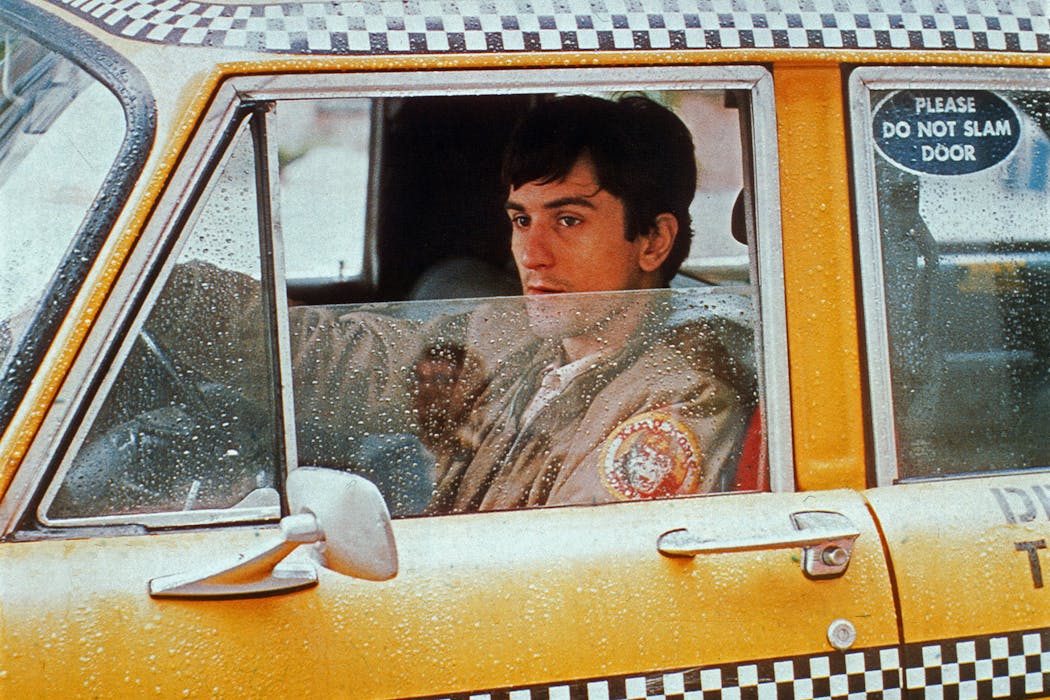
Taxi Driver at 50: Martin Scorsese’s film remains a troubling reflection of our times

Source: The Conversation – Global Perspectives – By Alexander Howard, Senior Lecturer, Discipline of English and Writing, University of Sydney

IMDB

Martin Scorsese’s Taxi Driver turns 50 this month. Nominated for four Oscars and winner of the Palme d’Or at the 1976 Cannes Festival, Scorsese’s searing, hallucinatory portrait of urban alienation is widely regarded as one of the most important American films of all time.

It is also unquestionably one of the most troubling.

Taxi Driver channels the anger, paranoia and alienation of an American decade shaped by economic decline, imperialist violence and political scandal. Set in the dilapidated squalor of a rapidly deindustrialising New York, the film proffers a forlorn portrait of a society coming apart at the seams.

At its heart sits a deeply unsettling vision of masculinity, bound up in racism and misogyny.

The social and psychological forces Taxi Driver brought into focus have not disappeared. If anything, they have simply migrated – finding new expression in digital cultures shaped by the platforming of grievance, aesthetised resentment and the monetisation of male rage.

American existentialism

Travis Bickle (portrayed with unnerving intensity by Robert De Niro) was the creation of screenwriter Paul Schrader, who drew heavily on his own experiences of isolation and emotional crisis. Schrader also looked to literature for inspiration, citing Fyodor Dostoevsky’s misanthropic Underground Man as a formative influence.

In placing the European existential hero in an American context, said Schrader:

you find that he becomes more ignorant, ignorant of the nature of his problem. Travis’ problem is the same as the existential hero’s, that is, should I exist? But Travis doesn’t understand that this is his problem, so he focuses it elsewhere: and I think that is a mark of the immaturity and the youngness of our country.

Schrader also drew on contemporary events, including the attempted assassination of right-wing politician George Wallace by Arthur Bremer. The result was a character who crystallised the violent confusions of the era.

Like Bremer, Travis keeps a diary. We see him writing in it at various points in the film and we hear excerpts from it in voiceover:

All the animals come out at night. Whores, skunk pussies, buggers, queens, fairies, dopers, junkies, sick, venal. Someday a real rain’ll come and wash all this scum off the streets.

Travis, a decidedly unreliable narrator who claims to have served in Vietnam, takes a job as a taxi driver because he has trouble sleeping. Working almost exclusively at night and wound impossibly tight, he rides through the city in a state of heightened unease.

One morning, after clocking off from a long shift, he notices a young woman through the window of a midtown Manhattan office. This is Betsy (Cybill Shepherd), an ambitious campaign worker employed by a presidential hopeful Charles Palentine (Leonard Harris).

Betsy quickly becomes the object of Travis’s fixation. He begins loitering in his cab outside her workplace, watching her from a distance. Eventually, he somehow persuades her to go on a date with him. It does not go well.

Socially inept, Travis’ idea of a good time is a trip to a Times Square porno theatre. He appears genuinely baffled when Betsy decides she has had enough and storms out, cutting off all contact with him. This only deepens Travis’ indignation and culminates in an angry confrontation at Betsy’s office, where he berates her in front of her coworkers.

Travis starts to spiral, confessing to a fellow cabbie that he’s got “some bad ideas” in his head. He settles on a plan of action. His diary entries become even more ominous.

He starts working out obsessively, loads up on guns and plots the public assassination of Betsy’s boss. Political violence becomes a way of giving shape to his discontent, transforming indignation into a pipe dream of historical consequence. He practices shooting in front of the mirror in his dingy apartment.

De Niro’s improvised line, “You talkin’ to me”, became (to borrow from film scholar Amy Taubin) “arguably the most quoted scene in movie history”.

When his plan to murder Palantine collapses, Travis redirects his attention to Iris, a 12-year-old sex worker played by Jodie Foster. He decides he must “help” her get away from her pimp, believing himself morally just. Carnage ensues – so ferocious that it initially led to the film being refused a commercial rating.

It ends on a bleakly ironic, ambiguous note.

A dark afterlife

Taxi Driver divided critics but proved an immediate hit with viewers.

Its disquieting power did not diminish with time; if anything, the film’s afterlife has been almost as troublesome as the work itself.

In 1981, John Hinckley Jr. – who had become obsessed with the film – attempted to assassinate Ronald Reagan in an effort to impress Jodie Foster. This incident shook Scorsese, who briefly considered giving up filmmaking altogether.

Travis Bickle has been repeatedly elevated to the status of anti-hero. The character has cast a long cultural shadow, most obviously in Todd Phillips’s Joker (2019).

A 2025 documentary series reflecting on Scorsese’s career returns to this question of legacy. Director Rebecca Williams puts it to Schrader that she gets the impression that “there are a lot of Travis Bickles, especially right now.” Schrader’s reply is blunt:

They’re all talking to each other on the internet. When I first wrote about him, he was talking to nobody. He really was, at that point, the Underground Man. Now he’s the Internet Man.

It is a sobering thought.

The Conversation

Alexander Howard does not work for, consult, own shares in or receive funding from any company or organisation that would benefit from this article, and has disclosed no relevant affiliations beyond their academic appointment.

ref. Taxi Driver at 50: Martin Scorsese’s film remains a troubling reflection of our times – https://theconversation.com/taxi-driver-at-50-martin-scorseses-film-remains-a-troubling-reflection-of-our-times-261662

What exactly is misconduct in public office and could Peter Mandelson be convicted?

Source: The Conversation – UK – By Jeremy Horder, Professor of Criminal Law, London School of Economics, London School of Economics and Political Science

Peter Mandelson, former UK ambassador to the United States, is currently under investigation by the Metropolitan Police concerning an allegation of criminal misconduct in public office.

The allegation centres on evidence that Mandelson passed sensitive, confidential information – received in his capacity as a minister – to Jeffrey Epstein and his associates.

If that is true, then it is, of course, not the first time that ministerial confidences have been breached. However, what makes this case potentially serious is the possibility that the information passed to Epstein was known to be likely to assist Epstein financially and that this favour may have been bound up with a relationship between the men in which Epstein conferred financial benefits on Mandelson.

The offence of misconduct in public office – described by famous legal commentator Sir William Blackstone in 1765 as “a crime of deep malignity” – dates back many centuries. It carries a maximum sentence of life imprisonment. In most cases, a significant prison sentence is imposed on a convicted offender – and there are around 25 to 50 convictions each year. Misconduct in public office is what lawyers call a common law offence. That is to say, it is an offence invented and developed (like the definition of murder) by judges, without parliamentary intervention.

In its modern form, the offence has three main elements. The accused must have been acting in an official capacity at the time of the alleged offence, they must have wilfully misconducted themselves and their conduct must have fallen “so far below acceptable standards that it amounts to an abuse of the public’s trust”.

Prosecutors must be confident that the evidence for these elements points to a reasonable prospect of conviction and separately that there is sufficient public interest in prosecution.

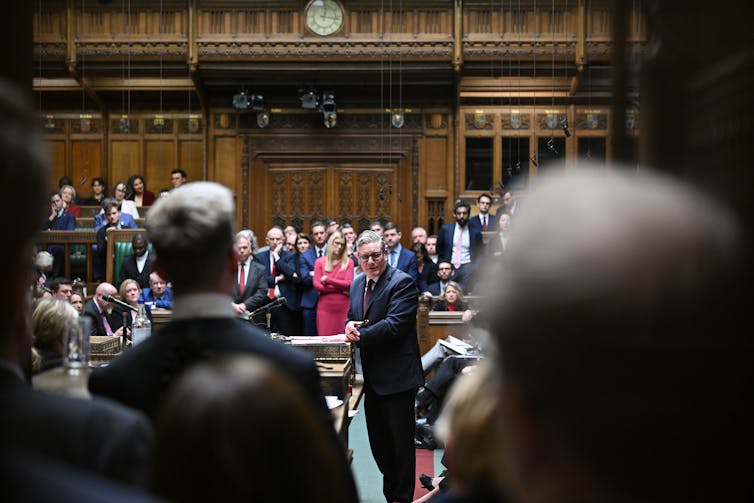
Keir Starmer at the dispatch box in the House of Commons.
Keir Starmer faces questions over Mandelson in PMQs.
Flickr/UK Parliament, CC BY-NC-ND

A typical case might be one in which a prison officer accepts money for passing information to a prisoner on the whereabouts of the latter’s former criminal associates. Such cases are ones in which the offence operates in a broadly top-down manner: servants of the state entrusted with powers are called to account for the knowing misuse of those powers.

However, the offence can also operate in a more bottom-up manner. Those holding the highest elected or judicial offices can themselves be criminally accountable for misuse of power, if need be, through a private prosecution launched by an ordinary citizen or a pressure group. For example, the MPs in the so-called expenses scandal who knowingly made false claims were convicted of false accounting, but they could all equally have been charged with misconduct in public office.

Corruption in public office?

In Mandelson’s case, there seems to be evidence that while acting in a public capacity as a minister (element one), he wilfully – knowingly – misconducted himself (element two). He must have known that it was wrong to share confidential information with Epstein if he received it in a ministerial capacity.

The key is probably element three: did his wilful misconduct fall so far short of what is expected of a holder of ministerial office as to amount to an abuse of the public’s trust? Misconduct in public office is a serious offence, and so this is a high bar to surmount. Central to the determination of element three will be whether information was wrongly disclosed for a purpose itself involving significant impropriety, such as benefiting a private individual financially.

There is also the possibility that such an improper purpose was also associated with corruption. If the information was disclosed as part of an exchange of favours, that makes the case stronger for saying that there was an abuse of the public’s trust. Corrupt activity has long been equated in law with the abuse of public trust. Proof of both improper purpose and corruption would be very serious indeed.

The lapse of time, and his political disgrace, may have diminished the public interest in prosecuting Mandelson; and it should be noted that public outrage is not the same as public interest. Even so, he would be well advised to find himself a first-rate lawyer.

The Conversation

Jeremy Horder does not work for, consult, own shares in or receive funding from any company or organisation that would benefit from this article, and has disclosed no relevant affiliations beyond their academic appointment.

ref. What exactly is misconduct in public office and could Peter Mandelson be convicted? – https://theconversation.com/what-exactly-is-misconduct-in-public-office-and-could-peter-mandelson-be-convicted-275122

ICE pullback in Minneapolis shows the limits of Donald Trump’s scare tactics

Source: The Conversation – Canada – By Eli Lawrence Sopow, Adjunct Faculty, Adler University

Thanks to United States President Donald Trump, 2026 is shaping up to be an age of angst as groups and countries retreat turtle-like into protective economic and cultural shells. We’re trusting very few and are suspicious of many. As is generally the result of such tactics, the perpetrator is creating an environment of divide and conquer.

The global and local anxiety being created by Trump are illustrated by the Edelman Trust Barometer Global Report. It reveals the results of a 2025 survey of 33,000 respondents in 28 countries.

The results show that trust in institutions of all description, and our “shared reality,” has created a “crisis of grievance.” This in turn has produced a “heightened insularity, a reluctance to trust anyone who’s different from you.”

But Trump’s draconian anti-immigration agenda — enforced through masked, violent and unaccountable Immigration and Customs Enforcement (ICE) agents — appears to be fuelling active and successful citizen collaboration.

In the aftermath of the slayings in Minneapolis of two civilians, Renee Good and Alex Pretti, and the mass protests that ensued, Trump’s border czar has announced he’s withdrawing 700 ICE agents from the city. Trump himself has also indicated his administration is backing down from its hardline tactics.

The simmering state of protest violence

A disturbing finding in the Edelman survey is that 40 per cent of respondents approve of one or more hostile actions to bring about change. This includes “attacking people online, intentionally spreading disinformation, threatening of committing violence, damaging public or private property.”

This willingness to take hostile action is the highest I have seen in my 45 years of research into public order and protest. It is far higher than numbers found in the 2017-22 World Values Survey of 102 countries that asked five questions about political action.

In that survey, only 35 per cent globally said they “might” get involved in a peaceful protest, while 46 per cent “would never.” In Canada, 48 per cent said they would get involved in a peaceful protest; 29 per cent would never. In the U.S., 55 per cent of respondents reported they “might” and 34 per cent wouldn’t.

The Edelman report states that “as fears rise, trust goes local.” This means that as change becomes a bigger feature in our lives, the circle of trust shrinks. Organizational psychologists like Canada’s Jason Walker note that this turn of the emotional screw can create paranoia, emotional stress and workplace/homelife violence.

One way to gauge rising fear and public anger is through Google Trends. Throughout January 2026, more people worldwide than at any point in the past five years — including during the darkest months of the COVID-19 pandemic — searched on the phrases “I fear change” and “I am angry.”

The U.S. led all countries on Google Trends, registering a score of 100 — the maximum value on the platform’s index, which indicates the highest relative search interest among all locations measured. The only other country matching this level of fear of change search was the Philippines, which is going through its own political and social turmoil.

In Cincinnati, Ohio, searches on “I am angry” were hitting close to 90 on the index following Good’s slaying in Minneapolis on Jan. 7. Ohio is where the National Guard shot and killed four unarmed students and wounded nine others who were protesting the Vietnam War in 1970.

Fear, distrust growing

Surveys and web searches expose a world of growing protective isolationism; it’s a lot more difficult to bring a collective, trusted resistance together.

Canadian Prime Minister Mark Carney recently warned that “a world of fortresses will be poorer, more fragile and less sustainable.” But in extolling the virtues of collectivism and mutual trust, Carney underplayed the fact that, unfortunately, fear and protectionism are often more powerful than trust.

Decades of public order research by myself and colleagues, as well as extensive academic research about public order and protest, has revealed a predicable pattern.

As I found in my book The Age of Outrage, when people are afraid, their fear can turn to boiling anger. That anger then becomes an emotional catalyst for action, either collectively or singularly, passively or violently, to fix things.

In fact, fear, anger and a demand for action can instill the collectivism and mutual trust missing in the Edelman survey. That could be what’s currently happening with the anti-Trump and anti-ICE protests throughout the U.S.

The challenge is that large public protests are a very delicate, potentially volatile formula for change. Collective protests require drama and a saturation of news and social media coverage to raise awareness and support. But protest support can quickly evaporate if the public sees acts of violence and destruction by even a minority of demonstrators (one TV news shot of a burning building or smashed storefront window will usually do the trick).

Trump was betting on fear

Amid the anti-ICE protests, Trump was betting that fear and chaos would prevail. He and his operatives continually seeded the public consciousness with language like “domestic terrorists,” “weaponized her vehicle” and “paid agitators” to describe the victims of ICE agents and other anti-ICE protesters. So far, Trump’s propaganda campaign is failing.

Trump didn’t count on the many peaceful anti-ICE protests and viral videos of the slayings of Good and Pretti that revealed the administration’s lies about their deaths. The over-zealousness of masked ICE agents has resulted in an uncomfortable drop of public support for the president.


Read more:
Anti-ICE protesters are following same nonviolent playbook used by people in war zones across the world to fight threats to their communities


Trump’s penchant for sowing fear is now in danger. If the “ICE Out” protests and strikes continue in their generally peaceful way, public fear, anger and a demand for public safety won’t be directed at demonstrators but at violent federal ICE officers.

How can protesters continue to build public support? My decades of research point to a consistent pattern among successful movements: a C.O.R.E. profile. Protesters remain committed, communicative, organized, resourceful and experienced — and above all else, non-violent.

What’s happening in the U.S. right now illustrates that public law-and-order initiatives are a double-edged sword. Just as over-zealous and violent protesters can quickly sour public opinion for their cause, so can the over-reaction of law enforcement and other authorities to peaceful protests — a lesson Trump is currently learning the hard way.

The Conversation

Eli Lawrence Sopow does not work for, consult, own shares in or receive funding from any company or organisation that would benefit from this article, and has disclosed no relevant affiliations beyond their academic appointment.

ref. ICE pullback in Minneapolis shows the limits of Donald Trump’s scare tactics – https://theconversation.com/ice-pullback-in-minneapolis-shows-the-limits-of-donald-trumps-scare-tactics-274933