Vente par la Russie d’hydrocarbures à la Chine en yuan : fin du dollar, opportunité pour l’euro ?

Source: The Conversation – in French – By Suwan Long, Assistant Professor, LEM-CNRS 9221, IÉSEG School of Management
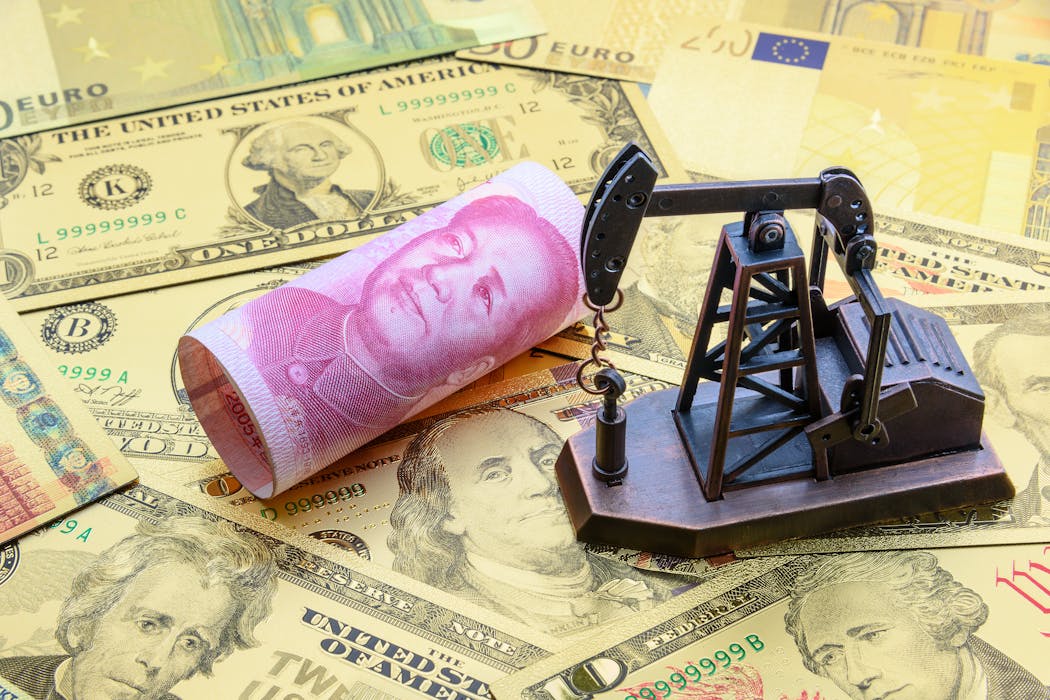
De 80 % à 85 % du pétrole de l’Union européenne étant encore facturé en dollar états-unien (USD), le paiement du pétrole russe en yuan par la Chine pourrait marquer un tournant monétaire historique. William Potter/Shutterstock

Le yuan (monnaie chinoise, officiellement appelée renminbi) s’impose dans le commerce du pétrole et du gaz entre la Russie et la Chine. Cette évolution présente des risques pour l’Union européenne, mais aussi une opportunité pour l’euro dans le contexte énergétique.


Lors du 25ᵉ Sommet de l’Organisation de coopération de Shanghai (OCS) tenu à Tianjin, en septembre 2025, les dirigeants chinois et russes ont ouvertement défendu un commerce de l’énergie en dehors du dollar états-unien. Cette poussée vers la dédollarisation, illustrée par l’augmentation des ventes de pétrole et de gaz de la Russie à la Chine en yuan (monnaie chinoise, officiellement renminbi), marque un bouleversement dans le commerce de l’énergie.

Pour l’Union européenne, et plus précisément pour les entreprises de la zone euro, où les importations de pétrole sont encore très largement facturées en dollars, cette évolution agit comme une arme à double tranchant.

Le yuan, central dans les accords énergétiques Russie–Chine

En quelques années, le yuan s’est affirmé comme monnaie de réglage importante dans les échanges énergétiques russo-chinois. En 2022, les entreprises Gazprom et China National Petroleum Corporation (CNPC) commencent à réduire leurs paiements en dollar pour certains contrats, en favorisant l’usage du rouble et du yuan. En 2023, le commerce bilatéral a atteint un record de 240 milliards de dollars (+ 26 %), avec la moitié du pétrole russe exporté vers la Chine.

En 2024, le commerce bilatéral Chine-Russie atteint 244,81 milliards de dollars états-uniens, en hausse de 1,9 % par rapport à 2023, selon les douanes chinoises. Ce chiffre s’explique par la montée des échanges sur la paire CNY/RUB, c’est-à-dire le taux de change entre le yuan chinois et le rouble russe. Autrement dit, de plus en plus d’entreprises russes achètent ou vendent directement des yuans contre des roubles, alors qu’auparavant, elles passaient presque toujours par le USD/RUB, le taux entre dollar des États-Unis et rouble.

Ce glissement reflète un transfert progressif du commerce de l’énergie russe, autrefois dominé par le dollar, vers la monnaie chinoise.

Ce basculement s’est confirmé à Tianjin, où Xi Jinping, Vladimir Poutine et Narendra Modi ont soutenu l’usage accru des monnaies nationales. Le président de la République populaire de Chine a même proposé la création d’une banque de développement destinée à contourner le dollar et à limiter l’impact des sanctions.

Plus de 80 % du pétrole de l’UE facturé en dollar

L’OCS réunit dix membres : la Chine, la Russie, l’Inde, le Pakistan, l’Iran, le Kazakhstan, le Kirghizstan, le Tadjikistan, l’Ouzbékistan et le Bélarus. Ils représentent près de la moitié de la population mondiale et un quart du PIB. Le commerce de la Chine avec ses partenaires a atteint 3,65 trillions de yuans (500 milliards de dollars états-uniens) en 2024.

Le commerce de la Chine avec ses partenaires est de plus en plus souvent réglé en yuan, transformant progressivement la monnaie chinoise en instrument international de facturation et d’échange, au-delà de son usage domestique. Le dollar conserve toutefois son statut dominant, représentant encore 58 % des réserves mondiales en 2024.

L’Union européenne (UE) reste largement dépendante du dollar pour ses importations d’énergie. Entre 80 et 85 % du pétrole de l’Union européenne est facturé en dollar états-unien (USD), alors qu’une part infime provient des États-Unis. Ce choix s’explique par le rôle du dollar comme monnaie commune de transaction sur les marchés mondiaux. Il sert d’intermédiaire entre producteurs et acheteurs, quelle que soit leur nationalité. L’UE se rend de facto vulnérable aux variations du dollar et aux décisions de la Réserve fédérale des États-Unis.

Nouvelle complexité pour les entreprises européennes

Si le commerce mondial du pétrole et du gaz cessait d’être dominé par le dollar pour se répartir entre plusieurs monnaies comme le yuan ou la roupie, les entreprises européennes, surtout celles de la zone euro, devraient s’adapter à un environnement financier plus complexe.

Aujourd’hui, la plupart d’entre elles achètent leur énergie en dollars. Elles peuvent se protéger contre les variations du taux de change grâce à des « marchés de couverture » très développés. Ces marchés permettent de conclure des contrats financiers à l’avance pour bloquer un taux et éviter des pertes si la valeur du dollar change.

Avec le yuan, la situation serait plus difficile. Les outils financiers permettant de se couvrir sont encore limités, car la Chine contrôle les mouvements de capitaux et restreint la circulation de sa monnaie à l’étranger. Autrement dit, le yuan ne circule pas librement dans le monde. Cela réduit la liquidité, c’est-à-dire la capacité d’une entreprise à acheter ou vendre rapidement des yuans quand elle en a besoin. Moins la monnaie circule, moins il y a d’échanges possibles, et plus les transactions deviennent lentes et coûteuses. Pour les entreprises, cela signifie des paiements plus complexes et des coûts financiers plus élevés.

Des signes concrets montrent que ce scénario commence à se concrétiser. En mars 2023, la China National Offshore Oil Corporation et TotalEnergies ont conclu la première transaction de gaz naturel liquéfié (GNL) libellée en yuan via une bourse de Shanghai. Quelques mois après, l’entreprise pétrolière publique de la République populaire de Chine a réalisé une autre transaction en yuan avec Engie. Ces accords illustrent la montée en puissance du yuan dans les échanges énergétiques et annoncent un nouvel équilibre où les entreprises européennes devront composer avec une plus grande diversité de devises.

Rôle accru de l’euro dans la facturation énergétique

L’évolution du commerce mondial de l’énergie ouvre une opportunité stratégique pour l’Union européenne : renforcer le rôle de l’euro dans la tarification du pétrole et du gaz, et réduire sa dépendance vis-à-vis du dollar – ou, demain, du yuan.

L’euro est déjà la deuxième monnaie mondiale, représentant 20 % des réserves. Elle sert de référence pour plus de la moitié des exportations européennes. Dans le commerce de l’énergie, son rôle demeure limité. Dès 2018, la Commission européenne avait d’ailleurs recommandé d’accroître son usage dans la tarification énergétique, afin de consolider la souveraineté économique du continent.

Les progrès les plus visibles concernent le gaz. Selon la Banque centrale européenne, la réduction des approvisionnements russes a poussé l’Union européenne à s’intégrer davantage aux marchés mondiaux du gaz naturel liquéfié (GNL). Les prix européens sont désormais étroitement liés aux marchés asiatiques, ce qui rend l’UE plus sensible aux variations de la demande mondiale. Cette interdépendance renforce l’intérêt de développer des contrats de gaz libellés en euros.

La même logique pourrait s’appliquer au pétrole. l’Union européenne importe plus de 300 milliards d’euros d’énergie chaque année. Elle dispose d’un poids suffisant pour négocier avec ses partenaires commerciaux, notamment les producteurs du Golfe cherchant à diversifier leurs devises.

Vers une monnaie énergétique européenne ?

Faire de l’euro une monnaie de référence dans les échanges énergétiques ne se décrète pas, mais cela pourrait devenir un levier essentiel de la politique monétaire et énergétique européenne.

L’euro dispose d’atouts : il est relativement stable, pleinement convertible, et soutenu par la Banque centrale européenne. Si des cargaisons de pétrole ou de gaz étaient facturées en euros, cela réduire la dépendance au dollar, simplifierait la couverture monétaire pour les entreprises européennes, et renforcerait l’indépendance financière de l’Union.

Ce virage monétaire implique des défis concrets. Le marché de l’énergie en euros reste peu développé, et certains pays ou entreprises pourraient craindre des sanctions états-uniennes s’ils s’éloignent du dollar. Surmonter ces freins nécessite de renforcer les marchés de capitaux européens, de créer des produits de couverture expressément en euros pour l’énergie, et d’assurer une politique économique stable à l’échelle de la zone euro.

Cette démarche ne vise pas à remplacer le yuan, mais à établir une alternative équilibrée, où l’euro pèse dans la facturation, dans les réserves stratégiques et dans le paysage monétaire mondial.

The Conversation

Suwan Long ne travaille pas, ne conseille pas, ne possède pas de parts, ne reçoit pas de fonds d’une organisation qui pourrait tirer profit de cet article, et n’a déclaré aucune autre affiliation que son organisme de recherche.

ref. Vente par la Russie d’hydrocarbures à la Chine en yuan : fin du dollar, opportunité pour l’euro ? – https://theconversation.com/vente-par-la-russie-dhydrocarbures-a-la-chine-en-yuan-fin-du-dollar-opportunite-pour-leuro-265602

Le fabuleux destin des comédies musicales françaises sur le continent asiatique

Source: The Conversation – in French – By Bernard Jeannot-Guerin, Enseignant chercheur en études culturelles, Université de Lorraine

En juin 2023 à Xiamen (Chine), la chanteuse Cécilia Cara assure la promotion de la tournée de _Roméo et Juliette, de la haine à l’amour_, de Gérard Presgurvic, créée en 2001.

Youtube/capture d’écran.

« Molière », le spectacle musical de Dove Attia, vient d’entamer une tournée en Chine, emboîtant le pas à « Notre-Dame de Paris » et au « Roi Soleil » en Corée du Sud ou aux « Misérables » et à « Mozart, l’opéra rock » au Japon. Souvent boudées par la critique, les comédies musicales à la française s’exportent en Asie, où elles rencontrent un succès grandissant.


En 2023, 35 % des spectacles de comédie musicale en Chine étaient francophones, et les chiffres dépassent de loin les données de production françaises. Passage désormais obligé, la tournée asiatique consacre le spectacle francophone en reconnaissant ce que la France considère précisément comme des défauts mercantiles : le spectaculaire, le vedettariat et le kitsch.

Entre goût populaire et attrait populiste

Si, en France, les pratiques pluridisciplinaires se démocratisent aujourd’hui dans les conservatoires, il existe en Asie une tradition pluridisciplinaire du spectacle vivant. Lee Hyun-joo, Jean-Marie Pradier et Jung Ki-eun montrent qu’en Corée, les acteurs savent performer tant pour la télévision que pour le théâtre et pour la comédie musicale.

La comédie musicale participe du paysage culturel asiatique : les shows de Broadway sont depuis longtemps importés. Mais l’hyperspectacle français attire pour ce qu’on lui reproche ici même : faisant la promotion des tubes au mépris de la diégèse, les productions s’accordent à surmédiatiser la chanson pop, à la véhiculer dans des théâtres traditionnels avec la même volonté politique d’occidentalisation qui présida à l’importation d’un art lyrique issu des opéras.

Il s’agit également de faire valoir la musicalité de la langue française et l’image de ses interprètes. C’est d’ailleurs ainsi que Nicolas Talar, producteur de Notre-Dame de Paris, pense le marché du spectacle vivant : il parle d’une langue commune.

À la frontière de la K-pop : « sweet power » et culture adolescente

Le spectacle de comédie musicale à la française contribue peut-être au « sweet power », tel que défini par Vincenzo Cicchelli et Sylvie Octobre : un attrait pour l’esthétique et une globalisation culturelle qui adoucissent les clichés impérialistes portés jadis par les spectacles plus traditionnels.

En donnant la part belle aux figures juvéniles tiraillées entre révolte, tourments et exaltation, la comédie musicale française se rapproche des idols (ces artistes des deux sexes sélectionnés adolescents, principalement pour leur physique) de la K-Pop dont l’esthétique « cute » séduit les adolescentes. Spécialiste des questions de l’émotion dans la littérature française, Siyang Wang a analysé l’attrait suscité par le spectacle le Rouge et le Noir en Chine et signale que « les spectatrices de moins de 25 ans représentent plus de 50 % du public, tandis qu’elles ne constituent qu’un pourcentage minoritaire (10 %-20 %) du public de la comédie musicale traditionnelle ».

En 2018, en Chine, la ferveur pour le personnage de Mozart, incarné par le créateur du rôle Mikelangelo Loconte, a pris de l’ampleur quand le jeune Yanis Richard a repris le rôle avec extravagance et sensibilité dans la tournée 2024, se faisant surnommer « Kid Mozart ». Côme, finaliste de The Voice en France en 2015, campe de son côté un Julien Sorel timide et mélancolique dans le Rouge et le Noir. En Chine, il est rebaptisé « Julien qui sort du roman » pendant la tournée de 2019.

Les chansons portées par ces figures juvéniles permettent à la communauté de fans – qui a « soif de chaleur humaine » – d’adopter des relations parasociales avec les personnages et leurs interprètes.

Vincent Cicchelli et Sylvie Octobre nous rappellent que le contenu des chansons de K-pop, « dans lesquelles les fans se reconnaissent, explorent ainsi les amours, les joies mais aussi les troubles, les angoisses et les diverses formes de vulnérabilités liées à l’adolescence ».

De Paris à Shanghai, il s’agit d’offrir une pop globale : les voix sirupeuses, la plastique du chanteur de charme ou la verve insolente de la star prépubère sont autant d’éléments humanisant le héros et ralliant le fan à son idole. Le personnage-star devient un ami imaginaire, voire un amour idéalisé.

Les interprètes sont à l’image des groupes préfabriqués de la K-pop qui permettent l’ascension de jeunes artistes. Depuis les années 2000, les performers français des comédies musicales sont globalement issus des télécrochets. Le casting permet à ces nouveaux venus promus par la télévision de se faire un nom dans un show détonnant et de parfaire leur image grâce au jeu médiatique. La projection et l’identification du public – français comme asiatique, d’ailleurs – à ces modèles de réussite spectaculaire contribuent à faire de la scène une fabrique du rêve.

Baroque, paillettes et guitares électriques

Si Roméo et Juliette et 1789, les amants de la Bastille ont été adaptés en langue japonaise, qu’est-ce qui pousse le public asiatique à plébisciter les shows français en langue originale ? La comédie musicale séduit, car elle convoque un sujet patrimonial, socle fondamental d’un livret dont le public n’a besoin que de connaître les grands axes. Seule compte la fable, symbole d’une culture européenne qui fait rêver. L’engouement pour le chant, la danse, les arrangements et les effets de machinerie renforce l’expressivité du mouvement dramatique et nourrit l’attrait populaire.

La spécialiste des contes de fée Rebecca-Anne C. Do Rozario a d’ailleurs montré en quoi l’emphase du sujet historique, mythique ou littéraire suscite l’emphase scénique, et amplifie les émotions du spectateur. La surenchère visuelle dans Molière ou dans 1789 convoque une imagerie affective renvoyant à la magie d’une cour de France imaginaire où dominent strass et dorures.

Le costume est d’une importance capitale pour mobiliser ces images affectives : les tons pastel avoisinent le gothique chic dans l’univers psychédélique de Mozart. Les tenues en cuir de Roméo et Juliette transportent l’intrigue dans le monde d’aujourd’hui, tandis que les formes et les couleurs tenant d’un baroque de convention offrent du pittoresque et de la lisibilité.

Les sujets classiques sont aussi redynamisés par les rythmes pop-rock et l’amplification de la musique électronique sur lesquels le public chante et danse comme dans un concert. Laurent Bàn, performer français ovationné dans les tournées asiatiques, a expérimenté l’aspect récréatif de ces spectacles cathartiques, selon lui plus important qu’en Europe :

« Le public sait que, pendant deux heures, il peut crier, applaudir, hurler, pleurer. »

L’imaginaire français : entre tradition et kitsch

Dans sa thèse, Tianchu Wu explique en quoi Victor Hugo est un des écrivains les plus plébiscités par le public asiatique. Symboles d’une culture française romantique et humaniste, les Misérables (1862, traduit dès 1903, ndlr) et Notre-Dame de Paris (1831, traduit dès 1923, ndlr) circulent largement et sont l’objet d’un transfert culturel qui assoit des valeurs affectives et traditionnelles. Cet imaginaire culturel français prime sur les enjeux réalistes comme le signale Zhu Qi, en affirmant que, dans la réception de ces œuvres, « le romantisme l’emporte sur le réalisme ».

Les tableaux successifs qui composent les spectacles musicaux français campent les lieux communs de la famille, de l’amitié et de l’amour inconditionnel, reçus en Asie comme l’expression de valeurs traditionnelles et appréhendées avec la facilité de lecture d’un livre d’images. Donnant volontiers dans l’imagerie kitsch, ces shows drapent les grandes figures du romantisme de glamour romanesque, sur fond de lyrisme édulcoré.

À la suite des musicals de Broadway adaptés en Asie, le spectacle français y rencontre désormais son public, peut-être plus qu’ailleurs, et devient un modèle de création à l’image des opéras européens, qui y sont importés depuis longtemps.

The Conversation

Bernard Jeannot-Guerin ne travaille pas, ne conseille pas, ne possède pas de parts, ne reçoit pas de fonds d’une organisation qui pourrait tirer profit de cet article, et n’a déclaré aucune autre affiliation que son organisme de recherche.

ref. Le fabuleux destin des comédies musicales françaises sur le continent asiatique – https://theconversation.com/le-fabuleux-destin-des-comedies-musicales-francaises-sur-le-continent-asiatique-267658

Just 1% of coastal waters could power a third of the world’s electricity – but can we do it in time?

Source: The Conversation – UK – By Aleh Cherp, Professor, Department of Environmental Sciences and Policy, Central European University

Just 1% of the world’s coastal waters could, in theory, generate enough offshore wind and solar power to provide a third of the world’s electricity by 2050. That’s the promise highlighted in a new study by a team of scientists in Singapore and China, who systematically mapped the global potential of renewables at sea.

But turning that potential into reality is another story. Scaling up offshore renewables fast enough to seriously dent global emissions faces formidable technical, economic and political hurdles.

To reach global climate targets, the world’s electricity systems must be fully decarbonised within a couple of decades if not sooner. Wind and solar power have grown at record-breaking rates, yet further expansion on land is increasingly constrained by a scarcity of good sites and conflicts over land use.

Moving renewables offshore is therefore tempting. The sea is vast, windy and sunny, with few residents around to object. The team behind the new study identified coastal areas with enough wind or sunlight, and water shallower than 200 metres, that are relatively ice-free and within 200 kilometres of population centres.

They estimate that using just 1% of these areas could generate over 6,000 terawatt hours (TWh) of offshore wind power and 14,000TWh of offshore solar power each year. Together that’s roughly one-third of the electricity the world is expected to use in 2050, while avoiding 9 billion tonnes of CO₂ annually.

That sounds impressive as 1% of suitable ocean seems small. Many European countries, such as Denmark, Germany, Belgium and the UK, already allocate between 7% and 16% of their coastal waters for offshore wind farms. Yet what matters for climate mitigation is not only how much low-carbon energy could eventually be produced, but how fast that could happen.

At present, offshore wind generates less than 200TWh per year, less than 1% of global electricity. By 2030, that might rise to around 900TWh. Hitting 6,000TWh by 2050 would require annual installations – each year, for two decades – to be about seven times larger than they were last year.

Offshore solar requires an even steeper climb. The technology is still experimental, producing only negligible amounts of electricity today.

Even if 15TWh a year (an equivalent of some 15GW capacity) can be generated by 2030, to reach the estimated potential of 14,000TWh by 2050 would require sustained annual growth of over 40% for two decades. Such a rate that has never been achieved for any energy technology, not even during the recent record-breaking growth of land solar.

Achieving techno-economic viability

Around 90% of existing offshore wind capacity is located in the shallow, sheltered waters of northwestern Europe and China, where most turbines are directly fixed to the seabed. Yet most of the untapped potential lies in deeper waters, where fixed foundations are impossible.

That means turning to floating turbines, a technology that currently accounts for just 0.3% of global offshore wind capacity. Floating wind power faces serious engineering challenges, from mooring and anchoring, to undersea cabling and maintenance in rougher seas.

It currently costs far more than fixed-bottom systems, and will need substantial subsidies for at least the next decade. Only if early projects prove successful and drive down costs could floating wind become commercially viable.

Solar panels on water
Floating solar on a reservoir in Indonesia.
Algi Febri Sugita / shutterstock

Offshore solar is even further behind. The International Energy Agency rates its technology readiness at only level three to five on an 11-point scale — barely beyond prototype stage. The new study refers to research saying offshore solar could become commercially viable in the Netherlands only around 2040-2050, by which time the world’s power system should already be largely decarbonised.

Overcoming growth barriers

Even when low-carbon technologies become commercially competitive, their growth rarely continues exponentially. Our own research shows manufacturing bottlenecks, logistics and grid integration eventually slow expansion. And these challenges are likely to be even tougher for offshore projects.

Social opposition and the need for permits can also slow progress. Moving wind and solar offshore avoids some land-use conflicts, but it does not eliminate them. Coastal space close to populated areas is already crowded with shipping, fishing, leisure and military activities.

In Europe, approval and construction of offshore wind farms can a decade or more. Permits are not guaranteed: Sweden recently rejected 13 proposed wind farms in the Baltic Sea due to national security concerns.

What is realistic?

Offshore renewables will undoubtedly play an important role in the global energy transition. Offshore wind, in particular, could become a major contributor by mid-century if its growth follows the same trajectory as onshore wind has since the early 2000s.

However, that would require floating turbines to quickly become competitive, and for political commitment to be secured in the Americas, Australia, Russia and other areas with lots of growth potential.

Offshore wind (green) is tracking the growth rate of onshore wind (orange):

graph
Timelines are shifted by 15 years, so that the year 2000 for onshore maps onto year 2015 for offshore.
Aleh Cherp (Data: IEA, Wen et al)

Offshore solar, by contrast, would need to achieve viability and then grow at an unprecedented rate to reach the potential outlined in the new study. It may be promising for niche uses, but is unlikely to deliver large-scale climate benefits before 2050.

Its real contribution may come later in the century, when we will still need to expand low-carbon energy for industries, transport and heating once the initial decarbonisation of power generation is complete.

For now, the world’s best bet remains to accelerate onshore wind and solar power as well as proven offshore wind technologies, while preparing offshore solar and floating wind power options for the longer run.

The Conversation

Aleh Cherp receives funding from Swedish Foundation for Strategic Environmental Research (MISTRA) and Swedish Energy Agency.

Jessica Jewell receives funding from the European Union’s H2020 ERC Starting Grant programme under grant agreement no. 950408 project Mechanisms and Actors of Feasible Energy Transitions (MANIFEST), Mistra Environmental Research (MISTRA), and the Swedish Energy Agency.

Tsimafei Kazlou receives funding from the European Union’s H2020 ERC Starting Grant programme under grant agreement no. 950408 project Mechanisms and Actors of Feasible Energy Transitions (MANIFEST).

ref. Just 1% of coastal waters could power a third of the world’s electricity – but can we do it in time? – https://theconversation.com/just-1-of-coastal-waters-could-power-a-third-of-the-worlds-electricity-but-can-we-do-it-in-time-268237

Scientists have puzzled over what happens to plastic as it breaks down in the ocean – our new study helps explain the mystery

Source: The Conversation – UK – By Kate Spencer, Professor of Environmental Geochemistry, Queen Mary University of London

Dotted Yeti/Shutterstock

Think of ocean plastic and you may picture bottles and bags bobbing on the waves, slowly drifting out to sea. Yet the reality is more complex and far more persistent.

Even if we stopped all plastic pollution today, our new research shows that fragments of buoyant plastic would continue to pollute the ocean’s surface for more than a century. These fragments break down slowly, releasing microplastics that sink through the water column at a glacial pace. The result is a “natural conveyor belt” of pollution that links the surface to the deep sea.

Our new study set out to understand what happens to large pieces of floating plastic once they enter the ocean. We developed a computer model to simulate how these plastics degrade, fragment and interact with the sticky suspended particles known as “marine snow” which help transport matter to the seafloor.

Marine snow is the ocean’s natural snowfall: tiny, sticky flakes of dead plankton and other organic particles that clump together and slowly sink, carrying anything that sticks, like microplastics, down into the deep.

bright yellow green flourescent particles of microplastic within clump of marine snow substance on brown background
The fluorescence-labelled polyethene microplastic (about 0.1mm in size) is shown embedded in marine snow.
Nan Wu, CC BY-NC-ND

The new model builds on our previous work understanding the long-term fate of microplastics smaller than 1mm, which showed that plastics would only interact with suspended fine organic particles once they had broken down and reached a critical size threshold. But that simple one-dimensional model didn’t consider other physical processes, such as ocean currents.

By linking plastic degradation to ocean processes including marine snow settling, we have now provided a more complete picture of how small plastic particles move through the ocean system, and why some floating plastic appears to vanish from the surface.

The ‘missing plastic’ problem

When large plastics such as food wrappers or fragments of fishing gear reach the ocean, they can remain afloat for years, slowly battered by sunlight and waves and colonised by marine biofilm – microbial communities that live on the plastic surface.

Over time, they break into smaller and smaller pieces, eventually becoming small enough to attach to marine snow and sink. But this is a slow transformation. After 100 years, around 10% of the original material can still be found at the ocean’s surface.


Read more:
We’re witnessing last-ditch talks to secure a global plastic pollution treaty


As for the rest, scientists have long noticed a puzzling mismatch between the amount of plastic entering the ocean and the much smaller quantities found floating at the surface. Floating plastics must be removed from the ocean’s surface layer through degradation and sinking, but so far the numbers have not quite added up. Our findings help explain this “missing plastic” problem.

We are not the first scientists to report the sinking of microplastics. But by combining experimental work on how microplastics associate with fine suspended sediments, with our modelling of plastic degradation and marine snow settling processes, we provide realistic estimates of how microplastics are removed from the ocean surface which account for the missing plastic.

The ocean’s natural biological pump, often described as a conveyor belt, moves carbon and nutrients from the surface to the deep sea. Our research suggests this same process also moves plastics.

However, there is a potential cost. As global plastic production continues to rise, the biological pump could become overloaded. If too many microplastics attach to marine snow, they may interfere with how efficiently the ocean stores carbon – an effect that could have consequences for marine ecosystems and even climate regulation.

A conveyor belt for pollution

Microplastic pollution is not a short-term problem. Even if we achieved zero plastic waste today, the ocean’s surface would remain contaminated for decades.

To tackle the problem effectively, we need long-term thinking, not just beach or ocean cleanups. Policies need to address plastic production, use and disposal at every stage. Understanding how plastic moves through the ocean system is a crucial step towards that goal.


Read more:
‘Everywhere we looked we found evidence’: the godfather of microplastics on 20 years of pollution research and the fight for global action


Large, buoyant plastic items degrade over decades, shedding microplastics as they go. These tiny fragments may eventually sink to the ocean floor, but only after going through multiple cycles of attachment and release from marine snow, a process that can take generations.

This means plastics lost at sea decades ago are still breaking down today, creating a persistent source of new microplastics.

The ocean connects everything: what floats today will one day sink, fragment and reappear in new forms. Our task is to make sure that what we leave behind is less damaging than what we have already set adrift.


Don’t have time to read about climate change as much as you’d like?

Get a weekly roundup in your inbox instead. Every Wednesday, The Conversation’s environment editor writes Imagine, a short email that goes a little deeper into just one climate issue. Join the 45,000+ readers who’ve subscribed so far.


The Conversation

Kate Spencer receives funding from NERC, Lloyd’s Register Foundation and EU Interreg IV programme Preventing Plastic Pollution

Nan Wu works for Queen Mary University of London and the British Antarctic Survey. Nan Wu receives funding from Lloyds Register Foundation, UK, Queen Mary University of London Principal Studentships, EU INTERREG France (Channel) England project ‘Preventing Plastic Pollution’ co-financed by the European Regional Development Fund’.

ref. Scientists have puzzled over what happens to plastic as it breaks down in the ocean – our new study helps explain the mystery – https://theconversation.com/scientists-have-puzzled-over-what-happens-to-plastic-as-it-breaks-down-in-the-ocean-our-new-study-helps-explain-the-mystery-268305

Pumpkins’ journey from ancient food staple to spicy fall obsession spans thousands of years

Source: The Conversation – USA – By Shelley Mitchell, Senior Extension Specialist, Horticulture and Landscape Architecture, Oklahoma State University

Pumpkin patch excursions have become a fall staple in many U.S. households. Creative Touch Imaging Ltd./NurPhoto via Getty Images

October in much of the U.S. brings cooler weather, vibrant fall colors and, of course, pumpkin-spiced everything. This is peak pumpkin season, with most of the American pumpkin crop harvested in October.

With the pumpkin spice craze fully underway, I find myself thinking more about pumpkins. As an extension specialist working at Oklahoma State University’s botanic garden, I educate the people pouring in to buy pumpkins at our annual sale about the plant’s storied history and its prominence today.

While people often picture pumpkins as bright orange, they actually come in a wide range of colors, including red, yellow, white, blue and even green. They vary in size and texture too: Some are smooth, others warty. They can even be miniature or giant.

The word “pumpkin” comes from the Greek word “peopon,” meaning “large melon.” Botanically, pumpkins are fruits because they contain seeds, and they belong to the squash family, Cucurbitaceae. This family also includes cucumbers, zucchini and gourds. Pumpkins are grown for many purposes: food, seasonal decorating, carving for Halloween and even giant pumpkin contests.

A crowd of people look at five large pumpkins lined up on small platforms
Some pumpkins can be over 1,000 pounds. Pumpkin-growing contests are common at county and state fairs.
Joseph Prezioso/AFP via Getty Images

All 50 states produce some pumpkins, with Illinois harvesting the most. In 2023, Illinois grew 15,400 acres of pumpkins. The next largest amount was grown in Indiana, with about 6,500 acres.

Pumpkin yields vary each year, depending on the varieties grown and the growing conditions in each area. The top six pumpkin-producing states are California, Illinois, Indiana, Michigan, Pennsylvania and Washington.

Early pumpkin history

Pumpkins originated in Central and South America, ending up in North America as Native Americans migrated north and carried the seeds with them. The oldest pumpkin seeds discovered were found in Mexico and date back about 9,000 years.

Pumpkins were grown as a crop even before corn or beans, the other two sisters in a traditional Native American “three sisters” garden. The three sister crops – corn, beans and squash – are planted together, and each has a role in helping the others grow.

Native Americans planted corn in the spring, and once the plants were a few inches tall, they planted beans. The beans vine around the corn as it grows, giving them a natural trellis. Beans also have the ability to take nitrogen from the atmosphere, and with the help of bacteria they convert it into forms that plants can use, such as ammonia, for fertilizer.

After the beans started growing, it was time to plant squash, such as pumpkin. Squash leaves covered the ground, shading the soil and helping keep it moist. The giant leaves also helped reduce the number of weeds that would compete with the corn, bean and squash growth.

Every part of the pumpkin plant is edible, even the flowers. Some Native American groups would dry pumpkins’ tough outer shells, cut them into strips and weave them into mats.

Pumpkins were introduced to Europe from North America through the Columbian Exchange. Europeans found that the pumpkins grown in the New World were easier to grow and sweeter than the ones in 1600s England or France, likely due to the weather and soil conditions in the Americas.

A black and white illustration of a group of people loading pumpkins in a cart.
People have been harvesting pumpkin for centuries. This historical illustration from around 1893 shows the pumpkin harvest in Hungary.
bildagentur-online/uig via Getty Images

Baking American pumpkins

Native Americans introduced early settlers to pumpkins, and the colonists eagerly incorporated them into their diet, even making pies with them.

Early settlers’ pumpkin pies were hollowed-out pumpkins filled with milk, honey and spices, cooked over an open fire or in hot ashes. Others followed English traditions, combining pumpkin and apple with sugar and spices between two crusts.

The custard-style pumpkin pie we know today first appeared in 1796 as part of the first cookbook written and published in the United States, “American Cookery,” by Amelia Simmons. There were actually two pumpkin pie recipes: one used mace, nutmeg and ginger, the other just allspice and ginger.

The pumpkin spice craze

Pumpkin spice as one mixed ingredient was sold beginning in the early 1930s for convenience. The spice mix typically includes a blend of cinnamon, nutmeg, ginger, allspice and cloves.

Pumpkins and pumpkin spice are now synonymous with fall in America. Pumpkin spice flavoring is used in candles, marshmallows, coffees, lotions, yogurts, pretzels, cookies, milk and many other products.

A white mug with a Starbucks logo, filled with foamy coffee and powdered cinnamon on top.
Starbucks’ pumpkin spice latte kicked off the craze thath put this seasonal flavor in high demand.
Beata Zawrzel/NurPhoto via Getty Images

While pumpkin spice is available in one form or another all year long, sales of pumpkin-spiced products increase exponentially in the fall. The pumpkin spice craze is so popular that the start of the pumpkin spice season is a couple of months before the pumpkins themselves are even ready to harvest in October.

Pumpkin excursions

Americans continue to wholeheartedly embrace pumpkins today. Pumpkins in production are typically hand-harvested as soon as they mature, when the skins are hard enough to not be dented when you press it with your thumb.

Children often take field trips to pumpkin patches to pick their own. With the growing popularity of agritourism, many farmers are letting the customers go into the field and pick their own, getting more dollars per pumpkin than farmers could get by selling through the markets. Customer harvesting also reduces labor costs, produces immediate profits and builds community relationships.

In addition, farmers often combine the you-pick experience with other sources of income: corn mazes, hay rides, petting zoos and more. The customers get fresher fruit, enjoy a fun and educational activity and support the local economy.

This year you could get pumpkin spice flavors across the United States by late August, and the industry started promoting pumpkin spice season in July. Because fall has the right conditions for pumpkin picking, the season will keep its hold on pumpkin spice flavor, and consumers will continue to eagerly await its return each year.

The Conversation

Shelley Mitchell does not work for, consult, own shares in or receive funding from any company or organization that would benefit from this article, and has disclosed no relevant affiliations beyond their academic appointment.

ref. Pumpkins’ journey from ancient food staple to spicy fall obsession spans thousands of years – https://theconversation.com/pumpkins-journey-from-ancient-food-staple-to-spicy-fall-obsession-spans-thousands-of-years-268260

Petróleo en la desembocadura del Amazonas: Brasil continúa con la expansión silenciosa de sus fronteras fósiles

Source: The Conversation – (in Spanish) – By Urias de Moura Bueno Neto, Especialista em Transição Energética (PUCPR) e Mestrando em Engenharia Ambiental, Universidade Federal do Paraná (UFPR)

La desembocadura del río Amazonas, en una imagen de satélite. European Space Agency, CC BY

Mientras el mundo debate formas de contener el calentamiento global, Brasil sigue ampliando sus fronteras de exploración de petróleo y gas. El pasado miércoles 22 de octubre, la Agencia Nacional de Petróleo, Gas Natural y Biocombustibles (ANP) llevó a cabo una subasta del 3º Ciclo de la Oferta Permanente de Participación (OPP), que concedió cinco bloques de exploración en el llamado polígono del presal –la mayor reserva petrolera del país– a empresas nacionales y extranjeras.

El resultado, que amplió en un 50 % el área de exploración bajo el régimen de reparto, se produjo solo un día después de que el Instituto Brasileño del Medio Ambiente y de los Recursos Naturales Renovables (Ibama) autorizara la perforación en el bloque FZA-M-59, en la cuenca marina de Foz do Amazonas, frente a la desembocadura de este río, y refuerza la contradicción entre el discurso climático del Gobierno y la continuidad de la expansión fósil.

Este modelo de oferta continua de bloques exploratorios en el polígono del presal y áreas estratégicas, creado en 2017 bajo el Gobierno de Michel Temer, transformó el territorio brasileño en un gran tablero de licitaciones permanentes. Los bloques no adjudicados en subastas anteriores siguen disponibles indefinidamente, y el resultado es una expansión silenciosa de las fronteras fósiles, sin el mismo nivel de debate público que las megalicitaciones del pasado.

Compromiso con un modelo obsoleto

La justificación del Gobierno es la de siempre: generar ingresos y puestos de trabajo. Pero detrás de la recaudación inmediata con los bonos de suscripción, el país renueva su compromiso con un modelo energético obsoleto. Hoy en día, Brasil es el sexto mayor emisor de gases de efecto invernadero del planeta, y las emisiones relacionadas con la explotación y la quema de petróleo y gas, por sí solas, superan los objetivos de reducción previstos por la Contribución Determinada a Nivel Nacional (NDC) para 2033.

Desde el inicio de la explotación del presal en 2010, la producción de petróleo prácticamente se ha duplicado, pasando de 856 millones a 1 550 millones de barriles equivalente de petróleo –una unidad de medida que equivale a la energía liberada al quemar un barril de petróleo crudo– al año en 2024. Este crecimiento contrasta con la promesa de una transición energética justa y sitúa al país en una posición de liderazgo entre los que más expanden el uso de combustibles fósiles.

Según el informe The Money Trail Behind Fossil Fuel Expansion in Latin America and the Caribbean, elaborado por el Instituto Internacional ARAYARA y la ONG Urgewald, Brasil representa el 45 % de la nueva expansión del petróleo y el gas en toda América Latina, con 11 000 millones de barriles equivalente de petróleo previstos. El país también lidera la expansión de gasoductos, con más de 3 000 kilómetros previstos, parte de los cuales conectarán el presal y la Amazonia con nuevos polos industriales y portuarios.

La 3ª OPP se celebró en un contexto aún más controvertido: el Ibama autorizó la perforación en el bloque FZA-M-59, en la cuenca de Foz do Amazonas, abriendo la primera frontera de exploración petrolera en la costa amazónica. La decisión, tomada menos de un mes antes de la COP30, que se celebrará en Brasil (en la ciudad de Belém), pone de manifiesto la contradicción entre el discurso climático del Gobierno y su práctica energética.

Licencias contrarias a los dictámenes técnicos

La concesión de licencias a la empresa petrolera brasileña Petrobras –que ya representa el 29 % de la expansión de los combustibles fósiles en América Latina– se autorizó a pesar de los dictámenes técnicos contrarios de los propios funcionarios del Ibama y sin consultar previamente a las comunidades pesqueras y los pueblos indígenas, como exige el Convenio 169 de la Organización Internacional del Trabajo.

Se trata de un precedente peligroso. El bloque FZA-M-59 es solo el primero de decenas que pueden ser liberados en el Margen Ecuatorial brasileño, una franja que se extiende desde el estado de Amapá hasta Río Grande do Norte y alberga uno de los ecosistemas marinos más sensibles del planeta.

La región se ha convertido en escenario de una disputa cada vez más encarnizada por nuevas áreas de exploración. En el [5º ciclo de la Oferta Permanente de Concesión](https://docs.google.com/document/d/1H7aleLcJgrIKiRg9eu180Vsf1tJlbJ_i7dlqk86pM7w/edit?tab=t.0 “), por ejemplo, de los siete bloques disputados entre los consorcios Chevron/CNPC y Petrobras/ExxonMobil, la asociación entre China y Estados Unidos salió victoriosa en la zona del cono del Amazonas, estimada por la Agencia de Investigación Energética ([EPE]) en 4 200 millones de barriles de petróleo equivalente.

Esta carrera por el petróleo en plena costa amazónica, sumada al riesgo de derrames, la contaminación acústica de las plataformas, la restricción de la pesca y la amenaza a la biodiversidad, desmonta el argumento de una supuesta “explotación responsable”.

Una decisión política, no energética

Mientras el Gobierno busca proyectar al país como líder internacional en materia climática, sus decisiones indican lo contrario. Brasil sigue abriendo nuevas áreas de exploración y fortaleciendo la presencia de gigantes extranjeros como Shell, Chevron, Total, CNPC y Qatar Energy, todos aptos para participar en la OPP.

La justificación de que el presal entrará en declive después de 2030 choca con el hecho de que el 70 % de las áreas bajo el régimen de reparto aún no han sido explotadas, lo que revela una vez más una elección política más que una necesidad energética.

En vísperas de la COP30, la pregunta es inevitable: ¿cómo puede el país que acogerá la principal conferencia sobre el clima abrir al mismo tiempo la explotación petrolera en el corazón de la Amazonia? La concesión de licencias en Foz y la nueva subasta de bloques exponen la misma lógica: posponer la transición energética en nombre de una falsa seguridad económica.

El avance silencioso de las fronteras fósiles no es solo una cuestión medioambiental: es una decisión sobre el tipo de futuro que elige Brasil. Un futuro de dependencia, emisiones y vulnerabilidad, o uno de innovación, justicia climática y soberanía energética. Lo que está en juego, más que barriles de petróleo, es la coherencia de un país que dice querer liderar al mundo hacia un planeta sostenible.

The Conversation

Urias de Moura Bueno Neto es coordinador de Medio Ambiente e Ingeniería del Instituto Internacional ARAYARA.

ref. Petróleo en la desembocadura del Amazonas: Brasil continúa con la expansión silenciosa de sus fronteras fósiles – https://theconversation.com/petroleo-en-la-desembocadura-del-amazonas-brasil-continua-con-la-expansion-silenciosa-de-sus-fronteras-fosiles-268317

The hardest part of creating conscious AI might be convincing ourselves it’s real

Source: The Conversation – UK – By David Cornell, Senior Lecturer in Philosophy, University of Lancashire

Leaf your prejudices at the door. Black Salmon

As far back as 1980, the American philosopher John Searle distinguished between strong and weak AI. Weak AIs are merely useful machines or programs that help us solve problems, whereas strong AIs would have genuine intelligence. A strong AI would be conscious.

Searle was sceptical of the very possibility of strong AI, but not everyone shares his pessimism. Most optimistic are those who endorse functionalism, a popular theory of mind that takes conscious mental states to be determined solely by their function. For a functionalist, the task of producing a strong AI is merely a technical challenge. If we can create a system that functions like us, we can be confident it is conscious like us.

Illustration of a human talking to a robot
Anyone there?
Littlestar23

Recently, we have reached the tipping point. Generative AIs such as Chat-GPT are now so advanced that their responses are often indistinguishable from those of a real human – see this exchange between Chat-GPT and Richard Dawkins, for instance.

This issue of whether a machine can fool us into thinking it is human is the subject of a well-known test devised by English computer scientist Alan Turing in 1950. Turing claimed that if a machine could pass the test, we ought to conclude it was genuinely intelligent.

Back in 1950 this was pure speculation, but according to a pre-print study from earlier this year – that’s a study that hasn’t been peer-reviewed yet – the Turing test has now been passed. Chat-GPT convinced 73% of participants that it was human.

What’s interesting is that nobody is buying it. Experts are not only denying that Chat-GPT is conscious but seemingly not even taking the idea seriously. I have to admit, I’m with them. It just doesn’t seem plausible.

The key question is: what would a machine actually have to do in order to convince us?

Experts have tended to focus on the technical side of this question. That is, to discern what technical features a machine or program would need in order to satisfy our best theories of consciousness. A 2023 article, for instance, as reported here in The Conversation, compiled a list of 14 technical criteria or “consciousness indicators”, such as learning from feedback (Chat-GPT didn’t make the grade).

But creating a strong AI is as much a psychological challenge as a technical one. It is one thing to produce a machine that satisfies the various technical criteria that we set out in our theories, but it is quite another to suppose that, when we are finally confronted with such a thing, we will believe it is conscious.

The success of Chat-GPT has already demonstrated this problem. For many, the Turing test was the benchmark of machine intelligence. But if it has been passed, as the pre-print study suggests, the goalposts have shifted. They might well keep shifting as technology improves.

Myna difficulties

This is where we get into the murky realm of an age-old philosophical quandary: the problem of other minds. Ultimately, one can never know for sure whether anything other than oneself is conscious. In the case of human beings, the problem is little more than idle scepticism. None of us can seriously entertain the possibility that other humans are unthinking automata, but in the case of machines it seems to go the other way. It’s hard to accept that they could be anything but.

A particular problem with AIs like Chat-GPT is that they seem like mere mimicry machines. They’re like the myna bird who learns to vocalise words with no idea of what it is doing or what the words mean.

Myna bird
‘Who are you calling a stochastic parrot?’
Mikhail Ginga

This doesn’t mean we will never make a conscious machine, of course, but it does suggest that we might find it difficult to accept it if we did. And that might be the ultimate irony: succeeding in our quest to create a conscious machine, yet refusing to believe we had done so. Who knows, it might have already happened.

So what would a machine need to do to convince us? One tentative suggestion is that it might need to exhibit the kind of autonomy we observe in many living organisms.

Current AIs like Chat-GPT are purely responsive. Keep your fingers off the keyboard and they’re as quiet as the grave. Animals are not like this, at least not the ones we commonly take to be conscious, like chimps, dolphins, cats and dogs. They have their own impulses and inclinations (or at least appear to), along with the desires to pursue them. They initiate their own actions on their own terms, for their own reasons.

Perhaps if we could create a machine that displayed this type of autonomy – the kind of autonomy that would take it beyond a mere mimicry machine – we really would accept it was conscious?

It’s hard to know for sure. Maybe we should ask Chat-GPT.

The Conversation

David Cornell does not work for, consult, own shares in or receive funding from any company or organisation that would benefit from this article, and has disclosed no relevant affiliations beyond their academic appointment.

ref. The hardest part of creating conscious AI might be convincing ourselves it’s real – https://theconversation.com/the-hardest-part-of-creating-conscious-ai-might-be-convincing-ourselves-its-real-268123

Dinosaur ‘mummies’ help scientists visualize the fleshy details of these ancient animals

Source: The Conversation – USA – By Paul C. Sereno, Professor of Paleontology, University of Chicago

A mummy of a juvenile duck-billed dinosaur, _Edmontosaurus annectens_, preserved as a dried carcass. Tyler Keillor/Fossil Lab

Dinosaur “mummies” couldn’t have been further from my mind as I trudged up a grassy knoll on the Zerbst Ranch in east-central Wyoming, followed by University of Chicago undergraduates on a field trip linked to my “Dinosaur Science” course.

As a university professor, I realized early that to understand paleontology, students would need to see first-hand where fossils are born. And that field experience had to be real, a place I wanted to be – somewhere where we had a shot at discovery.

I chose outcrops of the Lance Formation, a rock formation composed largely of sandstones laid down during last few million years of the dinosaur era. These rocks are well exposed in the parched badlands of Wyoming, crisscrossed for more than a century by dinosaur hunters. Yet, perhaps they missed something.

Then I saw it.

At the top of the hill lay a massive concretion – a hardened, iron-stained rock the size of a compact car – surrounded by some fossil bone fragments. Poking from its side were a series of small rod-shaped bones I recognized as the stomach ribs of the giant predator Tyrannosaurus rex.

Mummies nearby

But T. rex wasn’t alone among the amazing finds that field season. That same field trip, colleagues working nearby uncovered two fossilized duckbills – a plant-eating dinosaur that roamed in herds and grew to the length of T. rex. They showed signs of extraordinary preservation.

Poking out of the vertical wall of a cutbank in a seasonally dry river was a vertebra – part of the backbone – and some ossified tendons.

“What do you think?” asked my colleague Marcus Eriksen, who counts paleoartistry, science education and environmentalism as his other mainstays alongside paleontology. “You’ve got the back half of a duckbill,” I said, referring to Edmontosaurus annectens, the formal name for the dinosaur most likely to be on T. rex’s dinner menu.

It would take Marcus two field seasons to remove 15 feet of rock overlying the skeleton. To his surprise, the tail bones were covered with large areas of scaly skin and topped by a row of spikes. When I visited the exposed skeleton and took a look at its feet, I saw a hairline around the final toe bone. “Pull back, take more,” I said, wide-eyed at what I saw. “I think it has the hooves.”

A rock showing the outline of several bones and a hoof.
A juvenile duckbill dinosaur’s hoof preserved as a thin layer of clay.
Tyler Keillor/Fossil Lab

Yet another group of bone hunters in the area found a Triceratops skeleton next to a large slab of its scaly skin. Finding even a patch of skin on a skeleton merits celebration in paleontological circles. Discovering large areas of the outer fleshy surface of a dinosaur is the find of a lifetime.

Mummification mystery

How is the skin of a dinosaur “mummy” preserved? What composes the “skin impressions”?

Are these dinosaur “mummies” preserved like the human mummies from Egypt, where salt and oils applied after someone died were used to desiccate and then preserve skin, hair, internal organs and, as recently shown, their genomes?

No. Dinosaur “mummies” don’t preserve dehydrated skin. But many researchers thought that, just maybe, traces of tissue structure or even original organic materials might remain.

A hand touching a beige rock with a lined, crest pattern and dimpled texture.
A fossil preserves the scaly skin of a crest over the back of a juvenile duck-billed dinosaur.
Tyler Keillor/Fossil Lab

To lift the veil on dinosaur mummification, I needed expertise and digital savvy beyond my own. I recruited Evan Saitta to rigorously determine the composition of the ancient scaly skin, after learning he was cooking reptile skin to mimic fossilization.

I brought others on board: Dan Vidal, a Spanish paleontologist able to digitally capture surface detail in 3D; Nathan Myhrvold, a polyglot scientist fresh off studying the chemistry of barbecue; Stephanie Baumgart, a paleontologist steeped in the CT scans of living vertebrates; María Ciudad Real and Lauren Bop, the first skilled at analyzing CT scans and the latter at combining them into composite figures; Tyler Keillor, who would invent new methods to clean ancient skin tissue; and Dani Navarro, a superb Spanish paleoartist who reimagines prehistoric scenes.

Clay mask, crests, hooves and scales

We used a diamond blade to section the skin, spikes and hooves, and found that all were made of a very thin bounding layer of clay – a clay mask or template – one-hundredth of an inch (less than 1 millimeter) thick. The sand on both sides of the clay layer was indistinguishable, suggesting that when the carcass was buried, the same sand that pressed against the outside also entered the dried, hollowed carcass through many cracks and holes, filling all of the internal spaces. Even the spaces inside the spikes and hooves were sand-filled.

We found no evidence of tissue structures inside the clay layer, whether looking at scaly skin, a spike or a hoof. And we could not find any trace of original organic materials. In other words, the original skin inside the clay layer must have decayed and washed away, while the same groundwater saturated the bones en route to their fossilization.

The very real-looking skin, spikes and hooves of our duckbill are actually a mask of clay, a thin layer applied to the outside that captured all of the original form and texture of the fleshy body surface.

To test out the digital rendering we’d created, we compared the digital version of the duckbill’s hoofed foot with a fossilized duckbill footprint on a museum shelf in Canada, discovered in beds of the same age as those of the Lance Formation. We adjusted our foot up slightly in size, to see it was a snug fit. Together, the foot and footprint generated the first complete view of a duckbill’s fleshy foot.

The only duckbill alive at this time was Edmontosaurus annectens, the likely track-maker. The footprint was preserved so perfectly that it showed the scales on the sole of the foot.

The ‘mummy’ zone

The Lance Formation’s unique geology allowed many of these dinosaur mummies to be preserved under clay, in a small area.

Drilling in pursuit of natural gas and oil in Wyoming has shown that the sandstone rock composing the Lance Formation is very deep beneath the mummies, measuring more than 1,000 meters (over 3,200 feet). This is five times thicker than anywhere else in the West, suggesting that the formation subsided more quickly in the mummy zone, with periodic floods covering up dried dinosaur carcasses.

In this last epoch of the dinosur era in western North America, a monsoonal climate took hold. Severe droughts brought death to vast herds of duck-billed dinosaurs – for some, right as they looked for the last bit of water in a dry riverbed before succumbing. Flash floods followed, bringing tons of sandy sediment that would cover a sun-dried dinosaur carcass in an instant.

Only rarely do scientists have the chance to accurately visualize what any large dinosaur looked like when alive, because all we normally have are bones to reconstruct beasts with no close living analog. Dinosaur “mummies” give us that extraordinary opportunity through a fluke of preservation.

The dream research team I assembled was able to clean, scan, resize, combine and otherwise restore the life appearance of a duck-billed dinosaur from rare dinosaur mummies – breathing life back into the fossils, and allowing all to appreciate the grandeur of past life.

The Conversation

Paul C. Sereno is President of the Scitopia Foundation, a 501c3 organization dedicated to science education in out-of-school time, with operations and a founding facility in planning in Chicago (Scitopia Chicago).

ref. Dinosaur ‘mummies’ help scientists visualize the fleshy details of these ancient animals – https://theconversation.com/dinosaur-mummies-help-scientists-visualize-the-fleshy-details-of-these-ancient-animals-267619

Humans have an internal lunar clock – but light pollution is disrupting it

Source: The Conversation – UK – By Stefano Arlaud, PhD candidate in Time Processing and Metacognition of Time Processing, SBBS, Queen Mary University of London

Flash Vector/Shutterstock

Most animals, including humans, carry an internal lunar clock, tuned to the 29.5-day rhythm of the Moon. It guides sleep, reproduction and migration of many species. But in the age of artificial light, that ancient signal is fading – washed out by the glow of cities, screens and satellites.

Just as the circadian rhythm keeps time with the 24-hour rotation of the Earth, many organisms also track the slower rhythm of the Moon. Both systems rely on light cues, and a recent study analysing women’s menstrual cycles shows that as the planet brightens from artificial light, the natural contrasts that once structured biological time are being blurred.


Read more:
Five animals that behave differently in moonlight


Plenty of research suggests the lunar cycle still influences human sleep. A 2021 study found that in Toba (also known as Qom) Indigenous communities in Argentina, people went to bed 30-80 minutes later and slept 20-90 minutes less in the three-to-five nights before the full Moon.

Similar, though weaker, patterns appeared among more than 400 Seattle students in the same study, even amid the city’s heavy light pollution. This suggests that electric light may dampen but not erase this lunar effect.

The researchers found that sleep patterns varied not only with the full-Moon phase but also with the new- and half-Moon phases. This 15-day rhythm may reflect the influence of the Moon’s changing gravitational pull, which peaks twice per lunar month, during both the full and new Moons, when the Sun, Earth and Moon align. Such gravitational cycles could subtly affect biological rhythms alongside light-related cues.

Laboratory studies have supported these findings. In a 2013 experiment, during the full Moon phase participants took about five minutes longer to fall asleep, slept 20 minutes less, and secreted less melatonin (a hormone that helps regulate the sleep-wake cycle). They also showed a 30% reduction in EEG slow-wave brain activity – an indicator of deep sleep.

Their sleep was monitored over several weeks covering a lunar cycle. The participants also reported poorer sleep quality around the full Moon, despite being unaware that their data was being analysed against lunar phases.

Perhaps the most striking evidence of a lunar rhythm in humans comes from the recent study analysing long-term menstrual records of 176 women across Europe and the US.

Before around 2010 – when LED lighting and smartphone use became widespread – many women’s menstrual cycles tended to begin around the full Moon or new Moon phases. Afterwards, that synchrony largely vanished, persisting only in January, when the Moon-Sun-Earth gravitational effects are strongest.

The researchers propose that humans may still have an internal Moon clock, but that its coupling to lunar phases has been weakened by artificial lighting.

A metronome for other species

The Moon acts as a metronome for other species. For example, coral reefs coordinate mass spawning events with precision, releasing eggs and sperm under specific phases of Moonlight.

In a 2016 laboratory study, researchers working with reef-building corals (for example A. millepora) replaced the natural night light cycle with regimes of constant light or constant darkness. They found that the normal cycling of clock-genes (such as the cryptochromes) was flattened or lost, and the release of sperm and eggs fell out of sync. These findings suggest lunar light cues are integral to the genetic and physiological rhythms that underlie synchronised reproduction.

Other species, such as the marine midge Clunio marinus, use an internal “coincidence detector” that integrates circadian and lunar signals to time their reproduction precisely with low tides. Genetic studies have shown this lunar timing is linked to several clock-related genes – suggesting that the influence of lunar cycles extends down to the molecular level.

However, a 2019 study found that the synchrony of wild coral spawning is breaking down. Scientists think this may be due to pollutants and rising sea temperatures as well as light pollution. But we know that light pollution is causing disruption for many wildlife species that use the Moon to navigate or time their movements.

Glowing Milky Way and woman on mountain peak at starry night.
Most people can’t see the Milky Way at night where they live.
Denis Belitsky/Shutterstock

Near-permanent brightness

For most of human history, moonlight was the brightest light of night. Today, it competes with an artificial glow visible from space. According to the World Atlas of Artificial Night Sky Brightness, more than 80% of the global population – and nearly everyone in Europe and the US – live under a light-polluted sky (one that is bright enough to hide the Milky Way).


Read more:
For medieval people, the Moon was both a riddle and a blessing


In some countries such as Singapore or Kuwait, there is literally nowhere without significant light pollution. Constant sky-glow from dense urban lighting keeps the sky so bright that night never becomes truly dark.

This near-permanent brightness is a by-product of these countries’ high population density, extensive outdoor illumination, and the reflection of light off buildings and the atmosphere. Even in remote national parks far from cities, the glow of distant lights can still be detected hundreds of kilometres away.

In cognitive neuroscience, time perception is often described by pacemaker–accumulator models, in which an internal “pacemaker” emits regular pulses that the brain counts to estimate duration. The stability of this system depends on rhythmic environmental cues – daylight, temperature, social routines – that help tune the rate of those pulses.

Losing the slow, monthly cue of moonlight may mean that our internal clocks now run in a flatter temporal landscape, with fewer natural fluctuations to anchor them. Previous psychological research has found disconnection from nature can warp our sense of time.

The lunar clock still ticks within us – faint but measurable. It shapes tides, sleep and the rhythms of countless species. Yet as the night sky brightens, we risk losing not only the stars, but the quiet cadence that once linked life on Earth to the turning of the Moon.

The Conversation

Stefano Arlaud does not work for, consult, own shares in or receive funding from any company or organisation that would benefit from this article, and has disclosed no relevant affiliations beyond their academic appointment.

ref. Humans have an internal lunar clock – but light pollution is disrupting it – https://theconversation.com/humans-have-an-internal-lunar-clock-but-light-pollution-is-disrupting-it-266717

Grok, est-ce que c’est vrai ? Quand l’IA oriente notre compréhension du monde

Source: The Conversation – in French – By Nadia Seraiocco, Professeure associée, École des médias, Université du Québec à Montréal (UQAM)

Des millions de personnes participent quotidiennement à des débats politiques sur la plate-forme numérique X. À l’ère de l’intelligence artificielle, les usagers peuvent compter sur l’IA Grok, intégrée à la plate-forme. On peut ainsi lui demander d’analyser une publication en quelques clics à peine.

Le hic : Grok admet sans détour, si on lui pose la question, que ses réponses peuvent varier selon le contexte de la requête et l’information disponible.

Pour réduire la désinformation, le propriétaire de la plate-forme, le milliardaire Elon Musk, a mis en place les Notes de la communauté. Mais ce système n’a plus la cote. L’usage des Notes a en effet considérablement diminué en 2025 : les soumissions de billets auraient chuté d’environ 50 % de janvier à mai, passant de près de 120 000 à moins de 60 000.

Professeure associée à l’UQAM en communication numérique, je constate avec préoccupation que Grok devient progressivement sur X le seul outil de vérification permettant aux usagers de vérifier de l’information : en un mot l’autorité et le fardeau de la vérité sont délégués à une IA.


À lire aussi :
Les utilisateurs de X doivent lutter seuls contre la désinformation qui y sévit


La philosophie de Musk

Il aura fallu de nombreuses études sur la dissémination des fausses nouvelles sur Twitter-X, puis l’élection américaine de 2020, qui a mené à la suspension du compte de Donald Trump, pour que le site, alors sous la gouverne de Jack Dorsay, s’attaque plus fermement à la désinformation.

Ainsi, en janvier 2021, Le projet « Birdwatch » est déployé auprès d’un groupe limité d’usagers. Cette initiative, sous l’impulsion du nouveau propriétaire du réseau, Elon Musk, se transforme pour devenir les « Notes de la communauté ». Ce concept inspirait confiance, car il s’appuyait sur la « sagesse des foules » et l’esprit collaboratif, deux valeurs aux racines des communautés en ligne.

Déléguer à l’IA la vérification des faits

En novembre 2023, Grok, l’intelligence artificielle générative de xAI, compagnie d’Elon Musk, est déployé sur X et offert gratuitement à tous les usagers. À chaque déploiement d’une nouvelle version de son IA, X communique que Grok est gratuit, mais en fait plusieurs conditions régissent l’accès sans frais, dont la date de création du compte et le nombre d’utilisations quotidiennes.

Contrairement à d’autres IA commerciales, Grok se présente ouvertement avec un positionnement idéologique aligné sur celui de Musk et sa vision de la liberté d’expression, comme le constate aussi la doctorante et enseignante française spécialisée en IA générative et pratiques informationnelles Amélie Raoul.

Très vite, plusieurs usagers du réseau prennent l’habitude d’interpeller @Grok dans les conversations.

Alors que les Notes de la communauté sont de moins en moins utilisées au profit du nombre de requêtes faites à Grok, Ars Technica rapporte en juillet 2025 les préoccupations soulevées par un groupe de chercheurs des universités Stanford, Washington et MIT, ainsi que de l’équipe de X. L’étude en question aborde l’utilisation de Grok, devenu le principal rédacteur de ce qui reste des Notes de la communauté.

Dans un monde idéal, humain et IA travailleraient ensemble, disent les chercheurs, l’un complétant les compétences de l’autre. Ainsi se dégagerait une cartographie pour une contribution au développement des connaissances augmentée par l’IA. C’est l’idéal, mais bien évidemment, il y a un mais.


À lire aussi :
Grok, l’IA de Musk, est-elle au service du techno-fascisme ?


L’os dans la moulinette

Ce qui limite la collaboration idéale entre l’humain et la machine, les chercheurs l’admettent, est cette assurance, ce ton poli, mais persuasif, qu’emploie un robot comme Grok.

Dans le Guardian, Samuel Stockwell, chercheur britannique associé au Centre pour les technologies émergentes et la sécurité du Alan Turing Institute, s’est montré méfiant, puisque sans remparts solides pour encadrer l’IA, il pressent que les notes ainsi rédigées pourraient amplifier la désinformation. Sotckwell constate bien entendu que Grok peut, comme les autres IA générative, halluciner, mais également que ses réponses, pourtant pleines d’assurance, manquent souvent de nuance et de contextualisation.


Déjà des milliers d’abonnés à l’infolettre de La Conversation. Et vous ? Abonnez-vous gratuitement à notre infolettre pour mieux comprendre les grands enjeux contemporains.


En dépit de ces mises en garde, un nombre croissant d’usagers se tournent vers Grok pour avoir le fin mot et comprendre le contexte des actualités récentes. Grok répond immédiatement, au contraire des notes rédigées par des usagers qui demandent les étapes de validation par la communauté et qui nécessairement prennent plus de temps.

Le journaliste indien de TechCrunch Jagmeet Singh] a souligné que Grok, lorsqu’on le questionne sur ses propres biais, avoue volontiers qu’il peut contribuer à la désinformation, une mise en garde peu utile pour qui connaît bien le fonctionnement des IA, mais qui devrait alerter les usagers.

L’évaluation des sources immédiates par Grok

À titre d’exemple, lors de l’assassinat du populaire créateur de contenu et débatteur de la droite, Charlie Kirk, Grok s’est souvent retrouvé confronté à ses lacunes en ce qui a trait à la prudence et à la vérification des faits.

Alors que plusieurs journalistes reprenaient les propos du gouverneur Cox appuyés sur des sources non divulguées – selon lesquelles le suspect Tyler Robinson aurait été radicalisé par la gauche –, le 14 septembre 2025, Grok affirmait sans précaution que le suspect était de gauche. Pourtant, lorsque l’autrice du présent article transmet à Grok un lien vers l’article du Vanity Fair du 12 septembre qui expose les origines des messages gravés sur les projectiles tirés par Robinson, Grok répond ceci :

Mes réponses sont générées dynamiquement selon le contexte de la requête, les connaissances disponibles et l’analyse en temps réel de sources comme l’article de Vanity Fair que vous avez lié. Si vous m’avez vu (ou un autre exemple de moi) le décrire ainsi dans des interactions passées, c’était probablement une interprétation tirée du contenu de ces gravures et de leurs références culturelles, qui comportent des éléments qui peuvent raisonnablement être perçus comme antagonistes envers les idéologies de droite ou fascistes.

Fil de discussion sur la plate-forme X
Grok, le gouverneur Cox et le FBI.
(Capture d’écran/Xcom), CC BY-NC-SA


À lire aussi :
J’ai testé l’abonnement Premium de X et Meta Verified sur Instagram : voici mes constats sur les crochets d’authentification


Un support publicitaire

Dans une entrevue récente sur cette pratique émergente, le professeur français de sociologie à Sciences Po, Dominique Boullier, qualifiait cet appel à l’autorité d’une intelligence artificielle générative de « solution de la facilité ».

Cela, parce que cette délégation totale de la vérification des faits à Grok met en relief les problèmes de fiabilité des agents conversationnels privés et l’opacité de leurs systèmes génératifs.

La confusion risque d’ailleurs d’augmenter avec l’ajout de fonctions commerciales venant repousser d’autant plus les limites de l’information et de la publicité : Depuis le 7 août, des publicités sont ajoutées aux contenus générés par Grok.

En outre, Grok et les principaux agents conversationnels d’IA générative, dont ChatGPT, ont en commun d’adopter une attitude que l’on pourrait dire flagorneuse, c’est-à-dire d’une servilité intéressée. C’est souvent ainsi que ces agents conversationnels arrivent à créer une apparence d’intimité, qui peut pour l’usager s’apparenter à une relation interpersonnelle, voire à de l’amour.

C’est ce que la journaliste américaine Remay M. Campbell exposait dans un article de la revue Scientific American. Elle y expliquait que cette empathie feinte pouvait même menacer la sécurité nationale, la bulle conversationnelle étant propice à révéler des informations sensibles en toute confiance. Or, la stratégie pot-de-miel est aussi utilisée en marketing à des fins de captation de l’attention.

Vers une autorité diffuse et complaisante

À l’ère de la postvérité, la communication rapide privilégiée par les réseaux favorise la prise de position forte sans nuance avec « une prime au choquant », dit Boullier dans son ouvrage de 2023 Propagations. Dans ce contexte, les IA commerciales s’insèrent dans le débat sans que ceux qui basent leur perception de ce qui est juste ou vrai soient pleinement conscients de leurs biais et leurs zones aveugles.

De ce fait, dans les discussions en ligne, il s’opère une délégation de l’autorité à des IA, changeantes, flagorneuses, et dont le maintient en opération dépend d’impératifs capitalistes et du bon vouloir des milliardaires des technologies.

Il est donc pertinent de demander : à l’image de quoi ces IA élaboreront-elles le monde ?

La Conversation Canada

Nadia Seraiocco ne travaille pas, ne conseille pas, ne possède pas de parts, ne reçoit pas de fonds d’une organisation qui pourrait tirer profit de cet article, et n’a déclaré aucune autre affiliation que son organisme de recherche.

ref. Grok, est-ce que c’est vrai ? Quand l’IA oriente notre compréhension du monde – https://theconversation.com/grok-est-ce-que-cest-vrai-quand-lia-oriente-notre-comprehension-du-monde-262775