How to cook the perfect pasta – we used particle accelerators and reactors to discover the key

Source: The Conversation – UK – By Andrea Scotti, Senior lecturer of Physical Chemistry, Lund University

Whether you prefer your spaghetti al dente or soothingly soft, it can be difficult to achieve perfection at home. Many of us will have experienced our pasta disintegrating into a beige mush – particularly for gluten-free alternatives.

So how much water and salt do you really need, and how long do you cook it for if you want optimal results? What’s more, how should you amend your cooking process when using gluten-free pasta? A recent study my colleagues and I conducted, published in Food Hydrocolloids, has provided answers by unveiling the physics behind the cooking process.

Turning to the Diamond light source, the UK’s national synchrotron (a circular particle accelerator) facility, we studied the scattering of X-rays off pasta (at low angles) to uncover its internal structure. Then we went to Isis and to the Institute Laue Langevin, which are neutron facilities in the UK and France, and used neutrons (which make up the atomic nucleus along with protons) to shed light on the microstructure of regular and gluten-free spaghetti under different cooking conditions.

The study shows how the hidden structure of pasta changes as it cooks, and why gluten-free versions behave so differently.

The setup enabled us to investigate the structure of starches and gluten within spaghetti on small scales that spanned from tens of times the radius of an atom to thousands of times. In this way, we could compare the transformation that happens in regular and gluten-free pasta while they are cooked in different conditions, such as being cooked for too long or cooked without salt.

Our experiments allowed us to “see” different components of the pasta separately. By mixing normal and “heavy water” (which contains an isotope called deuterium), we could make either the gluten or the starch invisible to the neutron beam. In this way, we could effectively isolate each structure in turn, and understand the effects of starches and gluten during cooking.

The power of gluten and salt

Our study reveals that, in regular pasta, the gluten acts as a strong scaffold that holds starch granules in place even during boiling, giving the pasta its firmness and slow digestion rate. In gluten-free pasta, the starch granules swell and collapse more easily – explaining the mushy texture and faster breakdown experienced when this kind of pasta is cooked in non-optimal conditions.

We also probed the effect of salt in the cooking water on the pasta structure. What we found is that salt doesn’t just make pasta taste better; it also strongly affects the microstructure of the spaghetti. When regular pasta is boiled in salted water, the gluten maintains its structure, and the starch granules are less deteriorated by the cooking process.

So how much salt should you add to preserve the pasta’s microscopic structure? Our study revealed that the optimal salt level is seven grams per litre of water, with more water required for larger amounts of pasta. The pasta should be cooked ten or 11 minutes in the case of regular and gluten-free altertnative, respectively. In contrast, when the salt concentration was doubled, the internal order broke down more rapidly and the structure within the starches granules was significantly altered by the cooking process.

Spaghetti is taken out of the pan with tongs.
The ideal amount of salt is 7 grams per litre.
Kalashnikov Dmitrii/Shutterstock

In gluten-free pasta, the story was different again due to the lack of protection of gluten. Even small amounts of salt couldn’t compensate for the absence of gluten. Artificial compounds of processed starches, used by companies to substitute the gluten, degraded fast. The most extreme example of this degradation occurred when the gluten-free spaghetti was cooked too long, for instance, for 13 instead of 11 minutes, and in very salty water.

The main finding was therefore that gluten-free pasta is structurally more fragile and less tolerant of being cooked both for too long and with the wrong amount of salt.

Improving gluten-free alternatives

Understanding pasta’s structure on these very small scales, that are invisible even under a microscope, will help the design of better gluten-free foods. In particular, the hope is to obtain gluten-free alternative that are more resilient to bad cooking conditions and are more similar in texture to regular spaghetti.

Regular wheat pasta has a low glycaemic index because the gluten slows how starch granules are broken down during digestion. Gluten-free pasta, made from rice and corn flour, often lacks this structure, meaning sugars may be released faster. With neutron scattering, food scientists can now identify which ingredients and cooking conditions best recreate gluten’s structure.

This is also a story about how cutting-edge experimental tools, mainly used for fundamental research, are transforming food research. Neutron scattering played a fundamental role in advancing our understanding of magnetic materials, batteries, polymers and proteins. Now it is also helping us to explain how everyday foods behave at the microscopic level.

The Conversation

Andrea Scotti receives funding from the Knut and Alice Wallenberg Foundation, and the Swedish Research Council.

ref. How to cook the perfect pasta – we used particle accelerators and reactors to discover the key – https://theconversation.com/how-to-cook-the-perfect-pasta-we-used-particle-accelerators-and-reactors-to-discover-the-key-268416
Rural Devon cuisine has a rich history – from the origins of cream teas to squab pie

Source: The Conversation – UK – By Paul Cleave, Lecturer, Social and Political Sciences, Philosophy, and Anthropology, University of Exeter

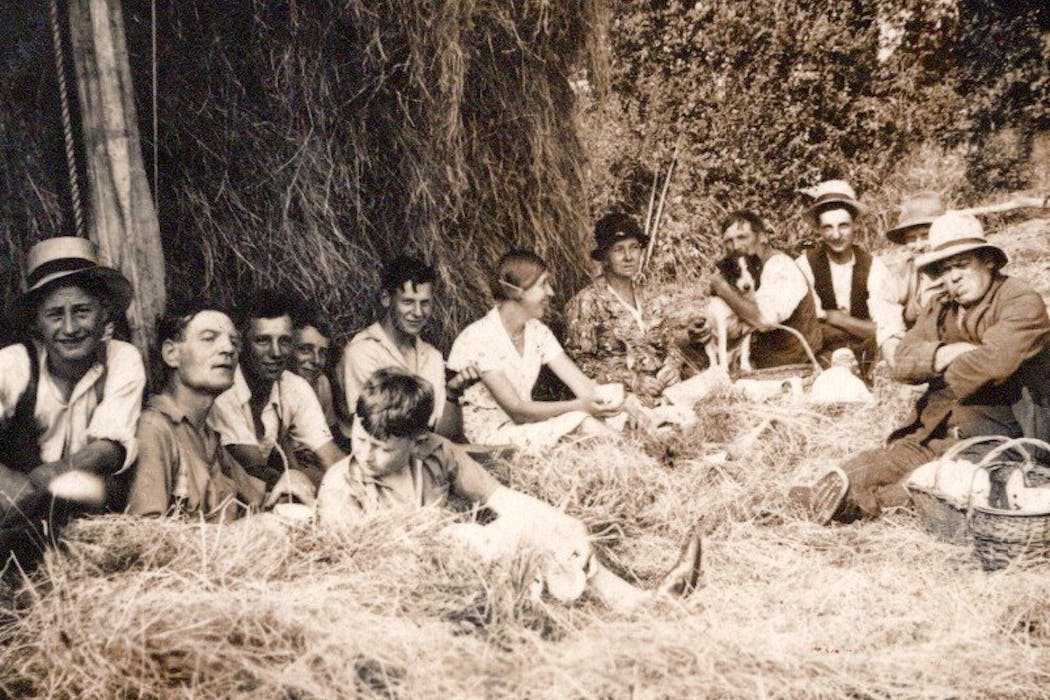
A postcard showing farm labourers gathering for a traditional harvest tea. Author’s collection

Growing up in rural Devon, I was introduced to its more remote villages, farmsteads and communities as a boy. In later life, I became interested in the food traditions of these places – finding out what was eaten, and how it was prepared and cooked. This became an important aspect of my research on the evolving relationship between food and tourism in Devon.

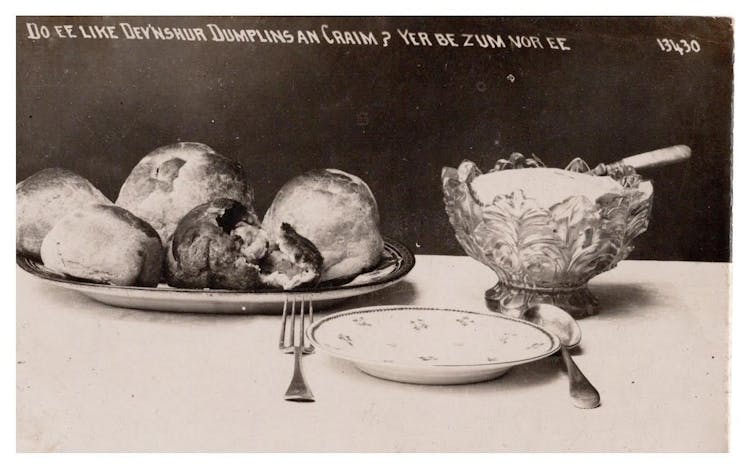
The food eaten in rural Devon up to the 1960s might appear frugal to us today, but it comprised of wholesome simple dishes. For example, Devonshire dumplings – apples wrapped in pastry and baked – were especially good when accompanied by a generous dollop of clotted cream.

Food was typically seasonal and sustaining, and fuelled hard work – especially through cold and often wet winters when a freshly baked “teddy cake”, prepared from mashed potatoes, flour, sugar, suet and dried fruit, made a welcome appearance at teatime.

I heard stories from family and friends of special food for Sundays – usually a roast dinner. And at teatime, perhaps something special like a “frawsy of junket” (milk set with rennet) or “thunder and lightning” – bread generously spread with clotted cream and anointed with treacle.

A black and white postcard showing Devonshire dumplings and cream.
A postcard showing Devonshire dumplings and cream.
Author’s collection

Before the introduction of coal- or wood-fired kitchen ranges and oil stoves, much cooking in Devon was done over an open hearth, with the bread oven fired up once a week for baking day.

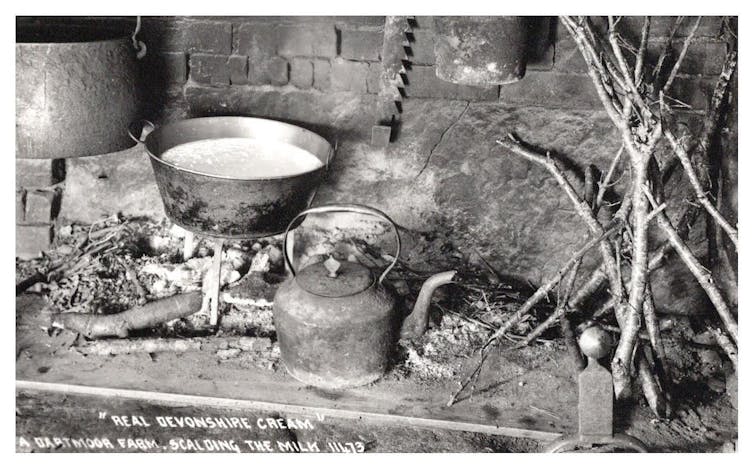
Without refrigeration and mains water, preparing meals, baking and making clotted cream and butter was hard work. Clotted cream was a three-day process – milk was allowed to stand overnight in a cool dairy, then gently heated to form the thick crust of the cream the next day, which was carefully removed on day three.

Devonshire food and tourism

Devon’s farmhouse kitchens and food featured on postcards taken by enterprising early 20th-century photographers. With their humorous captions in Devonshire dialect, postcards were popular with visitors and now provide a visual record of what was eaten.

As transport by rail and road improved in the 19th and 20th centuries, more tourists were able to discover Devon’s resorts, moorland and countryside – as well as its food.

The John Keats poem Teignmouth, written in 1818, tells of how “you may have your cream all spread upon barley bread”. Devonshire teas evolved to become the now-ubiquitous cream tea, but its origins were the staple food stuffs of “splits”, sometimes known as Chudleighs – small buns made from a yeast dough, eaten with clotted cream and jam or honey.

Cream being heated on a fireplace
A postcard shows the making of ‘real Devonshire cream’.
Author’s collection

The British author Douglas St Leger Gordon, writing in the 1950s, lamented the decline of Devon’s harvest teas, which involved rural rituals and ceremony. Traditionally, the farmer’s wife and daughters would host a feast for all who had helped with the harvest, usually comprising ham sandwiches, homemade cake, splits spread with cream and jam, and specially baked harvest buns – “all of which appeared as if by magic”. The food and tea was carried in baskets to the hay-field, and the sharing of labour was rewarded with farmhouse hospitality.

Devon’s larder of fine food was known out of the county, too. Devonshire butter was sold in Fortnum & Mason in London from the 18th century, and during the 1920s The Devonshire Dairy on Oxford Street traded butter and cream.

The word spread through cookery and travel books, too. In Alec Adair’s recipe book Dinners Long and Short (1928), salt cod fried for breakfast, apple-in-and-out (a baked pudding made with apples, suet, sugar and flour) and Devonshire fried potatoes appear alongside classic French cuisine.

Clovelly herrings, or “silver darlings”, feature in Murray’s Handbook for Travellers in Devon and Cornwall (1859), which recommended visitors should stay in the cliffside village to “regale at breakfast on herrings which have been captured overnight”, and are at their best in autumn.

Some of the more intriguing Devon recipes, alas, were not recorded for posterity. We can only imagine the dish that in his journals, Reverend John Skinner called the “squab pie”. It was “four feet in circumference … composed of neck of mutton, apples and onions, and by no means a bad thing”.

Devon’s food tells an evolving story of tradition, and a culinary and cultural relationship with landscape, communities and seasons. It is a celebration of regional food heritage and history – a legacy I hope, through my research on Devonshire food and cookery, to share with future generations.


Looking for something good? Cut through the noise with a carefully curated selection of the latest releases, live events and exhibitions, straight to your inbox every fortnight, on Fridays. Sign up here.


The Conversation

Paul Cleave does not work for, consult, own shares in or receive funding from any company or organisation that would benefit from this article, and has disclosed no relevant affiliations beyond their academic appointment.

ref. Rural Devon cuisine has a rich history – from the origins of cream teas to squab pie – https://theconversation.com/rural-devon-cuisine-has-a-rich-history-from-the-origins-of-cream-teas-to-squab-pie-266511

What if the path to ending fossil fuels looked like the fight to end slavery?

Source: The Conversation – UK – By Rob Lawlor, Lecturer in Applied Ethics, University of Leeds

When Britain abolished slavery in its empire in 1833, it paid the equivalent of hundreds of billions today in compensation – not to the enslaved, but to the slave owners. It was an imperfect, morally uneasy compromise, but it helped achieve a historic transition that had seemed impossible.

Today, as the world struggles to phase out fossil fuels, many doubt
such a transformation is still possible. Emissions keep rising, the Paris agreement isn’t properly enforced and powerful corporations continue to mislead the public and lobby against meaningful change.

Yet slavery was once seen as immovable. It was an institution that was accepted for thousands of years – far longer than fossil fuel-powered capitalism. Slavery was a significant source of wealth for many, and the rich and powerful opposed abolition. Yet it was abolished.

As a thought experiment, let us imagine a future where effective climate action unfolds the way slavery abolition once did. What might that look like?

Leadership and ‘persuasion’

Future historians might not point to a single moment of global unity, with all nations coming together to act as one. Rather, they’ll point to one nation – or a coalition – that took the lead. These early leaders might combine diplomacy, bribery and perhaps even the threat of military force or economic sanctions to “persuade” other countries to follow suit.

That’s how Britain pushed for the end of the slave trade: with a mix of idealism and hard power, with naval patrols and trade sanctions. A global fossil fuel phase out may unfold in a similarly non-ideal way.

Bottom-up pressure, top-down resistance

In this thought experiment, change will not start with governments. Rather, the demand for action will come from the bottom up. Activists will demand change and there will be huge public support but, at the same time, the rich and the powerful will continue to defend the status quo, lobbying against the introduction of stricter legislation.

The slavery abolition movement followed that pattern, with broad public support yet fierce opposition from those with most to lose. In Britain, slave owners were even compensated with £20 million (equivalent to “40% of state expenditure in 1834”) to secure their agreement to the loss of “their” property.

Something similar could happen in the climate fight. Perhaps fossil fuel companies will one day receive financial compensation to ease the transition away from fossil fuels – not because it is deserved, but rather as a pragmatic compromise.

The law as a tool for change

Legal action would also play a pivotal role. Governments and corporations will be (and, indeed, are already being) taken to court.

Abolitionists used the law in much the same way. A good example is a famous case in which enslaved Africans revolted and seized control of the ship La Amistad. The Africans were ultimately freed after reformers highlighted the contradiction between the idea of natural rights for all humankind in the US Declaration of Independence, and laws that allowed people to be private property.

As the historian David Brion Davis noted: “It was this contradiction that helped the reformers to pass laws for very gradual slave emancipation.” The Paris agreement, often dismissed as toothless, could gain real power through litigation in a similar way.

Why this thought experiment matters

Of course, this is not a real prediction. It is a thought experiment. Imagining that climate action will mirror the history of the abolition of slavery doesn’t guarantee that this is what will happen. But the comparison is valuable for several reasons.

It shows that historical precedent matters. Looking at what worked in the past can help us imagine what might work now. Massive moral change really has happened before, even despite entrenched interests working against it. As such, the example of the abolition of slavery offers hope.

It’s also realistic. Global cooperation would be ideal, but history suggests that change will be messier, potentially with some unpalatable compromise or confrontation.

The comparison poses some hard ethical questions. Is it ever justifiable to compensate fossil fuel companies? What forms of international pressure are morally acceptable?

The thought experiment can also sharpen our strategy. If this imagined future is unpalatable – if we’re ultimately not willing to send hundreds of billions to BP, Exxon and co – then it may motivate people to work for better solutions.

Perhaps most importantly, comparing slavery with climate change shows us that individual action still matters. You may feel powerless and want to know what you can do now. The history we have looked at suggests two things: support climate action publicly and, if you can afford it, provide financial support to groups like environmental law charity ClientEarth.

Abolishing slavery was messy and the strategy taken left many uneasy. Perhaps, when the time comes, significant action to mitigate climate change will involve similar controversies. But flawed solutions may be better than none.


The Conversation

Rob Lawlor received funding from the Arts and Humanities Research Council. This funded a project and a number of events that allowed me to collaborate with researchers from other disciplines, including historians.

ref. What if the path to ending fossil fuels looked like the fight to end slavery? – https://theconversation.com/what-if-the-path-to-ending-fossil-fuels-looked-like-the-fight-to-end-slavery-268162

Hidradenitis suppurativa: the painful skin condition that can hide in plain sight

Source: The Conversation – UK – By Dan Baumgardt, Senior Lecturer, School of Psychology and Neuroscience, University of Bristol

Justyna Sobesto/Shutterstock

You may not give much thought to your armpits, apart from checking whether they need another swipe of deodorant. But this small, often overlooked patch of skin is one of the body’s busiest crossroads. Beneath those folds lies a complex network of glands, nerves and lymph nodes that keep you cool, fight infection and even influence how you smell to others.

The armpit’s design allows flexibility and free movement of the arm, while serving as a vital passageway for blood vessels and nerves that link the limb to the torso. It is also home to sweat glands that regulate temperature and release pheromones, and to clusters of lymph nodes that drain fluid and help defend the body against infection.

Yet for some people, this humble underarm becomes the site of something far more troublesome than a bit of body odour. A distressing, recurring condition called hidradenitis suppurativa (HS) can turn these hidden hollows and other areas where skin rubs together into a source of chronic pain, infection and scarring. Once thought to be rare, HS is increasingly recognised and diagnosed, though still widely misunderstood.


Read more:
Pubic hair: beyond brazilians, more than manscaping


Several conditions can develop within the tissues of the armpit (or axilla, as it is known anatomically). One of these is the rather bewilderingly named hidradenitis suppurativa.

The name translates to “inflammation of the sweat glands with pus,” and that is essentially what the condition involves. HS is a chronic condition that affects areas of the body rich in sweat glands and hair follicles, particularly where the skin folds and rubs together. This means it can appear not only in the armpits but also in the groin, around the breasts and buttocks, and in the perineal area. Friction in these regions may make the condition worse.

The inflammation appears to be driven by a process similar to autoimmunity, where the body mistakenly attacks its own tissues. It seems that blockage of the hair follicles occurs first, which then triggers involvement of the sweat glands. The condition is estimated to be nearly three times more common in women than in men and may also run in families. Other risk factors include increased levels of androgens, which are hormones such as testosterone that increase after puberty, as well as smoking and obesity.

Research also shows that people of colour are disproportionately affected. Both UK and US studies have found that HS is more common and often more severe among black and Hispanic patients. These groups are also more likely to experience delays in diagnosis or have their symptoms mistaken for other infections or boils. The reasons are complex and include differences in healthcare access, underrecognition of how HS presents on darker skin tones and broader structural inequities within medical systems. Early recognition and equitable care can help prevent advanced disease and reduce the burden of pain, scarring and stigma that HS can cause.

HS symptoms

Inflamed and blocked glands appear on the skin as hard nodules or swellings. Infection can turn these into abscesses that may grow to significant sizes. Prolonged inflammation and infection can lead to the formation of sinuses, which are tunnels beneath the skin that connect nodules, and to scarring. This can cause painful, oozing or foul-smelling skin, sometimes restricting upper limb movement if scar tissue forms.

These processes resemble those seen in acne vulgaris, which is the medical term for common acne. In fact, one of the alternative names for HS is acne inversa, referring to the inverted skin folds where it occurs. Like acne, it is not caused by poor hygiene and it is not contagious, despite common misconceptions.


Read more:
Acne: a GP’s guide to understanding and managing it


When it comes to managing HS, some treatments overlap with those used for acne. Antibiotics such as lymecycline, which have both antibacterial and anti-inflammatory properties, can help prevent flare-ups. Lifestyle changes are also recommended, such as wearing loose clothing and losing weight to reduce skin folds and friction.

In some cases, HS can cause large abscesses, sometimes five to ten centimetres across, which may require surgery to drain the pus or remove scar tissue. Because of the long-term nature and scarring associated with severe disease, new biological therapies such as adalimumab, which work by calming the immune system’s overreaction, are now being used to manage more advanced cases.

HS diagnoses are rising each year. This could reflect an actual increase in numbers or simply better recognition. It may seem surprising that such a condition could be so often missed or misdiagnosed, but it happens.

HS can mimic other skin conditions that affect the folds. It is common to experience irritation from sweating or shaving in the armpits or groin, leading to folliculitis, which is inflammation of the hair follicles. Because HS lesions tend to flare and then subside, sometimes improving with short-term antibiotics, they are often mistaken for other problems and treated incompletely, sometimes for years.

Historically, HS has been poorly recognised. Its variable symptoms and the embarrassment and stigma that often surrounds skin changes in intimate areas have contributed to delays in diagnosis. Early detection can prevent progression to severe disease, so any recurrent skin changes are worth discussing with a doctor.

The armpit may seem insignificant, but for those affected by hidradenitis suppurativa, it can shape daily life in painful and isolating ways. Too many people live with the condition for years before receiving a diagnosis or effective treatment. Recognising it as a medical condition rather than a hygiene problem is a crucial step in changing that.

The Conversation

Dan Baumgardt does not work for, consult, own shares in or receive funding from any company or organisation that would benefit from this article, and has disclosed no relevant affiliations beyond their academic appointment.

ref. Hidradenitis suppurativa: the painful skin condition that can hide in plain sight – https://theconversation.com/hidradenitis-suppurativa-the-painful-skin-condition-that-can-hide-in-plain-sight-266651

Children’s books feature tidy nuclear families – but the animal kingdom tells a different story

Source: The Conversation – UK – By Louise Gentle, Principal Lecturer in Wildlife Conservation, Nottingham Trent University

Do animals really live like sylvanian families? Jeff Whyte/Shutterstock

Animals in children’s stories are often depicted as living in neat mum, dad and children family units. Examples include Fantastic Mr Fox, 101 Dalmatians and, more recently, Peppa Pig and Bluey. But, this might leave people feeling like outsiders if they don’t come from a traditional nuclear family set-up.

In reality, there is a huge diversity in what family looks like within the animal kingdom.

In biparental care, a male and female animal raise their offspring together. This type of parental behaviour is predominantly seen in birds and is rare in invertebrates, fish and mammals.

Mute swans are a good example, where mum and dad can share the responsibilities of incubating eggs, feeding the cygnets and teaching them to be independent.

Single-parenting represents the most common form of family in the animal kingdom.
Usually, males compete for access to females. This is because the female invests more in reproduction than the male. For example, in a typical mammal, the female is pregnant, suckles the young and raises it.

In some cases, such as leopards, the female raises the offspring completely on her own. In fact, single mothers are found in around 90% of mammals.

Such single-parenting is seen in children’s books like The Tale of Peter Rabbit by Beatrix Potter. Although, there are few stories where the mother chooses to single-parent, unlike in the animal kingdom where females of some species benefit from raising offspring alone.

For example, animals who are left in a nest while their parent or parents look for food may be safer from predators if only one parent is leaving scent trails as they come and go.

Sometimes the male raises the young on his own. This is more frequent in fish and amphibians, where the offspring hatch from eggs. The male midwife toad wraps his fertilised eggs around his back legs and carries them with him until they are ready to hatch.

Darwin’s frog has an alternative parenting tactic where the male carries his tadpoles in his vocal sac for six to eight weeks, until they are developed enough to face the world.

These types of behaviour allow the females to focus on feeding, which means she can produce more eggs for the next batch of young. Male parenting is also much less common in children’s books, but a popular exception is The Gruffalo’s Child by Julia Donaldson.

White toad with grey splodges carrying eggs on the back on his legs
Male midwife toads do the heavy lifting of parenting.
Pablo Mendez Rodriguez/Shutterstock

Homosexuality

Scientists have observed same sex couplings in over 500 species, including vultures, dolphins, giraffe, bonobos, geckos and dragonflies. Although life-long homosexuality in the wild is rare, in which animals forego heterosexual relationships, permanent male-male couplings have been seen in sheep.

Also, female albatrosses are known to sometimes reject males once their eggs have been fertilised, choosing to raise offspring in female-female relationships.

One of the most famous cases of homosexuality in captivity is that of Roy and Silo, a pair of chinstrap penguins from Central Park Zoo in New York, who formed such a strong bond in the early 2000s that the keeper gave them an egg to hatch and raise.

This story was turned into a popular children’s book And Tango Makes Three by Justin Richardson. Unfortunately, Silo’s head was turned by a female named Scrappy, ending his six-year relationship with Roy.

Same-sex parenting can be extended to species where large family units develop, such as elephants. Generally, elephant family units consist of several related females and their calves, led by an older matriarch. Sisters and grandmothers undertake allomothering, babysitting the youngsters, teaching them foraging, vigilance and defence, and sometimes even take on communal suckling of infants.

The story of one of the most famous communal parent species, the honey bee, has been turned into a novel for adults. The Bees by Laline Paull is the story of worker bee Flora 717, who helps feed her newborn sisters, and her life in the hive.

Communal parenting doesn’t have to be restricted to one sex, though. Many animals, including meerkats, are cooperative breeders. The young stay at home to help their parents to raise their baby siblings rather than go off and breed on their own. Most cooperative breeders are totipotent, which means they choose to help out temporarily. But some, such as naked mole rats are permanent helpers, foregoing their own reproduction.

Fostering and adoption

There are plenty of cases of animals being manipulated into raising the young of another. The most famous case is the common cuckoo where the female lays its egg in the nest of a different species, leaving the foster parent to raise the chick.

This deceptive brood-parasitism also happens within a species. For example, sometimes female starlings dump their eggs in the nests of other starlings.

Deliberate fostering and adopting is surprisingly common in the animal kingdom. Occasionally, adoption even happens between species. In 2004, a wild capuchin monkey was seen caring, for a common marmoset although it is not known how long this relationship lasted.

One of my favourite children’s storybooks is The Odd Egg by Emily Gravett, where a mallard adopts an egg that eventually hatches an alligator.

There are also many animals that hang out in friendship groups for a decent part of their adolescence. This is common among long-lived species, such as red deer, where bachelor herds often stay together until they reach sexual maturity.

Like humans who are orphaned early, estranged from their parents, or just leaving home, animals find family among their peers, learning from them, and creating strong bonds. Young, swifts form “screaming parties” for protection while looking for places to breed in future years.


Read more:
What fathers in the animal kingdom can tell us about humans


The final type of parenting seen in the animal kingdom is one that is, thankfully, rarely seen in humans – no parenting. The young of these animals are generally numerous, to ensure that some survive. They are also born to be independent of others.

This parenting style is typical of species such as fish and reptiles, and invertebrates including butterflies and spiders. Some types of solitary wasp trap paralysed grasshoppers in their nest, plug it shut and then abandon the nest.

This ensures a food supply for their young when they hatch. But, if their mother hasn’t provided enough food, larger wasp larvae will snack on their siblings instead. Three quarters of wasp larvae in nests end up as food for their siblings.

So, nuclear families are definitely not the norm when it comes to the animal kingdom. Species adopt a variety of parental care methods to ensure that their genes are passed on to the next generation.


This article features references to books that have been included for editorial reasons, and may contain links to bookshop.org. If you click on one of the links and go on to buy something from bookshop.org The Conversation UK may earn a commission.

The Conversation

Louise Gentle works for Nottingham Trent University.

ref. Children’s books feature tidy nuclear families – but the animal kingdom tells a different story – https://theconversation.com/childrens-books-feature-tidy-nuclear-families-but-the-animal-kingdom-tells-a-different-story-265532

Booker prize 2025: the six shortlisted books, reviewed by experts

Source: The Conversation – UK – By Sojin Lim, Reader in Asia Pacific Studies, Co-Director of the International Institute of Korean Studies, University of Lancashire

From 150 titles to a longlist of 13, six novels have been shortlisted for the 2025 Booker prize. Our academics review the finalists ahead of the announcement of the winner on November 10.

The Rest of Our Lives by Ben Markovits

Middle-aged Tom waits 12 years to keep his promise to leave his unfaithful wife when their youngest child starts college, then embarks on a roadtrip across an American landscape both vivid and commonplace.

Tom recounts the journey and his memories, his voice fluctuating between disclosure and holding back. The reader is the silent party, compelled to reflect: do you resemble the wife craving emotional impact, the son constructing amicable distance, the daughter thrust into change, the ex-partner successful but unsatisfied, or Tom himself? There is nothing really extraordinary, and yet the story is captivating.

Despite one significant obstacle, Tom never expresses regret for risks not taken. He has unanticipated glimpses of alternative paths, and learns the joys of routine, a steady career and ordinary family life. A film adaptation is inevitable; its challenge will be to capture the gentle melancholic tension of this thoughtful novel.

Jenni Ramone is an associate professor of postcolonial and global literatures at Nottingham Trent University


Read more:
Orbital by Samantha Harvey wins the 2024 Booker prize – a short but powerful story urging us to save the planet


The Land in Winter by Andrew Miller

An atmospheric domestic drama set during 1963’s “Big Freeze”, the novel follows the lives of two married couples – Eric and Irene, Bill and Rita – in the south-west of England over a few bitter winter months. Due to the intensity of events taking place over a short period of time with just a few characters, The Land in Winter feels claustrophobic, almost soap opera-like.

The wives are both pregnant and they bond, albeit tentatively, over impending motherhood. Despite being the novel’s protagonists, Rita and Irene feel like characters who have things done to them, rather than having their own agency.

Their pregnancies compound this, presented as inescapable obligations as opposed to happy, wanted circumstances. In a novel thick with metaphor and symbolism (the women’s friendship begins when Rita gifts Irene freshly laid eggs) it is perhaps unsurprising that a third pregnancy, that of a cow on Bill and Rita’s farm, foreshadows the trauma and tragedy experienced by the novel’s end.

Stevie Marsden is a lecturer in publishing studies at Edinburgh Napier University

Flashlight by Susan Choi

Susan Choi’s Flashlight opens with a disorienting event. Ten-year-old Louisa and her father Serk walk along a seaside breakwater at dusk, a flashlight in hand. By morning, Louisa is found barely alive. Serk is missing and presumed drowned. Instead of offering immediate answers, the novel follows three intertwined lives – Serk, Louisa, and Anne – across continents and decades.

What begins as a mystery expands into intimate family drama that takes in broader historical shifts, spanning across the Pacific and from the 1970s onwards. Serk, an ethnic Korean born in Japan, emigrates to the US and navigates a life shaped by statelessness and historical upheaval. Anne, Louisa’s American mother, embodies another thread of rupture and inheritance. Together, their stories form a constellation of absence and unresolved loss.

Choi illuminates the hidden currents of identity, migration and disappearance with remarkable skill. Flashlight is an ambitious, emotionally resonant work that rewards close reading.

Sojin Lim is a reader in Asia Pacific studies at University of Lancashire

Flesh by David Szalay

The titles of Szalay’s two Booker-nominated novels, this year’s Flesh and 2016’s All That Man Is, could be interchangeable. Both explore contemporary European masculinity, but where All That Man Is did this through nine short stories, Flesh is a novel about the eventful life of one Hungarian, István, from aged 15 to mid-life.

Here is sex, infidelity, murder, war. But the novel is spare rather than voluptuous, trimmed to the bone rather than fleshy. István’s thoughts and tragedies are often absent from the writing. We don’t hear about his time in a young offenders’ institution or anything at all about his father, for example. We learn that he is physically brave and attractive to women. “Flesh” then refers to the way he is seen, as only a body, a member of the new working classes whose lives are defined by precarity.

Kept outside, overhearing only his bare responses – “Okay” – readers become complicit in this failure to consider all that man is. And it is precisely this innovatively spare narration which makes the novel so deeply affecting.

Tory Young is an associate professor of literature at Anglia Ruskin University

The Loneliness of Sonia and Sunny by Kiran Desai

At 35, Kiran Desai became the youngest female author to be awarded the Booker prize when her second novel, The Inheritance of Loss, won in 2006. The follow up, The Loneliness of Sonia and Sunny, has been twenty years in the making.

Set between the 1990s and early 2000s, Desai’s elaborately structured novel deftly traverses the US, India, Italy and Mexico as it spins the tale of two Indian-born migrants: aspiring novelist Sonia Shah studying in Vermont and struggling journalist Sunny Bhati in New York. Their thwarted romance is instigated by their respective meddling north Indian grandparents, who reside in mouldering mansions symbolic of their declining fortunes and a decaying colonialism, making this 667-page love story an epic, multi-generational family saga.

It dramatises how nation, class, gender, race and history shape its large cast of characters, each explored in detailed vignettes. Desai shows formidable insight as she ponders the cultural values of the US and India, the nature of loneliness, ruthless liberal individualism, postcolonial disintegration and violence, but also creativity.


Read more:
Kiran Desai’s first novel in nearly 20 years is shortlisted for the Booker. Last time, she won it


Ruvani Ranasinha is a professor of global literature at King’s College London

Audition by Katie Kitamura

Katie Kitamura’s Audition (2025) consists of two seemingly contradictory parts. In the first, a stage and screen actress in her late 40s meets a much younger man in a Manhattan restaurant. He has asked for the meeting because he suspects he may be her secret son, given up for adoption as a baby. She reveals that this cannot be: she had an abortion.

In the second part, the young man is the woman’s son, and has grown up with her and her husband, although he has, as an adult, argued with them and left home. Now he wants to return with his girlfriend.

These two seemingly contradictory scenarios are balanced, played against one another, and the tension between these “sliding doors” variant realities throws into relief the uncertainties, intermittencies and variabilities of existence. A pared-down novella, directly written and intriguingly characterised, this is a memorably ambiguous meditation on parenthood, performance, relationship and commitment.

Adam Roberts is professor of 19th-century literature at Royal Holloway


Looking for something good? Cut through the noise with a carefully curated selection of the latest releases, live events and exhibitions, straight to your inbox every fortnight, on Fridays. Sign up here.


The Conversation

The authors do not work for, consult, own shares in or receive funding from any company or organisation that would benefit from this article, and have disclosed no relevant affiliations beyond their academic appointment.

ref. Booker prize 2025: the six shortlisted books, reviewed by experts – https://theconversation.com/booker-prize-2025-the-six-shortlisted-books-reviewed-by-experts-267508

Tensión entre EE. UU. y Colombia: un cóctel de antipatía personal, cambio geopolítico y disputa energética

Source: The Conversation – (in Spanish) – By Ulf Thoene, PhD, Profesor Asociado de Ética Empresarial y Organizacional, Negocios Internacionales y Geopolítica, Universidad de La Sabana

El presidente de Colombia, Gustavo Petro, se manifestaba en Nueva York contra las políticas de Trump en el conflicto palestino-israelí el pasado 20 de octubre. Saku_rata160520/Shutterstock

La creciente tensión entre los Estados Unidos y Colombia, protagonizada de forma personal por los presidentes Donald Trump y Gustavo Petro, ha evolucionado hacia un conflicto multifacético. Este combina la animadversión personal de estos líderes, sanciones y tensiones comerciales, un nuevo orden mundial y choques en políticas antidrogas.

En un contexto marcado por las guerras en Gaza y Ucrania, la fragmentación económica global, el realineamiento geopolítico y un auge del intervencionismo económico estatal y la geoeconomía, este conflicto, aparentemente bilateral, ejemplifica el cambio del libre comercio a un escenario de bloques rivales.

El mundo se bifurca en esferas de influencia con reminiscencias de una guerra fría económica y transita hacia un orden mundial multipolar. Lo ilustra una Unión Europea en problemas, el ascenso de los BRICS y la creciente importancia de entidades como la Organización de Cooperación de Shanghái.

Las acciones a menudo impredecibles y erráticas de Trump, que incluyen recortes de ayuda, sanciones y amenazas de aranceles, ponen en riesgo décadas de cooperación entre Colombia y EE. UU. Pese a ello, el impacto sobre la economía y las empresas no reviste la gravedad que estas medidas suponen para otros países debido a las exenciones que operan en el caso colombiano.

Doctrina Monroe 2.0

La “Doctrina Monroe 2.0”, burlonamente llamada “Doctrina Donroe”, busca afirmar el dominio de EE. UU., una potencia en hidrocarburos, en el hemisferio occidental. La demanda de energía, que incluye combustibles fósiles, energía nuclear y renovables, así como de minerales, impulsan maniobras geopolíticas por parte de Trump. Estas buscan limitar la influencia china y rusa.

Esa disputa por el acceso a la energía y los minerales se comprende como parte de la carrera global por la inteligencia artificial. También se explica por la necesidad de satisfacer la creciente demanda de electricidad para cumplir con el deseo de las poblaciones, que aspiran a estándares de vida más altos.

Todo ello resulta clave para entender las tensiones globales crecientes. La existencia de importantes productores de hidrocarburos en el hemisferio occidental, como Canadá, EE. UU., México, Brasil, Guyana o Venezuela, sin olvidar el potencial petrolero del yacimiento Vaca Muerta en Argentina, convierte a esta región en un campo de batalla geopolítico intensamente disputado.

Colombia, un aliado tradicional

Colombia constituye un aliado tradicional de EE. UU. en Sudamérica. Las relaciones han estado ancladas en esfuerzos antidrogas. Desde el lanzamiento del Plan Colombia en 2000, EE. UU. ha invertido fondos significativos y capital político en la nación andina, con costas en el Caribe y el Pacífico. Esta asociación ha incluido entrenamiento militar, equipo e intercambio de inteligencia.

Por todo ello, Colombia sigue siendo un puesto vital de avanzada para la inteligencia estadounidense en los Andes. Sin embargo, las políticas del presidente Petro, que han ido acompañadas de críticas severas a la política exterior de EE. UU., y su postura sobre el conflicto en Gaza, han servido de justificación de la crisis actual. Siempre con el telón de fondo que representa el deseo de Trump de recuperar el control sobre las naciones del hemisferio occidental y de Sudamérica en particular.

Acercándose al final de su presidencia de cuatro años y cada vez más visto como un “pato cojo” (expresión basada en el término anglosajón lame duck, que hace referencia a la debilidad de los cargos electos salientes), Petro ha buscado posicionarse como una voz en el discurso sobre cambio climático y en el debate sobre los derechos del pueblo palestino, utilizando la disputa actual con Trump para reforzar su imagen.

Esta disputa se intensificó en octubre de 2025, cuando Trump acusó a Petro de permitir que los carteles florecieran. Trump detuvo la ayuda y los pagos de EE. UU., descertificó a Colombia como socio en la lucha contra los narcóticos e impuso sanciones a Petro, a parte de su familia y a un círculo cercano de asesores.

Estas crecientes tensiones se intensifican como consecuencia de los ataques fatales contra barcos venezolanos, que EE. UU. relaciona con el transporte de drogas. A bordo de dichas embarcaciones se encontraban ciudadanos colombianos, a quienes Petro llama “pescadores asesinados”. Esto ha provocado revocaciones de visas y un aumento de presencia militar en el Caribe.

Factores comerciales

Los factores comerciales amplifican la brecha. Trump anunció aranceles sobre las exportaciones colombianas junto con los recortes de ayuda, posiblemente escalando de advertencias a acciones. Esto, unido a las amenazas arancelarias contra Brasil y las sanciones estrictas sobre Venezuela, revela parte de la estrategia de Trump para atraer a naciones latinoamericanas, como la Argentina de Milei, al lado de EE. UU. en medio de realineamientos globales.

Sin embargo, las sanciones se dirigen a Petro sin castigar ampliamente a las empresas, evitando medidas aplastantes para la economía y temidas por las firmas colombianas. Este enfoque selectivo refleja la impredecibilidad de Trump y los desafíos con la aplicación de sanciones. También es difícil descifrar qué facción de la actual administración de EE. UU. está impulsando la política actual hacia Sudamérica en particular.

Las divergencias en políticas de drogas alimentan el fuego. Colombia, a través de Venezuela, se ve como un proveedor clave de narcóticos, con cárteles que han infiltrado el negocio de hidrocarburos en varias naciones productoras de petróleo y gas en América Latina. Quedan así ligados los conflictos sobre drogas y energía a la geopolítica.

El aumento de la producción de cocaína durante el mandato de Petro ha alarmado a Estados Unidos. Pero cortar la ayuda podría desestabilizar la seguridad, permitiendo que los grupos armados aumenten y adquieran más poder. También existe el temor de que este tipo de sanciones contra Colombia puedan dejar a EE. UU. sin un aliado tradicional e incluso sirvan para fortalecer indirectamente al líder asediado de Venezuela, Nicolás Maduro.

Animosidad personal entre Trump y Petro

El conflicto adquiere tintes dramáticos por las motivaciones personales de dos presidentes muy singulares, Trump y Petro. Ambos líderes nacionales están atendiendo a sus partidarios locales sin mostrar ninguna disposición a ceder, lo que convierte sus posturas en símbolos de desafío.

Con China y Rusia geográficamente alejadas, EE. UU. aprovecha su poderío militar y el peso del dólar para mantener el dominio en la escalada en gran parte del hemisferio occidental.

A medida que el mandato de Petro avanza hacia su finalización en 2026, existe la esperanza de que se produzca un pase de página. Pero las tensiones actuales subrayan cómo las animosidades personales, el realineamiento estratégico y la carrera por controlar recursos energéticos vitales exacerban las divisiones globales.

La posición de Colombia es poco envidiable, ya que este aliado tradicional de EE. UU. podría encontrarse bajo mayor presión para repensar sus políticas exteriores y comerciales y posiblemente trazar un nuevo curso. En este nuevo orden mundial multipolar, nadie parece ganar con la escalada de tensión que vivimos.

The Conversation

Ulf Thoene, PhD no recibe salario, ni ejerce labores de consultoría, ni posee acciones, ni recibe financiación de ninguna compañía u organización que pueda obtener beneficio de este artículo, y ha declarado carecer de vínculos relevantes más allá del cargo académico citado.

ref. Tensión entre EE. UU. y Colombia: un cóctel de antipatía personal, cambio geopolítico y disputa energética – https://theconversation.com/tension-entre-ee-uu-y-colombia-un-coctel-de-antipatia-personal-cambio-geopolitico-y-disputa-energetica-267949

Insultos, amenazas y agresiones: cómo dejar de normalizar la violencia en el fútbol

Source: The Conversation – (in Spanish) – By Eneko Sanchez Mencia, Profesor de Ciencias de la Actividad Física y el Deporte Universidad de Deusto, Universidad de Deusto

dotshock/Shutterstock

La violencia en el fútbol volvió a ser noticia. En Écija, una pelea entre aficionados hace unos días terminó con varios heridos. Días después, un autobús de seguidores del Flamengo volcó y dejó decenas de lesionados.

Estos sucesos no son casualidad: muestran cómo algo tan apasionante como el deporte puede convertirse en un espacio de tensión y conflicto.

No se trata de episodios aislados, sino señales de un problema que mezcla identidad, pertenencia, rivalidad y falta de control. Lo que debería ser una celebración deportiva acaba convirtiéndose, demasiadas veces, en un escenario de confrontación.

El fútbol, como otros deportes de masas, no vive al margen de la sociedad. Lo que ocurre en los estadios, en las gradas o durante los desplazamientos masivos de hinchas, no puede entenderse sin observar lo que sucede fuera: una sociedad polarizada, emocionalmente desbordada y donde el conflicto parece cada vez más normalizado. En las gradas, la pasión se multiplica y, a veces, se desborda.
¿En qué momento la emoción que nos une empezó a ser también la que nos separa?

Pasión y conflicto en el campo

En el fútbol, la pasión no solo se siente: se comparte, se grita y se convierte en parte de quienes somos. Animar a un equipo no es solo seguir unos colores, sino formar parte de algo más grande, de un “nosotros” que da sentido y pertenencia. En muchos casos, ese sentimiento llega a llenar vacíos de reconocimiento o de comunidad que nuestro día a día no siempre ofrece.

Como explica un análisis sociológico sobre la cultura futbolística española, esta mezcla de emoción, pertenencia y conflicto complica las cosas. Hace que el estadio sea además de lo deportivo, un escenario donde también se expresan frustraciones y deseos de reconocimiento.

El problema aparece cuando esa identidad se construye en oposición al otro: el equipo rival deja de ser un adversario deportivo y pasa a verse como una amenaza. Lo que empezó siendo una expresión de emoción y orgullo se convierte en un espacio de enfrentamiento donde la rivalidad pesa más que el propio juego.

La violencia se previene, no se castiga

Los datos de la Comisión Estatal contra la Violencia, el Racismo, la Xenofobia y la Intolerancia en el Deporte muestran que, a pesar de los esfuerzos institucionales, los incidentes en los estadios españoles se mantienen estables. La mayoría no implica agresiones físicas, pero la violencia verbal, simbólica y discriminatoria (insultos, humillaciones o cánticos ofensivos) sigue siendo habitual. Es la parte más invisible de la violencia, pero también la más normalizada. Castigar ayuda a frenar, pero no a cambiar.

Para encontrar soluciones hay que mirar más allá de las sanciones. En otros países ya se están probando enfoques diferentes. En Suecia, el equipo del investigador Clifford Stott, de la Universidad de Keele, vio que el diálogo con los aficionados ayuda a reducir los conflictos. Lo hacen a través de personas mediadoras, llamadas Supporter Liaison Officers –oficiales de enlace con los aficionados–, que escuchan, orientan y crean puentes entre hinchas y autoridades. No se trata de vigilar más, sino de escuchar mejor.

Educar la emoción

La violencia en el fútbol no empieza en los estadios, sino mucho antes. Nace en la forma en que enseñamos a competir, en los modelos que mostramos y en cómo aprendemos a gestionar la frustración.

En España también se están dando pasos. Algunos programas educativos y comunitarios promueven la convivencia y el respeto, sobre todo en el deporte base. Aun así, estudios recientes muestran que la violencia verbal y simbólica sigue presente incluso en las categorías infantiles. La presión por ganar, la falta de modelos positivos y la ausencia de formación emocional hacen que esos comportamientos se repitan desde edades muy tempranas.

Por eso, la solución no pasa solo por reforzar la seguridad, sino por educar la emoción. Los clubes, las escuelas y las familias tienen un papel clave. Enseñar a competir también significa enseñar a respetar, a perder y a controlar la rabia.

Los clubes y las federaciones deberían asumir un papel activo como agentes de transformación social. Invertir en formación, mediación y campañas de convivencia no es un gasto sino una inversión en salud pública y cohesión social.

Los medios de comunicación también tienen su parte. Cuando priorizan el espectáculo del conflicto, refuerzan la narrativa de la violencia. Mostrar referentes positivos, diversidad y respeto sería un paso mucho más poderoso hacia el cambio cultural que necesitamos.

La violencia ultra no es solo responsabilidad de unos pocos radicales. Es el reflejo de cómo entendemos la pasión, el éxito y la rivalidad. Si queremos que el fútbol vuelva a ser un espacio de unión, debemos empezar fuera de los estadios: en las aulas, en los barrios, en los clubes. Solo así podremos transformar la pasión en convivencia y la rivalidad en respeto.

The Conversation

Las personas firmantes no son asalariadas, ni consultoras, ni poseen acciones, ni reciben financiación de ninguna compañía u organización que pueda obtener beneficio de este artículo, y han declarado carecer de vínculos relevantes más allá del cargo académico citado anteriormente.

ref. Insultos, amenazas y agresiones: cómo dejar de normalizar la violencia en el fútbol – https://theconversation.com/insultos-amenazas-y-agresiones-como-dejar-de-normalizar-la-violencia-en-el-futbol-268638

Why Canada must transform its long-term care system

Source: The Conversation – Canada – By Denise Suzanne Cloutier, Professor, Health Geography and Social Gerontology, University of Victoria

With Canadians now living longer than ever, the question of who will care for them — and under what conditions — when they can no longer care for themselves has become one of the country’s most pressing issues.

According to 2021 census data, the population aged 85 and over and 100 and over are growing at rates much faster than other population cohorts.

And the reality is that the longer we live, the more likely we are to experience chronic, multiple and complex health conditions like hypertension, osteoarthritis, heart disease, osteoporosis, chronic pulmonary disease, diabetes, cancer and dementia.

While most older people will continue to “age in place” in their own homes and in relatively good health, about eight per cent, or roughly 528,000, will require the specialized care provided in long-term care (LTC) or assisted living facilities.

This is especially true if they are experiencing progressive and intense illness or disease, disabilities or injuries, and if home care and family supports are limited.

The LTC workforce under pressure

As the demand for long-term care grows, Canada is simultaneously witnessing an exodus of LTC workers through retirement or by seeking employment elsewhere due to chronic and sustained sector challenges, including lack of funding and the lingering impacts of the COVID-19 pandemic.

Roughly 14 per cent of the Canadian health-care workforce, or just over 50,000 people, are engaged in LTC. This number does not include every member of the care team but does include those who spend the most time providing care at residents’ bedsides.

These practitioners include personal support workers, licensed practical nurses (LPNs), registered nurses (RNs), nurse practitioners and occupational and physiotherapists — most of whom are racially diverse and female. Many feel overwhelmed and unheard.

Caring for the care providers

It is a well-worn but still valid cliché to say the pandemic shone a spotlight on longstanding challenges within LTC, including rising privatization trends and rigid hierarchical organizational structures.

During and after the pandemic, workers said they felt pulled in all directions. Overtime hours, absenteeism, mental-health issues and sick time escalated as staff performed dual roles as both workers and acting family members due to restrictive distancing protocols.

The Canadian Institute for Health Information reported that in 2023, the number of LPNs, RNs and occupational therapists declined by 6.1 per cent, 2.1 per cent and 9.1 per cent respectively. Despite of these conditions, the LTC workforce is known to go above and beyond the call of duty in providing care.

In the same year, a government consultation aimed at developing national standards for quality of care and safety in LTC reported that LPNs, aides and allied health professionals were calling for action on working conditions, emphasizing the importance of job stability, equitable wages, training, advancement opportunities, reasonable workloads and limits on mandatory overtime in support of their health, well-being and job satisfaction.

Sociologist Pat Armstrong, a leading Canadian expert in transforming care for older adults, has said that “the conditions of work are the conditions of care.” This is a poignant reminder of the critical relationship between workers and each LTC environment in the care of residents.

Her words underline a hard truth — without attending to this relationship adequately, the level of care for residents becomes compromised.

A new model for aging well with dignity

The costs of providing LTC in large-facility settings bear further scrutiny.

The Conference Board of Canada suggested that 199,000 additional LTC beds will be needed between 2018 and 2035, an investment of $64 billion in capital spending and $130 billion in operating expenditures.

A 2021 survey of about 2,000 Canadians conducted by Ipsos and reported by the Canadian Medical Association noted that 97 per cent of those aged 65 and over are concerned about the state of Canada’s LTC system. Over 95 per cent of those same seniors said they will do everything they can to avoid moving into a LTC home.

Older people want to remain at home for as long as possible. But when they cannot, a growing global movement advocates for the development of smaller, less institutional, more home-like environments, including dementia-friendly communities, to care for older people, especially those living with dementia.

These new models are expanding across Canada, based on the De Hogeweyk Care Concept developed in the Netherlands in the 1990s, with the first village established in 2009. These villages offer settings that support social interaction and engagement in everyday life, provide access to outdoor spaces and gardens and help people retain dignity and autonomy for as long as possible.

For people living with dementia and older adults who desire to remain at home as long as they can, this is a silver lining.

Evidence is growing that these inclusive, age-friendly, home-like settings not only give residents a greater sense of comfort, control and autonomy; they also also provide an environment for direct-care workers to thrive and do meaningful work that makes a difference in their lives and in the daily lives of those they care for.

Creating environments that better support the conditions of care — quality of life for residents and workers, and having care labour recognized, respected and adequately remunerated across all sectors, with opportunities for training and career advancement — will encourage long-time workers to remain in the sector and help ensure that new health-care graduates continue to see LTC as a viable and rewarding career path.

If Canada wants to ensure dignity in aging, it must treat care work as essential infrastructure.

The Conversation

Denise Suzanne Cloutier is part of the C.A.R.I.N.G Dementia Collaborative funded by the University of Victoria, Aspiration 2030 initiative.

ref. Why Canada must transform its long-term care system – https://theconversation.com/why-canada-must-transform-its-long-term-care-system-267285

Le succès des applis de scans alimentaires à l’ère de la défiance

Source: The Conversation – France in French (3) – By Jean-Loup Richet, Maître de conférences et co-directeur de la Chaire Risques, IAE Paris – Sorbonne Business School; Université Paris 1 Panthéon-Sorbonne

Portées par la popularité de Yuka ou d’Open Food Facts, les applications de scan alimentaire connaissent un réel engouement. Une étude analyse les ressorts du succès de ces outils numériques qui fournissent des informations nutritionnelles perçues comme plus indépendantes que celles présentes sur les emballages et délivrées soit par les pouvoirs publics (par exemple, l’échelle Nutri-Score) soit par les marques.


La confiance du public envers les autorités et les grands industriels de l’alimentaire s’érode, et un phénomène en témoigne : le succès fulgurant des applications de scan alimentaire. Ces outils numériques, tels que Yuka ou Open Food Facts, proposent une alternative aux étiquettes nutritionnelles officielles en évaluant les produits au moyen de données collaboratives ouvertes ; elles sont ainsi perçues comme plus indépendantes que les systèmes officiels.

Preuve de leur succès, on apprend à l’automne 2025 que l’application Yuka (créée en France en 2017, ndlr) est désormais plébiscitée aussi aux États-Unis. Robert Francis Kennedy Jr, le ministre de la santé de l’administration Trump, en serait un utilisateur revendiqué.

Une enquête autour des sources d’information nutritionnelle

La source de l’information apparaît essentielle à l’ère de la méfiance. C’est ce que confirme notre enquête publiée dans Psychology & Marketing. Dans une première phase exploratoire, 86 personnes ont été interrogées autour de leurs usages d’applications de scan alimentaire, ce qui nous a permis de confirmer l’engouement pour l’appli Yuka.

Nous avons ensuite mené une analyse quantitative du contenu de plus de 16 000 avis en ligne concernant spécifiquement Yuka et, enfin, mesuré l’effet de deux types de signaux nutritionnels (soit apposés sur le devant des emballages type Nutri-Score, soit obtenus à l’aide d’une application de scan des aliments comme Yuka).

Les résultats de notre enquête révèlent que 77 % des participants associent les labels nutritionnels officiels (comme le Nutri-Score) aux grands acteurs de l’industrie agroalimentaire, tandis qu’ils ne sont que 27 % à percevoir les applis de scan comme émanant de ces dominants.


À lire aussi :
Pourquoi Danone retire le Nutri-Score de ses yaourts à boire


À noter que cette perception peut être éloignée de la réalité. Le Nutri-Score, par exemple, n’est pas affilié aux marques de la grande distribution. Il a été développé par le ministère français de la santé qui s’est appuyé sur les travaux d’une équipe de recherche publique ainsi que sur l’expertise de l’Agence nationale de sécurité sanitaire de l’alimentation, de l’environnement et du travail (Anses) et du Haut Conseil de la santé publique (HCSP).

C’est quoi, le Nutri-Score ?

  • Le Nutri-Score est un logo apposé, sur la base du volontariat, sur l’emballage de produits alimentaires pour informer le consommateur sur leur qualité nutritionnelle.
  • L’évaluation s’appuie sur une échelle de cinq couleurs allant du vert foncé au orange foncé. Chaque couleur est associée à une lettre, de A à E.
  • La note est attribuée en fonction des nutriments et aliments à favoriser dans le produit pour leurs qualités nutritionnelles (fibres, protéines, fruits, légumes, légumes secs) et de ceux à éviter (énergie, acides gras saturés, sucres, sel et édulcorants pour les boissons).

De son côté, la base de données Open Food Facts (créée en France en 2012, ndlr) apparaît comme un projet collaboratif avec, aux manettes, une association à but non lucratif. Quant à l’application Yuka, elle a été créée par une start-up.

Des applis nutritionnelles perçues comme plus indépendantes

Ces applications sont vues comme liées à de plus petites entités qui, de ce fait, apparaissent comme plus indépendantes. Cette différence de perception de la source engendre un véritable fossé de confiance entre les deux types de signaux. Les consommateurs les plus défiants se montrent plus enclins à se fier à une application indépendante qu’à une étiquette apposée par l’industrie ou par le gouvernement (Nutri-Score), accordant ainsi un avantage de confiance aux premières.

Ce phénomène, comparable à un effet « David contre Goliath », illustre la manière dont la défiance envers, à la fois, les autorités publiques et les grandes entreprises alimente le succès de solutions perçues comme plus neutres. Plus largement, dans un climat où rumeurs et désinformation prospèrent, beaucoup préfèrent la transparence perçue d’une application citoyenne aux communications officielles.

Dimension participative et « volet militant »

Outre la question de la confiance, l’attrait des applications de scan tient aussi à l’empowerment ou empouvoirement (autonomisation) qu’elles procurent aux utilisateurs. L’empowerment du consommateur se traduit par un sentiment accru de contrôle, une meilleure compréhension de son environnement et une participation plus active aux décisions. En scannant un produit pour obtenir instantanément une évaluation, le citoyen reprend la main sur son alimentation au lieu de subir passivement l’information fournie par le fabricant.

Cette dimension participative a même un volet qui apparaît militant : Yuka, par exemple, est souvent présentée comme l’arme du « petit consommateur » contre le « géant agro-industriel ». Ce faisant, les applications de scan contribuent à autonomiser les consommateurs qui peuvent ainsi défier les messages marketing et exiger des comptes sur la qualité des produits.

Des questions de gouvernance algorithmique

Néanmoins, cet empowerment s’accompagne de nouvelles questions de gouvernance algorithmique. En effet, le pouvoir d’évaluer les produits bascule des acteurs traditionnels vers ces plateformes et leurs algorithmes. Qui définit les critères du score nutritionnel ? Quelle transparence sur la méthode de calcul ? Ces applications concentrent un pouvoir informationnel grandissant : elles peuvent, d’un simple score, influer sur l’image d’une marque, notamment celles à la notoriété modeste qui ne peuvent contrer une mauvaise note nutritionnelle.

Garantir la sécurité et l’intégrité de l’information qu’elles fournissent devient dès lors un enjeu essentiel. À mesure que le public place sa confiance dans ces nouveaux outils, il importe de s’assurer que leurs algorithmes restent fiables, impartiaux et responsables. Faute de quoi, l’espoir d’une consommation mieux informée pourrait être trahi par un excès de pouvoir technologique non contrôlé.

À titre d’exemple, l’algorithme sur lequel s’appuie le Nutri-Score est réévalué en fonction de l’avancée des connaissances sur l’effet sanitaire de certains nutriments et ce, en toute transparence. En mars 2025, une nouvelle version de cet algorithme Nutri-Score est ainsi entrée en vigueur.

La montée en puissance des applications de scan alimentaire est le reflet d’une perte de confiance envers les institutions, mais aussi d’une aspiration à une information plus transparente et participative. Loin d’être de simples gadgets, ces applis peuvent servir de complément utile aux politiques de santé publique (et non s’y substituer !) pour reconstruire la confiance avec le consommateur.

En redonnant du pouvoir au citoyen tout en encadrant rigoureusement la fiabilité des algorithmes, il est possible de conjuguer innovation numérique et intérêt général. Réconcilier information indépendante et gouvernance responsable jouera un rôle clé pour que, demain, confiance et choix éclairés aillent de pair.

The Conversation

Marie-Eve Laporte a reçu des financements de l’Agence nationale de la recherche (ANR).

Béatrice Parguel, Camille Cornudet, Fabienne Berger-Remy et Jean-Loup Richet ne travaillent pas, ne conseillent pas, ne possèdent pas de parts, ne reçoivent pas de fonds d’une organisation qui pourrait tirer profit de cet article, et n’ont déclaré aucune autre affiliation que leur poste universitaire.

ref. Le succès des applis de scans alimentaires à l’ère de la défiance – https://theconversation.com/le-succes-des-applis-de-scans-alimentaires-a-lere-de-la-defiance-267489