Heated Rivalry: How investment in Canadian content can pay off at home and abroad

Source: The Conversation – Canada – By Daphne Rena Idiz, Postdoctoral Fellow, Department of Arts, Culture and Media, University of Toronto

Hudson Williams and Connor Storrie in an Episode 6 (‘The Cottage’) scene of ‘Heated Rivalry.’ (Bell Media)

In late December 2025, it seemed like everyone went to “the cottage.” This is a reference to the steamy Crave megahit Heated Rivalry. Even The Guggenheim Museum of New York and Ottawa Tourism has jumped on the Heated Rivalry bandwagon.

Heated Rivalry has launched the careers of Texas native Connor Storrie and Hudson Williams, from British Columbia. The actors play hockey rivals-turned-lovers Ilya Rozanov and Shane Hollander.


Read more:
_Heated Rivalry_ scores for queer visibility — but also exposes the limits of representation


The Heated Rivalry obsession is widespread, having topped Crave’s No. 1 most-watched spot for weeks and taken global audiences, TV networks and online algorithms by storm.

Storrie and Williams have appeared at the Golden Globes, on The Tonight Show Starring Jimmy Fallon and on Late Night with Seth Meyers.

In an era where data-crunching increasingly offers predictions about market-driven success, all this might make viewers wonder if Heated Rivalry has cracked the algorithmic code.

Crave trailer for ‘Heated Rivalry.’

Risk-taking gone right

Was the show a bet on #booktok fans? Heated Rivalry is based on a book that is part of the popular Game Changers series by Canadian author Rachel Reid.

However, as scholars who have examined contemporary TV production, we agree with acting coach Anna Lamadrid that Heated Rivalry would never have been made if left solely to algorithmic analysis.

The standard algorithm-driven approach designed to entice the widest possible audience — typical of U.S. streaming giants like Netflix — would argue the series had limited appeal, no star power and a niche audience.

More likely, as creator Jacob Tierney told Myles McNutt, a professor of media studies, Crave trusted him and his vision. Tierney previously made the popular and award-winning shows Shoresy and Letterkenny.

As Tierney told McNutt, Heated Rivalry was greenlit by Crave but needed additional financing. Tierney approached several studios, but received notes “that would fundamentally change the story, or fundamentally change the tone.”

In a recent CBS interview with Montréal-born actor François Arnaud, who plays older gay hockey player Scott Hunter, Arnaud said he “didn’t think the show could have been made in the U.S.” He said Heated Rivalry was “at a big streamer before” that wanted changes, including “no kissing until Episode 5.”

Two men in dressy suits leaning against a bar in a fancy environment.
François Arnaud and
Hudson Williams in an Episode 1 scene from ‘Heated Rivalry.’

(Bell Media)

Heated Rivalry is an example of risk-taking gone right at a time when there are calls to cancel international streamers in favour of investing in homegrown film and TV. Its success is also the result of a confluence of industry-level transformations in Canadian production and streaming.

A confluence of conditions

In the 1950s, only a few Canadian broadcasters made content entirely “in-house.” Production and distribution companies were operated by government-funded agencies, including the Canadian Broadcasting Corporation and the National Film Board of Canada.

Creative content consisted mostly of news and filmed theatre or dance productions. In the 1960s, pay TV emerged and appetite built for racier variety TV, game shows and talk shows.

By the 1970s, the baby boomer bubble — combined with arts funding and more affordable video and editing equipment — changed everything. Low-cost content for niche audiences proliferated on cable TV.

The Canadian media system moved toward independent production. Production companies were separated from broadcasters, owned and run by different people. But the ability to green-light Canadian-scripted TV shows still depended on acquiring distribution licences from a few major broadcasters.

This triggered funding from the Canada Media Fund and provincial or territorial tax credits, which still finance most productions. To spread financial risk, many dramas were co-productions between Canada and other countries.

By 2005, in the wake of broadband and the growth of more audacious content produced for smaller audiences, Canadian broadcasters shifted to reality (“unscripted”) TV as a relatively inexpensive genre that could draw big audiences.

Still, breakthrough dramatic programs — like Corner Gas (2004-09), Little Mosque on the Prairie (2007-12), Kim’s Convenience (2016-21) and Schitt’s Creek (2015-20) — dealt with the complexity and specificity of Canadian society.

Steamy streaming

Today, several key policy changes and corporate consolidations have brought smaller, riskier and explicitly Canadian projects to the screen.

The Online Streaming Act and the recently updated definition of Canadian content have targeted streaming services like Netflix and Crave to incentivize the production and discoverability of Canadian shows.

Shifts in policy have supported Canadian content, including funding for underrepresented voices. Heated Rivalry’s development ran parallel to recent policy and industry shifts.


Read more:
How do we define Canadian content? Debates will shape how creatives make a living


Bell Media, the largest Canadian media company, owns CTV and Crave. In March 2025, it acquired a majority stake of United Kingdom-based global distributor Sphere Abacus. This played a key role in Heated Rivalry’s development.

The Canada Media Fund contributed $3.1 million to Heated Rivalry. Culture Minister Marc Miller has also noted in addition to the federal funding, the series received tax credits. Eligible Canadian film or video productions can receive a refundable tax credit.

Bell Media committed to the show budget in March 2025, including a contribution from recently acquired Sphere Abacus.

Sean Cohan, Bell Media CEO, has said the company saw Heated Rivalry as a show that could move the conglomerate “from being seen as a legacy broadcaster to a digital-media content player with global impact.”

The series was shot in just over a month at a budget of less than CDN$5 million per episode and before long, stars Williams and Storrie were whisked away to the Golden Globes.

What’s next for Canadian productions?

Crave is already promoting Slo Pitch starring Schitt’s Creek actor Emily Hampshire and featuring Heated Rivalry’s Nadine Bhaba.

Set to premiere in 2026, this 10-episode mockumentary series follows a queer, underdog softball team. While the show is also about gay sports, it’s in a league all its own — promising “beer, lesbians and baseball.”

Is Crave a beacon of hope for Canadian content? Maybe Canadian producers and distributors can leverage the Heated Rivalry effect to galvanize Canadian and international audiences onto more Canadian-produced intellectual property (IP).

The issue of IP is now a key sticking point in multiple unresolved lawsuits by Netflix, Amazon and Spotify that have been brought to the federal government.

The looming Warner Bros Discovery (Warner Bros, HBO) acquisition by Netflix will directly impact Crave. As HBO Max’s sole Canadian distributor, there’s some worry about what could happen to this lucrative content for the Canadian streamer should Netflix gobble up all of the IP — a major issue for distribution deals and Canadian creatives.


Read more:
How do we define Canadian content? Debates will shape how creatives make a living


Not to stretch the hockey metaphor too tight, but policy sets the rules of the game. Corporate and government funding bring the players to the rink. Producers and writers aspire to be winning coaches. Audiences want to be on the edge of their seats.

They also want more choices: exploring riskier storylines, meeting new talent and seeing their own lives — and Canadian content — on screen. With Heated Rivalry’s success, they seem to have it all this season.

The Conversation

Daphne Rena Idiz receives funding from the Creative Labour and Critical Futures (CLCF) project.

Claudia Sicondolfo receives funding from SSHRC for Archives in Action and Platforming Leisure and is a Board Member for the Toronto Queer Film Festival.

MaryElizabeth Luka receives funding from University of Toronto Cluster of Scholarly Prominence program (Creative Labour Critical Futures) as well as from periodic competitive, peer-adjudicated Social Sciences and Humanities Research Council funding programs for research in their areas of expertise.

ref. Heated Rivalry: How investment in Canadian content can pay off at home and abroad – https://theconversation.com/heated-rivalry-how-investment-in-canadian-content-can-pay-off-at-home-and-abroad-272982


Fighting climate change in the Sahel is worsening conflicts – new research shows how

Source: The Conversation – Africa (2) – By Folahanmi Aina, Lecturer in Political Economy of Violence, Conflict and Development, SOAS, University of London

The Sahel, the semi-arid African region stretching from the Atlantic Ocean in the west to the Red Sea in the east, has become the epicentre of global terrorism, given the high number of attacks by armed groups and the resulting fatalities, including those suffered by civilians. This development is rooted in a complex interplay of factors. They include state fragility, illicit economies, limited presence of government in rural areas, and conflicts driven by resource scarcity due to climate shocks.

I am a political scientist with regional expertise in conflict, security and development in west Africa. In a recent policy brief for a research programme, I set out how climate change mitigation efforts in Sahelian communities have intensified pre-existing tensions.

The research involved extensive fieldwork and interviews in July and August 2025 with community members in Burkina Faso, Mali, Niger and Nigeria. The aim was to understand the interaction between various pressure points and crises playing out in their lives.

Livelihoods are under pressure as a result of climate change. Resources are scarce and unevenly allocated. Governance structures are weak and armed groups compete for control.

The findings were clear: climate action can either exacerbate or alleviate crises.

Many climate mitigation efforts are large-scale projects, like building solar farms, extensive reforestation initiatives, or bio-fuel plantations. The Great Green Wall initiative and the Agriculture Climate Resilient Value Chain Development Project in Niger are examples.

These projects are deemed vital for reducing carbon footprints. But carrying them out in fragile states poses a risk. In the Sahel, misconceived environmental security policymaking can have adverse impacts and even fuel the very insecurity it aims to prevent. Top-down approach objectives can be at odds with local social and ecological realities.

I conclude from my findings that the United Nations’ approach to climate change mitigation in the Sahel requires a re-evaluation. What’s needed are adaptation interventions that are:

  • conflict-sensitive

  • community-led and context-specific

  • designed using a transboundary process. This is because interventions are capable of shaping political economies, security arrangements and community relations across borders, not just within them.

A fragile environment

My research confirms that climate change in Sahelian communities has intensified pre-existing tensions. These include:

Insecurity: Local populations are exposed to conflicts that are made worse by climate-induced pressures. This includes farmer-herder disputes over diminishing grazing land, intercommunal clashes for access to scarce water resources, and ethno-religious tensions aggravated by competition over livelihood opportunities.

Interviews conducted with farmers, pastoralists and community heads, among others, highlighted how shifts in rainfall patterns, long droughts and unpredictable harvests are directly undermining livelihoods. People are being forced into daily coping strategies that sometimes heighten local conflicts.

State fragility: Interviews with key informants, including local vigilantes, paint a picture of governments’ inability to provide security, deliver basic services or mediate rising disputes.

As a result communities have been forced to find alternative forms of governance and protection. These include local vigilante groups, traditional community elders and informal resource management committees.

Criminal networks: Climate vulnerability and state fragility have created an environment that allows violent extremist organisations to operate and expand their influence. These groups range from armed bandits to violent extremist organisations such as Boko Haram and Jama’at Nusrat al-Islam wal-Muslimin (JNIM). They are not merely a result of ideology. They are consequences of a system in distress. They strategically exploit the insecurities and grievances that climate change and state fragility have created.

A Malian community leader put it perfectly. He warned that if a community

becomes a dry land … the armed group can use this opportunity to install themselves.

Towards a conflict-sensitive approach

Statements from people interviewed reflect simple, yet profound, solutions.

The central message is the need for local ownership and community involvement.

A traditional ruler from Burkina Faso, for instance, insisted that:

if projects come, they must include the community from the beginning, to ensure people feel respected, build trust, and ensure that solutions respond to real needs.

A respondent in Nigeria, too, said that “when the locals engage with government many solutions come aboard”. In Niger, a local actor stressed the need to “involve the population more in the decision-making process concerning them”.

These comments point to policy directives. They argue for a departure from the top-down, expert-driven model of development.

For climate change mitigation to be a force for peace, it must be integrated with peacebuilding and state-building efforts. Involving local authorities and community-level institutions in making decisions can lead to interventions that are context-sensitive, legitimate and responsive to local realities.

This translates to linking climate finance to projects that provide not only renewable energy infrastructure but also schools, health centres and sustainable livelihoods. It means transparent, community-led dialogue to resolve conflicts before they escalate across the Sahel region.

Next steps

The Sahel’s plight is a powerful lesson for the global community. The interconnectedness of climate change, state fragility and conflict is a complex adaptive system. It cannot be solved with single-sector interventions. The challenges are too intertwined, and the stakes are too high.

International development and climate policy must shift. Climate change mitigation is not a technical exercise, but an opportunity to rebuild broken social contracts, foster community resilience and promote equitable development.

Addressing root causes instead of symptoms can turn a vicious cycle of fragility into one of peace and development.

The Conversation

Folahanmi Aina does not work for, consult, own shares in or receive funding from any company or organisation that would benefit from this article, and has disclosed no relevant affiliations beyond their academic appointment.

ref. Fighting climate change in the Sahel is worsening conflicts – new research shows how – https://theconversation.com/fighting-climate-change-in-the-sahel-is-worsening-conflicts-new-research-shows-how-273673

La génération Z souffre davantage d’épuisement professionnel que toute autre génération. Voici pourquoi et ce qui peut être fait

Source: The Conversation – in French – By Nitin Deckha, Lecturer in Justice Studies, Early Childhood Studies, Community and Social Services and Electives, University of Guelph-Humber

Les travailleurs de la génération Z font état de niveaux d’épuisement professionnel parmi les plus élevés jamais enregistrés, et de nouvelles recherches suggèrent qu’ils croulent sous un stress sans précédent.

Si les personnes de tous âges affichent des niveaux d’épuisement professionnel, la génération Z et la génération Y signalent un « pic d’épuisement professionnel » à un âge plus précoce. Aux États-Unis, un sondage réalisé auprès de 2 000 adultes a révélé qu’un quart des Américains sont épuisés avant l’âge de 30 ans.

De même, une étude britannique a mesuré l’épuisement professionnel sur une période de 18 mois après la pandémie de Covid-19 et a révélé que les jeunes de la génération Z signalaient des niveaux d’épuisement professionnel de 80 %. Des niveaux plus élevés d’épuisement professionnel parmi la cohorte de la génération Z ont également été signalés par la BBC il y a quelques années.

Une enquête menée dans 11 pays auprès de plus de 13 000 employés et cadres de première ligne a révélé que les travailleurs de la génération Z étaient plus susceptibles de se sentir épuisés (83 %) que les autres employés (75 %).

Une autre étude internationale sur le bien-être a révélé que près d’un quart des 18-24 ans souffraient d’un « stress ingérable », 98 % d’entre eux déclarant présenter un ou plusieurs symptômes d’épuisement professionnel.

Au Canada, un sondage réalisé par Canadian Business a révélé que 51 % des répondants de la génération Z se sentaient épuisés, un pourcentage inférieur à celui des millénariaux (55 %), mais supérieur à celui des baby-boomers (29 %) et de la génération X (32 %).

En tant qu’enseignant universitaire depuis de nombreuses années auprès d’étudiants de la génération Z et père de deux enfants de cette génération, je trouve stupéfiant le niveau d’épuisement professionnel de la génération Z dans le monde du travail actuel. Plutôt que de rejeter les jeunes travailleurs en les qualifiant de distraits ou trop exigeants en matière d’équilibre entre vie professionnelle et vie privée, nous devrions peut-être considérer qu’ils tirent la sonnette d’alarme sur ce qui ne va pas au travail et sur la manière dont nous pouvons y remédier.


25-35 ans : vos enjeux, est une série produite par La Conversation/The Conversation.

Chacun vit sa vingtaine et sa trentaine à sa façon. Certains économisent pour contracter un prêt hypothécaire quand d’autres se démènent pour payer leur loyer. Certains passent tout leur temps sur les applications de rencontres quand d’autres essaient de comprendre comment élever un enfant. Notre série sur les 25-35 ans aborde vos défis et enjeux de tous les jours.

Qu’est-ce que le l’épuisement professionnel ?

L’épuisement professionnel peut varier d’une personne à l’autre et d’un métier à l’autre, mais les chercheurs s’entendent généralement sur ses caractéristiques fondamentales. Il survient lorsqu’il y a un conflit entre ce qu’un travailleur attend de son emploi et ce que celui-ci exige réellement.

Ce décalage peut prendre plusieurs formes : des tâches professionnelles ambiguës, une surcharge de travail, ou un manque de ressources ou de compétences nécessaires pour répondre aux exigences d’un poste.

En bref, l’épuisement professionnel est plus susceptible de se produire lorsqu’il y a un décalage croissant entre les attentes d’une personne vis-à-vis de son travail et de la réalité. Les jeunes travailleurs, les femmes et les employés ayant moins d’ancienneté sont particulièrement exposés au risque d’épuisement professionnel.

L’épuisement professionnel évolue généralement selon trois dimensions. Si la fatigue en est souvent le premier symptôme perceptible, le deuxième est le cynisme ou la dépersonnalisation, qui conduit à l’aliénation et au détachement du travail. Ce détachement conduit à la troisième dimension de l’épuisement professionnel : une baisse du sentiment d’accomplissement personnel ou d’efficacité personnelle.


À lire aussi :
Comment les Z s’épanouissent au travail dans un marché de l’emploi dominé par la « culture de l’agitation »


Pourquoi la génération Z est-elle particulièrement vulnérable à l’épuisement professionnel ?

La génération Z est vulnérable pour plusieurs raisons. Tout d’abord, de nombreux membres de la génération Z sont entrés sur le marché du travail pendant et après la pandémie de Covid-19.

C’était une période de profonds bouleversements, d’isolement social et de changement des protocoles et des exigences de travail. Ces conditions ont perturbé l’apprentissage informel qui se fait généralement par le biais d’interactions quotidiennes avec des collègues, difficiles à reproduire dans le cadre d’un travail à distance.

Deuxièmement, les pressions économiques générales se sont intensifiées. Comme l’affirme l’économiste américaine Pavlina Tcherneva, « la mort du contrat social et la précarisation des emplois » – l’espoir qu’une formation universitaire déboucherait sur un emploi bien rémunéré – a laissé de nombreux jeunes dans une situation beaucoup plus précaire.

L’intensification des perturbations économiques, l’aggravation des inégalités, l’augmentation des coûts du logement et de la vie et la montée de l’emploi précaire ont exercé une pression financière accrue sur cette génération.

Un troisième facteur est la restructuration du travail qui s’opère sous l’influence de l’intelligence artificielle. Comme l’a écrit Ann Kowal Smith, spécialiste des stratégies en milieu de travail, dans un article récent publié dans Forbes, la génération Z est la première génération à entrer sur un marché du travail défini par une « nouvelle architecture du travail : des horaires hybrides qui fragmentent les relations, une automatisation qui supprime le contexte et des dirigeants trop occupés pour donner l’exemple en matière de jugement ».


Déjà des milliers d’abonnés à l’infolettre de La Conversation. Et vous ? Abonnez-vous gratuitement à notre infolettre pour mieux comprendre les grands enjeux contemporains.


Que peut-on faire ?

Si vous lisez cet article et que vous vous sentez épuisé, la première chose à savoir est que vous ne réagissez pas de manière excessive et que vous n’êtes pas seul. Heureusement, il existe des moyens de s’en remettre.

L’un des remèdes les plus négligés contre l’épuisement professionnel consiste à lutter contre l’aliénation et l’isolement qu’il engendre. La meilleure façon d’y parvenir est de créer des liens et d’établir des relations avec les autres, en commençant par vos collègues de travail. Cela peut être aussi simple que de demander à un collègue comment il va après une réunion, ou d’organiser un café hebdomadaire avec un collègue.


À lire aussi :
La génération Z n’est pas intéressée par la gestion intermédiaire. Voici pourquoi elle devrait l’être


Par ailleurs, il est important d’abandonner l’idée que travailler trop est synonyme de mieux travailler. Fixez des limites au travail en bloquant du temps dans votre agenda et en indiquant clairement votre disponibilité à vos collègues.

Mais les stratégies d’adaptation individuelles ont leurs limites. Les solutions plus fondamentales doivent venir des lieux de travail eux-mêmes. Les employeurs doivent proposer des conditions de travail plus flexibles, notamment en matière de bien-être et de santé mentale. Les dirigeants et les responsables doivent communiquer clairement leurs attentes professionnelles, et les lieux de travail doivent mettre en place des politiques visant à examiner et à redistribuer de manière proactive les charges de travail excessives.

Kowal Smith a également suggéré de mettre en place une nouvelle « architecture d’apprentissage » sur le lieu de travail, qui inclurait le mentorat, fournirait des boucles de rétroaction et récompenserait la curiosité et l’agilité.

Ces efforts conjugués de transformation du lieu de travail pourraient humaniser celui-ci, réduire l’épuisement professionnel et améliorer l’engagement, même à l’ère de l’intelligence artificielle. Un lieu de travail qui convient mieux à la génération Z est finalement plus efficace pour nous tous.

La Conversation Canada

Nitin Deckha est membre de l’Institute for Performance and Learning et de la Canadian Community of Corporate Educators.

ref. La génération Z souffre davantage d’épuisement professionnel que toute autre génération. Voici pourquoi et ce qui peut être fait – https://theconversation.com/la-generation-z-souffre-davantage-depuisement-professionnel-que-toute-autre-generation-voici-pourquoi-et-ce-qui-peut-etre-fait-272142

Dérapages sur Twitter/X : le départ discret des universités

Source: The Conversation – in French – By Denis Carlier, Doctorant en science politique (UQAM) et en histoire (université d’Angers), Université du Québec à Montréal (UQAM)

Longtemps colonne vertébrale de la sociabilité académique en ligne, Twitter/X se vide désormais de ses universitaires. Le virage idéologique de la plate-forme vers l’extrême droite après son rachat par Elon Musk en 2022 a poussé les chercheurs à ne plus rester passifs : le « Twitter scientifique » se fragmente, puis se dissout, au profit d’un écosystème dispersé… et plus méfiant.

Créée en 2006, Twitter/X s’était imposé comme la plate-forme de prédilection des professions intellectuelles. Malgré le rejet par de nombreux universitaires des positions d’extrême droite d’Elon Musk, beaucoup ont eu du mal à quitter le réseau après son rachat en 2022, faute d’alternative offrant les mêmes ressources professionnelles.

L’attentisme dominait, dans l’espoir qu’une alternative émergerait, freinée par la nécessité d’atteindre une masse critique, en particulier pour les comptes les plus suivis capables d’attirer le public plus passif.

Un sondage publié en juin dernier conclut finalement à un éclatement du « Twitter scientifique », avec à la fois un intérêt renouvelé pour des plates-formes préétablies (YouTube, Instagram, LinkedIn), l’investissement de nouvelles plates-formes (Bluesky, Mastodon) et un retour aux lettres d’information, aux courriels et aux interactions en personne.


À lire aussi :
Grok, l’IA de Musk, est-elle au service du techno-fascisme ?


Élections, émeutes et ingérences : les déclencheurs d’un exode académique

Plusieurs événements auront pu servir de déclencheur au départ de Twitter/X, depuis le rachat lui-même et l’introduction d’un système d’abonnement premium jusqu’à la restauration du compte de Donald Trump, suspendu après l’attaque du Capitole.

Des événements plus locaux ont aussi servi de déclencheur, comme le blocage judiciaire de Twitter/X au Brésil à l’automne 2024, après le refus de Musk de suspendre des comptes liés à la tentative de coup du 8 janvier 2023. En Grande-Bretagne, son soutien aux émeutes anti-immigration de l’été 2024 a également précipité des départs. Le milliardaire avait auparavant amplifié la portée de Tommy Robinson, l’un des artisans des émeutes, en restaurant son compte.

L’événement majeur aura cependant été la réélection de Donald Trump en novembre 2024, à l’issue d’une campagne financée par Elon Musk. L’association des deux noms, la consternation face à une campagne marquée par les mensonges racistes, et les craintes quant aux politiques à venir ont agi comme un électrochoc bien au-delà des États-Unis. Dès novembre, des universitaires très suivis annonçaient leur départ pour Bluesky.

Les événements évoqués ne suffisent toutefois pas à expliquer, à eux seuls, la dissolution du « Twitter universitaire ». S’y ajoutent notamment les frustrations associées à la fin de l’interface de programmation (API) gratuite, utilisée pour de nombreuses recherches empiriques, ou le risque réputationnel pour les comptes les plus influents.

Le risque de harcèlement n’est pas le même pour tous : il concerne particulièrement les femmes, avec des campagnes qui peuvent s’étaler sur des années et mènent rarement à des condamnations.

Dans plusieurs pays, le départ des institutions s’est trouvé motivé par l’ingérence d’Elon Musk dans la politique nationale. Cela a été le cas en Grande-Bretagne après les émeutes de l’été 2024, avec notamment des annonces de départ de la part de la bibliothèque de York University et de la London Metropolitan University.

Ce désengagement est cependant demeuré largement silencieux, d’autres institutions arrêtant simplement de poster de nouveaux messages, dont la London Business School.

En Allemagne et en Autriche, c’est une intervention vidéo d’Elon Musk lors d’un rassemblement du parti d’extrême droite AfD qui a déclenché, en janvier 2025, le départ concerté d’une soixantaine d’universités. Au même moment en France, Polytechnique ou l’École des hautes études en sciences sociales annonçaient leur départ, suivies par d’autres universités. Au Pays-Bas enfin, un phénomène semblable a eu lieu.


À lire aussi :
Grok, est-ce que c’est vrai ? Quand l’IA oriente notre compréhension du monde


Un départ en toute discrétion

Cette tendance a été beaucoup plus discrète en Amérique du Nord. Toutefois, sans en faire grande publicité, les deux tiers des universités du Québec ont bien cessé de mettre à jour leur compte officiel. Le 27 janvier 2025, l’UQAR annonçait en interne sa décision, après avoir stoppé toute communication durant l’automne. Le compte de l’Université de Montréal, non alimenté depuis le 11 février, comprend en description la mention « Ce compte est inactif ». Enfin l’ÉTS publiait le 5 décembre un message annonçant son basculement vers Bluesky, après des mois d’inaction.

Pour la plupart des universités, ce départ a été parfaitement silencieux. On le constate pour l’UQTR (dernier message le 17 octobre 2024), l’UQAT, Polytechnique, ou encore HEC.

L’UQAC (octobre 2021) et le Collège militaire royal Saint-Jean (juin 2024) ont précédé cette vague, cet établissement ayant même supprimé son compte au cours de l’année 2025. Quant au compte de l’Institut national de la recherche scientifique, il est désormais passé en mode « privé ».

Seules six universités québécoises continuent aujourd’hui de communiquer sur Twitter/X : l’UQAM, l’UQO, l’Université Laval, Bishop’s, Concordia et McGill.

Parmi les raisons expliquant le maintien d’un compte institutionnel figure, selon le chercheur en communication Andy Tattersall, une volonté d’éviter l’usurpation d’identité, de laisser ouverte la possibilité de revenir, de maintenir une veille des discussions à propos de l’université et de maximiser la capacité à communiquer. Sur ce dernier point, on peut noter cependant un effondrement de l’engagement avec la fin du Twitter académique. Un tweet de l’UQAM n’atteint aujourd’hui que 100 à 200 personnes, avec un nombre négligeable de clics mensuels.

Parmi les raisons de quitter le réseau figure à l’inverse le risque réputationnel associé à une plate-forme d’extrême droite. La reprise en main du réseau par Elon Musk a également été marquée par des décisions incongrues, annoncée par des réactions impulsives à certains tweets. De quoi susciter une perte de confiance face à un manque de prévisibilité et de constance.


Déjà des milliers d’abonnés à l’infolettre de La Conversation. Et vous ? Abonnez-vous gratuitement à notre infolettre pour mieux comprendre les grands enjeux contemporains.


Fin de la neutralité des plates-formes

En faisant de Twitter/X son bac à sable personnel, Elon Musk rend de plus en plus difficile toute dissociation entre l’homme et le réseau social. Depuis son rachat, la modération des contenus a été considérablement réduite. Coutumier de sorties haineuses, souvent présentées comme de simples provocations pour rire (« pour le lulz »), Musk partage également des messages d’autres comptes pour en amplifier la diffusion – une pratique qui fait l’objet d’une plainte en France, déposée par la boxeuse algérienne Imane Khelif.

Le milliardaire est aussi engagé personnellement dans la guerre contre les sciences de l’administration Trump. Il y contribue notamment à travers l’outil conversationnel Grok, intégré à Twitter/X en novembre 2023. En novembre 2025, Grok faisait l’apologie de la Shoah. Deux mois plus tard, l’outil était utilisé pour générer des images pédopornographiques ou « déshabiller » des femmes par hypertrucage (deepfake).

Au-delà des prises de position d’Elon Musk, la droitisation de Twitter/X a accentué des dérives déjà présentes. Le harcèlement et la haine, autrefois perçus comme des abus, s’imposent désormais comme des traits centraux du réseau. L’échec relatif d’un « Bluesky académique » et le retour à des formats plus traditionnels, comme l’infolettre, relancent enfin la question d’un déclin des réseaux sociaux, marqué par une baisse globale du nombre de messages publiés, au profit de la simple consultation (lurking).

La Conversation Canada

Denis Carlier a reçu des financements du Conseil de recherches en sciences humaines du Canada (CRSH), du Réseau québécois en études féministes (RÉQEF) et de la Société québécoise de science politique (SQSP). Il possède un compte Twitter, inactif depuis plusieurs années.

ref. Dérapages sur Twitter/X : le départ discret des universités – https://theconversation.com/derapages-sur-twitter-x-le-depart-discret-des-universites-270209

Deep in the Amazon, I discovered this monkey’s ingenious survival tactic

Source: The Conversation – Global Perspectives – By Adrian Barnett, Senior Lecturer in Behavioural Ecology, University of Greenwich

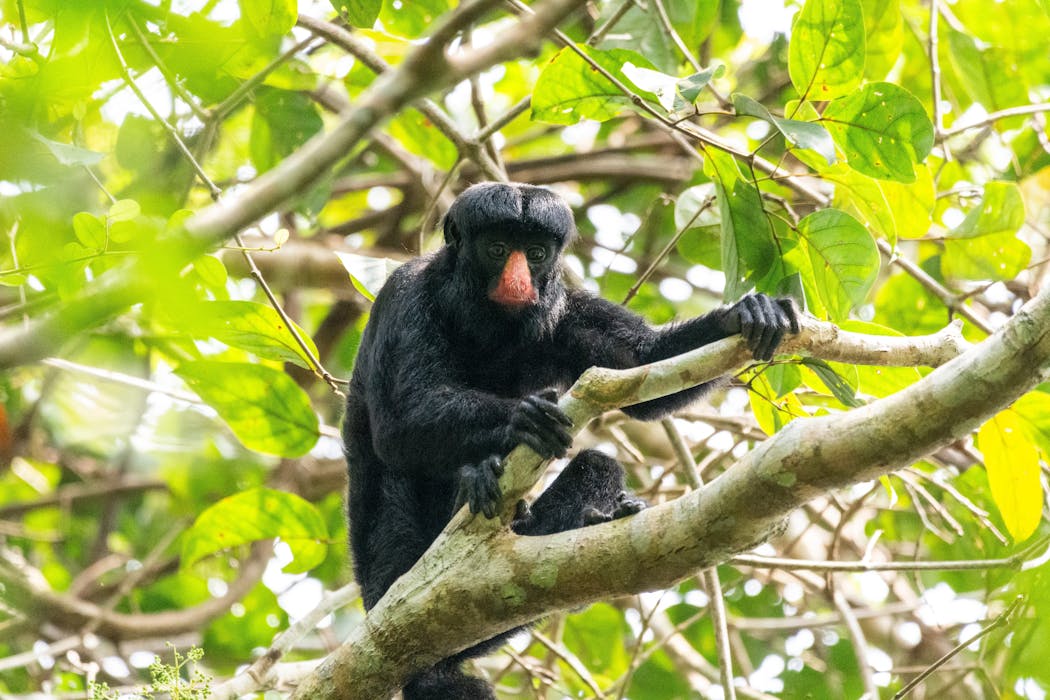
The red-nosed cuxiu is endangered. Cavan-Images/Shutterstock

Look down at the rainforest floor. Rotting flowers shift under the assault of tiny petal-eating beetles. Vividly coloured fungi pop up everywhere like the strange sculptures of a madly productive ceramicist.

Look in front of you and heliconias and calatheas, tropical plants familiar from garden centres and greenhouses, vie for the attention of hummingbirds with scarlet and orange flowers.

Look up and the distant canopy offers a full spectrum of shades of green, along with clusters of flowers and fruits in a bewildering range of shades, shapes and sizes.

You’d be excused from thinking that life in a tropical forest is easy. A lazy arm movement being all that’s needed to secure the next mouthful of food. But it’s not like that at all.

Life in the rainforest demands extraordinary adaptations.

Which is why I found myself stepping out of a small canoe on the Tapajós
River in Brazil’s central Amazon to collect the remnants of the most recent meal of the endangered red-nosed cuxiu monkey (Chiropotes albinasus) for my recent study.

They are like no other monkey on Earth. Many species have ecological parallels on other continents, often with very similar physical and behavioural adaptations. For example, spider monkeys and gibbons, chimpanzees and capuchin monkeys. But cuxius, and their close relatives the uacaris and sakis, are a uniquely South American phenomenon.

Cuxius are cat-sized animals, with canines bigger than human teeth, even though their skull is the size of an orange. Although other primates have massive canines too (think baboons, mandrills or chimps) these are for display. Those of the cuxiu are the real deal; designed for cracking open hard, unripe fruits to get at the equally unripe and hard seeds. They eat a range of fruits that include relatives of the Brazil nut, acacia tree and oleander.

Humans would need a hammer to crack open this kind of fruit. But cuxius and their near relations bite them open. Powered by massive muscles, the jaws can deliver a bite which, if scaled for size, is equal to that of a jaguar. They eat hundreds of rock-hard fruits a week, tens of thousands over their ten-year life span.

So, I wanted to know: how do they avoid cracking their teeth along with the nuts? We know their skulls are evolved to disperse the shock of a bite. But scientists have long been mystified by how the cuxiu avoids breaking its teeth through the sheer repetitive strain.

My findings revealed that cuxius are a lot smarter and more subtle than anyone thought.

Pick up a walnut and you’ll notice a thin line running around the hard shell. This is the suture, and it’s where the shell would naturally break open to free the seed when it ripens. It’s also a lot less resistant to puncture than the rest of the fruit. Fruits with sutures dominate the diet of the red-nosed cuxiu, so I wondered if this could be the key to the cuxiu’s success.

Measurements of the force needed for a copy of a cuxiu canine to penetrate fruit outer husks showed this was the case. It took up to 70% less force to go in at the suture than elsewhere on the fruits the cuxiu ate.

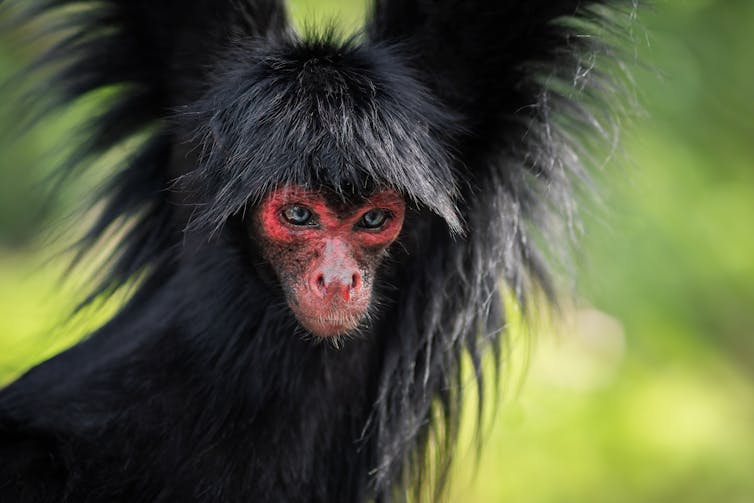
Close up of black long-haired monkey with pink face
The red-faced spider monkey is an ateline monkey, with a highly athletic lifestyle.
Diego Grandi/Shutterstock

My examination of skulls held in London’s Natural History Museum showed canine breakages were no more common in cuxius than in capuchins (which use either their molars or stone tools to break hard fruits) or ateline monkeys (which eat either soft pulpy fruits or leaves). Avoiding dental damage is smart – with no dentists in the forest a split tooth is a quick path to a slow death by starvation. And it allows the cuxius and their relatives to access unripe seeds, a food source few other animals can exploit.

This mirrors tactics used by carnivores like big cats, who bite prey at vulnerable spots to avoid breaking their teeth.

Then there’s the fact that every animal in the rainforest needs to be its own doctor, physiotherapist and fitness coach. With no first aid stations for bitten, twisted or shocked bodies, it’s best to avoid things going wrong in the first place. This is also true for actions that, through sheer repetition, could cause breakage through stress.

Survival in the rainforest depends on vigilance, cunning survival strategies and Olympian levels of fitness. An animal’s survival depends not only on knowing what to eat but how to eat it. Seconds count when a bite too many can mean missing the one key glance skywards that stops you becoming someone else’s breakfast.

Living in the top of the canopy of either rainforest or flooded forest, moving huge distances and doing so very fast, makes cuxius a challenge to observe. I first became interested in cuxius and uacaris because they are hard to study and, as a result, were so little known. But, soon after I started working with them, I realised cuxius and uacaris are like extreme sports athletes, pushing the boundary of what is possible in a monkey.

And they aren’t the only ones.

Swinging and hanging between the trees, the life of a spider monkey is like a perpetual parallel bar performance, not for a few brief minutes, after months of rigourous training as in humans, but all day, every day. No gold medal and long retirement, just surviving till dusk and starting again at dawn.

Additionally, while not exactly Olympian, the energy howler monkeys use during their daily calling bouts is similar to that of a mid-aria opera singer. Except that the monkeys must perform twice a day for a lifetime.

Sadly, animals’ Olympian abilities are no match for humans, whose use of tools is the equivalent of competitors using steroids or robotic enhancements. And, since it is clear that humans are not as smart as we are skilled, rainforest loss continues at a pace that even evolution – formerly the world’s best trainer – cannot have prepared them for.

The Conversation

Adrian Barnett does not work for, consult, own shares in or receive funding from any company or organisation that would benefit from this article, and has disclosed no relevant affiliations beyond their academic appointment.

ref. Deep in the Amazon, I discovered this monkey’s ingenious survival tactic – https://theconversation.com/deep-in-the-amazon-i-discovered-this-monkeys-ingenious-survival-tactic-271995

Chavismo has adapted before – but can Venezuela’s leftist ideology become US friendly and survive?

Source: The Conversation – Global Perspectives – By Paul Webster Hare, Master Lecturer and Interim Director of Latin American Studies, Boston University

When the Trump administration sent in a team of U.S. special forces on Jan. 3, 2026, to extract Venezuelan leader Nicolás Maduro, the operation fell short of full-scale regime change.

Despite years of U.S. antagonism toward Venezuela’s government, the broader political coalition that Maduro led was allowed to remain intact under the guidance of longtime Maduro ally Delcy Rodríguez. And it now seemingly has the tacit support of President Donald Trump – who has supported a transition to Maduro’s deputy over the option of pushing for opposition leader María Corina Machado to assume control.

As such, it marks a new phase, rather than an end, to the left-wing political ideology of Chavismo.

An ever-evolving Bolivarian revolution?

Now under its third stewardship in Rodríguez, Chavismo has already undergone change since being rolled out in Venezuela by Hugo Chávez.

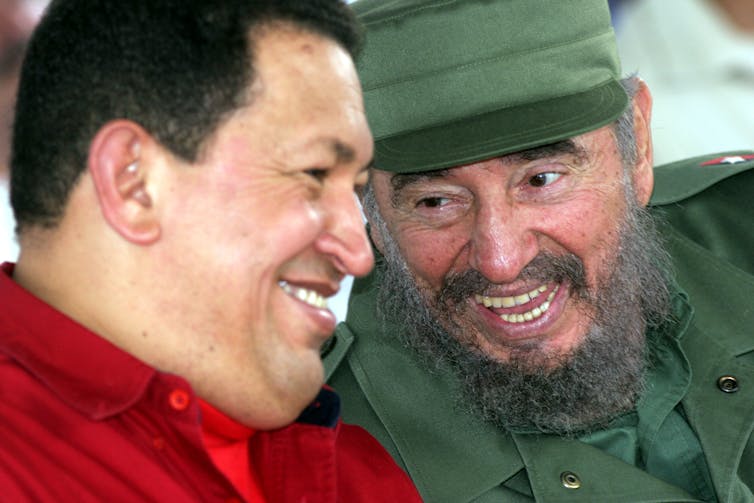
Chávez himself drew heavily on Fidel Castro’s Cuba in fomenting the ideology, which has ruled over Venezuela since Chávez came to power in a 1998 presidential election.

In particular, he borrowed from Cuba’s model of state controls and a blend of socialism, with a brand of Latin American nationalism and strident anti-imperialism. That included a wide-ranging platform of social welfare and programs to distribute land and money to the poor – financed by Venezuela’s vast oil reserves while the price of crude was high.

Two men joke and laugh with each other.
Cuban President Fidel Castro with President of Venezuela Hugo Chávez in Havana, Cuba on Feb. 3, 2006.
Sven Creutzmann/Mambo Photography via Getty Images

All of that is anathema to much of the political beliefs of the U.S Republican Party, particularly in Florida, and rubs up against both the MAGA wing and the coterie of anti-leftist foreign policy hawks that surround the president.

As such, the Trump administration’s willingness to give Chavismo a chance under Rodríguez is a startling difference from Dec. 19, 2025, when Sec. of State Marco Rubio gave a long explanation of why he thought Venezuela was “an illegitimate regime that openly cooperates with terrorist elements.”

Not just Maduro himself, note, but the “regime” itself.

As a former deputy head of the U.K. mission to Venezuela, I discussed politics with Chávez himself back in 1995. I had served in Portugal and the example of a left-wing Portuguese military ousting a right-wing dictator to promote a return to democracy was something that appealed to Chávez.

In opting to allow the Chavista former deputy to Maduro, Rodríguez, to take over the country rather than push for the immediate installation of María Corina Machado – whose proxy won the last Venezuelan election in 2024, according to international verification – Trump is betting that that a reformed Chavismo can uniquely provide the stability that is required to rebuild the Venezuelan oil industry. And that appears to be his immediate priority.

Rodríguez has succeeded, according to reports, in convincing Trump that immediate elections are not a priority, meaning that the Venezuelan people must wait further for their choices to made.

But Chavismo has gone through various iterations since the 1990s, and it might well do so now.

Chavismo’s evolution

At one point, Chavismo had been a more democratic venture. Chávez was elected in 1998 fairly, having been pardoned in 1994 for an earlier and unsuccessful illegal power grab. And at first Chávez seems committed to the idea of a democratic process. Moreover, like in Cuba after the revolution, he prioritized developing socialist programs in areas like health care and housing.

But how Chávez viewed the sustainability of his government changed markedly in 2002. That’s when the U.S. supported a coup attempt that challenged Chavez’s authority.

In surviving that coup attempt, he gained credibility with Cuba’s Fidel Castro who had at first doubted Chavez’ abilities.

Castro became his mentor in all policy decisions, particularly in helping craft his international profile.

At the time, Cuba was facing a more hawkish U.S. president on Latin American leftism in George W. Bush. So Chávez decided that Chavismo needed to become more anti-American, and the high price of oil enabled him to fund domestic and international largesse.

‘Competitive authoritarianism’

The system that the new Chávez presided over evolved gradually, and under Castro tutelage it became increasingly undemocratic.

Chávez was advised by the Cuban government on how to develop what critics have termed a system of “competitive authoritarianism.” This involved extending presidential terms, attacking the media and tweaking the constitution to further centralize power.

In a tried-and-tested authoritarian measure, Chávez packed the judiciary with loyalists, and turned the electoral commission into a rubber stamp for the incumbent government.

These measures proved the lynchpin of Maduro’s election fraud of 2024, when the courts refused to verify the QR codes of receipts produced by the opposition showing that they, not Maduro, had won.

A poster showing a man's face is next to a lectern with a flag on it.
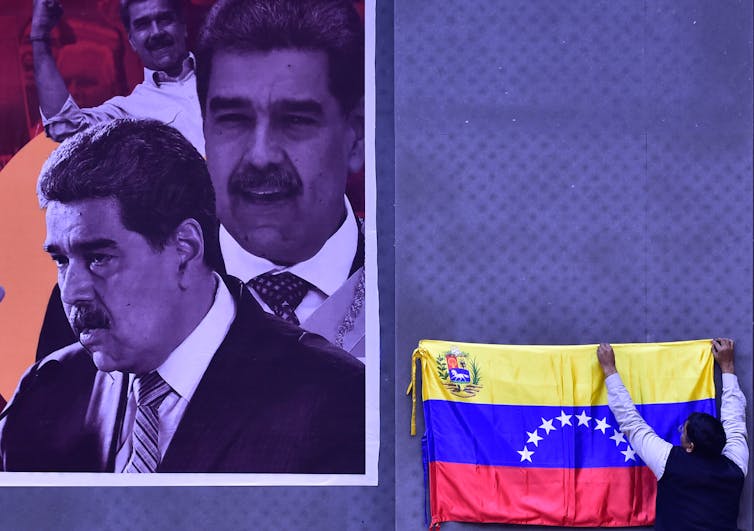
Maduro is a man gone, but not forgotten.
Ritesh Shukla/Getty Images

Under Maduro, Chavismo only got more repressive and authoritarian. Lacking the charisma of Chavez – who died in 2013 – and facing dwindling oil revenue with which to fund social and welfare programs, Maduro turned to the suppression of human and voting rights to maintain power as the country spiraled into the economic crisis and gang violence.

And to compensate for reduced oil revenues, Maduro turned to funding from drug and human trafficking, gold smuggling and, perhaps above all recently, crypto-trading.

A post-Trump makeover?

Rodríguez is no break from this Chavismo past, having served under both Chávez and Maduro.

Yet, she is apparently willing to work in cooperation with Washington. And the Trump administration has seemingly given her its blessing for now, evidenced most recently by a high-profile Jan. 15 visit to Caracas by the head of the CIA.

The basis of this apparent bargain is oil. Rodríguez has long experience of dealing with international oil companies – and her handling of oil production is reportedly a factor in her having been accepted by the U.S. administration.

The Chávez and Maduro governments advanced the state’s control of oil and other sectors, such as goldmining in Venezuela.

Under Rodriguez, it is likely to be reversed to appease Washington – opening up again to foreign companies and especially U.S. investment. Such a move would inevitably prove a wedge between Venezuela and Cuba.

Under Chávez and Maduro, Venezuela gave oil at heavily discounted prices to Cuba. In return, Cuban sent its doctors, advisers and security personnel.

This arrangement will likely be terminated under a new arrangement between Caracas and Washington. Its cessation would force Cuba to look for alternative oil supplies – probably from Mexico, Brazil and Colombia.

Yet Chavistas will likely be advising Cuba to do a similar deal with Trump. Cuba does not have oil, but it does have big nickel deposits and massive upside potential for U.S businesses in tourism. Cuba has only one 18-hole golf course, and years ago Trump, as a real estate developer, commissioned a study on building golf resorts on the island. Such deals might also save “Fidelismo.”

But where else might Chavismo go now? Will Rodríguez reverse the trend toward autocracy, and commit to future elections within a defined time period?

Will she also commit to dismantle “colectivos,” the militias of Chavismo that for years have suppressed opposition? And will she commit to returning the military to a national body, rather than the protector of one political movement?

Looking ahead, Trump’s prolonging of Chavismo is a political gamble in Florida – a state where many Latin Republican voters despise the system and any dealing with socialist governments. Trump ran in 2016 partly on a platform of opposing Obama’s deal with Cuba of 2014, claiming he would never deal with “socialist dictators.”

Can Chavismo survive?

The leaders of Chavismo have long been pragmatic negotiators, with a reputation among critics for breaking promises. In October 2023, for example, the Biden administration helped iron out the Barbados Agreement with Maduro and Venezuelan opposition groups, providing for free and fair elections in return for sanctions relief.

Yet the U.S. soon after accused Maduro of reneging on the deal by disqualifying the chosen opposition candidate, María Corina Machado. Now-acting President Rodríguez is still surrounded by all the stakeholders in Chavismo who concocted the scheme to deny the opposition’s victory – save, of course, Maduro himself.

Nonetheless, Chavismo had shown a strong instinct for survival. And Delcy Rodríguez has learned what many others leaders have: Chavismo can succeed in flattering, or at least appeasing, Trump. She has also learned that Trump appears more interested in oil than in restoring democracy.

The Conversation

Paul Webster Hare does not work for, consult, own shares in or receive funding from any company or organization that would benefit from this article, and has disclosed no relevant affiliations beyond their academic appointment.

ref. Chavismo has adapted before – but can Venezuela’s leftist ideology become US friendly and survive? – https://theconversation.com/chavismo-has-adapted-before-but-can-venezuelas-leftist-ideology-become-us-friendly-and-survive-273390

Valentino shaped the runway – and the red carpet – for 60 years

Source: The Conversation – Global Perspectives – By Jye Marshall, Lecturer, Fashion Design, School of Design and Architecture, Swinburne University of Technology

Valentino, who died on Monday at 93, leaves a lasting legacy full of celebrities, glamour and, in his words, knowing what women want: “to be beautiful”.

The Italian fashion powerhouse has secured his dream of making a lasting impact, outliving Karl Lagerfeld and Yves Saint Laurent.

Valentino was known for his unique blend between the bold and colourful Italian fashion and the elegant French haute couture – the highest level of craftsmanship in fashion, with exceptional detail and strict professional dressmaking standards.

The blending of these styles to create the signature Valentino silhouette made his style distinctive. Valentino’s style was reserved, and over his career he built upon the haute couture skills he had developed, maintaining his signature style while he led his fashion house for five decades.

But he was certainly not without his own controversial views on beauty for women.

Becoming the designer

Born in Voghera, Italy, in 1932, Valentino Clemente Ludovico began his career early, knowing from a young age he would pursue fashion.

He drew from a young age and studied fashion drawing at Santa Marta Institute of Fashion Drawing in Milan before honing his technical design skills at École de la Chambre Syndicale de la Couture Parisienne, the fashion trade association, in Paris.

He started his fashion career at two prominent Parisian haute couture houses, first at Jean Dessès before moving to Guy Laroche.

He opened his own fashion house in Italy in 1959.

His early work had a heavy French influence with simple, clean designs and complex silhouettes and construction. His early work had blocked colour and more of a minimalist approach, before his Italian culture really came through later in his collections.

He achieved early success through his connections to the Italian film industry, including dressing Elizabeth Taylor fresh off her appearance in Cleopatra (1963).

Black and white photograph.
Elizabeth Taylor wearing Valentino while dancing with Kirk Douglas at the party in Rome for the film Spartacus.
Keystone/Getty Images

Valentino joined the world stage on his first showing at the Pritti Palace in Florence in 1962.

His most notable collection during that era was in 1968 with The White Collection, a series of A-line dresses and classic suit jackets. The collection was striking: all in white, while Italy was all about colour.

He quickly grew in international popularity. He was beloved by European celebrities, and an elite group of women who were willing to spend the money – the dresses ran into the thousands of dollars.

In 1963, he travelled to the United States to attract Hollywood stars.

The Valentino woman

Valentino’s wish was to make women beautiful. He certainly attracted the A-list celebrities to do so. The Valentino woman was one who would hold themselves with confidence and a lady-like elegance.

Valentino wanted to see women attract attention with his classic silhouettes and balanced proportions. Valentino dressed women such as Jackie Kennedy, Audrey Hepburn, Julia Roberts, Gwyneth Paltrow and Anne Hathaway.

His aristocratic taste inherited ideas of beauty and old European style, rather than innovating with new trends. His signature style was formal designs that had the ability to quietly intimidate – including the insatiable Valentino red.

Red was a signature colour of his collections. The colour provided confidence and romance, while not distracting away from the beauty of the woman.

French influence

Being French-trained, Valentino was well acquainted with the rules of couture.

With this expertise, he was one of the first Italian designers to be successful in France as an outsider with the launch of his first Paris collection in 1975. This Paris collection showcased more relaxed silhouettes with many layers, playing towards the casual nature of fashion.

A woman in a polka-dot dress.
A model in the Valentino Spring 1976 ready to wear collection walks the runway in Paris in 1975.
Guy Marineau/WWD/Penske Media via Getty Images

While his design base was in Rome, many of his collections were shown in Paris over the next four decades. His Italian culture mixed with the technicality of Parisian haute couture made Valentino the designer he was.

Throughout his career, his designs often maintained a classic silhouette bust, matched with a bold Italian colour or texture.

Unlike some designers today, Valentino’s collections didn’t change too dramatically each season. Instead, they continued to maintain the craftsmanship and high couture standards.

Quintessentially beautiful” is often the description of Valentino’s work – however this devotion to high beauty standards has seen criticism of the industry. In 2007, Valentino defended the trend of very skinny women on runways, saying when “girls are skinny, the dresses are more attractive”.

Critics said his designs reinforce exclusion, gatekeeping fashion from those who don’t conform to traditional beauty standards.

The Valentino runways only recently have started to feature more average sized bodies and expand their definition of beauty.

The $300 million sale of Valentino

The Valentino fashion brand sold for US$300 million in 1998 to Holding di Partecipazioni Industriali, with Valentino still designing until his retirement in 2007.

Valentino sold to increase the size of his brand: he knew without the support of a larger corporation surviving alone would be impossible. Since Valentino’s retirement, the fashion house has continued under other creative directors.

Valentino will leave a lasting legacy as the Italian designer who managed to break through the noise of the French haute couture elite and make a name for himself.

The iconic Valentino red will forever be remembered for its glamour, and will live on with his legacy. A true Roman visionary with unmatched craftsmanship.

The Conversation

Jye Marshall does not work for, consult, own shares in or receive funding from any company or organisation that would benefit from this article, and has disclosed no relevant affiliations beyond their academic appointment.

ref. Valentino shaped the runway – and the red carpet – for 60 years – https://theconversation.com/valentino-shaped-the-runway-and-the-red-carpet-for-60-years-273891

What a bear attack in a remote valley in Nepal tells us about the problem of aging rural communities

Source: The Conversation – Global Perspectives – By Geoff Childs, Professor of Sociocultural Anthropology, Washington University in St. Louis

Dorje Dundul ponders a life living with increased risk of bear attacks. Geoff Childs, CC BY-SA

Dorje Dundul recently had his foot gnawed by a brown bear – a member of the species Ursus thibetanus, to be precise.

It wasn’t his first such encounter. Recounting the first of three such violent experiences over the past five years, Dorje told our research team: “My wife came home one evening and reported that a bear had eaten a lot of corn from the maize field behind our house. So, we decided to shoo it away. While my wife was setting up camp, I went to see how much the bear had eaten. The bear was just sitting there; it attacked me.”

Dorje dropped to the ground, but the bear ripped open his shirt and tore at his shoulder. “I started shouting and the bear ran away. My wife came, thinking I was messing with her, but when she saw the wounds, she knew what had happened.”

Researchers Dolma Choekyi Lama, Tsering Tinley and I spoke with Dorje – a 71-year-old resident of Nubri, a Buddhist enclave in the Nepalese highlands – as part of a three-year study of aging and migration.

Now, you may be forgiven for asking what a bear attack on a septuagenarian has to do with demographic change in Nepal. The answer, however, is everything.

In recent years, people across Nepal have witnessed an increase in bear attacks, a phenomenon recorded in news reports and academic studies.

Inhabitants of Nubri are at the forefront of this trend – and one of the main reasons is outmigration. People, especially young people, are leaving for education and employment opportunities elsewhere. It is depleting household labor forces, so much so that over 75% of those who were born in the valley and are now ages 5 to 19 have left and now live outside of Nubri.

It means that many older people, like Dorje and his wife, Tsewang, are left alone in their homes. Two of their daughters live abroad and one is in the capital, Kathmandu. Their only son runs a trekking lodge in another village.

Scarcity of ‘scarebears’

Until recently, when the corn was ripening, parents dispatched young people to the fields to light bonfires and bang pots all night to ward off bears. The lack of young people acting as deterrents, alongside the abandonment of outlying fields, is tempting bears to forage closer to human residences.

Outmigration in Nubri and similar villages is due in large part to a lack of educational and employment opportunities. The problems caused by the removal of younger people have been exacerbated by two other factors driving a rapidly aging population: People are living longer due to improvements in health care and sanitation; and fertility has declined since the early 2000s, from more than six to less than three births per woman.

These demographic forces have been accelerating population aging for some time, as illustrated by the population pyramid constructed from our 2012 household surveys in Nubri and neighboring Tsum.

A not-so-big surprise, anymore

Nepal is not alone in this phenomenon; similar dynamics are at play elsewhere in Asia. The New York Times reported in November 2025 that bear attacks are on the rise in Japan, too, partly driven by demographic trends. Farms there used to serve as a buffer zone, shielding urban residents from ursine intruders. However, rural depopulation is allowing bears to encroach on more densely populated areas, bringing safety concerns in conflict with conservation efforts.

Dorje can attest to those concerns. When we met him in 2023 he showed us deep claw marks running down his shoulder and arm, and he vowed to refrain from chasing away bears at night.

So in October 2025, Dorje and Tsewang harvested a field before marauding bears could get to it and hauled the corn to their courtyard for safekeeping. The courtyard is surrounded by stone walls piled high with firewood – not a fail-safe barrier but at least a deterrent. They covered the corn with a plastic tarp, and for extra measure Dorje decided to sleep on the veranda.

He described what happened next:

“I woke to a noise that sounded like ‘sharak, sharak.’ I thought it must be a bear rummaging under the plastic. Before I could do anything, the bear came up the stairs. When I shouted, it got frightened, roared and yanked at my mattress. Suddenly my foot was being pulled and I felt pain.”

Dorje suffered deep lacerations to his foot. Trained in traditional Tibetan medicine, he staunched the bleeding using, ironically, a tonic that contained bear liver.

Yet his life was still in danger due to the risk of infection. It took three days and an enormous expense by village standards – equivalent to roughly US$2,000 – before they could charter a helicopter to Kathmandu for further medical attention.

And Dorje is not the only victim. An elderly woman from another village bumped into a bear during a nocturnal excursion to her outhouse. It left her with a horrific slash from forehead to chin – and her son scrambling to find funds for her evacuation and treatment.

A woman in the foreground bendds over infront of a valley
A woman weeding freshly planted corn across the valley from Trok, Nubri.
Geoff Childs, CC BY-SA

So how should Nepal’s highlanders respond to the increase in bear attacks?

Dorje explained that in the past they set lethal traps when bear encroachments became too dangerous. That option vanished with the creation of Manaslu Conservation Area Project, or MCAP, in the 1990s, a federal initiative to manage natural resources that strictly prohibits the killing of wild animals.

Learning to grin and bear it?

Dorje reasons that if MCAP temporarily relaxed the regulation, villagers could band together to cull the more hostile bears. He informed us that MCAP officials will hear nothing of that option, yet their solutions, such as solar-powered electric fencing, haven’t worked.

Dorje is reflective about the options he faces as young people leave the village, leaving older folk to battle the bears alone.

“At first, I felt that we should kill the bear. But the other side of my heart says, perhaps I did bad deeds in my past life, which is why the bear bit me. The bear came to eat corn, not to attack me. Killing it would just be another sinful act, creating a new cycle of cause and effect. So, why get angry about it?”

It remains to be seen how Nubri’s residents will respond to the mounting threats bears pose to their lives and livelihoods. But one thing is clear: For those who remain behind, the outmigration of younger residents is making the perils more imminent and the solutions more challenging.

Dolma Choekyi Lama and Tsering Tinley made significant contributions to this article. Both are research team members on the author’s project on population in an age of migration.

The Conversation

Geoff Childs receives funding from the National Science Foundation.

ref. What a bear attack in a remote valley in Nepal tells us about the problem of aging rural communities – https://theconversation.com/what-a-bear-attack-in-a-remote-valley-in-nepal-tells-us-about-the-problem-of-aging-rural-communities-271377

Europe has five options for responding to Trump’s Greenland threats. None of them look good

Source: The Conversation – Global Perspectives – By Jun Du, Professor of Economics, Centre Director of Centre for Business Prosperity (CBP), Aston University

Johannes Madsen/Shutterstock

European negotiators believed they had bought stability in July 2025 amid the global trade turmoil sparked by Donald Trump’s liberation day tariffs. The EU’s deal with the US involved eliminating tariffs on American goods, purchasing US energy and committing to American investment. But six months later, as the US president made his intentions regarding Greenland clear, it collapsed.

Trump has now threatened new tariffs on eight European countries, the UK among them. The tariffs punish countries that sent military personnel to Greenland in support of Danish sovereignty.

The president has said 10% tariffs will apply to all goods entering the US from the eight countries from February 1, rising to 25% on June 1 until he is able to buy territory.

This isn’t an aberration. The US offered to buy Greenland in 1946. And before that it purchased Alaska (in 1867, from Russia), Florida (in 1821, from Spain) and Louisiana (in 1803, from France). What’s different now is the coercion mechanism – tariffs rather than a negotiated price.

Greenland offers Arctic shipping routes, rare earth deposits and missile defence positioning. Trump’s “Golden Dome” defence system needs more than military bases – it requires sovereign control to deploy classified systems without Danish oversight.

This is the same logic that drove pressure on Panama to renegotiate US control of the canal. This showed how existing arrangements aren’t enough – Washington wants exclusive control.

The tariff threats serve multiple purposes: punishing countries that showed solidarity with Denmark, testing whether economic pressure can fracture Nato from within, and of course generating revenue.

US tariff income hit US$264 billion (£197 billion) in 2025, up US$185 billion from 2024 after new tariffs kicked in. This is a windfall that makes security dependent allies who cannot retaliate reliable payers.

The usual playbook won’t work

When China faced US tariffs in 2025, it retaliated hard. China targeted soybeans from swing states, restricted rare earths with new export licences and slowed regulatory approvals for US tech companies. Beijing could absorb pain and inflict it back. That was a trade war fought with trade weapons.

Europe’s position is different. Brussels is now discussing the anti-coercion instrument – the so-called “trade bazooka”.

This law gives the EU teeth to hit back against economic blackmail from a non-EU country and overrides existing trade deals. In practice, this could restrict US companies from public procurement and impose retaliatory tariffs on €93 billion (£81 billion) of American goods.


Read more:
Tariffs may bring a US$50 billion monthly boost to the US government. But ordinary Americans won’t feel the benefit


But the EU requires unanimity for serious trade retaliation, and member states differ vastly in their US market exposure and Nato security dependence. Any serious escalation risks the security guarantee, a constraint China never faced.

And these tariffs aren’t really about trade anyway. Fighting a territorial objective with trade weapons is bringing the wrong tools to the job.

If trade diplomacy cannot solve a territorial problem, what can? The conventional playbook offers escalating retaliation — measured responses or catastrophic threats meant to deter a rational actor. But that assumes your opponent isn’t playing a game where brinkmanship is the point. Given those constraints, we have identified five options. None of them is comfortable.

1. Accept the new reality

Treat US tariffs as a permanent feature of transatlantic trade rather than a disruption to negotiate away. Price them into business planning and stop expending political capital on deals that probably won’t hold.

2. Diversify faster

The EU-Mercosur agreement signed in the same week between Brussels and the South American trading bloc wasn’t a coincidence. It was agreed in the knowledge that higher US tariffs were a distinct possibility one day.

For the UK, diversifying means accelerating its own negotiations (the Comprehensive and Progressive Agreement for Trans-Pacific Partnership – CPTPP, the Gulf and India). Every percentage point shifted from the US reduces Washington’s leverage.

3. Address the security dependence

European defence spending has risen sharply since Russia’s full-scale invasion of Ukraine — from €251 billion in 2021 to €343 billion in 2024. But capability takes longer than building up budgets. The Greenland tariffs illustrate the cost of dependence. When your security guarantor becomes your economic coercer, your options narrow dramatically.

4. Reconsider the UK-EU relationship

The crisis creates opportunity for both sides. These options require coordination across member states with vastly different US exposure and Nato dependence. Bringing Britain closer strengthens Europe’s negotiating position while giving the UK strategic options beyond an increasingly transactional US relationship.

The slow reset has been constrained by reluctance to make Brexit look costless. But when both face a direct challenge to the post-war order from their principal security guarantor, the calculation changes. Closer alignment becomes mutual strategic necessity.

5. Hold the line together

The worst outcome would be European countries peeling away from Denmark to escape tariffs. That is precisely what the policy is designed to achieve. This is the logic of political deterrence, which would suggest that showing solidarity will prevent further demands. If this cracks, there is likely to be more of the same from the US.

Whether Trump will ultimately acquire Greenland remains uncertain. Conventional wisdom says he won’t, but conventional wisdom has been wrong before. What’s clear is that this isn’t a tariff dispute requiring trade concessions. It’s a structural shift in transatlantic relations, and European strategy needs to adjust accordingly.

The Conversation

The authors do not work for, consult, own shares in or receive funding from any company or organisation that would benefit from this article, and have disclosed no relevant affiliations beyond their academic appointment.

ref. Europe has five options for responding to Trump’s Greenland threats. None of them look good – https://theconversation.com/europe-has-five-options-for-responding-to-trumps-greenland-threats-none-of-them-look-good-273885

¿Es posible perder peso eliminando el gluten de la dieta, como afirma Matt Damon?

Source: The Conversation – (in Spanish) – By Guy Guppy, Lecturer in Performance Nutrition and Exercise Physiology, Kingston University

Cuando Matt Damon atribuyó recientemente su pérdida de peso a una dieta sin gluten, reavivó un debate familiar sobre este controvertido enfoque alimenticio. Pero aunque las afirmaciones de la estrella de la Odisea han suscitado debate, la ciencia que hay detrás de la pérdida de peso cuenta una historia mucho más matizada que la simple eliminación de una sola proteína.

El gluten es una proteína natural que se encuentra en cereales como el trigo, la cebada y el centeno, lo que significa que se consume habitualmente en alimentos cotidianos como el pan, la pasta y los cereales. Para la mayoría de las personas, el gluten no causa ningún problema de salud.

Sin embargo, para quienes padecen la enfermedad celíaca, que afecta a alrededor del 1 % de la población, es esencial evitarlo. Esta enfermedad autoinmune desencadena una respuesta al gluten, dañando el revestimiento del intestino delgado y dificultando la absorción de nutrientes.

También existe la intolerancia al gluten, o sensibilidad al gluten no celíaca, una afección asociada a síntomas como hinchazón y reflujo. Las personas con esta afección también suelen experimentar problemas más allá del sistema digestivo, como dolores de cabeza y erupciones cutáneas.

A pesar del creciente número de personas que refieren estos síntomas, la intolerancia al gluten sigue siendo objeto de acalorados debates en cuanto a sus causas y tratamiento. Actualmente, el único enfoque recomendado es adoptar una dieta sin gluten.

Para el resto de personas, aquellas que no padecen celiaquía ni intolerancia al gluten, evitar los alimentos ricos en gluten puede ser innecesario y potencialmente problemático.

Los alimentos ricos en gluten, como el pan, la pasta y los cereales, no solo aportan carbohidratos, sino que también son excelentes fuentes de fibra y vitaminas del grupo B.

Eliminar estos alimentos puede contribuir inadvertidamente a deficiencias nutricionales. Sin embargo, el mercado de productos sin gluten sigue creciendo, y las previsiones sugieren que alcanzará los 13 700 millones de dólares estadounidenses (casi 11 700 millones de euros) en 2030.

Dado que Damon no reveló ninguna afección médica al hablar de sus objetivos de pérdida de peso, la explicación más probable de sus resultados radica en su dieta y comportamiento generales, más que en el gluten en sí. Una investigación publicada en Nutrients no encontró diferencias significativas entre las dietas sin gluten y las ricas en gluten en cuanto a la grasa corporal o el peso corporal entre adultos sanos.

Mecánica, no magia

La pérdida de peso que muchas personas experimentan con las dietas sin gluten a menudo se debe a la mecánica y no a la magia. Dado que el gluten se encuentra en muchos alimentos ricos en energía y basados en carbohidratos, las personas que lo eliminan suelen suprimir alimentos como la pizza, la comida rápida y la pasta.

Esta restricción de carbohidratos conduce a una reducción del glucógeno, la forma almacenada de carbohidratos en el cuerpo humano. Cuando se almacena glucógeno, también se almacena agua junto con él.

Por lo tanto, cuando los niveles de glucógeno disminuyen, el peso del agua también lo hace, creando la ilusión de una rápida pérdida de grasa. Este fenómeno explica por qué las personas suelen ver resultados espectaculares en la primera o segunda semana de cualquier nueva dieta o programa de ejercicio.

Más allá de la reducción de la ingesta de carbohidratos, las personas que siguen dietas sin gluten suelen pasar a consumir más alimentos integrales naturalmente libres de gluten. Esta reestructuración de la dieta suele dar lugar a un menor consumo de calorías en general.

Un pequeño estudio preliminar, publicado en Frontiers of Sports and Active Living, descubrió que seguir una dieta sin gluten durante seis semanas provocaba una reducción significativa del peso corporal en comparación con una dieta de control. Pero estos cambios probablemente fueron el resultado de un déficit calórico y una pérdida de líquidos, más que de cualquier ventaja metabólica derivada de la eliminación del gluten.

Hay otro factor en juego. Los carbohidratos derivados del trigo contienen azúcares fermentables llamados fructanos, que son descompuestos por las bacterias del intestino grueso. Esta fermentación produce gases que pueden causar hinchazón, dolor y cambios en las deposiciones. Cuando se eliminan estos alimentos, los síntomas desaparecen y el estómago puede parecer más plano, un cambio estético que las personas pueden confundir con la pérdida de grasa.

El gluten puede tener beneficios para la salud

Adoptar una dieta sin gluten que no sea médicamente necesaria podría, en realidad, aumentar los riesgos para la salud. Un amplio estudio publicado en el BMJ encontró una asociación entre una mayor ingesta de gluten y un menor riesgo de enfermedades cardíacas.

Del mismo modo, las investigaciones han revelado una relación entre el bajo consumo de gluten y el aumento del riesgo de diabetes tipo 2.

El culpable de estas preocupantes relaciones podría ser los productos sin gluten que llenan las estanterías de los supermercados. Cuando se elimina el gluten de un producto, cambia la textura y la palatabilidad del alimento. Para compensarlo, los fabricantes añaden otros ingredientes para mejorar el sabor y la consistencia.

¿El resultado? Se ha demostrado que los productos sin gluten contienen significativamente menos proteínas, más grasas saturadas, menos fibra y más azúcar que sus homólogos convencionales. Con el tiempo, este perfil nutricional puede conducir a una dieta deficiente y, por lo tanto, a una mala salud.

Así que, aunque la gente pueda creer que dejar de consumir gluten provoca la pérdida de peso, la realidad suele ser diferente. Los cambios sutiles en la estructura y la composición de la dieta, junto con las modificaciones en el comportamiento, suelen ser la verdadera razón.

The Conversation

Guy Guppy no recibe salario, ni ejerce labores de consultoría, ni posee acciones, ni recibe financiación de ninguna compañía u organización que pueda obtener beneficio de este artículo, y ha declarado carecer de vínculos relevantes más allá del cargo académico citado.

ref. ¿Es posible perder peso eliminando el gluten de la dieta, como afirma Matt Damon? – https://theconversation.com/es-posible-perder-peso-eliminando-el-gluten-de-la-dieta-como-afirma-matt-damon-273931