I analyzed more than 100 extremist manifestos: Misogyny was the common thread

Source: The Conversation – Global Perspectives – By Karmvir K. Padda, Researcher and PhD Candidate, Sociology, University of Waterloo

Two years have passed since a 24-year-old former student walked into a gender studies classroom at the University of Waterloo and stabbed the professor and two students.

The attack left the campus shaken and sparked national outrage. Many saw the attack as a shocking but isolated act of violence. But a close analysis of his 223-word manifesto reveals much more.

What emerges is a chilling picture of how deep-seated misogyny, disguised as grievance and moral outrage, can escalate ideological violence. Though short, the manifesto is saturated with anti-feminist, conspiratorial rhetoric.

As a researcher looking at digital extremism and gender-based violence, I’ve analyzed more than 100 manifestos written by people who carried out mass shootings, stabbings, vehicular attacks and other acts of ideologically, politically and religiously motivated violent extremism in Canada, the United States and beyond.

These attackers may not belong to formal terrorist organizations, but their writings reveal consistent ideological patterns. Among them, one stands out: misogyny.

Misogyny is the ‘gateway drug’

The Waterloo case is not unique. In fact, it mirrors a growing number of violent incidents where gender-based hate plays a central role. Reports by the Institute for Strategic Dialogue and Public Safety Canada show misogynist extremism is rising in Canada. It’s often entangled with white nationalism, anti-LGBTQ+ hate and anti-government sentiment.

According to political sociologist Yasmin Wong, misogyny now acts as a “gateway drug” to broader extremist ideologies. This is particularly true in digital spaces where hate and grievance are cultivated algorithmically.

In my analysis of manifestos collected from 1966 to 2025, gender identity-driven violence appeared in nearly 40 per cent of them. These violent beliefs were either the primary or a significant secondary motivation for the attack. This includes direct expressions of hatred toward women, trans and queer people and references to feminist or LGBTQ+ movements.

‘Salad bar’extremism

The Waterloo attacker did not explicitly identify as an “incel” (involuntary celibate), but the language in his manifesto closely echoes those found in incel and broader manosphere discourse. Feminism is portrayed as dangerous, gender studies as ideological indoctrination and universities as battlegrounds in a supposed culture war.

The Waterloo attacker destroyed a Pride flag during the attack, referred to the professor he targeted as a “Marxist,” and told police he hoped his actions would serve as a “wake-up call.”

At one point, he praised leaders like Hungarian Prime Minister Viktor Orbán and Canadian far-right politician Maxime Bernier as “based Chads.” “Based Chads” is a slang term used in online extremist communities to glorify or refer to dominant and assertive males.

Alongside anti-feminist messaging, the attacker’s writing echoes common far-right narratives: fear of “cultural Marxism,” disdain for liberal elites, and the belief that violence is necessary to awaken the public. He referenced prior mass attacks, including the 2011 Norway massacre and the 2019 Christchurch mosque shooting. These two incidents are frequently celebrated in far-right spaces.

These references place him within a transnational digital subculture where misogyny, white supremacy and ideological violence are valourized.

It reflects what researchers described as “salad bar extremism”: a mix-and-match worldview where misogyny is blended with white nationalism, anti-government sentiment and conspiratorial thinking to justify violence.

Manifestos rationalize violence

The authors of manifestos are frequently dismissed as “nutters” — demented or socially unstable people.

But the manifestos are valuable documents for understanding how ideology works. They show how people rationalize violence, where their ideas come from and how they see themselves as political entities. They also reveal the role of digital communities in shaping those beliefs.

Researchers can use them to map ideological ecosystems and identify patterns. These analyses can inform prevention strategies.

The Waterloo manifesto is no exception. It draws from a familiar ideological playbook — one that dehumanizes feminists, academics and LGBTQ+ people while portraying violence as both righteous and necessary.

These are not isolated ideas; they are symptoms of a wider digital ecosystem of online hate and ideological grooming.


Read more:
The stabbing attack at the University of Waterloo underscores the dangers of polarizing rhetoric about gender


Deliberate, ideologically motivated attacks

While a psychological assessment of the attacker raised questions about a psychotic break, there was no clinical diagnosis of psychosis. His actions — planning the attack, writing and posting a manifesto, selecting a specific target — were deliberate and ideologically motivated.

Yet the terrorism charge brought against him by federal prosecutors was ultimately dropped. The judge ruled his beliefs were “too scattered and disparate” to constitute a coherent ideology.

But his manifesto shared language and ideological frameworks recognizable across incel, anti-feminist and far-right communities. The idea that this doesn’t constitute “ideology” reflects how outdated our legal and policy frameworks have become.

Confronting ongoing danger

Two years on, we remember the victims of the Waterloo attack. We must also confront the larger danger the attack represents.

Misogyny is not just a cultural or emotional problem. Instead, it increasingly functions as an ideological gateway, connecting personal grievance with broader calls for violent extremism.

In this era of rising lone-actor violence, it is one of the most consistent and dangerous drivers of extremism.

If we continue to treat gender-based hate as peripheral or personal, we will keep misunderstanding the nature of violent radicalization in Canada. We must name this threat and take it seriously, because that’s the only way to prepare for what’s coming next.

The Conversation

Karmvir K. Padda receives research funding from the Social Sciences and Humanities Research Council

ref. I analyzed more than 100 extremist manifestos: Misogyny was the common thread – https://theconversation.com/i-analyzed-more-than-100-extremist-manifestos-misogyny-was-the-common-thread-259347
Why centuries-old astrology and tarot cards still appeal to us

Source: The Conversation – Global Perspectives – By Hanna Tervanotko, Associate professor, Religious Studies, McMaster University

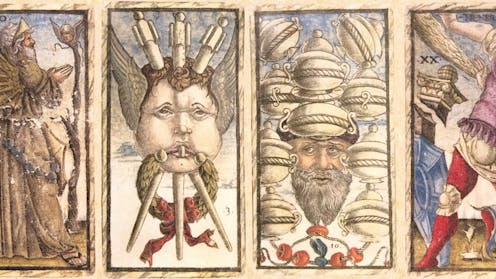
The Sola Busca tarot deck from Italy, circa 15th century. (Artist unknown), CC BY

More than 30 per cent of Americans believe in some sort of esoteric knowledge and regularly consult astrology, tarot readers or fortune tellers, according to a recent report by the Pew Research Centre.

Even though the survey says these Americans are doing so “just for fun” and claim they rely on the information gained by divination “only a little,” the persistence — and apparent rise — of these practices suggests something deeper is at play.

a drawing of a woman in blue robes,
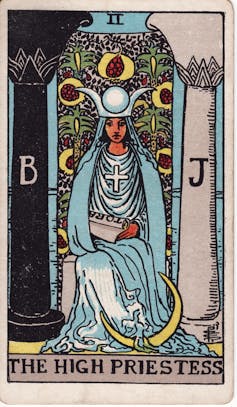
Tarot card: The High Priestess (Waite–Smith deck), c. 1909.
(Pamela Colman Smith), CC BY

People have always turned to divinatory methods to search for unanswered questions and to gain additional knowledge that could help them to prepare for the future, especially in times of uncertainty. For example, searches for “tarot cards” increased by more than 30 per cent during the pandemic.

I study ancient divination, but to better understand how diviners work, I have observed contemporary diviners at work and talked with them about their practices. They say their clients request tarot consultations more frequently than they did in the past.

What is divination?

Anthropologists define “divination” methods as “practice(s) that seeks to foresee or foretell future events or discover hidden knowledge usually by the interpretation of omen or by the aid of supernatural powers.”

Divination methods, including tarot and astrology, offer a way to ask questions when other systems fail to provide answers. These questions can be highly personal and difficult to address in a formal religious setting. The divinatory answers allow people to feel they’ve gained insight, which in turn gives a perception of control over an uncertain future.

Apart from astrology and tarot, some of the best known divination methods include: the interpreting of dreams, reading coffee cups or tea leaves, observing animals and nature, reading palms and other body features such as nose shape and eye placement.

When a diviner uses things, such as cards, tea leaves, dice or shells, the connecting thread to many of these methods is that people cannot control the signs they produce. For example, divination consultants typically mix the tarot card deck to make sure the result are randomized. People should not manipulate the results.

Divination as alternative ways of knowing

Pew Centre data reveals that young people, women and LGBTQ Americans are among the most likely to consult divinatory methods. Religious studies professor Marcelitte Failla has also written about contemporary Black women who have reclaimed the tarot deck to creatively address their spiritual needs.

Many people turn to religion when they face the unknown in their lives. They address their insecurities in worship, asking for divine help.

But there have always been people who did not have access to organized religion. Divinatory practices can be especially appealing to those who have been excluded from traditional religion and had to come up with alternative ways to address uncertainties.

They perhaps lived in remote areas and could not attend worship sites such as temples. Or possibly, they were excluded from organized religion for identity reasons. For example, women regularly stayed home to care for children and sick. Sometimes, they were denied access because of their bodily “impurities,” menstruation or recent childbirth.

LGBTQ+ individuals were also denied access. In the U.S., discrimination against LGBTQ+ individuals remains one of the leading reasons for leaving traditional religious institutions. In Canada, the churches’ discriminatory treatment of different sexual minorities has been one of the top reasons people dissolve membership.

Divination in times of uncertainty

In an age marked by ongoing anxiety, political instability and waning trust in institutions, centuries-old divination rituals offer alternative ways for folks to seek entertainment but also to gain a sense of insight, agency and connection. What may seem like harmless fun can also serve as a serious response to a chaotic world. Divinatory practices can provide both spiritual exploration and emotional validation.

It’s understandable that a new situation, like the COVID-19 pandemic, triggered anxiety and uncertainty for people.

People continue to experience more anxiety than they did before the pandemic. Some of the main concerns include world politics, job security and personal finances.

As we try to make sense of the new, confusing and constantly changing situations, many create different theories, some questionable. Some people turn to alternative approaches like divination to make sense of the world.

Tarot: Thinking through emotions

People are checking out tarot readings on online platforms. And many social media accounts feature tarot.

Besides increasing political insecurity, another reason for the increased interest in tarot may be the visual aspect. Increased interest in the decorated cards may be a reflection of our highly visual culture. Interest in the cards with images may reflect interest in other images we watch. They are like photos with messages.

The fascination with tarot may also speak about a need to control the consultation as a diviner and their client see exactly the same thing. The images in the cards are also symbolic, and they can be interpreted in different ways.

That means rather than providing a straightforward answer to a question, the cards are tools that can help think through one’s emotions and feelings.

Tarot is not a religion. The object that is consulted is paper is not an image of the divine or a symbol of transcendence. This lack of alignment with any particular religion allows different people to consult tarot as a spiritual practice.

In principle, the cards can be consulted anywhere without particular preparations. The only material one needs is a deck of cards. The accessible materiality may be adding to their popularity.

Playful aspects of divination

Many divinatory methods include a playful aspect. For instance, the objects used for the lot oracle — pebbles, stones, four-sided knucklebones or dice — are the same ones people used for playing board games.

Ancient images show people consulting the objects or playing, suggesting the boundaries of some of the divinatory methods were always fluid.

As randomizing is an important element of divinatory consultation, the new insights various methods produce can be both surprising and entertaining.

The Conversation

Hanna Tervanotko receives funding from the Social Sciences and Humanities Research Council of Canada.

ref. Why centuries-old astrology and tarot cards still appeal to us – https://theconversation.com/why-centuries-old-astrology-and-tarot-cards-still-appeal-to-us-258993

Canada needs a national AI literacy strategy to help students navigate AI

Source: The Conversation – Global Perspectives – By Mohammed Estaiteyeh, Assistant Professor of Digital Pedagogies and Technology Literacies, Faculty of Education, Brock University

AI literacy equips learners to understand and navigate the pervasive influence of AI in their daily lives. (Shutterstock)

With students’ use of artificial intelligence (AI) tools on the rise in Canada and globally, reports of cheating and unethical behaviors are making headlines.

One recent study indicates that 78 per cent of Canadian students have used generative AI to help with assignments or study tasks. In China, authorities have even shut down AI apps during nationwide exams to prevent cheating.

Students seem unprepared to navigate this new world and educators are unsure how to handle it. This is a problem Canada and other countries can’t afford to ignore.

The support structures and policies to guide students’ and educators’ responsible use of AI are often insufficient in Canadian schools. In a recent study, Canada ranked 44th in AI training and literacy out of 47 countries, and 28th among 30 advanced economies. Despite growing reliance on these technologies at homes and in the classrooms, Canada lacks a unified AI literacy strategy in K-12 education.

Without co-ordinated action, this gap threatens to widen existing inequalities and leave both learners and educators vulnerable. Canadian schools need a national AI literacy strategy that provides a framework for teaching students about AI tools and how to use them responsibly.

What is AI literacy?

AI literacy is defined as:

“An individual’s ability to clearly explain how AI technologies work and impact society, as well as to use them in an ethical and responsible manner and to effectively communicate and collaborate with them in any setting.”

Acknowledging its importance, scholars and international organizations have been developing AI literacy frameworks. UNESCO has developed AI competency frameworks for students and teachers, highlighting key capabilities they should acquire to navigate AI implications.

More recently, the Organisation for Economic Co-operation and Development and the European Commission released their joint draft AI Literacy Framework for primary and secondary education. This framework defines AI literacy as the technical knowledge, durable skills and future-ready attitudes required to thrive in a world influenced by AI.

The framework aims to empower learners to engage with, create with, manage and design AI, while critically evaluating its benefits, risks and ethical implications.

A young boy in a classroom using a laptop
AI-literate students are better able to develop an ethical and human-centred mindset as they learn to consider AI’s social and environmental impacts.
(Shutterstock)

Why does AI literacy matter?

AI literacy equips learners to understand and navigate the pervasive influence of AI in their daily lives. It fosters critical thinking skills to assess AI outputs for misinformation and bias.

AI literacy also enables students to make safe and informed decisions about when and how to use AI, preventing habits that compromise academic integrity. In addition, student knowledge of AI’s technical foundations demystifies AI, dispelling misconceptions that it is all-knowing, and highlights its capabilities and limitations.

Furthermore, AI-literate students are better able to develop an ethical and human-centred mindset as they learn to consider AI’s social and environmental impacts, including issues of transparency, accountability, privacy and the environmental cost of AI systems.

AI literacy prepares students to collaborate effectively and ethically with AI tools (for example, with writing) and helps them understand how to delegate only certain tasks to AI without cognitive offloading that may be detrimental at various developmental stages.

Finally, AI literacy aims to ensure inclusive access to AI learning environments for all students, regardless of background, status or ability.

Canadian and international landscape

In Canada, some provinces and school boards are moving ahead with AI integration, while others offer very little teacher training and resources to do so.

Some universities and community organizations are also taking the lead in building AI literacy by providing curricula, resources and training to teachers and students.

These scattered efforts, while appreciated, lead to AI learning opportunities that are often ad-hoc or extracurricular. Without national or province-wide requirements, many students — especially in marginalized communities and under-resourced schools — may graduate high school with no exposure to AI concepts at all, worsening the digital divide.

To put Canada’s situation in context, it is useful to compare with other countries that are implementing or proposing national AI education initiatives. As part of its National AI Strategy, Singapore launched a partnership to strengthen students’ AI literacy, building on earlier initiatives that focused on teacher training.

a teacher stands at the front of a class, students sit on desks using laptops
A meaningful AI literacy strategy must begin in the classroom with age-appropriate content.
(Shutterstock)

In China, the Ministry of Education issued systematic guidelines to promote AI education in primary and secondary schools. Similarly, the United Arab Emirates introduced AI classes into its curricula starting in the primary years.

More recently, the United States established an AI framework and a task force aimed at “building essential AI literacy from an early age to maintain a competitive edge in global technology development and prepare students for an AI-driven economy.”

Canada, in comparison to these examples, has strengths in its bottom-up innovation but lacks a guiding vision. Canada needs a co-ordinated strategy that leverages federal-provincial collaboration through a unifying framework, shared resources and a common baseline of AI knowledge that every Canadian student should acquire.

What should this strategy include?

A meaningful AI literacy strategy must begin in the classroom with age-appropriate content. Students can start with the technical foundations and advance to think critically about AI’s limitations, ethical issues and social implications.

It’s important that this content is woven across subjects and presented in ways that reflect the cultural and social contexts of learners.

Equally essential is supporting educators. Teachers need practical, research-informed professional development and teaching toolkits that equip them to guide students through both the opportunities and risks of AI.

To make these efforts sustainable and equitable, a national strategy must also include policy directions, regulations for the tech industry, community outreach programs and intentional opportunities for collaboration between various stakeholders (researchers, policymakers, school boards, teacher education programs and so on).

Whether you think AI is a good or bad thing, the fact is it’s here. This is not a call to incorporate AI tools in schools. It is a call to make Canadian students aware of its abilities and implications. Our kids need to learn about this technology and how to use it responsibly.

The Conversation

Mohammed Estaiteyeh does not work for, consult, own shares in or receive funding from any company or organisation that would benefit from this article, and has disclosed no relevant affiliations beyond their academic appointment.

ref. Canada needs a national AI literacy strategy to help students navigate AI – https://theconversation.com/canada-needs-a-national-ai-literacy-strategy-to-help-students-navigate-ai-257513

Netflix drama ‘Secrets We Keep’ exposes the dangers of domestic migrant work

Source: The Conversation – Global Perspectives – By Reena Kukreja, Associate Professor, Global Development Studies, Queen’s University, Ontario

In Secrets We Keep, the hidden world of domestic work and abuse is exposed. Here Excel Busano who plays Angel, Cecilia’s au pair and Ruby’s best friend in Denmark speaks with her community on the phone. Tine Harden/Netflix

Secrets We Keep (Reservatet), a Danish suspense series on Netflix created by Ingeborg Topsøe, delves into the disappearance of a Filipina au pair from an elite suburb of Copenhagen — and delivers a sharp social commentary on racial and class entitlements.

Moving fluidly between English, Danish and Tagalog, the six-part drama is a nuanced indictment of the lack of moral accountability among the rich. On display are the prejudices and complicity of white women in enabling a culture of toxic masculinity that treats Filipina migrant women as sexualized and disposable commodities.

The story starts with a tearful Ruby Tan — a Filipina au pair who works for the affluent Rasmus (Lars Ranthe) and Katarina (Danica Curcic) — asking for some help with her employers from her neighbour, Cecilie (Marie Bach Hansen).

Cecilie is a successful non-profit manager and mother of two married to a high-profile lawyer. She employs Angel (Excel Busano), a Filipina au pair. Cecilie tells Ruby (Donna Levkovski) she cannot get involved.

The next day, Ruby vanishes without a trace.

The series is propelled by Cecilie’s guilt in refusing to help Ruby. She is shocked at her neighbours’ apparent lack of concern for Ruby’s disappearance.

Cecilie begins to sleuth for clues regarding Ruby’s disappearance and she eventually decides to assist Aicha (Sara Fanta Traore), a racialized policewoman assigned to find the missing au pair. Cecilie discovers a pregnancy kit by a trash bin where she had last seen Ruby. And she soon suspects Ruby’s employer, Rasmus, of raping her.

While the series lacks true suspense due to its predictable story arc peppered with clues about Ruby’s disappearance, it is amply compensated by a sharp critique on the moral decay of modern society, systemic racism and the complicity of women in upholding white masculine privilege.

Warped racist view of the world

Secrets We Keep lays bare the warped world view of rich, white privilege, racism and the sexual fetishism of Asian women.

At a dinner party one night, Rasmus and Katarina do not seem concerned about their missing au pair. Katarina labels Filipina au pairs as whores working in brothels. When discussing Ruby, Katarina says, “she probably ran off to do porn.”

In one uncomfortable scene, Rasmus taunts Cecilia’s husband, Mike (Simon Sears), about his sexual preferences. Mike responds by saying: “I don’t have ‘yellow fever.’” Cecilia sits silently beside Mike.

Katarina also calls Aicha (Sara Fanta Traore), the policewoman, “the little brown one.”

At a formal dinner, Rasmus tells Cecilia: “We stick together. We are from the same world, and we are loyal to each other.”

High rates of violence against women

The reduction of Ruby into a sexual object in the show reflects the high rates of sexual violence against Filipina au pairs in Scandinavia.

It led the Philippines to ban the participation of Scandinavian countries in its “informal labour” arrangement in 1998. Though the ban was lifted in 2010, Au Pair Network, an advocacy group, reveals that the program is still riddled with abuse.

The Nordic Paradox is a term used to describe how Scandinavian countries, including Denmark, rank the highest in the Gender Equality Index yet suffer from very high rates of violence against women and intimate partner violence in Europe.

At a recent gender studies conference in Stockholm, Ardis Ingvars, a sociologist at the University of Iceland who worked as an au pair for a year in the United States just after she turned 18, recalls her anxiety and apprehension as she moved to Boston.

She said:

“Au pairs hope to be lucky with the family turning out OK. What is difficult to take is the attitude of ‘ownership’ that the children and families display over the au pairs as an unquestioned entitlement.”

Ingvars said asymmetrical power relations embedded within the au pair system reinforce racial and class hierarchies.

This is reflected in Secrets We Keep. Midway during Aicha’s investigation, as she hits roadblock after roadblock, she cries out in frustration: “She’s a fucking nobody in their world.”

a woman on the phone walks behind a police tape
Aicha Petersen (Sara Fanta Traore) is the police investigator charged with finding Ruby in ‘Secrets We Keep’.
Netflix

Feminized labour exploitation

Economic globalization, neoliberal policies and an increased dependence on the remittance economy fuses with the care gap in the Global North to fuel the feminized care migration from the Global South, many of them Filipino women.

Au pairs are placed with host families who provide free board and meals in return for up to 30 hours a week of housework and child care as they learn the host language and customs. The au pairs are paid “pocket money” of Danish Kroner 5,000 per month (approx $1,000 Canadian) out of which they also pay local taxes.

One scene shows one of Cecilie’s work meetings. A junior staff member expresses surprise that Cecilie has an au pair, labelling it a relic of colonial era racial hierarchies.

Cecilie defends herself, and says the system survives because of the failure of men to keep up their domestic bargain and thus the need for women like her “to outsource care.”

She argues the Filipina au pairs “are dependable” and she is “a much better mother” because of Angel. But Cecilie doesn’t acknowledge her privilege — that to be with her children and have a career is predicated on the exploitative extraction of care from Global South women.

The female au pairs in Denmark must be between 18-29 years of age, childless, never married and at the end of two years, return home. Almost 50 to 75 per cent of au pairs in Denmark are Filipino women

Cecilie’s shock at finding out that Angel has a son whom she left behind in the Philippines is part of her denial. In the end, Cecilie is unable to confront her own complicity and decides to release Angel from their au pair arrangement.

“You know nothing about my world…You are very lucky,” cries Angel in anguish as Cecilie hands her the return ticket and an extra three months’ pay to demonstrate her magnanimity.

Secrets We Keep reveals the brutal reality for Global South au pairs as well as upper-class white women and their entitlements. It indicates that even though these white wealthy women may see mistreatment, they maintain their silence and participate in wilful gendered violence to hold onto that privilege, while maintaining a façade of compassion towards the disposable racial migrant other.

The Conversation

Reena Kukreja receives funding from SSHRC.

ref. Netflix drama ‘Secrets We Keep’ exposes the dangers of domestic migrant work – https://theconversation.com/netflix-drama-secrets-we-keep-exposes-the-dangers-of-domestic-migrant-work-258556

Why brands are embracing fantasy: The psychology behind escapist marketing in anxious times

Source: The Conversation – Global Perspectives – By Eugene Y. Chan, Associate Professor of Marketing, Toronto Metropolitan University

Why did Aritzia open a café inside its flagship store in Toronto? Why did Burberry pivot from fashion photography to cinematic ads that transport viewers into dreamlike sequences? And why is Simons, Canada’s remaining department store, incorporating art and interactive technologies into its retail spaces?

The answer lies in a trend known as escapist marketing. In an era marked by economic uncertainty, climate anxiety, geopolitical tensions and relentless digital fatigue, brands are turning to fantasy, storytelling and emotionally immersive design to sell products to consumers.

Escapist marketing is a strategy that creates emotionally immersive experiences to help consumers temporarily escape from reality, often through fantasy, nostalgia or idealized lifestyles. It taps into the desire for relief from stress or monotony by offering imaginative or aspirational narratives.

A video introducing ‘It’s Always Burberry Weather: London in Love,’ a series of seven films by Burberry inspired by British romantic comedies.

Escapist marketing has been gaining traction in Canada as consumers are drawn to brands that spark imagination and emotional engagement. According to a 2024 Retail Council of Canada report, Gen Z shoppers prefer brands that offer emotional connection, purpose and creativity.

The inaugural Great Canadian Brand Index, which one of us (Eugene Y. Chan) helped develop, found that brands perceived as adventurous, honest and imaginative scored highest in overall public favourability. These are precisely the qualities expressed through fantastical storytelling.

As marketing professors and researchers, we’ve been studying how and why this approach works, and we’ve found it’s grounded in psychology.

The rise of fantasy in branding

While brands have long used aspiration in their marketing, today’s strategies feel noticeably different. The focus has shifted from luxury and exclusivity to escapism itself, and it’s becoming increasingly visible across industries.

Consider Coca-Cola’s “Real Magic” campaign, for instance, which uses AI-generated imagery to create whimsical dreamscapes. Or Apple’s recent “Mother Nature” ad, which reframes a corporate report about the brand’s support of environmental and social issues as a high-concept film starring Octavia Spencer.

Apple’s ‘Mother Nature’ ad.

In London, Gucci’s “Gucci Cosmos” series invites visitors into a surreal world of time travel and design history.

These marketing campaigns are all designed to be emotional experiences for consumers. This means that the emotional reactions consumers have during interactions with a brand, product or service influence their attitudes, memories and future decision-making. These emotions deepen engagement and strengthen brand loyalty.

As consumers continue to feel burned out and overstimulated, fantasy in the form of escapism offers them mental relief. Research shows that immersive experiences — whether through entertainment, retail environments or brand storytelling — can distract from stressors and promote emotional recovery. By providing a temporary break from reality, fantasy-driven marketing taps into a deep psychological need for comfort and cognitive release.

Why it works: The psychology of escapism

To understand why escapist marketing is so effective, it helps to look at the psychology behind it.

One explanation comes from construal level theory, a framework that examines how psychological distance shapes thinking. When something feels far away in time, space or familiarity, we tend to think about it more abstractly.

Surreal or fantastical branding increases this distance, shifting consumers’ focus from immediate utility to emotional resonance, identity and imagination.

While escapist marketing is a broader strategy that aims to help consumers mentally disengage from reality, surreal or fantastical branding is one specific tactic that uses dreamlike, imaginative visuals and narratives to achieve that goal.

Not all escapist marketing is surreal, but surreal branding often serves as a powerful form of escapism by transporting consumers into an alternate world.

A video about the Gucci Cosmos exhibition celebrating over 100 years of the brand’s history.

Our research supports this. In one study, we explored how concave visual design — where ad elements curve inward — draws viewers into the imagery, increases feelings of immersion and enhances message recall and persuasion. This is likely why dreamlike campaigns often use fluid, expansive or distorted imagery.

Another factor is anthropomorphism: the tendency to assign human traits to objects or environments. In our studies on destination branding, we found that people are more emotionally connected to places or products that seem to come alive. These findings help explain why fantastical branding resonates so strongly with consumers, particularly in times of stress.

Escapism also pairs naturally with luxury branding, where emotional desire often outweighs functional need. In a recent study with our research colleagues, we found that luxury brands were evaluated more favourably when their positioning felt abstract or elevated. Fantasy enhances this effect, allowing consumers to feel both wealthier and transported.

Escapism isn’t a free pass

There’s a fine line between meaningful escapism and empty spectacle. If a brand’s fantasy narrative feels disconnected from its action, or appears to mask unethical practices, consumers are quick to notice.

Greenwashing, AI overuse or tone-deaf advertising can easily backfire on businesses.

When consumers perceive a brand as inauthentic — whether through misleading sustainability claims, excessive reliance on AI or insensitive messaging — it can erode trust, trigger public criticism and lead to brand avoidance.

Studies show that such missteps often result in reputational damage and decreased customer loyalty, particularly among values-driven or socially aware consumers

This is where the concept of radical honesty intersects with escapism. The most effective marketing campaigns today blend creativity with transparency. They tell imaginative stories while also acknowledging real-world issues like carbon emissions, labour practices and social justice issues.

Brands like Patagonia — and Peace Collective in Canada that’s working in conjunction with McDonalds — have managed to strike this balance by combining emotionally impactful ad campaigns with commitments to ethical and sustainable practices.

Consumers want experiences that resonate

In times of economic stress and cultural fatigue, Canadians are seeking experiences that resonate with them. When done thoughtfully and grounded in psychology and authenticity, escapist marketing can respond to consumers’ desire to feel something deeper, even via something as brief as a 30-second ad.

So next time you find yourself smiling at a surreal commercial or lingering in a carefully curated retail space, understand that small moment of wonder is a strategic choice, supported by research.

But while immersive storytelling may captivate audiences, consumers are becoming more discerning about what feels authentic. The future of escapist marketing may lie in the blending of digital and physical realities. Tools like augmented and virtual reality can allow brands to create even more immersive fantasies.

Imagine ordering coffee from an AI-generated character or in a branded metaverse cafe. While it may seem futuristic and fun, many consumers feel uneasy when brands rely too heavily on artificial interactions, fearing a loss of authenticity. This tension highlights the growing divide between technological novelty and the human connection consumers still crave.

As technology evolves, so, too, will consumer expectations of emotional, imaginative engagement. The next chapter in fantasy branding may not just offer us an escape, but could redefine how we experience commerce itself.

The Conversation

The authors do not work for, consult, own shares in or receive funding from any company or organisation that would benefit from this article, and have disclosed no relevant affiliations beyond their academic appointment.

ref. Why brands are embracing fantasy: The psychology behind escapist marketing in anxious times – https://theconversation.com/why-brands-are-embracing-fantasy-the-psychology-behind-escapist-marketing-in-anxious-times-259226

How Israeli and U.S. strikes against Iran were facilitated by the Russia-Ukraine war

Source: The Conversation – Global Perspectives – By James Horncastle, Assistant Professor and Edward and Emily McWhinney Professor in International Relations, Simon Fraser University

The American intervention in Iran is being touted as an outstanding success by President Donald Trump. At the very least, Trump’s decision to attack Iran facilitated a ceasefire as it created angst in Gulf states about being caught in the crossfire after Iran symbolically attacked an American air base, Al Udeid, in Qatar.

The long-term implications and viability of the ceasefire are open for debate.

If Iran preserved its nuclear stockpile of fissile material, it has more incentive to develop a nuclear weapon, despite the damage Israel and the United States did to its production facilities. This is especially true if the damage to facilities like Fordow was less than Trump is proclaiming.

Russian-Iranian relations

While the future of Iran’s nuclear weapons capacity remains unknown, what is clear is that the U.S. and Israel were able to strike at Iran in large part due to Russia’s ongoing war in Ukraine.

In the modern era, relations between Russia and Iran have frequently been tense. Russia and the Soviet Union’s interests in the region have provoked several conflicts, most notably during the 1940s when the Soviets encouraged the formation of the People’s Republic of Azerbaijan on Iranian soil.

The shah of Iran’s close relationship with the U.S. further discouraged a strong relationship between Moscow and Tehran.

The shah’s fall and the collapse of the Soviet Union, however, allowed for a working relationship to develop between Iran and Russia. They’re still rivals but nevertheless work together when it suits their best interests. Russian and Iranian co-operation on the Syrian civil war is an example.

Furthermore, both Iran and Russia have provided diplomatic support for each other. Russia’s insertion into the Iran nuclear deal framework in 2015 benefited both parties. It provided economic benefits to Russia, and it also allowed Iran to develop its nuclear ambitions.

When Russia invaded Ukraine in 2022, Iran was one of the few countries that didn’t oppose the move. It abstained from voting on a United Nations resolution in March 2022 condemning Russia’s aggression against Ukraine, which amounted to tacit support.

More importantly, Iran’s own success in evading oil sanctions helped Russia do the same, allowing the Russians to maintain their war effort in Ukraine.

The connections between Russia and Iran, however, goes beyond the political and economic.

Drones and other weapons

Iran has played a pivotal role in Russia’s war in Ukraine. One of Ukraine’s initial advantages was in drone technology, including the drone expertise of its allies. The Russian military, which had not fully embraced the implications of drone technology, was at a severe disadvantage.

Iran, however, had embraced the role of drones in warfare and both provided drones to Russia and helped the Russians develop their own domestic production.

Iran, at an arms disadvantage against Israel and the U.S., sought to use drones to offset this weakness. The Iranians, in fact, pioneered the use of drones, most notably the Shahed 131 and 136.


Read more:
How Russian and Iranian drone strikes further dehumanize warfare


Before Russia’s invasion of Ukraine, however, the flow of weapons between Russia and Iran was more one-sided. Since the collapse of the Soviet Union, Iran has been a vital market for Russian military technology. Russian leaders have viewed the sale of weapons to Iran as both a way of supporting the Russian economy and to counter American interests in the Middle East.

So what’s all this have to do with Ukraine?

Iran left open to bombardment

The most crucial weapon provided by Russia to Iran is arguably the S-300, an advanced surface-to-air missile systems.

Israel’s air dominance and its ability to overcome Iranian air defences in the past meant that the S-300 was a vital piece of technology for Iran. Israeli officials recognized the S-300’s importance to countering their operations when they, for several years, used political pressure to block S-300 sales to Iran.

In October 2024, Israel likely breached the software that operates the S-300, disabling the system’s radar. This breach allowed Israel to eliminate Iran’s S-300s, and left Iran vulnerable to Israeli and American air attacks.

Iran has been unable to acquire replacements for one simple reason: Russia needs the weapon systems in Ukraine. Ukraine has prioritized eliminating Russian air defences like the S-300.

The enduring Ukraine-Russia conflict has served as a bleeding ulcer for the Russian armaments industry. Russian military hardware has been destroyed at such a rate that it’s delayed Russia’s sale of weapons to key markets, including Iran and India.

The situation has caused Indian Prime Minister Narendra Modi to pivot away from Russian military technology — a key feature in Russian-Indian relations — for domestic arms backed by western technology.

Iran, meantime, has been left open to aerial bombardment by Israel and the U.S.

Although Iran reportedly possesses the even more advanced S-400, this hasn’t been confirmed and Iran has denied it.

Ukraine advances U.S. interests

Rightly or wrongly, the U.S. government identified bombing Iran alongside Israel as being in its national interest. But it’s unlikely American involvement would have been possible without Ukraine draining Russian resources.

The problem is that the current U.S. administration views the world and its events in an isolated manner. But in a globalized world, few events remain in isolation.

The U.S. government may argue that supporting Ukraine is not in American interests, but Ukraine’s ongoing fight against Russia is actually assisting Americans elsewhere — most notably, in Iran.

The Conversation

James Horncastle does not work for, consult, own shares in or receive funding from any company or organisation that would benefit from this article, and has disclosed no relevant affiliations beyond their academic appointment.

ref. How Israeli and U.S. strikes against Iran were facilitated by the Russia-Ukraine war – https://theconversation.com/how-israeli-and-u-s-strikes-against-iran-were-facilitated-by-the-russia-ukraine-war-259845

Trump is not like other presidents – but can he beat the ‘second term curse’ that haunts the White House?

Source: The Conversation – Canada – By Garritt C. Van Dyk, Senior Lecturer in History, University of Waikato

Getty Images

While he likes to provoke opponents with the possibility of serving a third term, Donald Trump faces a more immediate historical burden that has plagued so many presidents: the “second term curse”.

Twenty-one US presidents have served second terms, but none has reached the same level of success they achieved in their first.

Second term performances have ranged from the lacklustre and uninspiring to the disastrous and deadly. Voter dissatisfaction and frustration, presidential fatigue and a lack of sustainable vision for the future are all explanations.

But Trump doesn’t quite fit the mould. Only one other president, Grover Cleveland in the late 19th century, has served a second nonconsecutive term, making Trump 2.0 difficult to measure against other second-term leaders.

Trump will certainly be hoping history doesn’t repeat Cleveland’s second-term curse. Shortly after taking office he imposed 50% tariffs, triggering global market volatility that culminated in the “Panic of 1893”.

At the time, this was the worst depression in US history: 19% unemployment, a run on gold from the US Treasury, a stock market crash and widespread poverty.

More than a century on, Trump’s “move fast and break things” approach in a nonconsecutive second term might appeal to voters demanding action above all else. But he risks being drawn into areas he campaigned against.

So far, he has gone from fighting a trade war and a culture war to contemplating a shooting war in the Middle East. His “big beautiful bill” will add trillions to the national debt and potentially force poorer voters – including many Republicans – off Medicaid.

Whether his radical approach will defy or conform to the second term curse seems very much an open question.

No kings

The two-term limit was enacted by the 22nd Amendment to the Constitution in 1951. Without a maximum term, it was feared, an authoritarian could try to take control for life – like a king (hence the recent “No Kings” protests in the US).

George Washington, James Madison and Thomas Jefferson all declined to serve a third term. Jefferson was suspicious of any president who would try to be re-elected a third time, writing:

should a President consent to be a candidate for a 3d. election, I trust he would be rejected on this demonstration of ambitious views.

There is a myth that after Franklin Delano Roosevelt broke the de facto limit of two terms set by the early presidents, the ghost of George Washington placed a curse on anyone serving more than four years.

At best, second-term presidencies have been tepid compared to the achievements in the previous four years. After the second world war, some two-term presidents (Eisenhower, Reagan and Obama) started out strong but faltered after reelection.

Eisenhower extricated the US from the Korean War in his first term, but faced domestic backlash and race riots in his second. He had to send 500 paratroopers to escort nine Black high school students in Little Rock, Arkansas, to enforce a federal desegregation order.

Reagan made significant tax and spending cuts, and saw the Soviet Union crumble in term one. But the Iran-Contra scandal and watered down tax reform defined term two.

Obama started strongly, introducing health care reform and uniting the Democratic voter base. After reelection, however, the Democrats lost the House, the Senate, a Supreme Court nomination, and faced scandals over the Snowden security leaks and Internal Revenue Service targeting of conservative groups.

Truly disastrous examples of second term presidencies include Abraham Lincoln (assassination), Woodrow Wilson (first world war, failure of the League of Nations, a stroke), Richard Nixon (Watergate, impeachment and resignation), and Bill Clinton (Lewinsky scandal and impeachment).

Room for one more? Trump has joked about being added to Mount Rushmore.
Shutterstock

Monumental honours

It may be too early to predict how Trump will feature in this pantheon of less-than-greatness. But his approval ratings recently hit an all-time low as Americans reacted to the bombing of Iran and deployment of troops in Los Angeles.

A recent YouGov poll showed voters giving negative approval ratings for his handling of inflation, jobs, immigration, national security and foreign policy. While there has been plenty of action, it may be the levels of uncertainty, drastic change and market volatility are more extreme than some bargained for.

An uncooperative Congress or opposition from the judiciary can be obstacles to successful second terms. But Trump has used executive orders, on the grounds of confronting “national emergencies”, to bypass normal checks and balances.

As well, favourable rulings by the Supreme Court have edged closer to expanding the boundaries of executive power. But they have not yet supported Trump’s claim from his first term that “I have an Article 2, where I have the right to do whatever I want as President”.

Some supporters say Trump deserves a Nobel Peace Prize. And he was only half joking when he asked if there is room for one more face on Mount Rushmore. But such monumental honours may only amount to speculation unless Trump’s radical approach and redefinition of executive power defy the second-term curse.

The Conversation

Garritt C. Van Dyk has received funding from the Getty Research Institute.

ref. Trump is not like other presidents – but can he beat the ‘second term curse’ that haunts the White House? – https://theconversation.com/trump-is-not-like-other-presidents-but-can-he-beat-the-second-term-curse-that-haunts-the-white-house-260002

The Dalai Lama is a cisgender man – yet he has an unexpected connection to the trans community

Source: The Conversation – Canada – By Stephen Kerry, Lecturer in Sociology, Charles Darwin University

Tenzin Gyatso, the 14th Dalai Lama, turns 90 this week – a milestone that’s reigniting speculation over his eventual successor.

While the Dalai Lama is the face of Buddhism to many people across the world, he is actually the head of just one tradition within Tibetan Buddhism known as the Gelug school.

Tibetans believe the Dalai Lama to be the manifestation of Avalokiteśvara, the bodhisattva of compassion, and the “one who hears the cries of the world”.


Read more:
What is a bodhisattva? A scholar of Buddhism explains


Avalokiteśvara is prayed to across Asia, and is known as Chenrezig in Tibet, Guanyin in China, and Kannon or Kanzeon in Japan.

A statue of Avalokiteśvara.
Wikimedia, CC BY-SA

In Buddhism, a bodhisattva is a person, or a mythic representation of a person, who denies themselves enlightenment until all beings can achieve enlightenment. Avalokiteśvara appears to living beings in whatever form could best save them.

Although Avalokiteśvara originated in India as a man, they can be depicted as either a man, woman, or non-binary being. This gender fluidity has led to them being revered as a trans icon in the West.

I have spent the past five years investigating the lives of queer Buddhists in Australia. As part of this research, I have surveyed and interviewed 109 LGBTQIA+ Buddhist Australians.

The words of these individuals, and my own experience as a genderqueer Buddhist person, reveal how the Dalai Lama emerges an an unlikely inspiration for individuals sharing a trans and Buddhist identity.

The Big Buddha is a large bronze sculpture located near the Po Lin Monastery on Lantau Island, Hong Kong.
Joshua J. Cotten/Unsplash

Letting go of binaries

Through my work I have found LGBTQIA+ Buddhist Australians are generally reluctant to disclose their queer identities to their Buddhist communities, and may be told to remain silent about their identities.

For some, Avalokiteśvara’s gender fluidity has been important for reaffirming both their queer and Buddhist selves.

One Buddhist trans woman, Annie*, told me Guanyin had special significance for her. Annie spoke about Avalokiteśvara travelling from India to China as a male, before “transitioning” to the mainly female presentation of Guanyin over centuries. Annie said:

I pray to her regularly and often find I get a response. Of course the enlightened state is beyond all manner of worldly binaries, including gender, and is immensely important in letting go of binaries in my journey towards enlightenment.

Walter* has had a long fascination with depictions of Avalokiteśvara that “showed ‘him’ looking effeminate and handsome, with a cute moustache […] A little bit homoerotic, a little bit provocatively gender fluid, as seen through my eyes”.

Walter adds:

A great many people in different cultures, across history, worship these figures. Clever how this figure can morph into a radical trans! We all want to feel comforted, safe and saved from suffering.

As queer Buddhists, we turn to to Avalokitesvara to feel “comforted, safe and saved”.

Another interviewee, Brian*, told me about a Tibetan invocation practice he did with a senior Tibetan monk, in which he encountered Guanyin:

[She] took my right hand and passed some sort of power into it. She never spoke to me but just returned the way she had come. I was given some sort of gift, that’s all I know.

Since this experience, Brian has “always felt a strong connection to the feminine through her”. He has a special Guanyin altar on his farm.

You can’t be what you can’t see

Some Buddhists deny Avalokiteśvara’s queerness.

Asher*, a genderqueer Buddhist I interviewed, told me about a teacher who said to them, “there was absolutely no way a gay person could be enlightened”.

Asher retorted:

What about Kanzeon, the bodhisattva of compassion, who has manifested as both male and female and, in the stories from Japan, has had erotic relationships with monks?

The teacher dismissed this, replying, “those are just stories”.

A black statue of Avalokiteśvara outside a Japanese temple.
Wikimedia, CC BY

In her 1996 book Transgender Warriors, trans activist Leslie Feinberg writes: “I couldn’t find myself in history. No one like me seemed to have ever existed.”

Similarly, Annie evoked the statement: “You can’t be what you can’t see.”

I, too, experience this need to see myself as a genderqueer, non-binary practitioner of Zen Buddhism. It was only through doing these interviews with other queer Buddhists that I came to realise Guanyin, a trans icon, is a statuette which adorns the altar of the Buddhist group I belong to.

Knowing Avalokitesvara may be depicted as a man, woman, or non-binary being lets us queer Buddhists know we exist – and have always existed – within Buddhism.

Despite being a cisgender man who has been somewhat inconsistent in his support of queer people, the Dalai Lama, as the manifestation of the bodhisattva of compassion, is a possible spiritual link between today’s queer Buddhists and centuries-long traditions of gender transition and fluidity.

*Names have been changed.

The Conversation

Stephen Kerry does not work for, consult, own shares in or receive funding from any company or organisation that would benefit from this article, and has disclosed no relevant affiliations beyond their academic appointment.

ref. The Dalai Lama is a cisgender man – yet he has an unexpected connection to the trans community – https://theconversation.com/the-dalai-lama-is-a-cisgender-man-yet-he-has-an-unexpected-connection-to-the-trans-community-260106

Too much vitamin B6 can be toxic. 3 symptoms to watch out for

Source: The Conversation – Canada – By Nial Wheate, Professor, School of Natural Sciences, Macquarie University

Selena3726/Shutterstock

Side effects from taking too much vitamin B6 – including nerve damage – may be more widespread than we think, Australia’s medicines regulator says.

In an ABC report earlier this week, a spokesperson for the Therapeutic Goods Administration (TGA) says it may have underestimated the extent of the side effects from vitamin B6 supplements.

However, there are proposals to limit sales of high-dose versions due to safety concerns.

A pathologist who runs a clinic that tests vitamin B6 in blood samples from across Australia also appeared on the program. He told the ABC that data from May suggests 4.5% of samples tested had returned results “very likely” indicating nerve damage.

So what are vitamin B6 supplements? How can they be toxic? And which symptoms do you need to watch out for?

What is vitamin B6?

Vitamin B6, also known as pyridoxine, plays an important role in keeping the body healthy. It is involved in the metabolism of proteins, carbohydrates and fats in food. It is also important for the production of neurotransmitters – chemical messengers in the brain that maintain its function and regulate your mood.

Vitamin B6 also supports the immune system by helping to make antibodies, which fight off infections. And it is needed to produce haemoglobin, the protein in red blood cells that carries oxygen around the body.

Some women take a vitamin B6 supplement when pregnant. It is thought this helps reduce the nausea associated with the early stages of pregnancy. Some women also take it to help with premenstrual syndrome.

However, most people don’t need, and won’t benefit from, a vitamin B6 supplement. That’s because you get enough vitamin B6 from your diet through meat, breakfast cereal, fruit and vegetables.

You don’t need much. A dose of 1.3–1.7 milligrams a day is enough for most adults.

Currently, vitamin B6 supplements with a daily dose of 5–200mg can be sold over the counter at health food stores, supermarkets and pharmacies.

Because of safety concerns, the TGA is proposing limiting their sale to pharmacies, and only after consultation with a pharmacist.

Daily doses higher than 200mg already need a doctor’s prescription. So under the proposal that would stay the same.

What happens if you take too much?

If you take too much vitamin B6, in most cases the excess will be excreted in your urine and most people won’t experience side effects. But there is a growing concern about long-time, high-dose use.

A side effect the medical community is worried about is peripheral neuropathy – where there is damage to the nerves outside the brain and spinal cord. This results in pain, numbness or weakness, usually in your hands and feet. We don’t yet know exactly how this happens.

In most reported cases, these symptoms disappear once you stop taking the supplement. But for some people it may take three months to two years before they feel completely better.

There is growing, but sometimes contradictory, evidence that high doses (more than 50mg a day) for extended periods can result in serious side effects.

A study from the 1990s followed 70 patients for five years who took a dose of 100 to 150mg a day. There were no reported cases of neuropathy.

But more recent studies show high rates of side effects.

A 2023 case report provides details of a man who was taking multiple supplements. This resulted in a daily combined 95mg dose of vitamin B6, and he experienced neuropathy.

Another report describes seven cases of neuropathy linked to drinking energy drinks containing vitamin B6.

Reports to the TGA’s database of adverse events notifications (a record of reported side effects) shows 174 cases of neuropathy linked with vitamin B6 use since 2023.

What should I do if I take vitamin B6?

The current advice is that someone who takes a dose of 50mg a day or more, for more than six months, should be monitored by a health-care professional. So if you regularly take vitamin B6 supplements you should discuss continued use with your doctor or pharmacist.

There are three side effects to watch out for, the first two related to neuropathy:

  1. numbness or pain in the feet and hands

  2. difficulty with balance and coordination as a result of muscle weakness

  3. heartburn and nausea.

If you have worrying side effects after taking vitamin B6 supplements, contact your state’s poison information centre on 13 11 26 for advice.

The Conversation

Nial Wheate in the past has received funding from the ACT Cancer Council, Tenovus Scotland, Medical Research Scotland, Scottish Crucible, and the Scottish Universities Life Sciences Alliance. He is a fellow of the Royal Australian Chemical Institute. Nial is the chief scientific officer of Vaihea Skincare LLC, a director of SetDose Pty Ltd (a medical device company) and was previously a Standards Australia panel member for sunscreen agents. He is a member of the Haleon Australia Pty Ltd Pain Advisory Board. Nial regularly consults to industry on issues to do with medicine risk assessments, manufacturing, design and testing.

Slade Matthews provides scientific evaluations to the Therapeutic Goods Administration as a member of the Therapeutic Goods Assessment and Advisory Panel. Slade serves on the NSW Poisons Advisory Committee for NSW Health as the minister-nominated pharmacologist appointed by the Governor of NSW.

ref. Too much vitamin B6 can be toxic. 3 symptoms to watch out for – https://theconversation.com/too-much-vitamin-b6-can-be-toxic-3-symptoms-to-watch-out-for-260400

How Europe dropped the ball on its own defence and was left fawning over Donald Trump – podcast

Source: The Conversation – Canada – By Gemma Ware, Host, The Conversation Weekly Podcast, The Conversation

The language from European leaders was fawning and obsequious. At one point, the head of Nato, Mark Rutte, even called Donald Trump “daddy”. But when the US president left the Nato summit in late June, there was a sigh of relief that he had not made any more angry criticism of the alliance.

After months of American pressure, Nato members – with the exception of Spain – agreed to increase their spending on defence to 5% of GDP by 2035. Trump called it “very big news”, and even reconfirmed his commitment to Nato’s article 5, which means an attack on one Nato country is an attack on them all.

 How did Europe become so unable to defend itself that it was forced to resort to outright flattery of an American president?

In this episode of The Conversation Weekly podcast, we report from the recent Siena Conference on the Europe of the Future in Italy about how the EU dropped the ball on its own defence and what its options are now.

 The European Commission, the executive branch of EU government, only appointed its first commissioner for defence in December 2024. There is no EU army, and no consensus as to whether democratic nations could ever allow one to be built.

But in the period after the second world war, ambitions for a united European defence policy were much grander, as Ana Juncos Garcia, professor of European politics at the University of Bristol in the UK, explains:

There was this idea to establish a European Defence Community which would pool competencies at the national level in defence to the European level, creating a supranational organisation with its own minister of defence, its own military committee.

That failed in 1954 when the French national assembly rejected ratification of the treaty and progress on a pan-European defence strategy stalled. Nato, founded in 1949, became the core military alliance organising Europe’s defence, with the US as its main guarantor.

Ever since, the EU has tried to balance the need for maintaining that transatlantic relationship, and figuring out a way to organise, and procure, its own defence capabilities in a joined up way.

Listen to The Conversation Weekly podcast, which includes interviews with Francesco Grillo, academic fellow in political science at Bocconi University in Italy, and François Lafond, former assistant professor at  Sciences Po University in Paris and former advisor to the Western Balkans on European integration.

This episode of The Conversation Weekly was written and produced by Gemma Ware with assistance from Katie Flood and Mend Mariwany. Mixing and sound design by Eloise Stevens and theme music by Neeta Sarl.

Newsclips in this episode from National Defence, NBC News, CNBCtelevision, Forbes Breaking News, CBS News and Critical Past.

Listen to The Conversation Weekly via any of the apps listed above, download it directly via our RSS feed or find out how else to listen here. A transcript of this episode is available on Apple Podcasts or Spotify.

The Conversation

Ana Juncos Garcia has received UKRI funding for a MSCA Doctoral Network and funding from Horizon Europe, ESRC IAA and WUN. She is also a visiting professor at the College of Europe.

Francesco Grillo is associated to VISION think tank.

ref. How Europe dropped the ball on its own defence and was left fawning over Donald Trump – podcast – https://theconversation.com/how-europe-dropped-the-ball-on-its-own-defence-and-was-left-fawning-over-donald-trump-podcast-260152