Psychology in democratic South Africa: new book explores a post-apartheid journey

Source: The Conversation – USA – By Liezille Jacobs, Associate Professor, Rhodes University

Dr Liezille Jacobs’ book explores the experiences of South Africa’s first generation of post-apartheid Black psychologists. Photo by Dirk Pieters/cover concept Antonio Erasmus, CC BY-NC-ND

When apartheid ended in 1994, South Africa underwent significant social and political transformation. A key aspect of this shift was the push for greater inclusion and representation of Black South Africans across all sectors – including psychology.

Dr Liezille Jacobs was part of a pioneering generation of Black psychologists who started their training in 1995. Now she has written a book, Rocklands: On becoming the first generation of Black psychologists in post-apartheid South Africa. In it she explores the barriers she and her colleagues faced and unpacks misconceptions around what psychology is and does. She also argues that critical (and African) psychology can both “address the legacies of apartheid and heal the relational traumas caused by systemic oppression”. The Conversation Africa asked her about the book and her work.

What is the book about?

I wrote Rocklands to address the widespread misconceptions that both first-year psychology students and the general public often hold about what it truly means to be a psychologist. It’s common for people to oversimplify the profession. They view it merely as talking to people or offering quick-fix solutions to problems. The reality is far more complex.

I wanted to challenge these superficial ideas and provide a more layered and accurate representation of the field. The process of becoming a psychologist is not just about acquiring theoretical knowledge. It’s also about developing emotional intelligence, critical thinking, and a strong ethical foundation. Psychologists must balance empathy with objectivity, personal insight with professional boundaries, all while navigating the vast complexities of human emotions, relationships, and societal influences.

The goal of the book is to make psychological knowledge and expertise more accessible to the public.

Rocklands is also an account of resilience and personal growth in the face of adversity. The first chapter reflects on my early experiences growing up in Rocklands, Mitchell’s Plain. Rocklands was established during apartheid as part of a government plan to segregate communities. Black South Africans were moved to areas like Mitchell’s Plain under the Group Areas Act. Over time, Rocklands grew into a working-class neighborhood, shaped by its apartheid-era history.

The ensuing chapters provide a detailed account of my unique and often difficult journey. I’ve traversed a path less travelled but it’s ultimately led to personal and professional fulfilment.

Why did you decide to study psychology?

I initially dreamed of becoming a journalist. However, my parents encouraged me to explore other career options. The results of a career assessment suggested I should consider social work, occupational therapy or psychology.

Psychology truly caught my attention. As someone with an introverted personality I was drawn to the idea of understanding human behaviour and thought processes on a deeper level. At the time, I envisioned myself working as a clinical psychologist, helping individuals one-on-one.

Everything shifted when I began my formal studies in 1995. I quickly realised that the field of psychology in South Africa – especially in the context of its history – had much more work to do. I saw the gaps in the system and became acutely aware of how psychology had, in many ways, been complicit in perpetuating social injustices. In 1995, as a first year psychology student, I was made aware of the field’s struggle with its apartheid legacy and psychology’s unfinished business.

Hendrik Verwoerd was the architect of the racist policies and segregation system that became known worldwide as “grand apartheid”. He was also a psychologist by training.

Psychology in South Africa has made efforts to adapt to a diverse society. But there are still challenges. These include a disconnect between academic training and professional practice, and the lingering effects of apartheid-era inequalities.


Read more:
Being black in the world: a tribute to pioneering South African psychologist Chabani Manganyi


South Africa desperately needed (and still does today) Critical Psychologists. Critical psychology challenges traditional psychological theories by examining the social, political, and historical contexts that shape psychological issues. It critiques mainstream psychology for overlooking power structures. And it aims to use psychology as a tool for social change and addressing inequalities.

Critical psychologists challenge the dominant narratives of the past, address the legacies of apartheid, and have access to the tools to heal the relational traumas caused by systemic oppression. I knew I wanted to contribute to the transformation of the profession – to make it more inclusive, socially responsible, and oriented towards healing the wounds left by historical injustices. This shift in perspective has shaped my entire career. It’s guided my studies, research and teaching practice.

Have South Africa’s universities changed how they teach psychology?

The academic transformation project continues and universities are striving to adapt to a more diverse student body. But the pace and extent of this change can vary between institutions.

There has been a growing recognition globally that psychology, as a discipline, needs to move beyond its traditional western-centric, individualistic frameworks. It must engage more deeply with local contexts and diverse ways of knowing and experiencing the world.

I was the head of the Psychology Department at Rhodes University in South Africa’s Eastern Cape province from 2022 to 2024. The department has incorporated indigenous knowledge systems such as African philosophical perspectives and non-western psychological practices into our teaching.

For example, community-based service-learning strategies are emphasised in the undergraduate courses I teach. Community-based service-learning combines community service with academic learning. This gives students the opportunity to engage in real-world problems and contribute to the community while applying psychological theories, concepts and methods. Students learn how to become engaged citizens.

We also use a variety of teaching materials – case studies, texts by African scholars, multimedia – that resonate with students’ lived experiences.


Read more:
Decolonising psychology creates possibilities for social change


In a society as culturally and racially diverse as South Africa it is crucial for people to see themselves reflected in the professionals they turn to for help. This can play a role in lowering barriers to mental health services.

South Africa has a legacy of collective struggle and community resilience. Psychology stands to gain from a greater understanding of collective identities, community dynamics and social justice. Psychologists from diverse backgrounds can offer more nuanced, holistic interventions that address systemic issues rather than focusing solely on individual pathology.

The Conversation

Liezille Jacobs receives funding from the Future Professors Programme for the Book publication.

ref. Psychology in democratic South Africa: new book explores a post-apartheid journey – https://theconversation.com/psychology-in-democratic-south-africa-new-book-explores-a-post-apartheid-journey-247699

Life after school for young South Africans: six insights into what lies ahead

Source: The Conversation – USA – By Gabrielle Wills, Senior researcher at Research on Socio-Economic Policy, Stellenbosch University

Matric exams are a crucial moment in a young person’s educational journey. Fani Mahuntsi/Gallo Images via Getty Images

At the dawn of democracy in 1994, South Africa faced a sobering reality. Fewer than a third of 25- to 34-year-olds had achieved at least a matric (12 years of schooling completed) or equivalent qualification.

Thirty years on, the proportion of individuals in this age group that had completed their schooling had almost doubled to 57%. This figure will be further bolstered by the record-breaking results in the National Senior Certificate (matric) examinations in recent years. South Africa’s school completion rates are now high and comparable to other middle-income countries.

But this good news is tempered by very high youth unemployment and a faltering economy. What are the prospects for young South Africans once they’ve matriculated?

I have aimed to answer this question in my new study. By using the Quarterly Labour Force Survey – a nationally representative, household-based sample survey – and other data sources, I have developed six insights that tell us what the post-matric landscape is like today. For the purposes of the study I defined recent matriculants as 15-24-year-olds with 12 years of completed schooling.

This study highlights how increasingly larger proportions of recent matriculants find they have limited opportunities. The rising number of youth leaving school with a matric, especially in recent years, is not being met with enough opportunities beyond school, whether in work or in post-school education and training.

Conditions in South Africa’s labour market must improve and further expansion in quality post-school education and training is required for the country to realise the benefits of rising educational attainment and progress for national development.

1. Less chance of employment

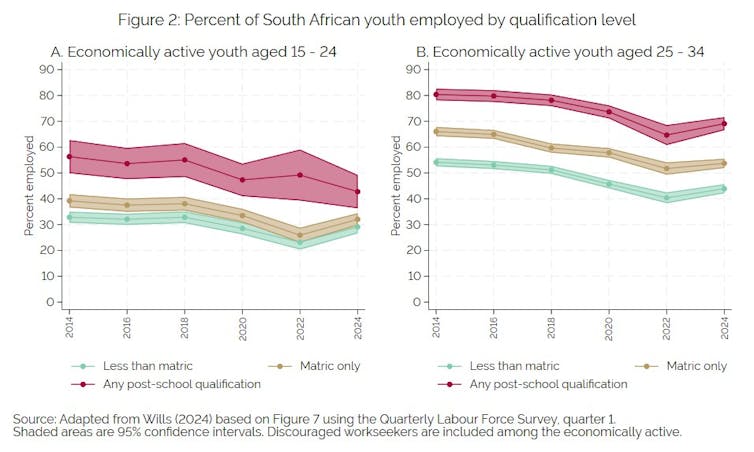
The graph below illustrates a brutal truth: ten years ago finding a job was easier for matriculants than it will be for the matric class who finished school in 2024. Between 2014 and 2018 about 4 of every 10 recent matriculants who were economically active (including discouraged work seekers) were employed. By the start of 2024 this figure was closer to 3 of every 10.

Two graphs, side by side, that show the percent of South African youth employed by qualification level
Percent of South African youth employed by qualification level.
Dr Gabrielle Wills, CC BY-NC-ND

The likelihood of youth with a matric having a job at the start of 2024 roughly resembled the chances of youth without a matric having a job eight to ten years ago.

With more learners progressing to matric, especially due to more lenient progression policy during and just after the COVID-19 pandemic, changes in the composition of the matric group could be driving some of the declines in this group’s employment prospects. But there has been a deterioration in the labour market for all youth over the past decade. Employment prospects have even declined for youth with a post-school qualification.

2. Not in employment, education or training

Proportionally fewer recent matriculants are going on to work or further study.

Before the COVID-19 pandemic (2014-2019), around 44%-45% of recent matriculants were classified as “not in employment, education or training” (NEET). The NEET rate among recent matriculants peaked at 55% in early 2022 and remained high at 49.8% at the start of 2024.

Stated differently, one of every two recent matriculants was not engaged in work or studies in the first quarter of last year. That’s 1.78 million individuals. Coupled with the rising numbers of youth getting a matric, this implies that the number of recent matriculants who were not working or studying rose by half a million from the start of 2015 to the start of 2024.

Among all 15-24-year-olds, the NEET rate rose from 32% in the first quarter of 2014 to 35% in the first quarter of 2024. Even larger increases in the NEET rate occurred among 25-34-year-olds, rising from 45% to 52% over the same period.

This is a worry. But it doesn’t mean the matric qualification has no value.

3. A matric still provides an advantage

In early 2024, nearly half of matriculants aged 15-24 were classified as not in employment, education or training. Almost 8 out of 10 of their peers who had dropped out of school were NEET. In short, you’re still more likely to get a job or further your studies with a matric certificate than without one.

4. A hard road

The road to opportunity beyond school is harder than it was a decade ago.

Among NEET matriculants aged 15-24 at the start of 2014, 27% searched for work for more than a year. By early 2024, this figure had risen to 32%.

It’s even worse for 25-34-year-old NEETs who hold a matric qualification. The percentage searching for work for over a year rose from 37% at the start of 2014 to 50% in early 2024.

The longer young people remain disconnected from employment, education or training, the greater the toll on their mental health. NEET status is associated with worse mental health, particularly among young men.

5. Post-school education and training

The government has made ambitious plans to expand opportunities for young people to study further. But enrolments in post-school education and training are not growing sufficiently to match the rising tide in school completion or to absorb youth who cannot find jobs. And, with projected declines in real per student spending on post-school education as South Africa tries to address escalating national debt servicing costs, this situation is unlikely to improve anytime soon.

The country is not keeping pace with tertiary enrolment rates in other developing nations like Brazil, Indonesia or China. For instance, 2021 estimates from the World Bank identify South Africa’s tertiary enrolment rate at 25%, compared to 41% in Indonesia, 57% in Brazil and 67% in China.

6. Location matters

Where someone lives in South Africa influences their chances for upward mobility. These inequalities are reflected in varying youth NEET rates across provinces. For instance, a third of recent matriculants in the Western Cape were not in employment, education or training in 2023/2024. That figure more than doubles in the North West province to 67%.

How to help

Two things are needed: improving labour market conditions and expanding post-school education and training opportunities.

This is unlikely without improved economic growth.

All of this may sound hopeless. But there are things that ordinary South Africans can do, too:

  • keep encouraging young people in your orbit to complete their schooling

  • where possible, spur them on to obtain a post-school qualification

  • use your social networks to connect youth to work experience opportunities, and help with CVs, referral letters and references.

Young people must also adopt a practical, pragmatic and entrepreneurial mindset. They need to seize every opportunity available to them, whether in the labour market or post-school education.

The Conversation

Gabrielle Wills is a senior researcher with Research on Socio-Economic Policy at Stellenbosch University. This research for the COVID-Generation project was made possible by financial support from Allan and Gill Gray Philanthropies. The findings and conclusions contained within are those of the authors and do not necessarily reflect positions or policies of Allan & Gill Gray Philanthropies.

ref. Life after school for young South Africans: six insights into what lies ahead – https://theconversation.com/life-after-school-for-young-south-africans-six-insights-into-what-lies-ahead-249031

Africa’s new credit rating agency could change the rules of the game. Here’s how

Source: The Conversation – USA – By Daniel Cash, Reader in Law, Aston University

For governments, a credit rating is more than a financial signal. It is a verdict that can influence the cost of borrowing, access to markets and, ultimately, the ability to provide for their citizens.

Rating decisions are made behind closed doors in a private process that isn’t open to assessment or scrutiny.

For African countries, this opacity can be especially damaging. When rating decisions lack transparency, it’s impossible to challenge potential biases or inconsistencies in methodology that put developing economies at a disadvantage. The result is higher borrowing costs that drain resources from healthcare, education and infrastructure investment.

Africa’s new credit rating agency has the chance to change this. The African Credit Rating Agency is an initiative under development by the African Union and its partners. It is more than a new entrant; it is an attempt to rethink how financial authority is earned, exercised and scrutinised. The new agency plans to introduce transparent governance structures that could revolutionise rating methodology.

As a researcher who has looked closely at the working of rating agencies, I believe this opportunity to bring transparency to financial governance isn’t just about better ratings. It’s a step towards economic sovereignty.

Success for the African Credit Rating Agency shouldn’t be measured by whether it displaces the “big three” rating agencies (Standard & Poor’s, Moody’s and Fitch). The real question isn’t whether an African agency can compete, but rather whether it can show the world how to rate credit differently.

A flawed process

The three big agencies do publish their methodologies – their criteria and risk models. This creates an illusion of transparency. Yet the final judgments emerge from committee meetings that produce no public record, no accountability, and no right of meaningful appeal.

These rating committees typically comprise five to 10 analysts who meet in closed sessions to make each sovereign rating decision. S&P, Moody’s and Fitch each operate internal rating committees for every sovereign rating decision. The deliberations, dissenting views, and specific reasoning behind final votes remain confidential. Only a brief summary is provided with a rating decision.

Research has shown that credit rating agencies are more accurate at assessing the creditworthiness of advanced economies than developing economies. There have also been studies on the discrepancy between what is expected when the public methodologies are applied and what the agencies actually rate. These studies have been done for economies like Hong Kong and China, but no equivalent research has yet been undertaken for African sovereigns.

This discrepancy exposes an accountability void. When methodology-based predictions miss the mark, we must question what happens in those committee rooms. Especially when African nations are being assessed by analysts stationed continents away, with limited understanding of local economic and political realities.

The African Credit Rating Agency could make three changes to the way ratings are done:

  • through public deliberations

  • by forming hybrid committees

  • with technological intervention.

First, it could release committee transcripts within 30 days of each decision. This would give markets and governments unprecedented insight into rating rationales. This isn’t radical – central banks already publish meeting minutes, and courts publish opinions with dissenting views.

Second, it could pioneer panels that include not only rating analysts, but regional economists, sectoral specialists, and even civil society observers. All with recorded votes. This diversified expertise would disrupt “group think” while capturing nuances of African economies that traditional agencies overlook.

I have examined this idea from the perspective of injecting climate and sustainability-related expertise into credit rating committees. I believe this is a crucial step to take to evolve the concept of the credit rating committee.

Third, the agency could use artificial intelligence to analyse patterns across committee discussions, flagging potential regional biases or inconsistent methodology application. It might be able to use secure digital ledgers to create unchangeable records of decisions.

Why the big three keep it closed

The industry thrives on privacy – protecting proprietary methodologies and shielding decisions from external challenge. And the natural oligopoly (a market dominated by a few large players due to high entry barriers, reinforced by market preference for predictability) helps it stay that way.

The sovereign credit ratings of the three big agencies are built on quantitative and qualitative factors. But research shows that sovereign ratings are subjected to qualitative understandings. This puts developing economies at a disadvantage when agencies demonstrate pro-western biases because they lack data or knowledge.

The impact of a credit rating downgrade for a sovereign borrower is usually multifaceted. Research shows that a single-notch downgrade can raise borrowing costs by more than 100 basis points, equivalent to an extra US$100 million annually on a US$10 billion bond.

Investors prefer fewer, stronger signals rather than many competing views. So there’s little incentive for established players to change. The African Credit Rating Agency, as a new entrant, can offer something the incumbents won’t: governance innovation that serves both markets and nations.

Radical openness will shake markets, at least at first. Committee members might face political pressure. Transparency alone doesn’t guarantee fair outcomes.

But the world already demands transparency from central banks and constitutional courts. Why accept anything less from institutions that shape sovereign destiny?

Next steps

By 2050, one in four people on Earth will be African. The financial architecture serving them must evolve towards systems that recognise the continent’s unique strengths.

Opening the rating committee to view represents more than technical reform – it’s about shifting who holds power in global finance. If it does this, the African agency won’t just deliver better ratings; it will model how global finance can be governed more justly.

The Conversation

Daniel Cash does not work for, consult, own shares in or receive funding from any company or organisation that would benefit from this article, and has disclosed no relevant affiliations beyond their academic appointment.

ref. Africa’s new credit rating agency could change the rules of the game. Here’s how – https://theconversation.com/africas-new-credit-rating-agency-could-change-the-rules-of-the-game-heres-how-257138

Development finance in a post-aid world: the case for country platforms

Source: The Conversation – USA – By Richard Calland, Emeritus Associate Professor in Public Law, UCT. Visiting Adjunct Professor, WITS School of Governance; Director, Africa Programme, University of Cambridge Institute for Sustainability Leadership, University of Cambridge

With the Trump administration slashing US Agency for International Development budgets and European nations shifting overseas development aid budgets to bolster defence spending, the world has entered a “post-aid era”.

But there is an opportunity to recast development finance as strategic investment: “country platforms”.

Country platforms are government-led, nationally owned mechanisms that bring together a country’s climate priorities, investment needs and reform agenda, and align them with the interests of development partners, private investors and implementing agencies. They function as a strategic hub: convening actors, coordinating funding, and curating pipelines of projects for investment.

Think of them as the opposite of donor-driven fragmentation. Instead of dozens of disconnected projects driven by external priorities, a country platform enables governments to set the agenda and direct finance to where it is needed most. That could be renewable energy, climate-smart agriculture, resilient infrastructure, or nature-based solutions.

Country platforms are a current fad. They were the talk of the town at the 2025 Spring meetings of multilateral development banks in Washington DC. Will they quickly fade as the next big new idea comes into view? Or can they escape the limitations and failings of the finance and development aid ecosystem?

The Independent High Level Expert Group on Climate Finance, on which I serve, is striving to find new ways to ramp up finance – both public and private – in quality and quantity. I agree with those who argue that country platforms could be the innovation that unlocks the capital urgently needed to tackle climate overshoot and buttress economic development.

The model is already being tested. More than ten countries have launched their platforms, and more are in the pipeline.

For African countries, the opportunity could not be more timely. African governments are racing to deliver their Nationally Determined Contributions. These are the commitments they’ve made to reduce their greenhouse gas emissions as part of climate change mitigation targets set out in the Paris Agreement. Implementing these plans is often being done under severe fiscal constraints.

At the same time global capital is looking for investment opportunities. But it needs to be convinced that the rewards will outweigh the risks.

Where it’s being tested

In Africa, South Africa’s Just Energy Transition Partnership has demonstrated both the potential and the complexity of a country platform. Egypt and Senegal also have country platforms at different stages of implementation. Kenya and Nigeria are exploring similar mechanisms. The African Union’s Climate Change and Resilient Development Strategy calls for country platforms across the continent.

New entrants can learn from countries that started first.

But country platforms come in different shapes and sizes according to the context.

Another promising example is emerging through Mission 300, an initiative of the World Bank and African Development Bank, working with partners like The Rockefeller Foundation, Global Energy Alliance for People and Planet, and Sustainable Energy for All. It aims to connect 300 million people to clean electricity by 2030.

Central to this initiative are Compact Delivery and Monitoring Units. These are essentially country platforms anchored in electrification. They reflect how a well-structured country platform can make an impact. Twelve African countries are already moving in this direction. All announced their Mission 300 compacts at the Africa Heads of State Summit in Tanzania.

This growing cohort reflects a continental commitment to putting energy-driven country platforms at the heart of Africa’s development architecture.

Why now – and why Africa?

A well-functioning country platform can help in a number of ways.

Firstly, it can give the political and economic leadership a clear goal. The platform can survive elections and show stability, certainty and transparency to the investment world.

Secondly, national ownership and strategic alignment can reduce risk and build confidence. That would encourage investment.

Thirdly, it builds trust among development partners and investors through clear priorities, transparency, and national ownership.

Fourthly, it moves beyond isolated pilot projects to system-level transformation – meaning structural change. The transition in one sector, energy for example, creates new value chains that create more, better and safer jobs. Country platforms put African governments in charge of their own economic development, not as passive recipients of climate finance.

The country sets its investment priorities and then the match-making with international climate finance can begin.

Making it work: what’s needed

Developing the data on which a country bases its investment and development plans, and blending those with the fiscal, climate and nature data, is complex. For this reason country platforms require investment in institutional capacity, cross-ministerial collaboration, and strong coordination between finance ministries, environment agencies and economic planners. And especially, in leadership capability.

African countries must take charge of this capacity and capability acceleration.

Second, development partners can respond by providing money as well as supporting African leadership, aligning with national strategies, and being willing to co-design mechanisms that meet both investor expectations and local realities.

Capacity is especially crucial given the scale of Africa’s needs. According to the African Development Bank, Africa will require over US$200 billion annually by 2030 to meet its climate goals. Donor aid will provide only a fraction of this. It will require smart, coordinated investment and careful debt management. Country platforms provide the structure to govern the process.

Seizing the opportunity

Country platforms represent one of the most promising innovations in climate and development finance architecture. Properly designed and led, they offer African countries the opportunity to take ownership of their climate and development futures – on their own terms.

Country platforms could be the “buckle” that finally enables the supply and demand sides of climate finance to come together. It will require commitment, strategic and technical capability, and, above all, smart leadership.

The Conversation

Richard Calland works for the University of Cambridge Institute for Sustainability Leadership. He is also an Emeritus Associate Professor at the University of Cape Town and an Adjunct Visiting Professor at the University of Witwatersrand School of Governance. He serves on the Advisory Council of the Council for the Advancement of the South African Constitution, Chairs of the Board of Sustainability Education and is a member of the Board of Chapter Zero Southern Africa.

ref. Development finance in a post-aid world: the case for country platforms – https://theconversation.com/development-finance-in-a-post-aid-world-the-case-for-country-platforms-257994

Kenya’s ride-hailing drivers say their jobs offer dignity despite the challenges

Source: The Conversation – USA – By Julie Zollmann, Digital Planet Fellow, The Fletcher School, Tufts University

Many argue that gig work involves exploitation, as research and media coverage have highlighted. But that doesn’t seem to deter ride hailing drivers on platforms like Uber and Bolt.

In Kenya, in fact, many new drivers continued to join platforms even as fares were slashed starting in 2016.

As a PhD student studying the role of digitalisation in development, I spent several years trying to understand how digital drivers experienced the quality of their work. My research found that in 2019, a typical digital driver in Nairobi worked about 58 hours a week and earned well below the minimum wage on an hourly basis. What made this work attractive? Why did drivers stay?

In a new paper, I draw on a 2019 survey of 450 drivers in Nairobi and 38 subsequent qualitative interviews in Nairobi and Kenya’s second largest ride hailing market, Mombasa, in 2021 that explored drivers’ experiences in detail.

In addition to measuring working hours and incomes, my survey team asked drivers if they considered their work “dignified”. Nearly eight in ten (78%) of our survey participants said yes. While that specific share of drivers may have changed since then, the underlying reasons drivers found the work dignified remain unchanged.

In the global north, scholars have rung alarm bells about what “gig work” means for the erosion of standard jobs with legal protections around working hours, minimum wage and other benefits. But the drivers my team and I spoke with in Kenya felt that digital driving was a step towards formalisation rather than a drift away from an ideal formal job. Driving had diginity in contrast to the indignities of low-wage work and the vast informal sector, which was their realistic alternative for making a living.

My findings highlight that workers’ experiences on global platforms like Uber are not universal and that digitisation may deliver some improvements in work quality relative to informal work in African contexts.

How did digital work deliver dignity?

Drivers explained that app companies imposed rules and structure that provided “discipline” in a transport sector more broadly associated with rudeness, unruliness, and disrespect towards passengers. Requirements for things like driving licences, proof of insurance, and ratings seemed to make drivers feel more professional and make passengers see them as such.

Drivers felt proud to be part of a driver community that behaved professionally under these conditions. A 38-year-old male driver in Nairobi who had been working on the platforms for three years told us:

We are very respected … Everyone trusts you to carry them. It’s not like the old days, when the taxi driver might rob you and dump you or even kill you. We are getting attraction from the society, even in the slums. They know you are an app driver, and they trust you because app drivers are good people. They know you can deliver, that you will be honest.


Read more:
Zimbabwe’s economy crashed — so how do citizens still cling to myths of urban and economic success?


On platforms, drivers were matched digitally with riders. Respondents said this brought dignity by ensuring drivers would receive a fairly steady stream of clients. This meant that a driver could rest assured he would earn money every day.

The alternative was to “hustle” in the informal economy to shake loose opportunities and constantly solicit those who might use their labour and beg for payment after a job was done. Constant solicitation and bargaining were exhausting and degrading.

One driver explained:

Most of us are poor. I have never walked out every morning sure that I would do a job. But now I know that if my car has been serviced and my phone is charged and working, I am going to work and not to some charity job. I used to wait at the base all day without getting a customer. Now, ….. at least two, three days are going to be good for you.

Digital matchmaking also meant that drivers were not limited to serving the few clients they already knew or who happened to pass them at a fixed base. They found themselves serving new parts of the city and carrying important people, including business people, celebrities and local politicians. Serving these high-end customers made them feel proud and important. Wealthy neighbourhoods, luxury hotels and high-end restaurants felt more open to them in otherwise exclusionary and segregated cities.

Some drivers felt that digitalisation had removed barriers to entry for taxi driving, like paying to join a parking base and building a client list.

The app did away with parking bases, and about half of drivers joined the system through a “partner”, paying a fixed weekly fee to rent their car instead of buying it themselves.

In efforts to make rides cheaper, in 2018 app companies in Kenya allowed smaller, less expensive cars on their platforms, lowering costs of ownership. Drivers in our survey showed that both formal and informal financiers were willing to offer loans to digital drivers, knowing they would have regular revenue to service their debt.

Buying a car was seen as a huge, dignifying accomplishment. One driver in the survey told us:

Growing up, I thought vehicles were owned only by the rich, but now digital driving has provided a means for me to own one and earn the respect of society.

David Muteru, then chairman of the Digital Taxi Association of Kenya, echoed this sentiment: “Owning a vehicle, that’s an asset”.

Dignity not always guaranteed

The dignifying value of order was only possible when app companies enforced their own rules and did so fairly. Drivers preferred the stringent rule enforcement of one major app over the lax enforcement of another, which made for more stressful and undignified interactions with riders.

When the rules were enforced, drivers could be sure that the app company would help if a rider refused to pay or if there was a dispute with the client. Drivers felt the stricter environment kept bad actors out.

Over time, though, app companies slashed prices, competing for market share. Drivers felt less respected by riders who saw them as desperate for money. Low fares pressed drivers to negotiate with riders for offline trips and higher rates, reintroducing the indignity of haggling.

Lessons for the future

Digitally mediated work raises many questions about labour standards.

This research shows how important it is to keep local context in mind. Digital driving is not the same experience for drivers in every context. Where people suffer indignities and deprivations in the informal sector, digitalisation may offer gains. But this potential depends on rule enforcement and pay. Material and subjective dignity are intertwined.

The Conversation

Julie Zollmann received funding from Mastercard Foundation.

ref. Kenya’s ride-hailing drivers say their jobs offer dignity despite the challenges – https://theconversation.com/kenyas-ride-hailing-drivers-say-their-jobs-offer-dignity-despite-the-challenges-257845

African countries are bad at issuing bonds, so debt costs more than it should: what needs to change

Source: The Conversation – USA – By Misheck Mutize, Post Doctoral Researcher, Graduate School of Business (GSB), University of Cape Town

Over the past two decades, African countries have increasingly turned to international capital markets to meet their development financing needs. For example, Kenya and Benin raised a combined US$2.5 billion through bond issuances during the first half of 2025. Proceeds were used to repay maturing bonds. This means new bonds, with unfavourable terms, are being issued to pay previous lenders.

Yet African bonds are substantially mispriced, resulting in excessively high yields that are not justified by fundamentals – based on economic, fiscal and institutional strengths. Mispricing occurs when a country has high economic growth, stable institutions that support government policy implementation, rule of law and accountability, yet its bonds trade at higher yields than those of its peers. In other words, there will be every reason for investors to trust that the country will repay what it owes, but they still expect a higher return. This is happening because of lack of information and biases perpetuated by global entities that are facilitating bond sells in Africa.

Côte d’Ivoire and Senegal have strong growth (5% to 6.5%), yet they face high yields on their bonds (7.8% to 8.2%) compared to Namibia and Morocco with approximately 3% growth and bond interest of 6%.

This mispricing imposes a heavy debt servicing burden on already constrained public budgets.

At the same time African countries face a puzzling paradox: while they’re paying more for the debt they’re raising, the demand for these bonds is much higher (oversubscribed). All bond issuances in Africa are subscribed by as much as over five times. This has only been common in Africa. It is puzzling why governments are not leveraging on the high demand to bargain for lower interest rates.

In my view, based on my bond pricing modelling expertise, I believe that mispricing of Eurobonds in Africa – debt instruments issued by a country in a currency different from its own – is not a market anomaly. It shows internal capacity failures in African countries, structural market biases and insufficient understanding of the complex mechanics of global debt markets.

Oversubscription of Eurobonds should be a source of power for African governments, not a missed opportunity. African countries can move from being price takers to price negotiators. They should be able to reduce debt costs, freeing up resources for development.

But to get there African countries need to address the power imbalance in the markets.

Governments need to invest in bond pricing expertise to increase their negotiating power.

The false success signal of oversubscription

There are several reasons why African bonds remain mispriced at a higher interest despite the oversubscriptions.

Firstly, a lack of technical expertise in primary bond issuance in the debt management offices of the majority of African governments. Very few on the continent have intelligence systems for gathering information on financial markets and formal investor relations programmes. Neither do they have in-house quantitative analysts or pricing specialists capable of engaging investment banks on an equal footing during roadshows and negotiations.

The debt management offices are unable to engage confidently and critically with financial intermediaries to challenge assumptions, simulate pricing scenarios and conduct their own comparative market analysis.

After initial public offers, most governments don’t engage with holders of their bonds on the secondary market. Nor do they monitor bond post-issuance performance. The lack of interest in the secondary market has created a feedback loop where poor market intelligence has contributed to high coupons on new issuances.

Secondly, advanced economies engage investors regularly through briefings, roadshows and timely reports. Communication by African governments is often ad hoc and usually limited to the period around a new bond issuance.

This prevents investors from forming informed, long-term views. It leads to a default risk premium in pricing.

Thirdly, debt issuance by African governments is often politically driven rather than strategically timed. Often this leads to rushed or ill-prepared entries.

Sometimes it’s done when the cost of debt is rising globally, close to election cycles, or because governments are facing a financial crunch caused by falling reserves.


Read more:
African governments have developed a taste for Eurobonds: why it’s dangerous


Fourth, African sovereigns often approach the Eurobond market with weak negotiating power. They are heavily reliant on a small pool of western investment banks as technical advisors to manage the bond issuance. These banks tend to be more inclined towards their own global investment client networks. Their incentives are not aligned with achieving the lowest possible yield for the issuers.

African issuers often accept the initial price guidance from advisors and agree to high yields even in oversubscribed situations. Even when demand could support a lower yield, African issuers fail to negotiate pricing downwards. Issuing syndicates have no incentive to push for optimal pricing for the issuer as they receive transaction-based fees.


Read more:
African countries aren’t borrowing too much: they’re paying too much for debt


The role of bond issuing syndicates is a major factor in the mispricing. In bond issuance, a syndicate is a group of financial institutions that structures the bond, price and market (also known bookbuilding), underwrite the unsold portion of the bond, sell the bond to their investors, and ensure compliance and documentation. These syndicates set coupon rates higher than necessary as a conservative hedge against perceived investor scepticism.

African governments have become passive participants rather than active price-setters. African-based bond syndicates are systematically bypassed despite growing regional capacity and distribution networks. Bond issues are also allocated to offshore buyers, sidelining local institutional investors.

Breaking the cycle of mispricing

To correct the systemic Eurobond mispricing and reduce debt servicing costs, African countries must undertake reforms.

First, governments should invest in debt management capacity.

Second, they must actively monitor secondary market trading to identify opportunities such as bond buybacks and exchanges that could improve the debt profile. Real-time analytics on bond trading performance should inform future issuance terms and investor communication strategies.

Third, governments must build institutional routines for submitting data, and proactively engage investors and rating agencies. This will challenge and influence risk assumptions. Investors need consistent assurances, especially on the ability to easily exit positions.

Fourth, African countries need to maintain and monitor up-to-date benchmarks from peers with comparable pricing data. Without accurate comparisons, it is difficult to know whether the proposed bond pricing by syndicates is fair and accurate. They must stop solely relying on what investment banks recommends.

Lastly, African governments should involve at least one African-based syndicate member, prioritise allocation to African institutional investors and promote regional arrangements with international banks to ensure knowledge transfer and equitable participation.

The Conversation

Misheck Mutize is affiliated with the African Union as a Lead Expert on Credit Ratings

ref. African countries are bad at issuing bonds, so debt costs more than it should: what needs to change – https://theconversation.com/african-countries-are-bad-at-issuing-bonds-so-debt-costs-more-than-it-should-what-needs-to-change-257128

Johannesburg’s problems can be solved – but it’s a long journey to fix South Africa’s economic powerhouse

Source: The Conversation – USA – By Philip Harrison, Professor School of Architecture and Planning, University of the Witwatersrand

Joburg skyline. South African Tourism/Flickr, CC BY

South African president Cyril Ramaphosa met senior leaders of Johannesburg and Gauteng, the province it’s located in, in March 2025 to discuss ways to arrest the steep decline in South Africa’s largest city.

Ramaphosa announced a two-year-long presidential intervention to tackle some of the city’s most pressing issues. It is to be led by the Presidential Johannesburg Working Group with eight cross-governmental and multi-stakeholder workstreams.

Johannesburg was established 130 years ago, where the world’s largest-ever gold deposits were discovered. It grew rapidly in the early 20th century and became the country’s economic heartland and largest population centre. Like all South African cities, it was deeply scarred by apartheid policies. People were divided by racially defined groups. Good services and a strong economy benefited a minority, and a black majority were pushed into impoverished ghettos.

But, for about the first two decades of post-apartheid rule from 1994, Johannesburg led the country with innovation and progressive change. It pioneered the new local government system, institutional reforms, new practice on city strategy and planning, pro-poor service delivery, and modern transport infrastructure.

Today, however, the city is in a dire state. Over the past decade, roughly coinciding with the arrival of messy coalition governance in 2016, sound political leadership, administrative stability and financial management have crumbled. Underinvestment in infrastructure maintenance has led to collapsing services. Public trust is deteriorating among increasingly frustrated communities. This was evident in local election results. It also shows up in recent data released by the Gauteng City-Region Observatory on public trust in local government.

The local economy has stagnated. The city’s official unemployment rate of 34.3% is higher than the national average of 32.9%. Mounting joblessness and dwindling incomes have intertwined with depleted trust to knock levels of payment for property rates and service charges. In turn this has deepened the financial and service maintenance crisis.

Corruption in many parts of the city is an endemic complicating factor.

The presidential intervention is designed to address this complex interplay between embedded legacies and failings post-apartheid. The workstreams involving city officials and concerned stakeholders are generating ideas for priority actions. There is also a new energy in the city government, with the executive mayor and members of his mayoral committee making turnaround promises.

This long overdue attention is heartening. But some caution is called for. While some “quick wins” are needed, there will be no easy turnaround. The best prospect is likely to be a process of recovery that will require patience and methodical attention over the long term. A city cannot be repaired in the way an automobile can. A city has a trillion moving parts and is in a constant state of makeover, as dynamics of economy, technology, demography, environment, society, politics, and more, interact and produce change.

The question is not whether a city is fixed – it can never finally be – but rather what trajectory it is on. For Johannesburg, the question is how to exit the downward spiral and begin the process of reconstruction.

We are a group who previously worked in the City of Johannesburg as officials, who are now academics with decades of experience observing local governance trends and dynamics, or scholars engaged in civil society coalitions or communities mobilising around the crisis. Some of us have been involved in the Presidential Johannesburg Working Group over the last few months.

Our view is that there are four areas needing urgent but sustained attention.

Focus areas

The first is the need for a joint effort across national, provincial and municipal government to resolve the crisis. We are pleased that this has begun. The political leadership in the city (and of the province) failed to grasp the opportunity provided by the post-2024 election national compromises to put together a broad-based government of local unity to lead reconstruction. There is no option now but to pursue an inter-governmental initiative led by national government with the committed involvement of the other spheres.

Only genuine collaboration will succeed.

In this respect, the Presidential Johannesburg Working Group holds promise. But what will be needed is careful, concerted work focused first on short-term priorities. Then, over years, on key structural challenges facing the city.

Second, the city needs civil society in all its forms to hold a careful balance between keeping up the pressure on municipal government, constantly holding it accountable to its residents, and working with government to help it solve problems. The Joburg Crisis Alliance, Jozi-my-Jozi, WaterCAN and similar initiatives are claiming well-recognised and respected voice in the affairs of the municipality.

Johannesburg needs a city government that is open to this scrutiny, accepting the need for transparency, and open to the help that civil society can offer.

To raise the level of accountability and collaboration, a clear programme of restoration has to be communicated openly to the public. Milestones and expenditure requirements need to be set that allow for constant monitoring. There must be open council meetings, and regular online and in-person briefings.

Also required are new mechanisms for citizen-based monitoring. These may include trained citizen monitors reporting on service delivery. Alternatively, the establishment of a sort of “Citizen’s Council” which meets regularly to receive reports from these monitors and the city administration.

International examples include the Bürgerrat model. This is now fully institutionalised in parts of Germany and Austria to strengthen local democracy and accountability. In this model, citizens are randomly selected to sit on a council which monitors performance of local government and provides new ideas.

Another approach could be for civil society organisations to be invited to a Citizen’s Council that would act in support of the oversight processes of the elected Municipal Council.

Third, there has to be a solution to unstable coalition governments. These seem to be structured to facilitate separate political fiefdoms where spoils can be divided in the allocation of portfolios. At minimum, the presidential intervention must provide for a check and balance on processes where bureaucratic appointments and budgetary allocations may serve the interests of cronyism. For example, there should be transparency and rigour in appointments to the boards of Johannesburg’s municipally owned companies.

Regulatory reforms are required in the political arena. This should include rules for the distribution of seats on the municipal executive and the election of mayors. Between January 2023 and August 2024 a tiny minority party held the mayoralty because the larger parties could not agree on a mayoral selection or, more cynically, to ensure that the executive mayor could not call large parties to account.

More importantly, though, there has to be a change in political culture. This is a longer-term process.

Fourth, the problems run far deeper than what bureaucratic reorganisation can achieve.

The longer-term project is to build a capable administration with clear political direction and oversight but insulated from personal agendas and factional battles. The administration became confused and demoralised because of the political instability over an extended period. There are, however, still many capable and committed public servants in the city bureaucracy. The focus should be on working with them to rebuild the administration, making it a place where talent and initiative are recognised and rewarded.

Restored political leadership and a rejuvenated administration is needed for a long term process, extending far beyond the quick wins. This process will involve refurbishing the decaying network infrastructure, restoring financial stability, reestablishing social trust and returning confidence to the city’s economy.

2025 marks 30 years since the first democratic local elections. National government is looking seriously at sweeping municipal reforms. And the next municipal election – likely to be held at the end of 2026 – is an opportunity to make a deep transformation effort. Citizens can ensure that parties contesting the election place Johannesburg’s recovery at the heart of their agenda.

The Conversation

Philip Harrison has received funding from South Africa’s National Research Foundation in support of the South African Research Chair in Spatial Analysis and City Planning.

The Gauteng City-Region Observatory receives core grant funding from the Gauteng Provincial Government.

Lorena Nunez Carrasco received funding from the National Research Foundation in support of research on the South African response on COVID-19

Rashid Seedat receives funding from Gauteng Provincial Government for the Gauteng City-Region Observatory. He is affiliated with the Ahmed Kathrada Foundation as a member of the Board of Trustees.

ref. Johannesburg’s problems can be solved – but it’s a long journey to fix South Africa’s economic powerhouse – https://theconversation.com/johannesburgs-problems-can-be-solved-but-its-a-long-journey-to-fix-south-africas-economic-powerhouse-256013

Choosing to be an orphan: for some Kenyan families it’s a strategy for survival

Source: The Conversation – USA – By Andreana Prichard, Associate Professor of Honors and African History, University of Oklahoma

In the world of international child development and orphan care, it’s not uncommon for children with families to declare themselves orphans. In fact, this practice can be traced back to precolonial times in Kenya.

Andreana Prichard has done research on the practice in Kenya. We asked her to share her insights into it.

Why do some people in Kenya assume the identity of ‘orphan’?

We often think of “orphans” as children who have lost both parents and who lack kin networks. One might ask why someone would “opt in” to orphan status when they do not fall within the classical definition of the term.

In my paper I look at the issue of orphanhood over the last 160 years. Case studies from Kenya I examine illustrate that the practice I define as “opting in” to orphanhood has precolonial roots. I define “opting in” as choosing to take on the label of being an orphan. This can be done by parents, relatives or even, in some instances, the child. This is because the label “orphan” has come to confer unique opportunities.

The practice became increasingly popular in the mid-1990s, when parents in eastern and southern Africa who had contracted HIV began to die in large numbers. Activists feared many children would be left without caregivers.

In response, the number of orphanages proliferated as humanitarian actors, churches and states inundated east Africa with orphan-focused NGOs.

In 2020, officials in Kenya estimated that there were at least 910 residential institutions for children in the country (of which 581 were registered), housing between 26,198 and 85,733 Kenyan children.

The predicted “orphan crisis” never materialised, partly because families and communities stepped in to care for newly parentless children. But the idea of an “orphan crisis” remained, and so did the funding and infrastructure.

This phenomenon occurred across the continent, not just in Kenya. However, its effects were felt particularly acutely in eastern and southern Africa where HIV/Aids prevalence rates were higher and where there was more western tourism.

Today, many African families see orphan-focused NGOs as a path to access education and improve their lives. My research shows that children themselves sometimes affiliate with an institution that provides shelter, food and schooling. Children facing abuse from caregivers may also prefer the relative anonymity and safety of an institution.

In some cases, receiving orphan services actually raises the status of the “orphan” child above that of other children. They have access to more material resources than they might have had in their villages or at home. They might have more leisure time and less work. They may have access to better bedding, shoes and clothing. They are also likely able to attend school more consistently and have a real opportunity to attend university.

Does ‘opting in’ have a long history?

Yes, it does.

In the precolonial period, most parentless or vulnerable children were cared for through lasting community support systems. Orphanhood, as it exists today as a child lacking support, protection, or care from kin, was largely avoided.

However, the late 19th to mid-20th centuries brought new actors to the east African region. The practice of “opting in” became a strategic, temporary option used by families to access services from western humanitarians.

The earliest example of this shift I found in my research is from the 1890s. Fearing their children would be caught in the Indian Ocean slave trade, African parents sometimes chose to send their children to British missions until the region was safe. They knew the missionaries opposed the slave trade and knew they offered food and medical care.

African parents thought they were making temporary arrangements to keep their children safe. Missionaries, however, understood parents to have abandoned their children. When parents returned to repay the debt – with agricultural produce or trade goods – and to reclaim their children, missionaries refused them.

In another example from Kenya in the 1950s, the British colonial government opened “reform schools” for young men. The Wamumu Approved School was renowned for the relative quality of education it provided. But the state admitted only the “most vulnerable” for a free education. Feeling they had no way to access Wamumu, students claimed to be orphans.

What have been the negative effects of Kenya’s orphan system?

There are several problems with creating a situation in which people present themselves as vulnerable just to gain safety or improve their social and economic standing.

First, research has shown that building orphanages in poor communities incentivises parents to abandon their children if they’re not also given the help to remain together.

Second, research shows that children are often put at risk in these institutions. Institutionalisation exposes children to risks such as sexual abuse, gender-based violence and neglect.

Third, orphanages have become so lucrative that African orphanage owners will go to great lengths to fit African children into the categories westerners wish to fund. The phenomenon of “paper orphans” is a prime example. “Paper orphans” are children who are recruited from their homes by proprietors (or middlemen/brokers) of orphanages and residential-care facilities. Fraudulent documentation is created for them – often including false death certificates of parents and new identity registration documents – rendering them orphans on paper, and vulnerable in practice.

What should be done?

Governments in Europe, Central Asia, Latin America and the Caribbean are trying to phase out orphanages, as are some African countries.

Based on my research I believe that working with families to support vulnerable children in their homes of origin or with extended families is a better option. This can be done through assistance programmes for vulnerable families as well as child welfare programmes. These allow families to remain intact when experiencing hardship.

Kenya is taking steps to do this by replacing orphanages and other forms of residential children’s homes with family-based, foster and community-based care and other forms of assistance. Family strengthening approaches include positive parenting instruction, life skills training, and income-generating activities, as well as supportive supervision.

In addition to this, missionary and voluntourism trips to orphanages and residential care facilities should be banned or limited.

The Conversation

Andreana Prichard received funding from the Fulbright-Hays Doctoral Dissertation Research Abroad Grant.

ref. Choosing to be an orphan: for some Kenyan families it’s a strategy for survival – https://theconversation.com/choosing-to-be-an-orphan-for-some-kenyan-families-its-a-strategy-for-survival-247371

Mbare Art Space: a colonial beer hall in Zimbabwe has become a vibrant arts centre

Source: The Conversation – USA – By Tinashe Mushakavanhu, Research Associate, University of Oxford

In southern Africa townships were built as segregated urban zones for black people. They were created under colonial and white minority rule policies that controlled movement, confined opportunity, and kept people apart.

I grew up in a different historic black township in Zimbabwe, but Mbare was the first of its kind. It holds a unique place in the nation’s imagination.

Mbare was originally named Harare. But in 1982 that name was reassigned to the capital city that houses it. In its storied past, it was once the heartbeat of black urban life. At its centre is Rufaro Stadium, where Bob Marley and the Wailers famously performed at Zimbabwe’s independence celebrations.

The township was a hub of cultural energy, sports, and political activism, and the community beer hall served as a vital gathering point. Today, many of these beer halls stand derelict.

These once-thriving communal spaces reflect a broader neglect of civic infrastructure in post-independence Zimbabwe. Yet out of these ruins, new life is taking shape.

One of the most influential figures in Zimbabwe’s artist-run spaces movement, Moffat Takadiwa, has transformed one of these former beer halls into the Mbare Art Space. The dynamic arts hub reclaims the building’s original spirit of gathering, creativity and public engagement.

Operating under a long lease from the Harare City Council, this nonprofit initiative is part of a wider urban renewal and adaptive reuse project aimed at reimagining the city’s cultural infrastructure.

My ongoing work in archival research includes mapping and visiting historical and cultural spaces like this. Here Takadiwa saw the potential for not just studios and an exhibition venue, but also for dialogue and community regeneration.

Transforming spaces

Beer halls were established by British colonial authorities in Zimbabwe (then Rhodesia) as part of a strategy of social control over the African urban population. They were designed to regulate leisure, restrict political organising and generate revenue through the sale of alcohol. By centralising drinking in state-run facilities, colonial administrators aimed to monitor and contain African social life while profiting from it.

Situated in a repurposed colonial-era beer garden, Mbare Art Space turns a former site of segregation into a vibrant centre of artistic and communal revival. It redefines a legacy of constraint and control as one of creative freedom and empowerment. The place is now an artists’ haven with studios, office space, an exhibition hall and a digital hub.

Takadiwa’s vision is informed by global precedents, notably inspired by US artist Theaster Gates, whose work includes the transformation of a derelict bank on Chicago’s South Side. It became the Stony Island Arts Bank – a hybrid space for art, archives and community engagement.

Takadiwa opened Mbare Art Space in 2019 with a vision to support emerging artists through mentorship and access to resources. True to his artistic philosophy – resurrecting abandoned, often overlooked materials suffering the effects of urban decay – he revitalised a neglected site. Most of the artists working from this space follow his lead, upcycling and recycling found materials into compelling visual forms that speak to both history and possibility.

When I arrive, Takadiwa is on his way out, but offers me a quick tour of his studio, where works in progress for his upcoming participation in the São Paulo Biennale are taking shape.

Known for his lush, densely layered sculptures and tapestry-like works made from found objects – computer keyboards, bottle tops, toothbrushes, and toothpaste tubes – Takadiwa has garnered international acclaim. His works are collected by US rapper Jay-Z and major institutions like the Centre National d’Art Plastique in Paris, the European Parliament’s art collection in Brussels, and the National Gallery of Zimbabwe in Harare.

Collaboration

What Takadiwa is building is not just an arts centre – it’s a new model space rooted in history and responsive to the present. The site itself becomes an ongoing installation, activated by the artists, curators and community members who inhabit it.

Tafadzwa Chimbumu, the operations manager, takes over the tour, guiding me through the rest of the precinct. The site retains the bones of its beer hall architecture, but it bursts with new life. Colourful murals adorn the walls. Tents draped over smaller buildings animate the exposed brickwork.

Plans are underway to establish a library here, a resource where researchers and artists can engage with Zimbabwe’s under-documented art history. Much of this history is scattered across archives and unpublished dissertations, rather than in widely available books. The aim is to bring these materials together and make them more accessible to the public.

Mbare Art Space is also becoming an exciting hub for collaboration and education. Community workshops, for example, are led by resident artists. Local schools take part in art education initiatives. Through community outreach and educational programming, the centre is extending its impact beyond its immediate geography.

As it looks to the future, Mbare Art Space is focused on expanding its artist-in-residence programme, inviting both local and international artists to immerse themselves in the context of Mbare and Zimbabwe.

Ultimately, what the space offers is something intangible – a feeling, a memory, a vision of what is possible when history and imagination meet in a shared place.

The Conversation

Tinashe Mushakavanhu does not work for, consult, own shares in or receive funding from any company or organisation that would benefit from this article, and has disclosed no relevant affiliations beyond their academic appointment.

ref. Mbare Art Space: a colonial beer hall in Zimbabwe has become a vibrant arts centre – https://theconversation.com/mbare-art-space-a-colonial-beer-hall-in-zimbabwe-has-become-a-vibrant-arts-centre-256528

African prisoners made sound recordings in German camps in WW1: this is what they had to say

Source: The Conversation – USA – By Anette Hoffmann, Senior Researcher at the Institute for African Studies and Egyptology, University of Cologne

During the first world war (1914-1918) thousands of African men enlisted to fight for France and Britain were captured and held as prisoners in Germany. Their stories and songs were recorded and archived by German linguists, who often didn’t understand a thing they were saying.

Now a recent book called Knowing by Ear listens to these recordings alongside written sources, photographs and artworks to reveal the lives and political views of these colonised Africans from present-day Senegal, Somalia, Togo and Congo.

Anette Hoffmann is a historian whose research and curatorial work engages with historical sound archives. We asked her about her book.


How did these men come to be recorded?

About 450 recordings with African speakers were made with linguists of the so-called Royal Prussian Phonographic Commission. Their project was opportunistic. They made use of the presence of prisoners of war to further their research.

In many cases these researchers didn’t understand what was being said. The recordings were archived as language samples, yet most were never used, translated, or even listened to for decades.

The many wonderful translators I have worked with over the years are often the first listeners who actually understood what was being said by these men a century before.

What did they talk about?

The European prisoners the linguists recorded were often asked to tell the same Bible story (the parable of the prodigal son). But because of language barriers, African prisoners were often simply asked to speak, tell a story or sing a song.

We can hear some men repeating monotonous word lists or counting, but mostly they spoke of the war, of imprisonment and of the families they hadn’t seen for years.

Abdoulaye Niang from Senegal sings in Wolof.
Courtesy Lautarchiv, Berlin275 KB (download)

In the process we hear speakers offer commentary. Senegalese prisoner Abdoulaye Niang, for example, calls Europe’s battlefields an abattoir for the soldiers from Africa. Others sang of the war of the whites, or speak of other forms of colonial exploitation.

When I began working on colonial-era sound archives about 20 years ago, I was stunned by what I heard from African speakers, especially the critique and the alternative versions of colonial history. Often aired during times of duress, such accounts seldom surface in written sources.

Joseph Ntwanumbi from South Africa chants in isiXhosa.
Courtesy Lautarchiv, Berlin673 KB (download)

Clearly, many speakers felt safe to say things because they knew that researchers couldn’t understand them. The words and songs have travelled decades through time yet still sound fresh and provocative.

Can you highlight some of their stories?

The book is arranged around the speakers. Many of them fought in the French army in Europe after being conscripted or recruited in former French colonies, like Abdoulaye Niang. Other African men got caught up in the war and were interned as civilian prisoners, like Mohamed Nur from Somalia, who had lived in Germany from 1911. Joseph Ntwanumbi from South Africa was a stoker on a ship that had docked in Hamburg soon after the war started.

In chapter one Niang sings a song about the French army’s recruitment campaign in Dakar and also informs the linguists that the inmates of the camp in Wünsdorf, near Berlin, do not wish to be deported to another camp.

An archive search reveals he was later deported and also that Austrian anthropologists measured his body for racial studies.

His recorded voice speaking in Wolof travelled back home in 2024, as a sound installation I created for the Théodore Monod African Art Museum in Dakar.

Chapter two listens to Mohamed Nur from Somalia. In 1910 he went to Germany to work as a teacher to the children of performers in a so-called Völkerschau (an ethnic show; sometimes called a human zoo, where “primitive” cultures were displayed).

After refusing to perform on stage, he found himself stranded in Germany without a passport or money. He worked as a model for a German artist and later as a teacher of Somali at the University of Hamburg. Nur left a rich audio-visual trace in Germany, which speaks of the exploitation of men of colour in German academia as well as by artists. One of his songs comments on the poor treatment of travellers and gives a plea for more hospitality to strangers.

Stephan Bischoff, who grew up in a German mission station in Togo and was working in a shoe shop in Berlin when the war began, appears in the third chapter. His recordings criticise the practices of the Christian colonial evangelising mission. He recalls the destruction of an indigenous shrine in Ghana by German military in 1913.

Also in chapter three is Albert Kudjabo, who fought in the Belgian army before he was imprisoned in Germany. He mainly recorded drum language, a drummed code based on a tonal language from the Democratic Republic of Congo that German linguists were keen to study. He speaks of the massive socio-cultural changes that mining brought to his home region, which may have caused him to migrate.

Together these songs, stories and accounts speak of a practice of extracting knowledge in prisoner of war camps. But they offer insights and commentary far beyond the “example sentences” that the recordings were meant to be.

Why do these sound archives matter?

As sources of colonial history, the majority of the collections in European sound archives are still untapped, despite the growing scholarly and artistic interest in them in the last decade. This interest is led by decolonial approaches to archives and knowledge production.

Sound collections diversify what’s available as historical texts, they increase the variety of languages and genres that speak of the histories of colonisation. They present alternative accounts and interpretations of history to offer a more balanced view of the past.

The Conversation

Anette Hoffmann does not work for, consult, own shares in or receive funding from any company or organisation that would benefit from this article, and has disclosed no relevant affiliations beyond their academic appointment.

ref. African prisoners made sound recordings in German camps in WW1: this is what they had to say – https://theconversation.com/african-prisoners-made-sound-recordings-in-german-camps-in-ww1-this-is-what-they-had-to-say-254127