Devil worship, muti and murder: what’s behind the growth of occult gangs in South Africa?

Source: The Conversation – Africa – By Ashwill Ramon Phillips, Lecturer and Postgraduate Supervisor, Department of Criminology, University of the Free State

Gang-related crime in South Africa is widespread, but is under-reported outside hotspots such as the Cape Flats in Cape Town or Westbury in Johannesburg. In these areas gangs are deeply rooted and contribute to ongoing violence, drug trafficking and territorial conflict.

But gangs have continued to evolve and gang violence has consistently increased throughout South Africa, particularly in the Gauteng and Free State provinces. In the Free State in the east-central part of the country, devil-worshipping and witchcraft-related gang practices have been reported.

Gang-related violence is fuelled by poverty, social exclusion, unemployment and the need for protection from rival gangs.


Read more:
Here’s how some of Cape Town’s gangsters got out – and stayed out


In my doctoral study in criminology, I explored the phenomenon of occult-inspired gangs in the Free State. I interviewed 23 active gang members, 16 offenders who weren’t affiliated to gangs, and 18 service providers like social workers and correctional officials working with these groups.

In a more recent study I developed a typology of occult gangs: a framework that captures their structure, symbolism, hierarchy and spiritual practices.

This matters because in order to prevent gang-related crime it is essential to understand how they operate.

The rise of Free State occult gangs

In 1997, a South African Police Service investigation uncovered a so-called devil worshipping group or “evil church” that had migrated from parts of northern Africa and established itself in Maseru, Lesotho (South Africa’s neighbour). This group reportedly blended occult practices with traditional African witchcraft. This led local communities to label it as a devil-worshipping gang.

Since 2011, groups like this have expanded across the Free State. There are now about 40 such gangs active in the province, as reported by the police and confirmed in my research. Some of the better known gangs are the Triple 6 (666), Born-To-Kill (BTK), Natural Born Killers (NBK), International Junior Portuguese (IJP), and Maroma (Romans/Romas).

More typical street gangs are mostly known for expanding their territory through profit from the drug trade and extortion. But these Free State gangs incorporate spirituality and esoterism (special hidden knowledge) to assert dominance, foster cohesion and generate fear within communities.

They engage in serious crimes including murder, organ trafficking and rape. They are particularly known for acts such as ritual stabbings, cannibalism, and alleged communication with demonic forces.

The communities in which these groups operate, and gang members themselves, refer to them as “devil worshipping gangs”. This is because of the explicit link between certain gang-related practices and satanism, or the worship of the devil as depicted in the Christian bible.

Some groups merge beliefs and rituals related to Satan and anti-Christianity with witchcraft. Or they use symbols commonly associated with satanism such as “666” and inverted crosses. But labelling all such groups as “devil worshipping gangs” is misleading. The term “occult gangs” better captures the range of practices involved.

While both devil worshipping and witchcraft-related practices can play a role in criminal gang activity, they differ in origin and form. Devil worshipping draws from western occult traditions, using symbols and rituals to strengthen gang identity. Witchcraft-based practices typically involve the malicious use of muti (traditional African medicine) and muti murders (murders for body parts to use in muti). As one participant told me:

Yes, there are gangs that believe in muti. There are also gangs that believe in the devil. IJP and Roma believe in muti, while BTK and Triple 6 believe in getting power from the devil. They say they speak to Lucifer to give them powers.

So, infamous gangs in the Free State are not only dreaded for their brutality but also for their reported links to ritual murder, blood oaths, the use of muti and the consumption of human organs and blood. According to my research these activities have progressed from being viewed as urban legends and community myths to becoming lived realities.

Inside the gangs

My gang typology study sample consisted of 39 male offenders, aged 14 to 38. Participants were either serving sentences or awaiting trial for serious offences such as murder, rape and armed robbery.

The gang members spoke openly about seeking power through supernatural means. Some believed that consuming blood and participating in occult rituals could make them invisible to police and invincible against their enemies. As one told me:

The minute you drink blood you are invoking spirits to become part of you, demons to become part of you, and give you the powers that you need to do what you have to do…

Ritual stabbings, inverted crosses, and the “mark of the beast” (“666”) were part of their gang symbolism – seen in gang graffiti and tattoos and furthered by involvement in spiritual gatherings and the use of muti.

These elements form part of a shared gang ideology that offers meaning, identity and purpose to marginalised young people. I found that the gang members in my studies often lacked family support, social support or significant formal education.

To prevent young people from joining gangs, it is crucial to understand what pulls them in. Several participants described joining gangs not only for wealth, protection or status, but for a sense of spiritual power. Especially in communities where traditional religion, ancestral beliefs and Christian teachings coexist and sometimes collide.

My typology of occult gangs has the potential to inform targeted prevention programmes, rehabilitation efforts and policing strategies that take the spiritual realities of gang members seriously.

A new approach to fighting crime is needed

The rise of occult gangs has now progressed beyond the Free State. Similar trends are observed in the Eastern Cape, Northern Cape, Gauteng and Western Cape provinces.

The intersection of faith, fear and violence in these gangs challenges mainstream approaches to crime prevention. Traditional anti-gang strategies assume that gangs are driven mainly by socioeconomic factors or rational incentives. They fail to account for spiritual motivations and metaphysical beliefs.

The presence of ritual elements complicates investigations and amplifies fear. It makes gangs seem more powerful than they are.

At the same time, public institutions such as the police and social workers often lack the frameworks and cultural sensitivity to address the spiritual dimensions of the offences perpetrated by these groups.

The struggle with the occult gangs in South Africa mirrors similar challenges in other countries, like Nigeria, the DRC and Haiti, where spiritual symbolism and ritualised violence are central to gang identity.

Effective interventions must include culturally grounded strategies to help members disengage from gangs, involving traditional leaders, healers, faith-based actors and mental health professionals.


Read more:
Rituals, rites and rumours: how women claim power in Zimbabwe’s informal gold mines


By addressing the spiritual, social, and psychological dimensions of gang involvement, more sustainable pathways out of these groups can be created.

Gang violence in South Africa is evolving, and so must the response. It shouldn’t just punish young offenders, but offer them a genuine alternative.

The Conversation

Ashwill Ramon Phillips does not work for, consult, own shares in or receive funding from any company or organisation that would benefit from this article, and has disclosed no relevant affiliations beyond their academic appointment.

ref. Devil worship, muti and murder: what’s behind the growth of occult gangs in South Africa? – https://theconversation.com/devil-worship-muti-and-murder-whats-behind-the-growth-of-occult-gangs-in-south-africa-260141
Comment le XIXᵉ siècle a réinventé les fêtes populaires, des cafés-concerts aux bals masqués

Source: The Conversation – France in French (3) – By Corinne Legoy, Professeure en histoire contemporaine, Université d’Orléans

Si aucun siècle ni aucune culture n’ignore les fêtes, c’est à partir du XIXe siècle que s’impose une nouvelle offre de divertissements, entre parcs d’attractions, théâtres, cafés-concerts, restaurants… multipliant les occasions de célébrations dans l’espace public. Explications alors qu’on s’interroge sur le sens contemporain de la fête.


Les fêtes populaires, dans les rues ou aux terrasses, en des lieux dédiés ou non, semblent, aujourd’hui, toujours un peu nous surprendre. Ainsi de la dernière fête de la musique, promue festival le plus cool du monde sur les réseaux sociaux, drainant une foule inédite de touristes fêtards attirés par l’événement.

Ainsi, un an auparavant, durant l’été des Jeux Olympiques, de ce Paris redevenu une fête aux yeux de bien des observateurs étonnés. Quelque chose s’était alors joué d’une vaste fête publique, irréductible aux grandes cérémonies orchestrées d’ouverture et de clôture et ce fut, pour beaucoup, une surprise. Comme si ressurgissait un usage perdu de la fête populaire, ce simple plaisir de s’amuser et de partager dans l’espace public et ses lieux.


À lire aussi :
JO : la cérémonie d’ouverture de Thomas Jolly, grande fête civique et théâtrale


L’actualité, au reste, a brouillé le sens de la fête : la fermeture ou la fragilité de nombre de ses lieux (des discothèques aux bars et restaurants) ainsi que les confinements liés à la pandémie du Covid-19 ont conduit à s’interroger sur la place et les conditions de possibilité de la fête dans nos sociétés. Tragiques, les attentats de 2015, prenant pour cible une salle de spectacle, le Bataclan, et des terrasses de cafés, puis celui de 2016, lors du 14 juillet à Nice, ont tout à la fois associé nos cultures à des pratiques festives et teinté dramatiquement ces grands rassemblements publics.

La peur, aussi, rôde sur la fête. Elle est, de surcroît, régulièrement nourrie par la crainte des débordements, constamment rappelés, voire instrumentalisés, à l’image de ceux qui ont suivi la victoire du PSG en finale de la ligue des Champions le 1er juin dernier. Journalistes, chercheurs ou acteurs du monde de la nuit se sont ainsi, depuis quelques années, emparés de la question, s’interrogeant sur ce sens perdu de la fête ou sur sa présence-absence dans nos sociétés.

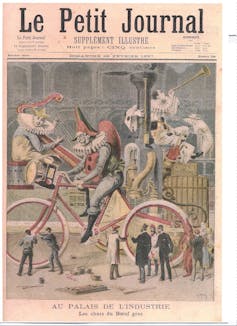
Le clown géant qui va prendre la tête de la Cavalcade du Bœuf Gras au Carnaval de Paris, en 1897.
Le Petit Journal, via Wikimedia

Cette idée que l’on ne saurait plus, ou que l’on ne pourrait plus, faire la fête n’est cependant pas un constat neuf. Dès 1961, Willy Ronnis commente ainsi le 14 juillet dans l’île Saint-Louis : « ce jour-là, j’étais monté sur un petit tabouret pour avoir une vue plongeante du petit bal. Il y avait une telle gaieté dans les rues de Paris, au 14 Juillet. Ça s’est raréfié, peu à peu ». Mais ce discours de la nostalgie entoure toujours, en réalité, le discours sur la fête. Dès le XIXe siècle, bien des contemporains déplorent ces fêtes qui ne seraient plus ce qu’elles étaient. La mélancolie qui s’empare des fêtards au petit matin semble souvent s’emparer de nombre de ses observateurs, masquant la résistance et la réinvention des pratiques festives.

Au fond, les confinements n’ont-ils pas surtout montré leur puissance de renouvellement, ici sous contrainte, avec leurs apéros-zooms, l’organisation de fêtes et de dîners privés en dépit de la distanciation sociale imposée partout, l’improvisation de concerts ou de performances sur les balcons ?

Alors plutôt que de nous demander, sans doute en vain, si l’on sait encore ou si l’on ne sait plus faire la fête, essayons plutôt d’éclairer un peu ce qu’elle fut juste avant nous, en ce XIXe siècle où s’inventèrent bien des formes festives.

Les « nuits parisiennes », naissance d’un mythe

Si aucun siècle ni aucune culture n’ignorent les fêtes, c’est à partir du XIXe siècle que s’impose progressivement une nouvelle offre de divertissements marquée par la démultiplication et la diversification des lieux festifs. Elle est particulièrement visible à Paris où la présence et la pratique de la fête s’intensifient alors, contribuant à forger le mythe puissant des « nuits parisiennes ».

L’obsession des contemporains pour l’inventaire de tous ces lieux « consacrés à la joie » dit, à elle seule, le caractère inédit de cette offre et de ces pratiques : physiologies, tableaux de Paris, guides touristiques ou articles de presse dressent inlassablement la liste de ces lieux où sortir et s’amuser, cherchant à rendre lisible ce nouveau Paris festif et nocturne en train de naître.

Cette forte présence de la fête dans le Paris du XIXe siècle tient au moment charnière qu’il représente : moment où persistent des usages festifs hérités encore très vivaces et où s’inventent de nouveaux divertissements, liés à une culture urbaine en pleine mutation.

Le principal héritage festif est celui de Carnaval, dont la tradition, très ancienne, est encore étonnamment puissante au XIXe siècle. Foules costumées, cortèges, voitures de masques, bals et festins scandent cette parenthèse admise de subversion des normes et des codes, ce monde à l’envers railleur.

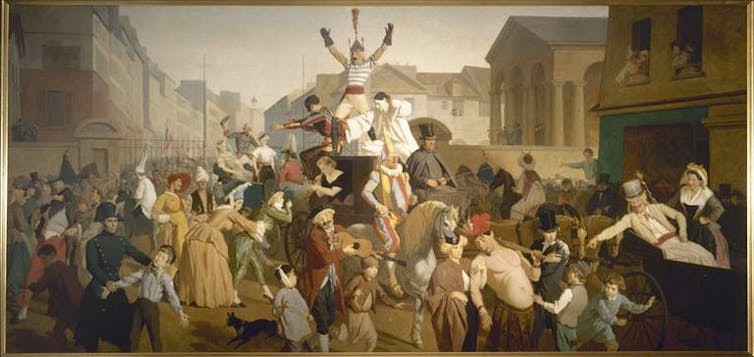
La Descente de la Courtille, entre 1835 et 1845, Musée Carnavalet
La Descente de la Courtille, entre 1835 et 1845.
Jean Pezous, via Wikimedia — (musée Carnavalet)

La rue, alors, est au peuple. Elle est parcourue de masques et de costumes, et traversée de grands cortèges rituels dont la population parisienne est longtemps coutumière : descente de la courtille, qui voit, dans la première moitié du siècle, les fêtards enterrer carnaval en un cortège déguisé, divagant et bruyant, rejoignant le cœur de Paris depuis la barrière de Belleville ; promenade du bœuf gras, ce défilé de bœufs, choisis pour leur fort poids en viande, mené en musique par des garçons bouchers déguisés et accompagné de chars ; cortège des blanchisseuses, enfin, avec sa reine des reines élue chaque année.

Fête rituelle, le carnaval parisien, en ce siècle des révolutions, se fait également politique. Les journées révolutionnaires de février 1848 qui chassent Louis-Philippe du pouvoir mêlent ainsi soulèvement politique et gestes carnavalesques quand, souvent, le mannequin traditionnellement brûlé à la fin des réjouissances prend le visage de tel ou tel homme politique. L’instrumentalisation de la fête en une arme d’affranchissement et d’affirmation est consacrée, et pour longtemps.

Progressivement, cependant, les fêtes de Carnaval deviennent plus commerciales, plus encadrées, leur présence reflue, en tout cas sous leurs formes anciennes, populaires et provocatrices. Les chars publicitaires se multiplient, les notables et les grands patrons s’imposent dans leur organisation. Carnaval alors se meurt – peut-être – mais les pratiques festives se renouvellent, affirmant leur présence dans la ville et leur vivacité populaire.

Danser pour faire la fête

Ces pratiques festives doivent alors beaucoup à l’essor, sans précédent, d’une offre de loisirs inédite, liée aux mutations de la ville et du rapport à elle : la nuit est conquise peu à peu par l’éclairage public qui se répand ; les divertissements proposés ferment plus tard ; un temps pour soi libéré peu à peu – même en d’étroites limites – permet de sortir plus aisément, et la diversification de l’offre permet presque à chacun – ouvrier, grisette, étudiant ou bourgeois – de trouver un lieu où divertir sa soirée et sa nuit.

Faire la fête, c’est alors avant tout danser. Ce goût si profondément ancré et si socialement partagé – qui fait parler de « dansomanie » – n’est certes pas tout à fait neuf, mais il bénéficie alors de l’expansion considérable du nombre de salles de bal jusque dans la seconde moitié du XIXe siècle.


Tous les quinze jours, nos auteurs plongent dans le passé pour y trouver de quoi décrypter le présent. Et préparer l’avenir. Abonnez-vous gratuitement dès aujourd’hui !


Selon les mots de Victor Rozier, « de même qu’à Paris, chaque quartier a ses habitants, chaque boulevard ses promeneurs, chaque bal a son public » : étudiants aux bals du Prado et à Bullier (fondé sous le nom de Closerie des Lilas et qui est resté quand le bal s’est transformé en brasserie) ; classes populaires au Château-Rouge, à la Reine-Blanche ou à la Boule-Noire, les grands bals de Montmartre ; monde mêlé de toutes les catégories sociales à Valentino ou Frascati.

En réalité, cependant, on ne danse pas que dans des salles dédiées. Bien d’autres lieux permettent de danser. C’est le cas des guinguettes, qui naissent alors, ces modestes restaurants ou débits de boisson, ajoutant un bal à leurs attractions. Elles existent à Paris, mais surtout à ses barrières, sur un axe Belleville-Montrouge. La Grande-Chaumière est l’une des plus fameuses, située à la barrière de Montparnasse, alors sur la commune de Montrouge. Quand le nombre de salles de bal commence à refluer, notamment à partir des années 1880, elles poursuivent leur histoire, renouvelée par les bals musettes qui se multiplient sur les bords de Marne.

Les salles de bal font en effet face, dans la seconde moitié, à la rude compétition des innombrables divertissements crées alors : cafés-concerts, cabarets, music-halls, cirques, fêtes foraines, skating-rinks, puis, plus tardivement, parcs d’attraction (Luna-Park ou Magic-City).

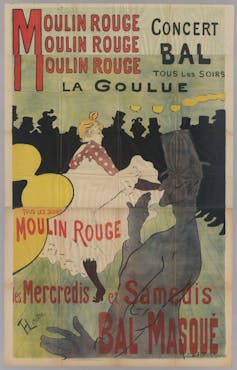
Affiche de Toulouse-Lautrec pour les bals du Moulin Rouge (1891, Musée Carnavalet)
Affiche de Toulouse-Lautrec pour les bals du Moulin Rouge (1891, Musée Carnavalet).

Mais cette nouvelle offre culturelle n’est cependant pas qu’une offre de spectacles, elle est, indissociablement et profondément, participative : presque tous les lieux de divertissement sont alors, et c’est une particularité du temps, des lieux hybrides, où se combinent spectacles et possibilités festives. D’abord parce que l’on peut y boire, fumer et se déplacer librement, ensuite parce que l’on peut aussi, et souvent, y danser, enfin parce qu’ils abritent, tous, une foule de fêtes.

L’Élysée-Montmartre, fondé en 1807, combine ainsi salle de spectacle et salle de bal ; les Folies-Bergère (fondées en 1869) et le Moulin Rouge (fondé en 1889), de la même façon, sont à la fois établissements de spectacle et salles de bal. Plus étonnant, peut-être, pour nous, ces skating-rinks, salles de patinage (à glace ou à roulettes) où le public se presse autant pour patiner que pour les fêtes qui y sont régulièrement données.

La vogue des bals masqués

Parcs d’attraction, théâtres, cafés-concerts, restaurants… Tous ces lieux voient alors triompher, jusqu’à la Première Guerre mondiale, une forme totalement disparue – du moins dans sa dimension publique et populaire – de fête nocturne, aux échos considérables dans la ville, les imaginaires et la culture du temps : les bals masqués et costumés. Dérivés du bal de l’Opéra, crée en 1715, ils sont d’abord organisés durant la période de Carnaval puis s’en émancipent au fur et à mesure du siècle.

Tous les lieux de divertissement évoqués, à commencer par les théâtres, organisent leurs bals masqués, ouverts moyennant un billet d’entrée dont les tarifs varient selon le prestige des salles. Ils drainent dans les salles des foules considérables de fêtards, mais aussi bien des curieux, et attirent, dans les rues, des badauds guettant les déambulations des noctambules déguisés. Ces fêtes sont, aussi, dans la ville. Fascinantes ou scandaleuses, selon les points de vue des contemporains, elles sont affolantes pour les pouvoirs qui les surveillent scrupuleusement, mais les tolèrent pourtant et les laissent même se multiplier.

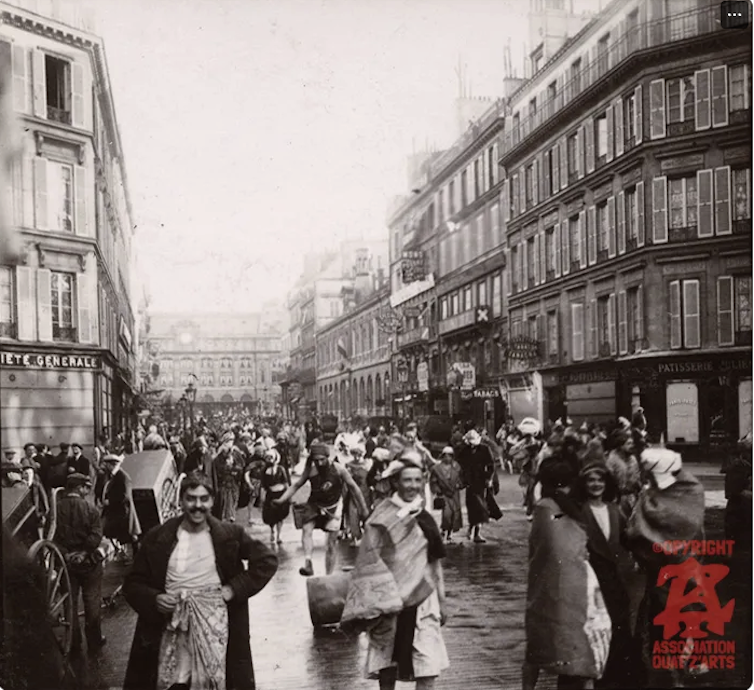
1912, photographie de la montée au bal des Quat’z’Arts au Skating de la rue d’Amsterdam.
Association des Quat’Z’Arts

La présence publique de ces fêtes masquées est redoublée par celles qu’organisent de nombreuses associations, étudiantes, professionnelles ou syndicales. Fêtes privées officiellement, puisque sur invitation, certaines d’entre elles brouillent cependant la frontière du privé, s’invitant dans la ville et s’ouvrant, bon gré mal gré, à des fêtards échappant à leur cercle. Le cas emblématique est celui du bal des Quat’z’Arts (le bal des étudiants des Beaux-Arts), dont les cortèges (le soir, avant le bal, et au petit matin, après lui) sillonnent Paris en un rituel provocateur perdurant de 1892 à 1966.

La familiarité avec la fête était-elle alors plus grande ? Son inscription dans l’espace de la ville plus forte ? Son appropriation partagée plus intense ? Nous laisserons à chacun le soin de trancher… Et d’y penser, peut-être, le 14 juillet, le jour de cette fête, voulue républicaine et populaire, par les pères de la IIIe République qui en firent, en 1881, la fête nationale.

The Conversation

Corinne Legoy ne travaille pas, ne conseille pas, ne possède pas de parts, ne reçoit pas de fonds d’une organisation qui pourrait tirer profit de cet article, et n’a déclaré aucune autre affiliation que son organisme de recherche.

ref. Comment le XIXᵉ siècle a réinventé les fêtes populaires, des cafés-concerts aux bals masqués – https://theconversation.com/comment-le-xix-siecle-a-reinvente-les-fetes-populaires-des-cafes-concerts-aux-bals-masques-256652

L’Indonésie à l’honneur le 14 juillet, reflet de la stratégie française en Indo-Pacifique

Source: The Conversation – France in French (3) – By Paco Milhiet, Visiting fellow au sein de la Rajaratnam School of International Studies ( NTU-Singapour), chercheur associé à l’Institut catholique de Paris, Institut catholique de Paris (ICP)

Portées par une volonté commune de proposer à la région indo-pacifique une option alternative à la rivalité sino-américaine, la France et l’Indonésie approfondissent le partenariat stratégique scellé en 2011. Après la visite d’État d’Emmanuel Macron à Jakarta en mai dernier, son homologue indonésien, Prabowo Subianto, est cette fois l’invité d’honneur du défilé du 14 juillet à Paris. Au-delà du symbole, c’est une dynamique de rapprochement à la fois militaire, économique et diplomatique qui se confirme entre les deux pays.


Quelques semaines après une visite d’État en Indonésie, Emmanuel Macron a rendu la politesse à son homologue indonésien, Prabowo Subianto, en le conviant aux cérémonies du 14 juillet 2025 en tant qu’invité d’honneur.

Cette double séquence diplomatique entre Jakarta et Paris, concomitante au 75e anniversaire de l’établissement des relations diplomatiques entre les deux pays, s’inscrit dans la continuité d’un partenariat en plein essor.

Élevée au rang de partenariat stratégique en 2011, la relation franco-indonésienne constitue désormais l’un des piliers de la politique proactive de la France en Asie du Sud-Est. Pour l’Indonésie, la France, en plus d’être un partenaire européen d’autant plus important qu’elle est un membre permanent du Conseil de sécurité de l’ONU, représente un levier de diversification stratégique cohérent avec sa posture traditionnelle de non-alignement.

Porté par une coopération de défense en pleine croissance, ce partenariat se veut ambitieux et durable. Si la relation globale demeure encore modeste, notamment en matière d’échanges économiques, les convergences géopolitiques croissantes et des ambitions compatibles dans la région indo-pacifique ouvrent la voie à un approfondissement stratégique de long terme.


Du lundi au vendredi + le dimanche, recevez gratuitement les analyses et décryptages de nos experts pour un autre regard sur l’actualité. Abonnez-vous dès aujourd’hui !


Une coopération de défense florissante

La coopération de défense et de sécurité constitue la pierre angulaire du partenariat franco-indonésien. Elle a connu un développement important au cours des cinq dernières années, notamment grâce à d’importants accords dans le domaine de l’armement.

Depuis 2022, l’Indonésie a acquis 42 avions de chasse Rafale, 2 sous-marins de classe Scorpène (impliquant des transferts de technologie importants, puisque ceux-ci sont construits par le chantier PT PAL en Indonésie), 13 radars longue portée Ground Master 400 auprès de Thales et 2 avions de transport militaire Airbus A400M. La France profite donc largement de l’effort capacitaire indonésien entamé depuis près d’une décennie et de la stratégie de diversification des fournisseurs, articulée autour d’une exigence croissante de transferts de technologies.

Jakarta est désormais le deuxième client de la France en Indo-Pacifique (derrière l’Inde), et la base industrielle et technologique de défense (BITD) française espère des ventes supplémentaires prochainement : Rafale et Scorpène supplémentaires, frégate de défense et d’intervention, avions Airbus multirôle de ravitaillement en vol et de transport (MRTT), satellites, missiles sol-air Mistral et système de défense aérienne VL MICA.

Cette communauté de moyens inédite entre les deux pays s’accompagne d’une coopération opérationnelle en progression constante. Ainsi, l’Indonésie est une escale régulière des missions de projections aériennes françaises Pégase. Les deux pays organisent un exercice terrestre nommé Garuda Guerrier depuis 2023. Une frégate française a participé en 2025 à l’exercice indonésien Komodo.

Sur les théâtres extérieurs, leur participation commune aux opérations de maintien de la paix de l’ONU, notamment la FINUL au Liban dont les deux pays sont des contributeurs majeurs, donne également lieu à des interactions opérationnelles renforcées.

Point d’orgue de cette dynamique de coopération, le porte-avions Charles de Gaulle a, pour la première fois de son histoire, fait escale en Indonésie, à Lombok, en février 2025. Le ministre des Armées, Sébastien Lecornu, s’est spécialement déplacé sur place et a accueilli à bord du bâtiment son homologue indonésien, Sjafrie Sjamsoeddin.


À lire aussi :
Le porte-avions « Charles-de-Gaulle », vitrine des ambitions françaises en Indo-Pacifique


Un partenariat global et ambitieux, mais encore modeste

Le partenariat franco-indonésien ne se limite pas à la seule sphère de la défense. Avec plus de 280 millions d’habitants, l’Indonésie est la première économie d’Asie du Sud-Est et représente, à ce titre, d’importantes perspectives de croissance.

La déclaration conjointe publiée à l’issue du voyage du président français en mai 2025, intitulée Horizon 2050, en témoigne : ses 68 points couvrent un spectre très large, allant de la gouvernance internationale à la sécurité alimentaire, en passant par la transition énergétique, la coopération maritime, la biodiversité, l’enseignement supérieur, la culture, le sport ou encore le droit.

Pourtant, malgré une feuille de route bilatérale ambitieuse et la présence de quelque 200 filiales françaises implantées dans le pays – notamment de grands groupes comme Eramet, Total ou Danone –, les échanges économiques entre la France et l’Indonésie demeurent modestes.

Avec environ 3,5 milliards d’euros d’échanges commerciaux annuels, la France reste un partenaire économique de second rang pour l’Indonésie, loin derrière la Chine (127 milliards), les États-Unis (35 milliards) ou encore d’autres puissances asiatiques, et ne figure qu’au quatrième rang des partenaires européens. De son côté, l’Indonésie n’est que le cinquième partenaire économique de la France au sein de l’Asean derrière Singapour, le Vietnam, la Thaïlande et la Malaisie.

Si la France demeure active sur le plan culturel et éducatif, notamment grâce à un Institut français dynamique et présent dans 4 villes, la communauté française en Indonésie reste toutefois relativement modeste, avec environ 3 000 expatriés recensés, bien moins qu’à Singapour ou en Thaïlande.

« Indonésie : l’émergence d’un géant », Le Dessous des Cartes, Arte, février 2024.

Convergences géopolitiques

Pourtant, au-delà des chiffres, c’est avant tout une vision commune des relations internationales qui semble porter le partenariat. Une vision que le président français a résumée en ces termes à Jakarta : « Nous ne voulons la guerre avec personne, mais nous ne voulons dépendre de personne. »

Pour l’Indonésie, le principe fondamental de sa politique étrangère depuis son indépendance en 1945 est la doctrine bebas aktif – une diplomatie libre et active – qui repose sur une politique de non-alignement, engagée, multilatérale et constructive. C’est cette vision qui a guidé l’engagement de l’Indonésie dans le mouvement des non-alignés et son rôle clé dans l’organisation sur son territoire de la Conférence de Bandung en 1955.


À lire aussi :
En relations internationales, le non-alignement existe-t-il vraiment ?


Soixante-dix ans plus tard, Jakarta reste un acteur diplomatique très actif : présidence du G20 en 2022, de l’Asean en 2023, adhésion aux BRICS en 2024, candidature en cours à l’OCDE, participation accrue aux opérations de maintien de la paix.

Dans un contexte régional marqué par l’intensification de la rivalité sino-américaine, Jakarta réaffirme sa volonté d’autonomie stratégique. L’élection du président Prabowo Subianto – – ancien gendre de Suharto et militaire de carrière à réputation pour le moins contrastée du fait des multiples accusations l’ayant visé par le passé – – s’inscrit dans la continuité de cette posture d’équilibriste. Passé par les États-Unis dans le cadre de sa formation, le nouveau chef de l’État a pourtant réservé son premier déplacement officiel à la Chine, en novembre 2024.

Ce geste fort s’est accompagné d’une déclaration conjointe sur l’exploitation partagée des ressources en mer de Chine méridionale, et ce, en dépit des tensions persistantes dans la zone des îles Natuna – une région sous souveraineté indonésienne, mais régulièrement sujette à des incursions de navires de pêche et de garde-côtes chinois.

Ces constantes de la politique étrangère indonésienne, marquée par une proximité simultanée et parfois tendue avec Washington et Pékin, sont compatibles avec « l’autonomie stratégique » défendue par le président Macron comme facteur de rapprochement entre l’Asie et l’Europe pour former une « coalition d’indépendants », concept qu’il a défendu lors du dernier dialogue de Shangri-La à Singapour.

Depuis 2023, les deux pays ont instauré un dialogue stratégique au format 2 +2 (réunissant les ministres des Affaires étrangères et de la Défense), une première pour l’Indonésie avec un pays européen – et cherchent désormais à approfondir leur coopération sur les grands enjeux internationaux. Ainsi, la déclaration conjointe franco-indonésienne du 28 mai 2025 sur le Proche-Orient appelle à un cessez-le-feu immédiat à Gaza, condamne fermement l’occupation illégale des territoires palestiniens et réaffirme l’engagement des deux pays en faveur de la solution à deux États.

C’est cependant dans l’espace indo-pacifique que les convergences stratégiques entre la France et l’Indonésie sont les plus nettes, les deux pays partageant, on l’a dit, une volonté commune de stabilité, de multilatéralisme et aussi de préservation des biens communs maritimes (lutte contre la pêche illégale, la pollution et les trafics illicites, sauvetage en mer, sécurisation des infrastructures critiques, surveillance des domaines maritimes, réponse aux catastrophes naturelles, aide humanitaire).

Horizons indo-pacifiques

À l’heure où l’Indo-Pacifique s’impose comme le théâtre central des recompositions géopolitiques, la convergence entre Paris et Jakarta se reflète dans leurs documents de doctrine respectifs : la Stratégie française en Indo-Pacifique (2018) et la Vision de l’Asean pour l’Indo-Pacifique (2019), dont l’Indonésie a été l’un des principaux artisans.

Les deux pays coopèrent déjà étroitement au sein de plusieurs forums multilatéraux dans l’océan Indien et en Asie du Sud-Est, tels que l’Indian Ocean Rim Association (IORA), l’Indian Ocean Naval Symposium (IONS) ou l’Asean Defence Ministers Meeting Plus (groupe auquel la France participe comme observateur).

Cette dynamique pourrait s’étendre au Pacifique insulaire, où la France – puissance riveraine – et l’Indonésie – État archipélagique majeur – ont tout intérêt à conjuguer leurs efforts pour répondre aux vulnérabilités spécifiques des États océaniens, en lien avec les priorités portées par le Forum des Îles du Pacifique, institution dont les deux pays sont partenaires de dialogue.

À cet égard, l’Indonésie cherche à renforcer sa présence diplomatique dans le Pacifique océanien. Elle est membre associé du Groupe de Fer de lance mélanésien (MSG) depuis 2015 et souhaite désormais participer au Sommet des ministres de la défense des pays du Pacifique (SPDMM). Dans cette stratégie, Jakarta s’appuie directement sur la France, perçue comme un acteur moins polarisant que la Chine ou les États-Unis dans la région.

Autant de dynamiques convergentes qui augurent d’un renforcement du partenariat franco-indonésien ans les années à venir.

The Conversation

Paco Milhiet ne travaille pas, ne conseille pas, ne possède pas de parts, ne reçoit pas de fonds d’une organisation qui pourrait tirer profit de cet article, et n’a déclaré aucune autre affiliation que son organisme de recherche.

ref. L’Indonésie à l’honneur le 14 juillet, reflet de la stratégie française en Indo-Pacifique – https://theconversation.com/lindonesie-a-lhonneur-le-14-juillet-reflet-de-la-strategie-francaise-en-indo-pacifique-260713

« Migrants », « réfugiés », « illégaux », « candidats à l’asile »… comment les politiques et les médias désignent les personnes en déplacement

Source: The Conversation – France in French (3) – By Valériane Mistiaen, Postdoctoral fellow, Vrije Universiteit Brussel

L’analyse de plus de 13 000 articles de presse et 3 400 journaux télévisés montre la grande diversité des termes utilisés pour désigner les personnes en déplacement – une terminologie qui influence profondément le regard porté sur elles.


Les termes utilisés dans les médias pour désigner les personnes en déplacement (une formule encore peu répandue en France mais qui tend à s’imposer comme une expression neutre et inclusive dans les sphères internationales, notamment au sein d’organisations comme l’Organisation internationale pour les migrations (OIM)) ne sont jamais neutres : ils révèlent, souvent malgré eux, des rapports de force politiques et idéologiques.

La catégorisation – et donc le mot utilisé pour désigner une catégorie – manifeste un rapport de pouvoir. Dans le contexte de la « crise migratoire » européenne, l’usage des catégories est devenu fortement politisé, et varie largement selon le contexte discursif. De plus, la catégorisation et la nomination dans le discours médiatique influencent grandement l’opinion publique.

Dans le cadre de ma thèse de doctorat, j’ai examiné plus de 13 300 articles de presse et 3 490 journaux télévisés diffusés en Belgique entre mars 2015 et juillet 2017. À travers une analyse lexicale du discours médiatique, ce travail documente le répertoire de dénominations utilisées pour nommer les personnes en déplacement et l’évolution du sens de ces termes dans les médias belges. La recherche dévoile plus de 300 dénominations et désignations différentes, allant des plus établies (réfugié, migrant, demandeur d’asile) à des formes plus fugitives ou créatives : personnes qui cherchent une vie meilleure, clients, amis, etc.

La porosité du langage médiatique aux discours politiques

Cette productivité lexicale s’explique par le besoin des journalistes et des responsables politiques de nommer de nouvelles situations ou des cas spécifiques. Elle révèle aussi la porosité du discours médiatique aux discours politiques, à tel point que de nombreuses dénominations, bien qu’émanant du monde politique et non des journalistes eux-mêmes, se retrouvent dans les médias via le discours rapporté – comme c’est le cas pour des formules comme « chercheur de fortune » ou le terme « illégal ».

Ces dénominations servent souvent à classer les personnes selon leur « mérite », divisant celles qui mériteraient d’être accueillies (les réfugiés politiques « idéaux ») de celles qui devraient être expulsées (les migrants dits « économiques »).

Les journalistes ne créent pas les mots qu’ils emploient. Ils piochent dans le langage juridique et administratif, ou dans les débats politiques. Ce qui les amène à reproduire, parfois sans le vouloir, les représentations dominantes. Cette dynamique est particulièrement visible dans le lexique des migrations.

Prenons l’exemple du mot transmigrant. Inexistant dans le droit international, ce terme s’est imposé dans les discours politiques belges dès 2015 pour désigner les personnes qui tentaient de rejoindre le Royaume-Uni depuis la France ou la Belgique, sans vouloir y rester. Ce néologisme a très vite été repris par les médias, en particulier néerlandophones. Les personnes ainsi désignées sont perçues comme provisoires et illégales. On parle de leur présence comme d’un « problème », jamais d’une trajectoire. La force de ce mot réside dans son caractère flou : ni réfugié, ni migrant, ni demandeur d’asile, le transmigrant devient une catégorie politique commode pour justifier l’application à son encontre des politiques de contrôle, voire d’expulsion, tout en évitant les obligations internationales liées à l’asile.

Autre exemple frappant : la forte fréquence du terme illégal, « l’exclu des exclus ». Cette désignation stigmatisante s’est banalisée dans le discours médiatique. Entre 2015 et 2017, plus de 700 occurrences du terme ont été relevées dans le corpus néerlandophone, contre 94 seulement dans le corpus francophone. Ce décalage linguistique reflète des choix éditoriaux différents mais aussi une proximité plus ou moins assumée avec les éléments de langage politiques.

La Belgique, pays multilingue sans espace public unifié, constitue un laboratoire d’observation privilégié. Les différences lexicales entre les médias francophones et néerlandophones sont notables : usage plus fréquent de sans-papiers au sud, de illegalen (« illégaux ») au nord ; plus de voix associatives dans les JT francophones, plus de voix politiques dans les JT néerlandophones. Mais ces différences ne doivent pas masquer une tendance commune : dans les deux espaces, le langage médiatique reste fortement influencé par les discours politiques, souvent opposés à l’accueil de réfugiés (durant la période étudiée, le secrétaire d’État à l’Asile et à la Migration, Théo Francken, était issu du parti nationaliste flamand N-VA, qui a fait de l’immigration son cheval de bataille.).

En Belgique, la résistance face à la politique migratoire s’organise, France24, janvier 2018.

Des journalistes critiques : pistes de bonnes pratiques

Certains journalistes développent des pratiques plus réflexives, plus éthiques. Les termes utilisés pour nommer sont souvent précis : mineur non accompagné, candidat à l’asile, personne en situation irrégulière, réfugié de guerre… Ou, une fois que le statut de la personne est décrit, des termes relationnels ou des termes comme sœur, fils, voisin ou ami, sont également utilisés. Cette précision permet d’éviter les amalgames et d’humaniser ces personnes.

Si les termes stigmatisants apparaissent surtout dans la bouche des politiciens et circulent via les discours rapportés, ils sont généralement contextualisés, voire remis en question par les journalistes qui s’en distancent en les mettant entre guillemets :

« Trois policiers l’emmènent. D. est ici en tant que “migrant illégal”, comme ils l’appellent. » (Het Laatste Nieuws, 24 août 2016).

Les journalistes font également preuve d’une grande créativité lexicale. Ils ont, par exemple, créé la désignation candidat demandeur d’asile pour référer aux personnes qui font la file devant l’Office des étrangers sans pouvoir déposer leur demande d’asile :

« Hier, l’Office des étrangers a dû refuser une cinquantaine de réfugiés qui voulaient demander l’asile parce que la salle d’attente était surpeuplée. Les candidats demandeurs d’asile doivent trouver refuge chez des parents ou des connaissances ou dans un hôtel. Certains n’y sont pas parvenus et ont passé la nuit dans un parc bruxellois. » (VRT, 4 août 2015).

Et ils n’hésitent pas à se montrer critiques :

« En outre, la confusion entre la cupidité et la recherche d’une vie meilleure est le plus souvent délibérée. Ainsi, nos esprits sont façonnés pour cocher mentalement la case “réfugié de guerre” et mettre une croix à côté de “réfugié économique”. Le “chercheur de fortune” a progressivement acquis une connotation négative. Sémantique ? Oui, mais pas de manière innocente. Des gens se noient en Méditerranée parce que l’Europe a tergiversé dans les opérations de sauvetage. » (De Standaard, 27 février 2016)


À lire aussi :
À bord de l’« Ocean Viking » (1) : paroles de réfugiés secourus en mer


Les termes liés à la migration mettent l’accent sur des aspects très variés : origine, nationalité, genre, statut relationnel, destination ou mouvement. De nombreuses dénominations dans le discours médiatique sont accompagnées de qualificatifs (vulnérable, économique, adjectifs de nationalité), qui modifient le sens du mot, même lorsqu’il s’agit de catégories juridiques supposées stables et précises sur le plan sémantique.

Vers un journalisme plus conscient

Pour aller vers une couverture médiatique plus humaine et plus rigoureuse des migrations, plusieurs pistes peuvent être envisagées :

  • Contextualiser les mots, leur usage, en expliquer la genèse, la portée.

  • Donner la parole aux personnes concernées, pour qu’elles puissent se nommer elles-mêmes.

  • Former les journalistes pour qu’ils prennent conscience des effets de leurs choix lexicaux.

  • Favoriser la diversité des sources : ONG, chercheurs, personnes en migration, avocats, et pas seulement des responsables politiques.


Pour aller plus loin, se reporter à notre livre (en anglais) « Did you say “migrant” ? Media Representations of People on the Move ».

The Conversation

Valériane Mistiaen a reçu des financements du Fonds de la Recherche Scientifique (FNRS) pour mener sa thèse de doctorat.

ref. « Migrants », « réfugiés », « illégaux », « candidats à l’asile »… comment les politiques et les médias désignent les personnes en déplacement – https://theconversation.com/migrants-refugies-illegaux-candidats-a-lasile-comment-les-politiques-et-les-medias-designent-les-personnes-en-deplacement-259166

Child hospitalised as bird flu cases climb in Cambodia

Source: The Conversation – UK – By Divya Venkatesh, BBSRC Discovery Fellow, University of Oxford

Tom…foto/Shutterstock.com

Cambodia’s Ministry of Health recently confirmed the country’s twelfth human case of H5N1 avian influenza so far this year. The patient, a five-year-old boy from Kampot province, is currently in intensive care with severe respiratory symptoms.

The announcement, on July 3, came just days after a 19-month-old child in neighbouring Takeo province died from the same virus.

To date, there is no evidence of human-to-human transmission. But the steady increase in cases has renewed attention to the risks posed by H5N1. This highly pathogenic bird flu virus spreads rapidly among poultry and occasionally jumps to humans – often with deadly consequences.

Since 2003, there have been at least 954 reported human infections globally, nearly half of them fatal, according to the World Health Organization (WHO). Experts have long considered H5N1 a serious pandemic threat due to its high mortality rate and potential to evolve.


Get your news from actual experts, straight to your inbox. Sign up to our daily newsletter to receive all The Conversation UK’s latest coverage of news and research, from politics and business to the arts and sciences.


The recent Cambodian cases are linked to the 2.3.2.1e lineage of H5N1 (previously known as 2.3.2.1c), a strain that has circulated for decades in poultry across Cambodia, Laos and Vietnam. From 2005 to 2014, Cambodia saw sporadic but severe human infections – then almost a decade passed without new cases.

That changed in 2023 when six human cases were reported. The numbers have since climbed: ten in 2024, and now 12 in the first half of 2025. Of these recent infections, at least 12 – about 43% – have been fatal. A troubling pattern is also emerging: seven of this year’s cases occurred in June alone, according to the WHO’s latest Disease Outbreak News update.

Animal pandemic

Globally, however, a different H5N1 lineage – 2.3.4.4b – has dominated in recent years. This strain sparked a devastating wave of avian outbreaks starting in 2021, sweeping across continents and decimating wild bird and poultry populations. It also spread to mammals, leading scientists to label it an “animal pandemic”.

Although it no longer causes mass die-offs, 2.3.4.4b remains widespread and dangerous, particularly because of its capacity to infect mammals. It has been linked to about 70 human cases in the US alone, with only one death recorded so far, and is under investigation for suspected mammal-to-mammal transmission in species, including US dairy cattle and seals.

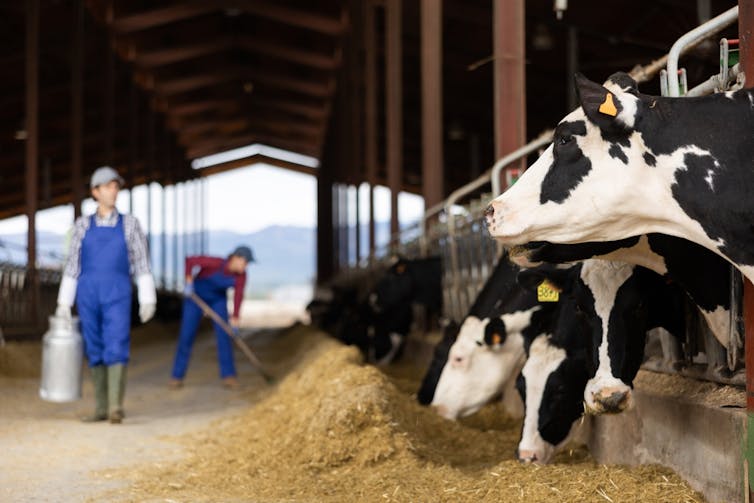
A dairy farm showing cows and farmers.
Bird flu strain 2.3.4.4b is suspected of mammal-to-mammal transmission.
BearFotos/Shutterstock

Influenza viruses are notoriously prone to genetic reassortment – a process by which two or more strains infect the same host and exchange genetic material. These events can sometimes generate new, more transmissible or deadly variants. In April 2024, the UN Food and Agriculture Organization reported the emergence of a reassortant virus in Vietnam. This new strain combines surface proteins from the long-standing 2.3.2.1e virus with internal genes from the globally dominant 2.3.4.4b.

Evidence suggests that this reassortant virus may be driving the rise in Cambodian human infections.

A 2024 study, which has not yet undergone peer review, found that the new virus carries genetic markers that could enhance its ability to infect humans – although it is not yet considered human-adapted. According to the study’s authors, this reassortant form has become the predominant strain found in poultry across the region in recent years.

So far, all confirmed human cases in Cambodia have been linked to direct contact with infected or dead poultry – often in small, rural backyards. This suggests that the country’s “one health” strategy, which aims to integrate human, animal and environmental health responses, is functioning as intended. Although some gaps clearly remain.

Food safety and food security remain serious concerns across much of Cambodia and south-east Asia. Limited veterinary oversight, informal poultry markets, lack of compensation for poultry losses due to disease, and poor biosecurity may offer the virus opportunities to persist and evolve – and potentially reach more people.

Since the COVID pandemic, advances in disease surveillance and reporting have made it easier to detect and confirm human infections, Dr Vijaykrishna Dhanasekaran, head of the Pathogen Evolution Lab at Hong Kong University, told me over email. However, he notes that surveillance remains heavily concentrated in urban areas and the commercial poultry sector, while rural settings and interactions with wild birds are poorly monitored.

Expanding surveillance to these overlooked areas will be vital, he says, if the world hopes to better understand – and prepare for – the next potential influenza pandemic.

The Conversation

Divya Venkatesh receives funding from BBSRC.

ref. Child hospitalised as bird flu cases climb in Cambodia – https://theconversation.com/child-hospitalised-as-bird-flu-cases-climb-in-cambodia-260565

Over 1.6 million children live in families made poorer by the two-child limit on benefits – new data

Source: The Conversation – UK – By Ruth Patrick, Professor in Social Policy, University of Glasgow

New government statistics released today show the reach of the two-child limit. There are 1,665,540 children in England, Scotland and Wales living in households affected by the two-child limit, an increase of over 35,000 from the same time in 2024.

The two-child limit restricts means-tested child benefits to the first two children in a household, subject to some exceptions.

Its sister policy, the benefit cap, affects over 115,000 households, including 300,000 children. It routinely pushes families into deep poverty, far below the standard poverty line of 60% of median income.

The benefit cap places a limit on the total amount a household can receive if no-one in the household earns a minimum amount, again subject to some exceptions linked to receipt of disability benefits.


Get your news from actual experts, straight to your inbox. Sign up to our daily newsletter to receive all The Conversation UK’s latest coverage of news and research, from politics and business to the arts and sciences.


Over the past five years, we have been part of a team of academic researchers investigating the impact of both policies on families with three or more children. We’ve found that these policies drive up poverty, creating deprivation and hardship. This in turn causes sustained and severe harm to children and their families.

The two-child limit and benefit cap leave many families living with extreme financial insecurity. They harm parental mental health, as mothers and fathers struggle to try and make an inadequate income stretch to meet the needs of their children.

Parent with baby in supermarket
Parents are struggling to make their income go far enough.
Odua Images/Shutterstock

In addition, these policies do not fall evenly across the population when looking at ethnicity. Overall, 70% of the families affected by the two-child limit are white, as are 66% affected by the benefit cap. But our new analysis shows that children from an ethnic minority are up to three times as likely as white children to be affected by the two-child limit. They are also up to four times as likely to be affected by the benefit cap.

Alongside administrative statistics, we have analysed household survey data, published today as a policy brief. We find that one in five children from Pakistani families and one in four children from Bangladeshi families are now affected by the two-child limit.

Rising poverty

Our analysis also indicates that these policies are contributing to very high and rising levels of poverty. We estimate that 66% of Bangladeshi children, 60% of Pakistani children, and nearly half (48%) of black children live in poverty. This compares to one in four (24%) white children living below the poverty line – still far too many.

This new analysis provides us with better understanding of where the damage done by both policies is falling. It’s an important reminder of how the two-child limit and benefit cap directly conflict with ambitions not only to act on child poverty, but also to reduce systematic inequalities linked to ethnicity.

Scrapping the two-child limit would give larger families access to benefits they currently miss out on – but it would not have any effect on smaller families living in poverty, so isn’t the only policy solution needed.

Nonetheless, analysis by the Resolution Foundation has shown that getting rid of the two-child limit – which would cost £1.4 billion – is by far the most cost-effective way to reduce the number of children living in poverty. Spending £1.4 billion in other ways – for example by increasing benefits for all families – would make less difference to child poverty than if the two-child limit were ended.

It’s also important to keep in mind the impact on the depth of poverty. Larger families tend to be living further below the poverty line. Scrapping the two-child limit will make a big difference in many households, even if they are not lifted out of poverty as a result.

Labour came into government on a manifesto of “change”, and Keir Starmer has promised to be “laser-focused” in his commitment to drive down poverty.

Labour have already said that they want to get rid of the two-child limit, arguing that they just need to find the money to do so. The government has established a child poverty taskforce, due to report in the autumn, and made a first concrete policy commitment with the extension of free school meals provision for families in England. But there is no alternative to serious action on social security benefits if significant progress is to be made.

The Conversation

Ruth Patrick receives funding from a range of funders including Nuffield Foundation, AFFT, Trust for London, The Robertson Trust and the Centre for Impact on Urban Health. She is a member of The Labour Party.

Kitty Stewart has received funding from the Nuffield Foundation and from LSE for the research reported in this article.

ref. Over 1.6 million children live in families made poorer by the two-child limit on benefits – new data – https://theconversation.com/over-1-6-million-children-live-in-families-made-poorer-by-the-two-child-limit-on-benefits-new-data-260449

Plans to relocate Gazans to a ‘humanitarian city’ look like a crime against humanity – international law expert

Source: The Conversation – UK – By James Sweeney, Professor, Lancaster Law School, Lancaster University

The Israel Defense Forces (IDF) are refusing to implement a government plan to move hundreds of thousands of Palestinians into a what it calls a “humanitarian city” in Rafah on Gaza’s southern border with Egypt. Lieutenant General Eyal Zamir, chief of the IDF general staff said the plan was not part of the military’s operational plan for destroying Hamas and freeing the remaining hostages.

Army reservists have reportedly also complained that the plan amounts to a war crime. In my view as an expert in international law, they are correct. Forcibly relocating a population is prohibited, even in war. It is also a crime against humanity and could even amount, under certain circumstances, to genocide.

There is some important historical context to consider before examining the legal issues at play.


Sign up to receive our weekly World Affairs Briefing newsletter from The Conversation in the UK. Every Thursday we’ll bring you expert analysis of the big stories in international relations.


The prosecution of crimes against humanity first took place at the Nuremberg trials of surviving senior Nazis after the second world war. By that time the idea of war crimes was clearly established – but they tended to concern what you should not do to the enemy civilian population.

The problem was that the worst atrocities of the Nazis were committed against their own people – the German Jews (and many, many others too). The idea of crimes against humanity was created to fill this gap, and was used to prosecute the surviving masterminds of the Holocaust.

Conditions for a ‘crime against humanity’

Crimes against humanity are a category that contains several separate crimes. If the right conditions are there, you might talk about “the crime against humanity of murder” or the “crime against humanity of rape”. The conditions are that the underpinning crime takes place against a backdrop of a “widespread or systematic” attack on a civilian population.

The attack does not have to include a literal armed attack: apartheid, for example, was established as a crime against humanity in 1973 in response to the policies of the South African government. It is also not necessary that there is an armed conflict for a particular crime to be a crime against humanity.

Within the category of crimes against humanity is included “deportation and forcible transfer” (see article 7 of the Rome statute of the International Criminal Court).

This is what the Israeli government’s plan for moving Palestinians into a “humanitarian city” would appear to amount to. If the plan stopped at leaving Gazan Palestinians in Rafah then it would be “forcible transfer”, and if they were relocated to another country it would be “deportation”.

Coercion is key to the crime of forcible transfer. It’s fanciful to think that every single Gazan civilian would want to move to Rafah in circumstances where they would be security-checked on entry and thereafter forbidden from leaving.

How could a liveable city, with all the infrastructure needed, even be created? What of the dentists, doctors, teachers, lawyers, mechanics, entrepreneurs and anyone else who was able to make an honest living? Will they really be given a place to carry out their work?

Ethnic cleansing

The term “ethnic cleansing” is sometimes used to describe what is being proposed by the Israeli government. I dislike the term, and it has no meaning in law. It became a commonly used term during the 1990s conflict in the former Yugoslavia when ethnic Serbs, and in some instances ethnic Croats, expelled hundreds of thousands of people of any other ethnicity out of the territory that they held.

For this practice, the president of the former Yugoslavia, Slobodan Milošević, and a string of Bosnian Serb and Bosnian Croat leaders were charged with crimes against humanity by the International Criminal Tribunal for the former Yugoslavia (ICTY).

Milošević died before the ICTY could deliver a verdict in his case, but many others were found guilty. The actions of the Bosnian Serb forces in the town of Srebrenica were even found by the ICTY to have been an act of genocide, because they were not just expelling non-Serbs but wiping them out: at one point in July 1995 they killed around 8,000 men and boys in just a few days.

A lot would depend on the conditions in which the Palestinians would live in the “humanitarian city”. If they were deprived of sufficient food and medical supplies in a way that could only be seen as intended to lead to their deaths, then that too could be held to qualify as an act of genocide.

Justice and accountability

It is clear to me that the forced relocation of Gazans to a “humanitarian city” would violate international law. What is not so clear cut is how to hold its instigators to account.

There are already arrest warrants issued by the International Criminal Court (ICC) for Israel’s prime minister, Benjamin Netanyahu, and his former defence minister, Yoav Gallant. But there is no international police force and so the ICC relies on participating states to arrest suspects on its behalf. Hungary welcomed Netanyahu in April this year, while announcing it would withdraw from the ICC.

In the same way, Netanyahu flew to Washington DC this week to meet with Donald Trump, but was not arrested because the US doesn’t recognise the ICC. During his visit, Netanyahu announced he would be nominating Trump for the Nobel peace prize.

South Africa has also sought to hold the state of Israel to account at the International Court of Justice, alleging the crime of genocide. The court has yet to rule, saying only that it is plausible that acts of genocide might occur in Gaza.

Since Hamas launched its vicious attack on Isreal on the October 7 2023, there has been constant violence and massive loss of life in the region. However, the proposed “humanitarian city” is not, in my view, a lawful route to peace and stability. As for anyone actually facing justice for the many atrocities that we have seen, an international consensus in favour simply doesn’t exist. And, in the current climate, there’s little sign that it will exist any time soon.

The Conversation

James Sweeney does not work for, consult, own shares in or receive funding from any company or organisation that would benefit from this article, and has disclosed no relevant affiliations beyond their academic appointment.

ref. Plans to relocate Gazans to a ‘humanitarian city’ look like a crime against humanity – international law expert – https://theconversation.com/plans-to-relocate-gazans-to-a-humanitarian-city-look-like-a-crime-against-humanity-international-law-expert-260727

Women’s Euro 2025: what players do to recover between matches — and how they prepare for their next game

Source: The Conversation – UK – By Paul Hough, Lecturer Sport & Exercise Physiology , University of Westminster

Recovery starts for England’s Lionesses as soon as the match ends. Romain Biard/ Shutterstock

As with many competitions, competitors in the UEFA Women’s Euro 2025 tournament face a gruelling match schedule. There are typically only three or four days between matches during the group stage of international tournaments – with some teams even facing tighter turnarounds depending on scheduling.

This congested fixture schedule places a significant physical demand on players, increases injury risk and makes it challenging to sustain peak physical performance. This is why recovery strategies are put into action from the moment the match ends so players are in peak condition for the next match.

The first recovery strategy happens as soon as players arrive in the changing room. There will be a buffet-style food selection with plenty of carbohydrate and protein-based snacks to begin refuelling. Players also typically consume a “recovery” drink. This consists of carbohydrates to restore muscle glycogen (which our body uses for energy), and around 20-30 grams of protein to aid muscle repair.


Get your news from actual experts, straight to your inbox. Sign up to our daily newsletter to receive all The Conversation UK’s latest coverage of news and research, from politics and business to the arts and sciences.


Over the following days, players will follow a meticulously-planned diet with the correct balance of carbohydrates, protein, fats and nutrients (such as the polyphenols found in tart cherry juice) to support muscle repair and adaptation.

Sweat loss during matches – particularly in summer tournaments – leads to significant dehydration. Players typically sweat around 1.5 litres or more during a match. Immediately after a match, players are given isotonic drinks to replace the water and electrolytes (specifically sodium) they’ve lost through sweating.

To estimate fluid loss, players’ post-match weight is recorded to guide how much they should drink. A one kilogram reduction in body weight corresponds to roughly one litre of fluid lost through sweating. To re-hydrate, players drink around 1.5 litres per kilogram of weight lost.

Physical recovery

Some players might perform around 10-15 minutes of low-intensity aerobic activity immediately following the match – such as cycling. This light activity maintains blood flow to the muscles, which might reduce the feeling of muscle soreness in the following days, although the evidence for this is inconclusive.

Players often use cold water immersion (ice baths) to reduce inflammation, swelling and muscle soreness. This involves standing or sitting in cold water (which is between 10–15°C) for around 10–15 minutes. Players may also take ice baths in the days between matches. Although there’s debate over whether ice baths speed up recovery, it remains a widely accepted practice in elite sport where rapid recovery is prioritised.

Another option involves alternating between hot water (around 36°C) and cold water – a practice known as contrast water therapy. Contrast water therapy causes the blood vessels to constrict in the cold water, then dilate in the hot water. This practice may enhance blood flow, reduce swelling and decrease muscle soreness.

Players often wear compression garments for several hours post-match and overnight. These garments enhance blood flow and reduce swelling. They’re also shown to reduce pain and muscle soreness.

Recently, inflatable compression leg sleeves have become popular among athletes. These boots inflate and deflate cyclically to promote blood flow and lymphatic drainage. This works similar to a sports massage or contrast water therapy, helping clear inflammatory proteins from the body. This may reduce swelling and decrease the severity of muscle soreness.

Sleep also plays a crucial role in a player’s physical and mental restoration between tournament matches. Players are encouraged to get eight to ten hours of quality sleep per night. Some players even take a 20-90 minute nap in the early afternoon to increase alertness, improve mood and potentially improve performance.

England footballer Lucy Bronze kicks the ball forward while holding off an opponent.
Recovery will be tailored to each player.
Jose Breton- Pics Action/ Shutterstock

Good sleep hygiene can help players get a good night’s sleep even despite hectic tournament schedules. This involves ensuring their bedroom is cool and dark and minimising screen time before bed.

Preparing for the next match

The day after a match, players will perform a recovery session incorporating some sort of light activity – such as cycling, dynamic movements in the swimming pool and foam rolling (a type of self-massage that uses a foam cylinder to apply pressure to different muscles).

Although light activity does not accelerate muscle recovery, it can offer psychological benefits – such as reducing the feeling of muscle soreness and stiffness. Players may also undergo targeted physiotherapy and massage to reduce muscle soreness, increase mobility and ease pain.

Recovery time varies between players and the level of fatigue they experience. Fatigue will be influenced by the player’s age and their match demands – with players who run a greater distance or perform more sprints and changes of direction typically taking more time to recover between matches.

Players’ fatigue is monitored between matches using various methods – including GPS data, biochemical markers of inflammation and muscle damage, and wellness questionnaires. This data is used to individualise training and recovery.

Players showing elevated fatigue might perform light technical drills, tactical walkthroughs of different plays and strategies the player might use on the field and mobility-focused gym work to maintain sharpness without causing more fatigue. Whereas players whose fatigue levels have returned to close to normal will resume normal training.

Performing on the world stage with the weight of national pride brings intense pressure. Players must contend with media scrutiny coupled with the expectations of coaches and fans. These factors can disrupt sleep and trigger a biological stress response, which may impair recovery.

So to help manage mental stress, teams schedule structured downtime, encouraging players to connect with family or engage in hobbies that promote mental recovery and psychological detachment from football. Sports psychologists may also support players during tournaments, providing mental skills training and helping players develop strategies to cope with stress and pressure.

The Conversation

Paul Hough does not work for, consult, own shares in or receive funding from any company or organisation that would benefit from this article, and has disclosed no relevant affiliations beyond their academic appointment.

ref. Women’s Euro 2025: what players do to recover between matches — and how they prepare for their next game – https://theconversation.com/womens-euro-2025-what-players-do-to-recover-between-matches-and-how-they-prepare-for-their-next-game-260248

Trump’s budget cuts are adding to risk in life-threatening floods and emergencies

Source: The Conversation – UK – By Clodagh Harrington, Lecturer in American Politics, University College Cork

Acclaimed author Michael Lewis wrote a book about the first Trump administration entitled The Fifth Risk, outlining the consequences when people who don’t understand how the government of a vast, complex and multifaceted nation works are put in charge of said government.

The bestseller was more gripping and fascinating than any work of fiction. It outlined the realities that followed Donald Trump’s 2016 campaign promises to shrink the federal bureaucracy. In it, Lewis quotes lawyer Max Stier, who he describes as the American with the greatest understanding of how his nation’s government worked. Stier offers the truism that “the basic role of governments is to keep us safe.”

You might deduce that this means those in charge during, and ahead of, emergencies should know what to do and how to do it. And, they have to want to do it. In the case of Trump term one, there was often evidence that some or all of these three elements were lacking. Evidently, planning for distant risk was not something that Trump and his team were interested in prioritising.

Fast forward to July 2025, and US headlines are filled with images of devastating flash floods in which more than 100 Texans, many of them children, lost their lives. In Kerr County, outside of San Antonio, water levels of the Guadalupe River rose to what was considered a once in a “100-year catastrophe”. Nobody saw it coming, or at least not to the extent that it did. Despite official warnings, the result was one of the worst natural disasters ever faced by the state.


Get your news from actual experts, straight to your inbox. Sign up to our daily newsletter to receive all The Conversation UK’s latest coverage of news and research, from politics and business to the arts and sciences.


Days earlier, Trump’s “big beautiful bill” was passed in the Senate with a tight 51:50 majority. Republican Texas senator Ted Cruz was among the supporters of a bill which will cut funding for the National Weather Service (NWS) by 6.7% in 2026. These come on the back of earlier resource reductions to the NWS and the National Oceanic and Atmospheric Association (NOAA).

Within days of the Texas floods, Democrats were calling for an investigation into whether previous budget cuts might have affected capacity for flood preparedness in Kerr County.


Read more:
How Donald Trump’s economic policies, including uncertainty around tariffs, are damaging the US economy


For the bereaved, talk of culpability will hardly bring solace. And any immediate political blame game presents as unseemly in the middle of so much personal tragedy. But a New York Times article reported that “some experts say that staff shortages might have complicated forecasters’ ability to coordinate response”. Such speculative language does not offer clarity or reassurance, and even the often brash president has thus far refrained from finger pointing.

Nonetheless, uncomfortable conversations are necessary, as it is clear that slashing federal funding does not serve the nation well. Trump already had budget cutting form, as his first-term efforts to slash NOAA and related programme funding demonstrated.

In 2017, the Environmental Protection Agency (EPA) was also targeted for staff and funding reductions. This came along with the appointment of EPA chiefs who appeared uninterested in prioritising the climate crisis. More recently, the controversial spending cuts agency the Department of Government Efficiency (Doge), headed by Elon Musk, included NOAA in its sights.


Read more:
Why Texas Hill Country, where a devastating flood killed dozens, is one of the deadliest places in the US for flash flooding


Yale University’s Center for Environmental Communication said that while there was no clear evidence that budget cuts had affected weather forecasting in the Texas case, Trump’s planned additional cuts would affect some of NOAA’s key flash flood forecast tools. This includes the Flash project, which improves accuracy, timing and specificity of warnings, such as those that occurred in Texas on July 4. It also said that the weather service had lost many of its most senior staff, which would increase the risks associated with weather-related tragedies.

Flood water in Texas rose spectacularly fast causing dozens of deaths.

Cuts and the climate

Across the board, Doge has targeted other agencies that the public rely on in a crisis, including the Federal Emergency Management Agency (Fema), where plans to reduce staffing by about 20% are currently coming into effect. With responsibility for managing natural and climate-fuelled disasters from hurricanes to floods, the agency has become busier in recent years as disasters have evolved from seasonal to perennial.

Rob Moore, the director of flooding solutions at the Natural Resources Defense Council, an influential environmental body, argued that “America’s disaster safety net is unraveling.”

There are likely to be more floods, and other nature-based catastrophes with multiple probable causes and features. While outright prevention may not always be possible, governmental risk and disaster management can help to preclude the devastation seen on July 4 in Texas.

The problem with responding to long-term risk with short-term or inadequate solutions is that one day, an existential threat could arrive for which the US will not be ready. The danger may not even be as overwhelming as a global pandemic or nuclear threat. It could be as mundane as a local river overflowing. For those who lost their loved ones in Texas, there is nothing distant about their anguish.

A country with the world’s largest economy does not have to cut federal bureaucracy corners. Wasting tax dollars is never a vote winner, but funding vital emergency services like Fema and the National Weather Service is a fundamental feature of an advanced democracy. As is investing in the technology and personnel to do all possible to predict flash floods. Trump would do well to remember this as he meets the bereaved in Kerr County.

The Conversation

Clodagh Harrington does not work for, consult, own shares in or receive funding from any company or organisation that would benefit from this article, and has disclosed no relevant affiliations beyond their academic appointment.

ref. Trump’s budget cuts are adding to risk in life-threatening floods and emergencies – https://theconversation.com/trumps-budget-cuts-are-adding-to-risk-in-life-threatening-floods-and-emergencies-260710

Bayeux tapestry set to return to the UK – in medieval times it was like an immersive art installation

Source: The Conversation – UK – By Alexandra Makin, Third Century Research Fellow, Manchester Metropolitan University

The Bayeux tapestry is set to return to the UK for the first time in almost 1,000 years. One of the most important cultural artefacts in the world, it is to be displayed at the British Museum from September 2026.

Its significance for history is unquestioned – but you may not think of the Bayeux tapestry as a work of art. Sure, you may recognise it from your history lessons or political campaigns. Maybe you like embroidery and textiles or know about it because of the modern versions it inspired – think the Game of Thrones tapestry or the Great Tapestry of Scotland. Perhaps you are an early medievalist and use it as comparative evidence.

For me, this now famous wall hanging is undoubtedly art, created with great skill. What fascinates me as a textile archaeologist is how early medieval people saw and understood the tapestry.

First, let’s contextualise it a little. The hanging is not a woven tapestry but an embroidery, stitched in wool threads on nine panels of linen fabric that were then sewn together. It was made in around 1070, probably in England. Nobody knows how big it originally was, but it now measures 68.3 metres long by approximately 70cm high.

Starting at the end of Edward the Confessor’s reign (1042-1066), the tapestry’s comic book narrative tells a vivid, very modern story of the struggle for power and the English throne – and the brutal means William of Normandy (1028-1087) used to get it.


This article is part of Rethinking the Classics. The stories in this series offer insightful new ways to think about and interpret classic books and artworks. This is the canon – with a twist.


It follows the highs and lows of Harold Godwinson, Edward the Confessor’s brother-in-law, who became king after Edward’s death in 1066, and his eventual downfall at the Battle of Hastings.

The end of the hanging, and therefore the story, is now missing but it was probably the triumphal coronation of William. It would have provided a mirror in symmetry to the first scene, which depicts an enthroned Edward.

Sensory archaeology of the tapestry

Today, the hanging is famous because it is the only surviving example of its kind. But documentary sources from early medieval England demonstrate that this type of wall hanging was a popular way for families to depict their stories and great deeds.

A good example is the Byrhtnoth wall hanging, which Æthelflæd, the wife of an Anglo-Saxon Ealdorman of Essex Byrhtnoth, gave to the church in Ely after he was killed in 991. We know that the Normans also understood these storytelling wall hangings because Abbot Baudri of Bourgueil (c. 1050-1130) expertly incorporated such a device in a poem he wrote to honour Adela of Blois (c. 1067-1137), the daughter of William the Conqueror and Matilda (c. 1031-1083).

The Bayeux tapestry was, therefore, an obvious way to tell people about the downfall of the English and the rise of the Normans. But this is not all. The early medieval population of Britain loved riddles, multilayered meanings and hidden messages. Evidence survives in pieces like the gold buckle from the 7th-century Sutton Hoo ship burial, the early 8th-century Franks Casket and the 10th-century Book of Exeter. So it is not surprising that people today have argued for hidden messages in the Bayeux tapestry.

While these concepts are interesting, so much emphasis has been placed on them and the role the embroiderers played in creating them, that other ways of early medieval viewing and understanding have been ignored.

Early medieval society viewed its world through the senses. By using sensory archaeology, a theoretical approach that helps researchers understand how past societies interacted with their worlds through sight, touch, taste, smell and sound, we can imagine how people encountering the Bayeux tapestry would have connected with and understood it.

A guide to the story depicted on the Bayeux tapestry.

Art historian Linda Neagley has argued that pre-Renaissance people interacted with art visually, kinaesthetically (sensory perception through bodily movement) and physically. The Bayeux tapestry would have been hung at eye level to enable this. So if we take expert in Anglo-Saxon culture Gale Owen-Crocker’s idea that the tapestry was originally hung in a square with certain scenes facing each other, people would have stood in the centre. That would make it an 11th-century immersive space with scenes corresponding and echoing each other, drawing the viewer’s attention, playing on their senses and understanding of the story they thought they knew.

If we imagine ourselves entering that space, we move from a cooler, stone-hewn room into a warmer, softer area, encased in linen and wool, their smell tickling our noses. Outside sounds would be deadened, the movement of people softened, voices quietened. People would move from one scene to another, through the open doors of the stage-like buildings where the action inside can be seen and watched, boldly or surreptitiously. The view might be partially blocked by others and their reactions and gesticulations as they engaged with and discussed what they saw.

The bright colours of the embroidery would have made a kaleidoscope of colour, a blur that defined itself the closer people got to the work. The boldness and three-dimensionality of the stitching helped to draw them into the action while any movement of the hanging brought the imagery alive.

Here are the main characters in the room with you, telling you their story, inviting you to join them on their journeys of victory or doom.

As onlookers discussed what they saw, or read the inscriptions, they interacted with the embroidered players, giving them voice and enabling them to join the conversation. If the hanging formed part of a banquet then the smell of food, clanking of dishes and movement of the fabric and stitchwork as servants passed would have enhanced the experience. The feasting scenes dotted throughout the hanging would be echoed in the hall.

I believe the Bayeux tapestry was not simply an inanimate art object to be viewed and read from the outside. It was an immersive retelling of the end of an era and the start of something new. When you entered its space you became part of that story, sensorially reliving it, keeping it alive. To me, this is the true power of this now famous embroidery.

Beyond the canon

As part of the Rethinking the Classics series, we’re asking our experts to recommend a book or artwork that tackles similar themes to the canonical work in question, but isn’t (yet) considered a classic itself. Here is Alexandra Makin’s suggestion:

The ITV series Unforgotten, now in its sixth season (with a seventh on the way) gripped me from the start. It follows a team of British police detectives as they track down the killers of people whose bodies have been recently found, but who were murdered years before.

As they do, we, the viewer, are given access to the characters’ often emotional stories. We are brought into their sphere and experience their pain, distress, happiness, horror. We get unrivalled access, eventually, to the motives for their seemingly strange actions. As with the Bayeux tapestry, we are swallowed up in their worlds. This is achieved by Chris Lang’s fabulous writing, the cinematography and the exquisite acting.

Together these elements make a whole, opening a window, immersing you in a world full of powerful sensory engagements. For me, this is classic art in the making.

The Conversation

Alexandra Makin undertakes unpaid consultancy work for the Bayeux Tapestry Museum.

ref. Bayeux tapestry set to return to the UK – in medieval times it was like an immersive art installation – https://theconversation.com/bayeux-tapestry-set-to-return-to-the-uk-in-medieval-times-it-was-like-an-immersive-art-installation-258438