What is the ‘Seven Mountain Mandate’ and how is it linked to political extremism in the US?

Source: The Conversation – USA (3) – By Art Jipson, Associate Professor of Sociology, University of Dayton

People pray before Republican vice presidential nominee J.D. Vance at a town hall hosted by Lance Wallnau on Sept. 28, 2024, in Monroeville, Pa. AP Photo/Rebecca Droke

Vance Boelter, who allegedly shot Melissa Hortman, a Democratic Minnesota state representative, and her husband, Mark Hortman, on June 14, 2025, studied at Christ for the Nations Institute in Dallas. The group is a Bible school linked to the New Apostolic Reformation, or NAR.

The NAR is a loosely organized but influential charismatic Christian movement that shares similarities with Pentecostalism, especially in its belief that God actively communicates with believers through the Holy Spirit. Unlike traditional Pentecostalism, however, the organization emphasizes modern-day apostles and prophets as authoritative leaders tasked with transforming society and ushering in God’s kingdom on Earth. Prayer, prophecy and worship are defined not only as acts of devotion but as strategic tools for advancing believers’ vision of government and society.

After the shooting, the Christ for the Nations Institute issued a statement “unequivocally” denouncing “any and all forms of violence and extremism.” It stated: “Our organization’s mission is to educate and equip students to spread the Gospel of Jesus Christ through compassion, love, prayer, service, worship, and value for human life.”

But the shooting has drawn attention to the school and the larger Christian movement it belongs to. One of the most important aspects of NAR teachings today is what is called “the Seven Mountain Mandate.”

The Seven Mountain Mandate calls on Christians to gain influence, or “take dominion,” over seven key areas of culture: religion, family, education, government, media, business and the arts.

With over three decades of experience studying extremism, I offer a brief overview of the history and core beliefs of the Seven Mountain Mandate.

‘Dominion of Christians’

The Seven Mountain concept was originally proposed in 1975 by evangelical leader Bill Bright, the founder of Campus Crusade for Christ. Now known as “Cru,” the Campus Crusade for Christ was founded as a global ministry in 1951 to promote Christian evangelism, especially on college campuses.

United by a shared vision to influence society through Christian values, Bright partnered with Loren Cunningham, the founder of Youth With A Mission, a major international missionary training and outreach organization, in the 1970s.

The Seven Mountain Mandate was popularized by theologian Francis Schaeffer, who linked it to a larger critique of secularism and liberal culture. Over time, it evolved.

C. Peter Wagner, a former seminary professor who helped organize and name the New Apostolic Reformation, is often regarded as the theological architect of the group. He developed it into a call for dominion. In his 2008 book “Dominion! How Kingdom Action Can Change the World,” he urged Christians to take authoritative control of cultural institutions.

For Wagner, “dominion theology” – the idea that Christians should have control over all aspects of society – was a call to spiritual warfare, so that God’s kingdom would be “manifested here on earth as it is in heaven.”

A gray-haired man wearing glasses and a blue shirt.
Bill Johnson.
Doctorg via Wikimedia Commons

Since 1996, Bill Johnson, a senior leader of Bethel Church, and Johnny Enlow, a self-described prophet and Seven Mountain advocate, among others, have taken the original idea of the Seven Mountain Mandate and reshaped it into a more aggressive, political and spiritually militant approach. Spiritual militancy reflects an aggressive, us-vs.-them mindset that blurs the line between faith and authoritarianism, promoting dominion over society in the name of spiritual warfare.

Their version doesn’t just aim to influence culture; it frames the effort as a spiritual battle to reclaim and reshape the nation according to their vision of God’s will.

Lance Wallnau, another Christian evangelical preacher, televangelist, speaker and author, has promoted dominion theology since the early 2000s. During the 2020 U.S. presidential election, Wallnau, along with several prominent NAR figures, described Donald Trump as anointed by God to reclaim the “mountain” of government from demonic control.

In their book “Invading Babylon: The 7 Mountain Mandate,” Wallnau and Johnson explicitly call for Christian leadership as the only antidote to perceived moral decay and spiritual darkness.

The beliefs

Sometimes referred to as Seven Mountains of Influence or Seven Mountains of Culture, the seven mountains are not neutral domains but seen as battlegrounds between divine truth and demonic deception.

Adherents believe that Christians are called to reclaim these areas through influence, leadership and even, if necessary, the use of force and to confront demonic political forces, as religion scholar Matthew Taylor demonstrates in his book “The Violent Take It By Force.”

Diverse perspectives and interpretations surround the rhetoric and actions associated with the New Apostolic Reformation. Some analysts have pointed out how the NAR is training its followers for an active confrontation. Other commentators have said that the rhetoric calling for physical violence is anti-biblical and should be denounced.

NAR-aligned leaders have framed electoral contests as struggles between “godly” candidates and those under the sway of “satanic” influence.

Similarly, NAR prophet Cindy Jacobs has repeatedly emphasized the need for “spiritual warfare” in schools to combat what she characterizes as “demonic ideologies” such as sex education, LGBTQ+ inclusion or discussions of systemic racism.

In the NAR worldview, cultural change is not merely political or social but considered a supernatural mission; opponents are not simply wrong but possibly under the sway of demonic influence. Elections become spiritual battles.

This belief system views pluralism as weakness, compromise as betrayal, and coexistence as capitulation. Frederick Clarkson, a senior research analyst at Political Research Associates, a progressive think tank based in Somerville, Massachusetts, defines the Seven Mountain Mandate as “the theocratic idea that Christians are called by God to exercise dominion over every aspect of society by taking control of political and cultural institutions.”

The call to “take back” the culture is not metaphorical but literal, and believers are encouraged to see themselves as soldiers in a holy war to dominate society. Some critics argue that NAR’s call to “take back” culture is about literal domination, but this interpretation is contested.

Many within the movement see the language of warfare as spiritually focused on prayer, evangelism and influencing hearts and minds. Still, the line between metaphor and mandate can blur, especially when rhetoric about “dominion” intersects with political and cultural action. That tension is part of an ongoing debate both within and outside the movement.

Networks that spread the beliefs

This belief system is no longer confined to the margins. It is spread widely through evangelical churches, podcasts, YouTube videos and political networks.

It’s hard to know exactly how many churches are part of the New Apostolic Reformation, but estimates suggest that about 3 million people in the U.S. attend churches that openly follow NAR leaders.

At the same time, the Seven Mountain Mandate doesn’t depend on centralized leadership or formal institutions. It spreads organically through social networks, social media – notably podcasts and livestreams – and revivalist meetings and workshops.

André Gagné, a theologian and author of “American Evangelicals for Trump: Dominion, Spiritual Warfare, and the End Times,” writes about the ways in which the mandate spreads by empowering local leaders and believers. Individuals are authorized – often through teachings on spiritual warfare, prophetic gifting, and apostolic leadership – to see themselves as agents of divine transformation in society, called to reclaim the “mountains,” such as government, media and education, for God’s kingdom.

This approach, Gagné explains, allows different communities to adapt the action mandate to their unique cultural, political and social contexts. It encourages individuals to see themselves as spiritual warriors and leaders in their domains – whether in business, education, government, media or the arts.

Small groups or even individuals can start movements or initiatives without waiting for top-down directives. The only recognized authorities are the apostles and prophets running the church or church network the believers attend.

The framing of the Seven Mountain Mandate as a divinely inspired mission, combined with the movement’s emphasis on direct spiritual experiences and a specific interpretation of scripture, can create an environment where questioning the mandate is perceived as challenging God’s authority.

Slippery slope

These beliefs have increasingly fused with nationalist rhetoric and conspiracy theories.

A white flag bearing the words 'An Appeal to Heaven,' featuring a green pine tree, with the American flag displayed beneath it.
The ‘Appeal to Heaven’ flags symbolize the belief that people have the right to appeal directly to God’s authority when they think the government has failed.
Paul Becker/Becker1999 via Flickr, CC BY

A powerful example of NAR political rhetoric in action is the rise and influence of the “Appeal to Heaven” flags. For those in the New Apostolic Reformation, these flags symbolize the belief that when all earthly authority fails, people have the right to appeal directly to God’s authority to justify resistance.

This was evident during the Jan. 6, 2021, Capitol insurrection, when these flags were prominently displayed.

To be clear, its leaders are not calling for violence but rather for direct political engagement and protest. For some believers, however, the calls for “spiritual warfare” may become a slippery slope into justification for violence, as in the case of the alleged Minnesota shooter.

Understanding the Seven Mountain Mandate is essential for grasping the dynamics of contemporary efforts to align government and culture with a particular vision of Christian authority and influence.

The Conversation

Art Jipson does not work for, consult, own shares in or receive funding from any company or organization that would benefit from this article, and has disclosed no relevant affiliations beyond their academic appointment.

ref. What is the ‘Seven Mountain Mandate’ and how is it linked to political extremism in the US? – https://theconversation.com/what-is-the-seven-mountain-mandate-and-how-is-it-linked-to-political-extremism-in-the-us-260034

This tropical plant builds isolated ‘apartments’ to prevent battles among the aggressive ant tenants it relies on for survival

Source: The Conversation – USA – By Guillaume Chomicki, Professor of Evolutionary Biology, Durham University

When aggressive ant species come in contact, deadly conflicts ensue G. Chomicki

In the middle of the South Pacific, a group of Fijian plants have solved a problem that has long puzzled scientists: How can an organism cooperate with multiple partners that are in turn competing for the same resources? The solution turns out to be simple – compartmentalization.

Imagine an apartment building where unfriendly neighbors might clash if they run into each other, but smart design keeps everyone peacefully separated. In our new research published in the journal Science, we show how certain plants build specialized structures that allow multiple aggressive ant species to live side by side inside them without ever meeting.

Ants and plants cooperate in Fijian rainforest

Squamellaria plants are epiphytes – meaning they don’t have roots attached to the ground, and instead grow on another plant for physical support. They live high up in the rainforest canopy, in the South Pacific.

Because they don’t have direct access to the soil’s nutrients, Squamellaria plants have evolved an original strategy to acquire what they need: In a mutually beneficial relationship, they grow structures that appeal to ants looking for a place to live. This kind of long-term relationship between species – whether helpful or harmful – is called symbiosis.

Here’s how it works in this case. The base of the Squamellaria plant stem forms a swollen, hollow structure called a domatium – a perfect place for ants to live. Domatia gradually enlarge to the size of a soccer ball, containing ever more plant-made houses ready for ants to move into. Each apartment can house a colony made up of thousands of ants.

A bulbous plant attached to a branch in a canopy
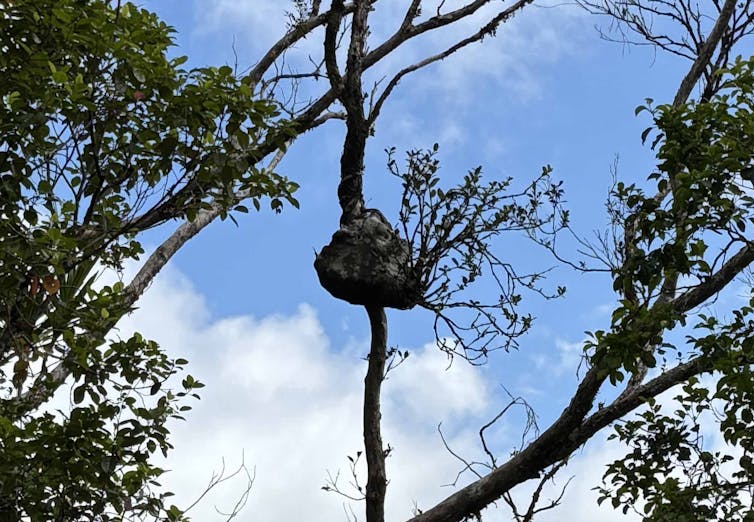
A multicompartment Squamellaria (S. tenuiflora) in its natural habitat: rainforests in Fiji. This large plant likely contains a dozen or more compartments.
G. Chomicki

The relationship between the ants and the plants is mutualistic, meaning both parties benefit. The ants gain a nice sturdy and private nest space, while the plants gain essential nutrients. They obtain nitrogen and phosphorus from the ants’ feces and from detritus – including dead insects, plant bits and soil – that the ants bring inside the domatium.

However, tropical rainforest canopies are battlegrounds for survival. Ants compete fiercely for nesting space, taking over any hollow branch or space under tree bark. Any Squamellaria ant house would thus be at risk of being colonized and taken over by other incoming ants, disrupting the existing partnership.

Until now, it was unclear how the cooperative relationships between ants and plants remain stable in this competitive environment.

Walls keep the peace

Our first hint about what keeps the peace in the Squamellaria real estate came when we discovered several ant species living in the same plant domatium. This finding just didn’t make sense. How could aggressively competing ant species live together?

We investigated the structure of domatia using computed-tomography scanning, which revealed an interesting internal architecture. Each plant domatium is divided into distinct compartments, with thick walls isolating each unit. Independent entrances prevent direct contact between the inhabitants of different units. The walls safeguard the peace as they prevent encounters between different ant species.

A close-up view of the domatium, showing three overlapping regions in different colors
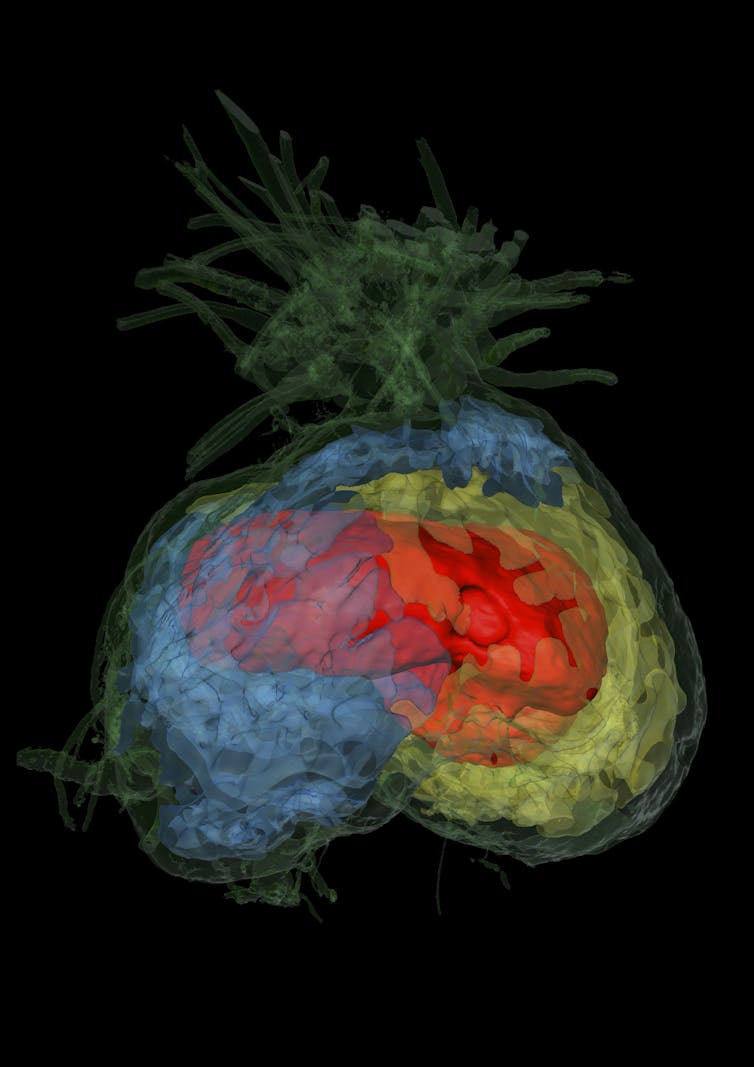
A 3D model of a Squamellaria tenuiflora domatiium based on CT-scanning data reveals its compartmentalization. Each color-coded cavity is a distinct ‘ant apartment,’ isolated of the others, but connected to the outside.
S. Renner & G. Chomicki

Back in the lab, when we removed the ant apartments’ walls, placing inhabitants in contact with their neighbors, deadly fights broke out between ant species. The compartmentalized architecture is thus critical in preventing symbiont “wars” and maintaining the stability of the plant’s partnership with all the ants that call it home. By minimizing deadly conflicts that could harm the ants it hosts, this strategy ensures that the plant retains access to sufficient nutrients provided by the ants.

This research reveals a new mechanism that solves a long-standing riddle – the stability of symbioses involving multiple unrelated partners. Scientists hadn’t previously discovered aggressive animal symbionts living together inside a single plant host. Our study reveals for the first time how simple compartmentalization is a highly effective way to reduce conflict, even in the most extreme cases. The ant colonies are living side by side, but not really together.

What’s next

The key to conflict-free living of multipartner symbioses discovered in these Fijian plants – compartmentalization – is likely important in other multispecies partnerships. However, it remains unknown whether compartmentalization is widespread in nature. Research on cooperation between species has long focused on pairwise interactions. Our new insights suggest a need to reinvestigate other multispecies mutualistic symbioses to see how they maintain stability.

The Conversation

Guillaume Chomicki receives funding from UKRI.

Susanne S. Renner received previous funding from the German Research Foundation (DFG)

ref. This tropical plant builds isolated ‘apartments’ to prevent battles among the aggressive ant tenants it relies on for survival – https://theconversation.com/this-tropical-plant-builds-isolated-apartments-to-prevent-battles-among-the-aggressive-ant-tenants-it-relies-on-for-survival-260674

Justice Department efforts to strip citizenship from naturalized Americans likely violate constitutional rights

Source: The Conversation – USA – By Cassandra Burke Robertson, Professor of Law and Director of the Center for Professional Ethics, Case Western Reserve University

New American citizens recite the Oath of Allegiance during a naturalization ceremony in Miami on Aug. 17, 2018. AP Photo/Wilfredo Lee

The Trump administration wants to take away citizenship from naturalized Americans on a massive scale.

While a recent Justice Department memo prioritizes national security cases, it directs the department to “maximally pursue denaturalization proceedings in all cases permitted by law and supported by the evidence” across 10 broad priority categories.

Denaturalization is different from deportation, which removes noncitizens from the country. With civil denaturalization, the government files a lawsuit to strip people’s U.S. citizenship after they have become citizens, turning them back into noncitizens who can then be deported.

The government can only do this in specific situations. It must prove someone “illegally procured” citizenship by not meeting the requirements, or that they lied or hid important facts during the citizenship process.

The Trump administration’s “maximal enforcement” approach means pursuing any case where evidence might support taking away citizenship, regardless of priority level or strength of evidence. As our earlier research documented, this has already led to cases like that of Baljinder Singh, whose citizenship was revoked based on a name discrepancy that could easily have resulted from a translator’s error rather than intentional fraud.

A brief history

For most of American history, taking away citizenship has been rare. But it increased dramatically during the 1940s and 1950s during the Red Scare period characterized by intense suspicion of communism. The United States government targeted people it thought were communists or Nazi supporters. Between 1907 and 1967, over 22,000 Americans lost their citizenship this way.

Everything changed in 1967 when the Supreme Court decided Afroyim v. Rusk. The court said the government usually cannot take away citizenship without the person’s consent. It left open only cases involving fraud during the citizenship process.

After this decision, denaturalization became extremely rare. From 1968 to 2013, fewer than 150 people lost their citizenship, mostly war criminals who had hidden their past.

A man dressed in a suit and tie speaks and points his right index finger.
Sen. Joseph McCarthy appears at a March 1950 hearing on his charges of communist infiltration at the State Department.
AP Photo/Herbert K. White

How the process works

In criminal lawsuits, defendants get free lawyers if they can’t afford one. They get jury trials. The government must prove guilt “beyond a reasonable doubt” – the highest standard of proof.

But in most denaturalization cases, the government files a civil suit, where none of these protections exist.

People facing denaturalization get no free lawyer, meaning poor defendants often face the government alone. There’s no jury trial – just a judge deciding whether someone deserves to remain American. The burden of proof is lower – “clear and convincing evidence” instead of “beyond a reasonable doubt.” Most important, there’s no time limit, so the government can go back decades to build cases.

As law professors who study citizenship, we believe this system violates basic constitutional rights.

The Supreme Court has called citizenship a fundamental right. Chief Justice Earl Warren in 1958 described it as the “right to have rights.”

In our reading of the law, taking away such a fundamental right through civil procedures that lack basic constitutional protection – no right to counsel for those who can’t afford it, no jury trial, and a lower burden of proof – seems to violate the due process of law required by the Constitution when the government seeks to deprive someone of their rights.

The bigger problem is what citizenship-stripping policy does to democracy.

When the government can strip citizenship from naturalized Americans for decades-old conduct through civil procedures with minimal due process protection – pursuing cases based on evidence that might not meet criminal standards – it undermines the security and permanence that citizenship is supposed to provide. This creates a system where naturalized citizens face ongoing vulnerability that can last their entire lives, potentially chilling their full participation in American democracy.

The Justice Department memo establishes 10 priority categories for denaturalization cases. They range from national security threats and war crimes to various forms of fraud, financial crimes and, most importantly, any other cases it deems “sufficiently important to pursue.” This “maximal enforcement” approach means pursuing not just clear cases of fraud, but also any case where evidence might support taking away citizenship, no matter how weak or old the evidence is.

This creates fear throughout immigrant communities.

About 20 million naturalized Americans now must worry that any mistake in their decades-old immigration paperwork could cost them their citizenship.

A two-tier system

This policy effectively creates two different types of American citizens. Native-born Americans never have to worry about losing their citizenship, no matter what they do. But naturalized Americans face ongoing vulnerability that can last their entire lives.

This has already happened. A woman who became a naturalized citizen in 2007 helped her boss with paperwork that was later used in fraud. She cooperated with the FBI investigation, was characterized by prosecutors as only a “minimal participant,” completed her sentence, and still faced losing her citizenship decades later because she didn’t report the crime on her citizenship application – even though she hadn’t been charged at the time.

A woman accepts a small American flag handed to her from a man across a counter.
A woman receives a U.S. flag after passing her citizenship interview in Newark, N.J., on May 25, 2016.
AP Photo/Julio Cortez

The Justice Department’s directive to “maximally pursue” cases across 10 broad categories – combined with the first Trump administration’s efforts to review over 700,000 naturalization files – represents an unprecedented expansion of denaturalization efforts.

The policy will almost certainly face legal challenges on constitutional grounds, but the damage may already be done. When naturalized citizens fear their status could be revoked, it undermines the security and permanence that citizenship is supposed to provide.

The Supreme Court, in Afroyim v. Rusk, was focused on protecting existing citizens from losing their citizenship. The constitutional principle behind that decision – that citizenship is a fundamental right which can’t be arbitrarily taken away by whoever happens to be in power – applies equally to how the government handles denaturalization cases today.

The Trump administration’s directive, combined with court procedures that lack basic constitutional protections, risks creating a system that the Afroyim v. Rusk decision sought to prevent – one where, as the Supreme Court said, “A group of citizens temporarily in office can deprive another group of citizens of their citizenship.”

The Conversation

The authors do not work for, consult, own shares in or receive funding from any company or organization that would benefit from this article, and have disclosed no relevant affiliations beyond their academic appointment.

ref. Justice Department efforts to strip citizenship from naturalized Americans likely violate constitutional rights – https://theconversation.com/justice-department-efforts-to-strip-citizenship-from-naturalized-americans-likely-violate-constitutional-rights-260353

Tres alimentos con K y con hongos: lo que el kéfir, la kombucha y el koji tienen en común

Source: The Conversation – (in Spanish) – By Sergio Fuentes Antón, Profesor de Didáctica de las Ciencias Experimentales, Universidad de Salamanca

Preparación de kombucha. ViJpeg/Shutterstock

En las estanterías de muchas tiendas gourmet y de cada vez más supermercados es frecuente encontrar frascos de kéfir, botellas de kombucha o bolsas de arroz fermentado con koji. Estos tres productos que comparten la inicial “k” tienen algo más profundo en común: su origen en la fermentación, un proceso milenario que transforma alimentos gracias a la acción de hongos y bacterias.

Durante siglos, el ser humano se ha servido de ciertos microorganismos para conservar alimentos, potenciar sabores y mejorar su digestibilidad, mucho antes incluso de comprender lo qué ocurría a nivel microscópico en el interior de nuestro cuerpo. Hoy, la ciencia de la microbiota y el creciente interés por la alimentación saludable han devuelto el protagonismo a estos cultivos vivos.

Kéfir, kombucha y koji representan culturas distintas –la de los pueblos nómadas, la del té oriental y la cocina japonesa– unidas por la misma fascinación: el poder invisible de los hongos para convertir lo ordinario en extraordinario. ¿Qué es los hace únicos y por qué están conquistando nuestras cocinas?


Leer más:
Los hongos son la materia prima del futuro


Kéfir: la bebida de los nómadas

El kéfir es una bebida fermentada de textura cremosa y sabor ligeramente ácido, elaborada tradicionalmente a partir de leche y unos gránulos únicos que concentran un ecosistema vivo de bacterias y hongos. Se cree que su origen se remonta a las montañas del Cáucaso, donde los pueblos nómadas lo preparaban en sacos de piel de cabra que colgaban de las puertas para que se agitara al paso de la gente.

Los gránulos de kéfir contienen una combinación simbiótica de microorganismos (principalmente lactobacilos, levaduras y hongos filamentosos) que transforman la lactosa en ácido láctico, dióxido de carbono y compuestos aromáticos.

Este proceso no solo prolonga la conservación de la leche, sino que enriquece la bebida con vitaminas, enzimas y probióticos que favorecen la salud intestinal. En la actualidad, el kéfir se elabora también con agua y azúcar, dando lugar a versiones veganas y refrescantes. Su historia refleja cómo la humanidad aprendió a domesticar microorganismos mucho antes de descubrirlos al microscopio.


Leer más:
Kéfir: un viejo producto que se ha puesto de moda


El té convertido en elixir: la kombucha

Las primeras referencias de esta bebida la sitúan en la antigua China, donde ha sido consumida desde hace milenios. La kombucha es una bebida fermentada a base de té endulzado que se transforma gracias a un cultivo simbiótico de bacterias y levaduras conocido como SCOBY (siglas de Symbiotic Culture Of Bacteria and Yeast).

Durante la fermentación, el SCOBY produce ácidos orgánicos, vitaminas del grupo B y pequeñas cantidades de alcohol y dióxido de carbono, responsables de su característico sabor avinagrado y burbujeante.

Actualmente, la kombucha se ha convertido en un icono de las dietas saludables y la cultura foodie. Esta mezcla de hongos y bacterias no solo crea un sabor único, sino que refleja la capacidad de la fermentación para reinventar algo tan cotidiano como una taza de té.

Koji: el hongo que cambio la gastronomía japonesa

El koji es un cultivo de hongos que ha modelado la cocina de Japón durante más de un milenio. Su protagonista es el Aspergillus oryzae, un hongo filamentoso que se cultiva sobre granos cocidos de arroz, cebada o soja.

Bajo condiciones de humedad y temperatura controladas, el hongo coloniza el cereal, liberando enzimas que transforman los almidones y proteínas en azúcares y aminoácidos. Este proceso es la base de productos esenciales como el miso, la salsa de soja y el sake, todos ellos con matices de sabor que deben su complejidad al koji.

Más allá de su importancia culinaria, este hongo se considera un símbolo cultural: en Japón se le llama cariñosamente “el hongo nacional”.

Hoy, chefs de todo el mundo exploran nuevas aplicaciones del koji en panes, embutidos o quesos veganos, demostrando que la fermentación fúngica sigue siendo una herramienta de innovación gastronómica.


Leer más:
Los hongos son la materia prima del futuro


El poder invisible de los hongos

Kéfir, kombucha y koji son mucho más que tendencias gastronómicas: representan un redescubrimiento de la fermentación como aliada de la salud, el sabor y la sostenibilidad. Estos alimentos, nacidos de tradiciones milenarias, nos recuerdan que convivimos con un universo microscópico que transforma lo que comemos y ayudan a mejorar la salud y el bienestar. El kéfir, por ejemplo, contiene sustancias anticancerígenas.

Detrás de su aparente sencillez se esconden hongos y bacterias que trabajan en simbiosis, liberando nutrientes, creando aromas complejos y prolongando la vida útil de los alimentos.

En un mundo que busca alternativas más naturales y menos procesadas, la fermentación y los hongos emergen como un puente entre el pasado y el futuro. Quizá, la próxima vez que contemplemos un hongo, recordemos que su labor silenciosa ha dado forma a culturas enteras y que, con cada sorbo o bocado, seguimos alimentando una relación milenaria que nos conecta con la vida más allá de lo visible.

The Conversation

Sergio Fuentes Antón no recibe salario, ni ejerce labores de consultoría, ni posee acciones, ni recibe financiación de ninguna compañía u organización que pueda obtener beneficio de este artículo, y ha declarado carecer de vínculos relevantes más allá del cargo académico citado.

ref. Tres alimentos con K y con hongos: lo que el kéfir, la kombucha y el koji tienen en común – https://theconversation.com/tres-alimentos-con-k-y-con-hongos-lo-que-el-kefir-la-kombucha-y-el-koji-tienen-en-comun-259621

Protección solar: nueve dudas frecuentes resueltas por una experta

Source: The Conversation – (in Spanish) – By Azahara Rodríguez Luna, Profesora de Farmacología e Investigadora en Fotobiología, Universidad Loyola Andalucía

verona studio/Shutterstock, CC BY

La piel es nuestro escudo natural. Nos protege de agentes externos, regula la temperatura corporal y participa en la producción de vitamina D. A pesar de ello, su cuidado –especialmente frente a la exposición solar– sigue rodeado de mitos, dudas y confusión. ¿Hay que ponerse protector todos los días? ¿Incluso con nubes o en interiores? ¿Bloquea la síntesis de vitamina D? ¿Y qué ocurre si tomo medicamentos? Veamos qué dice la ciencia al respecto.

1. ¿Debemos usar fotoprotección todos los días?

Sí, ¡aunque no vayamos a la playa o a la piscina! La radiación solar está presente durante todo el año, incluso en invierno o cuando el cielo está nublado. No solo importa el sol que vemos, sino también el que no vemos.

La clave está en el índice ultravioleta (UVI), que mide la intensidad de la radiación solar. Si el UVI es 3 o superior, ya se recomienda usar fotoprotección, especialmente en las zonas expuestas. En muchas ciudades de España, por ejemplo, el UVI supera ese valor durante varias horas al día, también en primavera o en días nublados.

La exposición solar acumulativa sin protección acelera el envejecimiento cutáneo, favorece la aparición de manchas y eleva el riesgo de cáncer de piel. Aplicar fotoprotector a diario en las zonas expuestas (rostro, cuello, dorso de las manos) es una medida sencilla, eficaz y avalada por la ciencia para prevenir esos daños.

2. ¿Cada cuánto y qué cantidad de protector solar hay que ponerse?

Según los estudios que evalúan la eficacia del protector solar, para que un producto con factor de protección solar (FPS) 50 funcione como promete, deberíamos aplicar 2 miligramos por cada cm² de piel. Traducido a algo más práctico: eso supone unos 30-35 mililitros (mL) por aplicación en un adulto, lo que significa que un bote de 250 mL apenas duraría 2 o 3 días si lo usáramos de forma estricta.

Pero seamos realistas: en el día a día casi nadie se pone tanta cantidad ni con esa frecuencia, lo que reduce considerablemente la protección. Por esto, es muy importante reaplicar el fotoprotector cada 2 horas, hacerlo al sudar o bañarse, usar SPF 50 y complementar la fotoprotección tópica con otras medidas.

3. ¿Y si está nublado o estoy en casa?

¡También hay que protegerse! Aunque las nubes bloquean parte de la radiación solar, dejan pasar entre el 30 % y el 80 % de los rayos ultravioleta, por lo que el riesgo para la piel persiste. Sobre todo son peligrosos los rayos UVA: responsables del envejecimiento prematuro, atraviesan fácilmente las nubes y también el vidrio de ventanas, lo cual implica que pasamos muchas horas expuestos sin darnos cuenta (en la oficina, en el coche o en casa).


Leer más:
El melanoma: un cáncer duro de pelar


Por otro lado, la luz azul que emiten los dispositivos digitales –como móviles, tabletas y pantallas LED– y su papel en el fotoenvejecimiento ha cobrado creciente interés. Aunque aún se necesitan más estudios clínicos para entender su impacto exacto en la piel sana y establecer estrategias óptimas de fotoprotección, estudios preclínicos sugieren que podría agravar condiciones cutáneas como el melasma, la hiperpigmentación postinflamatoria y ciertas dermatosis. Por ello, se recomienda precaución en pieles sensibles o con alteraciones pigmentarias, y considerar una protección de amplio espectro en caso de exposiciones prolongadas a luz azul en interiores.

4. ¿Desde qué edad puede usarse?

Desde los seis meses de vida. Antes de esa edad, no se recomienda exposición directa al sol y se debe priorizar la protección física: ropa, sombrilla y sombra. A partir del medio año, ya se pueden aplicar al bebé fotoprotectores pediátricos específicos, formulados con filtros físicos (minerales) y sin ingredientes irritantes.

5. ¿Existe el fotoprotector “pantalla total”?

No. El concepto de “pantalla total” es un mito. Ningún protector solar bloquea el 100 % de la radiación. Sin embargo, si lo aplicamos bien y lo combinamos con otras medidas, podemos proteger nuestra piel de forma muy eficaz. Por eso, lo ideal es usarlo siempre acompañándolo con estas acciones:

  • Evitar el sol en las horas centrales del día (entre las 12 y las 16 horas).

  • Usar gorra, sombrero, gafas de sol y ropa que cubra bien la piel expuesta.

  • Buscar la sombra siempre que sea posible.

  • Hidratarnos y complementar nuestra alimentación con alimentos antioxidantes.

  • Considerar la fotoprotección oral (suplementos nutricionales) como complemento, para alcanzar aquellas zonas donde la protección tópica no es suficiente.

6. ¿Cómo elegir un buen fotoprotector?

Es importante considerar diferentes aspectos, fijándonos en que:

  1. Tengan FPS 50 y protección UVA (verifique que lo indique con sus logos).

  2. Protejan también frente a luz visible e infrarroja (especialmente en pieles con melasma o rosácea).

  3. Contengan antioxidantes.

  4. Y muy importante: que nos guste su textura. Solo así nos lo aplicaremos bien y con regularidad.

7. ¿Los fotoprotectores solares bloquean la vitamina D?

No. Aunque filtran parte de la radiación UVB –que es la responsable de activar la síntesis de vitamina D en la piel–, no la eliminan por completo ni impiden su producción. En la práctica, basta con unos pocos minutos de exposición solar indirecta al día, en zonas pequeñas como manos o antebrazos, para cubrir las necesidades diarias de vitamina D (el tiempo exacto depende del fototipo y de la intensidad solar). Esto es especialmente fácil en climas soleados como el español.

Y si hay déficit, la solución no es exponerse sin protección, sino combinar una exposición saludable con una alimentación adecuada o suplementos, siempre bajo consejo médico. Quemarse nunca es el camino para tener más vitamina D.

8. ¿Debo ponerme crema si tengo la piel morena o no me suelo quemar?

Tener un fototipo alto no significa ser invulnerable al sol. Las pieles más oscuras cuentan con una mayor protección natural frente a la radiación ultravioleta, pero igualmente pueden sufrir daño solar acumulado, envejecimiento prematuro y cáncer de piel, que a menudo se diagnostica más tarde y con peor pronóstico. Por eso, también es fundamental vigilar este tipo de piel con regularidad, aplicando la regla ABCDE para detectar posibles señales de alarma y ante cualquier cambio consultar al especialista.

En definitiva, la prevención y el autoexamen son igual de importantes en todos los tonos de piel.

9. ¿Y si estoy tomando medicamentos?

Algunos fármacos pueden hacer que la piel reaccione con más intensidad a la radiación solar. Es lo que se conoce como fotosensibilidad, y puede provocar manchas, erupciones o incluso quemaduras graves tras una exposición solar que, en otras circunstancias, sería bien tolerada.

Entre los medicamentos más comunes que pueden causar ese efecto están ciertos antibióticos, antiinflamatorios (ibuprofeno, naproxeno), diuréticos, retinoides y otros tratamientos para el acné. Si está en tratamiento, consulte con su farmacéutico para adaptar su exposición al sol y priorizar el uso de fotoprotectores con filtros físicos (más recomendables en estos casos). Es fundamental evitar el sol directo, cubrirse con ropa adecuada y reaplicar el protector con frecuencia para minimizar riesgos.


Leer más:
No juguemos con la salud de nuestros ojos en verano


En cualquier caso, protegerse del sol no consiste solo en ponerse crema: la fotoprotección inteligente combina varios pilares. Implica evitar la exposición en las horas de mayor radiación (entre las 12 y las 16 h), usar ropa de tejido tupido o con FPS, gorros de ala ancha y gafas de sol homologadas, mantener una alimentación rica en antioxidantes y recurrir a complementos como la fotoprotección oral, cuando sea necesario.

Tener una relación sana con el sol no significa huir de él, sino aprender a disfrutarlo con responsabilidad. Adoptar un estilo de vida soludable, que combine educación, sentido común y hábitos sostenibles de exposición solar, es la mejor forma de cuidar nuestra piel… hoy y a largo plazo.

The Conversation

La autora, Azahara Rodríguez Luna, recibe fondos de la Fundación Española para la Ciencia y la Tecnología (FECYT) en el marco del programa de fomento de la cultura de la innovación pública 2024, para el desarrollo del proyecto de investigación y promoción de la salud Programa Integral de Prevención del Cáncer de Piel en Acción (PIPPA). Además, es miembro de Soludable, un grupo de trabajo impulsado por el Hospital Universitario Costa del Sol, cuyo objetivo es promover hábitos de vida saludables y prevenir el cáncer de piel.

ref. Protección solar: nueve dudas frecuentes resueltas por una experta – https://theconversation.com/proteccion-solar-nueve-dudas-frecuentes-resueltas-por-una-experta-259306

La adolescencia digital en la consulta

Source: The Conversation – (in Spanish) – By Daniel Ilzarbe, Investigador en Neuroimagen, psiquiatra infantil y adolescente, Institut d’Investigacions Biomèdiques August Pi Sunyer – Hospital Clínic Barcelona / IDIBAPS

Abro los ojos con el despertador del móvil. Mientras me bebo un café, leo las noticias de la prensa digital, y se me hace un poco tarde contestando los primeros correos electrónicos del día. Atravieso los tornos del metro gracias a la aplicación del abono transporte del móvil. Las ocho paradas que separan mi casa del trabajo pasan volando mientras escucho mi lista de canciones favoritas y contesto mensajes en grupos de WhatsApp.

Llego al hospital y enciendo el ordenador para llamar a mi primera visita. En la sala de espera está Antonio, un adolescente de 14 años, viendo vídeos y sentado entre su madre, que al verme aparecer abandona rápidamente una videoconferencia, y su padre, que aprovechaba para ponerse al día con las noticias.

Los padres entran en la consulta quejándose de que su hijo pasa mucho tiempo “en las pantallas”. “Yo también”, pienso, y les lanzo la pregunta crucial: “¿Y vosotros?”. Tragan saliva mientras el adolescente les mira, esperando la respuesta de sus padres con interés. Lanzamos esa misma pregunta a los lectores: ¿y ustedes?

Por la consulta pasan muchas familias con quejas sobre el uso que hacen sus hijos adolescentes de las pantallas. Algunos tienen serios problemas y otros no tanto. Pero, sin duda, son cada vez más los que sufren las consecuencias de un uso excesivo o inadecuado de los dispositivos digitales con conexión a internet. Así es una mañana en nuestra consulta.

Antonio: un trastorno de juego ‘online’

Hace más de un mes que Antonio dejó de ir a clase. Era un buen estudiante hasta que descubrió los videojuegos online. Inicialmente los usaba como una forma de divertirse con los compañeros de clase, pero gradualmente se convirtió prácticamente en su única actividad. Dice que quiere ser gamer profesional, y por eso pasa muchas horas jugando o viendo vídeos para aprender más.

Ha dejado de quedar con sus amigos y se muestra irritable y agresivo cuando sus padres intentan limitar su tiempo de juego. Una vez llegó a romper la puerta de su habitación. En la consulta, Antonio reconoce que siente ansiedad cuando no está conectado. Nos explica que, desde hace tiempo, sus amigos le han ido dejando de lado y se siente solo. Su identidad se ha construido en torno a un personaje virtual femenino (Osaki) y el mundo online es un refugio donde se siente aceptado y le reconocen sus habilidades.

El diagnóstico apunta a un trastorno de juego online, con un trastorno comórbido de ansiedad y síntomas depresivos. No es la primera vez que Antonio acude a los servicios de salud mental. Cuando tenía cinco años, fue diagnosticado con trastorno del espectro autista (en aquel momento, síndrome de Asperger).

Sus padres están pensando en separarse: el padre se pasa el día gritando a los hijos cómo hacer las cosas y la madre ha decidido no gritar más y dejarles hacer. Les pido que, para la próxima visita, acuda también el hermano mayor, que tiene un diagnóstico de trastorno por déficit de atención e hiperactividad, ha sido expulsado del colegio por colgar fotos inadecuadas de otras compañeras suyas en redes sociales, y se pasa el día navegando por internet y escribiendo mensajes en sus redes.

Aunque hagan caso a mi petición, el hermano de Antonio no podrá recibir un diagnóstico específico relacionado con el uso de pantallas, ya que en la actualidad ningún manual de trastornos mentales recoge la adicción a redes sociales como entidad diagnóstica (Clasificación Internacional de Enfermedades; Diagnostic and Statistical Manual of Mental Disorders). Si bien la falta de diagnóstico puede ser una dificultad para la vinculación a los servicios de salud mental, la mayoría de comunidades autónomas dispone de recursos preventivos específicos para asesorar en estos casos.

Antonio sí tiene diagnóstico porque el trastorno por uso de videojuegos está reconocido y considerado una posible entidad diagnóstica a estudiar. Pero aún existe debate en la comunidad científica sobre si la adicción a los videojuegos o las redes sociales deben considerarse un trastorno mental.

El caso de Antonio y su hermano pone de relevancia situaciones familiares, escolares y sociales complejas, con niños y adolescentes con vulnerabilidades intrínsecas potenciadas por lo extrínseco, la punta del iceberg. El uso de pantallas asoma por encima de la superficie, pero por debajo está lo relevante: problemas en casa, en la escuela, malestar psicológico independiente o previo al uso de pantallas, etcétera.

Berta: la importancia del entorno en el abordaje terapéutico

Berta, una adolescente de 16 años, suele llegar tarde a las visitas. Cuando vino por primera vez a la consulta sus padres decían que vivía “pegada” a su teléfono móvil, que era “una víctima del scroll infinito”. Lo primero que hacía al despertarse era actualizar sus perfiles y revisar las redes sociales buscando “me gusta” y comentarios de aprobación de los demás. Por la noche, a veces le daban las 2 o las 3 de la madrugada haciendo “el último scroll”.

Todo comenzó durante el confinamiento. Berta, como muchos adolescentes, encontró en las redes sociales y las plataformas de streaming una forma de entretenerse y de mantenerse conectada con sus amigos. Descubrió una forma de obtener atención y validación fingiendo ser feliz y vivir una vida idealizada, como la de sus instagrammers favoritos. Pasaba cada vez más tiempo en las redes sociales, modificando sus fotos, respondiendo a comentarios y pensando qué colgar al día siguiente.

Al terminar el confinamiento y volver al instituto, la relación con sus amigas se había deteriorado. En casa, seguía comiendo sola en su habitación (algo que había empezado como algo temporal cuando tuvo la covid-19), y apenas cruzaba unas palabras al día con sus padres. Un día recibió un comentario negativo de un seguidor que la afectó muchísimo y empezaron las autolesiones: había visto por redes que otras adolescentes también lo hacían. Los padres ya habían solicitado seguimiento en el centro de salud mental y Berta accedió a ir a consulta después de una conversación con ellos.

Berta pudo explicar que estaba triste y ansiosa, que le costaba dormir y se sentía especialmente mal por la bajada de rendimiento en el instituto. Pudo reconocer que tenía “dependencia” del móvil. Accedió a comenzar una terapia para explorar su necesidad de validación de los demás, trabajar su autoestima y desarrollar habilidades de relación social más satisfactorias que las de las redes. Aprendió a regular el uso de las plataformas en línea y pudo volver a utilizar algunas de ellas, limitando las que le habían ocasionado más problemas.

La participación de los padres fue clave en el proceso de Berta: les permitió entender la sintomatología que perpetuaba el uso abusivo y desarrollar estrategias para acompañar a su hija, combinando amor y límites. Coordinarnos con el instituto también ayudó a reintegrar a Berta en su círculo social y a reengancharse al curso.

El abordaje terapéutico de estos casos requiere, además de la participación de los profesionales de salud mental, de todos los agentes involucrados que rodean a los adolescentes: escuela, actividades extraescolares, amistades y, sobre todo, los padres.

En situaciones excepcionales, como en el caso de Berta, que había llegado a pasar más de 24 horas comprobando publicaciones en redes sociales e internet, se proponen periodos de abstinencia temporales con ingreso hospitalario.

Durante estos días sin acceso a los dispositivos, se desarrollan estrategias de regulación, habilidades y búsqueda de otras actividades. Esta abstinencia es siempre temporal porque la abstinencia absoluta no es, ni puede ser, el objetivo. Especialmente en el mundo entre pantallas en el que vivimos en la actualidad.

Hoy Berta pide espaciar las visitas porque se siente mucho mejor, y asegura que ya sabe pedir ayuda, si la necesita.

Adrián: cuando el malestar e internet se retroalimentan

Adrián acaba de cumplir 15 años. A nivel académico siempre había sido brillante, especialmente en matemáticas y tecnología. Incluso es posible que tenga “altas capacidades”. Sin embargo, a nivel social siempre se ha sentido incomprendido por sus compañeros, percibido a menudo como “raro”.

Al empezar la ESO (Educación Secundaria Obligatoria) fue víctima de ciberacoso. Los mensajes hirientes y las burlas, tanto en formato digital como en la vida real, se extendieron rápidamente por toda la escuela; incluso se difundieron fotos falsas de Adrián creadas con inteligencia artificial. Le afectó mucho y minó su autoestima: se aisló, se volvió desconfiado y acabó manifestando síntomas de ansiedad y depresión.

En segundo de la ESO encontró refugio en el mundo online. Siempre le habían gustado mucho la programación, el diseño de páginas web, los videojuegos, las películas de anime y los foros de ciencia ficción. Con sus nuevos amigos online, Adrián se sentía aceptado y podía compartir sus intereses.

Su intensa dedicación a las actividades en internet afectó a su rendimiento escolar: dejó de entregar trabajos, suspendió algunas asignaturas… lo que le generó una gran frustración. La situación empeoró con la presión del padre, que tenía expectativas muy altas para su hijo, y le reprendía constantemente por su uso de las pantallas, alegando que, si no le dedicaba suficiente tiempo a los estudios, no conseguiría buenas notas ni llegar a la universidad.

Adrián se deprimió profundamente, no podía concentrarse para estudiar y rumiaba constantemente pensamientos negativos sobre sí mismo y el futuro. La frustración se transformó en rabia hacia su padre. Las discusiones en casa se volvieron más frecuentes y tensas, con Adrián mostrándose cada vez más irritable, desafiante y retraído. En la consulta confesó que tenía pensamientos obsesivos y sueños en los que se veía haciendo daño a su padre y a algunos compañeros del instituto con un cuchillo.

La literatura científica ha relacionado el uso de redes sociales con síntomas depresivos, obsesivos y de ansiedad, autolesiones y tentativas autolíticas, así como conductas de riesgo, como puede ser el uso de sustancias. Sin embargo, la evidencia actual no permite establecer causalidad.

Algunos autores sugieren que se potencian mutuamente: el tipo de uso que se hace de las redes sociales puede potenciar algunos rasgos de personalidad o síntomas de algunas patologías, y viceversa. En el caso de Adrián, el uso intensivo de internet le hacía aislarse más y aumentaba su malestar, y esto a su vez provocaba que pasase cada vez más tiempo en el ciberespacio.

Un círculo vicioso

¿Hasta dónde puede crecer este círculo vicioso? ¿Qué impacto pueden tener en su desarrollo los contenidos a los que tienen acceso los adolescentes en internet? Cada vez más series y documentales, como Adolescencia o Malas influencias, nos ofrecen escenarios, a veces extremos, a los que podría llegar esta situación de retroalimentación negativa: un malestar emocional que provoca uso excesivo de internet, lo que a su vez empeora el sufrimiento y provoca aún mayor uso de internet con riesgo de exposición a contenidos nocivos.

Esta espiral impacta en la percepción que los adolescentes tienen del mundo, las decisiones que toman y las consecuencias de salud, familiares, sociales e incluso legales. Detectar este círculo vicioso a tiempo es clave para poder entenderlo e intervenir de forma precoz y preventiva.

En nuestro trabajo diario como terapeutas vemos algunos adolescentes en los que los síntomas de psicopatología pueden llegar a ser graves, con desconexión de la realidad o conductas de riesgo dirigidas hacia sí mismos o hacia los demás.

Para ayudarles, es fundamental realizar una evaluación completa del patrón de uso, los posibles trastornos comórbidos y del contexto familiar y social. De este modo, conseguimos diseñar un plan de intervención individualizado y flexible.

Las terapias cognitivo-conductuales, las terapias familiares y los grupos psicoeducativos y terapéuticos son las herramientas imprescindibles para ayudar a los adolescentes y a sus familias a desarrollar estrategias de afrontamiento saludables, establecer límites en el uso de las pantallas, mejorar su autoestima y reconectar con el mundo social presencial.

El mundo digital es una realidad. El aprendizaje sobre él es una necesidad. Los adultos debemos ser ejemplo: mostrar cómo se realiza un buen uso de la tecnología, de forma segura y saludable, complementándolo con las experiencias en el mundo presencial. Es también nuestra responsabilidad como terapeutas. Ahora nos dirigimos a los lectores: ¿acaso no es la de todos?


Este artículo se publicó originalmente en la Revista Telos de la Fundación Telefónica, y forma parte de un número monográfico dedicado a la Generación Alfabeta.


The Conversation

Las personas firmantes no son asalariadas, ni consultoras, ni poseen acciones, ni reciben financiación de ninguna compañía u organización que pueda obtener beneficio de este artículo, y han declarado carecer de vínculos relevantes más allá del cargo académico citado anteriormente.

ref. La adolescencia digital en la consulta – https://theconversation.com/la-adolescencia-digital-en-la-consulta-260865

International students’ stories are vital in shaping Canada’s future

Source: The Conversation – Canada – By Emilda Thavaratnam, PhD student, Leadership and Higher Education, University of Toronto

Over the past decade, international students have navigated a complex and challenging landscape shaped by neoliberal policies.

Neoliberal economic and political ideology upholds entrepreneurship, individualism, free trade, open markets, minimal government intervention and reduced public services for citizens.


Read more:
What exactly is neoliberalism?


Neoliberal governance has transformed higher education into a mechanism for economic growth, shifting the burden of funding onto students.

As my doctoral research examines, international students in Ontario’s colleges of applied arts and technology face barriers related to neoliberal restructuring. Drawing on interviews with students and front-line staff, my study examines experiences across five key themes: pre-arrival, housing insecurity, pandemic survival, precarious labour and future aspirations.

Through these challenges, the resilience and drive of international students to build community reveal powerful forms of everyday resistance.

This has been seen through their front-line work during the pandemic, their persistent pursuit of education and their collective efforts to challenge marginalization. Their stories are vital in shaping Canada’s social, economic and educational fabric.

Shifts towards neoliberal education

Since the late 1970s, higher education in Ontario and elsewhere has experienced significant changes. In the province, public funding per student has steadily declined, shifting the cost onto students, with higher educational institutions adopting models of privatization and corporatization to survive.

Though higher education continues to serve the public good, these changes reflect a broader adaptation to the new economic realities driven by market principles.

As David Harvey, a scholar of urban and political economy, explains, neoliberal approaches hold that economic growth and prosperity occur when markets are allowed to operate with minimal government regulation. Over time, these approaches have shaped policies and practices globally across various sectors, including education, media, corporations and international institutions such as the International Monetary Fund.

Neoliberal policies are presented as naturally occurring or unavoidable; however, this framing prioritizes market principles over social protections and often masks the deeper political and social dynamics.

Education as a product serving the job market

Neoliberal values have reshaped the purpose and practice of higher education. The problem with this market-driven approach is it often prioritizes individual gain and profit over social equity and the public good. This shift aligns learning with market-oriented approaches.

Scholars concerned with the adverse effects of neoliberal education policy highlight how education is often treated as a product designed to serve economic interests, with measurable outcomes and links to the job market becoming the primary focus.

This shift is evident when policymakers and institutions prioritize competition, performance, metrics and individual achievement — often at the expense of collaboration, critical thinking and shared goals.

COVID-19 pandemic

The COVID-19 pandemic highlighted the effects of neoliberal ideology in higher education, revealing both the precarity of post-secondary finance and living conditions for many international students.


Read more:
The pandemic exposed the vulnerability of international students in Canada


When colleges and universities faced pandemic closures and uncertain enrolment, international students came under scrutiny as learners who pay high fees. They contribute more than $21 billion annually to the Canadian economy and pay an average of five times more than domestic students.

It also became clear that international students make significant contributions to Canada by working on the front lines in sectors such as health care, long-term care and food supply chains.

At the same time, this situation revealed broader tendencies rooted in the neoliberal market logic.

During the pandemic, the federal government acknowledged how it has positioned international students as a flexible, commodified labour resource integral to the Canadian economy and essential services. For example, in April 2020, Immigration, Refugees and Citizenship Canada announced it would “temporarily lift the 20 hour per week work restriction on study permit holders working off-campus during their academic session, provided they are working in an essential service or function.”

While international student contributions are vital, this framing begs deeper questions around the protection of international students’ labour rights, student well-being and potential exploitation.

Housing, food insecurity, high tuition

Before the pandemic, many international students struggled with housing, food insecurity and tuition payments due to work restrictions and financial constraints.

With the current cap in place as of 2024, it’s ironic that international students have been treated as both “essential” and “disposable” simultaneously.

Despite facing housing insecurity, food shortages and inaccessible health care, international students have continued to demonstrate their resilience and resistance. Their efforts extend beyond individual acts of survival.

Post-pandemic protest

International students have also organized petitions, protests and advocacy campaigns to challenge unjust policies.

For example, in November 2022, hundreds of students (domestic and international) rallied at the Ontario legislature in Toronto under the banner “Need or Greed.” A coalition of student associations representing 120,000 students united to protest.

The protests were partly a response to unfair and unpredictable jumps in already high tuition fees for international students: the average undergraduate international tuition fees in Ontario rose from about $35,000 to just under $50,000 between 2018 and 2025. The coalition urged the provincial government and Colleges Ontario to freeze tuition for international students.

Following these efforts, nationwide protests erupted in August 2024 when 70,000 international student graduates faced possible deportation due to tightened immigration rules. Students set up encampments outside the Prince Edward Island legislative assembly for three months to protest the 25 per cent cut in permanent resident nominations, which left many students in limbo.

A notable aspect of this activism was the solidarity shown from labour organizations and people across the country. Laura Walton, president of the Ontario Federation of Labour, joined the protests in solidarity, stating: “Your right is our fight.

The Naujawaan Support Network, an advocacy group for youth and international students based in Brampton, Ont., issued a statement declaring:“International students are not the cause of the crisis, but we are being made into scapegoats.


Read more:
International students cap falsely blames them for Canada’s housing and health-care woes


Power of collective organizing

Collective organizing and calls for action are powerful acts of resistance that transcend the neoliberal ideology of individualism. Through petitions and protests, international students demonstrate a profound commitment to their education and aspirations.

As Canada continues to welcome international students, and post-secondary institutions, governments and public sector organizations navigate turbulent economic times, it’s essential to uphold the rights of international students.

It’s also essential to provide the support necessary for them to succeed and affirm their value as vital members of the community.

International students’ resilience offers a valuable lesson about the human capacity to reframe challenges and persist. Students and citizens across the country have a role in celebrating their contributions and building bridges to foster more resilient communities.

The Conversation

Emilda Thavaratnam does not work for, consult, own shares in or receive funding from any company or organisation that would benefit from this article, and has disclosed no relevant affiliations beyond their academic appointment.

ref. International students’ stories are vital in shaping Canada’s future – https://theconversation.com/international-students-stories-are-vital-in-shaping-canadas-future-258271

Returning to the office isn’t the answer to Canada’s productivity problem — and it will add pressure to urban housing

Source: The Conversation – Canada – By Dilara Baysal, Research Fellow in Sociology, Concordia University

As companies face pressure to increase productivity, many are calling workers back to the office — even though there is limited evidence that return-to-office policies actually improve innovation or performance.

In cities like Toronto and Vancouver, where many major companies are headquartered, this is putting pressure on people to live near expensive downtown areas.

As of April 2025, average one-bedroom rents were $2,317 in Toronto and $2,536 in Vancouver, with North Vancouver even higher at $2,680. If return-to-office policies continue, more workers may be forced into these pricey city centres, adding pressure to already overheated housing markets.

Since early 2025, return-to-office policies have added to Canada’s housing stress. The Royal Bank of Canada, for instance, now requires staff in the office four days a week, and Amazon ended remote work in January. While rents haven’t jumped yet, similar policies in the U.S. have already pushed up demand, and may be a sign of what’s to come.

In Washington, D.C., rents rose 3.3 per cent after federal employees were called back to offices. Cities like New York and San Francisco also saw rent increases linked to companies like JPMorgan Chase, Meta and Salesforce reversed remote work policies.

The myth of office productivity

According to the Bank of Canada, Canada’s economy is being negatively affected by low productivity. Low productivity slows Canada’s economic growth and keeps wages low. It also makes inflation worse because supply can’t keep up with demand. A productive economy meets demand more easily, keeping prices stable.

In response, many companies are pushing return-to-office as the answer. RBC CEO Dave McKay endorsed a return to the office back in 2023, saying that “the absence of working together” has hurt innovation and productivity.

At Google, under mounting pressure to compete in artificial intelligence, co-founder Sergey Brin also pushed for full-time office work, calling a 60-hour week the “sweet spot” for productivity.

But recent research shows the story isn’t so simple. A University of Chicago working paper found that strict return-to-office rules can cause senior staff to leave, which hurts innovation.


Read more:
Working one day a week in person might be the key to happier, more productive employees


Another study of 48,000 knowledge workers in India found that hybrid setups — where some people are in the office and others work from home — can make it harder to share ideas and work together.

Meanwhile, a Stanford-led study found that working in the office just two days a week kept productivity strong and cut employee turnover by 33 per cent.

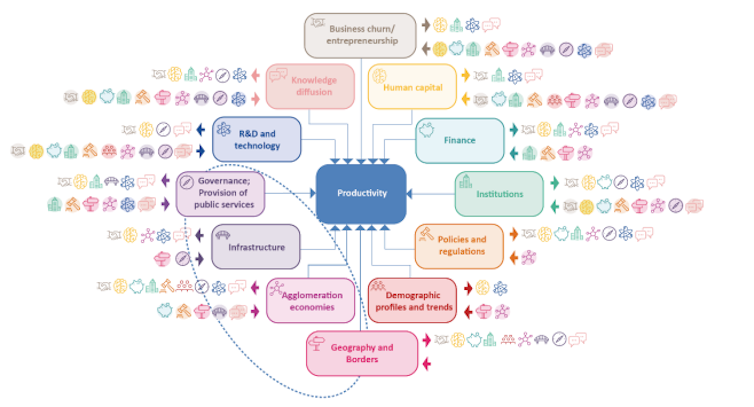
A mind map with productivity in the centre and different determinants of productivity branching out from it, including: entrepreneurship, human capital, finance, institutions, policies/regulations, demographic profiles and trends, infrastructure, governan
The determinants of productivity and their underlying factors. These determinants connect across industries, businesses and places.
(Organization for Economic Co-operation and Development), CC BY

Where people live matters more

Return-to-office mandates also aren’t a guaranteed way to boost productivity. A 2023 study supported by housing organizations across Canada found that affordable, well-located housing helps people find better jobs and specialize in their work.

But when housing costs are high and commutes are long, productivity drops, especially for lower-income workers. Long commutes and high living costs create stress, limit mobility and cause people to miss out on job opportunities.

Studies show that investing in technology and training workers matters much more. Research from the Canadian Research Data Centre Network finds that workplace training improves productivity in most sectors.

A recent report from the Canada Mortgage and Housing Corporation also shows that high housing costs make it harder for many people to live in big cities, which ultimately reduces diversity in the workforce and weakens the economy.

Affordable housing could boost productivity

Housing in Canada is often viewed in two ways. One treats it as a commodity, where prices follow supply and demand. In this view, policies focus on increasing supply and offering market incentives. The other sees housing as a public need and a basic right, and calls for government action to ensure affordability and stability.


Read more:
Housing is both a human right and a profitable asset, and that’s the problem


In practice, market forces can undermine policies designed to meet housing needs and ensure affordability. In Toronto, for example, developers resisted inclusionary zoning rules that require or encourage developers to include a certain percentage of affordable housing units within new residential developments. Instead, they delayed projects or chose to build high-end condos in different zones.

This tension between housing as a commodity and housing as a public good is central to Canada’s current housing strategy. Prime Minister Mark Carney’s government has pledged to build 500,000 new homes annually by 2035 using tools like public lands, modular housing and tax incentives.

While this supply-focused strategy targets long-term housing needs, it must also account for today’s complex economic realities such as inflation, increasing unemployment and economic stagnation due to lagging productiviy.

Without tackling affordability and access directly, building more homes alone won’t be enough.

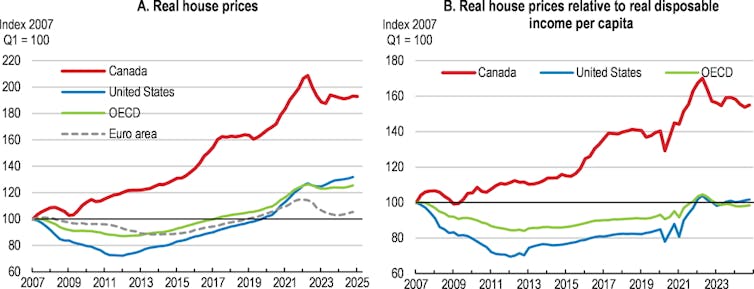
Two line graphs showing how housing has increased since 2004 in Canada
Rising home prices and rents have played a major role in driving inflation. In Canada’s Consumer Price Index, shelter makes up about 29 per cent of overall household spending.
(Organization for Economic Co-operation and Development), CC BY

The real foundation of a productive economy

Return-to-office policies often focus too much on one thing: how much each worker produces. But that narrow view of productivity ignores what really supports good work: access to affordable housing, time for training and flexibility to relocate for better job opportunities.

To address productivity challenges, companies should invest in job-specific training, digital skills and ongoing learning to help employees adapt to new tools and processes, and the should offer more flexibility. What workers need most are affordable homes, shorter commutes and real opportunities to grow — not added stress and rising costs.

The Conversation

Dilara Baysal does not work for, consult, own shares in or receive funding from any company or organisation that would benefit from this article, and has disclosed no relevant affiliations beyond their academic appointment.

ref. Returning to the office isn’t the answer to Canada’s productivity problem — and it will add pressure to urban housing – https://theconversation.com/returning-to-the-office-isnt-the-answer-to-canadas-productivity-problem-and-it-will-add-pressure-to-urban-housing-260395

Gene-edited pigs may soon enter the Canadian market, but questions about their impact remain

Source: The Conversation – Canada – By Gwendolyn Blue, Professor, University of Calgary

The Canadian government is currently considering approving the entry of gene-edited pigs into the food system.

Using CRISPR gene-editing technology, genetic changes can be created precisely and efficiently without introducing foreign genetic material. If approved, these pigs would be the first gene-edited food animals available for sale in Canadian markets. My research examines how including the public in decision-making around emerging applications of genomics can help mitigate potential harms.

These pigs are resistant to porcine reproductive and respiratory syndrome (PRRS), a horrible and sometimes fatal disease that affects pigs worldwide. PRRS has significant economic, food security and animal welfare implications.


Read more:
What is gene editing and how could it shape our future?


The United States Food and Drug Administration recently greenlit the commercial production of gene-edited pigs. Will the Canadian government follow suit?

AquAdvantage and EnviroPig

In 2016, Canada approved the first transgenic animal for human consumption — an Atlantic salmon called AquAdvantage salmon that contains DNA from other species of fish.

This approval came more than 25 years after the genetically modified fish was created by scientists at Memorial University in Newfoundland. The approval and commercialization of AquAdvantage salmon faced strong public opposition on both sides of the border, including protests, supermarket boycotts and court battles. In 2024, the company that produced AquAdvantage salmon announced that it was shutting down its operations.


Read more:
The science and politics of genetically engineered salmon: 5 questions answered


In 2012, the Canadian government approved the manufacture of a transgenic pig known by its trade name, EnviroPig. Created by scientists at the University of Guelph, EnviroPigs released less phosphorus than conventionally bred pigs.

EnviroPig did not make it to market; the same year, the University of Guelph ended the EnviroPig project. Funding for the project had been suspended, in part because of consumer concerns.

Government regulation

Some researchers argue that government regulation of gene-edited animals should be less restrictive than for transgenic techniques. Gene editing introduces genetic changes that can occur with conventional animal breeding that is not subject to regulation. Gene-edited crops in Canada are treated the same as conventionally bred crops.

Others insist that stringent government regulation is necessary for gene editing to identify potential problems and ensure that laws keep up with industry and scientific ambition. Regulation plays a vital role in minimizing risk, encouraging public involvement and building trust.

Social science research has, for decades, demonstrated that resistance to biotechnology is not because of the public’s lack of knowledge, as is often argued by biotechnology proponents. Public resistance to biotechnology is better understood as a rejection of potential harms imposed by governments and industry without public input and consent.

Ethical, moral, cultural and political concerns

At present, little opportunity exists for public engagement in Canadian assessments of gene-edited animals.

Similar to the U.S., Canada does not have specific gene technology regulation. Rather, the federal government relies on pre-existing environmental and food safety legislation. Canadian regulatory agencies use a risk, novelty and product-based approach to assess animal biotechnology. From a regulatory standpoint, distinctions between technical processes — like transgenic modification versus gene editing — are less important than the safety of the final product.

The Canadian government has recently updated its federal environmental and health regulations. This includes introducing mandatory public consultations for animals (vertebrates, specifically) created using biotechnology.

Even with these changes, there’s still room for improvement. Public engagement is limited to consultations conducted within a short time frame. Interested parties are invited to provide scientific information about potential risks of animal biotechnology to human health or the environment, but comments that address ethical, moral, cultural or political concerns are not taken into consideration.

More broadly, regulatory and academic debates about the gene editing of animals are largely informed by scientists and industry proponents with considerably less input from the public, Indigenous communities and social sciences and humanities researchers.

Consulting the public

From a social standpoint, the process by which gene editing is assessed matters as much as the safety of the final product. Inclusive public engagement is essential to ensure that the production of gene-edited food animals aligns with societal needs and values.

Reactions to gene technologies are based on underlying values and beliefs, and sustained opportunities for public reflection and deliberation are vital for responsible innovation.

Important questions should be addressed: Who will reap the benefits of gene-editing techniques? Who will bear the costs and harms? What are the potential implications, including hard-to-anticipate social and political changes? How should decision-making proceed to ensure that Canadians have sufficient opportunities for input?

Currently, for the gene-edited pigs, members of the public can submit comments to the government until July 20, 2025.

Public reactions to previous biotech food animals in Canada — including AquAdvantage salmon and the EnviroPig — show that lack of inclusive engagement can contribute to the rejection of animal biotechnology.

The Conversation

Gwendolyn Blue receives funding from the Social Sciences and Humanities Research Council. She is a member of Gene Editing for Food Security and Environmental Sustainability, a multi-university consortium based at McGill University, and funded by the Natural Sciences and Engineering Research Council of Canada.

ref. Gene-edited pigs may soon enter the Canadian market, but questions about their impact remain – https://theconversation.com/gene-edited-pigs-may-soon-enter-the-canadian-market-but-questions-about-their-impact-remain-260627

¿Para qué viajar?

Source: The Conversation – (in Spanish) – By Rafael Cejudo Córdoba, Profesor Titular de Ética y Filosofía Política, Universidad de Córdoba

Fotograma de ‘Come, reza, ama’, una película en la que el personaje interpretado por Julia Roberts (a la izquierda) busca, a través del viaje, volver a sentir apetito por su vida. FilmAffinity

La “propensión a viajar” de un grupo mide la probabilidad de que sus miembros hagan turismo. Se puede definir como el porcentaje de población que viaja a otros países, o más en general, como el deseo que una persona tiene de hacer turismo.

En la actualidad esta propensión es más alta que nunca: 1 400 millones de turistas se movieron por el mundo el año pasado, 140 millones más que en 2023. Eso equivale aproximadamente a casi dos de cada diez habitantes del planeta. Europa es la región del mundo preferida. Concretamente, 747 millones de turistas la eligieron en 2024, mientras que a España llegaron 93,8 millones de viajeros.

Esto supone una riqueza extraordinaria. Con razón se dice frecuentemente que el turismo es “nuestro petróleo”. En Noruega este hidrocarburo y el gas equivalen al 20,5 % de su PNB, mientras que el turismo supone el 13,1 % del PIB español. Pero como el petróleo, la industria turística también tiene impactos medioambientales negativos muy importantes. Sabemos que entre 2009 y el comienzo de pandemia de covid, las emisiones contaminantes debidas al turismo crecieron un 3,5 % al año, lo cual es una tasa que dobla la del crecimiento del resto de emisiones.

Un hombre observa la esfinge sentado de espaldas a la cámara.
En Muerte en el Nilo un crimen interrumpe el crucero por Egipto de Hercules Poirot.
IMDB

Uno de los efectos negativos del turismo es saber que nuestra propia conducta contribuye a esos efectos negativos. Nosotros somos parcialmente responsables.
Y no solo porque consentimos actividades negativas para el entorno, sino porque directamente las causamos con nuestras elecciones y comportamientos de ocio.

Como en otras muchas situaciones, estamos ante un problema de acción colectiva. Por un lado, queremos cooperar porque eso nos beneficiaría a todos, aunque suponga actuar en contra de nuestros intereses inmediatos. Por otro, queremos hacerlo contando con que los demás, al menos la mayoría, también lo hacen, porque si no es así, nuestro esfuerzo será inútil y parecerá estúpido. No se trata de una cuestión de mero egoísmo personal; aunque nosotros sí hagamos lo correcto a pesar de todo, de nada servirá si los demás no lo hacen.

Tratándose de un problema como el descrito, la razón para viajar menos, o para viajar de otra manera, no es tanto disminuir el impacto negativo global sino rechazar la complicidad con el mismo… por sentido del deber o simplemente porque nos guste.

Viajar para descubrir

Montaigne, considerado el primer ensayista moderno, escribía en 1588 que viajar era positivo, al proporcionar novedades desconocidas: “como he dicho con frecuencia, no conozco mejor escuela para moldear la propia vida que mostrar continuamente la diversidad de tantas otras, sus opiniones y costumbres”.

El primer ensayista inglés, Bacon, afirmaba otro tanto en su ensayo titulado Viajar, publicado en 1625: “viajar es parte de la educación en los jóvenes, y parte de la experiencia en la madurez”.

Un grupo de mujeres pasean por una plaza en la que al fondo se ve el David de Miguel Ángel.
En Una habitación con vistas una joven visita Florencia en un viaje que puede cambiarle la vida.
IMDB

El mismo viaje, por tanto, es una experiencia diferente según la edad del que viaja. Pero Bacon va más allá de esta obviedad. Considerando la trayectoria vital de una misma persona, en su juventud viajar fue una forma de aprender, mientras que esos mismos viajes, mirados desde la cuesta abajo de la vida, son parte de su experiencia. Y si ya en la madurez se viaja de nuevo, viajar es haber viajado, porque se aprendió ya lo necesario para que el viaje sea una forma de ampliar y de probar la experiencia personal.

Ahora bien, cualquiera viaja como si fuera un joven ignorante e inexperto si desconoce el lugar al que va, especialmente su cultura característica. Dice Bacon que “aquel que viaja a un país antes de haberse iniciado en su idioma, va a la escuela, no a un viaje”.

Pero ¿qué aprendemos viajando?

En gran medida, viajamos para divertirnos. Si, por ejemplo, que hacemos turismo de riesgo o “Extreme Budget Travel” (intentar llegar lo más lejos posible gastando el mínimo), ¿qué queremos aprender con la aventura?

Lo que en el fondo quiere aprender el turista es cómo viviría si no fuera como es el resto del tiempo, si fuera alguien de otro lugar, con otras costumbres. Es decir, “cruzar la línea”, probar cómo sería librarse de las rutinas, normas y convenciones de nuestro día a día (sin riesgo, eso sí). Todo turismo es entonces cultural, en el sentido de ser una experiencia planificada de contacto con otra cultura, que puede ser más o menos genuina.

Un joven hace autoestop sentado en un sofá viejo al lado de una señal en la carretera.
Hacias rutas salvajes contaba la peripecia real de Christopher McCandless viajando por Alaska sin dinero y entrando en contacto con quienes se cruzaban en su camino.
FilmAffinity

Tal como advirtió Freud en 1930, la vida en sociedad es inevitable por sus ventajas, pero también implica renunciar a satisfacer nuestros deseos de manera instintiva o inmediata. Por eso el turismo es una actividad liberadora y muy gratificante; consiste en dejar en casa, al otro lado de la línea, tanto la mochila de problemas como las máscaras que nos ponemos.

La industria turística juega con la apariencia de que podemos librarnos, siquiera unos días, de ser quien somos. Esta emancipación de la vida cotidiana puede resultar genuina, y no tiene que ser muy cara, si cambiamos nuestra perspectiva desde el objeto del viaje (a dónde viajo) al sujeto del mismo (yo que viajo).

El objeto del viaje o el sujeto que viaja

El ensayo de Bacon trata de los jóvenes miembros de la nobleza que viajaban desde Inglaterra a Italia (el llamado “Grand Tour”). Su finalidad era visitar lugares donde pudieran contemplarse monumentos y panoramas inolvidables. Lo visitado, el objeto del viaje, era su razón de ser. El viaje turístico conserva esta noción de que hay que viajar a donde merezca la pena ir.

Por eso existe la idea de los “lugares que visitar antes de morir” que masifica y degrada los destinos turísticos más conocidos. Incluso cuando se considera que el itinerario seguido es tanto o más importante que el punto de llegada, seguimos en el modelo de que el valor del viaje está en el objeto, en los lugares recorridos, y no en el sujeto que viaja.

Tres mujeres hacen fotos en Barcelona con la Sagrada Familia al fondo.
En Vicky Cristina Barcelona, las dos primeras son turistas en la ciudad del título.
FilmAffinity

Esta otra posibilidad, la de enfocarse en el sujeto, surgió en el siglo XIX con el Romanticismo y su importancia de la interioridad personal. “He viajado mucho en Concord”, decía el filósofo norteamericano Henry Thoreau en 1854, quien vivió toda su vida en ese pueblo o muy cerca de él. Lo importante no era haber visitado lugares lejanos, sino haber visto el propio pueblo y a sus gentes con otra mirada, una que sea crítica y que desvele las costumbres como meras costumbres, lo que vale la pena y lo que no.

Ese tipo de viaje al que se refería Thoreau, por Concord o por los alrededores de su río Merrimack, es una forma enriquecedora de pasear. El paseo es uno de los lujos más baratos; una actividad y sobre todo una actitud (la del paseante o flâneur), que no es un mero viaje para pobres, sino para quienes se distancian de lo cotidiano observando críticamente su realidad cultural.


Leer más:
Estamos dejando de pasear por la ciudad


Walter Benjamin plasmó en cientos de páginas sus divagaciones por la ciudad de París. El paseante “va a hacer botánica al asfalto”, decía en El París de Baudelaire, pero no con una mente crítica y fría. Más bien al contrario, su característica es la empatía con la naturaleza (en el caso de Thoreau) o de la vibrante vida de la ciudad (en el de Benjamin). En este tipo de viaje no hay necesariamente un punto de llegada (el paseo es divagación), no hay ese “hemos hecho tal y tal pueblo”, ni tampoco aquel “conozco Viena pero no Budapest”.

Como decía Pessoa, regresando de Cascais a la capital portuguesa: “el tren se va parando, estamos en el Cais do Sodré. Llegué a Lisboa pero no a una conclusión”. Si aprendemos algo en nuestros paseos, es que casi todo sigue por aprender.

The Conversation

Rafael Cejudo Córdoba no recibe salario, ni ejerce labores de consultoría, ni posee acciones, ni recibe financiación de ninguna compañía u organización que pueda obtener beneficio de este artículo, y ha declarado carecer de vínculos relevantes más allá del cargo académico citado.

ref. ¿Para qué viajar? – https://theconversation.com/para-que-viajar-260841