Guineafowl can outsmart extreme temperatures: we spent a year finding out how

Source: The Conversation – Africa (2) – By Johann van Niekerk, Doctor, Department of Environmental Sciences, University of South Africa

Have you ever wondered how wild birds cope with baking hot afternoons and freezing cold mornings? Our new study has taken a close look at one of Africa’s most familiar birds – the helmeted guineafowl – and uncovered surprising answers about how they deal with extreme temperatures.

The helmeted guineafowl (Numida meleagris) is a common sight across sub-Saharan Africa’s savannas and semi-arid regions. They are instantly recognisable with their spotted plumage, bony helmet, bare blue head, and loud cackling calls. These birds are famously social, often seen roaming in noisy flocks.

Helmeted guineafowl can endure air temperatures from -4°C up to 40°C in South Africa.

The idea that animals huddle to stay warm – known as social thermoregulation – is well documented in mammals and birds like penguins. This theory proposes that animals huddle together to conserve heat in cold conditions, but is this what guineafowl are doing?

Together with colleagues in Spain, we set out to find the answer because understanding whether birds group to keep warm or for other reasons helps ecologists uncover the true drivers of social behaviour. This can also inform how species will respond to changing climates and help guide conservation strategies.

We studied a wild population of guineafowl in South Africa’s Madikwe Game Reserve, a protected area near the Botswana border. It’s known for its sharp daily temperature fluctuations during winter, with cold, frosty mornings dropping to 0°C and sweltering afternoons reaching up to 40°C.

To spy on the birds without disturbing them, we set up a live-streaming webcam at a busy waterhole, recording their behaviour over an entire year. We watched how group size, body posture and daily routines shifted with the seasons and weather.

What we found was striking.

Our study challenges some common assumptions about how animals survive in extreme climates. Guineafowl don’t rely on cuddling for warmth like some penguins and some species of monkeys. Rather, they use behaviour – adjusting posture, timing their activity and changing group sizes according to food and safety needs – to navigate life’s temperature extremes.

This strategy may help them cope with the growing unpredictability of climate.

When they get together, it’s to exploit a food patch and nurture their offspring within close-knit social groups while foraging, or to fend off predators during coordinated mobbing behaviour.

What we found

The evidence we gathered shows that the guineafowl did not form bigger groups when temperatures dropped. There was no evidence they huddled together to stay warm. Even at night, when they roosted in trees, they perched in small family units – just two or three birds per branch.

Our findings suggest that the reason guineafowl form groups has more to do with food and safety.

During the dry winter months, when seeds and vegetation are scarce, the birds form large foraging flocks to help find food and stay safe from predators. More eyes mean better chances of spotting danger. This supports the widely recognised “many eyes” hypothesis, which shows that individuals in larger groups benefit from improved predator detection. But once the rains return and food becomes more plentiful and spread out, the guineafowl split into pairs or small groups to focus on breeding.

While group size wasn’t tied to temperature, the birds used clever body postures to handle both heat and cold. On chilly mornings below 17°C, they puffed out their collar feathers and tucked their bare necks deep into their bodies, creating a rounded, fluffy ball that trapped heat.

On warmer days, they stood tall with their necks fully extended, legs exposed, and feathers sleek to release excess heat. When temperatures soared above 30°C, they opened their beaks to pant, spread their wings slightly away from their bodies, and exposed bare skin to cool off, much as a dog pants on a hot day.

One of the most delightful behaviours observed was “sunning”. On frosty winter mornings, guineafowl would fly down from their roosts and stand facing the rising sun, fluffing their feathers and soaking up warmth before starting their day. It’s a simple, effective way to heat up after a cold night.

Another surprise was how rarely the birds drank water. Despite living in a dry environment, only about 2% of observed guineafowl visits were to the waterhole. In wet seasons, they likely get most of their moisture from eating green plants and insects. In the cold, dry season, when food is drier, drinking increased slightly, but still far less than expected.

They drank even less when it was both hot and windy, possibly because the noise of the wind makes it harder to detect predators when standing out in the open. Avoiding water during hot periods is usual among helmeted guineafowl, which typically avoid exposing themselves during peak heat due to increased predation risk and the physiological stress of extreme temperatures. Most galliforms (gamebirds) and terrestrial species favour early morning or late afternoon activity patterns, limiting mid-day exposure.

Every evening, the flock gathered at the same familiar “launching pad” near the waterhole and flew into nearby trees to roost. But once again, warmth wasn’t the reason for this behaviour. They roosted to avoid ground predators, not to share body heat. I have seen them for many years going into trees when predators or dogs chase them, unlike spurfowl and francolin just flying further on.

Why insights are useful

This research carries important lessons for understanding animal adaptation. Rather than relying on group warmth, guineafowl show how behavioural flexibility, adjusting posture, timing and habitat use, can buffer them against harsh conditions. It highlights how survival depends not just on temperature or water availability, but on having access to diverse habitat types: open grasslands for foraging and trees or dense bush for roosting and safety.

As climates shift and ecosystems change, understanding how animals like guineafowl cope with extremes will be crucial for conservation planning.

The Conversation

Johann van Niekerk does not work for, consult, own shares in or receive funding from any company or organisation that would benefit from this article, and has disclosed no relevant affiliations beyond their academic appointment.

ref. Guineafowl can outsmart extreme temperatures: we spent a year finding out how – https://theconversation.com/guineafowl-can-outsmart-extreme-temperatures-we-spent-a-year-finding-out-how-260439

Indonesia plans to rewrite its national history: A return to an incomplete narrative?

Source: The Conversation – Indonesia – By Adrian Perkasa, Peneliti Pascadoktoral, Royal Netherlands Institute of Southeast Asian and Caribbean Studies

Indonesia’s plan to rewrite its official national history was initially met with positive responses, particularly for its goal of better serving the younger generation. But the project to reshape the country’s mainstream historical narrative soon ignited widespread controversy for overlooking underrepresented groups and reinforcing authoritarian tendencies.

By incorporating the latest data and expanding the coverage of historical events and figures, the initiative — launched by the Indonesian Historian Association (MSI) and backed by the Culture Ministry on May 2025 — raised hopes for a more inclusive, accurate, and relevant national history.

However, backlash soon followed, with criticism intensifying after Culture Minister Fadli Zon’s controversial statement) dismissing the 1998 mass rapes as mere rumours.

Various groups argue that the rewriting of national history is a calculated move to bolster an increasingly authoritarian government, as it relies solely on scholars and historians with ties to those in power.

Many groups remain underrepresented

A nation’s relationship with its history is deeply tied to how contemporary narratives are constructed or shaped. For national historiography to carry legitimacy, it must meaningfully include the voices of diverse groups, classes, communities, and entities.

However, the project’s terms of reference fail to give due attention to space for women’s roles in the Indonesian independence movement].

Its treatment of historical narratives from regions beyond Java also remains insufficient — let alone its neglect of non-political and non-economic themes, such as the arts or sports.

Silent affirmation?

In response to the controversy, few formal statements have been made from either MSI or the historians involved in the project, apart from the minister and the project’s principal editor.

One notable exception came from a historian via his social media page, where he reflected on the dilemma of being both an intellectual and a public servant involved in the project.

He argued that speaking from within, rather than criticising from the outside, demands greater courage and careful calculation – a stance he fears is likely to be overlooked.

As a history-and-culture researcher, his remarks reinforce the perception that many of the historians involved in the revision project are civil servants at state universities or individuals closely aligned with those in power.

Lessons from the past

History itself tells us that the writing of national history is deeply intertwined with the interests of ruling authorities and their affiliated groups.

From its inception, the genre of national history that emerged in 19th-century Europe and the United States was closely tied to efforts to legitimise territorial expansion and colonial rule.

In the context of Indonesia’s current national history revision project, it is worth revisiting comparisons between how national histories were written under Ferdinand Marcos in the Philippines and Suharto in Indonesia.

Historians in both countries should be recognised as active agents with their own interests and authority — not as passive participants or easily influenced figures.

During Suharto’s regime, one historian even withdrew from the state-led national history writing project due to disagreements, particularly over methodological approaches.

The project’s director marginalised historian Sartono Kartodirdjo — who championed a multidimensional approach — in favour of a more linear, state-centric narrative. Sartono’s more holistic perspective made space for a broader range of historical actors, including farmers and other often-overlooked communities.

A similar precedent can be traced back to the early years of Indonesian independence, when the government initiated efforts to document the country’s national history in the 1950s. At the time, the National History Writing Committee — comprising prominent scholars — organised Indonesia’s first National History Seminar.

Yet the initiative failed to produce an official national history, partly due to the same kind of unresolved methodological debates that resurfaced during Suharto’s rule.

A project for whom?

Marcus Tullius Cicero, the Roman philosopher-turned-statesman, once said, historia magistra vitae est – history is the teacher of life.

Given the failures and controversies surrounding Indonesia’s earlier attempt to produce an official national history, the current revision project demands critical re-evaluation — and, if necessary, a complete halt.

Merely involving more historians to boost representation is not an adequate solution either.

The core issue lies not in revising history, but in advancing Indonesian historiography. Rather than pushing ahead with an extensive national history rewrite, the government should prioritise fostering diverse local history initiatives — through programmes such as the Cultural Endowment Fund or the Indonesiana Fund.

This approach would enable a more comprehensive and representative account of Indonesian history — one that integrates local perspectives while remaining connected to national and global narratives.

The Conversation

Saya pernah dan masih berkolaborasi untuk riset dengan beberapa lembaga di lingkungan Kementerian Kebudayaan seperti Museum dan Cagar Budaya Nasional, Balai Pelestarian Kebudayaan, dan lainnya.

ref. Indonesia plans to rewrite its national history: A return to an incomplete narrative? – https://theconversation.com/indonesia-plans-to-rewrite-its-national-history-a-return-to-an-incomplete-narrative-260298

Shopping en ligne : comment Shein, Temu et les autres utilisent l’IA pour vous rendre accro

Source: The Conversation – in French – By Ghassan Paul Yacoub, Associate Professor of Innovation and Strategy, EDHEC Business School

Le succès rencontré par des applis comme Temu ou Shein (et d’autres) s’appuie sur des outils marketing très efficaces. L’intelligence artificielle est devenue un levier majeur pour fidéliser les clients… Au-delà du raisonnable ?


Ces dernières années, plusieurs sites Internet à positionnement ultra low cost ont fait leur apparition sur le marché français. Shein, Temu ou encore Aliexpress, pour ne citer qu’eux, rebattent les cartes du commerce en ligne. D’après une étude menée par BPCD Digital & Payments en 2023, le nombre de cartes de paiements enregistrant au moins une transaction mensuelle sur un site discount a ainsi augmenté de 20 % entre le premier trimestre de 2022 et le premier trimestre de 2023.

Rien d’étonnant si le site Temu compte 18,4 millions d’internautes français chaque mois, selon les données de la fédération du e-commerce et vente à distance (Fevad)). Et, désormais, les plates-formes low cost représentent 22 % des colis pris en charge par la Poste, contre 5 % il y a 5 ans. Cette hausse devrait se prolonger, puisque l’on anticipe une croissance du secteur à 6,5 % en 2025.

Bien entendu, l’inflation galopante en France ces dernières années explique pour partie cet engouement. Mais celle-ci n’est pas la seule explication de ces évolutions. L’usage de l’intelligence artificielle (IA), au cœur du business model de ces plates-formes low cost, permet de fidéliser les consommateurs.


À lire aussi :
Comment fait Temu pour proposer des prix aussi bas ?


Profilage comportemental

Ainsi, dans nos derniers articles sur Shein et Temu, nous avons analysé, notamment, la façon dont ces plates-formes œuvrent en coulisses. En analysant les données comportementales des utilisateurs, les outils d’IA utilisés par les plates-formes peuvent identifier les clients les plus susceptibles de réaliser un achat et ajuster les messages publicitaires que ceux-ci reçoivent.

Des algorithmes prédictifs analysent également le comportement des utilisateurs pour leur proposer des recommandations personnalisées. Cette approche vise à créer un besoin avant même qu’il n’apparaisse, en jouant sur le sentiment de rareté et d’urgence. C’est le fameux FOMO, l’acronyme de fear of missing out, défini comme la crainte de rater une occasion importante.

Ces algorithmes prédictifs existent depuis de nombreuses années, mais leurs nouvelles capacités « augmentées » par les outils IA ouvrent une nouvelle ère, s’adaptant encore plus finement et rapidement à chaque internaute. En bas de chaque page, figure ainsi une liste d’« articles également consultés » par les autres utilisateurs, qui ressemblent au produit recherché. Cette technique marketing classique est poussée plus loin : les algorithmes soumettent en permanence de nouveaux contenus au client pour étudier sa réaction. La moindre réaction (clic, ajout d’un article dans le panier…) est analysée en direct. L’algorithme, appuyé par l’IA, utilise ensuite ces données pour inciter l’utilisateur à acheter d’autres produits, qu’il n’était pas venu chercher en premier lieu.


Abonnez-vous dès aujourd’hui !

Chaque lundi, recevez gratuitement des informations utiles pour votre carrière et tout ce qui concerne la vie de l’entreprise (stratégie, RH marketing, finance…).


Jouer pour mieux vendre

La gamification, aussi appelée ludification en français, désigne l’utilisation des mécanismes du jeu à des fins de marketing pour capter l’attention des clients.

Sur l’application Temu, les interfaces s’inspirent des jeux d’argent, connus pour être particulièrement addictifs : roue de la fortune, comptes à rebours mettant en avant des offres limitées dans le temps, cadeaux et codes promotionnels à débloquer… Ces stimulations constantes génèrent chez l’utilisateur un sentiment d’urgence, tout en perturbant le mécanisme biochimique du circuit de la récompense.

Les leviers psychologiques exploités par les plates-formes low cost sont redoutables. Elles agissent sur :

  • le besoin : grâce à des prix très bas qui incitent à acheter toujours plus de produits ;

  • le sentiment d’urgence, avec des comptes à rebours qui laissent croire que l’article ne sera bientôt plus disponible ;

  • la transformation de l’expérience shopping en un jeu.

Tarification dynamique

Toujours sur Temu, des mini-jeux intégrés à l’application mobile (Farmland, Fishland) promettent de gagner des objets gratuits et des coupons de réduction. Par ailleurs, des systèmes de points et de bons d’achat sont utilisés pour pousser les utilisateurs à retourner sur le site le plus souvent possible. Des notifications personnalisées sont également envoyées selon le moment propice, en fonction des données recueillies sur l’utilisateur (jour, heure, humeur supposée).

Par ailleurs, des algorithmes de tarification dynamique (qui ajustent les prix en fonction des variations de la demande) affichent des réductions dont la réalité est parfois loin d’être patente. Elles n’en sont pas moins psychologiquement puissantes sur les consommateurs.

Une hyperpersonnalisation en temps réel

Autre levier utilisé : l’hyperpersonnalisation de la plate-forme. Grâce à l’intelligence artificielle, qui collecte d’abondantes données relatives aux profils des utilisateurs, chaque client dispose d’une boutique en ligne différente, personnalisée selon son historique, ses goûts, ses préférences et ses aversions. De quoi augmenter la probabilité d’un ou de plusieurs achats impulsifs.

Mais la contribution la plus importante de l’IA au succès de Shein va bien plus loin, et précède l’arrivée des clients sur la plate-forme. En effet, Shein a développé ses propres outils d’IA et ses propres algorithmes pour collecter et analyser des données. Les utilisant pour suivre le comportement de ses clients sur Internet (sur et au-delà de son site), Shein s’appuie aussi sur ces outils pour analyser les résultats des recherches faites en ligne, les posts des réseaux sociaux, les sites de ses concurrents, etc.

Ces outils sont donc au cœur du succès de Shein, qui peut identifier les tendances (couleurs, prix, designs, etc.) en temps réel ou presque, et ajuster très rapidement la conception et la production de ses produits car l’ensemble de ces données est partagé avec ses fournisseurs, qui produisent l’intégralité des pièces vendues sur son site. Ceci est facilité par une stratégie privilégiant une production de petits volumes (100 pièces ou moins) pour tout nouveau produit.

France 24 2025.

D’importants enjeux éthiques

L’ensemble de ces éléments soulève évidemment des problèmes éthiques, eu égard à l’opacité des algorithmes utilisés et du manque de transparence quant à l’utilisation qui est faite des données recueillies.

Shein a d’ailleurs été condamnée en 2022 par la justice new-yorkaise pour ne pas avoir informé près de 40 millions d’utilisateurs d’un vol de données sur les utilisateurs intervenu en 2018. Comme nous l’avons évoqué plus haut, l’entreprise est aussi dans le viseur de la Commission européenne, qui lui reproche au moins six pratiques trompeuses ou abusives envers les consommateurs (faux rabais, informations mensongères, pression à l’achat, opacité de certaines informations, etc.).

Alors, jusqu’à quel point faut-il réguler l’intelligence artificielle dans la vente et le marketing en ligne ? Quelles limites doit-on poser ? Jusqu’où, enfin, doit aller la protection du consommateur ? Selon un rapport Statista de 2024, les systèmes de recommandation basés sur l’intelligence artificielle influencent près de 35 % des achats en ligne, ce qui démontre leur impact considérable. Ceci interroge sur la portée effective du Digital Services Act et de l’EU AI Act, pourtant supposés œuvrer pour une meilleure protection des consommateurs.

The Conversation

Les auteurs ne travaillent pas, ne conseillent pas, ne possèdent pas de parts, ne reçoivent pas de fonds d’une organisation qui pourrait tirer profit de cet article, et n’ont déclaré aucune autre affiliation que leur organisme de recherche.

ref. Shopping en ligne : comment Shein, Temu et les autres utilisent l’IA pour vous rendre accro – https://theconversation.com/shopping-en-ligne-comment-shein-temu-et-les-autres-utilisent-lia-pour-vous-rendre-accro-257029

Tour de France 2025 : quand des réserves naturelles émergent sur des sites pollués

Source: The Conversation – France (in French) – By Patrick de Wever, Professeur, géologie, micropaléontologie, Muséum national d’histoire naturelle (MNHN)

La mare à Goriaux, née d’un affaissement minier. Wikimedia commons, CC BY-NC-SA

Au-delà du sport, le Tour de France donne aussi l’occasion de (re)découvrir nos paysages et parfois leurs bizarreries géologiques. Le XXIe siècle est marqué par un regain de sensibilité à la nature, qui a poussé à la protection de certains sites, sélectionnés parmi de nombreuses possibilités. Mais paradoxalement, certaines aires sont protégées alors qu’elles semblent polluées… par un phénomène naturel ?


Le naturaliste respecte tout ce qui vient de la nature. De cette dernière il exclut généralement l’humain et ses œuvres, tant elles portent atteinte à un équilibre sain. En témoignent les nombreuses traces laissées par le passé industriel de notre pays : certaines sont visibles (bâtiments en ruines…), quand d’autres, plus insidieuses, sont chimiques (sols pollués).

Et pourtant, en France, certaines pollutions et désordres industriels sont aujourd’hui classés… comme des réserves naturelles.

La troisième étape du Tour de France 2025, le 7 juillet dernier, a permis de l’illustrer avec deux exemples : les pelouses métallicoles de Mortagne-du-Nord et la « Mare à Goriaux », deux réserves biologiques du Parc Naturel régional Scarpe-Escaut traversées par la route dans la forêt de Saint-Amand, à une dizaine de kilomètres de son départ. Nous évoquerons aussi un troisième cas dans le Massif central, que les cyclistes parcourront lors de la 10e étape, le lundi 14 juillet 2025.

Pelouses métallicoles et plantes hyperaccumulatrices

Éliminer les cicatrices que l’humain a laissées en maltraitant la Terre n’est pas chose aisée et les approches sont aussi variées que les causes sont différentes. Les blessures visuelles se résorbent quand les moyens financiers sont mobilisés. La pollution chimique en revanche requiert, outre des subsides, un bien non achetable : du temps.

Magie de la nature, certaines plantes dites hyperaccumulatrices ont la propriété de prospérer sur des sols qui empoisonneraient la plupart des autres. Elles ne sont pas rares : on en connaît près de 400 espèces. La plupart bioaccumulent un ou deux métaux, mais certaines prélèvent un plus large éventail, en pourcentage variable selon le polluant.


Du lundi au vendredi + le dimanche, recevez gratuitement les analyses et décryptages de nos experts pour un autre regard sur l’actualité. Abonnez-vous dès aujourd’hui !


Ces capacités d’extraction par des plantes qui absorbent et concentrent dans leurs parties récoltables (feuilles, tiges) les polluants contenus dans le sol sont utilisées pour la dépollution : on parle de phytoremédiation. Le plus souvent, les végétaux sont récoltés et incinérés : les cendres sont stockées ou valorisées pour récupérer les métaux accumulés.

Mortagne du Nord, commune qui appartient au Parc naturel régional Scarpe-Escaut, en offre un exemple édifiant. Une usine y traitait du zinc, du cadmium, du plomb et quelques terres rares.

Mortagne-du-Nord, une pelouse métallicole décontaminante environne le collège, 2005.
Patrick De Wever, Fourni par l’auteur

Désormais, en lieu et place de l’amoncellement de déchets qui y étaient entreposés, prospèrent de jolis prés. Des pelouses dites « métalicolles » ou « calaminaires » qui entourent un collège en pleine nature.

Une réserve biologique fruit d’un effondrement minier

Le nord de la France est connu pour son absence de relief, comme la plaine de Flandre, vers Dunkerque, ou la région marécageuse de Saint-Amand-les-Eaux. Cette horizontalité est démentie par une dépression, notamment visible sur certaines routes.

Ainsi, à proximité de la terrible « trouée de Wallers-Arenberg », passage célèbre du Paris-Roubaix, une route montre une dépression très nette qui semble évoquer le passage d’une rivière. Or il n’y a pas de rivière. Quelle peut en être l’explication ?

La dépression de la route D313 ne correspond pas à un vallon naturel mais à un effondrement minier du Boulevard des mineurs d’Aremberg.
Patrick de Wever, Fourni par l’auteur

La dépression de la route ci-dessus permet de quantifier l’effondrement topographique. On notera, sur la partie droite de la photo, que la ligne de chemin de fer est restée horizontale car un remblai régulier était effectué. C’est d’ailleurs ce remblai, pris annuellement en charge par les houillères, qui a permis de les rendre responsables de cet effondrement. La gauche de la route, derrière les arbres, est bordée par le terril qui délimite la Mare à Goriaux (gorets en picard), une zone naturelle protégée installée sur un terril plat.

Les bois de la gauche de la route sont ceux de la « Mare à Goriaux », une réserve naturelle créée suite à un affaissement minier en 1916. En effet, il existait là un ancien terril horizontal – avant de prendre leur forme conique avec la mécanisation des apports, les terrils étaient horizontaux car alimentés par des wagonnets poussés par des hommes ou tirés par des chevaux. L’affaissement a formé trois mares, qui ont fini par se réunir en 1930 en un seul plan d’eau, la Mare à Goriaux.

La colonisation des lieux par la flore et la faune, riche et diversifiée, a conduit à décréter ce lieu réserve biologique domaniale de Raismes-St Amand-Wallers en 1982.

Une source de pétrole au cœur de l’Auvergne

La nature rejette du pétrole depuis toujours : on en connaît dans les Caraïbes tant au fond de la mer, où il suinte et est constamment digéré par des bactéries spécialisées, qu’à terre. Il était déjà utilisé par les Amérindiens Olmèques 12 siècles avant notre ère, afin d’imperméabiliser les toitures, étanchéifier les navires, les canalisations, les récipients ou décorer des masques. Dans l’Antiquité Classique, il a servi à étanchéifier les jardins suspendus de Babylone, à enduire l’arche de Noé ou à conserver les momies.

Si le bitume affleurait en surface dans toutes les régions aujourd’hui connues comme étant pétrolifères, de l’Arabie saoudite à l’Iran (alors la Perse) en passant par l’Irak (alors la Mésopotamie), en France, le pétrole est plus rare. Il existe néanmoins un endroit où il coule en surface.

Près de Clermont-Ferrand, à proximité de l’aéroport de Clermont-Aulnat se trouve une rivière de pétrole. L’eau, très riche en organismes (bactéries, algues…), présente une couleur d’un vert très particulier.
Patrick de Wever, Fourni par l’auteur

À l’est de Clermont-Ferrand, que traversera le peloton lors de la 10e étape, est visible entre l’autoroute et l’aéroport la « Source de la Poix », un lieu géré par le Conservatoire des espaces naturels. Le bitume qui s’y écoule librement est associé à de l’eau salée, du méthane et des traces d’hydrogène sulfuré, dont l’odeur parfois forte peut évoquer celle d’œufs pourris. Le mélange, qui circule sur une quinzaine de mètres avec un débit extrêmement faible (de l’ordre d’un hectolitre/an), surgit par des fractures dans la roche volcanique, ce qui explique qu’il n’est plus exploité. Dans le passé, il fut utilisé pour calfater (c’est-à-dire, étanchéifier) les embarcations de l’Allier.

Panneau de la source de la poix. Ce site, unique en France, n’est cependant pas protégé aux yeux de la loi. Il est demandé de le « préserver ensemble » (haut du panneau), mais (est-ce parce qu’il s’agit de pétrole ?), en bas… on pense à le partager !
Patrick de Wever, Fourni par l’auteur

Cet hydrocarbure vient des sédiments de Limagne qui se sont déposés dans un grand lac peu profond qui permettait une vie abondante, il y a une trentaine de millions d’années (Oligocène). Celle-ci a évolué avec le temps pour devenir le bitume que l’on trouve aujourd’hui – il ne s’agit pas vraiment de pétrole car il a subi une légère oxydation. N’ayant pas été piégé par une couche ou une structure imperméable, le liquide remonte lentement en surface.

Les suintements de bitumes sont nombreux en Limagne : outre au Puy de la Poix, on en connaît au Puy de Crouël, à la carrière de Gandaillat et à Dallet, à quelques kilomètres, où une mine a été exploitée jusqu’en 1984.

Cette source de bitume a été plus ou moins aménagée au cours des siècles, mais depuis, le site est presque tombé dans l’oubli. Il présente pourtant un joli potentiel pédagogique, d’un point de vue géologique, biologique, environnemental et sociétal.


À lire aussi :
La filière pétrolière française que tout le monde avait oubliée


The Conversation

Patrick de Wever ne travaille pas, ne conseille pas, ne possède pas de parts, ne reçoit pas de fonds d’une organisation qui pourrait tirer profit de cet article, et n’a déclaré aucune autre affiliation que son organisme de recherche.

ref. Tour de France 2025 : quand des réserves naturelles émergent sur des sites pollués – https://theconversation.com/tour-de-france-2025-quand-des-reserves-naturelles-emergent-sur-des-sites-pollues-258130

A wildfire’s legacy can haunt rivers for years, putting drinking water at risk

Source: The Conversation – USA (2) – By Ben Livneh, Associate Professor of Hydrology, University of Colorado Boulder

Burned ground can become hydrophobic and almost waxlike, allowing rainfall to quickly wash contaminants downslope. Carli Brucker

A wildfire rages across a forested mountainside. The smoke billows and the flames rise. An aircraft drops vibrant red flame retardant. It’s a dramatic, often dangerous scene. But the threat is only just beginning for downstream communtiies and the water they rely on.

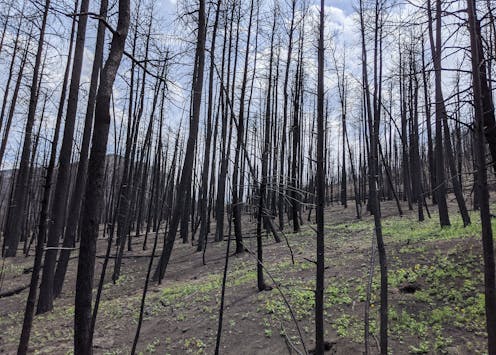
After the smoke clears, the soil, which was once nestled beneath a canopy of trees and a spongy layer of leaves, is now exposed. Often, that soil is charred and sterile, with the heat making the ground almost water-repellent, like a freshly waxed car.

When the first rain arrives, the water rushes downhill. It carries with it a slurry of ash, soil and contaminants from the burned landscape. This torrent flows directly into streams and then rivers that provide drinking water for communities downstream.

As a new research paper my colleagues and I just published shows, this isn’t a short-term problem. The ghost of the fire can haunt these waterways for years.

Scientists explain how wildfires can contaminate water supplies and the ways they measure the effects, summarized in their 2024 publication. University of Colorado-Boulder.

This matters because forested watersheds are the primary water source for nearly two-thirds of municipalities in the United States. As wildfires in the western U.S. become larger and more frequent, the long-term security and safety of water supplies for downstream communities is increasingly at risk.

Charting the long tail of wildfire pollution

Scientists have long known that wildfires can affect water quality, but two key questions remained: Exactly how bad is the impact? And how long does it last?

To find out, my colleagues and I led a study, coordinated by engineer Carli Brucker. We undertook one of the most extensive analyses of post-wildfire water quality to date. The results were published June 23, 2025, in the journal Nature Communications Earth & Environment.

We gathered decades of water quality data from 245 burned watersheds across the western U.S. and compared them to nearly 300 similar, unburned watersheds.

A map of watersheds in the western U.S.
A map of the basins studied shows the outlines of fires in red and burned basins in black. The blue basins did not burn and were used for comparisons.
Carli Brucker, et al., 2025, Nature Communications Earth & Environment

By creating a computer model for each basin that accounted for its normal water quality variability, based on factors such as rainfall and temperature, we were able to isolate the impact of the wildfire. This allowed us to see how much the water quality deviated after the fire, year after year.

The results were stark. In the first year after a fire, the concentrations of some contaminants skyrocketed. We found that levels of sediment and turbidity – the cloudiness of the water – were 19 to 286 times higher than prefire levels. That much sediment can clog filters at water treatment plants and require expensive treatment and maintenance. Think of trying to use a coffee filter with muddy water – the water just won’t flow through.

Concentrations of organic carbon, nitrogen and phosphorus were three to 103 times greater in the burned basins. These dissolved remnants of burned plants and soil are particularly problematic. When they mix with the chlorine used to disinfect drinking water, they can form harmful chemicals called disinfection byproducts, some of which are linked to cancer.

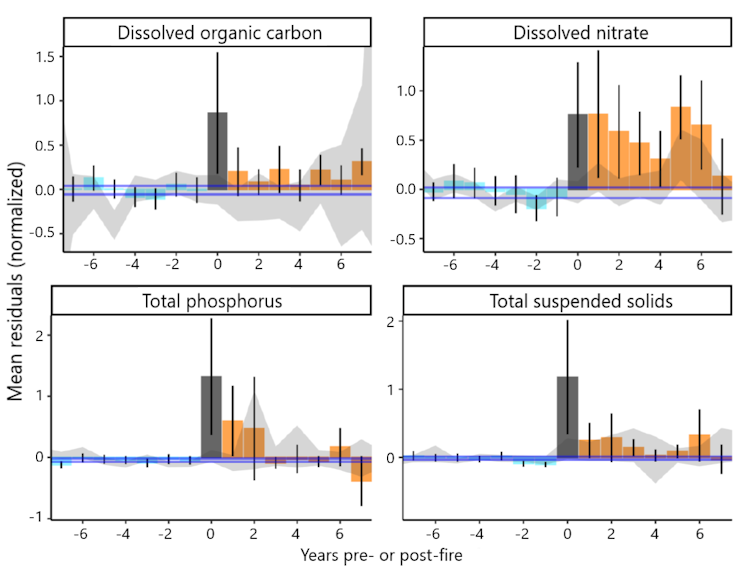
More surprisingly, we found the impacts to be really persistent. While the most dramatic spikes in phosphorous, nitrate, organic carbon and sediment generally occurred in the first one to three years, some contaminants lingered for much longer.

Charts show how contaminants lingered in water supplies for years after wildfires.
Contaminants including phosphorus, organic carbon and nitrates lingered in water supplies for years after wildfires. The charts show the average among all burned basins eight years before fires (light blue) and all burned basins after fires (orange). The gray bars show levels in the year immediately after the fire. The horizontal purple line shows levels that would be expected without a fire, based on the prefire years.
Carli Brucker, et al., 2025, Nature Communications Earth & Environment

We saw significantly elevated levels of nitrogen and sediment for up to eight years following a fire. Nitrogen and phosphorus act like fertilizer for algae. A surge of these nutrients can trigger algal blooms in reservoirs, which can produce toxins and create foul odors.

This extended timeline suggests that wildfires are fundamentally altering the landscape in ways that take a long time to heal. In our previous laboratory-based research, including a 2024 study, we simulated this process by burning soil and vegetation and then running water over them.

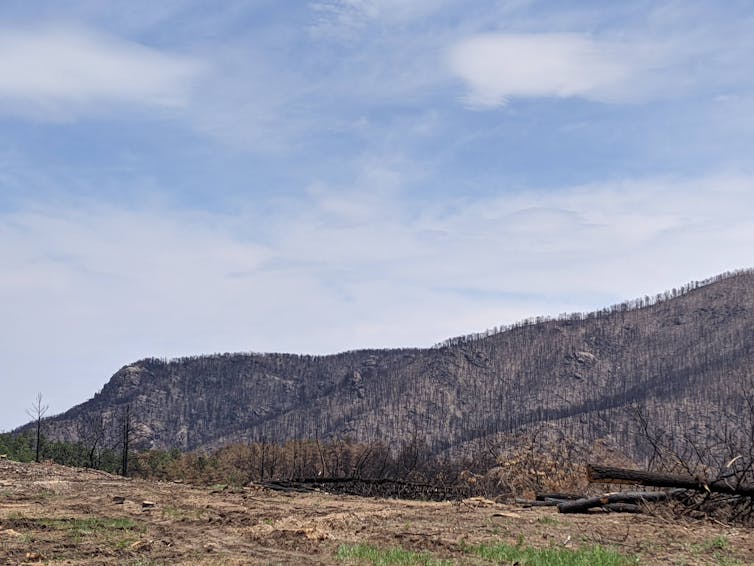
A blackened mountain slope where all of the trees have burned.
After mountain slopes burn, the rain that falls on them washes ash, charred soil and debris downstream.
Carli Brucker

The stuff that leaches out is a cocktail of carbon, nutrients and other compounds that can exacerbate flood risks and degrade water quality in ways that require more expensive treatment at water treatment facilities. In extreme cases, the water quality may be so poor that communities can’t withdraw river water at all, and that can create water shortages.

After the Buffalo Creek Fire in 1996 and then the Hayman Fire in 2002, Denver’s water utility spent more than US$27 million over several years to treat the water, remove more than 1 million cubic yards of sediment and debris from a reservoir, and fix infrastructure. State Forest Service crews planted thousands of trees to help restore the surrounding forest’s water filtering capabilities.

A growing challenge for water treatment

This long-lasting impact poses a major challenge for water treatment plants that make river water safe to drink. Our study highlights that utilities can’t just plan for a few bad months after a fire. They need to be prepared for potentially eight or more years of degraded water quality.

We also found that where a fire burns matters. Watersheds with thicker forests or more urban areas that burned tended to have even worse water quality after a fire.

Since many municipalities draw water from more than one source, understanding which watersheds are likely to have the largest water quality problems after fires can help communities locate the most vulnerable parts of their water supply systems.

As temperatures rise and more people move into wildland areas in the American West, the risk of wildfires increases, and it is becoming clear that preparing for longer-term consequences is crucial. The health of forests and our communities’ drinking water are inseparably linked, with wildfires casting a shadow that lasts long after the smoke clears.

The Conversation

Ben Livneh receives funding from the Western Water Assessment NOAA grant #NA21OAR4310309, ‘Western Water Assessment: Building Resilience to Compound Hazards in the Inter-Mountain West’.

ref. A wildfire’s legacy can haunt rivers for years, putting drinking water at risk – https://theconversation.com/a-wildfires-legacy-can-haunt-rivers-for-years-putting-drinking-water-at-risk-259118

FEMA’s flood maps often miss dangerous flash flood risks, leaving homeowners unprepared

Source: The Conversation – USA (2) – By Jeremy Porter, Professor of Quantitative Methods in the Social Sciences, City University of New York

A deadly flash flood on July 4, 2025, swept through Nancy Callery’s childhood home in Hunt, Texas. Brandon Bell/Getty Images

Destructive flash flooding in Texas and other states is raising questions about the nation’s flood maps and their ability to ensure that communities and homeowners can prepare for rising risks.

The U.S. Federal Emergency Management Agency’s flood maps are intended to be the nation’s primary tool for identifying flood risks.

Originally developed in the 1970s to support the National Flood Insurance Program, these maps, known as Flood Insurance Rate Maps, or FIRMs, are used to determine where flood insurance is required for federally backed mortgages, to inform local building codes and land-use decisions, and to guide flood plain management strategies.

A flood risk map.
A federal flood map of Kerrville, Texas, with the Guadalupe River winding through the middle in purple, shows areas considered to have a 1% annual chance of flooding in blue and a 0.2% annual chance of flooding in tan. During a flash flood on July 4, 2025, the river rose more than 30 feet at Kerrville.
FEMA

In theory, the maps enable homeowners, businesses and local officials to understand their flood risk and take appropriate steps to prepare and mitigate potential losses.

But while FEMA has improved the accuracy and accessibility of the maps over time with better data, digital tools and community input, the maps still don’t capture everything – including the changing climate. There are areas of the country that flood, some regularly, that don’t show up on the maps as at risk.

I study flood-risk mapping as a university-based researcher and at First Street, an organization created to quantify and communicate climate risk. In a 2023 assessment using newly modeled flood zones with climate-adjusted precipitation records, we found that more than twice as many properties across the country were at risk of a 100-year flood than the FEMA maps identified.

Even in places where the FEMA maps identified a flood risk, we found that the federal mapping process, its overreliance on historical data, and political influence over the updating of maps can lead to maps that don’t fully represent an area’s risk.

What FEMA flood maps miss

FEMA’s maps are essential tools for identifying flood risks, but they have significant gaps that limit their effectiveness.

One major limitation is that they don’t consider flooding driven by intense bursts of rain. The maps primarily focus on river channels and coastal flooding, largely excluding the risk of flash flooding, particularly along smaller waterways such as streams, creeks and tributaries.

This limitation has become more important in recent years due to climate change. Rising global temperatures can result in more frequent extreme downpours, leaving more areas vulnerable to flooding, yet unmapped by FEMA.

A map overlay shows how two 100-year flood maps compare. First Street shows many more streams.
A map of a section of Kerr County, Texas, where a deadly flood struck on July 4, 2025, compares the FEMA flood map’s 100-year flood zone (red) to First Street’s more detailed 100-year flood zone (blue). The more detailed map includes flash flood risks along smaller creeks and streams.
Jeremy Porter

For example, when flooding from Hurricane Helene hit unmapped areas around Asheville, North Carolina, in 2024, it caused a huge amount of uninsured damage to properties.

Even in areas that are mapped, like the Camp Mystic site in Kerr County, Texas, that was hit by a deadly flash flood on July 4, 2025, the maps may underestimate their risk because of a reliance on historic data and outdated risk assessments.

Political influence can fuel long delays

Additionally, FEMA’s mapping process is often shaped by political pressures.

Local governments and developers sometimes fight to avoid high-risk designations to avoid insurance mandates or restrictions on development, leading to maps that may understate actual risks and leave residents unaware of their true exposure.

An example is New York City’s appeal of a 2015 FEMA Flood Insurance Rate Maps update. The delay in resolving the city’s concerns has left it with maps that are roughly 20 years old, and the current mapping project is tied up in legal red tape.

On average, it takes five to seven years to develop and implement a new FEMA Flood Insurance Rate Map. As a result, many maps across the U.S. are significantly out of date, often failing to reflect current land use, urban development or evolving flood risks from extreme weather.

This delay directly affects building codes and infrastructure planning, as local governments rely on these maps to guide construction standards, development approvals and flood mitigation projects. Ultimately, outdated maps can lead to underestimating flood risks and allowing vulnerable structures to be built in areas that face growing flood threats.

How technology advances can help

New advances in satellite imaging, rainfall modeling and high-resolution lidar, which is similar to radar but uses light, make it possible to create faster, more accurate flood maps that capture risks from extreme rainfall and flash flooding.

However, fully integrating these tools requires significant federal investment. Congress controls FEMA’s mapping budget and sets the legal framework for how maps are created. For years, updating the flood maps has been an unpopular topic among many publicly elected officials, because new flood designations can trigger stricter building codes, higher insurance costs and development restrictions.

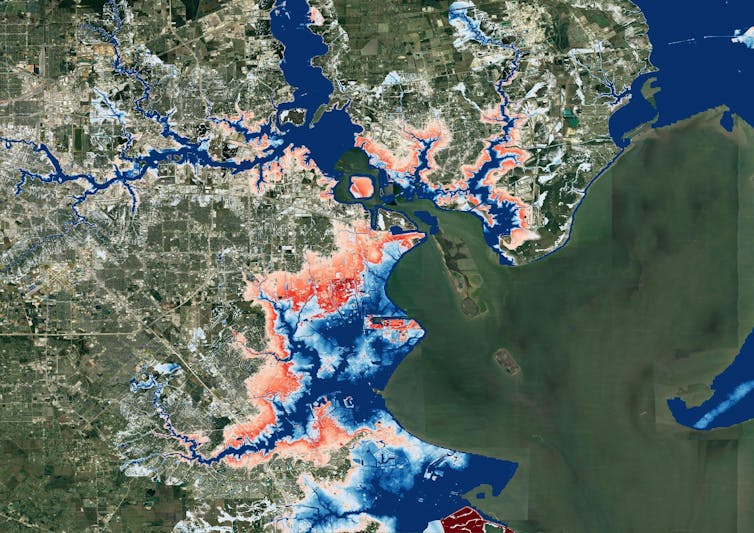
A map of Houston showing flooding extending much farther inland.
A map of Houston, produced for a 2022 study by researchers at universities and First Street, shows flood risk changing over the next 30 years as climate change worsens. Blue areas are today’s 100-year flood-risk zones. The red areas reflect the same zones in 2050.
Oliver Wing et al., 2022

In recent years, the rise of climate risk analytics models and private flood risk data have allowed the real estate, finance and insurance industries to rely less on FEMA’s maps. These new models incorporate forward-looking climate data, including projections of extreme rainfall, sea-level rise and changing storm patterns – factors FEMA’s maps generally exclude.

Real estate portals like Zillow, Redfin, Realtor.com and Homes.com now provide property-level flood risk scores that consider both historical flooding and future climate projections. The models they use identify risks for many properties that FEMA maps don’t, highlighting hidden vulnerabilities in communities across the United States.

Research shows that the availability, and accessibility, of climate data on these sites has started driving property-buying decisions that increasingly take climate change into account.

Implications for the future

As homebuyers understand more about a property’s flood risks, that may shift the desirability of some locations over time. Those shifts will have implications for property valuations, community tax-revenue assessments, population migration patterns and a slew of other considerations.

However, while these may feel like changes being brought on by new data, the risk was already there. What is changing is people’s awareness.

The federal government has an important role to play in ensuring that accurate risk assessments are available to communities and Americans everywhere. As better tools and models evolve for assessing risk evolve, FEMA’s risk maps need to evolve, too.

The Conversation

Jeremy Porter has nothing to disclose.

ref. FEMA’s flood maps often miss dangerous flash flood risks, leaving homeowners unprepared – https://theconversation.com/femas-flood-maps-often-miss-dangerous-flash-flood-risks-leaving-homeowners-unprepared-260990

How citizenship chaos was averted, for now, by a class action injunction against Trump’s birthright citizenship order

Source: The Conversation – USA – By Julie Novkov, Professor of Political Science and Women’s, Gender and Sexuality Studies, University at Albany, State University of New York

Protesters support birthright citizenship on May 15, 2025, outside of the Supreme Court in Washington. AP Photo/Jacquelyn Martin

Legal battles over President Donald Trump’s executive order to end birthright citizenship continued on July 10, 2025, after a New Hampshire federal district judge issued a preliminary injunction that will, if it’s not reversed, prevent federal officials from enforcing the order nationally.

The ruling by U.S. District Judge Joseph Laplante, a George W. Bush appointee, asserts that this policy of “highly questionable constitutionality … constitutes irreparable harm.”

In its ruling in late June, the Supreme Court allowed the Trump administration to deny citizenship to infants born to undocumented parents in many parts of the nation where individuals or states had not successfully sued to prevent implementation – including a number of mid-Atlantic, Midwest and Southern states.

Trump’s executive order limits U.S. citizenship by birth to those who have at least one parent who is a U.S. citizen or legal permanent resident. It denies citizenship to those born to undocumented people within the U.S. and to the children of those on student, work, tourist and certain other types of visas.

The preliminary injunction is on hold for seven days to allow the Trump administration to appeal.

The June 27 Supreme Court decision on birthright citizenship limited the ability of lower-court judges to issue universal injunctions to block such executive orders nationwide.

Laplante was able to avoid that limit on issuing a nationwide injunction by certifying the case as a class action lawsuit encompassing all children affected by the birthright order, following a pathway suggested by the Supreme Court’s ruling.

Pathways beyond universal injunctions

In its recent birthright citizenship ruling, Trump v. CASA, the Supreme Court noted that plaintiffs could still seek broad relief by filing such class action lawsuits that would join together large groups of individuals facing the same injury from the law they were challenging.

And that’s what happened.

Litigants filed suit in New Hampshire’s district court the same day that the Supreme Court decided CASA. They asked the court to certify a class consisting of infants born on or after Feb. 20, 2025, who would be covered by the order and their parents or prospective parents. The court allowed the suit to proceed as a class action for these infants.

Several people raise their hands as a man at a podium answers questions.
President Donald Trump takes questions on June 27, 2025, in Washington, D.C., after the Supreme Court ruled on the birthright citizenship case.
Joe Raedle/Getty Images

What if this injunction doesn’t stick?

If the U.S. Court of Appeals for the 1st Circuit or the Supreme Court invalidates the New Hampshire court’s newest national injunction and another injunction is not issued in a different venue, the order will then go into effect anywhere it is not currently barred from doing so. Implementation could begin in as many as 28 states where state attorneys general have not challenged the Trump birthright citizenship policy if no other individuals or groups secure relief.

As political science scholars who study race and immigration policy, we believe that, if implemented piecemeal, Trump’s birthright citizenship order would create administrative chaos for states determining the citizenship status of infants born in the United States. And it could lead to the first instances since the 1860s of infants being born in the U.S. being denied citizenship categorically.

States’ role in establishing citizenship

Almost all U.S.-born children are issued birth certificates by the state in which they are born.

The federal government’s standardized form, the U.S. standard certificate of live birth, collects data on parents’ birthplaces and their Social Security numbers, if available, and provides the information states need to issue birth certificates.

But it does not ask questions about their citizenship or immigration status. And no national standard exists for the format for state birth certificates, which traditionally have been the simplest way for people born in the U.S. to establish citizenship.

If Trump’s executive order goes into effect, birth certificates issued by local hospitals would be insufficient evidence of eligibility for federal government documents acknowledging citizenship. The order would require new efforts, including identification of parents’ citizenship status, before authorizing the issuance of any federal document acknowledging citizenship.

Since states control the process of issuing birth certificates, they will respond differently to implementation efforts. Several states filed a lawsuit on Jan. 21 to block the birthright citizenship order. And they will likely pursue an arsenal of strategies to resist, delay and complicate implementation.

While the Supreme Court has not yet confirmed that these states have standing to challenge the order, successful litigation could bar implementation in up to 18 states and the District of Columbia if injunctions are narrowly framed, or nationally if lawyers can persuade judges that disentangling the effects on a state-by-state basis will be too difficult.

Other states will likely collaborate with the administration to deny citizenship to some infants. Some, like Texas, had earlier attempted to make it particularly hard for undocumented parents to obtain birth certificates for their children.

Protesters hold signs in front of a federal building.
People demonstrate outside the Supreme Court of the United States on May 15, 2025, in Washington, D.C.
Matt McClain/The Washington Post via Getty Images

Potential for chaos

If the Supreme Court rejects attempts to block the executive order nationally again, implementation will be complicated.

That’s because it would operate in some places and toward some individuals while being legally blocked in other places and toward others, as Justice Sonia Sotomayor warned in her Trump v. CASA dissent.

Children born to plaintiffs anywhere in the nation who have successfully sued would have access to citizenship, while other children possibly born in the same hospitals – but not among the groups named in the suits – would not.

Babies born in the days before implementation would have substantially different rights than those born the day after. Parents’ ethnicity and countries of origin would likely influence which infants are ultimately granted or denied citizenship.

That’s because some infants and parents would be more likely to generate scrutiny from hospital employees and officials than others, including Hispanics, women giving birth near the border, and women giving birth in states such as Florida where officials are likely to collaborate enthusiastically with enforcement.

The consequences could be profound.

Some infants would become stateless, having no right to citizenship in another nation. Many people born in the U.S. would be denied government benefits, Social Security numbers and the ability to work legally in the U.S.

With the constitutionality of the executive order still unresolved, it’s unclear when, if ever, some infants born in the U.S. will be the first in the modern era to be denied citizenship.

The Conversation

The authors do not work for, consult, own shares in or receive funding from any company or organization that would benefit from this article, and have disclosed no relevant affiliations beyond their academic appointment.

ref. How citizenship chaos was averted, for now, by a class action injunction against Trump’s birthright citizenship order – https://theconversation.com/how-citizenship-chaos-was-averted-for-now-by-a-class-action-injunction-against-trumps-birthright-citizenship-order-260175

Women with ADHD three times more likely to experience premenstrual dysphoric disorder – new research

Source: The Conversation – UK – By Jessica Agnew-Blais, Senior Lecturer in Psychology, Queen Mary University of London

PMDD causes symptoms such as mood swings, irritability, depressed mood and anxiety. LightField Studios/ Shutterstock

Attention-deficit hyperactivity disorder (ADHD) has historically been under-studied in women. This means we still have a limited understanding of how the condition may uniquely affect women – and what effect monthly hormonal changes may have on women with ADHD.

But a recent study conducted by me and my colleagues has shown that women with ADHD are at higher risk for mental health struggles associated with the menstrual cycle. We found that having ADHD makes women around three times more likely to experience premenstrual dysphoric disorder.

Premenstrual dysphoric disorder (PMDD), is a serious condition that affects about 3% of women worldwide. The condition can seriously interfere with a person’s everyday life, causing symptoms such as mood swings, irritability, depressed mood and anxiety.

These symptoms occur in the days before menstruation, and resolve after the period starts. For some, PMDD may lead to severe outcomes, such as being at an increased risk of attempting suicide.


Read more:
Premenstrual dysphoric disorder: the frightening psychological condition suffered by Dixie D’Amelio


Get your news from actual experts, straight to your inbox. Sign up to our daily newsletter to receive all The Conversation UK’s latest coverage of news and research, from politics and business to the arts and sciences.


We conducted an online survey of 715 women aged 18 to 34 in the UK. We asked them whether they experienced different symptoms of ADHD or PMDD, whether they’d received an ADHD diagnosis from a doctor and how symptoms interfered with their lives.

We found that about 31% of women with a clinical ADHD diagnosis also had PMDD, as did around 41% of women who scored high for ADHD symptoms (whether they had been formally diagnosed with ADHD or not). In comparison, only about 9% of women without ADHD met the criteria for PMDD. We also found that women who had ADHD and a clinical diagnosis of depression or anxiety had an even greater risk of PMDD.

The research showed that the most common PMDD symptoms women experienced were irritability, feeling overwhelmed and depression. But women with ADHD may also be more likely to experience insomnia when they have PMDD.

A young woman sits on a couch looking sad.

The PMDD and ADHD link

Our study isn’t the first to show a link between the two conditions, but it is the first to identify a similar PMDD risk among women with ADHD symptoms, not just among those who were in treatment. We’re also the first to show that people who have ADHD plus depression or anxiety are at an even greater risk of PMDD.

Other research suggests that women with ADHD may also be at higher risk for mental health problems during other times of hormonal change. For instance, one study found women with ADHD experienced higher rates of depression and anxiety after starting combined oral hormonal contraceptives. Another study found that women with ADHD were more likely to experience depression after giving birth than those without the condition.

More research is now needed to understand why women with ADHD appear to be more vulnerable to PMDD, and whether this affects what treatments work best.

It should be noted that our study assesses “provisional PMDD diagnosis”. An official diagnosis requires two months of symptom tracking across the menstrual cycle. But we asked women to remember how they felt across their menstrual cycle rather than tracking how they feel in real-time.

This means we could be over- or under-estimating PMDD prevalence as we’re relying on participants to recall their symptoms.

Future research should assess PMDD symptoms among women in real-time as they experience their menstrual cycles to more accurately assess symptoms without having to rely on people’s memory. Additionally, it may be difficult to distinguish PMDD from other disorders that may worsen during the premenstrual period, such as depression or anxiety. Tracking symptoms across the menstrual cycle in real-time would help to disentangle this.

PMDD can have profoundly negative effects on women’s lives. Some women even report it can make them feel “physically unable to see the joy in things”. Although symptoms can be managed with prescription treatments, this can only happen if the condition is diagnosed by a doctor.

Our new research shows us that women with ADHD are an at-risk group for PMDD, especially if they also have depression or anxiety. This suggests doctors should consider screening for PMDD among women with ADHD to reduce distress and adverse outcomes associated with the condition.

The Conversation

Jessica Agnew-Blais receives funding from the UK Medical Research Council and GambleAware for her research.

ref. Women with ADHD three times more likely to experience premenstrual dysphoric disorder – new research – https://theconversation.com/women-with-adhd-three-times-more-likely-to-experience-premenstrual-dysphoric-disorder-new-research-260222

Don’t let food poisoning crash your picnic – six tips to keep your spread safe

Source: The Conversation – UK – By Edward Fox, Associate Professor, Department of Applied Sciences, Northumbria University, Newcastle

Jenny_Tr/Shutterstock

Nothing says summer quite like a picnic. Whether you’re lounging on a beach towel, stretched out in a park, or unpacking a hamper in your garden, picnics are a beloved way to enjoy good food in the great outdoors.

In the UK alone, the picnic food market is worth over £2 billion each year, with millions of us heading out for an alfresco feast with family or friends when the sun is shining.

But as idyllic as they may seem, picnics come with hidden risks, especially when it comes to food safety. Without access to fridges, ovens or running water, the chances of foodborne illness such as diarrhoea increase. So, how can you keep your spread both delicious and safe?

Warm, sunny weather is perfect for picnics – and unfortunately, also for bacteria. High temperatures can cause harmful microbes to multiply quickly in certain foods – especially meat, eggs, dairy or salads with creamy dressings. Add in a few flies or some dirty hands, and your picnic could become a recipe for illness.


Get your news from actual experts, straight to your inbox. Sign up to our daily newsletter to receive all The Conversation UK’s latest coverage of news and research, from politics and business to the arts and sciences.


Food poisoning bacteria can find their way into picnic food from several sources: flies that land on uncovered dishes, unwashed hands, cross-contaminated utensils, or even from leaving perishable food out in the sun too long.

This is not just a theoretical risk. There have been several well-documented outbreaks linked to picnics, including one event in Texas where more than 100 people developed diarrhoea and fever after eating food contaminated with salmonella. In another case at a church picnic in Ohio, clostridium botulinum – a bacterium that can be fatal – contaminated potato salad and led to one death.


Read more:
Salmonella cases are at ten-year high in England – here’s what you can do to keep yourself safe


Six tips to enjoy your picnic safely

However, with a few simple steps, you can protect yourself and others while enjoying that alfresco feast:

1. Keep cold food cold. If you’re bringing dishes that normally need refrigeration (think meats, cheese, egg mayo), don’t pack them until the last minute. Use a cool bag or insulated box with ice packs or frozen water bottles to help keep things chilled. Once you’re out, only take food out of the cooler when it’s time to eat, and always try to keep it in the shade.

2. Watch the clock. On hot days, perishable foods should be eaten within two hours (or four hours if it’s mild). After that, any leftovers should be thrown away. Don’t be tempted to take food home and refrigerate it “just in case” – one family in Belgium did just that with a salad, and ended up with severe food poisoning two days later.

3. Wash those hands. Picnics often mean touching tables, grass, pets or public benches – all potential sources of bacteria. Hand sanitiser is your best friend. Use it before handling or eating any food.

4. Cover up. Insects, especially flies, can carry bacteria and leave them behind when they land. Keep food in sealed containers or cover with foil or clean cloths to protect your spread. This helps keep animals (and rogue seagulls) away too.

5. Prep fresh produce properly. Salads, fruits and veg are picnic staples, but they must be washed thoroughly before being packed. Even pre-washed leaves can benefit from a rinse. Pack them in clean containers and don’t let utensils touch dirty surfaces.


Read more:
New study: Salmonella thrives in salad bags


6. Keep your utensils clean. Bring enough serving spoons, tongs and plates – and avoid putting them down on picnic tables or the ground. A spare clean plate is always a good idea when it comes to safe serving.

Enjoy the food, not the fallout

Picnics should leave you with warm memories – not stomach cramps. By following these food safety basics, you can enjoy your outdoor feast without any unwanted after-effects. From chilled pasta salads to hand-cut fruit or that classic homemade quiche, safe food is happy food.

So, pack a blanket, grab your cool bag, and soak up the sunshine – just keep the bacteria at bay.


Read more:
Food safety: are the sniff test, the five-second rule and rare burgers safe?


The Conversation

Edward Fox has received funding from the Food Safety Research Network.

ref. Don’t let food poisoning crash your picnic – six tips to keep your spread safe – https://theconversation.com/dont-let-food-poisoning-crash-your-picnic-six-tips-to-keep-your-spread-safe-260834

Channel crossings: what is a safe and legal route?

Source: The Conversation – UK – By Gillian McFadyen, Lecturer in International Politics, Aberystwyth University

Since figures were first recorded in 2018, more than 170,000 people have crossed the Channel in small boats, hoping to claim asylum in the UK. Over 20,000 have crossed this year alone, and many dozens have died.

Over the years, UK governments have tried a number of tactics – returns agreements, increased law enforcement, deportation schemes, and “smashing” organised smuggling gangs – to try and put an end to this dangerous practice. The latest attempt is the government’s new “one in, one out” pilot migration deal with France, which would see the UK accept some asylum seekers with legitimate claims to life in the UK, while sending an equivalent number back to France.


Read more:
How UK-France ‘one in, one out’ migration deal will work – and what the challenges could be


Campaigners, academics and groups that support asylum seekers have long called for the UK to introduce “safe and legal routes”. They argue that this is the only way to reduce demand for unsafe Channel crossings. The logic is that people seeking protection are turning to smugglers and small boats because, for most, there are no other options to enter the UK and claim asylum.

But what are these routes?


Get your news from actual experts, straight to your inbox. Sign up to our daily newsletter to receive all The Conversation UK’s latest coverage of news and research, from politics and business to the arts and sciences.


A safe and legal route is a scheme or journey approved by the UK government that allows people to enter the country without a visa in order to claim asylum. The 1951 refugee convention says that people have the right to claim asylum. But UK law requires someone to be physically present in the country to do so.

A safe and legal route stresses that arriving irregularly – for instance, by crossing the Channel in a small boat – is illegal, even though the UN refugee convention is explicit that refugees should not be penalised for how they arrive to claim refuge.

Does the UK have safe and legal routes?

The UK has had safe and legal routes available for refugees in the recent past.

Most schemes are restricted to certain populations and limited in accessibility. For example, two nationality-specific schemes for Afghans were set up in January 2022, after the fall of Kabul to the Taliban. These have resettled roughly 34,000 Afghans in the UK.

The schemes prioritised those who had worked or assisted UK efforts in Afghanistan, as well as assisting vulnerable people such as women and girls at risk, and minority groups. Both routes are now shut.

The UK also has schemes for Ukrainians and Hong Kongers. The Ukrainian schemes (Homes for Ukrainians and the now-closed Ukrainian Family Scheme), established in March 2022, have resettled 217,000 to the UK. The Hong Kong scheme is only eligible for British National Overseas status holders and their dependants. Most of these are not recognised, and nor do they identify, as refugees. Since opening in January 2021, 179,000 have been granted a visa to live in the UK.

There is also the family reunion pathway for those already granted protection in the UK, who can invite spouses or other dependants to join them. This can be viewed as a safe route, but it is specifically for those already with status (refugee or otherwise) in the country. Importantly, those who gain access this way are not given refugee status in their own right, but granted leave to remain that is connected to their family member’s status.

The UK has also worked closely with UNHCR, the UN refugee agency, since March 2021. The UNHCR identifies vulnerable candidates for resettlement direct from regions of conflict, primarily the Middle East and North Africa. This scheme highlights the value of safe and legal routes and the potential for developing a humane asylum route, but at present it is limited in scope, with only 3,798 people granted safe and dignified resettlement in the UK via this route.

The prime minister, Keir Starmer, has stressed that the new pilot with France will be limited to people “who have not tried to enter the UK illegally” and who have a strong case for asylum in the UK – again highlighting the strict access and eligibility for this “safe and legal” route.

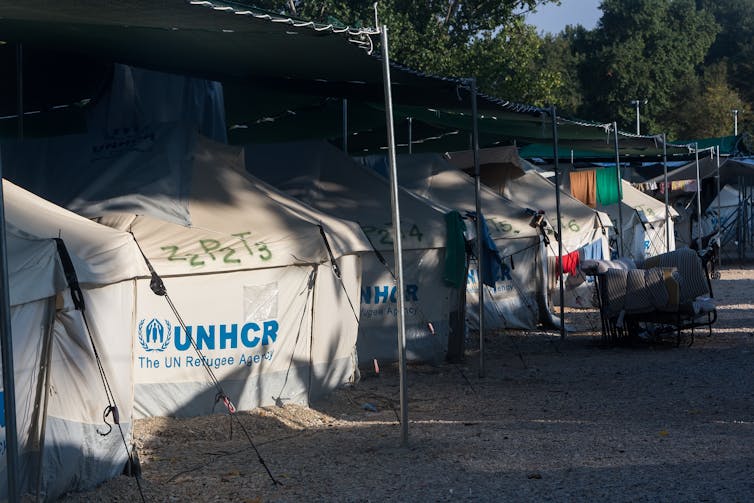
White tents with UNHCR printed on them
A refugee camp in Greece in 2016.
Ververidis Vasilis/Shutterstock

If we look at the map of international conflict today, the majority of people in conflict zones would be ineligible for these schemes. Afghans, Eritreans, Syrians, Iranian and Sudanese are some of the top nationalities arriving via the Channel crossing to the UK, but are provided with no safe or legal routes to sanctuary. Yet, in claiming asylum, 68% of small boat arrivals are ultimately granted status.

Conflicts in Gaza, the Democratic Republic of Congo and Sudan have not led to any bespoke humanitarian refugee protection rights from the UK. In practice, it is legally impossible for most asylum seekers to reach the UK via a safe and legal route as the schemes are so limited in scope.

Smashing the gangs

In January 2025, the Refugee Council, an organisation that supports asylum seekers and refugees in the UK, urged the UK to introduce a safe and legal route – in the form of a limited number of refugee visas – in order to stop deaths in the Channel.

Between 2018 and April 2025, 147 people have died attempting to cross the Channel in small boats, with 2024 being the deadliest year for child migrant deaths.

The UK government’s most recent approach has been to “smash the gangs” to prevent small boat crossings. But evidence shows that a criminal justice approach, while popular, ultimately leads smugglers to change their business practices – often jeopardising people further as they take longer routes or put more people into boats.

More safe and legal routes would, on the other hand, reduce demand for smuggling across the Channel, by giving people another option.

Crucially, even if the UK were to successfully “smash the gangs”, this does not eradicate peoples’ need for protection when fleeing war zones. Safe and legal routes would introduce a compassionate and humane refugee system which adheres with the UK’s obligations under international refugee law.

The Conversation

Gillian McFadyen receives funding from ACE Hub Wales, Public Health Wales for the project ‘A Welsh Pathways to Peace: Digital Storytelling and Forced Migration’ (2025-2026).

ref. Channel crossings: what is a safe and legal route? – https://theconversation.com/channel-crossings-what-is-a-safe-and-legal-route-246931