Liderar sin fronteras: cuando la distancia se convierte en estrategia

Source: The Conversation – (in Spanish) – By Isabel Gausi Carot, Adjunct professor, Universitat de València

Ground Picture/Shutterstock

“Acepté el puesto porque podía trabajar desde casa”, confesaba Mike Regnier, CEO del Banco Santander en Reino Unido, en una entrevista publicada en mayo de 2024. Su oficina no está en la sede central del banco, ni siquiera en el mismo país. Y no es una excepción: cada vez más multinacionales españolas apuestan por equipos directivos cuyos miembros están repartidos por distintos continentes.

¿Puede una empresa tomar decisiones acertadas cuando su equipo de liderazgo está separado por miles de kilómetros? Esta es la pregunta que guía la investigación que estamos desarrollando en la Universitat de València. Y la respuesta, lejos de ser un simple “sí”, revela una transformación profunda en la forma de dirigir empresas globales.

Del despacho a la red: una nueva arquitectura del poder

Durante décadas, el liderazgo corporativo ha estado ligado a la toma de decisiones centralizada, largas jornadas en oficinas ejecutivas y una presencia constante en la sede de la empresa. Sin embargo, el panorama ha cambiado drásticamente. Las organizaciones hoy en día operan en un entorno de creciente complejidad, marcado por una nueva era geopolítica, por la globalización, la transformación digital y nuevas expectativas por parte de los empleados.

Cuando hablamos de dispersión geográfica del equipo directivo no nos referimos simplemente al teletrabajo ocasional ni a reuniones por Zoom o por Teams. Hablamos de estructuras permanentes en las que los miembros de la alta dirección, quienes definen la estrategia y toman las decisiones clave, están físicamente ubicados en distintas ciudades, regiones o países. No es que viajen mucho: es que sus despachos están lejos unos de otros.

Esta configuración organizativa es cada vez más frecuente en empresas que tienen múltiples filiales y realizan operaciones en diversos mercados. Tener líderes repartidos geográficamente les permite ganar sensibilidad cultural, tener información de primera mano sobre los mercados y poseer una mayor agilidad para tomar decisiones enmarcadas en el contexto adecuado. En lugar de centralizar el poder en una única sede, lo distribuyen estratégicamente a través de una red global interconectada. Aunque puede parecer una desventaja, la dispersión geográfica puede convertirse en una ventaja estratégica.

Más innovación, más diversidad: lo que revela la investigación

Para entender mejor esta tendencia, hemos llevado a cabo un estudio empírico que analiza la ubicación de los miembros del equipo de la alta dirección de las multinacionales españolas más grandes. La investigación reveló que más del 50 % de estas empresas ya cuentan con equipos directivos geográficamente dispersos, lo que indica que no se trata de algo excepcional, sino de una práctica cada vez más extendida entre las organizaciones más internacionalizadas.

Pero lo más interesante no es cuántas lo hacen, sino qué tienen en común estas empresas:

  • Destacan por su fuerte orientación a la innovación, registran un mayor número de patentes y apuestan por la investigación y el desarrollo.

  • Tienen una mayor presencia internacional, operan en más países y gestionan más filiales.

  • Cuentan con equipos de alta dirección más diversos en términos de nacionalidades, y están compuestos por un mayor número de miembros.

Todo esto sugiere que la dispersión es más que la consecuencia de operar en muchos mercados: es una estrategia deliberada para gestionar la complejidad y generar valor desde múltiples puntos del mapa mundial.

Desde esta perspectiva, la distancia física puede favorecer que se tomen decisiones más contextualizadas, con mayor capacidad de adaptación y con una visión global que no se consigue solo desde la casa matriz.

La paradoja de la distancia: más lejos, más cerca

Dispersar el equipo directivo no solo implica superar las barreras logísticas de coordinar zonas horarias distintas. Supone un cambio más profundo: replantearse cómo se toman las decisiones, cómo se construye la confianza y qué significa liderar cuando las decisiones clave ya no se toman exclusivamente desde la sede central. Es lógico pensar que las organizaciones con equipos de alta dirección dispersos tienden a operar con estructuras más horizontales, fomentando una comunicación más constante y promoviendo una cultura más abierta a la colaboración.

Este modelo transforma la idea tradicional de control. La autoridad ya no se concentra en un único lugar, sino que se reparte geográficamente, multiplicando así los puntos de observación. Más allá de perder cohesión, muchas multinacionales encuentran en esta arquitectura distribuida una ventaja para adaptarse con rapidez y sensibilidad a contextos diversos.

¿Qué va primero: la expansión o la dispersión?

Queda una cuestión clave por resolver: ¿las empresas dispersan su liderazgo porque ya tienen una huella internacional consolidada, o lo hacen precisamente para construirla?

Es el clásico dilema del huevo o la gallina. Es decir, ¿estamos ante una consecuencia natural de la expansión global o ante una estrategia para impulsarla?
La realidad apunta a una relación circular. Cuanto más se dispersa el equipo directivo, más capacidad tiene la empresa para adaptarse a mercados diversos y expandirse con agilidad. Y, a medida que crece, más sentido cobra continuar dispersando el liderazgo. Entender bien ese vínculo y saber cuándo dar el primer paso puede marcar la diferencia entre liderar la transformación o quedarse anclado en modelos del pasado.

La dispersión geográfica del equipo directivo no es una moda ni una consecuencia inevitable de la globalización. Es una decisión estratégica que redefine el centro de gravedad de las organizaciones. Y, como muestra mi investigación, puede ser una poderosa palanca para innovar, crecer y liderar sin fronteras.


Artículo ganador del I Premio de Comunicación Científica de la Universitat de València en la modalidad de Ciencias Sociales.


The Conversation

Isabel Gausi Carot no recibe salario, ni ejerce labores de consultoría, ni posee acciones, ni recibe financiación de ninguna compañía u organización que pueda obtener beneficio de este artículo, y ha declarado carecer de vínculos relevantes más allá del cargo académico citado.

ref. Liderar sin fronteras: cuando la distancia se convierte en estrategia – https://theconversation.com/liderar-sin-fronteras-cuando-la-distancia-se-convierte-en-estrategia-260447

Así vigilamos la salud hídrica de Doñana desde el cielo

Source: The Conversation – (in Spanish) – By Emilio Ramírez Juidías, Tenured Lecturer at University of Seville (Spain). Founding member of the knowledge-based company RS3 Remote Sensing S.L.., Universidad de Sevilla

En el contexto actual de emergencia climática y creciente escasez de agua, la gestión eficiente de este recurso es un desafío urgente.

El Parque Nacional de Doñana, joya ecológica del sur de Europa, representa un ejemplo paradigmático de esta problemática. La disminución del nivel freático, el retroceso de lagunas temporales y el aumento de las temperaturas son signos visibles de un ecosistema en riesgo.

Ante este escenario, las técnicas de teledetección, aquellas tecnologías basadas en la observación de la Tierra, desempeñan un papel esencial para comprender y anticipar los efectos del cambio climático sobre los recursos hídricos.

Gracias al tratamiento digital de imágenes satelitales, y mediante el uso de algoritmos de aprendizaje automático, es posible identificar con precisión las variaciones en la cobertura de agua y vegetación.


Leer más:
La inteligencia artificial nos ayuda a estudiar la fauna de Doñana para mejorar su conservación


¿Por qué el agua en Doñana está en peligro?

El Parque Nacional de Doñana, situado entre las provincias de Huelva, Sevilla y Cádiz, es un enclave natural único que depende del equilibrio hídrico para mantener su biodiversidad. Sin embargo, en los últimos años, el descenso del nivel de los acuíferos, la reducción de lluvias y el aumento de las temperaturas están alterando gravemente este equilibrio. A ello se suma la presión ejercida por la actividad agrícola intensiva en el entorno, que conlleva extracciones masivas de agua subterránea para regadío, muchas de ellas ilegales.

Como resultado, lagunas estacionales que antes se llenaban cada año ahora permanecen secas, y comienzan a desaparecer o desplazarse especies animales y vegetales.

Este deterioro progresivo está afectando al ecosistema y al cumplimiento de los Objetivos de Desarrollo Sostenible (ODS) de la Agenda 2030, como el ODS 6 (agua limpia y saneamiento) y el ODS 13 (acción por el clima). Comprender las causas del problema y anticipar sus consecuencias resulta clave para poder intervenir de forma eficaz.


Leer más:
Agenda 2030: por qué incumplirla vulnera los derechos humanos en todo el planeta


La mirada desde el espacio: ¿qué nos dicen los satélites?

Desde el espacio, los satélites ofrecen una perspectiva privilegiada para observar la evolución del medio ambiente. Gracias a la radiación del Sol y a los sensores de los satélites, es posible detectar variaciones en la humedad del suelo, el retroceso de masas de agua o los cambios en la cobertura vegetal.

En espacios protegidos como Doñana, esta información resulta crucial para entender cómo afectan el cambio climático y las actividades humanas a su equilibrio ecológico. Misiones satelitales como Landsat, Sentinel o MODIS proporcionan datos periódicos y de libre acceso que permiten hacer un seguimiento preciso del territorio sin necesidad de intervención directa.

Nuestro proyecto “Aplicación del tratamiento digital de imágenes para el monitoreo de recursos hídricos en línea con la Agenda 2030” utiliza estas imágenes satelitales como base para desarrollar algoritmos avanzados que interpretan, clasifican y analizan la información. A través de técnicas de machine learning se puede identificar de forma automática la presencia o ausencia de agua, evaluar el grado de estrés hídrico y anticipar tendencias a medio plazo.


Leer más:
No podremos alcanzar un desarrollo sostenible con unos océanos enfermos


Algoritmos que aprenden a proteger el agua

El tratamiento digital de imágenes satelitales no solo consiste en observar el paisaje desde el espacio, sino en extraer información valiosa mediante el uso de algoritmos matemáticos. Para ello, nuestro equipo ha desarrollado y probado un índice espectral capaz de detectar con precisión la presencia de agua superficial en el Parque Nacional de Doñana. Este tipo de herramienta permite automatizar el análisis de grandes volúmenes de datos, así como generar mapas actualizados sobre el estado hídrico del territorio.

El algoritmo aplicado se basa en una fórmula que combina bandas satelitales específicas, es decir, la banda del infrarrojo cercano (NIR) y la banda del rojo (Red). La expresión matemática utilizada es:

Presencia agua superficial = 0.037 * 2.71[(NIR-Red)/(NIR+Red)]
(r = 0.85, R2 = 0.79)

Este índice, desarrollado a partir de técnicas de aprendizaje automático (machine learning), aprovecha el contraste entre la alta reflectancia del NIR en vegetación sana y su baja respuesta en cuerpos de agua, permitiendo una distinción clara entre ambos elementos. A mayor valor del índice, mayor es la probabilidad de que se trate de una superficie cubierta por agua o con alto contenido de humedad.

Gracias a este tipo de análisis es posible generar modelos predictivos que alerten sobre sequías, identificar zonas húmedas en retroceso y planificar estrategias de conservación más eficaces. Además, este enfoque automatizado se puede aplicar en otros entornos naturales con problemas similares.

Tecnología al servicio de la agenda 2030

El uso de imágenes satelitales y algoritmos inteligentes aplicados al análisis del agua representa una alianza estratégica entre tecnología y sostenibilidad. Gracias a estas innovaciones, es posible anticipar impactos, actuar con rapidez y evaluar la eficacia de las medidas adoptadas, lo que resulta clave en un contexto de cambio climático y creciente presión sobre los recursos naturales.

Este artículo se ha escrito con la colaboración de Paula Romero Beltrán y Clara Isabel González López, becarias de investigación en RS3 Remote Sensing S.L.

The Conversation

Emilio Ramírez Juidías no recibe salario, ni ejerce labores de consultoría, ni posee acciones, ni recibe financiación de ninguna compañía u organización que pueda obtener beneficio de este artículo, y ha declarado carecer de vínculos relevantes más allá del cargo académico citado.

ref. Así vigilamos la salud hídrica de Doñana desde el cielo – https://theconversation.com/asi-vigilamos-la-salud-hidrica-de-donana-desde-el-cielo-260246

Acoso escolar: ¿cómo se pueden reparar los daños tras un caso grave?

Source: The Conversation – (in Spanish) – By Cecilia Ruiz Esteban, Profesora Titular de Universidad. Psicología de la Educación., Universidad de Murcia

Ground Picture/Shutterstock

Un adolescente de 16 años con parálisis cerebral, acosado física y sexualmente durante días por sus compañeros de clase. Tras la denuncia y el clamor de medios y opinión pública: ¿qué ocurre con la víctima y los agresores? ¿Cómo se puede reparar un daño como este? ¿Qué contempla la ley y qué recomiendan las investigaciones especializadas?

Este reciente caso de bullying en un instituto de Almendralejo (en la provincia extremeña de Badajoz, España) nos obliga a plantearnos no solo cómo prevenir y detectar mejor, sino también qué medidas tomar una vez detectado.

Colectivos vulnerables

El mayor riesgo para sufrir agresiones reiteradas en la escuela es “ser diferente”. Es la situación de los alumnos o alumnas que tienen algún tipo de discapacidad, y que representan el 80.3 % de las víctimas de acoso en España. En todo el mundo, el 40 % de las víctimas de bullying escolar pertenecen a colectivos vulnerables (discapacidad, migrantes, LGTBIQ+).

Sabemos también gracias al mismo informe que 8 de cada 10 casos de acoso consisten en burlas, rechazos o aislamientos (en este último caso, los más afectados son los niños y niñas con alguna discapacidad física), y que el riesgo de victimización aumenta en los casos de trastorno del espectro autista y de alumnado con dificultades comunicativas o lingüísticas.

Curiosamente, aunque dichas situaciones suelen ser más frecuentes en la etapa de Educación Secundaria (el 40 % de los casos durante primer y segundo curso), sabemos que hasta un 50 % de los casos podrían prevenirse con detección temprana en etapas educativas iniciales.

¿Cómo atendemos a las víctimas?

A pesar de la prevalencia de este problema en los centros educativos, aún faltan protocolos de reparación integral que incluyan atención psicológica, seguimiento académico y mediación restaurativa. Por ejemplo, en España, el 94 % de las víctimas sufre algún problema psicológico y una de cada cinco necesita tratamiento psicológico especializado.

Por esta razón la prioridad absoluta es garantizar la seguridad física y emocional inmediata de la víctima mediante medidas de protección (como cambios de rutina o supervisión) y ofrecer apoyo psicológico especializado para manejar el trauma y empoderarla para recuperar su voz y control. ¿Cómo podemos hacerlo?

Espacios para el perdón emocional

Si la víctima así lo desea, de manera voluntaria y sin coerción alguna, puede disponer de un espacio seguro donde liberar la carga emocional (rabia, miedo) asociada al agresor como camino hacia el perdón emocional.

Los encuentros cara a cara (como los “círculos restaurativos”) pueden ser herramientas poderosas para la reparación, pero solo bajo condiciones estrictas. Su éxito depende de la voluntariedad explícita y preparación psicológica adecuada de la víctima, quien jamás debe sentirse presionada. Ambos actores, especialmente la víctima, necesitan apoyo individual previo para clarificar necesidades y emociones. El agresor debe mostrar signos de arrepentimiento y haber iniciado su proceso de responsabilización.


Leer más:
Qué nos dicen los comportamientos agresivos en la escuela infantil


El objetivo no es únicamente “pedir perdón”, sino que el agresor escuche el impacto real de sus acciones, la víctima exprese su dolor en un entorno protegido y, si es viable, se exploren conjuntamente formas de reparación y acuerdos de convivencia futura.

Es vital subrayar que estos encuentros no son adecuados en todos los casos; situaciones de trauma severo, desequilibrio de poder extremo o falta de disposición del agresor pueden hacerlos retraumatizantes. Son una opción, no un imperativo.

Reparación del daño

La evidencia científica es contundente: intervenir únicamente con la víctima resulta insuficiente y contraproducente a largo plazo. Abordar el acoso de forma efectiva y restaurativa requiere un cambio de paradigma: del castigo aislado a la responsabilización activa, la reparación del daño y la construcción de una comunidad escolar segura y respetuosa para todos. La “reparación” debe servir para que la víctima se sienta apoyada y protegida, y la escuela entera aprenda y mejore.

El enfoque restaurativo trasciende el castigo tradicional, priorizando la sanación de las heridas, la responsabilización activa de los agresores y la reconstrucción de relaciones seguras dentro de la comunidad escolar.

Se trata de guiar a los involucrados –especialmente al agresor o agresores– hacia la comprensión profunda del impacto causado y la asunción de acciones concretas para enmendar el perjuicio: disculpas significativas, gestos reparadores simbólicos o cambios de comportamiento verificables, fundamentales para que la víctima sienta validado su sufrimiento y perciba el apoyo comunitario.

¿Qué hacemos con los agresores?

Respecto a los agresores, la ley española prioriza medidas educativas sobre las punitivas, es decir, el 85 % de los casos se gestionan con programas de reeducación conductual y mediación, pero solo el 35 % de los centros aplican estos programas de forma efectiva.

Por eso es crucial ir más allá de las sanciones: se requiere una intervención terapéutica y psicoeducativa obligatoria que aborde las causas subyacentes de su comportamiento (falta de empatía, necesidad de dominio, problemas familiares), fomente una genuina responsabilización por el daño causado y desarrolle habilidades prosociales. Sin este trabajo profundo, el riesgo de reincidencia es alto.

El apoyo activo de los compañeros

Los testigos y compañeros desempeñan un papel vital. Es esencial educarles para romper la “cultura del silencio”, enseñarles a reconocer e intervenir ante el acoso de forma segura, y fomentar un clima de aula que rechace activamente el acoso y apoye a quien sufre.

Para que una víctima se sienta verdaderamente segura nuevamente en el mismo entorno donde ocurrió el acoso, la investigación señala que es indispensable que perciba cambios concretos y sostenidos. Además de una respuesta clara y contundente del centro escolar, las medidas de protección visibles y la evidencia de un cambio genuino en el agresor, es crucial sentir el apoyo activo de los compañeros.


Leer más:
La otra cara del acoso escolar: los que observan también tienen un papel


¿Qué deben saber las familias?

Además de contar con la información sobre las principales características del acoso para saber identificar indicadores o signos de riesgo, la familia puede contribuir desde la educación con un estilo educativo centrado en una comunicación eficaz y en un apoyo incondicional.

Siempre es imprescindible encontrar un equilibrio entre el apoyo y la comunicación y el control y las normas. En el caso de los menores con alguna discapacidad, la sobreprotección puede ponerles aún en mayor riesgo de vulnerabilidad.

Propuesta de Protocolo Estatal Integral

Un protocolo estatal efectivo contra el acoso debe ser obligatorio, claro y cubrir todas las fases del proceso:

  1. Mecanismos accesibles y confidenciales para la detección y reporte.

  2. Formación obligatoria para el personal.

  3. Actuación inmediata: implica garantizar la seguridad y derivación psicológica urgente para la víctima, y aplicar medidas protectoras iniciales (como separación o suspensión cautelar) y notificación formal a la familia del agresor.

  4. Investigación rápida y rigurosa que recoja información imparcial de todas las partes.

  5. Intervención integral: apoyo psicológico continuado a la víctima; intervención obligatoria con el agresor; trabajo con las familias de ambos e intervención grupal con testigos para cambiar dinámicas y fomentar apoyo.

  6. Comunicación a la comunidad: realizada con prudencia y respetando la privacidad, debe informar sobre los pasos generales tomados (aplicación del protocolo, apoyo a la víctima, medidas con el agresor, trabajo en el clima (EN EL AULA?) para reforzar la confianza y el mensaje de tolerancia cero.

Aunque todavía no hay un protocolo general a nivel estatal, en España varias comunidades autónomas integran elementos restaurativos en sus protocolos generales contra el acoso, como Andalucía, Cataluña y el País Vasco.

Romper el ciclo de violencia y sanar a la víctima

Cualquier forma de violencia es intolerable e injustificable. Los centros educativos tienen un papel fundamental para prevenir y erradicar las situaciones de acoso educando en la no violencia y en la tolerancia hacia la diversidad, reforzando la educación emocional y promoviendo valores de convivencia y de respeto.

Un enfoque holístico debe combinar prevención temprana, inclusión real y estrategias de reinserción basadas en evidencia, no solo para sanar a las víctimas, sino para romper el ciclo de violencia desde su raíz.

The Conversation

Las personas firmantes no son asalariadas, ni consultoras, ni poseen acciones, ni reciben financiación de ninguna compañía u organización que pueda obtener beneficio de este artículo, y han declarado carecer de vínculos relevantes más allá del cargo académico citado anteriormente.

ref. Acoso escolar: ¿cómo se pueden reparar los daños tras un caso grave? – https://theconversation.com/acoso-escolar-como-se-pueden-reparar-los-danos-tras-un-caso-grave-257851

¿Es España un país racista?

Source: The Conversation – (in Spanish) – By Gloria Fernández- Pacheco Alises, Profesora en Criminología y coordinadora del Grupo de investigación sobre Migraciones, Universidad Loyola Andalucía

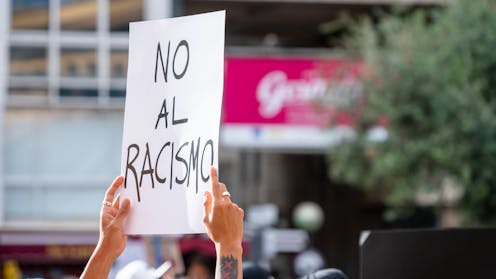
Manifestación en Palma de Mallorca contra el racismo en 2020. MF_Orleans/Shutterstock

Torre Pacheco es una localidad murciana de 40 000 habitantes –el 30 % de la población es inmigrante– que en los últimos días vive asediada por grupos de ultraderecha. Armados con bates y machetes, atacan o amenazan a los extranjeros en los barrios donde viven.

En España es cada vez más frecuente toparse con algún tipo de incidente de tintes xenófobos. Los partidos de ultraderecha, además, alientan el odio a los extranjeros, especialmente a los latinos y subsaharianos. Por eso preguntamos a siete expertos si España es un país racista y esto es lo que nos han contestado:


Gloria Fernández-Pacheco Alises, profesora en Criminología y coordinadora del Grupo de investigación sobre Migraciones. Universidad Loyola Andalucía.

En los últimos tiempos se han publicado noticias sobre estudios de opinión que sitúan la inmigración como una de las primeras preocupaciones de la ciudadanía en España. Ante ello surge la cuestión sobre si es racista tener prejuicios si estamos protegiendo nuestra seguridad.

Estas preocupaciones sociales han sido alimentadas por discursos políticos que esgrimen argumentos basados en la “infantilización”, la “despersonalización” y la “ridiculización” de la inmigración.

Nos hablan de menores migrantes no acompañados como colectivo peligroso al que imputarle delitos de toda índole. Atribuyen gastos desorbitados a los sistemas de protección social de menores en riesgo de exclusión en detrimento de las pensiones de nuestras abuelas. Frivolizan sobre expulsiones masivas de personas que llevan meses o años trabajando en España en la agricultura o el empleo doméstico.

Todos estos discursos contribuyen a generar un imaginario colectivo basado en estereotipos sociales que genera racismo estructural y debates sociales muy peligrosos. A través de etiquetas negativas que relacionan delincuencia e inmigración, se construyen identidades marginadas y sociedades violentas.

Este fenómeno ya fue estudiado por las denominadas teorías del etiquetado, que hablan de una reacción social basada en etiquetas. A través de la criminalización se genera marginalidad y delincuencia entre los colectivos etiquetados. Por el otro lado, se construyen sociedades deshumanizadas e inseguras.


Raúl Martínez Corcuera. Profesor de Comunicación. Investigador sobre el discurso del odio –racismo, sexismo, LGTBIfobia– en medios de comunicación, el deporte o la publicidad. Universitat de Vic – Universitat Central de Catalunya.

En España existe un racismo estructural contra personas migrantes y racializadas que confirmaría esta afirmación. Racismo institucional de una ley de extranjería que las lleva a vivir en situación irregular y limita sus derechos de participación política.

Existe el control policial selectivo por fenotipo y partidos políticos que asumen discursos y programas de ultraderecha legitimando actitudes xenófobas. Hay antigitanismo e islamofobia.

Se ha normalizado la discriminación y explotación laboral, agravada por el desconocimiento de los propios derechos y/o la dificultad para hacerlos respetar o el rechazo en el acceso a la vivienda por propietarios que niegan el alquiler a personas migrantes o racializadas.

Son múltiples las denuncias por discriminación en servicios públicos de salud y educación, limitando el acceso a una atención justa y respetuosa.

La presencia de inmigrantes y personas racializadas es residual en espacios de liderazgo político o social, pero son habituales insultos y violencia racista en los espacios públicos. Sufren una criminalización mediática que les culpa de la delincuencia y los conflictos públicos. Se normaliza una miserable estigmatización y deshumanización de niños y adolescentes llegados a España sin familia y en máxima vulnerabilidad.


Ana Alba Catoira, profesora de Derecho Constitucional. Universidade da Coruña.

El racismo es un fenómeno que está en todas las sociedades y que se convierte en muchas ocasiones en algo sutil o inconsciente presente en todas las estructuras. De hecho, ¿cuántas personas se reconocen como racistas? o ¿cuántas identifican comportamientos muy normalizados como racistas y discriminatorios?.

España es el cuarto país menos racista de la Unión según un informe de 2023 realizado por la Agencia de los Derechos Fundamentales, muy por debajo de Austria, Alemania, Finlandia, Dinamarca, Luxemburgo, Bélgica, Irlanda, Italia o Francia.

No obstante, sí somos un país racista, por lo que no debemos restar importancia a este problema. El racismo es en sí mismo ignorancia, por eso necesitamos sensibilización y educación de toda la sociedad en igualdad y diversidad con políticas públicas comprometidas y con la colaboración responsable de todos los sectores. Debemos construir entre todos y todas una sociedad más justa e igualitaria donde se respete la dignidad de todos los seres humanos.


Antonio Miguel Nogués Pedregal. Catedrático de Antropología Social. Universidad Miguel Hernández.

Imposible responder con un sí o un no a la pregunta. España es desde hace décadas una realidad social, cultural y económicamente muy heterogénea. Son muchos los ejes que la atraviesan y de muchos tipos las prácticas sociales que la conforman. No podemos hablar de una sola España o, si se prefiere, de una única forma de habitar este territorio que llamamos España.

Cada persona y cada grupo sociocultural que convive aquí se construye una imagen de los otros que enfatiza, sobre todo, aquellas características con las que quiere y cree distinguirse de esas otras personas o grupos.

En este sentido, considero que la dimensión económica, por aporofobia (fobia a los pobres) y clasismo, es la que más condiciona las relaciones y prácticas sociales entre individuos, independientemente de su origen étnico. La dimensión estética, llena de estereotipos y fenotipos, es la que condiciona la visión del otro agrupado y anónimo. Baste recordar las diferencias en las acogidas a ucranianos o a subsaharianos y su dispar representación en los medios.


Juan Carlos Jiménez Redondo. Catedrático de Historia del Pensamiento y Movimientos Sociales. Universidad CEU San Pablo.

Mantener que España es un país racista es tan absurdo como sostener lo contrario. Hay españoles racistas como hay racistas en Francia, Italia, Portugal o Reino Unido. Las democracias han desarrollado normas radicalmente contrarias al racismo, pero no han podido extirpar grupos con fuertes inclinaciones racistas. Muchos de ellos anidan en ámbitos de amplia trascendencia pública como el deporte, y muy especialmente el fútbol, porque es un entorno que deja salir lo peor del hombre-masa.

Igual sucede en las redes sociales, en las que el anonimato deja aparecer a todos esos grotescos incivilizados que dan rienda suelta a sus locuras racistas y de odio contra todo y contra todos, amparados en una supuesta impunidad.

España es un país tan racista o tan poco racista como otros. Lo que sí concentra es una amplia masa de peligrosos ultras, odiadores y toda esa calaña de violentos que pueblan el país.


Lucas Andrés Pérez Martín. Profesor de Derecho Internacional Privado. Universidad de Las Palmas de Gran Canaria.

Esta pregunta no es posible contestarla con un sí o un no. Desde la visión de un jurista que investiga en el ámbito de las migraciones y los derechos humanos, y sin un sustrato científico estadístico, en España descubrimos dos perfiles esenciales. El primero, el de una gran parte de la población que en absoluto es racista. No diferencia a las personas por su raza, el color de la piel o por la religión que profesen, e incluso acogen activamente a los migrantes. Sin embargo, hay otra parte de la población que sí lo es, que tiene claros prejuicios con las personas que llegan de otros lugares por su religión, color de piel y origen y no duda en difundir noticias absolutamente falsas sobre estas personas.

Por desgracia, esta parte de la opinión está marcando y ganando el debate político con discursos de odio y provocando confusión en la población que inicialmente no tenía prejuicio racista alguno.


Berta Álvarez-Miranda Navarro. Profesora titular de Sociología, especializada en Sociología de las Migraciones. Universidad Complutense de Madrid.

España participa de la tendencia general en Europa a centrar el debate público en la categoría religiosa “musulmanes” como principal criterio de alteridad, y no tanto en categorías raciales. Ambas formas de distinción, de raza y religión, se superponen para señalar como “otro” o “extraño” sobre todo al que proviene del norte de África, particularmente de Marruecos.

Se renueva así una desconfianza muy arraigada históricamente, que se ha reflejado a lo largo de los años en las encuestas de opinión y en estudios sociológicos muy variados que coinciden en que este grupo es el percibido como más ajeno. Un grupo que se denomina cada vez más frecuentemente por su religión, aunque la categoría “musulmanes” no ha alcanzado en el debate público español el grado de cristalización de otros países como Francia o Gran Bretaña, ni ha sido objeto de una polarización política tan marcada.

The Conversation

Las personas firmantes no son asalariadas, ni consultoras, ni poseen acciones, ni reciben financiación de ninguna compañía u organización que pueda obtener beneficio de este artículo, y han declarado carecer de vínculos relevantes más allá del cargo académico citado anteriormente.

ref. ¿Es España un país racista? – https://theconversation.com/es-espana-un-pais-racista-240874

From raw garlic cloves to cayenne pepper: why ‘natural’ DIY skincare can leave you burnt, itchy – or worse

Source: The Conversation – UK – By Adam Taylor, Professor of Anatomy, Lancaster University

Krakenimages.com/Shutterstock

Scrolling through social media, it’s hard to miss influencers raiding the pantry for “natural” beauty fixes: baking-soda scrubs, garlic spot sticks, cayenne masks that promise to tighten pores and banish dullness.

The appeal is obvious. Why pay for a dermatologist-tested cream when everyday ingredients come with antimicrobial or exfoliating properties? Yet what looks sensible in a 30-second reel can translate into painful, sometimes dangerous, DIY disasters.

Just because it’s edible doesn’t mean it’s safe to put on your skin.


Get your news from actual experts, straight to your inbox. Sign up to our daily newsletter to receive all The Conversation UK’s latest coverage of news and research, from politics and business to the arts and sciences.


Garlic, chilli, turmeric and their spice-rack neighbours may contain potent bioactive compounds, but in raw form they are unrefined, unstable and frequently far too harsh for the delicate acid mantle that shields human skin.

Professional cosmetic chemists isolate biologically active plant compounds, purify them and blend them at precisely calibrated doses suited to the skin’s natural pH. A spoonful of cayenne or a pinch of bicarbonate of soda offers none of that control. Slapping pantry powders on your face risks chemical burns, rashes or long-term damage.

Concentration is the first stumbling block. A teaspoon of baking soda, for instance, has nothing in common with a safety-tested cleanser that might contain less than 1% sodium bicarbonate balanced by humectants (moisture-attracting ingerdients) and acids.

Likewise, a swipe of raw cayenne delivers an unpredictable hit of capsaicin, the fiery molecule that dermatologists use in nerve-pain creams, but only at strictly managed strengths.

Pure kitchen spices also arrive with their own microorganisms: they are agricultural products processed in bulk. Once mixed with water or oil to create a mask they can become bacterial broths, inviting infection rather than a healthy glow.

Baking soda: more alkaline than your skin can handle

Baking soda illustrates how quickly a “harmless” staple can upset skin chemistry. Celebrated online for mild antibacterial and antifungal properties, sodium bicarbonate is, in fact, highly alkaline.

Normal skin sits in the acidic range of 4.5 to 5.5. Apply a thick alkaline paste and the pH shoots upward, disrupting friendly microbes and triggering irritation and breakouts.

Studies in humans show a bicarbonate paste does not relieve psoriasis itch or redness. On babies, baking-soda soaks for nappy rash have caused hypokalaemic metabolic alkalosis (low potassium levels in the blood), leading to seizures and coma.

Some influencers say that the same paste that soothes burns is safe, but it can be dangerous. There are reports of baking soda causing severe skin damage – such as deep burns and even tissue death – when it was applied to broken or injured skin.

Even more alarming are posts touting it as a DIY cancer therapy, on the theory that it “neutralises” tumour acidity. High oral doses have disrupted heart rhythm and caused death.

Garlic: ancient remedy, modern irritant

Garlic’s folklore as a “natural antibiotic” fares no better. Raw cloves are loaded with sulphur compounds that behave like caustic chemicals. Direct application has produced allergic or irritant dermatitis and even third-degree burns on lips and eyelids.

Any scars may outlast the pimple they were supposed to heal.

Research on allicin, a natural compound in garlic, shows promise as an antimicrobial and heart-protective agent – potentially helping to lower blood pressure, reduce inflammation and prevent heart disease. But that study used purified extracts in lab conditions – not a clove rubbed straight onto skin.

Chilli peppers: capsaicin isn’t a beauty hack

Chillies present an even hotter hazard. Capsaicin is licensed for nerve-pain creams yet even pharmacists warn of burning, redness and swelling. Home kitchens, obviously, lack a pharmacist.

Cooks who handle chillies daily can develop Hunan hand, an intensely painful, burning dermatitis. Despite this, some beauty hacks still recommend cayenne masks for radiance. Airborne or topical capsaicin stings the eyes, triggering involuntary spasms and long exposure can cause lasting corneal injury.

Inhaling the dust provokes coughing fits and, over time, lung inflammation. Because capsaicin penetrates the skin, repeated use can damage peripheral nerve fibres – dulling your ability to feel heat or pain – and disrupt normal blood flow, which may lead to tissue irritation, delayed healing or increased sensitivity. It can also affect blood pressure, especially in people with underlying health issues.

A notorious example underscored the danger: a woman suffered agonising vaginal burns after unknowingly using a tampon contaminated with pepper spray that had leaked in her handbag. Even mustard powder can deliver second-degree burns when misapplied.

Spice rack roulette: staining, burning, dermatitis

Spices thought to be milder are hardly innocent. Cinnamon is a trendy lip-plumper, yet dermatologists document contact dermatitis and chemical burns. Ginger “glow” masks leave many users with red, irritated skin.

Clove oil, hyped as a spot cure, has produced caustic injuries. Saffron can cause allergic rashes, while turmeric’s curcumin, celebrated online for anti-inflammatory benefits, often delivers dermatitis and bright yellow staining that lingers for days.

Dermatologists recommend patch-testing any new skincare product, even “pure” essential oils, on the inner arm for 48 hours.

Powdered spices also wander: a cinnamon scrub can fill the air with irritant dust that settles in eyes or airways, leaving you sneezing and sore instead of glowing.

Respect your barrier

Dermatologists emphasise the importance of protecting the skin barrier: gentle, pH-balanced cleansers and moisturisers help maintain the acid mantle that defends against germs. Your doctor or pharmacist can guide you toward proven plant-based ingredients like niacinamide, aloe vera, or colloidal oatmeal, all of which offer skin benefits without the sting.

Next time an influencer urges you to “ditch chemicals” or promote “clean beauty” and scoop your skincare out of a spice jar, remember, everything is a chemical. Some belong on your dinner plate – very few belong on your face.

The Conversation

Adam Taylor does not work for, consult, own shares in or receive funding from any company or organisation that would benefit from this article, and has disclosed no relevant affiliations beyond their academic appointment.

ref. From raw garlic cloves to cayenne pepper: why ‘natural’ DIY skincare can leave you burnt, itchy – or worse – https://theconversation.com/from-raw-garlic-cloves-to-cayenne-pepper-why-natural-diy-skincare-can-leave-you-burnt-itchy-or-worse-260264

We can learn a lot from Troy’s trash

Source: The Conversation – UK – By Stephan Blum, Research associate, Institute for Prehistory and Early History and Medieval Archaeology, University of Tübingen

Beneath the epic tales of heroes and gods, Troy’s true story is written in something far less glamorous – its rubbish.

When we think of Troy, we imagine epic battles, valiant deeds, cunning tricks and the wrath of gods. Thanks to Homer’s Iliad, the city is remembered as a stage for romance and heroism.

But long before Paris stole Helen and Achilles raged on the battlefield, the people of bronze age Troy lived ordinary lives – with extraordinary consequences. They built, cooked, stored, traded and, crucially, threw things away. And they did it right where they lived.

Today, waste is whisked away quickly – out of sight, out of mind. But in bronze age Troy (3000–1000BC), trash stayed close, often accumulating in domestic dumping grounds for generations.

Having spent more than 16 summers excavating and analysing the bronze age layers of Troy, I’ve learned to read the city’s history this waste.

Hundreds of thousands of animal bones from cattle, sheep, fish – even turtles – were found alongside vast quantities of pottery shards, ash, food scraps, and human waste. Sometimes, these layers were reused to level floors or build walls, showing how closely intertwined daily life and refuse management were.

Archaeology’s dirty secret

This wasn’t laziness or neglect, it was pure pragmatism. In a world without rubbish trucks or sanitation systems, managing refuse was neither chaotic nor careless, but a collective, spatially negotiated – and surprisingly strategic – effort.

The excavations I have worked on as part of the University of Tübingen’s Troy Project, which has been going on since 1988, have revealed just how deliberate these routines were. Where people chose to dump, or not to dump, speaks volumes about status, social roles, and community boundaries. Waste is the diary no one meant to write, yet it records the intimate rhythms of daily life with unfiltered clarity.

Far from a nuisance, Troy’s waste is an archaeologist’s treasure trove.

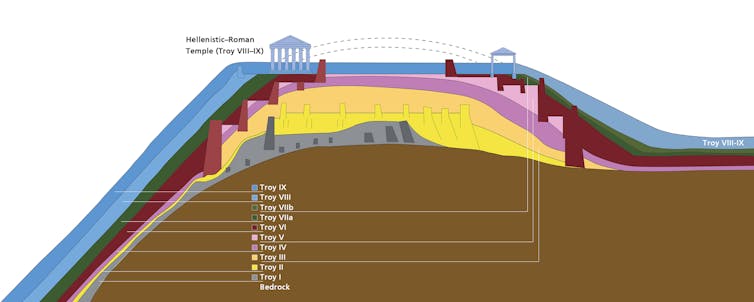
Over nearly 2,000 years, Troy ended up with 15 meters of built-up debris. Archaeologists can see nine major building phases in it, each made up of hundreds of thin layers, which formed as people lived their everyday lives. These layers act like snapshots, quietly recording how the city changed over time. Some capture hearth cleanings, others record the rebuilding of entire city quarters.

By analysing the layers and their ratios of bones to pottery, ash concentration, presence of storage jars, grinding stones, or production debris, specific spaces of activity become visible: kitchens, workshops, storage areas, rubbish pits. What appears chaotic turns out to be a carefully structured map of everyday routines – showing where meals were prepared, tools made, and discarded objects left behind.

A schematic cross-section through the settlement mound of Troy, revealing centuries of construction, destruction, and renewal.
University of Tübingen/Frank Schweizer, CC BY-NC-SA

The story these remains tell is one of profound transformation. Troy began as a modest agrarian settlement, shaped by the steady rhythms of farming, herding, and small-scale craft. Over time, it grew into a thriving regional centre.

The archaeological record, rich in refuse, traces this long arc of change. Exotic imports fashioned from stones such as carnelian and lapis lazuli begin to appear, revealing distant trade connections. Specialised metalworking tools emerge alongside monumental architecture. some buildings stretched nearly 30 metres, signalling growing ambitions and expanding capabilities.

This rise unfolded gradually, reflected not just in grander buildings, but in shifting tools, trade, and how people dealt with what they left behind. Waste management became more organised, with designated areas for different types of waste. This reflects broader shifts in how the community structured space and managed its economy.

Yet this ascent was interrupted. By the mid-third millennium BC, signs that things were becoming smaller appear. Architecture simplifies, household inventories shrink, production debris declines suggesting economic slowdown or political instability.

Still, Troy endured. By the mid-second millennium BC, the city revived. Refined ceramics, luxury imports and evidence of social complexity marked a new chapter of recovery and reinvention. This splendid settlement later became the stage for Homer’s Trojan War where Greek warriors faced the daunting task of climbing towering mounds of debris built up over centuries just to reach the palaces.

A heap worth climbing

These insights allow us to see Troy not just as a city of walls and towers, but as a living organism shaped by daily routines, unspoken norms and social negotiation. The waste left behind is a remarkably honest archive of bronze age society – beneath myths, stones, and poetry.

Troy’s trash heaps are the bronze age’s search history. To know what mattered 4,500 years ago, don’t ask poets – ask the garbage. From broken tools to shared meals, from imported luxuries to scraps, this waste reveals the pulse of everyday life and society’s evolving structure.

Ironically, these mundane refuse layers preserved the bronze age world for us. Without them, we’d know far less about early Troy’s people. Their depth and composition trace changes in economy, technology, and social structure. From scraps to towers of pottery shards, waste archaeology is key to understanding early urban complexity.

So next time you picture Achilles storming Troy’s gates, remember: the heroes might have been divine, but their city smelled very human.

The Conversation

Stephan Blum does not work for, consult, own shares in or receive funding from any company or organisation that would benefit from this article, and has disclosed no relevant affiliations beyond their academic appointment.

ref. We can learn a lot from Troy’s trash – https://theconversation.com/we-can-learn-a-lot-from-troys-trash-260613

How does the PKK’s disarmament affect Turkey, Syria and Iraq?

Source: The Conversation – UK – By Pinar Dinc, Associate Professor of Political Science, Department of Political Science and Researcher, Centre for Advanced Middle Eastern Studies, Lund University

The historic disarmament ceremony on July 11 where members of the Kurdistan Workers’ Party (PKK) laid down their arms marked a pivotal moment in a decades-long conflict in Turkey. The ceremony was described by many who attended as a profoundly symbolic and emotional day that may signal the beginning of a new era.

During the disarmament ceremony in Sulaymaniyah in the Kurdistan Region of Iraq, 26 PKK guerrillas alongside four senior commanders and leaders of the movement, symbolically laid aid down their arms and burned them. The audience included officials from the Kurdistan Regional Government (KRG), plus politicians, journalists and international observers.

For more than four decades the PKK has been embroiled in an armed conflict with Turkey that has claimed more than 40,000 lives and shaped Kurdish identity and politics across the region.


Get your news from actual experts, straight to your inbox. Sign up to our daily newsletter to receive all The Conversation UK’s latest coverage of news and research, from politics and business to the arts and sciences.


The PKK disarmament ceremony also could mark a new era for the Kurds, one of the largest stateless groups in the world with over 30 million people living across Turkey, Iraq, Iran and Syria. The PKK has said it will now shift from armed resistance to political dialogue and regional cooperation.

Strikingly, the day after the ceremony, Turkish president Recep Tayyip Erdoğan acknowledged the state’s historical failures in addressing the Kurdish issue. He listed past abuses of Kurds – state-sponsored abductions and extrajudicial violence, the burning of villages and the forced displacement of families – as examples of policies that had fuelled, rather than quelled, the conflict.

“We all paid the price for these mistakes” he said. He later added: “As of yesterday, Turkey began to close a long, painful and tear-filled chapter.” Erdoğan also announced the formation of a parliamentary commission to oversee the legal steps of the peace process, suggesting a much-needed institutionalised and transparent approach than in previous attempts.

This hints that the road ahead might include a period of transitional justice. This could compose of different tools used by societies to address past violence and human rights abuses during a shift from conflict to peace and democracy. These may include legal actions such as trials, as well as other efforts to heal and rebuild trust in society.

Erdoğan also underlined the regional dimension of the agreement: “The issue is not only that of our Kurdish citizens, but also of our Kurdish brothers and sisters in Iraq and Syria. We are discussing this process with them, and they are very pleased as well.”

PKK fighters take part in a symbolic peace ceremony.

International dimensions

While the PKK may be laying down arms, the Kurdish political movement should not be expected to disappear. On the contrary, it is likely to become more active in the democratic sphere — both in Turkey and in other parts of the Middle East where Kurdish people live. It is no secret that the current peace process is the result of shifting geopolitical realities.

Growing tensions between the US and Iran, Israel’s ongoing war in Gaza, the ousting of the Assad regime in Syria, and shifting power dynamics across the region have all contributed to a geopolitical landscape in which prolonged armed conflict has become increasingly unsustainable — for both Turkey and the PKK. In this context, the current peace process is not merely a domestic initiative.

It represents a strategic recalibration in a rapidly changing Middle East. For Turkey, stabilising its southeastern border and reducing internal security pressures is essential amid regional volatility.

Map of Turkey and neighbouring countries

Shutterstock

Turkey has long maintained strong ties with the Kurdistan Regional Government (KRG) (the official ruling body of the Kurdistan region) in Iraq. However, the situation for Kurds in Syria remains more complex, as Turkey continues to view the Autonomous Administration of North and East Syria (a region that has in effect been self governing since 2012 and where many Kurds live) as a security threat along its border.

Meanwhile, negotiations continue between the new Syrian government under current president, Ahmed Hussein al-Shara, and the Syrian Democratic Forces (SDF), the Kurdish-led coalition in Syria, which has been historically backed by the US. The SDF seeks to maintain its military autonomy and have its own independent political system — both of which are opposed by Damascus.

Western nations, particularly the US, remain influential in these talks. The US ambassador to Turkey and special envoy for Syria, Thomas Barrack, is reportedly uneasy with the lack of progress in the talks between al-Shara, and the SDF. He said: “The SDF, who has been a valued partner for America in the fight against ISIS, well-respected, bright, articulate, has to come to the conclusion that there’s one country, there’s one nation, there’s one people, and there’s one army.”

Another factor here is that a strong Arab-Turkish-Kurdish alliance is unlikely to align with Israeli strategic interests, which may favour a more fragmented Kurdish presence in the region.

For now, Turkey faces the complex task of overseeing a comprehensive disarmament, demobilisation and reintegration process. This requires not only the decommissioning of weapons and the disbanding of armed units, but also the social and political reintegration of former combatants. The success of this will depend on legal reforms, institutional trust and a genuine commitment to democratic inclusion.

Erdoğan has been critised for his government’s ongoing non-democratic practices such the appointment of state trustees who replace elected officials and the imprisonment of elected officials.

And, despite the symbolic disarmament, the Turkish government persists in using the words “struggle against terrorism” — an approach that risks undermining the peace process by criminalising political dialogue and delegitimising Kurdish demands.

Turkey’s foreign minister Hakan Fidan reiterated that the PKK’s broader network, including the Kurdistan Communities Union (KCK), a group representing Kurds across Iraq, Syria and Turkey, must cease to pose a threat. “We will remain vigilant until every component of the KCK is no longer a danger to our nation and region,” he stated.

For the PKK, the changing alliances and uncertainties in Syria and Iraq may have made armed struggle a less viable path forward. Yet the sustainability of peace will depend on more than disarmament. It will require ending the criminalisation of Kurds in political institutions and within civil society.

What comes next will determine whether this moment becomes a historic turning point or another missed opportunity.

The Conversation

Pinar Dinc is the principal investigator of the ECO-Syria project, which receives funding from the Strategic Research Area: The Middle East in the Contemporary World (MECW) at the Centre for Advanced Middle Eastern Studies, Lund University, Sweden.

ref. How does the PKK’s disarmament affect Turkey, Syria and Iraq? – https://theconversation.com/how-does-the-pkks-disarmament-affect-turkey-syria-and-iraq-261113

Russian Imperial Movement: how a far-right group outlawed by the UK is spreading terror across Europe

Source: The Conversation – UK – By Dale Pankhurst, PhD candidate and Tutor in the School of History, Anthropology, Philosophy and Politics, Queen’s University Belfast

The British government announced in early July that a far-right group called the Russian Imperial Movement (RIM) will be banned under terrorism legislation. This will make it a criminal offence in the UK to be a member of the group or to express support for it.

The RIM was at the centre of a string of letter bomb attacks targeting high-profile people and institutions in Spain in 2022. These included a bomb addressed to the official residence of Spanish prime minister Pedro Sánchez, which was intercepted by his security detail.

Six more letter bombs were mailed to targets including the American and Ukrainian embassies in Madrid, military installations, and weapons manufacturing companies that supply arms to Ukraine. No one was killed in the attacks, which US officials considered to be acts of terrorism.

Investigators soon announced that they suspected the RIM of being involved. US and European officials alleged that the group was directed to carry out the attacks by Russian intelligence officers.

What is the RIM?

The RIM is an ultra-nationalist, neo-nazi and white supremacist organisation based in Russia. It was created in 2002 by Stanislav Anatolyevich Vorobyev, a Russian national who is designated a terrorist by the US government.

The group seeks to create a new Russian empire, and uses the Russian imperial flag as its sign. The previous Russian empire (1721-1917) encompassed all of modern-day Russia, Belarus, Ukraine, Poland, Finland, Georgia, Armenia and the Baltic states, as well as parts of China.

The movement does not recognise Ukrainian sovereignty. It sees Ukraine as part of what it calls a global Zionist conspiracy designed to undermine Russia and promote Jewish interests. The RIM has engaged in Holocaust denial and is formally outlawed in the US, Canada and now the UK.

It also has a paramilitary wing called the Imperial Legions, which operates at least two training facilities in the Russian city of St. Petersburg. The US State Department believes these facilities are being used to train RIM members in woodland and urban assault, tactical weapons and hand-to-hand combat.


Get your news from actual experts, straight to your inbox. Sign up to our daily newsletter to receive all The Conversation UK’s latest coverage of news and research, from politics and business to the arts and sciences.


Denis Valliullovich Gariyev, the Imperial Legions’ leader, has in the past called on “young orthodox men” to join the Legions and defend Novorossiya – a term used to describe Russia’s claim over Ukraine. As of 2020, the Imperial Legions was estimated to have several thousand members.

The RIM and its paramilitary wing have engaged in a wide range of activities and operations. These range from passive alliances with other far-right groups in Europe to providing paramilitary training for terrorist organisations. They have also participated directly in bomb attacks.

Since 2014, when the conflict in eastern Ukraine began, the movement has trained and sent members as mercenaries to bolster the pro-Russian separatist groups fighting there. Its members have also actively supported the Russian armed forces in Ukraine after the full-scale invasion in 2022.

After the invasion, posts related to the RIM on various social media platforms such as Vkontakte and Telegram revealed a ramping up of recruitment to join operations in Ukraine. Its fighters have posted videos of themselves in Ukraine armed with weaponry from sniper rifles to anti-tank missiles.

According to analysts, the movement also maintains strong ties with the Russian private military company, the Wagner Group. Imperial Legions fighters are believed to have operated alongside Wagner mercenaries in Syria, Libya and possibly the Central African Republic.

Outside of these activities, the movement has been active in supporting far-right organisations in Europe. These include the Nordic Resistance Movement in Sweden and similar groups in Germany, Spain and elsewhere.

It provides training to these groups through its so-called “Partizan” (Russian for guerrilla) programme. The training includes bombmaking, marksmanship, medical and survival skills, military topography and other tactics. According to the UK government, the Partizan programme aims to increase the capacity of attendees to conduct terrorist attacks.

Two Swedish nationals who took part in the programme later committed a series of bombings against refugee centres in Gothenburg, a city on Sweden’s west coast, in late 2016 and early 2017. The men were convicted in Sweden, with the prosecutor crediting RIM for their terrorist radicalisation and training.

The RIM has also provided specific paramilitary training to far-right groups in Finland. Some members of these groups have fought on Russia’s side in Ukraine, while others have attempted to establish a Finnish cell of the international neo-nazi Atomwaffen Division. Police raids in 2023 also unveiled plans to assassinate the then Finnish prime minister, Sanna Marin.

Links with the Russian state

The movement has previously been critical of the Russian government. It initially believed the approach of Russia’s leader, Vladimir Putin, to Ukraine was too soft, while the group’s promotion of white supremacy and neo-nazism is at odds with Putin’s pragmatic nationalism within Russia.

In 2012, the RIM even took part in discussions with other far-right groups in Russia to form an opposition movement called New Force to challenge Putin’s rule. However, the crisis in Ukraine that erupted in 2014 after pro-Russian president Viktor Yanukovych was ousted from power has caused the Kremlin and RIM’s political objectives to converge.

Indeed, the group can now be viewed as one of the core Russian proxy paramilitaries operating in Ukraine at a time when Putin needs more recruits to continue the war. Western intelligence agencies now believe it has a relationship with officials from Russian state intelligence.

It is difficult to pinpoint the total number of RIM fighters operating in Ukraine as the involvement of mercenary groups there is a closely guarded secret. However, based on previous intelligence reports on the group’s activities, it is reasonable to assume the number is in the hundreds to low thousands.

The decision by the British government to proscribe the RIM indicates concern that the far-right group is increasing its operational capacity both in Ukraine and throughout Europe. With its extensive network, the movement will become an increasing threat to security if it is allowed to continue acting as a proxy for Putin’s foreign policy objectives.

The Conversation

Dale Pankhurst does not work for, consult, own shares in or receive funding from any company or organisation that would benefit from this article, and has disclosed no relevant affiliations beyond their academic appointment.

ref. Russian Imperial Movement: how a far-right group outlawed by the UK is spreading terror across Europe – https://theconversation.com/russian-imperial-movement-how-a-far-right-group-outlawed-by-the-uk-is-spreading-terror-across-europe-260825

Zambia facing a democratic crossroads as it enters a fresh constitutional crisis

Source: The Conversation – UK – By Nic Cheeseman, Professor of Democracy, University of Birmingham

The election of Zambia’s president, Hakainde Hichilema, in 2021 was widely interpreted as a victory for democracy. Zambia had suffered rising repression under former leader Edgar Lungu, but Hichilema promised democratic accountability. However, there are now concerns that his government is promoting constitutional changes that would entrench ruling-party dominance.

Hichilema has proposed a bill that would increase the number of MPs by over 60%. It would also introduce elements of proportional representation to create a “mixed” electoral system, and create reserved seats for women, young people and those with disabilities.

Zambia’s ruling United Party for National Development (UPND) claims the amendments are needed to correct historical exclusion. But many civil society groups believe this is “gender washing” – using inclusive rhetoric to mask an authoritarian agenda.


Get your news from actual experts, straight to your inbox. Sign up to our daily newsletter to receive all The Conversation UK’s latest coverage of news and research, from politics and business to the arts and sciences.


This scepticism is rooted in recent political developments and the text itself. The bill has emerged alongside other legislation that would tighten state control over civic and political space, at a time when infringements on fundamental freedoms in Zambia are growing.

Many of the bill’s provisions are also vague and some undermine democratic checks and balances, while the progressive aspects are ill-conceived. This makes the proposed reforms, in the words of well-known Zambian constitutional expert O’Brien Kaaba: “deeply problematic and counterproductive”.

I take no pleasure in saying this. The last time I wrote such an article about Zambia, it was to condemn the persecution of Hichilema after he was arrested in 2017 on trumped up treason charges. I was honoured to receive a letter of thanks upon his release.

Like many Zambians and international observers, I was hopeful for the new administration. Yet, while the government has kept some campaign promises and negotiated a difficult deal on the country’s debt burden, efforts to restore democracy are now going backwards.

Weakening a fragile system

As prominent Zambian civil society leaders like Laura Miti and Linda Kasonde have warned, a number of the proposed changes could enable the government to all-but-guarantee itself a majority in the next elections scheduled for 2026.

First, the bill would add 55 new constituency-based MPs – more than the total number to be elected through proportional representation. There are concerns that most of these new constituencies will be created in UPND strongholds, helping the party retain a majority even if it loses support.

These fears have been magnified by the government’s failure to release the Boundary Delimitation Report, which sets out the redrawing of electoral boundaries. This has prevented independent scrutiny of the process and its motivations.

Second, the rule that parliament must be dissolved 90 days before elections is also being revoked on the basis that this unfairly shortens office terms for MPs. Although MPs would not be supposed to conduct parliamentary business after this point, such a change would exacerbate existing problems. These include the use of government resources and vehicles in the ruling party’s campaign.

And third, the constitutional amendment increases the number of MPs the president can appoint from eight to ten. In a system already adding reserved seats for underrepresented groups, this lacks justification. Taken together, these changes threaten to further empower the government and explain why a collective of civil society groups recently demanded “an immediate halt” to the process.

At the same time, the government has not taken the opportunity to remove problematic clauses from Zambia’s constitution. These include the right of the president to dissolve the National Assembly if it fails to “reasonably” perform its duties.

The government has justified the bill by emphasising the historical underrepresentation of women and marginalised groups in Zambian politics. This is a serious problem, but the bill will not fix it.

The amendments only create 20 seats for women, 12 for young people, and three for those with disabilities. In a 256-seat chamber, this will do little to address the imbalance and falls well short of the Southern African Development Community’s target of 30% female representation.

Poorly designed quotas can also reinforce marginalisation. Parties may push women toward quota seats, limiting their participation in regular constituency races. The amendment may thus create a new ceiling: if women only run in reserved seats, female representation would almost halve from 15% now to just 8% in the next parliament.

A similar issue arises with the proportional representation system more broadly. When only a small proportion of seats are allocated this way, it fails to deliver the benefits of fairness that are associated with true proportionality.

In other words, the constitutional amendment bill gives the appearance of inclusivity while carefully preserving the government’s incumbency advantage.

A constitutional rush-job

Perhaps the most striking flaw in the bill has been the process itself. The amendments have seen such scant public consultation that, in June, the Law Association of Zambia called for them to be withdrawn.

This concern is shared by the constitutional court, which recently found the government had failed to meet constitutional requirements for public participation. The court recommended restarting a more inclusive process.

Hichilema, perhaps aware of the likely verdict, preempted the ruling by announcing shortly before the court’s decision that he would pause the process to allow for wider consultation. This is a welcome, but insufficient, development. As the Law Association has argued, the amendments are so badly designed that they do not represent a viable foundation for constitutional review.

Compounding its other flaws, the legislation is poorly written and vague. In many cases, it also fails to explain how new provisions would actually work in practice. The bill therefore needs to be withdrawn, not revised or deferred.

Zambia needs a new constitution, but it deserves one that is rooted in evidence, consultation and democratic principles. Anything less threatens to undermine the country’s hard-won democratic gains and Hichilema’s own legacy.

The Conversation

Nic Cheeseman does not work for, consult, own shares in or receive funding from any company or organisation that would benefit from this article, and has disclosed no relevant affiliations beyond their academic appointment.

ref. Zambia facing a democratic crossroads as it enters a fresh constitutional crisis – https://theconversation.com/zambia-facing-a-democratic-crossroads-as-it-enters-a-fresh-constitutional-crisis-260595

Over €10 billion has now been pledged for Ukraine’s recovery. It’s nowhere near enough

Source: The Conversation – UK – By Stefan Wolff, Professor of International Security, University of Birmingham

Clearly angered by the intensification of Russia’s air campaign against Ukraine, Donald Trump has pivoted from the suspension of US military assistance to Ukraine to promising its resumption. Russia’s strikes on major cities killed more civilians in June than have died in any single previous month, according to UN figures.

Over the past two weeks, the US president has made several disparaging comments about his relationship with Vladimir Putin, including on July 13 that the Russian president “talks nice and then he bombs everybody in the evening”.

Not only will the US resume delivery of long-promised Patriot air defence missiles, Trump is now also reported to be considering a whole new plan to arm Ukraine, including with offensive capabilities. And he has talked about imposing new sanctions on Putin’s regime.


Get your news from actual experts, straight to your inbox. Sign up to our daily newsletter to receive all The Conversation UK’s latest coverage of news and research, from politics and business to the arts and sciences.


This is the background against which the eighth Ukraine Recovery Conference took place in Rome on July 10 and 11. The event, attended by many western leaders and senior business executives, was an important reminder that while the war against Ukraine will be decided on the battlefield, peace will only be won as the result of rebuilding Ukraine’s economy and society.

Ending the war anytime soon and on terms favourable to Kyiv will require an enormous effort by Ukrainians and their European allies. But the country’s recovery afterwards will be no less challenging.

According to the World Bank’s latest assessment, at the end of 2024 Ukraine’s recovery needs over the next decade stood at US$524 billion (£388 billion). And with every month the war continues, these needs are increasing. Ukraine’s three hardest-hit sectors are housing, transport and energy infrastructure, which between them account for around 60% of all damage.

At the same time, the International Monetary Fund (IMF) provided a relatively positive assessment of Ukraine’s overall economic situation at the end of June, forecasting growth of between 2% and 3% for 2025 – likely to grow to over 4% in 2026 and 2027. But the IMF also cautioned that this trajectory – and the country’s macroeconomic stability more generally – will remain heavily dependent on external support.

Taking into account a new €2.3 billion package from the EU, consisting of €1.8 billion of loan guarantees and €580 million of grants, the cumulative pledge of over €10 billion (£8.7 billion) made by countries attending the Ukraine recovery conference is both encouraging and sobering.

It is encouraging in the sense that Ukraine’s international partners remain committed to the country’s social and economic needs, not merely its ability to resist Russia on the battlefield.

But it is also sobering that even these eye-watering sums of public money are still only a fraction of Ukraine’s needs. Even if the EU manages to mobilise its overall target of €40 billion for Ukraine’s recovery, by attracting additional contributions from other donors and the private sector, this would be less than 8% of Ukraine’s projected recovery needs as of the end of 2024.

As the war continues and more of the (diminishing) public funding is directed towards defence expenditure by Kyiv’s western partners, this gap is likely to grow.

Overcoming the trauma of war

Money is not the only challenge for Ukraine recovery efforts. Rebuilding the country is not simply about undoing the physical damage.

The social impact of Russia’s aggression is hard to overstate. Ukraine has been deeply traumatised as a society since the beginning of Russia’s full-scale invasion in February 2022.

Generally reliable Ukrainian casualty counts – some 12,000 civilians and 43,000 troops killed since February 2022 – are still likely to underestimate the true number of people who have died as a direct consequence of the Russian aggression. And each of these will have left behind family members struggling to cope with their loss. In addition, there are hundreds of thousands of war veterans.

Even before the full-scale invasion of Ukraine, there were nearly half a million veterans from the “frozen” conflict that followed Russia’s annexation of Crimea and incursion into eastern Ukraine. By the end of 2024, this number had more than doubled to around 1 million. Most of them have complex social, economic, medical and psychological needs that will have to be considered as part of a society-wide recovery effort.

Returning refugees

According to data from the UN refugee agency (UNHCR), there are also some 7 million refugees from Ukraine and 3.7 million internally displaced people (IDPs). This is equivalent to one quarter of the country’s population. The financial needs of UNHCR’s operations in Ukraine are estimated at $800 million in 2025, of which only 27% was funded as of the end of April.

Once the fighting in Ukraine ends, refugees are likely to return in greater numbers. Their return will provide a boost to the country’s economic growth by strengthening its labour force and bringing with them skills and, potentially, investment. But like many IDPs and veterans, they may not be able to return to their places of origin, either because these are not inhabitable or remain under Russian occupation.

Some returnees are likely to be viewed with suspicion or resentment by those Ukrainians who stayed behind and fought. Tensions with Ukrainians who survived the Russian occupation in areas that Kyiv may recover in a peace deal are also likely, given Ukraine’s harsh anti-collaboration laws.

As a consequence, reintegration – in the sense of rebuilding and sustaining the country’s social cohesion – will be a massive challenge, requiring as much, if not more, of Ukraine’s partners’ attention and financial support as physical reconstruction and the transition from a war to a peace-time economy.

Given the mismatch between what is needed and what has been provided for Ukraine’s recovery, one may well be sceptical about the value of the annual Ukraine recovery conferences. But, to the credit of their organisers and attendees, they recognise that the foundations for post-war recovery need to be built before the war ends. The non-military challenges of war and peace must not fall by the wayside amid an exclusive focus on battlefield dynamics.

The Conversation

Stefan Wolff is a past recipient of grant funding from the Natural Environment Research Council of the UK, the United States Institute of Peace, the Economic and Social Research Council of the UK, the British Academy, the NATO Science for Peace Programme, the EU Framework Programmes 6 and 7 and Horizon 2020, as well as the EU’s Jean Monnet Programme. He is a Trustee and Honorary Treasurer of the Political Studies Association of the UK and a Senior Research Fellow at the Foreign Policy Centre in London.

ref. Over €10 billion has now been pledged for Ukraine’s recovery. It’s nowhere near enough – https://theconversation.com/over-10-billion-has-now-been-pledged-for-ukraines-recovery-its-nowhere-near-enough-260936