Le rebond, après une liquidation judiciaire, une affaire collective ?

Source: The Conversation – in French – By Bénédicte Aldebert, Professeure des Universités, Entrepreneuriat & Innovation, IAE Aix-Marseille Graduate School of Management – Aix-Marseille Université

Comment rebondir après un échec entrepreneurial ? Pour les dirigeants des entreprises en liquidation, l’injonction à repartir vite n’est pas si simple à remplir. Il n’est pas sûr qu’on rebondisse bien, seul. Mieux vaut être accompagné pour repartir du bon pied.


Les défaillances d’entreprises continuent d’augmenter, de 55 000 cas en 2022 à plus de 66 000 cas en 2024. Une part significative a conduit à la liquidation judiciaire. Cet événement souvent vécu comme traumatique peut mener à des conséquences parfois désastreuses sur la vie de l’entrepreneur, mais aussi sur sa santé mentale – la perte de confiance et de légitimité pouvant déboucher sur un burn-out et parfois même un suicide.

Dans une société contemporaine qui valorise les success stories des entrepreneurs, la décision d’une liquidation judiciaire par le tribunal tombe comme un couperet. Les entrepreneurs ayant subi une liquidation sont parfois assimilés à de mauvais gestionnaires ou à des personnes imprudentes. Cette stigmatisation peut limiter l’accès à de nouvelles opportunités de financement et de partenariat pour un nouveau projet. Ce sentiment d’exclusion du monde des affaires et la baisse de l’estime de soi peuvent alors conduire à une autostigmatisation, où l’entrepreneur intègre et intériorise ces jugements négatifs portés par son entourage ou la société.


À lire aussi :
Succès, échecs : pourquoi le rôle du mérite est-il surévalué ?


Deux mille deux cent vingt entrepreneurs aidés

Aider les entrepreneurs ayant subi une liquidation à se reconstruire sur le plan personnel et professionnel est la raison d’être de plusieurs dispositifs d’intérêt général à caractère social, comme l’association 60 000 Rebonds. Avec 2 020 entrepreneurs ayant rebondi depuis sa création et 1850 bénévoles mobilisés, l’accompagnement de l’association repose sur une combinaison d’approches individuelles et collectives, incluant coaching, mentorat et ateliers thématiques.

Notre enquête menée en 2024, auprès de 216 entrepreneurs accompagnés par l’association, a pu mettre en lumière un état des lieux des entrepreneurs ayant rebondi, les obstacles à leur rebond et les leviers facilitant la reconstruction de ces entrepreneurs après une liquidation.

L’échec, une expérience individuelle

Premier constat issu de cette enquête : 67 % des rebonds sont réalisés dans le salariat contre seulement 33 % dans l’entrepreneuriat. Parmi celles et ceux qui se sont relancé·e s dans l’aventure entrepreneuriale, 71 % ont invoqué le désir d’autonomie professionnelle et d’indépendance dans leur décision. Pour 82 % des premiers, la raison principale de ce choix est le besoin de se sécuriser financièrement après cet épisode éprouvant.

Loin d’être uniquement entrepreneurial, le rebond peut en effet prendre plusieurs formes et implique, comme sa définition l’indique, une remise en mouvement après un choc. Mais qu’est-ce qui peut empêcher cette remise en mouvement ?

Une inquiétante perte de confiance en soi

En 2021, le principal frein au rebond était le manque d’argent pour 32,5 % d’entre eux et la confiance en soi pour 28,9 %. En 2024, la situation s’est renversée : 39 % des répondants ont évoqué un manque de confiance en soi comme frein majeur à leur rebond et 26 % ont cité des difficultés financières comme obstacle au rebond.

Si ce dernier chiffre souligne l’impact économique indiscutable de la liquidation sur les entrepreneurs, les chiffres de l’enquête 2024 attestent aussi d’une prise de conscience.

Perdre son entreprise est bel et bien un traumatisme au cours duquel l’amour-propre et la volonté d’aller de l’avant se trouvent ébranlés. Cet impact psychologique peut laisser des traces profondes – honte, sentiment d’inutilité, impression d’avoir perdu sa légitimité – et influence la manière dont on entrevoit les chemins qui nous sont offerts.

L’élan du collectif

En 2024, le dispositif le plus apprécié est devenu l’accompagnement collectif – et en particulier les groupes d’échanges et de développement (70 %) – alors qu’il n’était qu’en quatrième position en 2021. Si le coaching individuel reste néanmoins en position favorable, ces données mettent en lumière de nouvelles attentes prioritaires chez les entrepreneurs accompagnés : sortir de l’isolement, normaliser l’échec et retrouver un sentiment d’appartenance au sein d’un groupe de personnes ayant vécu la même expérience.

L’enquête enseigne ainsi que si sortir de la spirale négative de l’échec nécessite un travail de fond sur soi, cela est rendu possible grâce à un environnement soutenant, bienveillant et structurant. À travers ses multiples espaces de confiance et de bienveillance, l’accompagnement proposé par 60 000 Rebonds permet à l’entrepreneur ayant vécu une liquidation judiciaire de se sentir sécurisé, valorisé et reconnecté à un collectif.

France Culture, 2018.

Comprendre le rebond

Rebondir, ce n’est pas simplement retrouver un emploi ou lancer une nouvelle entreprise. C’est, d’abord, prendre la mesure du choc et de la perte vécus. Le rebond est en effet souvent précédé d’un processus de deuil, avec ses étapes : déni, colère, marchandage, dépression, acceptation. Mais si l’expérience de cette perte reste une expérience intime et personnelle, le rebond, quant à lui, représente un enjeu collectif. Car c’est bien dans le lien tissé avec les autres que l’entrepreneur ayant vécu une liquidation judiciaire va pouvoir retrouver un rapport positif à lui-même, réactiver son sentiment de compétence, d’autonomie et créer un nouveau récit pour lui-même.

Notre étude plaide donc pour un élargissement des dispositifs d’accompagnement post-liquidation, à l’image de ce que fait 60 000 Rebonds. Elle permet également de souligner notre responsabilité collective ainsi que celle de nos institutions dans la stigmatisation de l’échec. Si l’écosystème entrepreneurial qui vise à accompagner la création et la croissance des entreprises est en pleine expansion depuis plus de vingt ans, les initiatives politiques – issues notamment de la loi Pacte (2019) – pour intégrer l’échec et le rebond comme faisant partie du processus entrepreneurial sont encore timides.

Changer de regard sur l’échec ne consiste pas seulement à changer de regard sur l’entrepreneuriat. C’est également un changement de posture à mettre en œuvre dans la transmission de nos apprentissages, où l’humilité et le droit à l’erreur feront partie de nos standards et où la capacité à apprendre des échecs individuels et collectifs fera partie de nos enseignements scolaires et universitaires.

The Conversation

Nous traitons du sujet de la défaillance d’entreprises en lien avec l’association 60000 rebonds que nous citons dans l’article.

Nous traitons du sujet de la défaillance d’entreprises en lien avec l’association 60000 rebonds que nous citons dans l’article.

Nous traitons du sujet de la défaillance d’entreprises en lien avec l’association 60000 rebonds que nous citons dans l’article.

ref. Le rebond, après une liquidation judiciaire, une affaire collective ? – https://theconversation.com/le-rebond-apres-une-liquidation-judiciaire-une-affaire-collective-256658

Que faut-il pour que le travail d’équipe en entreprise soit performant ? Des expériences en laboratoire offrent des explications

Source: The Conversation – in French – By Marc Lebourges, Chercheur associé en sciences économiques, Université de Rennes

Faut-il motiver par la carotte, par le bâton ou par la force du collectif ? Une étude menée en laboratoire teste plusieurs façons de stimuler l’effort en équipe. Si les récompenses financières tirent la performance vers le haut, elles peuvent aussi créer des tensions.


Le travail en équipe est devenu dominant dans les entreprises depuis la fin du XXe siècle, comme l’a rappelé le fondateur de l’économie des ressources humaines, Edward P. Lazear, dans un article cosigné avec Kathryn L. Shaw. Les succès de l’industrie automobile japonaise, pionnière en la matière, ont popularisé ce mode d’organisation. Il accroît l’implication des salariés, stimule l’entraide et le transfert de compétences, offre de la flexibilité face aux aléas de production ou de demande, et améliore la rationalité des décisions des salariés.

Mais il a aussi des inconvénients. Des problèmes de coordination peuvent survenir en l’absence d’un processus de décision clair. Le travail collectif peut également diluer les incitations à l’effort, comme l’avait notamment montré montré Bengt Holmström si les rémunérations dépendent de la performance collective et que le produit des efforts individuels est partagé entre les équipiers.

Plusieurs types de mécanismes incitatifs

Plusieurs mécanismes destinés à prévenir la dilution des incitations au sein des équipes de travail ont été analysés. Il s’agit, soit de mécanismes centralisés et fondés sur un objectif d’équipe ou de la concurrence entre équipes, tels que Haig Nalbantian et Andrew Schotter les ont étudiés, soit de mécanismes décentralisés reposant sur la pression des pairs, c’est-à-dire la désapprobation sociale envers des membres de l’équipe ayant un comportement opportuniste, introduits dans l’analyse économique par Eugene Kandel et Edward P. Lazear.

L’étude de ces mécanismes a fait l’objet de nombreux travaux théoriques et expérimentaux. Mais leur efficacité n’avait pas encore été directement comparée.

C’est l’objet d’une expérience économique réalisée par Marc Lebourges et David Masclet. Les expériences en laboratoire se sont imposées ces dernières décennies comme un outil puissant pour analyser les comportements économiques. En économie, une expérience en laboratoire est une méthode de recherche dans laquelle les comportements économiques sont observés dans un environnement contrôlé (le laboratoire) et les participants sont rémunérés en fonction de leurs décisions. Selon Gary Charness et Peter Kuhn, c’est un outil privilégié pour étudier les incitations en entreprise car elles permettent de contrôler les facteurs mieux que toute autre approche, et sont aussi très flexibles et peu coûteuses.

L’expérience de Marc Lebourges et David Masclet s’inspire d’un jeu d’effort créé par Haig Nalbantian et Andrew Schotter pour modéliser en laboratoire le travail d’équipe en entreprise. Dans ce jeu d’effort, chaque participant décide, en choisissant un nombre, de sa contribution à la production de son équipe. La production de chaque équipe dépend de la somme des contributions de ses membres et détermine leurs revenus. Le gain de chaque participant correspond à la différence entre, d’un côté, sa part du revenu de l’équipe et, d’un autre côté, le coût de l’effort que lui a demandé sa contribution à la production de son équipe, fonction du nombre qu’il a choisi.

Le jeu est répété plusieurs fois et, à la fin de la session expérimentale, chaque participant touche une somme d’argent dépendant des gains qu’il a accumulés durant la session. Dans ce jeu les participants ont intérêt à être opportunistes, c’est-à-dire à ne pas contribuer en espérant que les autres contribuent à leur place. Ces sessions se sont déroulées sur les ordinateurs du laboratoire d’économie de l’Université de Rennes.


À lire aussi :
Entre télétravail et présentiel, quel management post-crise ?


L’expérience compare les niveaux de production et les gains des participants entre un traitement de référence où les revenus sont partagés sans mécanismes d’incitation, un mécanisme de pression des pairs où les coéquipiers peuvent se sanctionner mutuellement et des mécanismes centralisés fondés soit sur un objectif d’équipe, soit sur de la concurrence entre équipes. L’analyse étudie aussi si la nomination de leaders au sein des équipes de travail améliore la coordination de la pression des pairs et diminue son coût social. La possibilité donnée aux leaders de montrer l’exemple à leurs équipiers est enfin évaluée.

En l’absence de mécanismes d’incitation, on observe un niveau d’effort trop faible, quoique dans une moindre mesure que ce que prédit la théorie. La pression des pairs augmente le niveau d’effort, mais celui-ci reste loin de l’optimum. De plus, elle n’améliore pas les gains des participants, car les bénéfices d’une coopération accrue sont compensés par le coût des sanctions mutuelles, pour ceux qui sanctionnent comme pour ceux qui sont sanctionnés.

Xerfi Canal 2023.

Les mécanismes centralisés accroissent plus l’effort que la pression des pairs. Les objectifs d’équipe conduisent au plus haut niveau d’effort, mais à des gains faibles pour les participants. Cela s’explique parce qu’une proportion élevée d’équipes n’atteint pas l’objectif, et que leurs membres sont de ce fait pénalisés. Les tournois entre équipes augmentent le niveau d’effort de façon importante, mais sans accroître la moyenne des gains des participants et avec de fortes inégalités entre eux, en raison des transferts entre les équipes gagnantes et perdantes.

L’introduction de leaders d’équipe a un effet positif et durable sur l’effort s’ils peuvent à la fois donner l’exemple et sanctionner leurs équipiers, et cela même lorsqu’ils sont choisis au hasard. Mais un leader d’équipe choisi au hasard a un effet négatif sur les performances de son équipe si son rôle se limite soit à montrer l’exemple sans pouvoir sanctionner, soit à sanctionner sans pouvoir donner l’exemple. Enfin, l’efficacité d’un leader d’équipe ayant le pouvoir de sanctionner ses pairs augmente s’il est choisi par ses pairs plutôt qu’au hasard.

Les implications pratiques des résultats expérimentaux

Les résultats de l’expérience conduisent aux suggestions suivantes : les mécanismes centralisés fondés sur des incitations monétaires sont plus efficaces que la pression entre collègues pour accroître l’effort. Mais, ils risquent d’engendrer des gains très faibles ou très inégaux pour les salariés. De plus, les objectifs d’équipe ou la concurrence entre équipes peuvent dégrader l’ambiance de travail ou pire, inciter à des comportements délétères, comme saboter le travail des équipes rivales ou tricher pour améliorer artificiellement la performance de son équipe, comme Gary Charness, David Masclet et Marie-Claire Villeval l’avaient observé dans le cas de tournois individuels.

Les expériences de Klaus Abbink et de ses collègues ont aussi montré que les tournois collectifs risquent d’engendrer des conflits entre équipes ayant des coûts très élevés. Les entreprises doivent donc être prudentes dans la mise en œuvre de ce type de mécanisme.

Enfin, concentrer le pouvoir de sanction entre les mains d’un leader peut nuire à la performance de l’équipe si le choix du leader est perçu comme arbitraire et si le pouvoir de sanctionner ne s’accompagne pas de celui de donner l’exemple. Mais un leader qui donne l’exemple et peut sanctionner améliore durablement la performance de son équipe.

Ces expériences modélisent de façon simplifiée des mécanismes réellement utilisés en entreprise. Dans une expérience en laboratoire, notamment lorsqu’elle n’inclut pas d’effort réel, il n’y a pas de tâches à accomplir ayant un intérêt intrinsèque.

En entreprise en revanche, le contenu du travail joue un rôle important dans la motivation et constitue un levier grâce auquel le responsable peut inspirer, reconnaître et stimuler ses collaborateurs. Mais l’intérêt intrinsèque du travail à accomplir ne fait pas pour autant disparaître les effets des mécanismes d’incitation révélés par les expériences de laboratoire. En réalité, des mécanismes incitatifs bien conçus concourent, comme l’intérêt intrinsèque du travail, à la performance des équipes.

The Conversation

Marc Lebourges ne travaille pas, ne conseille pas, ne possède pas de parts, ne reçoit pas de fonds d’une organisation qui pourrait tirer profit de cet article, et n’a déclaré aucune autre affiliation que son organisme de recherche.

ref. Que faut-il pour que le travail d’équipe en entreprise soit performant ? Des expériences en laboratoire offrent des explications – https://theconversation.com/que-faut-il-pour-que-le-travail-dequipe-en-entreprise-soit-performant-des-experiences-en-laboratoire-offrent-des-explications-257564

Face aux risques d’une innovation ouverte non maîtrisée, les solutions mises en place par Decathlon

Source: The Conversation – in French – By Justin GOMIS, Attaché Temporaire d’enseignement et de Recherche (NIMEC), Université de Rouen Normandie

« Innovation ouverte », « cocréation »… ne sont pas que des mots à la mode. Ils renvoient à de nouvelles pratiques d’innovation, associant de multiples acteurs, là où avant la R&D était toute-puissante. Si ouvrir le processus d’innovation n’est pas sans danger, des moyens existent pour les limiter. L’exemple de Decathlon en est une illustration.


Concevoir de nouveaux produits est une activité risquée et de plus en plus coûteuse, dans un contexte d’intense concurrence. Pour surmonter ces défis, impliquer les clients durant tout le processus d’innovation, en faisant d’eux des acteurs à part entière, afin de créer de la valeur mutuelle, constitue une voie à étudier. Cela passe par l’utilisation des plateformes numériques qui ont aussi, depuis quelque temps, contribué à la démocratisation des pratiques d’innovation ouverte.

La réalité économique récente a mis en évidence le succès de ces nouveaux modes d’innovation.

Ces pratiques impliquent la réunion de multiples intervenants, comme des industriels, des usagers et des clients, ou encore des collectifs de citoyens, des associations, et, dans certains cas, les représentants des pouvoirs publics…

Une rapide adoption

Les pratiques d’innovation ouverte et de cocréation de valeur ont connu un succès et une adoption rapide, de la part des managers de l’innovation, par définition, mais aussi dans les domaines du marketing, de l’ingénierie, de la technologie, de la santé…

Si ces pratiques ont rencontré un certain succès chez les consommateurs, c’est qu’elles faisaient écho à des changements plus profonds les concernant. En effet, la mondialisation de l’économie, les préoccupations environnementales croissantes et le développement d’une société du savoir élèvent le niveau d’exigence et les attentes des consommateurs. Désormais mieux informés et interconnectés, ils ne se contentent plus de recevoir passivement des produits et services.


À lire aussi :
Innovation ouverte et réseaux sociaux : un potentiel qui reste à exploiter


Des réussites, mais aussi des échecs

Une part croissante des clients actuels ou futurs d’une marque désire activement participer à la conception des produits et à la création de valeur. Par exemple, des entreprises telles que Pepsi, Starbucks, Dell, Lego et Adidas ont mis en œuvre le processus de cocréation de valeur pour innover avec leurs clients, en intégrant mutuellement leurs ressources. En France, tous secteurs confondus, plusieurs grandes entreprises se sont, elles aussi, adonnées aux pratiques d’innovation ouverte et de cocréation de valeur depuis plus d’une décennie : Michelin, EDF, la Société générale, la SNCF, Bouygues et Decathlon, par exemple.

Cependant, cela n’est pas sans risque pour les entreprises. Si certaines plateformes obtiennent un succès notable dans la génération continue d’innovations – comme InnoCentive.com, Eÿeka, Storm ID, Lego Ideas –, d’autres – telles que MyStarbucksIdea ou Dell IdeaStorm – échouent ou subissent un exode de participants.

Ces échecs peuvent être attribués à trois facteurs :

Un processus « win-win »

Pour Decathlon, ces risques sont susceptibles de constituer un frein à l’innovation. Certains chefs de projet les associent à un manque de considération, de reconnaissance et à une mauvaise connaissance des utilisateurs. D’autres les associent à des difficultés d’animation de la communauté en ligne, ou bien à des problèmes de comportement venant du public, dont les risques d’abus. Et d’autres encore l’associent à un problème de gestion de réintégration des contributions diverses.

Face à toutes ces menaces, des entreprises comme Decathlon mettent en place des mécanismes de cocréation de valeur pour limiter ces risques et pour garantir malgré tout un processus d’innovation « win-win » («gagnant-gagnant ») avec les utilisateurs.

La cocréation de valeur est une initiative conjointe à travers laquelle l’entreprise, les fournisseurs et les clients créent de la valeur ensemble.

Chez Decathlon, d’autres partenaires externes peuvent y contribuer, comme des cabinets de conseil, des institutions de recherches… Cette diversité d’acteurs est un véritable atout pour la marque.

« L’utilisation des médias sociaux pour l’innovation ouverte », Fnege Médias, Fondation nationale pour l’enseignement de la gestion des entreprises, 2025.

L’intérêt de la démarche va au-delà de la création de solutions techniques originales, comme en témoigne un chef de produit interrogé dans le cadre de nos recherches :

« On peut aussi avoir une phase dans le dessin, où on va demander aux utilisateurs de nous dessiner, de nous faire un croquis de leurs idées pour vraiment favoriser l’émergence de solution technique. »

Des outils originaux pour limiter les risques

Cependant, cela n’est pas sans risque pour l’entreprise, car elle déploie beaucoup de moyens pour organiser toutes ces activités, telles que :

  • des cafés sport (travailler avec les utilisateurs à l’élaboration de nouveaux prototypes dans un cadre informel dans les campings ou lors des compétitions sportives),

  • des tables rondes en physique (discuter à bâtons rompus de manière horizontale avec les clients dans les locaux de la marque),

  • ou encore des tests sur le terrain ou à domicile (avec un envoi des produits à tester par la Poste au domicile des testeurs).

Par exemple, lors d’un test produit, une ingénieure essai terrain nous a confié ceci :

« Les risques, ce sont les conditions météo, la non-présence des testeurs, etc. Tu vois, par exemple, les annulations, moi je trouve ça moralement un peu déplacé, dans le sens où OK, on fait signer dans certains cas des contrats d’intérim, donc cela devrait être comme des mini contrats de travail. Mais les gens se disent : “Ah, c’est Decathlon, ah, ce n’est qu’un test produit, bon, bah ce n’est pas grave si je ne viens pas ou si je ne préviens qu’au dernier moment.” Tu vois ? Alors qu’on a déployé des moyens pour déplacer les équipes jusqu’à Strasbourg, par exemple, payer les nuits d’hôtel, les transporter, le matériel… »

Ces propos mettent en évidence plusieurs risques opérationnels et organisationnels liés à l’innovation ouverte ou à la cocréation de valeur. Plusieurs autres défis et risques ont été évoqués dans la littérature en sciences de gestion : les abus de la part des utilisateurs ; le fait que les utilisateurs transforment la plateforme d’innovation en un espace de contestation ou de règlement de compte ; ou encore le sentiment d’être exploité. Le tableau ci-dessous résume les principaux risques potentiels et réels liés à l’intégration des clients dans la conception des nouveaux produits chez Decathlon.

À côté de ces multiples défis et problèmes, l’entreprise a mis en place des stratégies d’animation qui permettent de « limiter les dégâts » :

The Conversation

Justin GOMIS ne travaille pas, ne conseille pas, ne possède pas de parts, ne reçoit pas de fonds d’une organisation qui pourrait tirer profit de cet article, et n’a déclaré aucune autre affiliation que son organisme de recherche.

ref. Face aux risques d’une innovation ouverte non maîtrisée, les solutions mises en place par Decathlon – https://theconversation.com/face-aux-risques-dune-innovation-ouverte-non-maitrisee-les-solutions-mises-en-place-par-decathlon-251380

In a world first, The Hague wants to arrest Taliban leaders over their treatment of women – what happens next?

Source: The Conversation – Global Perspectives – By Yvonne Breitwieser-Faria, Lecturer in Criminal Law and International Law, Curtin University

Earlier this month, the International Criminal Court (ICC) issued arrest warrants against the Taliban leadership in Afghanistan.

The court’s Pre-Trial Chamber II cited reasonable grounds for believing supreme leader Haibatullah Akhundzada and chief justice Abdul Hakim Haqqani were guilty of “ordering, inducing or soliciting the crime against humanity of persecution on gender grounds.”

The warrants – the first ever on charges of gender persecution – are being hailed as an “important vindication and acknowledgement of the rights of Afghan women and girls”.

But will they improve the plight of women and girls in Afghanistan, given the Taliban does not recognise the court or its jurisdiction?

The signs are not good with the Taliban denying the allegations and condemning the warrants as a “clear act of hostility [and an] insult to the beliefs of Muslims around the world”.

Erased from public life

Strict rules and prohibitions have been imposed on the Afghan people since the Taliban returned to power in August 2021.

Women and girls have been singled out for even worse treatment by reason of their gender.

According the warrants, the Taliban has

severely deprived, through decrees and edicts, girls and women of the rights to education, privacy and family life and the freedoms of movement, expression, thought, conscience and religion.

Women are banned from public places and girls from attending school once they turn 12.

Zahra Nader is the editor-in-chief of newsroom Zan Times which investigates human rights violations in Afghanistan. She says Afghan women and girls are being silenced, restricted and stripped of their basic human rights.

It is this discriminatory system of control of woman and girls in Afghanistan that is at the core of the court’s prosecution.

The warrants also accuse the Taliban of persecuting

other persons who don’t conform with the Taliban’s ideological expectations of gender, gender identity or expression; and on political grounds against persons perceived as ‘allies of girls and women.

This is the first time an international tribunal or court has confirmed crimes against humanity involving LGBTQIA+ victims. This marks an important milestone in the protection of sexual minorities under international law.

Crimes against humanity

International law clearly spells put the offences which constitute crimes against humanity.

The aim is to protect civilians from serious and widespread attacks on their fundamental rights. Different definitions of crimes against humanity have been included in the statutes of a handful of international tribunals and courts.

The definition under the Rome Statute of the International Criminal Court is the most comprehensive. It includes severe deprivation of personal liberty, murder, enslavement, rape, torture, forced deportation or apartheid.

Specifically, the Taliban leaders are accused under Article 7(1)(h) of the Rome Statute, which states:

Persecution against any identifiable group or collectivity on political, racial, national, ethnic, cultural, religious, gender […] or other grounds that are universally recognised as impermissible under international law.

Physical and direct violence is not necessary for persecution on “gender […] grounds” to be established. Systemic and institutionalised forms of harm, which can be the imposition of discriminatory societal norms, are sufficient.

Women and girls are often disproportionately affected by Taliban policies and rules. But proving gender-based crimes have occurred is not enough. Discriminatory intent must also be established.

The Taliban has been open about its religious beliefs and interpretations, suggesting a clear intention to persecute on the grounds of gender.

Not just symbolic

As with other cases, the court relies on the cooperation of states to execute and surrender those accused.

The interim government in Kabul which was formed after the US-led invasion in 2001 became a party to the Rome Statute in 2003. Afghanistan remains legally obligated to prosecute perpetrators of these crimes – it must accept the Court’s jurisdiction in the matter.

The Purple Saturdays Movement, an Afghan women-led protest group, is warning the arrest warrants must be more than just symbolic. Any failure to prosecute would likely result in an escalation of human rights violations:

The Taliban has historically responded to international pressure not with reform, but by intensifying such repressive policies.

Hopeful step

It is important to note the strict policies and widespread abuses targeting women and girls in Afghanistan are ongoing, despite the intervention by the International Criminal Court.

The court’s Office of the Prosecutor is stressing its commitment to pursuing “effective legal pathways” to bring the Taliban leadership to account. The Afghan Women’s Movement in Exile wants an independent international judicial committee established to monitor and accelerate the legal process.

It is not yet clear if the warrants will actually lead to arrest and prosecution in The Hague. But we know this is possible. A prime example being the the arrest earlier this year of former Philippines President Rodrigo Duterte.

At the very least, the arrests warrants are a hopeful step towards accountability for the Taliban and justice for the women and girls of Afghanistan.

The Conversation

Yvonne Breitwieser-Faria does not work for, consult, own shares in or receive funding from any company or organisation that would benefit from this article, and has disclosed no relevant affiliations beyond their academic appointment.

ref. In a world first, The Hague wants to arrest Taliban leaders over their treatment of women – what happens next? – https://theconversation.com/in-a-world-first-the-hague-wants-to-arrest-taliban-leaders-over-their-treatment-of-women-what-happens-next-261008

How the world’s nuclear watchdog monitors facilities around the world – and what it means that Iran kicked it out

Source: The Conversation – USA – By Anna Erickson, Professor of Nuclear and Radiological Engineering, Georgia Institute of Technology

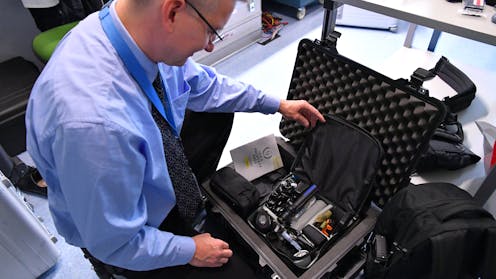
This travel case holds a toolkit containing equipment for inspecting nuclear facilities. Dean Calma/IAEA, CC BY

What happens when a country seeks to develop a peaceful nuclear energy program? Every peaceful program starts with a promise not to build a nuclear weapon. Then, the global community verifies that stated intent via the Treaty on the Non-Proliferation of Nuclear Weapons.

Once a country signs the treaty, the world’s nuclear watchdog, the International Atomic Energy Agency, provides continuous and technical proof that the country’s nuclear program is peaceful.

The IAEA ensures that countries operate their programs within the limits of nonproliferation agreements: low enrichment and no reactor misuse. Part of the agreement allows the IAEA to inspect nuclear-related sites, including unannounced surprise visits.

These are not just log reviews. Inspectors know what should and should not be there. When the IAEA is not on site, cameras, tamper-revealing seals on equipment and real-time radiation monitors are working full-time to gather or verify inside information about the program’s activities.

Safeguards toolkit

The IAEA safeguards toolkit is designed to detect proliferation activities early. Much of the work is fairly technical. The safeguards toolkit combines physical surveillance, material tracking, data analytics and scientific sampling. Inspectors are chemists, physicists and nuclear engineers. They count spent fuel rods in a cooling pond. They check tamper seals on centrifuges. Often, the inspectors walk miles through hallways and corridors carrying heavy equipment.

That’s how the world learned in April 2021 about Iran pushing uranium enrichment from reactor-fuel-grade to near-weapons-grade levels. IAEA inspectors were able to verify that Iran was feeding uranium into a series of centrifuges designed to enrich the uranium from 5%, used for energy programs, to 60%, which is a step toward the 90% level used in nuclear weapons.

Around the facilities, whether for uranium enrichment or plutonium processing, closed-circuit surveillance cameras monitor for undeclared materials or post-work activities. Seals around the facilities provide evidence that uranium gas cylinders have not been tampered with or that centrifuges operate at the declared levels. Beyond seals, online enrichment monitors allow inspectors to look inside of centrifuges for any changes in the declared enrichment process.

Seals verify whether nuclear equipment or materials have been used between onsite inspections.

When the inspectors are on-site, they collect environmental swipes: samples of nuclear materials on surfaces, in dust or in the air. These can reveal if uranium has been enriched to levels beyond those allowed by the agreement. Or if plutonium, which is not used in nuclear power plants, is being produced in a reactor. Swipes are precise. They can identify enrichment levels from a particle smaller than a speck of dust. But they take time, days or weeks. Inspectors analyze the samples at the IAEA’s laboratories using sophisticated equipment called mass spectrometers.

In addition to physical samples, IAEA inspectors look at the logs of material inventories. They look for diversion of uranium or plutonium from normal process lines, just like accountants trace the flow of finances, except that their verification is supported by the ever-watching online monitors and radiation sensors. They also count items of interest and weigh them for additional verification of the logs.

Beyond accounting for materials, IAEA inspectors verify that the facility matches the declared design. For example, if a country is expanding centrifuge halls to increase its enrichment capabilities, that’s a red flag. Changes to the layout of material processing laboratories near nuclear reactors could be a sign that the program is preparing to produce unauthorized plutonium.

Losing access

Iran announced on June 28, 2025, that it has ended its cooperation with the IAEA. It removed the monitoring devices, including surveillance cameras, from centrifuge halls. This move followed the news by the IAEA that Iran’s enrichment activities are well outside of allowed levels. Iran now operates sophisticated uranium centrifuges, like models IR-6 and IR-9.

Removing IAEA access means that the international community loses insight into how quickly Iran’s program can accumulate weapon-grade uranium, or how much it has produced. Also lost is information about whether the facility is undergoing changes for proliferation purposes. These processes are difficult to detect with external surveillance, like satellites, alone.

a satellite view of a complex of buidlings on a desert landscape
A satellite view of Iran’s Arak Nuclear Complex, which has a reactor capable of producing plutonium.
Satellite image (c) 2025 Maxar Technologies via Getty Images

An alternative to the uranium enrichment path for producing nuclear weapons material is plutonium. Plutonium can’t be mined, it has to be produced in a nuclear reactor. Iran built a reactor capable of producing plutonium, the IR-40 Heavy Water Research Reactor at the Arak Nuclear Complex.

Iran modified the Arak reactor under the now-defunct Joint Comprehensive Plan of Action to make plutonium production less likely. During the June 2025 missile attacks, Israel targeted Arak’s facilities with the aim of eliminating the possibility of plutonium production.

With IAEA access suspended, it won’t be possible to see what happens inside the facility. Can the reactor be used for plutonium production? Although a lengthier process than the uranium enrichment path, plutonium provides a parallel path to uranium enrichment for developing nuclear weapons.

Continuity of knowledge

North Korea expelled IAEA inspectors in 2009. Within a few years, they restarted activities related to uranium enrichment and plutonium production in the Yongbyon reactor. The international community’s information about North Korea’s weapons program now relies solely on external methods: satellite images, radioactive particles like xenon – airborne fingerprints of nuclear activities – and seismic data.

What is lost is the continuity of the knowledge, a chain of verification over time. Once the seals are broken or cameras are removed, that chain is lost, and so is confidence about what is happening at the facilities.

When it comes to IAEA inspections, there is no single tool that paints the whole picture. Surveillance plus sampling plus accounting provide validation and confidence. Losing even one weakens the system in the long term.

The existing safeguards regime is meant to detect violations. The countries that sign the nonproliferation treaty know that they are always watched, and that plays a deterrence role. The inspectors can’t just resume the verification activities after some time if access is lost. Future access won’t necessarily enable inspectors to clarify what happened during the gap.

The Conversation

Anna Erickson receives funding from DOE National Nuclear Security Administration.

ref. How the world’s nuclear watchdog monitors facilities around the world – and what it means that Iran kicked it out – https://theconversation.com/how-the-worlds-nuclear-watchdog-monitors-facilities-around-the-world-and-what-it-means-that-iran-kicked-it-out-260689

The first video of Earth’s surface lurching sideways in an earthquake offers new insights into this force of nature

Source: The Conversation – Global Perspectives – By Jesse Kearse, Postdoctoral Researcher, Geophysics, Kyoto University

Sai Aung MAIN/AFP via Getty Images

During the devastating magnitude 7.7 Myanmar earthquake on March 28 this year, a CCTV camera captured the moment the plate boundary moved, providing the first direct visual evidence of plate tectonics in action.

Tectonic plate boundaries are where chunks of Earth’s crust slide past each other – not smoothly, but in sudden, violent ruptures.

The footage shows Earth’s surface lurching sideways, like a gigantic conveyor belt switched on for just a second, as the fault slips.

What we’re seeing is the propagation of a large earthquake rupture – the primary mechanism that accommodates plate boundary motion at Earth’s surface. These shear fractures travel at several kilometres per second, making them notoriously difficult to observe.

This video explains the moment Myanmar’s Sagaing Fault ruptured in a large earthquake, allowing the tectonic plate boundary to shift. Research: https://doi.org/10.1785/0320250024.

These rare events, separated by centuries, have shaped our planet’s surface over millions of years, creating features such as Aotearoa New Zealand’s Alpine Fault and the Southern Alps.

Until now, seismologists have relied on distant seismic instruments to infer how faults rupture during large earthquakes. This video sheds new light on the process that radiates seismic energy and causes the ground to shake.

Analysis of the video

In our new study, we analysed the video frame by frame. We used a technique called pixel cross-correlation to reveal that the fault slipped 2.5 metres sideways over a duration of just 1.3 seconds, with a maximum speed of 3.2 metres per second.

The total sideways movement in this earthquake is typical of strike-slip fault ruptures, which move the land sideways (in contrast to faults that move land up and down).

But the short duration is a major discovery.

The timing of when a fault starts and stops slipping is especially difficult to measure from distant recordings, because the seismic signal becomes smeared as it travels through Earth.

In this case, the short duration of motion reveals a pulse-like rupture – a concentrated burst of slip that propagates along the fault like a ripple travels down a rug when it’s flicked from one end.

Capturing this kind of detail is fundamental to understanding how earthquakes work, and it helps us better anticipate the ground shaking likely to occur in future large events.

Validation of the ‘slickenline’ hypothesis

Our analysis also revealed something more subtle about the way the fault moved.

We found the slip didn’t follow a straight path. Instead it curved. This subtle curvature mirrors patterns we’ve observed previously at fault outcrops.

Called “slickenlines”, these geological scratch marks on the fault record the direction of slip.

Our work shows the slickenlines we see on outcrops are curved in a manner similar to the curvature seen in the CCTV footage. Based on our video analysis, we can be certain that curved slip occurs, giving credence to our interpretations based on geological observations.

In our earlier research, we used computer models to show that curved slickenlines could emerge naturally when an earthquake propagates in a particular direction. The Myanmar rupture, which is known to have travelled north to south, matches the direction predicted by our models.

This alignment is important. It gives us confidence in using geological evidence to determine the rupture direction of past earthquakes, such as the curved slickenlines left behind after the New Zealand Alpine Fault’s 1717 earthquake.

This first glimpse of a fault in motion shows the potential for video to become a powerful new tool in seismology. With more strategic deployments, future earthquakes could be documented with similar detail, offering further insight into the dynamics of fault rupture, potentially revolutionising our understanding of earthquake physics.

The Conversation

Jesse Kearse receives funding from Royal Society Te Apārangi Marsden Fund.

ref. The first video of Earth’s surface lurching sideways in an earthquake offers new insights into this force of nature – https://theconversation.com/the-first-video-of-earths-surface-lurching-sideways-in-an-earthquake-offers-new-insights-into-this-force-of-nature-261004

Is spinal cord stimulation safe? Does it work? Here’s what you need to know if you have back pain

Source: The Conversation – Global Perspectives – By Caitlin Jones, Postdoctoral Research Associate in Musculoskeletal Health, University of Sydney

AsiaVision/Getty

Spinal cord stimulators are electrical devices that are surgically implanted in the body to treat long-term pain. They have a battery pack and leads that deliver electrical impulses directly to the spinal cord. The devices are thought to work by providing electrical impulses that interfere with how the brain senses pain.

Spinal cord stimulators are mainly used to treat chronic back pain, especially when other less invasive treatments have not worked. They also aim to reduce people’s reliance on risky pain medicines. These include opioids, which research shows are ineffective and harmful for low-back pain.

But research, including our own, shows spinal cord stimulators work no better than a placebo. And they can also carry risks.

Do they work?

In a 2023 Cochrane review, researchers reviewed data from 13 randomised controlled trials on low-back pain and found no benefits in the short and medium term. These international reviews draw together the most robust evidence to provide a detailed summary of what we know on a particular topic.

Only one of the trials in the review tested efficacy in the longer term (six months). That trial found no benefits of spinal cord stimulation.

An earlier Cochrane review looked at the evidence of spinal cord stimulation for chronic pain in general, including for neck pain. Reviewers looked at 15 randomised controlled trials and couldn’t be certain about its benefits, largely due to the quality and reliability of the available trials.

Are there side effects?

Aside from disappointing results for pain relief, there are risks and side effects to consider.

We co-authored an analysis of 520 adverse events reported to Australia’s Therapeutic Goods Administration (TGA). We found 79% of reported events were rated as severe, with 13% life-threatening. The same research found 80% of events required surgery to correct.

Our recent analysis in the Medical Journal of Australia looked at data from private health insurers. These cover 90% of spinal cord stimulation implants in Australia. Five major insurers, which covered 76% of privately insured people, contributed de-identified data.

We found about one-quarter of people who had a spinal cord stimulator implanted needed corrective surgery afterwards. These surgeries occurred within a median of about 17 months. This indicates these surgeries are not routine or expected interventions, such as to replace batteries, which are meant to last five to ten years.

Our previous research shows the sorts of reasons for corrective surgery. These include to replace a malfunctioning device, or the person was in more pain, had an infection, or a puncture of the delicate tissues covering the spinal cord.

However, even our latest findings are likely to underestimate the risk of these devices.

Sometimes the lead delivering the electrical current moves away from the spinal cord to elsewhere in the body. This requires surgery to reposition the lead, but does not necessarily require new hardware, such as a brand new lead. So this type of corrective surgery is not counted in the data from the private health insurance companies.

How much does it cost?

We found spinal cord stimulators cost about A$55,000 per patient, including the device, its insertion, and managing any associated additional surgeries.

For people who only had a “trial” – where the leads are implanted temporarily but the battery pack remains outside the body – this cost was about $14,000 per patient.

These figures do not include any out-of-pocket costs.

What do regulators say about the devices?

In 2022 the TGA began a review of spinal cord stimulators on the market because of safety and performance concerns.

As a result, several devices were removed from the Australian Register of Therapeutic Goods – that is, they were banned from use in Australia, but existing stock could still be used.

The rest of the devices had conditions imposed, such as the manufacturers being required to collect and report safety data to the TGA at regular time points.

Should I do my own online research?

Yes, but be careful. Unfortunately not all online information about spinal cord stimulators is correct.

Look for sites independent of those who manufacture or implant these devices.

Government agencies, health departments and universities that have no financial interests in this area may be a better option.

The Cochrane Library is also a reliable and independent source for trustworthy health information.

What shall I ask my doctor?

The Australian health department provides useful advice for consumers about medical implants.

It says medical implants “are considered higher-risk therapeutic goods, and the decision to get one should not be taken lightly”. It recommends asking your health professional these questions:

  • do I really need this medical implant?

  • what are the risks/benefits?

  • is the medical implant approved?

  • where can I get more information?

  • what happens if I experience an adverse event?

What else could I do for my back pain?

There are other treatment options that are effective and have fewer risks than spinal cord stimulation.

For example, education about how to manage your pain yourself, exercise, cognitive behavioural therapy (a type of psychological therapy), and non-steroidal anti-inflammatory medicines (such as ibuprofen) all have solid evidence to back them. All offer benefits that are not outweighed by their potential risks.

Australian research has shown other types of therapy – such as sensorimotor retraining and cognitive functional therapy – are also effective. You can discuss these and other options with your health professional.

Spinal cord stimulation is a good example of a treatment that got ahead of the evidence. Although the devices have been around since the 1960s, we’ve only had reliable trials to test whether they work in recent years.

Everyone wants to find ways to help people with chronic pain, but we must ensure medical care is grounded in reliable science.

The Conversation

Christopher Maher holds a research fellowship funded by the National Health and Medical Research Council.

Caitlin Jones does not work for, consult, own shares in or receive funding from any company or organisation that would benefit from this article, and has disclosed no relevant affiliations beyond their academic appointment.

ref. Is spinal cord stimulation safe? Does it work? Here’s what you need to know if you have back pain – https://theconversation.com/is-spinal-cord-stimulation-safe-does-it-work-heres-what-you-need-to-know-if-you-have-back-pain-261364

Hold up, humans. Ants figured out medicine, farming and engineering long before we did

Source: The Conversation – Global Perspectives – By Tanya Latty, Associate Professor in Entomology, University of Sydney

Tambon Nong Chaeng/Pexels

Think back to a time you helped someone move a heavy object, such as a couch. While at first the task may have appeared simple, it actually required a suite of advanced behaviours.

The job needed verbal commands for social coordination (“pivot!”) and anticipation of near-future events (moving other furniture out of the way). It also required a clear, shared vision of the final goal (which room to take the couch to).

It’s a small but satisfying example of human cooperation. But before we all get too pleased with ourselves, consider that ants – creatures with tiny brains and no capacity for speech – routinely pull off feats that rival, and sometimes exceed, our own.

black ants on red dirt
Ants routinely pull off feats that rival, and sometimes exceed, our own.
Andre Moura/Pexels

Understanding ant intelligence

Earth is literally crawling with ants. Scientists estimate there are at least 20 quadrillion ants on Earth. That’s 20 followed by 15 zeros – more ants than stars in our galaxy!

These incredible insects are amongst the most successful organisms on the planet. Part of the success comes from an ability to form complex societies, ranging from a few individuals to millions. And those societies, or colonies, are remarkably co-operative.

Take, for example, ants’ abilities to move large food items. To do it, they mobilise teams of dozens – or even hundreds – of fellow workers. Together, they efficiently work together to transport the load back to the nest.

Longhorn crazy ants (Paratrechina longicornis) are even known to clear debris from a path before a heavy object arrives – seemingly anticipating its trajectory and preparing the way.

One experiment pit longhorn crazy ants against humans, all tasked with moving T-shaped objects (scaled to body size) through tight spaces. In some trials, the human teams were not permitted to speak or use gestures.

And the result? Ants performed better in larger groups compared to smaller ones, showing the clear benefits of collective action. In contrast, human performance did not improve with group size. And when communication was restricted, human performance declined as group size increased.

All this highlights how ants rely on collective intelligence, without the need for central control or sophisticated cognition.

Expert farmers

Humanity’s invention of agriculture 12,000 years ago is understandably hailed as one of our greatest achievements.

But leaf cutter ants beat us to it. These ants (from the species Atta and Acromyrmex) evolved to undertake large-scale agriculture about 55 million years ago.

These ants cut and transport fresh leaves not to eat directly, but to feed a fungus that serves as their main food source.

This evolutionary partnership allows the ants to feed colonies with populations in the millions.

Remarkably, leaf cutter ants have also evolved a form of biological pest control to protect their crops from bacteria. Some worker ants patrol the gardens, detecting infected sections of the fungus. Then they apply antibiotics produced by bacteria that live on their bodies.

What’s more, many ant species farm aphids and other sap-sucking insects.

As these farmed insects feed on plant sap, they excrete a sugary liquid the ants eagerly collect. In return, ants serve as bodyguards, defending their tiny livestock from predators such as ladybirds and lacewings.

In some species, queen ants gently carry sap-sucking insects in their jaws as they fly off to start new colonies. Fossilised ants preserved in amber suggest this behaviour evolved up to 20 million years ago, long before humans domesticated animals.

Ant medicine

Medical care may seem like a distinctly human innovation. But several ant species have evolved sophisticated ways to treat injuries.

When a Florida carpenter ant (Camponotus floridanus) is injured during a battle between colonies, its nest-mates will amputate a damaged limb to prevent infection from spreading. Ants receiving this battlefield care are more likely to survive than ants left untreated.

Some ants can also detect infection and treat infected wounds by cleaning them and applying antimicrobial secretions from specialised glands.

Master builders

Some ant species are known to literally put their bodies on the line for the colony.

Army ants (Eciton burchellii) join their bodies together to form structures. These include bridges across gaps on the forest floor, and “scaffolds” across steep terrain to prevent other ants from slipping.

Even the nest is made of hundreds of thousands of ants joined together, complete with tunnels and chambers housing the larvae and the queen. The entire structure is packed up and rebuilt each day, after the colony emigrates a few hundred metres into the forest.

Ants crawling across leaf litter
Army ants join their bodies together to form structures.
Smartse/Wikimedia, CC BY

Weaver ants (Oecophylla smaragdina), meanwhile, self-assemble into rope ladders to span vertical gaps.

They also form a line of workers that pull leaves together in treetops to form nests. Once the leaves are winched into place, other ants arrive with ant larvae in their jaws. Each larva produces a tiny blob of silk which the ants use to glue the leaves together.

Fire ants (Solenopsis invicta), a major pest species, owes its invasive success partly to a unique method of dispersal.

When their underground nests are flooded by rain, the ants join together into a huge raft which floats on a layer of buoyant larvae. These rafts can ride floodwaters in safety for hundreds of kilometres, until the ants reach dry land.

Ants forming a raft to float on water
When their nests are flooded, fire ants join together into a huge raft.
TheCoz/Wikimedia, CC BY

Lessons for humanity?

Humans rightly take pride in our greatest achievements – agriculture, medicine, engineering and building civilisations. But remarkably, ants mastered these innovations millions of years before we did.

Ants may be tiny – but by working together they can build complex societies and solve many problems. They might even teach humans a thing or two.

The Conversation

Tanya Latty co-founded and volunteers for conservation organisation Invertebrates Australia, is former president of the Australasian Society for the Study of Animal Behaviour and is on the education committee for the Australian Entomological Society. She receives funding from the Australian Research Council, NSW Saving our Species, and Agrifutures Australia

Chris R. Reid receives funding from the Australian Research Council and Macquarie University. He is secretary of the Australasian Society for the Study of Animal Behaviour and is on the education committee for the Australasian Entomological Society.

ref. Hold up, humans. Ants figured out medicine, farming and engineering long before we did – https://theconversation.com/hold-up-humans-ants-figured-out-medicine-farming-and-engineering-long-before-we-did-258922

Mario Vargas Llosa y Carmen Martín Gaite: el premio literario que revolucionó la literatura en español

Source: The Conversation – (in Spanish) – By Alicia Nila Martínez Díaz, Profesor Acreditado Contratado Doctor Filología Hispánica, Universidad Villanueva

Branko Devic/Shutterstock/Librería Nobel/Wallapop

En 1962, Mario Vargas Llosa ganó el Premio Biblioteca Breve con La ciudad y los perros. Carmen Martín Gaite, con su novela Ritmo lento, quedó finalista.

En 2025, cuando conmemoramos el centenario de la escritora salmantina y tenemos reciente la muerte del Premio Nobel, nos detenemos en este instante clave de la historia de la literatura hispánica en el siglo XX para intentar entender cómo se construyó el canon de la novela española contemporánea.

Un nuevo galardón

Carlos Barral creaba en 1958 el Premio Biblioteca Breve. El poeta y editor decidió instaurar este galardón para potenciar el enfoque innovador, experimental y transgresor del catálogo de la editorial.

Como él mismo explicó, el premio se otorgaría a una novela que “debía contarse entre las que delatan una auténtica vocación renovadora o entre las que se presumen adscritas a la problemática literaria y humana estrictamente de nuestro tiempo”.

Esta apuesta modernizadora implicaba no pocos riesgos que Barral supo afrontar con el coraje y el pragmatismo necesarios para conseguir posicionar al galardón como uno de los más relevantes de la literatura en lengua española.

Sin saberlo, estaba contribuyendo al desarrollo del denominado boom latinoamericano.

La novela rompedora

Imagen de un hombre hablando.
Mario Vargas Llosa en 1988.
Universitätsarchiv St.Gallen / Regina Kühne, CC BY-SA

Cuatro años más tarde, un joven y desconocido escritor peruano se hizo con el premio. Se llamaba Mario Vargas Llosa. Aunque no tenía a sus espaldas más que unos cuantos ensayos y algún que otro ejercicio de crítica literaria, su novela, breve y corrosiva con la tradición, no podía maridar más y mejor con los presupuestos del premio Biblioteca Breve. La ciudad y los perros era un artefacto literario ambicioso y agresivo, estructurado sobre el desafío del fragmento y marcado a fuego por la denuncia de la violencia institucional.

Premiando este relato, Barral perseguía la publicación de una nueva narrativa hispánica, emisaria de los vientos renovadores que soplaban desde América Latina y que entraba sin miedos ni complejos en dialéctica con las vanguardias europea y norteamericana. Laurear a Vargas Llosa significaba apostar por ese boom que ya alboreaba.

La cuestión es ¿por qué se otorgó el segundo puesto a Ritmo Lento? ¿Qué lugar quedaba para una novela diametralmente opuesta al relato ganador?

Dos formas de sacudir la literatura

La ciudad y los perros y Ritmo lento no pueden ser novelas más distintas. La primera está ambientada en un colegio militar de Lima y, gracias a una estructura narrativa fragmentaria, el relato despliega ante el lector una constelación de voces que articulan una feroz crítica a las instituciones autoritarias. Por la profundidad psicológica de sus personajes, por su violencia real y simbólica y por su voluntad de ruptura formal, heredada de su maestro William Faulkner, Vargas Llosa llegaba para plantearnos una historia dura y valiente contada de una forma distinta.

Una mujer con abrigo y boina mira a la cámara.
Carmen Martín Gaite en la presentación del libro La orgía perpetua, de Mario Vargas Llosa, en 1995, en Casa de América.
Casa de América/Flickr, CC BY-NC-ND

Por el contrario, Carmen Martín Gaite se adentraba con Ritmo lento en la conciencia de un anciano que, desde la reclusión de un psiquiátrico, hacía balance de su existencia. La novela utiliza la introspección como motor narrativo para proponer al lector una narración focalizada en el tiempo interno del personaje, en la estela de Virginia Woolf en La señora Dalloway –de la que Martín Gaite sería, por cierto, traductora al español– o Italo Svevo en La conciencia de Zeno.

Focalizada en la subjetividad, el monólogo interior y la atención por el detalle, la novela de Martín Gaite no parecía encajar, a priori, en los estándares marcados por Barral. Sin embargo, era una provocación para el establishment literario de la época y, quizás por ello –debió pensar Barral– merecía quedar finalista.

Porque el de Martín Gaite era también un texto escrito para subvertir, desafiar y turbar. De hecho, ella y su amigo Luis Martín Santos fueron los primeros escritores españoles en disputarle la supremacía al realismo imperante de la narrativa española de posguerra. Tiempo de silencio y Ritmo Lento constituyen “dos intentos aislados por volver a centrar el relato en el análisis psicológico de un personaje”, como la escritora escribió en su “nota” a la tercera edición de la novela. Leída desde hoy, Ritmo Lento representa una apuesta igual de bizarra que la de Vargas Llosa, pero menos sobresaliente.

El jurado premió la potencia narrativa de la obra del peruano. Pero otorgando a Martín Gaite ese segundo lugar lo que estaba poniendo sobre el tapete de la historia literaria no era solamente una elección estética, sino dos formas de estar y de pensar en la literatura.


¿Quiere recibir más artículos como este? Suscríbase a Suplemento Cultural y reciba la actualidad cultural y una selección de los mejores artículos de historia, literatura, cine, arte o música, seleccionados por nuestra editora de Cultura Claudia Lorenzo.


Rescatar el instante

Volver la vista al palmarés del Biblioteca Breve de 1962 no es un ejercicio de arqueología literaria. Es también la interpretación de un momento literario que marcaría los destinos de la literatura hispánica contemporánea.

Para Vargas Llosa constituyó el pistoletazo de salida para una carrera que le conduciría al Nobel. Para Martín Gaite, en cambio, fue el espaldarazo necesario para continuar escribiendo desde los márgenes y con una fidelidad inquebrantable hacia lo narrado en voz baja.

Ahora podemos interpretar ese momento como una intersección en las trayectorias de dos grandes de la narrativa hispánica. O, lo que es lo mismo, dos modos simbólicos de entender la literatura.

The Conversation

Alicia Nila Martínez Díaz no recibe salario, ni ejerce labores de consultoría, ni posee acciones, ni recibe financiación de ninguna compañía u organización que pueda obtener beneficio de este artículo, y ha declarado carecer de vínculos relevantes más allá del cargo académico citado.

ref. Mario Vargas Llosa y Carmen Martín Gaite: el premio literario que revolucionó la literatura en español – https://theconversation.com/mario-vargas-llosa-y-carmen-martin-gaite-el-premio-literario-que-revoluciono-la-literatura-en-espanol-260871

“Yo no bebo mucho, bebo lo normal”

Source: The Conversation – (in Spanish) – By Lorena Botella-Juan, Investigadora posdoctoral en el Área de Medicina Preventiva y Salud Pública, Universidad de León

View Apart/Shutterstock

Es muy posible que el título de este artículo le sea familiar. Quizá alguna vez haya estado en una conversación con personas de su entorno y al sacar a relucir el tema del alcohol usted o un conocido ha dicho algo como: “Bueno, a ver, que yo tampoco bebo mucho, bebo lo normal”. O puede que algo del tipo: “Yo, si eso, me bebo unas cañas el fin de semana con los colegas. Y si se lía la cosa, pues igual algo más. Es lo normal, ¿no?”.

Pero realmente, ¿puede ser normal beber alcohol, considerando que se trata de una sustancia adictiva? Según la Real Academia de la Lengua Española, una de las acepciones de “normal” es: “Dicho de una cosa que, por su naturaleza, forma o magnitud, se ajusta a ciertas normas fijadas de antemano”. Si consideramos las normas sociales de España, donde el alcohol es una droga legal y donde el 72,9 % de la población de más de 15 años lo ha probado alguna vez; y teniendo en cuenta que uno de los principales motivos para consumir es socializar, pues entonces sí: beber unas cañas el fin de semana es totalmente normal.

Lo que dice la estadística

Pero si nos ponemos rigurosos, debemos recurrir a algo más científico. Tomándome algunas licencias, voy a emplear un concepto estadístico que nos encanta a los epidemiólogos: la distribución normal.

La distribución normal se representa con una curva en forma de campana simétrica y la suelen describir muchas características físicas (peso, altura) y biomédicas (tensión arterial, glucosa en sangre) en las poblaciones. Nos dice que la media (la suma de todos los valores entre el total de valores) de una variable o medida (por ejemplo, el peso corporal de un grupo de personas) está en el centro.

Esquema de la distribución normal.
Lorena Botella Juan

Para establecer dicha distribución, también necesitamos conocer la desviación estándar (DE), que se calcula con una fórmula menos amigable y nos da una idea de lo dispersos que están los datos respecto a la media. Este segundo parámetro estadístico nos indica que el 68 % de los valores estarán a 1 DE de la media y el 95 %, a 1,96 DE. Así, la mayoría personas se agrupará en la zona central con valores cercanos a la media, y poco a poco se irán dispersando hacia los extremos, donde menos individuos tendrán valores poco frecuentes.

Pero esto… ¿qué tiene que ver con el alcohol?

De acuerdo con los datos de la encuesta Europea de Salud en España en 2020, el 65,4 % de los españoles había bebido alcohol en el último año (74,6 % de hombres y 56,8 % de mujeres). Entre los datos de esta encuesta también encontramos la media (11,98 gramos) y la DE (11,40 gramos) del consumo diario de alcohol de personas que beben al menos un día a la semana. Considerando esos valores podemos simular la distribución normal del consumo diario de alcohol en España.

Para ponernos más en situación, el Ministerio de Sanidad indica que 10 gramos de alcohol son una unidad de bebida estándar (UBE). Esto equivaldría a un chupito, media copa de vino o una caña. Si miramos nuestra distribución normal, la media de consumidores beben más o menos una UBE al día (11,98 gramos). Entonces, es probable que muchas personas españolas que toman una cañita al día entren dentro de nuestra normalidad. Efectivamente: beben lo normal. Sin embargo, ¿nos interesa ser normales?

No hay consumo sin riesgo

Pues la verdad es que, en este caso, no: lo normal no tiene por qué coincidir con lo saludable. Que el consumo de alcohol en España esté tan normalizado (o más bien banalizado) no quiere decir que no sea perjudicial. Actualmente, la evidencia científica y la propia Organización Mundial de la Salud lo tienen claro: “Ninguna forma de consumo de alcohol está exenta de riesgos”.

Ahora bien, tampoco todas las formas de consumo producen el mismo impacto en salud. Un consumo de “bajo riesgo” sería una UBE para mujeres al día y dos para los hombres (las mujeres y los hombres no toleran igual el alcohol por sus diferencias corporales, pero este es otro tema). Aunque el alcohol es un tóxico, en pequeñas dosis nuestro sistema hepático y otros pueden detoxificarlo correctamente, haciendo que no suframos tanto. No obstante, esto se complica si caemos en patrones de “alto riesgo”.

Atracones con consecuencias

¿Qué cree que es peor, tomar todos los días una bebida o beber un solo día muchas bebidas? Seguro que también le suena la frase: “No, hombre, si yo solo bebo los fines de semana”. Bueno, pues lo importante es cómo bebemos. Y eso implica qué cantidad ingerimos y con qué frecuencia lo hacemos.

De esta forma, beber solamente un día a la semana, pero hacerlo en atracón (conocido como binge drinking), tomando muchas bebidas (5 para hombres y 4 para mujeres) en un corto periodo de tiempo, ocasiona un grandísimo impacto negativo en la salud. Nuestro cuerpo no puede con tanta intoxicación repentina y, además, se agravan las consecuencias (daños a terceros, posibles caídas, riesgo de coma etílico y un larguísimo etcétera).

Así que las personas que están más a la derecha de la curva normal y beben más que la media –aunque sean menos numerosas– o aquellas cuyo consumo medio semanal se ajusta a la normalidad, pero lo hacen en forma de atracón, se encuentran en un alto riesgo para su salud, incluido el de adicción al alcohol. Recordemos que es una sustancia que causa 15 000 muertes al año en España.

En conclusión, cuando vuelva a escuchar que alguien “bebe lo normal”, seguramente tenga razón, pero lo normal, en el caso del alcohol, es perjudicial para la salud. Así que… ¿prefiere ser normal o estar sano?

The Conversation

Este artículo fue finalista del Premio Luis Felipe Torrente de Divulgación sobre Medicina y Salud, organizado por la Fundación Lilly y The Conversation

ref. “Yo no bebo mucho, bebo lo normal” – https://theconversation.com/yo-no-bebo-mucho-bebo-lo-normal-260979