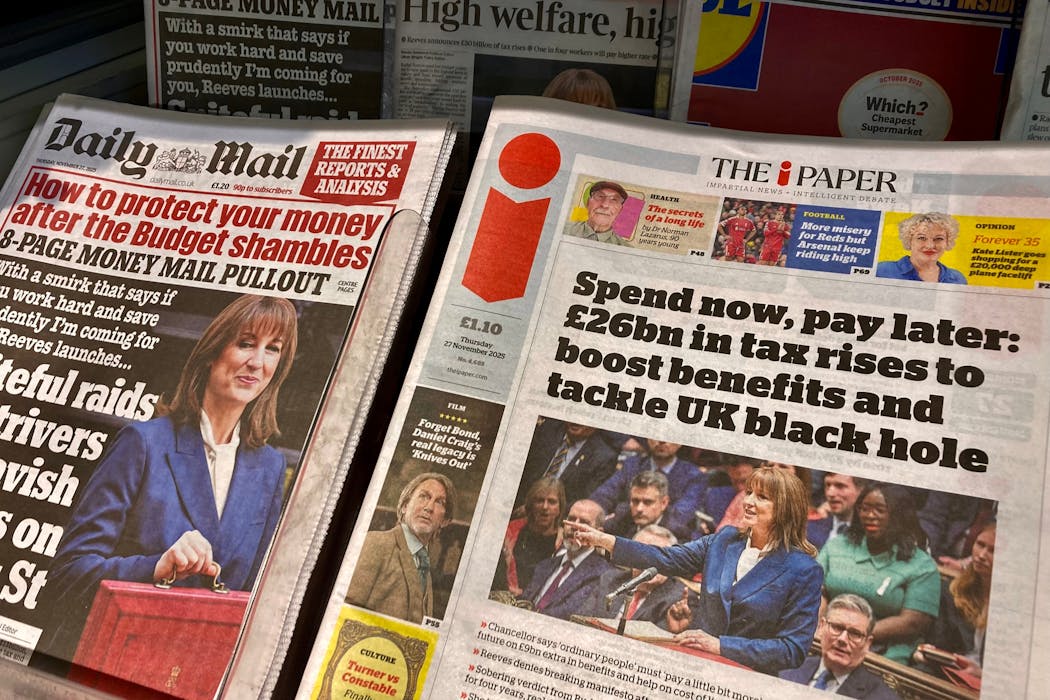
Headlines about tax in the UK being at an all-time high abounded after the autumn budget. The current overall tax take, at 35% of GDP, is indeed a historic high for the country. And the measures announced in the budget will take it to 38% by the end of the parliament.
Yet, contrary to what some might have you believe, it is only high by British standards.
If the UK wants a decent welfare system in the coming years, it’s time to start doing things differently. But this can’t just mean raising taxes to meet the growing demands of an ageing society.
The structure of the UK’s tax system must be fixed before politicians even think about further rises, since its complexity and distortions hold back investment, productivity and long-term growth.
In 2023, the tax take as a percentage of GDP was 35.3%, slightly above the overall average for the 38 countries in the Organisation for Economic Cooperation and Development (OECD). This placed the UK 18th on the list and almost two percentage points lower than the average of other European members.
But even the new figure of 38% does not take the UK anywhere near the top. It matches Germany, but remains significantly lower than the tax take in France, Italy, Belgium and the Nordic countries, where the tax share exceeds 40% of GDP.
The UK has a deep productivity problem. Real wage growth has collapsed from being third best among OECD countries before 2008 to 16th afterwards. Without a recovery, the country will not be able to maintain levels of public provision, let alone reboot the health and public support systems.
The welfare system certainly needs a reboot, as our latest research shows. In health, the NHS is grappling with some of the longest waiting lists on record as well as delivering comparatively poor results. At the same time, thousands of people are stuck in hospital due to the lack of affordable social care.
Social housing is increasingly out of reach for those who need it: the gains of the right to buy policy of the 1980s have been confined to those who bought their council houses, while the costs of that mass sell-off are borne by the state and today’s poor in the form of housing shortages and high rents.
The pressures on the system will only grow. The ageing population is dramatically increasing pension costs and the demand for social care. Advances in healthcare, while holding out the prospect of longer and higher-quality lives, are also extending the years that people can live with chronic conditions. This is particularly true among lower-income groups who often lack the means to maintain their health.
The health and social care sector is one where the real cost of delivery is rising, so the UK will need to increase the resources flowing into it just to stand still.
The pension triple lock is continuing to exacerbate the pressure on public finances. Meanwhile, precarious and low-paid employment means millions of people still rely on in-work benefits. And the post-COVID surge in health and disability-related personal independence payments (Pip) shows no signs of abating.
What kind of country does the UK want to be?
We see two feasible paths forward to fix the distortions in the tax system while ensuring that those who need the welfare state don’t fall through the widening cracks. But here’s the rub. Both would be extremely difficult politically.
First, the UK could accept that a universal welfare state is not affordable, and radically reshape and target it. The question is whether the public would tolerate deeper means-testing, for instance, which might represent a genuine reshaping of the welfare state.
The founder of the welfare state, William Beveridge, understood that his system required not only technical solutions but a compelling narrative about social solidarity where all citizens bought into its core principles.
Second, the country could engage in a genuinely open debate on the cost of and willingness to pay for welfare services. It could then fix the tax system to fund comprehensive welfare provision, moving toward European-style social insurance systems.
The UK spends just over 11% of GDP on welfare, placing it near the OECD average and well below Nordic countries and France. The fact that overall tax take of 35% rising to 38% is a historic high makes any conversation about taxation hard – perhaps impossible.
But UK outcomes compared to those of its neighbours who spend more should be food for thought. The answer cannot be in stealth taxes.
The budget mainly just walked a path of continuation from a long period of piecemeal reforms that may not achieve what they are intended to. It raised revenue primarily through fiscal drag (the freezing of tax thresholds so that rising pay pushes more people into higher brackets).
It did remove the regressive limit on universal credit or tax credits for larger families, but in the main it continues to follow a path of least political resistance. This is likely to result in the gradual emergence of a two-tier system where those who can afford it increasingly opt for private healthcare, private housing and private education.
Given how much resistance the government is facing even now, perhaps the path of least resistance is the only option available. But perhaps a braver conversation is possible – one that spells out the human tragedy of under-investing in welfare and the economic problems of continuing with the current UK tax structure.
What won’t work is pretending these choices don’t exist. The UK has neither the benefits of low taxes nor the welfare outcomes of its higher-tax neighbours. It’s time to redesign the tax and welfare system for the century we’re in.
The authors do not work for, consult, own shares in or receive funding from any company or organisation that would benefit from this article, and have disclosed no relevant affiliations beyond their academic appointment.
Source: The Conversation – France (in French) – By Jean-Marie Cardebat, Professeur d’économie à l’Université de Bordeaux et Professeur affilié à l’INSEEC Grande Ecole, Université de Bordeaux
Le célébrissime guide Michelin va proposer un guide des domaines viticoles. La diversification peut sembler logique. Après les mets, les vins… Toutefois, l’environnement concurrentiel est tel que rien ne dit que le nouveau guide connaîtra le même succès que son glorieux aîné. À l’ère des réseaux sociaux et des influenceurs, quelle place peut espérer occuper un enième guide professionnel ?
Dans un secteur déjà saturé de guides, d’experts, de revues spécialisées et de prescripteurs en tout genre, le guide Michelin annonce son entrée sur le marché de la notation des domaines viticoles. Erreur stratégique en perspective ou poursuite d’une diversification réussie ? Si la question reste ouverte pour le moment, on peut se demander si le guide Michelin ne se trompe pas (légèrement) de cible. Car la notation de la dimension œnotouristique des domaines semblerait a priori bien plus pertinente pour ce guide, né en 1900, qui évalue le secteur de l’hospitalité depuis 1926 (pour les restaurants et depuis 2024 pour les hôtels).
Un marché des experts déjà très concurrentiel
Le segment de l’expertise viticole est dominé depuis plusieurs décennies par une série d’acteurs spécialisés. Parmi les plus connus, on trouve le Wine Advocate (fondé par le célèbre Robert Parker), le Wine Spectator (la revue américaine spécialisée sur le vin qui touche 3,5 millions de lecteurs), la célèbre experte anglaise Jancis Robinson et la revue britannique Decanter (qui organise un concours international des vins bien connu), ou pour la France, La Revue du Vin de France et le Guide Hachette.
Chacun d’entre eux possède des méthodologies stabilisées et une légitimité historique auprès des particuliers mais aussi auprès des professionnels (détaillants, négociants, importateurs). Ce monde de l’expertise dans le vin et tous ses enjeux sont décrits de façon détaillée dans un article académique. Il souligne notamment le rôle central que ces acteurs jouent dans la formation des prix, en particulier pour les vins fins. L’entrée d’un nouvel évaluateur généraliste, en l’occurrence un guide gastronomique, même prestigieux, se positionnerait face à des experts techniques dont le cœur de métier est déjà parfaitement installé. La voie est donc étroite pour Michelin.
Un déplacement vers les communautés de consommateurs
Plus grave, le guide Michelin se positionne en tant qu’expert traditionnel dans un monde où les consommateurs privilégient désormais l’information issue de leurs pairs plus que de celle émanant des experts. La littérature académique démontre cette prédominance nouvelle des consumers geeks qui alimentent par dizaines de millions les notes agrégées de sites comme Vivino ou CellarTracker.
À l’instar de l’hôtellerie et de la restauration, ces notes et commentaires de consommateurs tendent à supplanter l’influence des experts traditionnels. Ce sont ces notes qui font les prix du vin à présent, plus que celles des experts, y compris dans le haut de gamme. Cette tendance de fond réduit considérablement l’espace de marché potentiel pour le guide Michelin. Son entrée sur le marché de l’expertise du vin se fait donc à contretemps de l’évolution du marché.
Des critères de notation encore flous
Dans ce contexte, la capacité du guide Michelin à imposer une nouvelle grille d’évaluation reste incertaine, d’autant que les cinq critères annoncés demeurent flous : la qualité de l’agronomie, la maîtrise technique, l’identité, l’équilibre, la constance. Le vocabulaire est imprécis, trop général, sans métrique ni méthode avancée pour saisir des critères souvent qualitatifs et éminemment subjectifs.
Cela nuit à la lisibilité et à l’objectivité de la démarche. Au final, qu’apporte cette nouvelle grille de lecture ? Que mesure-t-on exactement ? La qualité du vin, les processus menant à la réalisation du vin ? Le guide Michelin navigue entre le monde de l’expertise de processus (agronomique) et de produit (œnologique). Ce positionnement ambigu pourrait ne pas être compris par les utilisateurs potentiels.
Un atout : le capital de marque international
Pour autant, la stratégie du guide Michelin n’est pas sans fondement. Elle s’appuie sur une notoriété mondiale et une audience internationale à fort pouvoir d’achat. Le guide espère donc capter dans un premier temps sa propre clientèle. La force de la marque est ainsi son argument majeur, et l’on sait l’importance de la marque dans le monde du luxe. Cette reconnaissance constitue notamment un levier puissant pour attirer des consommateurs étrangers en quête de repères simples, particulièrement dans des régions viticoles complexes comme la Bourgogne ou Bordeaux où le guide débutera son activité de notation viticole.
Le capital réputationnel du guide Michelin comprend aussi son savoir-faire en matière d’évaluation. Avec ses étoiles, le guide manie depuis 1926 un système d’évaluation multicritères opaque mais néanmoins reconnu et respecté. Notons d’ailleurs que tous les experts du vin développent un système qui leur est propre et dont la transparence n’est pas la première qualité.
Dès lors, d’un point de vue économique, la notation des domaines viticoles peut être interprétée comme un mouvement logique de diversification horizontale. Michelin capitalise sur sa compétence centrale – la construction de standards de qualité – pour pénétrer un secteur adjacent à celui de la gastronomie.
En attendant l’évaluation œnotouristique
Cette stratégie de diversification peut toutefois être interrogée. Le guide Michelin possède un savoir-faire et une réputation dans l’hospitalité. L’œnotourisme apparait alors comme le secteur lié au vin le plus pertinent. Le guide Michelin, fort de son expertise en matière de destinations, d’expériences et de services, aurait pu s’imposer de manière naturelle sur ce terrain en évaluant des critères, tels que la qualité de l’accueil, le parcours/la visite du domaine, la cohérence de l’offre touristique, la gastronomie locale associée, l’expérience globale du visiteur, etc. Autant de critères sur lesquels la compétence est déjà présente et l’avantage concurrentiel incontestable.
Legend 2025.
En outre, l’industrie œnotouristique représente aujourd’hui un marché en expansion rapide : 18 % de croissance moyenne annuelle en Europe, selon le Global Wine Tourism Report (2025) de la Commission européenne. L’œnotourisme (et le tourisme gastronomique, très souvent liés) sont totalement alignés avec l’histoire du guide Michelin et avec les attentes de la clientèle internationale premium qu’il capte déjà en partie.
A minima, une stratégie tournée vers l’œnotourisme aurait dû constituer une étape vers l’évaluation des vins et des vignerons. Le risque d’aller directement sur l’évaluation du vin est double. C’est d’abord le risque de dilution de crédibilité lié à un manque de légitimité. Mais aussi le risque d’arriver bien trop tard, à contre-courant des tendances, dans un marché du vin en plein essoufflement. La force de la marque suffira-t-elle ? L’avenir nous le dira.
Jean-Marie Cardebat est Président de la European Association of Wine Economists
Alors que Donald Trump exige qu’il démissionne, Nicolas Maduro refuse pour l’instant de quitter le pouvoir. Washington brandit la menace d’une intervention armée.
Donald Trump l’a exprimé on ne peut plus clairement : il souhaite la chute du régime de Nicolas Maduro, au pouvoir au Venezuela depuis qu’il a pris en 2013 la suite d’Hugo Chavez. Pour cela, le président des États-Unis brandit diverses menaces : bombardements, opérations clandestines de la CIA, voire intervention militaire au sol. Lui qui se targue d’avoir mis fin à plusieurs guerres depuis son retour à la Maison Blanche il y a un an est-il sur le point d’en démarrer une ? Entretien avec Thomas Posado, maître de conférences en civilisation latino-américaine contemporaine à l’Université de Rouen-Normandie, auteur, entre autres publications, de Venezuela : de la Révolution à l’effondrement. Le syndicalisme comme prisme de la crise politique (1999-2021) (Presses universitaires du Midi, 2023).
Une déflagration militaire entre les États-Unis et le Venezuela vous semble-t-elle aujourd’hui possible ?
Je pense que oui, même si j’étais plutôt sceptique il y a encore peu de temps. Aujourd’hui, un tel développement est envisageable, mais sous quelle forme ? Une guerre ouverte entre les deux États et une intervention terrestre comparable à celles qu’on a connues en Irak ou en Afghanistan me semble hautement improbable. Ne serait-ce que parce que, pour envahir le Venezuela, il faudrait mobiliser au moins 100 000 hommes et il y aurait sans doute des pertes assez importantes du côté de l’US Army, ce qui ne serait pas bien pris par l’opinion publique états-unienne et, spécialement, par une bonne partie de la base trumpiste.
Les dernières interventions militaires de Washington sur le continent, c’était unilatéralement au Panama en 1989 et de manière multilatérale en Haïti en 1994. Deux petits pays de moins de 80 000 kilomètres carrés, alors que le Venezuela, c’est deux fois la France en superficie. Trump voudra sans doute éviter de plonger le pays dans un nouveau Vietnam ou un nouvel Afghanistan.
En revanche, des frappes ciblées ou des interventions terrestres extrêmement localisées — sur une raffinerie pétrolière par exemple — apparaissent comme des mesures crédibles au vu du déploiement militaire des États-Unis en mer des Caraïbes, et au vu de certaines actions que leurs forces armées ont conduites ces derniers mois — je pense notamment à leurs frappes contre l’Iran l’été dernier.
Trump a annoncé qu’il avait donné son feu vert à des actions clandestines de la CIA sur le territoire vénézuélien. De quoi pourrait-il s’agir, concrètement ?
Le fait même qu’on sache publiquement que Trump autorise des opérations secrètes de la CIA montre qu’il s’agit d’une manœuvre de communication. Le principe même des opérations secrètes est qu’elles ne sont pas claironnées à l’avance ! Il faut donc voir dans la déclaration de Trump avant tout un élément de pression psychologique sur l’adversaire.
Il n’empêche que cette annonce peut aussi avoir une traduction concrète. L’assassinat de certains hauts dirigeants vénézuéliens, voire de Maduro lui-même, est difficile à écarter. On sait en tout état de cause que ce n’est pas le respect du droit international qui bloquerait Donald Trump en la matière. Il a déjà ordonné ce type d’élimination de dignitaires étrangers — par exemple, pendant son premier mandat, celle du général iranien Ghassem Soleimani. L’assassinat extrajudiciaire est une mesure qui est présente dans le répertoire d’actions des États-Unis.
Autre possibilité : endommager gravement l’économie vénézuélienne en sabotant des infrastructures pétrolières. Une grande partie de l’électricité au Venezuela vient du barrage hydroélectrique de Guri, situé dans le sud du pays. Si vous touchez ce point, vous pouvez durablement impacter le réseau électrique du pays.
Vous avez dit que le droit international importait peu à Trump. Mais il doit tout de même composer avec la législation de son propre pays, s’il entend s’en prendre avec force à un État étranger…
Il y a une dizaine de jours, Trump aurait eu une conversation téléphonique avec Maduro durant laquelle il aurait exigé que ce dernier démissionne et quitte le pays…
Il faut se méfier des déclarations des uns et des autres, mais apparemment, Trump aurait proposé à Maduro de s’exiler en Russie sous peine de représailles militaires et Maduro lui aurait répondu qu’il serait prêt à quitter le pouvoir, mais à condition que les sanctions soient levées ; qu’une centaine de dirigeants vénézuéliens soient amnistiés des accusation états-uniennes d’atteinte aux droits humains, de trafic de drogue ou de corruption ; qu’il continue à contrôler l’armée depuis son lieu d’exil ; et que sa vice-présidente, Delcy Rodriguez, assure un gouvernement par intérim. Conditions rejetées par Trump.
Du côté du pouvoir de Caracas, on a aussi laissé entendre que la discussion a été très cordiale et que Trump aurait invité Maduro à Washington — ce qui me semble peu crédible au vu des menaces qui pèsent sur le président vénézuélien, les États-Unis ayant promis 50 millions de dollars à quiconque faciliterait sa capture ! Je vois donc mal un sommet international entre les deux hommes ; mais ce qui est sûr, c’est qu’il y a des manœuvres de communication de part et d’autre.
Trump veut un changement de régime, idéalement sans intervention militaire : cela représenterait une vraie victoire diplomatique pour lui. Maduro, lui, semble éventuellement disposé à accepter de quitter le pouvoir, mais à condition que la personne qui lui succédera maintienne la continuité — pour reprendre une expression classique, il est prêt à tout changer pour que rien ne change.
Qu’est-ce que Maduro peut céder pour obtenir un tel développement ?
Voilà des semaines que le camp Maduro tente de négocier pour faire baisser la pression. L’un des moyens d’y parvenir est de passer des accords préférentiels avec les entreprises états-uniennes, quitte à desserrer les liens commerciaux avec la Russie et la Chine, lesquels se sont développés ces dernières années.
L’administration Trump semble toutefois ne pas vouloir céder sur le changement de régime. Dans ce contexte, l’administration Maduro a tout intérêt à afficher sa combativité dans sa communication destinée au peuple vénézuélien : cela permet de remobiliser sa base sociale et de transformer le président impopulaire et autoritaire qu’il est en défenseur de la souveraineté vénézuélienne contre l’impérialisme états-unien. Mais on a bien conscience, à Caracas, de l’immense asymétrie des forces militaires. En cas de guerre, le premier budget militaire mondial affronterait le 57ᵉ.
À quel point Maduro est-il impopulaire ?
Selon les procès-verbaux de l’opposition vénézuélienne, lors de l’élection présidentielle de 2024, officiellement remportée par Maduro, il aurait en réalité recueilli 30 % des suffrages. C’est minoritaire, mais ce n’est pas rien ! Pour autant, cela ne signifie pas que 30 % des Vénézuéliens seraient prêts à se battre pour lui, mais il y a sans doute un noyau dur qui adhère vraiment à son discours et pourrait prendre les armes le cas échéant. Nicolas Maduro parle aussi volontiers des « milices bolivariennes » qui regrouperaient selon lui 2 millions, voire 4 millions de personnes. Ces chiffres sont sans doute exagérés mais, je le répète, une intervention au sol tournerait probablement au bourbier.
Pourquoi cette montée des tensions intervient-elle maintenant et pas il y a six mois, ou dans six mois, par exemple ?
Les explications sont sans doute multiples. D’une part, on peut y voir le poids croissant du secrétaire d’État Marco Rubio qui, à la différence de la partie isolationniste de l’administration Trump et du mouvement MAGA au sens large, est sur une ligne plutôt interventionniste, spécialement à l’encontre des gouvernements cubain et vénézuélien. En cela, il s’oppose à Richard Grenell, conseiller de Trump qui, quelques jours après l’entrée en fonctions de l’administration actuelle, s’était rendu à Caracas pour y négocier avec le régime de Maduro le renouvellement de l’allègement des sanctions promis par Joe Biden pour que Chevron puisse importer du pétrole vénézuélien aux États-Unis, en contrepartie de l’accord de Caracas de recevoir des vols de migrants vénézuéliens expulsés des États-Unis. Rubio semble avoir le dessus en ce moment, et il joue sans doute une partie importante de sa carrière politique sur ce dossier. Un changement de régime au Venezuela serait un succès dont il pourrait s’enorgueillir, ce qui pourrait le propulser à la vice-présidence, voire à la présidence, dès 2028.
D’autre part, cette focalisation sur le Venezuela peut aussi répondre à la nécessité, pour Trump, de faire diversion de son incapacité à obtenir la paix en Ukraine. Enfin, il n’est pas impossible qu’il y ait aussi chez lui le calcul de détourner l’attention du grand public vers le cas vénézuélien à un moment où les révélations embarrassantes pour sa personne se multiplient dans l’affaire Epstein…
Qui sont ces Vénézuéliens que Trump expulse déjà et veut continuer d’expulser vers Caracas ? Ne s’agit-il pas, en partie au moins, de gens ayant quitté leur pays par hostilité envers Maduro ?
C’est tout le paradoxe ! Cela dit, les immigrés politiques sont minoritaires même si l’immense majorité des migrants vénézuéliens sont hostiles à Maduro. Majoritairement, cette immigration est de nature économique. La plupart de ces gens sont partis à cause des conditions dramatiques dans lesquelles ils vivaient chez eux.
Qui sont les principaux leaders de l’opposition vénézuélienne à Maduro ?
La tête de gondole de l’opposition, c’est Maria Corina Machado, la récente prix Nobel de la paix, qui est une dirigeante politique reconnue dans tout le pays. Elle se trouve probablement au Venezuela, mais dans la clandestinité. Edmundo Gonzalez, le candidat de l’opposition unie qui a affronté Maduro à la présidentielle de 2024, est une personne relativement âgée, relativement inconnue de la population jusqu’au scrutin de l’année dernière, qui a servi de prête-nom à l’opposition dans cette élection face aux obstacles institutionnels que le gouvernement Maduro opposait à d’autres candidats. Juan Guaido, qui s’était autoproclamé président après la présidentielle de 2018, est aujourd’hui hors jeu. Il est exilé aux États-Unis et ne semble plus en mesure de jouer un rôle majeur. Il pourrait redevenir ministre en cas de changement de régime, mais il n’est plus une figure de premier plan.
Si changement de régime il y a, Machado et ses alliés pourraient-ils rapidement le remplacer et mettre le pays sur une nouvelle voie ?
Il n’est pas facile de passer de leaders dans la clandestinité à dirigeants d’un pays en proie à de très graves difficultés économiques. Il faut rappeler à cet égard que, entre 2014 et 2020, le pays a perdu 74 % de son PIB, une crise sans précédent pour un pays qui n’est pas en guerre. Depuis 2020, on a assisté à un certain redémarrage de l’économie, du fait de l’assouplissement des sanctions promues par Joe Biden. Ce redémarrage s’est fait aussi au prix d’une dollarisation de l’économie, c’est-à-dire que l’on a essayé de redynamiser l’économie en attirant des capitaux en dollars, ce qui a d’ailleurs accru les inégalités. De fait, la situation du Venezuela reste terrible. Les salaires sont très bas, les conditions de vie sont extrêmement difficiles, avec des pénuries d’électricité, des pénuries d’eau, des pénuries d’essence… d’où d’ailleurs une émigration colossale. Près d’un quart des habitants auraient quitté le pays, essentiellement pour des États voisins, mais aussi pour les États-Unis et pour l’Espagne.
En cas de changement de régime, l’opposition arriverait avec un leadership national, oui ; mais il lui faudrait aussi tout un réseau de cadres, ce qui serait difficile à rebâtir, parce que cela fait plus de 25 ans que le chavisme est au pouvoir.
Mais de toute façon, tout cela, c’est dans le scénario rêvé où il n’y aurait pas de résistance et où le chavisme s’effacerait sans résistance. Machado exige un changement de régime total. Dans sa vision, le régime serait balayé, il y aurait une liesse populaire, les militaires fuiraient ou se convertirait en alliés du nouveau régime.
Cette vision peut sembler trop optimiste pour certains dans l’opposition, dont certains leaders, comme Henrique Capriles (candidat aux présidentielles de 2012 et de 2013), estiment qu’il faudra passer par une transition pacifique et donc par des négociations avec le camp chaviste afin d’aboutir à une réconciliation. L’opposition vénézuélienne n’est pas unie et alignée sur une seule posture.
Est-il encore possible que tout cela s’apaise dans les prochains jours ou dans les prochaines semaines ?
Trump a besoin d’un changement notable à Caracas pour pouvoir se vanter d’une victoire. Maduro pourrait partir et établir à sa place un régime de transition piloté par Delcy Rodriguez, mais Rubio et l’opposition vénézuélienne veulent plus que cela. En réalité, il est très compliqué d’imaginer une option qui arrive à satisfaire à peu près toutes les parties prenantes.
Il reste qu’un deal « à la Trump » n’est pas impossible : il a déjà surpris son monde par le passé en menaçant un pays avant de s’afficher avec son leader — je pense à son rapprochement avec la Corée du Nord durant son premier mandat. Mais le Venezuela, pour la classe politique des États-Unis, pour une bonne partie de leurs électeurs latinos, notamment, revêt une importance bien plus grande que la Corée du Nord. La voie d’un règlement pacifique paraît donc à ce stade difficile à envisager…
Propos recueillis par Grégory Rayko
Thomas Posado ne travaille pas, ne conseille pas, ne possède pas de parts, ne reçoit pas de fonds d’une organisation qui pourrait tirer profit de cet article, et n’a déclaré aucune autre affiliation que son organisme de recherche.
Source: The Conversation – UK – By Jonathan Este, Senior International Affairs Editor, Associate Editor, The Conversation
This newsletter was first published in The Conversation UK’s World Affairs Briefing email. Sign up to receive weekly analysis of the latest developments in international relations, direct to your inbox.
The US secretary of state, Marco Rubio, believes that Russia’s strategy is to outlast Ukraine and its allies in a war of attrition. Rubio told Fox News host Sean Hannity this week that the Russian president, Vladimir Putin, had made it clear that he is determined to achieve his war aims even though it may “cost more and take longer” than Russia wants it to.
Rubio’s words appear to be borne out by the most recent negotiations in the Kremlin this week. Rubio wasn’t there this time. Instead the US president sent special envoy Steve Witkoff and Jared Kushner (Trump’s son-in-law). As Alexandros Koutsoukis of the University of Lancaster notes, replacing diplomats with dealmakers has been a feature of the way the US has approached this peace process.
A detailed account of their meeting with the Russian president and his aides has yet to be published, but the takeaway from that meeting was that Putin was not in the mood for compromise. While acknowledging the talks had been “useful, constructive and meaningful”, Putin’s aide, Yuri Ushakov, concluded that: “We are no closer to resolving the crisis in Ukraine.”
But it’s well worth noting a comment of Putin’s, delivered shortly before the meeting, which may shed some valuable light on what appears to be Russia’s long game, something becoming clearer as the conflict gets closer to its fourth anniversary. Putin accused Kyiv’s European allies of trying to scupper a peace deal with “absolutely unacceptable” demands. Ushakov meanwhile commented that “some American proposals appear more or less acceptable”.
This, writes Intigam Mamedov – an expert in conflict and security at Leiden University – appears to be a direct reference to the draft deal developed jointly between Russia and the US over a few days in Miami in late November. That 28-point proposal was viewed by Ukraine and its European allies as a non-starter, hanging as it did on Kyiv giving up the whole of the Donetsk and Luhansk regions, including territory that Russia has not been able to take by force. It also called for Ukraine to give up all hope of ever joining Nato and accept a limit on the size of its armed forces.
Mamedov sees a longer-term project here. Whatever Putin hopes to gain from the war in Ukraine itself, the more protracted and bloody the war in Ukraine becomes, the bigger a wedge it drives between the US and Europe. Hence all the talk of US proposals being constructive and Europe’s being unacceptable.
The conflict is also exposing deep divisions within Europe over the plan to raise €90 billion (£78 billion) to help Ukraine sustain its resistance, either by leveraging frozen Russian assets or by borrowing on the international markets. Belgium is very unhappy about the former plan, as the bulk of Russia’s frozen assets are held there potentially exposing it to liability if the loan is not repaid.
Meanwhile Hungary and Slovakia oppose funding Ukrainian defence and are also planning a legal challenge to an EU plan to halt imports of Russian liquefied natural gas (LNG) by the end of 2026 and shut off pipeline supplies by the end of the following year.
Whatever the outcome of talks, writes Roman Birke, it’s appearing increasingly likely that Ukraine will be forced to give up territory in return for peace. This is a denial of core principles of international law and the United Nations charter, which forbids “the threat or use of force against the territorial integrity or political independence of any state”.
Birke, an expert in modern European history at Dublin City University, believes rewarding Russian aggression with territory will “confirm that, in the 21st century, European borders can be redrawn by military force once more”. Birke recalls the work of Hugo Grotius, a Dutch lawyer born in 1583, who was one of the most influential thinkers of his time on the laws of warfare.
Grotius put forward the idea that only just wars where a state is defending itself against aggression or to enforce its legitimate property rights, should be legal. But eventually, disillusioned, by the violent world around him, he concluded that all states making war would simply claim theirs was a just war (a little like Putin is doing now in Ukraine) and that this risked other countries feeling obliged to back the side they believed was right. In that way, wars can quickly spread, be concluded.
Birke is concerned that rewarding Russia for its aggression by handing over bits of Ukraine would return the world to a Grotian state, in which less powerful states can be attacked with impunity. Might would become right, in other words.
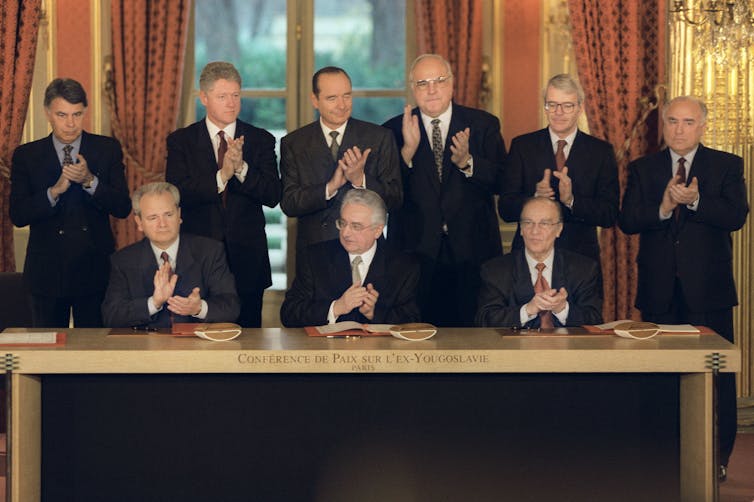
We recently marked the 30th anniversary of the signing, in an air force base in Ohio, of a treaty to bring an end to the appalling conflict in the former Yugoslavia. The Dayton accords was signed on November 21 1995 and again, in a public ceremony in Paris on December 14, by the presidents of Bosnia and Herzegovina, Croatia, and Serbia, bringing to an end three years of bloodshed and ethnic cleansing.
The Dayton accords, signed in December 1995, ended three years of bitter conflict in the Balkans.
International security experts Stefan Wolff of the University of Birmingham and Argyro Kartsonaki of the University of Hamburg see some useful parallels between the peace process in the Balkans and the attempts to bring an end to the war in Ukraine. The first, and arguably most vital, factor at play there was US leadership in Nato, which intervened with bombing missions to force Serbia to the table. There were robust security guarantees put in place and the treaty was a detailed (if imperfect) plan which aimed to ensure hostilities would not resume.
Thirty years on peace has largely held, although it remains tentative and the increasing confidence of Serbian separatists could still cause Bosnia and Herzegovina to disintegrate into its constituent parts, which possible horrific consequences.
But, as Wolff and Kartsonaki conclude, for all Dayton’s imperfections, “even an imperfect agreement may be preferable to an unending, and likely unwinnable, war”.
To Washington, where the focus is on the sequence of events leading up to the first of the US attacks on so-called Venezuelan drug boats in the Caribbean. It was recently alleged in the Washington Post that the US secretary of war, Pete Hegseth, had given an order that there were to be no survivors of the attack on September 2, which killed 11 people – nine in the initial strike on the boat and, we’re told, the remaining two, reportedly as they clung on to the boat radioing for assistance.
The full details of the incident have yet to emerge and, as Hegseth himself has claimed, there is always a lot of confusion in “the fog of war”. That said, the secretary of war has been quick to pass responsibility for the second strike on to the ranking military officer present in the situation room, Admiral Frank M. (Mitch) Bradley.
But in a political climate in which high-ranking former US officers such as Mark Kelly, a former US navy officer and astronaut who is now a Democrat senator, could face prosecution for urging members of the US military not to obey orders that are clearly illegal, this episode is a potential flashpoint.
But in the end this incident should not obscure an arguably more important issue with the US strikes on these Venezuelan boats: international law forbids extrajudicial killing. Andrew Bell and Thomas Gift explain the issues at stake.
Sign up to receive our weekly World Affairs Briefing newsletter from The Conversation UK. Every Thursday we’ll bring you expert analysis of the big stories in international relations.
Le temps en soi n’est pas complexe à saisir : nous le comprenons, malgré notre difficulté à le décrire. Le problème réside dans la formulation : nous n’arrivons pas à définir précisément les limites de la nature du temps, tant sur le plan conceptuel que linguistique.(Donald Wu/Unsplash), CC BY
La nature du temps tourmente les penseurs depuis que les humains essaient de comprendre le monde. Intuitivement, nous savons ce qu’est le temps, mais quand nous souhaitons l’expliquer, notre esprit s’embrouille.
Le théologien saint Augustin d’Hippone, dont les écrits ont influencé la philosophie occidentale, a exposé un paradoxe en tentant de définir le temps il y a plus de 1 600 ans :
« Qu’est-ce donc que le temps ? Si personne ne m’interroge, je le sais ; si je veux répondre à cette demande, je l’ignore. »
Près de mille ans plus tôt, Héraclite d’Éphèse avait proposé une vision pénétrante de ce sujet. Voici ce qu’écrit le philosophe grec classique Platon dans son dialogue intitulé Cratyle :
« Héraclite dit que tout passe, que rien ne subsiste ; et comparant au cours d’un fleuve les choses de ce monde : Jamais, dit-il, vous ne pourrez entrer deux fois dans le même fleuve. »
À première vue, cela peut sembler constituer un autre paradoxe : comment un fleuve peut-il être à la fois le même et un autre ? Mais Héraclite éclaire son affirmation : le fleuve est une chose qui existe et qui change continuellement. Bien qu’il s’agisse du même fleuve, ce sont des eaux différentes qui s’écoulent à chaque instant.
Si le flux constant du fleuve rend la notion claire, cette vision s’applique à tout ce qui existe, y compris la personne qui entre dans le fleuve. Elle reste la même, mais chaque instant où son pied est dans le fleuve est différent.
La question clé n’est pas considérée comme pertinente par la plupart des physiciens. Et ce n’est pas non plus un défi que les philosophes ont réussi à relever.
Le temps en soi n’est pas complexe à saisir : nous le comprenons tous, malgré notre difficulté à le décrire. Comme l’a perçu saint Augustin, le problème réside dans la formulation : nous sommes incapables de définir exactement les limites de la nature du temps, tant sur le plan conceptuel que linguistique.
Plus précisément, les physiciens et les philosophes ont tendance à confondre ce que signifie « exister » et ce que signifie « se produire », traitant les événements comme s’ils existaient. Une fois cette distinction reconnue, le brouillard se dissipe et le paradoxe d’Augustin s’évanouit.
En logique fondamentale, il n’existe pas de véritables paradoxes, mais seulement des déductions qui reposent sur des prémisses pas très bien interprétées.
Peu après qu’Héraclite a tenté de clarifier la notion de temps, Parménide d’Élée est allé dans une tout autre direction. Son raisonnement part d’une prémisse apparemment valable : « Ce qui est, est ; ce qui n’est pas, n’est pas » –, puis introduit subrepticement une hypothèse cruciale. Il affirme que le passé fait partie de la réalité parce qu’il a été vécu, et que l’avenir doit également en faire partie parce que nous l’anticipons.
Parménide en déduit que le passé et l’avenir font partie de « ce qui est » et que toute l’éternité forme un tout continu dans lequel le temps n’est qu’une illusion.
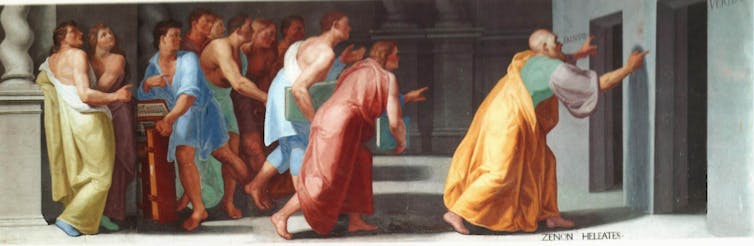
Zénon, disciple de Parménide, a imaginé plusieurs paradoxes pour étayer cette théorie. En termes modernes, il affirmerait que si vous essayiez de marcher d’un bout à l’autre d’un pâté de maisons, vous n’y arriveriez jamais. Pour parcourir un pâté de maisons, il faut d’abord en franchir la moitié, puis la moitié de ce qu’il reste, et ainsi de suite, en divisant toujours par deux la distance restante, sans jamais atteindre la fin.
Le philosophe grec Zénon d’Élée montrant à ses disciples les portes de la vérité et de la fausseté dans une fresque du XVIᵉ siècle à l’Escurial, à Madrid. (El Escorial, Madrid)
On peut évidemment marcher jusqu’au bout du pâté de maisons, et même au-delà, ce qui rend la proposition de Zénon absurde. Son erreur réside dans le fait qu’il élimine le temps de son raisonnement, ne considérant que des configurations spatiales successives. Or, la réduction des distances s’accompagne d’une réduction des intervalles de temps, les deux devenant parallèlement plus courts.
Zénon fixe implicitement le temps total disponible pour le mouvement – tout comme il fixe la distance –, et le paradoxe n’apparaît que parce que le temps a été supprimé. Rétablissons le temps, et la contradiction disparaît.
Parménide commet une erreur similaire lorsqu’il déclare que les événements passés et futurs, c’est-à-dire les choses qui se sont produites ou qui se produiront, existent. Cette hypothèse pose problème, car elle équivaut à la conclusion à laquelle il souhaite parvenir. Son raisonnement est circulaire et aboutit à réaffirmer son hypothèse, mais d’une manière qui semble différente et profonde.
Déjà des milliers d’abonnés à l’infolettre de La Conversation. Et vous ? Abonnez-vous gratuitement à notre infolettre pour mieux comprendre les grands enjeux contemporains.
Modèles d’espace-temps
Un événement est quelque chose qui se produit à un endroit et à un moment précis. Selon la théorie de la relativité d’Albert Einstein, l’espace-temps est un modèle à quatre dimensions qui décrit toutes les occurrences : chaque point est un événement particulier et la séquence continue d’événements associés à un objet forme sa ligne d’univers, c’est-à-dire son trajet dans l’espace et le temps.
Cependant, les événements n’existent pas, ils se produisent. Quand les physiciens et les philosophes parlent de l’espace-temps comme d’une chose qui existe, ils traitent les événements comme des éléments qui existent – la même erreur subtile qui est à l’origine de 25 siècles de confusion.
Cette science décrit un univers tridimensionnel rempli d’étoiles, de planètes et de galaxies qui existent. Au cours de cette existence, l’emplacement de chaque particule à chaque instant constitue un événement spatio-temporel individuel. Depuis la création de l’univers, les événements qui se produisent à chaque instant tracent des lignes d’univers dans un espace-temps à quatre dimensions, une représentation géométrique de tout ce qui se passe au cours de son existence. Ce modèle est utile, mais il ne représente pas une chose qui existe.
Résoudre le paradoxe d’Augustin – le temps est une chose que l’on comprend intuitivement, mais que l’on ne peut décrire – est simple une fois qu’on a identifié la source de la confusion.
Les événements, c’est-à-dire ce qui se produit ou survient, ne sont pas des choses qui existent. Chaque fois que vous entrez dans le fleuve, cela constitue un événement unique. Cela se produit au cours de votre existence et de celle de la rivière. Vous et la rivière existez ; le moment où vous entrez dans la rivière se produit.
Les philosophes se penchent sur le paradoxe du voyage dans le temps depuis plus d’un siècle, mais le concept de base repose sur la même erreur subtile. L’auteur de science-fiction H. G. Wells aborde cette notion au début de son roman La Machine à explorer le temps.
En présentant son idée, le voyageur temporel passe de la description d’objets tridimensionnels, à des objets qui existent, puis à des moments sur une ligne d’univers, pour finalement considérer cette ligne comme quelque chose qui existe.
Cette dernière étape correspond précisément au moment où l’on prend la carte pour le territoire. Une fois qu’on a imaginé l’existence d’une ligne d’univers, ou même l’espace-temps, qu’est-ce qui nous empêche d’imaginer qu’un voyageur puisse s’y déplacer ?
L’occurrence et l’existence sont deux aspects fondamentalement distincts du temps : chacun est essentiel pour le comprendre pleinement, mais ils ne doivent jamais être confondus.
Pendant des millénaires, le fait de percevoir les événements comme des choses qui existent a engendré la confusion qui règne autour du temps. Considérons maintenant le temps à la lumière de cette distinction. Pensons aux choses qui nous entourent, aux diverses histoires de voyage dans le temps et à la physique de l’espace-temps.
Une fois que l’on a reconnu que nous nous trouvons dans univers tridimensionnel existant, rempli d’éléments existants, et que des événements se produisent à chaque instant au cours de cette existence cosmique – cartographiant l’espace-temps sans pour autant être la réalité –, tout s’aligne. Le paradoxe d’Augustin se dissout : le temps n’est plus mystérieux si on arrive à distinguer occurrence et existence.
Daryl Janzen ne travaille pas, ne conseille pas, ne possède pas de parts, ne reçoit pas de fonds d’une organisation qui pourrait tirer profit de cet article, et n’a déclaré aucune autre affiliation que son organisme de recherche.
Le podcast raconte l’histoire de 580 femmes et filles tuées par des hommes au Canada depuis 2020. (Observatoire canadien sur les féminicides pour la justice et la responsabilité), CC BY
Une partie des appels à l’action du balado comprends une pétition demandant au Canada de reconnaître officiellement le crime de féminicide et de l’inclure dans le Code criminel.
Elle ne s’attaque pas à la culture qui favorise le féminicide ;
Elle peut avoir des conséquences imprévues ;
Il est difficile de parvenir à un consensus sur la définition du féminicide ;
Elle n’a pas réduit le nombre de féminicides.
Mais la criminalisation par opposition à la prévention n’est pas une question de choix entre l’un ou l’autre.
Les lois constituent un élément clé d’une approche de santé publique en matière de prévention de la violence. Les lois nationales sur les féminicides s’accompagnent généralement de programmes de prévention, de formations destinées aux forces de l’ordre et de campagnes de sensibilisation du public. La loi italienne, par exemple, prévoit des mesures plus sévères contre les crimes sexistes tels que le harcèlement obsessionnel et la pornographie vengeresse.
Les lois ne constituent pas des réponses isolées. Elles ne sont qu’une partie des réponses multisectorielles à un problème social qui doit inclure le suivi des processus de mise en œuvre et des résultats.
Changer les lois peut changer les cultures
En Italie, certaines militantes féministes se sont plaintes que la loi n’allait pas assez loin, notamment en matière de changement culturel. Au Canada, une avocate féministe suggère qu’il faudrait peut-être « repenser radicalement » toute la question plutôt que de créer une nouvelle infraction dans le Code criminel.
Mais qualifier ce crime de « féminicide » — un terme spécifique au sexe ou au genre — constitue en fait une remise en question radicale dans un climat de neutralité qui masque trop souvent le fardeau disproportionné que supportent les femmes et les filles dans certaines formes de violence masculine.
Les réponses apportées par les États à travers leurs lois reflètent les valeurs culturelles. À l’heure actuelle, ces valeurs considèrent le féminicide comme un problème individuel plutôt que comme le résultat de structures et de processus sociaux fondés sur des inégalités profondément enracinées.
Les lois visant à protéger les femmes peuvent avoir des conséquences imprévues, comme le montre le cas de l’obligation de poursuites judiciaires en cas de violence conjugale. Elle impose à la police de porter plainte si elle a des motifs raisonnables de croire qu’une agression a eu lieu. Et les lois non sexistes peuvent nuire aux femmes, en particulier lorsqu’elles sont appliquées dans un environnement sexiste et raciste.
C’est pourquoi le Canada doit inclure le féminicide dans son Code criminel. Le féminicide n’est pas neutre du point de vue du genre, et le reconnaître officiellement permettra de définir comment et pourquoi les femmes sont tuées par des hommes, ce qui est essentiel pour une prévention efficace.
Certaines recherches suggèrent que les lois sur le féminicide sont inefficaces. Elles n’ont pas permis de réduire le nombre de cas. Mais d’autres soulignent que les lois sur le féminicide ont renforcé la responsabilité et amélioré le signalement, la protection des survivantes et la sensibilisation à toutes les formes de violence sexiste.
Les effets variables d’une loi dépendent du contexte, notamment de qui la connaît, de sa clarté et de sa concision, et de la réactivité des personnes responsables de l’appliquer.
Les lois sur le féminicide ne suffiront pas à elles seules à réduire immédiatement le nombre de femmes tuées par des hommes ou victimes d’autres formes de violence sexiste. Peu de lois ont ce pouvoir. Le principal défi consiste à déterminer si et comment une loi sur le féminicide sera mise en œuvre.
Comme beaucoup d’autres pays, le Canada peut parvenir à un consensus sur la définition du féminicide et élaborer une loi qui conduira à des changements significatifs. Mais cela nécessite des consultations proactives, une volonté politique et des dirigeants à l’écoute.
Les 580 récits présentés dans Too True Crime démontrent clairement et sans ambiguïté que la vie des femmes et des filles en dépend.
Myrna Dawson a déjà reçu des subventions du Conseil de recherches en sciences humaines et du programme des Chaires de recherche du Canada.
Source: The Conversation – USA (3) – By Charles J. Russo, Joseph Panzer Chair in Education and Research Professor of Law, University of Dayton
Students work under posters of the Ten Commandments and the Bill of Rights in a high school classroom in Kyle, Texas, on Oct. 16, 2025.AP Photo/Eric Gay
As disputes rage on over religion’s place in public schools, the Ten Commandments have become a focal point. At least a dozen states have considered proposals that would require the posting of the Ten Commandments in classrooms, with Texas, Louisianaand Arkansas mandating their display in 2024 or 2025.
Challenges led to all three laws being at least partially blocked. Most recently, on Dec. 2, 2025, families in Texas filed a class-action lawsuit seeking to take down displays across the state. Federal trial court judges have already temporarily blocked the law in around two dozen districts. Ongoing appeals from the bills’ supporters, though, seem aimed at overturning a 45-year-old U.S. Supreme Court precedent prohibiting such displays.
As religion and educationlaw researchers, we believe this situation is especially noteworthy because of its timing. In 2022, the Supreme Court adopted a new standard to assess religious freedom cases, which may come into play – and its judgments on religion’s role in public education are perhaps the most religion-friendly they have ever been.
The Ten Commandments and the courts
Controversy over the commandments is not new. In more than a dozen early cases, courts generally upheld laws and policies mandating their recitation in schools. These enactments survived because the Supreme Court did not extend the First Amendment to state laws until 1940.
Litigation over posting the Ten Commandments in schools first reached the Supreme Court in 1980. In Stone v. Graham, the justices invalidated a Kentucky statute requiring displays of the commandments in classrooms. The court reasoned that the law violated the First Amendment’s establishment clause: “Congress shall make no law respecting an establishment of religion.”
At the time, the court applied the first of the three criteria it has since abandoned, known as the “Lemon test,” to evaluate whether governmental action violates the establishment clause. Under this test – which developed from a 1971 Supreme Court decision – governmental actions must have a secular legislative purpose, and their main effect may neither advance nor inhibit religion. In addition, they must avoid excessive entanglement with religion.
In Stone, the justices rejected Kentucky’s argument that the displays served a secular educational purpose. The court disagreed that a small notation on posters describing the Ten Commandments as the “fundamental legal code of Western Civilization and the Common Law of the United States” was sufficient, noting that the posters were “plainly religious in nature.”
Twenty-five years later, in 2005, litigation over public displays of the Ten Commandments returned to the Supreme Court. This time, neither display was in a school.
The first dispute arose in Kentucky, where officials in two counties had erected courthouse displays including the Ten Commandments, the Magna Carta and the Declaration of Independence. The justices limited their order to one dispute, in McCreary County, invalidating the display for violating the establishment clause – largely because it lacked a secular legislative purpose.
On the same day, the Supreme Court reached the opposite result in another case, Van Orden v. Perry. The court permitted a display including the Ten Commandments to remain on the grounds of the Texas Capitol in Austin, where it was one of 17 monuments and 21 historical markers.
A Ten Commandments monument on the grounds of the Texas Capitol in Austin. AP Photo/Eric Gay
Unlike the fairly new displays in Kentucky, the long-standing one in Texas, with the first monument erected in 1891, was built using private funds. The court left the Ten Commandments monument in place because it was a more passive display. The Capitol grounds are spread out over 22 acres, meaning the Ten Commandments were not as readily apparent as if they had been posted in classrooms.
‘Follow God’s law’
More recent controversy started in 2024. Louisiana mandated that the Ten Commandments be posted in public schools, and a federal trial court soon blocked the law. Undeterred, Arkansas and Texas passed similar legislation the following year.
Arkansas Act 573, signed into law in April 2025, obligated officials to display a “durable poster or framed copy” of the Ten Commandments in all state and local government buildings, including public school and college classrooms.
Republican Rep. Alyssa Brown, one of the Arkansas bill’s sponsors, described it as an effort to educate students on how the United States was founded and how the founders framed the Constitution.
“We’re not telling every student they have to believe in this God,” she told a legislative committee, “but we are upholding what those historical documents mean and that historical national motto.”
Arkansas representatives convene in the House chamber at the state Capitol in Little Rock on June 17, 2024. AP Photo/Andrew DeMillo
Texas, meanwhile, adopted a similar law in June 2025.
“It is incumbent on all of us to follow God’s law, and I think we would all be better off if we did,” the bill’s sponsor in the Texas House, Republican Rep. Candy Noble, said during debate.
The “history and tradition test” originated in 2022’s Kennedy v. Bremerton School District, a case about a public high school football coach who prayed on the field at the end of games. The court ruled that school officials could not prevent the coach from praying because it was a personal religious observance protected by the First Amendment’s other religion clause: that the government shall not prohibit the “free exercise” of religion.
The Kennedy case charted a new course on religion’s place in public life. Acknowledging that it “long ago abandoned Lemon and its endorsement test offshoot,” the justices explained that “the Establishment Clause must be interpreted by ‘reference to historical practices and understandings.‘” It remains to be seen how this standard plays out.
Blocked – for now
In August 2025, a federal trial court temporarily barred officials in four school districts from enforcing Arkansas’ law. The court found that the required display would have “forced [students] to engage with” the Ten Commandments, and “perhaps to venerate and obey” them. The court also applied the new historical practices and understandings test, holding that there was no evidence of a tradition to display the Ten Commandments in public schools permanently.
In Louisiana, too, a federal trial court blocked a state statute. The 5th U.S Circuit Court of Appeals initially affirmed that order. However, an en banc panel of the 5th Circuit – meaning all the circuit’s active judges – will rehear the case on Jan. 20, 2026.
The Texas statute’s future is also up in the air. In August 2025, a federal trial court enjoined the law, temporarily stopping it from going into effect in 11 districts. Acknowledging the cases from Arkansas and Louisiana, the judge held that Texas’ law likely violated the First Amendment. The full 5th Circuit will hear oral arguments in January, alongside the Louisiana case.
On Nov. 18, a second federal trial court judge enjoined the Texas law in around a dozen new districts.
Religion’s role
Controversy over the Ten Commandments continues to raise larger questions over the role of religion in public education, if any.
Supporters of such bills seemingly fail to recognize that they cannot impose their religious values in the public sphere. At the same time, some opponents – including Jewish, Christian, Unitarian Universalist, Hindu and nonreligious plaintiffs – do not necessarily wish to remove religion entirely from educational institutions.
These critics want to uphold the principle that, as the Supreme Court has affirmed, the government must demonstrate “neutrality between religion and religion, and between religion and nonreligion.” In other words, critics do not want one religion or religion generally to dominate.
Today’s challenge is to find the balance in public life. We believe the courts and legislatures must avoid sending the message that religion has no place in a free and open society – just as they must not permit one set of values to dominate, as the bills in Arkansas, Louisiana and Texas seem to aspire to do.
How the courts and legislatures balance the rights of the majority and minority in these disputes over the place of the Ten Commandments in public life may go a long way toward shaping the future of religious freedom in American public education.
The authors do not work for, consult, own shares in or receive funding from any company or organization that would benefit from this article, and have disclosed no relevant affiliations beyond their academic appointment.
The Beatles’ song Yesterday was written in what psychologists refer to as the “hypnagogic state”. This is the twilight zone between sleep and wakefulness, when we drowsily linger in a semi-conscious state, experiencing vivid mental images and sounds.
Waking up one morning in early 1965, Paul McCartney became aware of a long complex melody playing inside his head. He jumped straight out of bed, sat down at his piano and picked out the melody on the keys. He quickly found the chords to go with the melody and created some holding phrases (as songwriters call them, before they write proper lyrics) to fit the melody.
Finding it difficult to believe that such a beautiful melody could emerge
spontaneously, McCartney suspected that he was subconsciously plagiarising another composition. As he recalled: “For about a month I went round to people in the music business and asked them whether they had ever heard it before … I thought if no one claimed after a few weeks, then I could have it.” But it turned out to be original.
Many great discoveries and inventions have emerged from the hypnagogic state. The physicist Niels Bohr effectively won the Noble prize while semi-conscious. Drifting off to sleep, he dreamt he saw the nucleus of the atom, with the electrons spinning around it, just like the solar system with the sun and planets – and in this way he “discovered” the structure of the atom.
The sweet spot
Research has shown that the hypnagogic state is a creative “sweet spot.” For example, in a 2021 study, participants in a hypnagogic state were three times more likely to discover the “hidden rule” that could solve a mathematical problem.
Psychologists associate creativity with qualities such as openness to experience and cognitive flexibility. Others have suggested that creativity arises from co-ordination between the cognitive control network of the brain (which deals with planning and problem solving) and the default mode network (which is associated with daydreaming and mind-wandering).
However, in my view, one of the most important theories of creativity is one of the oldest, put forward by the early British psychologist Frederic Myers in 1881. According to Myers, ideas and insights come as a sudden “uprush” from a subliminal mind.
As Myers saw it, our conscious mind is just a small segment of our overall mind, including not only what Sigmund Freud called the unconscious, but also wider and higher levels of consciousness. Ideas may gestate unconsciously for a long time before they emerge into conscious awareness.
This is why it often feels as if ideas come from beyond the mind, as if they are gifted to us. They can come from beyond our conscious mind.
The importance of relaxation
The hypnagogic state is so creative because, as we hover between sleep and wakefulness, the conscious mind is barely active. For a brief period, our mental boundaries are permeable, and there is a chance creative insights and ideas will flow through from the subliminal mind.
In a more general sense, this is why creativity is often associated with relaxation and idleness. When we relax, our conscious minds are usually less active. Often, when we are busy, our minds are full of chattering thoughts, so there is no space for creative insights to flow through.
This is also why meditation is strongly associated with creativity. Research shows that meditation promotes general creative qualities such as openness to experience and cognitive flexibility.
But perhaps even more importantly, meditation quietens and softens the conscious mind, so that we’re more liable to receive inspiration from beyond it. As I point out in my book The Leap, this is why there is a strong connection between spiritual awakening and creativity.
Nurturing the hypnogogic state
Research has found that around 80% of people have experienced the hypnagogic state, and that around a quarter of the population experience it regularly. It is slightly more common in women than men.
It is most likely to occur at the onset of sleep, but can also occur on waking up, or during the day if we become drowsy and zone out of normal consciousness.
Can we use the hypnagogic state to enhance our creativity? It’s certainly possible to linger in the hypnagogic state, as you probably know from Sunday morning lie-ins.
However, one of the difficulties is capturing the ideas that arise. In our drowsiness, we may not feel the impulse to record of our ideas. It’s tempting to tell ourselves before falling back to sleep, “This is such a good idea that it will definitely stick in my mind.” But when we wake up some time later, the idea is gone forever.
However, through mental training, there is no reason why we can’t build up a habit of recording our hypnagogic ideas. The best practice is to keep a pen and paper right on a bedside table. Or for a more contemporary variant, keep your phone beside the bed, with the recording app open.
In fact, this is a practice that Paul McCartney has always followed. He even trained himself to write in the dark for this purpose.
We can also use a technique of “conscious napping” to generate ideas. Whenever the great inventor Thomas Edison was stuck for a solution or new idea, he would allow himself to drift into unconsciousness, while holding a metal ball. As he fell asleep, the ball would clatter to the ground and wake him, when he would often find that a new insight had emerged.
More generally, we should use idleness as a way of cultivating creativity. Don’t think of napping or relaxing as a waste of time. Far from being unproductive, they may lead to the most inspired ideas and insights of our lives.
This article features references to books that have been included for editorial reasons, and may contain links to bookshop.org. If you click on one of the links and go on to buy something from bookshop.org The Conversation UK may earn a commission.
Steve Taylor does not work for, consult, own shares in or receive funding from any company or organisation that would benefit from this article, and has disclosed no relevant affiliations beyond their academic appointment.
Source: The Conversation – UK – By Fabian Pape, Leverhulme Early Career Research Fellow in the School of Social and Political Science, University of Edinburgh
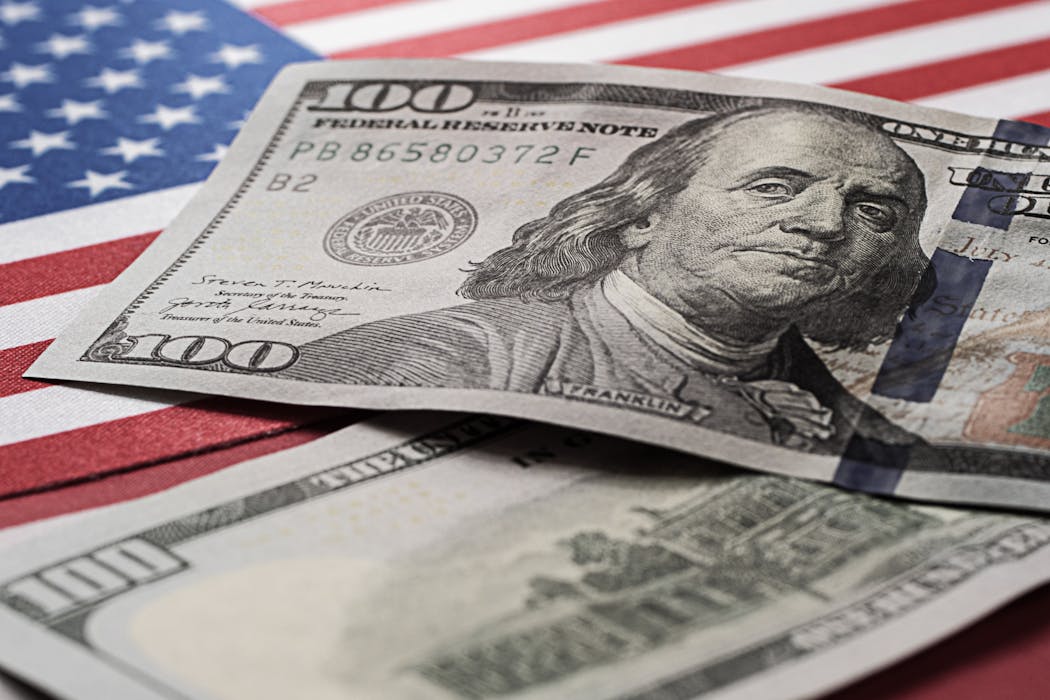
The dominant global financial position of the US and its currency, the dollar, is wobbling under the second Trump administration. AURA88 / Shutterstock
The US has long sat at the centre of the global financial system, with the US dollar serving as the backbone of the world economy. Private investors rely on the dollar as a store of value in times of uncertainty.
Governments and central banks hold dollars to manage the value of their own currencies and as a form of insurance against economic shocks. Key commodities such as oil are also priced in dollars.
This dominant position, which has given the US enormous privileges including the capacity to borrow money cheaply and the ability to use the global financial system as a tool of statecraft, is often explained through the size and stability of US markets and the strength of its institutions. But beneath these economic fundamentals lies something more intangible: trust.
Countries and private financial institutions hold dollars, trade in dollars and borrow in dollars because they trust the US to maintain an open, rules-based international order. They also trust the US to honour contracts, protect property rights and manage the world’s financial plumbing responsibly by acting as an international lender of last resort during periods of crisis.
The dollar system has long had its critics. In the aftermath of the global financial crisis, which occurred between 2007 and 2009, emerging economies faced severe spillovers from US monetary policy and growing exposure to dollar-denominated debt. They also witnessed the increasing use of financial sanctions as a tool of US foreign policy.
China, Russia, India and other countries outside the west began constructing alternative financial infrastructures – new payment systems, currency swap lines and efforts to internationalise their own currencies. What began as a gradual search for some form of protection from US financial power quietly created cracks at the margins of the dollar-based system.
However, nothing has been as disorienting to the global role of the dollar as the second Trump administration’s overt attacks on the liberal international economic order. The imposition of sweeping trade tariffs, as well as efforts to undermine international and domestic institutions, represent a fundamental break with the promise of responsible American financial leadership.
Previous predictions of the dollar’s decline have proved premature. But as we argue in a recently published paper, the erosion of trust in the US as the steward of the liberal international order should be taken seriously. What we are seeing is not the immediate collapse of US financial power, but the beginning of a slow transition towards a fragmented, multipolar – and less predictable – global monetary system.
Rupture of trust
Three developments stand out. First, Washington’s commitment to the liberal economic order under the leadership of Donald Trump is being widely questioned. Rather than acting as the guarantor of open markets, Trump has reframed global trade as a transactional system where countries must “buy down” US tariffs. This means other countries must essentially now buy American Treasuries and other securities in exchange for access to the US market.
Second, surging US debt is increasing doubts about US fiscal stability. The Trump administration’s major tax cuts and spending plans are projected to create persistent deficits of around 6% of GDP, and US government debt has ballooned to record levels. This has prompted foreign central banks to reduce their dollar holdings.
Third, the Trump administration is openly attacking and undermining US government agencies and the country’s central bank, the Federal Reserve. Trump has repeatedly threatened to replace the current Fed chair, Jerome Powell, and dismiss other central bank officials since returning to the White House in January.
Central bank independence is considered a hallmark of credible monetary governance and undermining it raises doubts about whether the US remains a reliable anchor for the global financial system. According to Reuters, European officials are now openly questioning whether the Fed will continue to supply dollars to overseas central banks at times of financial strife.
Taken together, these actions are striking at the core foundation of dollar dominance: the assumption that the US will behave predictably, responsibly and with institutional restraint.
Despite the turbulence, no single currency is ready to replace the dollar. China’s renminbi still lacks open capital markets and strong legal protections, while the euro lacks a unified fiscal authority. New digital currency platforms remain experimental or speculative.
Still, the world is moving towards a more fragmented monetary landscape. Countries are diversifying their reserves into gold and other non-dollar assets. At the same time, regional payment systems are proliferating and dollar-denominated lending to emerging economies is declining.
The global economy is entering a financial interregnum – a period in which the old order is fading but the new one is not yet born. The dollar’s dominance will not vanish overnight as too many institutions and networks still rely on it. But its uncontested supremacy is coming to an end.
A fragmented financial system will reduce US leverage, while also making the global economy more complex and, possibly, more crisis-prone. The dollar is not dead. But the world is slowly preparing for life beyond dollar hegemony, and the second Trump administration may be the catalyst that turns long-running dissatisfaction into systemic change.
Fabian Pape receives funding from the Leverhulme Trust (ECF-2024-367).
Johannes Petry receives funding from German Research Foundation (446618653)
Tobias Pforr received funding from the European Research Council (grant agreement No 884910).
Denis Johnson’s Train Dreams was first published in 2002 as a short story in the Paris Review. When it was reissued as a standalone novella almost a decade later, it was shortlisted for the Pulitzer prize. While the book did not win that year, somewhat strangely neither did anything else – for the first time in 35 years, the panel refused, without explanation, to choose a winner.
I have always liked this story because it brings to life the eerie and unsettling world of the American frontier. Train Dreams is a novella where each event and detail seems significant, fused into a larger tapestry of meaning.
And yet, by the end of the book, the reader struggles to explain exactly what has happened. The effect is one of deep disturbance – somewhere between alienation, curiosity and longing. I imagine it bewitching the Pulitzer panel, stunning them into indecision.
The new movie, adapted and directed by Clint Bentley and now streaming on Netflix, is a beautiful meditation on themes of grief and loss, and a frank account of an important phase in the history of environmental crisis. Whether you’re a fan of Johnson’s writing or have never read him before, you should take the time to watch it.
However, while the film is mostly loyal to Johnson’s plot, it doesn’t take the novella’s risk of refusing explanation or resolution. As such, it loses the spirit of unsettling indirection that comprises the magic of the original.
The trailer for Train Dreams.
Set in the late-19th and early-20th centuries, Train Dreams tells the story of Robert Grainier (played in the film by Joel Edgerton), an orphan-turned-logger who scratches a living together by cutting down trees and building railroads for the emerging US superpower. During one bridge-building job, he is involved in an incident in which an indentured Chinese labourer is wrongly accused of stealing, then punished by mob justice. Grainier’s guilt over his minor involvement in this episode haunts him for the rest of his life.
When a forest fire destroys his isolated log cabin, and his wife and only daughter disappear in the melee, Grainier feels the disaster must be some kind of retribution for his earlier misdeed. As I explore in one of the few academic papers written about Train Dreams, the novella also intimates a structural link between the ecological devastation wrought by industrial civilisation and the accelerating instability of our planetary home.
The film adaptation takes up these themes and makes them impossible to miss. In a world where deaths from forest fires are an annual occurrence, its scenes of smoke-ridden skies and charred landscapes are entirely believable – a matter of routine rather than spectacle. This underlying moral message of climate grief is communicated through exquisite landscape scenes, with felled trees falling through canopies and fire-breathing trains roaring over waterways.
But the film also pulls back from the most unforgiving elements of the novella’s critique. In the adaptation, the one Indigenous character, Kootenai Bob, lives peacefully in the local village. In Johnson’s original, he is swindled, bullied and attacked by white settlers, before being symbolically killed by an oncoming train.
The novella refuses the reader the comfort of decoupling contemporary climate disasters from the long histories of settler colonialism and racial violence that made the American frontier. These issues are still present in the movie, but they are smoothed over into something more palatable for mainstream audiences.
This is not, however, the movie’s greatest betrayal. A strange event haunts the ending of both novella and film, which I can say without spoiling either has to do with Grainier’s missing daughter. The brilliance of Johnson’s original work is that the utter bizarreness of this incident defies any single interpretation, problematising rather than explaining the rest of the story.
The movie maintains some of this ambiguity but ultimately reduces the scene to a dream sequence. It seems neither the boards of Netflix nor the Pulitzer prize could quite stomach the true weirdness of Train Dreams.
Johnson’s title intentionally evokes the righteous promise of the American dream and then disturbs it, blurring the promise of the frontier into an ethereal mirage of hope and sorrow.
The Netflix adaptation drives into these themes and does many of them justice. But whether you have watched the film and enjoyed it or not, I would urge you to pick up a copy of this short book and let it unsettle you. It will take you weeks to shake off the uncanny howling of wolves that rings in your ears after reading.
Looking for something good? Cut through the noise with a carefully curated selection of the latest releases, live events and exhibitions, straight to your inbox every fortnight, on Fridays. Sign up here.
This article features references to books that have been included for editorial reasons, and may contain links to bookshop.org. If you click on one of the links and go on to buy something from bookshop.org The Conversation UK may earn a commission.
Dominic Davies does not work for, consult, own shares in or receive funding from any company or organisation that would benefit from this article, and has disclosed no relevant affiliations beyond their academic appointment.