The Bible says little about Jesus’ childhood – but that didn’t stop medieval Christians from enjoying tales of him as holy ‘rascal’

Source: The Conversation – USA (3) – By Mary Dzon, Associate Professor of English, University of Tennessee
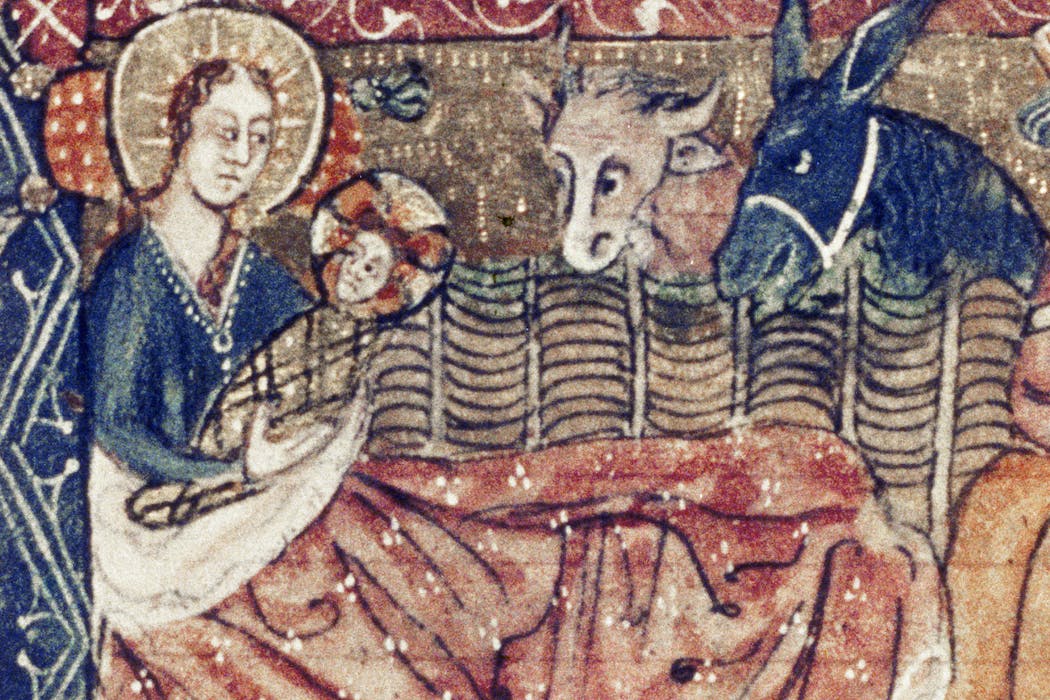
An illustration from the Vernon Manuscript, from around 1400, shows the familiar motif of an ox and ass watching over the newborn Jesus. © Bodleian Libraries, University of Oxford, CC BY-NC

Manger scenes displayed around Christmastime usually feature an ox and an ass beside the infant Jesus. According to the Gospel of Luke, Mary placed her child in a manger – an animal feeding bin – “because there was no room for them in the inn.”

No mere babysitters, the ox and ass harken back to the Book of Isaiah 1:3, a verse early Christians interpreted as a prophecy of the birth of Christ. In some early artwork, these beasts of burden kneel to show their reverence – recognizing this swaddled babe, who entered the world in humble circumstances, as lordly.

The canonical Gospels, the accounts of Jesus’ life included in the Bible’s New Testament, make no mention of those animals welcoming the newborn. Yet the motif was already seen in art from the fourth century. It was further popularized by the Gospel of Pseudo-Matthew, an apocryphal text – that is, one not included in the canon of Scripture. Pseudo-Matthew was composed by an anonymous monk, probably in the seventh century, and includes many tales about Jesus growing up.

After its account of Jesus’ birth, the Bible is almost entirely silent on his childhood. Yet legends about Jesus’ early years circulated widely in the Middle Ages – the focus of my 2017 book. While the detail of the ox and ass is quite familiar to many Christians today, few are aware of the other striking tales transmitted by the apocrypha.

Wonder-worker

A painting with a gold frame and background shows a man and woman with halos talking to a child with a halo, who has his arms crossed.
‘Christ Discovered in the Temple,’ by Simone Martini (1342).
Google Cultural Institute/Walker Art Gallery via Wikimedia Commons

The Bible does include one famous scene from Jesus’ youth: the incident when 12-year-old Jesus stayed behind at the Jewish temple in Jerusalem, unbeknownst to his parents. Searching for him with great anxiety, they find him conversing with religious teachers, both asking questions and astounding them with his answers. Fourteenth-century painter Simone Martini’s “Christ Discovered in the Temple” portrays him standing before his parents with crossed arms – a stubborn youth, apparently unapologetic about making them worry for days.

The apocryphal Gospel of Pseudo-Matthew – especially versions that incorporate material from an even earlier apocryphal gospel, the Infancy Gospel of Thomas – focuses on the years of Jesus’ childhood. Like the temple story, they show the boy Jesus as sometimes difficult and having preternatural wisdom that amazes and even offends his would-be teachers. More dramatically, the apocryphal legends depict Jesus exercising divine power from a very young age.

A small, colorful illustration with a gold background shows two adults and a child with halos, looking into a cave at small blue and green dragons
A 14th-century Italian manuscript shows Jesus fending off dragons to protect his parents.
© Bodleian Libraries, University of Oxford, CC BY-NC

Like the adult Jesus of the New Testament, this apocryphal Christ child often works wonders to help others in need. According to the biblical Gospel of Matthew, Mary and Joseph take the infant Jesus to Egypt after an angel warns in a dream that Herod, King of Judea, would kill the child. In Pseudo-Matthew’s elaboration of this episode, we see Jesus, not yet 2 years old, bravely stand on his feet before dragons emanating from a cave, where his family has stopped to rest.

The terrifying dragons worship him and then depart, while Jesus boldly assures those around him that he is the “perfect man” and can “tame every kind of wild beast.” He later commands a palm tree to bend down so that a weary Mary can partake of its fruits, and he miraculously shortens their journey in the desert.

At times, the Jesus of these legends is largely to blame for the troubles around him. The 14th-century Tring Tiles, now in the British Museum, depict one of Jesus’ friends imprisoned by his father in a tower. Christ pulls him out of a tiny hole, like a gallant medieval knight rescuing a maiden in distress. The father had tried to insulate his son from Jesus’ influence – understandable, considering that many legends show Jesus causing the death of his playmates or other boys who somehow irked him.

In a story summarized by one scholar as “death for a bump,” a boy runs into Jesus. He curses the child, who instantly drops down dead – though Jesus brings him back to life after a brief reprimand from Joseph.

A dark red or brown tile has lighter etchings on it, with scenes of a man standing next to a tower that a child stands atop, and then the child exiting the tower as another figure with a halo looks on.
One section of the Tring Tiles, created in the 14th century, shows Jesus removing his friend from a tower.
© The Trustees of the British Museum, CC BY-NC-SA

In another tale, included in an Anglo-Norman narrative that survives in an illustrated manuscript, Jesus takes off his coat, places it upon a sunbeam and sits upon it. When the other children see this, they “thought they would do the same …. But they were too eager, and they all fell down at once. One and another jumped up quickly onto the sunbeam, but it turned out badly for them, since each one broke his neck.” Jesus heals the boys at his parents’ prompting.

Joseph admits to his neighbors that Jesus “was indeed too wild” and sends him away. The 7-year-old Jesus becomes apprenticed to a dyer, who gives him very precise directions about dyeing three pieces of cloth in three different vats. Once his master has left, Jesus ignores his instructions, throwing all the cloth into one vat – yet still achieves the desired outcome. When the master returns, he at first thinks he has been “ruined by this little rascal,” but then realizes that a wonder has occurred.

An illustration with a red background shows several boys in tunics playing on a large, slide-like structure.
Jesus seated on a sunbeam, while other boys attempt to do so, in a miniature from the Selden Supra 38 manuscript, created in the early 14th century.
© Bodleian Libraries, University of Oxford, CC BY-NC-SA

Bond with animals

These apocryphal legends also show the boy Jesus having power over the animal world. When he enters a dreaded lion’s cave, cubs “ran about around his feet, fawning and playing with him,” while “the older lions … stood at a distance and worshipped him, and wagged their tails before him.” Jesus tells bystanders that the beasts are better than they are, because the animals “recognize and glorify their Lord.”

Indeed, these tales characterize Jesus as a rather haughty boy, conscious of his divinity and not happy with those who treat him as a mere child. At the same time, they depict him as a real child who likes to play. The boy Jesus is childlike in the way he often acts on impulse, not paying much attention to the admonitions of his elders.

An illumination of a pack of lions looking at a young boy with a halo who is stroking a cub outside a cave.
A 14th-century manuscript, the ‘Klosterneuburger Evangelienwerk,’ shows the young Jesus playing with lions.
Schaffhausen City Library via Wikimedia Commons

His affinity for animals, too, makes him seem childlike. Strikingly, beasts in the apocrypha, beginning with the ox and ass, often seem to realize that Jesus is no ordinary child before human characters do.

The legends’ insidious insinuation that many of the Jews around Jesus were not as perceptive as the animals is part of medieval Europe’s widespread antisemitism. In one fifth-century sermon, Quodvultdeus, the bishop of Carthage, asks why the animals’ recognition of Jesus in the manger was not a sufficient sign for the Jews.

A faded manuscript illustration shows the same boy fetching water, tending a fire, and working at a table as a man and woman look on.
The 14th-century Holkham Bible picture book depicts Jesus performing chores at home (London, British Library, Additional MS 47682, fol. 18).
Courtesy British Library

In the Bible, Jesus works his first miracle as an adult, at a wedding feast in Cana. The apocryphal tales, however, toy with the idea of the God-man revealing his power early on. The legends suggest that the childishness of Christ distracted many of those around him, preventing them from concluding that he was the Messiah. This allows the apocrypha to avoid contradicting the Bible’s reference to Jesus as simply “the carpenter’s son,” the opposite of a wonder child.

Each Christmas, modern Christians in the Western world tend to celebrate Jesus’ birthday, then quickly drop the theme of the Christ child. Medieval Christians, in contrast, were fascinated by tales about the Son of God growing up. Despite acting as a dragon tamer, physician and magician, the young Jesus of the apocrypha largely flies under the radar, cloaking his divinity with “little rascal” boyishness.

The Conversation

Mary Dzon does not work for, consult, own shares in or receive funding from any company or organization that would benefit from this article, and has disclosed no relevant affiliations beyond their academic appointment.

ref. The Bible says little about Jesus’ childhood – but that didn’t stop medieval Christians from enjoying tales of him as holy ‘rascal’ – https://theconversation.com/the-bible-says-little-about-jesus-childhood-but-that-didnt-stop-medieval-christians-from-enjoying-tales-of-him-as-holy-rascal-207475

Lily Allen’s West End Girl reflects the idea that women are becoming increasingly disaffected with men

Source: The Conversation – UK – By Kate McNicholas Smith, Senior Lecturer in Screen, University of Westminster

In October 2025, singer-songwriter Lily Allen released her fifth studio album, West End Girl, to great critical acclaim and commercial success. When she announced an album tour, the first dates sold out in just 20 minutes.

Described by the Guardian as “a gobsmacking autopsy of marital betrayal”, West End Girl is a work of “autofiction”, inspired by Allen’s separation from Stranger Things actor David Harbour, his reported affair and the emotional aftermath.

The concept album documents a relationship and its breakdown from Allen’s perspective (or that of her creative “alter ego”). The singer told Vogue that West End Girl refers to things “I experienced within my marriage, but that’s not to say that it’s all gospel.” So far, Harbour has declined to comment or address the issue.

The title track takes us back to what appears to be the couple’s move to a New York brownstone, before the singer is offered the lead role in a London play (when, she reveals, her partner’s demeanour starts to change).

The reference to the brownstone recalls the couple’s 2023 Architectural Digest video (below) featuring their home. Listeners were quick to return to that video in the wake of the album’s release, retrospectively identifying red flags in the couple’s dynamic and what is said to be Harbour’s “toxic” banter. One commentator quipped: “Harbour really made a trailer for his own cheating scandal during the first 20 seconds.”

With Allen and Harbour both well-known figures, it is unsurprising that the revealing album has captured public attention. But this interest goes beyond celebrity gossip: the album has resonated with audiences for its raw contemplation of contemporary heterosexuality.

In track three, Sleepwalking, Allen asks: “Who said romance isn’t dead?” The album’s evocative storytelling skewers the distinctly unromantic experience of a “modern wife”, navigating the conventional dichotomy of women as madonna or whore while reluctantly attempting an open marriage.

While ethical non-monogamy emphasises consent and boundaries, the reported terms of the couple’s arrangement – to be discreet, only with strangers and involving payment – are broken with the now-infamous “Madeline”, a woman referred to in a song of the same name, who is not a stranger. Though the real identity of Madeline was later revealed in the media, Allen had said she was a fictional character.

Meanwhile, the track Dallas Major documents the singer’s re-entry into the world of online dating as a 40-year-old mum to teenage children. “I hate it here,” she states unequivocally.

Over it

Just five days after the release of West End Girl, social commentator Chanté Joseph published a piece in Vogue asking: “Is having a boyfriend embarrassing now?”. The article, which quickly went viral, describes a distancing from public declarations of coupledom in what Joseph calls an era of widespread heterofatalism. Just a few months earlier, an article in The New York Times Magazine used the same concept to bemoan “the trouble with wanting men”.

The term heterofatalism was coined by writer Asa Seresin (initially as heteropessimism) in 2019 to refer to “performative disaffiliations with heterosexuality, usually expressed in the form of regret, embarrassment or hopelessness about straight experience”.

In other words, heterosexual women are expressing dissatisfaction with the ways in which, despite longstanding feminist critiques, gender inequalities persist in romantic relationships. Such expressions might be performative, Seresin suggests, in that they do not lead to change but rather to resignation.

Reasons for disappointment are backed up by data. Research shows, for example, that women do more unpaid care work than men, resulting in time poverty. In the UK, the Office for National Statistics’ analysis of time use data shows that women do more than double the amount of cooking, childcare and housework than men. The COVID pandemic only deepened these existing inequalities.

Domestic abuse remains shockingly common, and disproportionately affects women. According to Refuge, one in four women in England and Wales will experience domestic abuse in their lifetime.

Meanwhile, the rise of the manosphere has seen a proliferation of online misogyny, with concerning implications for romantic relationships. Such platforms are directly referenced in the song 4chan Stan, where Allen invokes the anonymous online forum associated with a troubling incidence of hate speech.

Into this context, social media movements like #boysober have emerged, where women pledge themselves to “no dating apps, no dates, no exes, no hookups”. In South Korea, the 4b movement sees young women similarly rejecting marriage, childbirth, dating and sex – a sentiment taken up by some US women following the re-election of Donald Trump as president in 2024.

While distinctly contemporary in their communication, these sentiments also evoke older ideas – such as the political lesbianism once proposed by second-wave radical feminists. Like political lesbianism, the 4b movement has been critiqued for trans-exclusionary ideas.

Back in 2013, Allen released the single Hard Out Here. The song critiqued the objectification of women within modern pop culture, but the music video objectified women of colour women and was described by cultural critic Cate Young as “a brilliant example of everything wrong with the current climate of white feminism”. Allen apologised for the video in 2016.

Heterofatalism can be similarly limited in its response to gender inequality, failing to recognise intersectionality – the way that different aspects of someone’s experience and identity can overlap to exacerbate inequalities and discrimination.

Nonetheless, these expressions of dissatisfaction might challenge the assumed inevitability of heterosexuality and the gender inequality it all too often reproduces. West End Girl ends on a defiant note, refusing “shame” and recognising “it’s not me, it’s you”.

While the cheating husband might remain “stuck” in his “fruityloop” of heteronormativity and toxic masculinity, for the singer – and those with whom her story resonates – there may be other possibilities.


Looking for something good? Cut through the noise with a carefully curated selection of the latest releases, live events and exhibitions, straight to your inbox every fortnight, on Fridays. Sign up here.


The Conversation

Kate McNicholas Smith does not work for, consult, own shares in or receive funding from any company or organisation that would benefit from this article, and has disclosed no relevant affiliations beyond their academic appointment.

ref. Lily Allen’s West End Girl reflects the idea that women are becoming increasingly disaffected with men – https://theconversation.com/lily-allens-west-end-girl-reflects-the-idea-that-women-are-becoming-increasingly-disaffected-with-men-271864

What is super flu? And other questions answered

Source: The Conversation – UK – By James Hay, Research Fellow, Infectious Diseases Modelling, University of Oxford

Fajar Arifiyanto/Shutterstock.com

The NHS is facing severe pressure this winter as flu cases surge earlier than usual, with some calling it “super flu”. Here’s what you need to know about this year’s flu season and how to protect yourself.

What is ‘super flu’?

Professor Meghana Pandit, NHS national medical director, said: “With record demand for A&E and ambulances and an impending resident doctors strike, this unprecedented wave of super flu is leaving the NHS facing a worst-case scenario for this time of year.”

Although this term has now been repeated frequently in the media, it was not intended as a new scientific designation. Although the flu season began early, both the spread of the virus and the severity of illness remain within what experts consider normal for a flu season.

Influenza viruses are constantly evolving to evade our immune system, which is why the flu vaccine must be updated regularly. Some years the virus mutates more than others, and it typically undergoes a major change every four to five years.

The “subtype” of flu that is dominant this year, called influenza A/H3N2, has been around since 1968 and there have been over a dozen such changes in that time. By this definition, we see “super flu” every few years.

Is the situation in the UK really as bad as some headlines suggest?

The situation isn’t unprecedented – it falls within the range of what scientists would expect in a bad flu season.

Because the season started early, it is misleading to directly compare the number of cases and hospitalisations to the same week in previous years. In fact, the situation is comparable to previous years after taking the early season start into account, as a recent analysis my colleagues and I conducted shows.

Which areas of the UK are worst affected?

The most important consideration from a public health perspective is the burden on healthcare systems in different regions, which is determined by what the virus is doing and what resources are available in those regions.

The available data only provides general infection trends at regional levels. England’s influenza season started earlier than in Scotland, Wales and Northern Ireland, so we might expect the situation to turn earlier in England than elsewhere.

Based on the data for England from the UK Health Security Agency, the north and the Midlands are possibly experiencing higher flu rates – but not significantly so.

Why are we seeing more flu cases in younger people?

Children and teens are more likely to get infected due to their high contact rates in schools, where a lot of spread happens, and also because their immune systems are less experienced at dealing with flu viruses.

Adults are less likely to become infected overall, as they typically have lower contact rates and their immune systems have more experience with influenza. However, people over 64 are more likely to have existing health conditions that put them at higher risk of severe illness if they do become infected, and their immune systems have started to weaken in a process called immunosenescence.

Babies are also at greater risk of severe illness as their immune systems are still undeveloped.

People of a similar age tend to have been infected with similar flu viruses, which might explain why certain age groups are more affected by flu than others in some seasons. It might be that the virus this year happens to have found an immunity gap in children that isn’t present in other age groups.

Vaccine effectiveness is lower for older people, so should they still get the jab?

The latest data shows that the flu vaccine reduces the risk of being hospitalised with flu by about 30 to 40% in older people. That’s lower than vaccines against some other viruses, but similar to previous years for flu.

The recommendations this year are therefore unchanged: vaccination is still the best thing you can do to protect yourself and help reduce the burden on the NHS.

Why does the vaccine have different effectiveness in different age groups?

This season’s vaccines are offering effective protection against severe flu. Children are around 70 to 75% less likely to attend or be admitted to hospital with flu if vaccinated, and, as mentioned above, adults are around 30 to 40% less likely to attend or be admitted.

Children are offered a nasal spray, whereas adults are given an injection. Studies have shown that the nasal spray vaccine works better in children and less well in adults, which is why the recommendations are different. So one reason for the difference is that we are comparing estimates from different vaccines as well as different age groups.

Another reason is differences in existing immunity. Adults have already been exposed to many flu viruses over their lives, so the incremental gain of one extra vaccine is probably smaller – but still beneficial – than for a child.

What should I do if I think I’ve caught it: call 111, stay home, or go to A&E?

Stay home if you are sick, rest, and take sensible precautions to avoid spreading the virus to others. Getting influenza is very unpleasant, but everyone will get it roughly once every five years. In the vast majority of cases, people get better on their own, without any medical treatment.

Are there test kits (lateral flow) I can buy at the pharmacy, as there were for COVID?

Yes, very similar tests exist for the flu and you can buy these at pharmacies and online. Although it’s interesting to know if it’s influenza or some other virus that is making you sick, if you have flu symptoms the advice is the same regardless of which virus caused it.

Is it too late to get the vaccine – given that it takes two weeks for the vaccine to properly kick in?

No, it’s not too late, and the sooner the better! Even after the epidemic has peaked, it will take a few months before cases reach low levels again. There is still a risk of infection in that time, so any extra protection from the vaccine is still helpful.

The Conversation

James Hay receives funding from the Wellcome Trust (grant 225001/Z/22/Z).

ref. What is super flu? And other questions answered – https://theconversation.com/what-is-super-flu-and-other-questions-answered-271959

Lily Allen’s West End Girl reflects the idea women are becoming increasingly disaffected with men

Source: The Conversation – UK – By Kate McNicholas Smith, Senior Lecturer in Screen, University of Westminster

In October 2025, singer-songwriter Lily Allen released her fifth studio album, West End Girl, to great critical acclaim and commercial success. When she announced an album tour, the first dates sold out in just 20 minutes.

Described by the Guardian as “a gobsmacking autopsy of marital betrayal”, West End Girl is a work of “autofiction”, inspired by Allen’s separation from Stranger Things actor David Harbour, his reported affair and the emotional aftermath.

The concept album documents a relationship and its breakdown from Allen’s perspective (or that of her creative “alter ego”). The singer told Vogue that West End Girl refers to things “I experienced within my marriage, but that’s not to say that it’s all gospel.” So far, Harbour has declined to comment or address the issue.

The title track takes us back to what appears to be the couple’s move to a New York brownstone, before the singer is offered the lead role in a London play (when, she reveals, her partner’s demeanour starts to change).

The reference to the brownstone recalls the couple’s 2023 Architectural Digest video (below) featuring their home. Listeners were quick to return to that video in the wake of the album’s release, retrospectively identifying red flags in the couple’s dynamic and what is said to be Harbour’s “toxic” banter. One commentator quipped: “Harbour really made a trailer for his own cheating scandal during the first 20 seconds.”

With Allen and Harbour both well-known figures, it is unsurprising that the revealing album has captured public attention. But this interest goes beyond celebrity gossip: the album has resonated with audiences for its raw contemplation of contemporary heterosexuality.

In track three, Sleepwalking, Allen asks: “Who said romance isn’t dead?” The album’s evocative storytelling skewers the distinctly unromantic experience of a “modern wife”, navigating the conventional dichotomy of women as madonna or whore while reluctantly attempting an open marriage.

While ethical non-monogamy emphasises consent and boundaries, the reported terms of the couple’s arrangement – to be discreet, only with strangers and involving payment – are broken with the now-infamous “Madeline”, a woman referred to in a song of the same name, who is not a stranger. Though the real identity of Madeline was later revealed in the media, Allen had said she was a fictional character.

Meanwhile, the track Dallas Major documents the singer’s re-entry into the world of online dating as a 40-year-old mum to teenage children. “I hate it here,” she states unequivocally.

Over it

Just five days after the release of West End Girl, social commentator Chanté Joseph published a piece in Vogue asking: “Is having a boyfriend embarrassing now?”. The article, which quickly went viral, describes a distancing from public declarations of coupledom in what Joseph calls an era of widespread heterofatalism. Just a few months earlier, an article in The New York Times Magazine used the same concept to bemoan “the trouble with wanting men”.

The term heterofatalism was coined by writer Asa Seresin (initially as heteropessimism) in 2019 to refer to “performative disaffiliations with heterosexuality, usually expressed in the form of regret, embarrassment or hopelessness about straight experience”.

In other words, heterosexual women are expressing dissatisfaction with the ways in which, despite longstanding feminist critiques, gender inequalities persist in romantic relationships. Such expressions might be performative, Seresin suggests, in that they do not lead to change but rather to resignation.

Reasons for disappointment are backed up by data. Research shows, for example, that women do more unpaid care work than men, resulting in time poverty. In the UK, the Office for National Statistics’ analysis of time use data shows that women do more than double the amount of cooking, childcare and housework than men. The COVID pandemic only deepened these existing inequalities.

Domestic abuse remains shockingly common, and disproportionately affects women. According to Refuge, one in four women in England and Wales will experience domestic abuse in their lifetime.

Meanwhile, the rise of the manosphere has seen a proliferation of online misogyny, with concerning implications for romantic relationships. Such platforms are directly referenced in the song 4chan Stan, where Allen invokes the anonymous online forum associated with a troubling incidence of hate speech.

Into this context, social media movements like #boysober have emerged, where women pledge themselves to “no dating apps, no dates, no exes, no hookups”. In South Korea, the 4b movement sees young women similarly rejecting marriage, childbirth, dating and sex – a sentiment taken up by some US women following the re-election of Donald Trump as president in 2024.

While distinctly contemporary in their communication, these sentiments also evoke older ideas – such as the political lesbianism once proposed by second-wave radical feminists. Like political lesbianism, the 4b movement has been critiqued for trans-exclusionary ideas.

Back in 2013, Allen released the single Hard Out Here. The song critiqued the objectification of women within modern pop culture, but the music video objectified women of colour women and was described by cultural critic Cate Young as “a brilliant example of everything wrong with the current climate of white feminism”. Allen apologised for the video in 2016.

Heterofatalism can be similarly limited in its response to gender inequality, failing to recognise intersectionality – the way that different aspects of someone’s experience and identity can overlap to exacerbate inequalities and discrimination.

Nonetheless, these expressions of dissatisfaction might challenge the assumed inevitability of heterosexuality and the gender inequality it all too often reproduces. West End Girl ends on a defiant note, refusing “shame” and recognising “it’s not me, it’s you”.

While the cheating husband might remain “stuck” in his “fruityloop” of heteronormativity and toxic masculinity, for the singer – and those with whom her story resonates – there may be other possibilities.


Looking for something good? Cut through the noise with a carefully curated selection of the latest releases, live events and exhibitions, straight to your inbox every fortnight, on Fridays. Sign up here.


The Conversation

Kate McNicholas Smith does not work for, consult, own shares in or receive funding from any company or organisation that would benefit from this article, and has disclosed no relevant affiliations beyond their academic appointment.

ref. Lily Allen’s West End Girl reflects the idea women are becoming increasingly disaffected with men – https://theconversation.com/lily-allens-west-end-girl-reflects-the-idea-women-are-becoming-increasingly-disaffected-with-men-271864

Por qué la obesidad es, ante todo, una enfermedad del cerebro

Source: The Conversation – (in Spanish) – By Rosalia Rodriguez Rodriguez, Catedrática. Departamento de Ciencias Biomédicas, Universitat Internacional de Catalunya

La obesidad empieza en el cerebro y hoy sabemos que su desarrollo –y su tratamiento– no es igual en hombres y mujeres. Esta pandemia silenciosa, que avanza junto con la diabetes tipo 2 como una de sus complicaciones principales, afecta ya a más de mil millones de personas.

Mientras nuestro entorno se vuelve cada vez más obesogénico, el cerebro sigue funcionando con reglas ancestrales que dificultan mantener la pérdida de peso, incluso con fármacos tan revolucionarios como la semaglutida (Ozempic). Este cambio de mirada está transformando los tratamientos actuales y abriendo la puerta a nuevas terapias dirigidas directamente al cerebro.

Un cerebro ancestral en un entorno moderno

La obesidad y el sobrepeso suelen describirse como un exceso de grasa o un problema metabólico, pero su origen profundo reside en el sistema nervioso central, especialmente en el hipotálamo, la región que actúa como un “termostato energético”. Durante el 95 % de nuestra historia evolutiva hemos vivido en escasez: caminar, cazar y recolectar era imprescindible, y el cerebro desarrolló mecanismos muy eficaces para defender la masa grasa, porque perderla podía significar no sobrevivir.

Ese “cerebro ancestral” opera hoy en un entorno absolutamente opuesto: alimentos hipercalóricos disponibles 24 horas, sedentarismo, estrés crónico, alteraciones del sueño y dietas ultraprocesadas. El resultado es un desajuste entre nuestra biología y nuestro estilo de vida, amplificado en personas con predisposición genética. A ello se suma algo que la investigación empieza a explorar con claridad: el sistema que regula el peso no funciona igual en hombres y en mujeres.

Hipotálamo: donde empieza la obesidad

El hipotálamo integra señales hormonales (como leptina o insulina), metabólicas y sensoriales para equilibrar la energía ingerida y la gastada. Cuando perdemos peso, el cerebro interpreta la situación como una amenaza y activa potentes mecanismos de defensa: aumenta el apetito, reduce el gasto energético y refuerza una “memoria metabólica u obesogénica” que empuja a recuperar el peso previo.

Por eso, aunque la dieta y el ejercicio son esenciales para la salud y deben ser siempre la primera intervención, en muchas personas no bastan para revertir la obesidad cuando los circuitos cerebrales ya están alterados. Este punto no invalida el beneficio del estilo de vida: simplemente reconoce que, en ciertos casos, el cerebro necesita apoyo farmacológico para salir del bucle obesogénico.

Cuando el hipotálamo se inflama –por estrés, dietas hipercalóricas, falta de sueño, alteraciones hormonales o susceptibilidad genética– se altera la actividad de las neuronas que regulan el hambre y la saciedad. Algunas personas logran volver espontáneamente al peso inicial tras una sobrealimentación; otras, en cambio, muestran un “freno hipotalámico” menos eficaz y acumulan peso con más facilidad. La diferencia está en el cerebro.

Perspectiva de género: dos cerebros, dos respuestas

Las neuronas hipotalámicas AgRP (que estimulan el hambre) y POMC (que promueven la saciedad) regulan de forma precisa el comportamiento alimentario. Sin embargo, el hipotálamo no es solo un conjunto de neuronas: también incluye microglía, las células inmunitarias del cerebro, cuyo papel se ha revelado determinante.
En nuestro grupo hemos descrito tres fases de activación microglial en las primeras etapas de la sobrealimentación:

  1. Una activación temprana, rápida y reversible.

  2. Una fase inflamatoria sostenida, que altera los circuitos de saciedad.

  3. Una fase de desregulación final, en la que fallan los mecanismos que deberían limitar la ganancia de peso.

Estas fases no se comportan igual en hombres y mujeres. En modelos de roedores, las hembras muestran una respuesta neuroinmune más estable y protectora, lo que podría explicar por qué desarrollan obesidad más tarde. Este patrón recuerda a lo que se observa en mujeres premenopáusicas. Antes de la menopausia, las mujeres tienen menor riesgo de enfermedades metabólicas y cardiovasculares que los hombres, gracias al efecto protector de los estrógenos. Pero la protección disminuye en la perimenopausia y la menopausia, un periodo todavía muy poco estudiado y crítico para el riesgo cardiometabólico.

Además, en modelos animales y cultivos celulares hemos detectado alteraciones muy tempranas –en microglía, en señales lipídicas como los endocannabinoides y en la sensibilidad neuronal a la insulina– incluso antes de que aparezcan cambios visibles en tejidos periféricos. Esto sugiere que el detonante inicial de la obesidad es cerebral. Integrar esta perspectiva de género resulta esencial para avanzar hacia tratamientos más precisos y efectivos.

Nuevas terapias contra la obesidad: incretinas y nanomedicina dirigida al cerebro

El tratamiento de la obesidad ha cambiado de manera drástica desde 2021 con los agonistas del receptor GLP-1. La semaglutida y otros fármacos de la familia de las incretinas, desarrollados inicialmente para la diabetes tipo 2, demostraron una notable capacidad de reducir peso mediante acciones tanto periféricas como centrales. Sin embargo, presentan limitaciones conocidas: efectos gastrointestinales, pérdida de masa magra, recuperación del peso tras suspenderlos o respuestas variables según el perfil biológico del paciente.

Estudios recientes muestran, además, diferencias por sexo: las mujeres premenopáusicas tienden a responder mejor a estos tratamientos que los hombres.

Esto plantea un desafío: necesitamos terapias que actúen directamente sobre el cerebro, con mayor precisión y menos efectos sistémicos. Aquí es donde la nanomedicina dirigida al cerebro abre un nuevo horizonte. En nuestro grupo desarrollamos nanoplataformas (micelas poliméricas, nanopartículas proteicas o formulaciones intranasales) capaces de transportar fármacos de forma selectiva al cerebro. Estas tecnologías permiten encapsular moléculas que, administradas sin protección, serían ineficaces o tóxicas, y dirigirlas a las células que controlan el apetito y la homeostasis energética.

Estas aproximaciones podrían complementar o potenciar las incretinas, reducir efectos secundarios, mejorar la adherencia y ampliar el número de pacientes que responden. Representan una vía para tratar la obesidad desde su origen cerebral, con intervenciones más personalizadas y sostenibles.

Una nueva mirada para un viejo problema

La obesidad no es un fallo de voluntad, como está estigmatizado a nivel social, ni un problema individual. Es una enfermedad compleja con raíces profundas en un cerebro adaptado para sobrevivir en la escasez. Abordarla requiere un doble enfoque: promover estilos de vida saludables y, cuando es necesario, utilizar terapias que actúen sobre los circuitos cerebrales que regulan el peso.

Comprender cómo funciona –y cómo falla– el hipotálamo será clave para frenar la pandemia silenciosa del siglo XXI. Y es ahí, en el cerebro, donde se está librando la batalla científica más prometedora.

The Conversation

Rosalia Rodriguez Rodriguez recibe fondos de Ministerio de Ciencia, Innovación y Universidades, de AGAUR-Generalitat de Catalunya (PRODUCTE, INNOVADORS), y del Centro de Investigación Biomédica en Red-Obesidad (CIBER-Obn)

ref. Por qué la obesidad es, ante todo, una enfermedad del cerebro – https://theconversation.com/por-que-la-obesidad-es-ante-todo-una-enfermedad-del-cerebro-270380

Who owns your chicken? We’ve mapped the corporate power behind the world’s favourite meat

Source: The Conversation – UK – By Ambarish Karamchedu, Lecturer in International Development, King’s College London

When you next bite into a chicken sandwich, consider this: 2,400 of these birds are being slaughtered somewhere in the world every second. From street stalls in Mumbai to supermarkets in Beijing, chicken has become the world’s most consumed meat. In 2023 alone, humans slaughtered an astonishing 76 billion chickens.

This didn’t arise naturally. It is the result of a system of industrial efficiency, designed by corporations to maximise profits from the birds.

The industry’s complexity often obscures who actually pulls the strings. But our new research maps, for the first time, the previously unpublicised architecture of chicken production, revealing an industry dominated by a handful of firms and their financial backers.

Feed represents up to 70% of meat production costs. That’s why firms have transformed chickens into living machines for converting feed into meat, faster than any other land animal.

The average broiler chicken is five times heavier than in the 1950s, while the time it takes to reach slaughter weight has been slashed by two-thirds. These birds grow so fast their skeletons and organs cannot keep pace, leaving them in chronic pain until their premature death.

Industrial chicken farming also devours resources. It consumes 27% of global soybean production and nearly 20% of the world’s corn – driving deforestation, pesticide use, and biodiversity loss in some of the planet’s most fragile ecosystems.

Who controls the chicken?

Our research found that 376 companies produced 75% of the world’s chicken in 2023. The top ten companies made up 28% of production, dominated by firms from Brazil, China and the US.

Our work focused in particular on four emerging countries – Brazil, Mexico, India and China.

In Brazil, JBS reigns supreme. As the world’s largest meat producer, it slaughtered 4.1 billion chickens in 2024 – about 9% of global production. Its dominance is underwritten by US asset managers, alongside pension funds and international investors. Its main rival, BRF, is also supported by Wall Street players.

Mexico tells a similar tale. Industrias Bachoco, still largely family-owned, competes with Pilgrim’s de Mexico, a subsidiary of JBS.

In India, production is dominated by private firms such as Suguna, which owes much of its growth to the International Finance Corporation (IFC), the World Bank’s investment arm. Between 2006 and 2020, the IFC invested US$96 million (£71 million) to help Suguna expand across South Asia and Africa.

China’s industry is more fragmented. Nineteen companies, many of them publicly traded, slaughtered 7.2 billion chickens in 2024. American agribusiness Cargill is a major player in China.

(Cargill is currently fighting a legal action in the UK over claims its chicken farms polluted the River Wye. The company denies the allegations).

Industrial chicken has fed millions of people globally at “cheap” prices. It has made chicken the most common meat on earth. Yet the system is not controlled by farmers or countries. It is controlled by a small group of corporations, and the financial institutions that bankroll them.

This concentration of power tends to undermine food sovereignty, leaving countries dependent on foreign corporations for staple protein. It risks perpetuating animal suffering by prioritising speed and profit over welfare. And it fuels ecological destruction, as vast amounts of crops, land and water are diverted to meat production.

Taking back control

Industrial chicken production is a clear example of how global finance and corporate power can reshape something as basic as food into a vehicle for profit, despite the cost to animals, people, or the planet. Yet the same concentration that makes the system so destructive also makes it vulnerable. A small number of firms and investors hold the keys.

If people want a food system that values justice, sustainability and compassion, they’ll need to wrest control back from the corporations that currently dictate its terms. Pressure can come from shareholders demanding better welfare and environmental standards; from investigative journalists and lawyers exposing allegations of corporate wrongdoing; from lawmakers better regulating the food industry; and from changes in our own consumption.

Ultimately, the best way to end the suffering of broiler chickens is to eliminate industrial farming altogether. This is won’t happen overnight, but – much like the transition from fossil fuels to renewables – can be achieved through a managed, gradual shift that keeps all the moving parts working together.

The most realistic path forward would be to reduce both the production and consumption of chicken meat, while accelerating the development of lab-grown alternatives. This transition would be supported by reducing subsidies for the industrial chicken sector while investing in new industries and in retraining farmers and other meat industry workers.

This would be good news for chicken, but would mean humans radically confronting our own consumption – and accepting that, ultimately, there will be less chicken available for us to eat.

All this is complicated by the fact that chicken on your plate is the endpoint of a global chain of decisions that shows who really holds power in our world. The question is: who do we want making these decisions – big corporations, or all of us?

The Conversation

Ambarish Karamchedu received funding from the Tiny Beam Fund Burning Questions Fellowship from the Tiny Beam Fund, a US non-profit, to conduct this research.

Benjamin Coles received funding from the Tiny Beam Fund Burning Questions Fellowship from the Tiny Beam Fund, a US non-profit, to conduct this research.

ref. Who owns your chicken? We’ve mapped the corporate power behind the world’s favourite meat – https://theconversation.com/who-owns-your-chicken-weve-mapped-the-corporate-power-behind-the-worlds-favourite-meat-267486

The quiet rise in the tax burden for UK businesses will hit workers and consumers too

Source: The Conversation – UK – By Jagannadha Pawan Tamvada, Professor of Entrepreneurship, Kingston University

William Barton/Shutterstock

Many businesses in the UK saw the 2025 budget as a tightening of the screw in a period of already difficult conditions. While the government insists it is not raising taxes on companies overall, disquiet among businesses could have an impact on jobs, wages and the wider economy.

It’s true that corporation tax (paid by businesses on their profits) will stay at 25%. But other moves are coming. From April 2026, changes to tax allowances that companies can claim on plant and machinery are expected to increase the tax take by more than £1 billion in the first year.

Things such as equipment, vehicles and office fixtures qualify for this allowance, and it means businesses can reduce their tax bill as the value of their assets depreciates. This allowance will fall from 18% to 14% in 2026.

And hospitality and retail firms have complained that changes to business rates (levied on commercial premises) could raise their annual costs by tens of thousands of pounds.

The reduction of income-tax relief for venture capital trusts (VCTs) risks making it costlier for young ambitious businesses to secure money from venture capitalists to help them grow. Tax relief for VCTs will now fall from 30% to 20%, meaning some may choose to back less risky ventures.

And from 2029, national insurance exemptions on salary-sacrificed pension contributions will be capped. This will affect nearly 290,000 employers and act as an ongoing cost increase for firms that use these schemes.

The problem for a government that wants to encourage growth but also needs to raise revenues is that increased taxes on businesses can dampen future investment.

Even if headline corporation tax is unchanged, the mix of allowance cuts, higher employment taxes and sector-specific hits (on pubs, for example) is likely to feed a “tax-raising, not pro-growth” narrative in the business community. And evidence suggests that higher effective corporate tax rates are associated with lower business investment.

For example, dropping the main rate of capital allowance on plant and machinery from 18% to 14% means these investments take longer to pay for themselves. While this is a net revenue-raising move for government, business can perceive this as policy that is tough on productive investment.

The autumn budget relied heavily on fiscal drag (frozen income-tax and national insurance contribution thresholds) and a series of smaller revenue-raisers like the pension salary-sacrifice cap. For the government, there is the risk that this creates a fear that it will keep coming back to “small print” tax measures.

And of course not all businesses will be able to absorb extra costs – many will look to pass these on to their customers. Sectors with thin profit margins (such as pubs, hospitality and small retailers) are warning that business-rate hikes plus higher wage bills force them either to push up prices or cut service and headcount.

While firms with more power will try to raise prices, more squeezed firms may hold prices but trim pay growth or hiring. This aligns with evidence that suggests consumers and workers are most affected by increases in business taxes.

Substituting workers with AI

Other evidence suggests that firms in high-wage sectors and countries adopt more AI, both to replace tasks and to make workers more productive. As the cost of labour rises, businesses are likely to have a stronger incentive to automate. This has already been a trend during periods of cost pressure or downturn – explicitly as a substitute for expensive labour.

As such, it makes financial sense for firms, especially large, capital-rich ones, to respond by increasing spend on AI tools that automate white-collar tasks such as accounting, human resources, marketing and customer support. And they may also choose to offshore or digitise back-office functions where UK labour is now relatively costly.

Without parallel policies to enhance AI skills, retraining and investment allowances for tech that complements labour, the government may be nudging firms towards automation and offshoring. This, of course, can reduce the domestic tax base over time.

queue of people waiting to be served in a shop or cafe
Higher wage bills could leave businesses trying to get by with fewer workers.
ilovephoto_KA/Shutterstock

When it comes to the super-rich, reports of an exodus from Britain may be exaggerated. But billionaire steel magnate Lakshmi Mittal did leave the UK just before the budget was announced, reportedly for tax purposes. And the founders of tech firm Improbable and fintech giant Revolut announced plans to do the same thing earlier in the year.

A small number of very wealthy individuals leaving won’t collapse the economy, but a policy mix seen as hostile to entrepreneurship can, at the margins, reduce the UK’s attractiveness as a base for high-growth founders and investors.

Think tanks, including the Adam Smith Institute, highlight that the people who leave tend to be “liquid millionaires” – founders who have sold businesses and are mobile. If too many of that very specific group leave the country, the UK could lose the mentoring networks, angel capital and soft power shoring up its “entrepreneurial ecosystem”.

This could lead to a slow erosion of the UK’s reputation as a place where ambitious and entrepreneurial people want to build things.

To restore trust that the government is not just pro-welfare but also pro-business, it should publish a multi-year tax roadmap for businesses, limiting surprise “salami-slice” changes. It could also offer incentives for firms using AI that complements workers – for example, through tax relief for AI systems that augment workers and job quality.

And to have a broad-based approach to wealth creation, it should support youth and student entrepreneurship and innovation. This could shift the narrative back to business creation, growth and prosperity.

The Conversation

Jagannadha Pawan Tamvada does not work for, consult, own shares in or receive funding from any company or organisation that would benefit from this article, and has disclosed no relevant affiliations beyond their academic appointment.

ref. The quiet rise in the tax burden for UK businesses will hit workers and consumers too – https://theconversation.com/the-quiet-rise-in-the-tax-burden-for-uk-businesses-will-hit-workers-and-consumers-too-271965

Persuasion, Paddington and Patti Smith: what to listen to, read, see, and sing along to this week

Source: The Conversation – UK – By Jane Wright, Commissioning Editor, Arts & Culture, The Conversation

Subject line: A second chance for Austen’s most melancholy heroine

This week saw the launch of the final episode of our hit podcast Jane Austen’s Paper Trail (although a bonus Q&A episode is coming in January for any Austen fans experiencing withdrawal).

Episode six is devoted to Austen’s last novel – and my favourite – Persuasion, which tells the story of lovelorn Anne Elliot who has missed her chance of happiness after being persuaded to give up the man she loves for lack of wealth and prospects. Seven years later, Anne is still pining and aching with regret, when Frederick Wentworth re-enters her life as a rich and successful naval captain.

Considered Austen’s most melancholy novel, it is little wonder one of our academic experts, John Mullan, states in the podcast: “If you’re under 40 your favourite Austen novel is Pride & Prejudice, after 40, it’s Persuasion.” It is a novel that resonates with those who have experienced the pain of loss and heartbreak.

More widely, the episode asks the question: was Jane Austen happy? As she remained a lifelong spinster, many might assume not. But this groundbreaking writer was a woman of substance, someone who filled her life with meaning through interests, friendships, socialising, travel, and most of all, a purpose.

I travelled to Lyme Regis with Nada Sadaaoui of Northumbria University to ponder this question on the very spot where the pivotal scene of Persuasion takes place: on the Cobb, a wide limestone breakwater that snakes out into the English Channel.

It is here in the novel that Anne and her captain reignite the spark of their love. And it was here we sat buffeted by the wind, listening to the waves and the cries of the gulls, imagining Austen herself walking here, exhilarated by the sense of freedom bestowed by the elements.

As Nada explains, walking alone for women in the early 19th century was a simple but radical act, a rare chance to be unshackled from men, chaperones and expectations. To feel invigorated, alive and most of all, free. It was a wonderful day spent by the seaside with this enthusiastic young academic thrilled to be walking in the footsteps of Jane Austen.

Question

As we come to our final podcast episode, having explored themes of love, romance, friendship, politics, and happiness in the life and work of Jane Austen, we’re curious to know: which is your favourite Austen novel?

a) Sense and Sensibility

b) Pride and Prejudice

c) Mansfield Park

d) Emma

e) Northanger Abbey

f) Persuasion

Eternal love and bear necessities

Who would you choose to spend the afterlife with? This is a question explored in the new romcom Eternity in which Joan (Elizabeth Olsen) has to choose between two husbands, the grumpy old one, Larry (Miles Teller) with whom she spent most of her life, and the handsome chiselled one, Luke (Callum Turner), who died young a war hero. (Luckily, in eternity your looks are restored to the period when you were happiest.) Who should Joan pick and why? We invited philosophy academic Tony Milligan to give his take exploring what really matters when it comes to love.

Twenty-nine children’s books and three movies later, our favourite little Peruvian finally becomes an all-singing, all-dancing bear in Paddington the Musical, currently delighting audiences in London’s West End. Fortuitously, we sent professor of Greek Culture Emma Stafford to review it and, by Zeus, she has decreed that Paddington is actually a hero in the classical mould, bearing comparison with the likes of Aeneas and Odysseus. Armed with his bear necessities – a trusty marmalade sarnie and a truly terrifying stare – our plucky little hero completes his journey with a real family, spreading his message of love and tolerance this Christmas.

Beauty and sorrow

Patti Smith has just published her latest memoir Bread of Angels at the age of 78, which took her a decade to write, “grappling with the beauty and sorrow of a lifetime”. This eloquently told story charts a life filled with adversity, creativity, tragedy and loss, but, says our reviewer Julia Toppin, “to read how Patti Smith has endured while staying true to herself is an uplifting experience”.

Now streaming on Netflix, Train Dreams is a new film adapted from the unsettling novella of the same name by Dennis Johnson, charting the frontier days and settler colonialism that shaped the building of America as it emerged as a superpower. Clint Bentley’s film revolves around a man haunted by regret, and is a stunning meditation on grief and loss – and an important account of the early days of environmental crisis, when huge swaths of forest were decimated to build America’s railroads.

Something good to read

Who doesn’t love a nice glass of mulled wine this time of year? This deeply warming tipple spiced with cinnamon, ginger, nutmeg and cloves has become synonymous with the Christmas period, but did you know it was brought to our shores by the Romans? Or that it is mentioned in the biblical poem, the Song of Solomon, and in Chaucer’s Canterbury Tales? Discover more fascinating facts about mulled wine as we take you through the history of this fine festive drink which is now firmly associated with yuletide thanks to Charles Dickens’ A Christmas Carol.

The Conversation

ref. Persuasion, Paddington and Patti Smith: what to listen to, read, see, and sing along to this week – https://theconversation.com/persuasion-paddington-and-patti-smith-what-to-listen-to-read-see-and-sing-along-to-this-week-271957

How we unlocked the secrets of Denmark’s oldest plank boat – with the help of an ancient fingerprint

Source: The Conversation – UK – By Mikael Fauvelle, Associate Professor and Researcher, Department of Archaeology and Ancient History, Lund University

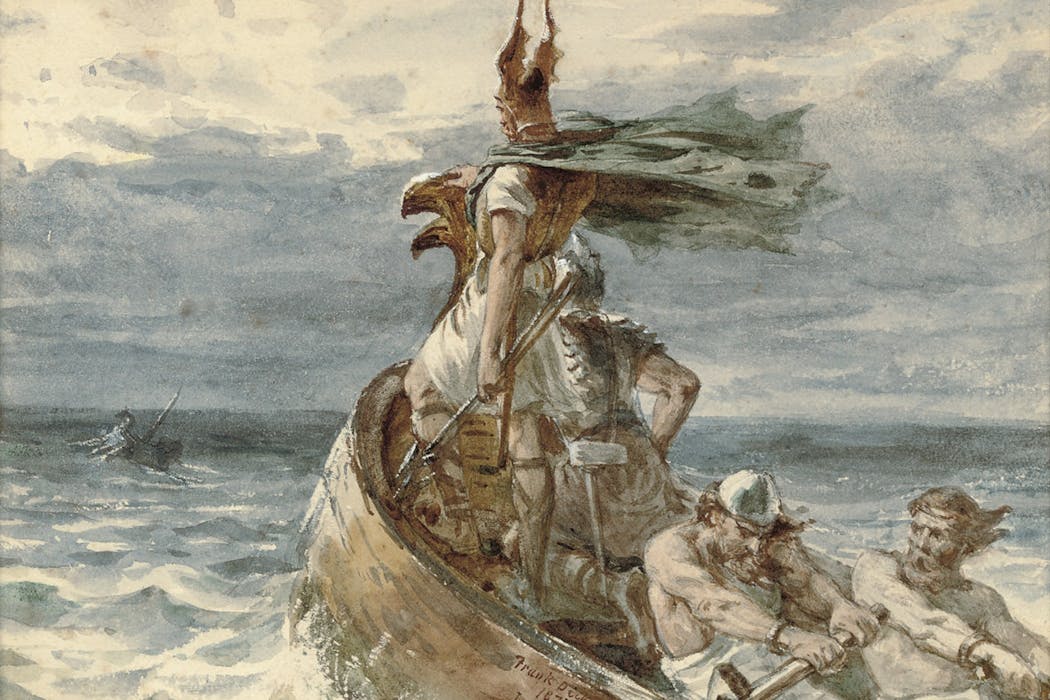
Vikings Heading for Land, by Frank Dicksee (1873). Christie’s via Wikimedia

Around 2,400 years ago, before the emergence of the Roman empire, a small armada of boats approached the island of Als off the coast of southern Jutland in modern-day Denmark. The armada carried around 80 warriors armed with spears and shields. Some of them were officers, and these men carried iron swords.

The seafarers had travelled across what is now the Baltic Sea in sleek plank boats some 20 metres long. The planks were sewn together as boats at this time did not use metal nails, and the seams were caulked (waterproofed) with tar.

At some point along the voyage, they had stopped to repair their vessels. One of them left a partial fingerprint in the soft, newly applied caulking material between the plank seams. This sea-warrior – age and gender unknown – was inadvertently leaving a message for scientists (including me) who, more than two millennia later, would finally recognise the fingerprint’s significance using cutting-edge technology.

The small army was planning a quick marine assault on their enemies in Denmark – but their plans failed. Soon after they jumped on to the beach, these warriors were killed by the local defenders.

To give thanks for their victory against this invading force, the locals filled one of the boats with the weapons of the invaders and sank it into a local bog as an offering to the gods. Their decision to sink the boat in the bog has allowed future archaeologists to piece together clues about the events surrounding the attack, as well as the technology and society of these ancient people.

Today, this island bog in southern Denmark is known as the Hjortspring bog. In the late 19th century, the remains of the ancient boat were discovered, well preserved in its low-oxygen environment. At the time, the region had recently been conquered by Prussia and was part of the German empire, so the local Danes who found the boat kept their discovery secret until Als rejoined Denmark in 1920.

The boat was finally excavated in 1921, and has been on display at the National Museum of Denmark in Copenhagen ever since. The excavation used the best archaeological methods that were available in the 1920s – but the scientific techniques of modern archaeology were not yet available.

In 2023, researchers from Lund University and the University of Gothenburg began a collaboration with the national museum in order to use modern scientific methods to study the materials pulled out of the Hjortspring bog over a century earlier. Some of these samples had never been studied since the original excavation – meaning that a major mystery had surrounded the Hjortspring boat ever since. Where did these invading warriors from the 4th century BC come from?

The Hjortspring boat on display at the National Museum of Denmark.
Boel Bengtsson, CC BY-NC-SA

A surprising result

The weapons such as swords and spears found in the boat were used widely across northern Europe during the early Iron Age, giving few clues as to the boat’s provenance. Most archaeologists had assumed the boat came from somewhere nearby in Jutland, or perhaps from northern Germany.

By analysing the boat’s caulking material using a technique called gas chromatography-mass spectrometry, we were able to determine what chemical compounds the caulking tars were made from – a combination of animal fat and pine pitch.

This was surprising, since nearly all the pine forests in Denmark and northern Germany had already been cut down to make room for agriculture during the Neolithic period. We know this because geologists have studied ancient pollen in lakes and bogs to determine what species grew in different parts of Europe and at what times.

While the people who built the Hjortspring boat may have traded items to acquire their tar, it was at that time possible to waterproof boats using materials local to Jutland such as linseed oil and tallow (cow fat). So our investigation suggests the Hjortspring boat probably did not come from Jutland or northern Germany – but rather, from a more distant location with access to abundant pine forests.

The closest large pine forests during the 4th century BC were located along the coasts of the Baltic Sea to the east of modern-day Denmark. This means the crew of the Hjortspring boat, and their fellow seafarers, may have travelled hundreds of kilometres across open sea to launch their attack on Als.

We already knew that such long-distance voyages took place during the Bronze Age, when Scandinavians travelled far from home in search of copper. Iron was locally produced in Scandinavia, however, making the economic need for such voyages less obvious during the Iron Age.

A sea trial in a reconstruction of the Hjortspring boat.
Knut Valbjørn/Boel Bengtsson, CC BY-NC-SA

Nonetheless, our results indicate that long-distance trading and raiding continued well after the end of the Bronze Age. While we will never know exactly what drove the warriors to launch this particular attack, our research suggests that back then – just as today – political conflicts spanned regional borders and led young warriors to travel far from home.

We were also able to carbon-date some of the lime bast rope used on the boat, giving the first absolute date from the original excavation material. The cordage dated to between 381 and 161 BC, confirming the boat was from the pre-Roman Iron Age.

While selecting tar samples for our scientific analysis, we made another fantastic discovery: the “secret message” left by one of the crew in the form of a partial fingerprint left by one of the mariners on a small clump of tar.

Using X-ray tomography, we have made a digital 3D-model of the fingerprint, accurate to the nanometer scale. From our analysis of the print, we believe it was left by an adult, although we cannot say much more at present about who this individual was. This exciting find gives us a direct connection to this ancient warrior who once voyaged across the Baltic Sea.

Within the next year, we hope to be able to extract ancient DNA from the caulking tar on the boat, which could give us more detailed information about the ancient people who used this boat.

At present, our results show that the practice of long-distance maritime trading and raiding, which came to characterise the famous Viking Age, persisted over nearly 3,000 years of Nordic history. By studying this ancient boat, we can peer deeper into Scandinavia’s origins as a seafaring society.

The Conversation

Mikael Fauvelle received funding for this research from the Marcus and Amalia Wallenberg Foundation (Complex Canoes project), and the Riksbankens Jubileumsfond (Maritime Encounters programme).

ref. How we unlocked the secrets of Denmark’s oldest plank boat – with the help of an ancient fingerprint – https://theconversation.com/how-we-unlocked-the-secrets-of-denmarks-oldest-plank-boat-with-the-help-of-an-ancient-fingerprint-271977

ADHD: girls’ symptoms are often missed in school because they don’t fit stereotypes – new research

Source: The Conversation – UK – By Vlad Glăveanu, Professor of Psychology, Business School, Dublin City University

Daydreaming, talkativeness or restlessness can all be signs of ADHD. PeopleImages/ Shutterstock

Many girls with ADHD aren’t diagnosed until their late teens or adulthood. My recent research points to a possible explanation for this.

The study, published with my colleague Sorcha Walsh, found that while many of the women we interviewed may have displayed signs of ADHD while at school, these weren’t interpreted as such. This misrecognition not only meant that most waited years for a diagnosis – it also had long-term impacts on their sense of self.

The research involved in-depth interviews with 13 women aged 18-35 who had been officially diagnosed with ADHD either during childhood or, much more commonly, after leaving school. We analysed their accounts to identify recurring patterns in their school experiences, pathways to diagnosis and the impact ADHD had on their wellbeing and identity.

A striking pattern emerged across the interviews: none of the girls were overlooked because they were invisible. Rather, they were overlooked because what adults noticed didn’t fit the stereotype of ADHD.

Teachers repeatedly flagged difficulties – such as the girls being too chatty, unfocused, disorganised, “quirky” or emotionally reactive in school. It seems teachers saw such behaviour as personality traits or as typical girls’ behaviour.

For instance, one participant told us: “I was always known as chatty in school … I just thought it was being a girl as it has always been a trait of being a young girl.”

Another participant said: “I think it’s easy with girls to just … say that they’re a bit chatty or contrary or a bit dreamy … rather than getting down and looking a bit deeper…”

Several participants described receiving school reports that essentially listed ADHD indicators without any suggestion the traits might be signs of the neurodevelopmental condition.

This misrecognition had long-term consequences. Almost all participants went through school believing they were lazy, careless, “too emotional” or that they were “not trying hard enough”.

The deepest impact they described wasn’t on their grades but on their sense of self. Many internalised the idea that something was wrong with them – and several were misdiagnosed with anxiety, depression or even personality disorders before finally receiving an ADHD diagnosis in adulthood.

One unexpected finding was that an early diagnosis didn’t automatically protect girls from these negative experiences. The few participants who were diagnosed during school still struggled – not because the diagnosis was wrong, but because teachers didn’t understand how ADHD presents in females. Some received no meaningful support at all and others continued to be treated as if their behaviour was intentional rather than symptomatic.

This highlights an important nuance: timing of diagnosis matters, but understanding matters more.

Diagnostic culture

Our study sheds light on a broader issue within today’s diagnostic culture. We tend to diagnose what we already expect to see. When a condition is seen through a single stereotype, those who don’t fit that picture fall through the cracks.

For decades, ADHD has been culturally associated with the image of a young boy who can’t sit still, disrupts lessons or climbs on furniture. But our research showed that most of the girls we interviewed did not behave this way.

A girl sitting in class with her head resting on her hand, looking away from her desk dreamily.
Many women with ADHD learned to ‘mask’ their symptoms.
wavebreakmedia/ Shutterstock

This also reveals something deeper about how society responds to girls’ behaviour. Many of the women in our study spoke about masking (concealing symptoms to fit in or avoid judgement), overcompensating, people pleasing and doing everything possible not to disrupt others. These behaviours were rewarded. Their ability to cope, or at least appear to cope, was taken as evidence that they were fine.

But coping is not the same as thriving. Masking and overcompensation are linked to higher rates of anxiety, depression, burnout and lower quality of life among women with ADHD.

Diagnostic systems for ADHD have historically been designed around identifying observable, behavioural signs of the condition – such as hyperactivity, rule-breaking and disruptive classroom behaviour – rather than the more internal forms of distress and impairment.

This means established criteria may struggle to detect internal difficulties – such as emotional dysregulation (having trouble managing emotions or feeling overwhelmed), cognitive overload (mental exhaustion when faced with a lot of information or demands) or quiet inattention – which can also be signs of the condition. This creates a systemic inequality: the children who are easiest to overlook are also those most likely to be misunderstood.

As our study was relatively small, it will be important for future studies to examine whether these patterns can be replicated in larger or more diverse samples.

However, our findings are consistent with others from the wider literature, showing that girls with ADHD are more likely to present with predominantly inattentive and internalising symptoms. Research has also shown they’re likely to have their difficulties misattributed to anxiety or mood problems and to be diagnosed later or overlooked altogether compared with boys.

Supporting girls with ADHD

The women we spoke with offered clear suggestions for what would have made a difference.

Schools can support girls with ADHD, and spot the condition earlier, by recognising non-stereotypical signs of ADHD (including daydreaming, talkativeness or restlessness) – and ensuring teachers are properly trained in identifying ADHD and how is manifests differently in girls.

Participants suggested that it would be helpful as well if positive strengths, such as creativity, humour, quick-thinking and the ability to hyperfocus, were seen as assets to be nurtured in school – rather than being overlooked.

Those who had been diagnosed with ADHD while they were still in school also suggested that meaningful accommodations would have improved their experiences – such as more structure, breaks for movement and mentorship for girls with ADHD.

In the end, girls with ADHD do not need to be louder to be recognised. They need a school system that knows what to look for. Recognising their experiences earlier could prevent years of misunderstanding, self-doubt and missed potential.

The Conversation

Vlad Glăveanu does not work for, consult, own shares in or receive funding from any company or organisation that would benefit from this article, and has disclosed no relevant affiliations beyond their academic appointment.

ref. ADHD: girls’ symptoms are often missed in school because they don’t fit stereotypes – new research – https://theconversation.com/adhd-girls-symptoms-are-often-missed-in-school-because-they-dont-fit-stereotypes-new-research-271780