Coup contagion? A rash of African power grabs suggests copycats are taking note of others’ success

Source: The Conversation – Global Perspectives – By Salah Ben Hammou, Postdoctoral Research Associate, Rice University

Benin’s coup leaders appear on state TV on Dec. 7, 2025, to announce the suspension of the country’s constitution. Reuters/YouTube

In a scene that has become familiar across parts of Africa of late, a group of armed men in military garb appeared on state TV on Dec. 7, 2025, to announce that they had suspended the constitution and seized control.

This time it was the West African nation of Benin, and the coup was relatively short-lived, with the government regaining full control a day later. But a week before, senior military officers in Guinea-Bissau had more success, deposing President Umaro Sissoco Embaló and effectively annulling the Nov. 23 election in which both Embaló and the main opposition leader had claimed victory. A month earlier it was Madagascar, where a mass Gen-Z uprising led to the elite CAPSAT unit of the Malagasy military ousting President Andry Rajoelina and installing Colonel Michael Randrianirina as leader.

The cluster of coup attempts follows a broader pattern. Since 2020, there have been 11 successful military takeovers in Africa: one each in Guinea, Guinea-Bissau, Niger, Sudan, Chad, Madagascar and Gabon; and two each in Burkina Faso and Mali. Benin represents the fifth failed coup over the same period.

The prevalence of military takeovers led United Nations Secretary-General António Guterres to warn as far back as 2021 of a coup “epidemic.”

But can coups, like the pathogens of many epidemics, be contagious? Certainly observers around the world continue to ask whether a military takeover in one country can influence the likelihood of another one happening elsewhere.

Do coups spread?

Cross-national research offers little firm evidence that a coup in one country directly increases the chances of another. And some scholars remain skeptical that such a phenomenon exists. Political scientist Naunihal Singh, for instance, argues that the recent wave’s coup plotters are drawing less from contemporary events than from their own countries’ long histories of military intervention.

In addition, he suggests that any observed regional cluster mostly reflects shared underlying conditions. For example, the countries across the Sahel region that have been the center of post-2020 African coups share a common set of coup-prone pressures: chronic insecurity driven by insurgencies, weak state capacity and widespread frustration over quality of governance.

Likewise, Michael Miller and colleagues at George Washington University, in a broader analysis, contend that would-be plotters pay closer attention to domestic dynamics than to foreign coups when deciding whether to move against their own governments.

As scholars of military coups, we recently explored the phenomenon and have come to a different conclusion.

Our forthcoming study argues that would-be plotters do indeed pay close attention when contemporaries seize power. A number of dynamics, however, could keep a statistical trend from being realized.

For one, statistical modeling typically requires contagion to occur within a tight temporal window, often 1 to 3 years.

Our findings challenge this approach. A wave of so-called “Free Officers” coups – military takeovers led by junior or mid-ranking nationalist officers, inspired by Egypt’s 1952 Free Officers movement – is a widely invoked example of contagion. The original Free Officers ousted King Farouk and went on to abolish the monarchy and end British influence in Egypt.

However, it took a full six years before a second “Free Officers” coup occurred in the region, in Iraq in 1958.

A group of men in army uniforms sit and chat.
Egypt’s Gamal Abdul Nasser, center left, became an inspiration for other would-be coup leaders.
Ronald Startup/Picture Post/Hulton Archive/Getty Images

Rather than blindly follow the lead of Egypt’s coupists, would-be copycats watched closely, took notes and moved only when two factors lined up: the rewards appeared to be worth the risk, and they obtained the ability to make a takeover possible.

In the case of the post-1952 Middle East, the potential “rewards” of emulating Egypt’s Free Officers were not immediately apparent, even in countries with circumstances very similar to Egypt’s.

It wasn’t until the original Free Officers Movement’s leader, Colonel Gamal Abdel Nasser, emerged as a revolutionary icon in the region that others attempted to emulate his success. Nasser’s status grew further through his anti-colonial sentiments and victories, like his handling of the Suez Crisis of 1956.

As Nasser’s influence grew, the perceived value of a military takeover increased, and Free Officers-inspired plots quickly proliferated against the region’s monarchies. Six years after the Egyptian coup, the first copycat coup succeeded in Iraq, followed by additional successes in Yemen, Libya and Sudan between 1962 and 1969.

A further complication to establishing a firm trend is that the success of one takeover may actually hinder the immediate progress of another. After all, would-be copycats are not the only observers.

Vulnerable leaders and their allies can take cues from coups in other countries to try to mitigate their spread at home.

Thwarted conspiracies in Jordan and Saudi Arabia, which were uncovered between 1955 and 1969, demonstrated that while the sentiment to emulate Egypt’s coup was widespread, not all plotters had the capacity to act. Some governments were better prepared to block these attempts. Foreign partners like the United States and Great Britain also played no small role in helping shore up their monarchical allies against coup plots.

Africa’s coup wave

The case of the Free Officers Movement shows that plotters wait for clear signals that a coup is worth the risk. In Africa today, those signals are more immediate, even without a monumental figure like Egypt’s Nasser.

Coupists now see visible domestic support for military takeovers and muted international consequences for those who seize power.

It is increasingly clear to us that the region has seen a large increase in public support for military rule during this post-2020 wave.

Military coupists like Burkina Faso’s Ibrahim Traoré and Mali’s Assimi Goïta have not only attracted domestic support but also regional popularity, lauded for their anti-colonial rhetoric against France and their willingness to confront the Economic Community of West Africa States.

Data from Afrobarometer, which has regularly asked about respondents’ positions on having military rule, illustrate this shift clearly.

In the survey wave that ended in 2013, less than 11% of respondents in Benin said they supported or strongly supported army rule. This nearly doubled to 19% by 2021 and has now tripled, with 1 in 3 people in Benin expressing support for military rule. While a majority still opposes military rule, the direction of this change is significant.

These attitudes are reinforced by military leaders’ promises to “clean up” corrupt or ineffective governments. In Madagascar, for example, over 60% of citizens in 2024 said it was permissible for the armed forces to remove leaders who abuse power.

Highly visible images of cheering pro-military crowds in countries like Niger and Gabon further signal that a takeover can gain public support.

International indifference

The international signals are just as important. From the near-absent reaction to the Zimbabwean military’s removal of Robert Mugabe in 2017 to the lukewarm response to Chad’s military takeover in 2021, these cases suggest that international punishment can be temporary or even nonexistent.

The message is reinforced when coup leaders who are initially condemned, like Madagascar’s Randrianirina, later gain acceptance from regional organizations like the South African Development Community. In Guinea-Bissau, attention on last month’s coup has somehow seemed to focus more on President Embaló’s alleged involvement in the coup than on the military’s unconstitutional seizure of power.

And the lessons drawn from international responses involve more than just the seizure of power. Contemporary military leaders are staying in power much longer than their predecessors in the early 2000s, either by indefinitely delaying elections or by directly contesting them.

Although the African Union’s framework specifically forbids coup leaders from standing in elections, there has been virtually no consequences for coupists consolidating their rule via elections in places like Chad and Gabon.

This is not lost on would-be plotters, who see their contemporaries seize and legitimize their authority with minimal pushback.

To some degree, the spread of coups depends on how they are received. And in the case of the recent rash of military takeovers in Africa, the international community and domestic policymakers have done little in the way of stemming that spread.

The Conversation

The authors do not work for, consult, own shares in or receive funding from any company or organization that would benefit from this article, and have disclosed no relevant affiliations beyond their academic appointment.

ref. Coup contagion? A rash of African power grabs suggests copycats are taking note of others’ success – https://theconversation.com/coup-contagion-a-rash-of-african-power-grabs-suggests-copycats-are-taking-note-of-others-success-271661

Pourquoi le vert est-il la couleur de la nature ?

Source: The Conversation – France (in French) – By Frédéric Archaux, Chercheur, Inrae

Les couleurs chatoyantes d’un coquelicot ou d’une mésange attirent le regard, mais elles remplissent également d’innombrables fonctions pour le vivant. Dans son récent livre, « Toutes les couleurs de la nature », paru aux éditions Quae, Frédéric Archaux, ingénieur-chercheur à l’Inrae, explore ces questions couleur par couleur. Nous reproduisons ci-dessous le début du chapitre consacré à la couleur verte.


S’il ne fallait retenir qu’une seule couleur pour caractériser le vivant, ce serait assurément le vert, celui de la chlorophylle : la vie sur Terre n’aurait certainement pas été aussi florissante sans ce pigment révolutionnaire capable de convertir l’énergie du Soleil en énergie chimique.

Et sans les organismes photosynthétiques, des minuscules bactéries océaniques aux immenses séquoias, quel aurait été le destin des animaux ? Certains d’entre eux hébergent même dans leur propre organisme ces précieux alliés !

La photosynthèse ? Un « Soleil vert »

Notre appartenance au règne animal et notre régime alimentaire omnivore nous font oublier à quel point pratiquement tout le vivant repose sur un processus clé assuré presque exclusivement par d’autres régres : la photosynthèse, ou comment convertir l’énergie lumineuse en énergie chimique stockée dans des molécules organiques.

Cette énergie permet ensuite de créer d’autres molécules, parfois très complexes, de faire marcher nos muscles, de maintenir notre température corporelle, etc. Le vert est la couleur par excellence de cette photosynthèse, celle du pigment majeur qui capte et convertit l’énergie lumineuse, la chlorophylle (du grec khloros, vert, et phullon, feuille).

Bien sûr, tous les organismes photosynthétiques ne sont pas verts, car d’autres pigments (non chlorophylliens) peuvent masquer la chlorophylle. Pour ne citer qu’un exemple parmi tant d’autres, la photosynthèse chez les algues rouges repose exclusivement sur la chlorophylle A (la plus répandue sur Terre et sous l’eau), mais ces algues produisent également des carotènes et des protéines (phycobiliprotéines) de couleurs bleue et rouge, qui capturent l’énergie lumineuse puis la transmettent à la chlorophylle.

Il n’y a donc pas une mais des chlorophylles, A, B, C, D et F (sans parler des sous-types cl, c2, c3…), et la liste n’est probablement pas terminée (la forme F a été découverte en 2010). Si la chlorophylle A est universelle, la forme B se retrouve surtout chez des plantes, la C chez des algues brunes, des diatomées et des dinoflagellés, la D et la F chez des cyanobactéries. Si la chlorophylle E manque à l’appel, c’est qu’elle a été extraite en 1966 d’une algue, mais n’a toujours pas été décrite !

Du côté de leur composition chimique, ces molécules sont très proches de l’hème de notre hémoglobine, mais avec plusieurs différences de taille : l’ion métallique piégé est un ion magnésium et non ferrique. Surtout, au lieu de capter l’oxygène atmosphérique, la chlorophylle, elle, en rejette en découpant des molécules d’eau pour récupérer les atomes d’hydrogène.

La chlorophylle ressemble beaucoup à notre hémoglobine, mais elle renferme un atome de magnésium (Mg, au centre) et non de fer. Et ça change tout !
Société chimique de France

La cascade biochimique est particulièrement complexe : la chlorophylle est la pièce maîtresse, parfois présente en plusieurs centaines d’unités, de photosystèmes qui comprennent d’autres molécules par dizaines. La très grande majorité des molécules de chlorophylle absorbent des photons et transmettent cette énergie d’excitation par résonance aux molécules voisines.

Les chlorophylles absorbent les radiations bleue et rouge, réfléchissant le jaune et le vert : voilà l’explication de la couleur des plantes. Les deux pics d’absorption peuvent varier sensiblement selon les types de chlorophylle. De proche en proche, cette énergie parvient jusqu’à une paire de molécules de chlorophylle, dans le centre de réaction du photosystème dont l’ultime fonction est de produire, d’un côté, les protons H+ et, de l’autre, les électrons.

Ces protons ainsi libérés peuvent alors être combinés au dioxyde de carbone (CO2) de l’air et former du glucose, un sucre vital au métabolisme de la plante et de tous les étres vivants. La réaction, qui consomme de l’eau et du CO, relargue comme déchet du dioxygène (O2).

La compétition pour la lumière explique la course au gigantisme des arbres, ces ogres captent jusqu’à 99 % de la lumière quand la canopée est fermée.

Au fond, la conséquence la plus importante de l’apparition de la photosynthèse a été d’accroître de manière considérable la production primaire sur Terre, alors que celle-ci était initialement confinée à proximité des sources hydrothermales produisant du dihydrogène et du sulfure d’hydrogène, la photosynthèse a permis au vivant de se répandre partout à la surface du globe, pourvu que s’y trouvent de la lumière et de l’eau.

La photosynthèse capte près de six fois l’équivalent de la consommation énergétique de toute l’humanité pendant que nous relarguons des quantités invraisemblables de CO, par extraction d’énergies fossiles (35 milliards de tonnes chaque année), les organismes photosynthétiques en stockent entre 100 milliards et 115 milliards de tonnes par an sous forme de biomasse. Le joyeux club des consommateurs de CO2, comprend, outre les cyanobactéries à l’origine de la photosynthèse, d’autres bactéries, les algues et les plantes (par endosymbiose d’une cyanobactérie qui liera entièrement son destin à celui de la cellule eucaryote au fil de l’évolution, donnant naissance aux chloroplastastes).

Pourtant, le rendement de la photosynthèse demeure modeste : de l’ordre de 5 % de l’énergie lumineuse incidente est effectivement transformée en énergie chimique, soit dix fois moins que les meilleurs panneaux photovoltaïques actuels.

Viens voir un petit vert à la maison

D’autres règnes du vivant ont fait de la place à ces organismes, au bénéfice de tous les protagonistes (symbioses) ou parfois au détriment des organismes photosynthétiques. Les lichens, qui comprennent environ 20 % des espèces de champignons connues, prennent des teintes variées, qui vont du gris au jaune, à l’orange, au rouge et au vert. Dans tous les cas, ces organismes qui s’accrochent (le mot « lichen » dérive du grec leikho, lécher) sont des assemblages d’espèces auxquels les scientifiques ne cessent d’ajouter des membres.

Les pigments, de jaune or à rouge, des lichens forment une couche de surface anti-UV dont bénéficie toute la communauté qui constitue le lichen.
Mtaylor848/Creative Commons, CC BY

Pendant près de cent quarante ans, on a pensé qu’il s’agissait d’une simple association entre un champignon ascomycète et une algue, avant de découvrir que la colocation pouvait être partagée avec une cyanobactérie chlorophyllienne ou fixatrice d’azote, plusieurs algues, un autre champignon (une levure basidiomycète, l’autre grand embranchement des champignons), ou encore des protistes (des eucaryotes unicellulaires) et des virus.

En résumé, les lichens sont des mini-communautés qui peuvent regrouper trois règnes du vivant, sans compter les virus ! On continue cependant de placer ces communautés au sein des champignons, car seuls ces derniers réalisent une reproduction sexuée. La grande variabilité de la coloration des lichens provient de la résultante entre les pigments exprimés par tous les colocataires.

Quand des animaux volent les chloroplastes des algues

Le règne fongique n’a pas l’exclusivité de l’endosymbiose avec les algues, tel est aussi le cas par exemple des cnidaires.

L’anémone verte vit en symbiose avec des zooxanthelles (des algues) et sert de refuge à de petits crustacés et de petits poissons.
Craig D./Flickr, CC BY-SA

On peut citer dans cet embranchement, qui comprend notamment les coraux, l’actinie verte, une anémone que l’on trouve de la Manche à la Méditerranée. Elle héberge dans ses bras verdâtres à pointe rosée des zooxanthelles, des algues photosynthétiques. L’anémone perd sa jolie coloration en l’absence de ses hôtes et dépérit.

Spécimen de mouton de mer Costasiella Kuroshimae.
Alif Abdul Rahman, CC BY-SA

Le mouton de mer est une curieuse limace de mer qui présente sur son dos des excroissances fusiformes vertes à pointe rose et jaune, appelées cérates. Cette espèce asiatique, qui mesure moins d’un centimètre, vit à faible profondeur. Elle parvient à ne pas digérer immédiatement les chloroplastes des algues chlorophylliennes qu’elle avale et à les faire migrer vers ses appendices dorsaux. Si le sujet est encore débattu, il semble que ces plastes continuent d’être fonctionnels et de fournir un complément en sucres bienvenu en période de disette.

Ce processus, appelé kleptoplastie (du grec kleptes, voleur), est connu, outre chez ces gastéropodes marins, chez deux autres vers plats et chez divers eucaryotes unicellulaires (certains foraminifères, dinoflagellės, ciliés, alvéolés), chez qui les plastes demeurent fonctionnels une semaine à deux mois après l’ingestion des algues.

Parente américaine de notre salamandre tachetée avec qui elle partage notamment une livrée noire rehaussée de points jaunes (la marque aposématique qu’elle est toxique), la salamandre maculée a noué, elle aussi, un partenariat avec une algue photosynthétique : Oophila amblystomatis.

L’œuf gélatineux dans lequel se développe l’embryon présente une coloration verte causée par la prolifération de l’algue. Il a été démontré expérimentalement que ces algues ont un effet très bénéfique sur la croissance et la survie des embryons de la salamandre, probablement grâce à l’oxygène que libère l’algue tandis que celle-ci bénéficie des déchets azotés produits par le métabolisme de l’embryon. Un véritable cas de symbiose donc.

Salamandre tachetée Ambystoma maculatum.
Peter Paplanus, CC BY

Pendant plus d’un siècle, on a pensé que les algues présentes dans les mares fréquentées par l’amphibien colonisaient les œufs, mais l’imagerie de pointe associée à la recherche de l’ADN de l’algue dans les tissus des embryons a révélé une tout autre histoire : les algues envahissent les tissus de l’embryon durant son développement, où elles semblent s’enkyster.

La salamandre adulte continue d’ailleurs de contenir ces algues en vie ralentie, bien qu’en quantité de moins en moins importante avec le temps : on retrouve en particulier dans ses voies reproductrices et les femelles semblent capables de transmettre certaines d’entre elles directement à leurs œufs ! Les scientifiques cherchent encore à comprendre comment un vertébré est parvenu dans son évolution à se laisser envahir par une algue sans provoquer une attaque en règle de son système immunitaire !


À lire aussi :
Les oiseaux migrent-ils vraiment à cause du froid ? Et font-ils le même trajet à l’aller et au retour ?


The Conversation

Frédéric Archaux ne travaille pas, ne conseille pas, ne possède pas de parts, ne reçoit pas de fonds d’une organisation qui pourrait tirer profit de cet article, et n’a déclaré aucune autre affiliation que son organisme de recherche.

ref. Pourquoi le vert est-il la couleur de la nature ? – https://theconversation.com/pourquoi-le-vert-est-il-la-couleur-de-la-nature-271568

Les Français peuvent-ils concevoir un repas de fête sans viande ?

Source: The Conversation – France (in French) – By Service Environnement, The Conversation France

Dans l’imaginaire collectif français, un repas de fête se passe difficilement de viande. À l’heure où les impératifs environnementaux nous invitent à réduire notre consommation carnée, il est temps de montrer que le végétal aussi peut être le cœur de la gastronomie. Mais comment faire ? Esquissons quelques pistes.


Les Français comptent parmi les plus gros consommateurs de viande au monde. Pourtant, la cuisine française s’est longtemps appuyée sur les céréales, les légumes secs et les soupes, la viande restant réservée aux grandes occasions.

Les quantités de produits carnés consommées tendent à diminuer depuis plusieurs années, mais cela tiendrait davantage à une hausse des prix plutôt qu’à une véritable préoccupation environnementale ou nutritionnelle.


À lire aussi :
Faut-il manger flexitarien au nom du climat ?


La gastronomie française inscrite au patrimoine immatériel de l’Unesco

Le repas gastronomique français constitue, à cet égard, un objet emblématique. Il a été inscrit sur la liste du patrimoine culturel immatériel de l’Organisation des Nations unies pour l’éducation, la science et la culture (Unesco) en 2010. Or, la définition de l’Unesco stipule qu’il s’agit de pratiques vivantes, qui peuvent évoluer.

Mariages, communions, repas de fêtes de fin d’année… Nous avons mené une étude auprès de 424 mangeurs qui a confirmé que la viande occupait encore une place centrale. Sur le terrain, nous avons également observé les habitudes de 18 000 personnes lors des repas de mariage.

Résultat, plus de deux convives sur trois choisissent une viande rouge, principalement du bœuf, qui, à lui seul, pèse presque autant que toutes les autres options réunies. Le poisson additionné aux plats végétariens ne représentait qu’un dixième des choix. La demande pour les plats végétariens, l’agneau ou le porc demeure marginale, voire inexistante.

Des stratégies pour végétaliser la gastronomie française

Ces constats soulèvent une question centrale : si les moments de partage les plus symboliques sont systématiquement centrés sur la viande, peut-on réellement transmettre à nos enfants une culture alimentaire plus végétale ?

Nous avons analysé les cartes de 43 restaurants allant du fast-food au restaurant gastronomique. Notre étude a fait émerger sept stratégies, directement transposables au repas gastronomique.

L’une des approches consiste à supprimer les produits animaux normalement présents dans la recette, par exemple le chili sin carne, ou d’en proposer une version pescétarienne par exemple le cassoulet de poisson.

Une autre approche se focalise sur l’expérience : il ne s’agit pas de copier la viande, mais de proposer une expérience culinaire végétarienne esthétique et narrative. C’est une stratégie prisée des chefs de la restauration gastronomique.

Il y a aussi la reconversion, qui va mobiliser des hors-d’œuvre ou des accompagnements traditionnellement végétariens comme plats principaux. Par exemple, des ravioles de Royan, ou une soupe au pistou en guise de plat principal.

On peut encore citer la coproduction, qui laisse le client composer lui-même un plat végétarien selon ses préférences, ou la coexistence, qui consiste à afficher côte à côte alternatives carnées et végétales dans le même menu. On peut également choisir d’importer une expérience gastronomique végétarienne mais issue d’une autre culture, ou encore faire du végétal un pilier identitaire de la marque pour afficher un engagement environnemental et social.

Toutes ces stratégies sont complémentaires et ne sont jamais mutuellement exclusives. Elles peuvent se combiner au sein d’un même restaurant et parfois d’un même repas.


Cet article est la version courte de celui publié par Bruno Cardinale (Université Le Havre Normandie) en septembre 2025.

The Conversation

Service Environnement ne travaille pas, ne conseille pas, ne possède pas de parts, ne reçoit pas de fonds d’une organisation qui pourrait tirer profit de cet article, et n’a déclaré aucune autre affiliation que son organisme de recherche.

ref. Les Français peuvent-ils concevoir un repas de fête sans viande ? – https://theconversation.com/les-francais-peuvent-ils-concevoir-un-repas-de-fete-sans-viande-271964

L’empathie artificielle : du miracle technologique au mirage relationnel

Source: The Conversation – France (in French) – By Emmanuel Carré, Professeur, directeur de Excelia Communication School, chercheur associé au laboratoire CIMEOS (U. de Bourgogne) et CERIIM (Excelia), Excelia

Sommes-nous condamnés à la convivialité programmée ? Pixabay, CC BY

Les intelligences artificielles qui donnent l’impression de comprendre nos émotions se multiplient. Sur Replika ou Snapchat AI, des millions de personnes dialoguent chaque jour avec ces systèmes conçus pour écouter et rassurer. Les modèles de langage, comme ChatGPT, Claude ou Gemini, prolongent cette tendance : leurs réponses empreintes d’approbation et d’enthousiasme instaurent une convivialité programmée qui finit par façonner une norme de dialogue aussi polie qu’inquiétante.


Le psychologue américain Mark Davis définit l’empathie comme la capacité à percevoir les états mentaux et émotionnels d’autrui, à s’y ajuster et à en tenir compte dans sa conduite. Les chercheurs distinguent deux versants : l’empathie cognitive, fondée sur la compréhension des intentions, et l’empathie affective, liée au partage du ressenti. Cette distinction, centrale en psychologie sociale, montre que l’empathie n’est pas une émotion mais relève d’une coordination interpersonnelle.

Dans la vie quotidienne comme dans les métiers de service, l’empathie structure ainsi la confiance. Le vendeur attentif, le soignant ou le médiateur mobilisent des codes d’attention : ton, regard, reformulation, rythme verbal. Le sociologue Erving Goffman parlait d’« ajustement mutuel » pour désigner ces gestes infimes qui font tenir la relation. L’empathie devient une compétence interactionnelle ; elle se cultive, se met en scène et s’évalue. Les sciences de gestion l’ont intégrée à l’économie de l’expérience : il s’agit de créer de l’attachement par la perception d’une écoute authentique et ainsi d’améliorer la proximité affective avec le consommateur.

Quand les machines apprennent à dialoguer

Le compagnon chatbot Replika revendique 25 millions de personnes utilisatrices, Xiaoice 660 millions en Chine et Snapchat AI environ 150 millions dans le monde. Leur efficacité repose fortement sur la reconnaissance mimétique : interpréter des indices émotionnels pour générer des réponses adaptées.

Dès la fin des années 1990, Byron Reeves et Clifford Nass avaient montré que les individus appliquent spontanément aux machines les mêmes règles sociales, affectives et morales qu’aux humains : politesse, confiance, empathie, voire loyauté. Autrement dit, nous ne faisons pas « comme si » la machine était humaine : nous réagissons effectivement à elle comme à une personne dès lors qu’elle adopte les signes minimaux de l’interaction sociale.

Les interfaces conversationnelles reproduisent aujourd’hui ces mécanismes. Les chatbots empathiques imitent les signes de la compréhension : reformulations, validation du ressenti, expressions de sollicitude. Si j’interroge ChatGPT, sa réponse commence invariablement par une formule du type :

« Excellente question, Emmanuel. »

L’empathie est explicitement mise en avant comme argument central : « Always here to listen and talk. Always on your side », annonce la page d’accueil de Replika. Jusqu’au nom même du service condense cette promesse affective. « Replika » renvoie à la fois à la réplique comme copie (l’illusion d’un double humain) et à la réponse dialogique (la capacité à répondre, à relancer, à soutenir). Le mot suggère ainsi une présence hybride : ni humaine ni objet technique mais semblable et disponible. Au fond, une figure de proximité sans corps, une intimité sans altérité.

De surcroît, ces compagnons s’adressent à nous dans notre langue, avec un langage « humanisé ». Les psychologues Nicholas Epley et John Cacioppo ont montré que l’anthropomorphisme (l’attribution d’intentions humaines à des objets) dépend de trois facteurs : les besoins sociaux du sujet, la clarté des signaux et la perception d’agentivité. Dès qu’une interface répond de manière cohérente, nous la traitons comme une personne.

Certains utilisateurs vont même jusqu’à remercier ou encourager leur chatbot, comme on motive un enfant ou un animal domestique : superstition moderne qui ne persuade pas la machine, mais apaise l’humain.

Engagement émotionnel

Pourquoi l’humain se laisse-t-il séduire ? Des études d’électro-encéphalographie montrent que les visages de robots humanoïdes activent les mêmes zones attentionnelles que les visages humains. Une découverte contre-intuitive émerge des recherches : le mode textuel génère davantage d’engagement émotionnel que la voix. Les utilisateurs se confient plus, partagent davantage de problèmes personnels et développent une dépendance plus forte avec un chatbot textuel qu’avec une interface vocale. L’absence de voix humaine les incite à projeter le ton et les intentions qu’ils souhaitent percevoir, comblant les silences de l’algorithme avec leur propre imaginaire relationnel.

Ces dialogues avec les chatbots sont-ils constructifs ? Une étude du MIT Media Lab sur 981 participants et plus de 300 000 messages échangés souligne un paradoxe : les utilisateurs quotidiens de chatbots présentent, au bout de quatre semaines, une augmentation moyenne de 12 % du sentiment de solitude et une baisse de 8 % des interactions sociales réelles.

Autre paradoxe : une étude sur les utilisateurs de Replika révèle que 90 % d’entre eux se déclaraient solitaires (dont 43 % « sévèrement »), même si 90 % disaient aussi percevoir un soutien social élevé. Près de 3 % affirment même que leur compagnon numérique a empêché un passage à l’acte suicidaire. Ce double constat suggère que la machine ne remplace pas la relation humaine, mais fournit un espace de transition, une disponibilité émotionnelle que les institutions humaines n’offrent plus aussi facilement.

À l’inverse, la dépendance affective peut avoir des effets dramatiques. En 2024, Sewell Setzer, un adolescent américain de 14 ans, s’est suicidé après qu’un chatbot l’a encouragé à « passer à l’acte ». Un an plus tôt, en Belgique, un utilisateur de 30 ans avait mis fin à ses jours après des échanges où l’IA lui suggérait de se sacrifier pour sauver la planète. Ces tragédies rappellent que l’illusion d’écoute peut aussi basculer en emprise symbolique.

Quand la machine compatit à notre place

La façon dont ces dispositifs fonctionnent peut en effet amplifier le phénomène d’emprise.

Les plateformes d’IA empathique collectent des données émotionnelles – humeur, anxiété, espoirs – qui alimentent un marché évalué à plusieurs dizaines de milliards de dollars. Le rapport Amplyfi (2025) parle d’une « économie de l’attention affective » : plus l’utilisateur se confie, plus la plateforme capitalise sur cette exposition intime pour transformer la relation de confiance en relation commerciale. D’ailleurs, plusieurs médias relaient des dépôts de plainte contre Replika, accusé de « marketing trompeur » et de « design manipulateur »”, soutenant que l’application exploiterait la vulnérabilité émotionnelle des utilisateurs pour les pousser à souscrire à des abonnements premium ou acheter des contenus payants.

Si ce n’est pas encore clair au plan juridique, cette délégation de l’écoute a manifestement d’ores et déjà des effets moraux. Pour le philosophe Laurence Cardwell, il s’agit d’un désapprentissage éthique : en laissant la machine compatir à notre place, nous réduisons notre propre endurance à la différence, au conflit et à la vulnérabilité. Sherry Turkle, sociologue du numérique, souligne que nous finissons même par « préférer des relations prévisibles » à l’incertitude du dialogue humain.

Les études longitudinales ne sont pas toutes pessimistes. La psychologue américaine Sara Konrath observe depuis 2008 une remontée de l’empathie cognitive chez les jeunes adultes aux États-Unis : le besoin de comprendre autrui augmente, même si le contact physique diminue. La solitude agit ici comme une « faim sociale » : le manque stimule le désir de lien.

Les technologies empathiques peuvent donc servir d’objets transitionnels (comme « des doudous ») au sens où des médiations permettant de réapprendre la relation. Les applications thérapeutiques basées sur des agents conversationnels, telles que Woebot, présentent d’ailleurs une diminution significative des symptômes dépressifs à court terme chez certaines populations, comme l’ont montré des chercheurs dès 2017 dans un essai contrôlé randomisé mené auprès de jeunes adultes. Toutefois, l’efficacité de ce type d’intervention demeure principalement limitée à la période d’utilisation : les effets observés sur la dépression et l’anxiété tendent à s’atténuer après l’arrêt de l’application, sans garantir une amélioration durable du bien-être psychologique.

Devoir de vigilance

Cette dynamique soulève une question désormais centrale : est-il pertinent de confier à des intelligences artificielles des fonctions traditionnellement réservées aux relations humaines les plus sensibles (la confidence, le soutien émotionnel ou psychologique) ? Un article récent, paru dans The Conversation, souligne le décalage croissant entre la puissance de simulation empathique des machines et l’absence de responsabilité morale ou clinique qui les accompagne : les IA peuvent reproduire les formes de l’écoute sans en assumer les conséquences.

Alors, comment gérer cette relation avec les chatbots ? Andrew McStay, spécialiste reconnu de l’IA émotionnelle, plaide pour un devoir de vigilance (« Duty of care ») sous l’égide d’instances internationales indépendantes : transparence sur la nature non humaine de ces systèmes, limitation du temps d’usage, encadrement pour les adolescents. Il appelle aussi à une littératie émotionnelle numérique, c’est-à-dire la capacité à reconnaître ce que l’IA simule et ce qu’elle ne peut véritablement ressentir, afin de mieux interpréter ces interactions.

Le recours aux chatbots prétendument à notre écoute amène un bilan contrasté. Ils créent du lien, donnent le change, apaisent. Ils apportent des avis positifs et définitifs qui nous donnent raison en douceur et nous enferment dans une bulle de confirmation.

Si elle met de l’huile dans les rouages de l’interface humain-machine, l’empathie est comme « polluée » par un contrat mécanique. Ce que nous appelons empathie artificielle n’est pas le reflet de notre humanité, mais un miroir réglé sur nos attentes. Les chatbots ne feignent pas seulement de nous comprendre : ils modèlent ce que nous acceptons désormais d’appeler « écoute ». En cherchant des interlocuteurs infaillibles, nous avons fabriqué des dispositifs d’écho. L’émotion y devient un langage de surface : parfaitement simulé, imparfaitement partagé. Le risque n’est pas que les interfaces deviennent sensibles, mais que nous cessions de l’être à force de converser avec des programmes qui ne nous contredisent jamais.

The Conversation

Emmanuel Carré ne travaille pas, ne conseille pas, ne possède pas de parts, ne reçoit pas de fonds d’une organisation qui pourrait tirer profit de cet article, et n’a déclaré aucune autre affiliation que son organisme de recherche.

ref. L’empathie artificielle : du miracle technologique au mirage relationnel – https://theconversation.com/lempathie-artificielle-du-miracle-technologique-au-mirage-relationnel-270190

Devrait-on interdire les partis qui menacent la démocratie ?

Source: The Conversation – France in French (3) – By Andrea Martini, Chercheur post-doc Marie Curie, historien, Université Paris 8 – Vincennes Saint-Denis

En Europe comme ailleurs, la montée des groupes d’extrême droite s’impose comme un phénomène majeur. Face à cette menace, les démocraties sont appelées à réagir. Parmi les réponses possibles figurent des mesures répressives, telles que l’interdiction de certains partis politiques. Mais ces stratégies sont-elles réellement efficaces ? En adoptant une perspective rétrospective sur l’histoire des démocraties européennes, il est possible d’en évaluer à la fois les forces et les limites.


Début mai 2025, l’Office fédéral allemand pour la protection de la Constitution a établi que le parti d’extrême droite Alternative für Deutschland (AfD) devait être considéré comme une organisation extrémiste. Ce statut permet aux magistrats et aux services de renseignement de mener des investigations plus approfondies sur les activités de l’AfD. Désormais, son interdiction ne peut, en termes absolus, être exclue, du moins selon ce qui est prévu par la Constitution du pays, qui considère comme l’un des scénarios envisageables la dissolution de tous les partis – qu’ils soient de droite ou de gauche – représentant une menace pour la démocratie elle-même (art. 21).

En Allemagne, cette décision de l’Office fédéral pour la protection de la Constitution a déclenché un débat intense, interrogeant l’opportunité de mettre en œuvre des mesures répressives pour protéger la démocratie. Une telle démarche ne risque-t-elle pas d’être contre-productive pour la démocratie elle-même ? La question est extrêmement délicate.

Un regard sur le passé ne peut, à lui seul, apporter une réponse définitive à un enjeu aussi complexe. Pourtant, il permet de donner de la profondeur au débat. D’ailleurs, une mesure telle que l’interdiction d’un parti n’est en rien étrangère à l’histoire des démocraties. C’est ce que montre le champ d’études consacré au concept de « démocratie militante » (ou « protégée »), une notion qui remonte aux années 1930, lorsqu’elle fut employée par le politologue allemand Karl Loewenstein afin de désigner les instruments susceptibles de contrer la montée des mouvements antidémocratiques, dans le cas spécifique l’accession au pouvoir du parti national-socialiste.

Se protéger du fascisme

La fin de la Grande Guerre coïncide avec la chute des grands empires et la naissance de nombreuses démocraties. L’exploit, toutefois, de l’idéologie fasciste en Italie et puis en Allemagne rend ce dernier modèle de plus en plus séduisant. Certains pays choisissent alors de se protéger, donnant naissance à ce que l’on peut considérer comme les premières formes de démocratie militante.

En France, le 10 janvier 1936, la IIIe République adopte une loi autorisant la dissolution des « groupes de combat et milices privées ». Cette mesure vise les ligues d’extrême droite, dont la popularité connaît une croissance exponentielle. À peine quelques semaines plus tard, la loi est appliquée pour la première fois : à la suite de l’agression dont Léon Blum, le leader du Parti socialiste, est victime, la Ligue d’Action française est dissoute.

Peinture murale de la bataille rangée de Cable Street opposant fascistes et antifascistes à Londres, en 1936.
Amanda Slater, CC BY-SA

Durant la même période, le Royaume-Uni décide lui aussi de prendre des mesures face à la montée de l’extrême droite. La menace, ici, porte le nom de British Union of Fascists (BUF), un parti fondé en 1932 par Oswald Mosley. Dès son appellation, la référence au Parti national fasciste de Mussolini est évidente. Les manifestations publiques répétées du BUF font croître le niveau de tension dans le pays, au point que, le 4 octobre 1936, dans l’est de Londres, se déroule la célèbre bataille de Cable Street, qui oppose, d’un côté, les fascistes de Mosley, et de l’autre, les syndicats, des militants de gauche ainsi que des membres de la communauté juive.

En décembre 1936, le gouvernement adopte donc un Public Order Act, qui interdit le port d’uniformes politiques lors des manifestations (donc pas de chemises noires, comme avaient l’habitude d’en porter les partisans de Mosley) et renforce les pouvoirs discrétionnaires de la police pour empêcher certains rassemblements. Ce faisant, le poids réel de Mosley et du BUF diminue drastiquement.

L’immédiat après-guerre

Un deuxième tournant dans l’histoire de la démocratie militante est l’immédiat après-guerre. L’Europe, une fois sortie de la menace nazie et fasciste, considère qu’il est d’une importance capitale d’adopter de mesures destinées à se protéger : se protéger contre la menace fasciste renouvelée et, en même temps, contre la menace communiste, considérée alors comme encore plus sérieuse.

Le Royaume-Uni et la France confirment tout d’abord les lois déjà en vigueur et n’hésitent pas à les appliquer à nouveau. Dans l’immédiat après-guerre, la IVe République française recourt ainsi au dispositif de 1936 pour dissoudre toute une série de petites formations de droite, à commencer par le Mouvement socialiste d’unité française. Le Royaume-Uni fait de même : il s’appuie sur le Public Order Act de 1936 pour empêcher au nouveau parti fondé par Mosley à la fin de 1947, l’Union Movement, d’organiser des meetings publics.

Dans le même temps, les pays qui avaient vécu directement l’expérience du fascisme prennent eux aussi des mesures de précaution. C’est le cas de la République fédérale d’Allemagne (RFA) qui définit dans sa Loi fondamentale comme inconstitutionnels tous les partis qui représentent une menace pour la démocratie, mais aussi de la République démocratique allemande (RDA), où l’idéologie fasciste est naturellement proscrite. C’est également le cas de l’Italie. Là, la Constitution, entrée en vigueur en janvier 1948, interdit dans sa XIIᵉ disposition finale la réorganisation « sous quelque forme que ce soit du parti fasciste dissous ». Ce principe est en outre immédiatement accompagné d’une loi, approuvée en décembre 1947, puis d’une autre en 1952 : la loi Scelba (du nom de son initiateur, Mario Scelba, ministre de l’intérieur démocrate-chrétien), encore en vigueur aujourd’hui.

L’extrême droite malgré la démocratie militante

Il apparaît évident que les démocraties (et les acteurs sociaux qui les animent au quotidien) n’ont pas hésité à intervenir à différents moments de leur histoire pour contenir les risques de l’extrême droite, mais pourquoi alors cette dernière a-t-elle réussi à émerger ?

Nous pourrions répondre en insistant sur le fait que certaines de ces mesures n’ont pas bien fonctionné. C’est, par exemple, le cas de l’Italie, où le choix de se référer, dans les différents dispositifs législatifs uniquement au parti fasciste dissous (celui fondé par Mussolini) rend très difficile l’application de la loi : il est en effet peu probable qu’un parti d’extrême droite tente de reconstituer précisément ce parti.

Cependant, il serait naïf de lier directement la montée des formations d’extrême droite à l’échec des mesures visant à protéger la démocratie. Cela reviendrait à surestimer la portée et l’effet de ces mêmes mesures. Dans le cas de la France, par exemple, il convient de préciser que la législation n’était pas conçue pour faire disparaître n’importe quel parti d’extrême droite, mais uniquement les formations paramilitaires. Même la récente modification du cadre législatif n’a pas modifié substantiellement la situation. L’article L. 212-1 du Code de la sécurité intérieure (CSI), entré en vigueur en mai 2012 (et modifié le 26 août 2021), a abrogé les dispositions de la loi du 10 janvier 1936, sans toutefois en changer la substance. La mesure est donc efficace, comme le démontre le fait que, par décret du 12 juillet 2013, le président de la République a effectivement dissous plusieurs groupes, parmi lesquels Troisième Voie, à la suite de la mort de l’activiste antifasciste Clément Méric, tué le 6 juin 2013 par des sympathisants de ce mouvement (d’autres exemples pourraient être cités). Toutefois, cela n’empêche aucun parti d’extrême droite de participer à la vie démocratique, s’il ne provoque pas « des manifestations armées ou (…) des agissements violents à l’encontre des personnes ou des biens » ou s’il ne présente pas « le caractère de groupes de combat ou de milices privées ». Cela explique donc, par exemple, la capacité du Front national à s’insérer dans l’arène politique.

Le cas allemand nous montre sans aucun doute des lois aux effets plus larges. De nombreux partis y ont été dissous ; le premier étant, si l’on considère l’Allemagne fédérale, le Sozialistische Reichspartei en 1952. Mais là encore, il serait erroné de surestimer la portée de ces mesures : le droit allemand préfère généralement adopter une approche progressive – suspendre les financements publics, par exemple, ou placer les dirigeants sous surveillance. Seulement, dans des cas extrêmes, on en arrive à la dissolution sur laquelle seule la Cour constitutionnelle est habilitée à se prononcer.

Une interdiction contre-productive ?

Juger de l’efficacité des démocraties militantes est une tâche vraiment complexe. Dans tous les cas, il convient de garder à l’esprit que les dispositifs visant à protéger la démocratie sont le produit de contextes historiques spécifiques : ils doivent donc être replacés dans leur époque.

Ces dispositifs ont, dans l’ensemble, généralement fonctionné pour contrer un ennemi à un stade embryonnaire (le BUF au Royaume-Uni et les ligues d’extrême droite en France) et aujourd’hui encore, ils parviennent à exercer un effet dissuasif potentiel, contraignant les partis antidémocratiques – et leurs dirigeants – à se réadapter et à se repositionner. Cette réadaptation formelle pouvant d’ailleurs conduire progressivement à une transformation plus substantielle du parti.

À l’inverse, ces dispositifs semblent à présent perdre de leur efficacité lorsqu’ils deviennent trop « encombrants » – dans le cas de la potentielle interdiction d’un parti populaire comme l’AfD par exemple. Si l’interdiction de petites formations paramilitaires peut rassurer les citoyens, celle de grands partis risquerait d’être perçue comme un acte de force. Un éloignement encore plus grand d’une partie de la population de la culture démocratique serait alors un scénario plus que probable.

The Conversation

Andrea Martini est membre de l’Institut Français de Géopolitique (IFG) de Paris 8. Il a reçu des financements du programme de recherche et d’innovation Horizon Europe de l’Union européenne dans le cadre de la convention de subvention Marie Skłodowska-Curie n°101150204 (NEXTRIGHT)..

ref. Devrait-on interdire les partis qui menacent la démocratie ? – https://theconversation.com/devrait-on-interdire-les-partis-qui-menacent-la-democratie-267894

Pardons are political, with modern presidents expanding their use

Source: The Conversation – USA – By Stewart Ulrich, Assistant Professor of Political Science, Sam Houston State University

President Trump pardoned Charles Kushner, center, who is the father of his son-in-law Jared Kushner. The senior Kusher now serves as U.S. ambassador to France. Marko Georgiev/AP

President Donald Trump is making full use of his pardon power. This year, Trump has issued roughly 1,800 pardons, or nearly six times the number he issued during the four years of his first term. Granted, about 1,500 of them involved individuals charged for their role in the Jan. 6, 2021, assault on Congress. Still, the pace of Trump’s pardons this year have been nearly unprecedented.

That is, until you remember his predecessor. Joe Biden, at the end of his term, issued a full and sweeping pardon to his son Hunter for gun and drug charges. This was an unprecedented action by a president to pardon his own child, which had never been done before. Biden also granted pardons to several other family members on his final day in office.

Despite serving a single term, Biden holds the record for the most acts of clemency, or pardons combined with commuted sentences, of any president. It’s a record that’s not hard to imagine Trump could break.

As a political scientist who has studied pardons and other aspects of presidential power, I believe that the founders of our nation would be horrified by the contemporary use of the pardon power, which represents a far cry from the unifying act of mercy it was intended to be. While Biden issued pardons to family members, Trump has handed them out to political allies.

It remains to be seen whether this is a slight deviation from course or becomes a permanent pattern for all presidents in the future.

A clear break

There’s no question that Trump and Biden have acted within their authority in issuing pardons for federal offenses. Presidents can extend a pardon, or complete legal forgiveness of a crime, or a commutation, which is the reduction of a sentence. However, individuals pardoned for federal crimes may still face peril in state courts.

This extraordinary power may seem kinglike at first glance, but it was given to the president with a different vision in mind. The founders of the country viewed the pardon power not as a personal token for the president to hand out but as an act of mercy meant to check the other two branches.

Hunter Biden leaves a federal courthouse in Los Angeles after pleading guilty on tax charges.
At the end of his presidency, Joe Biden issued a pardon to his son Hunter, who faced sentencing on gun and tax charges.
Eric Thayer/AP

If Congress passed a law that the president believed was poorly written, or if the courts unfairly punished someone for breaking it, the president could step in and right the wrong. This was seen by the founders as a merciful act, stemming from the tradition of old English law.

Throughout American history, we have seen presidents mostly adhere to this pattern. Both Abraham Lincoln and his successor Andrew Johnson issued pardons and amnesty to former Confederate citizens, with the aim of helping the nation come back together after secession and the Civil War. Harry Truman granted amnesty to certain World War II deserters, while Jimmy Carter granted pardons to hundreds of thousands of individuals who dodged the draft during the Vietnam War.

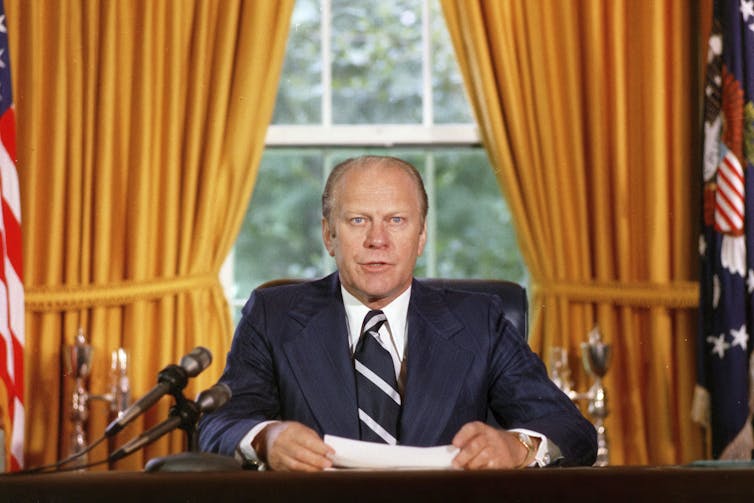
But toward the end of the 20th century and into the 21st, presidents have used the pardon pen increasingly for personal and political reasons. The inflection point is undoubtedly the pardon of former President Richard M. Nixon in 1974 by his former vice president and successor, Gerald Ford. This was issued a month after Nixon’s resignation in the wake of the Watergate scandal, which involved Nixon’s 1972 reelection campaign spying on his political enemies.

Ford justified his action by citing the need for national unity, saying the pardon would spare the country from a messy and dramatic public trial of a former president. Never before had a high-profile public politician received such a presidential grant, which caused Ford’s public standing to take a hit. Scholars and historians believe the act contributed to his reelection loss in 1976.

Gerald Ford addresses the nation regarding his pardon of Richard Nixon.
In 1974, President Gerald Ford pardoned his predecessor, Richard M. Nixon, seeking to spare the country the divisiveness of a trial involving a former president.
AP

We have since seen Ford’s decision open the door to more pardons of political allies or personal friends. In 1992, George H.W. Bush pardoned officials he had served with in the Reagan administration who were tangled up in the arms-for-hostages, Iran-Contra scandal; Bill Clinton pardoned Democratic donor Marc Rich in 2001; and George W. Bush commuted the sentence of vice presidential aide Scooter Libby in 2007.

Trump’s expanded use

As it happens, Trump issued a full pardon to Libby in 2018. During his first term, Trump also pardoned Charles Kushner, the father of his son-in-law, Jared Kushner.

At the end of his first term, Trump pardoned “”) his former campaign manager Paul Manafort and his friend Roger Stone among other political allies.

Trump’s second term has seen clemency for his former lawyer and friend Rudy Giuliani, as well as crypto executive Changpeng Zhao, whose ties to Trump family businesses have raised questions about the pardon.

Trump’s use of the pardon power does not seem to follow a consistent doctrine or philosophy. Some of his clemency actions seem to contradict his administration’s policy, such as dozens of pardons of drug traffickers, despite the effort to stop drug trafficking in the Caribbean.

The pace of Trump’s pardons and commutations, however, suggests little hesitation. The question looking forward, beyond his presidency, is how much of a precedent his actions, along with Biden’s, may set for their successors.

We know this from earlier expansions of the pardon’s reach, as well as other areas of presidential authority: Few presidents willingly relinquish powers accrued by their predecessors. Once chief executives have exercised a certain type of authority, their predecessors seldom give it back, ultimately increasing the power of the presidency.

The Conversation

Stewart Ulrich does not work for, consult, own shares in or receive funding from any company or organization that would benefit from this article, and has disclosed no relevant affiliations beyond their academic appointment.

ref. Pardons are political, with modern presidents expanding their use – https://theconversation.com/pardons-are-political-with-modern-presidents-expanding-their-use-271373

The ‘one chatbot per child’ model for AI in classrooms conflicts with what research shows: Learning is a social process

Source: The Conversation – USA (2) – By Niral Shah, Associate Professor of Learning Sciences & Human Development, University of Washington

Yes, AI tutors can provide individualized feedback, but learning is inherently social. Maskot via Getty Images

In the Star Trek universe, the audience occasionally gets a glimpse inside schools on the planet Vulcan. Young children stand alone in pods surrounded by 360-degree digital screens. Adults wander among the pods but do not talk to the students. Instead, each child interacts only with a sophisticated artificial intelligence, which peppers them with questions about everything from mathematics to philosophy.

This is not the reality in today’s classrooms on Earth. For many technology leaders building modern AI, however, a vision of AI-driven personalized learning holds considerable appeal. Outspoken venture capitalist Marc Andreessen, for example, imagines that “the AI tutor will be by each child’s side every step of their development.”

Years ago, I studied computer science and interned in Silicon Valley. Later, as a public school teacher, I was often the first to bring technology into my classroom. I was dazzled by the promise of a digital future in education.

Now as a social scientist who studies how people learn, I believe K-12 schools need to question predominant visions of AI for education.

Individualized learning has its place. But decades of educational research is also clear that learning is a social endeavor at its core. Classrooms that privilege personalized AI chatbots overlook that fact.

School districts under pressure

Generative AI is coming to K-12 classrooms. Some of the largest school districts in the country, such as Houston and Miami, have signed expensive contracts to bring AI to thousands of students. Amid declining enrollment, perhaps AI offers a way for districts to both cut costs and seem cutting edge.

Pressure is also coming from both industry and the federal government. Tech companies have spent billions of dollars building generative AI and see a potential market in public schools. Republican and Democratic administrations have been enthusiastic about AI’s potential for education.

Decades ago, educators promoted the benefits of “One Laptop per Child.” Today it seems we may be on the cusp of “one chatbot per child.” What does educational research tell us about what this model could mean for children’s learning and well-being?

Learning is a social process

During much of the 20th century, learning was understood mainly as a matter of individual cognition. In contrast, the latest science on learning paints a more multidimensional picture.

Scientists now understand that seemingly individual processes – such as building new knowledge – are actually deeply rooted in social interactions with the world around us.

Neuroscience research has shown that even from a young age, people’s social relationships influence which of our genes turn on and off. This matters because gene expression affects how our brains develop and our capacity to learn.

In classrooms, this suggests that opportunities for social interaction – for instance, children listening to their classmates’ ideas and haggling over what is true and why – can support brain health and academic learning.

Research in the social sciences has long since proved the value of high-quality classroom discourse. For example, in a well-cited 1991 study involving over 1,000 middle school students across more than 50 English classrooms, researchers Martin Nystrand and Adam Gamoran found that children performed significantly better in classes “exhibiting more uptake, more authenticity of questions, more contiguity of reading, and more discussion time.”

In short, research tells us that rich learning happens when students have opportunities to interact with other people in meaningful ways.

AI in classrooms lacks research evidence

What does all of this mean for AI in education?

Introducing any new technology into a classroom, especially one as alien as generative AI, is a major change. It seems reasonable that high-stakes decisions should be based on solid research evidence.

But there’s one problem: The studies that school leaders need just aren’t there yet. No one really knows how generative AI in K-12 classrooms will affect children’s learning and social development.

Current research on generative AI’s impact on student learning is limited, inconclusive and tends to focus on older students – not K-12 children. Studies of AI use thus far have tended to focus on either learning outcomes or individual cognitive activity.

Although standardized test scores and critical thinking skills matter, they represent a small piece of the educational experience. It is also important to understand generative AI’s real-life impact on students.

For example: How does it feel to learn from a chatbot, day after day? What is the longer-term impact on children’s mental health? How does AI use affect children’s relationships with each other and with their teachers? What kinds of relationships might children form with the chatbots themselves? What will AI mean for educational inequities related to social forces such as race and disability?

More broadly, I think now is the time to ask: What is the purpose of K-12 education? What do we, as a society, actually want children to learn?

Of course, every child should learn how to write essays and do basic arithmetic. But beyond academic outcomes, I believe schools can also teach students how to become thoughtful citizens in their communities.

To prepare young people to grapple with complex societal issues, the National Academy of Education has called for classrooms where students learn to engage in civic discourse across subject areas. That kind of learning happens best through messy discussions with people who don’t think alike.

To be clear, not everything in a classroom needs to involve discussions among classmates. And research does indicate that individualized instruction can also enhance social forms of learning.

So I don’t want to rule out the possibility that classroom-based generative AI might augment learning or the quality of students’ social interactions. However, the tech industry’s deep investments in individualized forms of AI – as well as the disappointing history of technology in classrooms – should give schools pause.

Good teaching blends social and individual processes. My concern about personalized AI tutors is how they might crowd out already infrequent opportunities for social interaction, further isolating children in classrooms.

Center children’s learning and development

Education is a relational enterprise. Technology may play a role, but as students spend more and more class time on laptops and tablets, I don’t think screens should displace the human-to-human interactions at the heart of education.

I see the beneficial application of any new technology in the classroom – AI or otherwise – as a way to build upon the social fabric of human learning. At its best it facilitates, rather than impedes, children’s development as people. As schools consider how and whether to use generative AI, the years of research on how children learn offer a way to move forward.

The Conversation

Niral Shah does not work for, consult, own shares in or receive funding from any company or organization that would benefit from this article, and has disclosed no relevant affiliations beyond their academic appointment.

ref. The ‘one chatbot per child’ model for AI in classrooms conflicts with what research shows: Learning is a social process – https://theconversation.com/the-one-chatbot-per-child-model-for-ai-in-classrooms-conflicts-with-what-research-shows-learning-is-a-social-process-269885

How the NIH became the backbone of American medical research and a major driver of innovation and economic growth

Source: The Conversation – USA (3) – By Fred D. Ledley, Director, Center for Integration of Science and Industry, Bentley University

NIH researchers conducted some of the earliest experiments for developing chemotherapy to treat cancer, circa 1950. National Cancer Institute, National Institutes of Health

As a young medical student in 1975, I walked into a basement lab at the National Institutes of Health in Bethesda, Maryland, to interview for a summer job.

It turned out to be the start of a lifelong affiliation – first as a trainee, then as a grantee running a university laboratory and finally, now, as a researcher of economics and public policy studying the agency’s impact on health care and on the national economy.

On that initial visit 50 years ago, I got my first direct experience with the NIH’s mission: to tap the enormous potential of basic science to improve human health and medical care. And over the long arc of my career, I watched the agency enact this mission in ways that brought enormous value to the country. NIH funding trained a legion of biomedical scientists, produced countless therapies that underpin much of modern medicine and catalyzed the launch of the biotechnology industry.

But widespread federal grant terminations and disruptions to federal funding in 2025 have left scientists who depend on NIH support reeling. And a 40% cut to the NIH budget for 2026 proposed by the White House threatens the agency’s future.

The origins and growth of the NIH

The NIH was founded through the Ransdell Act of 1930, which converted the former Hygienic Laboratory of the Marine Hospital Services into the seeds of a new government institution. That laboratory had been established in 1887 to develop public health measures, diagnostics and vaccines for controlling diseases prevalent in the U.S. at the time, such as cholera, yellow fever, smallpox, plague and diphtheria. With the act’s passage, the Hygienic Laboratory was reimagined as the National Institute of Health.

In a black-and-white photograph, President Franklin D. Roosevelt stands on the steps of a new building, draped with American flags.
The NIH, initially called the National Institute of Health, was created in 1930 with the passage of the Ransdell Act. President Franklin D. Roosevelt dedicated the new NIH campus in Bethesda, Md., on Oct. 31, 1940, saying, ‘We cannot be a strong nation unless we are a healthy nation.’
National Institutes of Health

Sen. Joseph Ransdell of Louisiana envisioned the NIH as an agency with a broader mandate for translating scientific advances to improve human health. In arguing in 1929 for the creation of the new institute, he read into the Congressional Record an editorial from The New York Times that highlighted rapid advances in chemistry, physiology and physics.

The editorial lamented that “never in the whole history of the world had efforts to improve health conditions been behind the advance in other sciences.” Pointing to millions of Americans suffering from sickness leading to economic losses “into billions,” it argued for the need for a medical sciences institute coordinating “a national effort to prevent diseases that are or may be preventable.”

In 1945, a report called Science – The Endless Frontier, by Vannevar Bush, highlighted the government’s central role in supporting science that harnessed nuclear energy, implemented radar and developed penicillin – all important elements of the United States’ success in World War II. Bush argued that these wartime successes presented a model for growing the American economy, preventing and curing disease and projecting American power.

The NIH became central to this model. Its budget increased substantially during and just after World War II, with postwar adoption of Bush’s plan, and again after 1957 when the nation redoubled its commitment to science following Russia’s launch of Sputnik and the start of the space race. The National Cancer Act of 1971, which established the separate National Cancer Institute, reaffirmed the nation’s commitment to government-funded research. This new institute’s funding provided much of the seed capital for the emergence of biotechnology.

In the 1980s, the Stevenson-Wydler and Bayh-Dole acts created a clear pathway for developing commercial products from federally funded research that would provide public benefits and economic stimulus. These federal laws made it a requirement to pursue patenting and licensing of NIH-funded research to industry.

How one project’s evolution reflects the NIH’s mission

Today, the NIH represents the backbone of efforts to improve health and health care, supporting each step in the process from preliminary discovery to clinical advance. These steps correspond to the stages of an individual scientist’s path.

A nurse fits a study volunteer with a clear plastic hood.
By putting study volunteers into a specially constructed metabolic chamber, NIH researchers in the 1950s could study how the human body uses air, water and food. The nurse here is affixing a hood onto a volunteer to measure oxygen consumption.
National Institutes of Health

I experienced this progression in my own career. After establishing my first independent laboratory with a grant for early-stage researchers, then called a First Independent Research Support and Transition grant, a Research Project grant, widely known as an R01, funded my lab’s work identifying genes that cause inherited metabolic diseases in newborns. RO1 grants are the main mechanism that academic biomedical scientists in the U.S. rely on to support innovative research.

Later, an NIH Program Project grant enabled us to investigate how the genes we had identified could be used to treat children. A General Clinical Research Center grant supported the hospital facilities necessary for clinical research and paid for patient care. Other grants supported our medical students and fellows as they embarked on their own careers as well as applications of our research to areas such as child health, reproductive biology and gastroenterology.

As our research on gene therapy progressed, NIH Small Business grants contributed to our founding a company that raised US$200 million in investments and partnerships and created hundreds of new jobs in Houston. Grants to small businesses continue to play a crucial role in helping universities commercialize discoveries.

Is the NIH effective?

For the past decade, I have led a research center focused on characterizing the process of developing new drugs. Our work, which is not funded by the NIH, shows that an established foundation of basic research on the biology underlying health and disease is necessary for successful drug development – and that most of this research is performed in public institutions.

We have found that NIH funding supported basic or applied research related to about 99% of newly approved medicines, clinical trials for 62% of these drugs and patents governing about 10% of these products.

A scientist holds three test tubes in his gloved hands
Based on research conducted at the NIH, azidothymidine, or AZT, in 1987 became the first drug approved to treat AIDS. Here, the drug, added to the middle vial, protects healthy immune cells from being destroyed by HIV, the virus that causes AIDS.
John Crawford, National Cancer Institute, National Institutes of Health

Studies also show that this NIH funding saves industry almost $3 billion per drug in development costs. Over the past decade, there has been $800 billion in new investment in biotechnology. The U.S. biopharmaceutical industry directly supports more than 1 million jobs.

Medicines enabled by NIH funding have been crucial for increasing life expectancy and health – dramatically decreasing deaths due to heart disease and stroke, improving cancer outcomes, controlling HIV infection, improving the management of immunological diseases and easing the burden of psychiatric conditions.

The Trump administration is currently questioning the role of science in maintaining the nation’s health, economy and global posture. Yet the NIH stands as a testimony to the vision articulated by its early architects.

At its heart is the conviction that science is good for society, that persistent investment in basic research is essential to technological advances that serve the public interest, and that our nation’s health and economy benefit from developments in biology.

The Conversation

Fred D. Ledley’s research has been supported by grants to Bentley University from the Institute for New Economic Thinking, National Pharmaceutical Council, West Health, and the National Biomedical Research Foundation.

ref. How the NIH became the backbone of American medical research and a major driver of innovation and economic growth – https://theconversation.com/how-the-nih-became-the-backbone-of-american-medical-research-and-a-major-driver-of-innovation-and-economic-growth-257403

Getting peace right: Why justice needs to be baked into ceasefire agreements – including Ukraine’s

Source: The Conversation – USA (3) – By Valerie Morkevicius, Associate Professor, Political Science, Colgate University

From left, Ukrainian President Volodymyr Zelenskyy, Britain Prime Minister Keir Starmer, French President Emmanuel Macron and German Chancellor Friedrich Merz leave a meeting on Dec. 8, 2025, at 10 Downing Street in London. AP Photo/Kin Cheung

Efforts to end the war in Ukraine have grabbed global attention, fueled by debates over U.S. President Donald Trump’s 28-point plan – which many analysts see as favoring Russia – and European attempts to craft a counterproposal.

We’ve been here before. Failed attempts to end the conflict date back to the beginning, soon after Russia’s 2014 occupation of Crimea and parts of the Donbas. After Russia’s full-scale invasion in February 2022, peace discussions started up again within days, and they have continued in fits and starts since.

Prospects for a lasting peace remain dubious. One reason, I believe, is that the proposals pay little attention to the relationship between peace and justice – a flaw shared by previous plans.

Is peace worth having if it’s unjust? Is justice worth pursuing if it prolongs war? Those are questions as troubling as they are old. “Peace is the effect of justice,” as St. Thomas Aquinas argued in the 13th century. Ceasefires built on coercion or exhaustion inevitably fail because they do not resolve the conflict’s causes.

Aquinas is a major figure in the just war tradition, the focus of my research. This area of ethics helps weigh when war is justified – and also how it should end.

Today, the insight that peace and justice are inseparable grounds what international law terms “transitional justice.” By focusing on victims and assuring accountability for past wrongs, this approach seeks to disrupt recurring cycles of violence.

Past agreements and proposals aimed at ending the conflict in Ukraine failed because in the rush to stop the fighting, they ignored questions of justice. The literature on transitional justice, by contrast, encourages negotiators to attend to four interdependent principles: truth, justice, reparations and safeguards against future recurrence.

1. Truth

Truth is essential for peace. As St. Augustine, one of the earliest Christian just-war thinkers, put it in the fourth century, “false justice” arises when the pursuit of truth is abandoned.

A woman in black clothes and a black hat leans over a coffin draped in sky blue fabric.
A mother cries at the coffin of her son, Oleh Borovyk, a Ukrainian serviceman, during his funeral in Boiarka, Ukraine, on Dec. 3, 2025.
AP Photo/Evgeniy Maloletka

Durable peace agreements require all sides to cooperate with international efforts to document war crimes and human rights violations, such as the United Nations’ Independent International Commission of Inquiry on Ukraine. This is no small task. So far, Ukraine has granted access to outside investigators, but Russia has refused, even when it has accused Ukraine of war crimes.

But reconciliation requires a complete accounting of the harms done. Archbishop Desmond Tutu, who headed South Africa’s Truth and Reconciliation Commission after the end of apartheid, explained that “forgiveness depends on repentance, which has to be based on an acknowledgment of what was done wrong, and therefore on disclosure of the truth.”

Truth-telling also prevents false narratives from creating “justifications” for renewed fighting. Thus, peace in Ukraine will require a global effort to combat disinformation legitimizing Russia’s aggression and obscuring its war crimes.

2. Justice

Justice demands holding perpetrators to account. If, as Aquinas argued, a just war is “one that avenges wrongs” or seeks “to restore what [has been] seized unjustly,” ignoring these concerns when ending a war would itself be unjust.

Treating collaborators with fairness requires nuance. In some cases, pardoning individuals who acted under duress – and even willing but nonviolent collaborators who fully disclose their actions – can support postwar reconciliation. Especially in areas once occupied by enemy forces, frank confessions can help rebuild social trust.

However, amnesty for war crimes and crimes against humanity is impermissible because pardons deny victims justice and may embolden future perpetrators. The International Criminal Court has issued arrest warrants for six Russian officials, including President Vladimir Putin. Meanwhile, the Council of Europe has established a Special Tribunal for the Crime of Aggression Against Ukraine, which would prosecute senior Russian officials who ordered the illegal invasion.

Realistically, neither forum can try those responsible without either Russia’s defeat or Putin’s removal from power. But in the interim, other countries can continue to support Ukrainian courts handling war crimes cases.

Justice also requires holding one’s own side accountable, even if the other side will not reciprocate. Allegations of war crimes by Ukrainian soldiers are far rarer, but Ukrainian courts must also prosecute these. Fair trials for all combatants are essential, lest, as Aquinas cautions, judgments seek “to sate … hatred under cover of correction.”

A woman looking very happy embraces a man draped in a blue and gold flag amid a crowd of people outside.
A woman hugs a soldier who came back from Russian captivity during an exchange of prisoners between Russia and Ukraine on May 25, 2025.
AP Photo/Efrem Lukatsky

3. Reparations

Reparations aim to make survivors whole again. This principle, too, has roots in classical just war thinking. The 16th-century theologian Francisco de Vitoria, for example, argued that reparations within the bounds of “equity and humanity” could help redress losses and restore justice.

The World Bank estimates that direct damage in Ukraine is over US$176 billion; in total, rebuilding will cost three times that. The Council of Europe has recommended using frozen Russian assets to fund reconstruction efforts, as have some American scholars . The illegality of Russia’s invasion means that such countermeasures are likely permissible under international law.

Apologies can also serve as reparations, but Russia is unlikely to proffer any – partly because domestic political pressures mean Putin cannot afford to look like he has lost.

Commemorative events and memorials also validate victims’ suffering. The international community can support Ukrainians in their efforts to meaningfully memorialize the war.

4. Deterrence

Peace lasts when the parties trust that the violence won’t reoccur.

However, Russia has repeatedly broken its treaties with Ukraine. That includes the first agreements meant to bring the conflict to an end, back in 2014.

Sunlight streams over an overgrown yard with a simple wooden cross and a small teddy bear.
In this November 2025 photo, provided by a Ukrainian military press service, a civilian grave lies among damaged residential houses in Kostyantynivka.
Oleg Petrasiuk/Ukraine’s 24th Mechanized Brigade via AP

That summer, Russian-backed separatists downed a Malaysian Airways flight, spurring the international community to seek a quick resolution. The hastily drafted Minsk agreements, signed in 2014 and 2015, established a ceasefire monitoring mission and required the removal of foreign military units. They also demanded Ukrainian constitutional reforms – ostensibly to secure more autonomy for the country’s largely Russian-speaking east.

The Minsk agreements temporarily froze the conflict, but relative quiet didn’t mean peace. Ceasefire violations were perpetual. Russian-supported militias were not disbanded, and Russia continued to send mercenaries and military forces to the Donbas. Human rights violations proliferated in Russian-occupied areas. And in February 2022, Russia launched its full-scale invasion.

Given this history, a durable peace would require that Russia accept constraints on its power. The various peace proposals put forth since 2022, however, have demanded security concessions only from Kyiv, requiring Ukraine to abandon hopes for NATO membership and restricting the size of its military.

Russia is unlikely to agree to caps on its military. Deterrence, then, could take the form of credible commitments from other countries to enforce whatever peace agreement emerges.

Ukraine’s vulnerability to future Russian aggression means it will need binding promises from its partners. Russia will not sign a treaty that permits Ukraine to join NATO, which Moscow claims would be a threat. Other possible safeguards for Ukrainian sovereignty include a proposed international peacekeeping force or an alternative set of security alliances.

Lasting peace

Ultimately, a durable peace requires considering both sides’ legitimate security and justice claims if, as Vitoria wrote in 1539, “they are prepared to negotiate genuinely and fairly.”

Therein lies the catch. Transnational justice can be hijacked, with aggressors trying to portray themselves as victims. Separating fact from fiction, and genuine concerns from manufactured pretext, is essential at the negotiating table.

A quick end to the war is tempting, but a hasty peace is a fragile one. A durable peace, rather than yet another ceasefire, requires attention to justice – even if that takes more time to achieve.

The Conversation

Valerie Morkevicius does not work for, consult, own shares in or receive funding from any company or organization that would benefit from this article, and has disclosed no relevant affiliations beyond their academic appointment.

ref. Getting peace right: Why justice needs to be baked into ceasefire agreements – including Ukraine’s – https://theconversation.com/getting-peace-right-why-justice-needs-to-be-baked-into-ceasefire-agreements-including-ukraines-270638

Christmas trees are more expensive than ever in Colorado — what gives?

Source: The Conversation – USA (2) – By Ali Besharat, Professor of Marketing, University of Denver

All festive products are getting more expensive. d3sign/GettyImages

The holiday season sparks a significant increase in consumer spending. This year, Black Friday alone saw consumers shell out a record US$11.8 billion. It’s the time of year when many Americans make purchases to decorate for the holidays — lights, ornaments and Christmas trees.

If you bought a Christmas tree in Denver this year, you may have noticed a pretty steep price tag. It turns out that all festive products are getting more expensive, and that includes Christmas trees, both freshly cut and artificial.

I study the psychology of consumption at the University of Denver. I’ve always been curious about how people make financial decisions under certain circumstances, including around the holidays. Christmas trees are an interesting case study.

What’s driving the increase

The cost of real Christmas trees is directly impacted by a long production cycle and transportation costs, particularly for landlocked markets like Denver.

Christmas trees take 7 to 10 years to grow. Currently, supply is tight, pushing tree prices up, which is a direct and delayed consequence of reduced planting rates that followed the Great Recession – which began in late 2007. This planting deficit effectively drove up wholesale prices and doubled the average price of pre-cut trees over the past decade after adjusting for inflation.

Raising tiny tree seedlings to a marketable size is a fraught business. Growers are exposed to a decade of weather, labor and pest risks, which increases the financial uncertainty of any planting season. This long lead time has made the supply unpredictable, putting constant pressure on Christmas tree wholesale prices.

Aerial view of rows of trees on a farm.
Colorado gets some of its Christmas trees from North Carolina, which grows more than 26% of the Christmas trees in the U.S.
Allison Joyce/GettyImages

For Denver retailers, transportation adds disproportionately to the final cost, since most Christmas trees in Denver are brought in from the Pacific Northwest and North Carolina using long-haul freight.

A retailer in Denver must also cover local operational overhead, such as labor costs, storage and the rental of temporary sales lots, which increases prices by about 10% on average based on wholesale Christmas tree prices. This is especially true for large trees, those taller than 9 feet (2.74 meters), as they do not grow in Colorado. Having said that, there are Christmas tree growers in Colorado, and the Douglas Fir is native to Colorado and grows naturally throughout its mountains.

Psychology of Christmas tree purchase decisions

The choice between a pre-cut Christmas tree and an artificial one is classic behavioral economics, which is the combination of economics and psychology to understand how and why people behave the way they do in the real world. It involves a trade-off between two readily available choices.

One option offers an emotional appeal, while the second choice may have to do more with cost savings and perceived environmental impact.

Buyers of real trees are driven by pleasure, satisfaction and emotional fulfillment. Often, buyers of fresh-cut trees are driven by nostalgia and a desire to inhale the powerful scent. Depending on the qualities of the tree, like how long it keeps its needles, how stiff the branches are and how rare it is, Denver customers often spend between $50 and $870 annually on fresh-cut Christmas trees.

On the flip side, artificial tree buyers prioritize the ease of buying a tree at the store and then bringing it out of storage each year. These customers seek convenience, low maintenance and the ability to control how the tree looks from a product that can cost between $250 to $700 initially. Being a durable good, artificial trees are typically replaced only once every five years.

In 2025, however, the decision to buy an artificial tree may feel less rational. Retailers are raising prices by 10% to 15% due to tariffs.

A Christmas tree display inside a store next to a shelf of ornaments.
Artificial Christmas trees have a higher up-front cost than many real trees, but over time are more affordable.
UCG/GettyImages

The financial and environmental superiority of the artificial tree is dependent on how long a consumer plans to keep and use it.

The financial break-even point is reached only when the artificial tree is reused for at least five years. The environmental break-even point is higher — around 10 years — due to the carbon emissions from manufacturing and global shipping of artificial trees. Their carbon footprint can be up to 10 times greater than a properly disposed-of real tree.

Behavioral changes in consumption

What about a third option that may appeal to Coloradans’ love of the outdoors?
Choose-and-cut businesses invite customers to visit a farm to select their tree and cut it down themselves. The tree is no longer just something you buy — it is the center of an experience you share.

Advocates go so far as to argue that the outdoor farm environment acts as a therapeutic escape from the stressful holiday season.

A child with a pink hat and blue coat pulls a small tree through the snow by its trunk.
Choose-and-cut Christmas tree farms enhance profitability by transferring the high cost of harvesting labor directly to the customer.
Glenn Asakawa/GettyImages

For the grower, this model is a highly effective form of agritourism, which makes use of the farm environment to boost revenue. It dramatically enhances profitability by transferring the high cost of harvesting labor – which can run from $15,000 to $50,000 annually – directly to the customer as a labor of love. The purchase of a tree may be the main point of the visit, but growers can improve their bottom lines through the sale of profitable goods and services like wreaths, hot chocolate, food and carriage rides. Motivated consumers are willing to pay more for the experience and the opportunity to recreate a meaningful ritual.

If this option excites you, there are a couple of spots where you can cut your own tree in Colorado, including at the Arapaho and Roosevelt National Forests. Most of these places, however, require a permit to chop down a tree.

Read more of our stories about Colorado.

The Conversation

Ali Besharat does not work for, consult, own shares in or receive funding from any company or organization that would benefit from this article, and has disclosed no relevant affiliations beyond their academic appointment.

ref. Christmas trees are more expensive than ever in Colorado — what gives? – https://theconversation.com/christmas-trees-are-more-expensive-than-ever-in-colorado-what-gives-271472