Bright, flickering and flashing lights really can be bad for you – here’s how to have a visually comfortable Christmas

Source: The Conversation – UK – By Catherine Manning, Associate Professor in Psychology, University of Birmingham

Maksim Pasko/Shutterstock

It is the time of year when decorations appear everywhere and everyone has a preferred style, from bright flashing lights to something more understated. Christmas decorations are meant to be cheerful, yet for some people, certain types of visual input can be surprisingly difficult to tolerate.

No one wants to dampen the festive mood, but it is worth knowing that decorations can cause discomfort in ways that are easy to overlook.

Flashing lights are a familiar Christmas choice, probably because they grab attention. We have known for a long time that flashing lights can trigger seizures in people with epilepsy because rapid flashes can synchronise activity in parts of the brain that are already more susceptible to overstimulation.

Autistic people can also be sensitive to flashing lights because many autistic people have heightened sensory responsiveness. People with migraines may be affected because bright, flickering contrast can stimulate the visual cortex and lead to headaches.

Even without these conditions, flashing lights can feel unpleasant. Faster flashes are usually worse. Anything above three flashes per second tends to more easily overload the visual cortex.

Since many modern lights have adjustable settings, slowing the flash rate or turning the flash off entirely can make the display more comfortable for people who are sensitive to this type of stimulation.

Invisible flicker

Lights can also be uncomfortable even when they appear steady. Some produce a rapid flicker that is too fast for you to see. A quick way to check is to record the lights on your phone using the video “slo mo” setting. Invisible flicker can affect reading ability,
cause headaches and increase visual fatigue.

People with sensory sensitivities, which can include heightened sensitivity to noise, touch, light, colour contrast or movement, are especially likely to be affected by flicker. Researchers are still exploring how flicker affects different groups, and the precise mechanism is not fully understood. But we know that certain lights bother some people far more than others.

Keep cool or stay warm?

When buying white Christmas lights, you will usually see two options. Cool white resembles bright daylight and warm white looks more like sunrise or sunset.

In general, cooler light can help with concentration because it mimics the colour temperature of daylight, which signals alertness to the brain. Warmer light tends to feel more relaxing as it resembles evening light when you are winding down. The choice depends on the atmosphere you want to create.

Warmer light can be particularly welcome when it is cold outside because it can make people feel physically warmer. People with sensory sensitivities, including many autistic people, may prefer warm white because cool white can feel harsher on the eyes, which makes it more uncomfortable to look at for long periods.

Festive colour schemes often rely on red and green. Red, however, is widely reported to be the most uncomfortable colour. One reason is because the photoreceptors responding to red light lead to more brain activity in the gamma range, which is a fast brain rhythm.

Discomfort is greater when red is a deep red or when it flickers. It can also feel more intrusive when displayed next to strong contrasting colours such as green or blue . Choosing reds and greens that are closer in tone to each other and avoiding alternating red and green lights can help reduce the strain.

Brightness also matters. Brighter lights are generally more uncomfortable for most people, and this is particularly true for people with sensory processing differences. Strong light feels more intense and can trigger quicker fatigue or discomfort.

For many people, visual discomfort caused by lights is mild and passes quickly. For others, it can lead to tiredness, nausea, headaches and feeling overwhelmed. People vary widely in how sensitive they are. Knowing that not everyone experiences decorations in the same way is a simple step to support friends and family. Something as small as changing a light setting or switching off certain decorations when someone visits can genuinely help.

Christmas decorations bring joy and brighten the darkest months of the year. With a little thought about how different lights and colours affect people, we can keep the festive sparkle while making the season more comfortable for everyone.

The Conversation

Catherine Manning currently receives funding from the Medical Research Council and The Leverhulme Trust, and has previously received funding from the Wellcome Trust.

Arnold J Wilkins has previously received funding from the Medical Research Council and the Wellcome Trust.

ref. Bright, flickering and flashing lights really can be bad for you – here’s how to have a visually comfortable Christmas – https://theconversation.com/bright-flickering-and-flashing-lights-really-can-be-bad-for-you-heres-how-to-have-a-visually-comfortable-christmas-271502
Russia’s war economy is not collapsing, but neither is it stable

Source: The Conversation – UK – By Yerzhan Tokbolat, Lecturer in Finance, Queen’s University Belfast

Russia’s wartime economy is getting weaker as the war in Ukraine approaches its fourth anniversary, according to a recent report by PeaceRep, a research group led by the University of Edinburgh. The report, Against the Clock? Why Russia’s War Economy is Running Out of Time, finds that Russia is being forced to spend aggressively on the war, while its earning abilities have dropped significantly.

The funding source used to finance much of this spending, Russia’s sovereign wealth fund, also looks to be dwindling. According to the report, around 76% of the fund’s US$148 billion (£110 billion) pre-war liquid reserves was spent within the first three years of the war.

In an article in May, I argued that Russian leader Vladimir Putin could afford a drawn-out war because he had spent more than 20 years preparing for it. Under Putin’s leadership Russia has consistently posted budget surpluses, amassed foreign currency reserves and reduced its reliance on western debt.

The question now is how far can that preparation carry the Russian economy? For the moment, it appears Russia can still sustain the war. But it can do so only by drawing heavily on earlier buffers, such as foreign reserves and the sovereign wealth fund, while diverting an ever-growing share of national resources towards the military.

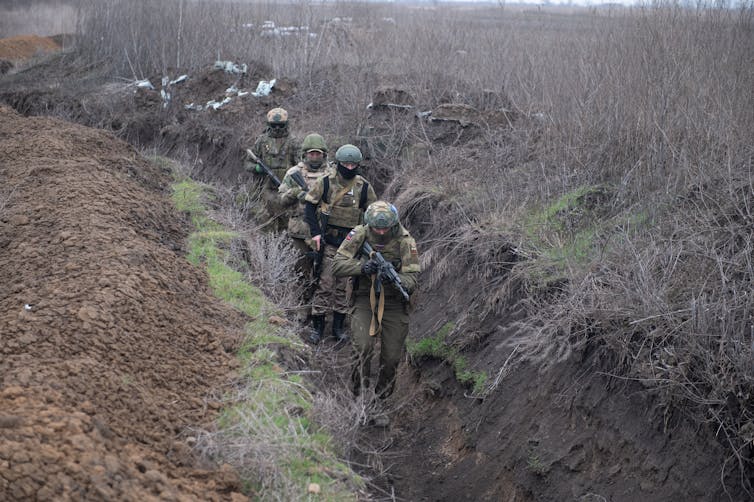
A group of four Russian servicemen walk along a trench in Ukraine.
Russian servicemen on the frontlines in eastern Ukraine.
Sergey Nikonov / Shutterstock

The strain on Russia’s economy is being compounded by mounting external pressures. The EU, which is currently the largest buyer of Russian liquefied natural gas (LNG) and pipeline gas, announced in early December that it would end its imports of Russian LNG in 2026. Imports of pipeline gas will end the following year.

But Russia’s revenue streams have remained relatively resilient throughout the war. Russia has diversified its exports of crude oil, with China now accounting for around 47%, India about 38% and Turkey roughly 6%. These revenue flows, together with earlier economic preparation, have helped sustain the three core areas that shape any wartime economy: industrial output, fiscal capacity and social resilience.

According to 2024 analysis by the Centre for Economic Policy Research, war-related output in Russia surged by about 60% in the early years of the conflict. That expansion still underpins Russia’s industrial base today. War-related industries have accounted for almost all of manufacturing growth since the invasion.

Energy revenues also continue to bolster the federal budget, though the government is relying increasingly on domestic borrowing and reserve drawdowns to fund deficits. And on the household side, higher wages in military-linked sectors and targeted government payments to the families of mobilised soldiers have helped soften the impact of inflation. Income from mobilisation has even lifted household savings, particularly in poorer regions of Russia.

Yet this appearance of stability reflects an economy being stretched rather than strengthened. Defence-related activity now dominates manufacturing, drawing labour and capital away from civilian sectors. Civilian industries are losing workers, machinery and investment, which is deepening structural stagnation and will make future economic recovery more difficult. What looks like resilience is, in practice, a system operating under growing strain.

Russia’s unsustainable economy

The central question now is how long can Russia’s remaining buffers support its militarised economy? Labour shortages have become structural rather than temporary, and inflationary pressures have persisted even amid weakening growth. Demographic pressures add to this squeeze, with mobilisation, emigration and long-term population decline shrinking the workforce available to both industry and the military.

Technological limits are tightening too. Export controls have cut Russia off from many advanced components, increasing reliance on parallel imports and domestic substitutes that are often more expensive or less reliable. This is slowing production and constraining the sophistication of new military systems.

A notable shift is also emerging in how the war is financed. With industry and labour close to capacity, and the EU phasing out Russian gas, the government can no longer rely on economic expansion or strong energy revenues to support the budget.

The new three-year budget, submitted to parliament in late September, raises VAT and expands the tax burden on small businesses. This will pass more of the cost of the war on to households and firms, a model that will only remain viable while the public tolerates higher taxes and gradually declining living standards. That makes its long-term sustainability uncertain.

How long Russia can continue fighting will also depend on forces beyond its borders. China and India are essential buyers of Russian oil, slowing the point at which fiscal pressures fully tighten. Meanwhile, tighter US and EU sanctions are constraining Russia’s access to advanced technology and complicating the logistics of foreign trade.

Geopolitics adds another layer of uncertainty. The latest US-drafted peace proposal for Ukraine echoes several longstanding Russian demands, while a major corruption scandal in Kyiv has weakened Ukraine’s political position at a sensitive moment.

These developments do not remove Russia’s economic vulnerabilities. But they do shape the environment in which Moscow navigates them, lowering the political cost of continuing the war even as economic pressures rise.

Russia’s war economy is not collapsing, but neither is it stable. It survives by pushing strain into the future – into labour markets, public finances and the everyday lives of Russian households.

The key question is how long the system can keep absorbing these pressures before they begin to reinforce one another. In that sense, Russia’s wartime economy still has time – but it is increasingly time borrowed from the future.

The Conversation

Yerzhan Tokbolat does not work for, consult, own shares in or receive funding from any company or organisation that would benefit from this article, and has disclosed no relevant affiliations beyond their academic appointment.

ref. Russia’s war economy is not collapsing, but neither is it stable – https://theconversation.com/russias-war-economy-is-not-collapsing-but-neither-is-it-stable-271700

Home Alone’s ‘Wet Bandits’ are medical miracles

Source: The Conversation – UK – By Adam Taylor, Professor of Anatomy, Lancaster University

The festive movie season is upon us, and one of my perennial favourites is Home Alone 2: Lost in New York. I will die on this hill: it is better than the original. But rewatching it as an adult raises an awkward question. How on earth did the Wet Bandits survive the first film at all, let alone escape without lasting injuries?

Ten-year-old Kevin McCallister, the boy left home alone, sets up traps that are played for laughs, but many involve levels of force that would be catastrophic in real life. A 100lb (45kg) bag of cement to the head, bricks dropped from height, or heavy tools swung at the face are not things a human body can simply shrug off. High-impact trauma to the head and neck rarely ends well.

To understand why, it helps to know a little about skull anatomy. The skull has a protective “vault” that encases the brain, while the bones of the face contain hollow spaces called sinuses. These spaces reduce the weight of the skull but also act as a biological crumple zone, helping to absorb force and protect the brain during impacts. But that protection has limits.

A rough calculation of the forces involved when a 100lb bag of cement strikes the head suggests instant fatal injury. The neck simply cannot absorb that level of force. To put that in perspective, research shows that the cervical spine suffers severe damage above about 1,000 newtons of force. A 100lb (around 45kg) cement bag already exerts roughly 440 newtons under its own weight, and when falling, it decelerates over a very short distance on impact.

While the exact force depends on the height of the fall and how quickly the bag comes to a stop, even conservative assumptions place the impact well above 1,000 newtons, easily exceeding thresholds for catastrophic neck injury.

Beyond that, there is a high risk of brain herniation, where swollen brain tissue is forced into spaces it does not belong. This can compress areas that control breathing and movement, often leading to coma and death.

Head injuries are only part of the problem. Many of Kevin’s traps would also place enormous stress on the chest and major blood vessels. Falling forward from a height, being crushed by heavy objects, or being struck in the torso can cause severe internal injuries. These forces are commonly seen in high-speed, head-on car crashes. In extreme cases, the impact can rupture the aorta, the body’s main artery, which is almost always fatal.

Crush injuries elsewhere in the body can have serious and life-changing consequences. Even if they are not immediately deadly, they can cause internal bleeding that worsens over hours or days. Broken ribs, for example, can puncture the liver, kidneys or spleen, allowing blood to leak slowly into the abdomen. Damage to soft internal organs can also lead to infection, organ failure, or delayed death, depending on the severity.

Then there are the less obviously lethal moments. When Marv crashes into a shelf stacked with paint tins and the shelf falls on him, the impact alone could cause serious internal injury. And paint splashed into the eyes could cause chemical burns and blindness.

Simple slips and falls are not harmless either. The bones at the back of the skull are only about 6–7mm thick. A hard blow here can cause bleeding inside the skull. These brain bleeds do not always show symptoms immediately and may worsen over hours or days after what seemed like a minor bump.

Electricity is another recurring gag that would be anything but funny in reality. When Marv grabs the taps attached to an arc welder, he is exposed to electrical current that causes his muscles to contract uncontrollably. This is why people who touch live electrical sources often cannot let go. The current overrides the body’s normal nerve signals. Prolonged exposure increases the risk of disrupting the heart’s normal rhythm, potentially triggering cardiac arrest.

Despite what cartoons suggest, electricity does not make the skeleton visible – as we see happen to Marv. There is no X-ray radiation involved. To expose bone, you would need extremely high-voltage current, causing fourth-degree burns, which destroy skin, muscle and bone.

Piercing injuries also feature heavily. A nail through the foot is not just painful. It can damage nerves and soft tissues, fracture bones, and introduce bacteria deep into the wound. This raises the risk of serious infection, including tetanus.

Finally, there is Harry’s infamous blowtorch scene. Being set alight for 22 seconds is more than enough time to cause permanent nerve damage, potentially destroying pain sensation altogether. While scalp skin is among the thickest on the body, it has relatively little cushioning underneath. This makes the underlying tissue and bone more vulnerable to deep burns, reaching third or even fourth degree severity, which can be lethal.

Add combustible kerosene to the mix and the risks escalate further. Exposure is linked to kidney damage, heart problems, central nervous system depression and serious respiratory issues.

In short, Harry and Marv are walking medical impossibilities. Surviving a second round of Kevin McCallister’s festive booby traps would require extraordinary luck, immediate trauma care, and months of rehabilitation. Even if they appeared outwardly fine, the internal damage would probably be devastating. Perhaps those lingering injuries explain why the Wet Bandits never made it back for another sequel.

The Conversation

Adam Taylor does not work for, consult, own shares in or receive funding from any company or organisation that would benefit from this article, and has disclosed no relevant affiliations beyond their academic appointment.

ref. Home Alone’s ‘Wet Bandits’ are medical miracles – https://theconversation.com/home-alones-wet-bandits-are-medical-miracles-271538

Can ‘miracle’ heaters really warm your home for pennies? The physics says no

Source: The Conversation – UK – By Dylan Ryan, Lecturer in Mechanical & Energy Engineering, Edinburgh Napier University

New Africa / shutterstock

The internet is awash with adverts for various portable heaters, with claims that they will heat your house for pennies. Some are marketed as the “Tesla of the heating industry” (despite being nothing to do with Elon Musk’s carmaker), while others claim they can “heat up a house in three minutes”.

It’s an appealing message, particularly during cold snaps when energy bills are high and many households are looking for quick fixes. But are any of these claims remotely true?

The short answer is no. And the reasons why are rooted in some very basic physics.

One key detail often missing from these adverts: almost all electric heaters are already close to 100% efficient. That doesn’t mean they are cheap to run – only that nearly all the electricity they use ends up as heat.

Electric heaters work by passing a current through a wire, which then heats up. That heat is then transferred to the room either by warming the air (distributed with a fan) or by radiating heat directly from a hot surface. Even things that sound like “losses”, such as friction in a fan motor, still end up as heat inside the room.

This means there is no clever design or secret component that can make one plug-in heater fundamentally more efficient than another. Electricity use is almost entirely converted into heat. So when a product claims to heat more while using less electricity, alarm bells should ring.

‘Heating a house in three minutes’ breaks the laws of physics

Some adverts go further, claiming a small portable device can heat an entire house in just a few minutes. This is where the numbers really matter.

Heating a typical home means warming hundreds of cubic metres of air, as well as countering heat losses to the outside. That takes lots of energy. To do it quickly would require tens of kilowatts of power – far more than can be drawn safely from a standard household plug socket.

In practice, most portable heaters are deliberately limited to around 2 kilowatts or less, to avoid overheating wiring and sockets. That’s enough to warm a small room, but nowhere near enough to rapidly heat a whole house. Claims otherwise simply don’t stack up.

What’s actually inside these devices?

Independent reviewers and engineers have tested many of these viral heaters, and are not impressed. In one teardown, electrical engineer and YouTuber Clive Mitchell found that a widely advertised “miracle” heater only produced just 500-800 watts of heat – less than half the output of a standard plug-in heater.

In another case, Mitchell looked at a device so badly built he described it as an “automatic house igniter” (though technically that really would heat up your home in three minutes…). He said it partly in jest, but it is a serious issue: badly made electrical products can pose genuine fire risks, particularly if left running unattended.

This is one reason why consumer groups consistently recommend buying heaters that meet established safety standards, rather than relying on anonymous online brands with big claims and little accountability.

Tea lights under flowerpot
Not a serious way to heat your home.
Art_Pictures / shutterstock

Another internet trend involves using candles or tea lights to heat homes, often putting them inside various contraptions made from flower pots or tin cans. This is both dangerous and ineffective. Fire brigades have repeatedly warned against these setups, which pose obvious fire and carbon monoxide risks.

They are also expensive. A single tea light produces about 35 watts of heat. Even burning continuously, candles deliver heat at a far higher cost per kilowatt hour than electricity – and many times more than gas. Putting a tea light under a flower pot doesn’t change how much energy it releases.

What actually is the best way to heat your home?

Portable electric heaters do have a place. They are useful for short-term, localised heating, such as warming a home office or bedrooom for a few hours. Used carefully, they can be a practical supplement to central heating.

But they are not designed to heat entire homes continuously. Even if you rely on electricity for heating, wall mounted radiators are going to be much better for that. They are wired directly into the mains and can pull more power safely and reliably than you can get from a plugin device.

That said, even the best electric radiator is still expensive to run compared to a gas boiler. This brings us to a broader issue: households aren’t just missing a miracle heater. It’s that energy itself is too expensive.

Future solutions for home heating

Heat pumps are one electric technology that may genuinely change things. They work like a fridge in reverse, extracting heat from the outside air and pumping it into your home.

Because they move heat rather than generate it directly, a heat pump can move more heat than it takes electricity to operate. On average an air source heat pump will provide 2.7 kilowatts of heat for every kilowatt-hour of electricity expended. This works out to about a third of the carbon emissions of a gas boiler.

The downside is cost and complexity. Heat pumps are expensive to install and work best in homes that are already well-insulated. They’re not ideal for everyone, but they are one of the few technologies that genuinely offer long-term savings.

Wood burning stoves are another option, but there can be serious issues with air pollution. The price is highly variable and it is generally more expensive than regular heating.

Of course, the whole reason such adverts and social media trends pop up around now is because it’s cold and people are looking for solutions to heat their homes. But unfortunately, there aren’t any quick fixes.

The only real solutions are slower and unglamorous: better insulation, more efficient heating, and reforms to lower the cost of energy itself.

If a heater claims it can warm your whole home for pennies, it’s almost certainly too good to be true. Even the best heater cannot rewrite the rules of physics.

The Conversation

Dylan Ryan does not work for, consult, own shares in or receive funding from any company or organisation that would benefit from this article, and has disclosed no relevant affiliations beyond their academic appointment.

ref. Can ‘miracle’ heaters really warm your home for pennies? The physics says no – https://theconversation.com/can-miracle-heaters-really-warm-your-home-for-pennies-the-physics-says-no-271818

AI tools are being used to subject women in public life to online violence

Source: The Conversation – UK – By Julie Posetti, Director of the Information Integrity Initiative, a project of TheNerve/Professor of Journalism, Chair of the Centre for Journalism and Democracy, City St George’s, University of London

An increasing number of women in pubic life report having been targeted for online abuse using AI tools. fizkes/Shutterstock

The era of AI-assisted online violence is no longer looming. It has arrived. And it is reshaping the threat landscape for women who work in the public sphere around the world.

Our newly published report commissioned by UN Women offers early, urgent evidence indicating that generative AI is already being used to silence and harass women whose voices are vital to the preservation of democracy.

This includes journalists exposing corruption, activists mobilising voters and the human rights defenders working on the frontline of efforts to stall democratic backsliding.

Based on a global survey of women human rights defenders, activists, journalists and other public communicators from 119 countries, our research shows the extent to which generative AI is being weaponised to produce abusive content – in a multitude of forms – at scale.

We surveyed 641 women in five languages (Arabic, English, French, Portuguese and Spanish). The surveys were disseminated via the trusted networks of UN Women, Unesco, the International Center for Journalists and a panel of 22 expert advisers representing intergovernmental organisations, the legal fraternity, civil society organisations, industry and academia.

According to our analysis, nearly one in four (24%) of the 70% of respondents who reported experiencing online violence in the course of their work identified abuse that was generated or amplified by AI tools. In the report, we define online violence as any act involving digital tools which results in or is likely to result in physical, sexual, psychological, social, political or economic harm, or other infringements of rights and freedoms.

But the incidence is not evenly distributed across professions. Women who identify as writers or other public communicators, such as social media influencers, reported the highest exposure to AI-assisted online violence at 30.3%. Women human rights defenders and activists followed closely at 28.2%. Women journalists and media workers reported a still alarming 19.4% exposure rate.

Since the public launch of free, widely accessible generative AI tools such as ChatGPT at the end of 2022, the barriers to entry and cost of producing sexually explicit deepfake videos, gendered disinformation, and other forms of gender-based online violence have been significantly reduced. Meanwhile, the speed of distribution has intensified.

The result is a digital landscape in which harmful, misogynistic content can be generated rapidly by anyone with a smart phone and access to a generative AI chatbot. Social media algorithms, meanwhile, are tuned to boost the reach of the hateful and abusive material, which then proliferates. And it can generate considerable personal, political and often financial gains for the perpetrators and facilitators, including technology companies.

Meanwhile, recent research highlights AI both as a driver of disinformation and as a potential solution, powering synthetic content detection systems and counter-measures. But there’s limited evidence of how effective these detection tools are.

Many jurisdictions also still lack clear legal frameworks that address deepfake abuse and other harms enabled by AI-generated media, such as financial scams and digital impersonation. This is especially the case when the attack is gendered, rather than purely political or financial. This is due to the inherently nuanced and often insidious nature of misogynistic hate speech, along with the evident indifference of lawmakers to women’s suffering.

Our findings underscore an urgent two-fold challenge. There’s a desperate need for stronger tools to identify, monitor, report and repel AI-assisted attacks. And legal and regulatory mechanisms must be established that require platforms and AI developers to prevent their technologies from being deployed to undermine women’s rights.

When online abuse leads to ‘real-world’ attacks

We can’t treat these AI-related findings as isolated statistics. They exist amid broadening online violence against women in public life. They are also situated within a wider and deeply unsettling pattern – the vanishing boundary between online violence and offline harm.

Four in ten (40.9%) women we surveyed reported experiencing offline attacks, abuse or harassment that they linked to online violence. This includes physical assault, stalking, swatting and verbal harassment. The data confirms what survivors have been telling us for years: digital violence is not “virtual” at all. In fact, it is often only the first act in a cycle of escalating harm.

For women journalists, the trend is especially stark. In a comparable 2020 survey, 20% of respondents reported experiencing offline attacks associated with online violence. But five years later, that figure has more than doubled to 42%. This dangerous trajectory should be a wake-up call for news organisations, governments and big tech companies alike.

When online violence becomes a pathway to physical intimidation, the chilling effect extends far beyond individual targets. It becomes a structural threat to freedom of expression and democracy.

In the context of rising authoritarianism, where online violence and networked misogyny are typical features of the playbook for rolling back democracy, the role of politicians in perpetrating online violence cannot be ignored. In the 2020 Unesco-published survey of women journalists, 37% of respondents identified politicians and public office holders as the most common offenders.

The situation has only deteriorated since 2020, with the evolution of a continuum of violence against women in the public sphere. Offline abuse, such as politicians and pubic office holders targeting female journalists during media conferences, can trigger an escalation of online violence that, in turn, can exacerbate offline harm.

This cycle has been documented all over the world, in the stories of notable women journalists like Maria Ressa in the Philippines, Rana Ayyub in India and the assassinated Maltese investigative jouralist Daphne Caruana Galizia. These women bravely spoke truth to power and were targeted by their respective governments – online and offline – as a result.

The evidence of abuse against women in public life we have uncovered during our research signals a need for more creative technological interventions employing the principles of “human rights by design”. These are safeguards recommended by a range of international organisations which build in protections for human rights at every stage of AI design. It also signals the need for stronger and more proactive legal and policy responses, greater platform accountability, political responsibility, and better safety and support systems for women in public life.

The Conversation

Julie Posetti is the Director of the Information Integrity Initiative, a project of TheNerve, the digital forensics lab run by the Nobel Laureate Maria Ressa, which is a partner associated with the UN Women study.

This research was funded by the EU-UN Women ACT to End Violence against Women programme, and the report was co-authored by Dr. Pauline Renaud, Nermine Aboulez and Nabeelah Shabbir.

Kaylee Williams and Lea Hellmueller do not work for, consult, own shares in or receive funding from any company or organisation that would benefit from this article, and have disclosed no relevant affiliations beyond their academic appointment.

ref. AI tools are being used to subject women in public life to online violence – https://theconversation.com/ai-tools-are-being-used-to-subject-women-in-public-life-to-online-violence-271703

Bien-être animal : ce que l’opacité des abattoirs canadiens nous empêche de voir

Source: The Conversation – in French – By Sarah Berger Richardson, Associate professor, L’Université d’Ottawa/University of Ottawa

Acheter de la viande locale pour le temps des Fêtes est souvent perçu comme un choix plus éthique. Pourtant, entre 2017 et 2022, près de 800 cas d’irrégularités liées au traitement des animaux ont été recensés dans des abattoirs sous inspection fédérale au Canada. Que révèlent réellement ces chiffres sur le bien-être animal ?

Cette année, en raison du climat politique avec les États-Unis, beaucoup privilégieront l’achat de produits locaux pour leur tablée. Dans un contexte où le bien-être animal est une préoccupation importante pour la population, la question se pose à savoir si l’achat de viande locale constitue également un bon geste en ce sens. Très peu de personnes savent comment les animaux sont transformés en viande, un angle mort largement entretenu par le malaise que suscite cette réalité.

Respectivement professeure et doctorante à la Faculté de droit de l’Université d’Ottawa, spécialisées en droit agro-alimentaire et animalier, c’est ce sur quoi nous souhaitions mettre la lumière dans un récent projet de recherche.


À lire aussi :
Manger des insectes : solution d’avenir ou fausse bonne idée ?


Le contexte législatif canadien

Au Canada, environ 95 % des animaux destinés à la consommation sont abattus dans des établissements agréés par le gouvernement fédéral. Ces abattoirs sont encadrés par la Loi sur la salubrité des aliments au Canada et à la Loi sur la santé des animaux, ainsi que par les règlements qui en découlent. Leurs activités sont surveillées par des inspecteurs et des vétérinaires de l’Agence canadienne d’inspection des aliments (ACIA).

Ces lois visent avant tout la salubrité et la qualité des aliments, mais elles prévoient aussi des mesures pour assurer le bien-être des animaux, les malades ou blessés nuisant généralement à la sécurité sanitaire. L’idée générale est de ne pas leur infliger de souffrances ou de blessures évitables. Par exemple, au moment de l’abattage, l’animal doit être rendu inconscient avant d’être suspendu, saigné et découpé.

De plus, dans un virage de l’ACIA vers une approche qui confie davantage de responsabilités aux abattoirs eux-mêmes, ceux-ci doivent élaborer et appliquer un plan de contrôle préventif (PCP) écrit, un document interne qui précise les mesures prévues pour assurer le bien-être des animaux.

Presque 800 irrégularités

Dans le cadre de ce projet, nous avons analysé 796 rapports d’événement décrivant des non-conformités en matière de traitement des animaux survenues entre 2017 et 2022 dans l’ensemble des abattoirs sous inspection fédérale au Canada. Les trois problèmes les plus récurrents concernent le débarquement des animaux à l’abattoir, l’étourdissement et le retour à la sensibilité des animaux au moment de leur mise à mort ainsi qu’une mauvaise manipulation des animaux.

Les irrégularités observées à la réception signifient qu’il y a eu un problème lors du déchargement des animaux du camion ou pendant l’attente avant leur entrée sur la chaîne d’abattage. À leur arrivée, de nombreux animaux sont retrouvés morts dans les camions, surtout lorsque les températures atteignent des extrêmes en été et en hiver. De plus, les employés ne prennent pas toujours les mesures appropriées pour manipuler avec soin les bêtes blessées.

Au moment de l’étourdissement, les différentes méthodes (mécanique, électrique ou au gaz) démontrent des défaillances diverses, faisant en sorte que plusieurs animaux ne sont pas insensibilisés ou reprennent connaissance ultérieurement, ce qui cause évidemment des souffrances évitables.

Pour la mauvaise manipulation par les employés, cela était un problème particulièrement saillant chez les oiseaux, lesquels se retrouvent souvent à des endroits où ils ne devraient pas être : dans des lave-vaisselle industriels, dans des poubelles destinées aux animaux morts, écrasés sous les roues d’un camion ou entre deux cages de transports.

Ces rapports de non-conformité ont été obtenus par une demande d’accès à l’information. Leur contenu ne surprendra guère les organisations qui dénoncent la maltraitance des animaux depuis des années, comme Humane Canada ou la SPCA de Montréal. La négligence observée s’inscrit aussi dans un contexte de conditions de travail précaires et de pressions exercées sur les employés pour maintenir la cadence et la rentabilité, souvent au détriment du bien-être animal.


À lire aussi :
Pourquoi entretenons-nous une relation d’amour-haine avec la viande ?


Une réalité difficile à documenter

Considérant que plus de 800 millions d’animaux sont abattus pour l’alimentation au Canada chaque année, quelles conclusions tirer des quelques 800 incidents survenus entre 2017 et 2022 ?

Afin de mieux contextualiser les données quantitatives, nous souhaitions mener des entretiens auprès de l’Agence canadienne d’inspection des aliments et de son inspectorat. Malgré des demandes répétées, aucune réponse officielle de l’agence n’a jamais été reçue. Le syndicat représentant le personnel de l’ACIA a refusé de participer à l’étude sans l’autorisation officielle de l’agence et plusieurs inspecteurs ont décliné notre invitation à une entrevue, estimant que cela contreviendrait à leur code de déontologie.

Néanmoins, nous avons réussi à mener quelques entretiens auprès de vétérinaires inspecteurs de l’agence fédérale et d’employés d’abattoirs. Sans être représentatifs, ces échanges, cumulés à l’analyse des rapports, nous permettent de croire que beaucoup de non-conformités seraient non documentées et que les chiffres sont plus élevés en réalité.

Une première explication, également présente dans la littérature, réside dans la marge de manœuvre laissée aux inspecteurs. L’application des règlements est variable. Par exemple, certaines personnes pourraient émettre davantage d’avertissements oraux avant de sévir, d’autres pourraient éviter les endroits les plus problématiques de l’abattoir afin de faciliter leur travail.

D’ailleurs, il nous a été rapporté que certains inspecteurs ont subi ou subissent de la pression indue de l’industrie afin de ne pas ralentir ou arrêter la ligne d’abattage en cas de non-conformités ou encore sont accusés de nuire aux activités en effectuant dûment leur travail.

Une autre explication : les 796 rapports ne représentaient pas un seul animal ni même une seule situation problématique. Certains rapports faisaient état de plusieurs événements similaires s’étant produits sur une certaine période. D’autres concernaient plusieurs animaux, par exemple, dans le cas du retour à la sensibilité d’un lot d’oiseaux.


Déjà des milliers d’abonnés à l’infolettre de La Conversation. Et vous ? Abonnez-vous gratuitement à notre infolettre pour mieux comprendre les grands enjeux contemporains.


Une réglementation qui brouille le portrait

Nous craignons que le manque de données et l’opacité institutionnelle ne s’accentuent, vu le virage vers la réglementation axée sur les résultats et la responsabilisation de l’industrie qu’a pris l’Agence canadienne d’inspection des aliments avec la nouvelle Loi sur la salubrité des aliments au Canada,

L’obligation pour les abattoirs de tenir leur propre plan de contrôle préventif signifie que les inspecteurs ne constateront une non-conformité que si les employés ne respectent pas ces mesures internes. Autrement dit, un incident lié au bien-être animal ne sera pas considéré comme une infraction s’il est réglé en interne. Par conséquent, les dossiers de l’ACIA accessibles par demande d’accès à l’information ne refléteront qu’une partie de la réalité, rendant le portrait global du transport et de l’abattage des animaux au Canada encore plus difficile à brosser.

Dans un contexte où le bien-être animal est une préoccupation grandissante pour la population et où la perte de confiance envers les institutions gouvernementales est en croissance, la posture opaque adoptée par l’Agence canadienne d’inspection des aliments est discutable. Elle contribue à maintenir la population dans l’ignorance, incapable de savoir si l’achat de viande canadienne en cette période des fêtes répond réellement à des normes plus éthiques en matière de traitement des animaux.

La Conversation Canada

Sarah Berger Richardson a obtenu une subvention Développement Savoir du Conseil de recherches en sciences humaines du Canada pour ses recherches sur la règlementation des abattoirs canadiens.

Daphnée B. Ménard a reçu du financement du Conseil de recherches en sciences humaines du Canada (CRSH) pour son projet doctoral.

ref. Bien-être animal : ce que l’opacité des abattoirs canadiens nous empêche de voir – https://theconversation.com/bien-etre-animal-ce-que-lopacite-des-abattoirs-canadiens-nous-empeche-de-voir-270609

« Achetez maintenant, payez plus tard » : voici comment éviter de vous réveiller des fêtes endetté jusqu’au cou

Source: The Conversation – in French – By Vivek Astvansh, Associate Professor of Quantitative Marketing and Analytics, McGill University

Quand arrive le temps des fêtes, on assiste à une hausse prévisible des dépenses, mais la façon dont les consommateurs les financent est en pleine évolution. Si les cartes de crédit dominaient autrefois les paiements en ligne, la popularité croissante des solutions « achetez maintenant, payez plus tard » (AMPPT) transforme la manière de gérer les dépenses à court terme.

AMPPT désigne un mode de paiement à court terme proposé par les détaillants au moment de l’achat. Le modèle le plus courant est le « payez en quatre versements » : au lieu de payer la totalité du montant, le client règle 25 % immédiatement, puis les 75 % restants en trois versements égaux, généralement prélevés automatiquement toutes les deux semaines.

Cette structure rend ce modèle relativement simple et peut donner l’illusion au consommateur de faire une bonne affaire.

En 2024, le modèle AMPPT représentait 5 % des transactions de commerce électronique, une proportion qui devrait augmenter de 58 % d’ici 2030. En comparaison, les cartes de crédit représentaient 20 % des transactions de commerce électronique en 2024, et cette part ne devrait augmenter que de 3 % d’ici 2030. [JG1]

Sachant que la moitié des consommateurs prévoit d’utiliser un plan AMPPT pour leurs achats de fin d’année, il est essentiel de bien comprendre de quoi il s’agit.

Au moment où les ménages se préparent à une nouvelle saison de dépenses liées aux fêtes, « Achetez maintenant, payez plus tard » apparaît sur de nombreuses pages de règlement, offrant commodité et flexibilité. Cependant, avant de choisir cette option, on doit avoir conscience de ses conséquences financières.

D’où vient l’attrait pour le mode AMPPT ?

Deux facteurs expliquent l’attrait des paiements différés. Premièrement, la valeur temporelle de l’argent donne à penser que les fonds disponibles maintenant ont plus de valeur que le même montant dans le futur. En réduisant les dépenses immédiates, on a l’impression d’avoir une plus grande marge de manœuvre.

De nombreux consommateurs croient que ce type de plan est toujours sans intérêt. Si c’est habituellement le cas pour le modèle en quatre versements, les plans de paiements mensuels en comportent souvent, et ceux-ci peuvent atteindre 35,99 %. Le taux annuel effectif global le plus élevé comparable pour les cartes de crédit est de 26 %.

Deuxièmement, les sociétés de prêt AMPPT, telles que Klarna, Affirm et Afterpay, effectuent généralement une simple vérification de solvabilité qui n’a aucune incidence sur la cote de crédit de l’emprunteur. Cette pratique a contribué à répandre l’idée que l’AMPPT s’adresse principalement aux personnes ayant un accès limité au crédit.

Or, dans la pratique, des consommateurs de tous les niveaux de revenus y ont recours. Ainsi, au Canada, 40 % des utilisateurs de plans AMPPT déclarent avoir des revenus élevés.

Un emploi aussi étendu n’est toutefois pas sans risques.

Quels sont les risques d’acheter maintenant et de payer plus tard ?

Ce modèle de paiement facile modifie la façon dont les gens évaluent leurs achats. Ses effets psychologiques peuvent encourager des dépenses excessives et entraîner des difficultés financières à long terme.

AMPPT peut inciter les consommateurs à considérer la gratification immédiate plutôt que la douleur différée du paiement, ce que j’appelle une mentalité « achetez maintenant, regrettez plus tard ».

Des études ont montré que le recours au modèle AMPPT augmentait la fréquence et le montant des achats. Cet effet est plus marqué chez les personnes sensibles à la publicité, à faible revenu et chez les jeunes.

Plus inquiétant encore, les utilisateurs du paiement différé s’exposent à des frais de découvert, à des intérêts sur leur carte de crédit et à des pénalités de retard plus élevés que les non-utilisateurs. Les risques de dépenses excessives augmentent pendant la période des fêtes, mais les revenus ne suivent pas, ce qui peut entraîner un endettement.

Cinq points à retenir

Avant d’opter pour le paiement différé, les consommateurs devraient s’assurer de réfléchir à ce qu’ils acceptent. Voici cinq points à prendre en compte pour utiliser ces services en toute sécurité et éviter les pièges courants.

1. Les modes de paiement par versements portent différents noms. Il n’est pas toujours écrit « Achetez maintenant, payez plus tard ». Lisez attentivement les conditions générales pour ne pas vous laisser induire en erreur par la terminologie marketing.

2. Le modèle AMPPT peut entraîner une superposition de prêts. Lorsque les paiements sont prélevés sur une carte de crédit, vous empruntez en réalité deux fois et vous vous exposez à un double risque. Si un prélèvement automatique échoue, les frais de retard peuvent être importants. Ne vous laissez pas tromper par l’affirmation « vous ne paierez jamais d’intérêts ni de frais de retard ».

3. Les gouvernements demandent de plus en plus aux sociétés qui ont recours au paiement différé d’effectuer une enquête de solvabilité et de signaler les mauvais payeurs aux autres institutions financières et aux gouvernements. Par conséquent, l’affirmation « votre cote de crédit ne sera pas affectée » n’est peut-être plus valable.

4. La protection des consommateurs est inégale. On ignore quelle agence gouvernementale (quand il y en a une) supervise les plaintes relatives au paiement différé. Tant que la réglementation n’aura pas été entièrement élaborée et appliquée de manière cohérente, vous êtes seul responsable de votre sécurité financière.

5. Le modèle AMPPT augmente le nombre d’entreprises qui manipulent vos données. Avec les cartes de crédit, une seule institution financière gère la transaction. Avec le paiement différé, les consommateurs peuvent faire leurs achats chez de nombreux détaillants en passant par différents fournisseurs d’AMPPT. Il peut être difficile de savoir quel fournisseur a traité quel achat, ce qui complique la gestion des litiges liés aux frais de carte de crédit non reconnus.

Trois questions à vous poser avant d’accepter un plan AMPPT

Le modèle AMPPT peut être utile, mais ne convient pas à tout le monde ni à tous les achats. Posez-vous les questions suivantes pour déterminer si ce type de paiement correspond à vos habitudes financières et à vos objectifs à long terme :

  1. Qui offre le prêt ? Consultez la foire aux questions et les politiques de paiement du fournisseur. Comparez les entreprises telles que PayPal, Affirm, Afterpay et Klarna. Des réponses floues et peu claires sont le signe d’un manque de transparence et vous devriez éviter d’avoir recours à une telle entreprise.

  2. Achetez-vous des produits de manière impulsive et avez-vous une faible discipline financière ? Si c’est le cas, soyez conscient des risques liés au paiement différé, qui peut accentuer l’impulsivité.

  3. Le renforcement de vos connaissances financières améliorerait-il votre prise de décision ? Si oui, envisagez de vous abonner à des ressources fiables en matière d’éducation financière avant d’utiliser de façon régulière le paiement différé.

Le modèle AMPTT est une innovation technologique financière. Si on y a recours de manière responsable, il peut aider à maintenir des liquidités. Cependant, si on l’adopte sans réfléchir, il peut conduire à un surendettement. À l’approche des fêtes, une démarche éclairée vous permettra de profiter de ses avantages tout en évitant ses risques.

La Conversation Canada

Vivek Astvansh ne travaille pas, ne conseille pas, ne possède pas de parts, ne reçoit pas de fonds d’une organisation qui pourrait tirer profit de cet article, et n’a déclaré aucune autre affiliation que son organisme de recherche.

ref. « Achetez maintenant, payez plus tard » : voici comment éviter de vous réveiller des fêtes endetté jusqu’au cou – https://theconversation.com/achetez-maintenant-payez-plus-tard-voici-comment-eviter-de-vous-reveiller-des-fetes-endette-jusquau-cou-272012

Mieux vieillir grâce à son assiette : une nouvelle étude le confirme

Source: The Conversation – in French – By Adrián Carballo Casla, Postdoctoral Researcher in Geriatric Epidemiology, Karolinska Institutet

Une étude sur 15 ans montre que les adultes âgés avec une alimentation saine vieillissent mieux et développent moins vite de maladies que les autres. (Studio Romantic/Shutterstock)

Imaginez deux personnes de plus de 70 ans, actives et indépendantes, qui profitent pleinement de la vie. Sur les 15 années suivantes, l’une développe plusieurs maladies chroniques (cardiaque, diabète, dépression), tandis que l’autre reste en bonne santé. Qu’est-ce qui a fait la différence ?

Selon nos nouvelles recherches, l’alimentation pourrait être un élément clé de la réponse.

Dans notre nouvelle étude, notre groupe du Centre de recherche sur le vieillissement de l’Institut Karolinska, en Suède, a suivi plus de 2400 personnes âgées suédoises pendant 15 ans.

Quels régimes protègent le mieux ?

Nous avons constaté que les personnes qui suivaient systématiquement un régime alimentaire sain développaient des maladies chroniques plus lentement. En revanche, celles dont le régime était riche en viandes transformées, céréales raffinées et boissons sucrées, des aliments connus pour favoriser une inflammation chronique de faible intensité, voyaient leurs maladies apparaître plus rapidement.

C’est important, car la présence de plusieurs maladies simultanées complique la santé des personnes âgées. Cela augmente le risque d’invalidité, d’hospitalisation et de décès prématuré. Cela fait également peser un lourd fardeau sur le système de santé. Mais si l’on sait depuis longtemps que l’alimentation peut aider à prévenir certaines maladies, notre étude montre qu’elle peut également influencer le rythme global du vieillissement biologique.


Cet article fait partie de notre série La Révolution grise. La Conversation vous propose d’analyser sous toutes ses facettes l’impact du vieillissement de l’imposante cohorte des boomers sur notre société, qu’ils transforment depuis leur venue au monde. Manières de se loger, de travailler, de consommer la culture, de s’alimenter, de voyager, de se soigner, de vivre… découvrez avec nous les bouleversements en cours, et à venir.


Nous avons examiné quatre régimes alimentaires bien connus. Trois d’entre eux – le régime Mind (axé sur la santé du cerveau), l’indice alternatif d’alimentation saine (lié à un risque moindre de maladie) et le régime méditerranéen – étaient associés à une progression plus lente des maladies. Le quatrième, un régime riche en aliments inflammatoires, montrait l’effet inverse.

Les liens les plus marqués concernaient les maladies cardiovasculaires et psychiatriques. Ainsi, les personnes qui mangeaient mieux étaient moins susceptibles de développer des maladies telles que l’insuffisance cardiaque, les accidents vasculaires cérébraux, la dépression ou la démence. Nous n’avons toutefois pas trouvé de lien clair entre l’alimentation et les maladies musculo-squelettiques telles que l’arthrite ou l’ostéoporose.

Certains des bienfaits d’une alimentation saine étaient plus prononcés chez les femmes et les participants les plus âgés, c’est-à-dire ceux âgés de 78 ans et plus. Cela suggère qu’il n’est jamais trop tard pour changer. Même à un âge très avancé, l’alimentation est importante.

Pourquoi l’alimentation a-t-elle un tel potentiel ? L’une des raisons pourrait être l’inflammation. Avec l’âge, beaucoup de personnes développent une inflammation chronique de faible intensité, parfois appelée « inflammaging », qui est liée à un large éventail de maladies. Les régimes riches en légumes, fruits, céréales complètes et graisses saines ont tendance à réduire l’inflammation. Les régimes riches en aliments hautement transformés et en sucre ont l’effet inverse.

Une autre raison est que les régimes alimentaires sains améliorent la résistance de l’organisme. Ils fournissent des nutriments essentiels qui aident à maintenir la fonction immunitaire, la masse musculaire et la santé cognitive. Cela peut faire une grande différence dans le vieillissement.

Notre étude est l’une des plus longues et des plus complètes du genre. Nous avons utilisé des évaluations alimentaires répétées et suivi plus de 60 maladies chroniques. Nous avons également testé nos conclusions à l’aide de différentes méthodes analytiques afin de nous assurer de leur validité.

Bien sûr, l’alimentation n’est qu’une pièce du casse-tête. L’activité physique, les relations sociales et l’accès aux soins de santé jouent tous un rôle important dans le vieillissement en bonne santé. Mais améliorer la qualité de l’alimentation est un moyen relativement simple et accessible d’aider les personnes âgées à vivre plus longtemps et en meilleure santé.

Recommandations pratiques pour les personnes âgées

Alors, que devraient manger les personnes âgées ? Le message est clair : mangez beaucoup de légumes, de fruits, de légumineuses, de noix et de céréales complètes. Choisissez des graisses saines comme l’huile de canola et le poisson. Limitez votre consommation de viande rouge et transformée, de boissons sucrées et de graisses solides.


Déjà des milliers d’abonnés à l’infolettre de La Conversation. Et vous ? Abonnez-vous gratuitement à notre infolettre pour mieux comprendre les grands enjeux contemporains.


Ces éléments clés des régimes étudiés ont été liés à un vieillissement plus lent, une meilleure santé cérébrale et une diminution des maladies chroniques, selon cette étude et d’autres travaux.

Le vieillissement est inévitable, mais nous pouvons en influencer le cours. Nos conclusions montrent que de simples changements dans l’alimentation peuvent réellement influencer la manière dont on vieillit, à tout âge.

La Conversation Canada

Adrián Carballo Casla reçoit des fonds de la Fondation pour les maladies gériatriques du Karolinska Institutet (projets nos 2023:0007 et 2024:0011), des subventions de la Fondation de recherche du Karolinska Institutet (projet no 2024:0017), de la fondation David et Astrid Hagelén (projet no 2024:0005) ainsi que du Conseil suédois de la recherche pour la santé, le travail et le bien-être (projet no STY-2024/0005).

Amaia Calderón-Larrañaga reçoit des financements du Conseil suédois de la recherche (projet no 2021-06398), du Conseil suédois de la recherche pour la santé, le travail et le bien-être (projets nos 2024-01830 et 2021-00256), de la Zone de recherche stratégique en épidémiologie et biostatistique du Karolinska Institutet, SFOepi (subvention consolidator bridging, 2023), ainsi que de l’Alzheimerfonden (AF-1010573, 2024).

David Abbad Gomez reçoit un financement de l’Institut de recherche de l’Hospital del Mar en tant qu’assistant de recherche.

ref. Mieux vieillir grâce à son assiette : une nouvelle étude le confirme – https://theconversation.com/mieux-vieillir-grace-a-son-assiette-une-nouvelle-etude-le-confirme-262162

What happens when managers don’t act? New research reveals the consequences can be severe

Source: The Conversation – Canada – By Christine C. Hwang, Postdoctoral scholar in the Department of Management, Lang School of Business and Economics, University of Guelph, University of Guelph

Most people recognize that we shouldn’t actively harm others at work. Yet people tend to assume that failing to act is relatively benign or inconsequential.

Imagine witnessing an employee being belittled by a coworker. As a manager, should you step in or could staying on the sidelines give employees room to resolve conflict themselves?

Our new research demonstrates that “perceived managerial inaction” — the belief that a manager has failed to act in response to a negative experience — can have devastating consequences in the workplace. We examined how employees react when they believe their manager has failed to respond to a harmful or disrespectful incident.

Across an experiment and surveys involving hundreds of employees, we measured whether people felt their manager had a duty to intervene, whether they believed that duty was violated and how this shaped their trust, well-being and behaviour.

What is perceived managerial inaction?

Because of their formal position of authority, managers have the obligation to protect their employees from harm and maintain a safe and ethical work environment.

We use the term perceived employee-directed managerial inaction to describe situations in which employees believe their managers have not acted to prevent or address potential harm to them. Three conditions need to be present for employees to perceive managerial inaction:

  1. There was a potential for harm to the employee;

  2. The manager was aware of this potential for harm, and

  3. The manager violated perceived managerial responsibilities or obligations by failing to act in response to this potential for harm.

When these conditions are met, employees interpret the absence of a response as a meaningful choice.

Why it matters for individuals and organizations

Perceived managerial inaction has real, measurable effects on employees’ well-being and their relationship with the manager.

Our research reveals that even a single instance of perceived managerial inaction can result in profound consequences. Employees can lose trust in their manager, even if there was a pre-existing positive relationship and their manager had demonstrated positive leadership behaviours.

Perceived managerial inaction can also undermine managers’ effectiveness. Our studies indicated that it can motivate employees to protect themselves from the manager by withdrawing support, engaging in negative gossiping and resisting work-related requests.

Organizations also face risks, as there is increasing momentum to hold them accountable for managers’ inaction. As high-profile cases show — such as the California lawsuit alleging that Activision Blizzard managers failed to “take reasonable steps” to protect employees from discrimination — inaction can escalate from an interpersonal issue to a legal and reputational one.

Addressing common misconceptions

Many managers underestimate the impact of doing nothing. Our research highlights four misconceptions that often keep leaders from acting and the reality behind them.

Misconception #1: Inaction is benign, and employees won’t notice or negatively react to managerial inaction.

Reality: Employees can be highly attuned to inaction because it has significant implications for how they perceive their manager and navigate their work environment.

Misconception #2: Inaction can empower employees or help them grow.

Reality: Even if managers withheld action with positive intentions, employees experience inaction as a violation of managerial responsibilities.

Misconception #3: The negative effect of managerial inaction is short-lived.

Reality: Managerial inaction can cause short- and long-term damage to employees’ well-being, managerial effectiveness and organizations at large.

Misconception #4: The negative effect is limited to the employee who perceived that the manager failed to act.

Reality: By failing to address harmful experiences, managers may inadvertently signal that mistreatment will be tolerated, which can normalize mistreatment within the workplace and increase its frequency.

Practical recommendations for managers

Managers are not only responsible for their actions, but also for failing to act to protect employees from harm. If inaction occurs or is perceived to have occurred, managers can take steps to repair trust and prevent harm:

1. Talk to the affected employee about inaction and address the source of the harm.

Listen to and support employees, including acknowledging their experience and any harm that occurred. Provide a clear explanation for why you did not act, without being defensive. Be honest if you were not sure what was happening at the time or if you did not know how to act. Take appropriate steps to remedy the situation: apologize, acknowledge responsibility and clearly communicate the steps you will take to repair harm and prevent future occurrences.

2. Recognize that the impact of the situation may include coworkers and the team.

Those who witnessed or heard about the incident may need support or benefit from debriefing the incident. If the negative experience involved employee mistreatment, reinforce that any mistreatment is against organizational norms will not be tolerated and consistently apply negative consequences.

3. Set an appropriate tone for the team to mitigate the negative impact of inaction.

Set clear expectations for appropriate organizational conduct and encourage employees to voice unpleasant work experiences while also addressing employees’ concerns.

Managers must recognize that “with great power comes great responsibility.” Fulfilling managerial obligations is critical to support employees as well as avoid negative implications for managers and organizations. Action, even if it is not perfect, can enable managers to fulfil their responsibilities and help create workplaces where people feel safe and valued.

The Conversation

Christine C. Hwang receives funding from the Social Sciences and Humanities Research Council of Canada.

Laurie J. Barclay receives funding from the Social Sciences and Humanities Research Council of Canada.

Daniel L. Brady and Robert J. Bies do not work for, consult, own shares in or receive funding from any company or organisation that would benefit from this article, and have disclosed no relevant affiliations beyond their academic appointment.

ref. What happens when managers don’t act? New research reveals the consequences can be severe – https://theconversation.com/what-happens-when-managers-dont-act-new-research-reveals-the-consequences-can-be-severe-271477

Who benefits from ‘nation-building’ projects like Ksi Lisims?

Source: The Conversation – Canada – By Sibo Chen, Associate Professor, School of Professional Communication, Toronto Metropolitan University

When the Canadian government added the proposed Ksi Lisims LNG terminal on Nisg̱a’a territory in northwest British Columbia to its new list of fast-tracked “nation-building” projects this fall, it resurrected an idea many British Columbians thought had quietly faded away: that liquefied natural gas (LNG) exports are central to the economic future of both B.C. and Canada.

A decade ago, then-B.C. premier Christy Clark promised up to 20 LNG export plants, 100,000 jobs and a sovereign-wealth “prosperity fund,” turning B.C. LNG into one of the most polarizing issues in the province between 2011 and 2018.

My research on this period reveals how competing coalitions of industry, governments and environmental groups struggled over whether B.C. LNG represented a climate solution or a risky fossil-fuel lock-in.

In reality, most of those projects were shelved; only one major export terminal in Kitimat has now entered its first phase of operation.

In recent years, public debate over LNG has largely slipped from view. Media analysis of Canadian climate coverage during the COVID-19 pandemic, for example, shows a sharp drop in climate stories in 2020 compared to 2019 as COVID-19 dominated the news agenda. Ksi Lisims brings those debates back with a twist. It is promoted as an Indigenous-led project and as a pillar of a more “diversified,” resilient Canadian economy.

However, the rhetoric around Ksi Lisims as a “nation-building” project masks unresolved questions about who actually benefits, who bears the risks and how such projects fit within a rapidly changing global LNG market.

Ksi Lisims LNG is frequently described as an Indigenous-led project proposed “in partnership” by the Nisg̱a’a Nation, Rockies LNG and Western LNG and an example of what reconciliation can look like. Those aspirations deserve to be taken seriously. Yet, public documents tell a more complex story about who ultimately controls the project and where profits will flow.

What is resource nationalism?

As American political geographers Natalie Koch and Tom Perreault describe, resource nationalism is when “the people of a given country, rather than private corporations or foreign entities, should benefit from the resources of a territorially defined state.”

Scholars have used the related concept of petro-nationalism to describe how fossil fuel industries and their allies frame oil, gas and bitumen extraction as a national public good, casting critics as “anti-Canadian” or “foreign to the body politic.”

A key tactic in this tactic is what Canadian communications scholar Shane Gunster and his colleagues call “symbolic nationalization:” a “thoroughly capitalist enterprise organized to profit private corporations and shareholders” is presented as if it were a public enterprise serving citizens and the common good.

The language surrounding Ksi Lisims LNG fits this pattern. In a September news release announcing the project’s environmental certificate, the B.C. government called Ksi Lisims “Indigenous-led.” Premier David Eby emphasized that there has “never been a more critical time to diversify our economy and reduce reliance on the U.S.,” framing the project as part of “the next chapter of a stronger, more resilient Canada.”

Federal messaging has similarly bundled Ksi Lisims into a package of “nation-building” megaprojects intended to reshape Canada’s economy and trade patterns. Such narratives are classic markers of resource nationalism: the project is cast as serving the people and the national interest, even as its ownership and risk profile are far more complicated.

Who owns and controls Ksi Lisims?

The Nisg̱a’a leadership has framed the project as a vehicle for “sustainable economic self-determination” and as an example of what reconciliation can look like: “a modern Treaty Nation moving from the sidelines of our economy” to leading a major project.

Filings from B.C.’s Environmental Assessment Office show that Ksi Lisims LNG is a “wholly owned” subsidiary of Texas-based company Western LNG.

Under the partnership agreement, the Nisg̱a’a Nation and Calgary-based company Rockies LNG sit on a steering committee until construction begins; only then do they become limited partners with specified governance rights. In other words, the project’s governance structure grants Nisg̱a’a important influence and potential revenues, but it does not resemble a nationalized public utility.

Moreover, Indigenous support is not unanimous. Along the route of the planned Prince Rupert Gas Transmission pipeline that would supply Ksi Lisims, several First Nations — including the Gitanyow — have opposed the project and launched legal challenges. This raises a crucial question for any “nation-building” story: which nation, and whose consent, are we talking about?

A crowded global LNG market

The economic case for Ksi Lisims is being made at a moment when the global LNG market is undergoing rapid change — and not in ways that favour new, high-cost projects in British Columbia.

The International Energy Agency (IEA) forecasts that over 300 billion cubic metres of additional annual export capacity will become operational between 2025 and 2030 from projects currently under construction, primarily led by the United States and Qatar.

A 2024 study by the think tank Carbon Tracker, commissioned by the Pembina Institute and the David Suzuki Foundation, stated that B.C. is a late entrant to an LNG market “dominated by lower-cost competitors.”

The study found that all four B.C. terminals still awaiting final investment decisions — including Ksi Lisims — sit high on the global cost curve. B.C. projects are, on average, about 26 per cent more expensive than competing projects in countries like Qatar, the United States and Mozambique.

Carbon Tracker also notes that the world’s existing LNG capacity is sufficient to meet projected demand under all three of the IEA’s main scenarios, with no new LNG export projects needed to satisfy demand through 2040.

This fragile economic base for Ksi Lisims complicates the notion that LNG expansion is a reliable source of public revenue. It highlights that long-term LNG export contracts — often touted as a way to lock in stable prices — cannot fully shield against global market fluctuations.

Rethinking “nation-building”

Ksi Lisims LNG has been presented as a reconciliation project for the Nisg̱a’a Nation, a diversification tool for Canada’s economy and a clean fuel solution for Asian buyers. But the project’s ownership structure concentrates control and profits in foreign-backed corporate hands, even as its public branding emphasizes Indigenous leadership.

Regional First Nations remain divided, highlighting an unresolved debate over consent and the meaning of “the people” in resource nationalist narratives. B.C. is entering a crowded, increasingly risky LNG market late and at a cost disadvantage.

If we take climate commitments and economic justice seriously, nation-building in the 2020s should mean something different: investing in infrastructure and industries that reduce emissions rather than lock them in, and supporting Indigenous and local communities in ways that do not depend on highly volatile fossil fuel markets.

Public discussions about the Ksi Lisims LNG project offer an opportunity to question whether the government’s approach to “nation-building” still makes sense in a warming and changing world.

The Conversation

Sibo Chen receives funding from Toronto Metropolitan University and the Social Sciences and Humanities Research Council of Canada. He is affiliated with International Environmental Communication Association and the Environment, Science, and Risk Communication Section of International Association for Media and Communication Research.

ref. Who benefits from ‘nation-building’ projects like Ksi Lisims? – https://theconversation.com/who-benefits-from-nation-building-projects-like-ksi-lisims-271272