Pénuries, marges en berne, diversification difficile… Pourquoi les pharmacies françaises vacillent

Source: The Conversation – France (in French) – By Frédéric Jallat, Professor of Marketing and Academic Director of MSc. in Biopharmaceutical Management, ESCP Business School

Les pharmacies françaises se trouvent aujourd’hui au cœur d’un paradoxe : dernier maillon de proximité d’un système de santé sous tension, elles subissent de plein fouet les choix budgétaires et politiques liés au prix des médicaments. Entre fermetures accélérées, marges érodées, pénuries répétées, leur fragilité dit beaucoup des difficultés que traverse la politique de santé au plan national.


Au cœur de l’hiver 2024, de nombreux patients ont eu la désagréable surprise de se voir refuser à l’officine un antibiotique pourtant banal, l’amoxicilline. « Rupture de stock », expliquaient alors les pharmaciens, contraints de trouver des alternatives ou de renvoyer les malades vers leur médecin. Ces incidents, fréquemment répétés au niveau national, illustrent une réalité mal connue : les pharmacies, maillon de proximité du système de santé, se trouvent aujourd’hui aux prises avec un mouvement combinant politiques de prix, stratégies industrielles et arbitrages budgétaires dont elles ne maîtrisent pas les évolutions.

Derrière le comptoir, c’est un acteur économique et social qui subit directement les choix de l’État, les complexités de l’Assurance-maladie et certaines des contraintes auxquelles les laboratoires pharmaceutiques sont désormais confrontés. La pharmacie n’est pas seulement un commerce : elle est devenue le miroir des tensions qui traversent la politique du médicament en France.

Un système très régulé : le prix du médicament, une décision politique

Contrairement à d’autres produits, le prix des médicaments en France ne relève pas du marché, mais d’un arbitrage centralisé. C’est en effet le Comité économique des produits de santé (Ceps) qui fixe les tarifs, à l’issue de négociations complexes avec les laboratoires pharmaceutiques.

Cette régulation poursuit, en réalité, plusieurs objectifs contradictoires :

  • garantir l’accès aux traitements des patients par un remboursement de l’Assurance-maladie ;

  • maîtriser les dépenses publiques de santé, dans un contexte de déficit chronique de la Sécurité sociale ;

  • soutenir l’innovation des laboratoires, grâce au développement de thérapies coûteuses issues de la biotechnologie notamment.

L’équilibre est difficile à tenir. Favoriser l’innovation implique d’accepter des prix élevés pour certains médicaments, tout en imposant des baisses régulières sur les molécules plus anciennes ou les génériques. Ce mécanisme place les officines dans une position de dépendance totale : leur rentabilité est directement conditionnée par ces décisions politiques qu’elles ne contrôlent aucunement.


À lire aussi :
Médicaments innovants : la France face à la guerre des prix lancée par Trump


Un jeu d’acteurs sous tension

La politique du médicament ne se joue donc pas seulement dans les antichambres du ministère de la santé ou dans les couloirs du Parlement, mais au cœur d’un rapport de forces permanent et plus ample entre acteurs :

  • l’État cherche à contenir le coût du médicament, en incitant la substitution des produits princeps par les génériques, notamment ;

  • les laboratoires mènent un lobbying intense pour préserver leurs marges, tout en menaçant parfois de délocaliser ou de réduire la production sur le territoire – plus encore dans un climat international délétère où le président Trump utilise les droits de douane comme une arme de déstabilisation massive des politiques de développement régional des laboratoires au profit des États-Unis ;

  • l’Assurance-maladie pousse à rationaliser la consommation, à réduire les volumes et à encadrer les prescriptions ;

  • les syndicats de pharmaciens défendent la survie du réseau officinal, dénonçant l’érosion continue des marges de la profession ;

  • les patients-citoyens, enfin, se retrouvent au centre de ce jeu d’influence : leurs perceptions des prix, du reste à charge et des génériques est régulièrement mobilisée comme argument par les uns et par les autres.

Chaque décision de baisse de prix ou de modification des taux de remboursement devient ainsi l’objet de conflits où se croisent intérêts économiques, enjeux budgétaires et considérations politiques que les pharmaciens ne maîtrisent nullement.

Les officines, révélateurs des contradictions du système

Dans ce contexte complexe et perturbé, les pharmacies apparaissent donc comme des victimes collatérales de la politique du médicament, et ce, d’un triple point de vue.

1. Des marges sous pression

Leur modèle économique est extrêmement encadré. Les marges sur les médicaments remboursables sont fixées par décision politique, non par une libre concurrence. Les baisses décidées par le Ceps se répercutent immédiatement sur la trésorerie des pharmaciens.

2. Une difficile gestion des pénuries

À cette contrainte financière s’ajoute la multiplication des ruptures de stock. Les pénuries ont été multipliées par 30 en dix ans, au point de devenir un phénomène structurel, selon la feuille de route ministérielle 2024–2027.

En 2023, l’Agence nationale de sécurité du médicament et des produits de santé (ANSM) recensait près de 5 000 ruptures de stock ou risques de rupture, soit un tiers de plus qu’en 2022 et six fois plus qu’en 2018.

À chaque fois, les pharmaciens sont contraints d’expliquer aux patients pourquoi certains produits sont indisponibles, et doivent improviser dans l’urgence en ayant parfois à gérer des situations psychologiquement difficiles. Une mission chronophage, source de frustration voire d’agressivité de la part de leurs patients-clients.

3. Une diversification insuffisante

Pour compenser ce manque à gagner, les pharmacies ont développé de nouvelles activités : vaccination, tests, conseils en prévention, vente de parapharmacie. Mais ces relais de croissance ne suffisent pas à stabiliser un modèle économique fragilisé par la régulation.

En France, en effet, le réseau officinal se délite d’année en année : au 1ᵉʳ janvier 2025, on comptait 20 242 pharmacies, soit 260 de moins qu’en 2024 et 1 349 de moins qu’en 2015. En une décennie, plus de 6 % des officines ont disparu…

Les territoires ruraux, déjà fragilisés par un ample phénomène de désertification médicale, sont les plus touchés. Faute de repreneur, de nombreuses officines ferment, accentuant les inégalités d’accès aux soins. Dans certains villages, la pharmacie peut souvent représenter le dernier service de santé disponible. Comme le bureau de poste ou l’épicerie locale, la fermeture d’une pharmacie est aussi un lieu de vie sociale qui disparaît.

Une dimension sociale, politique et symbolique

La pharmacie n’est pas un commerce comme les autres. Elle incarne un service de santé de proximité, accessible (car encore sans rendez-vous) présent dans de nombreux quartiers. Et c’est précisément cette valeur symbolique et sociale qui rend le débat explosif.

Chaque ajustement tarifaire est scruté par les syndicats, repris par les médias et discuté au Parlement. La récente décision du gouvernement de réduire le taux de remboursement des médicaments courants de 65 % à 60 % a suscité une vive inquiétude. Derrière ces chiffres, ce sont à la fois les patients (qui voient leur reste à charge augmenter) et les officines (qui anticipent une nouvelle pression sur leurs marges) qui sont concernés.

En 2024, la marge brute moyenne est passée sous les 30 % du chiffre d’affaires, un seuil historiquement bas, alors même qu’elle se situait encore à 32 % quelques années plus tôt. Si le chiffre d’affaires moyen des officines s’est élevé à plus de 2,5 millions d’euros, en hausse de 5 % par rapport à 2023, cette progression a surtout été portée par des médicaments coûteux à faible marge, représentant déjà 42 % des ventes remboursables. Dans le même temps, les charges ont bondi de près de 12 %.

Une enquête syndicale affirme que 75 % des pharmacies ont vu leurs disponibilités baisser en 2024, et qu’une sur cinq fonctionne désormais en déficit de trésorerie. Selon Philippe Besset, président de la Fédération des syndicats pharmaceutiques de France (FSPF), « les officines ne peuvent pas survivre si les pouvoirs publics continuent de rogner [les] marges [de celles-ci] tout en [leur] confiant de nouvelles missions ».

La colère des pharmaciens : un signal politique

En mai 2024, les pharmaciens ont décidé de faire entendre leur voix. Près de 90 % des pharmacies (de France hexagonale et ultramarine, ndlr) ont baissé le rideau le temps d’une journée, dans une mobilisation massive et inédite destinée à alerter les pouvoirs publics sur la dégradation de leurs conditions économiques.

Leur message était clair : dénoncer des marges insuffisantes, une explosion des charges et une gestion des pénuries devenue insupportable. Au-delà, s’exprimait aussi la peur d’une dérégulation accrue – via la vente en ligne ou l’arrivée de nouveaux acteurs de la distribution.

Plusieurs collectifs de pharmaciens ont exprimé l’idée de ne pas être relégués au rang de simples intermédiaires, mais bien d’être reconnus comme des acteurs de santé publique indispensables et spécifiques. Plusieurs actions ont été menées l’été dernier qui ont fait suite à la première mobilisation professionnelle inédite de 2024. À l’initiative de l’appel de l’Union des syndicats de pharmaciens d’officine (USPO) du 23 juin 2025, trois actions majeures ont été entreprises :

Grâce à cette mobilisation professionnelle sans précédent, les pharmaciens ont remporté une victoire symbolique importante. Le premier ministre d’alors, François Bayrou, a choisi de les écouter et a suspendu, pour un minimum de trois mois, l’arrêté sur le plafond des remises génériques, malgré l’opposition de Bercy.

Les officines françaises incarnent à elles seules le dilemme du système de santé national : concilier innovation pharmaceutique, maîtrise des dépenses publiques et équité d’accès aux soins. Elles sont à la fois le dernier commerce de proximité dans bien des territoires et le révélateur des contradictions d’une politique du médicament soumise à de multiples pressions, parfois contradictoires.

Leur fragilité croissante – marges érodées, fermetures multipliées en zone rurale, gestion quotidienne des pénuries – n’est pas une question marginale, mais un enjeu politique et social majeur. Comme l’a montré la mobilisation historique de mai 2024 et de l’été 2025, les pharmaciens refusent d’être réduits à de simples distributeurs. Leur avenir dépend désormais de la capacité des pouvoirs publics à inventer un compromis durable entre logiques économiques et exigences de santé publique.

On peut donc, à bon escient, se poser la question de savoir si la survie des officines n’est pas devenue le véritable baromètre de la santé démocratique de notre système de soins.

The Conversation

Frédéric Jallat ne travaille pas, ne conseille pas, ne possède pas de parts, ne reçoit pas de fonds d’une organisation qui pourrait tirer profit de cet article, et n’a déclaré aucune autre affiliation que son organisme de recherche.

ref. Pénuries, marges en berne, diversification difficile… Pourquoi les pharmacies françaises vacillent – https://theconversation.com/penuries-marges-en-berne-diversification-difficile-pourquoi-les-pharmacies-francaises-vacillent-266258

Gaza peace plan risks borrowing more from Tony Blair’s failures in the Middle East than his success in Northern Ireland

Source: The Conversation – Global Perspectives – By Dana El Kurd, Assistant Professor of Political Science, University of Richmond

As negotiators meet in Egypt to discuss a Trump-backed peace proposal, displaced Gazans make a daily trek to find drinking water. AP Photo/Abdel Kareem Hana

Tony Blair, the man being tapped by U.S. President Donald Trump to help oversee governance of a postwar Gaza, has ample experience with peace processes.

As British prime minister, Blair helped usher through the 1998 Good Friday Agreement that did much to end decades of sectarian violence in Northern Ireland. After leaving office, he was also special envoy to the so-called Quartet – a diplomatic effort to find a lasting solution to the Israeli-Palestinian conflict.

As Hamas’ Oct. 7, 2023, attack on Israel and the subsequent devastation in Gaza, described recently as genocide by a U.N. body, make clear, that attempt failed.

The 20-point peace plan that negotiators are currently discussing in Egypt is light on details. But it outlines the return of the remaining Israeli hostages held by Hamas, the demilitarization of the Gaza Strip and the creation of an international security force to operate on the ground. Notably, the plan does not support the removal of Palestinians from Gaza – something that was present in previous proposals by the Trump administration and which human rights advocates noted amounts to ethnic cleansing.

On Oct. 8, 2025, Trump announced that an initial phase involving the exchange of hostages for prisoners and a pause in fighting had been agreed upon. But negotiations continue on sticking points, including the disarming of the militant group.

Among other things, the deal also provisions a postwar Gaza governed by an interim “technocratic” and “apolitical” Palestinian committee. This temporary body will be overseen by a “Board of Peace” run by Trump himself. Other unspecified members will be added, but the only one mentioned in the proposals is Blair, who according to reports had been in talks with the Trump administration for some time crafting the current peace plan.

As a scholar of international relations and Palestinian politics, I fear the proposal contains the same limitations and failings that plagued previous peace plans pushed on Palestinians from outside bodies – including both Blair’s Quartet efforts and the earlier Oslo Accords – and too little of what made Northern Ireland peace stick.

A plan rooted in ‘illiberal peace’

The biggest shortcoming critics find with the current plan is that it does nothing to definitively address the right of Palestinians to self-determination and sovereignty – a right enshrined in international law.

Nor does the plan include any meaningful Palestinian input, either through legitimate representatives of the Palestinian people or through mechanisms to ensure the Palestinian public’s buy-in.

Instead, the new framework is asymmetric, providing the Israeli government many of its political objectives while imposing multiple layers of international control on and vague assurances to the Palestinian people – and only if they comply.

As such, the plan continues the trend of what political scientists describe as “illiberal peace” in conflict resolution.

In a 2018 paper, scholars described an “illiberal peace” as one in which “cessation of armed conflict is achieved in ways that are … unashamedly authoritarian.” Such a peace is achieved through “methods that eschew genuine negotiations among parties to the conflict, reject international mediation and constraints on the use of force, disregard calls to address underlying structural causes of conflict, and instead rely on instruments of state coercion and hierarchical structures of power.”

Past examples include conflict management in the Kurdish region of Turkey, Chechnya under Russian control and the ethnic cleansing of Nagorno-Karabakh.

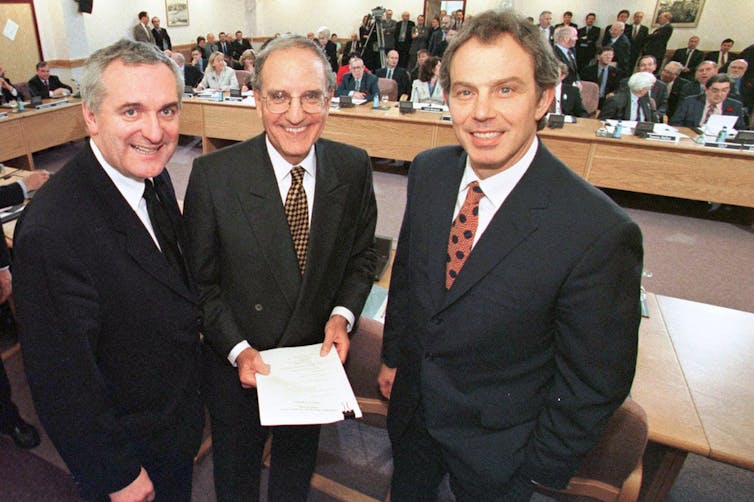
Three men pose together for a photo.
From left, Irish Prime Minister Bertie Ahern, U.S. Sen. George Mitchell and British Prime Minister Tony Blair pose together after signing the Good Friday Agreement on April 10, 1998.
Dan Chung/Pool Photo via AP, File

The Northern Ireland case study

That stands in contrast to peace agreements that have succeeded elsewhere using more inclusive diplomatic frameworks, like in Northern Ireland.

For 30-plus years, the territory was engulfed in sectarian violence between the mainly Protestant “loyalists” who wanted to remain part of the U.K. and the Catholic minority that wished to be part of a united, independent Irish republic.

To end this armed conflict, the peace process included all relevant parties, including militant groups on all sides.

The Northern Ireland peace process also explicitly engaged with the Irish public and offered the people input through two separate referendum votes. People in Northern Ireland voted on whether to support the plan, and people in the Republic of Ireland voted on whether to authorize the Irish state to sign the agreement.

This inclusive and democratic process has been able to sustain a cessation of conflict for the past 27 years.

While Blair didn’t start the Northern Ireland peace process, his government played a pivotal role, and it was he who memorably noted “the hand of history” on the shoulder of those involved in the final days of negotiation.

A failed Oslo counterexample

The Northern Ireland process stands in direct contrast to many of the failed peace processes attempted in the Middle East, which fall more in line with the “illiberal peace” concept.

The most serious push for lasting peace was the Oslo Accords in 1993, in which the Palestine Liberation Organization accepted Israel’s right to exist, forgoing its claims to much of historic Palestine, in return for Israel’s acknowledgment of the PLO as the legitimate representative of the Palestinian people.

That process led to the creation of the Palestinian Authority, which was meant to exercise limited governance on an interim basis, and presidential and parliamentary elections in order to facilitate the input of the Palestinian public. But as many former U.S. officials have since admitted, the accords were asymmetric: They offered Palestinians recognition under the PLO but little pathway to achieve a negotiated solution under conditions of occupation by a far more powerful sovereign country.

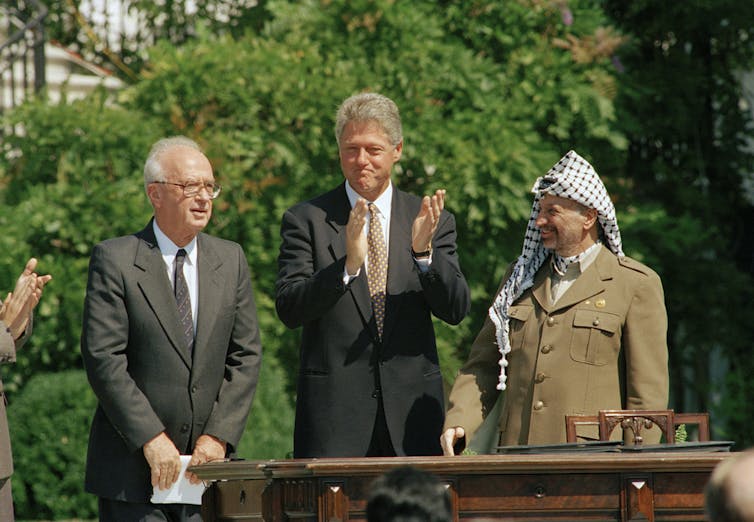
Three men stand together at a ceremony.
U.S. President Bill Clinton applauds as Israeli Prime Minister Yitzhak Rabin, left, and Palestine Liberation Organization Chairman Yasser Arafat look on after the signing of the Oslo Accords in 1993.
AP Photo/Dennis Cook

That peace process fell apart when that asymmetry became clear. The two parties meant very different things when they used the word “state.” The Israel government envisioned some form of limited self-governance for the Palestinians and continued its settlement expansion and military occupation. The Palestinians, on the other hand, envisioned a legitimate state exercising sovereignty.

Adding to the problems, Palestinians never had equal negotiating power, and the accords lacked a neutral arbiter in the U.S., the leading mediator.

Oslo was intended to be a time-limited process to give negotiators space to resolve outstanding conflict issues. In practice, it served to give long-term diplomatic cover for a status quo in which Israeli governments moved away from a two-state solution while Palestinians became more politically and geographically fragmented under worsening hardship and violence.

The Oslo peace process fell apart in the early years of Blair’s government, at the same time as he was helping put the finishing touches on the Good Friday Agreement.

The necessity of public buy-in and an inclusive process was evident to many onlookers to the divergent fortunes of both peace processes.

Repeating failed lessons in Gaza?

In the Israeli-Palestinian context today, Blair risks repeating the mistakes of Oslo. He is poised to sit on an undemocratic international body overseeing a people under a de facto military occupation.

A man waves to a camera.
As a representative for the Quartet, Tony Blair waves to the media in front of Palestinian officials in Ramallah in the West Bank in 2012.
AP Photo/Majdi Mohammed

Further, while the Trump plan is reliant on Hamas’ approval, there is no role for the group after the initial stage. In fact, the framework explicitly states that Hamas must be excised from any future discussions of postwar Gaza. Moreover, no other Palestinian group has any direct involvement; Hamas’ main rival Fatah – the party that is in control of the Palestinian Authority in the occupied West Bank – is only briefly mentioned. As for that Palestinian Authority, there is only a vague line about reforming the body.

Similarly, there has been no mention of what the Palestinian people might actually want. In this way, the body being proposed recalls the creation of the U.S.-led Coalition Provisional Authority during the invasion of Iraq. That body governed Iraq immediately following the invasion and was criticized for corruption and lack of transparency.

The failure of the Iraq War, and the U.K.’s involvement in it, contributed to Blair’s resignation as prime minister in 2007, after which he took on the role of special envoy to the Quartet. Led by the U.N., U.S., EU and Russia, the Quartet was tasked with preserving some form of the two-state solution and implementing economic development plans in Palestinian cities.

But it, too, failed to address the changing political realities on the ground as Israeli settlements expanded and the military occupation deepened.

The underlying assumption about the Quartet, critics contend, is that it largely ignored the Palestinian right to self-determination and sovereignty; rather, it focused on marginally improving economic conditions and Band-Aid initiatives.

The latest U.S.-backed proposal cribs heavily from the approach. Even if it does bring about a welcome respite from the suffering in Gaza in the short term, I believe a durable, mutually agreed upon resolution to the decades-long Israeli-Palestinian conflict requires what Trump’s plan sidelines: Palestinian self-determination.

In Northern Ireland, Blair once understood the importance of neutral mediation and the buy-in of all parties to the conflict and the people themselves. The plan he is involved with now appears to be operating with a far different calculus.

The Conversation

Dana El Kurd is affiliated with the Arab Center Washington.

ref. Gaza peace plan risks borrowing more from Tony Blair’s failures in the Middle East than his success in Northern Ireland – https://theconversation.com/gaza-peace-plan-risks-borrowing-more-from-tony-blairs-failures-in-the-middle-east-than-his-success-in-northern-ireland-266742

In 1776, Thomas Paine made the best case for fighting kings − and for being skeptical

Source: The Conversation – USA – By Matthew Redmond, Lecturer, Université de Lille

Were these protesters in Washington, D.C., on Aug. 16, 2025, inspired by Thomas Paine? Alex Brandon/AP

In one of his stand-up sets, comedian David Cross rejects all political commentary that tries to answer the question, “What would America’s Founding Fathers think if they were alive today?”

For Cross, it is pointless to speculate about the present-day views of men who could not have imagined cotton candy, let alone the machine that makes it.

“What’s a machine? What’s a machine???” he screams in their collective voice, recoiling from the sorcery of the state fair.

The first time I saw this bit, something odd happened. Having just read the 1776 political pamphlet “Common Sense,” I could hear its author, one of America’s founders, laughing louder than anybody.

That would be Thomas Paine, the man credited with turning the American Revolution from a complicated Colonial fracas into a titanic struggle for the soul of liberty itself.

If Cross is skeptical that anything 250 years old still holds up, Paine, were he alive today, could probably name one thing: skepticism. Ways of thinking and being do not grow out of the ground; we make them ourselves, then hand them down as best we can. Paine would smile to see his favorite heirloom, the skeptical worldview, still intact.

Saying “no” – especially to those in power – is an underrated American pastime, and Paine was its Babe Ruth. If you plan on joining No Kings rallies and have yet to find a slogan for your sign, Paine’s got you covered: “In America, the law is king!” “No King! No Tyranny!” “Monarchy hath poisoned the republic.”

I could go on. Because he did.

A yellowed copy of a short publication with the title 'Common Sense.'
Published in 1776, Thomas Paine’s pamphlet ‘Common Sense’ inveighed against monarchy and hereditary privilege and in favor of independence for the Colonies.
Smithsonian National Museum of American History

Birth of a revolutionary

Where did all this anti-monarchical fire come from? Originally, from a small town in Norfolk, England, in 1737. Turning from his father’s trade of corset-making, Paine tried his hand at business, met and impressed Benjamin Franklin in London, sailed to America, and there found his true metier as a pamphleteer and radical.

Using simple yet incandescent prose, Paine renounced, repudiated and ridiculed at a clip seldom witnessed in print before or since. Hereditary privilege, colonialism, the supernatural: no, no, no.

But what Paine made his name lambasting – what he knocked out of the park with almost steroidal force – were kings. All of them, from the figures of ancient legend and Scripture to those who warmed England’s throne during his lifetime.

Common Sense,” his first major work, was an urgent wake-up call to every light-sleeping lover of liberty within earshot. In that pamphlet, Paine labels kingship “the most prosperous invention the Devil ever set on foot for the promotion of idolatry.” He never minced words; he wanted the right people to choke on them.

Lawn signs that quote 'No King! No Tyranny!' and 'In America, the Law is King!'
Thomas Paine quotes in Lexington, Mass., not far from where the American Revolution began.
Photo: Joel Abrams, CC BY

‘Simple facts, plain arguments’

Exactly what was Paine’s problem with kings?

The same problem you’ll have, “Common Sense” promises, when you examine the evidence.

This is partly the secret of Paine’s rhetorical power: It’s hard to imagine any wordsmith demanding more vigorously that you not take his word for it.

Paine was a student of history, and history is chock-full of receipts. It shows that abuses of kingly power extend back to the “early ages of monarchy,” when some “principal ruffian” first took power, and “it was very easy, after the lapse of a few generations, to trump up some superstitious tale, conveniently timed … to cram hereditary right down the throats of the vulgar.”

Since that time, says Paine, even those fortunate enough to live under benevolent rule have seldom been more than one generation away from yet another dreadful monarch.

“One of the strongest NATURAL proofs of the folly of hereditary right in kings, is, that nature disapproves it, otherwise she would not so frequently turn it into ridicule by giving mankind an ASS FOR A LION.” What a tweet this would have made, caps and all.

Bring the Paine

The only thing Paine liked less than monarchical rule was its enablers, anyone who relinquished their freedom willingly to an aspiring tyrant.

This is not only wrong, Paine insists, but against nature, since all of us are created equal.

A somewhat puckish-looking middle-aged man from the 18th century, holding a
A somewhat puckish-looking Thomas Paine – with the wrong first name and a different spelling of his last one.
National Portrait Gallery, Smithsonian Institution

But even that’s not the worst part. Those who sacrifice their own freedom on the altar of monarchy also sacrifice that of future generations. Their “unwise, unjust, unnatural compact might (perhaps) in the next succession put them under the government of a rogue or a fool.” Ouch.

“Most wise men,” Paine adds, “in their private sentiments, have ever treated hereditary right with contempt; yet it is one of those evils, which when once established is not easily removed; many submit from fear, others from superstition, and the more powerful part shares with the king the plunder of the rest.”

Federal worker firings, court settlements, a government shutdown. Paine would loathe how right the U.S. is proving him.

Besides criticizing both tradition and manipulative elites for their role in abetting monarchs, Paine’s writing gestures toward a more widely accessible sense of false freedom that comes with getting what you want from whoever happens to wear the crown.

This kind of pleasure obscures a painful reality: that the tyrant can strike as well as stroke.

The problem of unchecked power is not nearly counterbalanced by any number of indulgences the wielder of that power deigns to bestow. Freedom, Paine insists, is not transactional; whatever price you name, you’re getting fleeced.

Or, to put it his way: “O ye that love mankind! Ye that dare oppose, not only the tyranny, but the tyrant, stand forth!”

The Conversation

Matthew Redmond does not work for, consult, own shares in or receive funding from any company or organization that would benefit from this article, and has disclosed no relevant affiliations beyond their academic appointment.

ref. In 1776, Thomas Paine made the best case for fighting kings − and for being skeptical – https://theconversation.com/in-1776-thomas-paine-made-the-best-case-for-fighting-kings-and-for-being-skeptical-266448

Refinery fires, other chemical disasters may no longer get safety investigations

Source: The Conversation – USA (2) – By Philip Steenstra, Ph.D. Candidate in Toxicology, University of Michigan

A Chevron refinery in El Segundo, Calif., burns on Oct. 3, 2025. Allen J. Schaben/Los Angeles Times via Getty Images

When fire erupted at the Intercontinental Terminals Co. bulk liquid petroleum storage terminal, large plumes of dark smoke billowed into the clear skies over Deer Park, Texas. Despite the efforts of site staff and local firefighters, more than 70 million gallons of petroleum products burned or were otherwise released into the environment over the following three days in March 2019.

Even while the fire was still burning, investigations began looking into what had happened and what was still happening. The Environmental Protection Agency tested air and water samples to determine how much pollution was being released – both to determine cleanup efforts and to assess fines. The Occupational Safety and Health Administration reviewed what had happened, but found that with no workers injured, there was no reason to investigate further or impose fines or other penalties on the company.

A third federal agency, the Chemical Safety and Hazard Investigation Board, often known as the CSB, got to work figuring out what had gone wrong, without assigning legal or financial responsibility, but rather seeking to learn from this disaster how to prevent future accidents. It’s an approach much like the National Transportation Safety Board takes toward airplane crashes, train derailments and other transportation-related tragedies: document what happened and identify every opportunity to prevent or reduce the chances of it happening again.

That deep investigative process reportedly will not happen in the wake of the October 2025 explosion and fire at a Chevron refinery in El Segundo, California, because of the federal government shutdown and lack of funding for the organization.

As scholars of chemical disasters, we believe this absence – and the potential for the board to be eliminated entirely under the proposed 2026 federal budget – raises the risk of more, and more serious, chemical disasters, not just in the U.S. but around the world.

A fire at several large round buildings sends dark black smoke into the sky.
A fire burns at Intercontinental Terminals Co. in Deer Park, Texas, in March 2019.
AP Photo/David J. Phillip

Many serious incidents

The CSB investigation of that 2019 fire that burned 15 petroleum tanks at the Intercontinental Terminals Co., near the Port of Houston, yielded key recommendations to the company, OSHA and the EPA. They included necessary updates to safety management systems, the need for flammable-gas detectors to identify leaks, and remotely operated emergency shutoff valves so workers could close tanks containing hazardous material without exposing themselves to danger. The company has addressed the first recommendation and is reportedly working on the next two.

The board also recommended to the petroleum industry that storage tanks be spaced farther apart so they would be less likely to catch each other on fire – a recommendation that is still under review.

And the Texas fire was just one of several disasters the Chemical Safety and Hazard Investigation Board investigated that year. Since its activation in 1998, the board has conducted in-depth investigations of 102 chemical disasters in the chemical and industrial sectors – an average of about four per year. And its reports are regularly used worldwide, including in France, South Korea and China.

A U.S. Chemical Safety and Hazard Investigation Board video summarizes the agency’s findings about a March 2019 petrochemical terminal fire in Texas.

Creation and goals of the CSB

The U.S. Chemical Safety and Hazard Investigation Board was created by Congress in a 1990 amendment to the Clean Air Act, in the wake of several high-profile chemical disasters around the world.

Those included the 1976 dioxin release in Seveso, Italy, which caused skin lesions on over 600 people and contaminated nearly 7 square miles of land; the deaths of thousands in Bhopal, India, from the 1984 release of methyl isocyanate from a Union Carbide pesticide plant; and the Chernobyl nuclear plant disaster in 1986 in what was then the Soviet Union. The goal was to prevent similar accidents from occurring on U.S. soil by investigating the causes of incidents and providing recommendations for improvement.

Specifically designed to be independent of other organizations and political influence, the CSB cannot be forced to modify its findings by other agencies, branches or political parties, ensuring its impartiality.

It has no power to issue regulations, nor any authority to impose fines or other punishments for wrongdoing. Rather, it is a fact-finding, investigative body designed to learn from past disasters and issue voluntary recommendations so chemical companies can improve their equipment and processes to prevent future tragedies. The vast majority of its recommendations are adopted by the industries affected, usually by the investigated company, though sometimes recommendations become industry standards. These recommendations can range from changes in procedure, the addition of safety devices or even overall facility design recommendations.

What does the board do?

There are several kinds of events companies must report to the federal government, including deaths and releases of particular chemicals, such as chlorine, naphthalene and vinyl chloride.

The board reviews those reports and decides on its own which to investigate. When an inquiry is opened, a group of experts who work for the board travel to the incident site to gather evidence to understand not only what happened in the big picture but a detailed view of how events unfolded.

After the investigation, the board issues a report detailing what it found and recommending specific changes to the company to reduce the risk of that sequence of events happening again. The board also delivers its information to other federal agencies, such as the EPA and OSHA, which can determine whether changes would be appropriate to federal regulations that apply to all companies in an industry.

The board’s value

The board had a US$14 million annual budget for 2025, which is a tiny part of the more than $6 trillion the U.S. government spends each year.

The current administration’s justification for eliminating the CSB is that its capabilities are duplicated by agencies such as the EPA and OSHA. But the EPA focuses specifically on environmental violations and potential threats to human life. OSHA investigates regulatory violations leading to personal injury.

In fact, the CSB has helped the EPA and OSHA evaluate and improve regulations, such as for the open burning of waste explosives, and improved methods of investigating accidental chemical releases and implementing new emergency response rules.

The CSB is the only organization that looks into improving processes to prevent future accidents instead of punishing past acts. It’s the difference between investigating who robbed a bank to hold the robbers accountable and improving bank security so another robbery can’t occur.

The Conversation

The authors do not work for, consult, own shares in or receive funding from any company or organization that would benefit from this article, and have disclosed no relevant affiliations beyond their academic appointment.

ref. Refinery fires, other chemical disasters may no longer get safety investigations – https://theconversation.com/refinery-fires-other-chemical-disasters-may-no-longer-get-safety-investigations-265546

A Denver MD has spent 2 decades working with hospitalized patients experiencing homelessness − here’s what she fears and what gives her hope

Source: The Conversation – USA (3) – By Sarah Stella, Professor of Medicine, University of Colorado Anschutz Medical Campus

People experiencing homelessness are more likely to end up in the emergency room. Helen H. Richardson/The Denver Post via Getty Images

On a recent early fall morning, hope was in short supply.

My first patient was a regular. Mr. D was a man in his 50s with diabetes. He had been living on Denver’s streets for most of the past five years, two of them with a walker in tow. Without stable housing and reliable access to insulin, he’d come to the hospital that morning with another limb-threatening infection.

I examined the telltale ulceration on the sole of his foot. It had progressed to the underlying bone and would require another amputation. This time he would be dependent on a wheelchair. I asked him about his prospects for housing. He shook his head and said, “Doc, I just keep falling through the cracks.”

Mr. D is one of the 10,774 people who experienced homelessness on a single night in 2025 across metro Denver, according to a count conducted by the Metro Denver Homeless Initiative and partner organizations. Of these, 35% were experiencing a chronic form of homelessness.

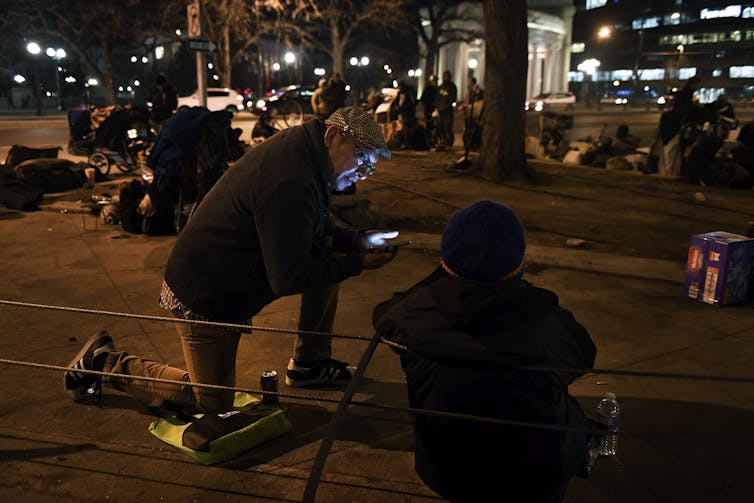
A man kneels with a cell phone in his hand next to a person who is sitting and holding a cane.
Each year, homeless service organizations count how many people are experiencing homelessness on one night in January. The count helps service providers and government entities understand the trends and needs of people experiencing homelessness.
Joe Amon/Denver Post via Getty Images

As an internal medicine physician whose focus is caring for hospitalized patients, my experience suggests that this count is too low. People in hospitals and other institutional settings the day of the survey are not reflected in these numbers. Others are hard to spot, staying out of sight on couches or in creek beds, or hiding in plain sight while they serve our food or fix our roads. For these reasons, point-in-time counts underestimate the true prevalence of homelessness in the city.

I work at Denver Health, the region’s comprehensive safety net health system, where I’m on the front lines of Denver’s homelessness crisis. My perspectives on this issue have been shaped by nearly two decades of experience caring for some of the city’s most vulnerable patients.

I’ve helped create and oversee hospital partnerships that help people like Mr. D find housing. But recent federal actions will only worsen homelessness and weaken the response to it in Colorado and across the nation.

Falling through the cracks

When people like Mr. D fall through the cracks, my colleagues and I are there to catch them. In 2024, Denver Health served more than 16,000 patients experiencing homelessness who collectively had 78,000 visits to the integrated health system.

I’ve watched these cracks widen as Colorado has become one of the least affordable places in the country to live. According to a report by the National Low Income Housing Coalition, in 2025 a Coloradan can work more than 80 hours per week and still be unable to afford a one-bedroom apartment. This means that housing is woefully out of reach for many of my patients.

As physicians, we are trained to address the root causes of the diseases we treat. I care for elderly patients who are newly homeless following an eviction, as well as homeless veterans and Lyft drivers who sleep in their vehicles. Though their individual circumstances vary — loss of job or a loved one, an illness or a battle with addiction — the root cause of their homelessness is the same: a lack of affordable and available housing.

Because of an increased prevalence of serious health conditions and structural barriers – such as marginalization and discrimination – that prevent equitable access to primary and preventive health care, people experiencing homelessness often rely on hospitals like ours for care.

In 2024, roughly 1 in 6 adults admitted to Denver Health’s hospital for an illness or injury were experiencing homelessness, according to internal data. Like Mr. D, many are aging and have cognitive and mobility impairments, along with the frailty characteristic of much older patients.

Those living unsheltered suffer preventable harms such as frostbite and heatstroke in Colorado’s climate of extremes. And for many, homelessness is lethal. Last year at least 223 people died while living on Denver’s streets.

At Denver Health, homeless adults who are admitted to the hospital stay on average 2.4 days longer than housed patients, translating into 5,400 excess hospital days for Denver residents alone, according to internal data. And without a safe place to recover, they have significantly higher readmission rates.

Evidence of the negative impacts of homelessness on health and hospital resources is so compelling that the Center for Medicaid and Medicare Services has recognized homelessness as a comorbid condition. This designation gives homelessness a similar weight to chronic health conditions such as heart disease or diabetes.

Seeing the needless suffering brought about by patients’ lack of housing and feeling powerless to stop it also contributes to moral injury among health care providers. Moral injury refers to the psychological and emotional wounds that occur when one witnesses events that violate their moral and ethical beliefs.

I’ve certainly recognized these feelings in myself or in colleagues who’ve been at the bedside with me all these years. To me, treating the symptoms of homelessness without addressing the underlying cause feels like treating a gunshot wound with a Band-Aid.

Cure for homelessness

But unlike many of the conditions I treat, homelessness does have a cure.

Simply put, it’s deeply affordable and supportive housing. Evidence shows that Housing First – an approach that prioritizes housing as a critical foundation for engagement in health care services – results in high rates of housing stability and brings down high-cost health care utilization.

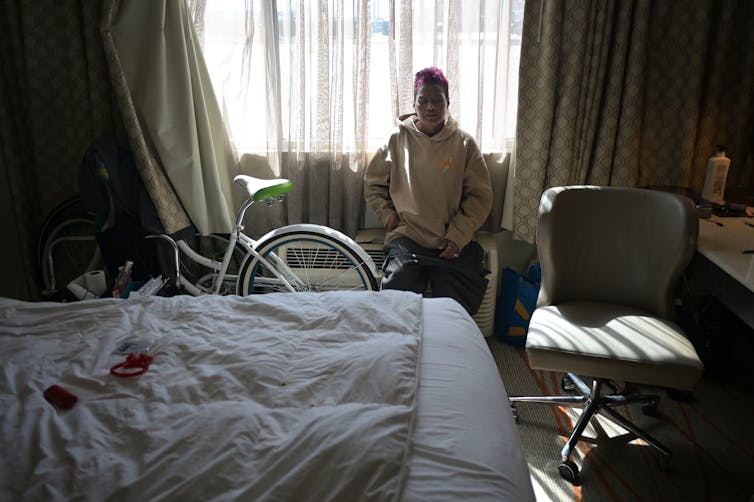
A woman sits in front of a hotel window next to a bike.
Roberta Ramirez stays at the Aspen, a noncongregate homelessness shelter in Denver.
Hyoung Chang/Denver Post via Getty Images

Yet many of the patients I treat, as one of my colleagues likes to say, “will never darken the door of a homeless service agency.”

In 2021, only 53% of patients on our health system’s homeless registry were using homeless services in the community. In a cruel irony, the chaos of homelessness that forces people to prioritize survival, combined with health conditions such as physical disabilities, dementia or serious mental illness, often collude to prevent patients from engaging with the very systems that could end their homelessness. Sometimes, like Mr. D, they give up trying.

This creates the heartbreaking situations I see in my daily work. Too often the patients with the greatest health care needs and vulnerability are the most underserved.

Over time, I’ve learned that improving health inside the hospital walls increasingly means working beyond them to build collaborations to address the myriad ways our systems are failing patients like Mr. D.

Housing and health partnerships

In Denver some progress has been made. In 2023 Mayor Mike Johnston issued an emergency declaration on homelessness. He subsequently enacted All in Mile High, a citywide strategy to address street homelessness. Through the collaborative efforts of the city and partnering agencies, on Aug. 27,2025, Denver announced a 45% reduction in unsheltered homelessness between January 2023 and January 2025.

Denver Health has aided these efforts by investing in strategic partnerships that provide alternatives to discharging hospitalized patients back to the streets.

An apartment building in Denver.
The Renaissance Legacy Lofts and John Parvensky Stout Street Recuperative Care Center in Denver offer medical respite and permanent supportive housing for people experiencing homelessness.
Hyoung Chang/Denver Post via Getty Images

Since 2023, Denver Health has discharged roughly 700 patients into medical respite beds through a partnership with the Colorado Coalition for the Homeless. The hospital helps fund a portion of beds at the John Parvensky Stout Street Recuperative Care Center to provide patients who are too ill or frail to recover in shelters or on the streets with a safe place and the right support to heal.

In another effort to offer housing to at-risk patients, the hospital system sold its former administration building to the Denver Housing Authority, which then redeveloped the property. The hospital now leases 14 apartments that it makes available to provide temporary housing and case management to elderly or disabled patients experiencing homelessness following a hospitalization. Most of the 39 patients who have been housed there have attained more permanent housing, according to internal data.

A 9News report on the office building converted into affordable housing in Denver.

Denver Health also partners on Denver’s Housing to Health Program, a permanent supportive housing program launched in 2022 that aims to reduce health care expenditures for people experiencing chronic homelessness. A hospital team identifies eligible patients and provides “warm handoffs” to directly connect them with the program’s housing service providers during hospitalizations or emergency room visits. While the evaluation is ongoing, it’s a promising partnership model for how hospitals might collaborate to address homelessness.

Impact of federal policies and funding cuts

With accompanying investments in proven solutions to homelessness, such partnerships have the potential to deliver better care at lower cost.

Actions taken by the federal government in 2025 that criminalize people experiencing homelessness, defund Housing First initiatives and dismantle Medicaid and other essential benefits threaten these partnerships and our progress. These policies will worsen homelessness, and patients will continue to be “housed” in the least appropriate and most expensive way – in the hospital.

In addition to harming patients, this trend is not sustainable for safety net hospitals like Denver Health that already provide millions of dollars annually in uncompensated care.

As a physician working at the intersection of housing and health, I believe hospitals are key partners in the fight to end homelessness. I’ve observed the hopelessness that homelessness can bring. But I’ve also seen how the right partnerships can transform a routine hospitalization into an unexpected opportunity for meaningful connection that puts patients on the path to housing and health.

Now when I see patients like Mr. D, I see possibility rather than another dead end for them. After all, for all their adversity, my patients’ stories are also stories of beauty, strength and resilience. While the “cracks” keep me up at night, their stories, and the partnerships we’ve created, bring me hope at a time when hope seems in short supply.

Note: Patient initials and other identifying details have been changed to protect confidentiality.

Read more of our stories about Colorado.

The Conversation

Sarah A. Stella, MD, works for Denver Health and Hospital Authority. She receives funding from the City and County of Denver, the Caring for Denver Foundation, and the Colorado Health Foundation.

ref. A Denver MD has spent 2 decades working with hospitalized patients experiencing homelessness − here’s what she fears and what gives her hope – https://theconversation.com/a-denver-md-has-spent-2-decades-working-with-hospitalized-patients-experiencing-homelessness-heres-what-she-fears-and-what-gives-her-hope-261234

Mark Carney’s climate inaction is at odds with his awareness of climate change’s existential threat

Source: The Conversation – Canada – By Bruce Campbell, Senior Fellow, Centre for Free Expression, Toronto Metropolitan University; York University, Canada

Mark Carney has long been recognized as an authority on climate change. In 2015, as the governor of the Bank of England, he gave his famous “tragedy of the horizon” speech that introduced climate change to bankers as a threat to international financial stability.

In an interview shortly after he was appointed UN Special Envoy on Climate Action and Finance in 2019, Carney described climate change as “the world’s greatest existential threat.”


Read more:
Is Mark Carney turning his back on climate action?


Carney’s efforts to deal with the American-driven upheaval of the international order are critically important: strengthening the domestic economy by building international trade and security relationships. But climate doesn’t seem to be a priority for the prime minister.

His first actions cast seeds of doubt, including repealing the consumer carbon tax, delaying the implementation of the electric vehicle mandate on auto producers and the possible removal of the federal government’s emissions cap on petroleum producers.

‘Decarbonized’ oilsands?

The Carney government’s first five “nation-building” projects under review by its Major Projects Office included the doubling of production of a liquified natural gas facility in Kitimat, B.C.


Read more:
Decision-making on national interest projects demands openness and rigour


It also included building small modular reactors (SMRs) at the Darlington, Ont., nuclear power generating plant. Apart from risks associated with its construction, it can take many years before SMRs can become fully operational, meaning they’re unlikely to play a significant role in reducing carbon emissions.

Under consideration for a second round of projects is carbon capture, utilization and storage (CCUS) proposal from Pathways Alliance, a consortium of oilsands companies. The industry claims the project will allow the continued expansion of so-called decarbonized oilsands bitumen and natural gas.

But an Oxford University study concluded that regarding CCUS “as a way to compensate for ongoing fossil fuel burning is economically illiterate.”

In fact, the very term “decarbonized oil and gas” has been denounced as a falsehood by the co-chair of the federal Net-Zero Advisory Body (NZAB), climate scientist Simon Donner.

Canada’s GHG emissions reductions

Canada is the world’s 11th largest emitter of CO2 and the second largest emitter on a per capita basis.

Canada’s Nationally Determined Contributions (NDC) represent its commitment under the Paris Agreement to reduce emissions by 45 to 50 per cent below 2005 levels by 2035, building on its emissions’ reduction plan of 40 to 45 per cent by 2030.

A report from Canada’s Commissioner of the Environment and Sustainable Development found emissions have declined by just 7.1 per cent since 2005.

The fossil fuel industry has essentially guaranteed that Canada’s 2030 reduction targets will not be met due mainly to continued increases in oilsands production, now accounting for 31 per cent of the total Canadian emissions.

The 2025 climate change performance index ranks Canada among the worst — 62nd out of 67 countries — for its overall climate change performance, which involves a combination of emissions, renewable energy, energy use and policy.

Legal consequences

Canada’s commitment to reach net-zero by 2050 is codified by the Canadian Net-Zero Emissions Accountability Act. The federal government could be held liable for failing to meet the 2050 net-zero target. But the act doesn’t include a legal commitment to meet its interim targets.

Numerous climate litigation cases against governments and corporations are underway in Canada.

In Ontario, a lawsuit brought by seven young applicants is claiming the provincial government’s weakened carbon emissions reduction targets are forcing them to bear the brunt of future climate impacts. They argue their rights to life and security of the person under the Canadian Charter of Rights and Freedoms are under threat.

In response to a case initiated by climate-vulnerable small Pacific island states, the International Court of Justice issued an advisory opinion in July on state obligations on climate change. It ruled that the 1.5C Paris Agreement target is legally binding on states.

It ruled that failure to take appropriate measures to prevent foreseeable harm — including through allowing new fossil fuel production projects, granting fossil fuel subsidies or inadequate regulation — can constitute a breach of international law.

The ICJ also confirmed that states violating their international obligations can face a full range of legal consequences under the law of state responsibility.

Where is Carney?

Heatwaves, hurricanes, floods, droughts, wildfires, rising sea levels, growing ocean acidity and biodiversity loss are ravaging the planet, causing starvation, sickness and death.

The world is on track to exceed the 1.5C Paris Agreement warming limit with temperatures set to rise by more than 3C beyond the pre-industrial average. Canada’s climate is warming at twice the global average.

Yet Carney is avoiding answering whether Canada will meet its 2030 Paris Agreement target. His attendance at the upcoming COP30 Climate Summit in Brazil has not been confirmed, and he unexpectedly withdrew from the UN Secretary General’s recent climate summit — all of which suggests he’s not prioritizing climate action.

In this disturbing development, it’s worth noting the late Jane Goodall’s remarks about hope in her The Book of Hope: A Survival Guide for Trying Times:

“People tend to think that hope is simply passive wishful thinking: ‘I hope something will happen but I’m not going to do anything about it.’ This is indeed the opposite of real hope, which requires action and engagement.”

The Conversation

Bruce Campbell does not work for, consult, own shares in or receive funding from any company or organisation that would benefit from this article, and has disclosed no relevant affiliations beyond their academic appointment.

ref. Mark Carney’s climate inaction is at odds with his awareness of climate change’s existential threat – https://theconversation.com/mark-carneys-climate-inaction-is-at-odds-with-his-awareness-of-climate-changes-existential-threat-266526

‘Polite racism’ is the subtle form of racial exclusion — here’s how to move beyond it

Source: The Conversation – Canada – By Karine Coen-Sanchez, PhD candidate, Sociological and Anthropological Studies, Faculty of Social Sciences, L’Université d’Ottawa/University of Ottawa

In Canadian society, the narrative of multiculturalism can lean toward a “colour-blind” ideology — a comforting idea that race doesn’t matter and everyone is treated the same — even though such narratives mask persistent inequalities. They may also undermine efforts to address structural racism.

Yet race is always present, regardless of whether it’s consciously acknowledged. It surfaces in questions like “Where are you really from?” or in the invitation to “represent diversity” that comes with no real influence.

This is polite racism: a form of exclusion hidden behind civility.

Polite racism doesn’t make headlines, but its message is clear — you are present, yet not fully accepted.

My recent peer-reviewed study explores how first- and second-generation Haitian and Jamaican Canadians navigate these exclusions.

What polite racism looks like

The study involved conducting interview focus groups with first- and second-generation Haitian and Jamaican Canadians (ages 25–45) in Ottawa, and Gatineau, Que.

Findings from my study show that polite racism manifests in academic and professional settings. Haitian and Jamaican participants recounted instances where their research interests were minimized, their accents scrutinized or their presence tokenized in “diversity” spaces without corresponding influence.

For example, participants described:

• A project on immigrant experiences dismissed as “more advocacy than scholarship.”

• An accent scrutinized while expertise is ignored.

• A racialized employee invited to every diversity panel, but passed over for promotion.

Resonance with broader patterns

These examples are grounded in participant narratives from my study, but they also resonate with broader patterns identified in research on race and exclusion. As interdisiplinary Black studies scholar Rinaldo Walcott argues in Black Like Who?, Canada’s multiculturalism often tolerates difference while simultaneously pushing racialized people to the margins.

Work on perception by psychologist and neurophysiologist Jacobo Grinberg
helps explain why polite racism endures. He argued that reality is filtered through “perceptual fields” shaped by cultural narratives and collective belief.

In Canada, these fields have been conditioned by false histories and omissions, training society to see racialized difference as threat rather than connection. Polite racism survives not only through institutions but also through these internalized ways of seeing, which make exclusion feel natural, even polite.


Read more:
Black Londoners of Canada: Digital mapping reveals Ontario’s Black history and challenges myths


The unseen toll

One of the most corrosive effects of polite racism on Black and racialized people is what I call duplicity of consciousness, drawing on the work of sociologist and historian W.E.B. Du Bois. Du Bois wrote about the concept of double consciousness — the tension of seeing oneself through both Black and white lenses.

Duplicity of consciousness captures the rupture that occurs when the promise of belonging collides with the reality of exclusion dressed in civility. It is the burden of entering spaces that promise inclusion but only on conditional terms — acceptance often requires minimizing or reshaping one’s identity to conform to whiteness as the dominant norm.

The constant demand of code-switching, suppressing frustration and remaining silent to avoid backlash, exposes the painful divide between the illusion of belonging and the lived reality of exclusion.

Polite racism is real — and harmful

Until the fear that underpins polite racism is dismantled, inclusion will remain conditional and incomplete. For example, a 2024 KPMG survey of 1,000 Black professionals in Canada found that 81 per cent had experienced racism or microaggressions at work, with women disproportionately affected.

Research also shows that perceived discrimination — even when subtle or ambiguous — creates chronic stress that harms both mental and physical health.


Read more:
Racism impacts your health


Polite racism also erodes trust. In a 2025 Statistics Canada study, 45 per cent of racialized Canadians surveyed reported experiencing discrimination in the past five years — experiences linked to lower life satisfaction and diminished faith in social cohesion and democratic institutions.

Why this matters for Canada

The exclusions enacted through polite racism wastes talent Canada cannot afford to lose. It also erodes faith in our democratic and social systems, leaving all of us more divided and less able to live up to the Canadian ideals we hold dear.

As Black studies professor Andrea A. Davis reminds us in Horizon, Sea, Sound: Caribbean and African Women’s Cultural Critiques of Nation, Caribbean women’s intellectual and cultural work has long shaped Canada, yet it is routinely overlooked even as institutions profit from it.

This is not just about fairness. It’s about whether Canada is willing to recognize and harness the full contributions of all its people.

Turning acknowledgement into action

Based on my academic findings, together with broader Canadian research, and my work as a consultant, here are five priorities to dismantle polite racism:

1. Increasing awareness and reducing fear: Training must move beyond theory to practice, helping managers (or faculty) and peers recognize subtle forms of exclusion and aversive racism as well as confronting the programmed fear of the “other” that underpins exclusion.

2. Reforming policy: Updating curricula and hiring practices to address embedded inequities and implicit barriers is not about special treatment. It ensures Canadian institutions benefit from the best ideas and the full range of talent, rather than silencing valuable perspectives.


Read more:
Reckoning and resistance: The future of Black hiring commitments on campus


3. Inclusive representation: Integrating the histories and voices of racialized communities into education and public discourse strengthens Canada’s story. It allows our multiculturalism to becomes a true reflection of the people who built this country and continue to shape it.

4. Data and accountability: Just as Canadians expect transparency in economic or health data, we should also expect accountability in how inclusive our institutions truly are.

5. Well-being support: Mental health services attuned to the stress of polite racism support not only individuals but also organizational health. When people can thrive without carrying the extra burden of silent exclusion, institutions perform better, communities are stronger and society benefits.

These priorities are not “asks” from racialized communities — they are investments in Canada’s future.

Toward authentic inclusion

Polite racism persists because it is comfortable for those who benefit from it, and it allows institutions to maintain appearances while avoiding change.

Action begins with self-reflection — for everyone. For white Canadians, it means confronting the inherited assumptions and comforts of whiteness that sustain inequality. For racialized people, it involves acknowledging the exhaustion and internal conflicts that arise from navigating exclusion within spaces that claim inclusion.

For teachers, it means teaching in a way that is culturally responsive and that works to dismantle systemic barriers, including polite racism.

When inclusion makes us uncomfortable, that discomfort reveals our shared wounds — the psychic scars produced by living within a racial hierarchy. For some, these wounds stem from privilege unacknowledged; for others, from exclusion endured. Both must be faced if we are to build genuine connection and trust.


Read more:
How to be a mindful anti-racist


Until we face these fears, Canada’s multiculturalism will remain polite on the surface, but exclusionary at its core. The opposite of polite racism isn’t impolite confrontation — it’s courageous honesty. It’s choosing truth over comfort, unity over silence.

The Conversation

Karine Coen-Sanchez does not work for, consult, own shares in or receive funding from any company or organisation that would benefit from this article, and has disclosed no relevant affiliations beyond their academic appointment.

ref. ‘Polite racism’ is the subtle form of racial exclusion — here’s how to move beyond it – https://theconversation.com/polite-racism-is-the-subtle-form-of-racial-exclusion-heres-how-to-move-beyond-it-263585

Acétaminophène et autisme : désinformation, confusion et biais épidémiologique

Source: The Conversation – in French – By Mathieu Nadeau-Vallée, Médecin résident en anesthésie, Université de Montréal

Le 22 septembre, Donald Trump a suscité la controverse en affirmant, parmi d’autres propos infondés, que les femmes enceintes devraient éviter de prendre de l’acétaminophène (ou paracétamol, vendu sous le nom de Tylenol) durant la grossesse, évoquant un lien supposé avec le trouble du spectre de l’autisme (TSA).

Ces déclarations sans nuances, anxiogènes pour les femmes enceintes et leurs familles, nuisent au traitement de la douleur et de la fièvre en grossesse, incitent à recourir à des solutions moins sûres et minent la confiance envers les institutions. Il convient donc d’explorer d’où provient cette théorie et de rétablir les faits.

Titulaire d’un doctorat de l’Université de Montréal en pharmacologie et médecin résident en anesthésiologie, j’ai animé une page TikTok durant la Covid-19, alors que beaucoup de désinformation circulait, en particulier sur la vaccination, pour communiquer des faits médicaux fiables au grand public.


À lire aussi :
Covid-19 : la désinformation est mortelle, surtout celle véhiculée par les professionnels de la santé


D’où vient l’idée d’une causalité acétaminophène-autisme ?

Il est vrai qu’un bon nombre d’études observationnelles publiées dans les dernières décennies ont mis en lumière un lien entre la prise d’acétaminophène durant la grossesse et l’augmentation, quoique petite, de nombre de diagnostics de TSA et d’autres troubles neurodéveloppementaux chez les enfants.

Ces résultats ne prouvent pas la causalité. En épidémiologie, une corrélation ne signifie pas qu’un facteur en cause un autre : par exemple, il existe une corrélation entre le nombre de parapluies et la pluie, mais les parapluies ne causent pas la pluie.

Un exemple qui s’ancre mieux en médecine et dans notre réalité est la corrélation entre le café et le cancer du poumon. Certaines études observationnelles anciennes montraient que les grands buveurs de café avaient un risque plus élevé de cancer du poumon. Cela a fait croire, à tort, à un effet cancérogène du café. Les gros buveurs de café, dans les cohortes étudiées, étaient aussi plus souvent de gros fumeurs. Comme le tabac est la principale cause du cancer du poumon, il était donc difficile de distinguer si c’était le café ou la cigarette qui expliquait l’augmentation du risque.

C’est un exemple classique de biais épidémiologique, plus précisément d’un facteur de confusion. Le café était ici associé à la fois à l’exposition (tabac) et à l’issue (cancer du poumon), créant une association trompeuse. On retrouve le même mécanisme derrière d’autres mythes médicaux, comme celui selon lequel un verre de vin par jour améliorerait la santé globale, une idée désormais démentie.

Dans la situation de la corrélation entre l’acétaminophène maternel et l’autisme, plusieurs biais peuvent être mis en cause :

1 — La confusion par indication : les femmes enceintes qui prennent de l’acétaminophène le font la plupart du temps pour traiter une fièvre, une infection ou maux de tête. Mais la fièvre maternelle en elle-même, qui parfois est le premier signe d’une infection, a déjà été associée à des risques pour le développement neurologique du fœtus. Il est donc difficile de savoir si c’est la fièvre, l’infection ou la pilule qui est à blâmer.

2 — Les biais de rappel : dans certaines études, les parents sont interrogés plusieurs années après la grossesse pour se souvenir des médicaments pris. Les mères d’enfants ayant un TSA peuvent, intentionnellement ou non, signaler plus souvent l’acétaminophène, ce qui crée une distorsion des données.

3 — La diversité des facteurs de complexité de l’autisme : nous savons maintenant que les TSA sont dus à un mélangé de facteurs génétiques et environnementaux. Isoler l’effet d’un seul médicament reste très compliqué.

Mais comment faire pour se sortir de ce type de biais ?

En méthodologie, il existe des méthodes pour tenir compte des facteurs qui peuvent fausser les résultats, comme comparer des groupes similaires ou analyser séparément certains sous-groupes.

D’ailleurs, une grande étude suédoise publiée dans le journal JAMA en 2024 a étudié une population de plus de 1,5 million de naissances, dont 185 000 ont été exposés à l’acétaminophène durant la grossesse. Chaque grossesse a été comparée à celles de frères et sœurs non exposés, ce qui permet de réduire l’influence de l’environnement familial. L’étude n’a trouvé aucun lien entre l’acétaminophène et l’autisme ou d’autres troubles neurodéveloppementaux.

Ainsi, les données actuelles ne permettent pas de conclure que l’acétaminophène provoque l’autisme.

Pourquoi la croyance perdure-t-elle ?

Même en l’absence de preuves concrètes, l’idée d’un lien entre l’acétaminophène et l’autisme reste bien ancrée dans l’imaginaire collectif, notamment sur les réseaux sociaux. Plusieurs mécanismes expliquent cette persistance. Par exemple, face à des troubles multifactoriels comme l’autisme, dont l’étiologie demeure incertaine, il est psychologiquement rassurant de pouvoir désigner une cause précise. De plus, des publications sur les réseaux sociaux qui jouent sur les émotions — qu’elles proviennent d’influenceurs ou de vidéos générées par l’intelligence artificielle — suscitent souvent plus d’engagements qu’une déclaration équilibrée sur les limites méthodologiques d’une recherche.

Ensuite, nous avons une tendance à mieux retenir en mémoire les informations qui concordent avec nos appréhensions ou nos intuitions, même si elles ne sont pas vérifiées ou valides. Finalement, comme la confiance envers les autorités médicales et pharmaceutiques est parfois fragilisée, certaines personnes accordent davantage d’importance aux témoignages personnels ou aux discours alternatifs.

Les conséquences pour les familles et pour la santé publique

Le danger, avec ce type de déclaration infondée, est d’éloigner les femmes enceintes d’un traitement sûr et efficace, surtout lorsque les alternatives peuvent être dangereuses. Les anti-inflammatoires non stéroïdiens (AINS) comme l’ibuprofène, par exemple, comportent des risques en grossesse.

Au premier trimestre, ils sont associés à un risque augmenté de fausses couches. Santé Canada recommande aussi d’éviter leur utilisation à partir de 20 semaines de grossesse, sauf avis médical, car cela pourrait occasionner une atteinte rénale fœtale entraînant une diminution du liquide amniotique et un retard de la maturation des poumons. Au 3e trimestre, ils sont carrément contre-indiqués à cause du risque fœtal. D’autres évitent de traiter une fièvre haute, ce qui pourrait être plus nocif pour le fœtus que le médicament lui-même.

Cette incertitude engendre également une charge émotionnelle importante. Plusieurs mères ont exprimé des sentiments de culpabilité, se demandant si la prise de quelques comprimés d’acétaminophène était une raison du diagnostic de leur enfant. À un niveau collectif, ces préoccupations peuvent faire du tort à la confiance dans les messages de santé publique. Lorsqu’une information est mal perçue ou mal relayée, il y a le risque que le public généralise son hostilité aux autres recommandations médicales, par exemple envers la vaccination.

Malgré les inquiétudes soulevées, les organismes de santé tels que Santé Canada, la Food and Drug Administration des États-Unis et l’Organisation mondiale de la Santé recommandent toujours l’acétaminophène en cas de besoin, avec une attention particulière au respect de la posologie prescrite.

Comment faire les choses mieux ?

Afin d’anticiper la désinformation et d’apaiser l’anxiété inutile, il est essentiel de maintenir une communication scientifique vulgarisée :

  • Définir nettement la différence entre association et causalité.

  • Présenter les risques réels de ne pas traiter la fièvre ou la douleur, afin que les familles comprennent que l’absence de traitement peut parfois être plus dangereuse.

  • Soutenir les femmes enceintes sans les culpabiliser : leur rappeler que prendre soin de leur santé fait aussi partie de la santé de leur bébé.

  • Offrir des sources de qualité et accessibles permet aux parents de vérifier les faits plutôt que de dépendre entièrement des réseaux sociaux.

  • Informer sans alarmer, rassurer sans banaliser : voilà la meilleure stratégie pour protéger à la fois la santé des mères et celle de leurs enfants.

Entre désinformation et anxiété, la science a un rôle clair : éclairer, pas effrayer.

La Conversation Canada

Mathieu Nadeau-Vallée ne travaille pas, ne conseille pas, ne possède pas de parts, ne reçoit pas de fonds d’une organisation qui pourrait tirer profit de cet article, et n’a déclaré aucune autre affiliation que son organisme de recherche.

ref. Acétaminophène et autisme : désinformation, confusion et biais épidémiologique – https://theconversation.com/acetaminophene-et-autisme-desinformation-confusion-et-biais-epidemiologique-266534

How Donald Trump’s ‘dead cat diplomacy’ may have changed the course of the Gaza war

Source: The Conversation – UK – By Asaf Siniver, Professor of International Security, University of Birmingham

When Donald Trump called Benjamin Netanyahu on October 4 to tell him that Hamas had agreed to at least some of his 20-point ceasefire plan, the Israeli prime minister’s equivocal response was he saw “nothing to celebrate, and that it doesn’t mean anything”. According to reports, the US president fired back: “I don’t know why you’re always so fucking negative. This is a win. Take it.”

Trump’s visceral response is less important than the fact that it became public only hours after this private conversation. By comparison, although Joe Biden’s frequent excoriations of Netanyahu were well documented, they were never made public immediately after he uttered them.

Trump’s scolding of the Israeli leader, on the other hand, was intentionally leaked to publicly paint Netanyahu as the intransigent party should negotiations over ending the war collapse. Unencumbered by nuance or subtlety, Trump’s “dead cat diplomacy” in recent weeks has proven to be his single most effective leverage in bringing Israel and Hamas to this agreement.


Read more:
Israel and Hamas agree ceasefire deal – what we know so far: expert Q&A


The practice of dead cat diplomacy was first articulated by former US secretary of state (1989-1992) James Baker, during his incessant diplomatic efforts to coax the Syrian, Israeli and Palestinian teams to attend the historic 1991 Madrid peace conference. Despite making eight trips to the region in as many months and drawing on seemingly every resource and skill in his diplomatic toolbox, Baker was repeatedly frustrated by each party’s objections to attending the conference.

Running out of options, Baker concluded that under such circumstances, the only leverage left at his disposal was to publicly lay the blame for killing the negotiations (the metaphorical dead cat) at the doorstep of an intransigent negotiator.

Soon, dead cats began appearing at the metaphorical doorsteps of the key negotiators. Palestinian negotiator Hanan Ashrawi recalled that Baker’s favourite expression to egg the Arab delegations on was “Don’t let the dead cat die on your doorstep!” After he told the Palestinians, “I am sick and tired of this. With you people, the souk [market] never closes. I’ve had it. Have a nice life”, they dropped their demands immediately.

Threatening to drop the dead cat at the doorstep of Syrian foreign minister Farouk al-Sharaa was equally effective. Baker shouted at Ashrawi over the phone, “You just tell Mr Sharaa that the whole thing is off. I’m going home. I’m taking the plane this evening and he can go back to Syria. As far as I’m concerned, it’s finished!”, after which he hung up abruptly. Ashrawi delivered Baker’s threat to the Arab group.

In her 1995 memoir, This Side of Peace, Ashrawi recalled that “everyone was convinced that Baker was serious, and we urged the Syrians to accept an Arab compromise”.

Despite the US-Israel special relationship, Baker did not hesitate to lay equal blame for the stalled negotiations on the intransigent Israeli prime minister, Yitzhak Shamir, telling him: “I’m working my ass off, and I’m getting no cooperation from you. I’m finished … I’ve got to say I’m basically disinclined to come here again.” On the way to the airport, Baker told his aide Dennis Ross: “I’m going to leave this dead cat on his doorstep”.

The cumulative effect of Baker’s dead cat diplomacy was that no party wanted to appear publicly as opposing peace. As his aide Aaron David Miller recalled: “No one wanted to be in that position.”

As I wrote elsewhere, dead cat diplomacy is likely to be effective when three conditions are met. It must be perceived by the intransigent parties as a last-chance threat, it must be perceived as a credible move by the third party and there must be internal factors which limit the intransigent party’s capacity to ignore the threat.

Trump plays the blame game

Notwithstanding the considerable differences in diplomatic nous between Baker and Trump, it is clear that at least in his negotiating an end to the two-year war between Israel and Hamas, Trump’s laying of dead cats at the Israeli and Hamas doorsteps has been perceived by both parties as last-chance and credible threats, while capitalising on their increasingly untenable domestic standings.

Trump’s calling Netanyahu “always fucking negative” is but the latest dead cat laid on the Israeli leader’s doorstep. It was preceded a few days earlier by a humiliating and (public) strong-arming of Netanyahu to apologise to the Qatari prime minister, Sheikh Mohammed bin Abdulrahman al-Thani, for Israel’s failed assassination attempt of Hamas negotiators in Doha on September 9.

As one Israeli pollster noted: “For the first time Netanyahu cannot disregard the wishes of an American president, because of the way Trump operates. Trump is unpredictable and will not fall in line with the Israeli position.”

This was perfectly illustrated by the image of Netanyahu reading out his apology from a script while Trump was resting the telephone on his lap in the Oval Office, which was a blunt – and public – rebuke of the Israeli leader: you are solely responsible for this chaos, and you’d better apologise, or else.

A few days later, Trump posted on his Truth Social account an image of the protests in Tel Aviv to end the war and against Netanyahu, showing a large banner that read: “It’s now or never.”

Such public amplifying of the voices of Netanyahu’s critics at home has left no illusions as to who Trump was blaming for the stalemate. “He was fine with it”, Trump briefed following his conversation with Netanyahu on Saturday. “He’s got to be fine with it. He has no choice. With me, you got to be fine.”

Trump has been equally expedient in laying dead cats at Hamas’s doorstep. First, by ironing out his peace plan with Israel while excluding Hamas from the process, and then by turning to his TruthSocial platform to single out Hamas as the remaining obstacle to ending the war, following his joint press conference with Netanyahu in the Oval Office.

Intentionally or otherwise, this Trumpian bludgeoning contained all the hallmarks of dead cat diplomacy. It emphasises that this is a last-chance opportunity and that the threat is credible, the US president having already shown his support for Israeli military action in Gaza. It also capitalises on Hamas’s increasingly isolated position, noting that it is the only party to not accept the plan and that the release of hostages held by Hamas was the difference between peace and hell in the Middle East.

Trump’s deployment of dead cat diplomacy may lack the finesse and strategic patience of Baker’s approach, but its raw, theatrical force has nonetheless reshaped the negotiating landscape. By publicly blaming Netanyahu and Hamas, isolating them diplomatically, and making clear that one of them will be remembered as the obstacle to peace, Trump has created precisely the kind of last-chance, credibility-laden pressure that dead cat diplomacy relies on to succeed.

Whether this results in a lasting peace remains uncertain. But what is clear is that Trump’s willingness to weaponise public humiliation and blame has, at least for now, jolted two entrenched adversaries closer to compromise than years of cautious mediation ever did. Dead cat diplomacy may yet earn Trump his coveted Nobel peace prize.

The Conversation

Asaf Siniver does not work for, consult, own shares in or receive funding from any company or organisation that would benefit from this article, and has disclosed no relevant affiliations beyond their academic appointment.

ref. How Donald Trump’s ‘dead cat diplomacy’ may have changed the course of the Gaza war – https://theconversation.com/how-donald-trumps-dead-cat-diplomacy-may-have-changed-the-course-of-the-gaza-war-266701

Écrire à la main et faire des pauses aide à mémoriser

Source: The Conversation – France (in French) – By María del Valle Varo García, Research assistant professor, Universidad de Deusto

Entre l’encre, le silence et le sommeil, le cerveau grave nos souvenirs. Farknot Architect/Shutterstock

Le cerveau a ses propres règles, tout comme notre façon d’apprendre et de mémoriser. Les réseaux neuronaux sont plus actifs quand on écrit à la main que quand on tape au clavier, et les pauses réelles aident à consolider les connaissances.


Arrêtons-nous un instant et observons le doux flux de ces mots sous nos yeux, ce va-et-vient silencieux et la voix qui les lit dans notre tête. Combien d’entre eux resteront gravés dans votre mémoire dans cinq minutes ? Et combien resteront, sans effort, dans notre mémoire demain ? La question n’est pas anodine. Nous vivons à une époque où la vitesse domine notre façon d’apprendre et, paradoxalement, aussi d’oublier.

Tous les mots ne sont pas traités au même rythme. Vous avez peut-être entendu dire qu’une personne peut lire entre 200 et 300 mots par minute, en écouter environ 150 ou en lire encore moins au toucher en braille. Mais cette vitesse n’est pas synonyme de compréhension : en fait, au-delà de 500 mots par minute, l’assimilation chute de manière drastique. Et ce qui est absorbé est-il vraiment conservé ? Pas nécessairement. Dévorer avidement des mots n’est pas la même chose que s’imprégner de leur essence.

Différents souvenirs en un seul

Pour que les mots prennent tout leur sens et se transforment en idées ou en concepts durables, ils doivent d’abord traverser l’espace fragile et éphémère de la mémoire opérationnelle, également appelée mémoire à court terme, chargée de maintenir l’information active pendant que le cerveau la traite. Mais cela ne suffit pas.

Pour que ce qui est retenu se stabilise, l’information doit être stockée dans un type de mémoire sémantique, affective, spatiale ou temporelle. Se souvenir de vacances implique une mémoire épisodique, teintée d’émotion et de lieu ; en revanche, savoir que la capitale de l’Italie est Rome renvoie à une mémoire sémantique, dépourvue de contexte personnel.

À la main ou au clavier ?

Il est difficile aujourd’hui de trouver un espace où le clavier n’a pas presque entièrement remplacé l’encre ou le graphite. Cependant, il convient de rappeler que l’écriture manuscrite reste un outil puissant pour le développement cognitif : écrire à la main active un réseau plus large de régions cérébrales (motrices, sensorielles, affectives et cognitives) que la dactylographie. Cette dernière, plus efficace en termes de vitesse, exige moins de ressources neuronales et favorise une participation passive de la mémoire de travail.

En revanche, l’utilisation active de la mémoire à court terme (à l’aide d’outils non numériques) s’avère plus bénéfique tant en classe que dans les contextes cliniques liés à la détérioration cognitive.

Les pauses sont sacrées

Le rythme et les pauses sont également déterminants dans ce passage de la mémoire de travail à la mémoire à long terme. Les pauses actives, ces brefs moments où nous interrompons notre étude pour nous étirer, marcher ou contempler quelque chose sans but immédiat, permettent au cerveau de réorganiser ce qui a été appris et de le consolider plus solidement.

Cependant, aujourd’hui, ces pauses sont souvent associées à des activités impliquant l’utilisation d’écrans : téléphones portables, télévision, tablettes. Si l’on pouvait faire une comparaison avec l’exercice physique, on pourrait s’imaginer dans une salle de sport où l’on court à 12 km/h pendant les pauses entre les séries. Il se passe quelque chose de très similaire lorsque nous utilisons nos pauses pour regarder des vidéos rapides, lire des titres ou naviguer sans but sur les réseaux sociaux : l’esprit ne se repose pas, ne se consolide pas, et l’attention se fragmente.

Le travail pendant le sommeil

Les neurosciences soulignent également le rôle crucial du sommeil dans la consolidation de la mémoire. Pendant le sommeil à ondes lentes, le cerveau entre dans un état de synchronisation neuronale caractérisé par la prédominance des ondes delta (0,5-4 Hz), qui favorisent la réactivation des traces mnésiques – traces qui restent dans l’esprit après une expérience et qui servent de base à la mémoire et à la possibilité de se souvenir.

Ces oscillations lentes créent un environnement à faible interférence sensorielle qui facilite le dialogue entre l’hippocampe et le néocortex. On a notamment observé que les ondes thêta (4-8 Hz), plus fréquentes pendant la phase REM (Rapid Eye Movement) et également présentes dans les phases NREM (Non-Rapid Eye Movement) légères, interviennent dans ce transfert. Plus précisément, elles permettent le passage des souvenirs de leur stockage temporaire dans l’hippocampe vers les régions corticales de stockage à long terme.

Sommeil à ondes lentes sur un électroencéphalogramme.
Wikimedia, CC BY

De même, les fuseaux du sommeil, brefs schémas d’activité cérébrale qui se produisent pendant le sommeil léger, générés principalement par le thalamus, sont associés au renforcement des connexions neuronales pertinentes.

Diverses études utilisant la polysomnographie et la neuro-imagerie ont montré des corrélations entre la densité de ces fuseaux de sommeil et les performances dans les tâches de mémoire épisodique.

Il a été suggéré que ces oscillations agissent comme une sorte de « marqueur de pertinence » qui sélectionne les informations méritant d’être consolidées.

Ainsi, pendant notre sommeil, le cerveau exécute automatiquement un processus de réorganisation et de renforcement de la mémoire. Il donne la priorité à ce qui est significatif et élimine ce qui est non pertinent. Ce n’est pas un hasard si, au réveil, une mélodie ou une phrase apparemment insignifiante nous revient sans effort à l’esprit : ce sont les échos de ce travail nocturne minutieux qui écrit la mémoire.

Reprendre de bonnes habitudes

Comprendre comment nous apprenons nous révèle également comment nous devrions vivre. Il ne s’agit pas seulement de réduire l’utilisation des écrans, mais aussi de retrouver un rythme plus humain. Écrire à la main aide à activer les réseaux neuronaux en profondeur ; pensons, par exemple, aux notes prises en classe et à la façon dont, en les relisant, les idées resurgissent plus clairement.

D’autre part, il est recommandé de reprendre l’habitude de faire de véritables pauses, loin des appareils : observer le vol d’un oiseau, sentir sa respiration, étirer son corps.

Il est également utile de renforcer ce que l’on a appris par de brefs exercices de récupération active.

De plus, il ne faut pas sous-estimer le rôle du sommeil profond : c’est là que la mémoire mûrit et fixe ce qui a été appris. Ce n’est que lorsque nous lui accordons le temps nécessaire pour se reposer et assimiler que la connaissance s’enracine véritablement. Ainsi, les mots qu’il lit aujourd’hui pourront devenir des souvenirs vivants, capables de l’accompagner au-delà des cinq prochaines minutes, peut-être même toute sa vie.

The Conversation

María del Valle Varo García ne travaille pas, ne conseille pas, ne possède pas de parts, ne reçoit pas de fonds d’une organisation qui pourrait tirer profit de cet article, et n’a déclaré aucune autre affiliation que son organisme de recherche.

ref. Écrire à la main et faire des pauses aide à mémoriser – https://theconversation.com/ecrire-a-la-main-et-faire-des-pauses-aide-a-memoriser-266686