The world wide web was meant to unite us, but is tearing us apart instead. Is there another way?

Source: The Conversation – Global Perspectives – By George Buchanan, Deputy Dean, School of Computing Technologies, RMIT University

The hope of the world wide web, according to its creator Tim Berners-Lee, was that it would make communication easier, bring knowledge to all, and strengthen democracy and connection. Instead, it seems to be driving us apart into increasingly small and angry splinter groups. Why?

We have commonly blamed online echo chambers, digital spaces filled with people who largely share the same beliefs – or filter bubbles, the idea that algorithms tend to show us content we are likely to agree with.

However, these concepts have both been challenged by a number of studies. A 2022 study led by one of us (Dana), which tracked the social media behaviours of ten respondents, found people often engage with content they disagree with – even going so far as to seek it out.

When an individual engages with a disagreeable post on social media – whether it’s “rage bait” or something else that offends you – it drives income for the platform. But on a societal scale, it drives antisocial outcomes.

One of the worst of these outcomes is “affective polarisation”, where we like people who think similarly to us, and dislike or resent people who hold different views. Research and global surveys both show this form of polarisation is growing across the world.

Changing the economics of social media platforms would likely reduce online polarisation. But this won’t be possible without intervention from governments, and each of us.

How our views get reinforced online

Social media use has been associated with growing affective polarisation.

Online, we can be influenced by the opinions of people we agree or disagree with – even on topics we had previously been neutral towards. For instance, if there’s an influencer you admire, and they express a view on a new law you hadn’t thought much about, you’re more likely to adopt their viewpoint on it.

When this happens on a large scale, it gradually separates us into ideological tribes that disagree on multiple issues: a phenomenon known as “partisan sorting”.

Research shows our encounters on social media can lead to us developing new views on a topic. It also shows how any searches we do to get more insight can solidify these emerging views, as the results are likely to contain the same language as the original post that gave us the view in the first place.

For example, if you see a post that inaccurately claims taking paracetamol during pregnancy will give your baby autism, and you search for other posts using the key words “paracetamol pregnancy autism”, you will probably get more of the same.

Being in a heightened emotional state has been linked to higher susceptibility to believing false or “fake” content.

Why are we fed polarising content?

This is where the economics of the internet come in. Divisive and emotionally laden posts are more likely to get engagement (such as likes, shares and comments), especially from people who strongly agree or disagree, and from provocateurs. Platforms will then show these posts to more people, and the cycle of engagement continues.

Social media companies leverage our tendency towards divisive content to drive engagement, as this leads to more advertising money for them. According to a 2021 report from the Washington Post, Facebook’s ranking algorithm once treated emoji reactions (including anger) as five times more valuable than “likes”.

Simulation-based studies have also revealed how anger and division drive online engagement. One simulation (in a yet to be peer-reviewed paper) used bots to show that any platform measuring its success and income by engagement (currently all of them) would be most successful if it boosted divisive posts.

Where are we headed?

That said, the current state of social media need not also be its future.

People are now spending less time on social media than they used to. According to a recent report from the Financial Times, time spent on social media peaked in 2022 and has since been declining. By the end of 2024, users aged 16 and older spent 10% less time on social platforms than they did in 2022.

Droves of users are also leaving bigger “mainstream” platforms for ones that reflect their own political leanings, such as the left-wing BlueSky, or the right-wing Truth Social. While this may not help with polarisation, it signals many people are no longer satisfied with the social media status quo.

Internet-fuelled polarisation has also resulted in real costs to government, both in mental health and police spending. Consider recent events in Australia, where online hate and misinformation have played a role in neo-Nazi marches, and the cancellation of events run by the LGBTQIA+ community, due to threats.

For those of us who remain on social media platforms, we can individually work to change the status quo. Research shows greater tolerance for different views among online users can slow down polarisation. We can also give social media companies less signals to work from, by not re-sharing or promoting content that’s likely to make others irate.

Fundamentally, though, this is a structural problem. Fixing it will mean reframing the economics of online activity to increase the potential for balanced and respectful conversations, and decrease the reward for producing and/or engaging with rage bait. And this will almost certainly require government intervention.

When other products have caused harm, governments have regulated them and taxed the companies responsible. Social media platforms can also be regulated and taxed. It may be hard, but not impossible. And it’s worth doing if we want a world where we’re not all one opinion away from becoming an outcast.

The Conversation

Dana McKay has received funding from the Australian Research Council, the Australian Digital Health Agency, and Google (this last ruing her PhD).

George Buchanan does not work for, consult, own shares in or receive funding from any company or organisation that would benefit from this article, and has disclosed no relevant affiliations beyond their academic appointment.

ref. The world wide web was meant to unite us, but is tearing us apart instead. Is there another way? – https://theconversation.com/the-world-wide-web-was-meant-to-unite-us-but-is-tearing-us-apart-instead-is-there-another-way-266253

Peter Thiel thinks Greta Thunberg could be the Antichrist. Here’s how three religions actually describe him

Source: The Conversation – Global Perspectives – By Philip C. Almond, Emeritus Professor in the History of Religious Thought, The University of Queensland

In a series of four lectures, Silicon Valley tech billionaire Peter Thiel has been opining on the Antichrist.

Thiel’s amateur riffing identifies the Antichrist with anyone or any institution that he dislikes – from environmental activist Greta Thunberg to governmental attempts to regulate artificial intelligence.

Thiel’s overall definition of the Antichrist “is that of an evil king or tyrant or anti-messiah who appears in the end times”.

Thiel is aligning himself with a long tradition of identifying the Antichrist as a despotic world emperor who would arise at the end of the world.

By the ninth century, influenced by the Christian idea of the Antichrist, Islam and Judaism each had their own Antichrist figures who would come at the end of history – in Islam, al-Dajjal (the Deceiver), in Judaism, Armilus.

The Christian Antichrist

Drawing together 800 years of earlier Antichrist speculations, the Benedictine monk Adso of Montier-en-der wrote the first life of the Antichrist 1,100 years ago. According to Adso, the Antichrist would be a tyrannical evil king who would corrupt all those around him.

The Antichrist was the opposite of everything Christ-like. According to Christianity, Christ was fully human yet absolutely “sin free”. The Antichrist, too, was fully human, but completely “sin full” – not so much a supernatural being who became flesh as a human being who became completely demonised.

Born in Babylon (present day Iraq), the Antichrist was destined to come at the end of the world and rule over the earth from Jerusalem until he and his supporters were defeated by the forces of Christ at the battle of Armageddon.

Al-Dajjal, the Muslim Antichrist

Although the Dajjal does not appear in the Qur’an, he plays an important role in later Muslim understanding of the end of the world in the Hadith literature – the later collections of the sayings and deeds of Muhammad.

Dajjal was large and stout, of a red complexion, blind in one eye that appeared like a swollen grape, and had big curly hair. His most distinctive feature was the word Kafir (disbeliever) written on his forehead.

There is no declaration in the Hadith literature that the Dajjal would be Jewish, but it was said he would be followed by 70,000 Jews of Isfahan in Iran wearing Persian shawls.

According to the longest of the accounts of the Dajjal in the Hadith, called Sahih Muslim (c.850), he would appear somewhere between Syria and Iraq and spread trouble in all directions. He would stay on the earth for one year and ten weeks.

An old manuscript with Arabic writing.
The Hadith literature is the later collections of the sayings and deeds of Muhammad. This copy was published in Saudi Arabia in the16th century.
Wikimedia Commons

For those who accepted him, there would be bountiful food. For those who rejected him, there would be drought and poverty. He would walk through the wasteland and say “bring forth your treasures” and they would appear before him like a swarm of bees. He would then call a young man, strike him with a sword and cut him in pieces.

Then, God would send Jesus Christ. He would descend with his hands resting on the shoulders of two angels at the white minaret on the Eastern side of Damascus. Every non-believer would perish at his breath. He would search for the Dajjal, capture him at the gate of the city of Ludd (Lydda) in Israel and kill him.

Armilus, the Jewish Antichrist

Like al-Dajjal, you would recognise Armilus instantly. According to the medieval Prayer of Rabbi Shimon ben Yohai, he was born in Rome, the child of Satan and a stone in the shape of a beautiful girl.

He was more monstrous in appearance than either the Muslim or the Christian Antichrists. He was a giant, 5.5 metres tall. In several sources, he was reported as having two skulls.

Two men stand on a hill.
Zerubbabel, depicted in this etching from c.1850, received biblical visions of the apocalypse.
Rijksmuseum

One mid-eighth century tradition reported his hair was dyed, another that it was red, and another that his face was hairy and his forehead leprous. Several reports had him as bald. His eyes were variously malformed – small, deep, red and crooked, one eye small and the other big.

According to the earliest Jewish account of Armilus in Sefer Zerubbabel (or the Apocalypse of Zerubbabel), from between the seventh and ninth centuries, his hands hung down to his green feet. Another text had his right arm only as long as a hand and his left one metre long.

Like the Christian and Muslim Antichrists, he too would come in the end times. Sefer Zerubbabel tells us all those who see him will be terrified. But the Messiah will come “and will blow into his face and kill him”. The Messiah will then gather the Jews in Israel and usher in the Messianic age.

The Antichrist now?

The idea of the Antichrist in Judaism, Christianity and Islam has played a significant role in the histories of these three religions, each asserting its belief in the final victory of good over evil.

The image of the Antichrist remains a powerful one. It speaks to the continuing belief among both believers and non-believers that the course of human history is still to be understood in terms of a world-wide struggle between those on the side of God and the rest on the side of evil.

This division of the world into the good and the evil, patriots and terrorists, angels and demons, whether within or between countries, is one that can never bring any peace to the earth. Best if Thiel – and the rest of us – consign it to history.

The Conversation

Philip C. Almond does not work for, consult, own shares in or receive funding from any company or organisation that would benefit from this article, and has disclosed no relevant affiliations beyond their academic appointment.

ref. Peter Thiel thinks Greta Thunberg could be the Antichrist. Here’s how three religions actually describe him – https://theconversation.com/peter-thiel-thinks-greta-thunberg-could-be-the-antichrist-heres-how-three-religions-actually-describe-him-267439

As Gaza starts to rebuild, what lessons can be learned from Nagasaki in 1945?

Source: The Conversation – Global Perspectives – By Gwyn McClelland, Senior Lecturer, Japanese Studies, University of New England

At first, there might not seem to be any immediate similarities between a devastated Nagasaki after the US atomic bombing in 1945 and Gaza today, aside from massive destruction.

But in considering Gaza’s recovery from war – should the current ceasefire hold – much may be gleaned from Nagasaki’s experience and how it managed the painful process of starting over and rebuilding from virtually nothing.

Damage and destruction

The estimates of those killed from the atomic bombings in 1945 range widely from 70,000–140,000 at Hiroshima and 40,000–70,000 at Nagasaki.

In Gaza, the Palestinian health authorities say more than 67,000 Palestinians have died, with many more perhaps buried in the rubble.

In 1945, the US Army dropped an atomic bomb close to the centre of Hiroshima. But in Nagasaki’s case three days later, the plutonium bomb fell a few kilometres to the north of the city in a suburb called Urakami.

The bombing destroyed an area that was socio-economically less well-off, which had an impact on Nagasaki’s recovery, compared with Hiroshima.

Many of those who lived there were minorities, including colonised Korean people, Catholics and outcasts known as buraku.

And just as in Gaza, much of the city infrastructure was decimated. An atomic archive estimates that in Nagasaki, around 61% of city structures were damaged in the bombing, compared with 67% in Hiroshima.

In Gaza, the United Nations Satellite Centre estimates 83% of structures have been damaged from Israeli bombing.

Recovering bodies in a war zone

The aftermath of the bombing shows just how great the needs of the people were in Nagasaki. I conducted an oral history survey with bombing survivors between 2008 and 2016. Twelve of them – mostly children from Catholic families close to Ground Zero at the time of the bombing – detailed their experiences before and after.

After the bombing, many said the unburied dead was a confronting aspect, both physically and spiritually “dangerous”. One survivor, Mine Tōru, told me:

The dead bodies were piled in carts used for rubbish collection and dumped out in an outer area.

Barrels were placed at intersections for the collection of ashes and bones. Meanwhile, the occupying US Army cleared Urakami with bulldozers.

In Swedish journalist Monica Brau’s book, a man named Uchida Tsukasa remembered those bulldozers driving over the bones of the dead in the same way as sand or soil. When someone tried to take a photo, a soldier pointed his gun and threatened to confiscate the pictures. Brau argued that US censorship grossly impaired the recovery in Hiroshima and Nagasaki.

The clean-up and retrieval of human remains took time. Some six months after the bombing, bones were still being pulled out of the river by a Buddhist Ladies’ Association.

This process is beginning in Gaza today, too. According to news reports, scores of bodies have already been pulled from the rubble since the ceasefire took hold. Estimates suggest there could be as many as 14,000 bodies in the rubble, many of which will never be recovered.

The political challenges of rebuilding

In rehabilitating Gaza, those overseeing the process will also need to ensure the civil liberties of the poor – children and women, in particular – are not infringed upon.

In Nagasaki, some bomb survivors were forced to live in caves that had previously been bomb shelters, including three of those I interviewed.

Fukahori Jōji, who was 16 at the time of the bombing, lost his whole family, including three siblings and his mother. He told me that after the bombing, urban revitalisation and road-widening took over part of his family’s land.

Nagasaki officials were alleged to have used the reconstruction to “clean up” an outcast community.

A writer, Dōmon Minoru, explained how land was acquired compulsorily and cheaply by the council, forcing many residents out: “the Urakami burakumin (outcasts) were neutralised”.

Their landlords sold the land where they had lived and the Nagasaki Council even did away with the name, Urakami town.

As will likely be the case in Gaza, the people of Nagasaki also had to rebuild under an occupation.

US historian Chad Diehl’s powerful book about the rebuilding highlighted the “disconnect” between the American occupiers and Nagasaki residents.

The rebuilding took decades. Diehl explained there are two words for recovery often used in Nagasaki, saiken (reconstruction), which usually refers to the physical rebuilding, and fukkō (revival), which refers to wellbeing – psychological, social and physical.

The wellbeing recovery will surely take even longer than the rebuilding of the physical infrastructure in Gaza.

Hope among the rubble

Another important aspect in recovery from war: the people need to have agency over the process. They shouldn’t just be thought of as survivors of a tragedy – they are integral to the revival of their communities.

Reiko Miyake, a teacher who was 20 at the time of the Nagasaki bombing, told me she returned to teaching at her elementary school a few months later. Only 100 of the 1,500 students at the school survived, and just 19 showed up on the first day.

As holders of memory, these people took on new roles of service for their communities. They were storytellers and rebuilders seeking hope in the face of unbearable loss and ongoing lament.

May such stories of the past encourage the difficult task of recovery in what is a bereft Gaza today.

The Conversation

Gwyn McClelland is the former recipient of a National Library of Australia Fellowship and a Japan Foundation Fellowship. He is the president of the Japanese Studies Association of Australia.

ref. As Gaza starts to rebuild, what lessons can be learned from Nagasaki in 1945? – https://theconversation.com/as-gaza-starts-to-rebuild-what-lessons-can-be-learned-from-nagasaki-in-1945-267437

Hamas is battling powerful clans for control in Gaza – who are these groups and what threat do they pose?

Source: The Conversation – Global Perspectives – By Martin Kear, Sessional Lecturer, Department of Government and International Relations, University of Sydney

Despite the euphoria surrounding the ceasefire between Hamas and Israel, Gaza is still wracked with violence.

More than two dozen Palestinians have been killed in recent days in clashes between Hamas and members of various clans. Hamas has also reportedly executed blindfolded men in a public square.

With the Israeli military withdrawing to pre-determined ceasefire lines, Hamas members are beginning to re-assert their control. However, powerful clans are also jockeying for position – some allied to Hamas’ ideological rival, the West Bank-based Fatah movement, and some backed by Israel.

So, who are these clans? What role do they play in Gaza? And how much of a threat are they to Hamas?

Who are the clans?

Familial clans have existed in Palestinian society for centuries. In recent decades, they have come to play a key role in Palestinian politics.

The clans are primarily collections of family groups in various parts of Gaza. One of the largest and most well-armed is the Dughmush clan in Gaza City, headed by Mumtaz Dughmush. This clan was immediately targeted by Hamas after the ceasefire.

The al-Majayda clan also holds sway in part of Khan Younis. Hamas forces raided their neighbourhood earlier this month, killing several family members. This week, however, the clan publicly supported Hamas’ effort to regain control over Gaza.

Importantly, these clans and their relationships with Hamas and Fatah are dynamic and constantly evolving. Members of both Hamas and Fatah also belong to clans. This often leads to clashes over territory and control, with clan loyalties often outweighing movement allegiances.

As Israeli historian Dror Ze’evi notes, any attempt by Hamas or Fatah to disarm the clans would be seen as an affront and met with serious opposition.

A long history of entrenched power

After the 1948 war that saw the creation of Israel and the Palestinian al-naqbah (or Nakba), around 750,000 Palestinians fled Israel to the Gaza Strip, West Bank and neighbouring Arab states.

This was when clans began to assume traditional roles of mediators and patrons. Their organised structures made them best-placed to provide welfare and assistance to a shattered Palestinian society.

As law and order, security and financial independence improved in the territories in the subsequent decades, Palestinians came to rely less on their support. This brought a decline in their power and influence.

This changed, though, during the First Intifada (1987–93) and Second Intifada (2000–05) when Palestinian society was again plunged into crisis. This was especially true in the Gaza Strip, which was known as the engine room of organised Palestinian resistance.

The Second Intifada, in particular, changed the role of the clans significantly, after Israel destroyed much of the organised Palestinian security forces and infrastructure in the territories.

With neither Hamas nor Fatah able to ensure the safety of Palestinians, this created a security vacuum. And some of the clans exploited this by transforming into paramilitary organisations. Again, this was especially true in the Gaza Strip, where Israel’s efforts to crush Palestinian resistance were felt most intensely.

When the Second Intifada ended, the Gazan clans retained a significant amount of political influence and military power. After Hamas won the 2006 elections, some Fatah-aligned clans tried to prevent it from taking power.

So entrenched were these clans that when Hamas finally assumed control of Gaza in 2007, it took the movement a year to effectively bring the more powerful clans under its authority. Even then, it was more of a truce than a victory for Hamas.

Israel backing Hamas rivals

This status quo remained until Hamas’ October 7 2023 terrorist attacks on Israel. Israel’s revenge for these attacks devastated the Gaza Strip, once again robbing Gazans of any semblance of safety and security.

Now, with Israel’s partial troop withdrawal, another security vacuum has been created. And many clans appear keen to fill it, some with the help of Israel.

In June, Israeli Prime Minister Benjamin Netanyahu admitted his government was arming some Gazan clans, gangs and militias, such as the Popular Forces, led by Yasser Abu Shabab.

Netanyahu’s rationale was that any opposition to Hamas helped Israel and saved soldiers’ lives. It also pitted Palestinian against Palestinian, placing additional pressure on Hamas.

After the ceasefire came into effect, Hamas began targeting what it called
“collaborators and traitors” – an apparent reference to those clans and gangs cooperating with Israel.

The Popular Forces, meanwhile, have refused to lay down their arms. A dozen other new militias have also reportedly emerged across the strip in recent days, including one led by Hossam al-Astal, who said:

Hamas was always betting that there won’t be any alternative to replace them in Gaza, but now I’m telling you, today, there is an alternative force to Hamas. It could be me or Abu Shabab or anyone else, but alternatives today exist.

While this violence between Hamas and rival groups does not directly affect the ceasefire that ended the war, it is evidence that Israel is still attempting to meddle in Gaza’s security and exert its control.

But the peace plan negotiated by US President Donald Trump looks shakier by the day, given its call for Hamas to disarm. Trump said this week if Hamas refused to disarm themselves, “we will disarm them […] perhaps violently”.

The peace plan also calls for Hamas to withdraw from Palestinian politics, to be replaced eventually by the Palestinian Authority, which currently administers parts of the West Bank. However, Netanyahu has repeatedly rejected the Palestinian Authority assuming control of Gaza.

This ambiguity over the future governance of Gaza opens the possibility that the more powerful clans could become alternate centres of political power, as they had during the Second Intifada. This time they may do so under the auspices of Israel’s military occupation.

This would further fracture Gaza and weaken any effort by the Palestinian Authority to reunite the territories under a single governance structure. It would also make a future Palestinian state tenuous.

Also, Hamas will not go quietly. And this is a very real danger to peace and security in Gaza, especially if Hamas sees any resistance to its authority from the clans as little more than a proxy war with Israel.

The Conversation

Martin Kear does not work for, consult, own shares in or receive funding from any company or organisation that would benefit from this article, and has disclosed no relevant affiliations beyond their academic appointment.

ref. Hamas is battling powerful clans for control in Gaza – who are these groups and what threat do they pose? – https://theconversation.com/hamas-is-battling-powerful-clans-for-control-in-gaza-who-are-these-groups-and-what-threat-do-they-pose-267446

When government websites become campaign tools: Blaming the shutdown on Democrats has legal and political risks

Source: The Conversation – USA – By Stephanie A. (Sam) Martin, Frank and Bethine Church Endowed Chair of Public Affairs, Boise State University

Screenshot of the Department of Health and Human Services homepage on Oct. 14, 2025. HHS website

For decades, federal shutdowns have mostly been budget fights. The 2025 one has become bigger than that: It’s turned into a messaging war.

Official government communications, including website banners, out-of-office email replies and autogenerated responses that denounce “Senate Democrats,” “the Radical Left” or “Democrats’ $1.5 trillion wishlist” for closing the government, mark a sharp break from past practice.

These messages are more than rhetorical escalation. Many may violate the Hatch Act, the 1939 statute that limits partisan political activity by federal employees and agencies. They also represent new tests for how far a White House can push the bounds of campaign-style messaging while also claiming to govern.

In any democracy, power lies not only in who writes the laws or signs the budgets but in who shapes the story. Communication is not an afterthought or byproduct of governance. It is one of its essential instruments. Political narrative helps citizens understand who’s responsible, who’s acting in good faith and who’s to blame.

The 2025 shutdown has turned that truth into strategy. Federal communication systems – agency websites, automated emails and public information portals – are being used to persuade rather than inform. It’s a move that is both politically risky and legally perilous.

Serve the public, not a party

The Hatch Act was passed during the Great Depression, after years of concern that federal agencies were being used improperly as political machines. Its goal was simple: to ensure that public servants worked for the American people, not for the party in power.

At its core, the Hatch Act prohibits executive branch federal employees – except for the president and vice president – from engaging in partisan political activity as part of their official duties or under their official authority. Government workers may not use their positions or public resources to influence elections, coerce individual behavior or engage in political advocacy.

The law requires federal agencies to avoid the partisan fray and focus on serving the public rather than political agendas.

The Office of Special Counsel, which enforces the law, has been clear on this point. “The purpose of the Act,” says an Office of Special Counsel guide written for federal employees, “is to maintain a federal workforce that is free from partisan political influence or coersion.” Government communication can inform, but it cannot campaign.

An email auto-reply from the Department of Education blaming the shutdown on Democrats.
An auto-reply to an email sent to the press staff at the U.S. Department of Education on Oct. 14, 2025.
CC BY

Yet the shutdown has already produced multiple potential violations:

• The Department of Education, according to a lawsuit, altered employees’ email auto-responses – without consent – to say things like “the Democrats have shut the government down.” Such changes do more than convey impartial information. They compel employees to align themselves with institutionally imposed scripts.

• Likewise, agencies including Health and Human Services and the Small Business Administration reportedly distributed or directed staff to adopt partisan out-of-office auto-replies assigning blame to Democrats.

• The Department of Housing and Urban Development posted a banner on its official website stating that the “Radical Left are going to shut down the government.”

Taken individually, each incident might provoke a Hatch Act complaint. Collectively, they amount to a systematic campaign to transform nonpartisan federal agencies into partisan political messengers.

'The radical left in Congress shut down the government' reads a banner across the US Department of Housing and Urban Development homepage, Oct. 14, 2025.
The message on the U.S. Department of Housing and Urban Development homepage, Oct. 14, 2025.
U.S. Department of Housing and Urban Development

Why this is unprecedented

What sets the 2025 messaging apart isn’t just its volume – it’s the scale, the coordination and the brazenness of its political targeting.

In past shutdowns, partisan spin lived mostly in press conferences and campaign talking points. Agencies themselves, even under pressure, stayed neutral.

This time, the administration is using the machinery of government to deliver partisan blame.

The timing and similarity of messages across departments seems coordinated. Housing and Urban Development posted a banner blaming Democrats the day before the shutdown began. Within hours, other agencies followed using nearly identical language.

More troubling are the reported changes to federal employees’ auto-replies without their consent.

These missives forced career civil servants, many of them furloughed, to become unwilling messengers for partisan ends. Federal agencies and their workers are supposed to serve everyone, not only those who support the party in power.

And because the watchdogs who could enforce the legal boundary are also sidelined – the Office of Special Counsel is furloughed – complaints have nowhere to go, at least for now. They simply land in unattended email inboxes.

Legal challenges and limits

Whether shutdown communications truly violate the Hatch Act – or related laws – is not yet clear. The administration could argue that it’s not campaigning but merely explaining why services are suspended. As a scholar of political communication and American democracy, I believe that defense weakens when official messages explicitly assign partisan blame or name a political party.

And not every political statement is a Hatch Act violation. The law allows employees to express views off duty or in private contexts, so long as they use their own phones and computers.

Even if the Office of Special Counsel later finds violations, harm will likely persist. Once messages are posted or auto-replies sent, their effects can’t always be undone. And because ethics officials are furloughed, too, accountability will be delayed, if it comes at all.

Some employees are likely to claim their speech rights were violated by being forced to send partisan messages. This is an argument already at the heart of the lawsuit filed by the American Federation of Government Employees against the Education Department.

A sign on a door warns people that during a partial government shutdown, the IRS office will be closed.
Doors at the Internal Revenue Service in a Seattle federal building are locked and a sign advises that the office will be closed during the 2018-2019 partial government shutdown.
AP Photo/Elaine Thompson

Why this matters

Federal agencies exist to administer laws impartially and to do so on behalf of the people.

When the government uses its own infrastructure for partisan messaging, the very neutrality on which democratic governance depends erodes. It dilutes public trust in the idea of a neutral state.

The damage also extends into the future. If the current administration succeeds in turning its administrative machinery into a political weapon, without consequence, a precedent will be created. Future presidents may be tempted to follow suit, making acceptable the use of taxpayer-funded systems as campaign tools.

And because enforcement bodies such as the Office of Special Counsel also are sidelined during a shutdown, accountability has to wait. That creates an asymmetry of power: One side gets to amplify its message through government channels in real time, while its opponents must wait for the system to restart just to file a complaint. By the time they can, the moment will have passed and the political narrative is likely to have already hardened.

Crises demand explanation, even blame. Citizens expect their leaders to tell them what went wrong. But they also expect honesty and fairness in how that story is told. The administration’s messaging strategy during this shutdown tests whether government communication remains a public service or becomes another instrument of political power.

The Conversation

Stephanie A. (Sam) Martin does not work for, consult, own shares in or receive funding from any company or organization that would benefit from this article, and has disclosed no relevant affiliations beyond their academic appointment.

ref. When government websites become campaign tools: Blaming the shutdown on Democrats has legal and political risks – https://theconversation.com/when-government-websites-become-campaign-tools-blaming-the-shutdown-on-democrats-has-legal-and-political-risks-267086

How anti-vaccine sentiment helped raise funds and saved the lives of some B.C. ostriches

Source: The Conversation – Canada – By Jeremy Snyder, Professor, Health Sciences, Simon Fraser University

More than 300 ostriches have been threatened with destruction in eastern British Columbia after avian flu was detected in the flock. The birds’ owners have argued this is a case of “unjust governmental overreach.”

The owners’ plight received support from members of Donald Trump’s administration in the United States and raised more than C$290,000 for their legal and operating costs through a series of crowdfunding campaigns.

This level of financial support for a small ostrich farm shouldn’t be completely surprising. It demonstrates how crowdfunding rewards and encourages political polarization.

Government overreach

The Canadian Food Inspection Agency’s decision to cull birds at Universal Ostrich Farms in Edgewood, B.C., has echoes of debates over government policy during the COVID-19 pandemic.

This includes decrying what is seen as government overreach into personal freedoms and medical decision-making, with comparisons drawn to 2022’s crowdfunded anti-vaccine Freedom Convoy.

The farm’s interest in researching natural immunity has attracted vaccine skeptics more generally and support from Health Secretary Robert F. Kennedy Jr. and others in the U.S.. This is reflected in some donors’ comments, where supporters have posted messages including “down with communism,” “the tyrannical leftist Canadian Government is to blame,” and “globalists don’t want natural cures. They only want to profit from their poison jabs!”

CP24 reports on the attention paid by U.S. Health Secretary Robert F. Kennedy Jr. and Dr. Oz to a potential ostrich cull.

Political appeals

Crowdfunding campaigns of all stripes benefit from public attention and the ability to appeal to potential donors. But while appealing to the general public is a well-tested way to win the popularity contest that is built into crowdfunding, so too is connecting to a subset of partisan supporters who see donating to campaigns as way of expressing their political values.

This has been evident in many viral crowdfunding campaigns, including the hugely successful Freedom Convoy campaign in Canada that raised more than $10 million.

In the U.S., some Jan. 6 defendants used crowdfunding to great success, raising more than US$5 million to pay for their legal bills through these campaigns.

These viral politicized campaigns are associated with a range of forms of populist political mobilization, as well as extremism.

Most recently, this included a campaign to pay for the legal bills of Luigi Mangione, accused of killing an American insurance executive in 2024.

Politicising issues

Our research has demonstrated the benefits of linking campaigns with politicized issues. Crowdfunding campaigns for legal needs tend to perform much better when they are linked to political events. These include fundraisers for people seeking help defending themselves in court for violations of COVID-19 pandemic policies, legal campaigns linked to “election integrity” and politicized violence.

Take the case of Daniel Penny, for example, who was charged with manslaughter after killing a Black man on a New York subway train. After Penny’s case was publicized by Republican politicians and linked to wider issues of public disorder and racialized crime, Penny raised more than US$3.3 million to fund his legal defence.

By comparison, ordinary people accused of violent crimes who are not able to link their needs to political outrage are much less likely to be able to afford a world-class legal defence. Savvy campaigners know this and, in some cases, may actively promote the more politicized dimensions of their needs, values and personal stories.

This incentive structure means that rather than seeking compromise or reflecting on behaviours that led to legal trouble or public condemnation, crowdfunding campaigners can benefit financially from doubling down on the politically polarizing elements of their campaigns.

Profit incentives

Crowdfunding platforms can benefit from encouraging this politicization as well. GiveSendGo, a crowdfunding platform used for many politicized campaigns, has a practice of not restricting campaigns for the legal defence of violent behaviour. The platform has also hosted white nationalist causes.

Crowdfunding platforms are generally financed by voluntary tips from donors, and so the large amounts raised by some politicized campaigns contribute to these platforms’ own financial success.

Political outrage and political donations can be legitimate and even praiseworthy ways of engaging in political expression. The problem with politicized crowdfunding is that it financially rewards polarization and attention-grabbing rhetoric.

Happily, people who are genuinely interested in animal welfare and political reform can find many groups working to address these issues in ways that promote social and political progress rather than polarization.

The Conversation

Jeremy Snyder receives funding from the Social Sciences and Humanities Research Council.

Claire Wilson does not work for, consult, own shares in or receive funding from any company or organisation that would benefit from this article, and has disclosed no relevant affiliations beyond their academic appointment.

ref. How anti-vaccine sentiment helped raise funds and saved the lives of some B.C. ostriches – https://theconversation.com/how-anti-vaccine-sentiment-helped-raise-funds-and-saved-the-lives-of-some-b-c-ostriches-267471

Le plan de cessez-le-feu de Trump mènera-t-il vraiment à une paix durable au Moyen-Orient ? L’avenir le dira

Source: The Conversation – in French – By Andrew Thomas, Lecturer in Middle East Studies, Deakin University

Le plan de paix pour Gaza progresse. Les deux parties ayant accepté les conditions, le Hamas a libéré tous les otages vivants dans les délais impartis. Israël a également procédé à un retrait partiel jusqu’à la ligne de démarcation convenue dans la bande de Gaza, et libéré près de 2 000 prisonniers palestiniens.

L’optimisme est palpable, en particulier sur le terrain à Gaza et en Israël après deux ans de conflit brutal. Certains estiment que les parties n’ont jamais été aussi proches d’une fin des hostilités et que le plan de paix en 20 points de Donald Trump pourrait enfin servir de véritable feuille de route.

Or, cette situation n’a rien de nouveau. Le Hamas et Israël ont désormais convenu d’une feuille de route pour la paix en principe, mais ce qui est en place aujourd’hui rappelle fortement les accords de cessez-le-feu passés, et un cessez-le-feu n’est pas la même chose qu’un accord de paix ou un armistice.

Le plan reste également flou sur plusieurs points clés, et c’est précisément là que réside le problème. L’armée israélienne se retirera-t-elle complètement de Gaza et renoncera-t-elle à l’annexion ? Qui assurera la gouvernance de la bande de Gaza ? Le Hamas participera-t-il à cette gouvernance ? Des signes de désaccord sur ces questions étaient déjà perceptibles avant même la fin des combats.

Si les mesures de cessez-le-feu sont maintenues à court terme, que se passera-t-il ensuite ? Que faudrait-il pour que le plan de paix aboutisse ?

Tout d’abord, les pressions politiques visant à empêcher la reprise des hostilités devront se maintenir. Le Hamas a libéré les 20 derniers otages vivants le 13 octobre, mais seulement 8 des 28 corps d’otages décédés ont été remis à Israël jusqu’à présent. Israël insiste sur le fait que le Hamas doit honorer pleinement ses engagements en restituant tous les corps restants. Si les hostilités devaient reprendre, le Hamas perdra effectivement tout levier de pression pour de futures négociations.

Une fois l’échange d’otages achevé, il est probable que le premier ministre israélien Benyamin Nétanyahou subisse des pressions de la part de la droite pour reprendre les hostilités.

Défis de gouvernance et désarmement à Gaza

Le Hamas ayant renoncé à ce moyen de pression, il sera essentiel que le gouvernement israélien considère ces négociations et la fin de la guerre comme essentielles à ses intérêts à long terme et à la sécurité indispensable au maintien de la paix. Il doit y avoir une volonté sincère de revenir au dialogue et au compromis, et non la complaisance qui prévalait avant le 7 octobre 2023.

Deuxièmement, le Hamas devra probablement renoncer à ses armes et à tout pouvoir politique à Gaza. Auparavant, le Hamas avait déclaré qu’il ne le ferait qu’à la condition de la reconnaissance d’un État palestinien souverain. Pas plus tard que le 10 octobre, les factions de Gaza ont déclaré qu’elles n’accepteraient pas la tutelle étrangère, un élément clé du plan de paix, la gouvernance devant être déterminée « directement par la composante nationale de notre peuple ».


À lire aussi :
Hamas is battling powerful clans for control in Gaza – who are these groups and what threat do they pose?


À cet égard, toute gouvernance ou autorité provisoire qui se mettrait en place à Gaza devrait refléter les besoins locaux. L’ « organe de paix » proposé, dirigé par Donald Trump et l’ancien premier ministre britannique Tony Blair, pourrait risquer de répéter les erreurs passées en excluant les Palestiniens des discussions sur leur propre avenir.

Paix durable et enjeux régionaux

Une partie de l’accord de paix prévoit la reprise de l’aide humanitaire, mais le sort du blocus de Gaza, en vigueur depuis 2007, reste incertain. Le blocus terrestre, maritime et aérien, imposé par l’Égypte et Israël après la prise de pouvoir politique du Hamas à Gaza, restreint fortement les importations et les déplacements des Gazaouis.

Avant octobre 2023, le chômage atteignait 46 % dans la bande de Gaza, et 62 % des Gazaouis avaient besoin d’une aide alimentaire en raison des restrictions imposées aux importations, notamment de denrées alimentaires de base et de produits agricoles tels que les engrais.

Si le blocus se poursuit, Israël créera au mieux à Gaza les mêmes conditions humanitaires d’insécurité alimentaire, médicale et financière qui existaient avant les attaques du 7 octobre. Alors que les restrictions sont aujourd’hui bien plus sévères à Gaza, les ONG ont qualifié les premières incarnations du blocus de « sanction collective ». Pour instaurer une paix durable dans la bande de Gaza, la politique de sécurité doit être conforme aux principes du droit humanitaire international.

Mais surtout, toutes les parties concernées doivent considérer la paix à Gaza comme étant fondamentalement liée à une paix plus large entre Israéliens et Palestiniens. Il serait erroné de considérer le conflit à Gaza comme distinct et séparé du conflit israélo-palestinien plus large. Les discussions sur l’autodétermination palestinienne, à Gaza comme en Cisjordanie, doivent être centrales à tout plan de paix durable.

Si le plan en 20 points mentionne une « voie crédible vers l’autodétermination et la création d’un État palestinien », l’histoire nous montre que ces voies ont du mal à dépasser le stade de la rhétorique.

De nombreux obstacles demeurent, notamment la colonisation et l’annexion israéliennes, le statut de Jérusalem et la question de la démilitarisation.


Déjà des milliers d’abonnés à l’infolettre de La Conversation. Et vous ? Abonnez-vous aujourd’hui à notre infolettre pour mieux comprendre les grands enjeux contemporains.


Une mesure significative serait que les États-Unis s’abstiennent d’utiliser leur droit de veto au Conseil de sécurité des Nations unies (CSNU) contre les résolutions soutenant la création d’un État palestinien. Alors que plusieurs États ont reconnu l’État palestinien lors de la récente Assemblée générale, les États-Unis ont systématiquement bloqué son statut officiel au CSNU.


À lire aussi :
Le Canada, le Royaume-Uni, la France et l’Australie reconnaissent la Palestine – qu’est-ce que cela signifie ? Entretien avec un expert


Bilan humain et perspectives de paix

Malgré toutes ces préoccupations, toute trêve dans les hostilités est indéniablement une bonne chose. Le nombre total de morts depuis le 7 octobre 2023 s’élève à près de 70 000, avec 11 % de la population de Gaza tuée ou blessée et 465 soldats israéliens tués. La reprise de l’acheminement de l’aide humanitaire contribuera à elle seule à lutter contre la famine croissante dans la bande de Gaza.

Cependant, les accords de paix sont extrêmement difficiles à négocier, même dans les meilleures conditions, car ils exigent de la bonne foi, un engagement soutenu et de la confiance. Les racines de ce conflit remontent à plusieurs décennies, et la méfiance mutuelle s’est institutionnalisée et transformée en arme. Les difficultés rencontrées lors de la négociation des accords d’Oslo dans les années 1990 ont montré à quel point les racines du conflit sont profondes. La situation est aujourd’hui bien pire.

Il n’est pas certain que les parties impliquées dans les négociations aient la volonté politique nécessaire pour parvenir à un accord. Cependant, une fenêtre d’opportunité s’ouvre pour y parvenir, et elle ne doit pas être considérée comme acquise.

La Conversation Canada

Andrew Thomas ne travaille pas, ne conseille pas, ne possède pas de parts, ne reçoit pas de fonds d’une organisation qui pourrait tirer profit de cet article, et n’a déclaré aucune autre affiliation que son organisme de recherche.

ref. Le plan de cessez-le-feu de Trump mènera-t-il vraiment à une paix durable au Moyen-Orient ? L’avenir le dira – https://theconversation.com/le-plan-de-cessez-le-feu-de-trump-menera-t-il-vraiment-a-une-paix-durable-au-moyen-orient-lavenir-le-dira-267578

Une main-d’œuvre expérimentée, mais peu sollicitée : quelles solutions pour garder les personnes aînées au travail ?

Source: The Conversation – in French – By Hugo Asselin, Professeur titulaire, Université du Québec en Abitibi-Témiscamingue (UQAT)

Plusieurs pays industrialisés connaissent actuellement une pénurie de main-d’œuvre causée, notamment, par un vieillissement de la population. Ce n’est pas une surprise. C’était prévu depuis au moins 30 ans.

Parmi les solutions possibles figure celle d’encourager les gens à rester en emploi plus longtemps, ou à retourner au travail après la retraite. Cet appel à mettre à contribution la « main-d’œuvre expérimentée » n’est pas nouveau non plus, mais tarde à se concrétiser.


Cet article fait partie de notre série La Révolution grise. La Conversation vous propose d’analyser sous toutes ses facettes l’impact du vieillissement de l’imposante cohorte des boomers sur notre société, qu’ils transforment depuis leur venue au monde. Manières de se loger, de travailler, de consommer la culture, de s’alimenter, de voyager, de se soigner, de vivre… découvrez avec nous les bouleversements en cours, et à venir.


Des préjugés tenaces

Bien que le taux d’activité des personnes de 65 ans et plus ait augmenté considérablement depuis une vingtaine d’années au Canada (de 8,9 % en 2001 à 15,8 % en 2021), il demeure trois fois moins élevé que la proportion se disant en très bonne ou en excellente santé (49,9 % en 2021).

Une large part du bassin de main-d’œuvre expérimentée reste donc encore sur la touche.

Pourtant, des programmes ont été mis en place (p. ex. : L’initiative ciblée pour travailleurs âgés et La compétence n’a pas d’âge), des guides, des formations, des sites Web, etc. Mais force est de constater que ça ne suffit pas.

L’âgisme est encore un des principaux freins à la participation au travail des personnes âgées, même si plusieurs préjugés à leur égard sont non fondés. Ainsi, il est faux de prétendre que la productivité diminue avec l’âge. Bien que certaines habiletés physiques (force, dextérité, équilibre) et psychologiques (mémoire, concentration) puissent, dans certains cas, diminuer avec l’âge, d’autres habiletés compensent (diligence, expérience, capacité de transmission de connaissances).

Le mythe selon lequel les personnes plus âgées s’absentent davantage pour des raisons de santé a lui aussi été déboulonné. Une des rares études longitudinales sur le sujet a montré que le nombre moyen de jours de congé de maladie diminue après 65 ans.

Il est évident qu’il faut changer les attitudes et les comportements, mais peu d’entreprises et d’organisations incluent l’âge dans leurs politiques d’équité, diversité et inclusion (EDI).

Repousser l’âge de la retraite : une fausse bonne idée ?

Certains suggèrent le prolongement de carrière comme moyen de maintenir active la main-d’œuvre expérimentée.

Toutefois, une étude sur les « emplois-ponts » (les emplois entre la carrière principale et la retraite) a montré que seulement 8 % des gens ont prolongé leur carrière dans le même emploi, que 29,5 % ont opté pour un emploi similaire à leur emploi de carrière, et que près des deux tiers (62,5 %) ont choisi un emploi différent. Ce besoin de changement indique qu’il faut des mesures pour permettre aux gens de travailler plus longtemps, mais pas nécessairement pour le même employeur ou dans le même domaine.

Le repoussement de l’âge de la retraite est aussi souvent évoqué, mais cette mesure uniforme fait l’objet de critiques vu ses effets négatifs pour certains groupes de la population. Par exemple, travailler plus longtemps a des effets délétères pour les personnes moins diplômées, dont plusieurs occupent des emplois physiquement exigeants à risque élevé de blessures ou de douleurs chroniques.

Les femmes, qui sont plus nombreuses que les hommes à agir comme proches-aidantes, sont également pénalisées par un repoussement de l’âge de la retraite ou de la retraite anticipée. En effet, combiner plus longtemps leurs responsabilités professionnelles et leur engagement envers leurs proches augmente leurs charges financières, émotionnelles et physiques.

C’est donc dire qu’il faut des mesures pour inciter les personnes qui le peuvent et qui le souhaitent à poursuivre leur vie active, sans toutefois que ça ne devienne une obligation.


Déjà des milliers d’abonnés à l’infolettre de La Conversation. Et vous ? Abonnez-vous gratuitement à notre infolettre pour mieux comprendre les grands enjeux contemporains.


Pourquoi travailler plus longtemps ?

On peut distinguer deux groupes parmi la main-d’œuvre expérimentée : les personnes pour qui le travail est une occasion de socialiser, de transmettre leurs connaissances et de se sentir utiles (environ les deux tiers), et celles qui doivent travailler plus longtemps pour des raisons économiques (environ le tiers).

Autrement dit, certaines personnes âgées vivent pour travailler tandis que d’autres travaillent pour vivre. Leurs besoins sont différents et nécessitent des approches différentes.

En raison de l’écart salarial persistant entre les hommes et les femmes, ces dernières sont nombreuses à avoir accumulé un revenu moindre une fois rendues à l’âge de la retraite. Occuper un emploi-pont bien rémunéré qui met en valeur leurs compétences (par exemple comme travailleuses autonomes), leur permettrait de combler une partie du manque à gagner et serait un beau point d’orgue à leur carrière.

Certaines personnes hésitent à travailler au-delà de la retraite, craignant des pénalités fiscales, ou que leurs prestations gouvernementales diminuent. D’abord, il convient de dire que ces craintes sont en partie exagérées, puisqu’une personne retraitée peut conserver entre 61 % et 89 % d’un revenu d’emploi d’appoint après prise en compte des charges fiscales.

Néanmoins, des améliorations pourraient tout de même être apportées aux politiques fiscales pour encourager la prolongation de la vie active. Par exemple, au Québec, le montant du crédit d’impôt pour prolongation de carrière pourrait être augmenté, et ce crédit pourrait être remboursable afin que les personnes à faible revenu y aient accès.

Quelles solutions pour favoriser la participation de la main-d’œuvre expérimentée ?

De nombreuses personnes aînées souhaitent continuer de travailler, mais pas nécessairement en prolongeant leur carrière principale. Elles sont parfois rebutées par certains aspects administratifs (p. ex. nécessité de mise à niveau, préparation d’un curriculum vitae, processus d’application, négociation des conditions de travail, etc.). À cet effet, les centres-conseils en emploi offrent des formations et du soutien pour outiller la main-d’œuvre expérimentée.

Au sein des entreprises et organisations, les mesures de conciliation emploi-retraite sont particulièrement importantes puisque plusieurs personnes aînées – particulièrement des femmes – font de la proche aidance ou s’occupent de leurs petits-enfants. D’autres font du bénévolat, ou ont des loisirs qui occupent une partie de leur temps. Certaines pratiques de gestion des ressources humaines sont ainsi plus favorables à la main-d’œuvre expérimentée (p. ex. horaires flexibles, temps partiel, travail à distance, rémunération concurrentielle).

L’emploi de main-d’œuvre expérimentée peut s’avérer plus complexe pour les employeurs, notamment en ce qui concerne le recrutement, la gestion des horaires et les besoins de formation. Des agences de placement de personnel ou des coopératives de travailleuses et travailleurs peuvent faciliter certains aspects logistiques.

Chose certaine, la participation de la main-d’œuvre expérimentée a des bénéfices, non seulement pour les travailleurs et travailleuses et leurs employeurs, mais aussi pour la société : réduction de la pénurie de main-d’œuvre, valorisation des expertises, réduction de la dépendance aux régimes publics, augmentation de la qualité de vie. Plusieurs mesures existent déjà et d’autres pourraient aisément être mises en place pour permettre aux personnes aînées de continuer de s’accomplir professionnellement et de contribuer activement au mieux-être collectif.

La Conversation Canada

Les auteurs ne travaillent pas, ne conseillent pas, ne possèdent pas de parts, ne reçoivent pas de fonds d’une organisation qui pourrait tirer profit de cet article, et n’ont déclaré aucune autre affiliation que leur organisme de recherche.

ref. Une main-d’œuvre expérimentée, mais peu sollicitée : quelles solutions pour garder les personnes aînées au travail ? – https://theconversation.com/une-main-doeuvre-experimentee-mais-peu-sollicitee-quelles-solutions-pour-garder-les-personnes-ainees-au-travail-261637

Miniature Heroes: what collecting big-headed football figures revealed to me about fan culture

Source: The Conversation – UK – By David Cook, Senior Lecturer in Marketing, Nottingham Trent University

The author’s collection of Corinthians. Author provided, CC BY-NC

If you ever visit my office, you’ll be greeted by a crowd of tiny footballers frozen in mid-stride. These are Corinthian football figures – the big-headed, plastic, caricature miniatures that once filled the shelves of 1990s stores and the pursuits of football-mad kids like me.

For me, what began as a childhood hobby has evolved into something more meaningful. In my academic life, it is now a lens through which I explore how communities co-create value, preserve culture and sustain brand legacies long after the original companies disappear.

Corinthian Marketing Ltd, the firm behind these figures, ceased operations several years ago. Yet the brand lives on. Not through corporate revival, but through the passion of collectors.

Fan-led online communities, social media content, websites and even a convention to celebrate the figures’ 30th anniversary have helped restore prominence. Many collectors buy, sell and trade figures with one another. Some go to great lengths to catalogue and showcase their collections.

A handful of more artistically minded fans even repaint them into different retro kits or sculpt and 3D-print new ones. This grassroots revival is more than nostalgia – it’s a form of co-creation.

In my doctoral study and subsequent work I have explored the concept of creating shared value (CSV). It’s an outlook originally advanced by Michael Porter, often considered the father of modern business strategy, and Mark Kramer, a social impact strategist focused on social change.

CSV encourages organisations to generate both economic and social value through collaborative engagement. It has gained traction in a variety of contexts, where value is increasingly understood as emerging from networks of people rather than isolated firms.

The Corinthian collector community exemplifies this. This community has re-energised and evolved a brand without any formal commercial backing, demonstrating how value can be cultivated and shared through community-led action.

Collecting as co-creation

This co-creation is deeply emotional. The figures tap into powerful memories — from family holidays spent hunting for rare finds in unfamiliar shops to negotiating swap deals with school friends between (and sometimes during) lessons. They also evoke the thrill of watching childhood footballing heroes in action.

Their exaggerated features and iconic kits aren’t just design quirks – they’re symbolic anchors for identity. Recent research shows that emotional branding and brand love are key drivers of consumer loyalty, especially when products evoke personal and cultural meaning.

In my own research, I have examined how emotional engagement fosters brand attachment, particularly in sport where fans form lasting bonds with teams, players and merchandise.

I still remember the thrill of stumbling upon my first ever figure on a trip to the local corner shop – right-back Warren Barton in England’s iconic Euro 96 kit. While Barton only ever made three appearances for England and didn’t even make the final Euro 96 squad – and the model itself isn’t worth anything monetarily – it represents the beginnings of my passion for collecting, and remains the most treasured piece in my collection.

Collecting is in itself a form of shared value creation. It generates cultural and emotional value, not just economic. The act of curating a collection, trading with others and preserving football history contributes to a broader ecosystem of fandom and identity. In CSV terms, this reflects the idea of “value in context” – where meaning is derived through interaction, not passive consumption.

A cupboard full of Corinthian figures
The author’s collection of Corinthians in his office.
Author provided, CC BY-NC

If you’re part of a collector community like the Corinthian Collector’s Club, you’re not just helping to shape how a brand is remembered and talked about, you’re actively reviving and reinvigorating it. This kind of involvement is what research calls “actor engagement”: the process of investing time, emotion, and creativity into shared platforms that keep a brand’s legacy alive.

What’s striking is how this mirrors the dynamics I have studied in sport sponsorship. In my research, I have explored how sponsors and event hosts co-create value with other stakeholder groups such as fans — not just through advertising, but by enabling meaningful interactions, such as educational initiatives or reducing plastic waste.

Similarly, Corinthian collectors have taken on the role of sustaining and evolving brand meaning, not through corporate strategy, but through dedicating their energy, sharing information, and taking collective action. In both cases, value is co-created through relationships – whether that be between brands and fans, products and memories, or communities and culture.

The Corinthian story shows that even in the absence of the very company that founded the product themselves, shared value can flourish when people care enough to keep it alive.

In a world increasingly dominated by digital platforms and ephemeral content, these little plastic figures can remind us that tangible artefacts still matter. They offer lessons in emotional branding, community cultivation and the enduring power of nostalgia. And they show that real, resonant value can be created not only by commercial organisations, but by the people who love what those companies once offered.


Looking for something good? Cut through the noise with a carefully curated selection of the latest releases, live events and exhibitions, straight to your inbox every fortnight, on Fridays. Sign up here.


The Conversation

David Cook does not work for, consult, own shares in or receive funding from any company or organisation that would benefit from this article, and has disclosed no relevant affiliations beyond their academic appointment.

ref. Miniature Heroes: what collecting big-headed football figures revealed to me about fan culture – https://theconversation.com/miniature-heroes-what-collecting-big-headed-football-figures-revealed-to-me-about-fan-culture-266082

Charlie Kirk: the latest in a long line of political martyrs, from left and right

Source: The Conversation – UK – By Natasha Lindstaedt, Professor in the Department of Government, University of Essex

Donald Trump has posthumously awarded the rightwing influencer Charlie Kirk the Presidential Medal of Freedom, the highest civilian award in the US.

In an emotional ceremony at the White House on October 14, Trump told his Kirk’s widow Erika that her husband “was a martyr for truth and for freedom … From Socrates and St. Peter, from Abraham Lincoln to Martin Luther King, those who change history the most — and he really did — have always risked their lives for causes they were put on earth to defend.”

Martyrdom has a long and successful history in US political mythology. This arguably began with Joseph Warren a Boston physician and American patriot who was killed at the Battle of Bunker Hill in 1775.

Warren was involved in almost every major insurrectionary act in the Boston area before dying in battle and became a rallying point for the American independence movement.

Another martyr was abolitionist John Brown of “John Brown’s body lies a-mouldering in the grave” fame. While he was alive, Brown was seen by many as difficult and fanatical.

But after he was captured and hanged for treason in 1859, he was elevated to martyr status as a folk hero of the Unionist side in the American civil war. As the song says: “his soul goes marching on”.

Some martyrs have been tied to civil rights, democratic and independence movements – think of Martin Luther King and Medgar Evers in the US, Patrice Lumumba in Congo and Mahatma Gandhi in India, whose memory has inspired resistance to tyranny and injustice.

Bobby Sands, the imprisoned IRA MP who died in 1981 after a lengthy hunger strike that aimed to get IRA prisoners political status, is now widely credited as an important figure in the Irish republican cause. At the time, Sands and his fellow IRA soldiers were treated as terrorists by the British government.

Mythmaking for legitimacy

But it’s authoritarian movements and regimes for whom martyrs often become almost central to their ideology, helping them manufacture legitimacy through mythmaking. Authoritarian movements use martyrs to exploit people’s emotions.

They storify their deaths – exaggerating their significance and reinforcing grief, pride and vengeance through elaborate ceremonies and in monuments and school curriculums. It’s a way to shape collective memory in ways that provide a moral justification for repression and provide a rallying point for loyalty.

In fascist Italy, after the dictator Benito Mussolini took power in 1922, he had the remains of 300,000 soldiers transferred to massive new ceremonial graveyards with great ceremony and accompanied by priests loyal to Il Duce’s regime. Guidebooks, pamphlets, films and newspaper articles were used to publicise these ossuaries. They became a must-see destination for schools, universities and clubs.

Mussolini was adept at using these “fallen heroes” as a central tool of Italian fascist propaganda. From then on, any Italian fascist who had died for the cause was glorified as a hero.

His aim was to inspire others to have similar levels of loyalty and religious devotion. It’s a lesson that clearly hasn’t been lost on the current Italian prime minister, Georgia Meloni, pursuing a similar tactic in sanitising the memory of prominent figures from the country’s fascist era.

Martyrs were also important to the mythology of the Bolsheviks. Bolsheviks killed in the cause were given red funerals, which were theatrical and verged on the religious. They offered a release and motivation for zealous members in support of the movement. Graves were treated as shrines and the stories of those who died would fill Soviet schoolbooks.

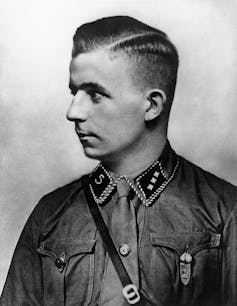
Portrait of murdered Nazi stormtrooper Horst Wessel.
Stormtrooper turned Nazi saint: Horst Wessel.
Bundesarchiv, Bild

Adolf Hitler and his propaganda chief Josef Goebbels also used martyrs to great effect. The 14 Nazi party members killed during the unsuccessful Munich “beer hall putsch” of 1923 were memorialised in a square in the centre of Munich and given their own day (after the war, the four police officers killed defending the Weimar republic were given a plaque in the same square).

But the Nazi movement’s most famous martyr was Horst Wessel. A young stormtrooper who was shot in a street brawl with a communist agitator, Wessel had written a song glorifying the Nazi movement’s struggle against communism. After his death in 1930, the “Horst Wessel lied” became the Nazi anthem and his death became a justification for fighting (and after the Nazis took power, imprisoning) opponents of the Nazis.

They also serve

In North Korea, Kim Jong-suk – the wife of eternal leader Kim il-Sung – is still portrayed as a martyr for the regime in the fight against Japanese occupation and in supporting her husband. Her death is commemorated each year as a quasi-sacred event.

It all helps to reinforce a culture of unquestioning loyalty to the Kim clan dynasty. By the early 2000s, her biography became a separate subject in the North Korean curriculum, while a museum was set up in her honour.

Martyrs also play an important role in Iran. Iranians who died for the revolution have been heralded as heroes. Their photographs adorn city streets and commemorations fill the calendar.

Those that died in the Iran-Iraq war are venerated in massive murals, monuments, billboards and comic strips. Massive pictures of more recent “martyrs”, such as Qassem Soleimani, the former head of the Revolutionary Guard’s al-Quds force who was assassinated in 2020 in a US drone strike, line some of the main thoroughfares in the capital Tehran.

Donald Trump: Charlie Kirk was a “‘martyr for freedom’ .

There is an enduring power of political martyrdom that is useful to both democratic and authoritarian movements. Democrats tend to use martyrs to broaden participation and protect pluralism, while in authoritarian movements, martyr narratives often fuse faith with politics and, in some cases, glorify violence.

In the case of Charlie Kirk, some scholars have even argued that Kirk’s elevation to martyr status appears part of a Trump administration campaign to vilify the liberal left.

The deaths of key figures that are attached to certain regimes or movements can be used to persuade people beyond reason, inspire undying loyalty and bind followers more tightly to each other and to their leaders. The US is more polarised than ever over what kind of martyr Charlie Kirk has become – and what, exactly, his death is meant to symbolise.

The Conversation

Natasha Lindstaedt does not work for, consult, own shares in or receive funding from any company or organisation that would benefit from this article, and has disclosed no relevant affiliations beyond their academic appointment.

ref. Charlie Kirk: the latest in a long line of political martyrs, from left and right – https://theconversation.com/charlie-kirk-the-latest-in-a-long-line-of-political-martyrs-from-left-and-right-266264