La langue inclusive : lorsque des mythes font leur entrée dans les politiques publiques

Source: The Conversation – in French – By Alexandra Dupuy, Doctorante en linguistique, Université de Montréal

En interdisant l’usage de certaines formes d’écriture inclusive en français, le gouvernement québécois s’inscrit dans une longue tradition d’aménagement linguistique, mais au risque de restreindre l’expression même des identités qu’il prétend protéger.

Au mois de septembre, le ministre de la Langue française, Jean-François Roberge, a annoncé le dépôt d’un décret visant à interdire l’utilisation de certaines formes de langue inclusive comme « iels », « toustes » et les doublets abrégés, comme « étudiant.e.s ». Cette mesure s’applique à l’Administration publique québécoise, aux municipalités, aux centres de services scolaires, au réseau de la santé et s’appliquera éventuellement aux cégeps et aux universités.

Une histoire qui se répète

De l’autre côté de l’Atlantique, cette décision donne un air de déjà vu. En 2017, le premier ministre français Édouard Philippe signait une circulaire invitant à ne pas utiliser la langue inclusive dans l’Administration publique française et en 2021, le ministre de l’Éducation nationale, Jean-Michel Blanquer, a publié un règlement interdisant l’utilisation de la langue inclusive dans le milieu de l’éducation. Parmi les motifs évoqués : les difficultés de lecture que les formes inclusives engendrent.

Alors que le gouvernement français se prononçait sur l’usage de l’écriture inclusive, aucune étude empirique n’avait encore mesuré l’effet des formes inclusives en français chez les personnes dyslexiques (plus particulièrement les formes abrégées comme « locuteur·ices »). Des personnes concernées y voyaient d’ailleurs une instrumentalisation des personnes en situation de handicap.

Ce que les données en psycholinguistique nous disent

En entrevue, le ministre Jean-François Roberge fait plusieurs fois référence à la complexification de la lecture causée par des formes inclusives comme les doublets abrégés et les néologismes. Des phrases comme « iels sont content.e.s » ou « si iel n’est pas avec l’enseignant.e souhaité.e » sont des exemples de la « confusion linguistique » qu’il dénonce et de la supposée entrave à la qualité de la langue causée par l’écriture inclusive. Pourtant, lorsque Jean-François Roberge dénonce la présence de néologismes dans la langue, il s’attaque à une réalité qui, d’un côté, est inhérente aux langues vivantes et qui, de l’autre, n’est pas considérée comme problématique d’un point de vue psycholinguistique.

Du côté des doublets abrégés, cet argument de la difficulté ajoutée a été démenti par plusieurs études réalisées à travers la francophonie. En effet, les données récentes montrent que les impacts des doublets abrégés sur la compréhension sont très minimes. De plus, il est fort probable qu’un effet d’habituation soit observable, tout comme c’est le cas pour les néologismes, de sorte que, plus on rencontre une certaine forme linguistique, plus on la lit facilement.

Bien que le décret ne vise que certaines formes de rédaction inclusive, des mythes portant sur l’ensemble de la pratique se sont glissés dans le discours public, notamment lorsque le chef du Parti québécois (PQ) Paul St-Pierre Plamondon a laissé sous-entendre que l’écriture inclusive n’avait aucun bienfait.

Sur ce point, les données en psycholinguistique nous disent en fait tout le contraire. De nombreuses études ont montré que l’écriture au masculin mène les lecteurs et lectrices à se représenter moins de femmes lors de la lecture. Au contraire, différentes formes d’écriture inclusive peuvent atténuer cet effet et améliorer la représentation de toutes personnes dans la langue.


À lire aussi :
L’écriture inclusive gagne en popularité, mais on en sait peu sur son application à l’école


Au-delà des données, la question de l’aménagement

Dans le préambule de la Charte de la langue française, on indique : « Langue distinctive d’un peuple majoritairement francophone, la langue française permet au peuple québécois d’exprimer son identité. » Cette loi a pour principal objectif de s’assurer que toute personne au Québec puisse vivre en français dans la sphère publique, sans discrimination.

Les interventions gouvernementales sur la langue française vont ainsi majoritairement porter sur la proposition de mots en français afin d’éviter le recours à d’autres langues. Par exemple, pour éviter le recours au mot anglais e-mail, l’Office québécois de la langue française (OQLF) a proposé le néologisme « courriel » dans les années 1990 ; ce néologisme est désormais largement diffusé au Québec et, dans une certaine mesure, en France.

L’OQLF en est également à la 6e édition du Concours de créativité lexicale où des jeunes du secondaire ont la possibilité de proposer des néologismes afin de nommer de nouvelles réalités. De ce concours, nous avons notamment obtenu les mots « saute-soucis », « sociomuselage » et « conséconscient ».

L’OQLF a une approche collaborative avec les membres de la société, tout en ayant un rôle pédagogique. Dans cette perspective, l’OQLF publie plusieurs documents visant à outiller la population quant à des difficultés linguistiques, mais également dans l’objectif de promouvoir l’usage du français. Dans le contexte de la féminisation, l’OQLF avait publié des guides et son approche avait été incitative plutôt que coercitive. En ce qui concerne les doublets abrégés ou les néologismes tels que « iel » ou « toustes », l’attitude de l’OQLF est différente de son approche traditionnelle.

Il est à noter que certaines formes tronquées sont permises, alors que d’autres ne le sont pas : les crochets et les parenthèses sont permis par l’organisme lorsque l’espace est restreint. Contrairement aux crochets et aux parenthèses qui sont utilisées en français notamment pour citer ou inclure des informations supplémentaires dans un texte, les points médians n’ont qu’une seule fonction dans l’usage : visibiliser les femmes et les personnes non-binaires dans le texte. Ceux-ci seraient donc moins susceptibles de mener à de la « confusion linguistique » en comparaison avec les signes acceptés par l’OQLF. En d’autres mots, si la clarté du texte était réellement le critère déterminant, les points médians ne seraient pas plus problématiques que les pratiques déjà tolérées.


Déjà des milliers d’abonnés à l’infolettre de La Conversation. Et vous ? Abonnez-vous aujourd’hui à notre infolettre pour mieux comprendre les grands enjeux contemporains.


Alors qu’aucun guide gouvernemental n’a été publié sur l’ensemble des techniques d’écriture inclusive, ceux conçus par la communauté linguistique pullulent. Cette multiplication d’ouvrages est un signe du désir d’exprimer l’identité de toustes en français.

Le respect des droits fondamentaux

Au-delà d’un débat linguistique, c’est la question du respect des droits fondamentaux qui est en jeu. La Charte des droits et libertés de la personne se veut un reflet des valeurs québécoises. En vertu de cette dernière, l’identité de genre et l’expression de genre sont des motifs de discrimination interdits ; le gouvernement du Québec a d’ailleurs planifié une série de mesures visant entre autres à « Promouvoir le respect des droits des personnes issues de la diversité sexuelle et de genre ». La protection des minorités s’inscrivant dans la constitution québécoise, il est ainsi légitime de se questionner sur le fait que Québec pose des actions allant à l’encontre des droits protégés par sa propre Charte.

La décision du ministre Jean-François Roberge ainsi que les interventions du chef du PQ sur l’écriture inclusive mettent en lumière des enjeux importants, notamment le détournement de la littérature scientifique afin de justifier des politiques publiques ayant un impact direct sur l’exercice de droits garantis.

Finalement, une question importante se pose : si le français permet au peuple québécois d’exprimer son identité, que devient cette promesse lorsqu’un décret nous interdit de le faire ?

La Conversation Canada

Gabrielle Girard a reçu des financements du Fonds de recherche du Québec.

Alexandra Dupuy ne travaille pas, ne conseille pas, ne possède pas de parts, ne reçoit pas de fonds d’une organisation qui pourrait tirer profit de cet article, et n’a déclaré aucune autre affiliation que son organisme de recherche.

ref. La langue inclusive : lorsque des mythes font leur entrée dans les politiques publiques – https://theconversation.com/la-langue-inclusive-lorsque-des-mythes-font-leur-entree-dans-les-politiques-publiques-267073


Les virus, ces messagers invisibles de la conversation du vivant

Source: The Conversation – in French – By Armand Namekong Fokeng, Doctorant en biologie cellulaire et épidémiologie, Université de Corse Pascal-Paoli

Bien que les virus n’aient ni cerveau ni langage, leur circulation entre tiques, animaux et humains dans un environnement donné pourrait se lire comme un flux d’informations qui modifierait à jamais des comportements et qui façonnerait notre évolution.


La plupart des animaux ont un mode de communication évident : les cris d’alarme des suricates alertent au danger, les danses des abeilles signalent le nectar, les infrasons des éléphants permettent le maintien de la cohésion des groupes. Ainsi, c’est un nouveau message codé qui circule chaque fois et qui est ensuite interprété pour induire une action collective. Imaginez alors un instant, des virus qui parlent… pas un langage sonore ni gestuel, mais une conversation génétique, gravée dans des molécules (ADN, ARN) qui traversent les espèces en modifiant les corps.

Pour faire simple, un virus n’est qu’un morceau d’information génétique. Dénué de toute autonomie propre, il n’a de vie qu’à travers les cellules hôtes qu’il infecte. Le code génétique du virus est lu et exécuté comme un programme. En conséquence, la cellule cesse ses activités nobles (respiration, reproduction, réparation, etc.) et devient une usine à virus.

Cependant, le message viral n’est presque jamais stable. En effet, la fidélité est limitée dans la réplication des virus à ARN, tels que celui de la fièvre hémorragique de Crimée-Congo (CCHFV) sur lequel porte mon projet de thèse.

Chaque nouvelle infection draine avec elle une nuée de variants génétiques, appelés « quasi-espèces ». L’information virale est donc en perpétuelle réécriture pour s’adapter aux environnements et aux hôtes. Parfois, elle s’inscrit dans la mémoire profonde des organismes ayant été en contact avec le virus.

On sait, actuellement, qu’environ 8 % du génome humain provient de séquences virales anciennes parmi lesquelles certaines ont été intégrées à nos fonctions vitales. À titre d’exemple, la protéine syncytine, issue d’un rétrovirus, est indispensable à la formation du placenta chez les mammifères.

Les virus sont-ils toujours des intrus nuisibles ? Eh bien non ! Ils peuvent se présenter comme des créateurs invisibles de notre histoire génétique.

Une communication sans intention

Un virus est sans voix et ne choisit pas ses mots. Cependant, son interaction avec la cellule rappelle un échange de signaux.

En effet, dans le processus de l’infection, il doit reconnaître un récepteur spécifique sur la membrane de la cellule hôte : c’est la clé moléculaire qui lui ouvre la porte. Un exemple assez connu est celui du virus de l’immunodéficience humaine (VIH) qui cible les lymphocytes T, en exploitant la très célèbre molécule CD4 à laquelle il se lie, et utilise les corécepteurs CCR5 ou CXCR4 pour infecter la cellule.

En réponse, l’organisme infecté met en place une véritable conversation immunitaire entretenue par de nombreux messagers chimiques : cytokines, interférons, fièvre, etc. Ces derniers modifient le comportement des cellules et, parfois, de l’individu lui-même.

À l’échelle sociale, l’infection induit des réactions telles que l’isolement, les soins, les nouvelles pratiques de prévention, etc. Ainsi, sans aucune intention, le virus modifie pourtant les relations collectives.

Virus de la fièvre hémorragique de Crimée-Congo : un connecteur écologique

Le virus de la fièvre hémorragique de Crimée-Congo est une parfaite illustration de cette logique. En effet, il circule dans un réseau où chaque espèce joue un rôle.

En ce sens, les tiques du genre Hyalomma sont à la fois vecteurs et réservoirs. Leur salive est riche en molécules immunomodulatrices, un cocktail de protéines ou de peptides (lipocalines, serpines, évasines, etc.) qui, en neutralisant les défenses immunitaires locales de l’hôte, préparent discrètement la transmission du virus.

Une fois infectés par les tiques, les mammifères domestiques (bovins, ovins, caprins), en tant qu’amplificateurs silencieux, hébergent le virus sans symptômes.

Chez l’humain, le scénario est différent. Ici, l’infection peut entraîner des fièvres hémorragiques potentiellement mortelles (de 10 % à 30 %) en cas d’apparition de symptômes. On estime de 10 000 à 15 000 cas environ, le nombre annuel de nouvelles infections à CCHFV. Ces dernières conduisent à environ 500 décès, soit une létalité moyenne globale d’environ 3-5 %.

En ce qui concerne la France, aucun cas humain symptomatique n’a été rapporté à ce jour. Cependant, des preuves d’une circulation virale dans le sang des animaux hôtes et dans les tiques vectrices prélevées dans ce pays ont été documentées. Bien qu’ayant un risque humain relativement faible pour le moment, la France est située au carrefour de plusieurs zones endémiques (la Turquie, les Balkans, l’Asie, l’Afrique).

À travers son cycle de transmission viral, le CCHV se présente comme un fil invisible qui relie tiques, animaux et humains. C’est un véritable message moléculaire qui circule, traverse les corps et remodèle les dynamiques écologiques et sociales.

Les devenirs d’un message viral

Il importe également de souligner qu’une fois dans la cellule, un virus a un destin riche en opportunités. Il peut ainsi être neutralisé par les défenses immunitaires ou se répliquer jusqu’à consumer entièrement son hôte.

Certains virus ont une présence latente et choisissent de rester silencieux ou endormis dans le génome ou le noyau. Cependant, dès que les conditions sont favorables (stress ou immunodépression), ils se réactivent et causent des dommages.

D’autres s’intègrent durablement dans le génome, modifiant ainsi la biologie de la cellule. Ainsi, ils peuvent dans certains cas activer des oncogènes et conduire à certains cancers, tels que celui du col de l’utérus pour le papillomavirus, ou simplement déclencher des dérèglements immunitaires qui débouchent sur l’expression de certaines maladies auto-immunes. Mais, dans certains cas, les virus passent inaperçus et disparaissent en silence.

La médecine, un nouvel interlocuteur moléculaire

Quand il faut barrer la voie aux virus, on s’attaque à leurs signaux moléculaires. Les antiviraux sont des brouilleurs de signal dans ce dialogue moléculaire.

Ainsi, certains empêchent l’entrée du virus, d’autres inhibent la copie de son génome : c’est le cas du favipiravir, par exemple, qui inhibe la polymérase des virus à ARN. Ce médicament est traditionnellement utilisé contre les pandémies grippales.

D’autres traitements agissent comme amplificateurs. C’est le cas des interférons, qui administrés comme médicament, renforcent l’expression des cellules et leur permettent d’alerter leurs voisines.

Ce jeu demeure toutefois dynamique. Face aux pressions thérapeutiques toujours plus nombreuses, les virus mutent en de nouveaux variants, enrichissant ainsi leur « vocabulaire moléculaire ». Le VIH en constitue un bel exemple ; en effet, il a rapidement développé des résistances aux premiers traitements en mutant. Ainsi, la médecine et la pharmacopée deviennent elles-mêmes des acteurs involontaires de cette conversation évolutive.

Et si l’on élargissait notre vision de la vie, en classant les virus parmi les acteurs de la communication ? Ainsi, la communication ne se limiterait plus seulement aux cris des animaux et aux paroles ou gestes d’humains. Elle pourrait également être inscrite dans la circulation d’informations génétiques entre les espèces.

De ce fait, les virus cesseraient d’être uniquement des ennemis pour devenir aussi, et surtout, des agents de mise en réseau, qui relient les tiques, les animaux et les humains. Ce faisant, ils laisseraient des traces dans nos génomes et modifieraient nos comportements sociaux en cas d’épidémie.

Vue sous cet angle, chaque infection virale deviendrait une conversation biologique, un échange franc où virus, cellules et écosystèmes négocieraient chacun leur position. De la simple chorégraphie d’une abeille au passage d’un virus dans un troupeau, le vivant deviendrait une immense polyphonie de messages.

Loin d’être un simple agent pathogène, le virus apparaît comme une voix invisible de la grande conversation du vivant.


Cet article est publié dans le cadre de la Fête de la science (qui a lieu du 3 au 13 octobre 2025), dont The Conversation France est partenaire. Cette nouvelle édition porte sur la thématique « Intelligence(s) ». Retrouvez tous les événements de votre région sur le site Fetedelascience.fr.

The Conversation

Armand Namekong Fokeng ne travaille pas, ne conseille pas, ne possède pas de parts, ne reçoit pas de fonds d’une organisation qui pourrait tirer profit de cet article, et n’a déclaré aucune autre affiliation que son organisme de recherche.

ref. Les virus, ces messagers invisibles de la conversation du vivant – https://theconversation.com/les-virus-ces-messagers-invisibles-de-la-conversation-du-vivant-266937

HIV prevention jab approved for use in England and Wales – here’s how it works

Source: The Conversation – UK – By Rosalie Hayes, Research Assistant, Centre for Public Health & Policy, Queen Mary University of London

Cabotegravir is a form of pre-exposure prophylaxis (Prep). Svitlana Hulko/ Shutterstock

The first ever injectable drug that can prevent HIV has been approved for use in England and Wales.

The drug, cabotegravir, would benefit an estimated 1,000 people at risk of HIV in England and Wales. It offers a long-acting alternative to other existing preventive HIV drugs, which are only available as pills and usually must be taken on a daily basis.

The jab belongs to a group of drugs called antiretrovirals, which were originally developed to treat HIV. It’s now well established that antiretrovirals can also be used by HIV-negative people to dramatically reduce their risk of acquiring HIV.

The jab stops HIV from replicating within a person’s cells, meaning infection cannot take hold. This approach is called pre-exposure prophylaxis, or Prep.

Injectable cabotegravir for Prep is administered by a single, intramuscular injection into the buttocks every two months. It must be administered by a trained health professional to ensure that the drug is delivered correctly into the muscle.

It is important to understand that cabotegravir is not a vaccine. Vaccines work by training the immune system to fight infections – whereas cabotegravir works by ensuring there are adequate levels of the antiretroviral drug in the bloodstream to prevent the HIV virus from replicating.

That’s why people using cabotegravir as Prep need to make sure they get their injections every two months for as long as they’re at risk of HIV.

Oral vs injectable Prep

Oral Prep is around 99% effective at preventing HIV when taken as prescribed – but this is reliant on people adhering to their pill regimen. Real-world effectiveness declines depending on adherence.

In contrast, injectable cabotegravir requires only six injections per year. Largely because it is easier to adhere to, cabotegravir has been found to reduce the risk of acquiring HIV by 66% in gay men, bisexual men and transgender women, and by 88% in cisgender women, compared to daily oral Prep.

There are other differences between injectable Prep and oral Prep beyond effectiveness.

People using cabotegravir for Prep will need to attend the clinic every two months to receive their injections. In comparison, people taking oral Prep will only need to get their prescription filled every three to six months.

A person holds a blue Prep pill in their hand.
The jab offers an alternative to oral Prep pills.
Michael Moloney/ Shutterstock

Both injectable and oral Prep are very safe and well-tolerated medications, but possible side-effects differ between the two types. The most common side-effect of cabotegravir is swelling or tenderness around the injection site. Oral Prep’s possible side-effects can include nausea, vomiting and headaches.

At the moment, current guidelines recommend cabotegravir is offered to people in need of Prep but who cannot use oral Prep effectively. This includes the small number of people with health conditions (such as severe liver or kidney problems) which may make oral Prep unsuitable for them and those with difficulty swallowing tablets.

It also includes those who are unable to adhere to oral Prep for social or personal reasons. For example, people who are homeless or in unstable housing who may easily lose medication or have it stolen, people experiencing intimate partner violence who may worry about their partner finding their pills and people who use drugs and find regular pill-taking challenging.

A significant milestone

Cabotegravir was already approved for use in England and Wales as part of a combination treatment for people living with HIV. Now, the drug will be available to those who are HIV-negative and looking to protect themselves from acquiring HIV. This is the first time an alternative to oral Prep has been made available on the NHS.

It offers access to highly effective HIV prevention for those who previously could not use Prep. Research shows that there is a strong preference for injectable Prep among people at risk of HIV, due to its convenience and the reduced pill burden.

This approval may also pave the way for other forms of injectable Prep that have an even longer duration. For instance, lenacapavir, which is already available in the United States, only needs to be administered every six months.

Currently, there are issues around inequitable access to Prep. For example, women make up only 3% of current Prep users but 35% of new HIV diagnoses. Recent research indicates that current Prep provision does not align with women’s needs.

Giving patients more choice in the type of Prep they can access is an important step forward in addressing this inequality. But it will be crucial that sexual health services are adequately funded so they can deliver injectable Prep services.

Ongoing research also shows that delivering Prep outside of traditional sexual health settings, such as in community pharmacies and GP practices, could also make an important contribution to equitable access. Considering how injectables could be incorporated into these services will be a vital next step.

By increasing the numbers of people who can use Prep, injectables offer a critical new tool for achieving the government’s goal of eliminating new HIV infections by 2030.

The Conversation

Sara Paparini has received funding from ViiV Healthcare and Gilead Sciences.

Sophie Strachan receives funding from ViiV and Gilead and MSD she is affiliated with Sophia Forum

Rosalie Hayes does not work for, consult, own shares in or receive funding from any company or organisation that would benefit from this article, and has disclosed no relevant affiliations beyond their academic appointment.

ref. HIV prevention jab approved for use in England and Wales – here’s how it works – https://theconversation.com/hiv-prevention-jab-approved-for-use-in-england-and-wales-heres-how-it-works-268037

‘No kings’: America’s oldest political slogan is drawing millions out onto the streets

Source: The Conversation – UK – By Tom F. Wright, Reader in Rhetoric, University of Sussex

Every few decades, Americans rediscover that their republic was built on a rejection – the rejection of being ruled by a monarch. Now, in one of the largest protest movements in many years, the phrase “No kings” is everywhere: on placards, online memes, and in chants aimed at a president who seems to want to rule rather than serve.

Yet the words are hardly new. They are the first note in the American political scale, the country’s founding slogan before it even had a flag.

Long before it echoed through the colonies, the slogan “No king but Jesus” rang out in the English civil war, where it was used to declare that divine authority, not royal prerogative, should rule the conscience.


Read more:
In 1776, Thomas Paine made the best case for fighting kings − and for being skeptical


When it crossed the Atlantic, colonial Americans inherited a phrase, a stance and an image that could turn theology into politics and rebellion into virtue.

As Thomas Paine put it in his 1776 pamphlet, Common Sense: “Of more worth is one honest man than all the crowned ruffians that ever lived.” Republican speech was invented by rejecting monarchy.

When independence was achieved, America’s experiment rested on a paradox: it needed strong leadership but feared the aura of command. “No kings” was a self-diagnosis of a nervous republic. A way of keeping the charisma of a leader on a leash.

That allergy to grandeur shaped the early republic. In the 1790s when John Adams proposed that the president be addressed as “His Highness”, he was swiftly mocked as “His Rotundity”. The laughter mattered. It expressed the conviction that democracy could not survive reverence.

By the 1830s, this suspicion of pomp had become visual. Critics of the seventh president, Andrew Jackson, issued a famous broadside “King Andrew the First” showing him crowned and trampling the constitution. It wasn’t just partisan art – it was an act of democratic hygiene.

Image from cover of 1864 pamphlet depicting Abraham Lincoln as a king.
Abraham LIncoln depicted as a king in 1864.
Lincoln Financial Foundation Collection

A generation later, Abraham Lincoln faced the same charge. During the American civil war, a notorious 1864 pamphlet Abraham Africanus I accused him of seeking to become a “hereditary ruler of the United States”. His sweeping wartime powers fed old fears that emergency rule would harden into monarchy.

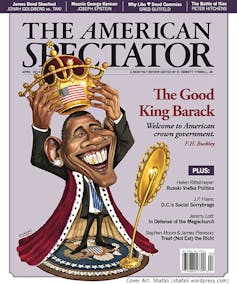
Sometimes, the charge is justified. When Puck magazine in 1904 depicted Theodore Roosevelt crowning himself Louis XIV (or perhaps Napoleon), it captured the public’s mixture of thrill and alarm at his trust-busting, canal-building, imperial swagger. Citizens wanted vitality in office, but not vanity.

Image from cocver of American Spectgator 2014 showing a caricature of Barack Obama crowning himself king.
How the American Spectator depicted Barack Obama in 2014.
American Spectator

Other times, the imagery seemed to speak more to American paternal longings. Take images of Dwight Eisenhower as “King Ike” in the 1950s, a genial ruler among smiling courtiers, soothing cold war nerves.

In our own century, the crown returns in sharper form. The American Spectator’s 2014 cover, “The Good King Barack” showed Obama beaming beneath a red velvet crown.

When Donald Trump triumphed in 2016, crown memes returned as America’s simplest moral shorthand for power that has gone too far.

It fell to his successor Joe Biden to officially declare, in response to the July 2024 Supreme Court ruling that Trump was not immune from prosecution: “This nation was founded on the principle that there are no kings in America.”

Why the crown keeps returning

The crown is both insult and safety valve at once. It’s an instantly legible piece of political folk art reminding citizens that authority is temporary, fallible and – like its wearer – mortal.

When protesters revive “No kings”, they aren’t just quoting the revolution. They’re translating an older language of civic republican virtue into an accent everyone can understand. No person above the law, no office above criticism, no citizen beneath respect.

The slogan reawakens the moral reflex that freedom depends on vigilance, and that dignity belongs to the governed as much as the governors.

And here’s the irony: both parties were founded on that same cry. Democrats and Republicans trace their roots to the anti-monarchical Democratic-Republicans of Thomas Jefferson and James Madison, who defined their movement against the spectre of kingly power. That party later fractured, giving rise to both modern traditions.

In that sense, “No kings” was the nation’s first party platform, the point of agreement from which every later disagreement grew.

Can it still work?

In today’s fractured America, “No kings” offers something rare: a language of protest that feels constitutional rather than ideological. It has the potential to speak to conservatives alarmed by executive overreach, to progressives wary of authoritarian drift, and to independents nostalgic for civic balance.

That gives it unusual rhetorical strength. Unlike most modern slogans – “Drill baby, drill”, “Make America great again” (Maga), or “Defund the police” – it doesn’t divide, it recalls a principle. “No kings” reminds Americans that what unites them is the rejection of tyranny.

The phrase also appeals to exhaustion as much as outrage. After years of political spectacle, “No kings” gestures toward humility, order and self-restraint: the virtues both parties claim to miss.

The movement may go nowhere. But if this moment does turn out to be an inflection point, it is a fitting way to frame it.

To chant “No kings” now is not nostalgia but muscle memory. That is how a republic tests its pulse: by mocking grandeur, refusing awe and rediscovering equality in the act of saying no.

The Conversation

Tom F. Wright does not work for, consult, own shares in or receive funding from any company or organisation that would benefit from this article, and has disclosed no relevant affiliations beyond their academic appointment.

ref. ‘No kings’: America’s oldest political slogan is drawing millions out onto the streets – https://theconversation.com/no-kings-americas-oldest-political-slogan-is-drawing-millions-out-onto-the-streets-268174

The Celebrity Traitors: psychologist explains how to defend yourself when you’re accused of lying

Source: The Conversation – UK – By Lara Warmelink, Lecturer, Department of Psychology, Lancaster University

The Traitors is a game built on lies and deceit. Contestants live together in a Scottish castle. Those secretly chosen as Traitors are tasked with “murdering” their fellow players while avoiding suspicion. The rest are Faithfuls, trying to banish the Traitors.

Of course, the Traitors must tell lies all the time to avoid getting caught – but many Faithfuls tell lies as well: to throw the traitors off their scent, build alliances or manage how other players think of them.

This means all players “take heat” at the nightly roundtable, when they are accused of being Traitors and telling lies. But what does psychology tell us about how best to defend yourself from accusations that you are lying?

Outside of TV shows, when you lie you have one big advantage: the people you are trying to deceive might not be looking out for any signs that you are lying. According to communication expert Timothy Levine’s Truth Default Theory, people normally assume that anything they are told is true – in other words, truth is the default.

This makes sense: people hear and read so much information in a day, and normally this information is true. Doubting everything we experience would be exhausting, possibly dangerous, and very bad for our social relationships.

If you are crossing the road and suddenly you hear someone yell “Stop!”, your first instinct should be to stop – not keep going, thinking: “I wonder whether they are lying to me.” And your friends would probably not stay your friends for long if you responded to everything they said with suspicion that they are lying.

This is something you can rely on when you’re telling a quick white lie. Whoever you are lying to is unlikely to submit you to a third degree in response to you saying: “We’d have loved to be at your party this weekend, but we just couldn’t make it.”

Strategies to use

However, on The Traitors, neither Traitors nor Faithfuls have that luxury. All other players are on the lookout for the slightest sign – a sly smile, a head turned at the wrong moment, an above-average vocabulary. Anything can lead to you being put under the spotlight. So, what options do you have then? Here are a few strategies to consider.

1. Think about the evidence.

What does the person who is accusing you know and what can they prove? Denying something vehemently only to have a third player say “You did say that, I heard it too” is likely to land you in hot water.

And don’t just think about evidence they have already confronted you with: consider whether your accuser might be holding other evidence back, to lure you into a lie and then confront you. This “strategic use of evidence” can be very effective for an interrogator, so guard against it.

Celebrity Traitors
All players ‘take heat’ at The Traitors’ roundtable.
BBC

2. Don’t protest too much.

When trying to look like you’re telling the truth, don’t overdo it. Your first instinct might be to do everything to look Faithful, but that’s not how normal truth-telling people behave. Doing too much can be as harmful as doing too little.

For example, research shows that many liars make too much eye contact. Because people think liars avoid eye contact, they try to prove they are telling the truth by staring into people’s eyes and end up giving themselves away.

3. Tell the truth.

Sometimes it might be better to just come out and admit you lied. The cover-up can be worse than the crime.

For example, in series 3 of The Traitors, when Lisa Coupland started being put under pressure over her lies, she decided she was best off coming clean and admitting she was an Anglican priest. This worked out beautifully: everyone believed her and the other Faithfuls stopped suspecting her of being a traitor (although the truth was almost certainly a factor in her “murder” four episodes later).

Strategies might not keep you safe for long though. The Traitors is a game designed to keep you on your toes. The rules of banishment mean all players benefit from you being the one who is accused. Once you have been named as a possible Traitor, any reprieve may well be temporary.

Faithfuls have long memories and can haunt you with the tiniest mistake, roundtable after roundtable. And even if they believe what they tell you, that might only make you a more juicy target for “murder”.

The Conversation

Lara Warmelink does not work for, consult, own shares in or receive funding from any company or organisation that would benefit from this article, and has disclosed no relevant affiliations beyond their academic appointment.

ref. The Celebrity Traitors: psychologist explains how to defend yourself when you’re accused of lying – https://theconversation.com/the-celebrity-traitors-psychologist-explains-how-to-defend-yourself-when-youre-accused-of-lying-268027

The Arctic in Guillermo del Toro’s Frankenstein reveals more about empire than about monsters

Source: The Conversation – UK – By Monica Germanà, Reader in Gothic and Contemporary Studies, University of Westminster

Warning: this article contains spoilers for the novel and film Frankenstein.

Watching Guillermo del Toro’s Frankenstein after my return from the 2025 Arctic Circle Assembly (ACA) in Reykjavik, I was intrigued by his adaptation of the Arctic setting of Mary Shelley’s novel.

The novel follows Dr Victor Frankenstein (played by Oscar Isaac in the film), a scientist who creates a living being from dead body parts, only to abandon him after the consequences of his experiment horrify him.

Rejected and lonely, the Creature (played by Jacob Elordi) seeks revenge on Victor by destroying everything he loves. The story is framed by letters from an explorer, Robert Walton (played as Danish Captain Anderson by Lars Mikkelsen in the film), who encounters Victor in the Arctic as he pursues the Creature.

Del Toro’s film presents the Arctic of the 1800s as a barren wasteland. While at the ACA, I asked Janne Oula Näkkäläjärvi, development manager at the Sámi Education Institute about this depiction. He said: “It feels sad and absurd. The Arctic is not empty – it is the home of many Indigenous peoples, including the Sámi, who have thrived here in harmony with nature for thousands of years.”

His position reflects the ongoing project to rewrite Arctic history through the perspective of Indigenous Arctic peoples. In this sense, Del Toro’s film, while faithful to the novel in many other ways, arguably misses an opportunity to deliver the anti-colonial political message embedded in Shelley’s work.

Shelley’s story implicitly draws attention to the overlaps between Frankenstein’s unethical experiments with human life and Walton’s “ardent curiosity” and desire to “tread a land never before imprinted by the foot of man”.

Although no Inuit characters feature in her novel, Shelley’s anti-imperial stance emerges throughout, and exposes Walton’s colonial us-versus-them mindset: “He was not, as the other traveller seemed to be, a savage inhabitant of some undiscovered island, but an European,” he says, when he sees the sledge carrying Frankenstein and the Creature.

The trailer for Frankenstein.

Frankenstein was first published in 1818 and again with revisions in 1831. This was a time of growing British interest in exploring and claiming Arctic regions. This surge in exploration began in the early 1800s, when Sir John Barrow was appointed Second Secretary to the Admiralty. Under his leadership, Britain launched more Arctic expeditions than ever before, driven by both scientific curiosity and colonial ambition.

In 1818 Barrow’s first book on his Arctic explorations, A Chronological History of Voyages into the Arctic, was published by John Murray. That same year, the Admiralty increased its investment in Arctic exploration. In particular, the search for the North-West Passage (a sea route connecting the Atlantic and Pacific Oceans through the Arctic) intensified.

Mary Shelley read many of the Arctic travel accounts published by John Murray, and they likely inspired the Arctic sections of Frankenstein. Shelley even sent her manuscript to John Murray, who rejected it.

Del Toro’s Arctic

Shelley’s novel is set in the 18th century, but Del Toro’s film is set in 1857, when British imperialist confidence was beginning to suffer significant blows. This was the year, for instance, of the Indian mutiny against British rule, while, in 1856, tension between Britain and China led to the second opium war.

The decline of the British Empire was also dramatically reflected in Arctic exploration disasters. Many vessels failed to deliver their missions and returned home having suffered considerable losses.

The doomed 1845-46 expedition of Sir John Franklyn’s HMS Erebus and HMS Terror was the most notable of such Arctic disasters. The ships never returned (the wrecks were only found in 2014 and 2016) and evidence from Inuit accounts of the mission suggested the crew had turned to cannibalism.

The controversial claim, shared initially by Orcadian explorer John Rae, and dismissed because of “the very loose and unreliable nature of the Esquimaux [sic] representations” by Charles Dickens, firmly put the Inuit in the European map of the Arctic, and, simultaneously, exposed the persistent racist bias of Imperial ideology.

In line with these Victorian views of the Arctic, Del Toro’s Frankenstein depicts the Arctic’s elusive barrenness simultaneously as a force hostile to the explorers from the south and a blank canvas for them to chart, control and ultimately, exploit.

His vision of the Arctic owes more to the sublime wilderness of 19th-century paintings such as Edwin Landseer’s Man Proposes, God Disposes (1864), than more recent representations including the 1973 Marvel comic adaptation of The Monster of Frankenstein, or the first television series of The Terror (2018).

The Terror retold the story of the Franklyn disaster based on the eponymous 2009 novel by Dan Simmons. While it was not filmed in the Arctic, the series was praised by critics for its inclusive script and casting, which included Inuuk actor Nive Nielsen.

Painting of two polar bears tearing at flesh in the Arctic
Man Proposes, God Disposes by Edwin Landseer (1864).
Royal Holloway, University of London

At the end of Frankenstein, the Creature spectacularly sets the Danish boat free to sail on a much-awaited southbound journey. His own lonely figure, significantly, is left to wander the Arctic barrenness in perpetuity.

Perhaps this apparently conservative emphasis on Arctic blankness is intentionally critical of the multiple forms of colonial oppression exposed by Shelley’s novel. There is, after all, an interesting parallel between Del Toro’s Arctic, with its limitless white expanse marked only by the traces of European blood, and the body of the Creature, his pale skin crudely scarred by the scientist’s stitches.

Both the Arctic and the Creature are exceptionally “undead” – simultaneously lifeless and supernaturally alive. Both are slates wiped blank, so that new master-slave stories can be written upon them.


Looking for something good? Cut through the noise with a carefully curated selection of the latest releases, live events and exhibitions, straight to your inbox every fortnight, on Fridays. Sign up here.


The Conversation

Monica Germanà does not work for, consult, own shares in or receive funding from any company or organisation that would benefit from this article, and has disclosed no relevant affiliations beyond their academic appointment.

ref. The Arctic in Guillermo del Toro’s Frankenstein reveals more about empire than about monsters – https://theconversation.com/the-arctic-in-guillermo-del-toros-frankenstein-reveals-more-about-empire-than-about-monsters-268032

Trump assault on US justice department independence revisits a Nixon-era problem

Source: The Conversation – UK – By Vince Pescod, Senior lecturer, The University of Law

The Trump administration is coming under fire for politicising the Department of Justice (DoJ) and undermining the US government’s enshrined separation of powers, which relies on an independent system of justice. This is a central principle of the US constitution, without which a president could govern virtually unchecked.

Critics point to recent indictments of people perceived to be Donald Trump’s political enemies, alleging the DoJ has acted on instructions or percived pressure from the president.

Former FBI director James Comey was indicted at the end of September on one count of making a false statement to Congress and one count of obstructing a congressional proceeding.

Letitia James, the attorney general of New York, has been charged with bank fraud and making false statements to a financial institution, relating to a property she purchased in Virginia in 2023. James led a civil prosecution of Trump on fraud charges the same year.

And most recently, John Bolton, the national security adviser during Trump’s first term and now an outspoken critic of the president, has been indicted on federal charges pertaining to the alleged mishandling of classified information.

All these indictments followed messages posted by the president on his TruthSocial platform, urging for them to be charged. In an often angry four-hour session in the senate judiciary committee on October 7, Democrat lawmakers accused the US attorney general, Pam Bondi, of “brazenly political” decision-making.

Democrat senators raised multiple areas of concern. These included the firing of hundreds of senior DoJ officials and their replacement with Trump loyalists, the dropping of investigations into some Trump loyalists, and the initiation of investigations, apparently at the behest of the president, into his political enemies.

Senator Dick Durbin of Illinois said Bondi had “systematically weaponised our nation’s leading law enforcement agency to protect President Trump and his allies and attack his opponents and, sadly, the American people … What has taken place since January 20 2025 would make even Richard Nixon recoil.”

Trump’s critics say his recent actions, appearing to put pressure on the US attorney general and DoJ to pursue certain investigations, are an abuse of power.

As US legal scholars Bruce Green and Rebecca Roiphe wrote in the the New York Law School’s journal in 2018, the attorney general must refuse a “president’s direction to indict a political opponent or to dismiss charges against a political ally because the president’s motivations are partisan”. They must also refuse, according to Green and Roiphe, when professional conduct rules require no action to be taken, such as where there is insufficient evidence to proceed.

Pam Bondi at the judiciary committee hearing.

But there are competing perspectives on the scope of the president’s power. During Trump’s first term, he and his lawyers – along with supportive legal scholars – argued that the president has absolute control over all decisions to prosecute. In a 2017 interview with the New York Times, Trump claimed to have an “absolute right to do what I want to do with the justice department”.

An independent system of justice?

The DoJ was set up in 1870 by an Act of Congress – headed by the attorney general, who is appointed by the president. The DoJ’s functions included prosecuting violations of federal law and protecting the country from subversive activities.

But when the DoJ was established, there was little federal criminal law in place. Most criminal activity was dealt with by each state, independently of the president.

This changed in 1908 with the creation of the Federal Bureau of Investigation (FBI), which was aimed at professionalising law enforcement (largely undertaken by locally trained state police) and rooting out government corruption. FBI investigations, particularly in relation to organised crime, highlighted the need for the creation of laws recognising a range of federal offences, which Congress duly passed.

The Hatch Act of 1939 then sought to limit the political activities of federal employees, establishing precedents for regulating executive branch behaviour. This significantly expanded the scope for misuse of the attorney general’s powers.

A year later, then-attorney general Robert H. Jackson warned: “With the law books filled with a great assortment of crimes, a prosecutor stands a fair chance of finding at least a technical violation of some sort on the part of almost anyone.” He added that: “It is here that law enforcement becomes personal, and the real crime becomes that of being unpopular with the predominant or governing group.”

The danger highlighted by Jackson became clear during the Nixon presidency. Most egregiously, at the height of the Watergate scandal in 1973, the president ordered the attorney general, Elliot Richardson, and his deputy, William Ruckelshaus, to fire Archibald Cox, the special prosecutor appointed by the Senate to investigate the growing scandal.

Both Richardson and Ruckelshaus refused and resigned. Nixon then ordered the solicitor general, Robert Bork, to carry out the firing. Bork complied.

Cut out of a New York Times story from the Nixon era.
How the New York Times reported the sacking of special counsel Archibald Cox in October 1973.
New York Times

Ensuring independence

The administrations of Gerald Ford and Jimmy Carter that followed set out to reestablish public confidence in both presidential integrity and the independence of the DoJ. The Independent Counsel Act of 1978 (part of the Ethics in Government Act) attempted to remedy some of the conflict of interest concerns highlighted by Watergate, and ensure impartial investigations in situations where the attorney general could face a conflict of interest.

While there is no formal separation, there has been a clear policy since the 1980s to limit communications between the White House and the DoJ to situations necessary for the discharge of the president’s constitutional duties. This would not include instructing or bringing any form of pressure on the DoJ to investigate or prosecute a perceived opponent, to prosecute someone at the request of the president, nor to drop an investigation for partisan reasons.

Commenting on the Comey indictment, Democrat senator Mark Warner severely criticised the charges, stating: “Donald Trump has made clear that he intends to turn our justice system into a weapon for punishing and silencing his critics.”

Warner added that this was “a dangerous abuse of power. Our system depends on prosecutors making decisions based on evidence and the law, not on the personal grudges of a politician determined to settle scores.”

It remains to be seen whether the US justice system is robust enough to hold, in the face of intense political pressure from the Trump administration.

The Conversation

Vince Pescod does not work for, consult, own shares in or receive funding from any company or organisation that would benefit from this article, and has disclosed no relevant affiliations beyond their academic appointment.

ref. Trump assault on US justice department independence revisits a Nixon-era problem – https://theconversation.com/trump-assault-on-us-justice-department-independence-revisits-a-nixon-era-problem-266379

Slow Horses season five: there’s comedy but also real spycraft – according to espionage expert

Source: The Conversation – UK – By Robert Dover, Professor of Intelligence and National Security & Dean of Faculty, University of Hull

The fifth season of Slow Horses, Apple TV’s gripping spy drama based on Mick Herron’s novel London Rules, shines a light on opportunist politicians, media manipulation, radicalisation and moral panics. In doing so, Herron taps into the zeitgeist of Britain in 2025.

It is, perhaps, because it is so on point that the writers and producers have opted for a lighter tone, including more direct humour about the characters and amusing moments. This is, however, in keeping with Herron’s book, which includes such incidences as an accidental death through dropping a pot of paint. This humourous tone persists even though the action is set around a series of terrorist attacks, which includes a mass shooting outside a shopping centre.

Jackson Lamb, the head of Slough House – an offsite MI5 office for semi-outcast spies – remains the key protagonist. He is just as smelly (I assume) and obnoxious as he has been in the previous series. He ultimately wants to protect Slough House, and his team, even if he plays at being permanently disappointed and dismayed by them.

In this series, the Libyan terrorists at the story’s centre are dangerous and violent adversaries the team battle against. Interestingly, they use a succession of unrelated groups, and a compromised former home secretary to disorient the British spies. The main terrorist group are seeking revenge on the UK’s conduct during the Arab Spring and Libyan conflicts of 2011. But there are adversaries at home too.

The opening episode begins with a mass shooting outside a block of flats by a supporter of a populist MP running to be London mayor. The shooter has been radicalised online in incel forums. One of the victims of this shooter is a campaigner for the incumbent mayor. Further attacks take place, in what amounts to a picture of deliberate confusion by the Libyan attackers.

The choice to add comedy into this serious plot has had a mildly polarising effect on critics and fans alike. Some preferred the previous tradecraft-driven plots, while others like the more humorous turns of this season.

Contrary to some of the early reviews, I found this series to be nuanced and I think it would only improve with a repeat viewing. It makes a mosaic of many disconnected real-world events but also tells us much about how the political world and intelligence agencies operate too. The potential violent toxicity of previous foreign policy adventures, online radicalisation and populist politics has enough truth in it to make this series compelling and believable enough.

What this series shows well – as the comedy about four wannabee jihadis Four Lions did in 2010 – is that terrorists are not universally motivated by their cause. Those seeking to inflict terror can pull in disconnected groups and individuals motivated by money, opportunity or desire for violence. Discerning what is signal and what is noise among the carnage is as much a function of intelligence as it is for the viewer embarking on this series.

As an expert in covert human intelligence) (aka “agents”), I found the take on a honeytrap odd. This deceptive practice involves a spy using sexual attraction on a target. In this series, Slough House’s tech officer, Roddy Ho, is the unwitting mark for such a tactic.

Ho is presented as completely (albeit arrogantly) naive, when in reality MI5 officers are trained in this area. Human frailties will always be a risk, but Ho’s behaviour is negligent.

Similarly, the cyber intrusion storyline is heavily reliant on MI5’s systems being vulnerable and linked, which allows them to be taken down. Again, all capable intelligence agencies have very carefully isolated and protected computer systems – the vast majority of which cannot be accessed from outside agency buildings.

These stories do have some echoes in real world incidents, however. One of the most famous honeytrap cases, from 2010, involved the Russian sleeper agent, Anna Chapman.

Chapman was arrested in an operation that broke a Russian sleeper cell in 2010 and later formed part of a spy exchange with Russia. Chapman had networked at parties for high net-worth individuals to produce usable intelligence for the Russian agencies.

This year, China claimed to have foiled honeytrap operations against its officials. These operations were run by westerners seeking to use “their seductive beauty”, claimed Chinese intelligence.

Emerging in the last few days and in the cyber realm, the Chinese Ministry of State Security has accused American intelligence of a highly sophisticated cyber attack on a core piece of national infrastructure.

Consumers and private industry have also experienced similar kinds of cyber attack: first there was the disruption in April to the high-profile British retailer Marks and Spencer whose site was taken off the web. A few months later, Indian owned carmaker Jaguar Land Rover had to close its factories for a month following a cyber attack. Both events underscore the enduring attempts at disrupting large organisations.

The crescendo of the final episode of this series will satisfy fans. The messy morality of some intelligence operations is captured beautifully in the novels and the TV drama. While George Smiley remains the purist’s choice, Jackson Lamb is the Smiley of Britain today.


Looking for something good? Cut through the noise with a carefully curated selection of the latest releases, live events and exhibitions, straight to your inbox every fortnight, on Fridays. Sign up here.


The Conversation

Robert Dover does not work for, consult, own shares in or receive funding from any company or organisation that would benefit from this article, and has disclosed no relevant affiliations beyond their academic appointment.

ref. Slow Horses season five: there’s comedy but also real spycraft – according to espionage expert – https://theconversation.com/slow-horses-season-five-theres-comedy-but-also-real-spycraft-according-to-espionage-expert-267792

The Thing With Feathers: a dark but uplifting exploration of grief and despair

Source: The Conversation – UK – By Daniel O’Brien, Lecturer, Department of Literature Film and Theatre Studies, University of Essex

Easily the most poignant film I have seen this year, Dylan Southern’s The Thing With Feathers is adapted from Max Porter’s 2015 novella Grief Is The Thing With Feathers. Using both subtle drama and horror spectacle, it cuts deeply into the tenderness of humanity and domesticity, reminding us that the most important things in life (so often taken for granted) are fragile shells that can be cruelly shattered at any moment.

The film follows a nameless father, referred to only as Dad (Benedict Cumberbatch), as he attempts to raise his two young sons in the aftermath of his wife’s sudden death. His grief takes the manifestation of a giant, monstrous crow, menacingly voiced by David Thewlis.

It’s yet another display of Thewlis’s uncanny ability to steal scenes even offscreen. But here, his range is on full display: he vocally dominates with an ambiguous malice. Crow is intimidating yet enigmatic and despite his haunting presence, functions as a kind of guardian figure over Dad and the boys.

Cinema’s engagement with avian imagery has long oscillated between two archetypes: the bird as looming threat and the bird as mysterious protector. Alfred Hitchcock’s The Birds (1963) remains the definitive expression of the former, while Andrea Arnold’s coming-of-age Bird (2024) offers a more recent embodiment of the latter.

Both came to mind while watching Southern’s film – not because it feels derivative, but rather it channels their resonance in subtle, intelligent ways. The sound design, for example, gradually swells from gentle feather rustles to piercing shrieks, which is unmistakably Hitchcockian.

Elsewhere, The Cure on the kitchen radio, playing as Dad fumbles through making a family breakfast, immediately put me in mind of the band’s association with Alex Proyas’s The Crow (1994), in which the eponymous bird also functions as a supernatural guardian and guide.

That echo is deepened further by the fact that Proyas’s film adapts James O’Barr’s 1989 graphic novel – and in Southern’s film, Dad is himself a graphic novelist. This is a deliberate shift from Porter’s novella, where Dad is a writer and literary scholar, and perhaps serves to emphasise the visual nature of storytelling – fitting for Southern’s debut narrative feature.

His previous work, drawn largely from music documentaries such as No Distance Left to Run (2010) about the band Blur, and Meet Me in the Bathroom (2022), about The Strokes and other indie bands, reveals a film-maker attuned to the emotional and cultural relevance of musical choices.

From paper to screen

Poetry is key to Porter’s book, which is written like a narrative poem. Similar in many ways to Edgar Allan Poe’s The Raven (1845), it also alludes to Emily Dickinson’s poem, Hope Is The Thing With Feathers (1891). In Southern’s adaptation the film replaces poetry with visual expression.

Southern weaves in a range of avian film references, while mixing domestic realism with the horror genre. He remains faithful to Porter’s novella which is structured in three parts that alternate between the three perspectives of Dad, the boys and Crow. In the film each has its own titled section, along with the Demon – an adversary that Crow must shield the family from.

If Crow is the embodiment of grief, then the Demon functions as its darker counterpart of despair – a dichotomy that the film explicitly invokes more than once. What makes Southern’s adaptation so engaging beyond the strength of its performances, is the maturity with which it articulates this emotional binary.

Rather than treating grief as something to be vanquished, the film suggests it must be accommodated, even befriended, lest one slide into the far more corrosive, and at times beguiling pull of despair. It’s a persuasive portrayal of mourning that recognises grief not as a wound to be sealed, but a permanent, unpredictable companion that you learn to live with, and eventually draw strength from.

Crow’s impact on Dad is tough to watch, testament to Cumberbatch’s convincing ability to appear both mentally and physically contorted in pain. Crow’s effect on the boys is equally wrenching, particularly in a scene where the bird suggests that it can resurrect their mother if they can produce a detailed picture of her.

Their innocent efforts collapse into heartbreak, forcing them to confront life’s hardest lesson sooner than they should. Thewlis’s elusive performance works well here to channel another well-known archetype of the crow as trickster.

While the emphasis on imagery again put me in mind of the song Pictures of You by The Cure, reverberating the idea that the band’s brief audible presence in the film is perhaps more significant and deliberate than it initially seems (although I maybe reading too much into that).

Other musical choices, including Fairport Convention’s Who Knows Where The Time Goes, more clearly alludes to the transient fragility of life, made all the more precious because of death’s inevitable and unknowable timing.

Yet for its darkness, Southern’s film can be unexpectedly uplifting. Like a bird taking flight, it reminds us to see afresh and reassess what matters – those everyday glimmers of joy that burn brighter against the shadow of mortality.

Any film capable of shifting your perspective, even briefly, is worth your time. The Thing With Feathers is a difficult but essential watch: grounded in powerful performances and a sharply crafted adaptation, faithful yet distinct enough to justify its existence on screen. It’s a confident narrative debut from a director clearly beginning to spread his wings.


Looking for something good? Cut through the noise with a carefully curated selection of the latest releases, live events and exhibitions, straight to your inbox every fortnight, on Fridays. Sign up here.


This article features references to books that have been included for editorial reasons. If you click on one of the links and buy something from bookshop.org, The Conversation UK may earn a commission.

The Conversation

Daniel O’Brien does not work for, consult, own shares in or receive funding from any company or organisation that would benefit from this article, and has disclosed no relevant affiliations beyond their academic appointment.

ref. The Thing With Feathers: a dark but uplifting exploration of grief and despair – https://theconversation.com/the-thing-with-feathers-a-dark-but-uplifting-exploration-of-grief-and-despair-267466

Apprendre une nouvelle langue : pourquoi on ne doit pas considérer l’âge comme un frein

Source: The Conversation – France (in French) – By Karen Roehr-Brackin, Reader, Department of Language and Linguistics, University of Essex

Les enfants sont très doués pour apprendre de nouvelles langues. Faut-il en déduire qu’il y aurait un âge limite pour s’initier à une langue qu’on ne connaît pas ? On le pense souvent, mais les dernières recherches contredisent cette idée reçue. Explications.


Si vous avez toujours voulu apprendre une nouvelle langue, ne vous laissez pas décourager par votre âge. Les personnes de plus de 60 ans peuvent être autonomes et faire preuve de souplesse dans leur façon d’apprendre une langue, et avec succès.

Des décennies de recherche ont largement démontré qu’avec l’âge, certaines de nos capacités de cognition et de perception diminuent progressivement. Notre ouïe et notre vue ne sont plus aussi bonnes qu’avant, nous traitons les informations moins rapidement et notre mémoire n’est peut-être plus aussi vive que lorsque nous étions plus jeunes. Ce sont là les conséquences connues du vieillissement et cela n’a généralement pas d’impact négatif majeur sur la vie quotidienne.

Ce que l’on dit moins souvent, c’est que ces effets ne sont pas nécessairement des déficits en soi, mais résultent d’une vie entière de connaissances et d’expériences accumulées. Plus nous vieillissons, plus nous avons d’informations à trier, ce qui peut nous ralentir. Dans ce contexte, il est important aussi de souligner le fait que les connaissances générales, et en particulier les connaissances verbales, peuvent en réalité s’accroître avec l’âge.

Des chercheurs se sont ainsi penchés sur l’apprentissage des langues à un âge avancé et ont démontré qu’il n’y a pas de limite d’âge pour acquérir une nouvelle langue : nous pouvons le faire à tout moment de notre vie. Cependant, il est moins évident de déterminer quelle approche d’apprentissage et d’enseignement des langues fonctionne le mieux à un âge avancé.

Quel type d’apprentissage privilégier ?

Des recherches menées auprès de jeunes adultes indiquent qu’une approche explicite, comprenant par exemple des explications sur la langue cible et des règles grammaticales détaillées, est ce qui est le plus efficace.

À première vue, on pourrait supposer que cela devrait également s’appliquer aux personnes plus âgées, voire que cela devrait être encore plus vrai pour elles, étant donné que cela reflète une approche traditionnelle de l’enseignement des langues. Les personnes âgées ont peut-être justement connu cette approche pendant leur scolarité et pourraient donc la privilégier.

À ce jour, il existe étonnamment peu de recherches qui ont testé cette hypothèse. Une étude récente menée aux Pays-Bas n’a trouvé aucune preuve permettant d’affirmer que les apprenants en fin de vie obtiennent de meilleurs résultats avec une approche explicite.

Le fait que l’enseignement soit explicite ou implicite, c’est-à-dire avec ou sans explications grammaticales, n’avait aucune importance. Les participants seniors ont obtenu des résultats tout aussi bons, quelle que soit la méthode d’enseignement utilisée.

Une capacité d’adaptation

Dans une nouvelle étude menée avec mon collègue Renato Pavlekovic, nous avons comparé une approche explicite et une approche incidente de l’apprentissage des langues. Dans le cadre d’une petite série de cours en ligne, 80 volontaires anglophones âgés de 60 à 83 ans ont appris les bases du croate, une langue qui leur était totalement inconnue.

Dans l’approche explicite, une explication complète de la structure grammaticale ciblée a été fournie. Dans l’approche incidente, aucune explication n’a été donnée, mais des exercices pratiques supplémentaires étaient proposés.

Woman with headphones and laptop taking notes
Les apprenants plus âgés ont obtenu de bons résultats avec différentes méthodes d’apprentissage.
fizkes/Shutterstock

Nous avons constaté que les apprenants obtenaient des résultats tout aussi bons, quelle que soit l’approche pédagogique utilisée. Ils ont d’abord appris un ensemble de mots de vocabulaire, puis la structure grammaticale ciblée, avec un taux de réussite élevé, obtenant des scores moyens d’environ 80 % de précision. Cela suggère que l’approche pédagogique n’avait pas d’importance pour ce public plus âgé : ces participants sont capables de trouver leur propre voie, indépendamment de la manière dont le matériel d’apprentissage était présenté.

Image de soi et statut professionnel, des facteurs à prendre en compte

Dans cette nouvelle étude, nous avons également exploré le rôle des facteurs cognitifs et liés à la perception ainsi que l’image que nos volontaires avaient d’eux-mêmes, c’est-à-dire leur opinion sur leur propre santé, leur bonheur et leurs capacités. De plus, nous leur avons posé des questions sur leur (ancienne) profession et leur expérience antérieure en matière d’apprentissage des langues. Il est intéressant de noter que nous avons découvert un lien entre la capacité d’apprentissage implicite (c’est-à-dire la capacité à comprendre des choses à partir du contexte sans en avoir conscience), le statut professionnel (que la personne soit à la retraite ou encore en activité) et l’image de soi.

Plus précisément, les personnes qui ont déclaré avoir une image plus positive d’elles-mêmes ont montré de meilleures capacités d’apprentissage implicite. C’est le cas également des personnes qui travaillaient encore au moment de l’étude par rapport aux personnes à la retraite, ce que nous avions également observé dans une étude précédente. Il est important de noter que cet effet était indépendant de l’âge.

À première vue, le lien entre le statut professionnel, la capacité d’apprentissage implicite et l’image de soi peut sembler peu évident. Il existe toutefois un dénominateur commun : la confiance en soi pourrait être au cœur d’un cercle vertueux. Une personne dotée d’une forte capacité d’apprentissage implicite reste plus longtemps sur le marché du travail. Cela renforce son image de soi, ce qui l’incite à poursuivre plus longtemps son activité professionnelle.

Au travail, ils doivent aussi faire avec les tâches qui leur plaisent comme celles qui ne leur plaisent pas ; ils ne peuvent donc pas se contenter de faire uniquement ce qu’ils aiment. Cela signifie qu’ils continuent à puiser dans leur capacité d’apprentissage implicite, etc.

Dans l’ensemble, les résultats de notre étude montrent que les personnes qui apprennent une langue sur le tard peuvent le faire avec succès. Elles semblent suffisamment indépendantes pour choisir la voie qui leur convient le mieux, de sorte que l’approche pédagogique utilisée ne compte pas tant que ça. Mais la confiance en soi, qui semble résulter des compétences comme du statut social dont on dispose, est importante.

The Conversation

Karen Roehr-Brackin a reçu un financement de la British Academy/Leverhulme Trust (référence de subvention SRG23230787).

ref. Apprendre une nouvelle langue : pourquoi on ne doit pas considérer l’âge comme un frein – https://theconversation.com/apprendre-une-nouvelle-langue-pourquoi-on-ne-doit-pas-considerer-lage-comme-un-frein-266763