¿Qué está pasando con el cáncer en la generación ‘millennial’?

Source: The Conversation – (in Spanish) – By Lydia Begoña Horndler Gil, Profesor en inmunología y biología del cáncer, Universidad San Jorge


Dikushin Dmitry/Shutterstock

Si está leyendo estas líneas es posible que pertenezca a la generación millennial (como yo misma) y seguramente ha notado que cada vez hay más casos de amigos o conocidos con enfermedades que antes se asociaban a la adultez avanzada, como la hipertensión y la diabetes tipo 2. O, quizá, una que da más miedo nombrar: cáncer.

Los millennials (nacidos entre 1981 y 1995) forman parte de la primera generación con más riesgo de sufrir tumores que sus padres: entre 1990 y 2019, los casos de cáncer de inicio temprano entre menores de 50 aumentaron un 79 % en todo el mundo, y la mortalidad, un 28 %.

Lo cierto es que cerca del 80 % de los cánceres son “esporádicos”, es decir, no se deben a mutaciones hereditarias, sino a factores externos que dañan el ADN con el tiempo: lo que comemos, lo que respiramos, el nivel de actividad física que mantenemos, nuestro descanso, el estrés o la exposición a sustancias nocivas.

Factores de riesgo en la generación millennial.
Elaboración de la autora.

Dicho de otra forma, más que la genética que heredamos, lo que realmente marca la diferencia son los factores que nos rodean en nuestro día a día. Y está claro que el estilo de vida de nuestros padres o abuelos era diferente al nuestro.

La dieta y sus huellas en el cuerpo

Uno de los principales factores que explican esta “nueva epidemia” es la alimentación. La obesidad infantil comenzó a dispararse en los años 80. En 2022, más de 390 millones de niños y adolescentes de 5 a 19 años tenían sobrepeso, de los cuales 160 millones eran obesos, según la OMS.

Esta condición no es solo estética: se asocia a resistencia a la insulina, inflamación crónica de bajo grado y alteraciones hormonales que aumentan el riesgo de desarrollar cáncer colorrectal, mama o endometrio.

Y lo más relevante es que esos efectos no desaparecen con la edad: la obesidad en la infancia puede dejar una huella a largo plazo. Según la Colon Cancer Foundation, un metaanálisis que incluía a más de 4,7 millones de personas mostró que quienes tenían un índice de masa corporal elevado en etapas tempranas de la vida presentan un mayor riesgo de cáncer colorrectal en la adultez: 39 % más en hombres y 19 % más en mujeres respecto a quienes tenían un IMC normal en la infancia.

Esos cambios en la alimentación también han modificado nuestra microbiota intestinal. Se ha visto que dietas ricas en ultraprocesados reducen la diversidad bacteriana y aumentan la proporción de cepas productoras de metabolitos proinflamatorios. Esto contribuye a enfermedades gastrointestinales como el síndrome de intestino irritable o el SIBO, que hoy parecen casi endémicas en mi generación millennial. Si en una cena de amigos preguntamos quién padece alguno de estos problemas, pocas manos quedarían sin levantarse.

El alcohol y sus efectos invisibles

El segundo gran responsable es el alcohol. Las reuniones millenials suelen girar en torno a una mesa con comida y bebida. Durante años se pensó que una copa de vino era “protectora”, pero hoy sabemos que no existe un nivel seguro de consumo de alcohol: la IARC lo clasifica como carcinógeno del grupo 1, al mismo nivel que el tabaco. El etanol se transforma en acetaldehído, un compuesto que daña el ADN.

Además, los patrones de consumo difieren entre generaciones: mientras que los baby boomers presentan mayor frecuencia de consumo diario, los millennials tienden a beber menos a diario pero con más episodios de binge drinking (atracones de alcohol para emborracharse en poco tiempo), un patrón que implica grandes riesgos. Así lo confirma la Encuesta EDADES 2024 del Ministerio de Sanidad de España, por ejemplo, que evidencia la distinta peligrosidad de los comportamientos entre generaciones.

Consumo de alcohol en los millennials.

Y, por si no fuera suficiente, un estudio reciente de Environmental Science & Technology detectó que muchas cervezas contienen sustancias perfluoroalquiladas (PFAS), conocidas como “químicos eternos” y relacionadas con mayor incidencia de cáncer testicular y renal.

Dormir poco también deja cicatrices

Pero hay más. Dormimos menos y peor que las generaciones anteriores: encuestas recientes muestran que los millennials y la generación Z duermen en promedio entre 30 y 45 minutos menos por noche que los baby boomers, en gran parte por la exposición nocturna a pantallas y redes sociales. Esta luz artificial altera la secreción de melatonina, una hormona con propiedades antioxidantes y reguladora del ciclo celular.

La falta de sueño crónico no solo daña la reparación del ADN, sino que también reduce los efectos protectores de la melatonina frente al cáncer: niveles bajos de esta hormona se han vinculado a una menor capacidad para contrarrestar daño oxidativo del ADN y a una mayor proliferación celular.

Además, la disrupción del ritmo circadiano interfiere con la expresión de genes clave de reparación del ADN, acumulando mutaciones con el tiempo y aumentando el riesgo de procesos tumorales.

El peso invisible del estrés

Probablemente somos la generación con los niveles más altos de cortisol. Cuando la “hormona del estrés” se mantiene elevada durante mucho tiempo, no solo favorece la resistencia a la insulina y la hipertensión, sino que también debilita al sistema inmune.

Las investigaciones revelan que el estrés crónico aumenta la inflamación, dificulta que las defensas eliminen células anormales e incluso puede “despertar” células tumorales latentes. De hecho, estudios en población general han encontrado que las personas con más carga de estrés presentan hasta el doble de riesgo de morir por cáncer frente a quienes lo manejan mejor.


Leer más:
El estrés prolongado podría contribuir de manera directa a la aparición y la progresión del cáncer


El riesgo de la automedicación

Y, por último, las últimas generaciones también están recurriendo cada vez más a la automedicación que las anteriores, lo que plantea nuevos riesgos a corto y largo plazo.
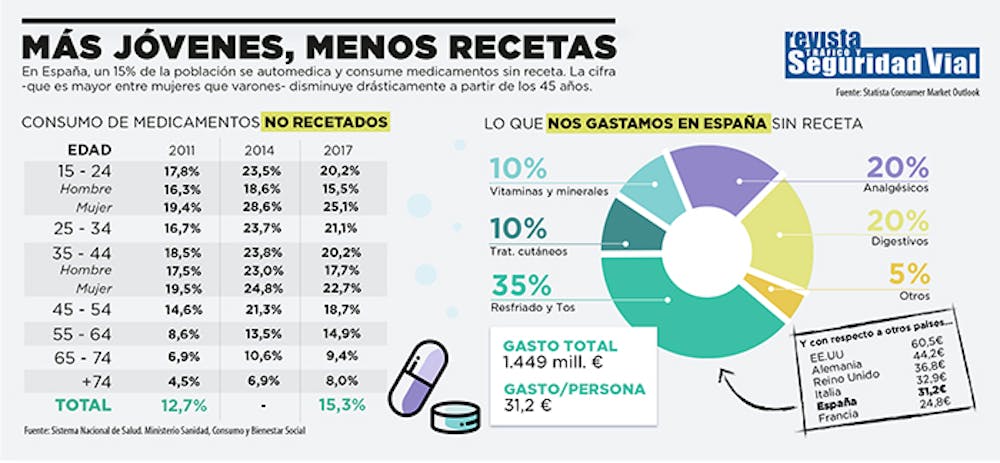
Las cifras de la automedicación en España.
DGT

El uso frecuente de paracetamol se vincula a mayor daño hepático y posible aumento de cáncer de hígado. Los anticonceptivos orales, empleados durante periodos muy largos debido al retraso de la maternidad, elevan ligeramente el riesgo de cáncer de mama y cuello uterino, aunque protegen frente a ovario y endometrio. Además, el uso prolongado de antiácidos y de antibióticos se ha relacionado con un mayor riesgo de cáncer digestivo a través de mecanismos indirectos como compuestos carcinogénicos o disbiosis intestinal.

El futuro de los ‘millennials’

Las proyecciones son realmente preocupantes: se espera que los casos de cáncer podrían crecer desde unos 20 millones en 2022 hasta cerca de 35 millones en 2050, lo que representa un incremento global de casi el 77 %. La tendencia es particularmente marcada en tumores digestivos y ginecológicos, que están apareciendo cada vez con más frecuencia en adultos jóvenes.

Somos la generación de lo inmediato, de la ansiedad y de la pastilla como solución rápida. Pero no todo está perdido: muchos de los factores que hoy nos enferman podemos controlarlos, y adoptar hábitos más saludables puede marcar la diferencia para reducir riesgos y ganar calidad de vida en un futuro no tan lejano.

The Conversation

Lydia Begoña Horndler Gil no recibe salario, ni ejerce labores de consultoría, ni posee acciones, ni recibe financiación de ninguna compañía u organización que pueda obtener beneficio de este artículo, y ha declarado carecer de vínculos relevantes más allá del cargo académico citado.

ref. ¿Qué está pasando con el cáncer en la generación ‘millennial’? – https://theconversation.com/que-esta-pasando-con-el-cancer-en-la-generacion-millennial-266167

Companies now own more than $100 billion in bitcoin – but the shine may be wearing off crypto treasury companies

Source: The Conversation – UK – By Gemma Ware, Host, The Conversation Weekly Podcast, The Conversation

Mehaniq/Shutterstock

One American company called Strategy owns more than 3% of all bitcoin in existence. Its executive chairman, Michael Saylor, is the pioneer of a new business model where publicly listed companies buy cryptocurrency assets to hold on their balance sheet.

Strategy, formerly called MicroStrategy, first bought US$250 million (£187 million) worth of bitcoin in mid-2020 during the depths of the COVID economic slump. As it continued to buy bitcoin, its share price soared, and it kept buying. As of October 2025, Strategy held 640,418 bitcoin, worth around $70 billion.

In the years since, more than 100 other public companies have followed Saylor’s lead and become bitcoin treasury companies, together holding more than $114 billion of bitcoin. There’s been a new rush into crypto treasury assets in 2025 following the general crypto enthusiasm of the new Trump administration.

But holding bitcoin assets also comes with some big risks, particularly given the volatility of cryptocurrency prices, and the share prices of some of these companies are now coming under pressure.

In this episode of The Conversation Weekly podcast, we speak to Larisa Yarovaya, director of the centre for digital finance at the University of Southampton, about whether bitcoin treasury companies are the future of corporate finance, or another speculative bubble waiting to burst.

This episode of The Conversation Weekly was written and produced by Katie Flood, Mend Mariwany and Gemma Ware. Mixing and sound design by Michelle Macklem and theme music by Neeta Sarl.

Newsclips in this episode from CBC News, Bloomberg Television, Yahoo Finance, Altcoin Daily, Strategy and CNBC Television.

Listen to The Conversation Weekly via any of the apps listed above, download it directly via our RSS feed or find out how else to listen here. A transcript of this episode is available on Apple Podcasts or Spotify.

The Conversation

Larisa Yarovaya is affiliated with the British Blockchain Association.

ref. Companies now own more than $100 billion in bitcoin – but the shine may be wearing off crypto treasury companies – https://theconversation.com/companies-now-own-more-than-100-billion-in-bitcoin-but-the-shine-may-be-wearing-off-crypto-treasury-companies-268127

Sanctions on Russia have failed to stop the war so far – will Trump’s latest package be any different?

Source: The Conversation – UK – By Sergey V. Popov, Senior Lecturer in Economics, Cardiff University

Donald Trump has finally decided to hit Russia with sanctions – the first package he has imposed since he came back to the White House in January.

The sanctions target Rosneft and Lukoil, Russia’s two largest oil companies, as a retaliation for Vladimir Putin’s refusal to agree to a ceasefire in Ukraine. The announcement came in the wake of the decision to call off a planned summit between the two leaders in Budapest next month.

The US treasury secretary, Scott Bessent, said in a statement: “We encourage our allies to join us in and adhere to these sanctions.” In fact the EU has imposed 19 rounds of sanctions against Russia since the full-scale invasion in 2022.

The UK government has passed sanctions which it estimates have cost Russia more than £28 billion since the start of the war. And the Biden administration also repeatedly imposed sanctions on Russia after the invasion.

In March 2022, I wrote a piece for The Conversation explaining why I thought the sanctions imposed on Russia in the aftermath of the full-scale invasion of Ukraine wouldn’t topple Putin. Sanctions often fail to achieve their goals the Russian economy has specifically been set up to resist western sanctions.

Three years on, Russia’s land grab continues to ravage Ukraine, albeit clearly with much less success than expected by Russia’s generals. A lot of this resistance is due to Ukrainian military heroism and creativity, and a lot of it due to humanitarian and military assistance from EU, the US and other allies. But how much of it was due to sanctions is open to debate.

Russia’s economy is now focused on waging war. And even in these days of drone combat, to wage war you needs soldiers. The amounts paid to people joining up in Russia are unprecedented. Not only is their enlistment pay about the price of a decent apartment in a regional capital, but any debt they hold up to 10 million rubles (£76,500) is wiped out.

Their salary is not a large amount by western standards – a policeman in New York earns a comparable amount in a year. But when the alternative in Russia is being a security guard for £400 per month, it is clear why many people who see no future – especially convicts who are also given pardons – enlist in the Russian armed forces.

Reservists and volunteers mean that Russia is able to maintain its fighting force. While the sanctions clearly hurt Russia’s economy, having sufficient soldiers is priority number one – and this is still largely unaffected.

Russia is managing to pay for the war, sanctions or no sanctions, by passing on the cost to the public. VAT is forecast to rise from 20% to 22% in 2026 and the revenue threshold under which businesses will be required to pay will come down. This will lower investment into things like barber shops, but investment in military production will not be affected.

The sanctions do hurt the Russian economy – lifting sanctions is always the most important demand anytime Russia is consulted about a ceasefire – but not so much that the war economy is slowing down.

Finding loopholes

Thus far, Russia has managed to circumvent sanctions. Europe still buys large quantities of oil and gas from Russia (more than it has given Ukraine in aid, in fact). Moscow has also exported massive amounts to India and China, but the quantities are expected to fall sharply as a result of the US sanctions.

Earlier this year, the US president also announced a massive tariff hike on Indian exports in retaliation for India buying Russian energy supplies.

All of this will make the war more expensive – but it will not stop it. For a start, Russia controls a big “shadow fleet” of ships that have been transporting its oil and other banned goods such as military equipment and stolen Ukrainian grain. The EU has imposed port bans on 117 ships believed to be part of this shadow fleet. But experience suggests that this is by no means a foolproof way of preventing them from operating.

Death by 1,000 cuts

It’s tempting to imagine sanctions as trying to cause death by 1,000 cuts. The EU has made 19 cuts, so we are still 981 away – 980 with Trump’s latest move.

The west could have done more and it could have done it sooner. It could have acted as early as 2008 when Russia signalled its aggressive intent by invading Georgia. It could have imposed more effective sanctions after Russia annexed Crimea and parts of eastern Ukraine in 2014.

In any case, these sanctions are designed against a western democracy, if they were imposed against the US or the UK, they would have changed governments. In western democracies governments have power at the discretion of the voters who can take these mandates back. Sanctions against autocracies, where power is not in the hands of the people, need to be different.

The good news is that the Trump administration is finally doing something besides putting out the red carpet for Putin. There is hope.

The Conversation

Sergey V. Popov does not work for, consult, own shares in or receive funding from any company or organisation that would benefit from this article, and has disclosed no relevant affiliations beyond their academic appointment.

ref. Sanctions on Russia have failed to stop the war so far – will Trump’s latest package be any different? – https://theconversation.com/sanctions-on-russia-have-failed-to-stop-the-war-so-far-will-trumps-latest-package-be-any-different-268228

Russia turns to an old ally in its war against Ukrainian drones: the weather

Source: The Conversation – UK – By Peter Lee, Professor of Applied Ethics and Director, Security and Risk Research, University of Portsmouth

Russia has long used harsh weather as a defensive ally. During Napoleon’s 1812 invasion, his Grand Army was defeated as winter closed in – the ground became impassable and logistical support to his army collapsed. Similarly, Hitler’s Operation Barbarossa in 1941-42 was halted by heavy rains and deep mud followed by freezing temperatures.

Today, in a different kind of war, Russia is again turning to its old ally, harsh weather – but this time to help in its offensive against Ukraine.

Ukraine’s extensive use of small, low-cost drones has transformed attack and defence strategies across the front lines. The Modern War Institute reports that drones are responsible for around 70% of Russia’s battlefield casualties, although it is unclear which kind of drones are killing in greater numbers: loitering one-way attack drones (known as “kamikaze drones”) or quadcopter first-person view (FPV) drones, armed with small explosives.


Read more:
How drone attacks are changing the rules and the costs of the Ukraine war


Beyond direct strikes, small drones play a vital role in intelligence gathering, surveillance and reconnaissance. They allow Ukrainian units to identify targets and coordinate ground operations with far greater precision. Real-time aerial imagery enables artillery crews to rapidly adjust fire, making bombardments more accurate – and more lethal.

Drones have become the eyes and, increasingly, the hands of Ukraine’s ground forces, increasing their defensive effectiveness against the larger and often better-equipped Russian ground forces. Mass Ukrainian use of FPV and one-way-attack drones has significantly improved defensive effectiveness, blunting larger Russian ground force assaults by using real-time targeting data and precise strikes.

Both sides in the war also regularly deploy electronic jamming, rendering radio-controlled FPV drones inoperable. Russia has, of necessity, become a global leader in this area.

The jamming disrupts the radio links and video feeds that pilots rely on for navigation and targeting. This places Ukraine’s forces, which rely heavily on drones to offset Russia’s advantages, at a considerable disadvantage.

Bad weather and drones

When bad weather combines with electronic interference, the effect is even more damaging. Snow, fog, wind and cold already limit drone endurance and visibility – sharply reducing Ukraine’s technological edge in aerial reconnaissance and precision battlefield drone strikes.

Russia, in contrast, gains relative advantage in such conditions. Its older, heavier ground-based systems – tanks, artillery and armoured vehicles – are more resilient against poor weather. The battlefield becomes a place where Russia’s attritional approach to war grinds out bloody advances.

Small quadcopter drones are light, have limited endurance and are easily influenced by weather. Take the DJI Mavic 3 series, used by many Ukrainian units for frontline reconnaissance. It is only effective in temperatures between –10°C and +40 °C and winds below about 12 metres per second. Strong gusts or freezing weather can quickly push this small drone off course.

More advanced Ukrainian systems, such as the winged Shark uncrewed aerial system, can operate from –15 °C to +45 °C and withstand winds up to 20 metres per second. Yet even these are restricted to dry conditions: rain or snow can ground them.

In cold conditions, batteries drain more quickly, cutting both flight time and operational range. Icing can ground large numbers of drones if it changes the characteristics of the quadcopter propellers – ice makes propeller blades thicker, heavier and less aerodynamic, reducing performance.

Winged drones can suffer from wing-tip icing, which changes their flight characteristics – reducing lift, increasing drag and the danger of stalling, and degrading control. Fog and snow also reduce visibility, limiting the ability to identify or track targets.

Russian offensive

In October 2025, Russia timed several large ground assaults to coincide with poor weather. This approach exploited conditions that significantly reduced Ukraine’s ability to defend itself with drones. Fog, rain and cloud cover made small reconnaissance drones unreliable or even unflyable. Visibility dropped so low that attacks on individual soldiers become far less effective.

In theory, Ukraine’s allies can offset some of this loss through satellite intelligence. US reconnaissance satellites can still gather valuable information on cloudy days by using synthetic aperture radar to detect ground movements. Yet even these advanced systems cannot see visually through thick cloud banks or heavy rainstorms.

Historically, Russia’s severe weather served a defensive purpose, turning back invading armies from Napoleon to Hitler. In the present war, however, Russia is using the same harsh climate offensively, turning natural concealment into a tactical advantage as it advances across Ukrainian ground.

Winter has not yet arrived, but Ukrainian and Russian military planners will be watching the weather. Ukraine’s vaunted ability to innovate and respond to Russian tactics will be tested even further in the months ahead.

The Conversation

Peter Lee does not work for, consult, own shares in or receive funding from any company or organisation that would benefit from this article, and has disclosed no relevant affiliations beyond their academic appointment.

ref. Russia turns to an old ally in its war against Ukrainian drones: the weather – https://theconversation.com/russia-turns-to-an-old-ally-in-its-war-against-ukrainian-drones-the-weather-268019

Ancient antelope teeth offer surprise insights into how early humans lived

Source: The Conversation – Africa (2) – By Megan Malherbe, Research Assistant Scientific Collection Institute of Evolutionary Medicine Faculty of Science, University of Zurich

Understanding what the environment looked like millions of years ago is essential for piecing together how our earliest ancestors lived and survived. Habitat shapes everything, from what food was available, to where water could be found, to how predators and prey interacted.

For decades, scientists studying South Africa’s Cradle of Humankind have tried to reconstruct the landscape in which species like Australopithecus sediba, Paranthropus robustus and Homo naledi once lived. These were hominins that inhabited the region between roughly 2.5 million and 0.25 million years ago. The Cradle of Humankind is a Unesco world heritage site that has remained the single richest source of early human fossils for over 90 years.

A long-standing idea has been that the Cradle experienced a dramatic environmental change around 1.7 million years ago: a shift from woodlands to open grasslands. This shift likely happened as global climates became cooler and drier, with stronger seasonal patterns. These broader changes, linked to the expansion of polar ice sheets and shifts in atmospheric circulation, reduced the availability of year-round rainfall in southern Africa.

Trees and shrubs, which depend on consistent moisture, gave way to hardy grasses better suited to long dry seasons and intense sunlight. In the woodlands, dense trees and shrubs had once provided leafy vegetation for browsing animals. As the landscape opened up, short grasses became dominant, supporting grazing animals.

This supposed sudden transformation was thought to have reshaped the setting in which early humans evolved, possibly influencing their diets, mobility and survival strategies.

But was there really such a sudden switch?

I’m a palaeoecologist who’s part of a team that specialises in reconstructing ancient environments by studying fossil animals. We set out to test the “sudden switch” idea, using a large dataset of fossil antelope teeth. Antelopes (bovids) are particularly useful for reconstructing past environments in Africa: they are abundant in the fossil record, they occupy a wide range of habitats today as well as in the past, and their teeth preserve clear signals of what they ate.

We examined more than 600 fossil teeth from seven well-dated sites in the Cradle, covering a broad time span from 3.2 million to 1.3 million years ago.

The results of our study were striking. Across all seven sites, spanning nearly two million years, the antelopes show consistently strong grazing signals. Grass-eating was dominant throughout the period, challenging the old model of a sudden woodland-to-grassland shift 1.7 million years ago. Instead, the evidence points to a more stable but varied landscape: a mosaic environment. Some fossil species even showed different feeding strategies from their modern relatives, highlighting that ancient antelopes adapted to past conditions in distinct ways.

This tells us more about the world early humans evolved in – but it also reminds us to be cautious. Fossil animals didn’t always behave like their modern relatives, so drawing direct parallels risks oversimplifying the past.

Dating the sites

To interpret the fossils in context, we needed to be sure of when each site formed. Previous work often relied on broad age estimates based on the types of animals found in each sediment layer – a method called biochronology – which could only give a rough idea of when different species lived. This made it difficult to line up fossils from the many cave sites in the Cradle on a reliable timeline. Thanks to recent improvements in radiometric dating, a method that finds the precise age of rocks by measuring how radioactive elements change into other elements over time, the chronology of the Cradle has been refined.

The layers of calcite deposited in caves (known as flowstones) were recently shown by geochronologists to have formed at the same time across multiple sites, providing a regional framework for the whole area. This means researchers can now compare fossils from different caves knowing they represent the same windows of time. It’s a huge step forward in testing whether environmental shifts were truly regional events.

Reading diets from teeth

The method used in this study is called dental mesowear analysis. It records the long-term impact of diet on the tooth surfaces of herbivores throughout their life. In simple terms, different diets wear teeth in different ways:

  • browsers (like kudu or giraffes), which eat leaves and twigs, usually have sharper cusps, because their food causes less wear on the teeth

  • grazers (like wildebeest or zebra), which feed mostly on grasses rich in silica and often covered in grit, develop blunter cusps from heavy tooth grinding

  • mixed feeders show intermediate wear, reflecting generalist behaviour and a diet that shifts with seasons or local vegetation.

By scoring cusp shape and relief on each fossil tooth, we assessed whether past populations leaned more towards browsing or grazing.

The results showed there was a mix of different habitats in this environment at that time: open grassy areas mixed with patches of trees and shrubs. This would have created a patchwork of ecological niches, offering early humans a diverse range of resources.

Some sites – including the famous Sterkfontein Caves, home to one of the most complete early hominin skulls ever found, “Mrs Ples” – showed a bimodal pattern in tooth wear, meaning that even within the same community, some antelopes were grazing while others were browsing. This suggests that vegetation structure shifted locally or seasonally, and that animals adapted their diets accordingly. They switched between food sources as conditions changed.


Read more:
Elephant teeth: how they evolved to cope with climate change-driven dietary shifts


Lessons from antelope diets

One of the most important findings is that some fossil antelopes fed very differently than their modern relatives. For example, certain groups that today are almost exclusively browsers were much more grass-focused in the Cradle fossil record. Others showed unexpected flexibility, with individuals of the same tribe in the same site adopting different strategies.

This has two key implications.

We cannot always rely on modern analogies. Assuming extinct animals behaved like their living relatives can be misleading, since the fossil record shows surprising shifts in diet. This means reconstructions based only on which species were present may give the wrong impression or oversimplify the reality.

Flexibility was crucial. The fact that antelopes could switch between grazing and browsing indicates that the Cradle’s environment was dynamic, and that survival often depended on adaptability. This echoes what we know about early humans, who also seem to have thrived by exploiting a wide range of resources.

The Conversation

Megan Malherbe is affiliated with the Institute of Evolutionary Medicine at the University of Zurich, and the Human Evolution Research Institute at the University of Cape Town.

ref. Ancient antelope teeth offer surprise insights into how early humans lived – https://theconversation.com/ancient-antelope-teeth-offer-surprise-insights-into-how-early-humans-lived-267169

Japan’s sumo association turns 100 – but the sport’s rituals have a much older role shaping ideas about the country

Source: The Conversation – USA (3) – By Jessamyn R. Abel, Professor of Asian Studies and History, Penn State

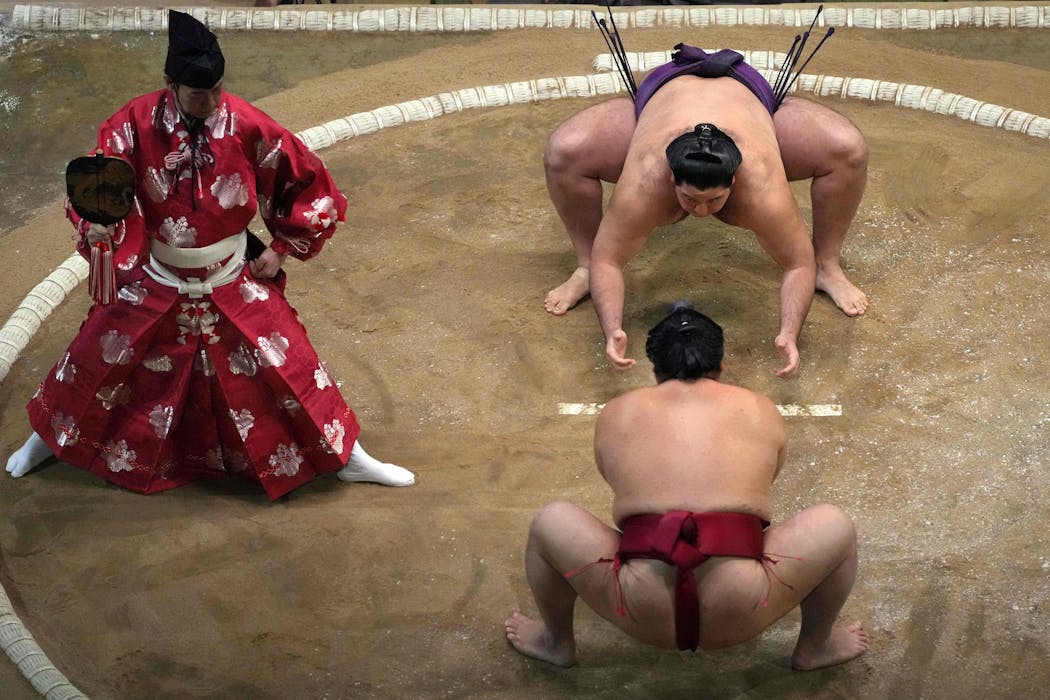
Sumo wrestlers Daieisho and Roga compete in a Grand Sumo Tournament bout at the Royal Albert Hall in London on Oct. 19, 2025. AP Photo/Frank Augstein

A visitor to Japan who wanders into a sumo tournament might be forgiven for thinking they had intruded upon a religious ceremony.

Tournaments begin with a line of burly men wearing little more than elaborately decorated aprons walking in a line onto a raised earthen stage. Their names are called as they circle around a ring made of partially buried bales of rice straw. Turning toward the center, they clap, lift their aprons, raise their arms upward, and then exit without a word.

Then two of those men face each other, crouching, clapping their hands together and stomping on the ground. They pause repeatedly to rinse their mouths with water and toss salt into the ring.

Overseeing their movements is a man outfitted in a colorful kimono and a black hat resembling that of a Shinto priest and holding a tasseled fan. After a subtle gesture with his fan, they finally grapple – and only then would the uninformed observer realize that the performance was an athletic event.

Every sport has its rituals, from the All Blacks rugby team’s pregame haka to the polite handshake between victor and vanquished over the tennis court net. Some, like many sumo rituals, have roots in religious practices. A few hundred years ago, competitions were frequently held at temples and shrines as part of festivals.

Two men in white robes bow, standing on the side of a dirt ring, as another man in white robes sits between them.
Sumo referees perform the Shinto ritual to purify and bless the ring ahead of a tournament at the Royal Albert Hall in London on Oct. 15, 2025.
AP Photo/Frank Augstein

Today, sumo is a modern sport with records, rules and a governing institution that celebrated its 100th anniversary in October 2025. But those religious roots are still visible. The salt the wrestlers throw, for example, is a purifying element. The clapping is a way of drawing the attention of the gods.

As a historian of modern Japan and a scholar of sports and diplomacy, I have seen many ways in which sports are much more than “just a game.” Sport rituals are an important part of those wider meanings. In fact, sumo and its rituals have helped shape foreign perceptions of Japan for at least 170 years.

First impressions

The first sumo tournament known to have been observed by American spectators was held in March 1854, in honor of a treaty establishing diplomatic relations between the United States and Japan. Described in the personal journal kept by Commodore Matthew Perry, the leader of the mission to Japan, the exhibition before gawking American sailors seemed designed to impress.

Before the matches began, the athletes put on a performance of strength, loading the American ships with a gift of some 200 bales of rice from the Japanese government. Perry describes how two dozen huge men, “naked with the exception of a narrow girdle around the loins,” paraded before the American crew before getting to work, each shouldering two 135-pound bales.

If the actual sumo competition was intended to inspire appreciation of Japanese culture, it backfired. Perry’s descriptions of the wrestlers were full of unflattering animal metaphors. He wrote that they resembled “stall-fed bulls” more than human beings and made noises like “dogs in combat.”

At the time, sports as we know them today were just emerging in England and the United States. Some of the earliest rules of soccer were recorded in the 1840s, and baseball’s growing popularity led to the development of professional leagues after the U.S. Civil War.

With this American idea of sports in Perry’s mind, the sumo tournament did not impress him. He called the bouts a “farce” and judged the wrestlers’ physique as one that “to our ideas of athletic qualities would seem to incapacitate him from any violent exercise.”

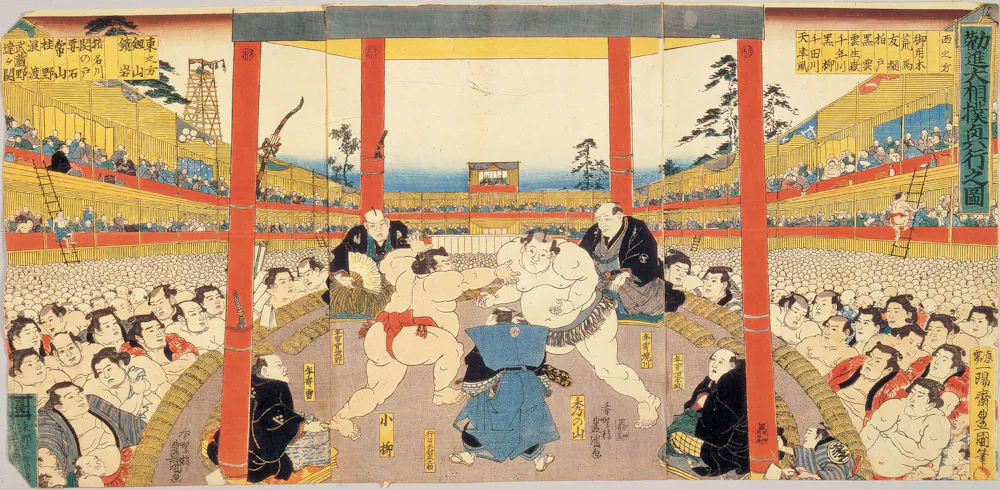
An illustration in muted colors shows two large men wrestling on a platform between red posts, as a large audience watches.
An illustration of an 1846 sumo tournament by Utagawa Kunisada.
Chunichi.co.jp/Wikimedia Commons

In the mid-19th century, Japan was relatively isolated from the Western world. Most Americans knew almost nothing about the country and considered it backward, even barbaric. The two cultures’ differing ideas of sports meant that sumo only added to American views of Japan as strange and uncivilized.

A competing sport

Sports diplomacy had a more positive impact on American views of Japan in the early 20th century, thanks to a different game: baseball.

After the fall of the shogunate in 1868, the new Japanese government – made up of oligarchs ruling in the name of the Meiji Emperor – employed Americans to help implement reforms. Some of them brought along America’s pastime, which became very popular within a few decades.

By the 1910s and ‘20s, Japanese college teams were regularly traveling to the U.S., where newspapers praised their skills and their sportsmanship.

A black and white photo shows two rows of men in suits posing outside a large white building.
The Osaka Mairuchi baseball team from Japan visits the U.S. White House in 1925.
National Photo Company Collection/Library of Congress/Wikimedia Commons

Some of the rituals in a Japanese baseball game, like a ceremonial first pitch, were familiar to American observers. Others, like a team bow toward the umpire, were quite a contrast, but struck them as superior to the rowdiness of American players and fans.

At the time, Japan’s Westernizing reforms and recent military victories over China and Russia had already improved Americans’ impressions of the country. Former baseball player Harry Kingman, writing about a game he watched during a 1927 stint coaching a Tokyo college team, explained the Japanese turn toward baseball as part of the nation’s modernization.

Sumo, however, continued to be the most popular sport in Japan until the 1990s, when baseball took that title. But the initial popularity of this American import caused some anxiety within the sumo world: A foreign game seemed to be taking over and stealing sumo’s fans.

Amid these changes, professional sumo’s governing institutions, which were divided into competing associations based in Tokyo and Osaka, joined forces. They officially unified in 1925 as the organization that would become today’s Japan Sumo Association.

Can sumo be cool?

Japanese popular culture now captivates people around the world. In 2002, journalist Douglas McGray wrote about the soft power conferred by what he called the nation’s “gross national cool.” But he noted sumo as an exception, blaming its leadership’s insular attitudes.

Perhaps sumo’s biggest hurdle to building an international fan base is its attitude toward foreigners. Immigration is controversial in Japan. The population is relatively homogeneous, and barriers to naturalization are high.

A man in a blue suit shakes hands with a much larger man in a gray suit.
Thomas Foley, then the U.S. ambassador to Japan, presents sumo grand champion Akebono with a letter of appreciation from Secretary of State Colin Powell in 2001.
AP Photo/Tsugufumi Matsumoto

In contrast to sports like baseball, soccer and rugby, where “imported” players abound, there are few foreign sumo wrestlers, and their success seems to rankle. In 1993, a Hawaiian named Akebono became the first foreigner to reach the top rank of “yokozuna,” sparking a temporary hold on recruiting sumo wrestlers from outside Japan.

Constraints were gradually softened, and the number of non-Japanese professional wrestlers has been rising. They still represent a small minority, but their success often sparks discussions about the place of foreigners in the sport.

Though sumo has gained some traction outside of Japan, its rituals still occasionally create negative impressions of Japanese culture. At a tournament in 2018, for example, a local official collapsed while giving a speech. Female medics who rushed to help him were told to leave the sumo ring, considered a sacred space polluted by a woman’s presence. The chairman of the Japan Sumo Association later apologized, but the incident brought criticism that the sumo world was clinging to anachronistic traditions.

Sumo continues to change. A 1926 Tokyo government ban on women’s sumo is no longer in force, and there are now some female wrestlers in amateur clubs. But women are still barred from professional competition.

Tournaments are certainly popular with tourists, but they generally go for a one-time experience. One might ask if sumo can change enough to play an effective role in Japan’s sports diplomacy. The answer depends on whether sumo leaders are more interested in maintaining the sport’s Japanese identity or building global connections.

The Conversation

Jessamyn R. Abel has received funding from the National Endowment for the Humanities, the Japan Foundation, the Northeast Asian Council of the Association for Asian Studies, and the McCourtney Institute for Democracy at Penn State University. She is currently a member of the Board of Directors of the Association for Asian Studies.

ref. Japan’s sumo association turns 100 – but the sport’s rituals have a much older role shaping ideas about the country – https://theconversation.com/japans-sumo-association-turns-100-but-the-sports-rituals-have-a-much-older-role-shaping-ideas-about-the-country-263093

Rift Valley fever: what it is, how it spreads and how to stop it

Source: The Conversation – Africa (2) – By Marc Souris, chercheur, Institut de recherche pour le développement (IRD)

Rift Valley Fever (RVF) is a viral disease transmitted by mosquitoes that mainly affects livestock. It can also infect humans. While most human cases remain mild, it can cause death. The disease causes heavy economic and health losses for livestock farmers.

As a researcher, I have contributed to several studies on this mosquito-borne virus.

So, what exactly is Rift Valley fever, how it is treated, and how it can be controlled?

What is Rift Valley fever?

Rift Valley fever is a zoonosis (a disease affecting animals that can be transmitted to humans). It is caused by the RVF virus, a phlebovirus from the Phenuiviridae family (order Bunyavirales). The disease primarily affects domestic animals, mainly cattle, sheep and goats, but also camelids and other small ruminants. It can occasionally infect humans.

In animals, the disease causes high morbidity: reduced milk production, high newborn mortality, mass abortions in pregnant females, and death in 10% to 20% of cases. This leads to serious economic losses for farmers.

Most people who get Rift Valley fever have no symptoms or just flu-like syndrome. But in a few people, it can become very serious, causing complications such as eye disorders, meningoencephalitis (inflammation of the brain), or hemorrhagic fever. The fatality rate among infected people is around 1%.

How it’s transmitted

In animals, the disease is mainly spread through bites from infected mosquitoes. At least 50 mosquito species can transmit the Rift Valley fever virus, including Aedes, Culex, Anopheles and Mansonia species. Mosquitoes become infected when they feed on animals carrying the virus in their blood, then transmit it to other animals through their bites. In Aedes mosquitoes, vertical transmission – from infected females to their eggs – is also possible, allowing the virus to survive in the environment.

For humans, the most common way to get infected is through direct contact with the blood or organs of an infected animal. This often happens during veterinary work, slaughtering, or butchering.

While it is also possible for human to get the virus from a mosquito bite, this is not common. No human-to-human transmission has been observed to date.

The origins and spread

A serious outbreak of Rift Valley fever began to be reported in Senegal in late September 2025. The west African country has been battling to control it.

The disease was first discovered in 1931 in the Rift Valley in Kenya in east Africa, during a human epidemic of 200 cases. The virus itself was isolated and identified in 1944 in neighbouring Uganda.

Since then, numerous outbreaks of the disease have been reported in Africa: in Egypt (1977), Madagascar (1990, 2021), Kenya (1997, 1998), in Somalia (1998), in Tanzania (1998), the Comoros (2007-2008) and Mayotte (2018-2019).

In west Africa, the main epidemics affected Mauritania (1987, 1993, 1998, 2003, 2010, 2012), Senegal (1987, 2013-2014) and Niger (2016).

Its spread into the Sahel and west African regions has been largely driven by the movement of livestock, and by environmental factors.

To date, around 30 countries have reported animal and/or human cases in the form of outbreaks or epidemics.

Why and how outbreaks occur

Rift Valley fever reemerges in cyclical patterns, with major outbreaks occurring in Africa every five to 15 years. The trigger for these outbreaks is closely linked to specific environmental conditions, like periods of heavy rainfall that create ideal breeding conditions for mosquitoes.

In east Africa, epidemics typically follow periods of exceptionally heavy rainfall or flooding in normally dry regions. For instance, the severe outbreaks of 1998-1999 were directly linked to intense rains caused by the El Niño climate phenomenon.


Read more:
West Africa’s trade monitoring system has collapsed – why this is dangerous for food security


In the Sahel region, the relationship with rainfall is less predictable. Outbreaks can appear in unexpected, poorly monitored areas, and genetic analysis of viruses in Mauritania suggests that new strains can be introduced directly from other regions.

A key mystery is how the virus persists in the environment between these major outbreaks. It is believed to survive in the environment within a “wild reservoir” of animals – such as certain antelopes, deer, and possibly even reptiles – though this reservoir has not yet been fully identified.

Once an initial outbreak occurs, the virus can spread to new areas. This happens through the movement of infected livestock, the accidental transport of infected mosquitoes (for example, in vehicles or cargo), and when environmental conditions are conducive.

Clinical symptoms and treatments

Adult cattle and sheep may show nasal discharge, excessive salivation, loss of appetite, weakness, diarrhoea.

In humans, after an incubation period of two to six days, most infections are asymptomatic or mild, with flu-like symptoms lasting four to seven days. People who recover from the infection typically gain natural immunity.


Read more:
Preventing the next pandemic: One Health researcher calls for urgent action


However, in a small percentage of individuals, the disease can take a severe turn:

  • Eye lesions affect up to 10% of symptomatic cases. They appear one to three weeks after initial symptoms and can heal on their own or lead to permanent blindness.

  • Meningoencephalitis (inflammation of the brain and meninges) occurs in 2%-4% of symptomatic cases, one to four weeks after symptom onset. Mortality is low, but neurological after-effects are common.

  • Hemorrhagic fever (diseases that cause fever and bleeding due to damage to the blood vessels) occurs in less than 1% of symptomatic cases, usually two to four days after symptoms begin. About half of these patients die within three to six days.

There is no specific treatment for severe cases of Rift Valley fever in humans.

Surveillance, prevention and control

Veterinary surveillance with immediate reporting and monitoring of infection in animals is essential to control the disease. During outbreaks, controlled culling of infected animals and strict restrictions on the movement of livestock are the most effective ways to slow virus spread.


Read more:
How does Marburg virus spread between species? Young Ugandan scientist’s photos give important clues


As with all mosquito-borne viral diseases, controlling vector populations is an effective preventive measure, though it is challenging, especially in rural areas.

To prevent new outbreaks, animals in endemic regions can be vaccinated in advance. A modified live virus vaccine provides long-term immunity after a single dose, but it is not recommended for pregnant females because it can cause abortions. An inactivated virus vaccine is also available, it avoids these side effects, but it requires several doses to provide adequate protection.

Threat, vulnerabilities and health risks

People at highest risk of infection include livestock farmers, abattoir workers and veterinarians. An inactivated vaccine for human has been developed. But it is not licensed yet and has only been used experimentally.

Raising awareness of risk factors is the only effective way to reduce human infections during outbreaks. Key risk factors include:

  • handling sick animals or their tissues during farming and slaughter

  • consuming fresh blood, raw milk, or meat

  • mosquito bites.

It is important to follow basic health precautions when Rift Valley fever appears. Wash your hands regularly. Wear protective gear when handling animals or during slaughter. Always cook animal products such as blood, meat and milk thoroughly. Use mosquito nets or repellents consistently.

The Conversation

Marc Souris receives funding from ANR (Agence Nationale de la Recherche, France) and IRD (Institut de Recherche pour le développement).

ref. Rift Valley fever: what it is, how it spreads and how to stop it – https://theconversation.com/rift-valley-fever-what-it-is-how-it-spreads-and-how-to-stop-it-267309

Pourquoi les migrants sont-ils nécessaires aux économies américaine et européenne ?

Source: The Conversation – in French – By Deniz Torcu, Adjunct Professor of Globalization, Business and Media, IE University

Les données économiques contredisent frontalement les récits hostiles aux migrants. Loin des peurs et des clichés, la migration apparaît comme un atout stratégique pour l’avenir.


Face à la montée des discours anti-immigration en Europe et aux États-Unis, il est urgent de dépasser les peurs pour regarder les faits. La mobilité humaine n’est pas un fardeau : c’est un moteur de croissance, de résilience démographique et de vitalité culturelle. L’ignorer revient à commettre une erreur stratégique et à trahir les principes démocratiques que les sociétés modernes affirment défendre.

Crise ou continuité ? La mobilité comme norme historique

La migration n’a rien d’une anomalie du XXIe siècle. Des diasporas méditerranéennes de l’Antiquité aux grands mouvements du XXe siècle, l’histoire humaine s’est écrite dans la circulation des personnes, des langues, des savoirs et des marchandises. Considérer la mobilité comme une menace revient à renverser la logique : c’est l’isolement qui est l’exception historique.

Le discours politique qui présente les migrants comme des intrus – plutôt que comme des citoyens potentiels ou des acteurs économiques – représente une distorsion dangereuse, non seulement sur le plan moral, mais aussi sur le plan stratégique.

La contribution réelle des migrants au PIB et à la productivité

Une analyse du McKinsey Global Institute a révélé un fait frappant : en 2015, alors que les migrants ne représentaient que 3,3 % de la population mondiale, ils généraient 9,4 % du PIB mondial (environ 6 700 milliards de dollars). Aux États-Unis, leur contribution s’élevait à environ 2 000 milliards de dollars.

Des études plus récentes le confirment. Le Fonds monétaire international (FMI) a estimé qu’en 2024, les flux migratoires nets vers la zone euro entre 2020 et 2023, y compris les millions de réfugiés ukrainiens, pourraient augmenter le PIB potentiel de la région de 0,5 % supplémentaire d’ici à 2030. Cette croissance n’est pas marginale : elle représente environ la moitié de toute la croissance potentielle attendue. En d’autres termes, sans la migration, les perspectives économiques de l’Europe seraient considérablement plus limitées.

États-Unis : main-d’œuvre, innovation et expansion

Aux États-Unis, plus de 31 millions d’immigrants faisaient partie du marché du travail en 2023, soit 19 % du total, selon le think tank indépendant Council on Foreign Relations – et leur taux de participation (c’est-à-dire le pourcentage de la population en âge de travailler qui est active sur le marché du travail) était de 67 %, contre 62 % pour les personnes nées dans le pays. Cette différence n’est pas négligeable. Elle implique une contribution disproportionnée aux recettes fiscales, à la consommation intérieure et au dynamisme économique en général.

Taux de participation de la population active.
Council on Foreign Relations

Souvent, ils occupent des postes physiquement exigeants ou délaissés par les travailleurs locaux : un rôle complémentaire et non substitutif, d’autant plus crucial dans un contexte de plein emploi et de vieillissement démographique.

Travailleurs occupés âgés de 16 ans et plus, 2022.
Council on Foreign Relations

Migration et innovation : une relation sous-estimée

Les migrations ne se résument pas à de la main-d’œuvre : elles apportent aussi des idées. Le Forum économique mondial rappelle que les immigrés ont 80 % plus de chances de créer une entreprise que les natifs, et que plus de 40 % des firmes du Fortune 500 (_ classement des 500 premières entreprises états-uniennes, ndlr_) ont été fondées par des migrants ou leurs descendants.

Leur empreinte est visible dans la recherche et la technologie : une large part des demandes de brevets déposées aux États-Unis compte au moins un inventeur étranger. Les universités de pointe dépendent aussi des étudiants internationaux pour maintenir leurs filières en sciences, technologies et ingénierie. Fermer les frontières, c’est aussi fermer la porte à l’innovation.

Europe occidentale : une dépendance silencieuse

Dans l’Union européenne, l’impact n’est pas moindre. Selon le même rapport du FMI, entre 2019 et 2023, deux tiers des nouveaux emplois ont été occupés par des migrants non communautaires. Ces données contredisent l’idée selon laquelle les migrants « prennent les emplois » : au contraire, ils pourvoient des postes vacants structurels que ni l’automatisation ni le marché intérieur n’ont réussi à pourvoir.

L’OCDE a par ailleurs averti qu’à défaut d’intégrer davantage de femmes, de seniors et de migrants dans la vie active, le PIB par habitant des pays membres pourrait voir sa croissance annuelle passer de 1 % (2000–2020) à seulement 0,6 % d’ici 2060. À l’inverse, une politique migratoire inclusive pourrait ajouter au moins 0,1 point par an.

Indicateurs de pénurie de main-d’œuvre.
OCDE, mai 2024

Envois de fonds : impact économique transnational

Le rapport sur les migrations dans le monde 2024 confirme que les transferts de fonds mondiaux ont atteint 831 milliards de dollars américains en 2022, soit une croissance de plus de 650 % depuis 2000. Ce volume dépasse largement l’aide publique au développement et même, dans de nombreux cas, les investissements étrangers directs. Les transferts de fonds sont principalement investis dans la santé, l’éducation et le logement.

Ils constituent en effet une redistribution mondiale de la richesse qui ne passe pas par le système multilatéral, mais qui produit un effet stabilisateur et profondément humain.

Et si nous regardons vers l’avenir ?

Le problème dépasse l’économie. Adopter un discours d’exclusion, c’est renoncer à la capacité d’adaptation des sociétés. Les coûts sont triples :

  1. Économique, en renonçant à une source structurelle de croissance, d’innovation et de viabilité budgétaire.

  2. Social, en alimentant des stigmates qui fracturent la cohésion.

  3. Géopolitique, en perdant de l’influence dans un monde où la concurrence pour les talents et le capital humain s’intensifie.

Des solutions existent pourtant : reconnaissance plus rapide des diplômes, coopérations régionales, politiques inclusives. Le véritable enjeu est politique – et narratif. Il s’agit de construire un récit qui fasse de la mobilité humaine un élément constitutif du contrat social contemporain.

Comme le souligne le Forum économique mondial, la migration n’est pas un problème à résoudre, mais un atout stratégique à gérer avec intelligence et humanité. La sous-estimer revient à saper les fondements du développement mondial au XXIe siècle.

The Conversation

Deniz Torcu ne travaille pas, ne conseille pas, ne possède pas de parts, ne reçoit pas de fonds d’une organisation qui pourrait tirer profit de cet article, et n’a déclaré aucune autre affiliation que son organisme de recherche.

ref. Pourquoi les migrants sont-ils nécessaires aux économies américaine et européenne ? – https://theconversation.com/pourquoi-les-migrants-sont-ils-necessaires-aux-economies-americaine-et-europeenne-263701

Les virus, ces messagers invisibles de la conversation du vivant

Source: The Conversation – in French – By Armand Namekong Fokeng, Doctorant en biologie cellulaire et épidémiologie, Université de Corse Pascal-Paoli

Bien que les virus n’aient ni cerveau ni langage, leur circulation entre tiques, animaux et humains dans un environnement donné pourrait se lire comme un flux d’informations qui modifierait à jamais des comportements et qui façonnerait notre évolution.


La plupart des animaux ont un mode de communication évident : les cris d’alarme des suricates alertent au danger, les danses des abeilles signalent le nectar, les infrasons des éléphants permettent le maintien de la cohésion des groupes. Ainsi, c’est un nouveau message codé qui circule chaque fois et qui est ensuite interprété pour induire une action collective. Imaginez alors un instant, des virus qui parlent… pas un langage sonore ni gestuel, mais une conversation génétique, gravée dans des molécules (ADN, ARN) qui traversent les espèces en modifiant les corps.

Pour faire simple, un virus n’est qu’un morceau d’information génétique. Dénué de toute autonomie propre, il n’a de vie qu’à travers les cellules hôtes qu’il infecte. Le code génétique du virus est lu et exécuté comme un programme. En conséquence, la cellule cesse ses activités nobles (respiration, reproduction, réparation, etc.) et devient une usine à virus.

Cependant, le message viral n’est presque jamais stable. En effet, la fidélité est limitée dans la réplication des virus à ARN, tels que celui de la fièvre hémorragique de Crimée-Congo (CCHFV) sur lequel porte mon projet de thèse.

Chaque nouvelle infection draine avec elle une nuée de variants génétiques, appelés « quasi-espèces ». L’information virale est donc en perpétuelle réécriture pour s’adapter aux environnements et aux hôtes. Parfois, elle s’inscrit dans la mémoire profonde des organismes ayant été en contact avec le virus.

On sait, actuellement, qu’environ 8 % du génome humain provient de séquences virales anciennes parmi lesquelles certaines ont été intégrées à nos fonctions vitales. À titre d’exemple, la protéine syncytine, issue d’un rétrovirus, est indispensable à la formation du placenta chez les mammifères.

Les virus sont-ils toujours des intrus nuisibles ? Eh bien non ! Ils peuvent se présenter comme des créateurs invisibles de notre histoire génétique.

Une communication sans intention

Un virus est sans voix et ne choisit pas ses mots. Cependant, son interaction avec la cellule rappelle un échange de signaux.

En effet, dans le processus de l’infection, il doit reconnaître un récepteur spécifique sur la membrane de la cellule hôte : c’est la clé moléculaire qui lui ouvre la porte. Un exemple assez connu est celui du virus de l’immunodéficience humaine (VIH) qui cible les lymphocytes T, en exploitant la très célèbre molécule CD4 à laquelle il se lie, et utilise les corécepteurs CCR5 ou CXCR4 pour infecter la cellule.

En réponse, l’organisme infecté met en place une véritable conversation immunitaire entretenue par de nombreux messagers chimiques : cytokines, interférons, fièvre, etc. Ces derniers modifient le comportement des cellules et, parfois, de l’individu lui-même.

À l’échelle sociale, l’infection induit des réactions telles que l’isolement, les soins, les nouvelles pratiques de prévention, etc. Ainsi, sans aucune intention, le virus modifie pourtant les relations collectives.

Virus de la fièvre hémorragique de Crimée-Congo : un connecteur écologique

Le virus de la fièvre hémorragique de Crimée-Congo est une parfaite illustration de cette logique. En effet, il circule dans un réseau où chaque espèce joue un rôle.

En ce sens, les tiques du genre Hyalomma sont à la fois vecteurs et réservoirs. Leur salive est riche en molécules immunomodulatrices, un cocktail de protéines ou de peptides (lipocalines, serpines, évasines, etc.) qui, en neutralisant les défenses immunitaires locales de l’hôte, préparent discrètement la transmission du virus.

Une fois infectés par les tiques, les mammifères domestiques (bovins, ovins, caprins), en tant qu’amplificateurs silencieux, hébergent le virus sans symptômes.

Chez l’humain, le scénario est différent. Ici, l’infection peut entraîner des fièvres hémorragiques potentiellement mortelles (de 10 % à 30 %) en cas d’apparition de symptômes. On estime de 10 000 à 15 000 cas environ, le nombre annuel de nouvelles infections à CCHFV. Ces dernières conduisent à environ 500 décès, soit une létalité moyenne globale d’environ 3-5 %.

En ce qui concerne la France, aucun cas humain symptomatique n’a été rapporté à ce jour. Cependant, des preuves d’une circulation virale dans le sang des animaux hôtes et dans les tiques vectrices prélevées dans ce pays ont été documentées. Bien qu’ayant un risque humain relativement faible pour le moment, la France est située au carrefour de plusieurs zones endémiques (la Turquie, les Balkans, l’Asie, l’Afrique).

À travers son cycle de transmission viral, le CCHV se présente comme un fil invisible qui relie tiques, animaux et humains. C’est un véritable message moléculaire qui circule, traverse les corps et remodèle les dynamiques écologiques et sociales.

Les devenirs d’un message viral

Il importe également de souligner qu’une fois dans la cellule, un virus a un destin riche en opportunités. Il peut ainsi être neutralisé par les défenses immunitaires ou se répliquer jusqu’à consumer entièrement son hôte.

Certains virus ont une présence latente et choisissent de rester silencieux ou endormis dans le génome ou le noyau. Cependant, dès que les conditions sont favorables (stress ou immunodépression), ils se réactivent et causent des dommages.

D’autres s’intègrent durablement dans le génome, modifiant ainsi la biologie de la cellule. Ainsi, ils peuvent dans certains cas activer des oncogènes et conduire à certains cancers, tels que celui du col de l’utérus pour le papillomavirus, ou simplement déclencher des dérèglements immunitaires qui débouchent sur l’expression de certaines maladies auto-immunes. Mais, dans certains cas, les virus passent inaperçus et disparaissent en silence.

La médecine, un nouvel interlocuteur moléculaire

Quand il faut barrer la voie aux virus, on s’attaque à leurs signaux moléculaires. Les antiviraux sont des brouilleurs de signal dans ce dialogue moléculaire.

Ainsi, certains empêchent l’entrée du virus, d’autres inhibent la copie de son génome : c’est le cas du favipiravir, par exemple, qui inhibe la polymérase des virus à ARN. Ce médicament est traditionnellement utilisé contre les pandémies grippales.

D’autres traitements agissent comme amplificateurs. C’est le cas des interférons, qui administrés comme médicament, renforcent l’expression des cellules et leur permettent d’alerter leurs voisines.

Ce jeu demeure toutefois dynamique. Face aux pressions thérapeutiques toujours plus nombreuses, les virus mutent en de nouveaux variants, enrichissant ainsi leur « vocabulaire moléculaire ». Le VIH en constitue un bel exemple ; en effet, il a rapidement développé des résistances aux premiers traitements en mutant. Ainsi, la médecine et la pharmacopée deviennent elles-mêmes des acteurs involontaires de cette conversation évolutive.

Et si l’on élargissait notre vision de la vie, en classant les virus parmi les acteurs de la communication ? Ainsi, la communication ne se limiterait plus seulement aux cris des animaux et aux paroles ou gestes d’humains. Elle pourrait également être inscrite dans la circulation d’informations génétiques entre les espèces.

De ce fait, les virus cesseraient d’être uniquement des ennemis pour devenir aussi, et surtout, des agents de mise en réseau, qui relient les tiques, les animaux et les humains. Ce faisant, ils laisseraient des traces dans nos génomes et modifieraient nos comportements sociaux en cas d’épidémie.

Vue sous cet angle, chaque infection virale deviendrait une conversation biologique, un échange franc où virus, cellules et écosystèmes négocieraient chacun leur position. De la simple chorégraphie d’une abeille au passage d’un virus dans un troupeau, le vivant deviendrait une immense polyphonie de messages.

Loin d’être un simple agent pathogène, le virus apparaît comme une voix invisible de la grande conversation du vivant.


Cet article est publié dans le cadre de la Fête de la science (qui a lieu du 3 au 13 octobre 2025), dont The Conversation France est partenaire. Cette nouvelle édition porte sur la thématique « Intelligence(s) ». Retrouvez tous les événements de votre région sur le site Fetedelascience.fr.

The Conversation

Armand Namekong Fokeng ne travaille pas, ne conseille pas, ne possède pas de parts, ne reçoit pas de fonds d’une organisation qui pourrait tirer profit de cet article, et n’a déclaré aucune autre affiliation que son organisme de recherche.

ref. Les virus, ces messagers invisibles de la conversation du vivant – https://theconversation.com/les-virus-ces-messagers-invisibles-de-la-conversation-du-vivant-266937

Chez les paons, la taille compte… mais aussi la beauté et la vigueur

Source: The Conversation – in French – By Rama Shankar Singh, Professor (Emeritus) of Biology, McMaster University

En 1871, Charles Darwin a présenté sa théorie de la sélection sexuelle par le choix des femelles dans La Filiation de l’homme et la sélection liée au sexe. Il y avançait que les femelles d’une espèce manifestent une préférence pour la beauté et l’ornementation lors du choix de leurs partenaires, ce qui favoriserait la prévalence de ces traits.

Darwin affirmait que cela permettait d’expliquer l’évolution de la longue queue du paon. Plus de 150 ans plus tard, des recherches sur les paons remettent en question cette théorie.

Nos recherches sur la longue queue du paon ont révélé une règle de développement simple qui explique sa symétrie, sa complexité et sa beauté. Elle suggère que les paonnes choisissent leurs partenaires en fonction de leur taille, de leur vigueur et de leur beauté, et non pas uniquement en fonction de leur beauté, comme le pensait Darwin.

Les hypothèses de Darwin

Darwin considérait la queue excessivement longue du paon comme un trait inadapté ; elle était trop longue pour être expliquée par sa grande théorie de la sélection naturelle, selon laquelle les espèces ne développaient que les traits qui les aidaient à survivre.

Comme il l’écrivait à un collègue scientifique : « La vue d’une plume dans la queue d’un paon, chaque fois que je la regarde, me rend malade ! »

Darwin a fait deux hypothèses implicites qui, selon nos recherches, affaiblissent sa théorie de la sélection sexuelle. Premièrement, Darwin n’a pas compris que la mauvaise adaptation peut également être le résultat d’une adaptation, car les compromis entre les traits sont courants dans la nature.

Les queues de paon font ici référence aux longues plumes irisées qui pendent à l’arrière. Des queues plus longues (la hauteur des plumes une fois déployées) peuvent aider les mâles à attirer les femelles, mais elle présente aussi des inconvénients, par exemple en gênant la fuite face aux prédateurs.

un paon sans ses plumes voyantes
Après la saison des amours, les paons perdent leur longue queue.
(J.M.Garg/Wikimedia)

Deuxièmement, Darwin supposait que les paonnes admiraient la queue du paon « autant que nous » et que les oiseaux évaluaient leurs partenaires en fonction de leur attrait esthétique. Il affirmait que les oiseaux avaient le sens de la beauté. Plus tard, cette explication allait ouvrir la voie à des recherches visant à comprendre comment les femelles évaluent la beauté de leurs partenaires.

Les chercheurs se sont intéressés aux taches colorées en forme d’œil présentes sur la queue, mais de nombreuses études menées au cours des 30 dernières années n’ont pas confirmé de façon certaine que les femelles choisissaient leurs partenaires en fonction de ces motifs.

Complexité et vision

En tant que généticien spécialiste des mouches à fruits et intéressé par la variation et l’évolution des gènes liés au sexe et à la reproduction, je suis tombé par hasard sur l’évolution de la longue queue du paon. J’ai remarqué sa grande complexité et je me suis demandé si les paonnes voyaient ce que nous voyons.

J’ai examiné des spécimens de queues de paons conservés dans des musées et identifié deux découvertes majeures. La symétrie, la complexité et la beauté de la queue s’expliquent par une disposition en zigzag/alternée des follicules. Cette disposition, la forme d’empilement sphérique la plus dense connue, produit des effets remarquables lorsqu’elle se retrouve chez les êtres vivants.

gravure en noir et blanc d’un paon assis sur une branche
Illustration d’un paon publiée dans L’Origine de l’homme de Darwin.
(Wikimedia)

Deuxièmement, puisque plumes et ocelles appartiennent à la même structure, la taille de la traîne et le nombre d’ocelles sont corrélés sur le plan du développement. Les paonnes ne peuvent pas percevoir les ocelles et la taille de la queue comme des traits distincts, contrairement à nous ; elles réagissent uniquement à la couleur vert-bleu des ocelles, qui sont trop petites pour être visibles de loin. Les paonnes perçoivent donc la queue comme un trait complexe qui combine la taille de la traîne et certains aspects de la couleur des taches oculaires.


Déjà des milliers d’abonnés à l’infolettre de La Conversation. Et vous ? Abonnez-vous gratuitement à notre infolettre pour mieux comprendre les grands enjeux contemporains.


Cela signifie que les femelles ne voient pas les taches oculaires sans percevoir d’abord la queue, ce qui suggère que la sélection porte directement sur la queue, et non indirectement sur les taches.

Puisque la sélection sexuelle et le choix du partenaire sont des éléments importants des processus évolutifs standard impliqués dans la sélection naturelle, il n’est pas nécessaire d’avoir une théorie distincte de la sélection sexuelle. Le naturaliste avait tort à cet égard.

Répondre aux croyances

À l’époque de Darwin, la théorie de la sélection sexuelle avait peu de soutien. Le naturaliste Alfred Russel Wallace, co-découvreur de la sélection naturelle, estimait que ce processus en relevait.

Mais Darwin avait d’autres raisons de défendre sa théorie de la sélection sexuelle. Il l’utilisait pour résoudre trois problèmes à la fois. Tout d’abord, bien sûr, pour expliquer l’évolution des traits sexuels secondaires et souvent exagérés, en particulier chez les oiseaux, notamment les paons.

Deuxièmement, il a utilisé sa théorie pour expliquer la formation des races chez les humains, en défendant l’idée de normes de beauté inhérentes à chacune d’entre elle, et qui servaient à les isoler les unes des autres.

À l’époque victorienne, on considérait les femmes comme faibles et incapables de choisir leurs partenaires de manière décisive. L’appréciation de la beauté était aussi vue comme un trait exclusivement humain, absent chez les autres animaux. Darwin en a conclu que, chez les oiseaux, ce sont les femelles qui choisissent selon la beauté, tandis que chez les humains, ce seraient les mâles.

Enfin, Darwin a utilisé les plumes du paon pour remettre en question l’ordre religieux et ouvrir la voie à l’appréciation esthétique du monde animal : la beauté, l’intelligence et la moralité, autrefois vues comme des dons divins.

Cette recherche montre pourquoi la théorie de la sélection sexuelle reste controversée, même après un siècle et demi. Le choix du partenaire par sélection sexuelle est indéniable, mais la théorie qui en découle est contestable.

La Conversation Canada

Rama Shankar Singh a reçu un financement du Conseil de recherches en sciences naturelles et en génie du Canada. Il est affilié au Centre d’études sur la paix de l’Université McMaster.

ref. Chez les paons, la taille compte… mais aussi la beauté et la vigueur – https://theconversation.com/chez-les-paons-la-taille-compte-mais-aussi-la-beaute-et-la-vigueur-263501