How the physics of baseball could help Kevin Gausman and the Blue Jays win the World Series

Source: The Conversation – Canada – By Patrick Clancy, Assistant Professor, Physics & Astronomy, McMaster University

There are few sports more exciting than playoff baseball, but behind every pitch there is also a fascinating story of physics. From gravity to spin, the science shaping the game can be just as compelling as the action on the field.

When the World Series returns to Toronto for Game 6, right-handed pitcher Kevin Gausman will take the mound. Gausman’s best pitch is the splitter, an off-speed pitch that looks like a conventional fastball but travels more slowly and drops more sharply before it crosses the plate.

Physicists consider the flight of a baseball as an example of projectile motion. The trajectory of the ball depends on several forces: the force of gravity (pulling the ball downwards), the drag force (slowing the ball as it moves through the air), and the Magnus force (which causes the ball to curve if it spins as it travels).

Why splitters are so hard to hit

So why is the splitter so difficult to hit? Start with speed. The average speed of Gausman’s fastball is 95 miles per hour (or 42.5 meters a second). Since the distance from the pitcher’s mound to home plate is 18.4 meters, this means that it takes 430 milliseconds, or less than half a second, for Gausman’s fastball to reach the batter.

In contrast, the splitter, which travels at an average speed of 85 mph (or 38.0 m/s), takes 490 milliseconds. That 60 millisecond-difference may seem small, but it can be enough to separate a strike from a base hit.

For context, a typical swing for a major league batter takes approximately 150 milliseconds. This includes time for the batter’s eye to form a picture of the ball leaving the pitcher’s hand, for their brain to process this information and send signals to the muscles in their arms, legs and torso, and for their muscles to respond and swing the bat.

This means a batter has roughly a quarter of a second to judge the trajectory of a pitch and decide whether to swing. Considering that it takes approximately 100 milliseconds for a blink of the human eye, it’s remarkable that batters can hit any major league pitch at all.

The importance of the drop

The second secret to the splitter is the drop. All baseball pitches drop as they travel towards home plate due to the force of gravity, which causes a baseball (or any object in freefall) to accelerate downwards.

If there were no other forces acting on the ball, this would cause Gausman’s fastball to drop by about 92 centimetres on the way to home plate, and his splitter to drop by approximately 115 centimetres.

In practice, however, there is another important force that acts on the ball to oppose the effect of gravity — the Magnus force. The Magnus force arises from the rotation or spin of an object (like a baseball) as it passes through a fluid (like air).

The ball’s rotation makes air move faster over one side than the other. On the side spinning in the same direction as the airflow, air speed increases; on the opposite side, it slows down. This difference in air speed creates a pressure imbalance, generating a force that acts perpendicular to the ball’s path.

This is an example of Bernoulli’s Principle, the same phenomenon that generates lift as air passes around the wing of an airplane.

In the case of a fastball, the pitcher creates a strong backspin by pulling back with their index and middle fingers as they release the ball. This rotation results in an upwards force, which causes the ball to drop far less than it would under the effect of gravity alone. The faster the rotation, the stronger this lift force becomes.

Gausman’s signature pitch

Gausman’s fastball typically drops 25 to 30 centimetres on the way to home plate — less than one third of the drop experienced by a “dead ball” without spin.

On the splitter, he changes his grip to dramatically reduce the amount of backspin, weakening the Magnus force and allowing the ball to fall much farther, about 50 to 75 centimetres, before it hits the plate. The result is a pitch that doesn’t reach the batter when or where they expect it to be.

Kevin Gausman explains the art of the splitter. (Toronto Blue Jays)

As the Blue Jays edge closer to third World Series title — their first in 32 years — Gausman’s splitter offers an example of how physics can shape performance in elite sport. Understanding the science behind the pitch offers a new way to appreciate the game.

The Conversation

Patrick Clancy does not work for, consult, own shares in or receive funding from any company or organisation that would benefit from this article, and has disclosed no relevant affiliations beyond their academic appointment.

ref. How the physics of baseball could help Kevin Gausman and the Blue Jays win the World Series – https://theconversation.com/how-the-physics-of-baseball-could-help-kevin-gausman-and-the-blue-jays-win-the-world-series-268732

Drinking tequila and mezcal sustainably on the Day of the Dead

Source: The Conversation – Canada – By Brendon Larson, Professor, School of Environment, Resources and Sustainability, University of Waterloo

People in Mexico and elsewhere will soon be marking the annual Día de Muertos (Day of the Dead) on Nov. 2. Many will celebrate the day with the quintessential Mexican beverage, tequila; perhaps in the form of a slushy margarita or a shot.

Tequila comes from a single species, blue agave. Agaves are fleshy plants of arid lands that accumulate sugars over several years to power their sole blooming. To produce tequila, the leaves and flower stalk are removed, the agave hearts (called piñas) roasted, and their sugars fermented and distilled.

Tequila was intentionally branded for a global market in the late 19th century, and it’s become an industrial product. There are vast blue-gray monocultures of it across the state of Jalisco, centred around the namesake town of Tequila.

Yet, in the interest of ethical consumption, we must consider the environmental impacts of industrial tequila production. There are several issues here. In Jalisco, the region’s ecosystems are being destroyed and replaced by a uniform crop that is prone to pest outbreaks.

Tequila’s manufacturing process consumes huge amounts of energy, water and agrochemicals. While some in the tequila industry make lots of money (such as celebrities who have their own brands), those who harvest the crops make significantly less.

In addition, despite the marketing, most commercial tequilas taste alike given their uniform source, standard yeast and mechanical production, not to mention added sugars and artificial flavours.

The mezcal shift

People have recently been turning to mezcal, perceiving it as a more authentic, tastier alternative. After all, tequila is simply mezcal from Tequila.

Mezcal-making derives from a relationship between Indigenous Peoples and their landscape that goes back millennia. They learned that agave fibers have many uses, for architecture, medicines and textiles. They drank the sweet, non-alcoholic sap, known as aguamiel and realized it could be fermented.

This history is the basis of peasant communities’ continued harvest of agave to make mezcal. They collect dozens of types of wild agave or grow them among other crops. They roast the hearts for several days in an earthen pit, then ferment them in a homegrown bacteria-and-yeast soup.

The distillation appears to be a more recent, colonial addition to the process. The resulting spirit has vital cultural meaning, not least in festivals such as Día de Muertos, where it honours those who have died and connects people to them.

Traditional production is slow and varied. It distils the diversity of life and the people’s history into a delightful bouquet: not just smoky, as many people think, but floral, fruity, herbal, metallic and so much more.

Is mezcal sustainable?

Many consumers find the narrative of mezcal’s authenticity and sustainability appealing. Its volume is a blip relative to tequila, so surely it must be better for both people and the planet. It’s never simple to assess sustainability, though, and the rapid growth of the industry — with eight per cent more expected annually through 2030 — raises a flag.

Traditional practices have been co-opted, and the same powerful families and multinational brands that drove tequila’s rise grow the main agave used for mezcal, espadín, in large farms of clones.

The spread of commercial farming destroys habitat, specifically the tropical dry forest where many of Mexico’s restricted, native species occur. In San Juan del Río, an Indigenous Zapotec town in the state of Oaxaca, remote sensing has shown an increase in agave cover from six to 22 per cent in 26 years. In addition to soil degradation and loss, these cash crops supplant ones grown for local consumption and strain traditional governance.

From a biodiversity perspective, it’s an open question whether family-scale operations are better given the pressure to expand. Agave and the trees used for firewood for roasting and distilling are interwoven ecological hubs in this dry landscape, along with the bats who visit them for nectar. Overharvesting can lead to ecosystem strain, if not collapse.

Connoisseurs have worsened the problem by developing a taste for particular species like cuish, jabalí and tepeztate, some of which cannot be cultivated, take decades to mature or yield less mezcal.

There has been a documented decline in desirable species of agave, including tobalá, which is listed as vulnerable. Many agaves used for mezcal production are rare.

Sustainability concerns

A few studies have begun to quantify the broader impacts, reinforcing questions about sustainability. It takes two tobalá plants, which require 10-15 years to mature, to produce one bottle of mezcal. Ten kilograms of both liquid and solid waste are released. Even if firewood is used rather than fuel, its weight may match that of the hearts.

Overall, production of one bottle requires the equivalent of about five litres of gasoline. While this may be less carbon than tequila, it’s more than beer and wine.

Mezcal production may bring money into communities, but the interface with global markets brings its own issues. For example, mezcal is now controlled under a Denomination of Origin (DO) certification. While this geographic indicator was ostensibly intended to protect small producers, evidence suggests they’re struggling to meet its standards (and cost) while power and profits concentrate elsewhere.

If you are celebrating this Día de Muertos with mezcal, consider buying from a collaborative that still relies on traditional practices: caring for agave and the land by leaving some flowers for the bats, replanting, reducing chemical use and recycling waste. Bear in mind that growing human consumption is at the root of unsustainability, which just adds to the reasons to moderate one’s drinking.

This article was co-authored by Diana Pinzón, a forestry engineer and co-founder of Zinacantan Mezcal and Fondo Agavero Asociación Civil.

The Conversation

Brendon Larson receives funding from the Social Sciences and Humanities Research Council of Canada.

Ronda L. Brulotte has received funding from the U.S. Fulbright Program.

Raymundo Martínez Jiménez does not work for, consult, own shares in or receive funding from any company or organisation that would benefit from this article, and has disclosed no relevant affiliations beyond their academic appointment.

ref. Drinking tequila and mezcal sustainably on the Day of the Dead – https://theconversation.com/drinking-tequila-and-mezcal-sustainably-on-the-day-of-the-dead-268119

Les cyclistes ont peut-être raison de brûler arrêts et feux rouges. Voici pourquoi

Source: The Conversation – in French – By Steve Lorteau, Long-Term Appointment Law Professor, L’Université d’Ottawa/University of Ottawa

Écoutez cet article en version audio générée par l’IA.

Sur nos routes, les interactions entre les différents usagers de la route sont souvent une source de frustration, avec en tête d’affiche celles entre automobilistes et cyclistes.

Par exemple, plusieurs automobilistes sont frustrés de voir les vélos traverser une intersection sans s’immobiliser complètement, alors qu’eux-mêmes se voient dans l’obligation de le faire.

Pour beaucoup, ce geste est perçu comme une marque d’indiscipline, voire une double mesure pour les cyclistes. En effet, les cyclistes ne semblent pas encourir de véritable risque à ralentir au passage d’un panneau d’arrêt plutôt qu’à s’y immobiliser.

En comparaison, les automobilistes risquent une amende salée pour conduite dangereuse s’ils brûlent un arrêt.

Alors, faut-il exiger des cyclistes qu’ils respectent les mêmes règles de la route que les automobilistes, ou au contraire, reconnaître que ces règles ne reflètent pas toujours la réalité du vélo en ville ?

En tant que professeur de droit à l’Université d’Ottawa spécialisé dans les questions d’urbanisme, j’ai étudié diverses approches réglementaires adoptées à travers le monde, qui présentent différents avantages et désavantages.


Cet article fait partie de notre série Nos villes d’hier à demain. Le tissu urbain connaît de multiples mutations, avec chacune ses implications culturelles, économiques, sociales et – tout particulièrement en cette année électorale – politiques. Pour éclairer ces divers enjeux, La Conversation invite les chercheuses et chercheurs à aborder l’actualité de nos villes.

L’égalité stricte entre les cyclistes et les conducteurs

Au Québec, comme dans d’autres juridictions, les codes de la route s’imposent à tous les usagers, qu’ils soient automobilistes ou cyclistes.

Par exemple, tous les usagers doivent faire un arrêt complet aux arrêts et aux feux rouges. Lorsqu’ils contreviennent à ces règles, les cyclistes « sont assujetti(s) aux mêmes obligations que le conducteur d’un véhicule », selon les mots de la Cour suprême du Canada.

Ainsi, peu importe les différences entre une voiture et un vélo, la loi les traite de façon égale. Bien sûr, cette égalité demeure souvent théorique, car l’application des règles varie selon les contextes et les comportements.


À lire aussi :
À Montréal, même en doublant les pistes cyclables, les voitures conserveraient 90 % de la chaussée


Une égalité trompeuse

L’application uniforme des règles de la route peut sembler juste, mais peut créer une fausse égalité dans les faits.

D’une part, les risques associés aux différents moyens de transport sont incommensurables. Une voiture qui franchit un feu rouge peut causer des blessures graves, voire mortelles. Un cycliste, en revanche, peut difficilement infliger de tels dommages.

Une pancarte électorale borde une piste cyclable
L’enjeu des pistes cyclables est au centre de la campagne électorale de Montréal.
La Conversation Canada, CC BY

D’autre part, l’efficacité du vélo dépend du maintien de la vitesse. S’arrêter complètement, encore et encore, décourage l’usage du vélo, malgré ses nombreux bénéfices pour la santé, l’environnement et la fluidité du trafic.

Traiter de la même manière deux moyens de transport si différents revient donc à privilégier implicitement l’automobile, un peu comme si l’on imposait les mêmes limitations de vitesse à un piéton et à un camion.

L’arrêt Idaho

Plutôt que de traiter les vélos et les voitures comme étant égaux, certaines juridictions ont opté pour une autre voie. Un exemple notable d’un traitement différent est celui de l’État de l’Idaho.

En Idaho, depuis 1982, les cyclistes peuvent traiter un panneau d’arrêt comme un cédez-le-passage et un feu rouge comme un panneau d’arrêt. Plusieurs États américains (comme l’Arkansas, le Colorado et l’Oregon) et pays, comme la France et la Belgique, ont adopté des règlements semblables. Au Canada et au Québec, des discussions sont en cours pour adopter un tel règlement.


À lire aussi :
Moins de cyclistes… ou répartis autrement ? Le Réseau Express Vélo (REV) à l’épreuve des données


Il est important de noter que l’arrêt Idaho ne cherche pas à légaliser le chaos sur les routes. En effet, les cyclistes doivent quand même céder la priorité aux voitures qui les précèdent au panneau d’arrêt, ainsi qu’en tout temps aux piétons, et ne peuvent s’engager dans l’intersection que lorsqu’elle est libérée.

L’arrêt Idaho a trois avantages principaux.

Premièrement, la règle reconnaît que les dynamiques du vélo diffèrent fondamentalement de celles de la voiture, et ainsi, que ceux-ci ne peuvent pas être traités de façon équivalente.

Deuxièmement, l’arrêt Idaho permet de décharger les tribunaux et les policiers de contraventions.

Troisièmement, l’efficacité du vélo dépend de la conservation de l’élan. S’arrêter complètement, encore et encore, décourage l’usage du vélo, malgré ses nombreux bénéfices pour la santé, l’environnement et la fluidité du trafic.


Déjà des milliers d’abonnés à l’infolettre de La Conversation. Et vous ? Abonnez-vous gratuitement à notre infolettre pour mieux comprendre les grands enjeux contemporains.


Les effets de la réforme

Face à ces deux approches très différentes quant au Code de la route des vélos, on peut se demander laquelle est la plus appropriée.

Plusieurs études empiriques indiquent que l’adoption de l’arrêt Idaho n’entraîne pas d’augmentation des collisions routières.

Certaines études suggèrent même une diminution modeste des collisions avec l’Arrêt Idaho. En effet, les cyclistes libèrent plus rapidement les intersections, ce qui réduit leur exposition aux voitures. De plus, les automobilistes deviennent plus attentifs aux mouvements des cyclistes.

D’ailleurs, la majorité des usagers de la route, automobilistes comme cyclistes, ne respectent souvent pas les arrêts de façon stricte. Selon une étude menée par la Société de l’assurance automobile du Québec (SAAQ), seulement 35 % des automobilistes font leurs arrêts correctement. Encore selon la SAAQ, seulement 27 % des cyclistes déclarent faire un arrêt complet aux panneaux d’arrêt obligatoires.

Bref, l’adoption de l’arrêt Idaho ne créerait pas le chaos, mais viendrait encadrer une pratique déjà commune, et ce, sans compromettre la sécurité publique, contrairement à certaines inquiétudes. Les cyclistes, qui s’arrêtent rarement complètement en l’absence de circulation, ralentissent toutefois avant de traverser, conscients de leur vulnérabilité.

Un changement de culture

Par ailleurs, l’arrêt Idaho au Québec invite à une réflexion plus large.

Depuis des décennies, nos lois et nos infrastructures routières sont conçues principalement pour les voitures. Plusieurs automobilistes considèrent encore que les cyclistes sont dangereux et adoptent des comportements délinquants.


À lire aussi :
À Montréal, même en doublant les pistes cyclables, les voitures conserveraient 90 % de la chaussée


Pourtant, il est important de se souvenir que les voitures représentent le principal danger structurel sur nos routes, et que les cyclistes sont en réalité vulnérables. Ce danger structurel s’est d’ailleurs accru avec la croissance des véhicules utilitaires sport (VUS) et camions, ce qui augmente les risques pour les piétons et des cyclistes.

L’adoption de l’arrêt Idaho ne donne pas un passe-droit aux cyclistes, mais reconnaît leurs réalités, et légitimise le vélo comme mode de transport, avec un code routier adapté à ses risques et à ses bénéfices. Cette réforme, modeste mais symbolique, pourrait s’inscrire dans un ensemble plus vaste de changements qui offriraient aux citoyens une véritable liberté et sécurité pour se déplacer.

La Conversation Canada

Steve Lorteau a reçu des financements du Conseil de recherches en sciences humaines, l’Association du Barreau canadien et les Instituts de recherche en santé du Canada.

ref. Les cyclistes ont peut-être raison de brûler arrêts et feux rouges. Voici pourquoi – https://theconversation.com/les-cyclistes-ont-peut-etre-raison-de-bruler-arrets-et-feux-rouges-voici-pourquoi-265049

Voters lose when maps get redrawn before every election instead of once a decade − a trend started in Texas, moving to California and likely spreading across the country

Source: The Conversation – USA – By David Patterson Soule, Lecturer of Economics, University of Richmond

The new congressional districts in Texas, and the ones proposed for California, are pervasive upheavals of the relationship between voters and those they elect. Douglas Rissing/iStock/Getty Images Plus

After the U.S. census is conducted every 10 years, each state must redraw its congressional districts to account for any loss or gain of congressional seats and to maintain an equal population in each district.

But in 2025, breaking from standard practice, President Donald Trump has asked Republican states to redraw their districts mid-decade to provide a greater Republican advantage in the upcoming 2026 midterm elections.

Not to be outdone, the Democrats have responded by starting a redistricting effort in California to offset the Republican gains in Texas. Californians will decide whether to approve those changes in a ballot measure on Nov. 4, 2025.

As other states join the fray, this battle for control of the U.S. House of Representatives has escalated to what the media has called a “Redistricting War.” In this war, the control of the House may be determined more by how each party is able to redistrict states they control and less by how citizens vote.

The media and politicians focus on which party is winning or losing seats. But are the citizens winning or losing in this conflict?

Studies have shown that districts contorted for political purposes make it more difficult for constituents to know who their representatives are, reduces representative-citizen interactions and lowers voter participation in elections.

Changing a resident’s congressional district will sever any existing relationship or understanding of who their current representative is and how to seek help or share policy concerns. This forces residents to navigate unfamiliar political terrain as they figure out their new district, who is running, and what the candidates stand for. This added complexity discourages residents from voting.

More importantly, it diminishes their faith in the democratic process.

Two people with question mark bubbles over their heads.
Districts being contorted for political purposes makes it more difficult for constituents to know who their representatives are and lowers voter participation in elections.
Circlon Tech/Getty Images

Staggering scale of changes

Just how big are the changes already enacted in Texas and proposed in California?

The University of Richmond Spatial Analysis Laboratory, which co-author Kyle Redican directs, has analyzed the impact of the mid-decade redistricting changes. The number of redistricting casualties – residents reassigned to a new congressional district – caused by these mid-decade changes in Texas and California is nearly 20 million. That’s about 6% of the overall U.S. population.

The scale of the changes is staggering: 10.4 million Texas residents, about 36% of the state’s population, and 9.2 million California residents, about 23% of the state’s population, will find themselves in new, unfamiliar congressional districts.

Only one district in Texas, of 38 total districts, and eight districts in California, of 52 total districts, remain untouched, making this a pervasive upheaval, not a surgical adjustment.

Most dramatically, nine districts in California and eight districts in Texas will have more than 50% new residents, fundamentally changing the overall composition of those districts.

The 41st District in California will have 100% new residents, while the 9th District in Texas will have 97% new residents, essentially becoming entirely different constituencies.

Making a change of this size mid-decade, as opposed to once every decade, will be highly disruptive and represent a major tear in the fabric of representative democracy.

Lawmakers picking their voters

So who exactly is being moved? The demographic patterns reveal the calculated nature of these partisan manipulations.

In Texas, Black and Hispanic residents are disproportionately shuffled into new districts compared to white residents.

Minorities constitute 67.1% of Texans who have been moved into a new district, while minorities constitute only 56.4% of Texans who get to remain in their same district. By moving more minorities out of a district and into another reliably Republican district, partisan mapmakers are able to reduce the likely Democratic voter share in that district and swing it to be a Republican-leaning district.

California follows the opposite playbook: White residents are disproportionately moved.

There, 41.2% of those moved into a new district are white, while only 32.7% of those who get to remain in their same district are white. In this case, California is moving likely Republican voters into another reliably Democratic district, which reduces the Republican voter share in the original district and swings it to be a Democratic-leaning district.

In either case, legislators are making deliberate decisions about which residents to move to achieve a political goal.

Yet fundamental to a representative democracy is a simple principle: The people choose their representatives. It’s not that representatives choose their constituents. The founders envisioned the House of Representatives as the people’s house, representing and accountable to the voters.

In the current mid-decade redistricting, the legislators are handpicking their constituencies.

Mocking the fundamental idea

Does the redistricting battle ever end?

If mid-decade redistricting becomes an accepted way to win elections, each time a party wins control of a state legislature and governorship they will have the incentive to redistrict. Each of these future redistrictings will continue to negatively affect citizens’ participation in the representative process and mock the fundamental idea that citizens should choose their representatives.

It’s entirely possible that redistricting could happen every two years – though that is an extreme outcome of this competition.

Texas and California have fired the opening shots in the redistricting arms race. Other states – Missouri, North Carolina and Virginia – are joining the fight, each time diminishing the public trust in our democratic process.

Today, it’s 20 million Americans caught in the crossfire. Tomorrow, it could be 100 million as this conflict spreads from state to state. With tit-for-tat redistricting offsetting gains in seats, who is really winning?

For sure, we know who is losing – the people and representative democracy.

Spatial Analysis Lab intern Ryan Poulsen worked on the block data processing for this story.

The Conversation

The authors do not work for, consult, own shares in or receive funding from any company or organization that would benefit from this article, and have disclosed no relevant affiliations beyond their academic appointment.

ref. Voters lose when maps get redrawn before every election instead of once a decade − a trend started in Texas, moving to California and likely spreading across the country – https://theconversation.com/voters-lose-when-maps-get-redrawn-before-every-election-instead-of-once-a-decade-a-trend-started-in-texas-moving-to-california-and-likely-spreading-across-the-country-268181

Rate my AI teacher? Students’ perceptions of chatbots will influence how they learn with AI

Source: The Conversation – Canada – By Nandini Asavari Bharadwaj, Ph.D. Candidate, Learning Sciences Program, Department of Educational & Counselling Psychology, McGill University

A “transformation” is upon us. After a multi-year procession of educational technology products that once promised to shake things up, now it’s AI’s turn.

Global organizations like the Organization for Economic Co-operation and Development, as well as government bodies, present AI to the public as “transformative.”

Prominent AI companies with large language model (LLM) chatbots have “education-focused” products, like ChatGPT Education, Claude for Education and Gemini in Google for Education.

AI products facilitate exciting new ways to search, present and engage with knowledge and have sparked widespread interest and enthusiasm in the technology for young learners. However, there are crucial areas of concern regarding AI use such as data privacy, transparency and accuracy.

Current conversations on AI in education focus on notions it will upend teaching and learning systems in schools, teacher lesson planning and grading or individualized learning (for example, via personalized student tutoring with chatbots). However, when or whether AI will transform education remains an open question.

In the meantime, it is vital to think about how student engagement with chatbots should make us examine some fundamental assumptions about human learning.

Learning is a social affair

How students view their teachers and their own ability to contemplate thinking (known as metacognition) are tremendously important for learning. These factors need to be considered when we think about learning with chatbots.

The popularity of the Rate My Professors website in Canada, United States and the United Kingdom is a testament to the significance of what students think about teachers.

With AI’s foray into education, students’ conceptions of their AI tutors, teachers and graders will also matter for multiple reasons.

First, learning is a thoroughly social affair. From how a child learns through imitating and modelling others to engaging with or being influenced by peers in the classroom, social interactions matter to how we learn.


Read more:
I got an AI to impersonate me and teach me my own course – here’s what I learned about the future of education


With use of chatbots increasing to more than 300 million monthly users, conversational interactions with LLMs also represent a new para-social interaction space for people worldwide.

What we think of interaction partners

Second, theory-of-mind frameworks suggest that what we think of others influences how we interact with them. How children interpret, process or respond to social signals influences their learning.

To develop this idea further, beyond other students or teachers as interaction partners, what we think about learning tools has an influence on how we learn.

Our sense of tools and their affordances — the quality or property of a tool that “defines its possible uses or makes clear how it can or should be used” — can have consequences for how we use the tool.

Perceived affordances can dictate how we use tools, from utensils to computers. If a learner perceives a chatbot to be adept at generating ideas, then it could influence how they use it (for example, for brainstorming versus editing).

New ‘social entity’

AI systems, at a minimum, represent the entrance of a new social entity in educational environments, as they have in the social environment. People’s conceptions of AI can be understood under the larger umbrella of a theory of artificial minds, referring to how humans infer the internal states of AI to predict actions and understand behaviour. This theory extends the notion of theory of mind to non-human AI systems.

A person’s theory of artificial minds could develop based on biological maturation and exposure to the technology, and could vary considerably between different individuals.

3 aspects to consider

It’s important to consider how student conceptions of AI may impact trust of information received from AI systems; personalized learning from AI; and the role that AI may have in a child’s social life:

1. Trust: In human learning, the judgments we make about knowledge and learning go a long way in acceptance of ideas inherent in learning material.

From recent studies in children’s interactions with conversational AI systems, we see that children’s trust in information from AI varies across factors like age and type of information. A learner’s theory of artificial minds would likely affect willingness to trust the information received from AI.

2. Personalized learning: Intelligent tutoring systems (ITS) research has shown excellent results for how traditional ITS — without chatbot engagement — can scaffold learners while also helping students identify gaps in learning for self-correction. New chatbot-based ITS, such as KhanMigo from Khan Academy, are being marketed as providing personalized guidance and new ways to engage with content.

A learner’s theory of artificial minds could affect the quality of interactions between them and their AI chatbot tutor and how much they accept their learning support.


Read more:
Why we should be skeptical of the hasty global push to test 15-year-olds’ AI literacy in 2029


3. Social relationships: The artificial friend (the “AF”) in Kazuo Ishiguro’s Klara and the Sun is a poignant literary example of the impact an artificial entity can have on a growing child’s sense of self and relationship to the world.

We can already see the detrimental effects of introducing children to AI social chatbots with the tragic suicide of a child who was allegedly engaged in emotional and sexual chat conversations with a Character.AI chatbot.

Social relationships with AI involve a serious renegotiation of the social contract regarding our expectations and understanding of each other. Here, relationships with children need special attention, foremost whether we want children to develop social relationships with AI in the first place.

Where do we go from here?

Many discussions about AI literacy are now unfolding, involving, for example, understanding how AI functions, its limitations and ethical issues. Throughout these conversations, it’s essential for educators to recognize that students possess an intuitive sense of how AI functions (or a theory of artificial minds). Students’ intuitive sense of AI shapes how they perceive its educational affordances, even without formal learning.

Instruction must account for students’ cognitive development, existing experiences and evolving social contexts.

The “rate my AI teacher” future is coming. It will require a focus on students’ conceptions of AI to ensure effective, ethical and meaningful integration of AI into future educational environments.

The Conversation

Nandini Asavari Bharadwaj receives funding from Social Sciences and Humanities Research Council of Canada.

Adam Kenneth Dubé receives research funding from Mitacs, Canadian Foundation for Innovation, and the Social Science and Humanities Research Council of Canada. He is the education leadership team member for the McGill Collaborative for AI and Society.

ref. Rate my AI teacher? Students’ perceptions of chatbots will influence how they learn with AI – https://theconversation.com/rate-my-ai-teacher-students-perceptions-of-chatbots-will-influence-how-they-learn-with-ai-265163

Why did the polls get the Caerphilly byelection wrong? They ignored the fact Reform is an English nationalist party

Source: The Conversation – UK – By Paul Whiteley, Professor, Department of Government, University of Essex

The results of the Caerphilly Senedd byelection held on October 23 were certainly a shock to Labour and to the Conservatives, but they also cast doubt on the reliability of polling as well. It had for some time appeared that Reform was in the running to win the seat but it ended up trailing some way behind Plaid Cymru.

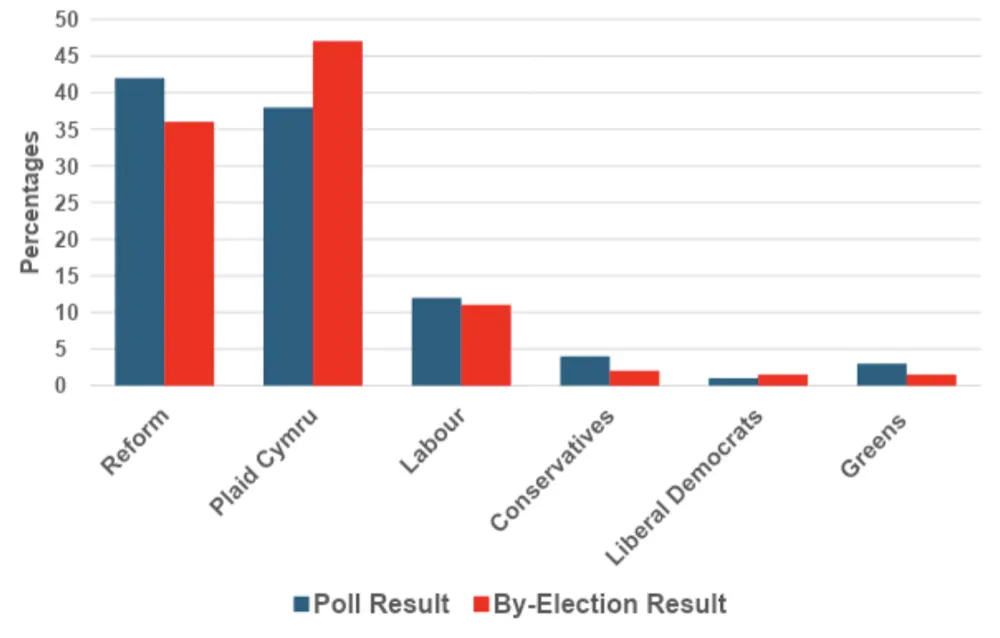
A Survation telephone poll published on October 16 suggested Plaid Cymru would come second with 38%, and the election would be won by Reform with 42%. The actual results after the October 23 vote were Plaid Cymru first on 47% and Reform second on 36%.

Labour obtained 12% in the poll and 11% in the election, which is fairly accurate. The Conservatives received 4% in the polling and got half of that with 2%. Similarly, the Greens also got half of their predicted share of 3% and the Liberal Democrats got 1.5% following a prediction of 1%.

Voting in Caerphilly – Poll vs Results:

A chart showing what a pre-election poll showed for Caerphilly and what actually happened, with the poll wide of the mark for most parties.
How a poll compared to the result.
P Whiteley, CC BY-ND

So what went wrong? The small sample telephone poll in the constituency which Survation used does not have a good track record. Surprisingly, national polls are more likely to be accurate than constituency polls.

There are a number of reasons why this is true, chiefly that it is harder to get an accurate sample of respondents at the constituency level than it is nationally. This is particularly true of telephone polls, where the great majority of people approached will not respond.

But there is another important reason why Reform did worse than expected in the byelection and it relates to national identity. The 2021 census asked questions about people’s national identities – that is, did they feel British, English, Welsh, Scottish, and so on.

Overall, 90% of the population (53.8 million people) in England and Wales identified with at least one UK national identity. This makes it possible to investigate identities at the constituency level.

Some 55% of the population in Wales described themselves as Welsh in the census, but in Caerphilly it was 69% – a far higher figure. Equally, 18% described themselves as British in Wales but in Caerphilly it was 14%. Finally, 9% of the Welsh population described themselves as English, but only 4% of the population in Caerphilly did so.

Census National Identity Data, Comparing Wales and Caerphilly:

A chart showing that people feel more Welsh in Caerphilly than the rest of Wales and less British.
Caerphilly identities.
P Whiteley, CC BY-ND

It’s also revealing to compare the constituency and the rest of Wales when it comes to voting in the general election of 2024. Plaid took just under 15% of the vote in Wales but it took 21% in Caerphilly. Reform took 17% in Wales and 20% in Caerphilly.

This is why many thought that Reform would win the byelection. So why did Plaid get 11% more of the vote share than Reform in the byelection?

The main reason is that Reform is fundamentally an English nationalist party, as the chart below reveals.

There is a very strong correlation between English identity in the census and voting Reform across the 543 constituencies in England. The more people think of themselves as English rather than British or something else, the more they were likely to vote Reform in the 2024 election.

English Identity and Reform Voting in 2024:

A chart showing a close correlation between Reform voting and English identity.
How Reform voting relates to English identity.
P Whiteley, CC BY-ND

Because English identity is low in Caerphilly, even by Welsh standards, Reform struggled to get the support it would have received in a comparable constituency containing a lot more English identifiers. It did well in the general election because this was focused on the entire UK, but when the focus is on Wales in a byelection, English identity is a problem for the party.

More generally Reform will face difficulties in the future winning seats in both Wales and Scotland, since English identifiers in these countries are few and far between.

This is going to be an issue in the Welsh Senedd elections and also the Scottish Parliamentary elections next year, since Plaid Cymru and the SNP are likely to be more successful against an unpopular Labour party in their respective countries than is Reform.

For next year’s local government and devolved parliamentary elections, there is something the pollsters can do to correct for the national identity effects.

All pollsters weight their data, that is, they attach more importance to some respondents than others in order to get an unbiased sample. They should weight for national identity using the census data and this will help to make the estimates more accurate.

Reform is in part a product of the incomplete devolution experiment introduced by Tony Blair’s government in the 1990s and 2000s. This exercise provided a powerful parliament for Scotland and a less powerful but important parliament for Wales.

The missing element was a parliament for England. It was thought at the time that this was unnecessary since the Westminster parliament would take care of English issues, but with English nationalism on the rise, it may well be time to reconsider this arrangement.


Want more politics coverage from academic experts? Every week, we bring you informed analysis of developments in government and fact check the claims being made.

Sign up for our weekly politics newsletter, delivered every Friday.


The Conversation

Paul Whiteley has received funding from the British Academy and the ESRC.

ref. Why did the polls get the Caerphilly byelection wrong? They ignored the fact Reform is an English nationalist party – https://theconversation.com/why-did-the-polls-get-the-caerphilly-byelection-wrong-they-ignored-the-fact-reform-is-an-english-nationalist-party-268630

Trump-Xi talks will not have changed the priorities of the Chinese government

Source: The Conversation – UK – By Chee Meng Tan, Assistant Professor of Business Economics, University of Nottingham

China’s president, Xi Jinping, has met with his American counterpart, Donald Trump, for their first face-to-face talks in six years. Trump emerged from the meeting in South Korea in a buoyant mood, describing it as a 12 on a scale of one to ten. He is now saying the US will lower tariffs on Chinese imports, with Beijing giving the US better access to rare earths in return.

The Chinese government’s response was, in comparison, relatively muted. In a statement, the foreign ministry declared that both sides had exchanged views on “important economic and trade issues” and said Xi was “ready to continue working” with Trump “to build a solid foundation for China and the US”.

Despite the optimism on show in South Korea, there is still much to be done before a trade deal between the two countries is signed. At the same time, Chinese officials appear to remain cautious of the Trump administration’s unpredictability and its damaging potential for their country’s economy.

Trump and Xi’s meeting came one week after China’s top leadership laid out their development priorities for the next five years, after four days of discussion in Beijing. Their message is clear: China needs to boost its self-reliance.

China has been reeling from an economic slowdown in recent years. A property market crash in 2021, which saw several major developers default on their debts, caused millions of Chinese people to lose wealth. This has dampened consumer spending and has reduced confidence in the economy.

Since China began shifting from central planning to a more market-oriented economy in 1978, it has enjoyed great success by relying on two mechanisms to stimulate growth. The first is attracting investment in the infrastructure and real estate sectors. The second, which is largely considered the primary driver of China’s extraordinary growth, is the export of manufactured goods.

However, investment in China’s infrastructure and property sectors has been lacklustre at best in recent years. At the same time, China has been embroiled in a trade war with the US – the largest importer of Chinese goods – since 2018. This period has been marked by cycles of escalating tariffs and retaliatory measures.

The external environment has become increasingly uncertain following Trump’s return to the White House in January 2025. Trump took Washington’s confrontation with Beijing to greater heights, imposing tariffs of 145% on most Chinese goods. Although many of these measures were later eased, the volatility of the two countries’ trade relationship was further evidenced when Trump threatened to reinstate 100% tariffs on Chinese exports just weeks before the Seoul meeting.

So, rather than relying heavily on exports, Chinese officials have announced that they intend to stimulate growth by boosting domestic consumption. Their plan is to create more job opportunities and improve healthcare and social benefits to help raise living standards. This should allow Chinese consumers to buy more goods and services.

However, improving domestic consumption will be no easy feat. China has weak social security nets, which encourage consumers to save more for uncertain times. Local governments in China, which provide public services, have also incurred huge amounts of debt in the past from excessive borrowing to fund projects. How China intends to improve living standards amid such debt is not certain.

A Chinese woman walking past a Gucci store.
A woman walking past a Gucci store in Chongqing, China.
Vincent_Nguyen / Shutterstock

Another key part of China’s economic plans is to become the world’s leader in AI and tech by 2035. This, like the government’s plans to boost economic growth, will also require self-reliance. The US has imposed sweeping tech restrictions in recent years to prevent advanced semiconductors and AI chips made by US firms from entering China.

These restrictions have intensified since the start of Trump’s second term. In May 2025, for example, the Trump administration ordered US chip design software makers to halt all sales to China. And even after Trump’s recent meeting with Xi, exports of advanced US technology to China still look like they will be largely restricted.

Trump said the two leaders discussed China purchasing some chips from US firms. But he clarified that the deal would not include Blackwell, Nvidia’s most advanced semiconductor, which US lawmakers have warned against allowing China to obtain. The Chinese government has not mentioned any agreement with the US regarding semiconductors.

As it stands, the US seems to be bent on ensuring that China is unable to access the tech that could aid Beijing in developing its computing and military prowess. So, to achieve tech superiority, China’s leaders have pledged more investment in education and talent. They have also promised measures to safeguard intellectual property.

Political survival

For years, China’s ruling communist party has relied on economic prosperity and nationalism to legitimise its rule. But Xi’s ability to retain control is likely to be undermined by China’s economic slowdown.

China needs a break from its external troubles, which have been induced by the US trade war and tech restrictions. And by dominating the production of rare earths, a group of metals crucial for high-tech manufacturing, China has a powerful trump card.

In early October, Beijing placed restrictions on the export of rare earths in a move that now appears to have been a calculated effort to strengthen China’s negotiating position with Washington. The strategy looks to have paid off, leading to a reduction of US tariffs on Chinese goods.

Ultimately, Xi needs victories of this sort to remain at the top of Chinese politics. If economic troubles worsen and growth continues to falter, even a leader as powerful as Xi may discover that loyalty sustained by rhetoric cannot be sustained.

The Conversation

Chee Meng Tan does not work for, consult, own shares in or receive funding from any company or organisation that would benefit from this article, and has disclosed no relevant affiliations beyond their academic appointment.

ref. Trump-Xi talks will not have changed the priorities of the Chinese government – https://theconversation.com/trump-xi-talks-will-not-have-changed-the-priorities-of-the-chinese-government-267785

What do spiders really get up to on Halloween?

Source: The Conversation – UK – By Alex Dittrich, Senior Lecturer in Zoology, Nottingham Trent University

Incy wincy hasn’t got time for witchcraft. thatmacroguy/Shutterstock

If you’re scared of spiders, Halloween certainly doesn’t help. People decorate their homes with monstrous-looking fake cobwebs and horror movies depict giant spiders hunting humans or creeping around spooky abandoned houses. Spiders’ long association with witches can also make their presence seem a little ominous.

In reality though, spiders are much more likely to be minding their own business than trying to pester humans.

The UK is home to more than 600 species of spider, with only a few of these common indoors. You might not notice them much through the year, but come autumn, more seem to start appearing in our homes.

This time of year we are focused on getting warm, sheltering from the weather outside. We may think that those animals we associate with our garden have similar ideas, and want to move in and share our cosy accommodation. However, the odds are they haven’t come in from the outside. The spiders you’re noticing have in fact probably always been there.

It’s just they are more active. Male spiders of many species are trying to find mates at this time of year. They cease to build webs and become roving individuals that are more easily spotted.

Mating for male spiders is a risky process as females often respond aggressively to male advances. So male spiders invest a lot of time and energy into finding the right mate. When spiders mate they fill specialised organs in front of their mouths, called palps, with sperm, that they then deposit into the sexual organ (epigynum) of the female.

Prior to this the male will go through a literal song and dance to make sure that the female is receptive and won’t eat him. This often involves a lot of leg tapping and sending vibratory signals sent down the female’s web. Only when she accepts these signals from the male will she mate with him.

Slowing down

Indoor female spiders are less active this time of year, often waiting in their homes, feeding and readying themselves for the mating season.

In early autumn indoor spiders are mostly nocturnal, with both males and females becoming more active at night when they are safer from potential predators, and maybe us humans.

While they rest during the day, some spider species even show signs of dreaming. A 2022 US paper found jumping spiders show bouts of eye movement and limb twitching that suggest phases of rapid eye movement (REM) sleep. REM sleep is associated with vivid dreaming.

Getting the munchies

The males may slow down the web-building but the females don’t. Spiders don’t just build webs randomly. They spend time finding the right spot based on the availability of prey as well as safety and structure.

One common species you may encounter, particularly in the UK, is the common house spider Tegenaria domestica one of Britain’s bigger spiders. It is well known for its funnel like webs which differ from classic cobwebs in the corners of rooms. These webs provide a secure home for the web dweller and surface for dispatching any potential prey that may fall on it.

Depending on the species, different webs evolved for catching different types of prey, or to provide a suitable home for the spider. There are some weird examples, such as Hyptiotes paradoxus which builds a triangular web – shaped much like a pizza slice. You are less likely to see this species in the home but you may find them on a graveyard yew tree.

Tegenaria Domestica spider walking through its funnel web.
Wirestock Creators/Shutterstock

Although not all species of spiders make complex webs, all spiders make silk that can be used for storing prey, or safety lines. For those that do make webs, depending on the species, this can take a few minutes, hours or days. It is of course a big investment taking a lot of energy to build a web. Some spiders ingest broken webs, to recycle the lost energy.

The tangled webs we find in our houses are often produced by what we refer to as synanthropic species, meaning that they have adapted well to a human-centred existence. Or rather many of them find our homes a nice facsimile to the habitat that they evolved within. Their natural habitats are similar to our homes in that they have stable temperature and humidity, with warm and dry corners and crevices.

Some synanthropic species such as the cellar spider Pholcus phalangioides are common inside. They are often seen hanging upside down waiting for their prey to fall victim to their delicate webs, in the corners of rooms, where they do a good job of eating other spiders that may enter your house. This species, however, is not native and was introduced to the UK and US from Asia in the 1800s.

Although we share our homes with many species of spider, they don’t eat crumbs or human food. But those crumbs can attract insects, which in turn attract spiders.

What can we do for spiders in the house?

There are movies on the tele at the moment that have done a good job of reinforcing people’s arachnophobia. But spiders aren’t out to get you. They just want to raise a family.

So my appeal to you is, maybe leave some of those cobwebs up (it’s great decoration for Halloween), drape a towel over the side of your bath so spiders can escape. And if you do need to remove a spider from your house, do it carefully and remember it is bad luck to kill a spider. To recite an old folk saying,“if you wish to live and thrive, let a spider run alive”.

The Conversation

Alex Dittrich does not work for, consult, own shares in or receive funding from any company or organisation that would benefit from this article, and has disclosed no relevant affiliations beyond their academic appointment.

ref. What do spiders really get up to on Halloween? – https://theconversation.com/what-do-spiders-really-get-up-to-on-halloween-265520

Scary stories for kids: All About Ghosts is a non-fiction book that gave me all the knowledge to spot spectres

Source: The Conversation – UK – By Catherine Bannister, Visiting Researcher at The University of Sheffield, Social research of children’s play and cultural worlds / archives of cultural tradition and childhood, University of Sheffield

Usborne

All About Ghosts by Christopher Maynard is a non-fiction book for children curious about spectral beings. First published in 1977, this book grabbed many children with the vice-like grip of a reanimated hand from a mouldering grave.

The book is one of several 1970s spooky releases that left many British children of the time with an abiding curiosity about all things unnerving. They are known as the “haunted generation”, a name coined by writer and broadcaster Bob Fischer.

One member of this haunted generation who went on to craft their own creepy contributions is actor and writer Reece Shearsmith, famous for The League of Gentlemen and Inside No.9, who introduces the 2019 edition of All About Ghosts. I too am a member, with an attraction to the mysterious that I can chart back to the original book – and which led me to become a folklorist.


Read more:
Scary stories for kids: these tales of terror made me a hit at sleepovers as a pre-teen


Despite the supernatural being an unusual topic for a factual book from an educational publisher such as Usborne, the writing addresses its younger readers with a straight face and without condescension. It presents its stories of eerie encounters succinctly and informatively, while indulging in just enough gruesome detail to have you sleeping with the light on.

The book’s whistlestop tour of the dark side opens by asking: “What is a ghost?” It provides definitions across the spectral spectrum before introducing the earliest recorded ghost sightings, beginning with the Babylonian Epic of Gilgamesh, dating from 2000BC.


This article is part of a series of expert recommendations of spooky stories – on screen and in print – for brave young souls. From the surprisingly dark depths of Watership Down to Tim Burton’s delightfully eerie kid-friendly films, there’s a whole haunted world out there just waiting for kids to explore. Dare to dive in here.


All About Ghosts leads its young readers through a landscape of graveyards and battlefields. It takes them out to a sea of doomed vessels and pirate wraiths. It wends its way through a haunted house with a bricked-up skeleton, and to the English village of Pluckley, which counts 12 ghosts among its population.

While its engaging style and clear prose indicate a younger readership, the information in the book’s brief, spooky vignettes owes a lot to research. In writing this guide to ghosts, Maynard consulted the folklorist Eric Maple, as well as organisations and archives including the Harry Price Library of Magical Literature and the Society for Psychical Research.

What resonates most are the evocative illustrations accompanying these yarns. The one-eyed phantom dog Black Shuck dripping drool is terrifying. The spectral submarine officer warning living comrades of incipient danger conveys a weird melancholy.

But the one I find most scary is Tom Colley’s ghost glowing by a gibbet – a cage in which the rotting remains of criminals were put on public display to warn against such crimes. Seeing this picture takes me back to being a child, sprawled on my bedroom carpet to read, pleasantly terrified and almost too nervous to turn the next page.

The book also invites its readers to participate in the hunt, sharing details of the equipment needed to track down apparitions and catch out frauds: “A thin layer of flour or powder … will show up any footprints or fingerprints made by fake ‘ghosts’.”

My younger self certainly took some of this advice on board. Even if I didn’t actively hunt ghosts, this book taught me to look out for the tell-tale signs of their presence: a sudden drop in temperature, strange draughts, objects moved by unseen hands. I would know a ghost was about.

Book cover

Usborne

These tips for ghost hunting in the style of other practical guides has the potential to encourage children to see themselves as daring researchers. And if the kit is a little outdated, today’s ghost hunters can always switch up a notepad and graph paper for digital tools.

The book’s examples of clever fakes and its ambiguous language – “ghosts are supposed to haunt the scene of death” – enable it to walk the line between belief and scepticism.

Children can sometimes be perceived by adults as being too ready to believe, growing into rationality later. However, folklorists of childhood Iona and Peter Opie – who have surveyed schoolchildren around the country from the mid-20th century onward on their play and games, language, beliefs and customs – describe the more nuanced phenomenon of “half belief”.

While children are drawn to the unexplained, their responses to tales of ghosts and summoning rituals, to good and bad luck, and to charms and omens, indicate they could also be taking part out of playful fun and exploration, curiosity and friendship. In subtly approaching its readers as critical thinkers as much as thrill-seekers, this book confirms its classic status for the spooky season and beyond.

All About Ghosts is suitable for children aged 10+.

This article features references to books that have been included for editorial reasons, and may contain links to bookshop.org. If you click on one of the links and go on to buy something from bookshop.org The Conversation UK may earn a commission.


Looking for something good? Cut through the noise with a carefully curated selection of the latest releases, live events and exhibitions, straight to your inbox every fortnight, on Fridays. Sign up here.


The Conversation

Catherine Bannister does not work for, consult, own shares in or receive funding from any company or organisation that would benefit from this article, and has disclosed no relevant affiliations beyond their academic appointment.

ref. Scary stories for kids: All About Ghosts is a non-fiction book that gave me all the knowledge to spot spectres – https://theconversation.com/scary-stories-for-kids-all-about-ghosts-is-a-non-fiction-book-that-gave-me-all-the-knowledge-to-spot-spectres-268244

Dam disasters of the 1920s made reservoirs safer – now the climate crisis is increasing risk again

Source: The Conversation – UK – By Jamie Woodward, Professor of Physical Geography, University of Manchester

One hundred years ago, a catastrophic flood carrying enormous boulders swept through part of Dolgarrog village, north Wales, destroying several homes, a bridge and the local chapel. Ten adults and six children lost their lives. The tragedy was widely reported and King George V sent a message of condolence.

This was not a natural flood. It was caused by the failure of two dams impounding the Eigiau and Coedty reservoirs on the Carneddau plateau, high above Dolgarrog, following a wet October. Overtopped by inflow from the Eigiau breach, the Coedty dam failed catastrophically, unleashing a flood of some 1.7 million cubic metres. There was no time to warn the village.


Read more:
When the dam broke: the 1925 disaster that reshaped a Welsh community and a country’s safety laws


The Dolgarrog disaster followed a reservoir failure at Skelmorlie, Scotland, in April 1925. Both brought attention to poor dam construction and inadequate maintenance practices, and led directly to the Reservoirs (Safety Provisions) Act of 1930.

The act sought to ensure the structural safety of large reservoirs by introducing legal requirements for regular inspection and certification by qualified engineers. It was the first attempt in the UK to regulate the design, construction, and maintenance of reservoirs through statutory safety measures.

Since Dolgarrog, the UK has had an excellent reservoir safety record. But in late July 2019, the evacuation of more than 1,500 residents from Whaley Bridge downstream of Toddbrook reservoir in Derbyshire, England, was ordered. Toddbrook had received a month’s rain in just two days.

Swollen inflows overtopped the dam’s emergency spillway, undermining its concrete slabs. A large cavity appeared on the spillway, exposing the dam’s core, raising fears of a breach.

A Chinook helicopter dropped 400 tonnes of aggregate on the Toddbrook spillway to reinforce the damaged section, while fire services used high-capacity pumps to lower the water level and reduce pressure on the dam. After several days, engineers declared the Toddbrook dam stable enough to lift the evacuation order.

The Toddbrook incident was one of the most serious near failures of a dam in recent UK history. It showed how extreme rainfall events can threaten dam safety and communities living downstream. Gavin Tomlinson, the fire incident commander, said: “We were in a situation where we had five times as much water going in than we could take out. We absolutely thought it could fail. It was a very, very tense night.”

Following this scare, in April 2021, the UK government commissioned an independent review into reservoir safety. A ministerial direction was issued to owners of all large, raised reservoirs, making the formulation of emergency flood plans a legal requirement to ensure that they are prepared for an eventuality that could result in an uncontrolled release of water.

The threat from climate change

As geomorphologists who work on river processes and landforms, we are researching the landscape-changing effects of such dam breach floods, but also how topography can amplify the hazard to communities.

As the Dolgarrog disaster showed so graphically, reservoirs that drain into steep and narrow upland valleys present a particular hazard, especially where flows increase in speed and pick up destructive boulders. All aspects of the landscape setting should be part of flood emergency planning.

While the Toddbrook reservoir was compliant with existing legislation and had been recently inspected, it suffered “unforeseen and potentially critical damage that could have led to a catastrophe.” Questions were raised by local residents about how well it had been maintained. Repairs were nearing completion in late 2025.

Most reservoirs in upland Britain were constructed in the 19th century under hydrological conditions that no longer hold. Embankment dams and older masonry dams can be especially vulnerable to erosion, seepage, slope instability or overtopping.

The most common cause of dam failures is overtopping where the spillway cannot cope with floodwaters. Reservoir safety may also be challenged by rapid or sustained water level lowering during droughts. As pore pressures change, and soils dry out and crack, embankment stability can be compromised.

Climate change is increasing both storm and drought intensity in many parts of the UK posing a threat to reservoir safety. Climate models tell us that intense rainstorms that cause flash flooding will be five times more likely by 2080. Steep upland catchments in hard impermeable rocks are especially vulnerable to flash flooding, and this is where much of the UK’s water storage infrastructure is located.

The Dolgarrog disaster was the last time anyone was killed in the UK by a dam failure. But if intense storms and prolonged droughts are the new normal for our climate, the risk to ageing upland water storage infrastructure will likely increase.


Don’t have time to read about climate change as much as you’d like?

Get a weekly roundup in your inbox instead. Every Wednesday, The Conversation’s environment editor writes Imagine, a short email that goes a little deeper into just one climate issue. Join the 45,000+ readers who’ve subscribed so far.


The Conversation

Jamie Woodward has received funding from research councils in the UK and Australia.

Jeff Warburton has received funding from UK research councils.

Stephen Tooth has received research funding from various sources, including charitable and non-charitable sources in the UK, Australia, South Africa, and USA.

ref. Dam disasters of the 1920s made reservoirs safer – now the climate crisis is increasing risk again – https://theconversation.com/dam-disasters-of-the-1920s-made-reservoirs-safer-now-the-climate-crisis-is-increasing-risk-again-267449