Why social media bans won’t make parenting teenagers easier

Source: The Conversation – UK – By Tim Fowler, Associate Professor in Political Theory, University of Bristol

Dmitrij Galacewicz/Shutterstock

Countries around the world, including France, Spain and Malaysia, are planning to following Australia in enacting a ban on young people using social media. And now the UK is considering moving in the same direction.

These bans have emerged out of concerns about the effects of social media on children’s mental health, and increasing attempts to regulate teenage life. The UK recently brought in a “lifetime” smoking ban for anyone aged 15 or younger.

The potential ban on social media use is often explicitly justified by the support of parents. When announcing her party’s support for the measure, Conservative leader Kemi Badenoch said she knew “as a parent” that a ban was needed. It is seen as common sense that parents are leading proponents of these bans.

Bans offer two core promises to parents. They offer protection from the perceived harms of social media, and greater simplicity in managing day-to-day life. Rather than parents having to negotiate their child’s social media, parents may believe that once a ban is in place, they can simply say to their children that this behaviour is not allowed.

Official sanction can be used by parents as evidence that society views children’s use of social media as unacceptable. But in order to fulfil these promises, bans would need to be highly effective and socially endorsed. There are strong reasons to think this won’t be the case.

Teenage rebellion

Far from being passive, teenagers are technologically literate, socially networked and highly motivated. Recent UK experience with age verification for certain websites shows how quickly workarounds spread.

Since the passing of the Online Safety Act, the UK has seen a huge surge in downloads of virtual private networks (VPNs). These allow users to register as being from a different country to the one they are physically in. Teenagers may be able to use VPNs to bypass the bans.

They can also circumvent parental controls in less technologically savvy ways. This might mean buying a burner phone from a friend to access social media outside of their parents’ evening restrictions. Anecdotally, there are similar accounts of school children finding workarounds to avoid the increasingly prevalent “pouches” that restrict access to smartphones during the school day.

The larger lesson here is that by forcing behaviour to become covert, parents can often lose oversight of what their children are doing.

These examples are not too different to traditional tricks to get around social bans, like having a fake ID or getting an older friend to purchase cigarettes or alcohol. If parents reflect on their own experiences of teenage life, it may be evident why the act of banning does not eliminate this behaviour – and may even increase its attraction.

Girl unhappily handing over phone
Bans don’t stop prohibited teenage behaviour.
NDAB Creativity/Shutterstock

Even more importantly, as we also know in relation to alcohol or sexual activity, just because it is prohibited doesn’t take away the necessity of parents having conversations with their children about these topics.

Parents know that even if they harshly sanction their children for underage drinking, their child’s peers may have parents who turn a blind eye, condone alcohol, or supply it themselves. This means that getting teenagers to think about their use is essential – and the same holds true for social media.

Whether there is a ban or not, prohibited teenage behaviour continues. Navigating these risks is an unavoidable part of parenting adolescents.

As we have argued, parenting should be seen less as about achieving specified outcomes, and more as about valuing the individual relationship.

Putting the relationship between parent and child centre-stage means recognising there are different positions on the use and value of social media, and managing those differences successfully.

While digital life is novel and frankly scary to some parents, seeing the issue in a wider context of teenage life – sometimes risky, contested and hidden – makes these new issues more explicable to older generations.

Just as parenting requires understanding why a young person might choose to drink, have sex or use drugs, the case of social media also depends on understanding teenagers’ (online) worlds. This means engaging with the value and benefits of social media, and gaining some understanding of what platforms are being used and their content.

This is not to say that more effective regulation is impossible, just as legal regulation is important for other dangers that children and teenagers face. However, such regulation will not – and cannot – take away parents’ involvement, and its related challenges.

The Conversation

Funding provided by Economic and Social Research Council (ES/W002639/1) for Centre for Socio-Digital Futures ESRC Centre for Sociodigital Futures | Research | University of Bristol

Tim Fowler does not work for, consult, own shares in or receive funding from any company or organisation that would benefit from this article, and has disclosed no relevant affiliations beyond their academic appointment.

– ref. Why social media bans won’t make parenting teenagers easier – https://theconversation.com/why-social-media-bans-wont-make-parenting-teenagers-easier-275263

The mathematical crimes of the Young Sherlock Holmes series

Source: The Conversation – UK – By Kit Yates, Professor of Mathematical Biology and Public Engagement, University of Bath

Warning this article contains spoilers about the new Amazon Prime series Young Sherlock.

I’ve read the whole Sherlock Holmes canon multiple times over. I love how Holmes uses analytical reasoning to unravel problems that look mysterious, but ultimately prove to have simple explanations. So I was excited when I saw Guy Ritchie’s Young Sherlock appear on Amazon Prime. My excitement was quickly tempered when I started watching, though.

A key part of the plot relies on mathematics. Holmes first meets his sidekick Moriarty (yes, he is working together with his future adversary) at the blackboard after a maths lecture at Oxford. Despite some mistakes in the dialogue, the maths on the blackboard is interesting enough. It is finding the solutions to the equation x5 + x4 + x3 + x2 + x + 1 = 0. As shown nicely in this video, the equation has five solutions.

In the maths many of us will have learned at school, we are taught that a positive times a positive makes a positive and that a negative times a negative also makes a positive. For example, 3 times 3 equals 9, but -3 times -3 also equals 9. Squaring a number (when you multiply a number by itself) should always give a positive result. The reverse operation – finding the number(s) you multiply together to give a positive number – is called taking the square root. The two square roots of 9 are 3 and -3, since when you square either of these numbers you get the answer 9.


Read more:
Taking a leap of faith into imaginary numbers opens new doors in the real world through complex analysis


If we want to take the square root of -1, say, then we need to venture into the realm of imaginary numbers. Imaginary numbers are the square roots of negative numbers. Mathematicians defined the imaginary number i to be the square root of -1 (technically -1 has two square roots i and -i). The square roots of other negative numbers are multiples of i. The square roots of -9, for example are 3i and -3i. Some of the solutions from the equation on the blackboard involve imaginary numbers (this will turn out to be an important plot point).

Mathematical blunders

It’s plausible that the equation on the blackboard might appear in an early first year undergraduate tutorial. Something approaching a passable solution is given, but in excruciating detail (the sort of detail you wouldn’t use at school, let alone in a maths degree at Oxford). And there are mistakes in the maths.

Towards the end of the lecture, the professor sets the students homework to find all the solutions to the equation, even though they are already written on the board (although incorrectly). Despite this, the end of the scene sees Sherlock spending some time trying to think of the solutions before Moriarty comes up and shows him two of the five solutions (as if they were the only ones). Moriarty too writes these down incorrectly, but in a different way to the incorrectness already on the board.

As Moriarty writes down the complex solution (complex means the answer contains both real and imaginary numbers) he says “These solutions, they’re not real. They’re imaginary.” which we can allow (although technically he means complex).

What we can’t forgive is Moriarty going on to say, “That means even if you can’t see the target, you can still shoot for it.” Which is nonsense, even as a metaphor. Complex numbers aren’t targets you can’t see, but well-defined, mainstream (even in the 1870s) mathematical quantities and there’s no sense in which you “aim at” a complex solution to an equation.

Death by numbers

In the last episode, Holmes and his team are battling to halt the distribution of a deadly chemical weapon known as the “creeping death”. They find a scrap of paper in a secret room which they say is the “equation for creating the creeping death.”

I was expecting to see some complex chemical reaction formulae sketched on the page, but when it’s held up to the camera, we see instead a mathematical equation: z3 + 4 z2 – 10 z + 12 = 0.

What does this have to do with the chemical process for creating the deadly nerve agent?

Nothing, it turns out. Or at least nothing I can imagine. In fact it’s a device to allow Holmes and Moriarty to hark back to that moment in the lecture theatre when they first met. What follows goes beyond artistic license into the realm of gibberish.

“If we have the positive equation”, they say, “then we can come up with the negative. And thus create a compound to neutralise the threat of creeping death.” Perhaps they meant “positive solution”, because equations themselves aren’t positive or negative. Either way, the idea that this simple mathematical equation or its solutions are the secret formula for making a weapon of mass destruction doesn’t make sense. There’s no context, no sense in which this equation could be the secret recipe for creating the nerve agent.

Moriarty points out that they have a problem. “This equation is not finished.” By this I think he means that the three solutions to the equation are not written out explicitly.

One solution, z = – 6 is given. And it’s correct. The rest of the scrap of paper contains a reformulation of the equation (a factorisation), which shows that the remaining solutions can be found by solving a quadratic equation: z2 – 2 z + 2 = 0.

A quadratic equation is just an equation built around a squared term (in this case z2), which has two solutions. The formula for the solutions may be familiar to GCSE students (normally aged 15 to 17 years old). For a general quadratic equation: a z2 + b z + c = 0, the two solutions are given below.

Yet, we are supposed to believe that, despite having supposedly solved a far more complicated equation than this in the first episode, Moriarty can’t find the solution to this much simpler equation. So stumped is Moriarty – the future maths professor – that he spends precious time, as a bomb is about to detonate, searching for a piece of paper with this missing solution. He almost loses his life when he could have just used a GCSE-level formula.

The piece of paper he eventually finds contains an incorrect statement of the quadratic formula alongside some nonsensical text, although the solutions are at least correct: z = 1 + i and z = 1 – i (where i, remember, is the imaginary number).

I appreciate my dissection of the maths is high-grade nerdery. Most people will have watched the series without pausing it like I did to look at the maths and probably won’t have noticed. But, if maths is going to be a pivotal plot point in your blockbuster series, then you’ll probably want to make sure you get it right.

The Conversation

Kit Yates does not work for, consult, own shares in or receive funding from any company or organisation that would benefit from this article, and has disclosed no relevant affiliations beyond their academic appointment.

– ref. The mathematical crimes of the Young Sherlock Holmes series – https://theconversation.com/the-mathematical-crimes-of-the-young-sherlock-holmes-series-278812

Guerre en Ukraine : comment la Russie recrute et exploite des migrants africains

Source: The Conversation – in French – By Thierry Vircoulon, Coordinateur de l’Observatoire pour l’Afrique centrale et australe de l’Institut Français des Relations Internationales, membre du Groupe de Recherche sur l’Eugénisme et le Racisme, Université Paris Cité

Le premier Africain officiellement mort sur le front russo-ukrainien était un jeune zambien tué en septembre 2022. Il était en prison en Russie et avait rejoint les rangs de l’organisation paramilitaire russe, le Groupe Wagner (devenu Africa Corps), en échange d’une amnistie. Depuis lors, plusieurs études récentes ont mis en lumière le recrutement d’Africains et d’Africaines par la Russie.

Dans une récente étude, j’ai constaté que, loin de refléter des aventures picaresques modernes ou des engagements individuels pro-russes, ces recrutements s’inscrivent dans le cadre d’une politique d’exploitation des migrants conçue et pilotée par les autorités russes.

Qui sont les recrutés ?

Les autorités russes recrutent deux catégories de personnes :

  • de jeunes femmes âgées de 18 à 22 ans, sans formation professionnelle spécifique pour travailler dans la zone économique spéciale d’Alabuga, au Tatarstan;

  • des hommes sans condition d’âge et de compétences professionnelles qui servent dans les rangs de l’armée russe.

Les premières se voient proposer des formations professionnelles gratuites pour des métiers civils avec procédure rapide de délivrance de visa. Elles candidatent auprès d’organismes officiels dans leur pays (Maisons Russie, ambassades de Russie, etc.) pour entrer dans ce qui est présenté comme un programme de formation professionnelle mais qui est, en réalité, au service du complexe militaro-industriel russe.

Les seconds répondent généralement à des offres d’emplois civils en Russie avec des salaires attractifs, souvent accompagnés de perspectives d’installation durable.

Qu’il s’agisse des hommes ou des femmes, la majorité des recrutés sont dupés par des offres d’emplois et de formation trompeuses.

Les formations professionnelles promises aboutissent très souvent à assembler des drones dans une usine d’Alabuga, tandis que les emplois promis aboutissent à endosser l’uniforme de l’armée russe. Seule une minorité d’hommes sont attirés par les campagnes de recrutement de l’armée russe sur certains réseaux sociaux et s’engagent en toute connaissance de cause. Ce sont souvent des militaires ou des policiers qui désertent.

Pour tous les autres, la recherche d’opportunités professionnelles et d’une meilleure vie dans un pays développé se transforme en implication directe ou indirecte dans une guerre en Europe.

Qui sont les recruteurs ?

Les recruteurs de Moscou forment une nébuleuse hétérogène aux profils variés. On y trouve des paramilitaires russes en Afrique, des Africains émigrés en Russie, des influenceurs africains, des associations de russophiles, des agences africaines spécialisées dans l’émigration de travail et des passeurs clandestins.

Cas exceptionnel pour l’instant, un parti politique aurait aussi joué le rôle de sergent recruteur pour l’armée russe. En Afrique du Sud, le parti d’opposition MK de l’ancien président Jacob Zuma a envoyé, pendant l’été 2025, 17 de ses militants suivre une soi-disant formation de garde du corps en Russie. Ceux-ci ont tous fini dans les rangs de l’armée russe.

Dans les pays où il est implanté (Centrafrique, Burkina Faso, Niger, Mali, etc.), le groupe paramilitaire Africa Corps (l’ex-Wagner Group d’Evgueni Prigojine) a aussi recruté des Africains pour aller combattre en Ukraine. Dans ces pays, il peut recruter très aisément car il coopère avec les armées nationales et parfois aussi avec certaines milices.

Parmi les Africains recruteurs de Moscou, plusieurs profils se dégagent :

  • les anciens formés dans ce qui était alors l’Union des républiques socialistes soviétiques (URSS) et qui étaient souvent des membres de l’appareil sécuritaire;

  • des adultes trop jeunes pour avoir connu l’URSS mais attirés par le discours anti-occidental du régime poutinien et souvent membres d’organisations affiliées aux BRICS;

  • et de purs opportunistes qui en profitent pour gagner de l’argent.

Fait particulier, en Afrique du Sud, les réseaux de recrutement mis à jour semblent organisés par des femmes : une journaliste de la radio nationale sud-africaine, la députée fille de l’ex-président Jacob Zuma et une femme d’affaires.

Quel est le rôle de la corruption dans le recrutement ?

La corruption intervient à chaque étape du recrutement. Des agences de travail à l’étranger ou des intermédiaires qui arrangent les rendez-vous à l’ambassade de Russie se font payer par les candidats au départ. Quand ils sont stoppés par la police des frontières à l’aéroport, certaines recrues parviennent à « acheter » leur embarquement.

Une fois en Russie, ils ne touchent pas le salaire promis dont une partie serait empochée par leurs officiers. Après le décès de certains, leurs familles ont reçu des messages leur proposant de rapatrier le corps du défunt contre de l’argent.

Qu’arrive-t-il aux hommes en Russie ?

Une fois arrivés en Russie, ils sont pris en charge dès l’aéroport par des militaires. Après vérification de leur identité, même s’ils viennent pour un emploi civil, on leur impose de s’engager dans l’armée. Piégés dans un pays dont ils ne comprennent pas la langue, ils signent un contrat avec le ministère de la Défense et reçoivent une formation militaire sommaire de deux à trois semaines.

Puis, ils sont envoyés dans des unités de combat où beaucoup font, pour la première fois, l’expérience de la guerre. Souvent maltraités dans une armée connue pour sa violence, ils n’ont aucune possibilité de recours et sont utilisés pour les missions les plus dangereuses, voire des missions suicides (par exemple, servir de cibles humaines afin de détecter les positions de l’ennemi et les bombarder).

Pourquoi recruter à l’étranger ?

D’après des estimations américaines, les pertes russes depuis le début du conflit s’élèveraient à 1,3 million de personnes. Pour tenter de compenser ces pertes, les autorités russes ont d’abord recruté parmi les communautés étrangères en Russie.

Elles ont rendu possible l’engagement d’étrangers dans l’armée puis elles l’ont rendu obligatoire en 2025 pour tous les étrangers voulant résider en Russie ou être naturalisés. Mais ce pool de recrutement se tarissant, elles ont décidé de recourir aux migrants.

Recruter des migrants comme combattants permet aux autorités russes de disposer d’une main d’œuvre à bas coût et qui ne compte pas. Ces soldats de fortune coûtent bien moins cher que leurs homologues russes qui sont mieux payés, sont indemnisés en cas de handicap et dont les familles touchent des compensations financières importantes en cas de décès. Le coût des soldats pour le budget russe a donc considérablement augmenté depuis le début du conflit.

En outre, les mercenaires amateurs étrangers sont des soldats jetables. Après avoir utilisé des délinquants recrutés dans les prisons au début de la guerre comme chair à canon, l’armée russe recourt désormais à des étrangers dont la disparition ne gênera personne en Russie et dont les familles ne seront pas indemnisées.

Les migrants constituent donc un réservoir de main-d’œuvre parfait pour une guerre très consommatrice de vies humaines. Pour l’armée russe, il ne s’agit pas de recruter des professionnels de la guerre mais de la chair à canon. Loin d’être limitée au continent africain, cette politique semble globale et particulièrement efficace dans les pays pauvres ayant une grande tradition d’émigration.

De ce fait, plusieurs gouvernements du sous-continent indien ont demandé à la Russie de mettre un terme à cette politique.

Quelle est la réaction des gouvernements africains ?

Silencieux depuis le début de la guerre, des gouvernements africains ont commencé à prendre ce problème au sérieux à cause du scandale des blessés de guerre. Les premières révélations publiques sur les recrutements russes ont eu lieu au Kenya et au Ghana où des familles dont les membres ont disparu en Russie ont informé les médias. C’est surtout le sort des blessés de guerre qui demandaient à être rapatriés de Russie qui a ému l’opinion publique et contraint les autorités de ces pays à :

  • exiger le rapatriement de leurs citoyens;

  • enquêter sur les réseaux de recrutement;

  • prévenir leurs citoyens contre les offres d’emplois en Russie.

Les autorités kenyanes ont ainsi découvert qu’environ 1000 citoyens avaient été recrutés par l’armée russe et ont demandé à Moscou de mettre fin à cette pratique. Elles ont arrêté un groupe de migrants prêts à partir en Russie et enquêtent sur les agences d’émigration qu’elles qualifient de « rogue agencies ».

Certaines d’entre elles ont disparu après les révélations publiques de leur rôle dans le recrutement. Leurs responsables sont introuvables et leurs locaux fermés. Les autorités sud-africaines ont suivi l’exemple du Kenya après le scandale des 17 militants de MK révélé à la fin de 2025. Deux personnalités publiques (l’ex-députée Duduzile Zuma-Sambudla et la présentatrice Nonkululeko Patricia Mantula) sont inculpées et vont être jugées cette année.

Les autorités du Nigeria, du Botswana et du Ghana ont aussi demandé à Moscou de cesser cette pratique. Les pays d’Afrique francophone restent pour le moment silencieux, bien que la présence de leurs concitoyens dans l’armée russe soit confirmée.

Quelle est la réaction des autorités russes ?

Après avoir initialement nié ces recrutements, les autorités russes ont rapatrié quelques recrues du Kenya et d’Afrique du Sud. Elles ont préféré se dédire plutôt que de susciter des tensions diplomatiques avec ces pays. Ces premiers rapatriements sont donc une victoire pour les gouvernements kenyan et sud-africain qui ont encore beaucoup d’autres citoyens à récupérer.

A cette fin, le ministre des Affaires étrangères du Kenya s’est d’ailleurs rendu à Moscou en mars. Prises en flagrant délit de recrutement et consciente de l’image négative de ces scandales, les autorités russes auraient décidé de ne plus recruter dans certains pays, dont le Kenya.

The Conversation

Thierry Vircoulon receives funding from the French Institute for International Affairs.

– ref. Guerre en Ukraine : comment la Russie recrute et exploite des migrants africains – https://theconversation.com/guerre-en-ukraine-comment-la-russie-recrute-et-exploite-des-migrants-africains-278344

The latest world climate report is grim, but it’s not the end of the story

Source: The Conversation – Global Perspectives – By Andrew King, ARC Future Fellow and Associate Professor in Climate Science, ARC Centre of Excellence for 21st Century Weather, The University of Melbourne

It’s no secret our planet is heating up.

And here’s the evidence: we’ve just experienced the 11 hottest years on record, with 2025 being the second or third warmest in global history.

The annual State of the Climate report, published today by the World Meteorological Organization, suggests we’re still too reliant on fossil fuels. And that’s pushing us further from our goal to decarbonise.

So what is happening to our climate? And how should we respond?

The climate picture

Unfortunately, the most recent climate data makes for grim reading.

Let’s look back at 2025, through the lens of four climate change indicators.

Carbon dioxide

We now have a record amount of carbon dioxide in the atmosphere, about 50% higher than pre-industrial levels. And we’re still emitting large amounts of carbon dioxide through our use of fossil fuels. In 2025, global emissions reached record high levels. The carbon dioxide we emit can stay in the atmosphere for a long time. So each year we keep emitting large amounts of carbon dioxide, the more concentrated it will be in our atmosphere.

Temperature

In 2025, the world experienced its second or third warmest year on record, depending on which dataset you use. The average temperature was about 1.43°C above the pre-industrial average.

This is particularly unusual given we observed slight La Niña conditions in the Pacific region. La Niña is a type of climate pattern characterised by temperature changes in the Pacific Ocean. It typically creates milder, wetter conditions in Australia and has a cooling effect on the global average temperature. But even with La Niña conditions, the planet stayed exceptionally hot.

And each of the last 11 years were hotter than any of the previous years in the global temperature series. This is true across all the different datasets used in the report. However, this does not mean a new record was set each year.

Oceans and ice

In 2025, the heat held within the world’s oceans reached a record high. And as our oceans continue to warm, sea levels will also rise. Hotter oceans also speed up the process of acidification, where oceans absorb an increased amount of carbon dioxide with potentially devastating consequences for some marine animals.

The amount of Arctic and Antarctic ice is also well below average. This report shows sea ice extent, a measure of how much ocean is covered by at least some sea ice, is at or close to record low levels in the Arctic. Meanwhile, the amount of ice stored in glaciers has also significantly decreased.

Extreme weather

Research shows many of the most devastating extreme weather events of 2025 were exacerbated by human-driven climate change. The heatwaves in Central Asia, wildfires in East Asia and Hurricane Melissa in the Carribean are just three examples. Through attribution analysis, which is how scientists determine the causes of an extreme weather or climate event, this report highlights how our greenhouse gas emissions are making severe weather events more common and intense.

How does Australia stack up?

Compared to most other countries, Australia has a disproportionate impact on the global climate.

This is largely because our per capita carbon dioxide emissions are about three times the global average. That means on average, each of us emits more carbon dioxide than people in all European countries and the US.

Emissions matter because they exacerbate the greenhouse effect. That is the process by which greenhouse gases, such as carbon dioxide and methane, trap heat near Earth’s surface. So by emitting more greenhouse gases, we contribute to global warming. And research suggests Earth is warming twice as fast today, compared to previous decades.

However, Australia is also experiencing first-hand the adverse effects of human-induced climate change.

In 2025, we lived through our fourth-warmest year on record. The annual surface temperatures of the seas around Australia reached historic highs, beating the record temperatures set in 2024. And last March was the hottest March we’ve seen across the continent.

Here in Australia, we are also battling longer and hotter heatwaves and bushfire seasons. And scientists warn these extreme weather events will only become more common.

The Bureau of Meteorology’s annual summary highlights how Australia’s climate is changing.

So what can we do?

The 2025 State of the Climate Report shows how much, and how quickly, we are changing our climate. And it is worryingly similar to previous reports, highlighting the need for urgent action.

The priority should be decreasing our emissions. This would slow down global warming, which will only continue if we keep the status quo. Some countries are already decarbonising rapidly, in part through transitioning to renewable electricity supplies. Others, including Australia, need to move much faster to reduce emissions.

Crucially, we must also meet our net zero targets. In Australia, as in many other countries, we are aiming to reach net zero by 2050. The sooner we reach net zero, the more likely we are to avoid harmful climate change impacts in future. To achieve net zero, we need to significantly reduce our emissions while also increasing how much carbon we remove from the atmosphere.

Even if we meet our net zero targets, climate change will not magically disappear. However, by turning away from fossil fuels and cutting our greenhouse gas emissions now, we may spare future generations from its worst effects. That’s the least we can do.

The Conversation

Andrew King receives funding from the Australian Research Council (Centre of Excellence for the Weather of the 21st Century and a Future Fellowship) and the Australian government National Environmental Science Program.

– ref. The latest world climate report is grim, but it’s not the end of the story – https://theconversation.com/the-latest-world-climate-report-is-grim-but-its-not-the-end-of-the-story-278886

We’re asking the wrong questions about women’s athletic performance

Source: The Conversation – Canada – By Kurt Michael Downes, PhD Candidate, Kinesiology, University of Windsor

In 1992, an article in Nature asked, “Will women soon outrun men?” The question was sparked by a series of remarkable performances by women, including Florence Griffith-Joyner’s 100-metre world record in 1988.

At the time, women’s performances were improving faster than men’s, prompting speculation that the gap might eventually close in endurance events, and then possibly the sprints.

More than three decades later, the answer is clearer. Prior to puberty, boys and girls perform similarly, but the hormonal surge at adolescence sets in motion a lasting gap in speed, strength and endurance. Women have continued to narrow the gap, but a sizeable difference still remains. Even when talent, training and effort are equal, biology still sets upper limits of performance.

But does this really matter? Women’s sport does not need to be compared to men’s sport in order for it to be considered elite or credible. It can stand on its own. Maybe the real question is not how close the gap is between men and women but instead whether we are providing women with the training and resources to maximize their potential.

Puberty changes everything

Prior to puberty, boys and girls are similar from a performance perspective. Girls often keep pace or outperform boys, with similar race times, jump height and endurance capacities. Once puberty enters the equation, the balance shifts.

In boys, testosterone surges well above that of females at any age, driving gains in muscle, bone, heart size, lung capacity and hemoglobin — an iron-rich protein in blood cells that transports oxygen from the lungs to body tissues, including working muscles, which plays a major role in sports and is especially important in endurance events.

These traits boost speed, power and endurance capabilities.

On the other hand, girls experience spikes in estrogen and progesterone during puberty. These hormones are essential for reproductive health and are associated with higher body fat and wider pelvic structure, which in turn could alter athletic performance.

By the late teens, and importantly after the start of puberty, the divide is obvious. Men outperform women by 10 to 30 per cent across the majority of athletic events not because of differences in dedication or effort, but because physiology has set different athletic ceilings.

Biology sets the boundaries

Expanded investment, higher salaries, greater participation opportunities, stronger advocacy, the growth of professional leagues and improved coaching and training have benefited some sports like women’s football (soccer) over the last few decades. Recent developments, such as the new WNBA collective bargaining agreement that includes salary expansion and revenue sharing reflect a shift in momentum towards an increasing value in women’s sport.

Nonetheless, once training conditions become comparable at the elite level, the performance gap does not disappear — it stabilizes. Despite similar coaching, facilities and sports science support, a consistent performance divide remains because after puberty, muscle size, lung capacity and hemoglobin set a baseline that training cannot erase.

None of this diminishes the extraordinary sporting achievements of female athletes.

Exceptions to the rule? Where women excel

There are events in which women outperform men, and these cases are telling. In ultra-events and cold-water swims, women have occasionally won outright, likely as a result of greater fat metabolism, better pacing and higher tolerance for prolonged discomfort. These traits matter less in explosive events but can be decisive in prolonged endurance or sustained output activities.

Also, performance includes aspects of sport — like skill, tactics, and strategy — that are difficult to compare. The elements are a reminder that the performance gap shifts with context, rather than being finite.

Alternative questions

Acknowledging these differences does not diminish women’s achievements. Instead, it protects the principle of fair competition that women’s sport was created to uphold. Fairness, however, is not the same as equity.

The majority of women’s sport still receives less funding, media coverage and scientific investment, there are gender-specific barriers to sport and physical activity participation, and there are major gaps in understanding how female-specific physiology such as menstrual cycles, contraceptives and pregnancy affect performance and recovery.

These are realities that coaching practice and sport policy are only beginning to tackle. And this leads to an alternative question: when will the coaching/administration gap close?

This question is put forward in the face of continued disparities in the number of female coaches and administrators across most sports, a fact noted at the most recent Winter Olympic games.

Similarly, when will the training gap close? Along with sex differences in physiology, coaches and athletes acknowledge differences in coach-athlete relationships, injury risk and other aspects of health, yet training often continues to draw on sport science literature and sport programming historically based on male participants.

Anecdotally, after presenting on these topics to a group of high-performance coaches, several described seeing these differences in practice and expressed frustration that the research base remains too limited to guide them in sex-specific, evidence-based training practices. Nonetheless, expanding this research, as well as increasing the representation of women in sport leadership and administration, would be a step forward in creating change.

Will female athletes ever compete with males in the most physically demanding sports? Maybe, maybe not. But is this the right question?

Women’s sport does not need to mirror men’s to matter. Its value stems from fair competition and athletic achievement. It has earned the right to visibility, respect and investment — both financially and through research — to best allow all of our aspiring athletes to maximize their full potential.

The Conversation

Kurt Michael Downes receives funding from the Coaching Association of Ontario (CAO). He is the President and Head Coach the Border City Athletics Club (not-for-profit) and is a member on the boards of Inclusion in Canadian Sports Network (not-for-profit), Family Fuse (not-for-profit) and Resilient Kids Canada (not-for-profit).

Kevin Milne does not work for, consult, own shares in or receive funding from any company or organisation that would benefit from this article, and has disclosed no relevant affiliations beyond their academic appointment.

– ref. We’re asking the wrong questions about women’s athletic performance – https://theconversation.com/were-asking-the-wrong-questions-about-womens-athletic-performance-270264

Psychological toll of betrayal trauma may help explain why women kept silent for decades after alleged abuse by civil rights icon Cesar Chavez

Source: The Conversation – USA – By Anne P. DePrince, Professor of Psychology, University of Denver

Cesar Chavez became a national hero for his advocacy of farmworkers’ rights. Here he gives a talk at Boston University in April 1979. Ted Dully/The Boston Globe via Getty Images

Multiple women told The New York Times that Mexican American civil rights hero Cesar Chavez assaulted them decades ago, including when some were just girls, one as young as 13. Over their multiyear investigation, published on March 18, 2026, journalists at the paper found “extensive evidence” of that abuse by poring over historical records and conducting interviews with more than 60 people.

While yearslong investigations into abuse allegations are rare, silence about abuse is common.

As a clinical psychologist who studies interpersonal trauma, I’ve seen how the dynamics of abuse can lead to silence, even over decades.

This research can help answer the question many asked when they heard about the charges against Chavez: Why didn’t the women speak earlier?

Power and trust betrayed

Among the women who disclosed abuse by Chavez, Dolores Huerta described seeing him “as my boss, as my hero, as, you know, somebody that would do the impossible.” Debra Rojas said, “I had love for him … He did his grooming very well.”

When perpetrators abuse those who trust and depend on them, the betrayal adds to the harm of trauma. Betrayal trauma theory helps explain why.

A woman with dark hair and a red dress and hat looking at a large mural of a man with brown hair.
United Farm Workers co-founder Dolores Huerta looks at a mural of the late Cesar Chavez on the San Jose State University campus in San Jose, Calif., on Sept. 4, 2008.
AP Photo/Paul Sakuma, File

Victims who depend on the people abusing them face extraordinary pressure to minimize what is happening. Disclosure can mean losing relationships or resources that are necessary for survival. Children abused by caregivers or community leaders risk relationships that they need to get their basic needs met. Adults who disclose abuse or harassment by employers risk losing their jobs and economic security.

Adding to the harm of abuse, perpetrators commonly twist reality to keep victims silent. They might directly instruct victims not to tell others what happened. They might also tell victims that they are actually the ones to blame for causing the abuse or that no one will believe them.

Victims must adapt to this untenable situation in which they depend on the very people causing harm.

For some people, betrayal results in dissociation symptoms and memory impairment for what happened. Dissociation is a common response to traumatic stress that can include amnesia, feelings that things are unreal or feeling disconnected from what is happening. Dissociation and memory impairment can help victims maintain necessary attachments in the short run.

Betrayal also contributes to more shame and self-blame, as well as more severe psychological and physical health problems.

Shame and self-blame can make it harder to disclose what happened. Not surprising, then, victims of high-betrayal traumas are less likely to disclose what happened relative to other kinds of traumas.

When betrayal-trauma survivors do speak up, delayed disclosures can be met with blame or disbelief, even from health providers. Survivors with more severe psychological symptoms are also met with more negative reactions to their disclosures.

Betrayal also makes escaping abusive relationships, including physically violent ones, difficult. Greater dependence on the perpetrator has been linked with a greater likelihood of staying with an abusive partner a year after a police report of domestic violence.

Cultural and institutional betrayal add to harm

Women told The New York Times that they stayed silent about their abuse, which for some began when they were girls, in part “for fear of tarnishing the image of a man who has become the face of the Latino civil rights movement.”

When people in marginalized groups are abused by someone from the same group, that constitutes an additional wound. Dr. Jennifer Gómez described this as “cultural betrayal trauma.”

With cultural betrayal trauma comes even greater pressure to stay silent as well as greater harm from the abuse.

When institutions such as churches, schools or unions fail to stop abuse or respond appropriately, that institutional betrayal can also add to the harm caused by the original abuse. In turn, institutional betrayal predicts greater dissociation and health problems, adding to the burden of abuse.

Anticipating disbelief and blame

Ana Murguia told The New York Times that she believed she would be blamed for the abuse.

Huerta, who was one of three co-founders, along with Chavez, of what ultimately became the United Farm Workers union, told the newspaper that she “feared that no one within the union would believe her.”

Anticipating disbelief and blame affects decisions to disclose. When researchers asked college women who were sexually victimized at some point in their lives why they kept what happened to themselves, they heard four common reasons. Women kept assaults private because they felt shame, guilt or embarrassment, minimized what happened, feared consequences of disclosing or wanted privacy.

Fears about negative reactions are unfortunately well founded. Research shows that when victims do disclose, victim blaming and other negative reactions are common. In turn, those negative social reactions add to psychological distress and the harm of abuse.

Connection and courage: Antidotes to betrayal

In the wake of the harm that betrayal trauma causes, healing is possible through connection and care.

Research shows that people can learn to respond in better ways to disclosures of abuse, such as connecting people to resources and expressing empathy. In addition, institutions that act with courage in the wake of abuse, such as by making it easy to report or taking actions to prevent future abuse, can help reduce harm to survivors.

Screenshot of an Instagram post about how a foundation honoring Dolores Huerta 'applauds her bravery in sharing her very personal story.'
Screenshot of an Instagram post by the Dolores Huerta Foundation in the wake of her revelations of abuse by Cesar Chavez.
Dolores Huerta Foundation Instagram

When survivors disclose, avoiding blame, disbelief and other negative reactions can minimize additional harm. Taking steps to offer emotional support and resources can even help open doors.

That’s what my research team found when we asked sexual assault survivors about the reactions they received from service providers, such as counselors or victim advocates. When survivors received more tangible support, they were more likely to later disclose what happened in a formal report to the police.

The Conversation

Anne P. DePrince has received funding from the Department of Justice, National Institutes of Health, State of Colorado, and University of Denver. She has received honoraria for giving presentations and has been paid as a consultant. She has a book with Oxford University Press. She is an Advisory Group Member of the National Crime Victim Law Institute and a Senior Advisor to the Center for Institutional Courage.

– ref. Psychological toll of betrayal trauma may help explain why women kept silent for decades after alleged abuse by civil rights icon Cesar Chavez – https://theconversation.com/psychological-toll-of-betrayal-trauma-may-help-explain-why-women-kept-silent-for-decades-after-alleged-abuse-by-civil-rights-icon-cesar-chavez-278950

Psychological toll of betrayal trauma may help explain why women kept silent for decades after their allegations of abuse against civil rights icon Cesar Chavez

Source: The Conversation – USA – By Anne P. DePrince, Professor of Psychology, University of Denver

Cesar Chavez became a national hero for his advocacy of farmworkers’ rights. Here he gives a talk at Boston University in April 1979. Ted Dully/The Boston Globe via Getty Images

Multiple women told The New York Times that Mexican American civil rights hero Cesar Chavez assaulted them decades ago, including when some were just girls, one as young as 13. Over their multiyear investigation, published on March 18, 2026, journalists at the paper found “extensive evidence” of that abuse by poring over historical records and conducting interviews with more than 60 people.

While yearslong investigations into abuse allegations are rare, silence about abuse is common.

As a clinical psychologist who studies interpersonal trauma, I’ve seen how the dynamics of abuse can lead to silence, even over decades.

This research can help answer the question many asked when they heard about the charges against Chavez: Why didn’t the women speak earlier?

Power and trust betrayed

Among the women who disclosed abuse by Chavez, Dolores Huerta described seeing him “as my boss, as my hero, as, you know, somebody that would do the impossible.” Debra Rojas said, “I had love for him … He did his grooming very well.”

When perpetrators abuse those who trust and depend on them, the betrayal adds to the harm of trauma. Betrayal trauma theory helps explain why.

A woman with dark hair and a red dress and hat looking at a large mural of a man with brown hair.
United Farm Workers co-founder Dolores Huerta looks at a mural of the late Cesar Chavez on the San Jose State University campus in San Jose, Calif., on Sept. 4, 2008.
AP Photo/Paul Sakuma, File

Victims who depend on the people abusing them face extraordinary pressure to minimize what is happening. Disclosure can mean losing relationships or resources that are necessary for survival. Children abused by caregivers or community leaders risk relationships that they need to get their basic needs met. Adults who disclose abuse or harassment by employers risk losing their jobs and economic security.

Adding to the harm of abuse, perpetrators commonly twist reality to keep victims silent. They might directly instruct victims not to tell others what happened. They might also tell victims that they are actually the ones to blame for causing the abuse or that no one will believe them.

Victims must adapt to this untenable situation in which they depend on the very people causing harm.

For some people, betrayal results in dissociation symptoms and memory impairment for what happened. Dissociation is a common response to traumatic stress that can include amnesia, feelings that things are unreal or feeling disconnected from what is happening. Dissociation and memory impairment can help victims maintain necessary attachments in the short run.

Betrayal also contributes to more shame and self-blame, as well as more severe psychological and physical health problems.

Shame and self-blame can make it harder to disclose what happened. Not surprising, then, victims of high-betrayal traumas are less likely to disclose what happened relative to other kinds of traumas.

When betrayal-trauma survivors do speak up, delayed disclosures can be met with blame or disbelief, even from health providers. Survivors with more severe psychological symptoms are also met with more negative reactions to their disclosures.

Betrayal also makes escaping abusive relationships, including physically violent ones, difficult. Greater dependence on the perpetrator has been linked with a greater likelihood of staying with an abusive partner a year after a police report of domestic violence.

Cultural and institutional betrayal add to harm

Women told The New York Times that they stayed silent about their abuse, which for some began when they were girls, in part “for fear of tarnishing the image of a man who has become the face of the Latino civil rights movement.”

When people in marginalized groups are abused by someone from the same group, that constitutes an additional wound. Dr. Jennifer Gómez described this as “cultural betrayal trauma.”

With cultural betrayal trauma comes even greater pressure to stay silent as well as greater harm from the abuse.

When institutions such as churches, schools or unions fail to stop abuse or respond appropriately, that institutional betrayal can also add to the harm caused by the original abuse. In turn, institutional betrayal predicts greater dissociation and health problems, adding to the burden of abuse.

Anticipating disbelief and blame

Ana Murguia told The New York Times that she believed she would be blamed for the abuse.

Huerta, who was one of three co-founders, along with Chavez, of what ultimately became the United Farm Workers union, told the newspaper that she “feared that no one within the union would believe her.”

Anticipating disbelief and blame affects decisions to disclose. When researchers asked college women who were sexually victimized at some point in their lives why they kept what happened to themselves, they heard four common reasons. Women kept assaults private because they felt shame, guilt or embarrassment, minimized what happened, feared consequences of disclosing or wanted privacy.

Fears about negative reactions are unfortunately well founded. Research shows that when victims do disclose, victim blaming and other negative reactions are common. In turn, those negative social reactions add to psychological distress and the harm of abuse.

Connection and courage: Antidotes to betrayal

In the wake of the harm that betrayal trauma causes, healing is possible through connection and care.

Research shows that people can learn to respond in better ways to disclosures of abuse, such as connecting people to resources and expressing empathy. In addition, institutions that act with courage in the wake of abuse, such as by making it easy to report or taking actions to prevent future abuse, can help reduce harm to survivors.

Screenshot of an Instagram post about how a foundation honoring Dolores Huerta 'applauds her bravery in sharing her very personal story.'
Screenshot of an Instagram post by the Dolores Huerta Foundation in the wake of her revelations of abuse by Cesar Chavez.
Dolores Huerta Foundation Instagram

When survivors disclose, avoiding blame, disbelief and other negative reactions can minimize additional harm. Taking steps to offer emotional support and resources can even help open doors.

That’s what my research team found when we asked sexual assault survivors about the reactions they received from service providers, such as counselors or victim advocates. When survivors received more tangible support, they were more likely to later disclose what happened in a formal report to the police.

The Conversation

Anne P. DePrince has received funding from the Department of Justice, National Institutes of Health, State of Colorado, and University of Denver. She has received honoraria for giving presentations and has been paid as a consultant. She has a book with Oxford University Press. She is an Advisory Group Member of the National Crime Victim Law Institute and a Senior Advisor to the Center for Institutional Courage.

– ref. Psychological toll of betrayal trauma may help explain why women kept silent for decades after their allegations of abuse against civil rights icon Cesar Chavez – https://theconversation.com/psychological-toll-of-betrayal-trauma-may-help-explain-why-women-kept-silent-for-decades-after-their-allegations-of-abuse-against-civil-rights-icon-cesar-chavez-278950

¿Por qué a los jóvenes les cuesta ahorrar? Una explicación desde el tiempo y la cultura económica

Source: The Conversation – (in Spanish) – By Miguel Ángel Ruiz Reina, Profesor de Economía Aplicada, Universidad de Málaga

Krakenimages.com/Shutterstock

Hablar de ahorro entre los jóvenes profesionales suele conducir a un diagnóstico inmediato: salarios bajos, precariedad laboral y vivienda inaccesible. Estos factores son relevantes, pero no suficientes. La investigación económica muestra que el ahorro no depende solo de los ingresos sino también de cómo una sociedad organiza su relación con el tiempo. En otras palabras, ahorrar es una decisión que conecta el presente con el futuro.


Leer más:
Los jóvenes españoles cuestionan la meritocracia: “El ascensor social se ha roto”


El ahorro y el tiempo: corto, medio y largo plazo

Desde la teoría económica, ahorrar significa renunciar a consumo presente para obtener bienestar futuro. Es una decisión intertemporal. La economía del comportamiento ha demostrado que las personas tienden a dar más peso al corto plazo que al largo, incluso cuando esto perjudica su bienestar futuro.

Este sesgo se intensifica en entornos dominados por la inmediatez. El consumo constante de información, entretenimiento y recompensas rápidas dificulta pensar en horizontes largos. Cuando el corto plazo domina, el ahorro pierde atractivo y la inversión se percibe como algo lejano o inaccesible.

La ruptura del marco tradicional de ahorro

En muchos países, esta dificultad se ha visto reforzada por un cambio estructural. Durante décadas, el ahorro estuvo ligado casi exclusivamente a la vivienda en propiedad. Comprar una casa era una forma de planificar el futuro y de transmitir estabilidad entre generaciones.

Cuando esta vía dejó de ser accesible para muchos jóvenes, no fue sustituida por una cultura alternativa de ahorro financiero. A ello se suma la escasa presencia de educación financiera en el sistema educativo y una entrada tardía y precaria en el mercado laboral. En este contexto, planificar a medio y largo plazo resulta complicado.


Leer más:
Los retos del empleo juvenil en España


No se trata de una falta de esfuerzo individual, sino de la ausencia de instituciones y aprendizajes sociales que faciliten decisiones financieras sostenidas en el tiempo.

Ahorro e inversión: una relación macroeconómica clave

Desde el punto de vista macroeconómico, el ahorro y la inversión están estrechamente relacionados. Cuando se observa una economía en su conjunto, a posteriori, el ahorro agregado y la inversión agregada terminan siendo iguales. Esta identidad contable no implica que todos los individuos ahorren o inviertan igual, pero sí subraya una idea central: no puede haber inversión sostenida sin una base previa de ahorro.

Cuando el ahorro interno es débil, la inversión depende del endeudamiento externo o de mecanismos financieros que aumentan la vulnerabilidad económica. Por eso, la dificultad para ahorrar no es solo un problema individual, sino también un reto estructural para el crecimiento y la estabilidad.

Cultura y transmisión intergeneracional del largo plazo

Las diferencias en ahorro entre países y grupos sociales no dependen solo del nivel de renta, sino también de normas culturales transmitidas entre generaciones.

La cultura china ha sido analizada como un ejemplo de sociedad con fuerte énfasis en el ahorro y la planificación intergeneracional, lo que se refleja en tasas de ahorro elevadas, incluso en periodos de rápido crecimiento. El elemento común es considerar el futuro como parte del presente.


Leer más:
Paradojas económicas: ahorro familiar y crecimiento empresarial en China


Estrategia, incertidumbre y decisiones económicas

Pensar en horizontes largos no significa renunciar al presente. Significa reducir la vulnerabilidad frente a la incertidumbre. Esta idea aparece también en textos clásicos como El arte de la guerra, de Sun Tzu (s. V a.e.c.), donde la anticipación y la preparación se presentan como claves del éxito frente a la improvisación.

En economía cotidiana comprender conceptos como el interés compuesto es fundamental. Este mecanismo favorece el ahorro cuando se aplica al capital acumulado, pero actúa en sentido contrario cuando se trata de deuda. El desconocimiento de este efecto contribuye a decisiones financieras perjudiciales, especialmente entre los jóvenes.

Instituciones, educación e inteligencia artificial

La reconstrucción de una cultura del ahorro no puede recaer únicamente en decisiones individuales. Requiere la implicación de instituciones públicas y privadas que generen entornos favorables a la planificación financiera.

La educación financiera temprana, el diseño de incentivos adecuados y el uso responsable de nuevas tecnologías pueden desempeñar un papel clave. Ya se utilizan herramientas basadas en IA para ayudar a planificar el ahorro, reducir errores conductuales y personalizar decisiones financieras. Su impacto dependerá de cómo se integren en marcos educativos y regulatorios sólidos.

Ahorrar como aprendizaje social

El problema del ahorro entre los jóvenes no se resolverá solo con mejores salarios o productos financieros más sofisticados. La evidencia sugiere que el ahorro es un comportamiento aprendido, reforzado por la familia, la educación y las instituciones. En una sociedad dominada por el corto plazo, recuperar el valor del tiempo es una condición necesaria para mejorar el bienestar económico futuro.

The Conversation

Miguel Ángel Ruiz Reina no recibe salario, ni ejerce labores de consultoría, ni posee acciones, ni recibe financiación de ninguna compañía u organización que pueda obtener beneficio de este artículo, y ha declarado carecer de vínculos relevantes más allá del cargo académico citado.

– ref. ¿Por qué a los jóvenes les cuesta ahorrar? Una explicación desde el tiempo y la cultura económica – https://theconversation.com/por-que-a-los-jovenes-les-cuesta-ahorrar-una-explicacion-desde-el-tiempo-y-la-cultura-economica-273847

La lección de las pymes manufactureras chilenas: se puede ser sostenible con pocos recursos

Source: The Conversation – (in Spanish) – By Rafael Paredes Carrasco, Investigador – área de Economía Financiera y Contabilidad, Universidad Pablo de Olavide, Universidad Pablo de Olavide

Tienda de ropa en Chile. BearFotos/Shutterstock

Las pymes conforman la mayoría del sector productivo en América Latina. Sin embargo, enfrentan barreras importantes: les cuesta acceder a tecnología, financiar mejoras y adaptarse a los cambios del mercado.

Estas barreras son claras en el sector manufacturero. Muchas empresas trabajan con altos costos de energía, mientras que otras tienen equipos pequeños y poco apoyo técnico. Aun así, buscan mejorar su desempeño y cumplir nuevas exigencias.

Normativa chilena sobre sostenibilidad

En los últimos años, Chile ha aumentado su regulación en materia de sostenibilidad. Se pide más claridad sobre el origen de los materiales y el impacto ambiental de los productos. Esto obliga a las empresas a ordenar su información y revisar sus procesos. Para muchas, este cambio es difícil, pero también una oportunidad para crear sistemas más claros y seguros.

Para entender cómo, pese a contar con pocos recursos, hacen frente a estas demandas, hemos analizado quince casos de pymes chilenas. Las empresas analizadas mostraron que se puede avanzar mediante apoyo externo, redes de trabajo y cambios graduales en sus operaciones.

Qué analizamos

En nuestra investigación, realizamos entrevistas y visitas a las pymes. Conversamos con gerentes, jefes de área y trabajadores; preguntamos qué cambios habían hecho y qué resultados habían visto; y revisamos estudios sobre redes de apoyo y cooperación entre empresas. Esta mirada nos permitió entender mejor sus avances.

Ilustración con cinco columnas que representan etapas de comprensión sobre las pymes: conocimiento limitado, entrevistas con gerentes y trabajadores, visitas para observar operaciones, revisión de estudios y conocimiento profundo.
Entender a las pymes requiere ir más allá de una mirada superficial: combinar entrevistas, observación directa y revisión de estudios permite construir una visión más completa de sus avances.
Imagen elaborada por el autor con apoyo de una herramienta de diseño asistida por IA.

Externalización para mejorar la estabilidad

Muchas empresas decidieron contratar servicios externos en áreas como tecnología, logística, limpieza o mantenimiento. Un gerente explicó: “Contratamos tecnología afuera porque ellos lo hacen mejor y más rápido”. Este tipo de apoyo no solo permite mantener la operación estable, sino que también reduce riesgos cuando la empresa no puede contratar más personal.

Innovación gracias a los proveedores

Los proveedores cumplen un rol clave: aportan nuevas ideas, equipos y herramientas actualizadas. En un caso del sector óptico, una empresa chilena creó un pigmento junto a un proveedor extranjero. Hoy ese producto se exporta a Alemania. Este ejemplo muestra que la innovación puede surgir de relaciones simples, basadas en confianza y comunicación.

Diagrama circular que muestra cuatro factores interconectados que impulsan la innovación en la relación con proveedores: comunicación, ideas nuevas, confianza y equipos actualizados. Cada factor aparece representado con un icono y conectado.
Las relaciones con proveedores pueden convertirse en una fuente clave de innovación cuando se basan en comunicación abierta, confianza, intercambio de ideas y actualización tecnológica.
Imagen elaborada por el autor con apoyo de una herramienta de diseño asistida por IA.

La Organización Internacional del Trabajo destaca la importancia de estas prácticas.

Prácticas circulares y uso de energía limpia

Muchas empresas están tomando medidas para reducir residuos y aprovechar mejor sus materiales. Algunas comenzaron a reciclar, y otras ajustaron sus líneas de producción para evitar desperdicios. Una compañía informó que su planta de envases funciona solo con energía de fuentes renovables, lo cual demuestra que los cambios no requieren grandes inversiones. Requieren voluntad y pasos graduales.

Diagrama secuencial compuesto por cinco etapas conectadas por flechas: residuos e ineficiencia en el uso de materiales, reciclaje, ajuste de líneas de producción, energía renovable y uso eficiente de materiales y energía.
La transición hacia prácticas circulares y energía limpia implica pasar de la generación excesiva de residuos a un uso más eficiente de materiales y recursos energéticos.
Imagen elaborada por el autor con apoyo de una herramienta de diseño asistida por IA.

El Informe Energético Nacional describe estos avances en Chile.

Más orden interno y trazabilidad

Las empresas muestran mejoras importantes en sus sistemas internos. Usan órdenes de compra claras, guardan certificados de materiales y realizan auditorías dentro de la empresa, prácticas que permiten rastrear cada parte del proceso. También ayudan a detectar fallas antes de que se conviertan en problemas. La trazabilidad se vuelve una herramienta clave para crear confianza.

Un modelo que funciona como un sistema

El estudio mostró que estas prácticas no operan por separado sino que forman un sistema: la externalización mejora la estabilidad, el apoyo de proveedores impulsa la innovación, las prácticas circulares reducen costos y el orden interno asegura calidad y confianza. Cuando estas piezas trabajan juntas, la empresa avanza de manera constante. Esto coincide con estudios recientes sobre pequeñas empresas.

Diagrama circular con cuatro etapas conectadas por flechas: orden interno, externalización, apoyo de proveedores y prácticas circulares. El esquema muestra un ciclo continuo de mejora empresarial.
La mejora empresarial no es un proceso lineal, sino un ciclo continuo que integra orden interno, colaboración con proveedores y prácticas circulares para fortalecer la eficiencia y la innovación.
Imagen elaborada por el autor con apoyo de una herramienta de diseño asistida por IA.

Por qué importa

En muchos países latinoamericanos, las pymes no tienen acceso a programas de apoyo o innovación. Aun así, nuestro estudio muestra que estas empresas pueden avanzar mediante acciones simples:

  • Buscar apoyo técnico.

  • Ordenar su información.

  • Trabajar con proveedores de forma cercana.

  • Compartir el aprendizajes con otras empresas.

Estas prácticas mejoran la eficiencia de las empresas y les permiten enfrentar las crisis con más y mejor preparación.

Beneficios más allá de las pymes

La externalización estratégica y la colaboración en las pymes manufactureras chilenas producen resultados sociales tangibles. Al contratar a proveedores locales, las empresas estimulan el empleo regional y promueven prácticas laborales inclusivas. La optimización circular y la adopción de energías renovables reducen los efectos negativos sobre el medio ambiente, mejorando la salud y el bienestar de la comunidad.

La transferencia de conocimientos fomenta el aprendizaje colectivo, apoyando la innovación social y fortaleciendo los sistemas de producción locales. En conjunto, estas prácticas promueven una conducta empresarial responsable, lo que mejora la confianza de la sociedad en las pymes y refuerza la cohesión social.

El estudio muestra que la colaboración orientada a la sostenibilidad puede generar un valor compartido que va más allá de las empresas, contribuyendo al desarrollo a largo plazo de las economías emergentes.

Reflexión final

La experiencia de estas empresas muestra que es posible avanzar con pocos recursos, ya que lo importante es contar con redes activas, procesos simples y decisiones claras. La mejora surge de muchas acciones pequeñas que se sostienen en el tiempo.

Estas experiencias demuestran que un enfoque gradual puede generar cambios reales: mientras que las alianzas permiten aprender, los controles internos ordenan la operación y el uso cuidadoso de los recursos mejora el rendimiento. En un contexto con mayores exigencias ambientales, estas empresas ofrecen ejemplos concretos y replicables.

Las pequeñas empresas no solo pueden adaptarse. También pueden liderar cambios importantes en sus sectores. Con pasos simples pero constantes, contribuyen a una manufactura más responsable y más preparada para el futuro.

The Conversation

Las personas firmantes no son asalariadas, ni consultoras, ni poseen acciones, ni reciben financiación de ninguna compañía u organización que pueda obtener beneficio de este artículo, y han declarado carecer de vínculos relevantes más allá del cargo académico citado anteriormente.

– ref. La lección de las pymes manufactureras chilenas: se puede ser sostenible con pocos recursos – https://theconversation.com/la-leccion-de-las-pymes-manufactureras-chilenas-se-puede-ser-sostenible-con-pocos-recursos-271431

Over 400 million barrels will be added to the oil market soon – what are strategic reserves and what can they do?

Source: The Conversation – USA (2) – By Scott L. Montgomery, Lecturer in International Studies, University of Washington

The world is about to open up reserve oil supplies. Photo illustration by PashaIgnatov/iStock/Getty Images Plus

In the second week of the Iran war – with the Strait of Hormuz effectively closed, cutting off shipping of 20% of the world’s oil supply – the International Energy Agency announced the largest release of strategic oil reserves in history. Thirty-two countries will sell a combined 412 million barrels from their reserves into the global market over four months, beginning in late March 2026.

Energy researchers like me know that the concept of a strategic oil stock goes back to the early 20th century, when the U.S. Navy first substituted oil for coal as a fuel for ships. Starting in 1912, Congress set aside several petroleum-rich areas in the U.S., including Elk Hills in California and Teapot Dome in Wyoming. In times of need, oil wells could be drilled in those regions to produce fuel for the Navy.

The current system involves oil that has already been produced and is stored so it can enter the market quickly. That approach was created by the International Energy Agency soon after its founding in the wake of the 1973-74 oil crisis. At that time, Arab nations in the Organization of the Petroleum Exporting Countries cut exports by as much as 25% to protest U.S. and other countries’ support for Israel in the Yom Kippur War. Global oil prices soared by over 350%, the equivalent today of US$70 – the price before Israel and the U.S. attacked Iran on Feb. 28, 2026 – jumping to $245.

Now, strategic reserves are a system of national oil stocks intended to replace at least 90 days of each country’s imports. In some cases, such as Japan, the reserve covers over 200 days. The 415 million barrels in the U.S. reserve as of March 13, 2026, covers only about 64 days.

A close-up photo of a gas pump shows prices above $4 per gallon
Gas prices have climbed since the U.S. attacked Iran.
AP Photo/Nam Y. Huh

What is the purpose of strategic oil reserves?

These reserves have a twofold purpose: to replace a portion of the disrupted supply and to moderate the resulting increase in prices.

In cases of a major loss to world supply, the International Energy Agency will propose a coordinated release from member countries. There have been five such releases, most recently in 2022, when Russia’s invasion of Ukraine caused oil prices to go above $120.

Together, members hold government stockpiles of about 1.2 billion barrels, with another 600 million barrels stored by private industry. The United States’ expected contribution of 172 million barrels is nearly half of the upcoming release.

To fill the U.S. reserve, the U.S. Department of Energy buys oil on the open market, using money funded by past sales and congressional appropriations. When releasing oil from the reserve, it sells to the highest bidder on the regular oil market, just like any other oil producer. Ideally, the reserve buys oil when the price is low and sells it at times of emergency when prices are high – though presidents of both parties have been accused of ordering oil releases for political gains rather than strictly economic reasons.

What can a major release from these reserves achieve?

Strategic releases are a short-term way to lessen the shock of an immediate supply loss.

A release provides a certain number of barrels – in the current case, perhaps 3 million to 4 million barrels per day – for a period of a few months.

But that amount is not enough to replace the roughly 10 million barrels per day or more now held back by the closed Strait of Hormuz.

My own study of the history of U.S. releases suggests, however, that a release can prevent prices from climbing to extreme levels at an early stage and staying there. That is because oil prices are mainly determined by futures contracts – legally binding agreements to buy or sell a quantity of oil at an agreed price for delivery one to three months in the future.

If oil buyers and sellers know additional oil will be released to the market in that period, they will likely agree to a lower price. So the strategic release temporarily moderates price increases.

What about the US reserve?

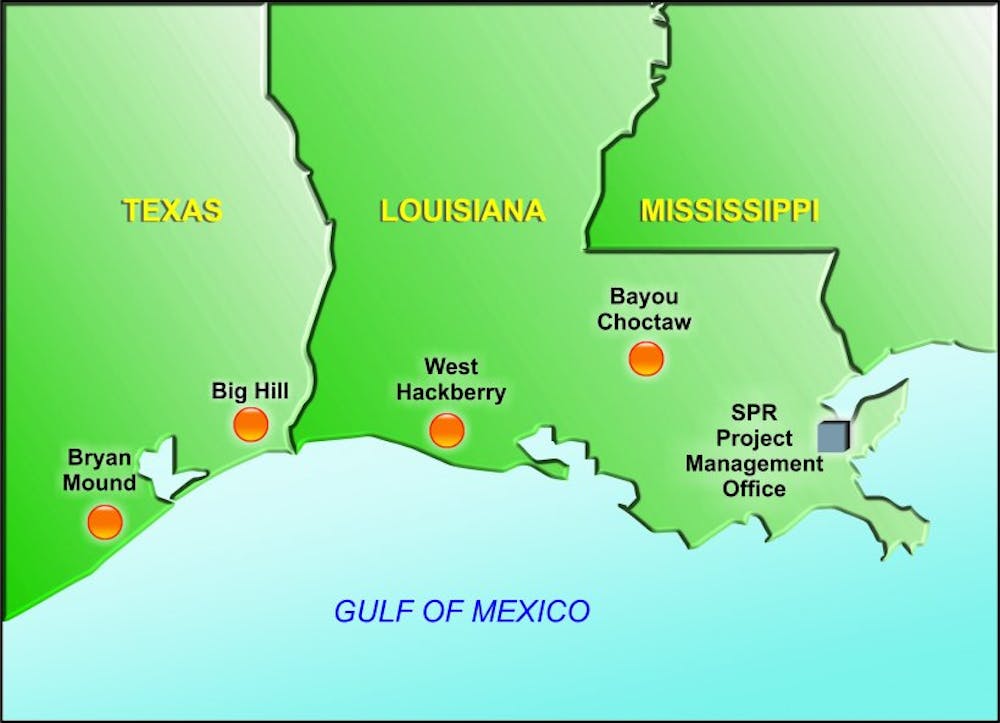
A map with red dots showing locations of SPR spots.
The map shows the locations of the oil held in the Strategic Petroleum Reserve.
Department of Energy

Congress created the Strategic Petroleum Reserve as part of the Energy Policy and Conservation Act of 1975. Its oil is stored underground in a series of large salt domes in four locations across the Gulf Coast, in Texas and Louisiana.

Congress originally said the reserve should hold up to 1 billion barrels of crude and refined petroleum products. Though it has never reached that size, the U.S. reserve was until 2025 the largest in the world, with a maximum volume of 713.5 million barrels.

Over the past decade, however, China has aggressively expanded its own stocks to an estimated 1.4 billion barrels. Such an enormous volume can be viewed as a sign of Beijing’s deep concern about oil security, as China relies on imports to supply more than 70% of its consumption.

In mid-March 2026, meanwhile, the U.S. reserve was only 60% full at 415 million barrels. In 2022, the Biden administration released 180 million barrels in response to the price jump caused by Russia’s invasion of Ukraine. An analysis by the U.S. Treasury Department concluded the release did reduce market volatility and lower prices at the pump by up to 30 to 40 cents per gallon. Nonetheless, it has not been a priority under the Biden or Trump administrations to refill the reserve.

As a result, the release of 172 million barrels recently ordered by the White House will temporarily shrink the U.S. reserve to 243 million barrels – only 34% of its capacity. That level is its lowest since the early 1980s.

U.S. Secretary of Energy Chris Wright has said plans are in place to add 200 million barrels back later in 2026. But doing so would return the reserve only to the pre-war stock level.

Risk or reward?

Nonetheless, the oil shock that has happened as a result of the Iran war has proven that the idea of strategic reserves is still relevant. Though the process of how it is utilized can be debated, having emergency stocks of a vital resource subject to supply crises can hardly be called irrational.

In the early days of the war, the White House said there was no reason for a release from the U.S. Strategic Petroleum Reserve.

But only days later, the administration changed its mind, reportedly because President Donald Trump saw oil prices soaring and remaining elevated.

But, as noted, this withdrawal will leave the U.S. and other nations in a highly vulnerable position. Additional price increases – like those that have occurred because of attacks on Gulf oil and gas facilities, production, and shipment locations – could well lead to a second call from the International Energy Agency to release oil from the world’s remaining reserves.

The Conversation

Scott L. Montgomery does not work for, consult, own shares in or receive funding from any company or organization that would benefit from this article, and has disclosed no relevant affiliations beyond their academic appointment.

– ref. Over 400 million barrels will be added to the oil market soon – what are strategic reserves and what can they do? – https://theconversation.com/over-400-million-barrels-will-be-added-to-the-oil-market-soon-what-are-strategic-reserves-and-what-can-they-do-278370