Does BBC Civilisations gets its four stories of collapse correct? Experts weigh in

Source: The Conversation – UK – By Jay Silverstein, Senior Lecturer in the Department of Chemistry and Forensics, Nottingham Trent University

In four episodes, the BBC’s Civilisations series tells the story of the fall of the Romans, Aztecs, Egypt’s Ptolemies and Japan’s Edo Samurais. The show tells these stories through a combination of recreated dramatic scenes, explanation from experts and discussions of objects from the British Museum. Here, four experts in each period have reviewed the episodes and shared their recommendations for further reading.

The Collapse of the Roman Empire

The canonical date of the fall of the Western Roman Empire is 476, when the general Odoacer deposed the last emperor, Romulus Augustulus – a child who had been on the throne for less than a year. I teach my students that this relatively muted event was probably not noticed by many ordinary people at the time, as very little likely immediately changed in their daily lives.

Instead, the much more dramatic events of 410 were the real collapse moment of the ancient world: the metropolis of Rome, the capital of the empire, was sacked by King Alaric and his Gothic army. As one of the expert contributors to this episode puts it, you would remember where you were when the news reached you.

The episode’s key achievement is to depict the way that Roman mistreatment of the Goths – a Germanic-speaking people many of whom fled war with Huns into the Roman Empire – effectively threatened their survival and backed them into a corner. While historians have long discussed these realities, it’s refreshing to see this message presented in such a compelling and humane way to the wider public. The contemporary resonances are obvious, and while history cannot provide us with answers, it can give us food for thought.

Further reading
To learn more about the end of the Western Roman Empire, I would recommend starting with the very readable and provocative introduction by Bryan Ward-Perkins, The Fall of Rome: And the End of Civilization. It looks at the very real changes that ordinary people would have experienced as a centuries-old empire fell apart.

Tim Penn is Lecturer in Roman and Late Antique Material Culture at University of Reading

The Last Days of the Ptolemies in Egypt

Neither the gradual decline nor the final fall of the Ptolemaic dynasty in Egypt in 30 BC is accurately realised in this episode. It presents a simplistic narrative riddled with factual inaccuracies. It also features inadvertent misreadings or deliberate misrepresentations that play fast and loose with the historical chronology of the reign of Cleopatra VII, and the significant historical figures that were part of it.

Such inaccuracy is not helped by the fact that, with the exception of two contributors, no one participating is actually an expert on this specific period of ancient Egyptian history. One prominent figure is not even an historian or archaeologist at all.

Most of the artefacts that are incorporated in an attempt to provide insight don’t date to this period of Egyptian history, and lead the narrative off in irrelevant directions. It’s not clear who the intended audience is, nor what they are expected to take away from this, beyond appreciation for the sumptuous dramatisation that unfolds in the background. There was potential here, such as the contribution of climate change and the wider geopolitical context, that was unfortunately squandered.

Further reading

If you want to read about Cleopatra’s reign specifically, then Duane W. Roller’s Cleopatra: A Biography is good. For the Ptolemaic dynasty more broadly, from start to end, I’d recommend Lloyd Llewelyn-Jones’s The Cleopatras: The Forgotten Queens of Egypt.

Jane Draycott is Senior Lecturer in Ancient History at the University of Glasgow

The Collapse of the Aztec Empire

The episode on the Aztecs focuses on the Aztec emperor Moctezuma in the 15th century. It offers a refreshing shift from the Eurocentric narrative that often paints him as indecisive while glorifying his nemesis, the conquistador Hernán Cortés. Here, the roles are reversed: Cortés’s ambition and brutality are exposed, while Moctezuma appears as a thoughtful and capable leader. Their confrontation feels less like a simple conquest and more like a high-stakes chess match – Moctezuma had Cortés in check until one audacious move changed history.

If you’re looking for a comprehensive account of the Aztec collapse, this episode won’t deliver that. Experts such as Matthew Restall, known for challenging colonial myths, are used sparingly, and the story remains selective. Key events are skipped, and contradictory sources are left out. All of this is inevitable in a single-episode format.

What it does offer is a visually stunning, well narrated introduction to imperial collapse, framed through iconic artefacts that bring the past to life.

Further reading

To learn more about the fall of the Aztecs, read
The True History of the Conquest of New Spain, Volume 4 by Bernal Díaz del Castillo – a Spaniard who served under Cortés during conquest of the Aztec Empire. There are many translations but the first edition of the text, edited by Mexican historian Genaro García and translated by Alfred Percival Maudslay, is my pick.

Jay Silverstein is Senior Lecturer in the Department of Chemistry and Forensics at Nottingham Trent University

The End of the Samurai in Japan

This episode deals with the military encounter between the American “black ships” (kurofune 黒船) under naval commodore Matthew Perry and the Tokugawa shogunate 徳川幕府 between 1852 and 1855. The interviewed historians are certainly familiar with the event, yet the conceptual framing is not quite right.

“Traditional Japan” is introduced as an unchanging and isolated place. In reality, Japan had lived in close economic and cultural symbiosis with continental East Asia since at least the rise of Buddhism in the 6th century.

A 1603 proclamation, known as sakoku, by the Tokugawa shogunate did make Japan a hostile place for Christians and foreigners. However, the Protestant Dutch, arch-enemies of their former Spanish overlords, were granted the right to send annual expeditions. These became the basis for Japan’s “Dutch studies” (rangaku 蘭學), an exchange of scientific knowledge which is ignored by the programme. Meanwhile, contact with China and Korea continued, albeit under stricter regulations.

The documentary dwells on the image of a powerful and conservative samurai class without alluding to the social transformations which had eroded its influence. The capital Edo was not only the largest city on earth, but a veritable engine of urbanisation and commercialisation.

This documentary is still a pleasure to watch, but the premise that Perry’s western gunboats led to the “fall” of Japanese civilisation is erroneous.

Further reading
If you want to know more about the political and social turmoil that led to the end of the samurais and the Tokugawa shogunate, I recommend The Emergence of Meiji Japan by Marius B. Jansen.

Lars Laamann is Senior Lecturer in the History of China At Soas, University of London


This article features references to books that have been included for editorial reasons, and may contain links to bookshop.org. If you click on one of the links and go on to buy something from bookshop.org The Conversation UK may earn a commission.


Looking for something good? Cut through the noise with a carefully curated selection of the latest releases, live events and exhibitions, straight to your inbox every fortnight, on Fridays. Sign up here.


The Conversation

The authors do not work for, consult, own shares in or receive funding from any company or organisation that would benefit from this article, and have disclosed no relevant affiliations beyond their academic appointment.

ref. Does BBC Civilisations gets its four stories of collapse correct? Experts weigh in – https://theconversation.com/does-bbc-civilisations-gets-its-four-stories-of-collapse-correct-experts-weigh-in-270114


Why hosting the UN climate summit in the Amazon was so important, despite the disappointing outcome

Source: The Conversation – UK – By Alexander C. Lees, Reader in Ecology and Conservation Biology, Manchester Metropolitan University

Storm clouds build over the Cop30 host city of Belém. Alexander Lees, CC BY-NC-ND

Extreme heat, fires and flooding – all hallmark consequences of climate change – directly influenced this year’s UN climate change conference Cop30 in Belém, Brazil.

For the first time, this annual climate summit was held in Amazonia,
a place at the frontline of climate change. The pivot from the two previous conferences in petrostates Azerbaijan and UAE to a base in the world’s largest tropical forest (albeit in one the world’s largest oil producing countries) was jarring.

As Amazonian researchers, and past and present residents of the city, we saw the potential for Cop30 to move discussions further forward than its predecessors in two key ways.

First, and in contrast to many previous gatherings that have sidelined them – or suppressed them altogether – Indigenous and marginalised voices were impossible to ignore at Cop30. They have helped shape media narratives and discourse in the blue zone, the venue that hosted events in hundreds of dedicated spaces for national and organisational bodies.

The Belém gathering saw the largest Indigenous participation in Cop history, with around 900 registered representatives. The Cúpula dos Povos, a parallel event hosted at the Universidade Federal do Pará, gave many more Indigenous peoples and local communities a platform to argue against the status quo of relative inaction.


Read more:
Behind the scenes in Belém: The Conversation’s report from Brazil’s UN climate summit


Hosting Cop30 in Belém broke down the physical travel barriers for many potential attendees from Indigenous peoples and local communities. The summit organisers went beyond the normal attempts at tokenism in engaging them in discussions.

The region’s extensive river networks allowed many Indigenous peoples and local communities from across Amazonia to reach Belém by boat. They held a symbolic “people’s flotilla” with over 500 people in 200 vessels, sailing to demand their voices be heard in calling for climate justice and an end to mining and large infrastructure projects affecting their territories.

Meanwhile, the disruptive influence of some Indigenous protesters and their allies in breaching security lines and temporarily obstructing access to the blue zone hopefully focused minds inside, in addition to garnering global headlines.

Indigenous delegates at the opening of the 30th Conference of the Parties to the United Nations Framework Convention on Climate Change (Cop30).
Ricardo Stuckert / PR, CC BY-ND

The second reason to be hopeful from Cop30 was that the realities of climate and land use change are jarringly obvious in Amazonia. Belém’s oppressive heat and humidity were evident even within the main blue zone arenas. Many delegates were visibly uncomfortable.

This catalysed an official complaint from UN climate chief Simon Stiell about the climate conditions in the Cop venue, asking for “a clear delivery plan on how temperatures will be brought down within the next 24 hours”. The parallels to the goals of the wider negotiation process were hard to miss.


Read more:
Cop30: five reasons the UN climate conference failed to deliver on its ‘people’s summit’ promise


The city’s local climate became a protagonist in its own right. A huge thunderstorm during one afternoon flooded many roads and brought down trees across the city, causing power outages.

A recent study has shown that Belém is now experiencing more and more days of high “wet bulb” temperatures (which determine the comfort level of the atmosphere). Such temperatures can lead to deadly heat stress. Continued warming could make many parts of the tropics unlivable.

Social justice as climate justice

These climate consequences will disproportionately be felt by the less affluent, and significant social inequalities were laid bare to delegates travelling through the urban area – despite some major investment. The need to foreground social justice as climate justice, as argued by Brazilian president Luiz Inácio Lula da Silva in his opening speech, was visibly evidenced by the poverty in some suburbs and stark inequalities.

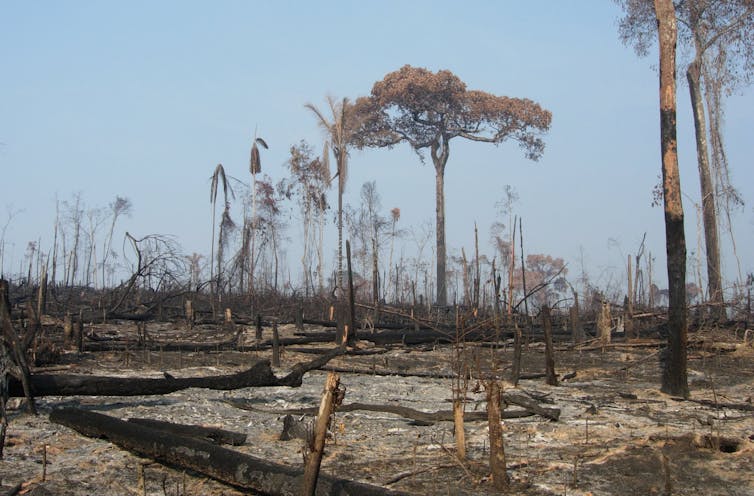
For many delegates flying into Belém, this will have been their first time in a tropical forest region. But this is the most heavily deforested region in Amazonia – a fact that is painfully evident to anyone flying in from the south on a clear day.

In a Cop30 venue on the campus of the Brazilian Agricultural Research Corporation, our team guided delegates, including heads of state, royalty and CEOs of large multinationals on an interpretive trail through a regenerating patch of rainforest. Some visitors were moved to tears to experience a tropical forest and hear about its importance for climate and biodiversity.

This underscores the power of hosting Cop in such a critically important ecosystem. People could also see how a forest can grow back, if given the chance.

The biome and region were much more than just a venue or educational opportunity. The fate of the Amazon and other tropical forests became a focal point of many of the blue zone discussions, clarifying strong climate and nature links.

This facilitated a narrative shift towards a search for the enabling conditions of forest protection, the value of biodiversity, and the importance of community-led stewardship.

This prominence of both nature and forest citizens is key, as these are fundamental to climate justice and the development of fair and effective adaptation and mitigation strategies. For example, forest fires became a central theme in week two (when the blue zone itself was evacuated owing to an electrical fire).

Vestiges of rainforest near the town of Novo Progresso in the Brazilian state of Pará – while the fire in the blue zone attracted press coverage, the location of the Cop also drew attention to threats to the Amazon.
Alexander Lees, CC BY-NC-ND

However, while a stronger focus on nature is essential, the failure to address strategies for ending fossil fuel emissions was the bitter outcome of Cop30. The presentation of the updated global carbon budget showed that we have only four years left to stay within 1.5°C of warming. That’s clearly an impossible task.

Although Belém helped bring the social and ecological effects of climate change to the forefront, the final declaration (which unbelievably contained no direct reference to fossil fuels) demonstrated once again that vested interests remain the strongest barrier to progress, and that climate justice risks continuing as mere rhetoric.


Don’t have time to read about climate change as much as you’d like?

Get a weekly roundup in your inbox instead. Every Wednesday, The Conversation’s environment editor writes Imagine, a short email that goes a little deeper into just one climate issue. Join the 47,000+ readers who’ve subscribed so far.


The Conversation

Alexander C. Lees receives funding from DEFRA’s GCBC programme, the BNP Paribas Foundation’s Climate and Biodiversity Initiative and UKRI. He is a Trustee of the British Ornithologist’s Union.

Joice Ferreira receives funding from the Brazilian National Council for Scientific and Technological Development, DEFRA’s GCBC programme and the BNP Paribas Foundation’s Climate and Biodiversity Initiative.

Jos Barlow receives funding from UKRI, DEFRA’s GCBC programme, the BNP Paribas Foundation’s Climate and Biodiversity Initiative. He is a Trustee of WWF-UK.

ref. Why hosting the UN climate summit in the Amazon was so important, despite the disappointing outcome – https://theconversation.com/why-hosting-the-un-climate-summit-in-the-amazon-was-so-important-despite-the-disappointing-outcome-269841

The gift that keeps on giving: How solar panels on farms can help increase crop yields

Source: The Conversation – Canada – By Joshua M. Pearce, John M. Thompson Chair in Information Technology and Innovation and Professor, Western University

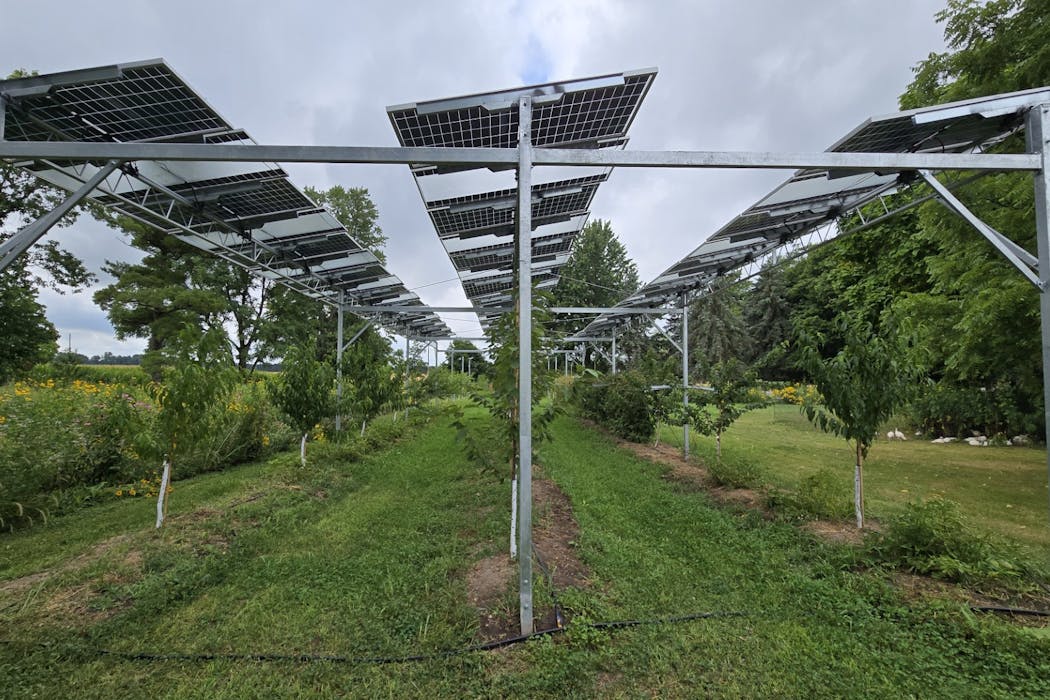
An agrivoltaic setup in southern Ontario. (U. Jamil), CC BY

Solar farm projects in the Canadian province of Alberta have been put on hold or cancelled because of a recent increase in regulations in the province. The new regulations ban solar panels from agricultural land and force solar developers to fully fund decommissioning upfront.

As a result, many originally profitable projects have been made unfeasible because of rules aimed at preventing a repeat of the orphaned oil and gas wells fiasco.

Agrivoltaics is the practice of purposefully shading agricultural crop lands with solar panels in order to enjoy the dual benefits of solar electricity and increased food production.

A new study I co-authored with my colleague, Uzair Jamil, found that partial shading to benefit crop production even works when the solar panels do not. This has interesting policy ramifications, particularly in Alberta.

How does shading crops make more food?

Studies from all over the world have shown crop yields increase when food crops are partially shaded with solar panels. Agrivoltaic yield increases are possible because of the microclimate created underneath the solar panels that conserves water and protects plants from excess sun, wind, hail and soil erosion. The temperatures are cooler, milder and all around more pleasant for plants.

Last year, we found that you could increase strawberry yield by 18 per cent under solar panels compared to strawberries in an open field. This agrivoltaic crop yield bump has been shown for dozens of other crops and solar panel combinations all over the world, including basil, broccoli, celery, corn, grapes, kale, lettuce, pasture grass, peppers, potatoes, tomatoes and more.

Agrivoltaics makes more food per acre, and could help bring down food prices while also supporting farmers in Canada. Such agrivoltaic farming can help meet Canada’s food and energy needs and reduce its fossil fuel reliance and greenhouse gas emissions as well as the rest of the world.

Our new study shows that the microclimate that benefits plants beneath agrivoltaics is maintained even when the solar is not generating any electricity.

We analyzed the lifespans of key agrivoltaic system components, experimentally measuring microclimate impacts of two agrivoltaic arrays. The results showed agrivoltaics still benefit crops even when unpowered.

What about Alberta?

Agrivoltaics also benefits renewable energy companies, farmers and everyone who eats food. However, to ensure “proper” site restoration after solar projects are complete, Alberta law demands land is returned to its original undisturbed state.

The newly passed Alberta’s Conservation and Reclamation Regulation makes it incumbent on the renewable energy developers to submit financial security. Specifically, new solar projects are required to post 30 per cent of the estimated security amount, while the projects already in operation are required to pay 15 per cent.

The comparison to orphaned oil and gas wells with a remediation cost estimates of $100 billion prompted preemptive legislation targeting solar farms, but is that fear justified?

Agrivoltaics could serve as a potential exception to solar photovoltaic development on agricultural land in Alberta, which is otherwise effectively not permitted.

Moving forward with agrivoltaics in Alberta

To ensure Agrivoltaics co-exist well with farming, Alberta mandates agricultural impact assessments before solar panels are installed, but it offers little guidance on how to optimize their co-use.

Some flexibility emerges through the assessment process, but it is not consistently built into infrastructure regulations.

In addition, Canadian zoning laws do not recognize agrivoltaics as a distinct land-use classification. That means that while provincial legislation might allow for agrivoltaics development, no explicit regulations are available.

To make things more clear for both farmers and financial backers, Canada could benefit from looking to other countries that have agrivoltaic legislation, such as France and Italy, to ensure land is being used in the most efficient way possible.

Experimental results from our research indicate that the shade provided by solar panels moderates soil temperatures and enhances soil moisture. Agrivoltaic systems, even when not used for power generation, can continue to deliver meaningful value for farmers through shading.

Government policy must adapt to this dual-use reality. Alberta’s current rules not only hurt the solar industry but also prevent farmers from making use of agrivoltaic infrastructure to help them grow more food for all of us.

The Conversation

Joshua M. Pearce has received funding for research from the Natural Sciences and Engineering Research Council of Canada, the Canada Foundation for Innovation, Mitacs, the U.S. Department of Energy and the Advanced Research Projects Agency-Energy, the U.S. Department of Defense, the Defense Advanced Research Projects Agency (DARPA), and the National Science Foundation (NSF). In addition, his past and present consulting work and research are funded by the United Nations, the National Academies of Science, Engineering and Medicine, many non-profits and for-profit companies in the energy and solar photovoltaic fields. He is a founding member of Agrivoltaics Canada. He does not directly work for any solar manufacturer and has no direct conflicts of interest.

ref. The gift that keeps on giving: How solar panels on farms can help increase crop yields – https://theconversation.com/the-gift-that-keeps-on-giving-how-solar-panels-on-farms-can-help-increase-crop-yields-269264

How ‘relationship anarchy’ is changing the nature of connection for millennials and Gen Z

Source: The Conversation – Canada – By Treena Orchard, Associate Professor, School of Health Studies, Western University

When the term anarchy pops up in everyday conversations, images of lawlessness and chaos after a government breakdown or catastrophic event come to mind. Think of the anti-hero comic character the Joker or the famed Sons of Anarchy series about an outlaw biker club that values family loyalty as much as violent crime.

Yet anarchy can also be understood as a belief system that emphasizes freedom and equality over authoritative rule, individuality over conformity.

These values are central to relationship anarchy, which is an approach to intimacy and human connection that’s becoming especially popular among millennials and Gen Z.

A recent survey from the Feeld dating app shows that 50 per cent of its members practise relationship anarchy, particularly those who are trans, non-binary, gender diverse or pansexual.

With an emphasis on relationships that decentre prescribed notions of love and power, relationship anarchy is a compelling new approach to interpersonal and communal connection. But what exactly is it and how can people use relationship anarchy to reinvent their relationships?


Dating today can feel like a mix of endless swipes, red flags and shifting expectations. From decoding mixed signals to balancing independence with intimacy, relationships in your 20s and 30s come with unique challenges. Love IRL is the latest series from Quarter Life that explores it all.

These research-backed articles break down the complexities of modern love to help you build meaningful connections, no matter your relationship status.


What is relationship anarchy?

First introduced in 2006 by Swedish tech developer, writer and producer Andie Nordgren, this approach to relating uses anarchic principles like anti-capitalism, anti-hierarchy and mutual aid to resist traditional relationship models.

Nordgren outlines four building blocks of relationship anarchy:

  1. The rejection of interpersonal coercion
  2. The importance of community
  3. Mutual aid as essential support
  4. Commitments as communication, not contract

The idea is that replacing the codependence of coupledom with more expansive and effective forms of interpersonal care can build stronger communities that emphasize interdependence among people, animals and the environment.


Read more:
Relationship anarchy is about creating bonds that suit people, not social conventions


Relationship anarchy is a fundamentally queer and inclusive framework that is predicated upon creating relationships that suit what people really want versus adhering to social conventions, whether because of obligation, family pressure or fear of expressing true desires.

Doing relationship anarchy means giving equal importance to friends, lovers and companions, and most practitioners are in alternative relationship structures, such as non-monogamy.

Given the social embarrassment now attached to certain kinds of relationships — as a recent Vogue piece questioning whether “having a boyfriend is embarrassing” suggests — alongside the steady rise in the number of unmarried people, many may already be adopting these radical approaches without realizing it.

How to practice relationship anarchy

If you’re interested in exploring relationship anarchy in your own life, a great place to start is by reflecting on the kinds of relationships you have been in, and the ones you desire.

How do you want these connections to feel? Have you been pressured into a monogamous partnership but really want to try something else? Do you miss friends who often slip away when you’re in a long-term relationship? Do you want to reduce the rigid boundaries that define and differentiate your relationships with friends, lovers, colleagues and family members?

Maybe you’re struggling to navigate family commitments that feel overwhelming because they crowd out the time you want to devote to self-care routines.

There are multiple entry points for bringing relationship anarchy into your life. You could tell your partner that you’d like to learn more about it and see how they respond when you share resources. You could focus your relationship energies on fostering meaningful connections with people who make up your chosen family or live in a more communal way.

Because relationship anarchy rejects labels like “friends,” “lovers” or “life partners,” you might abandon these categories in favour of more integrated ways of connecting that revolve around customized connections.

Perhaps you want to re-evaluate your consumptive patterns, which are often linked to traditional relational structures, and live in less resource-intensive ways.

Is the future of love non-hierarchical?

Whether it’s the decline of dating apps, the rise of AI matchmakers, or books about celibacy, love is at the beating heart of countless conversations and debates.

Given the growing interest in non-traditional relationships and resisting political systems that continue to tap our Earth for depleted resources, it makes sense that relationship anarchy is on the ascent. A lot of us are eager for new ways of relating that we define and navigate in our own unique ways.

Relationship anarchy also offers a way of enriching our social networks and community bonds, both of which can go a long way to reduce the social isolation and disconnection many millennials and Gen Zers experience. No relationship can address all of the complex challenges and conditions impacting younger generations, but how you relate evolves over time and relationship anarchy might offer another way of connecting that appeals to you.

You can reinvent your ideas about love and relationships so that they align with what you actually want. No, it’s not easy or straightforward — welcome to life and love — but it is possible.

In a media-saturated world that often prioritizes profit over meaningful connection, we can create alternate ways of relating that feel kinder, more collaborative and fun. Relationship anarchy might just offer the non-hierarchical antidote a lot of us are looking for.

The Conversation

Treena Orchard has received funding from CIHR, SSHRC, and Western Ontario but no research monies were used in the creation of this article.

ref. How ‘relationship anarchy’ is changing the nature of connection for millennials and Gen Z – https://theconversation.com/how-relationship-anarchy-is-changing-the-nature-of-connection-for-millennials-and-gen-z-268640

South Africa’s G20 presidency: diplomatic victory, but a weak final declaration

Source: The Conversation – Africa – By Danny Bradlow, Professor/Senior Research Fellow, Centre for Advancement of Scholarship, University of Pretoria

US president Donald Trump’s efforts to derail a successful wrap-up of the G20 summit in Johannesburg failed. Trump boycotted the meeting and the US told other countries through diplomatic channels not to sign a communiqué. Nevertheless, the 19 remaining countries and regional organisations signed a 30-page declaration. This called for, among other things, increased funding for renewable energy projects, more equitable critical mineral supply chains and debt relief for poorer countries. Senior research fellow Danny Bradlow explains what was, and wasn’t, achieved.

In what ways was South Africa’s G20 presidency a success?

The G20 has been a great diplomatic success for South Africa in at least three ways.

First, it succeeded in leading all the other G20 countries and organisations to adopt by consensus a leaders’ declaration despite a boycott and bullying tactics by Washington.


Read more:
G20 in a changing world: is it still useful? Four scholars weigh in


The 120 paragraph Leaders’ Declaration covered all the issues embodied in the “Solidarity, Equality and Sustainability” theme that South Africa chose for the G20. They included:

  • debt and access to affordable, sustainable finance

  • financing for a just energy transition

  • critical minerals

  • inequality

  • a second phase for the Compact with Africa The first phase was launched in 2017 during Germany’s G20 presidency and provided a framework for Africa’s engagement with its development partners.

  • illicit financial flows

  • inclusive growth.

Second, South Africa succeeded in launching a number of initiatives over the course of the year.

Firstly, the G20 acknowledged South Africa’s five years of support for the establishment of an African Engagement Framework within the G20’s finance track. It is intended to support enhanced cooperation between Africa and the G20.

Secondly, leaders expressed support, in various ways, for the G20 working group initiatives on illicit financial flows, infrastructure, air quality, artificial intelligence, sustainable development and public health. The ministerial declaration on debt was also supported. This includes reforms around initiatives supporting low and middle income countries facing debt challenges.

Thirdly, the Ubuntu Legacy Initiative was launched. This is designed to fund cross-border infrastructure in Africa. It was also agreed that an Ubuntu Commission will be set up to encourage research and dialogue on dealing cooperatively with global challenges. Ubuntu can be explained with reference to the isiZulu saying ‘umuntu ngumuntu ngabantu’ which means ‘a person is a person through other people.’ It entails an ethics of care, compassion and cooperation.

Lastly, South Africa succeeded in delivering an effective, efficient and constructive G20 year. This is no small feat. It required the country to organise more than 130 meetings of G20 working groups, task forces and ministerial meetings, in addition to the leaders’ summit.

Is this only a good news story?

It is inevitable that any complex, multifaceted and voluntary process involving participants with strong and contrasting views will not be an unqualified success.

This, without doubt, is the case with South Africa’s G20 year. The environment was complicated by a number of factors:

  • the wars in Gaza, Ukraine and Sudan

  • the actions of the US and some of its allies to undermine the international community’s efforts to address the intertwined challenges of climate, biodiversity, energy, poverty, inequality, food insecurity, debt, technology and development, and

  • trade wars initiated by Trump imposing tariffs on trading partners.

These factors meant that getting the diverse membership of the G20 to reach agreement on a broad range of complex issues would be extremely difficult. In fact, it would only be possible to do so at a high level of abstraction.

Unfortunately, this proved to be the case. The result is that the G20 Leaders’ Declaration largely boils down to a set of general statements that are almost totally devoid of commitments for which states can be held accountable. Such general statements are not uncommon in the diplomatic statements issued at the end of high-level multilateral meetings. However, this is an extreme example.

The leaders expressed their support for a number of voluntary principles on issues such as disaster relief, artificial intelligence, critical minerals and debt. They also expressed support for the work of organisations like the multilateral development banks and the International Monetary Fund, and for some specific South African led initiatives like the review of the G20 itself.

However, there are no time frames or deliverables attached to these expressions of support.

What needs to be done to make the declaration effective?

The G20 is a voluntary association with no binding authority. The declaration’s efficacy therefore ultimately depends on all the G20’s stakeholders both taking – and advocating – for action on the issues raised in it.


Read more:
The G20: how it works, why it matters and what would be lost if it failed


These stakeholders include states and non-state actors like international organisations, businesses and civil society organisations.

The value of the declaration is how both the state and non-state actors use it to advocate for action. That can be in future G20 meetings as well as other regional and international forums.

How can the declaration be used to lead to action?

One of the biggest challenges facing African countries is debt. Over 20 are either in debt distress or at high risk of debt distress. Many African countries are being forced to choose between servicing their debts and investing in the development and climate resilience of their own populations.


Read more:
Africa has a debt crisis: momentum from G20 in South Africa can help find solutions


The challenge that this creates for African states is exacerbated by their limited access to affordable, predictable and sustainable sources of development finance.

This means that African countries are unlikely to gain a sustainable path to reaching their development and climate goals without substantial action on debt and development finance. The Leaders’ Declaration, in paragraphs 14-22, clearly recognises the challenge. Key elements include:

  • the endorsement of the statement their finance minister and central bank governors made on debt sustainability

  • a reiteration of the support for the Common Framework for dealing with low-income countries in debt distress. The framework establishes a process for dealing with the official and commercial debt. But the process has proven to be too slow and cumbersome.

  • a commitment to working with the Global Sovereign Debt Roundtable to explore better ways to meet the needs of debtor countries in distress and their creditors. This roundtable establishes an informal mechanism that brings together creditors and debtors and other stakeholders in sovereign debt to discuss ways to improve restructuring processes.

But these will be just empty words unless the endorsements are turned into action.

There are three actions that stakeholders can take.

First, African leaders can form a regional borrowers’ forum to discuss the debt issue and share information on their experiences dealing with creditors and on developing common African positions on development finance and debt. This would build on the work done by:

  • the African Expert Panel appointed by South African president Cyril Ramaphosa, and

  • the African finance ministers under the auspices of the African Union and the UN Economic Commission on Africa.

They can also use this forum to engage in open discussions with African non-state actors.

Second, African non-state actors can develop strategies for holding the leaders accountable if they fail to follow up on the declaration. And they can hold creditors accountable for their actions in their negotiations with African debtors in distress.

Third, African non-state actors should initiate a review of how the IMF needs to reform its operational policies and practices. Africa has eloquently advocated for greater African voice and vote in IMF governance. The next step should be to explore how the substantial changes that have taken place in the scope of IMF operations can be translated into operational practices. These include the macroeconomic impacts of climate, gender and inequality –

The Conversation

Danny Bradlow in addition to his position with the University of Pretoria is a senior G20 advisor with the South African Institute of International Affairs; a Non-Resident Senior Fellow at the Global Development Policy Center, Boston University and a Compliance Officer with the Social and Environmental Compliance Unit, UNDP.

ref. South Africa’s G20 presidency: diplomatic victory, but a weak final declaration – https://theconversation.com/south-africas-g20-presidency-diplomatic-victory-but-a-weak-final-declaration-270476

Inquiry says COVID lockdowns could have been avoided – they’re right

Source: The Conversation – UK – By Mark Woolhouse, Professor of Infectious Disease Epidemiology, University of Edinburgh

Alexey Fedorenko/Shutterstock.com

The UK was one of the most locked down countries in the world during the COVID pandemic, but this was not inevitable – it was a failure of public health policy.

That should be the lasting legacy of the UK COVID inquiry’s latest report, not a critique of politicians no longer in office.

In a public health emergency, saving lives will always be the first priority, but even as COVID raged, it was never a binary choice between harsher restrictions or more deaths. The choice was between different ways to protect people from a dangerous virus.

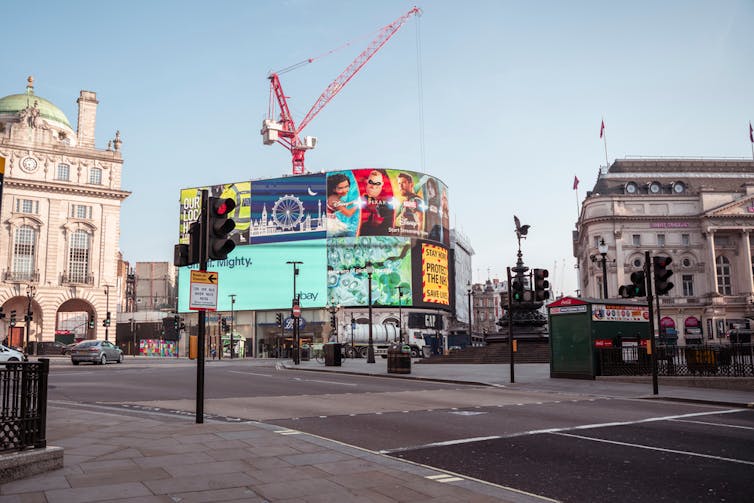
In 2020, governments that had never previously contemplated lockdowns imposed them anyway. On March 23, the UK population was ordered to stay at home, without any assessment of how much harm this would do to the economy, education, access to healthcare and the wellbeing of everyone – especially children.

The vast scale of the resulting damage shows why avoiding lockdowns must be a priority for policymakers in future pandemics.

I gave evidence to that effect to the COVID inquiry myself. I also listened to testimony from politicians, officials, doctors and epidemiologists. But I heard surprisingly little about how COVID could have been tackled without lockdowns, even though everyone has had years to reflect on this question.

Instead, witness after witness argued that the problem with the March 2020 lockdown was that it came too late. Matt Hancock, the UK’s then health minister, thought it should have come three weeks earlier, but one week was the majority view.

So, the inquiry was justified in making that point in their report. Backing it up with the claim, based on a mathematical model, that it would have saved more than 20,000 lives is more contentious. Historians distrust counterfactuals, and it makes no difference if one is expressed in equations rather than words.

Despite making that claim, the inquiry doesn’t like lockdowns. “Far from it,” said the inquiry’s chair, Baroness Hallett, when she introduced her report. She explained that if action had been taken earlier, then lockdowns “might not have been necessary at all”.

That’s correct: earlier action can be less drastic action. There is no need for draconian measures intended to drive down the number of cases if you don’t let them rise in the first place.

Piccadilly Circus during lockdown. No pedestrians.
The UK was one of the most locked down countries in the world.
Jam Travels/Shutterstock.com

More moderate precautions from respiratory hygiene to self-isolation of people with COVID were enough to keep essential services going, even to make professional sports possible, long before there were vaccines. Next time, basic interventions must be identified more quickly, and rolled out faster and wider than they were in 2020.

The inquiry’s report also concludes that more should have been done to protect those most vulnerable to COVID: the elderly, frail and infirm. This should have been the priority throughout, but it was overshadowed by lockdown — a strategy that did not do enough to protect care home residents, who faced far greater risks than the children no longer able to go to school.

“Cocooning”, ensuring those around them are virus free, is the most effective way of protecting the vulnerable. The cumbersome PCR tests used early in the pandemic were not ideal for this purpose. Lateral flow devices were far better, yet this straightforward technology was not largely deployed for almost two years.

When advisers stop offering alternatives

The next pandemic may be different from COVID, so more generic lessons must be learned too. The most pressing one is why it took so long to intervene effectively, with February 2020 described as a “lost month”.

The inquiry concluded that the quality of the UK’s political leadership was a major barrier, but when the next pandemic arrives, it will again be a case of whoever is in the hot seat. Other considerations are more controllable.

Much better preparedness planning, real-time data collection, and competent public health agencies are all important. So are more resilient national health services, though their current state makes that harder to deliver.

Then there is the approach to giving scientific advice. I write as a former member of COVID advisory committees to the UK and Scottish governments, and the inquiry report describes my attempts to push for strong and urgent action from mid-January 2020. That I failed is no surprise; throughout that period, the UK’s highest-level advisory committee, Sage, was not conveying the same sense of urgency, to the despair of some of its own members.

As the pandemic progressed, there were repeated tensions between a government that did not want to go back into lockdown and advisers who were now reluctant to suggest anything else. I heard senior scientists tell the inquiry that the test, trace and isolate scheme had limited potential, that cocooning was too difficult, mass testing would not deliver, and localised restrictions were insufficient.

The few witnesses who rejected this counsel of despair were in a clear minority.
Yet all these interventions succeeded at other times or places.

Given what it had been told, the best the inquiry could do was endorse an abbreviated form of lockdown called a circuit-breaker; it was all that was left on the table. The COVID pandemic might have played out differently if advisers had engaged more constructively with alternatives to lockdown at the time.

This matters because policy should be informed by science but not driven by scientific advisers presenting limited options. It’s patronising to act as though policymakers will be paralysed into inaction if they hear more than one idea. Yet a senior adviser told the inquiry that advisers should “err on the side of giving unequivocal advice earlier”.

Buried deep in the report are two recommendations that point in the opposite direction. First, advisory committees should be more diverse and entertain a wider range of views. Second, they should seek to give the government options.

Last week’s COVID inquiry report fuels a vital debate that was difficult to have in 2020, even among advisers. If that makes lockdowns less likely when the next pandemic arrives, then the exercise will have been worthwhile.

The Conversation

Mark Woolhouse holds grants from the European Union and the Wellcome Trust. He was previously a member of the UK’s advisory group on modelling SPI-M-O, the Scottish Government’s Covid-19 Advisory Group and Standing Committee on Pandemic Preparedness. He has been a consultant for the Coalition for Epidemic Preparedness. He wrote a book on the pandemic response, The Year The World Went Mad (Sandstone Press, 2022), which has been entered into evidence by the UK Covid Inquiry.

ref. Inquiry says COVID lockdowns could have been avoided – they’re right – https://theconversation.com/inquiry-says-covid-lockdowns-could-have-been-avoided-theyre-right-269827

Lupus may be triggered by a common virus – new research

Source: The Conversation – UK – By Graham Taylor, Associate Professor in Viral and Tumour Immunology, University of Birmingham

Epstein-Barr virus is a type of herpesvirus. Kateryna Kon/ Shutterstock

Around 5 million people worldwide live with the autoimmune condition lupus. This condition can cause a range of symptoms, including tiredness, fever, joint pain and a characteristic butterfly-shaped rash across the cheeks and nose.

For some people, these symptoms are mild and only flare-up occassionally. But for others, the disease is more severe – with constant symptoms

Although researchers know that lupus is caused by the immune system mistakenly attacking the body’s own tissues and organs, it isn’t entirely clear what triggers this response. But a new study suggests a common virus may play a key role in lupus.

There are two main forms of lupus. Discoid lupus primarily affects the skin, while systemic lupus erythematosus – the most common form of lupus – is more severe and affects the organs.

The immune system’s B cells play a key role in systemic lupus. B cells normally produce proteins called antibodies to target pathogens such as viruses and bacteria. But in people with systemic lupus, some B cells produce antibodies, called autoantibodies, that instead bind to and damage their own organs.

What causes B cells to produce autoantibodies in people with systemic lupus is poorly understood. But this recent study suggests that the trigger may be a common virus.

Epstein-Barr virus (EBV) infects most people worldwide. Infection with EBV most commonly occurs in childhood, when it usually goes unnoticed. But if a person becomes infected by EBV in adolescence, it can cause infectious mononucleosis (better known as glandular fever).

EBV is a type of herpes virus. These are complex viruses that are able to escape the body’s immune response by hiding inside certain cells. In these cells, herpes viruses switch off their genes and go silent – like submarines diving beneath the waves to hide from the enemy. This allows herpes viruses to persist throughout a person’s lifetime – occasionally reawakening to spread to new people.

Interestingly, EBV has evolved to hide within the immune system itself, infecting and persisting in a very small number of B cells. This strategy has proven highly successful for EBV. Over 90% of adults around the world are infected with EBV – meaning the virus is hiding in their immune system’s B cells.

While most people experience no adverse consequences from their infection, EBV has been linked to certain diseases.

For instance, EBV was the first virus shown to cause cancer. Subsequent research has linked EBV to several different types of cancer – including certain lymphomas and 10% of stomach cancers. Each year, about 200,000 people develop an EBV-associated cancer.

More recently, large epidemiological studies have linked EBV with multiple sclerosis, which is an autoimmune condition. Studies have shown that people with multiple sclerosis are almost always infected with EBV.

Previous research has also suggested that EBV may be involved in systemic lupus. But this new study provides insight into the specific mechanism involved.

To conduct their study, the researchers developed a sensitive test to analyse the genetic material in thousands of B cells isolated from the blood of people with systemic lupus and healthy donors as a control.

An illustration of a B cell releasing antibodies.
People with systemic lupus had EBV present in more of their B cells.
ART-ur/ Shutterstock

They found that EBV was present in around 25 times more B cells in systemic lupus patients compared to participants who didn’t have the condition. In systemic lupus patients, EBV was present in around one in 400 B cells – while in healthy controls it was only present in around one in 10,000 B cells.

This is an interesting finding – though the researchers acknowledge it could potentially be caused by the medicines patients with systemic lupus take to control their illness. These decrease the activity of the immune system which reduces the symptoms of systemic lupus. But these medicines also reduce the immune system’s ability to control EBV infection.

The most important finding from the research was that many of the EBV-infected B cells from systemic lupus patients made autoantibodies that bound to specific proteins. These same proteins are often targeted by autoantibodies in people with systemic lupus. In contrast, EBV-infected B cells from healthy donors did not make these autoantibodies.

To understand the mechanisms involved, the researchers then studied the expression of EBV genes in the infected B cells. Although EBV was generally shown to be in its silent state, some EBV-infected B cells from systemic lupus patients produced the viral protein EBNA2, which reprogrammed the B cells to become more inflammatory. These activated B cells were better able to stimulate responses from other immune cells, including non-EBV infected B cells and T cells.

Together, these observations suggest that EBV may initiate systemic lupus by infecting and reprogramming dormant B cells to become activated. These cells produce autoantibodies that could potentially contribute to the development of systemic lupus. They also appear to recruit additional immune cells able to produce stronger autoimmune responses that are more likely to play a role in systemic lupus development.

EBV infection

These new findings raise the possibility that targeting EBV could form the basis of a new therapy to treat people with systemic lupus. But given these infected B cells also recruit additional immune cells, a broader therapeutic strategy may be needed.

Additional research will also be needed to confirm whether EBV is indeed an essential trigger for the development of systemic lupus. If this is confirmed, preventing EBV infections through vaccination could prevent systemic lupus developing.

Currently there are a number of potential EBV vaccines in development – and two candidates are being tested in large clinical trials. A key requirement for any effective EBV vaccine will be its ability to generate long-term protection against infection. This is because EBV is already widespread in the population. If vaccination only delays infection until later in life, then this could lead to many cases of glandular fever.

The results of these trials are eagerly anticipated, given the potential impact an effective vaccine could have to reduce the numbers of people worldwide that develop lupus, other autoimmune conditions, or cancers caused by EBV.

The Conversation

Graham Taylor has previously received funding from Cancer Research UK, Blood Cancer UK, the UK Medical Research Council, Melanoma UK, and the University of Birmingham to support his research team. This funding has no relation to the content of this article.

Heather Long currently receives funding from Medical Research Council, Kidney Research UK and Rosetrees. This funding has no relation to the content of this article.

ref. Lupus may be triggered by a common virus – new research – https://theconversation.com/lupus-may-be-triggered-by-a-common-virus-new-research-270309

The three spectres hanging over Rachel Reeves’ make-or-break budget

Source: The Conversation – UK – By Renaud Foucart, Senior Lecturer in Economics, Lancaster University Management School, Lancaster University

As the UK prepares for the budget announcement, familiar debates are taking shape. Should Chancellor Rachel Reeves cut welfare spending? Or reform the “triple lock” on state pensions?

Other debates focus on revenue: how should she raise money without breaking Labour’s manifesto promise not to increase taxes on working people? But these discussions are being held in a strange vacuum, where the three enormous expenditures that led the UK to this point are not mentioned.

COVID debt, energy support schemes and Brexit have fundamentally shaped the UK’s financial woes. Yet voters and politicians alike seem determined not to talk about them. Instead, they’re treated as shocks imposed on the country, although they involved hugely consequential political choices.

Gloomy vibes accompany this Advent budget, and Britain’s awkward collective amnesia is preventing the country from learning the lessons needed for future crises and from talking honestly about the best route forward.

The ghost of COVID past

The COVID pandemic required unprecedented government intervention. Between 2020 and 2022, the UK’s spending watchdog, the Office for Budget Responsibility estimates, support measures totalled £169 billion or 7% of UK GDP. Most of it (£100 billion) went on direct support for things like the furlough scheme.

In hindsight, the vaccine roll-out was one key moment when the country showed its ability to deliver on a massive scale. Some other decisions were less glorious.

There was a general lack of transparency in the purchase of health equipment during the first wave of the pandemic, and the Eat Out to Help Out scheme to support hospitality led to a further increase in infections..

But there is very little discussion of the most important, unanswered questions. Despite a long inquiry examining government failings, there has been no debate about how much risk we as a country are willing to take, and how much we are willing to pay in order to reduce that risk.

COVID support schemes increased public debt from 80.4% of GDP in 2018 to 107.4% in 2021. The government paid close to zero interest on the debt at the time.

But now, higher interest rates make it a huge burden on taxpayers. Debt interest spending is higher than the budget for education, more than twice as big as it was in 2018. This is why Reeves now appears so determined to bring down UK debt levels.

We also know the cost lockdowns put on schoolchildren. But we know very little about the cost of doing less, or the current choice to stop vaccinating people.

Perhaps the main hit on UK budget capacity comes from a global pandemic, something that will happen again in the future. The focus is on putting the finances back on track without discussing how to manage similar trade-offs next time.

The ghost of our present energy transition

When Russia invaded Ukraine and energy prices spiked, the UK faced a choice: reduce demand or subsidise consumption. It chose the latter. The government stepped in with massive support packages to pay people’s energy bills. This cost £78.2 billion, or more than 4% of GDP (compared to less than 3% on average in Europe).

There were strong arguments for this approach. Allowing fuel poverty to spike during a cost-of-living crisis would have been terrible, and there was little time to target the policy. But to be clear about what happened: the public was given huge handouts to avoid having to change lifestyles, technology or consumption patterns.

This happened in the middle of an energy transition. The goal, ostensibly, is to decarbonise, reduce dependence to fossil fuels from dictators, and to modernise infrastructure.

These are complex decisions that require public support, some level of sacrifice, but also a clear collective commitment that change is inescapable. But this is not how the country is approaching these challenges, having just demonstrated that when energy costs rise the government will step in.

Just like COVID debt, UK taxpayers carry the cost of energy support debt while sweeping the decisions that caused it under the rug.

The ghost of Brexit yet to be

The UK’s relationship to Brexit appears more confused than ever. Only 11% of British adults think Brexit is more a success than a failure, and 56% would vote to rejoin the EU. Yet many tout Reform UK leader Nigel Farage as the frontrunner to be the next prime minister while also blaming him (among others) for Brexit’s failures.

This may be because Brexit has largely disappeared from the public’s radar, as Prime Minister Keir Starmer starts to move towards more integration with the EU.

anti-brexit protesters waving a placard reading populism leaves us poor.
The figures are in and they’re not good – Brexit has shaved 6-8% off UK GDP.
Ink Drop/Shutterstock

Conversations on the topic tend to do everything to avoid reopening old wounds. But economists are slowly realising the full extent of the damage caused to the economy. An unprecedented comprehensive study relying on comparisons with other nations and also on detailed data from Bank of England business surveys estimates that Brexit has reduced UK GDP by 6% to 8%. These figures were at the most pessimistic end of the estimates at the time of the referendum.

To put this into perspective, with UK tax receipts at 40% of GDP, a GDP that was 7% higher would give £77 billion extra a year to the chancellor. This is more than half of the 2024-25 budget deficit of £137 billion.

Yet, there has been no massive trade deal with the US and no attempt to replace the EU in any major way. The UK is paying a hefty price for having chosen one of the hardest possible versions of Brexit, but is yet to define what economic gain this could bring.

COVID debt, energy support and the Brexit deficit are the three ghosts that will haunt this budget – ghosts that no one wants to face. The UK cannot prepare for future pandemics without learning from how it handled COVID.

It will not complete its energy transition without confronting the choices made about who bears the costs of energy security. And it will not develop a coherent economic strategy without assessing what to do with Brexit. Until the UK faces up to these issues, it will be left discussing minor austerity measures and hoping for a Christmas miracle.

The Conversation

Renaud Foucart does not work for, consult, own shares in or receive funding from any company or organisation that would benefit from this article, and has disclosed no relevant affiliations beyond their academic appointment.

ref. The three spectres hanging over Rachel Reeves’ make-or-break budget – https://theconversation.com/the-three-spectres-hanging-over-rachel-reeves-make-or-break-budget-270388

‘Quiet piggy’ and other slurs: Powerful men fuel online abuse against women in politics and media

Source: The Conversation – Canada – By Tracey Raney, Professor, Politics and Public Administration, Toronto Metropolitan University

Tuesday is the International Day for the Elimination of Violence against Women and the beginning of 16 days of activism against gender-based violence. It’s a global call to action by the United Nations to prevent and eliminate all forms of violence against women and girls.

This year’s theme — “End digital violence against all women and girls” — aims to draw attention to the rapid rise of hate directed at women online. Sadly, this problem is all too common in today’s political world.

Why do we need attention drawn to this issue in politics?

Technology-facilitated gender-based violence is a serious and growing threat to women and girls. It’s defined by the UN as:

“Any act that is committed, assisted, aggravated, or amplified by the use of information communication technologies or other digital tools that results in or is likely to result in physical, sexual, psychological, social, political, or economic harm, or other infringements of rights and freedoms.”

It includes hate speech, violent threats, cyber-harassment, doxxing, image and video-based abuse, astroturfing, gendered disinformation and defamation.

Silencing prominent women

Marginalized women and women with public-facing roles — especially politicians, journalists and activists — often bear the brunt of attacks, with the intent to silence and push them out of the public arena.

While popular assumptions about online misogynists view them as “bearded white dudes in a basement” ranting about women on their computers anonymously, some political leaders are also unfortunately spreading misogyny openly online.

What motivates leaders to spread gendered hate online?

Politicians who are most likely to use misogynistic rhetoric are those who seek to uphold a “masculinist strongman ideal,” according to research by British scholar Nitasha Kaul. She explains how public figures like Donald Trump, Vladimir Putin and Narendra Modi have all used misogyny to assert their power.

By positioning women (and men who do not conform to dominant masculine norms) as inferior, strongmen are signalling their dominance to their followers and to other “strong” men.

When it’s directed at women in the public eye, political misogyny serves to suppress the voices of political opponents and people with differing views, posing threats to freedom of expression and fundamental human rights.


Read more:
Why some populist supporters want a strong-arm leader and others just want change


American public policy scholar Suzanne Dovi explains how political misogyny unfolds through an evolving process, and includes three stages:

  1. Political elites advance “nasty claims” about high-profile women in politics;
  2. Those “nasty claims” connect with and/or activate conscious and unconscious prejudices regarding women in politics; and finally
  3. The audience receives and accepts the nasty claims as their own.

Online political misogyny is violent

Given their vast reach, digital platforms have become ideal spaces for leaders to spread their misogynistic views. In 2017, a Conservative MP referred to former environment minister Catherine McKenna as “Climate Barbie” on social media (the MP later apologized).

Since then, McKenna has shared details about the online violence she experienced in connection with this slur, with one meme featuring a Barbie Doll being crushed by a sledgehammer and another saying, “Tick Tock, Barbie Bitch.”

In 2023, former Conservative leader Andrew Scheer shared a post on his X account (which today has more than 250,000 followers) styled as a “wanted” poster, featuring the photos and office phone numbers of two women senators.

He urged his followers to call their offices, falsely claiming they had deliberately shut down debate on a Conservative-backed bill. Afterward, Sen. Bernadette Clement, who identifies as Black, received racist online abuse and a phone call from an unknown man threatening to come to her home. Sen. Chantal Petitclerc also reported her office being inundated with sexist voicemail messages.

‘Play dirty’

Women journalists are also being attacked, fuelled by misogynistic online posts from political leaders. In 2021, several Canadian women journalists — almost all of whom were racialized — were targeted by an online hate campaign encouraged by Maxime Bernier, leader of the People’s Party of Canada.

After the journalists raised questions about white supremacy inside the party, Bernier told his X followers to “play dirty” with them. The reporters were subsequently inundated with rape and death threats, as well as racist abuse. While X forced Bernier to take down the post and briefly restricted his account, the damage had been done.

In the United States, Trump has frequently relied on gendered attacks on women journalists as a way to humiliate, discredit and silence them. Just recently, Trump responded to a question from a woman journalist by telling her “quiet, piggy.” He has previously described women journalists as “dogs and pigs.”

The cost of online political misogyny

Online political misogyny has real-world consequences. After Trump’s Nov. 20 Truth Social post inciting violence against his Democratic rivals, congresswoman Jasmine Crockett’s office in Washington, D.C., was threatened by a white supremacist.

Writing on Blue Sky, Crockett vowed she would not back down and reminded the public that “when leaders promote hate, hate shows up — sometimes right at our door.”

As my research with Canadian political science professor Cheryl Collier shows, gender-based violence in politics has democratic costs, diminishing diverse voices and expertise in public office.


Read more:
Another barrier for women in politics: Violence


In journalism, research by Australian scholar Julie Posetti and her colleagues at the International Center for Journalists shows that online attacks against women reporters have a chilling effect, reducing their willingness (along with those of their sources, colleagues and audiences) to participate in public debate.

These attacks also undermine journalistic accountability and trust in facts during a time when mis- and disinformation have become a scourge.

How to bring about change

The UN’s global campaign challenges us to reflect on how online political misogyny can be stopped. Worldwide, governments must pass public policies and enforce laws that criminalize hate-motivated digital violence. Technology companies must ensure platform safety and enforce robust, transparent codes of conduct.

Men and boys need access to mental health support and positive role models who encourage healthy forms of masculinity, rather than framing toxic masculinity as the ideal. Concerned citizens can donate to organizations dedicated to eradicating gender-based violence, such as the Native Women’s Association of Canada, WomanACT, White Ribbon or to a women’s shelter in their local community.

Finally, public leaders must actively refuse to engage in political misogyny and lead efforts to uphold respect and civility in public discourse. Campaigns like Gov. Gen. Mary Simon’s “Building a Safer and Respectful Digital World” and Elect Respect, initiated by Burlington Mayor Marianne Meed Ward, are positive steps in the right direction.

The Conversation

Tracey Raney receives funding from the Social Sciences and Humanities Research Council of Canada (SSHRC).

ref. ‘Quiet piggy’ and other slurs: Powerful men fuel online abuse against women in politics and media – https://theconversation.com/quiet-piggy-and-other-slurs-powerful-men-fuel-online-abuse-against-women-in-politics-and-media-270435

Que penser de la justice restaurative dans les cas de violences de genre ?

Source: The Conversation – in French – By Delphine Griveaud, Chargée de recherche au Fonds national de la recherche scientifique belge (FNRS), Université catholique de Louvain (UCLouvain)

Le film _Je verrai toujours vos visages_ (2023), de Jeanne Herry, restitue avec acuité la pratique de la justice restaurative en France. Christophe Brachet/Chifoumi Prod/Trésor Films/StudioCanal/France 3 Cinéma

La justice restaurative consiste à accompagner des victimes et des auteurs d’infractions qui souhaitent dialoguer. Ce type de médiation ne prétend pas remplacer la justice pénale, mais offrir une option supplémentaire à celles et ceux qui y aspirent. La majorité de ces mesures concernent des violences sexuelles et de genre. Mais pour ce type de violences, la justice restaurative est-elle vraiment adaptée ?


Le film Je verrai toujours vos visages (2023), de Jeanne Herry, a permis au grand public de découvrir l’existence des mesures de justice restaurative prévues par le système judiciaire français. Fidèle à la réalité, cette fiction montre notamment le processus par lequel une jeune femme en vient à rencontrer son frère, qui l’a plusieurs fois violée enfant. Elle souhaite convenir avec lui d’une séparation des espaces de la ville dans laquelle elle et lui vont devoir cohabiter alors qu’il vient de sortir de prison. Ce cas a suscité des réactions critiques, soulignant les débats houleux qui entourent la justice restaurative dans le cas de violences de genre.

Peut-on traiter à égalité, dans le processus d’une médiation, les propos et attentes d’une victime d’inceste et de celui qui l’a violée ? Cela revient-il à minimiser les faits ? Ne serait-il pas dangereux, au moins psychiquement, pour une victime de violence sexuelle de rencontrer son agresseur ? Y a-t-il là un trop fort risque d’instrumentalisation du processus de la part de l’auteur des faits ?

Ces questions agitent les discussions sur la justice restaurative en cas de violences de genre, mais à l’aune de nos recherches en sciences sociales auprès des premières personnes concernées, elles tendent à réduire la complexité de la pratique.

Justice restaurative : de quoi parle-t-on ?

Depuis 2014, l’article 10-1 du Code de procédure pénale indique qu’une mesure de justice restaurative peut être proposée

« à l’occasion de toute procédure pénale et à tous les stades de la procédure, y compris lors de l’exécution de la peine, [à] la victime et l’auteur d’une infraction, sous réserve que les faits aient été reconnus ».

Ces mesures sont mises en place si victimes et auteurs le souhaitent. Elles développent une approche différente de la justice pénale : il s’agit moins de punir l’auteur des faits que de créer un dialogue entre victimes et auteurs pour réparer les victimes et responsabiliser les auteurs.

Différentes pratiques restauratives coexistent en France aujourd’hui. Les plus répandues sont les médiations restauratives : des processus, longs, menés par des animateurs et animatrices formées à cet effet, qui offrent un cadre sécurisant à une victime ou un auteur de délit/crime pour revenir sur ce qu’il s’est passé, et se préparer à une rencontre avec l’autre (son auteur, sa victime) s’ils le souhaitent.

Ces mesures reposent sur la libre participation de celles et ceux qui le souhaitent, elles ne peuvent en aucun cas être imposées. Étant donné le peu de moyens alloués et le manque d’information des justiciables, elles sont peu nombreuses. En 2023, l’Institut français pour la justice restaurative, l’association prenant en charge la majorité des mesures de justice restaurative sur le territoire dénombrait 89 mesures terminées et 158 en cours, dont plus de 90 % de médiations restauratives. En agrégeant à cela les mesures restauratives de toutes les autres organisations, à l’activité quantitativement plus restreinte, on ne dépasse pas les 200 mesures terminées sur l’année 2023. Selon les estimations les plus récentes, les deux tiers de ces mesures concernent des violences de genre, cette proportion ayant progressivement augmenté depuis 2014.

La justice restaurative : un danger pour les victimes de violences de genre ?

Parce qu’elle s’appuie sur une approche relationnelle qui tend à (ré)instaurer une communication entre eux par un processus qui propose autant d’écoute et de considération à l’un qu’à l’autre, on peut considérer que la justice restaurative tend à symétriser les positions de victime et d’auteur.

Cette démarche égalitariste peut entrer en conflit avec la perspective des associations de lutte contre les violences sexuelles (et/ou conjugales, incestueuses, etc.) qui mettent l’accent sur le rapport de pouvoir existant entre auteur et victime et sur les risques que cette asymétrie engendre en cas de face-à-face. Elles craignent que cela réinstaure l’« emprise » de l’auteur sur la victime et accroisse le risque de « revictimiser » la victime.

Reposant sur une compréhension individuelle des violences, qui emprunte à des savoirs psychologiques très diffusés actuellement, une telle approche amène à considérer le pouvoir que prennent les auteurs sur les victimes en matière de violences de genre moins comme le produit d’un contexte social inégalitaire que comme une faculté individuelle des auteurs, qui leur permet de prendre l’ascendant psychique sur leur victime pour les déposséder de leur libre arbitre. Dans cette perspective, la source du pouvoir n’est pas un ensemble de mécanismes sociaux mais la personnalité de l’auteur lui-même.

Par ailleurs, certaines associations féministes voient dans les « médiations restauratives » une manière déguisée de contourner l’interdiction pour une autorité publique d’imposer une médiation dans les situations de violences dans le couple ; celle-ci a justement été posée pour couper court aux risques d’emprise des hommes violents sur leurs victimes par la Convention d’Istanbul sur la lutte contre la violence à l’égard des femmes, ratifiée par la France en 2014.

Pourtant, la médiation restaurative n’est pas une médiation obligatoire telle qu’interdite dans la Convention, elle ne peut pas être imposée, elle n’est pas un acte de procédure pénale et n’a pas les mêmes objectifs que celle-ci. Mais ces distinctions semblent floues pour beaucoup, et les pouvoirs publics prennent donc de grandes précautions au sujet de la justice restaurative en cas de violence conjugale.

Ce sont alors d’autres types de pratiques restauratives qui sont privilégiées, des pratiques indirectes, qui accompagnent auteurs et victimes à des rencontres avec d’autres auteurs et victimes qui ont commis ou subi le même type de délit/crime, mais qui ne se connaissent pas au préalable. Ces dispositifs sont appelés « rencontres détenus-victimes ».

Les réticences sont moins grandes du côté des pouvoirs publics dans les cas de violences sexuelles extérieures au couple, mais elles ont pu émerger du côté des associations : en 2022, la Fédération des CIDFF (centres d’information sur les droits des femmes et des familles) s’est ainsi opposée à la justice restaurative au niveau national, tandis que le rapport de la Commission indépendante sur l’inceste et les violences sexuelles faites aux enfants (Civiise) de 2023 la rejetait catégoriquement dans les cas de violences incestueuses.

Ce que les victimes de violences de genre font de la justice restaurative

Les débats sur la pertinence de la justice restaurative dans les cas de violences de genre sont souvent théoriques, et détachés de l’analyse de ce qu’il se passe réellement quand des mesures de justice restaurative sont mises en place. Surtout, ces débats sont menés au nom du bien-être et de la protection des victimes, sans connaissance réelle de la méthode de travail des associations spécialisées et sans qu’on entende les voix de celles qui ont bénéficié ou sont engagées dans une mesure de justice restaurative.

Entre 2022 et 2023, notre terrain d’enquête nous a amenées à rencontrer 14 d’entre elles : neuf victimes de violences sexuelles et cinq victimes de violences conjugales (dont les violences étaient à la fois psychologiques, physiques et sexuelles). Certaines se sont lancées dans la justice restaurative après une mauvaise expérience avec la justice pénale, au cours de laquelle elles ne s’étaient pas senties écoutées. D’autres sont dans des situations beaucoup plus rares en France, mais qui tendent à se développer : elles ont été prises en charge par des associations qui, contrairement à celles travaillant sous financement du ministère de la justice, acceptent d’accompagner des médiations restauratives hors de toute reconnaissance judiciaire. Elles n’ont donc jamais déposé plainte. Cinq ont fait l’expérience d’une rencontre entre détenus et victimes ; neuf d’une médiation restaurative. Ce nombre de victimes est trop peu élevé pour que nos observations puissent avoir un caractère représentatif, mais il nous donne un aperçu de ce que peut être la justice restaurative en cas de violences de genre.

Tout d’abord, les raisons qui ont amené ces personnes à s’engager dans la justice restaurative sont multiples : souvent, elles saisissent une main tendue et l’opportunité, rare, d’une écoute gratuite et inconditionnelle, elles espèrent que cela leur permettra d’aller mieux, mais elles peuvent aussi vouloir poser des questions à un ou à leur auteur ou espérer que la démarche pourra transformer l’auteur et ainsi protéger d’autres femmes ou enfants. Ensuite, elles s’approprient de manières disparates les dispositifs. À rebours de l’image de passivité prêtée aux victimes, l’une d’entre elles nous a raconté avoir parlé sans discontinuer pendant une heure lors de la rencontre avec son frère qui l’avait violée enfant. Elle lui a dit tout ce qu’elle n’avait jamais pu lui dire dans le cadre familial qui, contrairement au cadre créé par la justice restaurative, ne légitimait pas sa parole.

Enfin, toutes les personnes que nous avons rencontrées ont souligné l’importance d’avoir été reconnues et écoutées par les praticiennes de la justice restaurative, sans remise en cause de leur récit ni injonction à s’expliquer, se justifier.

Témoignages de praticiennes de la justice restaurative.

Cette considération est racontée comme étant en elle-même réparatrice, et ce, aussi parce qu’elle contraste avec le peu d’attention apportée aux victimes par leur entourage. Les personnes rencontrées qui sont, ou ont été, engagées dans une procédure judiciaire opposent par ailleurs une justice pénale froide, technique et pragmatique à une justice restaurative chaleureuse, empathique, et laissant place aux émotions.

En pratique donc, les victimes de violences de genre avec qui nous avons échangé ne se sentent pas vulnérabilisées par les mesures de justice restaurative. Au contraire, elles se disent renforcées par elles. Ces expériences sont produites, selon les cas, à la fois par la considération et la reconnaissance accompagnant l’entrée dans les mesures, par le travail émotionnel des praticiennes, par la resocialisation permise par la mesure (sortie de l’isolement que connaissent de nombreuses victimes à la suite des violences, formation d’amitiés avec d’autres victimes rencontrées pendant le parcours, et même avec des auteurs participant aux cercles de parole) et par la revalorisation de soi qu’elle permet bien souvent également.

Ces résultats indiquent sans doute l’importance du contexte que la justice restaurative produit pour la rencontre entre victime et auteur : considérant auteurs et victimes à parts égales, il peut donner de fait plus de pouvoir aux victimes qu’elles n’en avaient dans les relations violentes qui les liaient à leurs agresseurs, d’autant plus que ce cadre s’éloigne de la figure de passivité attribuée aux victimes pour ouvrir la possibilité d’une prise en main de leur histoire. En revanche, si le cadre créé par la justice restaurative établit une égalité entre auteur et victime au moment de leur rencontre, il ne change pas les inégalités sociales qui ont permis la violence. En cela, selon nous, la justice restaurative ne constitue pas tant un moyen de lutte contre les violences de genre que la rustine d’une société qui tolère, et favorise, ces violences.

The Conversation

Delphine Griveaud a reçu pour cette recherche des financements du Fonds national de la recherche scientifique belge (FNRS), de l’Institut Robert Badinter (CNRS – Ministère de la Justice), de la Direction et l’Ecole nationale de la protection judiciaire de la jeunesse, et du Service d’aide aux victimes et à l’aide juridictionnelle.

Emeline Fourment a reçu pour cette recherche des financements de l’Institut Robert Badinter (CNRS – Ministère de la Justice) et du Centre Rouennais d’Etudes Juridiques (CUREJ).

ref. Que penser de la justice restaurative dans les cas de violences de genre ? – https://theconversation.com/que-penser-de-la-justice-restaurative-dans-les-cas-de-violences-de-genre-260935