Peace plan presented by the US to Ukraine reflects inexperienced, unrealistic handling of a delicate situation

Source: The Conversation – USA – By Donald Heflin, Executive Director of the Edward R. Murrow Center and Senior Fellow of Diplomatic Practice, The Fletcher School, Tufts University
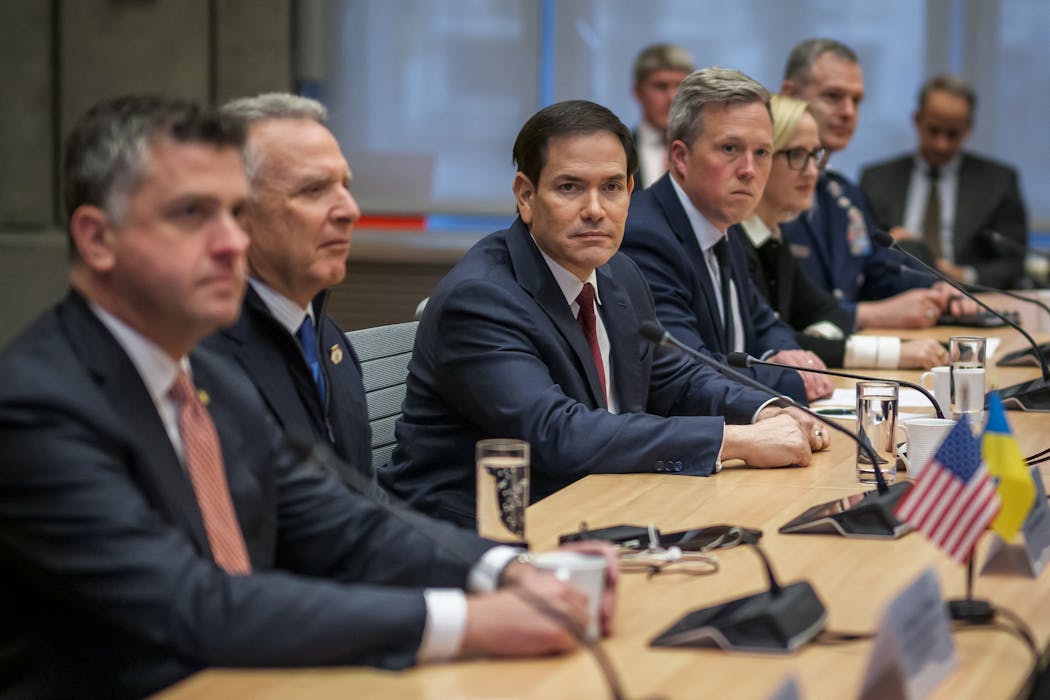
U.S. Secretary of State Marco Rubio, center, with U.S. delegation members faces the Ukrainian delegation during discussions in Geneva on Nov. 23, 2025, on a plan to end the war in Ukraine. Fabrice Coffrini/ AFP via Getty Images

As Russian bombs continued to pound Ukraine, a different conflict has blown up over plans to end that almost four-year-long war. The Trump administration on Nov. 20, 2025, formally presented Ukraine with a 28-point proposal to end the war, and President Donald Trump announced the country had until Thanksgiving to sign it. But Ukraine and its European and U.S. allies said the plan heavily favored Russia, requiring Ukraine to give up territory not even held by Russia, diminish the size of its military and, ultimately, place its long-term sovereignty at risk. The Trump administration was accused by policy experts and some lawmakers of fashioning a plan to serve Russia’s interests, and Secretary of State Marco Rubio got enmeshed in an argument with U.S. senators over whether the U.S. or Russia had authored the document. On Nov. 23, Ukrainian and U.S. officials held talks in Geneva, which Rubio declared were “productive and meaningful,” and those negotiations continue. The Conversation U.S. politics editor Naomi Schalit asked longtime diplomat Donald Heflin, now teaching at Tufts University’s Fletcher School, to help make sense of the chaotic events.

I have a whole list of questions to ask you, but my first question is what on earth is going on?

It’s hard to say. Ever since the Trump administration took power for the second time, it’s alternated between leaning towards Russia in this war or being more neutral, with occasional leaning towards Ukraine. They go back and forth.

This particular peace plan gives Russia a lot at once. It gets the size of the Ukrainian army cut down from 800,000-plus to 600,000, when the country is barely hanging on defending itself with 800,000 troops. Russia gets land, including land that it has conquered. A lot of people expected that might be one of the conditions of a Ukraine-Russia peace deal. But this also gives Russia land that it hasn’t taken yet and may never take.

It bars Ukraine from seeking NATO membership. That’s not a huge surprise. That was probably always going to be part of an eventual deal. Ukraine gets security guarantees from the West. Unfortunately, the U.S. gave ironclad security guarantees in 1994 when Ukraine gave up its nuclear weapons voluntarily. It’s been invaded by Russia twice since then, in 2014 and 2022. So our security guarantees really don’t mean a whole lot in that area of the world.

A rescue worker in a uniform stands in front of the rubble of a bombed building.
Rescue workers extinguish a fire at the site of a Russian drone strike on residential buildings in Kharkiv, Ukraine, on Nov. 24, 2025.
Viacheslav Mavrychev/Suspilne Ukraine/JSC ‘UA:PBC’/Global Images Ukraine via Getty Images

And there’s more, right?

I think this is the most important part, what Putin is looking for more than anything else. Russia gets released from economic sanctions and it rejoins the group of G7 industrialized countries.

Putin’s economy is under a lot of stress. The cash that would flow in for the sale of Russian goods, particularly energy, would enable him to build a whole new army from scratch, if he needed to. That’s a huge strategic advantage. This would be a major shot in the arm for the Russian economy and for the Russian war economy.

So this is a very pro-Russian deal, unless it’s modified heavily, and there’s argument in Washington now whether the Russians just plain drafted it, or whether our State Department drafted it but for some reason leaned heavily towards Russia.

I’m inclined to think the original draft came from the Russians. It’s just too loaded up with the stuff that they want.

There was a fair amount of confusing back-and-forth on Nov. 23 that Rubio had told some senators that, in fact, the plan wasn’t generated by the United States, that it reflected a Russian wish list. The senators revealed this publicly. Then a State Department spokesman called that claim “blatantly false.” You’re a former diplomat. When you see that kind of thing happening, what do you think?

It’s amateur hour. We’ve seen this before. With this administration, it puts a lot of very amateurish people – Rubio’s not one of them – in place in important offices, like Steve Witkoff, the special envoy for Russia and Ukraine who is also the special envoy for the Middle East. And they’ve gotten rid of all the professionals. They either just fired some or ran some off.

So you know, the problem here is implementation. Politicians can have great thoughts, but they usually then turn to the professionals and say, “Here’s what I’m thinking.” The people they would turn to are gone. And that was their own doing – the left hand doesn’t know what the right hand is doing.

How might that affect the ultimate goal, which is peace?

This is a very delicate situation that calls for delicate peace talks from professional diplomats. There are a couple of things that need to happen and aren’t happening very much. First off, this is a war in Eastern Europe. Europe should be very involved now. They lean against Russia, so they probably can’t be honest brokers, but they need to be involved in every step of this process. If there’s going to be any rebuilding of Ukraine, Europe’s going to have to help with that. If there’s going to be pressure on Russia, Europe buys a lot of its goods, especially energy. They’re just a necessary player, and they haven’t been included.

Two men sit on chairs in front of a number of flags.
Ukrainian President Volodymyr Zelenskyy meets with U.S. President Donald Trump at the 80th session of the United Nations General Assembly on Sept. 23, 2025. in New York City.
Chip Somodevilla/Getty Images

What else?

The other is that when people have these great ideas, normally they would turn to their professionals. Those professionals would then talk to the professionals on the other side or other sides. Staff work would be done, then your presidents or your prime ministers or your secretaries of state would meet and hammer out the deal.

None of that’s happening in this process. People are having great thoughts and getting on planes, and that’s not a recipe for a permanent peace deal.

Europe is champing at the bit to try to get involved in this, because they’ve got professional diplomats still in place, and it affects them.

Why is this happening now?

The timing of all this is really interesting. Winter’s coming, and Northern Europe, particularly Germany, is very dependent on Russian natural gas to heat their homes. These sanctions against Russia make that difficult. They make it more expensive. Should Russia decide it wanted to play hardball, it could cut off its natural gas in Northern Europe, and people in Germany would be freezing in the dark this winter. This timing is not an accident.

Trump said he wanted an agreement by Thanksgiving. Is that a reasonable requirement of a process to bring peace after a multiyear war?

No, it’s not. I don’t know if they even realize this in the
Trump administration, but that’s another sign – just as we had ahead of the Alaska Summit between Putin and Trump – that this isn’t really about trying to make peace. It’s for show and to get credit. In a war that’s been going on now for almost four years, you don’t say, “OK, within the next week, come up with a very complicated peace deal and sign off on it and it’s going to stick.” That’s just not the way it works.

The Conversation

Donald Heflin does not work for, consult, own shares in or receive funding from any company or organization that would benefit from this article, and has disclosed no relevant affiliations beyond their academic appointment.

ref. Peace plan presented by the US to Ukraine reflects inexperienced, unrealistic handling of a delicate situation – https://theconversation.com/peace-plan-presented-by-the-us-to-ukraine-reflects-inexperienced-unrealistic-handling-of-a-delicate-situation-270488

Por qué la presión de Trump sobre Venezuela no tiene precedentes y podría llevar a una intervención militar

Source: The Conversation – (in Spanish) – By Alan McPherson, Professor of History, Temple University

Maduro, en septiembre de 2025. AP Photo/Jesus Vargas

La enorme acumulación militar en el Caribe ha desatado especulaciones de que Estados Unidos está inmerso en su último capítulo de intervención directa en América Latina. Una idea que se ha visto reforzada en las últimas horas por la inclusión del cartel de los Soles en la lista de organizaciones terroristas que maneja el Departamento de Estado. La decisión coloca en la diana al presidente venezolano Nicolás Maduro y a altos cargos de su Gobierno.

Por ahora, al menos, el presidente Donald Trump ha dado marcha atrás en sus insinuaciones de que Washington está considerando lanzar ataques dentro de Venezuela, aparentemente satisfecho con atacar numerosos buques de guerra con el pretexto de una operación antinarcóticos. No obstante, la presencia estadounidense en la región se amplió la semana pasada con la llegada del portaaviones más grande del mundo: el USS Gerald R. Ford.

Como estudioso de las relaciones entre Estados Unidos y América Latina, sé que las acciones de la actual administración estadounidense se inscriben en una larga historia de intervenciones en la región. Si la escalada pasara de los ataques a barcos a una confrontación militar directa con Venezuela, tal agresión parecería algo habitual en las relaciones interamericanas.

Y, sin duda, los gobiernos de toda América Latina, tanto dentro como fuera de Venezuela, la situarán en este contexto histórico.

Pero, aunque recuerda a algunas prácticas cuasi piratas de la Marina de los Estados Unidos, el aumento del poderío militar actual no tiene precedentes en muchos aspectos clave. Y podría dañar las relaciones de Estados Unidos con el resto del hemisferio durante toda una generación.

Una historia de intervenciones

De la forma más evidente, el despliegue de una flotilla de buques de guerra en el sur del Caribe evoca oscuros ecos de la “diplomacia de las cañoneras”, el envío unilateral de marines o soldados para intimidar a gobiernos extranjeros, especialmente frecuente en América Latina. Fuentes fiables recogen hasta 41 casos de este tipo en la región entre 1898 y 1994.

De ellos, 17 fueron casos directos de agresión de Estados Unidos contra naciones soberanas y 24 fueron intervenciones de las fuerzas estadounidenses en apoyo de dictadores o regímenes militares latinoamericanos. Muchos terminaron con el derrocamiento de gobiernos democráticos y la muerte de miles de personas. Entre 1915 y 1934, por ejemplo, Estados Unidos invadió y luego ocupó Haití y pudo haber matado a unas 11 500 personas.

Un hombre se manifiesta en una concentración.
Un partidario venezolano de Maduro participa en una concentración contra la actividad militar estadounidense en el Caribe.
Federico Parra/AFP via Getty Images

Durante la Segunda Guerra Mundial y la Guerra Fría, Washington siguió dictando la política de América Latina, mostrando su disposición a responder a cualquier amenaza percibida para las inversiones o los mercados estadounidenses y respaldando dictaduras proestadounidenses como el régimen de Augusto Pinochet en Chile entre 1973 y 1990.

Los latinoamericanos, en general, se han irritado ante estas muestras tan evidentes del poder de Washington. Esta oposición de los gobiernos latinoamericanos fue la razón principal por la que el presidente Franklin D. Roosevelt renunció a las intervenciones con su política de “buena vecindad” en la década de 1930. Sin embargo, las intervenciones continuaron durante la Guerra Fría, con medidas contra los gobiernos de izquierda en Nicaragua y Granada en la década de 1980.

El fin de la Guerra Fría no supuso el fin definitivo de las intervenciones militares. Algunas fuerzas armadas estadounidenses siguieron operando en el hemisferio, pero, desde 1994, lo hicieron como parte de fuerzas multilaterales, como en Haití, o respondiendo a invitaciones o colaborando con los países anfitriones, por ejemplo, en operaciones antinarcóticos en los Andes y Centroamérica.

El respeto por la soberanía nacional y la no intervención –dos principios sagrados en el hemisferio–, especialmente en el contexto del aumento de la violencia relacionada con las drogas, ha acallado en gran medida la resistencia a la presencia de tropas estadounidenses en los países más grandes del hemisferio, como México y Brasil.

No es un simple reinicio de la Doctrina Monroe

¿Está Trump simplemente reviviendo una postura abandonada hace tiempo sobre el papel de Estados Unidos en la región?

Ni mucho menos. En dos aspectos clave, la agresión contra Venezuela o cualquier otro país latinoamericano en la actualidad, justificada por Washington como respuesta a la insuficiente aplicación de la ley contra el tráfico de drogas, representa un peligro sin precedentes.

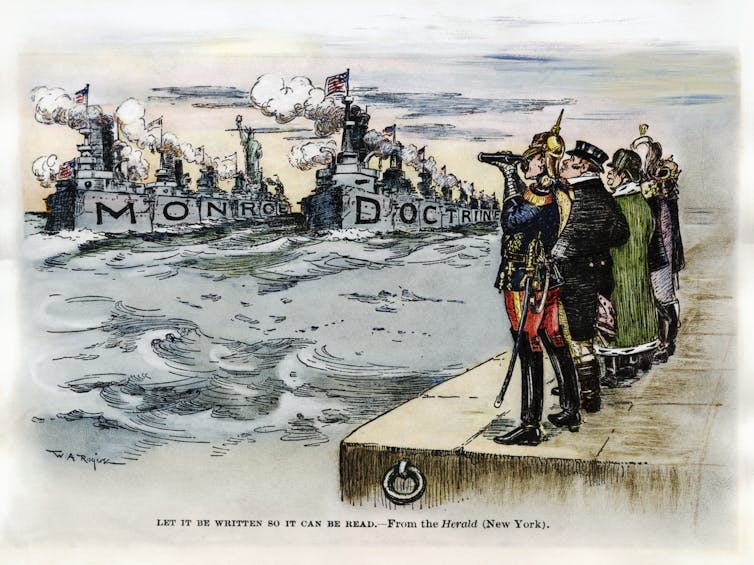
En primer lugar, echaría por tierra la antigua justificación de la intervención armada estadounidense conocida como la Doctrina Monroe. Desde 1823, cuando el presidente James Monroe la anunció, Estados Unidos ha tratado de mantener a las potencias extranjeras fuera de las repúblicas del hemisferio.

Washington creía que, una vez que un pueblo latinoamericano ganaba su independencia, tenía derecho a conservarla, y la Marina de los Estados Unidos debía ayudar en la medida de lo posible. A principios del siglo XX, esa supuesta ayuda adoptó la forma de un policía que patrullaba el mar Caribe, ejerciendo lo que el entonces presidente de Estados Unidos, Theodore Roosevelt, denominó un “gran garrote” e impidiendo que los europeos desembarcaran y, por ejemplo, cobraran deudas. A veces esto se hacía haciendo desembarcar primero a los marines y trasladando el oro de un país a Wall Street.

Una antigua caricatura política muestra un mapa de personas mirando buques de guerra.
Una caricatura de 1904 en el New York Herald muestra a los líderes europeos observando el poder naval estadounidense bajo la Doctrina Monroe.
Bettmann/Getty Images

Una ampliación del precedente de Panamá

Incluso durante la Guerra Fría, la Doctrina Monroe podía invocarse lógicamente para mantener a los soviéticos fuera del hemisferio, ya fuera en Guatemala en 1954, en Cuba en 1961, o en la República Dominicana en 1965.

A menudo, el vínculo soviético era débil, incluso inexistente. Pero aún quedaba un hilo tenue de mantener fuera una “ideología extranjera” que parecía mantener la relevancia de Monroe.

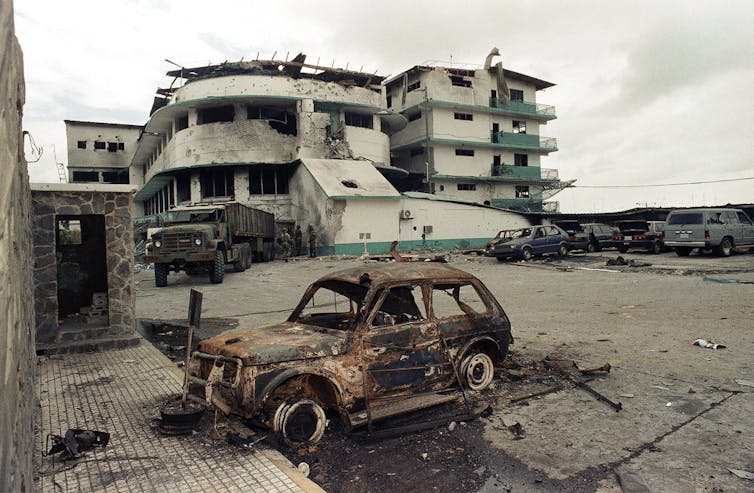
La doctrina murió de forma definitiva en 1989 con la invasión de Panamá para derrocar a su líder rebelde, Manuel Noriega, condenado por tráfico de drogas y culpable de destruir la democracia de su país. Nadie señaló a ningún cómplice fuera del hemisferio.

El derrocamiento de Noriega por unos 26 000 soldados estadounidenses podría ser el paralelismo más cercano a la persecución por parte de Trump de los supuestos barcos de drogas en el Caribe. Trump ya ha afirmado en repetidas ocasiones que el presidente venezolano Nicolás Maduro, al igual que Noriega, no es el jefe de Estado de su propio país y, por lo tanto, es procesable.

Más aún, ha afirmado que el líder venezolano es el jefe de la banda Tren de Aragua, que ha sido designada “organización terrorista extranjera” por las autoridades estadounidenses. De ahí a pedir –y promover– el derrocamiento de Maduro con el pretexto de eliminar a un “narcoterrorista” internacional no hay más que un paso. Un paso que ha quedado confirmado este 24 de noviembre al entrar en vigor la declaración por parte del Departamento de Estado del cartel de los Soles como organización terrorista y situar al frente de la misma a Nicolás Maduro.

Pero incluso ahí, el paralelismo con Panamá diverge de manera crucial: un ataque estadounidense contra Venezuela sería muy diferente en escala y geografía. El país de Maduro es doce veces más grande y tiene aproximadamente seis veces más población. Sus tropas activas suman al menos 100 000 efectivos.

Foto de un vehículo bombardeado.
Foto de 1989 del cuartel general de las Fuerzas de Defensa de Panamá bombardeado tras ser destruido en la invasión estadounidense de Panamá.
AP Photo/Matias Recar

¿Otro Irak?

De todas las invasiones y ocupaciones estadounidenses en América Latina, ninguna ha tenido lugar en Sudamérica ni en un país grande.

Es cierto que las tropas de EE UU invadieron México varias veces, a partir de 1846, pero nunca ocuparon todo el país. En la guerra de México, las tropas estadounidenses se retiraron después de 1848. En 1914, ocuparon una sola ciudad, Veracruz, y en 1916 persiguieron a Pancho Villa en la Expedición Punitiva. En todos estos episodios, se comprobó que tomar zonas de México era costoso e improductivo.

Un cambio de régimen provocado por Estados Unidos en un país soberano hoy en día, como en Venezuela, probablemente desencadenaría una resistencia masiva no solo por parte de su ejército, sino en todo el país.

La amenaza de Maduro de una “república en armas” en caso de que Estados Unidos invadiera podría ser una bravuconada, pero tambien podría no serlo. Muchos expertos predicen que tal invasión sería un desastre. Es más, Maduro ya ha solicitado ayuda militar de Rusia, China e Irán. Incluso sin esa ayuda, la movilización de los activos estadounidenses en el Caribe no garantiza el éxito.

Y aunque a muchos gobiernos del resto del hemisferio sin duda les encantaría expulsar a Maduro, les disgustaría el método utilizado para ello. Los presidentes de Colombia y México han criticado los ataques, y otros han advertido acerca del resentimiento que se generaría en el hemisferio si se produjera una intervención.

En parte, esto se debe al pasado intervencionista de Estados Unidos en América Latina, pero también proviene de un instinto de supervivencia, especialmente entre los gobiernos de izquierda que ya han despertado la ira de Trump. Como dijo el presidente de Brasil, Luiz Inácio Lula da Silva, “si esto se convierte en una tendencia, si cada uno piensa que puede invadir el territorio de otro para hacer lo que quiera, ¿dónde queda el respeto por la soberanía de las naciones?”.

Venezuela, contrariamente a lo que afirma la Casa Blanca, no es un gran productor ni punto de tránsito de narcóticos. ¿Qué pasaría si Trump dirigiera su mirada hacia otros gobiernos aún más comprometidos con la corrupción relacionada con las drogas, como México, Colombia, Bolivia y Perú? Nadie quiere ser la siguiente ficha de dominó.

The Conversation

Alan McPherson no recibe salario, ni ejerce labores de consultoría, ni posee acciones, ni recibe financiación de ninguna compañía u organización que pueda obtener beneficio de este artículo, y ha declarado carecer de vínculos relevantes más allá del cargo académico citado.

ref. Por qué la presión de Trump sobre Venezuela no tiene precedentes y podría llevar a una intervención militar – https://theconversation.com/por-que-la-presion-de-trump-sobre-venezuela-no-tiene-precedentes-y-podria-llevar-a-una-intervencion-militar-268954

Vivas de milagro: violencias médicas contra las mujeres del siglo XIX

Source: The Conversation – (in Spanish) – By Elena Lázaro Real, Investigadora colaboradora en el Instituto de Estudios de las Mujeres y de Género, Universidad de Granada

Marcha contra la Violencia contra las mujeres en Vigo, Galicia. Olivier Guiberteau/Shutterstock

Hace 25 años que, a instancias de Naciones Unidas, el mundo celebra el Día Internacional por la Eliminación de la Violencia contra las Mujeres. Fue en una resolución específica para la que se eligió el día exacto del calendario: 25 de noviembre, efeméride del asesinato de las hermanas Mirabal, opositoras del dictador Rafael Trujillo, en República Dominicana.

Aquella resolución publicada en el año 2000 recogía, en realidad, un trabajo previo de la propia Asamblea de Naciones Unidas que, empapada por la Tercera Ola del Feminismo de los años 70, había celebrado una Convención sobre la eliminación de todas las formas de discriminación contra la mujer en 1979 y que terminó 24 años después con una declaración específica sobre la violencia de género, el antecedente más próximo de todos los 25N que estarían por llegar.

Dicho de otra forma, el mundo lleva ya casi medio siglo hablando a las claras contra una de las violencias humanas más evidentes: la que sufren las mujeres por el hecho de serlo. Esa violencia que en pleno siglo XXI muchos se niegan a reconocer como una violencia con motivaciones y formas específicas es fruto de un sistema que ha reconocido al hombre como sujeto de poder, otorgándole la capacidad de violentar, y ha relegado a las mujeres al de víctimas.

Ese sistema que las sociedades democráticas tratan de transformar encontró a partir del siglo XIX en Occidente la manera de legitimarse legal, social e incluso científicamente. Sí, el siglo XIX, el mismo de los grandes avances científicos y tecnológicos de la contemporaneidad, el del nacimiento de los Estados liberales, primero, y las democracias, después, es el mismo que legitimó científicamente el patriarcado y, por tanto, convirtió a las señoras del XIX en las primeras víctimas “oficiales” de sus diferentes formas de violencia.

Ellas, las que parieron el feminismo como una corriente de pensamiento liberador para hombres y mujeres, fueron las primeras en quedar legalmente sujetas al poder de los hombres.

Tuteladas por padres y maridos

Los códigos civiles y penales que regulaban las relaciones sociales nacen en el siglo XIX con la premisa de que las mujeres deben ser tuteladas por sus padres o maridos. Su capacidad de agencia queda negada incluso en sus relaciones románticas gracias a un concepto de honra que las infantiliza.

Al mismo tiempo, sus cuerpos quedan controlados por una medicina sesgada por la moralidad imperante. La ciencia dominante ve a las mujeres como seres inferiores intelectual y sexualmente. Su sexualidad es construida científicamente a base de teorías que patologizan su capacidad para sentir deseo y placer, lo que no significa que no hubiera discursos desde los márgenes que cuestionaran esas ideas.

Y ahí es donde se me ha ocurrido mirar este 25N: al origen de las violencias contra los cuerpos de las mujeres a través de su sexualidad.

A lo largo del siglo XIX, cuando la Ginecología y la Obstetricia se consolidan como materias en las Facultades de Medicina, la teoría médica “inventa” dos enfermedades que atribuye a las mujeres que manifiestan sentir deseo o placer sexual. La histeria –utilizada como cajón de sastre para muchas otras patologías– y la ninfomanía son diagnosticadas ante el más mínimo síntoma. Y se diseñan tratamientos especialmente agresivos.

Según recogen las revistas médicas de la época, existieron tratamientos puramente físicos que en casos extremos llegaron a la extirpación de clítoris, ovarios y útero como medida preventiva.

A esa práctica se sumaban otras como la prohibición de la masturbación, considerada una práctica patológica, al tiempo que en las consultas se practicaban masajes pélvicos aplicados manualmente o mediante vibradores mecánicos y eléctricos, aunque su uso generó controversia por la posibilidad de producir excitación sexual.

Este último asunto fue fruto de una polémica al haber sido planteado por la historiadora de la tecnología Rachel Maines hace años y rebatido con posterioridad, si bien al menos en prensa especializada española sí han aparecido estos vibradores como instrumentos para paliar las “molestias de las mujeres”.

Electroterapia y bromuro contra la “lascivia”

Las señoras del XIX fueron sometidas a tratamientos como la electroterapia, uso de corrientes eléctricas en diferentes partes de la anatomía femenina, incluidos los genitales. Además, fueron tratadas con fármacos como el bromuro de potasio –recetado para combatir pensamientos lascivos y dolores de ovarios y hoy retirado de cualquier práctica sanitaria que no sea veterinaria– y remedios naturales como la quininina, valeriana y la belladona.

También probaron las “histéricas” el platino, la cloretona y hasta sangre de matadero. Cualquier cosa con tal de controlar cualquier manifestación de deseo sexual fuera del interés reproductivo.

Aquellas prácticas más agresivas físicamente fueron cayendo en desuso y sustituidas por terapias psicoanalíticas que igualmente agredían la salud mental de las mujeres. Las mujeres del XIX fueron sometidas a tratamientos mentales como la hipnosis y, lo más radical, el internamiento en manicomios en los que se practicaban también la hidroterapia, duchas frías a presión contra el cuerpo.

La expresión de sus emociones y su condición de ciudadanas tuteladas por padres y maridos las convirtió en víctimas de violencias que hoy suenan lejanas y casi anecdóticas y que fueron destruidas gracias, precisamente, a las conquistas que desde los márgenes hizo el feminismo y la investigación con perspectiva de género.

Aquel mismo feminismo que impregnara la convención de la ONU de 1979 y que este 25N nos hace conscientes de que Vivas nos queremos, aunque estemos “vivas de milagro”.

The Conversation

Elena Lázaro Real es miembro de la Asociación Española de Comunicación Científica y de la Asociación de Periodistas por la Igualdad

ref. Vivas de milagro: violencias médicas contra las mujeres del siglo XIX – https://theconversation.com/vivas-de-milagro-violencias-medicas-contra-las-mujeres-del-siglo-xix-270340

Jair Bolsonaro arrested amid fears he planned to flee as coup trial nears conclusion

Source: The Conversation – UK – By Felipe Tirado, PhD Candidate in Law, King’s College London

Brazil’s former president, Jair Bolsonaro, was taken into custody on November 22 after it was determined there was a “high risk” of him attempting to flee to a foreign embassy. The arrest took place as the Brazilian supreme court was analysing Bolsonaro’s final appeal against a 27-year prison sentence for leading a coup plot after losing the 2022 election.

Bolsonaro was arrested after he broke his ankle monitor. This happened right after his son, Senator Flávio Bolsonaro, called for a vigil outside the former president’s house. The supreme court justice, Alexandre de Moraes, said Bolsonaro’s escape would have been “facilitated by the confusion caused by the demonstration called by his son”.

Federal agents took Bolsonaro to a police facility in the Brazilian capital of Brasília ahead of a custody hearing. He was subsequently taken to the Papuda prison complex, also in Brasília, where he is expected to begin serving his sentence. Bolsonaro’s sons, allies and lawyers said he wasn’t trying to flee.

Ahead of the ankle monitor incident, Bolsonaro’s lawyers had requested that he serve his sentence at home. They cited his health issues and mentioned that the supreme court had recently granted this benefit to another of Brazil’s former presidents, Fernando Collor, who was convicted of corruption earlier in 2025. The court rejected this request.

The coup plot was first discovered during investigations into an insurrection in Brasília in January 2023, where thousands of Bolsonaro supporters stormed the heart of the Brazilian government. Investigators uncovered evidence that the riot was part of an attempted coup.

They subsequently found that the plot also included a plan to assassinate Brazil’s current president, Luiz Inácio Lula da Silva, as well as his vice-president, Geraldo Alckmin, and Justice Moraes. Bolsonaro and several other high-ranking officials were indicted for their involvement in the plot in early 2025, with convictions handed down in September.

Those convicted alongside Bolsonaro include Colonel Mauro Cid, army generals Walter Braga Netto, Augusto Heleno and Paulo Sérgio Nogueira, and former navy commander Almir Garnier Santos. Also convicted were former justice minister Anderson Torres and former intelligence agency director Alexandre Ramagem.

Brazil’s supreme court ordered the arrest of Ramagem on November 21. He fled Brazil in September and has been living in the US since then. Ramagem’s lawyers and political allies informed the press that they did not know he had left the country.

Bolsonaro received the longest sentence of the eight main conspirators. The sentences handed out to Netto, Heleno, Nogueira, Garnier Santos, Torres and Ramagem range from 16 to over 26 years in prison. Cid, who was Bolsonaro’s former main military aide, will serve a two-year house arrest sentence after cooperating with the investigation.

The sentencing and arrest of Bolsonaro and his co-conspirators is a significant moment for Brazil. Never before have members of the country’s political and military elite been held to account for staging a coup.

Supreme court verdict

In total, 34 people have been formally indicted in connection with the coup plot. The supreme court has accepted all but one of these criminal complaints. It still has to analyse the charges against prominent right-wing influencer Paulo Figueiredo, who has not not yet presented his defence. Figueiredo is the grandson of Brazil’s last dictator, João Figueiredo, and lives in the US.

In October, the supreme court panel responsible for the case convicted seven other defendants for their roles in the coup plot. These people were accused of running a disinformation campaign to spread fake news about the 2022 election and attacking Brazil’s state institutions. Their sentences range from seven to 17 years in prison.

Those convicted were former army officers Ailton Barros, Ângelo Denicoli, Giancarlo Rodrigues, Guilherme Almeida and Reginaldo Abreu, as well as federal police agent Marcelo Bormevet. Carlos Moretzsohn Rocha, who was accused of drafting the report used to challenge the 2022 election results, was also sentenced to prison.

More recently, on November 18, the panel convicted nine of ten defendants who were accused of planning the plot’s violent actions. These actions involved the plans to assassinate Lula, Alckmin and Moraes.

One of these defendants, an army general called Estevam Theophilo, was acquitted due to a lack of evidence. And two others, colonels Márcio Resende and Ronald Araújo, may benefit from non-prosecution agreements.
The sentences of the other seven range from 16 to 24 years in prison.

The panel is set to judge six other defendants in December who are accused of planning and coordinating other aspects of the plot.

Reckoning with the past

Over the past few decades, some Latin American countries have held their former leaders accountable for crimes committed while in office. Argentina pioneered this trend in 1985 with the so-called “trial of the juntas”.

This trial ended with the conviction of former dictators Jorge Rafael Videla, Roberto Eduardo Viola and Leopoldo Galtieri, as well as other leading figures of the military regime of 1976 to 1983 for crimes against humanity. Argentina’s last dictator, Reynaldo Bignone, has also been convicted multiple times for such crimes since 2010.

Elsewhere in the region, Uruguayan courts convicted Gregorio Álvarez for crimes against humanity in 2007. Álvarez was the last president of Uruguay’s dictatorship, ruling from 1981 until 1985. Former Peruvian leader Alberto Fujimori was also convicted for human rights violations while in office in 2009.

However, coup plotters and former dictators have generally remained unpunished for their crimes in most Latin American countries. Perhaps the most prominent example is Augusto Pinochet, who was never held to account for his brutal dictatorship in Chile.

Pinochet was arrested in London in 1998 on an international warrant for his alleged role in human rights abuses, but was released on medical grounds before facing trial. Once back in Chile, further charges against him were also blocked by the country’s courts.

The arrest of Bolsonaro represents a long overdue reckoning with Brazil’s authoritarian past and another step in Latin America’s progress towards accountability.

The Conversation

Felipe Tirado receives funding from the Centre for Doctoral Studies – King’s College London.

ref. Jair Bolsonaro arrested amid fears he planned to flee as coup trial nears conclusion – https://theconversation.com/jair-bolsonaro-arrested-amid-fears-he-planned-to-flee-as-coup-trial-nears-conclusion-269554

Abraham accords: Israel’s latest push to improve Arab relations could stall over Palestinian statehood

Source: The Conversation – UK – By Simon Mabon, Professor of International Relations, Lancaster University

Mohammed bin Salman wants to bring Saudi Arabia into the Abraham accords, the network of agreements to normalise relations between Israel with other countries in the Middle East and, increasingly, beyond. Donald Trump would have enjoyed hearing this when the Saudi crown prince visited the White House on November 18.

It was Trump’s first administration that brokered the initial agreements between Israel and the UAE, Bahrain, Morocco and Sudan in 2020. It’s an achievement that is often trumpeted by his supporters as the key foreign policy win of the US president’s first term in power.

But the Saudi leader’s plan to normalise with Israel comes with a price. He wants to see a “clear path [towards a] two-state solution”, he told reporters as he sat alongside Trump in the Oval Office.

The Abraham accords were the first instance of Arab countries formally recognising Israel since 1994, when Jordan and Israel signed a peace agreement. For Trump, Benjamin Netanyahu and others, the signing of the accords was a diplomatic breakthrough. It would, they believed, usher in a new age of peace and prosperity across the Middle East driven by economic aspirations.

But little substantive progress has been made on securing additional signatories since 2020. And when Kazakhstan announced its plan to join the accords and normalise diplomatic relations with Israel at the start of November, it came as something of an anticlimax.

Rumours had begun to spread about a new signatory – and advocates of the accords were almost certainly hoping for a more high-profile signatory. But the Kazakh move reveals much about the current status of the accords.

Big deal

For Trump and Israel’s prime minister, Benjamin Netanyahu, the accords were a significant move – a major effort to reshape the Middle East. But things have not quite gone according to plan in the five years since the first agreements were signed.

Prior to the terrorist attacks of October 7 2023, there was a growing expectation that Saudi Arabia would soon join the accords. Diplomatic overtures from Israel to Saudi Arabia and vice versa, were built on a form of tacit security collaboration that had long endured between the two states. This collaboration was in part driven by a shared fear of Iranian aspirations across the Middle East.

The apparent threat from Iran was a key driving force behind the accords. The UAE, Bahrain and Israel had all expressed concerns about Tehran’s nefarious activity across the Middle East.

According to US inteligence documents published by Wikileaks, Hamad bin Isa Al Khalifa, the king of Bahrain, had been telling US officials of his desire to normalise with Israel as far back as 2007.

By 2023, however, Saudi Arabia was beginning to see Iran as less of a threat. The two countries had embarked on their own process of normalisation earlier that year. They signed a deal to restore full diplomatic and security ties, an agreement seen by some in the Gulf as an indication that the region was moving towards what one scholar called a “post-American Gulf era”.

The Beijing-mediated agreement pointed to a new way of thinking about regional politics, driven by a desire for a more stable regional security environment shaped by states from the region rather than outside it.

Meanwhile, Hamas’s attack on Israel on October 7 2023 and Israel’s destruction of Gaza halted Saudi overtures to Israel. Since then, Saudi officials have declared that, in order for the kingdom to normalise relations with Israel, the establishment of a Palestinian state with East Jerusalem as its capital is a necessary step.

In the months that followed, Bin Salman was increasingly steadfast in his refusal to normalise relations with Israel without a Palestinian state. In the summer of 2024, he reportedly expressed fears about being assassinated because of normalisation with Israel. He indicated he was still pursuing normalisation, but very publicly linked this aspiration with a requirement for Palestinian statehood.

Reassessing Middle East threats

Israeli policy across the Middle East since the October 7 attacks has also shifted threat perceptions away from Iran. Israel’s strikes on Gaza, Lebanon, Syria, Iran, Qatar, Yemen, Iraq and Tunisia – coupled with raids on sites across the West Bank – have created an increasingly unstable regional security landscape.

The focus is now on deeper inter-regional collaboration. This was emphasised in the way that, in the aftermath of Israeli strikes on Iran, leaders from across the Middle East almost unanimously condemned the attacks.

At the same time, Iran has held discussions with the UAE and Saudi Arabia over an arrangement for a uranium enrichment programme which would ensure that Iran’s programme did not provide a means to developing nuclear weapons.

The words and deeds of Israeli politicians have also angered many. Benjamin Netanyahu has repeatedly spoken of his ongoing efforts to prevent the establishment of a Palestinian state.

Israel’s finance minister Bezalel Smotrich has repeatedly called for the annexation of the West Bank. The national security minister, Itamar Ben-Gvir, has provoked anger and concern across the Muslim world by praying at the site of the al-Aqsa Mosque in Jersualem, violating the agreement that only Muslims should worship there.

There was been little or no progress on the implementation of the second phase of Trump’s 20-point Gaza peace deal – a deal that has no concrete steps towards the establishment of a Palestinian state. When you consider this, and the Israeli political elite’s explicit rejection of a Palestinian state, it feels unlikely there will be any more signatories to the Abraham accords for the foreseeable future.

The Conversation

Simon Mabon receives funding from Carnegie Corporation of New York and the Henry Luce Foundation. He is affiliated with the Foreign Policy Centre.

ref. Abraham accords: Israel’s latest push to improve Arab relations could stall over Palestinian statehood – https://theconversation.com/abraham-accords-israels-latest-push-to-improve-arab-relations-could-stall-over-palestinian-statehood-269998

How we created a climate change museum to inspire hope among eco-distressed students

Source: The Conversation – UK – By William Finnegan, Head of Programmes in Lifelong Learning in Social Sciences, University of Oxford

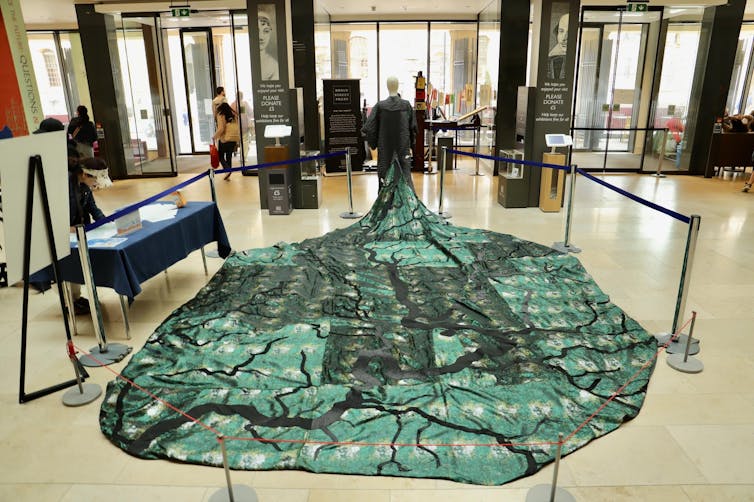
Student contributions were added to a participatory artwork representing the Thames watershed as a 15-metre-long wearable robe.
Authors provided, CC BY

In 2023, a visit to a local state secondary school to discuss our project, The Museum of Climate Hope, led to an unexpected discussion. A few weeks earlier, an eminent climate scientist had presented a harrowing tale of climate apocalypse to the school’s sixth form. But the students told us the scientist’s presentation, intended as a wake-up call to apathetic teenagers, had backfired.

After that “doom and gloom” message, a teacher at the school told us some students who were already concerned about climate change were showing signs of eco-distress. This term has been coined by environmental psychologists to capture the negative emotional responses – worry, anxiety, despair – to environmental change.

In contrast, teachers observed that other students who were less engaged with the issue seemed to be coping by further distancing themselves from the issue.

Subsequently, we took a group of these students to the Oxford Botanic Garden and and the university’s History of Science Museum to help us identify objects to include in our own museum’s trail.

The authors’ digital storytelling project explores climate futures with young people.

The Museum of Climate Hope was designed to foster constructive engagement with the climate crisis. It can be experienced in person – as a trail of objects spread through the University of Oxford’s gardens, libraries and museums – or digitally through our interactive multimedia platform.

Climate in the curriculum

For most students in England, opportunities to learn about climate change are rare. The Curriculum and Assessment Review, published in November 2025, included education on climate change and sustainability as one of five applied knowledge areas, based on feedback from young people, parents and carers. Yet it also noted there is “currently minimal explicit inclusion of climate education in the national curriculum”.

The review has reinforced calls from researchers for climate to be more fully integrated across school subjects, from geography to history. It also noted that enhancing climate education will involve changes not only in content but also pedagogy – the way we teach.

In collaboration with other sustainability education researchers and practitioners, we have proposed a “pedagogy of hope”. We hope this will support teachers as they implement the recommendations of the review “to equip learners to rise to the challenges of a sustainable future”.

Our museum incorporates pedagogies of hope into both structured and self-directed learning. The objects on our trail represent positive stories of resilience, innovation and transformation, rather than negative stories of loss and destruction.

For example, the Oxford University Museum of Natural History is known for having an extinct dodo in its collection. But the young people who helped curate our trail thought that swifts and beavers would be better symbols for exploring successful conservation and rewilding projects.

Another item on our trail is a bronze-age cauldron at the Ashmolean Museum. This large cooking vessel illustrates how resources were shared in those communities, while its signs of repair over many centuries indicate material value and craftsmanship, in contrast to today’s throwaway culture.

The cauldron was discovered in – and is believed to have been a gift to – the River Cherwell. So it also represents its users’ reciprocal relationship with the natural world.

Moving from museums to the classroom, we spent a term working with local primary school students to incorporate environmental themes into activities combining arts and science. Our sessions focused on understanding climate change as a local phenomenon that every child experiences directly. One example was the increased flooding of the nearby Cherwell river.

These students were introduced to another Museum of Climate Hope object in one of the Bodleian Libraries: the 400-year-old Sheldon tapestry map of Oxfordshire. They found their school and homes on the tapestry, and contrasted it with contemporary maps of the same area – helping them to explore local people’s changing relationships with rivers and landscapes. The students then created their own textile art of local nature that was important to them.

Their contributions were added to a participatory artwork representing the Thames watershed – the land area that includes the River Thames and its tributaries – as a 15-metre wearable robe. This Tamesis Unweaving robe combines elements of the Sheldon tapestry map with objects on the trail found in the Pitt Rivers Museum – a Hawaiian cloak made of feathers and an Evenki parka coat made of reindeer skin.

The wearable robe
Student contributions were added to this artwork representing the Thames watershed as a 15-metre-long wearable robe.
Author provided, CC BY-SA

For some of these young people, the first step towards climate action was creatively connecting to the local environment, and depicting a sustainable future through art.

Back at the sixth form assembly in Oxford, we were invited to do a follow-up talk. We spoke about the power of cultural change – not simply technological innovation – in response to climate change, and the importance of constructive hope.

Most of the students humoured our invitation to close their eyes and travel in time to the year 2051, to visit a future museum. It’s an activity inspired by the 1851 Great Exhibition and 1951 Festival of Britain, as well as our research on speculative digital storytelling.

They were encouraged to think of objects that might be put on a pedestal or relegated to a museum as part of the transition to a more sustainable future. We also asked them to think of any people who might have their stories told in this future museum.

One student yelled out the name of someone else in the room – claiming they were the smartest person he knew, someone who could definitely solve any problem the future could throw at us. Laughter rippled through the assembly, tension was released, and we all felt a little more hopeful.


The climate crisis has a communications problem. How do we tell stories that move people – not just to fear the future, but to imagine and build a better one? This article is part of Climate Storytelling, a series exploring how arts and science can join forces to spark understanding, hope and action.


The Conversation

The Museum of Climate Hope project is supported by the Public and Community Engagement with Research Fund and the Cultural Programme at the University of Oxford.

Tina Fawcett receives funding from UKRI and the Askehave Foundation.

Anya Gleizer does not work for, consult, own shares in or receive funding from any company or organisation that would benefit from this article, and has disclosed no relevant affiliations beyond their academic appointment.

ref. How we created a climate change museum to inspire hope among eco-distressed students – https://theconversation.com/how-we-created-a-climate-change-museum-to-inspire-hope-among-eco-distressed-students-269544

Gut microbes may have links with sleep deprivation

Source: The Conversation – UK – By Lewis Mattin, Senior Lecturer, Life Sciences, University of Westminster

Pixel-Shot/Shutterstock

Sleep is one of the essential physiological needs for human survival, alongside food, water and air. But sleep is socially driven, influenced by environmental and personal factors, and a recent study suggests it may be affected by fragments from bacteria.

Historically scientists have thought it unlikely that gut microbes affect physiological sleep regulation. The recent study, published in Frontiers in Neuroscience, indicated bacterial cell wall components (peptidoglycan) have been found in areas of the brain called the brainstem, olfactory bulb and hypothalamus.


Read more:
Preserving barramundi, and the barra and chips


Peptidoglycan, also known as murein in scientific lore, is a strong, mesh-like layer outside the plasma membrane of most bacterial cells. This helps contain the bacteria’s shape and rigidity. Without peptidoglycan, bacteria would just be little water balloons.

The recent study suggested that concentration of peptidoglycan seems to increase in periods of sleep deprivation, or changes in sleeping patterns. This is a sign that the gut microbiota might play a role in sleep quality.

This work was carried out on nine male mice which were housed in a 12-hour light/dark cycle. Measurements were taken over 48 hours to map brain activity cycles during sleep and rest. Afterwards the mice were euthanised. Different areas of the brain were separated immediately so isolated areas could be measured independently for peptidoglycan levels.

The research has been conducted and designed in a rigorous fashion. But the study exclusively used adult male mice. Although animal models can be translated to humans, the crossover in microbiota research is weak. Animal research into microbiota can only tell us so much about what is happening in our guts because the environment in which humans and mice live is vastly different.

For example, a breakthrough paper in 2006 raised mice without any microorganisms in their bodies, known as germ-free mice, and then transplanted some of them with the gut microbiota from obese mice. The study found the mice who had the gut microbiota transplant gained more body fat than germ free mice colonised with microbiota from lean mice. This breakthrough research suggested that the gut microbiota might contribute to weight gain and a knock-on effect obesity.

But follow up studies using humans fecal microbiota transplantation from lean humans into obese adolescents did not lead to weight loss. Findings in mice can suggest mechanisms but not necessarily predict outcomes in humans.

Furthermore the recent sleep research on mice has ignored the other 49% of the population, females. It’s a gap that risks leaving half the world in the dark about sleep health.

So when it comes to understanding the gut microbiota, does it really matter what organisms are found in the gastrointestinal tract of rodents and how this might interfere with their sleep patterns?

Our brain is traditionally considered sterile and protected by the blood brain barrier. This tight system blocks microbes and molecules from entering the brain in healthy people. There is no evidence to suggest that there is a brain microbiome unlike within the digestive system and on our skin.

However, previous studies have shown fragments that relate to bacteria such as peptidoglycan and lipopolysaccharides can be detected within the brain. This is probably because the fragments are smaller than bacteria. The blood brain barrier and intestinal wall are more permeable in conditions like sleep deprivation, inflammation, ageing or even after strenuous exercise.

Woman lying on grey bedsheets with her arms over her face.
Could there be a link between sleep deprivation and gut bacteria?
fizkes/Shutterstock

Day-to-day variations in the cells that make up the wall of your intestines may be affected due to the direct effects of circadian regulation on the junctions between the cell membrane and its other compartments. These junctions form a seal that prevents the passage of molecules and ions between cells, essentially controlling what passes through.

When these junctions relax, this allows the organisms found in the GI tract to enter the blood, which are then transported around the body. It’s unclear whether that is good or bad but leaky junctions have been associated with inflammatory bowel disease.

Some research suggests that our microbiota is closely linked through the gut-brain axis. Although large amounts of research on the gut-brain axis have been conducted on rats and mice, there are very few translational links between what has been researched in animals and what actually happens in the human body.

This means researchers would need to make a massive investment in researching how the gut microbiome interacts with our organs and other physiological systems with large-scale human interventions.

Since there is still much we do not understand about the gut microbiome, we are a long way off this kind of scientific insight. However, this study does reflect growing scientific and public interest in the intersection between human microbiology and neuroscience. It may be that we are only beginning to appreciate just how interconnected the human body and everything in it is.

The Conversation

Lewis Mattin is affiliated with The Physiological Society, The Society for Endocrinology, In2Science & UKRI funded Ageing and Nutrient Sensing Network.

ref. Gut microbes may have links with sleep deprivation – https://theconversation.com/gut-microbes-may-have-links-with-sleep-deprivation-266928

England’s national curriculum review misses opportunity to revitalise language learning

Source: The Conversation – UK – By Joseph Ford, Senior Lecturer in French Studies, School of Advanced Study, University of London

Rawpixel.com/Shutterstock

The decline of languages education in England is a familiar and depressing story. Take-up of French at GCSE is down from 25% in 2009-10 to 18% in 2024-25. German has halved in the same period from 10% to 5%.

There is also a significant gap in take-up at GCSE by disadvantaged pupils (34%) compared with those from more privileged backgrounds (50%).

In March 2025, the interim report of a review of England’s national curriculum diagnosed languages as a particular problem area. Languages education was deemed to be furthest away from the principles set out by the review panel. These included an engaging, coherent, knowledge-rich and inclusive curriculum, and the involvement of teachers in its design and testing.

The review’s final report, now published, recommends a much sharper focus on the provision of languages in primary schools. It encourages a smoother transition from primary to secondary, which has been shown to improve languages take-up even in areas with relatively high numbers of pupils from disadvantaged backgrounds.

Its proposal of the introduction of new “stepped” qualifications, where learners can build up and bank their progress over time, is promising. This has been embraced by the government response to the review and organisations such as the UK Association for Language Learning.

The report points to Hackney in London as an example of good practice. Here, there is a focus on teaching only one language – Spanish – and sharing teacher training and professional development across schools. Figures show that the local authority had the highest take-up of Spanish across England. Students were also more likely to continue with languages at GCSE.

A more joined-up approach is welcome. However, there is a danger that by focusing on a single European language, schools risk ignoring the huge diversity of languages that surround pupils in some of the most multilingual areas of England.

Existing languages

Celebrating pupils’ existing multilingualism brings great benefits. Research shows embracing the languages spoken by children improves educational outcomes for pupils across subjects such as English, maths and science.

Happy primary school children on play equipment
Many children are already surrounded by other languages.
Rawpixel.com/Shutterstock

Some efforts are already being made here. Charity World of Languages, Languages of the World has created a curriculum which engages with the languages pupils already speak at home in an attempt to dissolve the hierarchy of European languages. It works with pupils between the ages of seven and 15 to value the study of languages already spoken in communities around schools. It centres history, culture and communication, while not shying away from contested topics such as migration.

Yet, despite initiatives like this, there is no mention in the curriculum review of that wider sphere of languages that constitutes such a rich tapestry of multicultural life in towns and cities across England.

A core caveat within the curriculum review stems from recent changes made to the existing curriculum for French, German and Spanish GCSEs. This new curriculum has not yet reached its first examinations, which will happen in summer 2026. The review recommends the evaluation of that new GCSE at the end of its first teaching cycle in 2026.

This will be an important moment for teachers to offer feedback on the new specification. The previous languages curriculum received criticism for excluding pupils from disadvantaged backgrounds because exam questions asked for responses based on personal experience, such as describing holidays. Teacher feedback will show whether the government has met its stated aims to make the new curriculum more accessible and relevant for pupils.

It might also be the moment for the government to consider more explicit inclusion of culture in the curriculum at GCSE. How an enhanced awareness of the effects of climate change and the development of digital skills can be built into the study of languages, in line with the review’s wider recommendations, should also be on the table. For instance, language classes could include discussing how the social and political contexts of climate change differ internationally, including in Indigenous cultures.

Finally, the curriculum review revisits what many experts see as the disastrous decision by the government in 2004 to make languages non-compulsory at GCSE. But it stops short of recommending languages become compulsory once again.

This is a shame. According to polling by YouGov, taking a compulsory language learning is supported by a clear majority of Britons. What’s more, research has estimated that removing the language barrier with Arabic, Chinese, French and Spanish-speaking countries could increase UK exports annually by about £19 billion.

Making a language compulsory at GCSE would also help arrest the now catastrophic decline in languages uptake across the educational pipeline, as university languages departments face closure.

Most importantly, promoting the study of languages would foster more nuanced, culturally and linguistically informed responses to the sorts of divisive political discourse increasingly on display in Britain today. Learning languages promotes cross-cultural understanding and tolerance of ambiguity in an increasingly ambiguous world.

The Conversation

Joseph Ford does not work for, consult, own shares in or receive funding from any company or organisation that would benefit from this article, and has disclosed no relevant affiliations beyond their academic appointment.

ref. England’s national curriculum review misses opportunity to revitalise language learning – https://theconversation.com/englands-national-curriculum-review-misses-opportunity-to-revitalise-language-learning-269532

Why hosting the UN climate summit in the Amazon was so important, despite the disappointing outcome

Source: The Conversation – UK – By Alexander C. Lees, Reader in Ecology and Conservation Biology, Manchester Metropolitan University

Storm clouds build over the Cop30 host city of Belém. Alexander Lees, CC BY-NC-ND

Extreme heat, fires and flooding – all hallmark consequences of climate change – directly influenced this year’s UN climate change conference Cop30 in Belém, Brazil.

For the first time, this annual climate summit was held in Amazonia,
a place at the frontline of climate change. The pivot from the two previous conferences in petrostates Azerbaijan and UAE to a base in the world’s largest tropical forest (albeit in one the world’s largest oil producing countries) was jarring.

As Amazonian researchers, and past and present residents of the city, we saw the potential for Cop30 to move discussions further forward than its predecessors in two key ways.

First, and in contrast to many previous gatherings that have sidelined them – or suppressed them altogether – Indigenous and marginalised voices were impossible to ignore at Cop30. They have helped shape media narratives and discourse in the blue zone, the venue that hosted events in hundreds of dedicated spaces for national and organisational bodies.

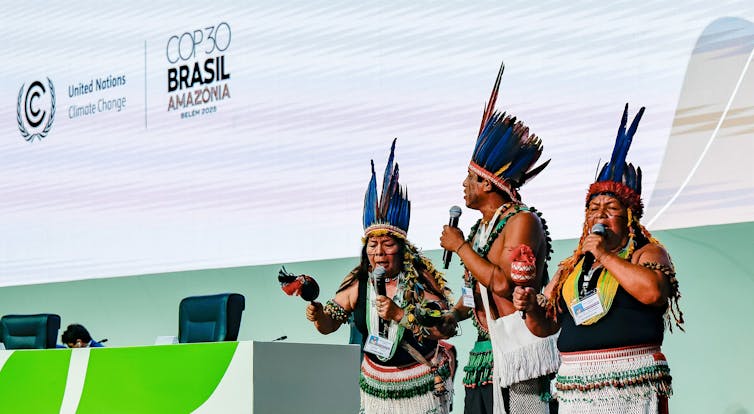
The Belém gathering saw the largest Indigenous participation in Cop history, with around 900 registered representatives. The Cúpula dos Povos, a parallel event hosted at the Universidade Federal do Pará, gave many more Indigenous peoples and local communities a platform to argue against the status quo of relative inaction.


Read more:
Behind the scenes in Belém: The Conversation’s report from Brazil’s UN climate summit


Hosting Cop30 in Belém broke down the physical travel barriers for many potential attendees from Indigenous peoples and local communities. The summit organisers went beyond the normal attempts at tokenism in engaging them in discussions.

The region’s extensive river networks allowed many Indigenous peoples and local communities from across Amazonia to reach Belém by boat. They held a symbolic “people’s flotilla” with over 500 people in 200 vessels, sailing to demand their voices be heard in calling for climate justice and an end to mining and large infrastructure projects affecting their territories.

Meanwhile, the disruptive influence of some Indigenous protesters and their allies in breaching security lines and temporarily obstructing access to the blue zone hopefully focused minds inside, in addition to garnering global headlines.

Indigenous delegates at the opening of the 30th Conference of the Parties to the United Nations Framework Convention on Climate Change (Cop30).
Ricardo Stuckert / PR, CC BY-ND

The second reason to be hopeful from Cop30 was that the realities of climate and land use change are jarringly obvious in Amazonia. Belém’s oppressive heat and humidity were evident even within the main blue zone arenas. Many delegates were visibly uncomfortable.

This catalysed an official complaint from UN climate chief Simon Stiell about the climate conditions in the Cop venue, asking for “a clear delivery plan on how temperatures will be brought down within the next 24 hours”. The parallels to the goals of the wider negotiation process were hard to miss.


Read more:
Cop30: five reasons the UN climate conference failed to deliver on its ‘people’s summit’ promise


The city’s local climate became a protagonist in its own right. A huge thunderstorm during one afternoon flooded many roads and brought down trees across the city, causing power outages.

A recent study has shown that Belém is now experiencing more and more days of high “wet bulb” temperatures (which determine the comfort level of the atmosphere). Such temperatures can lead to deadly heat stress. Continued warming could make many parts of the tropics unlivable.

Social justice as climate justice

These climate consequences will disproportionately be felt by the less affluent, and significant social inequalities were laid bare to delegates travelling through the urban area – despite some major investment. The need to foreground social justice as climate justice, as argued by Brazilian president Luiz Inácio Lula da Silva in his opening speech, was visibly evidenced by the poverty in some suburbs and stark inequalities.

For many delegates flying into Belém, this will have been their first time in a tropical forest region. But this is the most heavily deforested region in Amazonia – a fact that is painfully evident to anyone flying in from the south on a clear day.

In a Cop30 venue on the campus of the Brazilian Agricultural Research Corporation, our team guided delegates, including heads of state, royalty and CEOs of large multinationals on an interpretive trail through a regenerating patch of rainforest. Some visitors were moved to tears to experience a tropical forest and hear about its importance for climate and biodiversity.

This underscores the power of hosting Cop in such a critically important ecosystem. People could also see how a forest can grow back, if given the chance.

The biome and region were much more than just a venue or educational opportunity. The fate of the Amazon and other tropical forests became a focal point of many of the blue zone discussions, clarifying strong climate and nature links.

This facilitated a narrative shift towards a search for the enabling conditions of forest protection, the value of biodiversity, and the importance of community-led stewardship.

This prominence of both nature and forest citizens is key, as these are fundamental to climate justice and the development of fair and effective adaptation and mitigation strategies. For example, forest fires became a central theme in week two (when the blue zone itself was evacuated owing to an electrical fire).

Vestiges of rainforest near the town of Novo Progresso in the Brazilian state of Pará – while the fire in the blue zone attracted press coverage, the location of the Cop also drew attention to threats to the Amazon.
Alexander Lees, CC BY-NC-ND

However, while a stronger focus on nature is essential, the failure to address strategies for ending fossil fuel emissions was the bitter outcome of Cop30. The presentation of the updated global carbon budget showed that we have only four years left to stay within 1.5°C of warming. That’s clearly an impossible task.

Although Belém helped bring the social and ecological effects of climate change to the forefront, the final declaration (which unbelievably contained no direct reference to fossil fuels) demonstrated once again that vested interests remain the strongest barrier to progress, and that climate justice risks continuing as mere rhetoric.


Don’t have time to read about climate change as much as you’d like?

Get a weekly roundup in your inbox instead. Every Wednesday, The Conversation’s environment editor writes Imagine, a short email that goes a little deeper into just one climate issue. Join the 47,000+ readers who’ve subscribed so far.


The Conversation

Alexander C. Lees receives funding from DEFRA’s GCBC programme, the BNP Paribas Foundation’s Climate and Biodiversity Initiative and UKRI. He is a Trustee of the British Ornithologist’s Union.

Joice Ferreira receives funding from the Brazilian National Council for Scientific and Technological Development, DEFRA’s GCBC programme and the BNP Paribas Foundation’s Climate and Biodiversity Initiative.

Jos Barlow receives funding from UKRI, DEFRA’s GCBC programme, the BNP Paribas Foundation’s Climate and Biodiversity Initiative. He is a Trustee of WWF-UK.

ref. Why hosting the UN climate summit in the Amazon was so important, despite the disappointing outcome – https://theconversation.com/why-hosting-the-un-climate-summit-in-the-amazon-was-so-important-despite-the-disappointing-outcome-269841

EU proposal to delay parts of its AI Act signal a policy shift that prioritises big tech over fairness

Source: The Conversation – UK – By Jessica Heesen, Head of Research Group, media ethics, philosophy of technology & AI, International Center for Ethics in the Sciences and Humanities (IZEW), University of Tübingen

The roll-out of the European Union’s Artificial Intelligence Act has hit a critical turning point. The act establishes rules for how AI systems can be used within the European Union. It officially entered into force on August 1 2024, although different rules come into effect at different times.

The European Commission has now proposed delaying parts of the act until 2027. This follows intense pressure from tech companies and from the Trump administration.

Rules contained in the act are based around the risk posed by an AI system. For example, high risk AI is required to be very accurate and be overseen by a human. This was to apply to companies developing high-risk AI systems posing “serious risks to health, safety or fundamental rights” from August 2026 or a year later. But now organisations deploying these technologies, whose purposes would include analysing CVs or assessing loan applications, will now not come under the bill’s provisions until December 2027.

The proposed delay is part of an overhaul of EU digital rules, including privacy regulations and data legislation. The new rules could benefit businesses, including American tech giants, with critics calling them a “rollback” of digital protections. The EU says its “simpler” rules would help “European companies to grow and to stay at the forefront of technology while at the same time promoting Europe’s highest standards of fundamental rights, data protection, safety and fairness”.

The negative reaction to the proposals exposes transatlantic fault lines over how to effectively govern the use of AI. The first international speech by Vice President JD Vance in February 2024 offers a useful insight into the current US admininstration’s attitudes towards AI regulation.

Vance claimed that excessive regulation of the sector could “kill a transformative industry just as it’s taking off”. He also took aim at EU regulations that are relevant to AI such as the General Data Protection Regulation (GDPR) and Digital Services Act (DSA). He said that for smaller firms, “navigating the GDPR means paying endless legal compliance costs”.

He added that the DSA created a burden for tech companies, forcing them to take down content and police “so-called misinformation”. Vance further pledged that the US would not accept “foreign governments … tightening the screws” on American tech companies.

On the offensive

By August of this year, the Trump administration had launched its own AI policy offensive, including a plan to accelerate AI innovation and national AI infrastructure. It announced executive orders to streamline data infrastructure, promote the export of American AI technologies and prevent what the administration sees as the potential for bias in federal AI procurement and standards.

It also sought deregulation, open-source development (where the code for AI systems is available to developers) and “neutrality”. The last of these appears to mean resisting what the White House sees as “woke” or restrictive governance models.

Additionally, President Trump has criticised the EU’s Digital Services Act, threatening additional tariffs in response to further fines or restrictions on US tech companies. EU responses varied. While some policymakers were reportedly shocked, others reminded US leaders that EU rules apply equally to all companies, regardless of origin.

So how can this gap over AI policy be bridged? In March 2025, a group of interdisciplinary US and German scholars – ranging in disciplines from computer science to philosophy – gathered at the University of North Carolina in the town of Chapel Hill. Their aims were to tackle a series of questions about the state of transatlantic AI governance and to make sense of evolving tech negotiations between the US and EU.

The recommendations from the meeting were summarised in a policy paper. The scholars saw the combination of US innovation strengths and EU human rights protections as key to meeting the urgent challenges of designing AI systems that benefit society.

The policy paper said: “The interconnected nature of AI development makes isolated regulatory approaches insufficient. AI systems are deployed globally, and their impacts ripple through international markets and societies.”

Major challenges identified in the paper include algorithmic bias (where AI based systems favour certain sections of society or individuals), privacy protection and labour market disruption (including but not limited to intellectual property theft). Also mentioned were the concentration of technological power and adverse environmental consequences from all the energy required.

Based on human rights and social justice principles, the policy paper made a series of recommendations that range from clear guidelines for ethical AI deployment in the workplace to mechanisms for safeguarding reliable information, and preventing potential pressure on academic researchers to support particular viewpoints.

Ultimately, the goal is a democratic and sustainable AI that is developed, deployed, and governed in ways that uphold values like public participation, transparency and accountability.

To achieve that, policy and regulation must strike a difficult balance between innovation and fairness. These variables are not mutually exclusive. For this all to work, they must co-exist. It’s a task that will require transatlantic partners to lead together, as they have for the better part of the last century.

The Conversation

Jessica Heesen received funding from the Excellence Strategy at the University of Tübingen to travel to the University of North Carolina at Chapel Hill.

Tori Smith Ekstrand does not work for, consult, own shares in or receive funding from any company or organisation that would benefit from this article, and has disclosed no relevant affiliations beyond their academic appointment.

ref. EU proposal to delay parts of its AI Act signal a policy shift that prioritises big tech over fairness – https://theconversation.com/eu-proposal-to-delay-parts-of-its-ai-act-signal-a-policy-shift-that-prioritises-big-tech-over-fairness-268814