Twice a year, 40 scientists gather together for five days to decide what strains of influenza to vaccinate against for the next flu season. It takes around six months to prepare the vaccine – which usually includes protection against three different strains of flu. So in February, the group’s decision affects the northern hemisphere’s flu season, and in September, it’s about the southern hemisphere.
Europe and the US are heading into a flu season that some are warning could be particularly severe this winter. While even as summer approaches in Australia, the country is still registering high numbers of cases after a record-breaking flu season earlier in the year.
So how does the process of deciding on a flu vaccine each year actually work? And does what happens in the southern hemisphere influence the way the virus circulates in the northern hemisphere?
In this episode ofThe Conversation Weekly podcast, we speak to Ian Barr, deputy director for the WHO Collaborating Centre for Reference and Research on Influenza, based at the Peter Doherty Institute for Infection and Immunity, part of the University of Melbourne. Barr is one of those 40 scientists who attend the meetings to decide what strains to focus vaccination efforts on.
After a tour around his lab, Barr explains how the different parts of the global flu monitoring system cooperate – and why it can be misleading to think that what happens in the southern hemisphere influences the northern hemisphere, and vice versa. Barr says that might be the case in some years – including in 2025 – but in “other years, I think it’s less clear that the viruses are coming from south to north … they may come from other places that have had unseasonable outbreaks during the summer or autumn.”
This episode of The Conversation Weekly was written and produced by Gemma Ware and Mend Mariwany with assistance from Katie Flood. Mixing by Michelle Macklem and theme music by Neeta Sarl.
Listen to The Conversation Weekly via any of the apps listed above, download it directly via our RSS feed or find out how else to listen here. A transcript of this episode is available via the Apple Podcasts or Spotify apps.
Ian Barr owns shares in an influenza vaccine producing company, and his centre receives funding from commercial groups for ongoing activities.
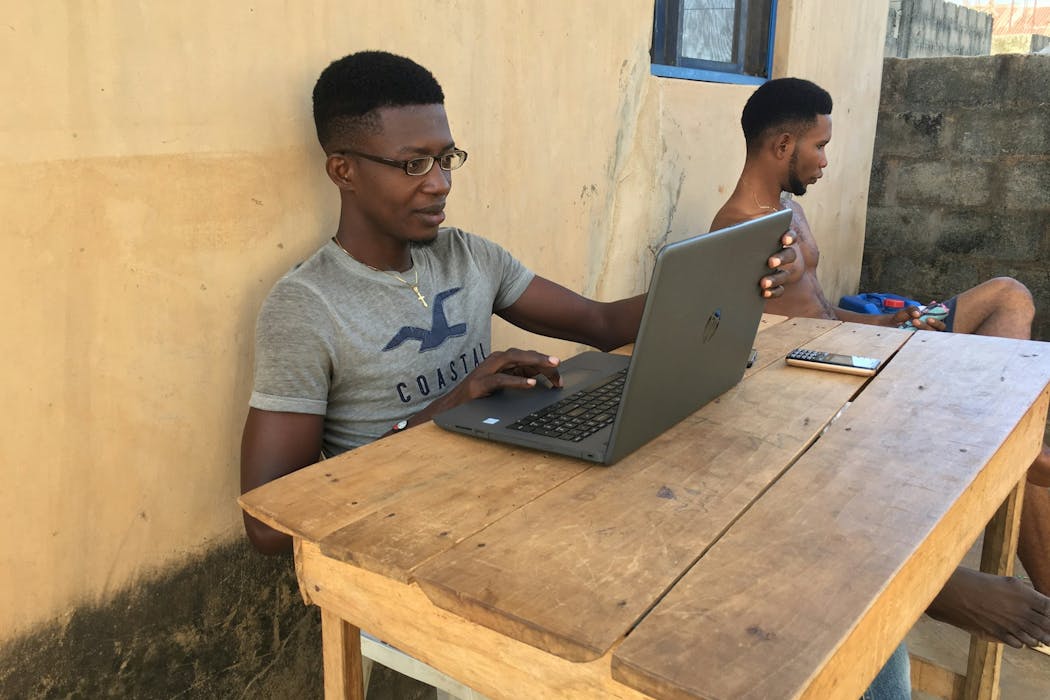
For students outside cities, participation in distance learning can be a lonely struggle.Tobi Oshinnaike via Unsplash
Across Africa, distance education has become one of the most powerful forces for expanding access to higher learning. Open and distance learning institutions such as the Open University of Tanzania, the Zimbabwe Open University and the National Open University of Nigeria have joined long-standing providers like the University of South Africa in offering flexible study opportunities to millions of students who would otherwise be excluded from higher education.
These institutions are reimagining what it means to go to university in contexts where geography, cost and social responsibilities often keep young people out of the classroom.
The value of distance education is undeniable. It allows working adults to continue their studies without leaving employment, gives rural youth the chance to stay in their communities while earning qualifications, and provides people with opportunities to balance learning alongside family responsibilities. During crises such as the COVID-19 pandemic, distance education proved to be a lifeline when face-to-face teaching was impossible.
Across the continent, it is not simply an alternative to traditional universities; for many, it is the only route into higher education.
The World Bank has reported that only 9% of the African population in the five years after secondary school is enrolled in tertiary education – the lowest rate in the world.
My own research takes the University of South Africa (Unisa) as a case study to dig deeper into how geography and inequality shape students’ experiences of distance learning: their access, participation, and outcomes. With over 370,000 students in South Africa and other countries, Unisa is the continent’s largest provider. It’s an ideal lens through which to understand both the promise and the challenges of this educational model.
I’m a geographer with an interest in international education and economic development. For the Unisa case study, I took a qualitative research approach, interviewing 28 Unisa postgraduate students from different regions of Africa. I chose them to reflect the diversity of students enrolled at Unisa and because they already had experience of studying.
The study found that although distance education can meet educational needs where people can’t access face-to-face learning, it’s not a perfect solution. There are still challenges which make it hard for some people to study, like inadequate infrastructure (poor internet connectivity and electricity supply), financial constraints, and language and cultural barriers. There’s a need for interventions to improve the effectiveness and equity of distance education.
Experiences of distance education
My interviews with postgraduate students across Africa showed a complex picture. For the 18 students based in cities, distance education can be genuinely empowering. Internet connections, though costly, are usually accessible in cities. Electricity supply is more stable, and digital platforms are within reach. Students in urban areas spoke of the freedom and flexibility they gained, describing distance education as the only way to balance work, family life and study.
But geography matters. For students in rural or marginalised regions, participation in distance learning can become a daily struggle.
Downloading a file may take hours. Travelling long distances to internet cafés eats into scarce time and resources. A student in Zimbabwe explained how he missed deadlines simply because the university portal would not load in his village. Another said:
Some days I feel like I’m learning less and figuring out how to connect more.
Another, in Kenya, described travelling to Nairobi every two weeks to collect academic materials. She felt the sacrifice was worth it because she knew education could change her life. For others:
I begin to wonder if it’s really worth it.
These obstacles, however, underline rather than diminish the value of distance education. Students are willing to endure enormous effort and cost to access learning because they believe in its power to transform their futures. Their determination is itself evidence of the demand for and importance of this model of education.
Still, the barriers are real. High data prices, unstable internet, and unreliable electricity continue to limit access. Women in rural areas often face additional responsibilities that leave them with little time or energy to study.
It’s hard to keep up with my guy classmates who don’t face the same rules at home.
And the flexibility that makes distance education attractive can sometimes turn into a sense of isolation when students don’t have peer support.
I feel alone a lot. Even when I try to share, they don’t seem to understand what I’m facing.
Persistent inequities in distance education
Distance education can actually keep existing inequities in place, because students from wealthier, urban backgrounds are better positioned to succeed than rural students are.
My study also revealed how the realities of students’ lives not only affect their ability to use digital tools but also their sense of belonging to the academic community. There is a growing digital divide within distance education itself.
The task ahead is to make sure that these challenges do not undercut the progress distance education has already made. Over the past decade, distance education has expanded access, increased enrolment far beyond the capacity of traditional campuses, and improved the quality of digital teaching, learner support, and flexible study pathways.
Investment in affordable broadband and electricity is essential, particularly in rural and underserved regions. Financial aid needs to cover the hidden costs of learning, from devices to data. Outreach centres should be located closer to marginalised communities, and policies must explicitly address the gendered realities that shape women’s access to higher education.
Across Africa, open universities have already demonstrated how distance education can widen participation and build inclusive futures. Unisa’s story, and the experiences of its students, highlight both the opportunities and the work still to be done.
Geography continues to shape who can learn, but it does not have to decide who gets left behind. With the right investments and policies, distance education can move closer to fulfilling its full promise: to provide equitable, life-changing access to higher learning for all.
Ashley Gunter receives funding from, The Arts and Humanities Research Council UK, British Academy UK, National Research Foundation, Newton Fund UK.
Source: The Conversation – Canada – By Benjamin Freeman, Assistant Professor, School of Biological Sciences, Georgia Institute of Technology
We know that climate change is affecting animals and habitats across our world, but figuring out how isn’t always easy. In fact, for years, I told audiences we simply could not know how mountain birds in the Pacific Northwest were responding to climate change. But as my recent research proves, I was mistaken.
It wasn’t for lack of scientific interest — biologists worry that mountain species are vulnerable to warming temperatures. It wasn’t for lack of personal interest — I grew up among the snow-capped mountains of the region and wanted to know what was happening in my own backyard. It was because we lacked the data.
Specifically, I thought there was no historical data describing where Pacific Northwest birds lived along mountain slopes prior to recent climate change. Historical data provides a crucial baseline. With good historical data in hand, researchers can compare where species live now to where they used to live. In protected landscapes where people aren’t directly changing the habitat, climate change is the main force that could impact where birds live.
As a postdoctoral fellow at the University of British Columbia, I had found historical datasets and conducted resurveys in far-flung locations from Peru to Papua New Guinea. Yet I did not know what was happening to the birds living in the mountains visible from campus.
Researchers conducted surveys in the mountains near Vancouver, B.C. to find out how climate change is impacting birds that live in the area. (Benjamin Freeman)
The expectation is that mountain species should respond to hotter temperatures. Some species like the warmer areas at the base of the mountain, while others require cold areas near the mountain top.
Bird surveys
The general prediction is that plants and animals will move to higher elevations where temperatures remain cool, as if they are riding a slow-motion escalator. This spells trouble for mountaintop species, which have nowhere higher to move to. For them, climate change can set in motion an “escalator to extinction.”
To determine whether this was true, I first had to relocate the locations that Waterhouse and her colleagues had surveyed. Global positioning system units did not exist at the time, so they marked their survey locations on maps. I spent days in the forest, tracing my finger along the map as I walked through the woods.
Luckily for me, Waterhouse conducted her surveys in old-growth forests. With their towering trees and massive decaying logs on the forest floor, it was easy to tell when I stepped from the surrounding younger forest into one of these ancient groves.
Then I had to do the modern surveys. This required waking up at 4 a.m. for a month. Birds are most active in the early morning, so that’s the best time to conduct research.
While it’s never fun to set an early alarm, it was glorious to spend dawn among giant trees listening for birds. One morning a bobcat padded along a mossy log just a couple of metres from where I stood.
Another day a barred owl swooped noiselessly past me like a forest ghost. And every morning I conducted survey after survey, scribbling the species I encountered in my notebook.
What we found
After the survey work was completed, our team analyzed the data. We found that temperatures have increased by around 1 C in southwestern British Columbia since the early 1990s.
We wondered whether this warming would set the escalator to extinction in motion. But the main response we found was that species still live in the same slices of mountainside but have become more abundant at higher elevations. That suggests most species living in old-growth forests in this region are resilient to climate change so far.
Our resurvey is kind of like going to your doctor for a routine physical exam, but for an entire bird community. We found most species are doing well, akin to a general good report from your doctor. But we also identified problems.
Most notably, the Canada jay has dramatically declined and is on the escalator to extinction. This grey-and-white bird, also known as “whiskey jack,” is well-loved for its bold behaviour and intelligence and is considered by some to be Canada’s national bird. Follow-up research is urgently needed to help these charismatic jays persist in this region.
Our study provides a clear picture of how birds are responding to climate change in the mountains near Vancouver. This information is directly useful to land managers and conservationists.
I think back to the years when I said this study was impossible. If I hadn’t come across Waterhouse’s study that one grey afternoon, the hard-won data that she and her team collected might have been lost.
Thinking about mountain birds, I realize my toes are tapping as I look to the alarm clock and decide that maybe I need more 4 a.m. wake-ups in my life.
Benjamin Freeman receives funding from the David and Lucille Packard Foundation.
Source: The Conversation – UK – By Sabah Suhail, Research Fellow, School of Electronics, Electrical Engineering and Computer Science, Queen’s University Belfast
Earlier this year, a cyberattack on British retailer Marks & Spencer caused widespread disruption across its operations. Stock shortages, delayed deliveries, and logistical chaos rippled through the retailer’s network.
The food sector is highly dependent on different links in a chain. This makes it an appealing target for hackers, because a single weak link can compromise an entire supply chain. Because of the essential role of food for public health and safety – and its importance to the economy – it is regarded as critical national infrastructure.
So how can the UK’s vital food sector be made more resilient to cyber-attacks? One possible way is to use what’s called a “digital twin”. A digital twin is a virtual replica of any product, process, or service, capturing its state, characteristics, and connections with other systems throughout its life cycle. The digital twin will include the computer system used by the company.
It can help because conventional defences are increasingly out of step with cyber-attacks. Monitoring tools tend to detect anomalies after damage occurs. Complex computer systems can often obscure the origins of breaches.
A digital twin creates a bridge between the physical and digital worlds. It allows organisations to simulate real-time events, predict what might happen next, and safely test potential responses. It can also help analyse what happened after a cyber-attack to help companies prepare for future incidents.
For companies in the food sector, becoming resilient to cyber-attacks involves the ability to detect suspicious activity early, and keep operations running, even under attack. This will ultimately protect food quality and consumer trust.
Simulating an attack
Let’s focus on the example of a strawberry packhouse, where strawberries are sorted, cooled, and packed for distribution. Due to strawberries spoiling easily, controlling the temperature and humidity in these areas is essential to ensuring a high quality product. Sensors and HVAC (heating, ventilation, and air conditioning) systems maintain these conditions to keep the fruit fresh from the field to the shelf.
But what happens if the HVAC system gets hacked, perhaps through weak passwords or software that isn’t regularly updated to account for new computer security vulnerabilities. Temperatures could rise unnoticed, causing spoilage before the fruit even reaches the supermarket. The results: food waste, lost revenue, delayed deliveries, and reputational harm. A single breach can reverberate through the chain, leading to wasted produce and empty shelves.
A digital twin might be able to avert disaster under this scenario. By combining operational data such as temperature, humidity, or the speed air of flow with internal computing system data or intrusion attempts, digital twins offer a unified view of both system performance and cybersecurity.
They enable organisations to simulate cyber-attacks or equipment failures in a safe, controlled digital environment, revealing vulnerabilities before attackers can exploit them.
A digital twin can also detect abnormal temperature patterns, monitor the system for malicious activity, and perform analysis after a cyber-attack to identify the causes.
Over time, these insights can enable the strawberry packhouse, in our
example, and by extension the broader supply chain, to strengthen its defences against hackers and reduce the future risk of a cyber-attack.
As cyber-threats become more sophisticated, the question is no longer whether the food sector will be targeted again, but whether it will be ready when further attacks inevitably happen.
Digital twins cannot prevent every cyber-attack, but by turning uncertainty into foresight, they give the food sector a fighting chance to stay safe, sustainable, and secure.
Salil S. Kanhere receives funding from the Australian Research Council, the Department of Defence and the Alexander von Humboldt Foundation.
Sabah Suhail does not work for, consult, own shares in or receive funding from any company or organisation that would benefit from this article, and has disclosed no relevant affiliations beyond their academic appointment.
Zootropolis 2 arrives in cinemas with real confidence: a fun, fast-paced sequel bursting with sharp gags, lovable characters, beautiful animation design and a heartwarming central message which avoids turning syrupy. The film, titled Zootopia 2 in the US, will delight younger viewers and, thankfully, has more than enough charm for adults too.
This new chapter returns to the first instalment’s central duo, Nick (Jason Bateman) and Judy (Ginnifer Goodwin), a mismatched fox-and-bunny partnership working in the Zootropolis Police Department.
Bateman brings knowing, mischievous charisma to the roguish Nick, while Goodwin’s Judy is energetic and flawed, with an endearingly warm dollop of emotional depth. Nick and Judy spend much of the story at odds, creating many of its most poignant moments.
Early on, they are ordered to attend “partner therapy” in a wonderfully over-the-top scene which sets the tone for the rest of the film, prompting giggles from little ones and knowing laughter from the adults, while the surprisingly insightful advice lands with the pair. This is Zootropolis 2’s strength: the humour is blended with heartfelt moments, always preventing it from tipping into the saccharine.
The world of Zootropolis is expanded in this sequel as Judy and Nick leave the confines of the city for the countryside in pursuit of a mysterious snake. This gives the film’s production team ample opportunity to stretch their design muscles, and the result is breathtaking.
Vast animated expanses recall the most stunning snowscapes of Frozen and dazzling twilight skies of Tangled. Vibrant colours and countless animals with individual quirks create genuine playfulness which feels fresh and inventive.
At times the jokes steal the spotlight, leaving our lead duo a bit shortchanged and the central reptile mystery a little muddled and under-explained. But this never undermines the film’s appeal. The script delights in its new, exuberant characters, who bring a generous dose of joy and entertainment.
Nibbles Maplestick (Fortune Feimster) – a beaver who has a podcast investigating mysterious reptiles – steals every scene she is in, with slapstick physical comedy and hilariously odd questions like “Do snakes wear half a pant or just one long sock?” (which she later answers).
Gary De’Snake (Ke Huy Quan), an electric blue, heat-sensing pit viper, is animated with a dynamism that recalls The Jungle Book’s villainous Kaa. But he manages to pull off the impossible: making snakes likeable.
There are so many Easter eggs, quick quips, action set-pieces and fast-paced jokes that even the keenest-eyed viewer won’t catch them all on first viewing. Puns and visual gags abound and will keep the audience smiling throughout.
We get a macho pair of zebras calling themselves “Zeebros”, a carrot logo on Judy’s phone, and even a weather “furcast”. A music festival cheekily named Burning Mammal pokes fun in all the right ways and the high-octane tube transport system is begging to be a theme park ride.
Especially fun are several call-backs to other Disney films. A loving riff on Ratatouille’s rat chef and an uproariously awkward parody of Lady and the Tramp’s spaghetti scene give the film the comic sensibility of the best of DreamWorks’ Shrek, but with a gilded Disney flair that is both nostalgic and hilarious at the same time.
Behind all of the thrills and jokes lies a message of community and harmony between species. This is gently woven through the film, never becoming didactic. Nick and Judy’s strained partnership mirrors the wider anxieties of Zootropolis itself, while the reptile mystery quietly explores prejudice and fear of the unfamiliar.
Nick says, “Our differences don’t make a difference.” It’s a resonant and powerful idea in 2025’s zeitgeist, shaped by war, conflict, political and cultural unrest.
Zootropolis 2 is a sharp, funny sequel with a heartwarming and vital idea at its core. Confident and imaginative, it bursts with colour and heart, offering crowd-pleasing thrills without losing sight of something worth saying.
By keeping sentimentality at bay and balancing its spectacle with humour-laced sincerity, it proves the world of Zootropolis is still as vibrant and rewarding as ever.
Looking for something good? Cut through the noise with a carefully curated selection of the latest releases, live events and exhibitions, straight to your inbox every fortnight, on Fridays. Sign up here.
Laura O’Flanagan does not work for, consult, own shares in or receive funding from any company or organisation that would benefit from this article, and has disclosed no relevant affiliations beyond their academic appointment.
What does the familiar film tagline “based on a true story” really mean? Leaving aside questions of historical fidelity versus poetic license, what does an audience get from the assurance that a given story “truly happened”?
At best, these claims remind us that – however fantastic or horrific – these events were once realities for other people very much like ourselves. At worst, they exercise a kind of moral blackmail: guilt tripping the audience into thinking that criticising the film’s storytelling somehow disrespects the real people who endured those traumatic events.
Every story of Holocaust survival and rescue is unique and, against the backdrop of ubiquitous slaughter, uniquely miraculous. Annabel Jankel’s new film Desperate Journey, based on the experiences of Austrian-born Holocaust survivor Freddie Knoller (1921-2022), is certainly as extraordinary a story as any.
Freddie (played by Lucas Lynggaard Tønnesen) escaped his parents’ fate through a circuitous and often picturesque journey across Nazi-dominated Europe, ultimately landing late in the war in Auschwitz-Birkenau and surviving a death march.
Such accounts can all too easily topple into cliches of wartime derring-do, or fall victim to sentimentality and sensationalism. What inoculates them against these perils is precisely the unique and often tiny details that ground wildly improbable tales of survival in gritty reality. (The French film-maker Claude Lanzmann, best known for the Holocaust documentary film Shoah, once remarked that “there is more truth for me in some trivial confirmation than in any number of generalisations about the nature of evil”.)
However, Desperate Journey – which focuses almost exclusively on the most colourful part of Freddie’s tale, his time working under a false identity in German-frequented nightclubs in occupied Paris – leaves out almost all of this granular detail. As a consequence, it ends up feeling almost as divorced from the hard-to-fathom realities of the Holocaust as much-derided fantasies like The Boy in the Striped Pyjamas (2008)
The trailer for Desperate Journey.
For example, shortly after Freddie’s escape from Austria, at the urging of a friendly farmer’s wife (Niamh Cusack), he burns his Austrian passport, stamped with the lethal “J” (for Jew). From this point on he is stateless and without papers in a continent-wide trap. But, bar a narrow escape on board a train, in the film his fugitive status seems to cause him remarkably few problems.
Numerous survivor accounts attest to the grinding daily fear and the incessant improvisation needed to stay one step ahead of the Gestapo. Yet courtesy of a friendly Jewish landlady and a tolerant employer, Freddie enjoys a life – albeit precarious – of sleazy glamour in the demi-monde of wartime Parisian nightclubs and brothels.
Despite a screenplay by Michael Radford (1984, Il Postino), and handsome if somewhat overblown production design, almost nothing in Freddie’s story has a ring of authenticity. Nazi officers are uniformly leering sadists. The nightclub dancer (Sienna Guillory) with whom Freddie strikes up an ill-starred and dramatically unconvincing romance performs improbably elaborate routines that evoke Josephine Baker and harbours her own tragic secret to match Freddie’s. The French Resistance fighters he encounters are hard but honourable tough guys in leather jackets and crew-neck sweaters (including an enjoyably hammy turn from Steven Berkoff).
Viewers who favour historical precision will be dissatisfied to find Freddie fleeing Austria days after the March 1938 Anschluss and arriving apparently a few weeks later in occupied Paris (France surrendered to Germany in June 1940; the real Freddie Knoller spent two years in Belgium before fleeing to France ahead of Hitler’s advancing armies).
To those with an aversion to cliche, Freddie’s arrival there, emerging from the Metro to the strains of accordion music and the overtures of improbably glamorous street prostitutes and a cartoonishly Mephistophelian pimp (Fernando Guallar), will be equally grating.
Perhaps the film’s most fatal flaw is its refusal even to try to dramatise the trauma that Freddie – only 17 when his six-year trans-European odyssey began – underwent. He sees his family torn apart, sees his companions mown down by German border guards, lives with the ever-present threat of capture and deportation, and ultimately survives (offscreen) the death factory of Auschwitz and the nightmare of the death marches. Yet his principal character note, from early on in the film, is his adolescent fascination with the imagined lubricious pleasures of Parisian nightlife. His exploits there play more as a slightly risky caper than a struggle for survival.
Desperate Journey feels like a throwback – a 1950s Hollywood version of the war. It is far too light and conventionally melodramatic to hold up against decades of scholarship and public understanding of the real costs of survival amid inconceivable terror and against overwhelming odds.
Looking for something good? Cut through the noise with a carefully curated selection of the latest releases, live events and exhibitions, straight to your inbox every fortnight, on Fridays. Sign up here.
Barry Langford does not work for, consult, own shares in or receive funding from any company or organisation that would benefit from this article, and has disclosed no relevant affiliations beyond their academic appointment.
Warning: this article contains spoilers for the first four seasons of Stranger Things.
When the Duffer Brothers came up with the idea for a television show that would mix Stephen King and Stephen Spielberg, they had trouble convincing network executives. Some thought a show that had an ensemble cast of kids as main characters would be a production nightmare. Others thought the tone was far too scary to have children at the centre, so it either needed to be “nicer” or focus on the reclusive, angry-sad chief of police Jim Hopper (David Harbour) instead.
But when the first season aired in its entirety in 2016, it became an instant success. The 1980s nostalgia, the use of practical effects on the Demogorgon (the show’s monster), a comeback performance by Winona Ryder and the chemistry between the kids all combined to bring a show that represented what the quintessential Netflix Original should be.
When the first season of Stranger Things was released, House of Cards (2013-18) was the flagship Netflix Original. Long before the lawsuits against lead actor Kevin Spacey, the show enjoyed such status that the iconic Netflix “tu-dum” that sounds out whenever you hit play was derived from the show (just watch the very final few seconds of the season two finale and you’ll understand).
The trailer for Stranger Things volume five.
There were other successful and popular originals like Orange is the New Black (2013-19), a new season of Arrested Development (2013-19), and the Marvel collaboration, Daredevil (2015-18). But nothing showed the narrative and world-building possibilities of this still-strange way of TV quite like Stranger Things did.
Fans of Stranger Things soon began to exert power over the show itself. When many demanded “justice for Barb” (Shannon Purser), a character that died early on in the first season, plans for season two changed to make room for just that. When season four came around, fans were equally passionate about Eddie’s (Joseph Quinn) death, petitioning to bring him back for the final season.
As it prepares to launch its fifth and final season, Stranger Things is a different beast than before. It is now more akin to the “event television” series like Lost (2004-10), Sherlock (2010-17), or perhaps the most prominent example, Game of Thrones (2011-19). Event TV is the kind of television show that fans don’t just binge on their mobile phones during their commute, or watch in the background as they eat cereal, but make plans to watch, frequently with friends or family. Fans are no longer just watching new seasons as they drop, but diving into petitions, online debates and the personal lives of its cast.
Acknowledging this change of status, the fourth season of Stranger Things wasn’t released in one go, as with the previous three seasons, but drip fed to fans in two parts – seven episodes first, then two more episodes a few days later. The final season is to be divided into three parts. Four episodes first on November 27, three episodes a month later on December 26, and the grand finale, a few days later, on New Year’s Eve.
Back in 2016, The Guardian’s TV critic Mark Lawson likened Stranger Things to watercooler TV hits, shows from the pre-streaming era that would create such a buzz that you would talk about them with your colleagues over the watercooler the next day. Nine years later, Netflix seems eager to frame Stranger Things as the watercooler TV show of the 2025 holiday season.
The trailer for Tales From ‘85.
The original show is going to end, but in many ways this seems to be just the beginning. A teaser trailer has already been released for a new animated Stranger Things series, called Tales from 85. The show takes place between the events of the second and third seasons of Stranger Things, already positioning the show to become a franchise.
Add to that other spin-offs like the after-show Beyond Stranger Things, in which cast and creators discuss the events and behind-the-scenes details of episodes, tie-in mobile games, an immersive viewing experience, books, board games, merchandise and a London theatre production, Stranger Things: The First Shadow, it is now so much more than the quintessential Netflix Original.
Stranger Things proves that even in an era filled with sequels, prequels, remakes and reboots, it’s still possible for a brand-new story to launch a major franchise that grows far beyond its original platform. Who knows, we may even get a new season down the line. After all, stranger things have happened in the TV business.
Looking for something good? Cut through the noise with a carefully curated selection of the latest releases, live events and exhibitions, straight to your inbox every fortnight, on Fridays. Sign up here.
Orcun Can does not work for, consult, own shares in or receive funding from any company or organisation that would benefit from this article, and has disclosed no relevant affiliations beyond their academic appointment.
Does the truth matter in a film about historical events? This question sits at the heart of any biographical drama, shaping how we judge the balance between storytelling and accuracy.
Early in Richard Linklater’s Blue Moon, I thought of Amadeus. That 1984 film isn’t about Mozart – it’s about jealousy. Similarly, Blue Moon isn’t a documentary about Broadway composer Richard Rogers (Andrew Scott) and lyricist Lorenz Hart (Ethan Hawke). It’s a moving drama about Hawke’s character dealing with professional and romantic failure. Don’t expect it to be historically accurate.
Linklater and screenwriter Robert Kaplow set the movie as an extended scene in a bar called Sardi’s on the opening night of Oklahoma! in 1943. The Broadway hit marked the end of the exclusive partnership of Rodgers and Hart when the former decided to form a new, genre-defining pairing with Oscar Hammerstein II.
The Rodgers and Hammerstein musicals (including Carousel, South Pacific, The King and I, and The Sound of Music) went on to become staples of the repertoire. They provided models for much of what came later. In contrast, the Rodgers and Hart collaboration is now remembered more for its songs, such as standards like My Funny Valentine and The Lady Is a Tramp, than for its musicals, including On Your Toes and Pal Joey.
Blue Moon shows us a portrait of Hart who can see that the parade has passed him by. He comments loudly on Hammerstein’s clunky lyric writing while watching the title song of Oklahoma! in the theatre (the number itself rather feebly staged). When Rodgers arrives at Sardi’s, Hart discloses his low opinion of the show.
The trailer for Blue Moon.
The alcoholism that would soon take his life is a key theme used to explain why Rodgers can’t bear to write with him anymore. He has become unreliable. Meanwhile, a romantic crush inspired by 11 letters written to Hart from a Yale college student (a vulnerable Margaret Qualley) is used to explore Hart’s sexual fluidity, though it’s not clear that Hart ever met her in real life.
Hawke’s elegiac performance is worth the price of admission alone. This is a truly stunning portrayal of someone whose illness makes them unable to evolve professionally when the culture around them changes. Both witty and deeply sad, it’s an intense psychological tour de force, worthy of an Academy Award.
But that intensity is also tiring. Almost the entire movie shows Hart sitting in Sardi’s, having discussions with the bartender (a wonderfully colourful performance from Bobby Cannavale), writer E.B. White (sensitively portrayed by Patrick Kennedy) and the pianist (Jonah Lees, hampered by having to mime a strangely pedestrian piano soundtrack of songbook classics). Although the screenplay is notionally conversational, Hart’s inability to share a genuine exchange with anyone other than his crush means that much of the time it feels like being adrift in an 80-minute monologue.
That’s where the movie is most striking and most problematic. You can’t help but find Hawke’s colossal speeches compelling, but it’s so static that it feels more like the material for a play – possibly even a radio play – than a movie. The sustained focus also makes Linklater’s awkward handling of Hart’s diminutive stature (achieved through careful placing of the camera) distracting far too much of the time. It quite unnecessarily allows the fact that the real Hart was about 4ft 10in to hinder the presentation of Hawke’s searing portrayal.
Throwing in other factual details also unhelpfully overwhelms common sense. The film recounts how Rodgers and Hart got together again a few months after Oklahoma! to write some new songs for a revival of their 1927 musical A Connecticut Yankee. Yet it shows Rodgers proposing the revival to Hart in the middle of their fraught exchange in the bar soon after the composer arrives for his opening night party – something that doesn’t ring true and upsets the psychology of the scene.
Ethan Hawke discusses his role in Blue Moon.
Another implausible moment, when Hammerstein introduces his future protege Stephen Sondheim – then a child – to Hart as his “neighbour”, borders on the risible. Sondheim wasn’t at the opening night of Oklahoma! and wasn’t that close to Hammerstein at this point, and it’s almost certain that the stagestruck child would not have been so rude when meeting a major lyricist (it was only later that he became openly critical of him). He was too much in love with the theatre and was only 13 years old.
It seems to me that these sorts of problems stem from the decision to set all the action on one night, rather than splitting it into two or three scenes in Hart’s final months. Throwing in too many facts and then not paying attention to credibility undoes the research itself.
If we’re here to learn about human truths that speak to a wider audience beyond theatre nerds, then why allow the reality of Hart’s height to be the thing that dictates where the camera is most of the time? After all, Rodgers wasn’t sleek and handsome in the way Scott embodies him, so why is Hart’s height a constant focus? Or if the aim is to engage with historical truths, why portray Hart as snarky about Hammerstein’s lyrics – and pompous about his own syntactic ability as a writer – when he was no more pedantic than his colleague?
As such, Blue Moon falls between two stools, the real and the imagined, without being quite sure which is the more important. Thankfully, and ironically, Hawke’s performance rises above it.
Looking for something good? Cut through the noise with a carefully curated selection of the latest releases, live events and exhibitions, straight to your inbox every fortnight, on Fridays. Sign up here.
Dominic Broomfield-McHugh does not work for, consult, own shares in or receive funding from any company or organisation that would benefit from this article, and has disclosed no relevant affiliations beyond their academic appointment.
A short video of a private wedding went viral in Iran recently, tearing away the country’s veil of piety and exposing hypocrisy and a seeming disregard for the rules by which the theocratic regime requires that most Iranians live their lives.
The wedding in question was that of Fatemeh Shamkhani, in mid-2024. She is the daughter of Ali Shamkhani, a close adviser to Iran’s supreme leader, Ali Khamenei, at the luxurious Espinas Palace Hotel in Tehran.
She wore a low-cut strapless dress with a western-style bridal veil rather than the full head-covering mandated for Iranian women. Many wedding guests also wore modern western styles and a lot of the women went without head coverings.
The video displayed images that were starkly dissonant, revealing the significant class and moral divides within the Iranian Republic and contradicting Iran’s values of revolutionary simplicity and Islamic modesty.
That it was Shamkhani’s family wedding made matters worse. A former commander of the regime’s Revolutionary Guards, he is a key power broker in Iran, who has the ear of Khamenei himself. He was also involved in the savage crackdown on the public protests in Iran in recent years, in defence of the same security and morality laws his family was seen so lavishly violating at the wedding celebration.
More than a mere scandal, the event functions as a potent symbol of a systemic crisis. It has highlighted the triple ailments of elite privilege, selective morality and a rapidly eroding social contract between the ruling class and the people of Iran.
Shamkhani is part of a wealthy group at the centre of power in Iran that enjoys many privileges but imposes strict religious and moral rules on ordinary citizens. In recent years, the wealthiest people have become steadily richer – according to Forbes magazine, in 2020 the number of high net worth people in Iran grew by 21.6% against a global average of 6.3%.
Tehran’s wealthiest people enjoy a luxurious lifestyle while many others struggle to make ends meet.
The emerging ruling elites maintain their wealth through oil revenue, state contracts and shadow economic activities – that enable them to evade sanctions (the Shamkhani family was identified and sanctioned earlier this year by the US treasury as controlling a vast shipping empire involved in transporting oil from Iran and Russia in breach of US sanctions). .
Meanwhile, millions of Iranians are facing severe economic hardships due to hyperinflation, stagnant wages and currency devaluation. To the 36% of Iranians living below the poverty line, it is deeply offensive for these citizens to witness senior officials’ families flaunting their extravagant wealth.
Tale of two Irans
Since the 1979 Revolution, Iran has maintained its legitimacy through its mission to reshape public conduct by enforcing rules such as hijab requirements and sex segregation. The state maintains complete authority to regulate female bodies.
So the Shamkhani wedding, with its ostentatious luxury, its low-cut gowns and lack of head coverings felt to many Iranians as showing complete disregard for laws that the regime’s “morality police” uses to enforce strict rules on ordinary women. The rules exist to control, but they do not apply to those at the top of the tree.
This incident is significant in the context of the “woman, life, freedom” protests of recent years. These were sparked in 2022 by the death in custody of Mahsa Amini, a young Kurdish woman who had been arrested for not wearing her hijab properly. Since then, many Iranians, particularly young people, have openly defied the hijab law.
In response, the government has stepped up its enforcement efforts. But Iran is struggling to address significant shifts in generational attitudes and a substantial decline in its legitimacy. The state is attempting to establish a degree of control that may be impossible to achieve. It cannot force millions of women, who have courageously rejected a law, to return to compliance.
The continuing defiance of Iranian women is a powerful sign that the identity of Iranian society has evolved beyond the state’s ability to dictate it.
Additionally, the viral nature of the leaked video is significant. In an era characterised by the prevalence of smartphones and encrypted messaging applications, the regime finds itself unable to exert control over the narrative. The video spread rapidly inside Iran, prompting a great deal of outrage and extensive commentary, criticising the powerful elites.
Infighting at the top
There has also been some speculation that the leaking of the Shamkhani wedding video is part of a power struggle at the top. It’s been reported that the supreme leader has appeared in public only very rarely since the 12-day war with Israel and the US airstrikes on Iran’s nuclear installations in June. Meanwhile, there are signs of political infighting as rival factions jockey for position.
Prominent among those are Shamkhani and former president Hassan Rouhani. The pair have clashed openly over issues such as the 2015 nuclear deal which Rouhani presided over for Iran. Rouhani has also been accused by Shamkhani’s faction of mismanagement in office. There has been speculation that the leaking of the video may have been sanctioned by the former president as a power play.
The disunity has been made worse by resentment among many Iranians who observe the apparent excesses illustrated by the Shamkhani wedding. For the regime’s critics, the video emphasises Iran’s growing inequality, corruption and hypocrisy.
Events like this are more than just news – over time, they can weaken the social and political foundations of Iran. When the ruling families disregard the rules, those rules begin to lose their authority.
Farhang Morady does not work for, consult, own shares in or receive funding from any company or organisation that would benefit from this article, and has disclosed no relevant affiliations beyond their academic appointment.
Histotripsy is a non-invasive cancer treatment that uses focused ultrasound to destroy tumours with targeted, precise therapy, minimising damage to nearby healthy tissue.Aunt Spray/Shutterstock
For anyone facing cancer, the treatment options can feel brutally familiar: surgery, radiotherapy, chemotherapy, or a combination of them all. But a new approach is beginning to offer something very different. By using nothing more than precisely controlled sound waves, histotripsy can destroy tumours without cutting the skin or burning healthy tissue.
Histotripsy uses technology similar to medical ultrasound scans but delivers far more powerful and focused energy. Instead of creating an image, it produces controlled bursts of energy that form microscopic bubbles inside the targeted tissue.
As these bubbles rapidly expand and collapse, they break the tissue apart into tiny particles. The body then absorbs and clears away this debris over a few weeks, leaving behind little to no scar tissue and protecting the surrounding structures.
One of the biggest advantages of histotripsy is that it is non-invasive. For patients, this means no incisions, less pain, a lower risk of infection, and a quicker recovery than surgery or treatments that rely on heat to destroy tissue.
Crucially, histotripsy does not use ionising radiation or heat, both of which can harm healthy cells. Instead, the procedure is guided in real time using imaging, so clinicians can see exactly where the therapy is being delivered and adjust instantly. This level of precision is central to its safety.
Research into histotripsy has grown rapidly. Laboratory and animal studies have shown that it can effectively destroy tumours in the liver, kidney, pancreas, and other organs. Its ability to clearly define the treatment area while sparing nearby vital structures makes it especially useful for cancers that sit close to blood vessels, ducts, or other sensitive tissues.
Clinical trials have recently brought histotripsy closer to routine patient care. The US Food and Drug Administration has approved it for selected liver treatments after promising results in patients with primary and secondary liver cancers.
In the multi-centre Hope4Liver trial, histotripsy successfully removed targeted liver tumours with fewer complications than many standard treatments. These early results suggest the technology could be valuable not only for cancer but also for benign conditions.
Histotripsy does more than mechanically break down tumours. When tumour cells are fragmented, they release cellular debris and chemical signals that alert the immune system. Laboratory research shows this can help the body recognise and attack cancer cells.
Some studies have even demonstrated abscopal effects, meaning immune responses are triggered in tumour sites far from the treatment area. This immune activation raises the possibility of combining histotripsy with modern immunotherapies to make cancer cells more vulnerable to the body’s defences.
Another strength of histotripsy is that it works hand-in-hand with real-time imaging. This gives doctors the ability to adjust the treatment to a patient’s movement, such as breathing, and to work around anatomical variations.
Researchers are exploring histotripsy for a wide range of health problems. Trials have investigated its use for benign prostate enlargement, softening calcified heart valves, and potentially treating certain neurological conditions. Its ability to target tissue gently and precisely, without harming surrounding areas, makes it appealing for patients who are poor candidates for surgery.
In early studies of valve disease, histotripsy has been shown to soften calcified valve cusps and improve leaflet motion, thereby reducing pressure gradients and improving valve opening. It is not yet a technique that reliably removes all calcification or replaces the valve, and most of the evidence so far comes from pre-clinical research.
Looking ahead, histotripsy may become a powerful addition to medicine’s toolkit. Researchers are still studying its long-term benefits in larger patient groups, but its safety record, minimal damage to surrounding tissues, and compatibility with immune-based treatments set it apart.
As further trials are completed, doctors expect to better understand which patients will gain the most. Technological advances are also likely to produce devices designed specifically for different organs, along with improved imaging guidance and motion correction.
For patients, the potential impact is significant. If widely adopted, histotripsy could reduce the need for invasive surgery, improve tumour control and offer new options when other treatments are too risky or have failed.
The transition from laboratory research to clinical practice is still underway, but the momentum is strong. Each study adds to the evidence that histotripsy can provide precise, effective treatment with fewer risks
Current limitations
But challenges remain. Differences in tissue density, patient anatomy and movement can make targeting harder. The phenomenon known as acoustic aberration, where sound waves are distorted by bone or other tissues, can also reduce accuracy.
Engineers and clinicians are continually improving equipment and navigation algorithms to achieve even greater precision and to broaden its use.
It is also important to remember that cancer is often more widespread than imaging can detect. Histotripsy works on specific, localised lesions and cannot identify or treat hidden microscopic cancer cells. For many patients, though, it can play a valuable role in a broader treatment plan.
Histotripsy’s ability to break cancer with sound reflects a major shift in medical innovation. By transforming sound waves into a potent and precise therapy, scientists and clinicians are redefining how conditions such as cancer can be treated: less invasively, more safely and with greater potential for cure. As research continues, histotripsy stands poised to reshape patient care for years to come.
Justin Stebbing does not work for, consult, own shares in or receive funding from any company or organisation that would benefit from this article, and has disclosed no relevant affiliations beyond their academic appointment.