Three reasons why China wants global green leadership after Cop30 – and two reasons it doesn’t

Source: The Conversation – UK – By Alex Lo, Professor, Environmental Social Scientist, York St John University

Ahead of the UN’s Cop30 summit, China appeared keen to take on the mantle of new global leader on climate change, stepping into the gap left by the US’s withdrawal from the top spot under Donald Trump.

In trying to understand what China wants from this role, it’s worth examining three areas motivating Beijing to take over leadership, and two others which it is trying to avoid.

First, China is attempting to reshape climate change talks along “tech and trade” lines. At Cop30, it presented itself as a “clean-tech” superpower and as ambitious, technologically capable and cooperative.

Certainly, the country’s capacity for renewable energy generation has more than tripled in ten years, reaching 1,876,646mw in 2024. Solar energy has shown astonishing growth – 20 times higher than in 2015. In 2024, China, the world’s largest greenhouse gas emitter, invested US$290 billion (£219 billion) in renewable energy, that’s US$80 billion more than the combined total of the EU, UK and the US.

China needs to address its domestic energy planning for the world to achieve significant reductions in global emissions. Renewable energy is critical, particularly as the rapid scaling of AI and data centres drives a surge in electricity consumption. China is shaping the global agenda in favour of low-carbon technologies and their global expansion.

Growing green exports

A second priority for China in taking on global green leadership is using it to grow its export economy. China gains a trade advantage by making clean energy cheaper. Lower costs allow these clean technologies to access international markets easily. Since 2018, China has shipped out close to US$1 trillion worth of batteries, solar components, electric vehicles (EVs) and wind-power systems globally. But some of these industries are facing overcapacity, and so China must find new markets for its products.


Read more:
Chinese controls on rare earths could create challenges for the west’s plans for green tech


China’s traditional markets, Europe and the US have recently added trade barriers, including tariffs on Chinese EVs and solar panels. At Cop30, China used global climate negotiations to set out its opposition to these barriers, positioning free trade in clean technologies as essential for reaching global climate goals. But they are also ideal for Chinese economic growth.

Shipping to other emerging markets is an alternative to these more established markets. China’s EVs exports to south-east Asia saw an explosive growth in 2025. Its new customers are large, energy-intensive economies, such as Indonesia and India. China wants to keep them and everybody else committed to net-zero emissions in order to maximise its clean-tech trade benefits.

What’s good for China?

China also wants to strengthen cooperation across developing countries. Shared trade interests are only one driver of climate action alignment between competing economies, such as between China and India at the recent summit. Regional security is another.


Read more:
How China cleaned up its air pollution – and what that meant for the climate


China hopes to increase its political power in countries and regions of strategic interest, such as via its economic and trade partnership, the belt and road initiative, and also in the Pacific.

It has already increased its investments in new security allies, such the Solomon Islands and Cook Islands, competing in the region with the US, Australia and New Zealand. To repackage this strategy under the name of climate change, China launched the China-Pacific Island Countries Climate Change Cooperation Center in 2022. Addressing global climate change enables China to legitimise its involvement in these countries and regions.

China is being seen as stepping up to a leadership position on climate change.

What China doesn’t want

But assuming full leadership and historical responsibilities for climate change are beyond China’s comfort zone. China’s delegates entered Cop30 meeting rooms being praised for new leadership.

But Beijing is struggling to meet its current pledges. Latest analysis suggests that its carbon emissions are falling slowly. The country’s emission reduction pledges, announced ahead of Cop30, are regarded as insufficient. The biggest threat is its own economy: weak factory output, low consumer spending, high youth unemployment and lower state taxation to encourage growth.

Local governments in China have difficulties in financing the low-carbon economy. Local government debts are accumulating. It’s not clear whether China can fulfil its pledges by cutting emissions sharply, continue to subsidise its green energy industries, and make significant economic investments in regional cooperation, all under its current weak economy.

So China does not want to lead as an advocate of deep emission cuts. Nor does it want to take on the mantle with other industrialised economies of accepting the historical responsibility for global climate change. Analysis has shown that, despite being far behind the US, China’s historical emissions since 1850 have overtaken those from the 27 EU member states. The closer China comes to the US’s traditional role, the more it will be expected to take historical responsibility for climate change. China is not ready for that. It cannot reduce emissions significantly in a short timeframe under a weak economy.

China sees itself as a developing country. At Cop30, one of the contentious issues was getting US$1.3 trillion per year in climate finance from public and private sources in the EU and other OECD economies.

China did not formally commit to supporting the US$1.3 trillion goal, disappointing the rest of the developing world. The lack of commitment was not just a matter of money, but the idea that China should be held responsible in the same terms as developed countries. China has provided a substantial amount of climate and clean energy finance to other developing countries, but this is primarily driven by its strategic and geopolitical considerations.

China also opposed the fossil fuel roadmap aimed at phasing out fossil fuels and declined to contribute to Brazil’s Tropical Forest Forever Facility, a mechanism for compensating countries for preserving tropical forests.

Clearly, China is leading the world in low-carbon technologies. It also believes that climate cooperation with developing nations will deliver trade and security benefits. China will continue to shape climate change talks along these lines.

The next few years are too early for China to want to play as big a role as the US and EU did for the Kyoto protocol and Paris agreement. It will hold on to its red lines and only sign up to plans that meet its own economic and political ends.


Don’t have time to read about climate change as much as you’d like?

Get a weekly roundup in your inbox instead. Every Wednesday, The Conversation’s environment editor writes Imagine, a short email that goes a little deeper into just one climate issue. Join the 47,000+ readers who’ve subscribed so far.


The Conversation

Alex Lo does not work for, consult, own shares in or receive funding from any company or organisation that would benefit from this article, and has disclosed no relevant affiliations beyond their academic appointment.

ref. Three reasons why China wants global green leadership after Cop30 – and two reasons it doesn’t – https://theconversation.com/three-reasons-why-china-wants-global-green-leadership-after-cop30-and-two-reasons-it-doesnt-270329


Au travail, l’approche par générations renforce surtout les préjugés

Source: The Conversation – France (in French) – By Nicolas Raineri, Professeur associé en comportement organisationnel, ICN Business School

Génération X, Y ou Z, boomers ou alphas… le discours sur les générations est omniprésent chez certains experts du management. Pourtant, il est aussi très critiqué pour son manque de solidité scientifique. Plus grave, en confondant âge et génération, il est la porte ouverte à des pratiques de discriminations condamnées par la loi.


« Les jeunes d’aujourd’hui ne veulent plus travailler », « les millennials manquent de loyauté », « les baby-boomers ne comprennent pas les nouvelles technologies »… l’on retrouve ces poncifs dans les médias, les entreprises et les salles de réunion. Les « chocs de génération » semblent expliquer tous les maux du travail contemporain : désengagement, recul de la place du travail dans la vie, individualisme, rapport à l’autorité….

Mais nous sommes-nous suffisamment interrogés sur l’existence réelle de ces « générations », au sens sociologique ou psychologique du terme. Et si les générations n’existaient pas ? C’est la conclusion certes provocatrice, mais solidement étayée, de la plus vaste méta-analyse jamais menée sur le sujet, publiée dans le Journal of Organizational Behavior par Daniel Ravid et ses collègues.

Celle-ci combine les résultats de plusieurs études indépendantes portant sur une même question de recherche, afin d’obtenir une estimation globale plus précise et fiable de l’effet étudié. Ce massif travail de recherche démontre à partir de plus de 140 études regroupant plus de 158 000 individus que les différences entre générations au travail sont infimes, voire inexistantes.


À lire aussi :
Seniors : comment travailler plus longtemps quand personne ne vous recrute plus ?


Fausses évidences

Le concept de génération repose pourtant sur un postulat logique et de prime abord évident et rationnel : les individus nés à la même époque sont façonnés par les mêmes événements historiques, technologiques et culturels, et développent ainsi des valeurs et des comportements relativement homogènes. De plus, le concept apparaît familier, il est largement usité au quotidien et renvoie à nos observations et ressentis à chacun ; l’on se rend bien compte des différentes manières de penser et d’agir entre nos aînés et nos cadets.

De fait, la soi-disant évidence, familiarité et simplicité d’un cadre d’analyse réduisant toute une génération à des archétypes comportementaux – tels que les baby-boomers décrits comme matérialistes et attachés au travail, les générations X jugées sceptiques et individualistes, ou les millennials présentés comme idéalistes mais narcissiques –, en fait un objet très utile pour le storytelling managérial. Il permet de catégoriser les collaborateurs et leurs préférences en un clin d’œil, et alimente un marché florissant : formations, conférences, livres blancs et articles de presse vantent les vertus de la « gestion intergénérationnelle ».

Pourtant, les données ne suivent pas. Ravid et ses collègues arrivent à la conclusion que les différences entre générations sont statistiquement insignifiantes sur tous les indicateurs clés du monde du travail : satisfaction, engagement, motivation, valeurs, équilibre entre la vie professionnelle et personnelle, stress, intention de quitter son emploi. Autrement dit, un millennial n’est pas moins engagé qu’un boomer ni plus stressé qu’un GenX.

Distinguer âge et génération

Il est d’ailleurs essentiel de distinguer l’âge de la génération : l’âge renvoie à une étape du parcours individuel, tandis que la génération suppose une appartenance collective fondée sur une période de naissance commune. En effet, les variations observées semblent surtout relever de l’âge ou du contexte socio-économique au moment où les personnes ont été interrogées, pas d’une appartenance générationnelle.

L’étude rappelle que lorsqu’on compare des groupes d’âge, trois effets se confondent :

  • l’effet d’âge, lié au cycle de vie (on ne pense pas le travail de la même façon à 25 ans et à 55 ans) ;

  • l’effet de période, lié aux conditions économiques et sociales du moment (désengagement ou quête de sens touchent toutes les tranches d’âge après la crise sanitaire de 2020-2021) ;

  • et l’effet de cohorte, celui-là même qui correspond aux potentielles différences générationnelles.

Or, ces trois effets sont indissociables. Quand l’on constate une différence, il est impossible de savoir si elle provient du fait d’avoir grandi dans les années 2000 ou simplement d’avoir 20 ans à une époque donnée.

Mêmes événements, sens différents

Par ailleurs, les événements censés « façonner » les générations (crises économiques, attentats, innovations technologiques) ne touchent pas toute une génération de manière uniforme : ils ne revêtent pas le même sens pour une étudiante française, une étudiante brésilienne ou indienne du même âge, ni même entre deux étudiants français issus de milieux sociaux différents. À cela s’ajoute également des différences individuelles qui ne sont pas l’apanage d’une génération. L’idée de génération tend à négliger le contexte comme la diversité individuelle, et relève d’une vision souvent ethnocentrée et simplificatrice, largement héritée du contexte américain et des modes managériales qui l’accompagnent.

En fonction des études, les sciences de gestion et la psychologie sont plus ou moins prudentes et réservées sur le concept de génération, ou du moins sur l’existence de différences substantielles légitimant une personnalisation des méthodes de communication, de recrutement ou de management en fonction de la génération plutôt qu’en fonction de l’âge, du stade de carrière ou de la période considérée. Cette approche contribue à entretenir le mythe générationnel, alors que les données tendent, au contraire, à montrer l’inverse.

Le principal problème posé par l’approche générationnelle réside dans l’usage de stéréotypes dont les effets peuvent être davantage négatifs que positifs sur la performance, la motivation et l’équité au travail. Lorsqu’un manager suppose qu’un jeune collaborateur « changera vite d’emploi » ou « ne supporte pas la hiérarchie », il modifie son comportement – moins de feedback, moins de confiance –, ce qui finit par confirmer sa croyance. Les stéréotypes deviennent des prophéties autoréalisatrices.

Gare à l’âgisme

Par ailleurs, cette logique alimente aussi l’âgisme : les collaborateurs plus âgés font l’objet de stéréotypes inverses, tels que « les seniors ne comprennent pas les nouvelles technologies » ou « résistent au changement », qui peuvent conduire à leur mise à l’écart ou à une moindre reconnaissance de leurs compétences. Le risque est également juridique : des dispositifs législatifs encadrant la discrimination liée à l’âge existent dans de nombreux pays, y compris en France, où le Code du travail prohibe toutes les formes de discrimination, notamment celle fondée sur l’âge.

Si les générations ne structurent pas nos attitudes au travail, d’autres facteurs le font. Les recherches en sciences de gestion et en psychologie montrent que les différences observées tiennent davantage à l’âge et au stade de carrière, à la personnalité et aux trajectoires de vie, ou encore aux expériences de travail et au contexte organisationnel, bien plus qu’à une appartenance générationnelle.

Repenser le mythe générationnel

Un jeune collaborateur n’est pas « différent » parce qu’il est de la génération Z : il l’est parce qu’il débute, qu’il a moins d’expérience, qu’il se situe à un autre moment de sa trajectoire de vie, dans un contexte socio-économique donné. Par ailleurs, les évolutions du travail (précarité, intensification, numérisation) touchent tout le monde, mais chacun y réagit selon ses ressources personnelles et son environnement professionnel, et non selon son année de naissance.

Fnege media 2024.

Repenser le mythe générationnel ne signifie pas nier la diversité des rapports au travail. Il s’agit de changer de grille de lecture. Plutôt que d’opposer des « jeunes » et des « anciens », on peut s’interroger sur la manière dont les organisations favorisent la coopération interâges, valorisent les apprentissages croisés (mentorat, tutorat, parrainage), et adaptent leurs pratiques non pas à des étiquettes générationnelles, mais à des besoins, des motivations et des parcours individuels.

Comme le soulignent Ravid et ses collègues, il s’agit avant tout de dépasser les lectures parfois trop simplistes pour comprendre la complexité des comportements au travail. Le désengagement ou la quête de sens ne sont pas des symptômes générationnels, mais des réactions humaines à un environnement professionnel en mutation, qui touche toutes les catégories de travailleurs, indépendamment des étiquettes générationnelles qui leur sont attribuées.

The Conversation

Nicolas Raineri ne travaille pas, ne conseille pas, ne possède pas de parts, ne reçoit pas de fonds d’une organisation qui pourrait tirer profit de cet article, et n’a déclaré aucune autre affiliation que son organisme de recherche.

ref. Au travail, l’approche par générations renforce surtout les préjugés – https://theconversation.com/au-travail-lapproche-par-generations-renforce-surtout-les-prejuges-269300

To truly tackle child poverty, the UK needs to look again at migration policy

Source: The Conversation – UK – By Lucy Leon, Researcher – Centre on Migration, Policy & Society, University of Oxford

wavebreakmedia/Shutterstock

The UK government is expected to soon publish its ten-year child poverty strategy, designed to tackle the root causes of poverty for children.

Poverty is an issue for families from all backgrounds. But it is often particularly acute for the children of people born outside the UK. These families may not be permitted to access benefits because of their immigration status.

Instead, they may receive help from local authorities who, research my colleagues and I conducted shows, are operating a parallel welfare system – one that’s patchy and poorly resourced.

Or these families may get no help at all. They may avoid asking for support, fearful that contacting governmental services will jeopardise their families or their ability to stay in the UK.

Current Home Office proposals to extend the time migrants must spend in the UK before becoming eligible for settled status, and to introduce further welfare restrictions, may deepen poverty. This would not only prolong the time children and families have no access to public funds but also increase the number of children and families affected.

The government’s child poverty strategy must address the effect of immigration policy if it is to improve the lives of all children.

No recourse to public funds

The UK’s current “no recourse to public funds” immigration policy was formalised through the Immigration and Asylum Act 1999. It restricts access to most income-based welfare benefits for large numbers of people residing in the UK. It applies to most people holding temporary or time-limited visas to enter or remain in the UK.

These could be people on a time-limited work visa, health and care workers and students. It can include people who have come to the UK because they are married to or the family of a British person, and people building lives in the UK who have leave to remain on routes to settlement.

It is also applied by default to people with an irregular immigration status. This covers European nationals without EU settled status, families who have overstayed their visas and those awaiting an immigration decision.

The no recourse to public funds policy is aimed at “temporary migrants”. But many children in households subject to the policy are British-born or have spent most of their childhood in the UK. The policy is one of the biggest contributors to poverty, destitution, and social exclusion among children in resident migrant families.

In 2024, over half a million children – 578,954 – under the age of 18 were recorded as having a visa or leave to remain in the UK, which generally comes with a no recourse to public funds condition.

Sad girl hugging teddy
It’s likely that hundreds of thousands of children live in families with no recourse to public funds.
MAYA LAB/Shutterstock

While not all of them will experience poverty, children in migrant families living in the UK are at a disproportionately high risk of poverty and destitution. No recourse to public funds restrictions mean that families cannot access any benefits regardless of need. These include child benefit, universal credit, housing and disability-related benefits.

The Home Office maintains that there are existing safeguards, comprising of local authority social care teams with a statutory duty to provide a basic safety net to families facing destitution. While these safeguards can offer a lifeline to some, the system was designed for families at risk of destitution, the most severe hardship. It wasn’t intended to alleviate poverty or to be a substitute for the social security system.

The parallel safety net

Local authorities are, essentially, forced to provide a parallel welfare system, at a significant and unfunded cost. Our findings indicate that local authorities spent an estimated £65 million supporting families with no recourse to public funds in 2021-22.

However, at best, local authorities provide below-poverty-level weekly subsistence payments and substandard temporary accommodation for families with no recourse to public funds. However, there is a significant discrepancy in the level of support provided. With no clear statutory minimum rates, vulnerable families face a postcode lottery.

In some areas, a lack of financial policy means families receive only vouchers and foodbank referrals, while others rely on already-stretched social workers to define acceptable amounts. Many families end up turning to charities and food banks for emergency support.

There is no official data on the number of families with no recourse to public funds receiving local authority support across the UK. Through conducting our own survey, the local authorities that did respond reported supporting 3,108 of these destitute families, including 5,831 children between 2021-22.

However, many authorities do not record this data and were therefore unable to provide figures. Our research estimates the true number across all UK local authorities to be closer to 5,400 families, including around 10,500 children.

Even this estimate is unlikely to truly represent the wider need. Many parents do not ask for help. They are afraid that seeking help from statutory services will jeopardise their visa or future applications to remain in the UK. “I didn’t face them as I heard horrible, horrible stories,” one parent told us.

“I was told that if I didn’t have a safe and good home for my kids, they would take my kids,” another said. “People feel scared, so they won’t ask for help.”

The lack of support from the central government goes beyond just the finances. While there are some pockets of good practice within some local authorities, without statutory guidance for social care teams in England, many councils fail to provide the information, accommodation and support that families with children facing destitution are legally entitled to. We spoke to families who described the process of accessing support as humiliating, distressing and intrusive.

To tackle child poverty over the next decade, addressing both the impact of these welfare restrictions and the severe limitations of the parallel safety net system is vital. In the meantime, if local authorities are expected to provide a safety net, they need – at a minimum – dedicated central government funding and clear statutory guidance to fulfil their duties effectively.

Without this support, growing pressure on an inadequate system will continue to mount. The true cost will extend far beyond the overstretched budgets of social care teams.

The Conversation

As part of her research on migrant destitution, Lucy Leon has previously received research funding from the Aberdeen Group Charitable Trust (formerly known as abrdn financial fairness trust) and is currently receiving research funding from Trust for London.

ref. To truly tackle child poverty, the UK needs to look again at migration policy – https://theconversation.com/to-truly-tackle-child-poverty-the-uk-needs-to-look-again-at-migration-policy-270335

Black Friday : le bonheur s’achète-t-il en solde ?

Source: The Conversation – France (in French) – By Mickaël Mangot, Docteur en économie, spécialiste d’économie comportementale et d’économie du bonheur, conférencier, chargé de cours, ESSEC

Les difficultés de la vie quotidienne peuvent modérer le bénéfice de la consommation sur notre bonheur. Gorodenkoff/Shutterstock

Consommer nous rend-il plus heureux ? Le Black Friday nous rapproche-t-il du bonheur ou, au contraire, nous en éloigne-t-il ? Selon l’économie du bonheur, toutes les consommations ne se valent pas…

Depuis le début des années 1970, l’économie du bonheur constitue un courant de recherche, au sein de la science économique, qui se propose de décrypter comment les comportements des individus influencent leur niveau de bonheur.

Si la relation entre revenus et bonheur a beaucoup occupé la discipline, de plus en plus de chercheurs s’intéressent désormais à la relation entre consommation et bonheur, sur un plan quantitatif – combien on consomme – comme qualitatif – ce que l’on consomme.

Est-on d’autant plus heureux que l’on consomme ? À l’instar de la relation entre revenus et bonheur, la réponse est clairement affirmative, que ce soit en Europe, aux États-Unis ou en Asie. Mais, comme pour le revenu, la consommation explique à elle seule très peu des différences de bonheur entre individus, entre 5 % et 15 %. Il existe beaucoup de personnes qui sont heureuses tout en consommant peu et, inversement, des individus très dépensiers qui sont insatisfaits de leur vie.

Impact éphémère

Cette absence de causalité entre niveau de consommation et niveau de bonheur s’explique en grande partie par plusieurs mécanismes psychologiques.

Hormis quelques exceptions – chômage, handicap lourd, maladies chroniques ou dégénératives, etc., les humains s’adaptent aux chocs de vie, positifs ou négatifs.

La consommation, notamment de biens matériels, fait partie de ces événements qui ne laissent plus aucune de trace sur le bonheur à moyen long terme. Une fois l’achat effectué, nos consommations sont vite reléguées à l’arrière-plan de nos vies. Cette règle s’applique autant pour les petits achats – vêtements, déco ou high-tech – que pour les biens durables très onéreux comme la voiture ou le logement.

Les désirs se renouvellent et progressent constamment. Plus le niveau de vie augmente, plus les aspirations s’élèvent.

Cette montée en gamme (ou lifestyle inflation) s’applique à tout : logement, voiture, vêtements, restaurants, loisirs… À 20 ans on rêve d’un McDo et d’une chambre de bonne et à 60 ans d’un restaurant étoilé et d’une maison de maître. Dans nos armoires ou sur nos étagères, les consommations passées sont les vestiges visibles de désirs aujourd’hui dépassés.

Compétition sociale

S’ajoute aussi le mécanisme de la comparaison sociale : on fait l’expérience de son niveau de vie en partie cognitivement, en l’évaluant par rapport à celui des autres. Un niveau de vie élevé n’est pas gage de satisfaction s’il traduit un statut inférieur à celui de ses collègues, de ses voisins et de sa famille.

Ce n’est donc pas seulement notre propre consommation qui est importante pour le bonheur (positivement), mais également celle de notre entourage immédiat (négativement), du moins pour les consommations facilement observables – logement, voiture, vêtements, montres…

La satisfaction de la vie au sein d’un ménage augmente en fonction du rang de ce ménage en termes de consommation observable au sein de la même localité. D’ailleurs, lorsqu’un ménage gagne à la loterie, cela tend à augmenter les consommations observables des ménages dans ses alentours.


À lire aussi :
Soldes : les commerçants sont-ils d’honnêtes manipulateurs ?


L’observation de biens de luxe chez les autres peut être particulièrement nocive pour le bonheur. Une étude a obtenu que plus la proportion de Porsche et de Ferrari est élevée dans une ville ou une région, et plus le niveau de bonheur moyen y était faible.

Privilégier les expériences

De nombreux travaux ont cherché à distinguer différents types de consommation selon leur intensité et selon la durabilité de leur impact sur le bonheur. Ils ont fait émerger une liste de consommations plus propices au bonheur :

Ces consommations ont la particularité de renforcer la connexion aux autres, d’améliorer l’image sociale ou l’image de soi, ou de contribuer à forger une identité.

Il est à noter que la liste n’est pas exactement la même pour tout le monde. Elle est modérée par les valeurs, la personnalité et les difficultés propres à la personne. Les biens matériels influencent plus le bonheur des personnes ayant des revenus modestes ou des valeurs matérialistes. Les valeurs matérialistes expliquent que la possession d’une voiture et sa valeur marchande sont particulièrement impactantes pour le bonheur des… boomers.

Plus la consommation est alignée avec la personnalité, et plus elle a généralement d’effet. Par exemple, les extravertis bénéficient plus que les introvertis des consommations sociales comme les sorties dans les bars et restaurants, et inversement pour les achats de livres.

Pallier les difficultés

Les difficultés du quotidien modèrent l’effet de la consommation sur le bonheur. La voiture est particulièrement importante pour le bonheur chez les personnes qui ont des problèmes de mobilité du fait d’une santé défaillante ou de l’absence d’alternatives. De même, le recours à des services pour gagner du temps est particulièrement efficace pour doper le bonheur des personnes qui en manquent (comme les parents en activité).

Ces dernières observations sont à relier à un autre mécanisme psychologique fondamental : le biais de négativité. Les émotions négatives affectent plus fortement et plus durablement l’évaluation de la vie que les émotions positives. On s’adapte en général moins rapidement aux chocs de vie négatifs qu’aux chocs positifs.

Les domaines de la vie pour lesquels on est insatisfait influencent plus l’évaluation générale de la vie que les domaines apportant satisfaction. Les consommations ont généralement plus d’effet sur le bonheur quand elles permettent de corriger un manque, plutôt que lorsqu’elles ajoutent du positif.

Plaisir de la transaction

Ces découvertes sont, pour certaines, plutôt intuitives. Néanmoins, les consommateurs peinent à en tirer les leçons pratiques du fait d’erreurs systématiques au moment des décisions. Par exemple, ils tendent à sous-estimer la puissance de l’adaptation aux évènements de la vie, notamment positifs, tout comme ils sous-estiment leurs changements de goûts et de priorités dans le temps.

Lors d’un achat, la quête du bonheur entre souvent en conflit avec la recherche d’une rationalité économique. La satisfaction attendue de la consommation est mise en balance avec le plaisir de la transaction, comme l’a montré le Prix Nobel d’économie Richard Thaler. En période de promotions, on se laisse aller à acheter des produits dont on n’a ni besoin ni réellement envie uniquement pour faire une bonne affaire. Le plaisir de la transaction est éphémère ; après coup on oublie vite avec quel niveau de remise l’achat a été réalisé.

Finalement, essayons de renverser la question : être vraiment heureux changerait-il notre façon de consommer ? Quelques études pionnières suggèrent que les personnes heureuses consomment différemment des autres : elles consomment moins (et épargnent plus) tout en ayant une consommation davantage orientée vers les sorties que vers les biens matériels. Ces études ne disent pas, en revanche, si ces personnes déjà très heureuses vont jusqu’à ignorer le Black Friday…

The Conversation

Mickaël Mangot ne travaille pas, ne conseille pas, ne possède pas de parts, ne reçoit pas de fonds d’une organisation qui pourrait tirer profit de cet article, et n’a déclaré aucune autre affiliation que son organisme de recherche.

ref. Black Friday : le bonheur s’achète-t-il en solde ? – https://theconversation.com/black-friday-le-bonheur-sachete-t-il-en-solde-270576

Tracking with care: The ethics of using location tracking technology with people living with dementia

Source: The Conversation – Canada – By Madalena Pamela Liougas, PhD Candidate, Rehabilitation Science Institute, University of Toronto

Imagine you’re 83 years old, living with dementia in a long-term care home. Lately, your caregivers keep asking you to wear a bracelet on your wrist 24/7. They say it’s for your safety, so they can locate you quickly when needed.

At first, you think it’s OK, and it looks like a watch, so you go along. But you soon notice it never comes off. You must wear it everywhere, even in private spaces like your bed and bathroom. This becomes annoying, especially when you realize that it doesn’t have any functions that are useful to you.

What you may be unaware of is that it also collects information about your daily movements.

This technology is a real-time location system (RTLS), and it’s becoming increasingly common in hospitals and long-term care homes. They are promoted as improving physical safety and quality of care and are used for nurse calls, contact tracing, preventing unaccompanied exits and more.

Research demonstrating RTLS’s worth is sparse, and its use raises questions around data security, privacy and control. This is the case for those most affected by RTLS — older adults, family caregivers and direct care staff — whose perspectives are often overlooked in technology research.

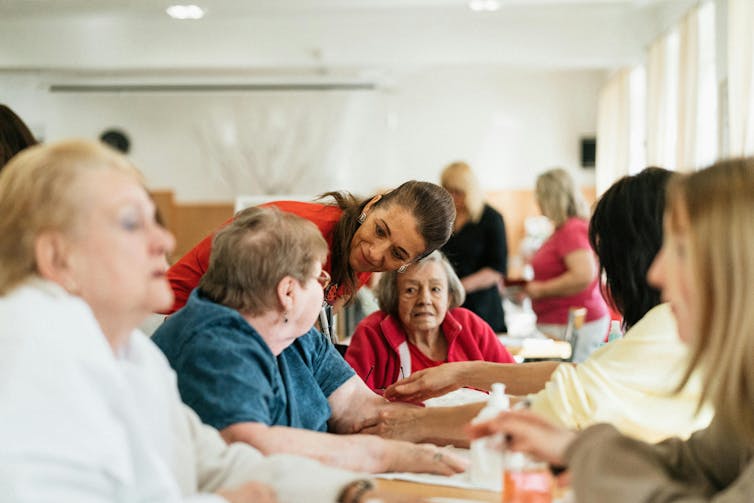
Older people sitting at a table and a younger person standing, speaking with them
Care staff in a study said it was often simpler to locate residents in person.
(Pexels/Jsme Mila)

Real-time location systems

An RTLS works like an indoor GPS. Residents under care at a long-term care home (and sometimes staff) wear a tag or a bracelet with a sensor that communicates with beacons placed throughout the walls and ceilings of the building. The system enables the tracking of people wearing the sensor in real time, and collects movement data. It can also send automated geo-fencing alerts, such as when someone enters or exits a room.

Interest in RTLS in long-term care and other health-care settings largely stems from the belief that they can be useful for predicting changes in health and well-being if clinical algorithms could be developed to analyze movement data.

As part of a larger project, our research team conducted a study with residents, family caregivers, direct care staff and administrators in one home that purchased an RTLS. Administrators and family caregivers told us that RTLS could make care safer and more efficient by increasing staff’s ability to continuously monitor residents and enable quicker intervention.

However, staff informed us that it was often simpler to locate residents in person, and that they lacked time and resources for continuous remote monitoring of residents or to investigate and respond in real time.

This reinforced our findings from an earlier study of this technology in a hospital setting that similarly suggested that RTLS may increase staff workload. More concerningly, we found that administrators, staff and caregivers had limited awareness of this technology’s ethical implications, including its impact on residents, and lacked the knowledge and skills to involve residents in decision-making.

Power and control

In the setting we studied, consent for the use of RTLS came from substitute decision-makers — often a family caregiver — as most residents of the home lived with severe cognitive impairment or dementia. Many caregivers consented quickly, believing RTLS would help staff stay aware of residents’ whereabouts, without fully considering residents’ preferences. Few family caregivers involved residents in the consent process, despite their legal obligation as their substitute decision-makers to align decisions with residents’ values.

While most residents agreed to wear the bracelet, some explicitly rejected the idea of sharing their location data with family or staff. Over time, many wearers found no direct value in it and frequently described it as uncomfortable and heavy.

Caregivers didn’t fully know what data was collected by RTLS, who owned the data or how it would be used to improve care beyond localization. Still, most believed that having more information about residents’ movements was beneficial and morally justified the continuous surveillance.

Although privacy rights are protected by law in Canada and the United States, many family caregivers told the researchers they believed residents gave up those rights by entering long-term care. Some also sought access to RTLS data collected about their family members, expecting it would be shared to enhance transparency, although this never happened.

Staff faced their own challenges. Some were unsure how to explain RTLS’s benefits and risks to residents and to their families or respond to residents’ concerns. They lacked guidance on whether to respect a resident’s refusal to wear the tracking bracelet or override it based on family consent.

This left staff uncertain about how to balance residents’ autonomy with their duty of care, and contributed to moral distress among employees.

Future considerations

Our research suggests RTLS offers uncertain benefits and creates new challenges in an already under-resourced sector. Its use also raises ethical concerns, particularly around surveillance and control, which can exacerbate power imbalances and perpetuate digital ageism and digital ableism.

Digital ageism refers to discrimination on the basis of age that intersects with digital economies. Examples include limited or stereotypical representation of old age or older people in data training sets, tech design that doesn’t reflect the heterogeneity of older users, the push to replace humans with technologies in caring for older adults and automated algorithmic decision-making that discriminates against older adults.

Decision-making around RTLS needs to fully involve those who will be affected by these technologies. Before deciding to wear a tracking bracelet, residents and families should be supported in discussing this with care staff who help them to understand and reflect on:

  • What information will this technology collect?
  • Who will see it?
  • How will it be used in practice to improve my care?
  • Are these improvements worth compromising my privacy?

This is ethical decision-making: transparent, collaborative and grounded in dignity.

The Conversation

Alisa Grigorovich receives funding from AMS Healthcare (Fellowship in Compassion and Artificial Intelligence) and SSHRC.

Madalena Pamela Liougas does not work for, consult, own shares in or receive funding from any company or organisation that would benefit from this article, and has disclosed no relevant affiliations beyond their academic appointment.

ref. Tracking with care: The ethics of using location tracking technology with people living with dementia – https://theconversation.com/tracking-with-care-the-ethics-of-using-location-tracking-technology-with-people-living-with-dementia-268459

Ukraine: deal or no deal?

Source: The Conversation – UK – By Jonathan Este, Senior International Affairs Editor, Associate Editor, The Conversation

This newsletter was first published in The Conversation UK’s World Affairs Briefing email. Sign up to receive weekly analysis of the latest developments in international relations, direct to your inbox.


At times this year, it has been difficult to pin down where the Trump administration stands on the war in Ukraine. Under Joe Biden, America’s position was clear: the Russian invasion was illegal and the US and its allies would do everything in their power – short of actually taking up arms – to bring the conflict to an end and secure a just and lasting peace for Ukraine.

This involved hundreds of billions of dollars in military and other aid and unrelenting diplomatic pressure. This was clearly not enough, and with Russia regularly issuing bloodcurdling nuclear threats, Biden and his advisers baulked at supplying Kyiv with the weapons that might have helped swing the conflict in Ukraine’s favour.

Since Donald Trump was sworn in for a second term, however, his administration’s mercurial approach to diplomacy has kept everyone guessing. The president’s position has oscillated between contempt for the Ukrainian president, Volodymyr Zelensky, and warmth towards the Russian president, Vladimir Putin, to anger at Putin and affection towards Zelensky.

It would be wrong to say that the US president hasn’t poured energy into securing some kind of deal with Russia. An article in the New York Times this week counted eight phone calls with Putin, five meetings between his envoy Steve Witkoff and the Russian leader and an in-person summit in Alaska.

But when news of a new peace plan emerged last week, it appeared as if the US had become, for all intents and purposes, the Kremlin’s interlocutor. Developed in Miami by Witkoff and Russian businessman Kirill Dmitriev, head of Russia’s sovereign wealth fund, the plan called for international recognition of Crimea and all land occupied by the Russians – by force – since 2014 as being henceforth sovereign Russian territory. Ukraine would also have to cede the remainder of the Donetsk and Luhansk oblasts, where fighting continues. Kyiv would have to accept restrictions on the size of its army and the door to Nato membership would be closed.

It reads like Putin’s original wishlist and is neither just nor fair, writes Selbi Durdiyeva, an expert in transitional justice at Nottingham Trent University. Nor does the deal pass muster legally. Durdiyeva walks us through the main objections. She also points out that research has shown that peace agreements imposed over the top of one party’s objections and interests and with no mechanism for accountability, more often than not fail to last.


Read more:
Any peace deal in Ukraine must be just and fair – the plan proposed by the US and Russia was neither


Once details of the deal were revealed, European leaders scurried to come up with a response. A revised and slimmed down plan was developed, which deferred some of the key points – including decisions on territory or Ukraine’s Nato membership – to a later date to be discussed between Zelensky and Trump. It also beefed up the language around security guarantees. This is the mechanism by which a peace deal would ensure that Russia cannot simply regroup and attack Ukraine again.

ISW map showing the state of the conflict in Ukraine, November 26 2025.
The state of the conflict in Ukraine, November 26 2025.
Institute for the Study of War

But while security guarantees are vital, Zelensky and his aides will be only too well aware of how flimsy they can be without real teeth. Ukrainians remember the Budapest Memorandum signed by Russia, the US and the UK in 1994, when Ukraine agreed to give up its nuclear arsenal – the third largest on the planet – in return for an agreement by all parties to henceforth respect Ukrainian sovereignty and the country’s internationally recognised borders.

At the risk of stating the obvious, that didn’t work out well for Ukraine. But as Jennifer Mathers points out, the agreement struck in Budapest was hardly robust when it came to guaranteeing Ukrainian security. It pledged, if Ukraine were to be attacked or threatened “with a nuclear weapon”, that the signatories would refer the situation to the UN security council.

Mathers, whose research in international relations at the University of Aberystwyth has a strong focus on modern Russian history, reports that the then president of Ukraine, Leonid Kuchma, remarked after the deal was done (prophetically as it turns out): “If tomorrow Russia goes into Crimea, no one will raise an eyebrow.”


Read more:
Ukraine peace deal will hinge on security guarantees – but Kyiv has been there before


Meanwhile, the killing continues. The Washington-based military thinktank, the Institute for the Study of War, says that while the progress on the battlefield remains extremely slow (it estimates that at the current rate, Russia could take until August 2027 to occupy the whole of the contested Donetsk region), the long-range strikes campaign against Ukraine’s cities is taking an increasingly heavy civilian toll.

Much of the killing, on both battlefield and in Ukraine’s cities, is being done by drones, which are estimated to be responsible for 60 to 70% of military deaths and thousands of civilians, in contravention of international law, according to the UN.

But, as Matthew Powell notes, just as drones have transformed the way this conflict has been waged, so technology is already being developed, which, it is hoped, will counter the devastating effect of unmanned aerial vehicles. This is a story as old as warfare itself. As soon as a new class of weapon has proved successful in battle, scientists and engineers find a way to thwart it.

Powell describes two weapons being developed by the British army and navy, which could be deployed relatively soon and which, it is hoped, will go a long way towards countering the threat posed by drones. Both are what’s known as “direct- energy weapons”. One, DragonFire, fires a laser capable of finding and shooting down targets from a distance of one metre. It can lock in on an object as small as a one-pound coin.

The other uses a pulse of directed radio waves to disable a drone’s internal electronics. It has the advantage of not having to lock on to one target (handy when there is cloud cover or fog) and can potentially be used to knock out several targets at once (handy when facing a swarm of drones).


Read more:
Drones have changed warfare. Two new weapons might be about alter its course again


Cry the beloved country

For two years, Sudan has been riven by a horrific civil war. Sudan’s army and the powerful paramilitary group, the Rapid Support Forces (RSF), have struggled for control of the central African country. Reports of massacres have become distressingly common, including of thousands killed when El Fasher, the capital of the western Darfur region, was captured after a lengthy siege.

An international group of researchers travelled to Sudan’s southern border, where they interviewed nearly 700 people who were trying to cross into South Sudan. Many of them had already crossed the same border, fleeing the civil war in South Sudan – now they were trying to get to a precarious safety there.

Many of the most harrowing stories were of the sexual violence experienced by women. And the horrifying finding by the research team was that it was adolescent girls who were most at risk. The Conversation’s Insights team worked with the researchers to compile this report, which will shock and upset in equal measure.


Read more:
‘I have to talk about it so that the world can know what happened to women and girls in Sudan’ – rape and terror sparks mass migration


Sign up to receive our weekly World Affairs Briefing newsletter from The Conversation UK. Every Thursday we’ll bring you expert analysis of the big stories in international relations.


The Conversation

ref. Ukraine: deal or no deal? – https://theconversation.com/ukraine-deal-or-no-deal-270850

A stranger’s face? The unresolved questions of face transplantation 20 years on

Source: The Conversation – UK – By Fay Bound-Alberti, Professor in Modern History and UKRI Future Leaders Fellow, King’s College London

When he saw the newspaper headlines in 2002, James Partridge was furious. Severely burned in a fire at 18, he spent his life advocating for people with “visible difference” through charities like Changing Faces and Face Equality International. Yet he found himself used as tabloid fodder in discussions about face transplants: how much better might James look with one?

The question emerged during a wave of publicity surrounding the UK’s bid to undertake the world’s first face transplant. Plastic surgeon Peter Butler and his team at the Royal Free Hospital in north London argued they were ready, claiming that nothing could match a face transplant for restoring appearance and function after severe injury.

The debate had been building for decades. The first successful kidney transplant in 1954 showed that replacing organs was possible. Since then, surgeons have transplanted hearts, lungs and most recently, hands. Some surgeons saw a natural progression: “a face is just like a hand”, they argued. But not everyone agreed.

James Partridge, for one, described the idea of face transplantation as ethically fraught and potentially harmful. As he argued in his commentary on the UK proposals, the procedure risked sending a message that disfigurement must be “fixed” at any cost.

The risks were already clear. Early reviews noted the potential for graft rejection, life-threatening infections, cancers and other complications linked to lifelong immunosuppressants. Yet the UK media were enthralled, especially after reports suggested the Royal Free team had identified a 14-year-old burns survivor as a potential first patient.

Partridge stepped in. He persuaded Sir Peter Morris, then President of the Royal College of Surgeons (RCS), to convene an expert working party. The resulting RCS report advised against proceeding at that stage. The psychological implications of giving someone a new face were unknown, making fully informed consent impossible. And what would it mean for others living with facial differences, if the surgical message implied their faces were not good enough?

Then everything changed. On November 27 2005, a French team led by Bernard Devauchelle and Jean-Michel Dubernard carried out the world’s first partial face transplant. The recipient was Isabelle Dinoire, a 38-year-old woman mauled by her pet Labrador after taking an overdose. When she woke on her sofa and tried to smoke, she couldn’t. In the bathroom mirror, she discovered the dog had chewed off part of her face.

At a press conference a few months later, Dinoire drank from a cup with new lips, spoke quietly, and expressed gratitude to surgeons and the donor.

Dinoire’s story became a global media spectacle.

In 2006, the RCS shifted position. Recognising that face transplants were now a surgical reality, it suggested they could proceed – but only with extreme caution. By that time, however, the UK programme had lost momentum, while centres in China, the US and elsewhere moved ahead.

Two decades on, only around 50 face transplants have been performed worldwide. Some patients have required re-transplantation after graft failure, but long-term survival data remains limited.

A face, it turns out, is not like a hand. Failed hand grafts can be removed; a rejected face leaves few good options. And immunosuppressants still carry significant risks.

Dinoire’s experience also underscores the psychological toll. She struggled with depression and intense media scrutiny, describing herself in one interview as feeling like a “circus animal”.

These are not the kinds of issues kidney or liver recipients usually face. A face is visible, social and symbolic. We meet the world with it; we recognise ourselves in it. Questions of identity, belonging and self-recognition sit at the centre of face transplantation.

James Partridge understood this. In his 2015 reflection on Dinoire’s operation, he praised her for taking what he called “a leap into the dark”. But he also warned that innovation must not outrun psychological support or a deeper understanding of what faces mean to people who live with visible difference.

At the same time, wider cultural pressures have only intensified. Social media has been linked with rising appearance anxiety among young people. Cosmetic surgery rates have climbed in recent years, and research also shows high rates of suicide and thoughts of suicide among people with body dysmorphic disorder, when perceived flaws in appearance become overwhelming. For this reason, surgeons often describe face transplants as “life-enhancing” rather than “life-saving”.

Understanding how and why faces matter – how they ground identity, relationships and social life – is far more complex than any single operation can capture. In my forthcoming book, I explore how faces act as a foundational marker of identity.

Twenty years after Isabelle Dinoire’s transplant, the world is still learning what it means to give someone a stranger’s face. The surgery itself is possible. The long-term consequences – medical, psychological and cultural – remain deeply uncertain.

The Conversation

Fay Bound-Alberti receives funding from a UKRI Future Leaders Fellowship

ref. A stranger’s face? The unresolved questions of face transplantation 20 years on – https://theconversation.com/a-strangers-face-the-unresolved-questions-of-face-transplantation-20-years-on-270698

Venezuela’s Cartel de los Soles: what are the implications of its US ‘terrorist’ designation?

Source: The Conversation – UK – By Brian J. Phillips, Reader (Associate Professor) in International Relations, University of Essex

The US escalated its dispute with Venezuela on November 24 when the state department added the Cartel de los Soles to its list of foreign terrorist organisations. It claims the network is a drug trafficking organisation led by the Venezuelan president, Nicolás Maduro. The reality is more complicated, but either way, the designation has serious implications.

The Cartel de los Soles is an interesting choice for the foreign terrorist organisation list. While it is indeed foreign to the US, it is probably not a terrorist organisation as most people understand them. Whether it is even an organisation in a formal sense is also up for debate.

The term “terrorist organisation” has traditionally been used for groups with political motivations. This includes groups that want to impose their religion on a country, or groups that are fighting for the political rights of an ethnic minority. Criminal groups like drug trafficking organisations, on the other hand, are mostly devoted to making money illicitly.

This distinction is important because some research, including my own, shows that counterterrorism tactics can lead to adverse consequences when used against criminal groups. The targeting of cartel leadership in Mexico, for example, has often led to more bloodshed as newly fragmented groups fight viciously for control of drug markets.

Experts also do not consider the Cartel de los Soles a formal organisation, but rather an informal network of individuals involved in the drug trade. There does not seem to be one single leader or other indicators of an organisation such as a clearly defined membership or meetings. No “member” of the group seems to use the term Cartel de los Soles.

Journalists in Venezuela started using the term Cartel de los Soles in the 1990s as a figure of speech for corrupt military officials apparently involved in the drug trade. Soles means suns in Spanish, and high-level military officers in Venezuela wear sun-shaped badges on their uniforms.

Venezuela located on a world map.
Venezuela’s geography helps it play a key role in the global drug trade.
BOLDG / Shutterstock

Venezuela’s geography helps it play a key role in the cocaine trade. While some cocaine is produced in Venezuela, even more passes through the country from neighbouring Colombia towards Europe and the US.

This creates an opportunity for corrupt officials – of which there are many in Venezuela – to profit substantially. Many sources say high-level Venezuelan generals are involved in the drug trade, but it is difficult to know exactly how widespread the problem is.

Implications of designation

A foreign terrorist organisation designation has several legal ramifications. First, “material support” for the group becomes a crime, so a person can be prosecuted for donating to or doing business with a designated organisation. Second, people deemed to be associates of the group could possibly be barred from entering the US. And third, US financial institutions with any funds connected to the group will need to report these to the US government.

It is unclear if the designation will actually affect the cartel’s supposed leaders given they have long been subject to US economic sanctions anyway. Venezuelan interior minister Diosdado Cabello, who is alleged to be a leader in the network, has been subject to sanctions since 2018. The US government already sanctions suspected drug traffickers through laws such as the Kingpin Act.

Venezuela’s government has denied the existence of the Cartel de los Soles, describing the new terrorist label as a “vile lie to justify an illegitimate and illegal intervention against Venezuela”. But it’s worth emphasising that a terrorist designation does not necessarily justify or authorise war, which Venezuelan officials seem to fear. The legislation behind terrorist listing does not mention military actions.

A terrorist designation is also meant to communicate US government priorities. It creates focal points for US agencies, while also signalling to other countries the threats they should join the fight against and the groups they should not support.

A US terrorist designation can be powerful. Other countries, especially US allies like the UK and Australia, have followed American terrorist designation patterns for decades. In 2008, the US designated the Somalia-based Islamist militant group al-Shabaab as a foreign terrorist organisation. Australia followed suit the following year, with Canada and the UK doing so soon after.

However, the pattern has not held so far in 2025 as the Trump administration has started to add criminal groups to its list of foreign terrorist organisations for the first time. This began in February, when the US government listed eight criminal groups, mostly Mexican drug cartels.

Few countries have joined the US in declaring these groups as terrorist organisations. European countries, for example, generally do not seem to see these groups as threats worthy of their terrorist lists.

As for the Cartel de los Soles, several countries have made pronouncements similar to the US terrorist designation. However, these are all Latin American countries like Argentina and Ecuador that currently have Trump-allied conservative governments. There has not been a wider international response, even from traditional US partners like Canada.

This is not ideal for the US government, as international cooperation is highly important for confronting transnational challenges like drug trafficking. The Trump administration’s approach of labelling criminal groups as terrorists does not look set to be adopted by most of its longtime allies.

The Conversation

Brian J. Phillips does not work for, consult, own shares in or receive funding from any company or organisation that would benefit from this article, and has disclosed no relevant affiliations beyond their academic appointment.

ref. Venezuela’s Cartel de los Soles: what are the implications of its US ‘terrorist’ designation? – https://theconversation.com/venezuelas-cartel-de-los-soles-what-are-the-implications-of-its-us-terrorist-designation-270627

To truly tackle child poverty, the UK needs to look again at migration

Source: The Conversation – UK – By Lucy Leon, Researcher – Centre on Migration, Policy & Society, University of Oxford

wavebreakmedia/Shutterstock

The UK government is expected to soon publish its ten-year child poverty strategy, designed to tackle the root causes of poverty for children.

Poverty is an issue for families from all backgrounds. But it is often particularly acute for the children of people born outside the UK. These families may not be permitted to access benefits because of their immigration status.

Instead, they may receive help from local authorities who, research my colleagues and I conducted shows, are operating a parallel welfare system – one that’s patchy and poorly resourced.

Or these families may get no help at all. They may avoid asking for support, fearful that contacting governmental services will jeopardise their families or their ability to stay in the UK.

Current Home Office proposals to extend the time migrants must spend in the UK before becoming eligible for settled status, and to introduce further welfare restrictions, may deepen poverty. This would not only prolong the time children and families have no access to public funds but also increase the number of children and families affected.

The government’s child poverty strategy must address the effect of immigration policy if it is to improve the lives of all children.

No recourse to public funds

The UK’s current “no recourse to public funds” immigration policy was formalised through the Immigration and Asylum Act 1999. It restricts access to most income-based welfare benefits for large numbers of people residing in the UK. It applies to most people holding temporary or time-limited visas to enter or remain in the UK.

These could be people on a time-limited work visa, health and care workers and students. It can include people who have come to the UK because they are married to or the family of a British person, and people building lives in the UK who have leave to remain on routes to settlement.

It is also applied by default to people with an irregular immigration status. This covers European nationals without EU settled status, families who have overstayed their visas and those awaiting an immigration decision.

The no recourse to public funds policy is aimed at “temporary migrants”. But many children in households subject to the policy are British-born or have spent most of their childhood in the UK. The policy is one of the biggest contributors to poverty, destitution, and social exclusion among children in resident migrant families.

In 2024, over half a million children – 578,954 – under the age of 18 were recorded as having a visa or leave to remain in the UK, which generally comes with a no recourse to public funds condition.

Sad girl hugging teddy
It’s likely that hundreds of thousands of children live in families with no recourse to public funds.
MAYA LAB/Shutterstock

While not all of them will experience poverty, children in migrant families living in the UK are at a disproportionately high risk of poverty and destitution. No recourse to public funds restrictions mean that families cannot access any benefits regardless of need. These include child benefit, universal credit, housing and disability-related benefits.

The Home Office maintains that there are existing safeguards, comprising of local authority social care teams with a statutory duty to provide a basic safety net to families facing destitution. While these safeguards can offer a lifeline to some, the system was designed for families at risk of destitution, the most severe hardship. It wasn’t intended to alleviate poverty or to be a substitute for the social security system.

The parallel safety net

Local authorities are, essentially, forced to provide a parallel welfare system, at a significant and unfunded cost. Our findings indicate that local authorities spent an estimated £65 million supporting families with no recourse to public funds in 2021-22.

However, at best, local authorities provide below-poverty-level weekly subsistence payments and substandard temporary accommodation for families with no recourse to public funds. However, there is a significant discrepancy in the level of support provided. With no clear statutory minimum rates, vulnerable families face a postcode lottery.

In some areas, a lack of financial policy means families receive only vouchers and foodbank referrals, while others rely on already-stretched social workers to define acceptable amounts. Many families end up turning to charities and food banks for emergency support.

There is no official data on the number of families with no recourse to public funds receiving local authority support across the UK. Through conducting our own survey, the local authorities that did respond reported supporting 3,108 of these destitute families, including 5,831 children between 2021-22.

However, many authorities do not record this data and were therefore unable to provide figures. Our research estimates the true number across all UK local authorities to be closer to 5,400 families, including around 10,500 children.

Even this estimate is unlikely to truly represent the wider need. Many parents do not ask for help. They are afraid that seeking help from statutory services will jeopardise their visa or future applications to remain in the UK. “I didn’t face them as I heard horrible, horrible stories,” one parent told us.

“I was told that if I didn’t have a safe and good home for my kids, they would take my kids,” another said. “People feel scared, so they won’t ask for help.”

The lack of support from the central government goes beyond just the finances. While there are some pockets of good practice within some local authorities, without statutory guidance for social care teams in England, many councils fail to provide the information, accommodation and support that families with children facing destitution are legally entitled to. We spoke to families who described the process of accessing support as humiliating, distressing and intrusive.

To tackle child poverty over the next decade, addressing both the impact of these welfare restrictions and the severe limitations of the parallel safety net system is vital. In the meantime, if local authorities are expected to provide a safety net, they need – at a minimum – dedicated central government funding and clear statutory guidance to fulfil their duties effectively.

Without this support, growing pressure on an inadequate system will continue to mount. The true cost will extend far beyond the overstretched budgets of social care teams.

The Conversation

As part of her research on migrant destitution, Lucy Leon has previously received research funding from the Aberdeen Group Charitable Trust (formerly known as abrdn financial fairness trust) and is currently receiving research funding from Trust for London.

ref. To truly tackle child poverty, the UK needs to look again at migration – https://theconversation.com/to-truly-tackle-child-poverty-the-uk-needs-to-look-again-at-migration-270335

The-two child limit failed – all it did was increase poverty

Source: The Conversation – UK – By Ruth Patrick, Professor in Social Policy, University of Glasgow

UK chancellor Rachel Reeves has taken decisive action in getting rid of the two-child limit – a policy that has held a totemic place in the UK for more than a decade. Since 2017, this policy has limited the means-tested support that families can receive from the state to the first two children in a household, with some specific exceptions.

But now, the two-child limit is to be scrapped from April 2026. My own research has shown how the limit often leaves families struggling to meet essential costs, and forced to forgo everyday activities. This could even be things like reading children a bedtime story as parents instead hunt round supermarkets for discounted food.

Both the two-child limit and the benefit cap (a ceiling on the support that a household where no one works 16 hours a week can receive, and which remains in place) were launched at the height of the UK’s austerity years.

At the time, the public were being served sensationalised portrayals of people receiving social security support. Politicians were happy to denigrate social security recipients too.

Amid claims of seeking to create more fairness in the tax and social security systems, politicians returned to binary divisions between “strivers” and “shirkers”. These representations bore little relationship to reality but they appeared to be electorally popular. And they provided the rationale to take a wrecking ball to what remained of the social security “safety net”.

Announcing the two-child limit in an emergency budget in 2015, the then chancellor, George Osborne, spoke of the need to support families while being fair to “working” people. This ignored the reality that millions of families require social security to top up the incomes they receive from paid employment.

The narrative does not align with the realities of in-work social security recipients – 2.7 million UK workers receive universal credit, a third of total recipients. And 59% of those affected by the two-child limit live in working households.

Neither is it possible to divide the UK into those who do and do not pay taxes. Everyone pays them, both through income taxation and taxes on goods and services. Some taxes, such as VAT, even leave those with the least handing over a much greater share of their income every time they pay for an item.

Hard realities

In introducing both the benefit cap and then the two-child limit, the Conservatives were seeking to change the behaviour of the people affected by these policies. In the case of the two-child limit, there was the suggestion that claimants would think differently about how many children they could afford to have, or change their employment patterns.

And in the case of the benefit cap, they hoped people would move into work. Or, where high rents were the issue, that people would move into cheaper properties.

But all of this was a mirage, and research I have undertaken with colleagues has shown how both of these policies fail. This failure is complete even in the terms set out by those who introduced them.

That is, with the two-child limit, there has been almost no noticeable impact on fertility, nor have there been changes to employment.

three children holding hands and playing in a forest
Families with more children are often vulnerable to economic shocks.
maxim ibragimov/Shutterstock

None of this is surprising because no one knows what their future holds. As Reeves argued in the budget, people lose their jobs, get sick or die prematurely. That’s why the social security system should be there to support people, providing help when times are hard.

The same applies with the benefit cap. The cheaper homes that the Conservatives hoped families would move into simply do not exist in many parts of the UK. Families living under the cap often face real and serious barriers to employment such as a lack of good childcare and poor transport links. These are not addressed by simply limiting financial support.

Instead, these policies create and deepen poverty and hardship. Both have directly resulted in rapid rises in poverty risks, especially for vulnerable groups like larger families, single parents and people with disabilities.


Read more:
In the struggle to get Britain working, the long shadow of austerity could be part of the problem


Given all of this evidence, it is surprising that the two-child limit was not scrapped earlier. Perhaps it has endured in part because of the pervasiveness of anti-welfare rhetoric – the prevalence of the language of “scroungers” and “skivers” that sociologists describe as constituting an “anti-welfare commonsense”.

While Reeves’ decision to axe the two-child limit prompted some predictably negative headlines, the vast majority of the UK public (83% according to recent polling) actually wants to see action on child poverty.

When kids can have the very best childhood possible it is good for all of us. Children free of poverty now will become adults who are more able to flourish and make a real and lasting contribution as workers, parents or carers in future.

Reeves set this out in her budget speech, and it would be great to hear more of these arguments from her and others in Labour in the weeks and months ahead. Perhaps this could even begin a reset of the UK’s relationship with social security after those long years of austerity.

The Conversation

Ruth Patrick leads research projects that are funded by various charitable foundations, including Nuffield Foundation, Trust for London and The Robertson Trust. She is a member of the Labour Party.

ref. The-two child limit failed – all it did was increase poverty – https://theconversation.com/the-two-child-limit-failed-all-it-did-was-increase-poverty-270841