The NHS didn’t receive a great deal of specific attention in Rachel Reeves’ budget. She mentioned it, but in fairly general terms around plans to invest and cut waiting lists.
But the overall plan presented by the chancellor effectively incorporates the NHS into a high tax, high spend economic model. Those revenue-raising taxes include a long freeze in income tax thresholds, higher rates on property, dividends and savings, plus new levies on gambling and electric vehicles.
And structurally, this arrangement does two things for the NHS. First, it shifts more of the tax burden onto wealth and higher incomes, which may be politically easier to defend when channelling money into health. Second, it broadens the tax base that pays for day-to-day NHS running costs, reducing reliance on borrowing to fund nurses’ salaries or catching up on elective (non-emergency) procedures.
On the spending side, there was talk of protecting “record investment” and a promise of 250 new neighbourhood health centres.
Reeves said the government was “expanding more services into communities so that people can receive treatment outside of hospitals and get better, faster care where they live”.
This is an encouraging sign of plans to boost primary and community care capacity rather than just pour more money into hospitals. And it could be the only route to a sustainable NHS. For if more problems are dealt with earlier and closer to home, acute care becomes less overwhelmed.
Away from the NHS frontline, the “milkshake tax” – extending the sugar levy to high-sugar dairy drinks – is a relatively small move economically. But it is an important strategic step which shows that the Treasury realises that diet-related disease should be treated not just as a clinical problem, but a fiscal one too.
Even modest reductions in obesity and diabetes can significantly ease future NHS demand and improve people’s chances of working.
That said, critics could argue that it also functions as a kind of “sin tax” because lower-income households spend a higher share of their income on cheap, high-sugar products. So the levy risks being regressive unless it is paired with affordable healthy alternatives and targeted support, so that it changes behaviour without simply squeezing the poorest.
Alongside this, the decision to remove the two-child cap on some benefits pulls in the opposite direction. It is a redistributive measure that should reduce child poverty rather than penalise it.
Health risks
For the NHS, that matters just as much as any health-specific tax. Children growing up in poverty are more likely to experience poor nutrition, overcrowded housing, chronic stress and worse mental health. All of these drive higher use of health and social care over their lifetime.
Lifting the cap therefore acts as a preventative health intervention by boosting household resources for larger families, improving the chances that children have access to adequate food, heating and stability.
So in combination, a sugar levy that nudges diets in a healthier direction and a benefits system that no longer structurally penalises the children of larger families could, if well designed and properly supported, start to lessen long-term demand on the NHS. And that could work out to be a better approach compared to simply funding ever-rising treatment costs.
Overall, the budget nudges the UK towards paying more tax now to avoid an even more financially fragile NHS later.
But that comes with risks too. If economic growth, productivity and the UK’s general health do not improve quickly enough, a tax-heavy model with a still-overstretched health service could prove politically and economically unstable.
Catia Nicodemo is affiliated with the University of Oxford
Drug use appears to be changing in England – both in the types of drugs people take and their potency, according to our latest survey of adult mental health and wellbeing.
The Adult Psychiatric Morbidity Survey (APMS) began in 1993 and is the longest running mental health survey series in the world. This national study gives us one of the clearest pictures of mental health in England. Because it includes people from all walks of life, not just those using NHS services, it shows how mental health is changing across the population.
In the latest survey, a random sample of around 7,000 adults aged 16 to 100 living in England took part in detailed interviews at home, each lasting about an hour and an half. Participants were asked questions about their mental health, whether they used any of a range of illicit drugs, and if they had experienced signs of dependence, such as symptoms of withdrawal or increased tolerance.
Although the Crime Survey for England and Wales (CSEW) is the government’s official source of statistics on illicit drug use in England, it is a survey about crime. As such, those surveyed may not be comfortable disclosing their illegal activities – meaning the CSEW might not fully capture the extent of drug use across the population.
Because our survey is of the population’s health and wellbeing, participants may be more willing to disclose their drug use. This gives us a valuable alternative lens on drug use and an opportunity to cross-check against official figures.
Our report has highlighted important shifts in what we know about the extent of drug use in England, the types of drugs adults take and the degree to which people may be dependent on those drugs.
Drug use may be more widespread
Our findings suggest a higher proportion of adults in England use drugs than official figures have shown.
We found that around 18.1% of 16- to 24-year-olds reported using an illicit drug in the past year. This is higher than the 16.5% reported by the CESW for the same age group and time period.
A few factors could be at play here.
Our survey doesn’t include Wales – so the geographic coverage isn’t identical between the two surveys – and we also asked participants about substances which aren’t covered in the CSEW. This included amyl nitrites, prescription opioids, synthetic cannabinoids and volatile substances. This broader scope may contribute to a more complete picture of drug use in the population – and account, to some extent, for the higher prevalence we found.
But even when we compared just one drug type, differences are evident: 4.3% of 16- to 24-year-old participants reported using ketamine in the past 12 months, compared with 2.9% of 16- to 24-year-olds in the CSEW.
This suggests that surveys framed around crime might lead to under-reporting, as people may be less willing to disclose illegal behaviour in that context. Approaching drug use through the context of mental health may offer a more accurate picture of what’s really going on.
Non-medical use of prescription opioids
Until now, due to a lack of data little was known about what proportion of people in England use prescription opioids without a prescription. So our survey asked people whether they had ever used opioid medications such as buprenorphine, fentanyl, morphine, oxycodone and tramadol that hadn’t been prescribed to them.
Around 3% of participants reported that they had – much higher than the proportion reporting use of another opioid, heroin (which was below 1%). This suggests that non-medical use of prescription opioids may be a distinct and more widespread problem.
Men and women were equally likely to report using prescription opioids that had not been prescribed to them. Prevalence was highest in 25- to 34-year-olds. This indicates that usage probably can’t be explained solely by self-medication for medical conditions and physical pain, which tend to be more common in older age groups.
Gender profile of drug dependence
Among 25- to 34-year-olds, men were twice as likely as women to report signs of dependence – possibly reflecting gender differences in family responsibilities or life stage. But in 16- to 24-year-olds, signs of drug dependence were similarly common in men and women.
This is a noticeable shift. In earlier waves of the survey series, young men consistently showed the highest levels of drug use and dependence. It appears this is no longer the case.
These results suggest that young women may be engaging in similar levels of risk-taking – or that young men are starting to use drugs at a later age, with problems emerging later down the line.
But given the relatively small number of 16- to 24-year-olds in the sample, it’s too early to say for sure.
Cannabis dependence rising
The proportion of adults reporting signs of cannabis dependence nearly doubled this decade – from 2.8% in 2014 to 5.4% in 2023-2024. Yet this rise doesn’t appear to be explained by an increase in the number of people using cannabis. In 2014, 7.2% of people reported having used cannabis in the past year. In 2024, this figure only rose to 8.7%.
So it’s likely this increase in cannabis dependence is due to changing potency or other factors.
A 2018 analysis of drug seizures indicated that the UK’s cannabis market is increasingly populated by high-potency varieties. Stronger cannabis potency has been linked to higher risk of addiction. The growing range of cannabis products, such as cannabinoid vapes, may also be making it easier to access and use cannabis more frequently.
Lack of specialist support
Only about one adult in every five who showed signs of drug dependence reported they’d ever received support or treatment for their drug use.
The survey also revealed a strong overlap between dependence and depression or anxiety.
This can present further challenges for mental health services in terms of engagement and recovery.
Patterns of drug use and dependence in England appear to be shifting. It’s important that there’s awareness of these changing trends so that support can be targeted effectively.
This chapter was produced by a team of researchers: Maxineanu, I., Roop,S., Morris, S., McManus, S., Roberts, E., Strang, J. (2025) Drug use and dependence. In Morris, S., Hill, S., Brugha, T., McManus, S. (Eds.), Adult Psychiatric Morbidity Survey: Survey of Mental Health and Wellbeing, England, 2023/4. NHS England.
Sally McManus led the 2007 and 2014 Adult Psychiatric Morbidity Surveys and is part of the team running the 2023/4 survey. She is Professor of Social Epidemiology and Director of the Violence and Society Centre at City St George’s, University of London. She is a deputy director of the VISION consortium, which is funded by UKRI.
Sarah Morris leads the Adult Psychiatric Morbidity Survey and works on the Health Survey for England at the National Centre for Social Research, which is commissioned by NHS England, with funding from England’s Department of Health and Social Care.
Net migration to the UK has fallen to levels last seen before Brexit. The latest ONS figures show net migration reached just over 200,000 in the year ending in June. This marks a 78% decline over the past two years, from a peak of more than 900,000.
The Labour government will welcome this development. It has made bringing down net migration (the difference between the number of people entering the country and expected to stay long term, and the number leaving) one of its key pledges.
The government also recently announced a series of reforms to asylum and immigration with the aim of deterring people from coming to the UK. These include making refugee status temporary and requiring people to wait for 20 to 30 years in some cases before becoming eligible for permanent status – longer than any other European country.
As numbers fall and restrictions are implemented, are high public concerns about immigration also likely to come down, reducing pressure on the government? Not necessarily, for several reasons.
First, numbers will not necessarily stay this low for the long term. EU citizens are currently subtracting around 70,000 per year from the total net migration figure, because more are leaving than arriving.
This is unlikely to continue indefinitely. People from outside the EU may also push up net migration figures over the medium term. Fewer of these migrants have arrived recently, which is likely to mean fewer people departing the UK in the future and hence lower emigration.
Recent numbers might also be revised up at a later date. The ONS has raised concerns about the accuracy of data showing an unexpected decline in net migration of family migrants (close family members of British nationals and other migrants with settlement in the UK) that seems inconsistent with other data sources.
Even if numbers do remain around the 200,000 mark, it is difficult to know how this will affect public opinion. In the past, the salience of migration has tended to go up when numbers were higher, although the relationship is not always precise.
The public may not be aware that numbers have fallen, and those who are aware may not consider 200,000 to be particularly low. The sharp decline in net migration may also raise some concerns about why an increasing number of people choose to leave the UK, particularly if they are British nationals.
Second, asylum applications and unauthorised arrivals by small boat – the least popular and most salient forms of migration – have not declined. Opinion polling suggests that asylum is the category the public would most like to see reduced.
Asylum applications rose to an all-time high of 110,000 in the year ending September 30 2025. This was partially driven by a substantial rise in small boat arrivals to almost 46,000, close to the record seen in 2022.
There were also growing numbers of asylum claims from people who arrived to the country on legal visas, particularly from countries such as Pakistan, which was the top nationality among new asylum seekers.
The number of people living in asylum hotels – which the government promised to close by the end of this parliament – increased by 13% to 36,000, due to a rapidly growing appeals backlog and the lack of alternative accommodation.
The government will be hoping that numbers decline in the future due to the newly announced reforms to the asylum system which aim to deter arrivals, as well as the combined impact of increased enforcement and the returns deal with France. However, it is unclear if, and to what extent, the new measures will lead to fewer people claiming asylum. Any effect might take time to become visible.
Migration and the economy
Third, there are important trade-offs facing the government. A sharp decline in arrivals for work and study means that people claiming asylum now make up a significantly higher share of overall migration – 11% of total immigration into the UK, compared to 5% before the pandemic.
All things equal, this makes migration less beneficial to the economy, since asylum seekers require more support, and refugees are less likely to be employed and make fiscal contributions.
The newly announced policies to keep refugees on temporary status for long periods of time may plausibly deter at least some people from coming. But they are also likely to make integration more difficult for those who remain in the UK, and give them less incentive to invest in their skills and social integration in the UK.
Essentially, all migration policies come with both costs and benefits. Public concerns become difficult to address if they stem from a desire to achieve goals that are sometimes contradictory, such as reducing net migration, keeping public services afloat, enforcing immigration rules and complying with international law.
Migration is hence likely to be a central political issue for the foreseeable future. Potential changes in numbers, ongoing problems in the asylum system and the inherent trade-offs in policy may all sustain public concern and create enduring challenges – something most UK governments in the last two decades have struggled to address.
The Migration Observatory receives funding from the John Armitage Charitable Trust, the Barrow Cadbury Trust, the Esmée Fairbairn Foundation and the Paul Hamlyn Foundation, and has also received support from the Economic and Social Research Council (ESRC).
Source: The Conversation – UK – By Christopher Byrne, Assistant Professor in British Politics, University of Nottingham
After last year’s tax-raising budget, UK chancellor Rachel Reeves assured the public that Labour had “wiped the slate clean” and would not be coming back for more. And yet this year, the chancellor froze tax thresholds and introduced several other tax-raising measures in a budget that was called “brutal” even before it was delivered.
This reversal helps to explain why Reeves is, according to one poll, the UK’s most unpopular chancellor on record. And she’s not alone. Depending on which polling you think is most credible, Keir Starmer comes out as either the most unpopular prime minister since records began in 1977, or merely on a par with Boris Johnson, just prior to his scandal-plagued resignation in 2023.
Clearly, the Labour government has got off to a bad start. But might the bad vibes be fleeting? Is there a way to fairly and objectively assess the performance of governments that cuts through the noise?
It’s difficult to identify objective criteria for judging a government. I have already alluded to one possible measure, in the form of public opinion polls. But many would argue that the best measure of a government is whether or not it does what’s “good”.
In this regard, the government’s defenders might point to decisions such as scrapping the two-child benefit cap at this budget or raising minimum wage. The problem with this approach is that it’s deeply subjective and depends on moral and ethical judgements which are impossible to prove.
A third approach, and one the electorate uses frequently, is economic stewardship: what is the government’s record on the economy and has it been able to generate general prosperity? A fourth is whether the incumbent party keeps its manifesto promises.
Given the UK’s dismal economic growth and this budget’s stealth income tax increase in the form of the threshold freeze, the Labour government arguably doesn’t do well on either of these criteria.
Academic literature provides us with a range of potentially more objective and systematic measures. Within this, I argue the best all-round set of criteria comes via political scientist Jim Bulpitt’s highly-cited “statecraft” model. This approach has been used for decades to evaluate political leaders.
It emphasises that governments need three main things in order to succeed: first, a winning electoral strategy, founded on a policy package that unites the party and is appealing to at least a plurality of the electorate. Second is “political argument hegemony”. This means getting your story about what is wrong with the country, and how to fix it, accepted as the common sense of politics. And third, of paramount importance, is to be perceived as competent.
So how does the current government stack up?
Not being Liz Truss was an excellent election strategy in a country traumatised by spiralling mortgage and energy costs. But a viable strategy for governing it is not.
A common criticism of Starmer is that he lacks what we might call a “political vision” for the country – a conception of what the good society looks like and how to get there. When polled recently, just 24% of the public said that they “understand his vision for Britain”. What is Starmer’s big idea, comparable to Thatcher’s supply side revolution, Blair’s modernisation drive, or even Cameron’s “big society” agenda?
In lieu of such a big idea, he prefers to play up his managerial and technocratic credentials. This has led to criticism that he “governs by focus group”. This budget, with all the briefing and leaks that preceded it, actually resembled an extended national focus group designed to see which tax rises the country would wear.
Competence is key
It is on competence – according to Bulpitt, a matter of selecting the right policies and implementing them well – that the current government’s record really falls apart.
Time and again, Starmer has been stymied by his own MPs on key issues like welfare reform, and forced into a humiliating climbdown over cutting winter fuel payments.
The appearance of competence has not been helped by the mistaken release of migrant sex offender Hadush Kebatu from HMP Chelmsford, simultaneously making a mockery of the government’s plan to “smash the gangs” and sort out prisons.
Nor by any of the scandals that have damaged the government since it was revealed that Starmer and Reeves had accepted tens of thousands of pounds’ worth of clothes and hospitality from Labour donor Lord Alli. This, plus deputy PM Angela Rayner’s resignation after having underpaid stamp duty on her second home, were particularly damaging for a leader who consciously cultivated an image as “Mr. Rules”.
Worse still, Starmer and Reeves seem to have stumbled into a debt doom loop on the economy: public spending increases lead to a shrinking of the government’s fiscal headroom, which leads to an increase in the cost of borrowing (gilt yields have already exceeded the heights reached as a result of Truss’s mini-budget) and speculation about future tax rises.
This in turn inadvertently dampens consumer and business confidence and depresses economic growth, leading inexorably to a tax-raising budget like this one that the government hoped it would never have to do again.
One final insight the academic literature gifts us is that context is everything. While Starmer and Reeves have arguably performed poorly against the criteria above, perhaps their biggest mistake is to have fundamentally misread the nature of the political moment they are in.
They are governing as if it were still 1997, doubling down on a Blairite style of politics that passed its sell by date around 2008. The current situation now is much closer to 1945 or 1979 – moments when an exhausted political settlement had plainly stopped working and there was an urgent need for a new politics. The tragedy of this government is that, barely a year in, they are already in survival mode.
Christopher Byrne does not work for, consult, own shares in or receive funding from any company or organisation that would benefit from this article, and has disclosed no relevant affiliations beyond their academic appointment.
Source: The Conversation – UK – By Alexandros Koutsoukis, Lecturer in International Relations, University of Lancashire
Recent reports about the role of Donald Trump’s special envoy, American businessman Steve Witkoff, in the Ukraine peace negotiations have raised wider questions about why political leaders turn to business figures in high-stakes diplomacy – and whether this can ever work.
A leaked recording of Witkoff advising Russian officials on how to present their proposals to Washington has intensified concern about the direction of the process. Some see it as a symptom of the US president’s personalised foreign policy, while others view the process as a sign of a broader shift away from professional diplomacy altogether.
Diplomacy is often portrayed as the preserve of seasoned professionals, and for good reason. Skilled negotiators such as the UK’s Jonathan Powell – who played a key role in the Northern Ireland peace process – understand how to manage escalation, read political constraints and build agreements that can survive leadership changes.
Yet political outsiders sometimes play constructive roles. Businesspeople can think creatively, take risks that cautious officials avoid and open up transactional trade-offs that traditional diplomats might have dismissed as impossible.
When diplomatic processes are stuck and international pressures are high, a different perspective can widen the space for compromise and create opportunities for what earlier leaders could not achieve: a working deal.
One of history’s most striking examples of a businessman-turned-diplomat is Jean Monnet. After starting his career in his family’s cognac business, Monnet was appointed by the French government in 1939 to coordinate Franco-British war supplies.
He was one of the key figures to propose and advocate the idea that became the Lend-Lease Act of 1941 to the then-US president, Franklin D. Roosevelt. This agreement saw the US provide military and other supplies to its European allies without the need for immediate payment.
Monnet later conceived the plan that led to the 1950 Schuman Declaration. This produced the European Coal and Steel Community and laid the foundations for the European Economic Community, which eventually evolved into the EU.
What made Monnet successful was not only his creativity, positive political vision and ability to work behind the scenes. He was helped by a political context in which the US and Europe shared a desire to find a way to unite. This contributed to effective, cooperative and stable outcomes.
Strengths like those displayed by Monnet only matter when business envoys operate within political contexts and organisational structures that keep their transactional instincts in check. Unlike Monnet, Witkoff is operating within a context that amplifies – rather than restrains – these tendencies.
Dangerous tendencies
Witkoff’s first tendency is to lean towards a “victor’s peace”. His advising of Russian officials on how to persuade Trump of their peace plan reflects a transactional mindset that prioritises what is politically easy for the presumed victor, rather than what is just or stable.
But if negotiations begin from the assumption that Russia will ultimately win the war, and therefore Ukraine must accept the terms of its anticipated defeat sooner rather than later, the result may look less like a lasting peace and more like a humiliating capitulation.
This fear has already been voiced by European leaders. The French president, Emmanuel Macron, warned on November 25 that Europe cannot support “a peace that is in essence a capitulation” as this would leave Ukraine weakened and Russia emboldened.
Witkoff’s second tendency is to focus on the outcome of the negotiations rather than the process, neglecting to realise that peace agreements endure only when they are recognised as legitimate by those who must live with them.
The carefully calibrated balance of coercion and consent is the real art of diplomacy, and requires appreciating how the defeated can learn to live with defeat and not see it as humiliation. This occurred in Japan after the second world war, where defeat was gradually transformed into pride in a new liberal pacifist culture.
Witkoff’s third tendency is that he, like many businesspeople, appears to view negotiations as direct dealings between the most powerful players. This is what I have referred to in my research as the “great power bias”.
Approaching negotiations in this way can reinforce the idea that the US and Russia are the “real” players in the peace negotiations, while Ukraine and its European allies become peripheral. This could result in a deal based on the idea that the strongest party does what it wants and the weakest suffers what it must.
These three tendencies are manageable on their own. But the danger arises when they all move in the same direction and experience very little pushback. In an era of rising populism and a political environment dominated by Trump’s personalised style, there is little room for such counterweights. Witkoff’s influence is based on proximity to the president, not on a mandate shaped by allies, diplomats or Congress.
Ordinarily, allies would act as a counterweight to such tendencies. Yet Europe’s ability to shape the negotiations is limited by its own dependency. Without greater capacity to support Ukraine militarily or to provide the satellite intelligence on which Kyiv relies to continue fighting the war, European governments are forced to depend on the US even as they question its approach. This leaves them able to offer guidance but with diminished influence on the terms of the negotiation.
Peace in Ukraine will ultimately require a combination of creativity and restraint: an openness to new ideas but within a framework that ensures a degree of fairness, legitimacy and security. Businesspeople can contribute to such a process, but not when their tendencies are unchecked. The balance that makes outsider involvement constructive is precisely what is missing in the case of Ukraine.
Alexandros Koutsoukis does not work for, consult, own shares in or receive funding from any company or organisation that would benefit from this article, and has disclosed no relevant affiliations beyond their academic appointment.
On the western flanks of Mount Kenya lies the Laikipia plateau, an achingly beautiful landscape that is both a refuge for wildlife and a home to traditional Masai communities. Black rhinos, which were once nearly extinct, are now thriving on some of these conservation properties, thanks to the intense efforts to keep them safe.
The new documentary Rhino tells the story of the people and the challenges faced to protect wildlife in this volatile landscape. The cinematography and score beautifully captures the landscape, people, animals and pace of life, which is at times languorous and at times frantic.
The story unfolds from the perspective of two rangers. Ramson Kiluko is an experienced ranger who works with his team to watch, protect and understand the rhinos. The film gives us a glimpse into his family life, the camaraderie of the ranger team and the rich knowledge he has about the lives of individual rhinos and their landscape. Rita Kulamu is a young ranger learning about rhinos as her property prepares to welcome them. Their work takes place against a background of danger, posed by both people and animals.
Rhino focuses on the critical role rangers play in the conservation story of black rhinos, which is an inspiring change from the traditional wildlife documentary that suggests a wildness that exists without the need for human intervention or involvement. Once on the brink of extinction, it is precisely the intensive efforts made to protect rhinos by people like Kiluko and Kulamu that has seen numbers slowly rebound.
The film focuses on the role of rangers in conserving rhinos. Tom Martienssen/Dustoff Films
The film loosely follows a narrative around the planned move of 21 rhinos from the Lewa and Borana reserves in central Kenya, where they are too numerous, to Loisaba – a 58,000 acre wildlife conservation area which has long been without rhinos.
On Lewa and Borana, the rhinos fight for space and territory, on Loisaba they have the opportunity to create a new breeding population. Moving rhinos between reserves is a core part of their conservation. Poaching pressures require rhinos to be fiercely guarded. In Kenya, where my team has carried out research to understand the factors that lead to successfully breeding rhino populations, rangers are tasked with finding each rhino every day. Fences that keep rhinos in and people out mean that rhinos cannot move to avoid threats, avoid inbreeding, or to reestablish populations where they no longer are found.
Moving rhinos is far from easy. They can be aggressive and need to be handled with care. Rhinos are also not very resilient to being moved between properties. These moves often lead to rhinos dying from fighting, stress and disease.
The film shows how extreme drought led to a delay of several years to try to maximise the success of the move . This widespread and prolonged drought caused intense suffering of humans, livestock and wildlife. Conflicts over animals and land boiled over, leading to violence between communities but also towards rangers. These day-to-day challenges faced by conservationists are rarely touched on. Hopefully this film will help audiences understand that there are legions of passionate conservation professionals behind every success story.
The new documentary covers how the black rhino were facing extinction.
However, there is much that the story doesn’t tell. My experience researching wildlife health and disease in this landscape has highlighted how critical it is to create solutions that benefit both nature and people. Laikipia is a complicated landscape, where land rights, land ownership and power inequalities create tensions, and even violence, between communities.
This is a landscape where settlers, European farmers that immigrated, appropriated the best, most productive beautiful lands from traditional communities. High-end conservation reserves manage landscapes that teem with wildlife but are often off limits to the people that once moved widely with their animals. Our conversations with local people suggest that they view rhino conservation as a Trojan horse, moved around to justify high fences, armed security and to restrict people’s movement.
Rhino portrays the situation in somewhat simplistic terms: the good rangers and the bad “bandits”. In reality, conservation sits at a much less clear cut interface between the haves and the have nots, between those with international and national support for protecting animals, and pastoralists, a traditional way of life where people move with their herds of animals across the land, who feel their rights and traditional lands have been taken from them and that the wild animals have more rights that they do.
Violence comes not just from evil, avaricious thieves, but sometimes from frustrated, desperate people who have to deal with too many animals on too little land. Rhino tells an interesting and valuable story, but true conservation success must also address inequality, disenfranchisement and the tensions that “parachute” and colonial conservation can create in local communities.
Don’t have time to read about climate change as much as you’d like?
Susanne Shultz and her group have received funding for their work in Laikipia from the Darwin Initiative, the International Science Partnership Fund, the University of Manchester, the Biotechnology and Biosciences Research Council, and the Natural Environment Research Council.
Source: The Conversation – UK – By Lars Cornelissen, Lecturer in Politics, Manchester Metropolitan University; Independent Social Research Foundation
Prime Minister Keir Starmer thinks that racism is returning to British society. He has accused Nigel Farage’s Reform UK of sowing “toxic division” with its “racist rhetoric”.
Starmer’s comments follow a trend that has seen senior Labour party officials portray their political opponents on the far-right as sowing division with racist rhetoric.
Recently, Wes Streeting, the Labour health secretary, warned that an “ugly” racism is on the rise again, pointing to worrying figures showing an increase of race-based abuse of NHS staff.
And in October, senior Labour officials attacked Farage’s plans to strip millions of legal migrants of their Indefinite Leave to Remain status as a racist policy. Home Secretary Shabana Mahmood said that Farage’s plans sounded like a “very loud dog whistle to every racist in the country”.
Labour officials portray the rise in racist incidents and rhetoric as the return of attitudes that had all but disappeared from British society. Streeting expressed his worry that “1970s, 1980s-style racism has apparently become permissible again in this country”. Starmer similarly stated that “frankly I thought we had dealt with” the problem of racist abuse “decades ago”.
This is an appealing story because it conveys a neat and simple message: racism was defeated decades ago and it is now being revived by racist agitators. But in truth, the history of post-war racism is much more complex.
In my new book, I investigate how ideas of race and racism have changed since the second world war. History shows that racism never disappeared from public life. Rather, it assumed different shapes, some of which are harder to discern than others.
The experience of fascism
The defeat of Nazism in 1945 marked a key moment in the history of racism. Prior to the second world war, ideas of racial difference and even racial hierarchy were firmly entrenched in elite society.
In Victorian Britain, for example, a belief in the racial superiority of Europeans was decisive to maintaining colonial rule across large parts of central and east Asia, Africa, and the Caribbean. This sentiment was famously captured in Rudyard Kipling’s 1899 poem, The White Man’s Burden, which depicted colonial rule as the moral duty of white nations.
The Insights section is committed to high-quality longform journalism. Our editors work with academics from many different backgrounds who are tackling a wide range of societal and scientific challenges.
Likewise, pseudosciences like eugenics and physical anthropology enjoyed significant prestige among British elites well into the 20th century. The British Eugenics Society, dedicated to improving the genetic stock of the British population, flourished in the interwar period. At this time the eugenics movement was an ideological broad church, appealing to progressive as much as conservative elites.
But the second world war irrevocably changed this landscape. The experience of fascism made it clear for all to see just how dangerous the concept of racial superiority was. Ideas of racial purity, racial hierarchy, and eugenics had driven the Nazis to commit genocide. It had led to a world war that many experienced as a straightforward conflict between good and evil.
There was no Nazi atrocity – concentration camps, wholesale maiming and murder, defilement of women or ghastly blasphemy of childhood – which Christian civilization or Europe had not long been practicing against colored folk in all parts of the world in the name of and for the defense of a Superior Race born to rule the world [sic].
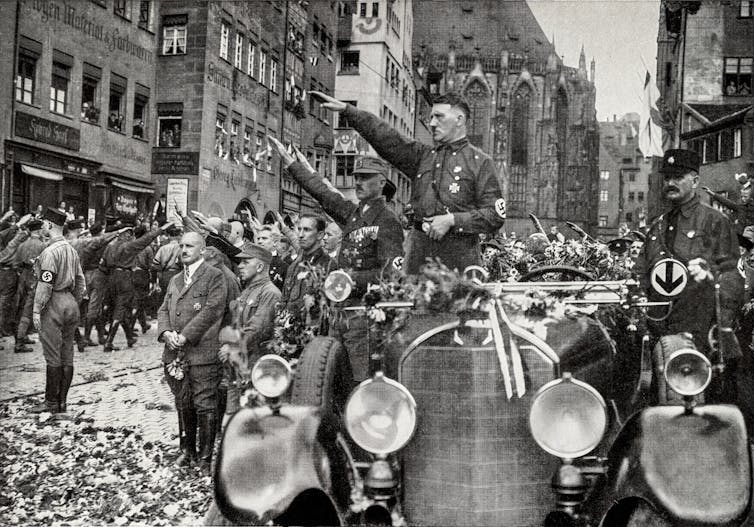
Adolf Hitler on the third day of the Nazi party conference Nuremberg, Germany, in 1929. Shutterstock/Andreas Wolochow
The cumulative effect of these experiences was that ideas of racial superiority came to be seen an unscientific relic of the past.
Squashing ‘scientific racism’
This was exemplified by the United Nations, which in November of 1945 established Unesco (United Nations Educational, Scientific and Cultural Organisation) with the explicit aim of battling racism. Unesco’s constitution, adopted on November 16 of that year, drew a direct connection between racism and the second world war:
The great and terrible war which has now ended was a war made possible by the denial of the democratic principles of the dignity, equality and mutual respect of men, and by the propagation, in their place, through ignorance and prejudice, of the doctrine of the inequality of men and races.
In 1949, Unesco appointed a panel of prominent scientists to formulate a critique of scientific racism. Reporting in 1950, the panel concluded that there is no scientific basis for any claims of racial superiority of one group over another. As the panel wrote, “the likenesses among men are far greater than their differences”.
While a small number of academics remained committed to race science and eugenics, they were forced into the margins of the academic world. The Eugenics Society, though it continued to exist, lost much of its prestige.
Going forward, race science or political appeals to racial superiority were no longer deemed acceptable, even among ruling elites. The language of race lost the scientific legitimacy and political purchase it once had.
This did not mean that racism disappeared, however. Rather, it changed shape.
Immigration and culture
Explicit appeals to race remained politically unacceptable for many decades after the war. This forced intellectuals and politicians on the right, especially those with divisive views about racial and ethnic differences, to develop an alternative language in which to express their ideas.
The backlash against these migration trends was exemplified by Enoch Powell, a Conservative MP and former Minister of Health. In the late 1960s, Powell developed a vocal critique of immigration numbers.
Powell’s rhetoric was inflammatory and racially charged. In his infamous ‘Rivers of Blood’ speech, delivered in 1968 in Birmingham, Powell claimed that unless immigration was restricted, people of colour would soon have “the whip hand over the white man”. In another speech, from 1970, Powell complained that it was no longer politically acceptable to say that “the English are a white nation”.
Powell made no appeal to the idea of biological difference. Instead, his emphasis was on cultural difference. He claimed that migrants and white British people were culturally too dissimilar for assimilation to be possible in large numbers.
Powell’s speeches on immigration cost him his political career. He was dismissed from the Shadow Cabinet following his “Rivers of Blood” comments. Yet his views were soon echoed by other political figures.
In 1976, Ivor Stanbrook, a Conservative MP, said in the House of Commons: “Let there be no beating about the bush. The average coloured immigrant has a different culture, a different religion and a different language. That is what creates the problem.”
And in 1978, Margaret Thatcher said in a TV interview that British “people are really rather afraid that this country might be rather swamped by people with a different culture”. Migration was a threat to Britain’s national identity.
Thatcher added: “We are a British nation with British characteristics. Every country can take some small minorities and in many ways they add to the richness and variety of this country. The moment the minority threatens to become a big one, people get frightened.”
In the 1979 general election, which Thatcher won with a landslide, the Conservative party manifesto pledged to tighten immigration controls and restrict citizenship. This pledge was enacted in 1981.
The denial of racism
The rhetoric of people like Powell, Stanbrook, and Thatcher represented a new kind of racial vocabulary. What is striking about this rhetoric is that it pretended not to concern race at all. Each of them explicitly denied that their rhetoric appealed to racist sentiment.
Powell often distanced his critique of immigration from concerns over race. In a 1970 interview, Powell said:
I’m not talking about race at all. I am talking about those differences, some of which are related to race, between the members of different nations which make the assimilation of the members of one nation into another nation more difficult or less difficult.
Stanbrook also denied that his comments about “coloured immigrants” were racist. In a parliamentary debate, he insisted that to highlight problems with cultural integration “is not racialism, if by that one means, as I do, an active hostility to another race”. This was because, in his view, “a preference for one’s own race is as natural as a preference for one’s own family”. A dislike of immigration, therefore, is not based on racist animosity. “It is simply human nature,” Stanbrook added.
Even Thatcher complained that whenever she tried to address concerns about immigration she was “falsely accused of racial prejudice” by her political opponents. She claimed that because mainstream political parties were not willing to talk about immigration, voters were instead turning to the far-right National Front. “If we do not want people to go to extremes, and I do not, we ourselves must talk about this problem and we must show that we are prepared to deal with it,” she said.
These denials of racism indicate that during this period, the language of race itself remained socially unacceptable. Powell, Stanbrook and Thatcher all felt the need to distance themselves from it.
This helps to explain why they preferred to focus on ideas of cultural difference and national identity. These ideas did not carry the same negative connotations as race, yet could be used to convey a similar message – namely that some groups did not belong in Britain.
The rise of inflammatory rhetoric surrounding immigration in the 1960s and 70s had an immediate impact on policy. During this period, successive governments responded to the growing clamour over immigration by selectively tightening migration controls and nationality legislation.
However, this rhetoric has also had a more gradual, long-term effect on racism’s place in society. Powell’s and Thatcher’s views on immigration have been echoed again and again, often framed in the same vocabulary. This continues to this day.
Last month, Katie Lam, the shadow home office minister, appeared to argue that Ukrainian and Gazan refugees should be treated differently because the former are better able to assimilate to British culture, as well as being more likely to go back to rebuild their country of origin.
And earlier this month, nationalist writer and academic Matthew Goodwin, who is formally linked to Reform, wrote in his personal newsletter that the “cultures that our hapless politicians are now importing into our country at speed are not just radically different and incompatible to our own; they are inferior, primitive, stuck in cultural codes and practices we moved on from centuries ago”.
The gradual normalisation of this kind of rhetoric has allowed it to re-enter mainstream public discourse. This has caused the erosion of the anti-racist norms established in the wake of the second world war. For many years after the war, these social norms meant that public figures who expressed views that were considered racist paid a high social or professional cost. Powell’s dismissal from the shadow cabinet following his Rivers of Blood speech is a forceful example of this.
Today, these anti-racist norms are under increasing pressure. To be sure, they have not fully disappeared. In recent years, anti-racist movements like the Black Lives Matter have enjoyed broad popular support in Britain and elsewhere.
Likewise, officials who express inflammatory rhetoric can still expect to be challenged. Politicians including Starmer, Robert Jenrick and Katie Lam have recently been met with criticism for divisive comments or policies on race, migration, and culture.
Starmer, for instance, was criticised for saying that migration numbers are turning Britain into an “island of strangers”. This comment was likened to Powell’s rhetoric on immigration, who also said that immigration left Britons feeling like “strangers in their own country”. When confronted with criticism, Starmer said he deeply regretted using that phrase.
Meanwhile, Farage has faced pressure to distance himself from racist comments he is alleged to have made in the past – allegations which he has strongly denied.
Yet, the prospect of a politician being dismissed from a cabinet role for racially inflammatory comments is very remote today. Neither Jenrick nor Lam has been dismissed from the shadow cabinet for their comments, with Conservative Party leader Kemi Badenoch expressly defending Jenrick.
Various forms of racism persist. Today, cultural racism is the most widespread and politically consequential kind. Derogatory and stereotyped views on cultural differences and national identity are now an everyday feature of public discourse, especially in debates over immigration.
Yet cultural racism remains poorly understood. In most media reporting and political discourse, the term “racism” continues to refer primarily to individual prejudice based on outward appearance or group belonging. When Streeting talks about “1970s, 1980s-style racism” he specifically means “abuse based on people’s skin colour”.
While it is undeniably a good thing that racist abuse is being vocally challenged by politicians, this narrow definition of racism obscures as much as it reveals. It fails to challenge forms of racism that do not appeal to physical traits but to cultural traditions. And it gives political agitators intent on sowing division on themes like immigration the opportunity to deflect criticism by denying that their ideas are racist.
At the structural level, racism causes certain individuals or communities to be more vulnerable to violence, exclusion, marginalisation, poverty, and other harmful outcomes on the basis of their membership of a particular racial, cultural, or religious group. Rhetoric that intensifies this vulnerability feeds racism, even when it is not expressed in the language of “race” or when there is no prejudicial intent.
So long as these structural factors are not taken into consideration, more subtle forms of racism will continue to hide in plain sight and exert a corrosive influence on the health and wellbeing of those it targets.
To hear about new Insights articles, join the hundreds of thousands of people who value The Conversation’s evidence-based news. Subscribe to our newsletter.
Lars Cornelissen does not work for, consult, own shares in or receive funding from any company or organisation that would benefit from this article, and has disclosed no relevant affiliations beyond their academic appointment.
Deception is everywhere in nature. Animals and plants routinely cheat, lie and manipulate for their own benefit. One example is mimicry, where one species (the mimic) has evolved to resemble another (the model).
No group of animals takes this to greater lengths than hoverflies – bean-sized bullets that zip around your garden, cosplaying bees and wasps.
As some new research by ourselves and others show, hoverflies surprise not just their predators, but evolutionary biologists too.
Mimicry is most often for protection. Harmless mimics evade predators by evolving to resemble dangerous species. Some can even mimic several species. But mimicry can also be aggressive, where dangerous species dress up as innocuous ones to ambush unsuspecting prey, like the spider-tailed viper – or to steal food, like the rove beetle with a fake termite on its back.
It can be sexual. Flowers such as bee orchids resemble female insects to trick males into trying to copulate with them, unwittingly pollinating them in the process. Weedy male bluegill sunfish adopt the dark colouration of females to sneak into the brightly coloured alpha male’s harem and mate with the females. Some female damselflies even mimic males just to cut themselves a break from constant harassment by males for mating.
But sometimes it’s not enough just to look like your model; you have to behave like them too.
Take hoverflies, for example. Some hoverflies are highly accurate mimics, like Temnostoma. These amazingly wasp-like hoverflies have one notable flaw in their mimicry: typical short stubby fly antennae. Wasp antennae are long. But a recent study shows that Temnostoma species have evolved to mimic the long, ever-moving antennae of wasps by waving their forelegs in front of their head. Their legs have also changed from orange to black for that purpose. Stilt-legged flies do the same thing.
In a new paper out this week, we and colleagues from the Universities of Hull and Nottingham showed how bumblebee-mimicking hoverflies take behavioural mimicry to the next level.
Bumblebees love blue and purple flowers, unlike wasps and many solitary bees and most flies which usually visit yellow and white flowers. A keen-eyed predator could theoretically spot a tasty fly – even one that looks like a bee – just by the colour of the flower it is visiting.
We predicted that those hoverflies that mimic bumblebees would have switched their preference to visit blue flowers. To test this we looked at nearly a thousand pictures of insects visiting flowers posted on the web by amateur enthusiasts. We looked at the colours of the flowers in the photos, comparing their “blueness” and “yellowness”.
When in Rome
Bumblebees tended to be snapped on flowers with more of a “blue” component than other insects (and less of a “yellow” component). What surprised us was how closely the mimics followed the bumblebees in the blueness of the flowers they visited.
Most likely these flies have evolved to hang out in the right places to enhance their cover story as a bumblebee. It could also be that they may have been visiting blue flowers since before they ever evolved to be mimics. This would have brought them close to bumblebees, which may have been how mimicry began evolving in the first place.
Why would this happen just in bumblebee mimics? We think we have an idea.
In nature, while some mimics are downright astonishing, like Temnostoma, or like these moths, others are really pretty ropey to the point where it’s difficult to see what they are even trying to mimic.
For protective mimicry to work, predators have to have at least one experience where they try attacking something brightly coloured to see if it is tasty, with unpleasant consequences. This teaches them to avoid these bright colours in future. In wasps, the bright colours are all broadly the same – yellow and black. This helps each individual wasp, because one clear warning signal is better than many different ones.
Do the best mimics resemble the nastiest species? Actually in many cases it’s the other way round. A recent study using 3D-printed models showed that, if your model is super-nasty, even a passing resemblance to the model will be enough for predators to avoid you.
The stronger and clearer the warning signal, the easier it is for harmless charlatans to take advantage. So you can get away with looking only a bit like a wasp.
But if you mimic a species that is only mildly noxious, you need to be super-accurate, because the predator doesn’t care as much if it makes a mistake. Bumblebees are not as nasty as wasps or honeybees. They are more palatable to predators and don’t sting as readily. So if a fly is going to mimic a bumblebee, it had better be pretty good.
And bumblebee-mimicking hoverflies are some of the best mimics in nature – right down to the kinds of flowers they visit.
The authors do not work for, consult, own shares in or receive funding from any company or organisation that would benefit from this article, and have disclosed no relevant affiliations beyond their academic appointment.
Les Centrafricains éliront leur président, le 28 décembre 2025, dans un contexte toujours fragile, où l’insécurité persiste et où le spectre des groupes armés continue de peser lourdement sur le processus électoral. L’élection présidentielle s’annonce sous haute tension, avec la candidature du président sortantFaustin-Archange Touadéra, mais aussi de figures comme Anicet-Georges Dologuélé ou l’ancien Premier ministre Henri-Marie Dondra. La chercheuse Alexandra Lamarche jette un éclairage sur les principaux risques entourant le processus électoral en Centrafrique, et évoque les actions prioritaires et nécessaires pour prévenir des violences post-électorales.
Quels sont, selon vous, les principaux risques entourant l’élection du 28 décembre ?
L’élection présidentielle du 28 décembre en République centrafricaine (RCA) se déroule dans un climat d’insécurité marqué par la présence persistante de groupes armés et les tensions avec les Forces armées centrafricaines (FACA). Cette situation fait planer un risque réel de violences et d’affrontements. Dans de nombreuses régions, les électeurs pourraient être confrontés à des intimidations venant tant des forces nationales que des groupes armés. Certains combattants issus d’anciennes coalitions dissoutes ont rejoint de nouvelles factions.
Bien que les membres de certaines milices aient été intégrés aux forces nationales, cette intégration présente des lacunes et bon nombre d’anciens combattants pourraient ne pas se montrer loyaux envers l’État en cas de conflit. Cela accroîtrait encore les risques liés au scrutin. Cette insécurité, combinée à une profonde frustration politique et à un désengagement, suggère que le taux de participation sera faible.
Le référendum du 30 juillet 2023 — boycotté par l’opposition et largement perçu comme un « coup d’État constitutionnel » – a supprimé la limitation du nombre de mandats présidentiels. Il permet à l’actuel chef de l’Etat, Faustin-Archange Touadéra, de demeurer au pouvoir indéfiniment. Cette situation renforce l’impression que les règles du jeu démocratique sont biaisées.
Enfin, les difficultés persistantes pour de nombreux citoyens musulmans à obtenir une carte d’identité nationale risquent de les exclure du scrutin. Elles exacerbent les frustrations communautaires et sapent davantage la crédibilité du processus électoral.
Quel rôle jouent les groupes armés et les acteurs étrangers dans ce scrutin ?
Les groupes armés demeurent des acteurs centraux, surtout dans les zones où ils peuvent perturber les opérations électorales, restreindre l’accès des électeurs ou interrompre le vote afin de préserver leur influence locale ou de se positionner pour d’éventuelles négociations post-électorales.
À leurs côtés, les acteurs étrangers jouent un rôle tout aussi déterminant. La Russie, via ses instructeurs et sociétés militaires alliées, sécurise certaines zones tout en renforçant l’avantage du pouvoir en place. Le Royaume-Uni accuse même Moscou d’envisager de réprimer des voix politiques et de mener des campagnes de désinformation pour influencer le débat électoral.
Le Rwanda, pour sa part, soutient activement le président Touadéra afin de consolider sa présence militaire et protéger un réseau croissant d’investissements dans les secteurs minier, commercial et de la construction, tout en étendant son influence régionale. Cette dynamique s’ajoute à l’appui que la Russie, notamment via Wagner, accorde à Touadéra pour sécuriser leurs propres intérêts miniers et maintenir un régime favorable à son implantation stratégique en Afrique centrale.
Si la force de maintien de la paix onusienne, la Minusca, tente de promouvoir un processus plus crédible, sa marge de manœuvre reste limitée par la fragmentation territoriale et les alliances politiques du régime. Parallèlement, le gouvernement de Touadéra apparaît de plus en plus dépendant de ses partenaires étrangers, au détriment de la souveraineté de la RCA.
Comment la situation des déplacés affecte-t-elle la crédibilité du vote ?
La situation des déplacés internes et des réfugiés centrafricains compromet sérieusement la représentativité du scrutin. Alors que les réfugiés — majoritairement musulmans — avaient pu voter en 2015-2016, ils en sont désormais exclus par le gouvernement, malgré les appels des Nations Unies en faveur de leur inclusion et les offres de soutien pour faciliter ce processus. Cette exclusion prive l’élection de milliers de voix. À l’intérieur du pays, de nombreuses personnes déplacées, de toutes confessions et d’origines ethniques, vivent dans des zones isolées ou se cachent pour échapper aux violences et peuvent hésiter à se rendre aux bureaux de vote par peur d’être ciblées.
Cette combinaison d’exclusion administrative et de contraintes sécuritaires crée un processus électoral qui laisse de côté certaines des populations les plus affectées par le conflit, remettant en doute l’inclusivité et, par conséquent, la légitimité globale du scrutin.
Quelles actions prioritaires sont nécessaires pour prévenir des violences post-électorales ?
Prévenir les violences post-électorales nécessiterait une action anticipée et coordonnée, mais j’ai peu d’espoir que ce soit possible. Même si les bulletins de vote sont déposés, si une partie importante de la population se sent exclue ou contrainte, le résultat pourrait déclencher un retour à la violence.
Bien que le mandat de la Minusca ait été renouvelé année après année, celle-ci ne dispose pas des fonds ni des effectifs nécessaires pour mener à bien sa mission ambitieuse. L’une des principales priorités est de travailler en étroite collaboration avec l’Autorité nationale des élections (ANE). Bien que celle-ci fasse de nombreux efforts positifs, notamment sur les plans technique et logistique, elle n’est probablement pas encore en mesure de garantir que tous les risques majeurs (sécurité, portée, légitimité) soient atténués.
Les élections ne sont qu’une étape. Le véritable test consistera à déterminer si l’État sera capable d’exercer son autorité après les élections de manière à renforcer la paix plutôt qu’à accentuer la polarisation.
La protection des civils doit être assurée de manière impartiale, notamment par un déploiement ciblé de la MINUSCA dans les zones sensibles afin d’éviter l’usage excessif de la force par les FACA ou leurs alliés étrangers.
Il est également crucial de décourager tout discours identitaire inflammatoire et de garantir un accès rapide à la justice pour enquêter sur les violences, protéger les témoins et poursuivre les auteurs, quel que soit leur camp. Cette combinaison de prévention, de transparence et de responsabilité est indispensable pour réduire les risques de violences après le scrutin.
Alexandra Lamarche receives funding from the Social Sciences and Humanities Research Council (SSHRC) of Canada.
Source: The Conversation – in French – By Bonnie Campbell, Professeure émérite en économie politique. Département de science politique de l’Université du Québec à Montréal., Université du Québec à Montréal (UQAM)
Les activités d’extraction d’or ont récemment repris dans le complexe de Loulo-Gounkoto, dans l’ouest du Mali, après plusieurs mois d’interruption. En janvier, le gouvernement malien a commencé à bloquer les exportations de la mine appartenant à la société canadienne Barrick Mining (anciennement Barrick Gold).
Ce cas particulier est trop complexe pour être abordé ici. Cependant, les conflits concernant la distribution des revenus soulèvent des interrogations majeures quant à la façon dont les nations dotées de ressources naturelles tirent profit de leurs richesses.
Pour améliorer leurs infrastructures et leurs services de santé, ainsi que pour atteindre leurs objectifs de développement social, l’apport des recettes publiques générées grâce à la taxation de leurs ressources naturelles est d’une importance critique pour les pays d’Afrique subsaharienne.
Plusieurs raisons expliquent pourquoi les pays d’Afrique riches en ressources minérales ne tirent pas suffisamment profit de leurs ressources.
De plus, les incitations fiscales régulièrement accordées pour attirer des investissements miniers, telle qu’une réduction significative des taux d’imposition et de redevances, sont rarement justifiées au regard de la perte de recettes publiques qu’elles entraînent.
Malgré ses importantes ressources minérales, le continent est en proie à un mécontentement généralisé, à la pauvreté et au sous-développement en raison des concessions excessives obtenues par les sociétés minières étrangères. Cette situation a été condamnée par les dirigeants de tout le continent.
En réponse, la Vision minière pour l’Afrique de l’Union africaine et les politiques qu’elle a inspirées, notamment la réforme des codes miniers, visent à garantir une contribution plus durable des ressources minérales du continent.
Or, les déséquilibres de pouvoir entre les entreprises étrangères et les gouvernements africains persistent et orientent les négociations relatives aux codes miniers, aux contrats et aux pratiques.
Bien que la situation varie d’un pays, d’un secteur et d’un site à l’autre, des recherches ont été menées pour déterminer les principaux obstacles à l’augmentation des recettes minières des États.
L’inégalité d’influence dans le cadre des négociations, qui favorise les sociétés minières, entraîne de nombreuses irrégularités. On peut citer, par exemple, la prolongation des clauses de stabilité malgré les réformes réglementaires, ou encore la priorité accordée aux contrats miniers par rapport aux cadres réglementaires nationaux plus larges.
Le secteur minier est un pilier de l’économie malienne. En 2022, il représentait 9,2 % du produit intérieur brut (PIB), 76,5 % des recettes d’exportation et 34,8 % des recettes publiques.
Comme dans d’autres pays du continent, la nouvelle législation minière vise à remédier aux dommages environnementaux et aux recettes minières décevantes qui sont l’héritage du passé. Le code minier de 2023 propose des réformes qui ont pour but d’améliorer les retombées nationales du secteur, à l’instar des mesures prises en Tanzanie, en Zambie et en République démocratique du Congo.
Ces réformes comprennent des exigences plus importantes en matière de participation de l’État (généralement de 10 à 30 %), des redevances et des taux d’imposition plus élevés, des exigences concernant le contenu et les emplois locaux, des dispositions plus strictes relatives à la responsabilité environnementale et sociale, ainsi que des obligations accrues en matière de développement communautaire.
Le code de 2023 vise à renforcer la souveraineté du Mali sur ses ressources et à garantir une répartition plus équitable des bénéfices.
Le régime fiscal a notamment été réformé pour supprimer certaines exonérations dont bénéficiaient les sociétés minières. Le nouveau code met aussi fin à l’allégement fiscal de 25 % accordé par les codes précédents pour une durée de 15 ans. Il introduit également une redevance de 10 % sur la production excédant les prévisions.
Par ailleurs, le Mali a créé plusieurs fonds pour répondre aux besoins du secteur et favoriser l’inclusion sociale.
Comme d’autres pays riches en minerais, le Mali a dû faire face à une forte résistance, notamment de la part des entreprises les plus importantes et les plus influentes. Cela a conduit à une escalade de conflits plutôt qu’à des solutions négociées.
Il convient de noter que plusieurs sociétés, comme Robex Resources, ont conclu des accords avec le gouvernement malien. L’entreprise britannique Endeavour Mining a négocié avec le gouvernement des conditions d’exploitation dans le cadre du nouveau code minier.
Déjà des milliers d’abonnés à l’infolettre de La Conversation. Et vous ? Abonnez-vous gratuitement à notre infolettre pour mieux comprendre les grands enjeux contemporains.
Deux autres producteurs d’or ont également signé des accords pour exercer leurs activités en vertu du nouveau code minier : Faboula Gold et Bagama Mining.
Bien que moins importants en termes d’investissement, ces projets illustrent la possibilité de mener à bien des initiatives conformément au nouveau code. Ils offrent aussi de nombreuses possibilités d’emploi dans les zones rurales.
Une souveraineté accrue
Certains analystes du secteur ont critiqué les pays riches en minerais pour avoir adopté une approche de « nationalisme des ressources ». Des études montrent toutefois que des revenus miniers bien gérés, transparents et stables pourraient contribuer à améliorer l’accès aux soins de santé et aux services sociaux au Mali et au Sénégal.
Le fait d’exercer une plus grande souveraineté sur les ressources naturelles afin d’assurer le bien-être de la population d’un pays pourrait en fait être salué comme un nationalisme responsable.
Le Mali et ses voisins sont confrontés à d’importantes menaces militaires et sécuritaires. L’industrie minière peut jouer un rôle clé dans la lutte contre ces problèmes en générant des revenus et des emplois.
Pour ce faire, elle devra respecter les réglementations nationales et contribuer de manière équitable aux recettes fiscales. En fin de compte, la rentabilité et la responsabilité sociale de l’industrie sont étroitement liées à la stabilité sociale du pays ainsi qu’au bien-être sanitaire, social et économique de sa population.
Bonnie Campbell a reçu des financements du Conseil de recherches en sciences humaines du Canada (CRSH) et du Centre de recherches pour le développement international (CRDI) du Canada.
Moussa Doumbo ne travaille pas, ne conseille pas, ne possède pas de parts, ne reçoit pas de fonds d’une organisation qui pourrait tirer profit de cet article, et n’a déclaré aucune autre affiliation que son organisme de recherche.















_(19339431752).jpg)
