Source: The Conversation – Canada – By Lilian Barraclough, PhD Student, Social Practice and Transformational Change, University of Guelph
Youth engagement is critical in the fight for a just and sustainable future. And creating opportunities for young people is a vital part of a just transition away from fossil fuels.
The Canadian government’s 2025 federal budget has emphasized creating new opportunities for young people by establishing a Youth Climate Corps, providing employment placements in renewable energy, protecting biodiversity and retrofitting buildings. The government promised to invest $40 million over two years starting in 2026-27.
However, while the creation of the Youth Climate Corps is an encouraging step toward a more sustainable, equitable and resilient country, the 2025 budget simultaneously caters to the oil and gas industry, reducing requirements for urgent emissions reduction and increasing subsidies supporting oil and gas production.
One of the leading causes of climate grief and anxiety among young people is government inaction, in Canada and elsewhere, that has led to feelings of betrayal, anger and despair about climate change.
In our research, colleagues and I have found that young Canadians are experiencing intense emotions related to the climate crisis, and they often have little to no hope for the future, envisioning apocalyptic conditions for themselves and their children.
Eco-anxiety
Although I am now a researcher, I have been involved in environmental and climate action since I was a child. I have witnessed the never-ending cycle of false commitments and lack of follow-through on the climate crisis.
Climate grief refers to grief in response to the losses caused by climate change — of trees, animals, place, homes as well as more intangible elements of culture and connection. Climate or eco-anxiety is defined by the American Psychological Association as “a chronic fear of environmental doom.”
Young Canadians describe their grief in visceral, embodied ways, emphasizing how their concerns about climate change invade their daily lives, relationships and life choices.
In our research, politically active youth expressed anger, frustration and hopelessness at the state of inaction on the climate crisis.
As one participant told us:
“There are times youth lose hope, when you try to push for something and then you have government push back and they just don’t get it when it makes so much sense to you that our climate is changing and we need to do something about it. Why would you not listen? Why aren’t you doing this?”
Youth need genuine engagement
It’s critical to involve more young people in the sectors addressing climate change and create better employment opportunities while building capacity to respond to increasing pressures from the realities of the climate crisis. The Youth Climate Corps is an important step in that direction.
The challenge, however, is that when youth are left out of the decisions that truly influence Canada’s ability to reduce emissions, address biodiversity loss and adapt to the changes we face, it reinforces feelings of betrayal and grief.
Models of youth-adult partnership on climate action show that the most important outcomes come from positive, meaningful youth engagement. These models, when paired with the real-world experience of youth activists, make it clear that both youth and their adult counterparts — in this case government decision-makers — have a responsibility to ensure that climate action is implemented in an intentional, thorough and meaningful way.
When youth are engaged in climate decision-making but the impact on overall action to address the crisis is negligible, it can reinforce and exacerbate climate grief and anxiety.
I see many of my peers facing an impossible job market, forced to take under-paying jobs that don’t align with their values and desires for change. The Youth Climate Corps undoubtedly represents progress, but the recent federal budget investment is limited. It will create few jobs and likely won’t meet the demands of young Canadians.
Limited progress in green jobs for young people doesn’t make up for Canada’s failure to reduce emissions and hold the fossil fuel industry accountable, making young Canadians question whether the federal budget is really one of “generational investment.”
Without inclusive decision-making and concrete action, young people will continue to feel grief and anxiety over the climate crisis and its impact on their health, well-being, jobs and future prospects.
Lilian Barraclough receives funding from the Social Sciences and Humanities Research Council of Canada. She is the Co-Chair of the Board of Directors of the Youth Climate Lab and a regional representative for Ontario on the Young Greens Council of Canada and Youth Representative on the Green Party of Canada’s federal council.
Source: The Conversation – UK – By Adrian R Bell, Chair in the History of Finance and Associate Pro-Vice-Chancellor Research, Prosperity and Resilience, Henley Business School, University of Reading
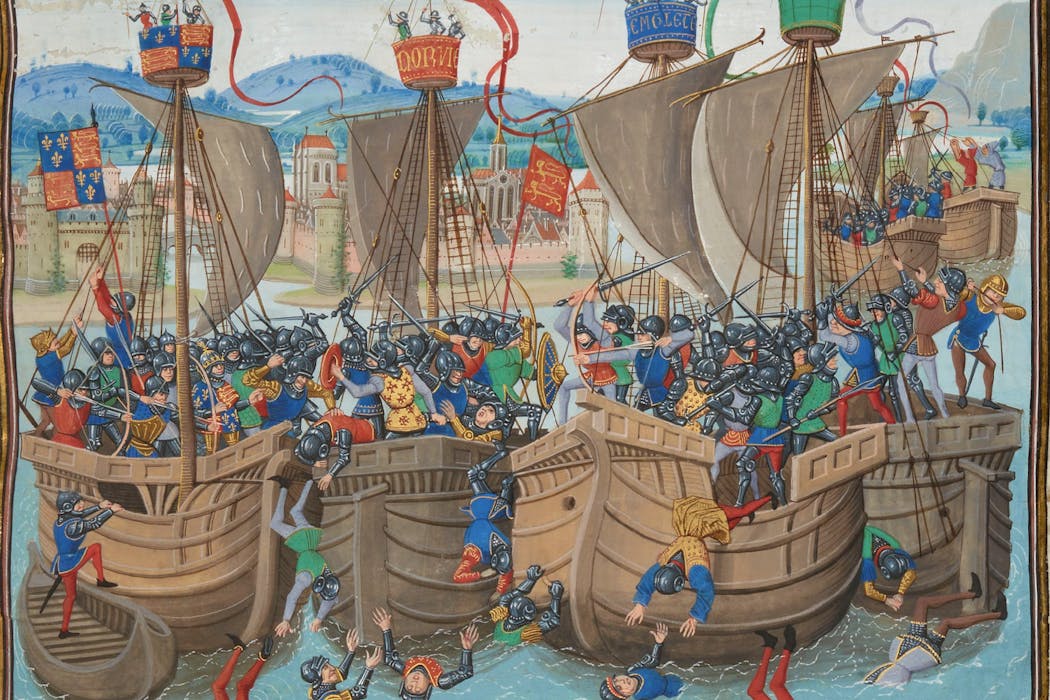
The Battle of Sluys during the 100 year war, as depicted by Jean Froissart in the 15th century.National Library of France
When you picture medieval warfare, you might think of epic battles and famous monarchs. But what about the everyday soldiers who actually filled the ranks? Until recently, their stories were scattered across handwritten manuscripts in Latin or French and difficult to decipher. Now, our online database makes it possible for anyone to discover who they were and how they lived, fought and travelled.
To shed light on the foundations of our armed services – one of England’s oldest professions – we launched the Medieval Soldier Database in 2009. Today, it’s the largest searchable online database of medieval nominal data in the world. It contains military service records giving names of soldiers paid by the English Crown. It covers the period from 1369 to 1453 and many different war zones.
We created the database to challenge assumptions about the lack of professionalism of soldiers during the hundred years war and to show what their careers were really like.
In response to the high interest from historians and the public (the database has 75,000 visitors per month), the resource has recently been updated. It is now sustainably hosted by GeoData, a University of Southampton research institute. We have recently added new records, taking the dataset back to the late 1350s, meaning it now contains almost 290,000 entries.
This data is mainly drawn from muster rolls (lists of names of soldiers comprising the military force) of men-at-arms (soldiers with full armour and a range of weapons) and archers. We can even see the little dots used by officials taking the muster to confirm the soldiers had turned up and had the right equipment. All these soldiers were paid and the Exchequer wanted to be assured it was receiving value for money.
We have also included protections and appointments of attorneys and legal mechanisms to protect local interests while serving overseas. Together, these records provide rich accounts of military activities, allowing for significant conclusions to be drawn. Careers of 20 years and more are revealed. We also see men moving upwards socially because of their good service. For many soldiers, especially archers, this information may be the only record we have of their existence.
The expanded data enables us to explore the garrison of Calais from 1357 to 1459. We can see the high manpower commitment needed to maintain this key English base in northern France. Calais was the gateway through which many great expeditions passed, including that of 1359 when Edward III set out to besiege Reims to be crowned King of France.
The database also allows comparisons with other emerging projects. For instance, we can establish the military experience of rebels in the peasants’ revolt of 1381, a widespread English uprising driven by economic hardship, high taxes and social tensions, ultimately suppressed violently by King Richard II and his government. The data allows many deep dives into the past. It allows historians to demonstrate that, unlike today where the armed forces specialise, the medieval soldier would have served repeatedly across different theatres of war.
We can see expeditionary armies sent to invade France as well as naval campaigns in the English Channel. We also find soldiers in garrisons in Scotland, Ireland and France. Our data has allowed family historians to push their genealogies back further than has been previously possible.
Standout stories
The resource is home to many insightful records of key events and figures. One well known person is Geoffrey Chaucer, author of The Canterbury Tales, which were written between 1387 and 1400. The database holds a number of service records for him. He was a man-at-arms in the garrison of Calais in 1387.
The writer Geoffrey Chaucer is included in the database. Wiki Commons
This was probably Chaucer’s last foray into military service, but he had considerable experience as a soldier and as a diplomat. He had been in France in 1372, 1377 and 1378. He testified to the Court of Chivalry – a court which settled disputes over coats of arms – in 1386. He told the court that he was then aged “40 and upwards” and “had been armed 27 years”. He gave more details about his service on the Reims campaign of 1359 where he was captured by the French and ransomed.
Records for a man named Thomas Crowe of Snodland in Kent shed some light on his rebellious past. During the peasants’ revolt of 1381, he was accused of “taking up position and throwing great stones” to demolish someone’s house. The database suggests he may have served in France in 1369. He was certainly in the garrison of Calais in 1385 and on a naval campaign in 1387. His military knowledge about trebuchets – a powerful type of counterbalanced medieval siege engine – or giant catapults may explain how he was able to wreak so much destruction in the revolt.
The muster roll for the garrison of Calais in 1357 shows not only the names of men-at-arms and archers but also the support roles needed: mason, locksmith, fletcher (a maker of arrows), bowyer (a maker of bows), plumber, blacksmith, wheelwright, cooper (maker of barrels), ditch digger, boatman, carter and carter’s boy. One record belongs to a tiler – Walter Tyler. Was this the future rebel leader of 1381, Wat Tyler?
We hope the database will continue to grow and go on providing answers to questions about our shared military heritage. We are sure that it will unlock many previously untold stories of soldier ancestors.
Looking for something good? Cut through the noise with a carefully curated selection of the latest releases, live events and exhibitions, straight to your inbox every fortnight, on Fridays. Sign up here.
Adrian R Bell receives funding from UKRI via AHRC.
Anne Curry receives funding from the Leverhulme Trust, and in the past received funding from UKRI via the AHRC .
Source: The Conversation – UK – By William Yat Wai Lo, Associate Professor in Intercultural and International Education, Durham University
From climate marches to Gaza encampments, students across the globe are demanding political change. Their activism is often praised as a sign of youth empowerment and civic engagement.
But there is another side to this story. Activism can also exclude, silence, and polarise. It can amplify the voices of some, while pushing others to the margins.
My recently published study with colleague Euan Auld explored these dynamics in the context of Hong Kong’s 2019 student protests. This was a mass movement initially sparked by opposition to a proposed extradition bill, which quickly expanded into broader calls for democracy.
We interviewed 26 student leaders from 11 universities, capturing a complex picture of student politics under pressure. What we found challenges simple narratives of activism as purely empowering. Student-led organisations became not just platforms for mobilisation, but also sites of internal tension and exclusion.
This paradox – the power to empower, and the power to disempower – is a contradiction at the heart of student politics. And while Hong Kong may be a unique setting, the lessons carry broader relevance as campus protests rise around the world.
In the lead-up to and during Hong Kong’s 2019 protests, student organisations played a prominent role in the broader movement for political change. Student organisations helped shape protest strategies, coordinated campus actions, and became powerful symbols of resistance.
Our interviewees described feeling seen, heard, and united for a cause larger than themselves, with their student union involvement providing visibility. “No one would respond to my email if I was an ordinary student,” one student explained. “Being a student union executive gives me a position to make change.”
But that visibility came at a cost. As the political climate intensified, political alignment with localist viewpoints – often associated with a strong Hong Kong identity and, in some cases, pro-independence stances – became a prerequisite for leadership. In our interviews, student leaders explained that although student unions were expected to represent a wide range of student interests, from campus welfare to academic policy, their increasing focus on political advocacy meant that only candidates with strong ideological positions could credibly run for office.
“A political stance is essential to running an election for a cabinet of the student union,” said one student.
Some also described feeling significant pressure to conform to dominant narratives, often tied to a rising sense of local identity or support for more radical actions. One student reflected that “when the society stresses ‘Yung Mo’ [a confrontational stance] or the society no longer stays at this kind of ‘Wo Lei Fei’ viewpoint [a peaceful, non-violent approach], the students’ mentality changes too and they want to escalate their actions.”
This creates a difficult environment for those who don’t fully agree. Moderate voices, or students unsure of how far they wanted to go, were sometimes silenced or sidelined. “We would avoid showing our political stance publicly,” a student said, pointing to the discomfort students felt in expressing dissenting views.
Some interviewees said they chose to withdraw from student organisations altogether, fearing peer pressure, disciplinary consequences from universities, or even legal risks. The paradox is clear: the very organisations that enabled student voice also narrowed whose voices were heard.
Universities today
Hong Kong may have been a specific and high-stakes political setting, but the underlying tensions it revealed are not unique. As student protests resurface globally, university campuses have once again become contested spaces. Demands for institutional action collide with calls for neutrality and restraint.
In such polarised environments, activism can sometimes become a gatekeeping force. The louder it gets, the harder it may be for students to disagree. When political alignment becomes the price of participation, student activism risks losing what makes it meaningful: its openness to diverse perspectives.
This presents a real challenge for universities. How can they encourage political engagement without being seen to endorse one stance over another? How can they protect space for students to express themselves without letting any group dominate the conversation?
Hong Kong’s experience is a cautionary tale of how student politics can turn inward, excluding the very voices it aims to empower. But it’s also a moment to reflect. Universities have an opportunity – and a responsibility – to help keep student engagement open, inclusive, and pluralistic.
Student activism plays a vital role in challenging injustice and pushing for social change. At its best, it fosters leadership, political awareness, and a sense of collective purpose. “The campus is the epitome of society,” one student said. “If [civic engagement and study] are cut apart, then going to university becomes completely meaningless… Participating in civil society during one’s studies is very important.”
But if it only empowers those who speak the loudest or hold the most popular views, then something important is lost. The lesson from Hong Kong is not to silence activism, but to ensure that it doesn’t silence others.
William Yat Wai Lo receives funding from Policy Innovation and Co-ordination Office of the Hong Kong Special Administrative Region, China
Source: The Conversation – UK – By Andrew Bell, Senior Research Scholar at the Center for International Security and Conflict, Stanford University
A bombshell revelation on November 28 that the US secretary of defense, Pete Hegseth, ordered a second strike to kill the survivors of a Venezuelan drug boat targeted by US forces has shocked Congress and American citizens alike.
The US president, Donald Trump, citing Hegseth’s affirmations, has disputed these reports. Trump said Hegseth told him “he did not” give a spoken order to kill all crew members aboard the boat. “I believe him, 100%,” Trump added.
But US lawmakers have pledged to investigate the strike. Mark Kelly, a Democrat senator who recently urged military members to refuse unlawful orders, declared: “We’re going to have a public hearing. We’re going to put these folks under oath. And we’re going to find out what happened.”
Whatever the true nature of this incident, one fact is inescapable: there is no credible basis by which Trump’s military campaign against Latin American drug vessels is lawful under either US or international law.
For the past two months, the Trump administration has been flexing US muscle through a campaign of deadly strikes on alleged drug-carrying vessels in the Caribbean and eastern Pacific. At least 20 strikes have so far killed upwards of 80 people since early September.
With the recent addition of a US aircraft carrier to the substantial military assets deployed to the region, the campaign appears to only be getting more deadly. Yet, despite his insistence that Venezuelan criminal networks commit crimes “with impunity”, it is Trump who is acting with disregard for the law.
The US military reportedly carried out a follow-up strike on a suspected drug vessel in the Caribbean.
Undermining legal principles
Trump’s first term foreshadowed his transgressive behaviour regarding legal constraints on the military, a subject we have examined in depth elsewhere. Among other actions, he granted clemency to multiple US service members accused or convicted of war crimes and spoke enviously of enemies who “chop off heads” while US forces are bound by rules of engagement.
This trend has accelerated in Trump’s second term with efforts that are culminating in a broad-scale attack on international and domestic law in the unfolding armed campaign in the Caribbean and eastern Pacific. These unilateral strikes on drug vessels go further than any US president in recent history in undermining fundamental legal principles, breaching long-established rules and norms in three key ways.
First, the Trump administration’s strikes against drug vessels appear to flout the international legal prohibitions against extrajudicial killings. The International Covenant on Civil and Political Rights, a foundational treaty of international human rights law and one to which the US is a party, prohibits governments from arbitrarily depriving individuals of life.
Customary human rights law, which binds US government actions and is considered part of US law, also prohibits the killing of individuals without legitimate judicial processes. Customary law develops over time through a general acceptance of certain behavioural norms by states and is distinct from written treaty law.
Summary executions that happen outside the confines of domestic and international law can be considered as murder. It appears the Trump administration is ordering US service members to commit such offences as part of its Latin America campaign.
Second, the Trump administration is executing these strikes outside the legal exceptions that permit military force under the laws of war. Under these laws, soldiers receive a special exception during armed conflict to kill without facing judicial consequences.
Known as the “combatant’s privilege”, it is what keeps soldiers from going to jail for killing when a war ends. Vitally, however, this privilege extends only to combatants who kill other combatants during wartime.
The White House has provided no evidence that these alleged drug smugglers on the high seas are “combatants” instead of mere criminals. And despite the clear criminality of Latin American drug cartels, the administration has also provided no evidence that they are “organised armed groups” or have conducted protracted or intense violence against the US.
These are the conditions that mark a state of “armed conflict”, which triggers the laws of war and permits lawful military force against terrorists, insurgents or other armed groups.
Not only do these attacks transgress bedrock legal rules, they may expose US service members to criminal prosecution in the years ahead. Indeed, concern for the legality of the strikes reportedly led Admiral Alvin Holsey, commander of the military command responsible for Latin America, to announce in October that he would be giving up his position a year early.
Giving up such a high-ranking command is extremely unusual in US military practice, signalling the extraordinary and troubling nature of these strikes.
Third, much as the administration has disregarded international law, it is probably breaching domestic law as well. The strikes on drug smugglers appear to violate both US federal and military legal codes outlawing murder, including murder on the high seas.
Under the War Powers Resolution, any military action during hostilities must also be reported to Congress. The president then has a 60-day window after which US military force needs to be authorised by Congress or halted. The Trump administration has essentially rejected the constraints of the War Powers Resolution altogether.
In an October letter to Congress, Trump argued that because airstrikes on alleged drug runners are not “hostilities”, War Powers Resolution restrictions do not apply. With the acceptance of the quiescent Republican-led Congress, this has stripped the War Powers Resolution of much of its ability to constrain executive force.
Trump’s strikes in Venezuela represent another example of his rejection of any constraint on his powers as commander-in-chief. He has previously praised the virtues of torture and has declared the Geneva Conventions, which set rules for how people are to be treated during times of war, to be a “problem”. Trump is now putting his disregard for law into action.
It remains to be seen where such disregard will take the US military. However, one thing remains certain: in ordering this campaign of armed attacks, the Trump administration is rejecting the rule of law outright. Trump’s leadership in this campaign is, simply put, a military agenda defined by impunity.
The authors do not work for, consult, own shares in or receive funding from any company or organisation that would benefit from this article, and have disclosed no relevant affiliations beyond their academic appointment.
Recent weeks have shown – more starkly than many would wish – just how exposed the BBC has now become. The furore over revelations about Panorama’s clumsy edit of Donald Trump’s January 6 speech, and the astonishingly high-level resignations that followed, have put the UK’s public broadcaster under an intense and highly politicised spotlight.
Trump’s threat to sue the BBC has added further heat, handing fresh ammunition to those already opposed to the licence fee. It is hard to escape the sense that this could prove to be a decisive moment in the wider battle over the corporation’s future, just as the government prepares the ground for the public consultation phase of its review of BBC funding.
But moments like these are a reminder why the debate about BBC funding matters. For most of my working life, I have defended the licence fee. When I joined the corporation in 1980, I saw what shared public funding could build: a national institution paid for by all and available to all. I still believe in that ideal – even as the pressures on it intensify, and as we face the hard question of what comes next.
The BBC’s funding model, in its current form, seems unlikely to survive much longer. So viable alternatives must be considered that safeguard public service media. And many argue that the question now is not only how to fund the BBC – but also what kind of BBC we want to fund.
Former BBC director-general Tony Hall puts it neatly in the foreword to his 2025 study, The BBC: After the Licence Fee? . He argues that the debate is the wrong way round. Rather than how to pay for the BBC, we should ask what kind of BBC people want – and be honest about the trade-offs. The public needs more than headlines about BBC salaries or scandals – they need to understand what the BBC does, and what is at stake if it changes or shrinks.
A model under pressure
The licence fee was designed in a world of broadcast schedules, not personalised streaming. In 2024, 300,000 households did not renew their licence fee. Younger audiences increasingly watch TikTok, YouTube and Netflix rather than BBC channels, and many will never develop the attachment their parents and grandparents had.
Yet the BBC still plays roles that commercial services do not – and systems like this do not rebuild themselves if they collapse. You only realise their value when they are gone.
So what should replace the licence fee – and how do we protect what’s essential? In September the government published a research briefing on the future of the BBC licence fee. Here are three further potential models.
1. The hybrid subscription
This is a popular suggestion: “BBC-plus”, with core services such as news, children’s content, emergency information and so on, staying free to access by being publicly funded. Big dramas, live sport and premium content could then go behind a subscription paywall.
In theory that feels pragmatic. In practice, it risks a two-tier BBC with public service basics for all and premium content for those who can pay. And it chips away at universality – the principle that everyone, wherever they live or whatever they earn, can share the same programmes and conversations.
The BBC has always been strongest when it brings the country together. Splitting the audience into subscribers and non-subscribers weakens this shared civic space. And if the BBC becomes “just another app”, it will struggle to justify public support at all.
Whether it could compete with the big-budget dramas and films of the major streaming platforms is hard to predict. The BBC has a strong record of producing award-winning drama, and many of those global streamers now face challenges of their own. But the BBC often produces its best work when the competition is toughest.
2. The citizenship dividend
A more radical option takes inspiration from the concept of a universal basic income: each adult receiving publicly funded media credits to spend with any approved provider – from the BBC to local newsrooms, children’s media charities, Gaelic-language services and so on.
Instead of one broadcaster receiving almost all public money, the audience would decide where it goes. In theory, this could open space for regional voices, local journalists and independent creators. It would force the BBC – and others – to earn trust and to maintain what trust they’ve earned.
It also raises hard questions. Who counts as a public-service provider? Who accredits them? How do we stop political interference? But if these hurdles can be addressed, the model encourages pluralism and accountability. It matches the digital era’s instinct: people choose; institutions respond.
3. The BBC as digital public utility
This proposal moves away from treating the BBC as a content factory and revisioning it more as a form of civic infrastructure, like a public transport system or the NHS. As civic life migrates online, social cohesion may depend less on shared programming and more on shared infrastructure.
Instead of competing only on content the BBC could, for example, host civic debate spaces insulated from abuse and misinformation, invest in digital literacy and fact-checking and help rebuild local media ecosystems where “news deserts” now spread.
In this future, the BBC does not try to do everything itself. Rather, it enables others more – strengthening the democratic information system rather than dominating it.
What must not be lost
A bold BBC does not mean an uncritical one. It must be more transparent. It has to rebuild trust among audiences who feel ignored or misrepresented. It must become more open, more local, more global – and less comfortable.
But one thing must endure: the principle that trusted information and cultural life are public goods. Once lost to market logic, they do not return.
Defending the BBC as it is will not save it. Abandoning public funding will not save our public sphere. The task is more challenging than either of those arguments allow.
We must decide what kind of media future we want, and then build the system that protects it. If we get this right, the BBC can remain a shared national resource: independent, trusted and universal. If we get it wrong, it will shrink into a subscription niche – and we will all be poorer for it.
This article is part of our State of the Arts series. These articles tackle the challenges of the arts and heritage industry – and celebrate the wins, too.
Deborah Wilson David previously worked for the BBC.
Source: The Conversation – UK – By Francesco Grillo, Academic Fellow, Department of Social and Political Sciences, Bocconi University
In the 1966 film Fantastic Voyage, a spacecraft and its crew are shrunk to microscopic size and injected into the body of an injured astronaut to remove a life-threatening blood clot from his brain. The Academy Award-winning movie – later developed into a novel by Isaac Asimov – seemed like pure fantasy at the time. However, it anticipated what could be the next revolution in medicine: the idea that ever-smaller and more sophisticated sensors are about to enter our bodies, connecting human beings to the internet.
This “internet of beings” could be the third and ultimate phase of the internet’s evolution. After linking computers in the first phase and everyday objects in the second, global information systems would now connect directly to our organs. According to natural scientists, who recently met in Dubai for a conference titled Prototypes for Humanity, this scenario is becoming technically feasible. The impact on individuals, industries and societies will be enormous.
The idea of digitising human bodies inspires both dreams and nightmares. Some Silicon Valley billionaires fantasise about living forever, while security experts worry that the risks of hacking bodies dwarf current cybersecurity concerns. As I discuss in my forthcoming book, Internet of Beings, this technology will have at least three radical consequences.
First, permanent monitoring of health conditions will make it far easier to detect diseases before they develop. Treatment costs much more than prevention, but sophisticated tracking could replace many drugs with less invasive measures – changes in diet or more personalised exercise routines.
Millions of deaths could be prevented simply by sending alerts in time. In the US alone, 170,000 of the 805,000 heart attacks each year are “silent” because people don’t recognise the symptoms.
Second, the sensors – better called biorobots, since they’ll probably be made of gel – are becoming capable of not just monitoring the body but actively healing it. They could release doses of aspirin when detecting a blood clot, or activate vaccines when viruses attack.
The mRNA vaccines developed for COVID may have opened this frontier. Advances in gene editing technologies may even lead to biorobots that can perform microsurgery with minuscule protein-made “scissors” that repair damaged DNA.
Third, and most important, medical research and drug discovery will be turned on its head. Today, scientists propose hypotheses about substances that might work against certain conditions, then test them through expensive, time-consuming trials. In the internet of beings era, the process reverses: huge databases generate patterns showing what works for a problem, and scientists work backwards to understand why. Solutions will be developed much more quickly, cheaply and precisely.
Radical transformations
The era of one-size-fits-all medicine is already ending, but the internet of beings will go much further. Each person could receive daily advice on medication doses tailored to micro-changes such as body temperature or sleep quality.
The organisation of medical research itself will transform radically. Enormous amounts of data from bodies living natural lives might reveal that some headaches are caused by how we walk, or that brains and feet influence each other in unexpected ways.
Research currently focuses on specific diseases and organs. In future, this could shift to the use of increasingly sophisticated “digital twins” – virtual models of a person’s biology that update in real time using their health data. These simulations can be used to test treatments, predict how the body will respond and explore disease before it appears. Such a shift would fundamentally change what we mean by life science.
The dream here isn’t to defeat ageing, as some transhumanists claim. It’s more concrete: making healthcare accessible to all Americans, saving the UK’s NHS, defeating cancers, reaching poorer countries and helping everyone live longer without disease.
The nightmare, however, is about losing our humanity while digitising our bodies. The internet of beings is one of the most fascinating possibilities that technology is opening up – but we need to explore it carefully. We’re resuming the voyage that humankind was travelling in those optimistic years of the 1960s, when we landed on an alien planet for the first time. Only now, the alien territory we’re exploring is ourselves.
This article was commissioned in conjunction with the Professors’ Programme, part of Prototypes for Humanity, a global initiative that showcases and accelerates academic innovation to solve social and environmental challenges. The Conversation is the media partner of Prototypes for Humanity 2025.
This article was commissioned in conjunction with the Professors’ Programme, part of Prototypes for Humanity, a global initiative that showcases and accelerates academic innovation to solve social and environmental challenges. The Conversation is the media partner of Prototypes for Humanity 2025.
Francesco Grillo is Director of Vision, The Think Tank.
The flu season has started early this year, and we are prepared for it to be a bad one. Whether you have already had a vaccine or are thinking about getting one, here are some answers to questions you may have.
Do I have to pay for the flu vaccine?
In the UK, people who are at a higher risk of becoming severely ill with the flu are prioritised for a free flu vaccine.
This includes people over the age of 65 and those who have weakened immune systems, as well as health and social care workers. It also includes people who are at high risk of passing the virus on to someone vulnerable. If you’re not on this list, you can choose to pay for a flu vaccine at some pharmacies.
Are there any groups who should not get the flu vaccine this year?
The only reason not to get the flu vaccine is if you have had a life-threatening allergy to the ingredients in the vaccine. There are different types of flu vaccines, and some use hens’ eggs in the manufacturing process. If you have an allergy to egg, let the person giving you the flu vaccine know, as they will make sure you have one that is safe for you.
How long does it take for the flu vaccine to take effect?
The flu vaccine takes about two weeks to reach peak effectiveness. Why so long? Your immune system needs time to produce the protective antibodies against the influenza viruses in the vaccine.
If I get the flu a few days after the vaccine, is it because I had the flu already?
After you catch the flu virus, it usually hides in your body for a few days before you notice any symptoms. So, it is possible to catch the flu and then get a vaccine without knowing you are infected because you haven’t developed symptoms yet.
This is just unlucky timing. While it isn’t dangerous, getting the vaccine while you have the flu may make you feel worse. If you do feel unwell with a fever, you should delay getting your flu jab until you recover.
Does a vaccine for a more virulent flu strain make you feel more unwell?
There are a few different types of flu vaccines available, but none of the jabs contain a virus that is able to attack you. Having a vaccine is a bit like showing your immune system a picture of the influenza virus so it knows what to recognise and allows you to have practice at fighting the virus before you catch it from another person.
It is normal to feel a bit unwell for 24 hours after a flu vaccine. Some years, the influenza virus causing infections is more aggressive than normal, but the “picture” of the virus in the vaccine is already weakened, so it won’t cause a stronger reaction.
Does getting COVID boosters around the same time affect the flu vaccine’s effectiveness or the risk of side-effects?
Receiving COVID and flu vaccines at the same time is safe, and both vaccines will still be effective. If people develop side-effects, they are usually very mild and can include feeling shivery and having a sore arm. This usually lasts less than 24 hours.
There is no good evidence that shows you would be more at risk of side-effects by having both vaccines at the same time compared to separately.
How long does protection typically last, and when is the optimal time to get vaccinated?
The flu vaccine will protect you for about three months. Ideally, you would get the vaccine at the start of winter so you’re protected before you’re exposed to flu. But you also don’t want it too early, or the protection might fade before winter ends. October or November is usually the optimum time for the flu jab.
If I recently had the flu, do I still need the vaccine?
Each winter, there are lots of different strains of flu circulating in the population. The flu jab is what’s called “trivalent”, which means it will protect against three different strains of influenza. If you have already had the flu this winter, it is still a good idea to get your flu vaccine because it will protect you against the other strains.
How does the vaccine work for people with weakened immune systems? Will I still get good protection?
If you have a weakened immune system, you’re at a higher risk of becoming sick with the flu. Usually, a medical condition or specific medications make it harder for your immune system to produce strong antibodies that will successfully attack the flu virus. However, immune suppression exists on a wide spectrum, and most people will still have protection from the flu vaccine despite this.
If you’re an older adult, your immune response to influenza is often less effective, so you’ll be offered a stronger dose of influenza vaccine to increase your response.
To be on the safe side, it’s important to try to avoid getting the flu in the first place. As well as staying away from people who are unwell and using measures such as face masks, you should encourage your household members and caregivers to also get a flu vaccine. This adds an extra layer of protection for you.
Why should I get vaccinated against the flu this year?
While the flu jab doesn’t stop you catching the flu, it does reduce the chance of you getting very ill. Importantly, it also reduces the chance of you passing the flu on to someone else who is vulnerable.
How do we know what strain of flu the UK is likely to get, and how well does this system work?
The flu virus constantly develops changes in proteins on its surface – the parts that are recognised by our immune systems. All year round, scientists are working together in an international team, coordinated by the World Health Organization, to predict what the virus might look like in time to make vaccines before the flu season starts.
Luckily, flu is seasonal, and not every country experiences seasons at the same time: this gives the scientists a head start. They look at the flu virus that is circulating in the southern hemisphere during winter in June and July – especially in Australia. This gives them an early idea of what the virus might be like when it moves to the northern hemisphere and begins spreading in the UK during our winter.
Information from our flu season this winter will then be used to update the flu vaccine for people in the southern hemisphere before their next winter. This cycle continues every year to try to make the flu vaccine as effective as possible.
This system usually works well, but because there is an element of unpredictability, some years the vaccine isn’t as good a match for the virus as others. Despite this, it is worth getting the vaccine even if it isn’t a perfect match, as it will still protect you from severe disease and from passing the virus on to others, more than if you were unvaccinated.
Catherine Wilson receives funding from the CSO (Chief Scientist Office), NHS Scotland.
Source: The Conversation – UK – By Akhil Bhardwaj, Associate Professor (Strategy and Organisation), School of Management, University of Bath
Donald Trump’s new “Genesis Mission” initiative promises to use artificial intelligence to reinvent how science is done, in a bid to move the dial on the hardest challenges in areas like robotics, biotech and nuclear fusion.
It imagines a system in which AI designs experiments, executes them, learns from the results and continually proposes new lines of inquiry. The hope is that this will unlock dramatically higher productivity in federally funded research.
This vision fits a wider international trend, including in the UK: governments are investing heavily in AI for science, citing successes such as DeepMind’s AlphaFold, which predicts protein structures, and is now woven into many areas of biology and drug discovery.
However, core lessons from the philosophy of science show why “automating discovery” is far harder – and riskier – than the rhetoric suggests.
The philosopher Karl Popper famously described science as a process of “bold conjectures and severe attempts at refuting [them]”. Discovery, in this view, begins when researchers encounter an anomaly – a phenomenon that existing theories cannot easily explain. They then propose new hypotheses that might resolve the puzzle. Philosophers call this “abduction”: inferring to an explanation rather than merely extrapolating from previous data.
The large language models that underpin today’s AI systems mimic some patterns of abductive reasoning. But they do not possess the experience, know-how or situational understanding that human scientists draw on when reframing a problem or redefining what counts as an anomaly.
Machines excel at spotting regularities in existing data. Yet the most interesting scientific advances often occur when researchers notice what the data fails to capture – or decide that a previously ignored discrepancy is actually a clue to a new area needing investigated.
Even once a new idea is on the table, scientists must decide which theories to pursue, refine and invest scarce resources in. These choices are guided not just by immediate empirical payoffs, but virtues such as coherence with other ideas, simplicity, explanatory depth or the ability to open up fertile new research programmes.
None of these can be reduced to fixed rules. Trying to reduce them to simpler but more measurable proxies may result in prioritising projects that yield short-term gains over speculative but potentially transformative lines of inquiry. There’s also a risk of ignoring hypotheses that challenge the status quo.
Justification is not just data
Scientists assess competing theories using evidence, but philosophers have long noted that evidence alone rarely forces a single conclusion. Multiple, incompatible theories can often fit the same data, which means scientists must weigh the pros and cons of each theory, consider their underlying assumptions, and debate whether anomalies call for more data or a change of framework.
Fully automating this stage invites trouble, because algorithmic decision systems tend to hide their assumptions and compress messy tradeoffs into binary outputs: approve or deny, flag or ignore. The Dutch childcare-benefits scandal of 2021 showed how this can play out in public policy. A risk-scoring algorithm “hypothesised” and “evaluated” which families were engaging in fraud to claim benefits. It fed these “justified” conclusions into automated workflows that demanded repayment of benefits, and plunged many innocent families into financial ruin.
The same data can lead to multiple conclusions. NicoElNino
Genesis proposes to bring similar forms of automation into scientific decision chains. For instance, this could let AI agents determine which results are credible, which experiments are redundant, and which lines of inquiry should be terminated. It all raises concerns that we may not know why an agent reached a certain conclusion, whether there is an underlying bias in its programming and whether anyone is actually scrutinising the process.
Another lesson from the philosophy and history of science is that producing data is only half the story; scientists must also persuade one another that a claim is worth accepting. The Austrian philosopher Paul Feyerabend showed how even canonical figures such as Galileo strategically chose languages, audiences and rhetorical styles to advance new ideas.
This is not to imply that science is propaganda; the point is that knowledge becomes accepted through argument, critique and judgement by a scientist’s peers.
If AI systems begin to generate hypotheses, run experiments and even write papers with minimal human involvement, questions arise about who is actually taking responsibility for persuading the scientific community in a given field. Will journals, reviewers and funding bodies scrutinise arguments crafted by foundation models with the same scepticism they apply to human authors? Or will the aura of machine objectivity make it harder to challenge flawed methods and assumptions embedded deep in the pipeline?
Consider AlphaFold, often cited as proof that AI can “solve” major scientific problems. The system has indeed transformed structural biology (the study of the shapes of living molecules) by providing high-quality predictions for vast numbers of proteins. This has dramatically lowered the barrier to exploring how a protein’s structure affects how it works.
Genesis-style proposals risk overgeneralising from such successes, forgetting that the most scientifically useful AI systems work precisely because they are embedded in human-directed research ecologies, not because they run laboratories on their own.
Protecting what makes science special
Scientific institutions emerged partly to wrest authority away from opaque traditions, priestly castes and charismatic healers, replacing appeals to enchantment with public standards of evidence, method and critique.
Yet there has always been a kind of romance to scientific practice: the stories of eureka moments, disputes over rival theories and the collective effort to make sense of a resistant world. That romance is not mere decoration; it reflects the human capacities – curiosity, courage, stubbornness, imagination – that drive inquiry forward.
Automating science in the way Genesis envisions risks narrowing that practice to what can be captured in datasets, loss functions and workflow graphs. A more responsible path would see AI as a set of powerful instruments that remain firmly embedded within human communities of inquiry. They would ultimately support but never substitute the messy, argumentative and often unpredictable processes through which scientific knowledge is created, contested and ultimately trusted.
Akhil Bhardwaj does not work for, consult, own shares in or receive funding from any company or organisation that would benefit from this article, and has disclosed no relevant affiliations beyond their academic appointment.
Your 20s can be an intense decade. In the words of Taylor Swift, those years are “happy, free, confused and lonely at the same time”. Many of us turn to literature to guide us through the highs and the lows of this formative era. We asked 20 of our academic experts to recommend the book that steered them through those ten years. And we’d love to know your pick – let us know in the comments below.
1. Butterfly Burning by Yvonne Vera (1998)
Growing up, I didn’t have much guidance in discovering Black writers, especially not Black women writers. I’d read African classics like Chinua Achebe’s Things Fall Apart (1958), Ngũgĩ wa Thiong’o’s Devil on the Cross (1980), or Amos Tutuola’s The Palm-Wine Drinkard (1952), but I found it hard to connect with them.
As a young woman I was drawn to feminist and poetic writing about the body rather than political parables about places I’d never been to. That’s why Butterfly Burning – a fiercely poetic and mysteriously intimate novel – was such a revelation.
In 1997, Vera described her practice in a short essay called Writing Near the Bone. There she recalled her earliest memories of writing: being sent outside with her cousins where they would play by tracing their names in the mud and dust covering their legs. “We wrote deep into the skin and under skin where the words could not escape.” If a sentence can be a muse, this was destined to become mine.
Mathelinda Nabugodi is a lecturer in comparative literature
2. The Remains of the Day by Kazuo Ishiguro (1989)
Do you lie awake at night wondering what it would be like to work as a butler in a magnificent British manor during the first half of the 20th century? No? Still, it’s hard to escape such thoughts while reading Kazuo Ishiguro’s masterful 1989 novel The Remains of the Day.
The protagonist, Stevens, strives to become a “great” butler, which – according to him – means being able to carry out his duties even in the most extreme circumstances.
Emotions have no place in that job description, which leads to tragic consequences. Stevens is unable to express his deep feelings for his colleague Miss Kenton. Nor does he question his employer Lord Darlington’s political misjudgments.
The novel is a brilliant portrayal of class divisions and restrained masculinity – alas, traits not limited to a bygone era. In many ways, these are timeless themes. We must all reflect on how we balance our inner butler in our daily lives.
Torbjörn Forslid is a professor in literary studies
No one’s 20s and 30s look the same. You might be saving for a mortgage or just struggling to pay rent. You could be swiping dating apps, or trying to understand childcare. No matter your current challenges, our Quarter Life series has articles to share in the group chat, or just to remind you that you’re not alone.
The History Man is my favourite campus novel. Like most successful satires, it pinballs between funny and bleak.
It follows an academic year in the life of sociology professor Howard Kirk, his wife Barbara, students and colleagues. His alternate charming and bullying outraged moralists and feminists on the book’s release.
After the #MeToo campaign, Howard is yet more likely to be termed emotionally and sexually abusive. I read the book the year I started teaching and immediately put it on my syllabus. Some cohorts loved it, some loathed it. Either reaction from my class of 20-somethings was better than indifference.
The political and activist energy of youth will be recognisable to many in their 20s, though the book cautions readers to consider who is agitating and why. It confronts readers with unethical and unjust scenarios in workplace and social settings that, unfortunately, will still be relatable to many young people – even if, today, their responses might differ from those of the characters.
Sarah Olive is a senior lecturer in English literature
4. Palestine by Joe Sacco (1993)
I was 25 when I first read Joe Sacco’s Palestine. Drawn in serialised chapters in the early 1990s, in the wake of the first intifada and on the eve of the Oslo accords, Sacco’s non-fiction comic offers a snapshot of history that will open your eyes to the deprivations of the Israeli occupation of Gaza.
It overturned the west’s media blackout on the Palestinian experience when it was first published, and it continues to serve as urgent testimony to the suffering of civilians who have lived their whole lives under settler colonial power. Sacco maintains his self-deprecating style throughout, reflexively satirising his reader’s consumption of war and violence as entertainment and bringing the architecture of the occupied territories to life.
Palestine will make you see through to the roots of conflict and feel the thickness of history as a force that accumulates in real people’s lives – in their eyes, their bodies, their homes, their landscapes.
Dominic Davies is a Reader in English
5. Lost Illusions by Honoré de Balzac (1843)
Reading Lost Illusions profoundly shaped my 20s. It follows Lucien de Rubempré, a poor young poet from the provinces who arrives in Paris full of idealism, believing talent alone ensures success. He soon learns that literary success in Paris depends more on corruption, social connections and birth than on merit.
The novel prepared me for my own “loss of illusions”. In my youth, I joined the 2011 India Against Corruption movement and protests in Delhi, convinced that corruption could be eradicated overnight. That movement later became a political party which now faces corruption charges. Like many young people back then, I believed in the possibility of overnight transformation, only to confront the disappointments of reality and the slow nature of change.
What makes Balzac’s novel valuable for people in their 20s is how it celebrates romantic idealism through the Cénacle (a group of idealist characters) all the while preparing readers, through Lucien’s story, for inevitable disillusionment.
Harsh Trivedi is a teaching associate in French studies
6. Hotel Du Lac by Anita Brookner (1984)
I bought Anita Brookner’s Hotel Du Lac at the Brookline Booksmith in Boston, having been stunned by the author’s other novel, Look at Me (1983). I was 25, acquisitive and impulsive, and newly caught up in the restive and wordy life of US grad school.
The protagonist, Edith Hope, is a writer of romance novels. She’s banished to the damp solitude of a Swiss hotel, with its assortment of affluent misfits, melancholics and the inveterately companionless. A hopeless affair and an abandoned wedding in her wake, Edith tries to restart her writing here, now that domesticity had been set aside like the “creditable” Chanel copy that was her bridal suit.
That novel is not written, the heart hardly mended, but she dodges another disastrous proposal. I credit this novel for teaching me the aliveness of being unhoused, benumbed, and lonely. How to be tortoise reader, not a hare, for “hares have no time to read”.
Ankhi Mukherjee is Professor of English and World Literatures
7. Never Far From Nowhere by Andrea Levy (1996)
Andrea Levy’s most acclaimed novels are those released in the early 21st century, but her 1990s novels are some of my favourites, and were important to me during my 20s.
Never Far From Nowhere is a coming-of-age story that follows sisters Olive and Vivien, born in London to Jamaican parents. The book’s perspective alternates between sisters, and readers are brought into the very different lives they lead as they navigate diasporic identities, violence, racism, colourism friendships and more.
As a Caribbean woman raised in London, this book was influential in my 20s because of the carefulness with which Levy writes characters who are raised between places and cultures, and the way she explores strategies for belonging for her “third culture” characters (“third culture” refers to people who are raised in different cultures to that of their parents). This novel, as with all of Levy’s work, probes the intimate and fluid relationship between Britain and the Caribbean through prose that is beautifully crafted and full of heart.
Leighan Renaud is a lecturer in the Department of English
8. The Long Goodbye by Raymond Chandler (1953)
In my 20s I undertook a PhD examining representations of war trauma in the work of American crime writer Raymond Chandler. At the time, the Iraq and Afghanistan wars were intensifying, with misinformation over the so-called war on terror’s effectiveness and a lack of transparency leading to mistrust and suspicion.
The Long Goodbye – where the “long goodbye” becomes a metaphor for the slow erosion of trust, friendship and human closeness in a commodified, cynical age – fit the era well. Chandler transforms the hardboiled story into a humanist meditation on the struggle to remain moral in a corrupt and dehumanising world.
Chandler revealed a deeply moral and human-centered worldview to me, where integrity triumphed over corruption, and human flaws and weaknesses were treated with compassion and empathy. This humanistic perspective developed further in me as I watched nightly accounts of increasing military casualties. It echoed Chandler’s existential humanist concerns: how to live authentically in a world without clear moral or spiritual certainty.
Sarah Trott is a senior lecturer in American studies and history
9. The City by Valerian Pidmohylnyi (1928)
If there is one book I could recommend to any 20-year-old, it would be The City by Ukrainian writer, Valerian Pidmohylnyi. The English translation is beautifully written by Maxim Tarnawsky.
It follows an ambitious young writer who has just arrived in a capital city and has to sleep in a shed of a friend of a friend to make ends meet. He enters university and starts his path to glory, using any means necessary to get the private apartment he covets in a bohemian neighbourhood, where he imagines sitting with a morning coffee and writing a bestseller.
Whether they’re living in early 20th century Kyiv, or today’s Edinburgh or London, there are certain things that young people want – and Pidmohylnyi captures them. The novel is sharp, very honest and bitingly funny. It’s a book you need to read in your twenties, then return to it in your thirties – it will hit some very different notes a decade on.
Viktoriia Grivina is a PhD candidate in energy ethics
10. The Mezzanine by Nicholson Baker (1988)
For many people, their 20s are their point of entry into the world of work. The lucky ones find professional fulfilment. Others, however, discover with horror that they are doing what the anthropologist David Graeber famously called “bullshit jobs”. Rather than feeling creative or empowered, they occupy one (or more) of the roles that Graeber identifies in the modern workplace: “flunkies,” “goons”, “duct tapers”, “box tickers” and “taskmasters”.
Nicholson Baker’s wonderfully distinctive short novel, The Mezzanine (1988), offers respite from such stultification. Howie, its narrator, toils as a corporate drudge. Far from letting routine work matters absorb his thoughts, however, he allows his mind to take flight, dwelling for pages at a time on esoteric things such as drinking straws, staplers and footnotes (of which, quirkily, this novel is full).
The book stages a polite rebellion against the conformist professional life. Reading it in your 20s, as soon as you start to feel such pressures, will help to keep your imagination open.
Andrew Dix is a senior lecturer in American literature and film
Did a particular book help you navigate your 20s? Let us know in the comments below.
This article features references to books that have been included for editorial reasons, and may contain links to bookshop.org. If you click on one of the links and go on to buy something from bookshop.org The Conversation UK may earn a commission.
The authors do not work for, consult, own shares in or receive funding from any company or organisation that would benefit from this article, and have disclosed no relevant affiliations beyond their academic appointment.
Pets just don’t live long enough. We spend time, emotion, energy and lots of money caring for them, all while knowing we’ll invariably outlive them.
It’s unsurprising then, that with the advent of cloning technologies a growing number of people are exploring the potential of creating copies of their beloved pets.
Creating copies of special pets might be a way to keep the deep bond between person and pet alive, especially since their loss can be devastating. But is cloning our pets a good idea? Not only is cloning expensive, it potentially comes with health and welfare risks for the clones. There’s also a very high chance that your cloned pet might be nothing like your original – in personality, behaviour and appearance.
The basic principle of cloning is to make an exact genetic replica of an organism. In the same way that identical twins have the same genetic profile, animal clones are genetically identical to the “parent” animal from which the genetic material is obtained.
The process of animal cloning is called somatic cell nuclear transfer or SCNT. Genetic material is removed from nucleus of an individual cell, which is then transferred into an egg cell which had its nucleus removed. Under the right conditions, that egg cell can then develop into a new organism – the clone. For pet clones, the treated egg needs to be transferred into a surrogate female, who will carry and then give birth to the fully developed clone.
But while we might think that making a clone of our beloved pets would mean having an identical copy of them, cloning doesn’t work quite like that.
Yes, clones will be genetically identical – but an individual animal’s behaviour cannot be replicated. Although certain animal breeds may share common traits, their personality is also the result of their life experiences and their environmental exposures. These all impact on how genes actually function as well.
So unless you can create exactly the same maternal influences, upbringing, routines and living conditions for your cloned pet, it’s unlikely they will behave in exactly same way as your original pet.
Even the physical appearance of cloned animals can differ from the original genetic donor. This is a result of how genes are expressed. This means a clone’s coat colour might differ from the “parent”. For example, the genetic donor for the first cloned cat, “CC,” was a calico – but the clone had a brown coat.
The ethics of pet cloning
Pet cloning also raises significant ethical considerations. Our pets cannot consent to their genetic material being recovered before or after death for the production of clones.
If tissue samples are to be recovered from a living pet for future cloning potential, that might be associated with pain and distress – as well as the financial burden of a monthly storage fee for samples to be stored cryogenically.
The process of SCNT involves harvesting eggs from female animals which can be invasive, involving hormone treatment and surgery. Even pregnancy and birth can be problematic for surrogate mothers, with pregnancy loss, birth abnormalities and offspring loss relatively common – although this is also seen with natural reproduction, too. The care and welfare of egg donors and surrogate females also needs careful consideration during throughout the cloning process.
There are also potential health issues for cloned animals. One study suggested that 48% of cloned piglets died within the first month of life and cattle clones have had musculoskeletal issues, including lameness and tendon issues.
Some early evidence also suggested that clones had an increased risk of early oseteoarthritis, but more recent studies suggest this might not be the case. As clones become more numerous, our understanding of their health will improve – but at present there’s still much we don’t know.
If your pet had any genetic diseases or increased disease risk because of their genetics, then any clones will inherit these too. This means that careful consideration should be taken in any cloning decisions for long-term animal wellbeing.
Cost is also a significant concern – with cloning typically costing upwards of US$50,000 (£37,836). It is easy to see how that money could instead be used to benefit the pet population more generally – including those in shelters that are desperately seeking loving homes.
In the UK, pet cloning is not currently permitted commercially – being viewed as a form of animal experimentation. However, the process can be commenced by recovering tissue samples from the donor animal and then progressed with the support of overseas laboratories, should your bank balance allow.
Our pets are important members of our families. Cloning might initially seem the perfect way to keep them in our lives longer. But with the challenges and potential concerns attached to the process, we would be better placed devoting time, money, emotional energy into making their time with us as happy and memorable as possible. This is often the best legacy of a much loved pet.
In addition to her academic affiliation at Nottingham Trent University (NTU) and support from the Institute for Knowledge Exchange Practice (IKEP) at NTU, Jacqueline Boyd is affiliated with The Royal Kennel Club (UK) through membership, as advisor to the Health Advisory Group and member of the Activities Committee. Jacqueline is a full member of the Association of Pet Dog Trainers (APDT #01583). She also writes, consults and coaches on canine matters on an independent basis.















.jpeg)
