Why one theologian’s advice for a bitterly divided nation holds true today

Source: The Conversation – USA (3) – By Michael Bruening, Professor of History, Missouri University of Science and Technology
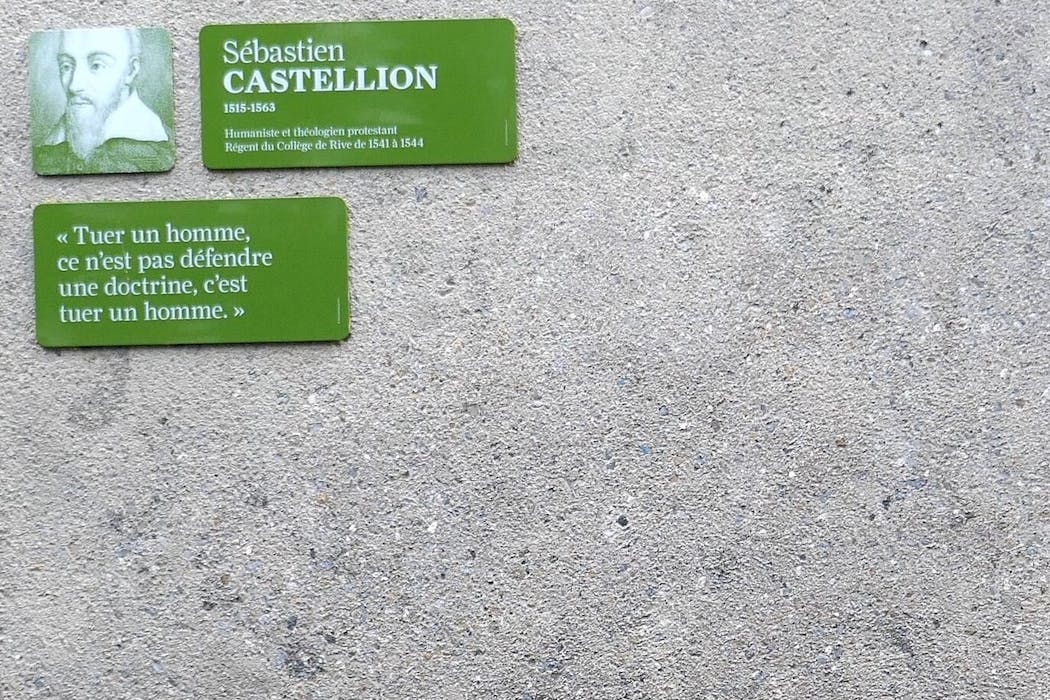
A monument to Sebastian Castellio in Geneva – using a French spelling of his name – reads, ‘Killing a man is not defending a doctrine; it is killing a man.’ MHM55/Wikimedia Commons, CC BY-SA

Ideological division was tearing the country apart. Factions denounced each other as unpatriotic and evil. There were attempted kidnappings and assassinations of political figures. Public monuments and art were desecrated all over the country.

This was France in the middle of the 16th century. The divisions were rooted in religion.

The Protestant minority denounced Catholics as “superstitious idolaters,” while the Catholics condemned Protestants as “seditious heretics.” In 1560, Protestant conspirators attempted to kidnap the young King Francis II, hoping to replace his zealous Catholic regents with ones more sympathetic to the Protestant cause.

Two years later, the country collapsed into civil war. The French Wars of Religion had begun – and would convulse the country for the next 36 years.

I am a historian of the Reformation who writes about the opponents of John Calvin, a leading Protestant theologian who influenced Reformed Christians, Presbyterians, Puritans and other denominations for centuries. One of the most significant of Calvin’s rivals was the humanist Sebastian Castellio, whom he had worked with in Geneva before a bitter falling out over theology.

Soon after the first war in France broke out, Castellio penned a treatise that was far ahead of its time. Rather than join in the bitter denunciations raging between Protestants and Catholics, Castellio condemned intolerance itself.

He identified the main problem as both sides’ efforts to “force consciences” – to compel people to believe things they did not believe. In my view, that advice from nearly five centuries ago has much to say to the world today.

Foreseeing the carnage

Castellio rose to prominence in 1554 when he condemned the execution of Michael Servetus, a medical doctor and theologian convicted of heresy. Servetus had rejected the standard Christian belief in the Trinity, which holds that the Father, Son and Holy Spirit are three persons in one God.

A dark-colored statue of a downcast, seated man, positioned in front of trees and bushes.
A monument to Michael Servetus, who was condemned for heresy and executed, in Geneva.
Iantomferry/Wikimedia Commons, CC BY-SA

Already condemned by the Catholic Inquisition in France, Servetus was passing through Geneva when Calvin urged his arrest and advocated for his execution. Servetus was burned alive at the stake.

Castellio condemned the execution in a remarkable book titled “Concerning Heretics: Whether They are to be Persecuted and How They are to be Treated.” In it, Castellio questioned the very notion of heresy: “After a careful investigation into the meaning of the term heretic, I can discover no more than this, that we regard those as heretics with whom we disagree.”

In the process, he laid the intellectual foundations for religious toleration that would come to dominate Western political philosophy during the Enlightenment.

But it took centuries for religious toleration to take hold.

In the meantime, Europe became embroiled in a series of religious wars. Most were civil wars between Protestants and Catholics, including the French Wars of Religion, a series of conflicts from 1562 to 1598. These included one of the most horrific events of the 16th century: the St. Bartholomew’s Day Massacre of 1572, when thousands of Protestants were slain in a nationwide bloodbath.

Castellio had seen the carnage coming: “So much blood will flow,” he had warned in a treatise 10 years earlier, “that its loss will be irremediable.”

A painting in faded colors shows a plaza in a medieval city, with scenes of people slaughtering each other and throwing bodies in a river.
‘The St. Bartholomew’s Day Massacre,’ by 16th-century artist François Dubois.
Cantonal Museum of Fine Arts/Wikimedia Commons

Remembering the Golden Rule

Castellio’s 1562 book, “Advice to a Desolate France,” was a rarity in the 16th century, for it sought compromise and the middle ground rather than the religious extremes.

With an extraordinarily modern sensibility, he decided to use the terms each side preferred for themselves, rather than the negative epithets used by their opponents.

“I shall call them what they call themselves,” he explained, “in order not to offend them.” Hence, he used “Catholics” rather than “Papists” and “evangelicals” rather than “Huguenots.”

Castellio pulled no punches. To the Catholics, referring to decades of Protestant persecution in France, he said: “Recall how you have treated the evangelicals. You have pursued and imprisoned them … and then you have roasted them alive at a slow fire to prolong their torture. And for what crime? Because they did not believe in the pope, the Mass, and purgatory. … Is that a good and just cause for burning men alive?”

To the Protestants, he complained, “You are forcing them against their consciences to attend your sermons, and what is worse, you are forcing some to take up arms against their own brothers.” He noted that they were using three “remedies” for healing the church, “namely bloodshed, the forcing of consciences, and the condemning and regarding as unfaithful of those who are not entirely in agreement with your doctrine.”

A sepia-colored illustration of a man with a long goatee, wearing a black jacket with buttons.
A portrait of Sebastian Castellio, made by 18th-century printmaker Heinrich Pfenninger.
Sepia Times/Universal Images Group via Getty Images

In short, Castellio accused both sides of ignoring the Golden Rule: “Do not do unto others what you would not want them to do unto you,” he wrote. “This is a rule so true, so just, so natural, and so written by the finger of God in the hearts of all,” he asserted, that none can deny it.

Both sides were trying to promote their vision of true religion, Castellio said, but both were going about it the wrong way. In particular, he warned against trying to justify evil behavior by appealing to its possible effects: “One should not do wrong in order that good may result from it.”

In another essay, he made the same point to argue against torture, writing that “Evil must not be done in order to pursue the good.” Castellio was the anti-Machiavelli; for him, the ends did not justify the means.

Force doesn’t work

Finally, “Advice to a Desolate France” argued that forcing people to your own way of thinking never works: “We manifestly see that those who are forced to accept the Christian religion, whether they are a people or individuals, never make good Christians.”

Americans, I believe, would do well to bear Castellio’s words in mind today. The country’s two dominant political parties have become increasingly polarized. Students are reluctant to speak out on controversial topics for fear of “saying the wrong thing.” Americans increasingly think in binary terms of good and evil, friends and enemies.

In the 16th century, Christians failed to heed Castellio’s advice and continued to kill each other over differences of belief for another hundred years. It would be wise to apply his ideas to today’s bitter divisions.

The Conversation

Michael Bruening does not work for, consult, own shares in or receive funding from any company or organization that would benefit from this article, and has disclosed no relevant affiliations beyond their academic appointment.

ref. Why one theologian’s advice for a bitterly divided nation holds true today – https://theconversation.com/why-one-theologians-advice-for-a-bitterly-divided-nation-holds-true-today-266457
Les professeurs des écoles travaillent plus qu’on le croit : enquête sur les coulisses de l’enseignement

Source: The Conversation – France (in French) – By Léa Chabanel-Kahlik, Docteure en Sciences de l’éducation, spécialiste de l’organisation du travail des enseignant·es du premier degré en France, Université de Lille

Le travail des profs ne s’arrête pas au temps passé en classe face aux élèves. Une recherche menée en école primaire nous permet de mieux comprendre quelles sont ces tâches invisibles, indispensables à la réalisation de leur mission et qui pèsent sur des emplois du temps hebdomadaires de 45 heures à 48 heures.


Le temps de travail des professeurs des écoles en France fait l’objet de nombreuses représentations sociales négatives, quand il n’est pas franchement question de « profbashing ». En tête de ces croyances, se trouve celle qu’il s’agirait d’un métier aux horaires faibles et accommodants, idéal pour qui souhaite concilier vie privée et vie professionnelle (et notamment, donc, pour les femmes).

Cette sous-estimation de leur charge de travail ne manque pas de provoquer une blessure professionnelle profonde chez des profs des écoles en quête de reconnaissance. La recherche, en effet, montre que leur travail, ne se réduisant pas au temps passé face aux élèves, est en réalité complexe et sous-évalué. Elle offre un autre éclairage sur l’activité dite « de préparation », phénomène peu connu, dont on estimait jusqu’à peu qu’il était grosso modo strictement l’affaire de préparations didactiques (c’est-à-dire de préparations de séances de classe, de « leçons ») réalisées en amont de l’enseignement, et de corrections, réalisées en aval.

Plus encore, en dépit de son rôle incontournable pour l’enseignement, l’activité de préparation ne figure pas dans le cadre réglementaire du travail des professeurs des écoles. Elle n’est pas reconnue, ce qui signifie qu’elle n’est ni prescrite officiellement, ni pourvue de conditions de travail, ni rémunérée. D’ailleurs, d’un point de vue strictement juridique, elle ne relèverait pas d’un « travail » à proprement parler (qui s’inscrit nécessairement dans un lien avec le droit), mais bien d’une forme d’activité gratuite.

Mais alors qu’est-ce précisément que l’activité de préparation ? Quel rôle joue-t-elle pour l’enseignement et quelle part du travail total représente-t-elle ?

Des préparations qui ne s’arrêtent pas à la préparation de leçons

D’abord, la recherche montre que les préparations des professeurs des écoles sont aujourd’hui plus complexes qu’elles n’y paraissent, dépassant les seules préparations de « leçons ». Elles comprennent en réalité cinq ensembles, allant des préparations didactiques (D) aux préparations de planification (P), en passant par les préparations administratives (A), les préparations relatives à l’évaluation (E) ou celles relatives à la gestion des élèves (G).

De plus, ces ensembles s’interpellent les uns les autres. Par exemple, les préparations relatives à la gestion des élèves (G) sont étroitement liées à celles relatives à l’évaluation (E), elles-mêmes liées à des préparations didactiques (D) qui sont, elles, adossées à des préparations de planification (P). Les préparations administratives (A), quand bien même elles sont souvent « jugées sans valeur », y compris par le corps enseignant, trouvent en fait d’importantes ramifications avec l’intégralité des autres ensembles de préparations.

Mais cela n’est pas tout. En réalité, un sixième ensemble de préparations rend possibles les cinq premiers. Il s’agit des préparations relatives à l’organisation (O) de l’activité de préparation. En effet, en l’absence de moyens spécifiques, les professeurs des écoles s’organisent et organisent (O) leurs autres préparations (D, P, E, A, G). En clair, ils compensent l’absence de moyens octroyés à la préparation.

Concrètement, sur leur temps libre et « avec leurs propres deniers », ils font divers déplacements, des achats ou encore (ré)aménagent leur espace de travail. Et si certains niveaux (maternelle) ou certains domaines (arts, sciences) sont réputés nécessiter davantage de matériel, un ou une prof des écoles exerçant en CE2, préparant une banale séance de maths, aura aussi le plus souvent à se procurer, par exemple, une plastifieuse et des feuilles de plastification très onéreuses, parfois même, du papier.

Des préparations indispensables à l’accompagnement des élèves

Et même lorsque les préparations didactiques n’ont plus nécessairement à être créées de A à Z, comme lorsque les enseignants sont en charge d’un même niveau pendant plusieurs années consécutives, le temps consacré à la préparation ne s’écroule pas. Loin de là. Sans même parler de ces autres préparations (P, E, A, G, O) qui ne relèvent pas des préparations didactiques (D) et qui, globalement, demeurent en dépit de l’expérience, il apparaît en réalité que les préparations didactiques (D) ont elles aussi quelque chose d’irréductible.

En effet, en l’état actuel de la vision de l’éducation telle qu’elle est donnée par l’éducation nationale et par les instituts universitaires de formation, enseigner à de jeunes élèves et à de très jeunes élèves, non autonomes par définition, ne peut consister à délivrer de manière frontale des cours magistraux. L’enseignement ne suffit pas, il requiert invariablement une préparation de la part du prof des écoles, chargé d’accompagner chaque enfant vers les apprentissages, de plus en plus individuellement d’ailleurs.

Aussi, contrairement aux idées reçues, le ou la prof des écoles ne réutilise pas telles quelles ses préparations d’une année à l’autre. Au minimum, il ou elle aura à réadapter ses préparations didactiques : chaque nouvelle classe se composant en effet de nouveaux élèves qu’il faut de nouveau intéresser, « faire rentrer dans les apprentissages ».

C’est là le propre de la pédagogie du prof des écoles qui se décline simultanément tant pour le groupe que de manière différenciée, ce qui provoque une charge importante de préparations de toutes sortes à réaliser. Le moyen mnémotechnique « PEDAGO » permet d’inventorier et de mémoriser les six ensembles de préparations incontournables à la mise en œuvre de la pédagogie du prof des écoles :

  • P : préparations de planification didactique

  • E : préparations relatives à l’évaluation

  • D : préparations pédagogiques et didactiques

  • A : préparations administratives et de concertation

  • G : préparations relatives à la gestion des élèves

  • O : préparations relatives à l’organisation de l’activité de préparation

Une organisation de travail complexe

Toutes les réévaluations effectuées suggèrent que la durée de l’activité de préparation des professeurs des écoles aurait augmenté, si bien qu’elle serait aujourd’hui proche, voire supérieure, au temps imparti à l’enseignement. Concrètement, au-delà des 44 heures de travail au total par semaine rapportées par une étude, ancienne déjà, leur temps de travail total hebdomadaire aurait atteint entre 45 heures et 48 heures.

Quelques comparaisons permettent d’ailleurs de démontrer que les professeurs des écoles français, au regard d’autres catégories d’actifs français ou européens, n’ont pas à rougir du temps qu’ils passent à travailler. Et la question de la durée des vacances, elle, doit être comprise au prisme de la question des femmes et du cumul d’activités qui leur incombe à leur domicile, pour un métier où plus de 8 professeurs des écoles sur 10 sont des femmes.


À lire aussi :
Salaires des profs : un travail invisible à prendre en compte


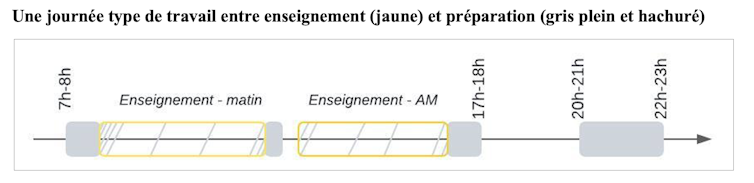
Il faut dire que l’organisation de leur travail est inédite, elle ne ressemble à aucun autre métier. L’activité de préparation se fragmente de tôt le matin jusqu’à tard le soir, au domicile, à l’école ainsi que sur le temps d’enseignement.


Fourni par l’auteur

Le métier de professeur des écoles aujourd’hui est plus complexe qu’il n’y paraît, que ce que notre propre expérience d’écolier nous suggère et que ce que nos seuls yeux nous permettent de voir. Or, le faible intérêt que suscite l’activité de préparation, au regard de la place et du rôle qu’elle prend, questionne. Loin d’un simple « débordement du travail », elle représente une part colossale du travail total, une part non rémunérée et laissée finalement à la discrétion des enseignants.

Il y a trente-sept ans maintenant, dans un article publié dans la Revue française de pédagogie, « Le malaise des enseignants », José M. Esteve et Alice F. B. Fracchia s’exclamaient déjà :

« Peut-on améliorer les résultats de l’enseignement alors que les innovations et les efforts en ce sens doivent toujours se fonder sur le volontariat ? Peut-on demander aux enseignants de puiser éternellement dans leur temps personnel pour y participer ? »

The Conversation

J’ai exercé par le passé le métier de professeur des écoles au sein de l’Education nationale.

ref. Les professeurs des écoles travaillent plus qu’on le croit : enquête sur les coulisses de l’enseignement – https://theconversation.com/les-professeurs-des-ecoles-travaillent-plus-quon-le-croit-enquete-sur-les-coulisses-de-lenseignement-268861

The UK’s latest compromise on workers’ rights will not fix its labour market problems

Source: The Conversation – UK – By Danny Buckley, Workplace Learning Director, Loughborough University

koldo_studio/Shutterstock

The UK’s autumn budget tried to appeal to both workers and employers. But the decision the very next day to soften a key plan to improve workers’ rights shows how difficult that balance has become.

Just hours after Chancellor Rachel Reeves delivered her budget, the government announced it would backtrack on a manifesto pledge to give all workers the right to claim unfair dismissal from day one of their employment.

Business groups had warned that the plan could discourage hiring, particularly for smaller firms that depend on probation periods to assess staff. Critics, of course, call it a broken promise.

Other planned day-one rights – to sick pay and paternity leave – will still go ahead from next year. But the government argued that delaying protection from unfair dismissal until six months after someone starts a new job (it is currently two years) is a practical compromise.

The decision is supposed to be pro-business and pro-hiring. But while workers will now miss out on what would have been a major change to their rights as a new employee, the move is unlikely to be enough to encourage under-pressure firms to take on staff.

The fact is that this debate sits within a wider policy environment where employing people has become harder. Regardless of dismissal rights, rising labour costs, tight margins and increasingly complex rules mean many firms are hesitant to take on staff.

But this is not to say that watering down workers’ protections in a bid to help firms is the way forward. The standard employment relationship is still the main way workers access rights and social protection, so its erosion raises serious concerns for working conditions and basic benefits.

When formal employment offers fewer protections, the gap between secure jobs and insecure arrangement narrows. If the government is suggesting that strengthening workers’ rights is negotiable, then in the eyes of an employer it may seem like less of a leap to opt for informal hiring models that deny workers certain protections.

For example, bogus self-employment (when workers are classified as “self-employed” or “subcontractors” even when their working conditions are effectively the same as regular employees) allows employers to shift legal and financial responsibilities on to workers. Protections like sick pay, redundancy rights and holiday pay disappear. The worker absorbs the risk as the employer cuts their costs.

Wider research on the informal economy shows how quickly these models spread once the rules allow it. In essence, rather than encouraging firms to hire on standard contracts, weaker protections normalise risk-shifting and accelerate the move towards arrangements that sit outside standard employment law.

In sectors such as hair and beauty and construction, workers are often told they are “independent” while being given fixed hours, fixed prices and strict instructions. They look like employees in every meaningful sense, but receive none of the protections.

The unfair dismissal U-turn could legitimise the drift towards these models. And at the same time, issues that the budget did not address – such as the VAT threshold and the rising cost of employment – leave many small business-to-consumer (those that sell their products or services direct to the public) deliberately choosing not to grow.

For example, when firms cross the VAT limit with a turnover of more than £90,000, this increases their costs sharply. As a result, adding even one or two employees to the staff can make the business unprofitable – far more so than the risk of taking on a staff member who might not work out and may have to be let go quickly.

As such, many firms deliberately cap their growth, restructure their operations or rely on “contractors” as the only affordable way to bring in extra capacity.

The cost of complying

I’ve seen this repeatedly in my previous and ongoing research into the impact of regulations on small businesses in the UK service sector. Firms avoid formal employment not because they want to exploit people, but because the cost of compliance has become too high for them to absorb. Bogus self-employment becomes the only viable staffing model if they want to continue trading.

When this practice becomes widespread, responsible employers face a hard choice. Either they adopt the same practices to stay competitive or watch rivals undercut them. This is the classic race to the bottom. Rights fall away, protections shrink and low-quality employment becomes the baseline across the sector.

The government insists that new enforcement measures will prevent abuse but there is little evidence to suggest this will work. Enforcement capacity has been repeatedly cut and agencies such as HMRC, the Employment Agency Standards Inspectorate and the Health and Safety Executive struggle to investigate even straightforward cases. Ambiguous rules are easy to exploit and hard to police.

torso of a bricklayer adding mortar to a wall with a trowel
Weakening plans for workers’ rights could push entire sectors towards informal employment.
Irene Miller/Shutterstock

This is why MPs from across the political divide are calling for a full review of worker status. Closing loopholes is essential as ambiguity only helps those who want to reduce standards. This U-turn goes in the opposite direction.

The UK says it wants to “make work pay”. This requires tackling the VAT threshold and the rising cost of employing people, both of which encourage small firms to avoid growth. Some argue for raising the threshold to give firms more room to expand, while others support reducing the VAT rate for the sectors that are hardest hit.

While the U-turn on unfair dismissal is a blow to workers, at the same time it is insufficient to nudge pressurised firms towards employing formally. And this is important: a labour market built on insecurity is not efficient in the long run. It produces high turnover, low commitment and low productivity. It penalises responsible employers, rewards those that exploit grey areas and leaves workers in precarious positions.

If the UK wants a stable workforce, economic growth and a competitive economy, it needs employment rules that support both workers and the businesses that want to grow. This plan moves the UK further away from that goal.

The Conversation

Danny Buckley does not work for, consult, own shares in or receive funding from any company or organisation that would benefit from this article, and has disclosed no relevant affiliations beyond their academic appointment.

ref. The UK’s latest compromise on workers’ rights will not fix its labour market problems – https://theconversation.com/the-uks-latest-compromise-on-workers-rights-will-not-fix-its-labour-market-problems-271045

Data centres in space: will 2027 really be the year AI goes to orbit?

Source: The Conversation – UK – By Domenico Vicinanza, Associate Professor of Intelligent Systems and Data Science, Anglia Ruskin University

Appsky

Google recently unveiled Project Suncatcher, a research “moonshot” aiming to build a data centre in space. The tech giant plans to use a constellation of solar-powered satellites which would run on its own TPU chips and transmit data to one another via lasers.

Google’s TPU chips (tensor processing units), which are specially designed for machine learning, are already powering Google’s latest AI model, Gemini 3. Project Suncatcher will explore whether they can be adapted to survive radiation and temperature extremes and operate reliably in orbit. It aims to deploy two prototype satellites into low Earth orbit, some 400 miles above the Earth, in early 2027.

Google’s rivals are also exploring space-based computing. Elon Musk has said that SpaceX “will be doing data centres in space”, suggesting that the next generation of Starlink satellites could be scaled up to host such processing. Several smaller firms, including a US startup called Starcloud, have also announced plans to launch satellites equipped with the GPU chips (graphics processing units) that are used in most AI systems.

The logic of data centres in space is that they avoid many of the issues with their Earth-based equivalents, particularly around power and cooling. Space systems have a much lower environmental footprint and it’s potentially easier to make them bigger.

As Google CEO Sundar Pichai has said: “We will send tiny, tiny racks of machines and have them in satellites, test them out, and then start scaling from there … There is no doubt to me that, a decade or so away, we will be viewing it as a more normal way to build data centres.”

Assuming Google does manage to launch a prototype in 2027, will it simply be a high-stakes technical experiment – or the dawning of a new era?

The scale of the challenge

I wrote an article for The Conversation at the start of 2025 laying out the challenges of putting data centres into space, in which I was cautious about them happening soon.

Now, of course, Project Suncatcher represents a concrete programme rather than just an idea. This clarity, with a defined goal, launch date and hardware, marks a significant shift.

The satellites’ orbits will be “sun synchronous”, meaning they’ll always be flying over places at sunset or sunrise so that they can capture sunlight nearly continuously. According to Google, solar arrays in such orbits can generate significantly more energy per panel than typical installations on Earth because they avoid losing sunlight due to clouds and the atmosphere, as well as night times.

Google CEO Sundar Pichai
Hello spaceboy: Google CEO Sundar Pichai.
FotoField

The TPU tests will be fascinating. Whereas hardware designed for space normally requires to be heavily shielded against radiation and extreme temperatures, Google is using the same chips used in its Earth data centres.

The company has already done laboratory tests exposing the chips to radiation from a proton beam that suggest they can tolerate almost three times the dose they’ll receive in space. This is very promising, but maintaining a reliable performance for years, amidst solar storms, debris and temperature swings is a far harder test.

Another challenge lies in thermal management. On Earth, servers are cooled with air or water. In space, there is no air and no straightforward way to dissipate heat. All heat must be removed through radiators, which often become among the largest and heaviest parts of a spacecraft.

Nasa studies show that radiators can account for more than 40% of total power system mass at high power levels. Designing a compact system that can keep dense AI hardware within safe temperatures is one of the most difficult aspects of the Suncatcher concept.

A space-based data centre must also replicate the high bandwidth, low latency network fabric of terrestrial data centres. If Google’s proposed laser communication system (optical networking) is going to work at the multi-terabit capacity required, there are major engineering hurdles involved.

These include maintaining the necessary alignment between fast-moving satellites and coping with orbital drift, where satellites move out of their intended orbit. The satellites will also have to sustain reliable ground links back on Earth and ovecome weather disruptions. If a space data-centre is to be viable for the long term, it will be vital that it avoids early failures.

Maintenance is another unresolved issue. Terrestrial data centres rely on continual hardware servicing and upgrades. In orbit, repairs would require robotic servicing or additional missions, both of which are costly and complex.

Robot with pliers
Won’t come cheap.
BLACKDAY

Then there is the uncertainty around economics. Space-based computing becomes viable only at scale, and only if launch costs fall significantly. Google’s Project Suncatcher paper suggests that launch costs could drop below US$200 (£151) per kilogram by the mid 2030s, seven or eight times cheaper than today. That would put construction costs on par with some equivalent facilities on Earth. But if satellites require early replacement or if radiation shortens their lifespan, the numbers could look quite different.

In short, a two-satellite test mission by 2027 sounds plausible. It could validate whether TPUs survive radiation and thermal stress, whether solar power is stable and whether the laser communication system performs as expected.

However, even a successful demonstration would only be the first step. It would not show that large-scale orbital data centres are feasible. Full-scale systems would require solving all the challenges outlined above. If adoption occurs at all, it is likely to unfold over decades.

For now, space-based computing remains what Google itself calls it, a moonshot: ambitious and technically demanding, but one that could reshape the future of AI infrastructure, not to mention our relationship with the cosmos around us.

The Conversation

Domenico Vicinanza does not work for, consult, own shares in or receive funding from any company or organisation that would benefit from this article, and has disclosed no relevant affiliations beyond their academic appointment.

ref. Data centres in space: will 2027 really be the year AI goes to orbit? – https://theconversation.com/data-centres-in-space-will-2027-really-be-the-year-ai-goes-to-orbit-271018

By hiding their faces, metal bands maximise the emotional punch of their music

Source: The Conversation – UK – By Chris Waugh, Lecturer in Sociology and Criminology, Manchester Metropolitan University

In 2024, along with 20,000 others, I attended a sold-out metal show in Manchester. Unlike most concerts at the Co-op Live Arena, however, none of us in the packed-out venue knew who we were actually seeing. The band was Sleep Token – a masked and anonymous collective formed in London in 2016, now selling out arenas across the UK and the US with their distinctive blend of progressive metal, indie pop and trap.

A few months later, I stood among thousands to watch the Swedish band Ghost, famous for dressing as a satanic clergy led by their masked frontman Papa Emeritus. Their show was an extravagant parody of religion. Theirs was an entirely different performance of concealment from Sleep Token, but one just as emotionally charged.

Then, earlier this year, I found myself in a concert hall on the outskirts of Antwerp, Belgium. In a room filled with billowing smoke and illuminated only by the snap of strobe lighting and a single candelabra, I watched the death-metal outfit Dragged into Sunlight thrash and shriek through their gloriously misanthropic album Hatred for Mankind. Once again, I had absolutely no idea what they looked like.


Read more:
Heavy metal’s bad rep is unfair – it can actually have numerous health benefits for fans


In a cultural moment where visibility in popular music is at its zenith – where all eyes and screens fixate on Taylor Swift’s Eras tour or Oasis’s long-awaited reunion – something interesting is happening in the metal scene. Metal musicians are refusing to reveal their identities, names and faces, or (in the case of Dragged into Sunlight) even acknowledging that they have an audience at all, by playing with their backs to the crowd, and never speaking between songs.

Dragged into Sunlight perform with their backs to the audience.

Rock and metal musicians have concealed their identities before, of course. Kiss and Alice Cooper strut the stage in elaborate makeup. Slipknot and Gwar perform in grotesque masks or full-body costumes. And the use of “corpse paint” (skull-like facial makeup) and occult pseudonyms is par for the course in certain kinds of Black Metal, an extreme offshoot of heavy metal, characterised by shrieked vocals, tremello guitar playing and Satanic imagery.

However, anonymous metal bands such as Ghost, Sleep Token and Dragged into Sunlight draw attention to a paradox – concealment is what gives their performances their emotional power.

Researchers of the “affective turn” in social science argue that emotion isn’t just something we have; it is something that moves between us. Cultural theorist Sara Ahmed describes affect – those intensities that we feel, often before we fully know what we’re feeling – as “what sticks”. Affects are the energy that circulates between people, objects and ideas, binding them together.

As literary critic Raymond Williams has noted, affect often emerges before it’s fully articulated – inarticulate, but powerful. This is precisely what is at play in anonymous metal bands. When performers hide their faces and identities, they strip away one of the most recognisable cues in performance. In that absence, the audience and listeners become part of the emotional work – projecting, imagining and collectively generating meaning.

My research, due for publication next year, draws on ideas from affect theory to explore how hiding a performer’s face or identity creates new ways of generating shared emotion. Anonymous metal bands show how concealment itself can become a tool for feeling.

How bands use their anonymity

In the case of Sleep Token, the effect is a sense of both devotion and intimacy. Sleep Token’s lyrics explore spiritual and religious experiences, desire (both sexual and for connection) and vulnerability. Yet, at the same time, their lyrics are often ambiguous.

The lack of clear meaning, along with a lack of identity among the band members, leaves space for audiences to interpret and process their own emotions – even those that they cannot fully verbalise. Evidence of this is clear in Sleep Token’s active digital fanbases, where frequent posts on a Reddit fan page attest to how the absence of identity becomes a conduit for intimacy.

Sleep Token performing in masks.

In the case of Ghost, concealment lends itself to irony and parody. Ghost presents itself as a kind of Satanic clergy, with their front man, Papa Emeritus, playing the part of a Satanic pope-like figure, flanked by masked musicians, known as the “nameless ghouls”. This rather menacing presence is a means of satire. Ghost mocks the bureaucracy and power dynamics of the Catholic Church, promotes self-discovery, consent and mutual pleasure, and keeps its tongue firmly planted in its cheek. Ghost’s anonymity, then, takes the austere and the totalitarian, turns it on its head, and creates a space for fun, transgression and communal ritual.

If Sleep Token’s anonymity invites connection and Ghost’s invites laughter and collective joy, then Dragged into Sunlight weaponises their lack of identity.

Unlike the other bands, Dragged into Sunlight doesn’t wear masks, but instead performs with their backs to the audience, in poorly lit stages filled with billowing smoke. Their music, which blends black metal, death metal and grindcore, is blistering, chaotic and misanthropic.

By refusing to acknowledge the crowd and refusing to adopt clear identities, Dragged into Sunlight’s music – which focuses on mass killing, cruelty and social disarray – pummels the audience with pure affect. It consists of overwhelming volume, deafening distortion and indecipherable screaming fury, underpinned by a rigorous contempt for the subject matter of their lyrics. There is emotion here, but it is stripped of empathy, a kind of anti-performance that paradoxically heightens the experience.

Across these examples, concealment produces different emotional registers – intimacy, joy, rage – but in each case, it’s what makes feeling possible. These bands remind us that emotion doesn’t always depend on recognition. Sometimes it’s the very act of not knowing that allows us to feel more deeply. The face, once the centre of performance, gives way to atmosphere, sound and sensation.

Perhaps that is why audiences respond so strongly to these bands. In a world obsessed with being seen, they offer the relief of not being known – the freedom to lose yourself in something larger.


Looking for something good? Cut through the noise with a carefully curated selection of the latest releases, live events and exhibitions, straight to your inbox every fortnight, on Fridays. Sign up here.


The Conversation

Chris Waugh does not work for, consult, own shares in or receive funding from any company or organisation that would benefit from this article, and has disclosed no relevant affiliations beyond their academic appointment.

ref. By hiding their faces, metal bands maximise the emotional punch of their music – https://theconversation.com/by-hiding-their-faces-metal-bands-maximise-the-emotional-punch-of-their-music-267934

Visual thinking: the strategy that could help you spot misinformation and manipulated images

Source: The Conversation – UK – By Shaun Nolan, Associate professor in English and sociolinguistics, Malmö University

DC Studio/Shutterstock

A fake photo of an explosion near the Pentagon once rattled the stock market. A tearful video of a frightened young “Ukrainian conscript” went viral: until exposed as staged. We may be approaching a “synthetic media tipping point”, where AI-generated images and videos are becoming so realistic that traditional markers of authenticity, such as visual flaws, are rapidly disappearing.

In 2025, 70% of people struggle to trust online information, and 64% fear AI-generated content could influence elections. We are entering an era where seeing is no longer believing.

In such a world, learning to critically decode media is key to safeguarding truth, trust and democracy. “Visual thinking strategies”, a discussion technique originally developed for art education, offers a simple but powerful framework for navigating today’s complex media landscape.

It is based on three open-ended questions around a piece of visual media (like a painting, photograph or video):

  1. ehat’s going on in this picture?

  2. What do you see that makes you say that?

  3. What more can we find?

These questions prompt people to slow down, observe carefully and justify their interpretations with evidence. The approach is not only about looking, it’s about thinking together.

It usually happens in a group, guided by a facilitator – often a teacher – who paraphrases and connects participants’ ideas. Participants share and listen to individual observations, build on each other’s contributions, challenge assumptions and refine their thinking. This process surfaces biases, mitigates groupthink and promotes critical engagement.


Read more:
What is AI slop? Why you are seeing more fake photos and videos in your social media feeds


Imagine you are shown a picture of a protest and asked “What is going on in this picture?” You say, “It looks like a climate march.” When asked, “what is it that you see makes you say that it is a climate march?”, you point to the signs. Others notice the police presence, the age of the crowd, the place where it’s happening or the lighting.

As the discussion unfolds, the group begins to see the image from multiple angles. This approach is exactly what’s needed in a world of manipulated images and political polarisation.

This strategy doesn’t guarantee “truth.” It cultivates habits of mind that resist manipulation: curiosity, evidence-based reasoning and tolerance for ambiguity. Even if someone responds in bad faith, its structure – especially the second question, which is intended to trigger critical analysis – requires them to explain their reasoning. This opens space for others to question, clarify and reframe.

Early classroom observations in the 1990s revealed that children carried these reasoning habits beyond the art class, asking, “what’s going on in this text?” or “in this maths problem?” Learners internalise this protocol and apply it intuitively to other activities in their everyday lives.

Why this approach matters now

The visual thinking strategies approach has positive implications not just for media literacy, but for fostering dialogue in divided societies and improving decision-making at a policy level.

Polarisation thrives on certainty and echo chambers. This strategy creates space for multiple interpretations and respectful disagreement, modelling the kind of dialogue democratic societies need. Participants consider alternative viewpoints and revise their thinking as new observations emerge. By showing how to disagree constructively, this technique can help rebuild trust in public discourse.

Amid mass migration, climate crises, cultural conflict and growing inequality, empathy is not just a moral virtue: it’s a strategic asset for education and social cohesion. Stepping into others’ perspectives through interpreting images that reflect diverse experiences and worldviews can help people navigate this, engaging with the emotions and contexts behind the images.

Leaders and policymakers increasingly rely on visual data such as maps, infographics and dashboards. Organisations like the OECD, World Bank and UN acknowledge this trend. Yet visual literacy is rarely taught in business or political science education, despite the growing use of visual materials in courses.

The benefits extend to fields where visual data drives critical action: humanitarian organisations using satellite imagery to track displacement, or climate scientists analysing environmental impact models. It can be used to train teams to notice patterns, question assumptions and surface alternative perspectives, supporting more informed, equitable outcomes.

As AI, climate change and economic disruption reshape our societies, we need tools that help us think clearly, communicate effectively and collaborate across divides. This is one such tool that requires no expensive technology or background in art; only a willingness to look, listen, and learn. In doing so, it cultivates the capacities – curiosity, humility and critical thinking – that our world urgently needs.

Try it yourself

Take a moment to look at the above picture. Then, alone or with a group, ask:

  1. What’s going on in this picture? What’s your first impression? Is this a protest? A moment of mourning? A celebration?

  2. What do you see that makes you say that? Look closely. Are you focusing on the clothing? The facial expressions or the way the people are standing? Do you recognise the language on the signs?

  3. What more can we find? What’s happening in the background? Who is included – and who might be missing? Are there many people? What assumptions are you making about the people or the event? Why?

This image shows indigenous activists and students who forced their way into the COP30 venue in Belém, Brazil, on November 11, 2025. They clashed with security personnel at the entrance while demanding stronger climate action and better protection of indigenous lands. The questions above – and others you might ask – will help you understand what’s depicted, and deepen your thinking about this image.

Visual thinking strategies aren’t about finding the “correct” answer. It’s about slowing down, noticing more and explaining your reasoning. Try doing this exercise with a group – others may notice what you missed, challenge your interpretation or build on it. Together, you all begin to see more clearly.

The Conversation

Shaun Nolan does not work for, consult, own shares in or receive funding from any company or organisation that would benefit from this article, and has disclosed no relevant affiliations beyond their academic appointment.

ref. Visual thinking: the strategy that could help you spot misinformation and manipulated images – https://theconversation.com/visual-thinking-the-strategy-that-could-help-you-spot-misinformation-and-manipulated-images-269128

How mouth health affects diabetes – and vice versa

Source: The Conversation – UK – By Aylin Baysan, Professor of Cariology in relation to Minimally Invasive Dentistry, Queen Mary University of London

Media_Photos/Shutterstock

Imagine trying to enjoy your favourite meal but finding that your gums hurt, your mouth feels dry and chewing has become uncomfortable. For people living with diabetes, this can be a daily reality that often goes unrecognised.

Diabetes care routinely focuses on the heart, feet, eyes, liver and kidneys. The mouth, however, is frequently overlooked, even though oral health both affects and is affected by diabetes in important ways.

One in nine adults worldwide has diabetes, and more than four in ten do not know they have the condition. By 2050, global projections indicate that one in eight adults, around 853 million people, will be affected, an increase of 46%.

Understanding the two-way connection between diabetes and oral health is therefore essential. It is not about achieving a Hollywood smile. Keeping diabetes under control supports good general and oral health in turn helps improve overall wellbeing.

Diabetes influences how the body processes sugar. When blood sugar levels remain high for long periods, they damage blood vessels and nerves, slow healing and weaken the body’s ability to fight infection. The mouth having soft and hard tissues and naturally diverse community of bacteria, becomes particularly vulnerable.


Read more:
One million people in England may have undiagnosed type 2 diabetes – what you need to know


Oral health complications linked to diabetes include dry mouth caused by reduced saliva, high risk of tooth decay, gum disease involving inflammation and bone loss around the teeth, oral infections such as thrush, mouth ulcers, difficulty wearing dentures, changes in taste and ultimately tooth loss. These problems can affect nutrition, confidence and even blood sugar control.

My latest study showed a clear association between type 2 diabetes and severe dental decay. High blood sugar, combined with changes in saliva quantity and quality, may contribute to this progression. Many people are unaware of this link, which creates a vicious cycle. However, dry mouth and the dental decay that follows can often be prevented if awareness is increased among the public and healthcare professionals.

Gum disease and diabetes

People with diabetes are more likely to experience gum disease, and the relationship works both ways. Diabetes increases the risk of gum disease because high blood sugar leads to more sugar in saliva. Bacteria in the mouth feed on sugar and produce acids that irritate and damage the gums. Once the gums become infected, the supporting bone around the teeth can shrink. As bone is lost, teeth may become loose or fall out. Keeping blood sugar within a healthy range and maintaining good oral hygiene significantly lowers this risk.

Dry mouth and tooth decay

Dry mouth is another common issue for people with diabetes. Around 20% of the general population experiences dry mouth, with higher numbers seen in women and older adults. Certain medications used for treating blood pressure, depression or nerve pain can make dryness worse.

Saliva is the mouth’s natural protection. It washes away food particles, neutralises acids and helps prevent infection. Without enough saliva, the mouth becomes more acidic and teeth lose minerals, which increases the risk of decay. Dentists can offer personalised prevention plans for people at higher risk. These may include fluoride varnishes, specialist mouthwashes or high-fluoride toothpaste.

Saliva also plays a vital role for denture wearers. It cushions the gums, stabilises dentures and reduces irritation. When the mouth is dry, dentures can rub and cause discomfort, ulcers and infections such as oral thrush. Good denture care can greatly improve comfort, eating and overall health, including cleaning dentures daily, removing them at night, brushing the gums and tongue, using suitable cleaning solutions rather than hot water and attending regular dental check-ups to ensure a proper fit.

Dental implants are another option for replacing missing teeth, but diabetes must be well controlled before they are considered because high blood sugar slows healing, increases infection risk and makes it harder for the bone to fuse properly with the implant. Healthy gums, stable bone levels and good oral hygiene are essential for implant success. Dentists need to assess each person’s situation to determine whether implants are appropriate.

Good mouth care can make eating easier, support blood sugar control and improve quality of life. Staying informed, building healthy daily habits and attending regular dental check-ups all help manage the oral health complications linked to diabetes.

The Conversation

Aylin Baysan is the third inventor of an ozone delivery system for the management of root caries. She is co-recipient of a Life Science Initiative Award of £50,000 to work on a novel bioactive membrane for the regeneration of dental hard tissues.

ref. How mouth health affects diabetes – and vice versa – https://theconversation.com/how-mouth-health-affects-diabetes-and-vice-versa-270182

What we told UK leaders about climate and nature at a national emergency briefing

Source: The Conversation – UK – By Paul Behrens, British Academy Global Professor, Future of Food, Oxford Martin School, University of Oxford

I joined eight other experts to deliver a national emergency briefing in late November on the climate and nature to around 1,200 of the UK’s leaders — across politics, business, faith and culture — in Central Hall Westminster.

Much like the televised national briefings delivered during COVID, the aim was to deliver sober, science-based overviews of the various climate and nature crises that the UK faces. Chaired by the academic and author Mike Berners-Lee, the aim was to set off a tipping point of engagement among politicians, faith leaders, CEOs, sport and cultural figures. TV presenter and naturalist Chris Packham opened the event.

The alignment among the scientists speaking was clear. Several of us had never met before, yet our research all linked to tell a story of unprecedented threat and opportunity.

Nathalie Seddon, a professor of biodiversity at the University of Oxford, laid bare the nature crisis. Nature, she emphasised, is not a luxury. It is critical infrastructure, and the state of depleted nature across the country is a national security issue.

Kevin Anderson, a professor in energy and climate change at the University of Manchester, presented the clear carbon arithmetic of how quickly we need to cut emissions. He pointed out what our political discourse studiously avoids: “It is now too late for non-radical futures.”

Hayley Fowler, spoke about how Valencia-style flooding is perfectly possible in the UK. Tim Lenton, a professor of Earth system science at the University of Exeter, spoke about how climate-driven changes in ocean currents may impact the UK.

I spoke about food security and the great food transformation that’s needed, including dietary change, waste reductions, production improvements and increased resilience. I explained how more plants in our diets are necessary to reduce climate and nature impacts, improve our health, increase food resilience and reduce reliance on imports.

Hugh Montgomery, chair of intensive care medicine at UCL, said: “You don’t respond to an emergency with talk and homeopathy. You respond with genuine action. … Climate change is the greatest threat to human health in the 21st century.”

Lieutenant General Richard Nugee, a retired senior British Army officer, spoke on national security implications and how the energy transition means greater stability and security for the UK, as the country would be less vulnerable to petrostates and the inherent volatility of fossil fuels.

Angela Francis, director of policy solutions at the environmental charity World Wide Fund for Nature, spoke about how innovation is the key to productivity and healthy economies. She highlighted how faster energy transitions are cheaper, and the cost of the UK energy transition is now 73% cheaper than what was thought five years ago. Had we made the transition already, recent inflation would have been 7% lower.

Tessa Khan is an environmental lawyer and the co-founder of the Climate Litigation Network: a global coalition of organisations using litigation to compel governments to ramp up their climate mitigation ambition. She described how the price of renewables has dramatically reduced, their efficiency has soared, and how investment in renewables pays dividends.

The science was news to many

The message was consistent: these are not distant projections but rapidly accelerating realities that will profoundly affect every aspect of British life.

There was anger too. Frustration at vested interests blocking action, and at the inequality of climate impacts. The UN’s annual climate summit, Cop30, had just concluded in Belém, Brazil, attended by a record 1,600 fossil fuel lobbyists.

The words “fossil fuel” were removed from the final Cop30 text. Our current collective response could not be more inadequate.

Some people I spoke to suggested that the panel at this event was preaching to the choir. It’s important to remember that MPs radically underestimate the urgency of the situation. Fewer than 15% of the 100 MPs surveyed in one study knew that global emissions needed to peak by 2025 to have any chance of limiting warming to 1.5°C.

The science was news to many present. The planet is heading into dangerous overshoot above 1.5°C within the next few years. As Anderson pointed out: for the UK to meet its fair share obligations in emissions reductions without relying on highly speculative and costly carbon dioxide removal, we would need to see roughly 13% year-on-year reductions for just 2°C – let alone 1.5°C.


Read more:
We surveyed British MPs – most don’t know how urgent climate action is


There was a catharsis during the briefing. Knowing that people with the power to act were finally hearing the full picture: the health effects, the extreme weather, the collapsing nature, the food insecurity, the economic and geopolitical risks. As Rabbi Jonathan Wittenberg, senior rabbi of Masorti Judaism (a traditional movement for modern Jews), wrote afterwards in the Observer: “Those facts were hard to hear, but I also felt thank goodness, we’re being told it as it is.”

A just, equitable transition to a clean economy would improve countless aspects of our lives, from creating jobs and improving health to strengthening communities and increasing resilience. We will look back on this moment bewildered that we did not act sooner, if we are able to act in time.

This is why we are calling for a televised national emergency briefing, so that what happened in Central Hall Westminster can reach the public. Anyone can sign this open letter, calling on the prime minister, Keir Starmer, and the heads of the BBC, ITV, Channel 4, Channel 5, S4C and the media regulator Ofcom, for urgent, honest communication about the scale of the crisis and the solutions available.


Don’t have time to read about climate change as much as you’d like?

Get a weekly roundup in your inbox instead. Every Wednesday, The Conversation’s environment editor writes Imagine, a short email that goes a little deeper into just one climate issue. Join the 47,000+ readers who’ve subscribed so far.


The Conversation

Paul Behrens receives funding from the British Academy and is a REAPRA senior fellow.

ref. What we told UK leaders about climate and nature at a national emergency briefing – https://theconversation.com/what-we-told-uk-leaders-about-climate-and-nature-at-a-national-emergency-briefing-270992

La longue histoire du despotisme impérial de la Russie

Source: The Conversation – in French – By Sabine Dullin, Professeur en histoire contemporaine de la Russie et de l’Union soviétique, Sciences Po

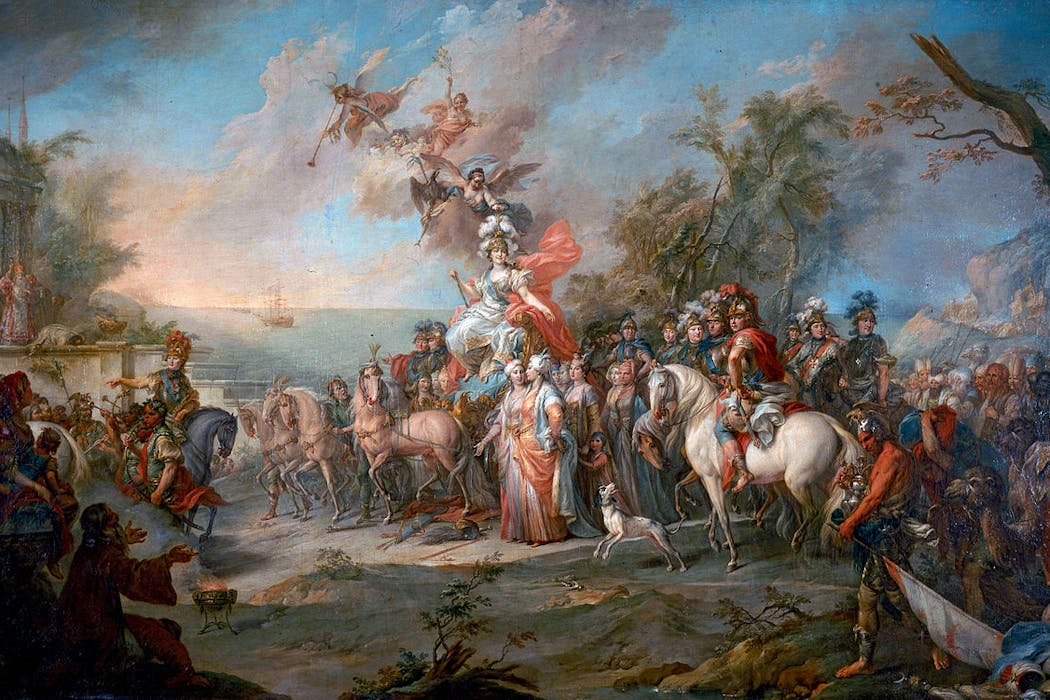
Allégorie de la victoire de Catherine la Grande sur les Turcs et les Tatars par le peintre italien Stefano Torelli, 1772. Ce tableau est exposé à la Galerie Tretiakov à Moscou. Wikimédia Commons

Dans son nouvel essai « Réflexions sur le despotisme impérial de la Russie » qui vient de paraître aux éditions Payot, Sabine Dullin, professeure en histoire contemporaine de la Russie et de l’Union soviétique à Sciences Po, examine la formation et la persistance à travers le temps de l’identité impériale russe. Avec la précision de l’historienne, elle montre comment ce modèle s’est établi puis s’est construit dans la longue durée, a évolué selon les périodes et les natures des régimes, et continue à ce jour de peser lourdement sur la politique de la Russie contemporaine. Nous publions ici des extraits de l’introduction, où apparaît cette notion de « despotisme impérial » qui donne son titre à l’ouvrage et qui offre un angle d’analyse inédit des cinq derniers siècles de l’histoire du pays.


Un despote et une vision impériale : telle est la prison dans laquelle l’identité russe est enfermée depuis des siècles. Au pouvoir depuis vingt-cinq ans et artisan de la guerre en Ukraine, Poutine en donne hélas une confirmation éclatante.[…]

Les représentations extérieures de la Russie comme despotique et impériale ont repris de l’importance dans le débat public à la suite de l’invasion de l’Ukraine. Elles relient despotisme interne et guerre extérieure en redessinant la frontière orientale de l’Europe comme nouvelle barrière de civilisation.

L’acronyme « Rashistes », de la contraction entre « Russia » et « fascistes », né sous la plume d’un journaliste ukrainien au moment de la guerre en Géorgie en 2008, a été repris à partir de 2014 quand Poutine lança, à la suite de l’annexion de la Crimée, sa guerre non déclarée au Donbass. Son usage devint viral après l’invasion de l’Ukraine fin février 2022 et quand le président Volodymyr Zelensky l’utilisa en avril pour exprimer le retour de la barbarie fasciste en Europe, près de quatre-vingts ans plus tard.

Mais au moment des massacres de civils à Boutcha, en Ukraine, la présence dans l’armée russe d’unités non russes de Sibérie, d’ethnicité turcique ou mongole (Bouriates, Touva, Sakha), provoqua aussi dans les médias européens la réapparition d’une autre image de la Russie, plus asiatique qu’européenne.

Si l’envoi prioritaire au front des non-Russes pauvres de Sibérie ressemblait fort à de la discrimination raciste en Fédération de Russie, le descriptif d’une civilisation européenne blanche attaquée en Ukraine par les hordes barbares en provenance de Russie relevait quant à lui d’une longue histoire des stéréotypes occidentaux du despotisme oriental. Le despotisme avait notamment servi à décrire la Russie du tsar Nicolas Ier au milieu du XIXe siècle.

Dans sa comparaison entre les États-Unis et la Russie, Alexis de Tocqueville faisait alors de la servitude et de la conquête militaire les clés du gouvernement et du dynamisme des Russes. Pour lui, le peuple russe concentrait dans un seul homme toute la puissance de la société. Karl Marx, qui prit fait et cause pour les insurgés polonais en 1830 comme en 1863, dénonçait le danger que faisait peser la « sombre puissance asiatique sur l’Europe », dont l’art de la servitude, qu’il jugeait hérité des Mongols, servait une conquête sans fin.

Ainsi, soit le despotisme russe entrait dans une typologie des régimes politiques allant de la liberté et de la démocratie jusqu’à la tyrannie et l’absolutisme, soit il était essentialisé sous les traits d’un régime oriental et non européen. La grille de lecture orientaliste d’une Russie irréductiblement différente de l’Europe servit à nouveau, dans le contexte de la guerre froide, pour combattre l’adversaire communiste, son tout-État sans propriété privée et son expansionnisme rouge.

Le despotisme est une notion négative que les dirigeants russes eux-mêmes n’assumeraient pas. Elle est le plus souvent utilisée par les détracteurs du pouvoir russe. Pour vanter les mérites de leur système en regard de la démocratie occidentale, les gouvernants de la Russie ont préféré et préfèrent d’autres termes, comme absolutisme et autocratie à l’époque des tsars, dictature du prolétariat et démocratie populaire après la révolution russe, dictature de la loi ou verticale du pouvoir dans la Russie de Poutine.

Chaque terme peut se comprendre en miroir du système politique européen de l’époque. Ainsi, l’autocratie répond à la monarchie constitutionnelle, la dictature du prolétariat s’oppose à la démocratie formelle bourgeoise, la dictature de la loi remplace l’État de droit. Ce livre voudrait tester la notion de despotisme impérial, montrer à quel point les représentations du despotisme et de l’Empire se nourrirent l’une l’autre dans l’histoire russe.

Le concept est évidemment contestable et sera contesté. Mais dans son flou sémantique, il a la vertu heuristique d’étudier des usages et des récurrences. Depuis la Moscovie du XVIe siècle, il s’agira donc de comprendre comment despotisme et Empire ont pu former dans leur association un nœud coulant enserrant l’identité russe et bloquant son épanouissement, aussi bien comme nation que comme démocratie.

Dans les scénarios du pouvoir en Russie, on constate la personnalisation du pouvoir, sa dimension religieuse ou sacrée, la faiblesse des contre-pouvoirs, le service du souverain comme source principale de richesse. L’Empire, comme idée et comme pratique, relève pour l’État russe de l’ordre naturel des choses. En son sein s’est forgée une identité russe impériale englobante (rossiïski), différente de l’ethnicité russe (russki). L’Empire fut cependant l’objet de la critique acerbe des marxistes qui prirent le pouvoir en 1917. Mais l’immensité et la multinationalité, qui en étaient les traits positifs, et la Puissance qui en découlait furent – y compris en Union soviétique – valorisées, au contraire de l’impérialisme dont il fallait se dissocier.

Ni le despotisme ni l’Empire ne disparurent, malgré des idéologies contraires et les récits radicalement nouveaux d’après 1917. La figure du despote a pu prendre les traits d’un tyran sanguinaire ou d’un despote éclairé, il a pu se présenter comme le garant de l’ordre établi ou, au contraire, comme un modernisateur. Le régime despotique a été le pouvoir sans limites du tsar ou de Staline, mais aussi celui d’une bureaucratie civile et militaire pesant de tout son poids sur les multiples communautés et peuples composant l’Empire. Le despotisme impérial a provoqué violence, asservissement, mais aussi consensus et collaboration.

Ce passage est issu de Réflexions sur le despotisme impérial de la Russie, de Sabine Dullin, qui vient de paraître aux éditions Payot.

La notion de despotisme impérial offre également la possibilité de penser le pouvoir absolu et impérial en Russie en comparaison avec d’autres : l’Empire ottoman, la Chine, mais aussi les monarchies absolues, les Empires et les impérialismes occidentaux. Dans l’histoire russe, beaucoup de notions utilisées ne sont pas transposables ailleurs. Le dilemme du pouvoir russe est ainsi très souvent posé en termes d’occidentalisme (imitation de l’Occident) ou de slavophilie (recherche d’une voie spécifique). L’autocratie, lorsqu’elle conquiert des territoires, serait moins impérialiste que panslave (quand il s’agit de conquérir à l’ouest) ou eurasiste (quand il s’agit de coloniser vers l’est et le sud).

La notion de totalitarisme entendait insister sur la nouveauté des régimes communiste et fasciste issus de la Première Guerre mondiale et des révolutions qui ont suivi. « Despotisme impérial » évite de brouiller les systèmes de reconnaissance du régime politique par des caractérisations trop spécifiques dans le temps et l’espace. Utiliser la notion de despotisme impérial pour comprendre la Russie d’aujourd’hui a une valeur d’analyse critique, mais aussi de prospective. En soulignant les récurrences autocratiques de l’État russe et les ressorts d’une identité russe adossée à l’Empire, on est amené à se demander comment sortir de cette apparente fatalité du despotisme impérial en Russie.

Il ne faudrait pas se leurrer. Le jeu de miroirs est multidirectionnel. Pour critiquer la monarchie absolue française, Montesquieu analysait les régimes lointains de despotisme oriental. L’analyse du despotisme impérial de la Russie peut relever d’un exercice similaire de fausse altérité et de vigilance, comme un miroir tendu à l’Europe, lui renvoyant ce qu’elle fut : coloniale, impérialiste et fasciste, et ce qu’elle pourrait bien redevenir : antidémocratique.


Copyright : éditions Payot & Rivages, Paris, 2025.

The Conversation

Sabine Dullin ne travaille pas, ne conseille pas, ne possède pas de parts, ne reçoit pas de fonds d’une organisation qui pourrait tirer profit de cet article, et n’a déclaré aucune autre affiliation que son organisme de recherche.

ref. La longue histoire du despotisme impérial de la Russie – https://theconversation.com/la-longue-histoire-du-despotisme-imperial-de-la-russie-270533

Mettre du pain sur la table : au Moyen Âge, un enjeu politique

Source: The Conversation – France in French (3) – By Coline Arnaud, Chercheuse au Laboratoire centre d’histoire culturelle des sociétés contemporaines (CHCSC), Université de Versailles Saint-Quentin-en-Yvelines (UVSQ) – Université Paris-Saclay

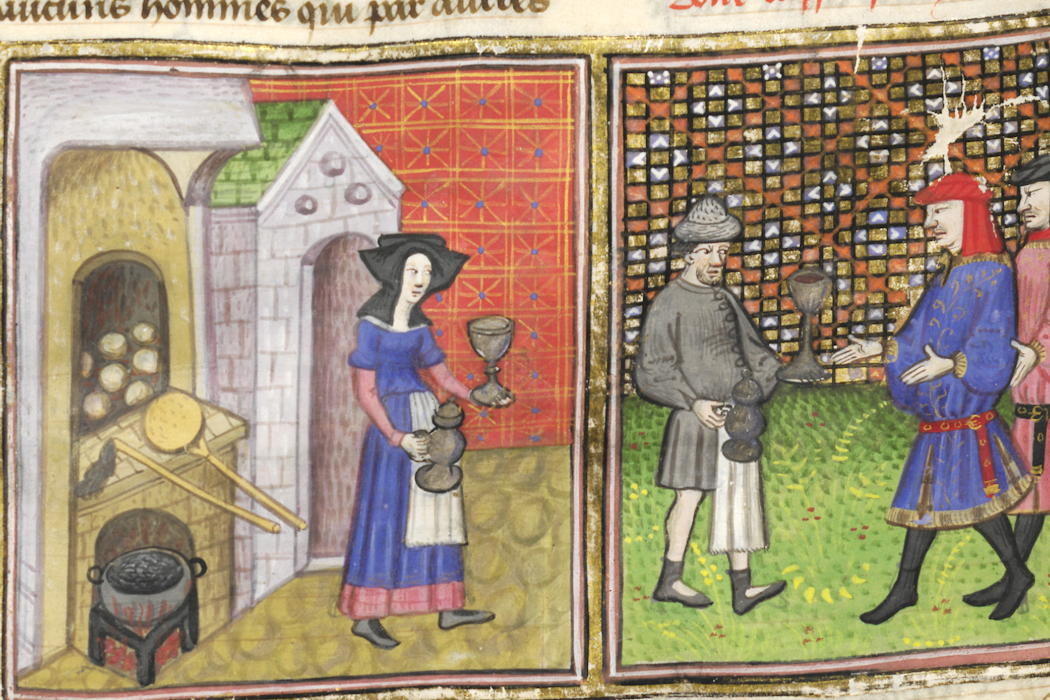
Illustration du Décaméron, de Boccace – Sixième journée; une femme travaille chez le boulanger Cisti, qui offre son vin à Geri Spina. Bibliothèque nationale d’Autriche, via Wikimedia commons, CC BY-SA

Si sa consommation baisse en France, le pain reste un aliment de base et son approvisionnement, les évolutions de son prix font l’objet d’une grande attention politique. Cette place centrale trouve sa source dans l’histoire. Pour bien la comprendre, il est important de revenir sur son rôle dans les sociétés du Moyen Âge.


« Est-ce la fin de la baguette ? » Le constat du média CNN, reposant sur une enquête récente de la Fédération des entreprises de boulangerie française, est sans appel : la consommation de pain a baissé dans l’Hexagone de plus de 50 % depuis la fin de la Seconde Guerre mondiale.

Pourtant, son approvisionnement continue de faire l’objet d’une attention constante de la part des États, notamment dans un contexte d’accroissement des conflits armés et de crises sanitaires. Pour mieux comprendre la valeur sociale, politique et symbolique de cet aliment dans nos sociétés contemporaines, il est nécessaire d’interroger son rôle au fil des époques, en revenant notamment sur le sens de cet aliment au Moyen Âge.

Si le pain est considéré par la recherche contemporaine comme un ingrédient majeur de la survie de l’humanité, c’est parce que son usage simultané dans plusieurs sociétés, par ailleurs éloignées sur les plans géographique et culturel, constitue une forme essentielle de diversification alimentaire (au-delà des protéines et des végétaux). Les débuts du pain évoluent au gré des découvertes archéologiques, mais les premières galettes de riz, bulbe de jonc, maïs ou encore blé sont identifiées dès la fin du Paléolithique. Ce rôle central se perpétue au fil des siècles, dans l’Antiquité et jusqu’au Moyen Âge.

En Europe, le XIVe siècle marque progressivement l’instauration de sociétés de cour à la relative pérennité dont le schéma féodal, séparant le peuple, le clergé et la noblesse, s’organise autour du pain. Faisant parfois curieusement écho à l’organisation politique de notre monde actuel, la société médiévale se divise ainsi entre ceux qui reçoivent, ceux qui produisent, ceux qui donnent, dans un jeu de distinctions et de pouvoirs qui n’exclut ni la nuance ni l’ambiguïté.

Le pain et la couronne : un fragile équilibre

Les têtes couronnées de la fin du Moyen Âge le savent à leurs dépens, le pain est l’ingrédient premier d’une société apaisée. La célèbre maxime romaine « Panem et circences » (« Du pain et des Jeux ») synthétise à elle seule le contrat tacite qui lie le dirigeant à ses administrés. Le premier protège, le second travaille.

La paix sociale s’achète ainsi par un approvisionnement régulier et suffisant en pain. Ce dernier représente de très loin l’aliment le plus consommé par tous et, par conséquent, la part la plus importante du budget alimentaire des familles. C’est pourquoi, le roi cherche dès le XIIIe siècle à contrôler l’influente corporation des talemeliers (ancien nom des boulangers) par un encadrement de ses statuts qui régule également les conditions d’exercices et de production du pain.

L’équation est complexe et l’équilibre délicat pour parvenir à une denrée à la composition fiable, au poids raisonnable et au prix juste. La police du pain mise en place par Charles V en 1372 applique des taxes fluctuantes sur les matières premières, le produit fini, les ventes et se montre sans pitié sur les fraudes.

La profession est assujettie à des taxes d’installation, à des contrôles réguliers et à un encadrement permanent de la valeur marchande du pain. Par décret, seuls trois types de pains peuvent être fabriqués : le pain mollet (à la fine fleur de froment), le pain cléret (composé de farines de blé et de seigle) ou bourgeois, et le pain brun ou de « retraites » (uniquement constitué de farine complète, dense et roborative).

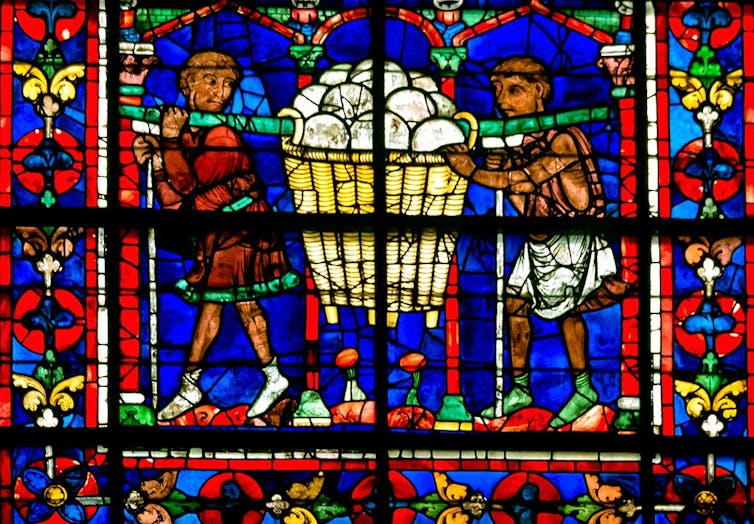
Vitrail représentant des boulangers
Vitrail représentant des boulangers, cathédrale de Chartres (Eure-et-Loir).
Rolf Kranz/Wikimédia, CC BY-SA

Néanmoins, ces restrictions sont rapidement contournées par les boulangers qui répondent à la demande de l’aristocratie pour un pain socialement différencié, qui lui permet, notamment de se distinguer de la bourgeoisie des villes, elle-même avide des mêmes privilèges que la noblesse.

C’est ainsi que des pains de fantaisie apparaissent, vendus en marge des recettes autorisées. Ces derniers s’appuient sur l’échelle de valeurs chromatiques qui régit alors l’appréciation de cet aliment en établissant une hiérarchie des consommateurs.

Les pauvres doivent ainsi se satisfaire d’un pain noir de son ou de sarrasin, à la mie épaisse et à la croûte dure, quand les plus riches se régalent de pains de Gonesse, fabriqués à partir d’une fine fleur de froment, au blutage serré. Littérature, iconographie et chansons participent à la promotion de ce système pyramidal qui valorise le gosier délicat d’un nanti par rapport aux rudes besoins des paysans.

« Charité bien ordonnée… » : collecter et distribuer le pain

Rappelons d’abord que les relations entre l’Église et le pain sont nombreuses, ne serait-ce que parce que la symbolique chrétienne s’appuie en grande partie sur la métaphore du pain comme signe de vie et d’espoir. La mise en place du sacrement de l’Eucharistie, au XIIIe siècle, confirme cette importance.

L’institution ecclésiastique incarne une forme de passerelle entre la couronne et le reste de la population à travers, par exemple, l’exercice de la charité. Les distributions de pains font en effet partie intégrante du quotidien des monastères. Ceux-ci centralisent les dons des nobles et des riches communautés marchandes qui assurent ainsi leurs saluts par leur générosité.

Les communautés religieuses entreposent ces dons alimentaires puis organisent les collectes en effectuant un tri dans les bénéficiaires. Les femmes, les enfants et les malades sont prioritaires au détriment de tous ceux qui ne contribuent pas à la vie économique et spirituelle de la communauté.

Cette charité du pain rythme ainsi les calendriers juif et chrétiens et constitue un ensemble de rituels importants qui participe à la relation de dépendance entre pauvres et riches, entre survie, devoir moral et achat d’une probité.

Le pain des pauvres

L’iconographie médiévale, de la tapisserie aux enluminures, offre un aperçu informé de la place de chacun au cœur du système féodal. Les populations rurales constituent la cheville ouvrière du pain à travers semences et moissons. Le travail des champs se conçoit autour de la vie de la cité, cette dernière garantissant le stockage et la protection du grain dans des granges dîmières, propriétés de la commune, gardées par des soldats qui contrôlent chaque sac entrant et sortant. Ces espaces sont de véritables ruches où se croisent paysans, commerçants, édiles et militaires.

Cette relation d’interdépendance encourage les villes, comme la cité-État de Sienne, en Italie du Nord, à promouvoir un chemin vertueux et sécurisé du pain. Celui-ci devient rapidement une métaphore plus générale d’une philosophie politique plaçant l’individu au cœur d’un système de réciprocité et d’équilibre collectif.

Mais le pain des pauvres, c’est aussi, en écho aux conflits actuels, celui de la révolte et du soulèvement. Les atroces récits des famines qui jalonnent la seconde partie du Moyen Âge (1030-1033, puis 1270, 1314-1318 et périodiquement jusqu’en 1347) marquent les esprits et fournissent un terreau propice à l’effroi collectif et à la contestation.


À lire aussi :
Le pain, une longue histoire d’innovations techniques et sociales


Le blé ne manque pourtant pas toujours sur le territoire français ou dans les pays voisins. Mais son acheminement, depuis des territoires parfois éloignés, et sa distribution font l’objet de spéculations financières qui influencent le cours du grain et vont jusqu’à faire tripler le prix du pain.

Les meneurs des révoltes sont rarement les bénéficiaires de la charité ecclésiastique. Sans être nantis, ces paysans relativement aisés sont les premiers touchés par l’instabilité monétaire générée par la flambée du prix du blé et les levées d’impôts qui en découlent.

Les cibles de ces révoltes sont plurielles, à l’instar de tout mouvement contestataire : les « riches » qui se nourrissent au-delà de la satiété, les collecteurs de taxes, les usuriers et plus largement ceux qui incarnent une opulence indécente en des temps d’incertitudes chroniques.

L’Ancien Régime hérite et perpétue la plupart de ces représentations et de ces fonctionnements politiques. La couronne de France multiplie contrôles et régulations sur la profession, mais les famines qui jalonnent les XVIIe et XVIIIe siècles alimentent révoltes, suspicions et colères.

Prélude à la Révolution, la « guerre des farines » de 1775 synthétise trois siècles de cheminements politiques, sociaux et intellectuels autour de la question décidément centrale du pain pour tous.

The Conversation

Coline Arnaud a reçu des financements de la Bibliothèque nationale de France dans le cadre d’une bourse de recherche de “chercheuse invitée” en 2017.

ref. Mettre du pain sur la table : au Moyen Âge, un enjeu politique – https://theconversation.com/mettre-du-pain-sur-la-table-au-moyen-age-un-enjeu-politique-270331