Mal-être au champ : pourquoi les agriculteurs sont-ils plus à risque de suicide ?

Source: The Conversation – France in French (3) – By Virginie Le Bris Fontier, enseignante chercheuse en sociologie, Université Bretagne Sud (UBS)

Les agriculteurs, en particulier les hommes de moins de 64 ans, sont beaucoup plus à risque de suicide que la population générale. Comment expliquer ce phénomène ? Les raisons sont multiples : aucune, à elle seule, n’explique tout. Les pressions économiques jouent un rôle, tout comme le manque d’accès aux soins de santé mentale et une certaine construction du métier au masculin, qui rend encore plus compliqué le fait d’appeler à l’aide.


Derrière les images bucoliques, la réalité du monde agricole reste souvent rude, et parfois tragique. En France, un agriculteur se suicide tous les deux jours. En 2016, 529 exploitants affiliés à la Mutualité sociale agricole (MSA, le régime de protection sociale des agriculteurs) ont mis fin à leurs jours, un chiffre que les spécialistes considèrent comme sous-évalué.

Pourquoi ces hommes et ces femmes, qui nourrissent la société, sont-ils et elles si vulnérables face au risque de suicide ? Les difficultés économiques jouent un rôle, mais n’expliquent pas, à elles seules, un phénomène aussi massif et durable dans le temps : en 2015, la MSA dénombrait 604 suicides parmi ses bénéficiaires, tandis Santé publique France dénombrait près de 300 suicides entre 2010 et 2011.

Dans tous les cas, les agriculteurs âgés de 15 ans à 64 ans ont environ 46 % plus de risques de se suicider que les autres catégories socioprofessionnelles, selon le rapport 2025 de la MSA. Le suicide agricole révèle donc des mécanismes sociaux profonds.

Le suicide agricole, un fait social

Depuis Émile Durkheim (1897), le suicide est compris comme un fait social. Il ne dépend pas seulement de la psychologie individuelle, mais aussi de l’intégration et de la cohésion sociale.

Autrefois concentrés dans les villes, les suicides touchent désormais le monde rural, fragilisé par les transformations du travail agricole, la solitude et l’insuffisance des formes actuelles de solidarités.

Le rapport 2026 de la MSA montre que ce sont les non-salariés agricoles (par exemple, les chefs d’exploitation) qui présentent le surrisque de suicide le plus élevé. Ce surrisque, d’environ 56,7 %, est supérieur à la fois à celui des salariés agricoles (40 %) et à celui de la population générale.

Il touche plus particulièrement les hommes entre 45 ans et 54 ans et les plus de 65 ans, avec des disparités régionales marquées. Les taux de suicide supérieurs à la moyenne nationale se concentrent particulièrement dans les territoires ruraux et semi-ruraux de la France. La MSA identifie plusieurs territoires particulièrement à risque, dont la Bretagne et plus largement l’Armorique, la Dordogne et le Lot-et-Garonne, le Poitou, la Mayenne, l’Orne et la Sarthe, le Limousin, ainsi que les Charentes.

Les facteurs de risque incluent l’âge, le sexe (les hommes étant près de trois fois plus exposés que les femmes), les maladies psychiatriques et un antécédent de tentative de suicide dans les cinq années précédant le passage à l’acte.

Le suicide agricole est donc un symptôme de souffrance d’origine sociale. Le suicide agricole doit être compris non seulement comme une souffrance individuelle, mais aussi comme un phénomène façonné par des facteurs collectifs et structurels. Les régularités observées dans l’exposition au surrisque (âge, sexe, lieu de résidence, secteur d’activité, etc.) montrent qu’il s’agit d’un fait social, dont les causes sont avant tout sociales et contextuelles.

Facteurs de risque de suicide chez les agriculteurs âgés de 15 ans à 64 ans.
Rapport charges et produits MSA 2025

Elle ne peut être soulagée uniquement par une aide psychologique. L’analyse des parcours de soins montre qu’un profil majoritaire, qui représente plus des trois quarts des suicides, correspond à des personnes ayant peu recours aux soins dans l’année précédant leur décès. Si les territoires ruraux apparaissent davantage exposés selon la grille de densité de l’Insee, les statistiques révèlent ici qu’il n’existe aucun lien direct entre l’accessibilité aux soins primaires et le suicide.

Ainsi, le surrisque observé dans les zones rurales ne semble pas lié à la densité ou à l’accès aux soins, mais renvoie plutôt à d’autres déterminants sociaux. Agir sur les conditions qui produisent la souffrance est indispensable.


À lire aussi :
Pourquoi tant de suicides chez les agriculteurs ?


Une conjonction de causes qui augmente le risque suicidaire

Réduire le suicide des agriculteurs à la crise économique serait une erreur. Crises du lait, de la vache folle ou hausse des coûts peuvent déclencher des passages à l’acte, mais ne constituent pas des causes uniques. Le sociologue Nicolas Deffontaines a montré que chaque situation combine des facteurs économiques, sociaux, symboliques et biographiques.

Chaque parcours est singulier. Certains vivent l’effondrement économique comme une perte d’identité. D’autres subissent la pression familiale ou le regard du voisinage. Les transformations du métier, la dépendance aux marchés mondiaux, la bureaucratisation et la précarisation bouleversent profondément les équilibres de vie. Le suicide agricole n’est pas conjoncturel : c’est un phénomène structurel, révélateur d’un système en mutation et d’une identité professionnelle en souffrance.

Entre 2018 et 2021, la Bretagne a expérimenté un dispositif de reconversion pour les agriculteurs en difficulté. Les témoignages des reconvertis mettent en lumière que perdre son activité, c’est perdre une expertise, un rôle social et un sens à sa vie quotidienne. La reconversion implique une recomposition identitaire difficile, comparable à un deuil : deuil d’une histoire, d’un statut, d’une vocation, parfois même d’un projet de vie. C’est une question que j’explore dans un article à paraître en décembre 2025 dans la revue Paysans et Société, 2025/6, n° 414.


À lire aussi :
Ce que la crise agricole révèle des contradictions entre objectifs socio-écologiques et compétitivité


Un métier encore souvent construit au masculin

Le monde agricole reste profondément marqué par une construction genrée du métier. L’homme producteur, fort et silencieux, symbolise le « bon agriculteur ». Courage physique, endurance et dévouement total à l’exploitation définissent ce modèle.

Il relève de la masculinité hégémonique au sens de Raewyn Connell, qui valorise force, maîtrise de soi et distance face à la souffrance. La division sexuée du travail et la transmission patrimoniale renforcent cette identité masculine.

Ces représentations influencent directement la santé mentale des agriculteurs : demander de l’aide, se reposer ou reconnaître sa détresse peuvent être perçus comme une faiblesse ou une atteinte à l’honneur professionnel. La valorisation de l’autonomie, héritée de l’indépendance paysanne, peut ainsi conduire à un déni de vulnérabilité. Les normes de genre produisent une exposition différenciée à la souffrance et au risque suicidaire. Comprendre cette dimension genrée est essentiel pour toute politique de prévention.

Le suicide agricole est donc multifactoriel et ne se comprend qu’en articulant les dimensions économiques, sociales, culturelles et genrées du métier. Il révèle moins des fragilités individuelles que les tensions d’un système professionnel et symbolique en crise.


À lire aussi :
Crise agricole : quels défis pour demain ?


Comment prévenir le mal-être agricole ?

Les politiques de prévention actuelles reposent sur plusieurs axes :

  • la sensibilisation et la formation des agriculteurs et des professionnels pour détecter la détresse ;

  • l’accès à l’aide psychologique, via des lignes d’écoute (Agri’écoute, numéro de téléphone unique à disposition es assurés MSA en grande détresse, joignable 24 heures sur 24, sept jours sur sept), des consultations et des accompagnements spécifiques ;

  • la prévention collective, avec réseaux d’entraide, groupes de parole et soutien local pour réduire l’isolement.

Le programme de Prévention du mal-être agricole (PMEA) de la MSA vise à structurer et coordonner ces actions. Il intervient dès les premiers signes de difficulté et mobilise acteurs agricoles, partenaires institutionnels et professionnels de santé.

Les « sentinelles », bénévoles ou professionnels de proximité issus du monde rural, jouent un rôle crucial dans le dispositif. Ce sont eux qui repèrent les signes de détresse, écoutent et orientent les agriculteurs vers les bonnes structures. Leur proximité avec le terrain permet d’intervenir avant la rupture. Cette approche humaine, fondée sur la solidarité et ancrée dans le territoire, constitue un pilier de la santé mentale en milieu agricole.

Mais pour que ces actions soient pleinement efficaces, il est essentiel de prendre en compte les expériences (dont les difficultés) vécues par ces sentinelles, qui ne doivent pas nécessairement être des actifs du secteur agricole. Il peut également s’agir de retraités agricoles ou d’autres acteurs ruraux non agricoles, par exemple maires et secrétaires de commune, ambulanciers, vétérinaires, etc. Il faut ainsi répondre à leur besoin de formation et de soutien. Entre 2023 et 2024, le nombre de sentinelles a augmenté de 29 %.

Une telle approche systémique, organisée autour d’un véritable écosystème de prévention du mal-être agricole (réunissant un réseau d’acteurs de proximité, de professionnels de santé, d’institutions et politiques publiques), constitue une piste majeure pour construire une stratégie de santé mentale en milieu agricole, capable de répondre aux vulnérabilités individuelles tout en agissant sur les facteurs sociaux et collectifs.


À lire aussi :
Comprendre le malaise des agriculteurs


The Conversation

Virginie Le Bris Fontier ne travaille pas, ne conseille pas, ne possède pas de parts, ne reçoit pas de fonds d’une organisation qui pourrait tirer profit de cet article, et n’a déclaré aucune autre affiliation que son organisme de recherche.

ref. Mal-être au champ : pourquoi les agriculteurs sont-ils plus à risque de suicide ? – https://theconversation.com/mal-etre-au-champ-pourquoi-les-agriculteurs-sont-ils-plus-a-risque-de-suicide-268935

Africa’s drylands need the right kind of support – listening to the pastoralists who live there

Source: The Conversation – Africa – By Claire Bedelian, Senior Researcher, SPARC Consortium, ODI Global

Africa’s drylands are often imagined as vast, empty spaces. Romantic wilderness on the one hand. Zones of hunger, conflict and poverty on the other. Media stories tend to emphasise crises and scarcity, portraying these regions as peripheral and fragile.

But this narrative obscures a more complex and hopeful reality. Across these landscapes, millions of pastoralists and dryland farmers are constantly adapting, innovating, and building livelihoods in some of the continent’s most variable environments.

Drylands are areas of low rainfall and high temperature that cover 60% of Africa. They support the livelihoods and food security of half a billion people who depend on pastoralism and crop farming. These regions are integral to biodiversity, culture and economies. Pastoralists alone supply over half the continent’s meat and milk, sustaining millions of households and enterprises. They underpin food systems and trade networks that reach far beyond the drylands.

Yet drylands people face mounting pressures. These include political marginalisation, insecure land tenure, persistent conflict and climate change. These challenges are often worsened by misguided investments and inappropriate policies. Among them are land grabs and mining concessions to rangeland conversion.

In addition, many initiatives in the drylands have failed to deliver lasting change despite decades of investments. Too often, they are shaped by outdated, crisis-driven narratives. These misrepresent drylands as “empty”, “unproductive”, or in need of “saving”.

Such interventions disrupt livelihoods and distort the underlying logic of dryland societies, while being used to justify yet more external investment.

For more than a decade we have been researching dryland livelihood systems in Africa and the Arab Region. We are part of the six-year SPARC programme (Supporting Pastoralism and Agriculture
in Recurrent and Protracted Crises), which informs more feasible and cost-effective policies and investments in the drylands of Africa and the Middle East. We recently produced a documentary that followed five stories of pastoralists driving positive change in Africa’s drylands.

We found that the most effective support for drylands builds on the local systems and expertise that people already rely on. Yet many external initiatives still attempt to replace these rather than work with them. This matters because efforts that overlook local systems often weaken resilience and increases vulnerability.

Why past efforts often fall short

Misconceptions about drylands define them by what they lack rather than by their strengths. They oversimplify complex, dynamic systems to rationalise interventions aimed at taming dryland variability. The result has been projects that often undermine resilience instead of strengthening it.

For example, many investments in large-scale irrigation schemes have diverted water from traditional livelihoods while failing to boost agricultural productivity.

Similarly, fixed water infrastructure such as boreholes or dams can disrupt pastoral mobility. In Turkana, northern Kenya, permanent water points contributed to resource conflicts and rangeland degradation, and many have since fallen into disuse.

These “imported” solutions rarely account for local priorities or ecological realities. That’s why dozens of boreholes lie abandoned even in areas still facing water shortages.

Limited long-term learning compounds this problem. Few organisations return to assess how previous resilience projects fared. Millions are spent on building resilience, yet there is little follow-up to understand the outcomes of past efforts.

In contrast, locally-led approaches have proven far more effective. Along the shores of Lake Turkana, joint planning between local communities and county government has produced investments people value and maintain. These include shared water systems, fishing equipment and community gardens.

These examples underline a key lesson: initiatives designed around community priorities and local governance structures are more likely to have lasting impact.

Dynamic, adaptive and innovative

While external projects often struggle, dryland people continue to adapt in creative and diverse ways. Their resilience is rooted in mobility, cooperation and environmental knowledge passed down through generations.

Pastoralists and farmers have developed finely tuned strategies for living with this variability such as unpredictable rainfall, recurrent droughts and occasional floods. They move herds, manage grazing and water resources, diversify incomes, and draw on social networks that spread risk.

Mobility and flexibility are central. Herders move strategically across rangelands to access water and pasture, balancing environmental and social factors in real time. In flood-prone Bor, South Sudan, many Dinka women shift seasonally from livestock to fish preservation and trade.

Pastoralists also embrace digital technology, dispelling myths of technological illiteracy. Herders use mobile phones, social media, and digital tools such as Kaznet and Afriscout to locate water and monitor pasture.

Initiatives like Livestock247 – a livestock traceability and marketing platform – show how tech can open markets and improve herd management when aligned with pastoralist social values and practices.

Informal networks are another cornerstone of resilience. Motorbike riders scout for pasture during droughts, local traders offer credit to women, lorry drivers deliver goods to remote areas, and mobile money agents keep remittances flowing. In times of crisis these social and economic linkages often provide more reliable safety nets than formal aid systems.

Rethinking support: building on what works

If governments, donors and development partners are serious about helping Africa’s drylands become more peaceful, prosperous and resilient, they must start by recognising the expertise, agency and innovation that already exist.

Effective support means investing in – and strengthening – the systems that already work rather than replacing them with rigid, top-down solutions. These include mobility, local governance, informal trade, and indigenous knowledge

Empowering women and youth is key. When given opportunities and resources, they are often the first to innovate, diversify livelihoods and rebuild communities after crises.

Iterative, context-specific efforts strengthen resilience in the drylands, not rapid, transformational change. Small-scale, locally-grounded efforts can have a lasting impact. In many post-conflict recovery examples, smallholders steadily rebuilt agriculture through gradual improvements in seeds, fertilisers and tools. They do this with minimal government support.

Building resilience in drylands is not a technical fix. It requires flexibility, listening, and partnership over control and prescription.

2026 is the International Year of Rangelands and Pastoralists (IYRP). It is a year for highlighting the importance of drylands for food security, biodiversity and sustainable livelihoods, and for elevating pastoralist’s contribution and influence over policy and investment priorities. It offers an opportunity to shift the narratives from outdated myths of scarcity and crises to those that champion the agency, knowledge and resilience of dryland people.

This requires sustained commitment – placing dryland communities at the centre of decisions, nurturing their innovations, and resisting attempts to impose incompatible models.

A new story of Africa’s drylands is emerging, one grounded in respect, recognition and partnership. One worth amplifying for a more peaceful, resilient and prosperous future.

The Conversation

Guy Jobbins and the SPARC Consortium receive funding from the UK Foreign, Commonwealth and Development Office. However the views expressed do not necessarily reflect the UK government’s official policies.

Claire Bedelian does not work for, consult, own shares in or receive funding from any company or organisation that would benefit from this article, and has disclosed no relevant affiliations beyond their academic appointment.

ref. Africa’s drylands need the right kind of support – listening to the pastoralists who live there – https://theconversation.com/africas-drylands-need-the-right-kind-of-support-listening-to-the-pastoralists-who-live-there-269975

Why one 16th-century theologian’s advice for a bitterly divided nation holds true today

Source: The Conversation – USA (3) – By Michael Bruening, Professor of History, Missouri University of Science and Technology

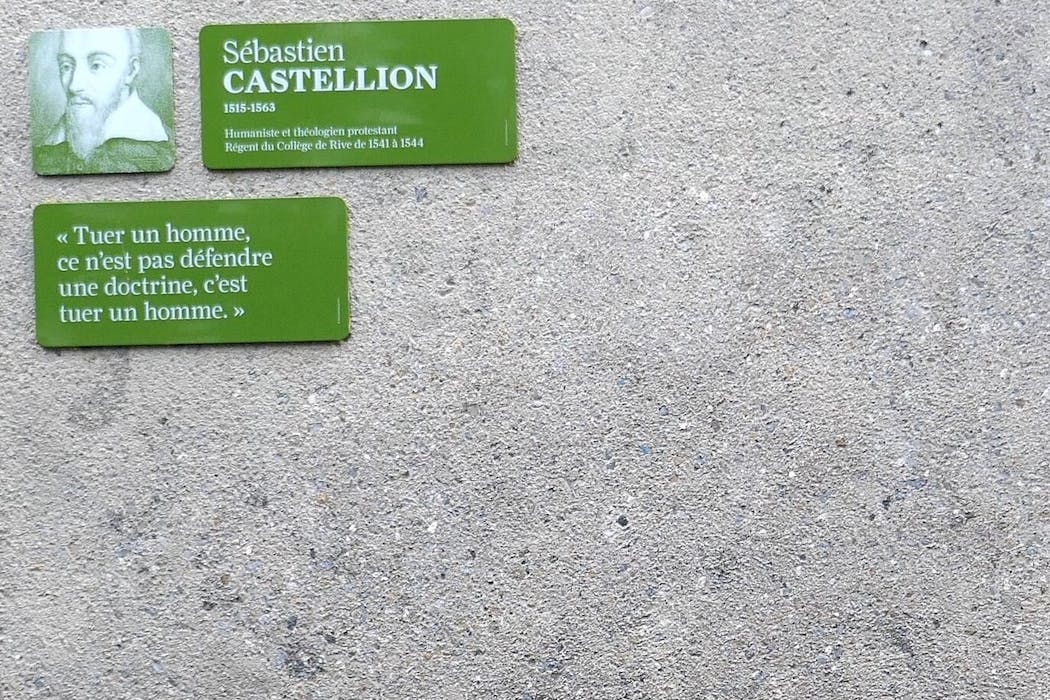
A monument to Sebastian Castellio in Geneva – using a French spelling of his name – reads, ‘Killing a man is not defending a doctrine; it is killing a man.’ MHM55/Wikimedia Commons, CC BY-SA

Ideological division was tearing the country apart. Factions denounced each other as unpatriotic and evil. There were attempted kidnappings and assassinations of political figures. Public monuments and art were desecrated all over the country.

This was France in the middle of the 16th century. The divisions were rooted in religion.

The Protestant minority denounced Catholics as “superstitious idolaters,” while the Catholics condemned Protestants as “seditious heretics.” In 1560, Protestant conspirators attempted to kidnap the young King Francis II, hoping to replace his zealous Catholic regents with ones more sympathetic to the Protestant cause.

Two years later, the country collapsed into civil war. The French Wars of Religion had begun – and would convulse the country for the next 36 years.

I am a historian of the Reformation who writes about the opponents of John Calvin, a leading Protestant theologian who influenced Reformed Christians, Presbyterians, Puritans and other denominations for centuries. One of the most significant of Calvin’s rivals was the humanist Sebastian Castellio, whom he had worked with in Geneva before a bitter falling out over theology.

Soon after the first war in France broke out, Castellio penned a treatise that was far ahead of its time. Rather than join in the bitter denunciations raging between Protestants and Catholics, Castellio condemned intolerance itself.

He identified the main problem as both sides’ efforts to “force consciences” – to compel people to believe things they did not believe. In my view, that advice from nearly five centuries ago has much to say to the world today.

Foreseeing the carnage

Castellio rose to prominence in 1554 when he condemned the execution of Michael Servetus, a medical doctor and theologian convicted of heresy. Servetus had rejected the standard Christian belief in the Trinity, which holds that the Father, Son and Holy Spirit are three persons in one God.

A dark-colored statue of a downcast, seated man, positioned in front of trees and bushes.
A monument to Michael Servetus, who was condemned for heresy and executed, in Geneva.
Iantomferry/Wikimedia Commons, CC BY-SA

Already condemned by the Catholic Inquisition in France, Servetus was passing through Geneva when Calvin urged his arrest and advocated for his execution. Servetus was burned alive at the stake.

Castellio condemned the execution in a remarkable book titled “Concerning Heretics: Whether They are to be Persecuted and How They are to be Treated.” In it, Castellio questioned the very notion of heresy: “After a careful investigation into the meaning of the term heretic, I can discover no more than this, that we regard those as heretics with whom we disagree.”

In the process, he laid the intellectual foundations for religious toleration that would come to dominate Western political philosophy during the Enlightenment.

But it took centuries for religious toleration to take hold.

In the meantime, Europe became embroiled in a series of religious wars. Most were civil wars between Protestants and Catholics, including the French Wars of Religion, a series of conflicts from 1562 to 1598. These included one of the most horrific events of the 16th century: the St. Bartholomew’s Day Massacre of 1572, when thousands of Protestants were slain in a nationwide bloodbath.

Castellio had seen the carnage coming: “So much blood will flow,” he had warned in a treatise 10 years earlier, “that its loss will be irremediable.”

A painting in faded colors shows a plaza in a medieval city, with scenes of people slaughtering each other and throwing bodies in a river.
‘The St. Bartholomew’s Day Massacre,’ by 16th-century artist François Dubois.
Cantonal Museum of Fine Arts/Wikimedia Commons

Remembering the Golden Rule

Castellio’s 1562 book, “Advice to a Desolate France,” was a rarity in the 16th century, for it sought compromise and the middle ground rather than the religious extremes.

With an extraordinarily modern sensibility, he decided to use the terms each side preferred for themselves, rather than the negative epithets used by their opponents.

“I shall call them what they call themselves,” he explained, “in order not to offend them.” Hence, he used “Catholics” rather than “Papists” and “evangelicals” rather than “Huguenots.”

Castellio pulled no punches. To the Catholics, referring to decades of Protestant persecution in France, he said: “Recall how you have treated the evangelicals. You have pursued and imprisoned them … and then you have roasted them alive at a slow fire to prolong their torture. And for what crime? Because they did not believe in the pope, the Mass, and purgatory. … Is that a good and just cause for burning men alive?”

To the Protestants, he complained, “You are forcing them against their consciences to attend your sermons, and what is worse, you are forcing some to take up arms against their own brothers.” He noted that they were using three “remedies” for healing the church, “namely bloodshed, the forcing of consciences, and the condemning and regarding as unfaithful of those who are not entirely in agreement with your doctrine.”

A sepia-colored illustration of a man with a long goatee, wearing a black jacket with buttons.
A portrait of Sebastian Castellio, made by 18th-century printmaker Heinrich Pfenninger.
Sepia Times/Universal Images Group via Getty Images

In short, Castellio accused both sides of ignoring the Golden Rule: “Do not do unto others what you would not want them to do unto you,” he wrote. “This is a rule so true, so just, so natural, and so written by the finger of God in the hearts of all,” he asserted, that none can deny it.

Both sides were trying to promote their vision of true religion, Castellio said, but both were going about it the wrong way. In particular, he warned against trying to justify evil behavior by appealing to its possible effects: “One should not do wrong in order that good may result from it.”

In another essay, he made the same point to argue against torture, writing that “Evil must not be done in order to pursue the good.” Castellio was the anti-Machiavelli; for him, the ends did not justify the means.

Force doesn’t work

Finally, “Advice to a Desolate France” argued that forcing people to your own way of thinking never works: “We manifestly see that those who are forced to accept the Christian religion, whether they are a people or individuals, never make good Christians.”

Americans, I believe, would do well to bear Castellio’s words in mind today. The country’s two dominant political parties have become increasingly polarized. Students are reluctant to speak out on controversial topics for fear of “saying the wrong thing.” Americans increasingly think in binary terms of good and evil, friends and enemies.

In the 16th century, Christians failed to heed Castellio’s advice and continued to kill each other over differences of belief for another hundred years. It would be wise to apply his ideas to today’s bitter divisions.

The Conversation

Michael Bruening does not work for, consult, own shares in or receive funding from any company or organization that would benefit from this article, and has disclosed no relevant affiliations beyond their academic appointment.

ref. Why one 16th-century theologian’s advice for a bitterly divided nation holds true today – https://theconversation.com/why-one-16th-century-theologians-advice-for-a-bitterly-divided-nation-holds-true-today-266457

Disability rights and services are shaped by the narratives embedded in policies like the Accessible Canada Act and MAID

Source: The Conversation – Canada – By Alfiya Battalova, Assistant Professor in Justice Studies, Royal Roads University

This year’s International Day of Persons with Disabilities centres on “fostering disability inclusive societies for advancing social progress.”

The theme recognizes persistent barriers faced by disabled people: disproportionate poverty, employment discrimination, inadequate social protection and the denial of dignity and autonomy in care systems.

Accessibility gains and losses

In 2022, the disability rate for people aged 15 years and over in Canada was 27 per cent. Nearly eight million people identified as having one or more disabilities, an increase of 1.7 million people over 2017, when the disability rate was 22 per cent.

The United Nations’ latest review of Canada’s implementation of the UN Convention on the Rights of Persons with Disabilities praised Canada’s progress in adopting the Accessible Canada Act and accessibility legislation at the provincial/territorial levels.

At the same time, the committee identified several areas of deep concern, such as the expansion of Medical Assistance in Dying (MAID) for disabled people whose death is not foreseeable. The report warns that inadequate supports risk normalizing death as a “solution” to poverty, lack of services and discrimination, and that the concept of choice can create a false dichotomy, enabling death without guaranteeing support.

All policies tell stories

All policies convey narratives and stories that carry values. They deal with questions of “why” as well as “how.”

Narratives distil and reflect a particular understanding of social and political relations. A story about disability as a phenomenon can be told from different perspectives. A medical model of disability views disability as a personal problem, a social model focuses on removing the barriers, and a human rights model introduces a language of rights and their protection. We often hear deficit-based stories rooted in the medical model about disability.

The Accessible Canada Act (ACA) and Medical Assistance in Dying (MAID) Track 2 in Canada tell contradictory stories about disability rights and state responsibility.

A young person using crutches shakes hands with a person holding open a door
The Accessible Canada Act is framed as a landmark piece of human rights legislation, emphasizing inclusion, accessibility and the removal of barriers.
(Pixabay)

The ACA is framed as a landmark piece of human rights legislation, emphasizing inclusion, accessibility and the removal of barriers to ensure full participation for people with disabilities, with a vision of a barrier-free Canada by 2040. Disability activists played a central role in its development, and the law is celebrated for its systemic, proactive approach to tackling exclusion and discrimination, offering rights to consultation, representation and accessible information.

In contrast, the MAID regime, especially after the expansion through Bill C-7, has been criticized for normalizing assisted death as a response to suffering caused by lack of access to medical, disability and social support, rather than addressing the underlying barriers and systemic failures that the ACA promises to remove.


Read more:
A dangerous path: Why expanding access to medical assistance in dying keeps us up at night


Research shows that the odds for having unmet needs for health-care services, medications, assistive aids or devices, or help with everyday activities increases with disability severity. A coalition of disability rights organizations and two personally affected individuals have filed a Charter challenge with the Ontario Superior Court of Justice opposing Track 2 of the MAID law, which extends eligibility to people whose death is not reasonably foreseeable.

Narrative accounts like the ones below, and research in bioethics, highlights that many people seek MAID not because they are terminally ill, but because they face poverty, inadequate housing and lack of care. This reveals a troubling contradiction: while the ACA proclaims a commitment to inclusion and support, MAID often functions as a default solution for those failed by the very systems the ACA aims to fix.


Read more:
Ontario Chief Coroner reports raise concerns that MAID policy and practice focus on access rather than protection


The stories told by these two policies — on one hand, the promise of full inclusion and on the other, the normalization of state-facilitated death for those marginalized by inadequate support — reveal a profound tension in Canada’s approach to disability rights and social responsibility.

Troubling cases

Cases are emerging where people access MAID due to intolerable suffering caused by systemic failures. There is a story of 66-year-old Normand Meunier who requested medical assistance in dying following a hospital stay last year that left him with a severe bedsore. He died a few weeks later.

The coroner’s report on Meunier’s case highlights the need for guaranteed and prompt access to therapeutic mattresses for patients with spinal cord injuries. Québec coroner Dave Kimpton also calls on the province to create an advisory committee aimed at preventing and treating bedsores with new tools and training. Kimpton observes:

“It is now undeniable to me, after this research, that the body of someone with a spinal cord injury speaks a different language, and that health-care professionals must learn to decode it if they are to anticipate and effectively manage medical complications.”

The stories of disabled people advocating for life-saving treatment is an example of continuing devaluation of disabled lives. Jeremy Bray of Manitoba pleaded for continued coverage of medication for his Type 2 spinal muscular atrophy. In British Columbia, Charleigh Pollock’s family fought for continued coverage of the medication for her neurological disorder. These stories individualize disability and promote a medical model approach.

Disability justice, as championed by the late activist Alice Wong and her Disability Visibility project, insists that storytelling is not “add-on” advocacy — it is evidence that exposes how policies like MAID, income-testing and institutionalization feel on the ground. Wong’s work demonstrates that disabled people’s stories are a powerful form of resistance, providing evidence that disabled people exist in societies that often erase them.

In her book Dispatches from Disabled Country, activist, educator and researcher Catherine Frazee provides an alternative vision of living with a disability. She uses a metaphor of Disabled Country to describe a “place of refuge for outlaws from the rules of fitting in a place where the value of human life is intrinsic, not contingent on a place that yields itself to our being and our capacity to flourish.”

Re-examining Canada’s disability policy story

From a policy-research perspective, understanding these narrative dynamics is essential for evaluating the effects of laws such as the ACA and for anticipating the implications of MAID expansion.

Scholars argue that policy narratives influence everything from budget priorities to program eligibility criteria and institutional cultures. They also shape how disabled people imagine their futures — an increasingly important dimension of well-being research.

As Canada reflects on the International Day of Persons with Disabilities, emerging evidence underscores the importance of aligning disability policy with the lived realities documented through research, monitoring processes and personal accounts.

Examining the narratives embedded in policy frameworks can help clarify how laws and institutions either support or hinder long-term flourishing for disabled people, and can offer insights into how stories told in policies ultimately align with societal values.

The Conversation

Alfiya Battalova does not work for, consult, own shares in or receive funding from any company or organisation that would benefit from this article, and has disclosed no relevant affiliations beyond their academic appointment.

ref. Disability rights and services are shaped by the narratives embedded in policies like the Accessible Canada Act and MAID – https://theconversation.com/disability-rights-and-services-are-shaped-by-the-narratives-embedded-in-policies-like-the-accessible-canada-act-and-maid-271094

Zero waste in schools? Why factoring in labour is essential

Source: The Conversation – Canada – By Mitchell McLarnon, Assistant Professor, Adult Education, Concordia University

Over the last decade, I’ve worked closely with Montréal educators and students to better understand how climate change education occurs in schools — and how climate change curricula and policies shape everyday experiences there.

In 2019, as part of a wider climate action plan, Montréal ambitiously committed to transitioning to zero waste by 2030.

With hopes of further reducing landfill waste, 22 schools across four school boards in Montréal were promised compost collection as part of the city’s zero-waste plan.

I interviewed three teachers from three different schools, one principal from another school and a school board employee to hear their analyses of how this program unfolded. The research suggests that to effectively expand composting and zero-waste climate action through schools, the labour of educators and other school workers must be factored into a “just transition.”

As a conceptual framework and practice, a “just transition” is an approach for connecting mechanisms of climate action with social fairness.

Importance of ‘just transition’

Montréal has goals to use a zero-waste model to reduce its emissions because food waste accounts for 15 to 20 per cent of emissions in the city. The aim is to ensure food waste is either being composted or that still-edible food finds its way to people experiencing food insecurity.

As communities grapple with climate change mitigation and adaption, efforts to realize global and local climate policy ambitions like zero waste are often premised upon the concept of a just transition.

Just transitions typically seek to reconcile environmental and social issues with a low-carbon and fossil-fuel-free future. Much of the research on just transitions encircles worker and labour rights from the energy, manufacturing, transport and related sectors as they move toward zero-emission outcomes.

My research points to teachers and other educational workers as key contributors for policy development toward a just transition. Because ecological and social crises are constructed and reproduced through power imbalances, a just transition away from fossil fuels and ecologically destructive practices also needs to be a departure from unequal and extractive ways of relating.

Zero waste by 2030?

During the pilot phase of the zero-waste plan’s implementation in schools, educational workers I partnered with stated they experienced a top-down policy implementation that created additional labour and misunderstandings while undercutting existing school composting programs and other established processes.

School board and city policymakers did not initially consider who would actually take on different compost-related tasks like sorting and transporting waste, and how this might intersect with labour relations and collective bargaining agreements.

As such, teachers and other school staff were compelled to take on additional and onerous tasks, such as organizing waste across the school, raising awareness and communicating with city workers.

For example, one participant said the only support and resources offered to their school by the city came in the form of two large composting bins and a short workshop on what goes into the city’s compost bins. They also felt there was an assumption that the compost would simply sort itself when someone needed to be present to ensure that organic matter ended up in the right place.

When the implementation of city-mediated school composting didn’t work well, some teachers intervened. In different schools, each having its own set of patterns, behaviours and peculiarities, varied responses emerged to the composting program.

One educator opted to work with the city on structuring the kind of compost support that would be pertinent for their school, while another motivated their students to participate during instructional time.

Teachers as key players

Increasingly, climate change education is included in provincial curricula. Along with this are mounting pressures on teachers to add climate change content into existing courses. In this way, teachers are being positioned as key players in addressing the global climate crisis.

Unfortunately, decades of austerity reforms to public education are now coupled with a growing list of unmet social, environmental and health needs (for example, pertaining to child and youth mental health, food insecurity and nutrition) that schools are tasked with addressing. Yet teachers are not structurally supported to take on this important new work.

It’s important that teachers and other educational workers be included in any large-scale policy implementation addressing students or educational spaces. For example, beyond the zero-waste project, the Canadian government announced a National School Food Policy in 2024 to address hunger and health inequities among Canadian youth, boost their mental and physical wellness and promote environmentally sustainable practices. Teacher expertise is crucial for equitable outcomes.


Read more:
School lunches, the French way: It’s not just about nutrition, but togetherness and _bon appetit_


Recognizing people’s labour

Montréal’s 2024 zero-waste report (Montréal objectif
zéro déchet
)
notes that the city now has 418 educational institutions with organic waste pickup. However, how much school waste is being diverted through the program and how it fits into the larger city’s zero-waste plans are unclear.

Policymakers mean well, but municipal policies need stronger social and structural supports to help stakeholders meet climate-action goals.

If our governments are indeed committed to connecting social justice and climate action, then they should also provide additional funding and labour to local schools to acknowledge the immense efforts required to develop and sustain these kinds of climate policies.

To sketch out where we might begin, I encourage governments to:

  1. Realize that climate policy like composting and notions of zero waste in schools are dependent on the labour and care of students and multiple education workers, including custodians, teachers, day-care workers, principals and others who fell outside of the scope of my research;

  2. Engage, recognize and compensate teachers and other school staff for their time, feedback and expertise on issues that impact them;

  3. Incorporate teacher, student and school-based reactions to proposed projects’ overall goals. Use their input to make the proposed budget realistic and relevant;

  4. Commit to transparency that allows local schools, teachers, education workers and organizers to receive meaningful and detailed updates on climate change mitigation data, benchmarks and budgetary allocations; and

  5. Rather than contracting or using “experts” from outside of a school and its community, work with people in the education sector to hire local climate-engaged teachers and school staff to manage the initiatives.

All climate change mitigation efforts from cities, schools and individuals ought to be applauded and encouraged for attempting to better improve and adapt to the current climate crisis.

But as a society, we shouldn’t pretend that ineffective responses are good enough — instead, climate-engaged educators and policymakers must resolve to learn from experience and insight to improve responsive policy and practice.

The Conversation

Mitchell McLarnon receives funding from the Fonds de Recherche du Québec, le Ministère de l’Éducation du Québec and the Social Sciences Research Council of Canada

ref. Zero waste in schools? Why factoring in labour is essential – https://theconversation.com/zero-waste-in-schools-why-factoring-in-labour-is-essential-263689

Sudan’s protesters built networks to fight a tyrant – today they save lives in a war

Source: The Conversation – Africa (2) – By Lovise Aalen, Research Professor, Political Science, Chr. Michelsen Institute

Sudan has a long history of civilian-led resistance, with young people playing a key role. For example, informal neighbourhood networks established in 2013 to survive repression under three decades of authoritarian rule have since transformed into vibrant support systems.

These groups helped mobilise mass protests in 2018. They have provided a lifeline for communities in the ongoing civil war, which started in 2023.

During the mass protests, youth-led networks organised political sit-ins and demonstrations against the Islamist regime of Omar al-Bashir. They were ultimately successful in overthrowing a 30-year dictatorship.

We are researchers in the fields of anthropology and political science, studying youth mobilisation in authoritarian states. In a recent paper, we studied the emergence and role of Sudan’s neighbourhood committees and informal networks. These became the backbone of protests.

We found that young people built grassroots networks through engagement in different forms of voluntarism and charity. They built resistance structures under the repressive environment of the Islamist regime. Later (around 2013 or so), these developed into neighbourhood committees organising resistance underground.

And since the outbreak of war in April 2023, Emergency Response Rooms, which are community-led networks, have been providing crucial humanitarian relief.

African youth mobilisation is often seen as an outcome of tension between an urban underclass and a repressive state. We argue that in Sudan, a collaboration between different classes, including the middle class, has been key in the fight against autocratic governance.

We found that the committees enabled protests. They played a vital role in organising emergency responses during times of crises.

Building the resistance

Under the repressive policies of the al-Bashir regime, political activities were not allowed in public spaces. Opposition was heavily suppressed.

Despite this, young people found innovative ways to create political spaces. Neighbourhood committees became sites of resistance, emerging as a critical infrastructure for grassroots mobilisation.

The committees represent a unique blend of political and practical action. They serve a dual functionality – mobilising for change while addressing immediate community needs. This underscores the potential of informal, decentralised networks to drive both political and social transformation.


Read more:
Sudan’s people toppled a dictator – despite the war they’re still working to bring about democratic change


They were initially formed during the 2013 anti-austerity protests as neighbourhoods’ underground cells. These committees were informal, hyper-local networks of politically engaged youth.

Over time, they evolved into organised structures. They facilitated protests, provided essential services and emergency responses during crises. In the 2018 uprising, they coordinated logistics. They also provided real-time updates through social media.

The committees also supported a sit-in at the military headquarters in April 2019. This became a focal point of the uprising. This sit-in presented a vibrant community space where youth experienced a sense of political togetherness. It featured art exhibitions, public debates and cultural performances, creating a shared vision of a better Sudan.

The civil war

The war between the army and a paramilitary group, the Rapid Support Forces, has put more than 30 million people – about two-thirds of the population – in need of humanitarian aid. This has created one of the world’s worst humanitarian crises. Conflict and blockades have meant international efforts to send aid hasn’t always been possible.

During the transitional period after al-Bashir’s exit and the 2023 war, the committees transformed into emergency response rooms. These provided critical services, such as healthcare, food and water. These rooms were run by the same youth networks that had led the protests. They drew on their pre-war experiences of grassroots mobilisation and humanitarian aid.

Amid a devastating civil war, they carry on the idea of political togetherness. Bonds of trust, necessity and solidarity established years ago have transcended ethnic or class divisions. They have created civilian resilience against state repression.

Lessons in resilience

The committees’ ability to adapt to new challenges underscores the importance of grassroots networks in both political and humanitarian contexts.

The concept of political togetherness, as seen in Sudan, reveals how temporary alliances across class, gender and ethnic divides can create a cohesive force for change.


Read more:
How a Sudanese university kept learning alive during war


This has implications for understanding youth movements globally, particularly where formal political spaces are inaccessible or untrustworthy.

The adaptability of Sudan’s neighbourhood committees illustrates the resilience of grassroots networks. By stepping into the void left by state failure, these committees provide essential services and also reinforce their legitimacy within their communities.

This suggests that such networks can serve as a foundation for future governance models, especially in post-conflict reconstruction efforts.


Read more:
Sudan’s civilians urgently need protection: the options for international peacekeeping


However, our study also reveals risks associated with informal and flexible structures.

The lack of formal governance mechanisms within these committees leaves them vulnerable to co-optation, fragmentation and the erosion of trust over time.

Without proper institutional support, the cohesion and effectiveness of these networks may wane. This is especially when the crises or transitions are prolonged.

What next?

In a post-war Sudan, both the Sudanese government and the international community should aim to preserve the emergency response rooms’ autonomy and grassroots nature. This should happen while providing resources and institutional support to enhance their capacity for community service and crisis response.

Activists within Sudan and similar contexts should continue to build on the model of political togetherness. This means fostering inclusive alliances that transcend traditional divides.

By prioritising both political mobilisation and community service, these grassroots networks can maintain the momentum for change while addressing immediate needs.


Read more:
Omar al-Bashir brutalised Sudan – how his 30-year legacy is playing out today


The humanitarian efforts that the Sudanese people invented are based on previous experience in civil engagement. The current call for a civilian government, which was also a demand by the protesters during the 2018 uprisings, is rooted in political togetherness. It is also linked to the long history of civilian governance practices at the grassroots level.

The Conversation

Lovise Aalen receives funding from the Research Council of Norway (grant no. ES620468) and the Sudan-Norway Academic Collaboration (SNAC). She is a member of the board of the Rafto Foundation for Human Rights.

Mai Azzam receives funding from the Bayreuth International Graduate School for African Studies (BIGSAS) and from the Gender and Diversity Office (GDO) of the Africa Multiple Cluster of Excellence, University of Bayreuth, Germany.

ref. Sudan’s protesters built networks to fight a tyrant – today they save lives in a war – https://theconversation.com/sudans-protesters-built-networks-to-fight-a-tyrant-today-they-save-lives-in-a-war-270176

Is anyone really misled by the term ‘veggie burger’? Our research suggests consumers are savvy

Source: The Conversation – UK – By Friederike Döbbe, Assistant Professor (Lecturer) in Business & Society, School of Management, University of Bath

Avelina/Shutterstock

The European parliament recently backed changes to the rules around the labelling and marketing of plant-based meat alternatives. New definitions specify that words like “burger”, “sausage” or “steak”, refer exclusively to animal protein. To get to the meat of the matter, this may mean that Europeans’ favourite soy-based patty can no longer be called a burger.

The vote took place amid a long-running European debate over the designation of plant-based alternatives to animal protein and the associated “linguistic gymnastics”.

A previous proposal to prohibit comparisons between dairy and plant-based foods was rejected. But the EU did decide to reserve the term “dairy” for products derived from animal milk. As a result, companies must now refer to their products as “almond drink” or “plant-based slices”, for example.

In the case of meat, the labelling propositions are part of a broader set of amendments to EU agricultural and food market regulations. These are supposed to strengthen the position of farmers in the food supply chain.
Farmers in Europe have long expressed concerns that plant-based substitutes could threaten traditional farming practices.

But what about the role of the consumer in debates over how meat and its plant-based substitutes should be labelled?

Before the vote, MEPs had discussed a perceived lack of transparency for consumers. It was suggested that terms such as “veggie burger” or “tofu steak” obscure the distinction between meat and plant-based or lab-grown alternatives. These ambiguities, it was argued, could confuse or mislead consumers.

While member states must still negotiate the amendments detailing the labelling changes, the consequences could be significant. Some retailers, like supermarket chain Lidl, are working to increase sales of plant-based foods. This aligns with what the science says about sustainable diets.

After initial growth in the market for plant-based alternatives, sales have plateaued. Many producers fear they may now also face additional costs associated with rebranding and relabelling their products.

In response, a coalition of food producers and retailers have argued that avoiding familiar terms like “steak” or “burger” could actually create more confusion among consumers.

But how misled are consumers really?

Despite concerns on both sides of the debate, our research shows a different reality – one in which many consumers are much more knowledgeable than they are made out to be.

We studied how people reacted to a marketing campaign by Swedish chicken producer Kronfågel. The campaign implied that climate action is the consumer’s responsibility, suggesting that shoppers should switch from beef to chicken to “do something simple for the climate”.

As part of the campaign, an emissions calculation underscored this shift, even leaving the impression it could offset air travel – based on just one meal. While the campaign drew from standardised carbon footprinting, the calculation left more questions than answers.

The ‘eat chicken, fly more’ message didn’t land well with consumers.

Through analysis of comments on social media and complaints to the Swedish consumer protection agency, we studied how people reacted to the campaign – rejecting it vehemently. They took issue for a range of reasons, including the corporation’s use of climate science and debates about what constitutes sustainable food consumption and what does not.

The various sources of disagreement illustrate the polarisation over food consumption and production. Many people were critical of the suggestion to “offset” flying by eating chicken, while others questioned the appropriateness of a chicken producer, with suppliers in the agricultural sector, demonising beef production.

The company responded by saying that its intention was to “help consumers navigate” the difficulties of lowering their consumption-related carbon footprint. It also said that it took consumer criticisms about the campaign being misleading to heart and would learn from them. We know of no investigation into the campaign, but we sense a shift towards softer messaging more broadly as companies’ fears of greenwashing accusations increase.


Read more:
Quick climate dictionary: what actually is a carbon footprint?


Our research shows that many consumers are well informed about their choices, actively scrutinising food products about their health effects, climate impact and production processes. And in debating the advantages and disadvantages of meat and plant-based alternatives, we found that they would openly disagree with each other.

These discussions reveal that there are many relevant perspectives and values involved in choosing the “best” diet – and consumption choices are deeply tied to identity, emotion and culture. In light of this complexity, our research serves as a warning for businesses and other organisations, including political parties, to approach climate messaging with care and to make sure their claims are credible.

So what then to make of the labelling debate? It is of course important to safeguard consumers from harmful or deceptive marketing. However, research has illustrated how powerful people and organisations may stereotype citizens. This may be, for instance, as “responsible”, “misled” or “duped” consumers – often the purpose is to serve their own commercial or political interests.

Politicians, food producers and retailers should be cautious about claims that consumers cannot differentiate meat from plant-based alternatives. Shoppers are often much more switched on than some in the EU debate suggest.

The Conversation

The authors do not work for, consult, own shares in or receive funding from any company or organisation that would benefit from this article, and have disclosed no relevant affiliations beyond their academic appointment.

ref. Is anyone really misled by the term ‘veggie burger’? Our research suggests consumers are savvy – https://theconversation.com/is-anyone-really-misled-by-the-term-veggie-burger-our-research-suggests-consumers-are-savvy-270635

What ancient Athens teaches us about debate – and dissent – in the social media age

Source: The Conversation – Global Perspectives – By Sara Kells, Director of Program Management at IE Digital Learning and Adjunct Professor of Humanities, IE University

Monument to Socrates and Confucius in Athens, Greece. Collection Maykova/Shutterstock

In ancient Athens, the agora was a public forum where citizens could gather to deliberate, disagree and decide together. It was governed by deep-rooted social principles that ensured lively, inclusive, healthy debate.

Today, our public squares have moved online to the digital feeds and forums of social media. These spaces mostly lack communal rules and codes – instead, algorithms decide which voices rise above the clamour, and which are buried beneath it.

The optimistic idea of the internet being a radically democratic space feels like a distant memory. Our conversations are now shaped by opaque systems designed to maximise engagement, not understanding. Algorithmic popularity, not accuracy or fairness, determines reach.

This has created a paradox. We enjoy unprecedented freedom to speak, yet our speech is constrained by forces beyond our control. Loud voices dominate. Nuanced voices fade. Outrage travels faster than reflection. In this landscape, equal participation is all but unattainable, and honest speech can carry a very genuine risk.

Somewhere between the stone steps of Athens and the screens of today, we have lost something essential to our democratic life and dialogue: the balance between equality of voice and the courage to speak the truth, even when it is dangerous. Two ancient Athenian ideals of free speech, isegoria and parrhesia, can help us find it again.

Ancient ideas that still guide us

In Athens, isegoria referred to the right to speak, but it did not stop at mere entitlement or access. It signalled a shared responsibility, a commitment to fairness, and the idea that public life should not be governed by the powerful alone.

The term parrhesia can be defined as boldness or freedom in speaking. Again, there is nuance; parrhesia is not reckless candour, but ethical courage. It referred to the duty to speak truthfully, even when that truth provoked discomfort or danger.

These ideals were not abstract principles. They were civic practices, learned and reinforced through participation. Athenians understood that democratic speech was both a right and a responsibility, and that the quality of public life depended on the character of its citizens.

The digital sphere has changed the context but not the importance of these virtues. Access alone is insufficient. Without norms that support equality of voice and encourage truth-telling, free speech becomes vulnerable to distortion, intimidation and manipulation.

The emergence of AI-generated content intensifies these pressures. Citizens must now navigate not only human voices, but also machine-produced ones that blur the boundaries of credibility and intent.


Leer más:
The ancient Greeks invented democracy – and warned us how it could go horribly wrong


When being heard becomes a privilege

On contemporary platforms, visibility is distributed unequally and often unpredictably. Algorithms tend to amplify ideas that trigger strong emotions, regardless of their value. Communities that already face marginalisation can find themselves unheard, while those who thrive on provocation can dominate the conversation.

On the internet, isegoria is challenged in a new way. Few people are formally excluded from it, but many are structurally invisible. The right to speak remains, but the opportunity to be heard is uneven.

At the same time, parrhesia becomes more precarious. Speaking with honesty, especially about contested issues, may expose individuals to harassment, misrepresentation or reputational harm. The cost of courage has increased, while the incentives to remain silent, or to retreat into echo chambers, have grown.


Leer más:
Social media can cause stress in real life – our ‘digital thermometer’ helps track it


Building citizens, not audiences

The Athenians understood that democratic virtues do not emerge on their own. Isegoria and parrhesia were sustained through habits learned over time: listening as a civic duty, speaking as a shared responsibility, and recognising that public life depended on the character of its participants. In our era, the closest equivalent is civic education, the space where citizens practise the dispositions that democratic speech requires.

By making classrooms into small-scale agoras, students can learn to inhabit the ethical tension between equality of voice and integrity in speech. Activities that invite shared dialogue, equitable turn-taking and attention to quieter voices help them experience isegoria, not as an abstract right but as a lived practice of fairness.

In practice, this means holding discussions and debates where students have to verify information, articulate and justify arguments, revise their views publicly, or engage respectfully with opposing arguments. These skills all cultivate the intellectual courage associated with parrhesia.

Importantly, these experiences do not prescribe what students should believe. Instead, they rehearse the habits that make belief accountable to others: the discipline of listening, the willingness to offer reasons, and the readiness to refine a position in light of new understanding. Such practices restore a sense that democratic participation is not merely expressive, but relational and built through shared effort.

What civic education ultimately offers is practice. It creates miniature agoras where students rehearse the skills they need as citizens: speaking clearly, listening generously, questioning assumptions and engaging with those who think differently.

These habits counter the pressures of the digital world. They slow down conversation in spaces designed for speed. They introduce reflection into environments engineered for reaction. They remind us that democratic discourse is not a performance, but a shared responsibility.


Leer más:
‘Historical time’ helps students truly understand the complexity of the past – and how they fit into it


Returning to the spirit of the agora

The challenge of our era is not only technological but educational. No algorithm can teach responsibility, courage or fairness. These are qualities formed through experience, reflection and practice. Athenians understood this intuitively, because their democracy relied on ordinary citizens learning how to speak as equals and with integrity.

We face the same challenge today. If we want digital public squares that support democratic life, we must prepare citizens who know how to inhabit them wisely. Civic education is not optional enrichment – it is the training ground for the habits that sustain freedom.

The agora may have changed form, but its purpose endures. To speak and listen as equals, with honesty, courage and care, is still the heart of democracy. And this is something we can teach.


A weekly e-mail in English featuring expertise from scholars and researchers. It provides an introduction to the diversity of research coming out of the continent and considers some of the key issues facing European countries. Get the newsletter!


The Conversation

Sara Kells no recibe salario, ni ejerce labores de consultoría, ni posee acciones, ni recibe financiación de ninguna compañía u organización que pueda obtener beneficio de este artículo, y ha declarado carecer de vínculos relevantes más allá del cargo académico citado.

ref. What ancient Athens teaches us about debate – and dissent – in the social media age – https://theconversation.com/what-ancient-athens-teaches-us-about-debate-and-dissent-in-the-social-media-age-270100

Like night and day: why Test cricket changes so much under lights

Source: The Conversation – Global Perspectives – By Vaughan Cruickshank, Senior Lecturer in Health and Physical Education, University of Tasmania

Cricket’s first Test match was played between Australia and England in 1877.

The next Ashes match, starting at the Gabba in Brisbane on Thursday, will be Test number 2,611.


Read more:
The ‘Bazball’ game style has revolutionised English cricket. Australia should be nervous


It will also be the 25th day-night Test.

Many people criticised the introduction of day-night Tests – including challenges posted by the pink ball (not red, as used in day clashes), visibility issues during twilight, and concerns that cricket is putting commercial interests ahead of the sport’s integrity.

But just how are day-night Tests different from traditional day matches?

History of day-night Tests

Australia and New Zealand played the first official day-night Test at the Adelaide Oval in 2015.

Day-night matches were introduced to increase the popularity of Test cricket and to play it at a time when it could attract larger crowds and a greater primetime audience on television.

From a commercial angle, the move has worked. Evening sessions draw larger crowds and television audiences.

Australia has embraced day-night Tests more than any other country, playing in 14 of the 24 completed day-night Tests. England is next with seven.

Australia has also hosted 13 of the day-night Tests, eight of them in Adelaide. India is next with three.

Cricket Australia and various state governments negotiate summer schedules and venues, with only Adelaide, Brisbane and Hobart hosting day-night Tests so far.

Australian dominance

The Australian team’s familiarity with day-night cricket may partly explain its outstanding record of 13 wins and one loss.

In contrast, England has only won two of its seven day-night Tests, losing all three against Australia.

Familiarity and more opportunities have contributed to Australian dominance of day-night Tests. The top four leading wicket-takers in day-night Tests are Australian.

Mitchell Starc leads (81 wickets in 14 Tests) while the best by an English player is the now-retired James Anderson with 24 wickets in seven Tests.

Australia also has the top five run scorers in day-night Tests.

Marnus Labuschagne (958 runs in nine Tests) is the current leader and has the chance to be the first player to score 1,000 runs in day-night encounters. Joe Root (501 runs in seven games) is the top Englishman at sixth on the list.

How things change under lights

Day-night games have several key differences to day Tests, such as the ball, the conditions and tactics used.

To make day-night Tests work, manufacturers had to develop a ball that’s visible under floodlights, yet durable enough for Test conditions.

Traditional red balls are too difficult to see at night, whereas white balls (used in shorter cricket formats) become dirty and discoloured too quickly.

After years of experimentation with orange and yellow versions, the pink ball emerged as the best compromise. It was trialled in domestic competitions and one-day internationals before being used in Tests.

Batting and bowling under lights is very different from daytime play because the pink ball behaves differently.

Its thicker coating keeps it shiny for longer, which gives fast bowlers more swing and seam movement.

This is most obvious when the ball is new and also during the twilight session, when dew can add extra moisture to the pitch.

Additionally, more grass is often left on the pitch to help reduce damage to the ball.

This all makes life more difficult for batters.

Spinners, though, often struggle because the ball’s harder coating and extra dew reduce grip and turn.

Players have also spoken about the difficulty of adjusting their eyes as daylight fades and floodlights take over. Fielders can also lose sight of the ball against the dusky sky.

In day Tests, the average runs per wicket increases slightly from session one to session three, with scoring rates also increasing slightly across the day. This pattern suggests batting becomes easier as the ball softens and the pitch flattens, while bowlers tire and conditions remain stable across daylight hours.

In contrast, session two is the easiest to bat in during day-night Tests. Batting is much harder in session one (when the ball is often new) and in session three under lights.

Pink ball scoring rates are similar to daytime matches but bowlers strike more often.

What about tactics?

Teams have learned to plan around the evening session (session three), when the fading light and cooling air can make batting harder.

Captains often time their declarations or new-ball spells to coincide with the twilight period and choose to bat first.

Fast bowlers in particular relish the chance to attack under lights and many batters say adapting footwork and timing against the moving pink ball is more difficult.

Comparing results

In short, day-night Tests are harder for batters. Fewer runs are scored, wickets fall more quickly, and games generally finish earlier.

When comparing all Tests from the past ten years, teams in day-night matches score about 150 fewer runs per game and bowlers need ten fewer balls to take each wicket.

Day-night Tests also tend to end with a result sooner, with matches on average being around 50 overs shorter. Notably, none of the 24 day-night Tests played so far has ended in a draw, compared with 14% of day Tests.

Thursday’s second Ashes Test at the Gabba will be the fourth day-night Test at the Queensland ground.

The Australians lost the previous day-night Gabba Test, to the West Indies last summer, which will give England some hope after their disastrous loss in the opening Ashes clash in Perth.

The Conversation

The authors do not work for, consult, own shares in or receive funding from any company or organisation that would benefit from this article, and have disclosed no relevant affiliations beyond their academic appointment.

ref. Like night and day: why Test cricket changes so much under lights – https://theconversation.com/like-night-and-day-why-test-cricket-changes-so-much-under-lights-267320

Kim Kardashian’s brain scan shows ‘low activity’ and holes. I’m a brain expert and I have questions

Source: The Conversation – Global Perspectives – By Sarah Hellewell, Senior Research Fellow, The Perron Institute for Neurological and Translational Science, and Research Fellow, Faculty of Health Sciences, Curtin University

A recent episode of the The Kardashians shared some startling news about Kim Kardashian’s brain.

Discussing Kim’s recent brain scan, her doctor pointed out “holes” on her brain scan he said were related to “low activity”.

While this sounds incredibly sad and concerning, doctors and scientists have doubts about the technology used and its growing commercialisation.

I study brain health, including imaging the brain to look for early signs of disease.

Here’s what I think about this technology, whether it can really find holes in our brains, and if should we be getting these scans to check our own.

What can imaging really tell you?

Earlier this year, Kim was diagnosed with a brain aneurysm, or widening of an artery, after an MRI.

The type and extent of this aneurysm is unclear. And there doesn’t seem to be a clear link between her aneurysm and this recent news.

But we do know the latest announcement came after a different type of imaging, known as single-photon emission tomography (known as SPECT).

This involves injecting radioactive chemicals into the blood and using a special camera which creates 3D images of organs, including the brain. This type of imaging was developed in 1976 and was first used in the brain in 1990.

SPECT scans can be used to track and measure blood flow in organs, and are used by doctors to diagnose and guide treatment for conditions affecting the brain, heart and bones.

While SPECT does has some clinical use under limited circumstances, there is not good evidence for SPECT scans outside these purposes.

Enter the world of celebrities and private clinics

The clinic featured in The Kardashian episode offers
SPECT to its clients, including the Kardashian-Jenners.

SPECT images have mass appeal due to their aesthetically pleasing pastel colours, widespread promotion on social media, and claims these scans can be used to diagnose any number of conditions. These include stress (as in Kim’s case), Alzheimer’s, ADHD, brain injury, eating disorders, sleep problems, anger and even marital problems.

But the scientific evidence to support the use of SPECT as a diagnostic tool for an individual and for so many conditions has led many doctors, scientists and former patients to criticise the work of such clinics as scientifically unfounded and “snake oil”.

Scans could potentially show changes in blood flow, though these may be common across conditions. Blood flow can also vary depending on the area of the brain examined, time of day, and even how well-rested a person is.

Areas in which blood flow is reduced have been described as “holes”, “dents” or “dings” on such SPECT scans.

In Kim’s case, this reduced blood flow was explained as “low activity” of the brain. Her doctor suggested the frontal lobes of her brain were not working as they should be, due to chronic stress.

But there is no scientific evidence to link these changes in blood flow to stress or functional outcomes. In fact, there is no single technique with scientific support to link changes in brain function to symptoms or outcomes for an individual.

These scans aren’t cheap

Doctors have several concerns about people without symptoms seeking SPECT as a diagnostic tool. First, people are injected with radioactive materials without a defined clinical reason.

Patients may also undergo treatment, or be recommended to take particular supplements, based on a diagnosis from SPECT that is scientifically unfounded.

And as SPECT scans are not recognised as a medical requirement, patients pay upwards of US$3,000 for a SPECT scan, with dietary supplements costing extra.

Do I need a scan like this?

While imaging tools such as SPECT and MRI may be genuinely used to diagnose many conditions, there is no medical need for healthy people to have them.

Such scans for healthy people are often described as “opportunistic”, with a double meaning: they may possibly find something in a person with no symptoms, but at several thousand dollars a scan, they take advantage of people’s health anxieties and can lead to unnecessary use of the health-care system.

It can be tempting to follow in the footsteps of the stars and look for diagnoses via popularised and widely advertised scans. But it’s important to remember the best medical care is based on solid scientific evidence, provided by experts who use best-practice tools based on decades of research.

The Conversation

Sarah Hellewell receives funding from the Medical Research Future Fund for MRI-based research.

ref. Kim Kardashian’s brain scan shows ‘low activity’ and holes. I’m a brain expert and I have questions – https://theconversation.com/kim-kardashians-brain-scan-shows-low-activity-and-holes-im-a-brain-expert-and-i-have-questions-271083