Vaccine committee votes to scrap universal hepatitis B shots for newborns despite outcry from children’s health experts

Source: The Conversation – USA (3) – By David Higgins, Assistant Professor of Pediatrics, University of Colorado Anschutz Medical Campus
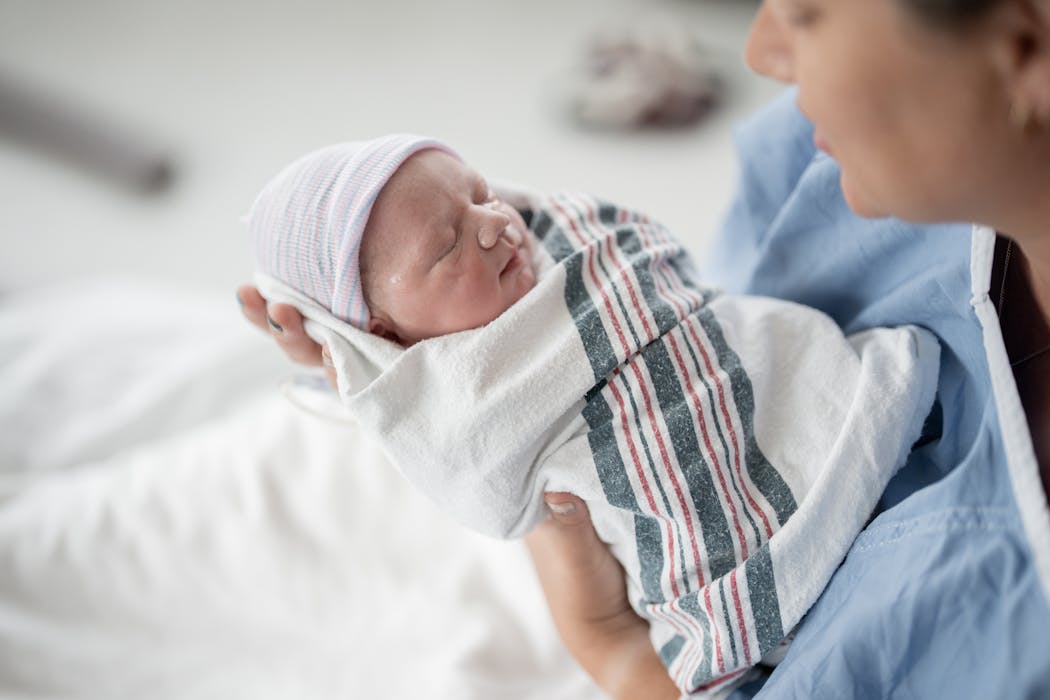
For the past 34 years, the Centers for Disease Control and Prevention has recommended that all babies receive their first hepatitis B vaccine at birth. FatCamera/E+ via Getty Images

The committee advising the Centers for Disease Control and Prevention on vaccine policy voted on Dec. 5, 2025, to stop recommending that all newborns be routinely vaccinated against the hepatitis B virus – undoing a 34-year prevention strategy that has nearly eliminated early childhood hepatitis B infections in the United States.

Before the U.S. began vaccinating all infants at birth with the hepatitis B vaccine in 1991, around 18,000 children every year contracted the virus before their 10th birthday – about half of them at birth. About 90% of that subset developed a chronic infection.

In the U.S., 1 in 4 children chronically infected with hepatitis B will die prematurely from cirrhosis or liver cancer.

Today, fewer than 1,000 American children or adolescents contract the virus every year – a 95% drop. Fewer than 20 babies each year are reported infected at birth.

I am a pediatrician and preventive medicine specialist who studies vaccine delivery and policy. Vaccinating babies for hepatitis B at birth remains one of the clearest, most evidence-based ways to keep American children free of this lifelong, deadly infection.

What spurred the change?

In September 2025, the Advisory Committee on Immunization Practices, or ACIP, an independent panel of experts that advises the CDC, debated changing the recommendation for a dose of the hepatitis B vaccine at birth, but ultimately delayed the vote.

This committee regularly reviews vaccine guidance. However, since Secretary of Health and Human Services Robert F. Kennedy Jr. disbanded the entire committee and handpicked new members, its activity has drastically departed from business as usual. The committee has long-standing procedures for evaluating evidence on the risks and benefits of vaccines, but these procedures were not followed in the September meeting and were not followed for this most recent decision.

The committee’s new recommendation keeps the hepatitis B vaccine at birth for infants whose mothers test positive for the virus. But the committee now advises that infants whose mothers test negative should consult with their health care provider. Parents and health care providers are instructed to weigh vaccine benefits, vaccine risks and infection risks using “individual-based decision-making” or “shared clinical decision-making.”

The hepatitis B vaccine has an outstanding safety record and has been administered to billions of infants at birth.

On the surface, this sounds reasonable. But while parents have always been free to discuss benefits and risks with their health care providers to make a decision on what’s best for their child, this change is not based on any new evidence, and it introduces uncertainty into a recommendation that has long been clear.

As a doctor, I am already seeing this uncertainty play out in the clinic. I recently had new parents ask to postpone the hepatitis B vaccine until adolescence because they believed federal health leaders had evidence that people only become infected through sexual activity or contaminated needle use.

After a brief conversation, they came to understand that this was inaccurate — children can be infected not only at birth but also through routine household or child care exposures, including shared toothbrushes or even a bite that breaks the skin. In the end, they chose to vaccinate, but this experience highlights how easily well-intentioned parents can be misled when guidance is not clear and consistent.

Why the CDC adopted universal hepatitis B shots

Hepatitis B is a virus that infects liver cells, causing inflammation and damage. It is spread through blood and bodily fluids and is easily transmitted from mother to baby during delivery.

The hepatitis B vaccine has been available since the early 1980s. Before 1991, public health guidance recommended giving newborns the hepatitis B vaccine only if they were at high risk of being infected – for example, if they were born to a mother infected with hepatitis B.

That targeted plan failed. Tens of thousands of infants were still infected each year.

Some newborns were exposed when their mothers weren’t screened; others were exposed after their mothers were infected late in pregnancy, after their initial screening. And like any lab test, the screening can have false negative results, be misinterpreted or not be communicated properly to the baby’s care team.

Recognizing these gaps, in 1991 the CDC recommended hepatitis B vaccination for every child starting at birth, regardless of maternal risk.

The U.S. adopted a policy of vaccinating all babies from birth because the number of people with hepatitis B infections was, and remains, relatively high, and because many mothers do not receive prenatal care, so their infections go undetected.

Meanwhile, in some European countries, like Denmark, only babies with certain risk factors receive the vaccine at birth. That’s because in those countries, hepatitis B infections are much less prevalent and pregnant mothers are more widely tested due to universal health care. Due to these differences, that approach is not effective in the United States. In fact, most World Health Organization member countries do recommend a universal birth dose.

Vaccinating at birth

The greatest danger for infants contracting hepatitis B is at birth, when contact with a mother’s blood can transmit the virus. Without preventive treatment or vaccination, 70% to 90% of infants born to infected mothers will become infected themselves, and 90% of those infections will become chronic. The infection in these children silently damages their liver, potentially leading to liver cancer and death.

Newborn lying on exam table touching doctor's stethoscope
Children are most likely to get infected by hepatitis B at birth, when contact with their mother’s blood can transmit the virus.
Ekkasit Jokthong/iStock via Getty Images Plus

About 80% of parents choose to vaccinate their babies at birth. If parents choose to delay vaccination due to this new recommendation, it will leave babies unprotected during this most vulnerable window, when infection is most likely to lead to chronic infection and silently damage the liver.

A research article published on Dec. 3, 2025, estimates that if only infants born to mothers infected with hepatitis B received the vaccine, an additional 476 perinatal hepatitis B infections would occur each year.

The hepatitis B vaccines used in the U.S. have an outstanding safety record. The only confirmed risk is an allergic reaction called anaphylaxis that occurs in roughly 1 in 600,000 doses, and no child has died from such a reaction. Extensive studies show no link to other serious conditions.

How children get exposed to hepatitis B

Infants and children continue to be vulnerable to hepatitis B long after birth.

Children can become infected through household contacts or in child care settings by exposures as ordinary as shared toothbrushes or a bite that breaks the skin. Because hepatitis B can survive for a week on household surfaces, and many carriers are unaware they are infected, even babies and toddlers of uninfected mothers remained at risk.

Full protection against hepatitis B requires a three-dose vaccine series, given at specific intervals in infancy. Anything short of the full series leaves children vulnerable for life.

In addition to changing the birth dose recommendation, the committee is now advising parents to consult with their health care provider about checking children’s antibody levels after one or two doses of the vaccine to determine whether additional doses are needed. While such testing is sometimes recommended for people in high-risk groups after they get all three doses to confirm their immune system properly responded to the vaccine, it is not a substitute for completing the series.

The recommendation for all babies to receive the vaccine at birth and for infants to complete the full vaccine series is designed to protect every child, including those who slip through gaps in maternal screening or encounter the virus in everyday life. A reversion to the less effective risk-based approach threatens to erode this critical safety net.

Portions of this article originally appeared in a previous article published on Sept. 9, 2025.

The Conversation

Dr. Higgins is affiliated with the American Academy of Pediatrics, Immunize Colorado, and Colorado Chooses Vaccines. These are volunteer roles.

ref. Vaccine committee votes to scrap universal hepatitis B shots for newborns despite outcry from children’s health experts – https://theconversation.com/vaccine-committee-votes-to-scrap-universal-hepatitis-b-shots-for-newborns-despite-outcry-from-childrens-health-experts-271202

Why we created a phone-sized device to take blood diagnostics out of the lab into the real world

Source: The Conversation – Global Perspectives – By Parth Shinde, Researcher, Birla Institute of Technology and Science

When your doctor thinks you might have an infection or an allergy, a simple blood test should give answers within hours. But for much of the world, that test can take days – or never happen at all. The problem is not usually the test itself, but an overlooked step between taking your blood and performing the diagnosis.

In most hospitals in high-income countries, separating plasma from blood is so routine that most people never think about it. A nurse takes your blood, sends it to the lab, and a machine called a centrifuge spins it at high speed to separate the liquid plasma from the cells. Lab staff then look for signs of infection, immune responses or bacteria, and your doctor uses those results to decide on treatment.

But centrifuges need electricity, regular checks and trained staff. When these things are not available or the lab is overwhelmed, testing slows down.

This doesn’t just affect rural clinics or refugee camps. This can also happen during busy winter months in emergency departments in wealthy countries. If plasma cannot be separated quickly with a consistent, high-grade quality, care is delayed even when fast tests are ready to use.

The scale of the issue became clear when my colleagues and I watched how doctors work day to day. A common pattern emerged as people with long-running, allergy-type symptoms were often told something like: “For now, try antihistamines, and if things get worse, we can arrange a test.” Tests were not avoided because they didn’t exist, but because they were too slow, too costly, or too far away.

A quiet bottleneck

This raised a basic question about healthcare: if diagnosis is the first step towards treatment, then why is it held back by cost, infrastructure and geography? The answer lies in sample preparation and testing – the quiet bottleneck at the centre of the process.

It was now clear the first biggest barrier to point-of-care testing was dependence on specialised equipment. The challenge became obvious: remove that dependency and testing could happen in the clinic or anywhere.

The problem appears in different ways in different countries, but the underlying pattern stays the same. In India, where I am based, many people can reach a doctor but avoid testing due to its delayed results and high costs. So, treatment is often based on symptoms.

During dengue surges in Brazil and Indonesia, tuberculosis care in rural South Africa, and COVID or RSV waves in the US and UK, care slowed not because tests were missing, but because samples relied on busy, centralised labs that patients or hospitals could not easily access.

In many field clinics and emergency health camps, teams have to depend heavily on equipment. A team might plan to run thousands of tests in a day, but they end up doing far fewer because someone has to separate plasma from every sample of blood before the test can even start.

A potential solution came from an unexpected place: paper towel. If you’ve ever dipped the end of a piece of paper towel in water, you will have noticed that the water “climbs” up the paper. My colleagues and I developed a device we call HemoSift that uses this principle (called “capillary action”) to separate red blood cells from the straw-coloured plasma (the part of blood needed for testing).

HemoSift uses capillary action to pull blood through tiny channels, and along the way something simple happens: plasma moves ahead while the red blood cells fall behind, the way faster and slower traffic sort themselves into different lanes. In under five minutes, it produces cell-free plasma with no pumps, no power and no moving parts.

A photo of the HemoSift device.
The HemoSift device.
Parth Shinde, CC BY

HemoSift has passed benchtop testing with blood-like fluids at the nanofabrication and microfluidics facility at IIT Bombay and has moved into early testing using donated patient blood samples. More samples are now being tested to build strong and reliable data.

HemoSift encourages us to rethink where diagnosis takes place. Instead of asking how to push more laboratory services into more locations, it asks why diagnosis needs to rely on a lab at all.

By removing the infrastructure barrier, rapid testing could reach places where it was previously impossible: rural health posts, mobile clinics, refugee camps, or overstretched emergency departments during outbreaks.

The aim of our device – which my colleagues and I are now developing at our startup, Tvashtr Biotech – is not to replace laboratories, but to widen the places where diagnosis can happen. With a simple plastic device, a healthcare worker could give a patient not only attention, but an answer – wherever they meet.

This article was commissioned in conjunction with Prototypes for Humanity, a global initiative that showcases and accelerates academic innovation to solve social and environmental challenges. The Conversation is the media partner of Prototypes for Humanity 2025.

The Conversation

This article was commissioned in conjunction with Prototypes for Humanity, a global initiative that showcases and accelerates academic innovation to solve social and environmental challenges. The Conversation is the media partner of Prototypes for Humanity 2025.

Parth Shinde is the Founder and owns shares at Tvashtr Biotech.

ref. Why we created a phone-sized device to take blood diagnostics out of the lab into the real world – https://theconversation.com/why-we-created-a-phone-sized-device-to-take-blood-diagnostics-out-of-the-lab-into-the-real-world-271437

Your Party: if the name sounds terrible, there’s a good reason for it

Source: The Conversation – UK – By Nicholas Dickinson, Lecturer in Politics, University of Exeter

When independent MPs Jeremy Corbyn and Zarah Sultana launched their new political venture in July 2025, they did so under a name that seemed almost deliberately empty: “Your Party”. Initially dismissed as a placeholder, the name is now official, having been narrowly confirmed by members at the party’s inaugural conference in November.

The name won just 37% of the vote against alternatives including “For the Many”, “Popular Alliance” and “Our Party”. The contested nature of this choice, and the peculiar blandness of the winning option, reflects a deeper crisis in how the far left names itself in the contemporary era.

Ten years ago, my research into 20th-century British Marxist groups revealed that these organisations once operated within what I characterise as a coherent naming culture. Terms like “communist”, “workers” and “socialist” were commonly used and carried substantial symbolic weight. Throughout the 20th century, British Leninist groups used these terms not merely as brands but mechanisms to articulate their identity, legitimacy and relationship to the revolutionary tradition.

The patterns were remarkably consistent within each tradition. Orthodox communist groups emerging from the Communist Party of Great Britain (CPGB), which was founded in 1920, showed complete conformity – every single one retained “Communist party” in its name, even decades after splitting from the CPGB.

Anti-revisionist groups, influenced by Maoism, displayed a different pattern. Of the 11 groups I studied, nine used “communist”. More significantly, seven appended “Marxist-Leninist” to their names – an attempt to reconnect some of the smallest and most peripheral groups, often with only a handful of members, back to a grander tradition of messianic leaders.

Most revealing were the Trotskyist groups. Of 13 major organisations, only five used “communist” at any point. Of the remainder, six instead opted for “socialist” in their name and six included the word “revolutionary”. The word “workers” featured in four names. This diversity masked fundamental instability in leftist politics. Most Trotskyist groups changed their names at least twice.

The left’s endless internecine disputes on nomenclature were infamously satirised in Monty Python’s riff on the idea of the Judean People’s Front. It’s hard not to detect some of these dynamics also at play in Your Party’s troubled launch.

Do you want to join The People’s Front of Judea or the Judean People’s Front?

When Lenin rebranded “social democracy” as “communism” in 1917, he was not simply changing a label but investing enormous symbolic capital in a term that would shape leftwing politics for seven decades. The Communist Party of Great Britain, founded in 1920, became the anchor of this naming culture in Britain, with splinter groups and rivals forced to negotiate their position relative to these established terms.

This naming system became increasingly dysfunctional over time. By the 1970s, even terms like “party” had become almost impossible to define coherently within the Leninist tradition. Was a “party” the revolutionary vanguard waiting for its moment in history, or a conventional electoral organisation competing for votes?

When the Socialist Workers Party emerged in 1977 from its predecessor International Socialist, it attempted to embody both definitions simultaneously, presenting itself as both a mass political party and a disciplined Leninist cadre. This contradiction contributed to rapid, often confusing shifts in strategy that alienated members and observers alike.

Whose party?

Your Party emerges from the wreckage of this collapsed naming system. The term “communist” was largely unusable in British politics by 1991. “Marxist-Leninist” had become a punchline even within the far left. “Workers” sounded antiquated in a deindustrialised Britain. Even “socialist” carries decades of baggage. What remained? A name so generic it barely qualified as one at all.

The genius and the problem of the name Your Party are inseparable. The name refuses to make the traditional ideological commitments that far-left names once signalled. It does not claim to be the vanguard party, does not invoke workers or socialism, and does not even claim ownership of itself through terms like “our party” – which, tellingly, came last in the naming vote. Instead, it performs a nominal sleight-of-hand, suggesting both maximal democracy (“it’s yours!”) and minimal commitment.

This vagueness might appear strategically savvy in an age of widespread distrust of traditional party structures. But the chaotic conference that ratified the name suggests otherwise. The bitter disputes over collective versus individual leadership, the expulsions of members, and Sultana’s boycott of the first day all point to unresolved issues. When 20th-century Trotskyist groups battled over whether to call themselves a “league”, “tendency” or “party”, those were not merely semantic disputes but arguments about organisational structure and democratic accountability, encoded in nomenclature.

Your Party attempts to avoid these arguments by adopting a name that articulates no clear position. But the politics of naming cannot be escaped so easily. What does “Your” signify when members cannot agree on basic questions of leadership or membership rules? Whose party is it, ultimately?

The polling data tells a sobering story. Support for Your Party fell from 18% in July 2025 to just 12% by November, while the Green party, with its clear brand identity, experienced a membership surge. Perhaps voters and activists sense the same problem that plagued late 20th-century Leninist groups – when you cannot articulate what your name signifies, you cannot sustain a coherent political project.

The collapse of Leninist naming culture reflected the exhaustion of a symbolic system where words like communist and workers had been stretched to accommodate too many contradictions. Your Party represents an attempt to build something new without that vocabulary. But in trying to avoid the old mistakes, it may have created a new one – a name so empty that it cannot provide the symbolic foundation a political organisation requires.

The Conversation

Nicholas Dickinson does not work for, consult, own shares in or receive funding from any company or organisation that would benefit from this article, and has disclosed no relevant affiliations beyond their academic appointment.

ref. Your Party: if the name sounds terrible, there’s a good reason for it – https://theconversation.com/your-party-if-the-name-sounds-terrible-theres-a-good-reason-for-it-271419

Jurors aren’t impartial – that’s exactly why they are so important to justice

Source: The Conversation – UK – By Elaine Jackson, PhD Candidate, University of Glasgow; University of the West of Scotland

On the surface, the rationale for the UK government’s proposals to limit the use of jury trials in England and Wales is pragmatic. Over 78,000 crown court cases remain unresolved, creating years-long delays for victims and defendants alike.

But among those of us who research jury behaviour and decision-making, these proposals raise a deeper debate. Some argue that juries are too biased, too unreliable to deliver justice.

Their hope is that if we could replace them with trained legal professionals, we might finally reduce the role that bias plays in the courtroom. But is this even possible?

All observation is “theory-laden”. Scientists, politicians, judges and jurors are not immune to their biases and worldviews influencing their decision-making.

Both judges and juries bring biases to the courtroom. The critical difference is that juries are more diverse than a single judge. Today, 89% of judges are white, 61% are men, and around a third attended private school. Fewer than 10% come from lower socioeconomic backgrounds.

This class and educational homogeneity matters profoundly. Judges who attended private school and Russell Group universities share not just demographic characteristics but formative experiences. Their relationships with authority, economic security, educational advantage and professional networks are likely to be less diverse than those of a jury.

Different social positions provide access to different knowledge. Someone who attended private school, joined chambers and rose through the judiciary simply hasn’t lived through experiences that would provide insight into many people’s lives.

For example, this might include how economic precarity affects people’s decisions, how working-class communities relate to police authority, or how educational disadvantages affect your ability to navigate bureaucratic systems.

These aren’t biases in the sense of prejudice. They are inevitable limitations of a single perspective.


Read more:
Limiting jury trials will harm minority ethnic victims and defendants, research shows


When judges assess whether behaviour was “reasonable” or a complainant’s response was “credible”, they are making ethical evaluations that mix facts with values. A judge evaluating whether a working-class defendant’s actions were reasonable brings their own class experience to that judgment, whether they recognise it or not.

Twelve randomly selected citizens bring 12 different life experiences. Through deliberation, they must make those experiences visible and justify their interpretation to each other.

If a judge makes a decision on their own, only their own biases will influence the verdict. In a jury, consensus needs to be reached. Different opinions and perspectives will shape the outlooks of others. This makes the verdict more informed by community beliefs, rather than from specific sections of the community.

The human “bias” we worry about in juries is actually the diversity of experience and judgment that may improve group decision-making. Homogeneity masquerades as objectivity. Trials should be decided by the people – and the various human experiences they bring to the courtroom.

A jury drawn from the electoral register might include someone who left school at 16, someone who has experienced unemployment or housing insecurity, someone who’s worked in manual labour, or someone from a community where police relations are fraught. These aren’t just different backgrounds, they are different forms of knowledge about how society works for many people.

This diversity is important for both defendants and victims. Evidence shows that judges may be more likely to convict defendants compared with juries.

Any changes towards judge-only trials may disadvantage future defendants when compared with the current system, where a defendant can choose the option of a jury trial for certain types of offence.

How jury deliberation reduces bias

Our research – part of Elaine Jackson’s PhD – investigated Scottish jury deliberations in rape cases, revealing what kinds of bias jurors bring to them by staging a series of mock trials.

The research shows the influence of rape myths – stereotypes and false assumptions about how rape victims and perpetrators behave – in the courtroom, and how juries can both perpetuate and mitigate their influence.

Across 90 jurors in one mock trial, we identified 180 instances of rape myths. These included victim blaming, demanding impossible proof, framing assault as “heat of the moment”, and using “real rape” stereotypes such as expecting severe injuries and immediate reporting. These myths were pervasive across juror populations, not simply held by a few outliers.

But we also observed that jury deliberation could challenge these assumptions. Both guilty verdicts occurred when a strong foreperson (the jury’s spokesperson) voiced immediate challenges to these myths, or trauma-informed jurors countered these frameworks. For example, when one juror suggested that the accused offering wine to the victim meant sexual invitation, another challenged them, asking: “According to what logic?”

We believe it’s positive that the UK government’s proposals will retain jury trials in cases of rape and murder. In serious crimes, we need diversity of thought and opinion in our decision-making.

This collective scrutiny, 12 different perspectives negotiating with each other, is something an individual judge cannot replicate.

While judges may consult colleagues, at trial stage they ultimately decide alone – without a formal deliberation requiring them to defend their interpretations to others who have equal decision-making authority. A diverse jury has this built-in corrective mechanism, which is why it must remain a part of the UK’s legal system.


Want more politics coverage from academic experts? Every week, we bring you informed analysis of developments in government and fact check the claims being made.

Sign up for our weekly politics newsletter, delivered every Friday.


The Conversation

The authors do not work for, consult, own shares in or receive funding from any company or organisation that would benefit from this article, and have disclosed no relevant affiliations beyond their academic appointment.

ref. Jurors aren’t impartial – that’s exactly why they are so important to justice – https://theconversation.com/jurors-arent-impartial-thats-exactly-why-they-are-so-important-to-justice-271322

Reform’s £9m gift and the rise of the political mega-donor

Source: The Conversation – UK – By Sam Power, Lecturer in Politics, University of Bristol

When the latest figures on donations to political parties were released, it was revealed that businessman Christopher Harborne had donated £9 million to Reform. Harborne, who lives in Thailand, made his fortune on aviation and cryptocurrency. Reform leader Nigel Farage insists he wants nothing in return for the money and that the two speak once a month or every six weeks.

Harborne’s is the biggest one-off donation by a living individual in British history. But he’s far from alone in giving massive amounts to parties. Financier Stuart Wheeler gave £5 million to the Conservatives in 2001 which is actually £9.5 million in today’s money. Frank Hester donated £15 million to the Tories just before the 2024 election but broke it up a little bit so nobody seems to care or remember.

Harborne’s gift amounts to a quite significant boost to Reform’s coffers. For context, Reform received £1.3 million in the reporting period directly prior to this one, and just £70,000 in the same period a year ago (donations figures that aggregate to over £11,180 are released quarterly).

But as I have shown elsewhere, political donations are cyclical and the receipt of them tends to ratchet up in advance of elections. Next May – with elections in Scotland, Wales and a seemingly bruising set of locals set for Labour – is seen to be a time where Reform can lay a marker as the “true” opposition party. So it’s less surprising to see such big figures this far out of a general election.

Who is Christopher Harborne?

The fact that Harborne has donated to the Conservatives in the past, as well as to Boris Johnson’s private office when he was prime minister, has been taken by some as indicative of a donor exodus from the Tories to Farage’s outfit. But that’s premature, we’ve seen some small movement to Reform in the figures since the 2024 election, and several stories about Reform-curious Tory donors but no real sea change in this respect.

The research is also fairly settled that donors tend to give money to parties for three reasons: they agree with them (they are ideological), they like the access it provides (they are intimates) or they want something in return (they are investors).

There is a long history of donors as pragmatic investors, thinking long and hard about how their money can be best spent to achieve their aims and effectively spreading their bets (though that is much more common in systems of proportional representation).

As one donor said during the 2024 election, when it became increasingly apparent Rishi Sunak was failing to bring in significant amounts of money: “Any self-respecting businessperson conducts due diligence before an investment decision. Time will tell whether smart money will back Mr Sunak”. Reader, it didn’t.

So, while donors do tend to be ideologues in the UK, there is some precedent for them changing lanes. The aforementioned Wheeler ended up as Ukip treasurer, for example. And given that British politics is increasingly characterised by fragmentation, it would be little surprise if donors started following the voters in shopping around.

Rise of the mega donor

What this donation also speaks to, though, is an increasingly worrying trend in British politics, which is the rise of the mega-donor. The very rich have always made up the vast majority of the donor class but there are signs this has become supercharged in recent years.

As investigative journalist Peter Geoghegan points out, 75% of all donations to Reform and its predecessor the Brexit Party since 2019 have come from three men: Harborne, deputy leader Richard Tice and businessman Jeremy Hosking.

Hester’s donations to the Conservatives in the run up to the 2024 election, meanwhile, equated to about 63% of the party’s entire spend on the campaign.

When almost exactly a year ago Elon Musk mooted a £70 million donation to Reform, which never materialised, it felt like a canary in the coalmine. That, if something wasn’t done, the UK was moving towards an increasingly Americanised system of glorified oligarchy.

In the US, remember, it’s no longer even a case of the 1% having all the power. Across the pond, the top 0.01% of donors accounted for 50% of all funds raised in 2024.

There is currently no upper limit on political donations. Parties have debated bringing one in for 25 years but can never agree to actually doing so – despite the fact the public (including Reform voters) backs the idea.

This is because any significant cap set at, say, £10,000 a year (as suggested by the Committee on Standards in Public Life and Transparency International) or £100,000 (which is think-tank the IPPR’s preference) would mean injecting more state funding into the system. Which the public hates just about as much (if not more) than the idea of mega-donors.

This leaves everyone in a “damned-if-you-do, damned-if-you-don’t” system of inertia and paralysis. It’s the kind of frustrating state of affairs which causes me to write book chapters with titles like “What do you do when the voters are wrong?” (which is reason #51 that I could never be an MP) and a similarly frustrated political scientist to remark: “parties need money: but not mine, not from my taxes, and not from interest groups”.

My solution, when faced with this, is that doing something is better than nothing. It’s why I think there’s utility in what I call a “democracy backstop” cap of £1 million.

It would do little to allay public fears that the very rich have outsize influence on politics, but I’m not sure there’s a limit low enough that can, and I do (literally) have a PhD’s worth of research to back me up on that. It would, though, put the brakes on just a little bit.

Let’s not forget that Labour has said it will introduce an elections bill in this parliament. That means it is not quite too late, but the time to act is very much now.

The Conversation

Sam Power has received funding from the Economic and Social Research Council and the Engineering and Physical Sciences Research Council.

ref. Reform’s £9m gift and the rise of the political mega-donor – https://theconversation.com/reforms-9m-gift-and-the-rise-of-the-political-mega-donor-271428

Low-tax or high-welfare? The UK must decide what type of country it wants to be

Source: The Conversation – UK – By Christopher Adam, Professor of Development Economics, University of Oxford

Perceptions of a high-tax UK are wide of the mark. Steve Travelguide/Shutterstock

Headlines about tax in the UK being at an all-time high abounded after the autumn budget. The current overall tax take, at 35% of GDP, is indeed a historic high for the country. And the measures announced in the budget will take it to 38% by the end of the parliament.

Yet, contrary to what some might have you believe, it is only high by British standards.

If the UK wants a decent welfare system in the coming years, it’s time to start doing things differently. But this can’t just mean raising taxes to meet the growing demands of an ageing society.

The structure of the UK’s tax system must be fixed before politicians even think about further rises, since its complexity and distortions hold back investment, productivity and long-term growth.

In 2023, the tax take as a percentage of GDP was 35.3%, slightly above the overall average for the 38 countries in the Organisation for Economic Cooperation and Development (OECD). This placed the UK 18th on the list and almost two percentage points lower than the average of other European members.

But even the new figure of 38% does not take the UK anywhere near the top. It matches Germany, but remains significantly lower than the tax take in France, Italy, Belgium and the Nordic countries, where the tax share exceeds 40% of GDP.

The UK has a deep productivity problem. Real wage growth has collapsed from being third best among OECD countries before 2008 to 16th afterwards. Without a recovery, the country will not be able to maintain levels of public provision, let alone reboot the health and public support systems.

The welfare system certainly needs a reboot, as our latest research shows. In health, the NHS is grappling with some of the longest waiting lists on record as well as delivering comparatively poor results. At the same time, thousands of people are stuck in hospital due to the lack of affordable social care.

Social housing is increasingly out of reach for those who need it: the gains of the right to buy policy of the 1980s have been confined to those who bought their council houses, while the costs of that mass sell-off are borne by the state and today’s poor in the form of housing shortages and high rents.

Perhaps most damning of all, child poverty has risen steadily since 2010 and is now among the highest in the OECD.

grandmother reading to a little boy sitting on her knee.
Pressures on health and social care spending will only grow in future.
PeopleImages/Shutterstock

The pressures on the system will only grow. The ageing population is dramatically increasing pension costs and the demand for social care. Advances in healthcare, while holding out the prospect of longer and higher-quality lives, are also extending the years that people can live with chronic conditions. This is particularly true among lower-income groups who often lack the means to maintain their health.

The health and social care sector is one where the real cost of delivery is rising, so the UK will need to increase the resources flowing into it just to stand still.

The pension triple lock is continuing to exacerbate the pressure on public finances. Meanwhile, precarious and low-paid employment means millions of people still rely on in-work benefits. And the post-COVID surge in health and disability-related personal independence payments (Pip) shows no signs of abating.

What kind of country does the UK want to be?

We see two feasible paths forward to fix the distortions in the tax system while ensuring that those who need the welfare state don’t fall through the widening cracks. But here’s the rub. Both would be extremely difficult politically.

First, the UK could accept that a universal welfare state is not affordable, and radically reshape and target it. The question is whether the public would tolerate deeper means-testing, for instance, which might represent a genuine reshaping of the welfare state.

The founder of the welfare state, William Beveridge, understood that his system required not only technical solutions but a compelling narrative about social solidarity where all citizens bought into its core principles.

Second, the country could engage in a genuinely open debate on the cost of and willingness to pay for welfare services. It could then fix the tax system to fund comprehensive welfare provision, moving toward European-style social insurance systems.

The UK spends just over 11% of GDP on welfare, placing it near the OECD average and well below Nordic countries and France. The fact that overall tax take of 35% rising to 38% is a historic high makes any conversation about taxation hard – perhaps impossible.

But UK outcomes compared to those of its neighbours who spend more should be food for thought. The answer cannot be in stealth taxes.

The budget mainly just walked a path of continuation from a long period of piecemeal reforms that may not achieve what they are intended to. It raised revenue primarily through fiscal drag (the freezing of tax thresholds so that rising pay pushes more people into higher brackets).

It did remove the regressive limit on universal credit or tax credits for larger families, but in the main it continues to follow a path of least political resistance. This is likely to result in the gradual emergence of a two-tier system where those who can afford it increasingly opt for private healthcare, private housing and private education.

Given how much resistance the government is facing even now, perhaps the path of least resistance is the only option available. But perhaps a braver conversation is possible – one that spells out the human tragedy of under-investing in welfare and the economic problems of continuing with the current UK tax structure.

What won’t work is pretending these choices don’t exist. The UK has neither the benefits of low taxes nor the welfare outcomes of its higher-tax neighbours. It’s time to redesign the tax and welfare system for the century we’re in.

The Conversation

The authors do not work for, consult, own shares in or receive funding from any company or organisation that would benefit from this article, and have disclosed no relevant affiliations beyond their academic appointment.

ref. Low-tax or high-welfare? The UK must decide what type of country it wants to be – https://theconversation.com/low-tax-or-high-welfare-the-uk-must-decide-what-type-of-country-it-wants-to-be-271231

Un guide Michelin des vins : une vraie fausse bonne idée ?

Source: The Conversation – France (in French) – By Jean-Marie Cardebat, Professeur d’économie à l’Université de Bordeaux et Professeur affilié à l’INSEEC Grande Ecole, Université de Bordeaux

Le célébrissime guide Michelin va proposer un guide des domaines viticoles. La diversification peut sembler logique. Après les mets, les vins… Toutefois, l’environnement concurrentiel est tel que rien ne dit que le nouveau guide connaîtra le même succès que son glorieux aîné. À l’ère des réseaux sociaux et des influenceurs, quelle place peut espérer occuper un enième guide professionnel ?


Dans un secteur déjà saturé de guides, d’experts, de revues spécialisées et de prescripteurs en tout genre, le guide Michelin annonce son entrée sur le marché de la notation des domaines viticoles. Erreur stratégique en perspective ou poursuite d’une diversification réussie ? Si la question reste ouverte pour le moment, on peut se demander si le guide Michelin ne se trompe pas (légèrement) de cible. Car la notation de la dimension œnotouristique des domaines semblerait a priori bien plus pertinente pour ce guide, né en 1900, qui évalue le secteur de l’hospitalité depuis 1926 (pour les restaurants et depuis 2024 pour les hôtels).

Un marché des experts déjà très concurrentiel

Le segment de l’expertise viticole est dominé depuis plusieurs décennies par une série d’acteurs spécialisés. Parmi les plus connus, on trouve le Wine Advocate (fondé par le célèbre Robert Parker), le Wine Spectator (la revue américaine spécialisée sur le vin qui touche 3,5 millions de lecteurs), la célèbre experte anglaise Jancis Robinson et la revue britannique Decanter (qui organise un concours international des vins bien connu), ou pour la France, La Revue du Vin de France et le Guide Hachette.

Chacun d’entre eux possède des méthodologies stabilisées et une légitimité historique auprès des particuliers mais aussi auprès des professionnels (détaillants, négociants, importateurs). Ce monde de l’expertise dans le vin et tous ses enjeux sont décrits de façon détaillée dans un article académique. Il souligne notamment le rôle central que ces acteurs jouent dans la formation des prix, en particulier pour les vins fins. L’entrée d’un nouvel évaluateur généraliste, en l’occurrence un guide gastronomique, même prestigieux, se positionnerait face à des experts techniques dont le cœur de métier est déjà parfaitement installé. La voie est donc étroite pour Michelin.


À lire aussi :
Comment le Guide Michelin rebat les cartes des restaurants qu’il récompense


Un déplacement vers les communautés de consommateurs

Plus grave, le guide Michelin se positionne en tant qu’expert traditionnel dans un monde où les consommateurs privilégient désormais l’information issue de leurs pairs plus que de celle émanant des experts. La littérature académique démontre cette prédominance nouvelle des consumers geeks qui alimentent par dizaines de millions les notes agrégées de sites comme Vivino ou CellarTracker.

À l’instar de l’hôtellerie et de la restauration, ces notes et commentaires de consommateurs tendent à supplanter l’influence des experts traditionnels. Ce sont ces notes qui font les prix du vin à présent, plus que celles des experts, y compris dans le haut de gamme. Cette tendance de fond réduit considérablement l’espace de marché potentiel pour le guide Michelin. Son entrée sur le marché de l’expertise du vin se fait donc à contretemps de l’évolution du marché.

Des critères de notation encore flous

Dans ce contexte, la capacité du guide Michelin à imposer une nouvelle grille d’évaluation reste incertaine, d’autant que les cinq critères annoncés demeurent flous : la qualité de l’agronomie, la maîtrise technique, l’identité, l’équilibre, la constance. Le vocabulaire est imprécis, trop général, sans métrique ni méthode avancée pour saisir des critères souvent qualitatifs et éminemment subjectifs.

Cela nuit à la lisibilité et à l’objectivité de la démarche. Au final, qu’apporte cette nouvelle grille de lecture ? Que mesure-t-on exactement ? La qualité du vin, les processus menant à la réalisation du vin ? Le guide Michelin navigue entre le monde de l’expertise de processus (agronomique) et de produit (œnologique). Ce positionnement ambigu pourrait ne pas être compris par les utilisateurs potentiels.

Un atout : le capital de marque international

Pour autant, la stratégie du guide Michelin n’est pas sans fondement. Elle s’appuie sur une notoriété mondiale et une audience internationale à fort pouvoir d’achat. Le guide espère donc capter dans un premier temps sa propre clientèle. La force de la marque est ainsi son argument majeur, et l’on sait l’importance de la marque dans le monde du luxe. Cette reconnaissance constitue notamment un levier puissant pour attirer des consommateurs étrangers en quête de repères simples, particulièrement dans des régions viticoles complexes comme la Bourgogne ou Bordeaux où le guide débutera son activité de notation viticole.

Le capital réputationnel du guide Michelin comprend aussi son savoir-faire en matière d’évaluation. Avec ses étoiles, le guide manie depuis 1926 un système d’évaluation multicritères opaque mais néanmoins reconnu et respecté. Notons d’ailleurs que tous les experts du vin développent un système qui leur est propre et dont la transparence n’est pas la première qualité.

Dès lors, d’un point de vue économique, la notation des domaines viticoles peut être interprétée comme un mouvement logique de diversification horizontale. Michelin capitalise sur sa compétence centrale – la construction de standards de qualité – pour pénétrer un secteur adjacent à celui de la gastronomie.

En attendant l’évaluation œnotouristique

Cette stratégie de diversification peut toutefois être interrogée. Le guide Michelin possède un savoir-faire et une réputation dans l’hospitalité. L’œnotourisme apparait alors comme le secteur lié au vin le plus pertinent. Le guide Michelin, fort de son expertise en matière de destinations, d’expériences et de services, aurait pu s’imposer de manière naturelle sur ce terrain en évaluant des critères, tels que la qualité de l’accueil, le parcours/la visite du domaine, la cohérence de l’offre touristique, la gastronomie locale associée, l’expérience globale du visiteur, etc. Autant de critères sur lesquels la compétence est déjà présente et l’avantage concurrentiel incontestable.

Legend 2025.

En outre, l’industrie œnotouristique représente aujourd’hui un marché en expansion rapide : 18 % de croissance moyenne annuelle en Europe, selon le Global Wine Tourism Report (2025) de la Commission européenne. L’œnotourisme (et le tourisme gastronomique, très souvent liés) sont totalement alignés avec l’histoire du guide Michelin et avec les attentes de la clientèle internationale premium qu’il capte déjà en partie.

A minima, une stratégie tournée vers l’œnotourisme aurait dû constituer une étape vers l’évaluation des vins et des vignerons. Le risque d’aller directement sur l’évaluation du vin est double. C’est d’abord le risque de dilution de crédibilité lié à un manque de légitimité. Mais aussi le risque d’arriver bien trop tard, à contre-courant des tendances, dans un marché du vin en plein essoufflement. La force de la marque suffira-t-elle ? L’avenir nous le dira.

The Conversation

Jean-Marie Cardebat est Président de la European Association of Wine Economists

ref. Un guide Michelin des vins : une vraie fausse bonne idée ? – https://theconversation.com/un-guide-michelin-des-vins-une-vraie-fausse-bonne-idee-271321

États-Unis/Venezuela : la guerre ou le deal ?

Source: The Conversation – France in French (3) – By Thomas Posado, maître de conférences en civilisation latino-américaine contemporaine, Université de Rouen Normandie

Alors que Donald Trump exige qu’il démissionne, Nicolas Maduro refuse pour l’instant de quitter le pouvoir. Washington brandit la menace d’une intervention armée.

Donald Trump l’a exprimé on ne peut plus clairement : il souhaite la chute du régime de Nicolas Maduro, au pouvoir au Venezuela depuis qu’il a pris en 2013 la suite d’Hugo Chavez. Pour cela, le président des États-Unis brandit diverses menaces : bombardements, opérations clandestines de la CIA, voire intervention militaire au sol. Lui qui se targue d’avoir mis fin à plusieurs guerres depuis son retour à la Maison Blanche il y a un an est-il sur le point d’en démarrer une ? Entretien avec Thomas Posado, maître de conférences en civilisation latino-américaine contemporaine à l’Université de Rouen-Normandie, auteur, entre autres publications, de Venezuela : de la Révolution à l’effondrement. Le syndicalisme comme prisme de la crise politique (1999-2021) (Presses universitaires du Midi, 2023).


Une déflagration militaire entre les États-Unis et le Venezuela vous semble-t-elle aujourd’hui possible ?

Je pense que oui, même si j’étais plutôt sceptique il y a encore peu de temps. Aujourd’hui, un tel développement est envisageable, mais sous quelle forme ? Une guerre ouverte entre les deux États et une intervention terrestre comparable à celles qu’on a connues en Irak ou en Afghanistan me semble hautement improbable. Ne serait-ce que parce que, pour envahir le Venezuela, il faudrait mobiliser au moins 100 000 hommes et il y aurait sans doute des pertes assez importantes du côté de l’US Army, ce qui ne serait pas bien pris par l’opinion publique états-unienne et, spécialement, par une bonne partie de la base trumpiste.

Les dernières interventions militaires de Washington sur le continent, c’était unilatéralement au Panama en 1989 et de manière multilatérale en Haïti en 1994. Deux petits pays de moins de 80 000 kilomètres carrés, alors que le Venezuela, c’est deux fois la France en superficie. Trump voudra sans doute éviter de plonger le pays dans un nouveau Vietnam ou un nouvel Afghanistan.

En revanche, des frappes ciblées ou des interventions terrestres extrêmement localisées — sur une raffinerie pétrolière par exemple — apparaissent comme des mesures crédibles au vu du déploiement militaire des États-Unis en mer des Caraïbes, et au vu de certaines actions que leurs forces armées ont conduites ces derniers mois — je pense notamment à leurs frappes contre l’Iran l’été dernier.

Trump a annoncé qu’il avait donné son feu vert à des actions clandestines de la CIA sur le territoire vénézuélien. De quoi pourrait-il s’agir, concrètement ?

Le fait même qu’on sache publiquement que Trump autorise des opérations secrètes de la CIA montre qu’il s’agit d’une manœuvre de communication. Le principe même des opérations secrètes est qu’elles ne sont pas claironnées à l’avance ! Il faut donc voir dans la déclaration de Trump avant tout un élément de pression psychologique sur l’adversaire.

Il n’empêche que cette annonce peut aussi avoir une traduction concrète. L’assassinat de certains hauts dirigeants vénézuéliens, voire de Maduro lui-même, est difficile à écarter. On sait en tout état de cause que ce n’est pas le respect du droit international qui bloquerait Donald Trump en la matière. Il a déjà ordonné ce type d’élimination de dignitaires étrangers — par exemple, pendant son premier mandat, celle du général iranien Ghassem Soleimani. L’assassinat extrajudiciaire est une mesure qui est présente dans le répertoire d’actions des États-Unis.

Autre possibilité : endommager gravement l’économie vénézuélienne en sabotant des infrastructures pétrolières. Une grande partie de l’électricité au Venezuela vient du barrage hydroélectrique de Guri, situé dans le sud du pays. Si vous touchez ce point, vous pouvez durablement impacter le réseau électrique du pays.

Vous avez dit que le droit international importait peu à Trump. Mais il doit tout de même composer avec la législation de son propre pays, s’il entend s’en prendre avec force à un État étranger…

Pour déclarer une guerre, il doit obtenir une majorité au Congrès, ce qui ne va pas de soi. Les votes sur la possibilité d’une guerre contre le Venezuela au Congrès des États-Unis sont toujours très serrés. Mais Trump tente de contourner cette règle. Il a classé comme « terroristes » des groupes comme le « Cartel de los Soles », dont il prétend qu’il serait dirigé par Maduro. En réalité, cette organisation n’existe pas vraiment, et n’a aucun lien structurel avec le gouvernement Maduro, selon les services de renseignement états-uniens eux-mêmes. Il n’empêche : Trump peut désormais prétendre qu’au Venezuela, il faut conduire une « opération antiterroriste ».

Il y a une dizaine de jours, Trump aurait eu une conversation téléphonique avec Maduro durant laquelle il aurait exigé que ce dernier démissionne et quitte le pays…

Il faut se méfier des déclarations des uns et des autres, mais apparemment, Trump aurait proposé à Maduro de s’exiler en Russie sous peine de représailles militaires et Maduro lui aurait répondu qu’il serait prêt à quitter le pouvoir, mais à condition que les sanctions soient levées ; qu’une centaine de dirigeants vénézuéliens soient amnistiés des accusation états-uniennes d’atteinte aux droits humains, de trafic de drogue ou de corruption ; qu’il continue à contrôler l’armée depuis son lieu d’exil ; et que sa vice-présidente, Delcy Rodriguez, assure un gouvernement par intérim. Conditions rejetées par Trump.

Du côté du pouvoir de Caracas, on a aussi laissé entendre que la discussion a été très cordiale et que Trump aurait invité Maduro à Washington — ce qui me semble peu crédible au vu des menaces qui pèsent sur le président vénézuélien, les États-Unis ayant promis 50 millions de dollars à quiconque faciliterait sa capture ! Je vois donc mal un sommet international entre les deux hommes ; mais ce qui est sûr, c’est qu’il y a des manœuvres de communication de part et d’autre.

Trump veut un changement de régime, idéalement sans intervention militaire : cela représenterait une vraie victoire diplomatique pour lui. Maduro, lui, semble éventuellement disposé à accepter de quitter le pouvoir, mais à condition que la personne qui lui succédera maintienne la continuité — pour reprendre une expression classique, il est prêt à tout changer pour que rien ne change.

Qu’est-ce que Maduro peut céder pour obtenir un tel développement ?

Voilà des semaines que le camp Maduro tente de négocier pour faire baisser la pression. L’un des moyens d’y parvenir est de passer des accords préférentiels avec les entreprises états-uniennes, quitte à desserrer les liens commerciaux avec la Russie et la Chine, lesquels se sont développés ces dernières années.

L’administration Trump semble toutefois ne pas vouloir céder sur le changement de régime. Dans ce contexte, l’administration Maduro a tout intérêt à afficher sa combativité dans sa communication destinée au peuple vénézuélien : cela permet de remobiliser sa base sociale et de transformer le président impopulaire et autoritaire qu’il est en défenseur de la souveraineté vénézuélienne contre l’impérialisme états-unien. Mais on a bien conscience, à Caracas, de l’immense asymétrie des forces militaires. En cas de guerre, le premier budget militaire mondial affronterait le 57ᵉ.

À quel point Maduro est-il impopulaire ?

Selon les procès-verbaux de l’opposition vénézuélienne, lors de l’élection présidentielle de 2024, officiellement remportée par Maduro, il aurait en réalité recueilli 30 % des suffrages. C’est minoritaire, mais ce n’est pas rien ! Pour autant, cela ne signifie pas que 30 % des Vénézuéliens seraient prêts à se battre pour lui, mais il y a sans doute un noyau dur qui adhère vraiment à son discours et pourrait prendre les armes le cas échéant. Nicolas Maduro parle aussi volontiers des « milices bolivariennes » qui regrouperaient selon lui 2 millions, voire 4 millions de personnes. Ces chiffres sont sans doute exagérés mais, je le répète, une intervention au sol tournerait probablement au bourbier.

Pourquoi cette montée des tensions intervient-elle maintenant et pas il y a six mois, ou dans six mois, par exemple ?

Les explications sont sans doute multiples. D’une part, on peut y voir le poids croissant du secrétaire d’État Marco Rubio qui, à la différence de la partie isolationniste de l’administration Trump et du mouvement MAGA au sens large, est sur une ligne plutôt interventionniste, spécialement à l’encontre des gouvernements cubain et vénézuélien. En cela, il s’oppose à Richard Grenell, conseiller de Trump qui, quelques jours après l’entrée en fonctions de l’administration actuelle, s’était rendu à Caracas pour y négocier avec le régime de Maduro le renouvellement de l’allègement des sanctions promis par Joe Biden pour que Chevron puisse importer du pétrole vénézuélien aux États-Unis, en contrepartie de l’accord de Caracas de recevoir des vols de migrants vénézuéliens expulsés des États-Unis. Rubio semble avoir le dessus en ce moment, et il joue sans doute une partie importante de sa carrière politique sur ce dossier. Un changement de régime au Venezuela serait un succès dont il pourrait s’enorgueillir, ce qui pourrait le propulser à la vice-présidence, voire à la présidence, dès 2028.

D’autre part, cette focalisation sur le Venezuela peut aussi répondre à la nécessité, pour Trump, de faire diversion de son incapacité à obtenir la paix en Ukraine. Enfin, il n’est pas impossible qu’il y ait aussi chez lui le calcul de détourner l’attention du grand public vers le cas vénézuélien à un moment où les révélations embarrassantes pour sa personne se multiplient dans l’affaire Epstein

Qui sont ces Vénézuéliens que Trump expulse déjà et veut continuer d’expulser vers Caracas ? Ne s’agit-il pas, en partie au moins, de gens ayant quitté leur pays par hostilité envers Maduro ?

C’est tout le paradoxe ! Cela dit, les immigrés politiques sont minoritaires même si l’immense majorité des migrants vénézuéliens sont hostiles à Maduro. Majoritairement, cette immigration est de nature économique. La plupart de ces gens sont partis à cause des conditions dramatiques dans lesquelles ils vivaient chez eux.

Qui sont les principaux leaders de l’opposition vénézuélienne à Maduro ?

La tête de gondole de l’opposition, c’est Maria Corina Machado, la récente prix Nobel de la paix, qui est une dirigeante politique reconnue dans tout le pays. Elle se trouve probablement au Venezuela, mais dans la clandestinité. Edmundo Gonzalez, le candidat de l’opposition unie qui a affronté Maduro à la présidentielle de 2024, est une personne relativement âgée, relativement inconnue de la population jusqu’au scrutin de l’année dernière, qui a servi de prête-nom à l’opposition dans cette élection face aux obstacles institutionnels que le gouvernement Maduro opposait à d’autres candidats. Juan Guaido, qui s’était autoproclamé président après la présidentielle de 2018, est aujourd’hui hors jeu. Il est exilé aux États-Unis et ne semble plus en mesure de jouer un rôle majeur. Il pourrait redevenir ministre en cas de changement de régime, mais il n’est plus une figure de premier plan.

Si changement de régime il y a, Machado et ses alliés pourraient-ils rapidement le remplacer et mettre le pays sur une nouvelle voie ?

Il n’est pas facile de passer de leaders dans la clandestinité à dirigeants d’un pays en proie à de très graves difficultés économiques. Il faut rappeler à cet égard que, entre 2014 et 2020, le pays a perdu 74 % de son PIB, une crise sans précédent pour un pays qui n’est pas en guerre. Depuis 2020, on a assisté à un certain redémarrage de l’économie, du fait de l’assouplissement des sanctions promues par Joe Biden. Ce redémarrage s’est fait aussi au prix d’une dollarisation de l’économie, c’est-à-dire que l’on a essayé de redynamiser l’économie en attirant des capitaux en dollars, ce qui a d’ailleurs accru les inégalités. De fait, la situation du Venezuela reste terrible. Les salaires sont très bas, les conditions de vie sont extrêmement difficiles, avec des pénuries d’électricité, des pénuries d’eau, des pénuries d’essence… d’où d’ailleurs une émigration colossale. Près d’un quart des habitants auraient quitté le pays, essentiellement pour des États voisins, mais aussi pour les États-Unis et pour l’Espagne.

En cas de changement de régime, l’opposition arriverait avec un leadership national, oui ; mais il lui faudrait aussi tout un réseau de cadres, ce qui serait difficile à rebâtir, parce que cela fait plus de 25 ans que le chavisme est au pouvoir.

Mais de toute façon, tout cela, c’est dans le scénario rêvé où il n’y aurait pas de résistance et où le chavisme s’effacerait sans résistance. Machado exige un changement de régime total. Dans sa vision, le régime serait balayé, il y aurait une liesse populaire, les militaires fuiraient ou se convertirait en alliés du nouveau régime.

Cette vision peut sembler trop optimiste pour certains dans l’opposition, dont certains leaders, comme Henrique Capriles (candidat aux présidentielles de 2012 et de 2013), estiment qu’il faudra passer par une transition pacifique et donc par des négociations avec le camp chaviste afin d’aboutir à une réconciliation. L’opposition vénézuélienne n’est pas unie et alignée sur une seule posture.

Est-il encore possible que tout cela s’apaise dans les prochains jours ou dans les prochaines semaines ?

Trump a besoin d’un changement notable à Caracas pour pouvoir se vanter d’une victoire. Maduro pourrait partir et établir à sa place un régime de transition piloté par Delcy Rodriguez, mais Rubio et l’opposition vénézuélienne veulent plus que cela. En réalité, il est très compliqué d’imaginer une option qui arrive à satisfaire à peu près toutes les parties prenantes.

Il reste qu’un deal « à la Trump » n’est pas impossible : il a déjà surpris son monde par le passé en menaçant un pays avant de s’afficher avec son leader — je pense à son rapprochement avec la Corée du Nord durant son premier mandat. Mais le Venezuela, pour la classe politique des États-Unis, pour une bonne partie de leurs électeurs latinos, notamment, revêt une importance bien plus grande que la Corée du Nord. La voie d’un règlement pacifique paraît donc à ce stade difficile à envisager…


Propos recueillis par Grégory Rayko

The Conversation

Thomas Posado ne travaille pas, ne conseille pas, ne possède pas de parts, ne reçoit pas de fonds d’une organisation qui pourrait tirer profit de cet article, et n’a déclaré aucune autre affiliation que son organisme de recherche.

ref. États-Unis/Venezuela : la guerre ou le deal ? – https://theconversation.com/etats-unis-venezuela-la-guerre-ou-le-deal-271270

Why Vladimir Putin’s in no hurry for peace

Source: The Conversation – UK – By Jonathan Este, Senior International Affairs Editor, Associate Editor, The Conversation

This newsletter was first published in The Conversation UK’s World Affairs Briefing email. Sign up to receive weekly analysis of the latest developments in international relations, direct to your inbox.


The US secretary of state, Marco Rubio, believes that Russia’s strategy is to outlast Ukraine and its allies in a war of attrition. Rubio told Fox News host Sean Hannity this week that the Russian president, Vladimir Putin, had made it clear that he is determined to achieve his war aims even though it may “cost more and take longer” than Russia wants it to.

Rubio’s words appear to be borne out by the most recent negotiations in the Kremlin this week. Rubio wasn’t there this time. Instead the US president sent special envoy Steve Witkoff and Jared Kushner (Trump’s son-in-law). As Alexandros Koutsoukis of the University of Lancaster notes, replacing diplomats with dealmakers has been a feature of the way the US has approached this peace process.


Read more:
Ukraine’s peace talks reveal the risks of replacing diplomats with dealmakers


A detailed account of their meeting with the Russian president and his aides has yet to be published, but the takeaway from that meeting was that Putin was not in the mood for compromise. While acknowledging the talks had been “useful, constructive and meaningful”, Putin’s aide, Yuri Ushakov, concluded that: “We are no closer to resolving the crisis in Ukraine.”

But it’s well worth noting a comment of Putin’s, delivered shortly before the meeting, which may shed some valuable light on what appears to be Russia’s long game, something becoming clearer as the conflict gets closer to its fourth anniversary. Putin accused Kyiv’s European allies of trying to scupper a peace deal with “absolutely unacceptable” demands. Ushakov meanwhile commented that “some American proposals appear more or less acceptable”.

This, writes Intigam Mamedov – an expert in conflict and security at Leiden University – appears to be a direct reference to the draft deal developed jointly between Russia and the US over a few days in Miami in late November. That 28-point proposal was viewed by Ukraine and its European allies as a non-starter, hanging as it did on Kyiv giving up the whole of the Donetsk and Luhansk regions, including territory that Russia has not been able to take by force. It also called for Ukraine to give up all hope of ever joining Nato and accept a limit on the size of its armed forces.

Mamedov sees a longer-term project here. Whatever Putin hopes to gain from the war in Ukraine itself, the more protracted and bloody the war in Ukraine becomes, the bigger a wedge it drives between the US and Europe. Hence all the talk of US proposals being constructive and Europe’s being unacceptable.

The conflict is also exposing deep divisions within Europe over the plan to raise €90 billion (£78 billion) to help Ukraine sustain its resistance, either by leveraging frozen Russian assets or by borrowing on the international markets. Belgium is very unhappy about the former plan, as the bulk of Russia’s frozen assets are held there potentially exposing it to liability if the loan is not repaid.

Meanwhile Hungary and Slovakia oppose funding Ukrainian defence and are also planning a legal challenge to an EU plan to halt imports of Russian liquefied natural gas (LNG) by the end of 2026 and shut off pipeline supplies by the end of the following year.


Read more:
Impasse at the Kremlin: here’s what we know after the latest US-Russia talks


Whatever the outcome of talks, writes Roman Birke, it’s appearing increasingly likely that Ukraine will be forced to give up territory in return for peace. This is a denial of core principles of international law and the United Nations charter, which forbids “the threat or use of force against the territorial integrity or political independence of any state”.

Birke, an expert in modern European history at Dublin City University, believes rewarding Russian aggression with territory will “confirm that, in the 21st century, European borders can be redrawn by military force once more”. Birke recalls the work of Hugo Grotius, a Dutch lawyer born in 1583, who was one of the most influential thinkers of his time on the laws of warfare.

Grotius put forward the idea that only just wars where a state is defending itself against aggression or to enforce its legitimate property rights, should be legal. But eventually, disillusioned, by the violent world around him, he concluded that all states making war would simply claim theirs was a just war (a little like Putin is doing now in Ukraine) and that this risked other countries feeling obliged to back the side they believed was right. In that way, wars can quickly spread, be concluded.

Birke is concerned that rewarding Russia for its aggression by handing over bits of Ukraine would return the world to a Grotian state, in which less powerful states can be attacked with impunity. Might would become right, in other words.


Read more:
Ukraine peace talks reveal a world slipping back into an acceptance of war


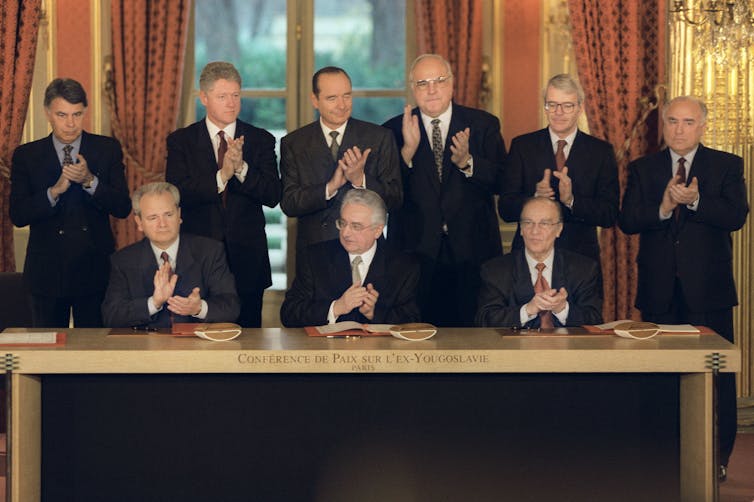
We recently marked the 30th anniversary of the signing, in an air force base in Ohio, of a treaty to bring an end to the appalling conflict in the former Yugoslavia. The Dayton accords was signed on November 21 1995 and again, in a public ceremony in Paris on December 14, by the presidents of Bosnia and Herzegovina, Croatia, and Serbia, bringing to an end three years of bloodshed and ethnic cleansing.

Two rows of men in suits clapping, including Bill Clinton and John Major
The Dayton accords, signed in December 1995, ended three years of bitter conflict in the Balkans.

International security experts Stefan Wolff of the University of Birmingham and Argyro Kartsonaki of the University of Hamburg see some useful parallels between the peace process in the Balkans and the attempts to bring an end to the war in Ukraine. The first, and arguably most vital, factor at play there was US leadership in Nato, which intervened with bombing missions to force Serbia to the table. There were robust security guarantees put in place and the treaty was a detailed (if imperfect) plan which aimed to ensure hostilities would not resume.

Thirty years on peace has largely held, although it remains tentative and the increasing confidence of Serbian separatists could still cause Bosnia and Herzegovina to disintegrate into its constituent parts, which possible horrific consequences.

But, as Wolff and Kartsonaki conclude, for all Dayton’s imperfections, “even an imperfect agreement may be preferable to an unending, and likely unwinnable, war”.


Read more:
Thirty years after the Balkans peace deal, a different US leadership is fumbling the war in Ukraine


Death in the Caribbean

To Washington, where the focus is on the sequence of events leading up to the first of the US attacks on so-called Venezuelan drug boats in the Caribbean. It was recently alleged in the Washington Post that the US secretary of war, Pete Hegseth, had given an order that there were to be no survivors of the attack on September 2, which killed 11 people – nine in the initial strike on the boat and, we’re told, the remaining two, reportedly as they clung on to the boat radioing for assistance.

The full details of the incident have yet to emerge and, as Hegseth himself has claimed, there is always a lot of confusion in “the fog of war”. That said, the secretary of war has been quick to pass responsibility for the second strike on to the ranking military officer present in the situation room, Admiral Frank M. (Mitch) Bradley.

But in a political climate in which high-ranking former US officers such as Mark Kelly, a former US navy officer and astronaut who is now a Democrat senator, could face prosecution for urging members of the US military not to obey orders that are clearly illegal, this episode is a potential flashpoint.

But in the end this incident should not obscure an arguably more important issue with the US strikes on these Venezuelan boats: international law forbids extrajudicial killing. Andrew Bell and Thomas Gift explain the issues at stake.


Read more:
US accused of killing Venezuelan drug boat survivors – Trump’s military agenda is based on impunity


Sign up to receive our weekly World Affairs Briefing newsletter from The Conversation UK. Every Thursday we’ll bring you expert analysis of the big stories in international relations.


The Conversation

ref. Why Vladimir Putin’s in no hurry for peace – https://theconversation.com/why-vladimir-putins-in-no-hurry-for-peace-271350

Pourquoi les physiciens et les philosophes ont-ils eu tant de mal à comprendre la nature du temps ?

Source: The Conversation – in French – By Daryl Janzen, Observatory Manager and Instructor, Astronomy, University of Saskatchewan

Le temps en soi n’est pas complexe à saisir : nous le comprenons, malgré notre difficulté à le décrire. Le problème réside dans la formulation : nous n’arrivons pas à définir précisément les limites de la nature du temps, tant sur le plan conceptuel que linguistique. (Donald Wu/Unsplash), CC BY

La nature du temps tourmente les penseurs depuis que les humains essaient de comprendre le monde. Intuitivement, nous savons ce qu’est le temps, mais quand nous souhaitons l’expliquer, notre esprit s’embrouille.

Le théologien saint Augustin d’Hippone, dont les écrits ont influencé la philosophie occidentale, a exposé un paradoxe en tentant de définir le temps il y a plus de 1 600 ans :

« Qu’est-ce donc que le temps ? Si personne ne m’interroge, je le sais ; si je veux répondre à cette demande, je l’ignore. »

Près de mille ans plus tôt, Héraclite d’Éphèse avait proposé une vision pénétrante de ce sujet. Voici ce qu’écrit le philosophe grec classique Platon dans son dialogue intitulé Cratyle :

« Héraclite dit que tout passe, que rien ne subsiste ; et comparant au cours d’un fleuve les choses de ce monde : Jamais, dit-il, vous ne pourrez entrer deux fois dans le même fleuve. »

À première vue, cela peut sembler constituer un autre paradoxe : comment un fleuve peut-il être à la fois le même et un autre ? Mais Héraclite éclaire son affirmation : le fleuve est une chose qui existe et qui change continuellement. Bien qu’il s’agisse du même fleuve, ce sont des eaux différentes qui s’écoulent à chaque instant.

Si le flux constant du fleuve rend la notion claire, cette vision s’applique à tout ce qui existe, y compris la personne qui entre dans le fleuve. Elle reste la même, mais chaque instant où son pied est dans le fleuve est différent.

Comment le temps peut-il sembler si évident, si intimement lié à notre expérience, et pourtant demeurer le cauchemar de tous les penseurs qui ont tenté de l’expliquer ?

Une question de formulation

La question clé n’est pas considérée comme pertinente par la plupart des physiciens. Et ce n’est pas non plus un défi que les philosophes ont réussi à relever.

Le temps en soi n’est pas complexe à saisir : nous le comprenons tous, malgré notre difficulté à le décrire. Comme l’a perçu saint Augustin, le problème réside dans la formulation : nous sommes incapables de définir exactement les limites de la nature du temps, tant sur le plan conceptuel que linguistique.

Plus précisément, les physiciens et les philosophes ont tendance à confondre ce que signifie « exister » et ce que signifie « se produire », traitant les événements comme s’ils existaient. Une fois cette distinction reconnue, le brouillard se dissipe et le paradoxe d’Augustin s’évanouit.


À lire aussi :
Qu’est-ce que l’espace-temps, exactement ?


L’origine de la question

En logique fondamentale, il n’existe pas de véritables paradoxes, mais seulement des déductions qui reposent sur des prémisses pas très bien interprétées.

Peu après qu’Héraclite a tenté de clarifier la notion de temps, Parménide d’Élée est allé dans une tout autre direction. Son raisonnement part d’une prémisse apparemment valable : « Ce qui est, est ; ce qui n’est pas, n’est pas » –, puis introduit subrepticement une hypothèse cruciale. Il affirme que le passé fait partie de la réalité parce qu’il a été vécu, et que l’avenir doit également en faire partie parce que nous l’anticipons.

Parménide en déduit que le passé et l’avenir font partie de « ce qui est » et que toute l’éternité forme un tout continu dans lequel le temps n’est qu’une illusion.

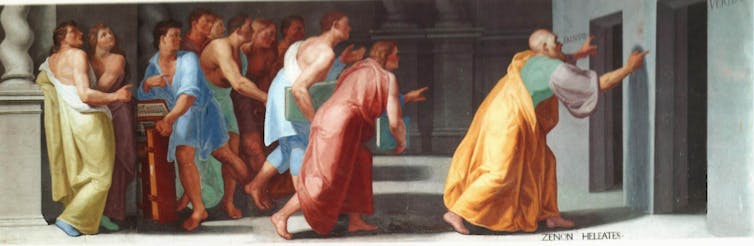
Zénon, disciple de Parménide, a imaginé plusieurs paradoxes pour étayer cette théorie. En termes modernes, il affirmerait que si vous essayiez de marcher d’un bout à l’autre d’un pâté de maisons, vous n’y arriveriez jamais. Pour parcourir un pâté de maisons, il faut d’abord en franchir la moitié, puis la moitié de ce qu’il reste, et ainsi de suite, en divisant toujours par deux la distance restante, sans jamais atteindre la fin.

Une peinture montre un homme en robe guidant d’autres hommes en robe
Le philosophe grec Zénon d’Élée montrant à ses disciples les portes de la vérité et de la fausseté dans une fresque du XVIᵉ siècle à l’Escurial, à Madrid.
(El Escorial, Madrid)

On peut évidemment marcher jusqu’au bout du pâté de maisons, et même au-delà, ce qui rend la proposition de Zénon absurde. Son erreur réside dans le fait qu’il élimine le temps de son raisonnement, ne considérant que des configurations spatiales successives. Or, la réduction des distances s’accompagne d’une réduction des intervalles de temps, les deux devenant parallèlement plus courts.

Zénon fixe implicitement le temps total disponible pour le mouvement – tout comme il fixe la distance –, et le paradoxe n’apparaît que parce que le temps a été supprimé. Rétablissons le temps, et la contradiction disparaît.

Parménide commet une erreur similaire lorsqu’il déclare que les événements passés et futurs, c’est-à-dire les choses qui se sont produites ou qui se produiront, existent. Cette hypothèse pose problème, car elle équivaut à la conclusion à laquelle il souhaite parvenir. Son raisonnement est circulaire et aboutit à réaffirmer son hypothèse, mais d’une manière qui semble différente et profonde.


Déjà des milliers d’abonnés à l’infolettre de La Conversation. Et vous ? Abonnez-vous gratuitement à notre infolettre pour mieux comprendre les grands enjeux contemporains.


Modèles d’espace-temps

Un événement est quelque chose qui se produit à un endroit et à un moment précis. Selon la théorie de la relativité d’Albert Einstein, l’espace-temps est un modèle à quatre dimensions qui décrit toutes les occurrences : chaque point est un événement particulier et la séquence continue d’événements associés à un objet forme sa ligne d’univers, c’est-à-dire son trajet dans l’espace et le temps.

Cependant, les événements n’existent pas, ils se produisent. Quand les physiciens et les philosophes parlent de l’espace-temps comme d’une chose qui existe, ils traitent les événements comme des éléments qui existent – la même erreur subtile qui est à l’origine de 25 siècles de confusion.

La cosmologie – l’étude de l’univers dans son ensembleoffre une réponse claire.

Cette science décrit un univers tridimensionnel rempli d’étoiles, de planètes et de galaxies qui existent. Au cours de cette existence, l’emplacement de chaque particule à chaque instant constitue un événement spatio-temporel individuel. Depuis la création de l’univers, les événements qui se produisent à chaque instant tracent des lignes d’univers dans un espace-temps à quatre dimensions, une représentation géométrique de tout ce qui se passe au cours de son existence. Ce modèle est utile, mais il ne représente pas une chose qui existe.


À lire aussi :
L’espace-temps n’existe pas, mais c’est un cadre qui permet de comprendre notre réalité


La résolution

Résoudre le paradoxe d’Augustin – le temps est une chose que l’on comprend intuitivement, mais que l’on ne peut décrire – est simple une fois qu’on a identifié la source de la confusion.

Les événements, c’est-à-dire ce qui se produit ou survient, ne sont pas des choses qui existent. Chaque fois que vous entrez dans le fleuve, cela constitue un événement unique. Cela se produit au cours de votre existence et de celle de la rivière. Vous et la rivière existez ; le moment où vous entrez dans la rivière se produit.

Les philosophes se penchent sur le paradoxe du voyage dans le temps depuis plus d’un siècle, mais le concept de base repose sur la même erreur subtile. L’auteur de science-fiction H. G. Wells aborde cette notion au début de son roman La Machine à explorer le temps.

En présentant son idée, le voyageur temporel passe de la description d’objets tridimensionnels, à des objets qui existent, puis à des moments sur une ligne d’univers, pour finalement considérer cette ligne comme quelque chose qui existe.

Cette dernière étape correspond précisément au moment où l’on prend la carte pour le territoire. Une fois qu’on a imaginé l’existence d’une ligne d’univers, ou même l’espace-temps, qu’est-ce qui nous empêche d’imaginer qu’un voyageur puisse s’y déplacer ?

L’occurrence et l’existence sont deux aspects fondamentalement distincts du temps : chacun est essentiel pour le comprendre pleinement, mais ils ne doivent jamais être confondus.

Pendant des millénaires, le fait de percevoir les événements comme des choses qui existent a engendré la confusion qui règne autour du temps. Considérons maintenant le temps à la lumière de cette distinction. Pensons aux choses qui nous entourent, aux diverses histoires de voyage dans le temps et à la physique de l’espace-temps.

Une fois que l’on a reconnu que nous nous trouvons dans univers tridimensionnel existant, rempli d’éléments existants, et que des événements se produisent à chaque instant au cours de cette existence cosmique – cartographiant l’espace-temps sans pour autant être la réalité –, tout s’aligne. Le paradoxe d’Augustin se dissout : le temps n’est plus mystérieux si on arrive à distinguer occurrence et existence.

La Conversation Canada

Daryl Janzen ne travaille pas, ne conseille pas, ne possède pas de parts, ne reçoit pas de fonds d’une organisation qui pourrait tirer profit de cet article, et n’a déclaré aucune autre affiliation que son organisme de recherche.

ref. Pourquoi les physiciens et les philosophes ont-ils eu tant de mal à comprendre la nature du temps ? – https://theconversation.com/pourquoi-les-physiciens-et-les-philosophes-ont-ils-eu-tant-de-mal-a-comprendre-la-nature-du-temps-270220