Life after stroke: the hidden struggle for recovery

Source: The Conversation – UK – By Siobhan Mclernon, Senior Nurse Lecturer , London South Bank University

Pranithan Chorruangsak/Shutterstock

Stroke is one of the leading causes of serious and complex adult disability; anyone reading this could be the next stroke survivor.

Every day in the UK, 240 people of all ages wake up to the effects of stroke: unable to move, see, speak or even swallow. Many survivors describe stroke as a “thief” that takes the life they once knew. Stroke affects not only the survivor but also the family, community, health services and wider economy. Although more people survive stroke than in the past, too many do so without the support needed to make meaningful recovery possible.

Six months after a stroke, 64% of survivors still have problems carrying out usual activities, 47% report anxiety or depression and 62% struggle with mobility. This pattern has been documented repeatedly in national datasets, including the UK’s Sentinel Stroke National Audit Programme, which also found that only 35.1% of eligible survivors received a six-month follow-up.

But many people live with hidden disabilities for five to eight years after a stroke, even if they appear physically well. These can include pain, fatigue, sleep problems and reduced social participation, memory loss, difficulty concentrating and sensory changes.

These long-lasting effects highlight the need for comprehensive and sustained support that matches the complexity of life after stroke. Support groups such as the Stroke Association and Different Strokes offer peer connection, information, emotional support and advocacy.

However, they cannot replace structured NHS rehabilitation, psychological care and long-term clinical follow-up, which many survivors report is inconsistent or unavailable.

What is missing for many people is reliable access to NHS-delivered therapy, mental health provision, vocational rehabilitation and regular reviews that identify ongoing or emerging needs.

There are also major practical consequences. Losing independence, being unable to return to work and facing financial pressures can have profound effects on survivors and their families. A quarter of all strokes happen in people under 65, during their most productive working years. About one third of survivors in this age group leave employment after a stroke, often resulting in significant financial instability.

This individual loss becomes a societal challenge. Stroke costs an estimated €60 billion per year across the EU (about £51 billion). Improving vocational support could help reduce this impact.

Early support means intervention as soon as someone is medically stable and beginning rehabilitation. It includes workplace assessments, gradual return-to-work planning, retraining when needed and guidance on benefits or workplace adjustments. Evidence shows that early vocational rehabilitation significantly improves return-to-work outcomes.

Traditional stroke rehabilitation includes physiotherapy, occupational therapy and speech therapy. Physiotherapy helps restore upper and lower limb movement. Speech therapy supports communication, reading and writing.

Occupational therapy helps people manage everyday tasks and rebuild cognitive skills such as working memory and flexible thinking. Despite these well-established therapies, many survivors continue to experience significant disability that affects daily functioning.

Although guidance recommends at least three hours per day of therapy delivered by rehabilitation professionals, demand vastly exceeds capacity. In reality, the average daily therapy time in many services is closer to 14 minutes.

As a result, many survivors experience gaps in long-term support, including rehabilitation, psychological care and community reintegration. Holistic, person-centred services that continue well beyond hospital discharge are essential.

Effective care must address both medical and social needs. This includes community resources such as social prescribing schemes, local neurorehabilitation hubs, peer support networks and accessible exercise programmes. It also includes caregiver support for unpaid family or friend carers through training, respite and financial guidance. Tailored rehabilitation plans are vital to ensure that support adapts as survivors’ needs change.

Innovation offers new possibilities. Technology enriched rehabilitation such as robotics, virtual reality and digital wearables can increase the intensity of repetitions, improve patient engagement and provide precise feedback on movement and performance.

The use of therapeutic robots has been shown in several trials to improve upper limb function in selected stroke patients while reducing the physical workload on therapists. Selection is typically based on clinical assessments of arm or hand impairment, cognitive capacity to follow instructions and the stage of rehabilitation.

Stroke survival has improved, but survival alone is not enough. The evidence shows that long-term disability, unmet clinical needs and preventable loss of independence continue to shape life after stroke for millions. A system built around short bursts of early rehabilitation cannot meet the needs of a condition that unfolds over years.

Improving access to therapy, psychological care, vocational support and community services is not an optional extra. It is central to giving stroke survivors the chance to rebuild their future.

Without this shift, the gap between what is possible and what people receive will continue to define life after stroke. After all, a life saved should be a life worth living.

The Conversation

The authors do not work for, consult, own shares in or receive funding from any company or organisation that would benefit from this article, and have disclosed no relevant affiliations beyond their academic appointment.

ref. Life after stroke: the hidden struggle for recovery – https://theconversation.com/life-after-stroke-the-hidden-struggle-for-recovery-266041

Why OpenAI is a prime example of the ethical limits of capitalism

Source: The Conversation – UK – By Nikhil Venkatesh, Leverhulme Early Career Fellow, University of Sheffield

izzuanroslan/Shutterstock

As OpenAI marks its tenth birthday in December 2025, it can celebrate becoming one of the world’s leading companies, worth perhaps as much as US$1 trillion (£750 billion). But it started as a non-profit with a serious moral mission – and its story demonstrates the difficulty of combining morality with capitalism.

The firm recently became a “public benefit corporation”, meaning that – in addition to performing some sort of pubic good – it now has a duty to make money for its shareholders, such as Microsoft.

That’s quite a change from the original set up.

Influenced by a movement known as “effective altruism”, a project which tries to find the most effective ways of helping others, OpenAI’s initial mission was to “ensure that artificial general intelligence […] benefits all of humanity” – including preventing rogue AI systems from enslaving or extinguishing the human race.

Being a non-profit was central to that mission. If pushing AI in dangerous directions was the best way to make money, a profit-seeking company would do it, but a non-profit wouldn’t. As CEO Sam Altman said in 2017: “We don’t ever want to be making decisions to benefit shareholders. The only people we want to be accountable to is humanity as a whole.”

So what changed?

Some argue that the company simply sold out – that Altman and his colleagues faced a choice between making a fortune or sticking to their principles, and took the money. (Many of OpenAI’s founders and early employees chose to leave the company instead.)

But there is another explanation. Perhaps OpenAI realised that to fulfil its moral mission, it needed to make money. After all, AI is a very expensive business, and OpenAI’s rivals – the likes of Google, Amazon and Meta – are vast corporations with deep pockets.

To have a chance of influencing AI development in a positive direction, OpenAI had to compete with them. To compete, it needed investment. And it’s hard to attract investment with no prospect of profit.

As Altman said of a previous adjustment towards profit-making: “We had tried and failed enough to raise the money as a non-profit. We didn’t see a path forward there. So we needed some of the benefits of capitalism.”

Capitalist competition

But along with the benefits of capitalism come constraints. What Karl Marx called the “coercive laws of competition” mean that in a competitive market, businesses have little choice but to put profit first, whatever their moral principles.

Indeed, if they choose not to do something profitable out of moral concerns, they know they’ll be replaced by a less scrupulous firm which will. This means not only that they fail as a business, but that they fail in their moral mission too.

The philosopher Iris Marion Young, illustrated this paradox with the example of a sweatshop owner who claims that they would love to treat their workers better. But the cost of improved pay and conditions would make them less competitive, meaning they lose out to rivals who treat their workers even worse. So being kinder to their workers would not do any good.

Similarly, had OpenAI held back from releasing ChatGPT due to worries about energy usage or self-harm or misinformation, it would probably have lost market share to another company. This in turn would have made it harder to raise the investment it needed to fulfil their mission of shaping AI development for good.

So in effect, even when its moral mission was supposedly paramount (before it became a public benefit corporation), OpenAI was already acting like a for-profit firm. It needed to, to stay competitive.

The recent legal transition just makes this official. The fact that a nonprofit board dedicated to the moral mission retains some control over the company in principle is unlikely to stop the drive to profit in practice. Marx’s coercive laws of competition squeeze morality out of business.

Marx and Milton

If Marx is capitalism’s most famous critic, perhaps its most famous cheerleader was the economist Milton Friedman.

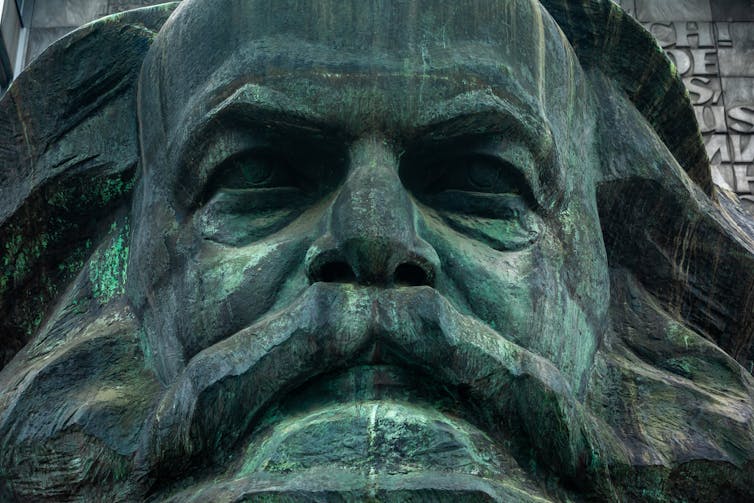
Partial view of Karl Mark bronze statue.
Karl and coercion.
christianthiel.net/Shutterstock

But Friedman actually agreed with Marx that business and morals are difficult to mix. In 1971, he wrote that business executives have only one social responsibility: to make profit for shareholders.

Pursuing any other goal would be spending other people’s money on their own private principles. And in a competitive market, Friedman argued, businesspeople will find that customers and investors can quickly switch to other companies “less scrupulous in exercising their social responsibilities”.

All of this suggests that we cannot expect businesses to do as OpenAI originally promised, and put humanity before shareholder value. Even if it tries, the coercive laws of competition will force it to seek profit.

Friedman and Marx would have further agreed that we need other types of institutions to look after humanity. Though Friedman was mostly sceptical about the state, the AI arms race is precisely the kind of case that even he recognised required government regulation.

For Marx, the solution is more radical: replacing the coercive laws of competition with a more co-operative economic system. And my own research suggests that safeguarding the future of humanity may indeed require some restraining of capitalism , to allow tech workers time to develop safe and ethical technologies together, free from the pressures of the market.

The Conversation

Nikhil Venkatesh does not work for, consult, own shares in or receive funding from any company or organisation that would benefit from this article, and has disclosed no relevant affiliations beyond their academic appointment.

ref. Why OpenAI is a prime example of the ethical limits of capitalism – https://theconversation.com/why-openai-is-a-prime-example-of-the-ethical-limits-of-capitalism-270407

Premier League football matches can be crime hotspots – but community sports centres have the opposite effect

Source: The Conversation – Global Perspectives – By Yijing Li, Senior Lecturer on Urban Informtics, King’s College London

Tottenham Hotspur Stadium in the north London borough of Haringey is the largest club ground in the capital. Joas Souza/Shutterstock

Premier League football stadiums in England can be hotspots for certain types of crime on match days, demanding a heavy police presence. But for much of the year, community sports clubs located in nearby neighbourhoods play an important role in reducing levels of crime.

Our recently published research focused on men’s match days at Tottenham Hotspur Stadium in Haringey, north London – using Haringey Council’s daily crime counts for 2023 to highlight local variations in crime on the stadium’s 23 Premier League, FA Cup and Champions League match days.

We found an average increase in all “expressive” crimes of 20 percentage points over non-match days, with drug offences also increasing significantly. Expressive crimes are those driven by emotional release and identity conflict – often fuelled by increased alcohol or drug consumption – which can lead to disorder and violence against other fans or local residents.

Our study, in conjunction with London Sport, also used the UK police’s open data portal to analyse the relationship between crime and distribution of sports clubs across the whole of London. This showed how community sports clubs serve an important protective role against crime in higher-risk neighbourhoods, such as the White Hart Lane and Hermitage & Gardens wards close to Tottenham’s stadium.

Three factors of “routine activity theory” converge to create crime opportunities on Premier League match days: a spike of people influenced by alcohol or team rivalry (“motivated offenders”); a sudden influx of large, dense crowds of opposing fans (“suitable targets”); and diverted or overwhelmed police resources by the sheer volume of people (“absence of capable guardians”).

Map of London highlighting hotspots with high levels of expressive crime and a dense distribution of community sports clubs.
Map of London highlights red hotspots with high levels of expressive crime and a dense distribution of community sports clubs. Yellow denotes areas with relatively high crime but a low density of sports clubs.
Yijing Li, CC BY-SA

Around the Tottenham Hotspur Stadium over the course of 2023, there were 33 public order offences on match days, representing 20% of all such offences in the area that year. There were also 78 drug-related offences, accounting for 47% of all drug offences in the area in 2023. The average attendance for a Spurs Premier League match is over 61,000 fans, including around 3,000 away supporters.

The crime hotspots were highly localised, spiking around transport hubs such as White Hart Lane and Bruce Grove train stations, and the Bounds Green and Woodside shuttle bus locations.

But our study also highlights the risk of police displacement when officers flood a stadium zone, meaning neighbouring areas can be left under-protected. We conclude that police forces should ensure that the “ring of steel” around a stadium on match days does not create a security vacuum in adjacent residential areas.

Crime-reducing effects of sports clubs

In many parts of London, community sports clubs play an important protective role against crime in their neighbourhoods. The White Hart Lane and Hermitage & Gardens areas around Tottenham Hotspur Stadium, for example, are recognised crime hotspots with above-average rates of violence against women and drug offences.

But our analysis shows activities organised by local sports clubs there – and throughout much of London – suppress these crimes during school term times, when the clubs are operating.

The crime-suppressing effect of community sport centres fluctuates with the calendar, however, with the effect weakening significantly in December and January when cold weather limits outdoor sports activities and the school holidays leave many young people with more unstructured, unsupervised leisure time – exacerbated by a reduction in the availability of organised club activities.

This suggests policymakers seeking to address youth crime should not only fund programmes during the summer holidays but also winter “bridge” programmes – investing in indoor facilities and youth camps during the Christmas break to maintain the social supervision structure that reduces delinquency.

However, a “one-size-fits-all” policy for sports community clubs is not advisable. We found that some sports clubs located in quiet, low-density areas of London did not show the same protective effect against crime. In these residential pockets, levels of expressive crime tended to increase slightly around the club, probably because the inflow of visitors and noise created some disruption to the local social fabric.

Sadiq Khan launches London’s Violence Reduction Unit partnership with the capital’s professional football clubs, October 2025.

Nonetheless, there is much evidence for sporting activities developing skills and traits in young people that offer deterrents against youth violence – including self-control, teamwork and cooperation, prosocial behaviour and conflict resolution skills. Taking part in sport can encourage a sense of belonging and ways of expressing stress that have positive effects on self-esteem and mental wellbeing.

Organised sports occupy the leisure time of adolescents who might otherwise engage in unstructured, risky behaviour. The community clubs provide “capable guardians” in the form of coaches and mentors offering social supervision that can be particularly lacking in high-deprivation areas.

In April 2025, London’s mayor Sadiq Khan announced the capital’s Violence Reduction Unit was investing a further £1 million to provide sports and physical activities to young people at the highest risk of being affected by violence in London. The unit is now partnering with London’s 17 professional football clubs in an attempt to provide positive opportunities for young people across the capital.

This article was commissioned in conjunction with the Professors’ Programme, part of Prototypes for Humanity, a global initiative that showcases and accelerates academic innovation to solve social and environmental challenges. The Conversation is the media partner of Prototypes for Humanity 2025.

The Conversation

This article was commissioned in conjunction with the Professors’ Programme, part of Prototypes for Humanity, a global initiative that showcases and accelerates academic innovation to solve social and environmental challenges. The Conversation is the media partner of Prototypes for Humanity 2025

Rui Wang does not work for, consult, own shares in or receive funding from any company or organisation that would benefit from this article, and has disclosed no relevant affiliations beyond their academic appointment.

ref. Premier League football matches can be crime hotspots – but community sports centres have the opposite effect – https://theconversation.com/premier-league-football-matches-can-be-crime-hotspots-but-community-sports-centres-have-the-opposite-effect-271483

South Africa and Pakistan: countries brought to their knees by elite capture and economic paralysis

Source: The Conversation – Africa – By Busani Ngcaweni, Director: Center for Public Policy and African Studies & Visiting Professor, China Foreign Affairs University, University of Johannesburg

In the ongoing quest to understand South Africa’s political and economic stagnation, it may be helpful to look at other postcolonial states that have travelled further along the path of independence. This may help clarify the stagnation question that citizens, politicians and economists are grappling with.

Much of the analysis of postcolonial Africa and Asia has identified poor leadership, authoritarianism and misguided economic policies as determinants of stagnation. These factors do matter. But they do not fully explain why some new independent states collapsed into dysfunction while others achieved growth. The deeper question is how institutions are built, sustained or destroyed.

South Africa’s stagnation is not the complete absence of growth or democracy, but the inability to convert political freedom and economic potential into sustainable and inclusive growth manifesting in quality of life for the majority.

The World Bank calls this an incomplete transition. In its 30 years of democracy review report, the South African Presidency concluded that the economy was performing below its full potential, unemployment was high, poverty levels were persistent in pockets of broader society and inequality levels were stubbornly high and racially biased.

As we read in the World Bank’s Africa’s Pulse report, these challenges continue to trouble most of the countries on the continent.

I have encountered this in my economic governance capacity building work in government and through my affiliations with local and Asian universities. There is common concern about deteriorating statecraft and the weakening of institutions.

In that connection, this essay is framed as a comparative reflection. It situates Pakistan alongside Ghana, Malaysia and Singapore, then turns to former Pakistani civil servant and now academic Ishrat Husain’s book, Governing the Ungovernable. It is a detailed case study of institutional decline.

A former governor of the central bank of Pakistan and long-time government advisor on public sector reform, Husain offers an authoritative framework against which we can understand the performance of other post-colonial states. I use this framework to mirror South Africa, showing how elite capture, institutional weakness and cycles of reversal explain its present stagnation.

I chose Pakistan because its story of “ungovernable” institutions is similar to that of South Africa, compared to Singapore, whose success story is determined by the performance of its institutions.

Ungovernabilty in Pakistan

Husain identified ungovernability as a key determinant of Pakistan’s stagnation. By ungovernability he does not mean complete disorder (although there is too much political instability in Pakistan). He uses the term to describe a state where institutions exist but fail.

Pakistan, he writes, developed

a well entrenched system in which political, bureaucratic, business and professional elites collaborate in extracting rents at the expense of the larger society (p. 41).

Every major crisis could be traced back to this governance deficit (p. 43). Need we add, in many post-colonial states in Africa and Asia, institutions are either still being formed or they do not exist.

Institutions that should deliver services instead serve rent-seeking. Tax authorities, utilities and the police used their discretion for private gain (pp. 70–72). Elites blocked reforms because they benefited from dysfunction. Even when reforms began, they were quickly undone.

Ungovernable thus means institutions exist in name but not in substance.

Husain identifies coalitions that benefit from weakness and resist reform.

  • Political dynasties dominate parties without internal democracy, using legislatures as platforms for patronage (p. 134).

  • The military intervened in 1958, 1977 and 1999, stunting civilian institutions (pp. 140–144).

  • Bureaucrats exploited their powers for rent extraction (p. 155).

  • Business and landed elites resisted taxation and defended subsidies (pp. 160–165).

  • Law enforcement was crippled by bribery and political appointments:

Law and order is bound to suffer when police officials are appointed… rather than professional competence. (p. 172).

Together, these groups made Pakistan ungovernable in practice.

Husain points to several interlocking causes: the vacuum after the death of Mohammed Ali Jinnah, Pakistan’s first governor-general (1947–48) (pp. 22–24), repeated military dominance (pp. 140–144), weak dynastic parties (p. 134), corruption across key sectors (pp. 70–80), cycles of reform and reversal (pp. 112–115), entrenched patronage networks (pp. 180–182), and a systemic governance deficit undermining taxation, energy, law and service delivery (pp. 200–210).

South Africa reflects these same patterns

South Africa’s political and economic stagnation can be defined as a prolonged period in which the state struggles to generate growth, reduce inequality and renew governance capacity, despite the presence of democratic institutions and economic potential. This challenges the theory of South African exceptionalism, as we witness the same trend of political and economic elites whose decisions result in the capture of institutions and the destruction of public value.

In South Africa, the role of economic and political elites is central to understanding institutional fragility. The Zondo Commission of Inquiry into State Capture (2018–2022) revealed how networks of political leaders, senior bureaucrats and business elites colluded to systematically weaken public institutions for private gain.

State-owned enterprises such as Eskom, Transnet and South African Airways were targeted through corrupt procurement, inflated contracts and political patronage, undermining their ability to deliver services and support economic development. The commission showed that elite capture distorted the functioning of key accountability institutions including the National Prosecuting Authority and law enforcement agencies, which were compromised to shield powerful individuals from scrutiny.

These practices eroded public trust, drained fiscal resources and entrenched political stagnation. Testimonies from the ongoing commission led by retired judge Mbuyiseli Madlanga are echoing stories told at the Zondo Commission, and now, like in Pakistan, showing the “ungovernability” of the criminal justice system.

Like in Pakistan, the police and the National Prosecuting Authority are politicised and weakened. The army, once a regional force, has declined under shrinking budgets and skills shortages. Immigration is compromised by incoherent policy, corruption at the Home Affairs department and porous borders. Local government is the weakest link, condemned by poor leadership, incompetence and failing services.

Therefore, in the South African case, ungovernability or institutional weakness cannot be explained solely by colonial legacies or structural constraints, although they do matter because the apartheid regime was corrupt. Ungovernability has been actively produced and perpetuated by elites who hollowed out institutions designed to safeguard democracy and development. They became machines of rent-seeking instead of agents of national development. They subverted the will of the people for the will of the elites who undermine accountability.

As in Pakistan, the institutions exist but fail. They are captured by elites. Reforms begin but rarely last. Why?

The comparison is instructive. Ghana fell into coups. Malaysia survived but with uneven governance. Pakistan allowed patronage to corrode its foundations. South Africa shows the same symptoms: revenue shortfalls, energy collapse, transport paralysis, policing failures, weakened defence, porous borders and failing municipalities.

Singapore deliberately built strong institutions and prospered.

Some answers

Husain warns against “sweeping reforms that collapse at each election cycle” (p. 245). Instead, he calls for “selective, sequenced and incremental reforms that enjoy broad consensus” (p. 246). The implication for South Africa is clear.

Political settlements must be reset so that institutions serve citizens rather than factions. Core institutions must be restored: courts, revenue authorities, utilities, police and prosecutors. Coalitions must be built around national goals of security, growth and fairness (p. 252).

Comparative lessons are instructive. Singapore shows the rewards of disciplined governance, while Malaysia illustrates the limits of partial reform. Above all, renewal will take decades, as decay did (p. 260).

From Pakistan’s partition in 1947 to Ghana’s independence in 1957, from the separation of Malaysia and Singapore in 1965 to South Africa’s democratic transition in 1994, post-colonial states have combined early promise with the test of institution-building. Some passed, others faltered.

Husain’s book shows that ungovernability is not chaos but the hollowing out of institutions until they exist only on paper. South Africa mirrors this reality.

The case of Pakistan also defies the idea that cultural or religious homogeneity guarantees cohesion and growth. Despite greater uniformity than many of its neighbours, Pakistan has struggled to sustain unity and development. Cohesion and growth, as Husain’s analysis confirms, are not products of identity but of politics. They depend on the presence of a developmental elite able to mobilise all productive forces in society, on effective institutions that secure delivery and accountability, and on coalitions that bring legitimacy to the national project while managing contradictions. Without these, even homogeneous nations fragment.

For South Africa, the lesson is clear. The future will not be saved by appeals to “organisational renewal” that leading political parties speak about, cultural unity or new slogans about reforms. It will be built through the deliberate reconstruction of institutions, the cultivation of developmental leadership and the forging of coalitions that sustain legitimacy across political cycles. And it requires stronger instruments of accountability and consequence management.

Only through such long and patient work can the country move from being ungovernable in practice to governable in fact.

The Conversation

Ngcaweni is affiliated with the South African Association of Public Administration and Management (SAAPAM), Faculty Expert at Singapore’s Chandler Governance Institute. He is Distinguished Fellow of the National School of Government of SA and Research Associate at the University of the Chinese Academy of Social Sciences where he reads and writes about the National and Regional Economic Development/Governance Models.

ref. South Africa and Pakistan: countries brought to their knees by elite capture and economic paralysis – https://theconversation.com/south-africa-and-pakistan-countries-brought-to-their-knees-by-elite-capture-and-economic-paralysis-265427

Terror threat in Nigeria: what the killing of a general tells us about the fight against ISWAP

Source: The Conversation – Africa (2) – By Saheed Babajide Owonikoko, Researcher, Centre for Peace and Security Studies, Modibbo Adama University of Technology

The killing of Nigeria’s Brigadier General Musa Uba, in mid-November 2025, by the Islamic State West Africa Province, ISWAP, risks boosting the morale of insurgents while demoralising Nigerian troops fighting insurgency.

The rank of brigadier general is one of the highest in the military. A brigadier general typically commands a brigade, which consists of approximately 4,000 troops. Uba was the commander of the 25 Task Force Brigade in Damboa local government area of Borno State.

The death of an officer of this rank isn’t unprecedented. But it is rare. Brigadier General Zirkushu Dzarma was killed in November 2021 with four other soldiers when ISWAP rammed a bomb-laden car into his official vehicle.

Uba’s case differs, however. He was captured – and then killed – during active engagement with the insurgents.

The circumstances around his capture and killing provide insights into two aspects of Nigeria’s security challenges. The first is that it tells us a great deal about technological adaptability of ISWAP. The second is that it highlights the weaknesses in Nigeria’s counter-terrorism efforts.

I am a scholar researching terrorism and counter-terrorism in the Lake Chad region and I have been studying ISWAP’s terror activities and Lake Chad countries’ response.

Based on this work I would argue that the capture and killing of Brigadier General Musa Uba shows two things. First, it points to ISWAP’s increased capability in rapid intelligence, surveillance and reconnaissance. Secondly, it underscores poor coordination between Nigeria’s military authority and counter-terrorism units, as well as poor technological improvements despite increased defence spending.

Accounts of what happened

According to media reports, Brigadier General Uba led his troops, along with members of the Civilian Joint Task Force, on a routine patrol in the ISWAP-dominated area of Damboa on 14 November 2025. They encountered an ambush by ISWAP around Wajiroko village. Two soldiers and two civilian task force members were killed.

The brigadier general managed to leave the point of attack but became separated from the forces and found himself alone in ISWAP territory.

He began coordinating his rescue using WhatsApp on his personal phone. As his WhatsApp messages published in the local media revealed, he had agreed with the rescue team on what to do and how to proceed. A helicopter was reportedly deployed to locate and rescue him, but he could not be found.

Three days later, ISWAP said it had captured and killed him. In its media outlet, Amaq, it claimed that as soon as it had received intelligence about the brigadier general, it deployed a group of fighters to search for him.

A key question this raises is: how did ISWAP determine Uba’s location while the army rescue team couldn’t?

I think that technology might have aided ISWAP in quickly detecting his hideout. This is based on evidence that shows ISWAP’s growing use of technology to enhance its activities in recent years. For example, it’s now using drones for intelligence, surveillance, reconnaissance and attacks. In 2022 it released video of military camps and vehicles it filmed using drones to spy on the Nigerian army and the Multinational Joint Task Force in Wajiroko.

How the military responded

News broke in the local media in the early hours of 16 November that the brigadier general leading the ambushed troop was missing. This suggested that ISWAP might have kidnapped him.

The military leadership in Abuja rebutted the news, explaining that the troops were able to fight back and force the terrorists to withdraw. They also debunked the news of the abduction of the brigadier general by ISWAP, saying he successfully led troops back to base.

ISWAP said it had captured him on the morning of 15 November. The Nigerian Army leadership released their rebuttal around 1pm the same day.

Either the military leaders were deliberately covering the truth, or they were not in close and reliable contact with their counter-terrorism units.

This raises questions about communication between the military authority and various units which leads to the issue of the battlefield communication between troops and military authority.

In contemporary warfare and counter-terrorism, troops ought to wear a Global Positioning System (GPS) device attached to their uniforms or equipment.

GPS is one component of the broader positioning, navigation and timing system, which constantly transmits the locations of troops. If something goes wrong, commanders or rescue teams can quickly see exactly where they are without waiting for calls or searching blindly.

This appears not to have been the case.

Between the evening of 14 November, when the troops were ambushed, and early in the morning of 15 November, when the brigadier general was captured, Nigerian military leadership could not evacuate him from the dangerous location despite the short distance of 88km between Maiduguri, the headquarters of Operation Hadin Kai, and Damboa.

The most likely explanation for this is that it didn’t have the necessary intelligence to do so.

This raises the question of whether Nigeria’s military has been investing enough in its technological capabilities. The country invests heavily in the military. In the 2025 budget, 6.57 trillion naira (US$4.5 billion) – about 12.45% of the total budget – was approved for security and defence. The question is whether this money is being spent in ways that equip the military to fight ever-more sophisticed insurgency groups.

With the gradual shift in terrorism and counter-terrorism towards a technology war, the Nigerian military authority must understand that investing in technological capabilities, including tracking technology, is not a luxury. It is a necessity.

The Conversation

Saheed Babajide Owonikoko does not work for, consult, own shares in or receive funding from any company or organisation that would benefit from this article, and has disclosed no relevant affiliations beyond their academic appointment.

ref. Terror threat in Nigeria: what the killing of a general tells us about the fight against ISWAP – https://theconversation.com/terror-threat-in-nigeria-what-the-killing-of-a-general-tells-us-about-the-fight-against-iswap-270644

Africa’s power grabs are rising – the AU’s mixed response is making things worse

Source: The Conversation – Africa (2) – By Richard Fosu, Lecturer in International Relations, Monash University

Hardly a month goes by without news of another unconstitutional change of government on the African continent.

These can take one of three forms.

The first is a military coup d’état or violent change of (democratically) elected government. The second is the refusal of an incumbent government to relinquish power after losing an election. And finally, manipulating constitutions to win or extend term limits of an incumbent government.

We study peace and conflict in Africa, as well as African Union law. We set out these three categories in a paper we published in 2023. In it we analysed unconstitutional changes of government in Africa between 2001 and 2022.

We found that there had been 20 coup d’états, six instances of constitutional manipulation and four attempts by incumbents to hang onto power after losing elections.

These patterns have persisted since the publication of our study. The most recent was the military takeover in Guinea-Bissau in late November 2025.

With the persistence of unconstitutional changes of government, particularly what has been described as a coup resurgence in Africa, we analysed the African Union’s stance on these three forms of regime change.

The African Charter on Democracy, Elections and Good Governance of 2007 prohibits unconstitutional changes of government. It prescribes sanctions to restore constitutional order when they occur.

We found that for the majority of coup d’états (17 out of 20 in our dataset), the AU was strict in enforcing the sanctions prescribed by the charter to restore constitutional order. However, its response to incumbents’ attempts to hang onto power after losing elections and constitutional manipulations to extend term limits has been mixed at best.


Read more:
Presidential term limits help protect democracy – long ones can be dangerous


These findings led us to look at how the AU can strengthen continental democratic mechanisms to prevent the so-called African coup belt from widening further.

We conclude from our findings that the AU needs to do two things.

Firstly, avoid unconstitutional changes of government. The way to do it is to:

  • foster a true democratic culture in African states

  • set clear rules on matters such as constitutional changes that are often manipulated by incumbents to stay in power

  • enforce these rules without fear or favour.

Secondly, the AU, the Economic Community of West African States (Ecowas) and other regional bodies must apply firm sanctions to civilian leaders who manipulate the law to stay in power, just as they do to military coup makers.

A history of coups

The euphoria that swept across Africa following independence from European colonial rule in the late 1950s and 1960s was short-lived.

Many African countries plunged into decades of political instability, socioeconomic crises and civil wars. One of the major factors that drove this period was the lack of strong systems of democratic participation and peaceful transfers of power.

With no meaningful space for inclusive political participation and peaceful transitions, military coups and countercoups, rebel movements and other violent means of ascending power became the norm.

Between 1956 and 2001, there were 80 successful coup d’états, 108 failed coup attempts and 139 coup plots in sub-Saharan Africa.


Read more:
Coups in west Africa have five things in common: knowing what they are is key to defending democracy


In 2000, African leaders decided at a summit in Togo to adopt the Lomé Declaration. This condemned coup d’états and other unconstitutional changes of government. It was the first continental instrument to lay out a framework for a collective African response to unconstitutional changes of government.

This was followed by the 2007 African charter on democracy and the Malabo Protocol on an African criminal court in 2014.

These three instruments provide for various sanctions targeted at African states and individuals complicit in breaching democratic principles.

Despite these, several African states have still recorded transitions of power that are unconstitutional. And the AU’s response has been mixed.

The AU’s mixed response

These are some of the examples we identified.

In 2010, the AU supported an international effort to remove Laurent Gbagbo after he refused to hand over power after losing elections in Côte d’Ivoire.

Yahya Jammeh’s refusal to step down from power after losing elections in 2016 in The Gambia was also met with a stern response from the AU. It said it “will not recognise” Jammeh. Ecowas considered “removing him using mililtary force” if he refused to hand over power peacefully.

But there have been some notable failures to take action.

For instance, Ali Bongo’s flawed electoral win in Gabon in 2016 did not attract concrete action from the AU. Nor was any action taken over the delayed elections in the Democratic Republic of Congo under Joseph Kabila in 2018.


Read more:
Who do Africans trust most? Surveys show it’s not the state (more likely the army)


The most glaring failure in building democratic principles in Africa has been the lack of sanctions from the AU when incumbents manipulate constitutions to extend term limits.

From Burundi to Côte d’Ivoire, through Togo to Zimbabwe, we found no evidence in our dataset where the AU has directly responded to instances of constitutional manipulations.

Yet, in recent history, constitutional manipulations have been the major precipitants of military interventions. Recent coups in Gabon, Guinea, Chad and Sudan were all preceded by constitutonal manipulation to extend or abolish term limits.

We found that when the democratic space shrinks and people feel they have no way to express dissent, the risk of popular uprisings increases. The military often seizes on these moments to intervene.

What needs to happen

The continental treaties on democracy and good governance require strict adherence to democratic principles and respect for the principles of democratic changes of government.

For them to be effective, the following steps need to be taken.

Firstly, democratic principles must be clearly defined. For instance, does amending a constitution to abolish presidential term limits to benefit an incumbent violate these principles? How about engineering the disqualification of opposition candidates through machinations like politically motivated prosecutions?

Secondly, clear rules must be established on matters like term limits.

Thirdly, the AU, Ecowas and other regional bodies must stop coddling pseudo-democrats whose conduct invites coups. They must stop supervising and endorsing sham elections that keep these leaders in power.

Finally, the AU can demonstrate its commitment to democracy and good governance by refusing to reward autocrats. This could mean not appointing autocrats to important bodies, such as the AU Peace and Security Council (which is charged with monitoring democracy and good governance on the continent), or awarding them chairmanship positions.

Dr Christopher Nyinevi, who works with the Ecowas Court of Justice in Abuja, Nigeria, is a co-author of this article.

The Conversation

Richard Fosu does not work for, consult, own shares in or receive funding from any company or organisation that would benefit from this article, and has disclosed no relevant affiliations beyond their academic appointment.

ref. Africa’s power grabs are rising – the AU’s mixed response is making things worse – https://theconversation.com/africas-power-grabs-are-rising-the-aus-mixed-response-is-making-things-worse-271137

Venezuela, Cuba y Nicaragua ante su mayor crisis: ¿se derrumbarán los autoritarismos del Caribe?

Source: The Conversation – (in Spanish) – By Tulio Alberto Álvarez-Ramos, Profesor/Investigador Instituto de Investigaciones Jurídicas de la Universidad Católica Andrés Bello. Jefe de Cátedra de Derecho Constitucional de la Universidad Central de Venezuela, Universidad Católica Andrés Bello

El presidente de Venezuela, Nicolás Maduro. StringerAL/Shutterstock

Los regímenes de Venezuela, Nicaragua y Cuba han sobrevivido a todo tipo de sanciones, crisis económicas y presiones sociales a lo largo de la historia. Aunque cada uno tiene su propia dinámica, están interconectados por alianzas políticas, económicas y de seguridad que refuerzan su resistencia. La incógnita es si este modelo se derrumba o encuentra nuevas formas de supervivencia.

Estos países, dominados por el desorden institucional, han sido evaluados como territorios sin democracia ni libertades civiles. En el Democracy Index 2024, de la Economist Intelligence Unit (EIU), aparecen clasificados como regímenes autoritarios, en los niveles más bajos del ranking global.

El Rule of Law Index señala que Cuba permanece asfixiada por un partido único, sin pluralismo político, y que Nicaragua se caracteriza por una justicia partisana, persecución a la oposición y concentración de poder en el Ejecutivo.

En conjunto, estos regímenes encarnan violaciones sistemáticas de derechos humanos, ausencia de garantías democráticas y un Estado de derecho reducido a escombros. Al entrelazarse, proyectan una advertencia para la región sobre el declive del ideal democrático.

El ocaso de la liga autoritaria

Durante años, Venezuela sostuvo a Cuba y Nicaragua con petróleo subsidiado y acuerdos de cooperación que amortiguaron el colapso de sistemas inviables. Cuba ha sido soporte estratégico del poder venezolano, controlando seguridad e inteligencia, esfuerzo ahora concentrado a mantener la servidumbre sobre su propio pueblo, a un paso de la rebelión.

Nicaragua sirvió de aliado y palanca internacional mientras el sandinismo simulaba su naturaleza de régimen forajido. Esta interdependencia ha tejido un bloque que reproduce el mismo patrón: represión de la disidencia, manipulación electoral, proscripción de prensa y medios de comunicación libres.

Por otra parte, los indicadores del Anuario Estadístico de América Latina y el Caribe 2024 de la CEPAL revelan una vulnerabilidad económica inédita. El cierre de 2025 marca la mayor debilidad común en dos décadas: Cuba proyecta una caída del PIB de -1,5 % en 2025 y un crecimiento ínfimo de 0,1 % en 2026, acompañado de crisis energética y colapso del turismo.

En Venezuela se vive una inflación desbordada y la zozobra de un pueblo privado de servicios básicos, que sobrevive con pensiones y salarios inferiores a un dólar mensual.

Entre apoyos dudosos y confrontación directa

Rusia y China han sido pilares externos del autoritarismo latinoamericano, aunque con enfoques distintos. Moscú ofrece respaldo militar y diplomático, limitado hoy por las sanciones y el desgaste económico de la guerra en Ucrania. Pekín privilegia un apoyo pragmático mediante inversiones estratégicas que permite la captura de recursos y mercados.

Estados Unidos, por su parte, manifiesta su confrontación con un masivo despliegue militar y operaciones de seguridad en el Caribe, bajo la bandera de la lucha contra el narcotráfico. Ante Nicaragua, impone sanciones contra sus funcionarios y acrecienta denuncias de violaciones de derechos humanos.

La depauperación extrema del pueblo cubano hace insostenible la narrativa que justifica el fracaso comunista como consecuencia del embargo impuesto desde 1962.

El detonante regional

En Venezuela, la crisis humanitaria, el colapso económico y la migración masiva hacen insostenible la situación. El conflicto trasciende las fronteras nacionales y se proyecta en el plano global.

En este contexto, resulta claro que Estados Unidos no depende del petróleo venezolano para sostener su economía ni su seguridad energética: con una producción cercana a 13,6 millones de barriles diarios en 2025, se mantiene como uno de los mayores productores mundiales. En contraste, Venezuela apenas alcanza entre 956 000 y 1 132 000 barriles diarios, una caída dramática frente a los más de 3 millones que producía en los años noventa.

La infraestructura petrolera venezolana está devastada: refinerías deterioradas y una capacidad de extracción reducida convierten a la industria en un símbolo de decadencia, más que en un activo estratégico. Entonces, las acciones de Estados Unidos no se explican como disputa por el control del petróleo venezolano.

Escenarios bajo otra lógica

Se detecta el interés del presidente estadounidense, Donald Trump, por activar una crisis internacional monitorizada, una narrativa de seguridad nacional que se proyecta en lo interno y sirve de justificación para medidas de dudosa constitucionalidad.

Las elecciones al Congreso se celebrarán el 3 de noviembre de 2026, con la renovación de los 435 escaños de la Cámara de Representantes, 35 del Senado y 36 cargos de gobernador, una posibilidad de desequilibrio político que Trump quiere bloquear. Partiendo de una deriva autoritaria de esa administración y un cambio de política exterior que no tiene retroceso, se plantean varias posibilidades:

  • Ruptura inminente: el desconocimiento de los resultados electorales cerró la vía negociada. La juramentación de Nicolás Maduro el pasado 10 de enero abrió un proceso de quiebre que pudo haberse contenido con una transición política. La presión norteamericana, mediante ataques selectivos contra infraestructuras vinculadas al narcotráfico, podría precipitar un derrumbe del régimen, con una primera fase marcada por la anarquía y la violencia. Luego, se instalaría un gobierno amparado por la legitimidad de las elecciones presidenciales que tuvieron lugar el 28 de julio de 2024.

  • Transición militar-constituyente: la falta de credibilidad de los negociadores dificulta un acuerdo. Nicaragua y Cuba enfrentarían presiones internas similares. Bajo un momento constituyente, factores militares podrían asumir el control y, con apoyo externo, canalizar una fuerza constituyente hacia una restauración democrática.

  • Continuidad autoritaria: la ausencia de consenso de los factores políticos y la eventual neutralización de Estados Unidos permitiría la supervivencia de los autoritarismos. Se consolidarían alianzas regionales y se intensificaría la represión interna para mantener el poder. Panorama improbable considerando el interés de la administración Trump por justificar su dinámica con la crisis caribeña.

Transición incierta, coste seguro

La definición depende de una combinación de factores. La interconexión entre Venezuela, Nicaragua y Cuba convierte cualquier ruptura en un fenómeno regional. El papel de Estados Unidos, Rusia y China es decisivo: sin un acuerdo entre ellos, la transición será altamente conflictiva.

Lo cierto es que la crisis actual no se vincula con la seguridad energética, sino que está determinada con la política interna estadounidense y la estrategia de Trump. Lo que considero inexorable es que el precio de esta guerra de autoritarismos lo seguirá pagando, en última instancia, el pueblo venezolano.

The Conversation

Tulio Alberto Álvarez-Ramos no recibe salario, ni ejerce labores de consultoría, ni posee acciones, ni recibe financiación de ninguna compañía u organización que pueda obtener beneficio de este artículo, y ha declarado carecer de vínculos relevantes más allá del cargo académico citado.

ref. Venezuela, Cuba y Nicaragua ante su mayor crisis: ¿se derrumbarán los autoritarismos del Caribe? – https://theconversation.com/venezuela-cuba-y-nicaragua-ante-su-mayor-crisis-se-derrumbaran-los-autoritarismos-del-caribe-271132

Cuando la mente avisa del peligro: morderse las uñas, procrastinar y otras formas de autosabotaje

Source: The Conversation – (in Spanish) – By Guillermo López Lluch, Catedrático del área de Biología Celular. Investigador asociado del Centro Andaluz de Biología del Desarrollo. Investigador en metabolismo, envejecimiento y sistemas inmunológicos y antioxidantes., Universidad Pablo de Olavide

New Africa/Shutterstock

Las neuronas del cerebro pueden hacernos creer cosas que no existen, se anticipan a nuestras decisiones, se activan selectivamente frente a estímulos visuales e interaccionan entre sí para guardar la información que conforma nuestra memoria. Así lo describen varios libros del neurobiólogo y divulgador Rodrigo Quian Quiroga, actualmente científico de la Institución Catalana de Investigación y Estudios Avanzados (ICREA) en el Instituto de Investigación del Hospital del Mar de Barcelona.

Esta enorme capacidad del sistema nervioso central para procesar la información que recibimos, especialmente la visual, hace que podamos adelantarnos a las consecuencias de lo que ocurre alrededor y tomar decisiones al respecto. Se considera una capacidad muy humana y esencial para nuestra supervivencia.

El autosabotaje como aviso de peligro

Cuando estamos nerviosos puede que nos sorprendamos mordiéndonos las uñas, retorciendo nuestros dedos, arañándonos esa pequeña pústula o incluso dándonos pequeños golpes con un bolígrafo o con algo más pesado. Incluso cuando tenemos que afrontar un trabajo complejo y en el que nos jugamos mucho puede que nos dé por ir aplazándolo casi hasta que no hay tiempo material para hacerlo.


GoodStudio/Shutterstock

Estos comportamientos tienen su origen en el instinto de supervivencia. O, al menos, eso es lo que propone el psicólogo clínico Charlie Heriot-Maitland. En un libro titulado Controlled Explosions in Mental Health (“Explosiones controladas en la salud mental”), el experto explora cómo el cerebro utiliza pequeños daños como dosis protectora para prevenir daños mayores. Digamos que es como si el cerebro prefiriese lidiar con la certeza de una amenaza controlada y conocida antes que afrontar un riesgo presuntamente mayor.

Diferentes formas de control de daños

La procrastinación, o eso de dejar el informe, el proyecto o la decisión esencial para el último momento, se podría ver como una defensa frente al fracaso o el rechazo y la depresión consecuente.

Por el contrario, el perfeccionismo utiliza mecanismos diferentes. El perfeccionismo requiere de hiperconcentración y atención al detalle. De esta manera intentamos aseguramos de no cometer errores y evitar el fracaso, pero exponiéndonos al riesgo del estrés y de agotamiento. Y eso también puede desembocar en un estrepitoso fracaso.

Igual ocurre con la autocrítica, que llevada al extremo engaña a la mente con una situación equivocada de control e independencia.

Todas estas actitudes responden a que nuestro cerebro demanda un mundo predecible, controlable, sin sorpresas, para asegurar la supervivencia. Y no afronta bien las situaciones poco controladas.

Un mecanismo de defensa de origen evolutivo

El gran genetista Theodosius Dobzhansky acuñó la famosa frase “nada en biología tiene sentido si no es a la luz de la evolución”. Hace referencia a que la teoría de la evolución es fundamental para comprender todos los aspectos de la biología, incluyendo también las funciones neuronales.

Somos organismos diurnos con muy pocas armas corporales. Podríamos decir que nuestra mayor arma frente a los depredadores es nuestra inteligencia y capacidad para analizar el peligro, adelantarnos a él, afrontarlo o evitarlo. No es de extrañar que el cerebro haya evolucionado para detectar el peligro en todas partes. Es cuestión de supervivencia, incluso en situaciones carentes de peligro real.

Nuestro sistema de alerta o amenaza –y hasta miedo– dispara procesos neuronales que tienden a valorar diferentes situaciones que predigan lo que va a ocurrir y que solventen la amenaza. Neurotransmisores como la noradrenalina, la dopamina o el glutamato estimulan los sentidos y la actividad neuronal para responder a la amenaza y asegurar la supervivencia.

La cruz de un sistema de alerta

El mayor problema de comportamientos de autosabotaje es que, a menudo, se convierten en profecías autocumplidas. Nuestra percepción exagerada de lo buenos que somos en algo pueden llevar a “dormirnos en los laureles” y llegar a un rendimiento inferior al que obtendríamos de haber prestado atención. En el polo opuesto, nuestro miedo a fallar puede hacer que no aceptemos retos o que evitemos situaciones que podríamos haber enfrentado sin problemas.

El daño autoinfringido y la adolescencia

Un capítulo aparte de este tema lo podemos reservar al daño autoinfligido en los adolescentes, una situación más común de lo que se suele apreciar. Entran en este tipo de daño los cortes y otras formas de autolesión en lo que se conoce como autolesiones no suicidas, o NSSI (de nonsuicidal self injury). Este tipo de comportamiento se produce generalmente en situaciones de estrés por estados afectivos negativos, ansiedad o depresión.

Podemos considerar a este tipo de comportamiento como un mecanismo defensivo del cerebro que asume un daño menor antes de afrontar una situación dolorosa que supone un daño mucho mayor. Entre estas situaciones más dolorosas estarían el abuso sexual, la depresión o la ansiedad, el bullying, el trauma, el abuso de sustancias, el divorcio de los padres y la ausencia de amigos, entre otras. Así, los opioides endógenos, como las beta-endorfinas liberadas por los pequeños daños autoinfringidos, reducirían los síntomas de depresión y ansiedad.

El caso del trastorno del espectro autista (TEA)

Caso aparte podemos encontrar en los niños con TEA. De hecho, el autismo es considerado un factor de riesgo para el desarrollo de conductas autolesivas. Estas conductas incluyen golpes en la cabeza, autocortes, autoestrangulamiento, automordeduras, autoarañazos o tirones de cabello entre otras.

Al igual que en los adolescentes, la autolesión en algunas personas con TEA cumple la función de calmar la ansiedad, responder a un colapso sensorial (ruidos, luces, olores…) o afrontar situaciones que no acaban de entender y que les provocan estrés o ansiedad. Es decir, hablamos de un mecanismo biológico de estimulación para evitar situaciones más agresivas.

Heriot-Maitland plantea terapias psicológicas conducentes a reducir la necesidad de autoinfligirse daño y, a la vez, afrontar la realidad con menos angustia y estrés. Conociendo la naturaleza del problema se puede abordar su tratamiento. Aunque en este caso, el problema radica profundamente en nuestra evolución y la necesidad de supervivencia.

The Conversation

Guillermo López Lluch es miembro de la Sociedad Española de Biología Celular, la Sociedad Española de Bioquímica y Biología Molecular, la Sociedad Española de Geriatría y Gerontología, la Society for Free Radical Research y presidente de la International Coenzyme Q10 Association. Las investigaciones realizadas por el autor están financiadas por fondos públicos provenientes del Gobierno de España, la Unión Europea o del Gobierno Autonómico de Andalucía.

ref. Cuando la mente avisa del peligro: morderse las uñas, procrastinar y otras formas de autosabotaje – https://theconversation.com/cuando-la-mente-avisa-del-peligro-morderse-las-unas-procrastinar-y-otras-formas-de-autosabotaje-271342

Día de la Inmaculada: el ‘kilómetro cero’ de la Navidad gastronómica

Source: The Conversation – (in Spanish) – By José Miguel Soriano del Castillo, Catedrático de Nutrición y Bromatología del Departamento de Medicina Preventiva y Salud Pública, Universitat de València

Las yemas son dulces de origen conventual que tradicionalmente se preparaban por estas fechas. Lecker Studio/Shutterstock

El 8 de diciembre es el Día de la Inmaculada Concepción, una de las festividades marianas más extendidas y arraigadas del calendario litúrgico. Aunque para muchos se trata simplemente de un día festivo que anuncia la llegada inminente de la Navidad, si se observa con detenimiento, esta fecha ha actuado durante siglos como un punto de inflexión cultural: marca el inicio de un tiempo de preparación, de expectación y, sobre todo, de una profunda transformación alimentaria que todavía hoy podemos rastrear en los hábitos gastronómicos de diversos países.

Así, en Colombia, la noche del 7 de diciembre, víspera de la Inmaculada Concepción de la Virgen María, se celebra el Día de las Velitas, que consiste en encender velas y compartir natillas y buñuelos. Mientras, en el sur de Italia, se conserva la costumbre de elaborar pettole o zeppoline dell’Immacolata, un dulce frito típico del 8 de diciembre.

Día de las Velitas en Colombia.

Una tradición que empieza en los conventos

En España, buena parte de la relación entre la Inmaculada y la alimentación se forjó en los conventos de clausura, muchos de los cuales llevan siglos bajo la advocación de la Purísima. La repostería conventual, una de las joyas gastronómicas españolas, surgió como una actividad económica esencial para la vida monástica. Dulces como las yemas, los mazapanes o los mantecados se elaboraban en estas fechas y comenzaban a venderse precisamente alrededor del 8 de diciembre, anticipando la llegada de la Navidad.

Yemas elaboradas por las Hermanas Clarisas.

La iconografía mariana y la gastronomía: el simbolismo del blanco

Además, la Inmaculada es la advocación que representa la pureza original de María, un concepto ligado históricamente al color blanco. Este simbolismo ha convivido durante siglos con alimentos considerados “puros” o “nutritivos”, especialmente aquellos asociados a la maternidad y la protección.

La leche, presente en numerosas escenas marianas medievales, simbolizaba alimento sagrado, vínculo entre madre e hijo. La almendra, blanca bajo su cáscara, se convirtió en base de muchos de los dulces emblemáticos de diciembre: mazapanes, peladillas o turrones. Y en algunos conventos, preparaciones como las yemas blancas o los bollos glaseados reforzaban esta estética luminosa, vinculando lo culinario a lo espiritual.

Al observar la gastronomía de diciembre desde esta óptica, aparece con claridad cómo la cultura alimentaria europea integró, durante siglos, un lenguaje religioso en aquello que se comía y en cómo se comía.

Principio del “maratón gastronómico navideño”

Aunque hoy los supermercados exhiben turrones desde octubre, la realidad antropológica es diferente. Tradicionalmente, el 8 de diciembre marcaba el principio de la decoración navideña, la compra de dulces, la preparación de platos festivos y los encuentros en torno a la mesa. Era, en la práctica, el “kilómetro cero” de la Navidad gastronómica, el inicio de lo que podríamos denominar el “maratón nutricional navideño”.

Hay razones profundas para ello. En el mundo rural, los primeros días de diciembre coincidían con la reposición de despensas para el invierno, el final de las cosechas y la matanza del cerdo. A partir de esa fecha, la comunidad podía permitirse ciertos excesos culinarios que antes hubieran sido impensables. En muchos pueblos españoles se preparaban platos colectivos, como los potajes y migas, que fortalecían la cohesión social.

La Inmaculada y el desafío nutricional del diciembre moderno

Pero si miramos esta festividad desde la perspectiva de la nutrición, aparece una contradicción interesante: el 8 de diciembre no solo inicia un ciclo de celebraciones religiosas, sino también uno de los periodos más exigentes del año para la salud alimentaria. Entre cenas de empresa, comidas familiares, dulces tradicionales y bebidas, muchos españoles consumen entre un 30 y un 50 % más de calorías en diciembre, pudiendo ganar entre unos 2 y 4 kg en Navidad debido a estos excesos. Y lo hacen justo cuando la actividad física suele disminuir por el frío o la falta de luz.

Esto plantea dos retos. El primero es la moderación: los dulces conventuales o caseros, consumidos puntualmente, no representan un riesgo significativo; el problema aparece cuando se integran en la dieta diaria durante varias semanas.

El segundo reto es la gestión de la abundancia: la apertura del ciclo gastronómico navideño invita a revisar cómo comemos y cuál es el papel cultural de estos alimentos, para encontrar un equilibrio entre tradición y salud.

Una festividad religiosa con impacto cultural, económico y alimentario

Así pues, el Día de la Inmaculada no es solo un episodio devocional: es un marcador cultural que ha influido en la tradición culinaria de España y de buena parte de América Latina durante siglos. Desde la repostería monástica hasta los dulces fritos italianos preservados en el continente americano, desde los simbolismos iconográficos hasta los desafíos nutricionales contemporáneos, esta festividad modela prácticas alimentarias que aún hoy permanecen vivas.

Cada 8 de diciembre, las mesas, en cualquier parte del mundo, siguen recordándonos que la gastronomía es un territorio donde la historia, la identidad y el placer se entrelazan. Y que, más allá de la devoción mariana, esta fecha sigue siendo el punto exacto donde comienza, simbólicamente, la Navidad.

The Conversation

José Miguel Soriano del Castillo no recibe salario, ni ejerce labores de consultoría, ni posee acciones, ni recibe financiación de ninguna compañía u organización que pueda obtener beneficio de este artículo, y ha declarado carecer de vínculos relevantes más allá del cargo académico citado.

ref. Día de la Inmaculada: el ‘kilómetro cero’ de la Navidad gastronómica – https://theconversation.com/dia-de-la-inmaculada-el-kilometro-cero-de-la-navidad-gastronomica-271053

South Africa’s water, energy and food crisis: why fixing one means fixing them all

Source: The Conversation – Africa – By Thulani Ningi, Research associate, University of Fort Hare

South Africa faces serious water, energy and food problems. Drought, overuse and ageing infrastructure strain water supplies. Coal-fired electricity is not sustainable in the long term and causes high greenhouse gas emissions. Tens of millions of people can’t afford enough food because of rising prices. These crises are interconnected: water is needed to grow food and cool power plants; and energy is needed to pump and treat water and grow food. Problems in one area affect the others. Agricultural economists Thulani Ningi and Saul Ngarava and environmental law specialist Alois Mugadza were part of a team that researched uncoordinated funding and planning in food, water and energy. They explain what needs to change.

What are South Africa’s water, energy and food problems?

Water: Millions of South Africans still don’t have reliable access to clean water, proper toilets, or steady electricity.

The country has limited water sources, and has experienced changing climate (floods and drought).

Energy: The country suffered from regular power cuts between 2007 and 2024.


Read more:
Woman-headed households in rural South Africa need water, sanitation and energy to fight hunger – G20 could help


A big part of the problem is that South Africa still depends heavily on coal for energy. The transition to green energy is slow and largely depends on individuals, businesses and families to buy solar systems. However renewables are now cheaper in many parts of the country.

Food insecurity: High levels of hunger, with about one in four families going to bed hungry, show how the system isn’t working well. About 23% of children in South Africa live in severe food poverty.

How are food, energy and water funded now?

Apart from receiving government funding, these sectors are funded by institutions like the World Bank, European Investment Bank and African Development Bank, as well as local institutions such as the Public Investment Corporation and Land Bank.

Our research found that funding decisions about water, energy and food are usually made separately.


Read more:
Africa needs to manage food, water and energy in a way that connects all three


This makes it difficult to get funding for projects that could solve problems across all three areas at once. For example, using solar power to pump water for irrigating crops could help with energy, water and food needs all at the same time.

Our research found that one of the main funding problems is that the current financing model is highly centralised. Decisions are taken in national offices about local projects. Big institutions like the Public Investment Corporation and Land Bank dominate decision-making.

Communities are rarely consulted, even though they understand their own challenges in managing drought or securing food best. They’re also not chosen to lead projects.

In addition, international funding tends to go towards big infrastructure projects, rather than helping local communities get basic services like clean water and toilets.


Read more:
South Africa’s scarce water needs careful management — study finds smaller, local systems offer more benefits


Another problem is that local municipalities sometimes lack the technical capacity, skilled personnel and financial management systems to deliver effectively. For example, a national plan to roll out solar-powered water pumps in small towns might not happen if the municipalities lack the ability to procure the pumps or maintain them.

Many municipalities are also mired in corruption and mismanagement, which undermines their ability to act on plans or use funds appropriately.

The current financing model slows down progress, wastes resources, and fails to build the resilience needed for a just transition, away from coal and towards renewable energy.

How should water, energy and food projects be funded?

Water, energy and food should be funded through financing hubs. These could pool funding from different sectors and sources specifically to support integrated projects.

Development finance institutions should also use blended finance, which means combining public and private money, to fund climate-friendly infrastructure. In practice, this works by using government or donor funds to reduce the risk for private investors. This makes solar energy, water systems, or sustainable farming projects more attractive to private investors.


Read more:
Development finance: how it works, where it goes, why it’s needed


We also suggest that decentralised funding instruments be set up. These include:

  • Provincial green funds – locally managed public funds that support environmentally friendly projects, like renewable energy or sustainable farming, within a specific province.

  • Local water, energy and food financing trusts – these would fund projects that meet the needs of specific communities.

  • Water, energy and food communities – there should be localised funding mechanisms allowing communities to self-finance and self-govern their own initiatives. Communities could come together and decide on projects, and finance these themselves. But a proper framework needs to be in place to prevent abuse of finance going to these initiatives.

  • Community development finance institutions – locally rooted financial organisations that provide loans and support to underserved communities for projects like small businesses, housing and basic services.

Banks and government agencies should check how big projects affect all three – water, energy and food – before approving a project in one area. Departments should share information, work together on projects, and keep track of money openly. These steps make the system clearer, fairer and easier to understand.

What needs to happen to get there?

Finance institutions must change how they work. Development banks should require different government departments to set up teams that work across departments. This will ensure that food, water and energy projects are rolled out in a coordinated way.


Read more:
African development banks need scale, urgently. Here’s how it can be done


Local communities should have a say in how money is used. This helps make sure funding matches both national plans and the needs of local people. Community-based organisations like stokvels, cooperatives and catchment partnerships should be explored and developed as alternative funding structures.

Finally, development finance institutions should prioritise pilot projects involving women, youth and smallholder farmers. These can highlight how local leadership drives sustainability and equity.

The Conversation

Thulani Ningi received funding for his PhD studies from the South African National Research Foundation. He is also currently employed as a Socio-Economics Manager at Conservation International, working on Behavioural Incentives for Land Transformation and Natural Grasslands research.

Saul Ngarava receives funding from Project Groundwater funded by the Lincolnshire County Council and Department for Environment, Food and Rural Affairs (DEFRA), through the Flood and Coastal Resilience Innovation Programme, which is managed by the Environment Agency, United Kingdom.

Alois Mugadza does not work for, consult, own shares in or receive funding from any company or organisation that would benefit from this article, and has disclosed no relevant affiliations beyond their academic appointment.

ref. South Africa’s water, energy and food crisis: why fixing one means fixing them all – https://theconversation.com/south-africas-water-energy-and-food-crisis-why-fixing-one-means-fixing-them-all-267374