Sí a Dios, pero no a la Iglesia: así es el cambio religioso para muchos latinoamericanos

Source: The Conversation – (in Spanish) – By Matthew Blanton, PhD Candidate, Sociology and Demography, The University of Texas at Austin
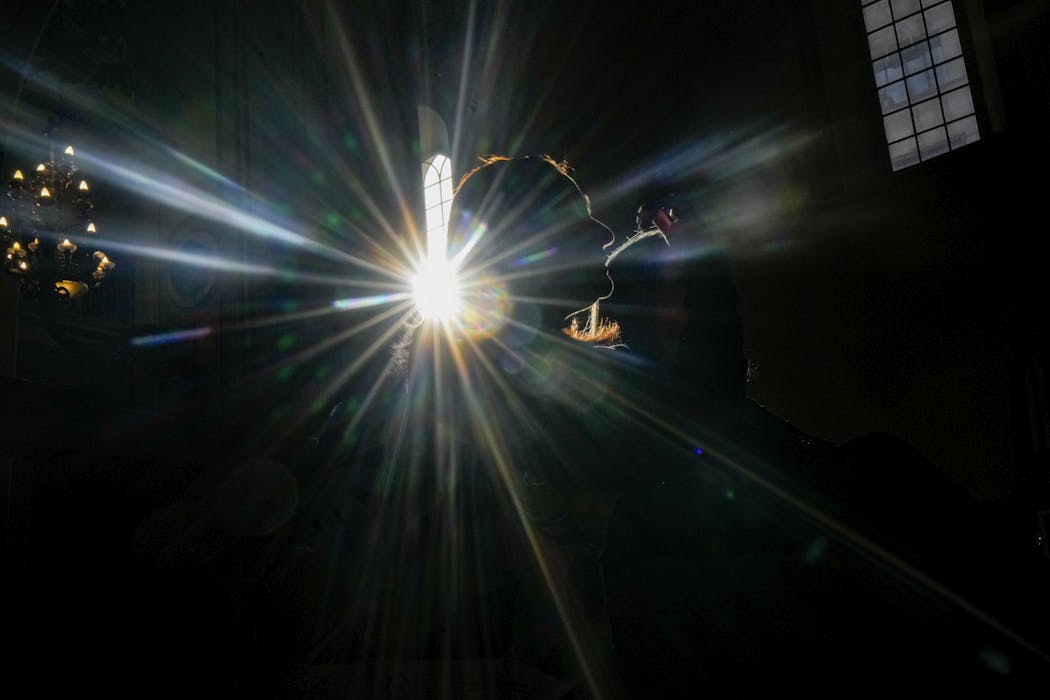
Una mujer participa en una procesión del Cristo de Mayo en Santiago de Chile, llevando en procesión por la ciudad una reliquia del crucifijo de una iglesia destruida. AP Photo/Esteban Felix

En una región conocida por sus cambios tumultuosos, algo se ha mantenido notablemente constante durante siglos: América Latina se considera católica.

La transformación de 500 años de la región en un bastión católico pareció culminar en 2013, cuando el argentino Jorge Mario Bergoglio fue elegido como el primer papa latinoamericano. América Latina es, desde entonces, el corazón de la Iglesia católica: alberga a más de 575 millones de fieles, más del 40 % de todos los católicos del mundo. Las siguientes regiones más grandes son Europa y África, cada una de las cuales alberga al 20 % de los católicos del mundo.

Aún así, el panorama religioso de la región está cambiando. En primer lugar, los grupos protestantes y pentecostales han experimentado un crecimiento espectacular. En 1970, solo el 4 % de los latinoamericanos se identificaban como protestantes; en 2014, la proporción había aumentado hasta casi el 20 %.

Pero, incluso mientras aumentaba el número de protestantes, otra tendencia ganaba terreno silenciosamente: una proporción cada vez mayor de latinoamericanos abandonaba por completo la fe institucional. Y, como muestra mi investigación, este declive religioso presenta una diferencia sorprendente con respecto a los patrones de otros lugares: aunque cada vez son menos los latinoamericanos que se identifican con una religión o asisten a los servicios religiosos, la fe personal sigue siendo fuerte.

Tres mujeres con túnicas blancas y gorros de noche junto a una gran cruz de madera.
Mujeres conocidas como ‘animeras’, que rezan por las almas de los difuntos, caminan hacia una iglesia para las festividades del Día de los Muertos en Telembi, Ecuador.
AP Photo/Carlos Noriega

Declive religioso

En 2014, el 8 % de los latinoamericanos afirmaba no profesar ninguna religión. Esta cifra es el doble del porcentaje de personas que se criaron sin religión, lo que indica que el crecimiento es reciente y proviene de personas que abandonaron la iglesia ya en la edad adulta.

Sin embargo, desde entonces no se había realizado ningún estudio exhaustivo sobre el cambio religioso en América Latina. Mi nueva investigación, publicada en septiembre de 2025, se basa en dos décadas de datos de encuestas realizadas a más de 220 000 personas en 17 países latinoamericanos. Estos datos proceden del Americas Barometer, una gran encuesta regional realizada cada dos años por la Universidad de Vanderbilt (EE. UU.) que se centra en la democracia, la gobernanza y otras cuestiones sociales. Dado que plantea las mismas preguntas sobre religión en todos los países y a lo largo del tiempo, ofrece una visión inusualmente clara de los patrones cambiantes.

En general, el número de latinoamericanos que declaran no tener afiliación religiosa aumentó del 7 % en 2004 a más del 18 % en 2023. La proporción de personas que dicen no tener afiliación religiosa creció en 15 de los 17 países, y se duplicó con creces en siete.

En promedio, el 21 % de las personas en Sudamérica dicen no tener afiliación religiosa, en comparación con el 13 % en México y Centroamérica. Guatemala, Perú y Paraguay son los países tradicionalmente más religiosos, con menos del 9 % que se identifica como sin afiliación, mientras que Uruguay, Chile y Argentina son los tres países menos religiosos de la región.

Otra pregunta que suelen utilizar los estudiosos para medir el declive religioso es la frecuencia con la que las personas acuden a la iglesia. Entre 2008 y 2023, la proporción de latinoamericanos que acuden a la iglesia al menos una vez al mes disminuyó del 67 % al 60 %. Por su parte, el porcentaje de personas que nunca acuden a la iglesia aumentó del 18 % al 25 %.

El patrón generacional es evidente. Entre las personas nacidas hasta la década de 1940, algo más de la mitad afirma acudir a la iglesia con regularidad. Cada generación posterior muestra un descenso más pronunciado, hasta llegar a solo el 35 % en el caso de los nacidos en la década de 1990. La afiliación religiosa muestra una trayectoria similar: cada generación está menos afiliada que la anterior.

Religiosidad personal

Sin embargo, en mi estudio, también examiné una medida de religiosidad menos utilizada, que cuenta una historia diferente.

Esa medida es la “importancia religiosa”: la importancia que las personas otorgan a la religión en su vida cotidiana. Podríamos considerarla como religiosidad “personal”, en contraposición a la religiosidad “institucional”, vinculada a congregaciones y denominaciones formales.
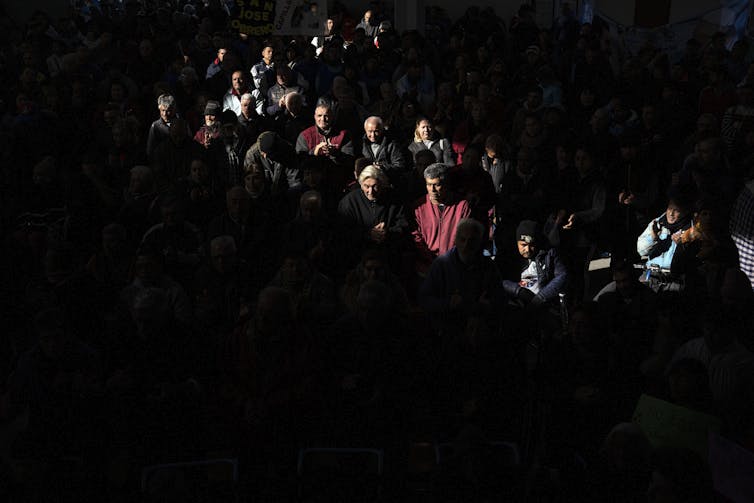
Un foco ilumina una fila en zigzag de personas que llevan chaquetas, mientras que el resto de la multitud permanece oculta en la oscuridad.
Personas asisten a una misa con motivo del Día Internacional contra el Abuso y el Tráfico Ilícito de Drogas en Buenos Aires, Argentina, el 26 de junio de 2024.
AP Photo/Rodrigo Abd

Al igual que la asistencia a la iglesia, la importancia religiosa general es alta en América Latina. En 2010, aproximadamente el 85 % de los latinoamericanos de los 17 países cuyos datos analicé dijeron que la religión era importante en su vida cotidiana. El 60 % dijo “muy importante” y el 25 % dijo “algo importante”.

En 2023, el grupo que la consideraba “algo importante” se redujo al 19 %, mientras que el grupo que la consideraba “muy importante” aumentó al 64 %. La importancia personal de la religión estaba creciendo, incluso cuando la afiliación y la asistencia a la iglesia estaban disminuyendo.

La importancia de la religión muestra el mismo patrón generacional que la afiliación y la asistencia: las personas mayores tienden a reportar niveles más altos que los jóvenes. En 2023, el 68 % de las personas nacidas en la década de 1970 afirmaron que la religión era “muy importante”, en comparación con el 60 % de las personas nacidas en la década de 1990.

Sin embargo, cuando se compara a personas de la misma edad, el patrón se invierte. A los 30 años, el 55 % de las personas nacidas en la década de 1970 calificaron la religión como muy importante. Compárese eso con el 59 % de los latinoamericanos nacidos en la década de 1980 y el 62 % de los nacidos en la década de 1990. Si esta tendencia continúa, las generaciones más jóvenes podrían acabar mostrando un mayor compromiso religioso personal que sus mayores.

Afiliación frente a creencia

Lo que estamos viendo en América Latina, en mi opinión, es un patrón fragmentado de declive religioso. La autoridad de las instituciones religiosas está disminuyendo: cada vez menos personas profesan una fe y menos asisten a los servicios religiosos. Pero las creencias personales no se están erosionando. La importancia de la religión se mantiene estable, e incluso está creciendo.

Este patrón es muy diferente al de Europa y Estados Unidos, donde el declive institucional y las creencias personales tienden a ir de la mano.

El 86 % de las personas no afiliadas en América Latina dicen creer en Dios o en un poder superior. Esto contrasta con solo el 30 % en Europa y un 69 % en Estados Unidos.

Una proporción considerable de latinoamericanos no afiliados también cree en los ángeles, los milagros e incluso están convencidos de que Jesús volverá a la Tierra durante su vida.

En otras palabras, para muchos latinoamericanos, dejar atrás una etiqueta religiosa o dejar de ir a la iglesia no significa dejar atrás la fe.

Un hombre con un colorido gorro de punto y un jersey o chaqueta brillante sostiene una pequeña muñeca con una túnica blanca rodeada de volutas de humo.
Un guía espiritual indígena aimara bendice una estatua del niño Jesús con incienso después de una misa de Epifanía en una iglesia católica de La Paz, Bolivia, el 6 de enero de 2025.
«AP

Este patrón distintivo refleja la historia y la cultura únicas de América Latina. Desde la época colonial, la región ha estado marcada por una mezcla de tradiciones religiosas. A menudo, la gente combina elementos de las creencias indígenas, las prácticas católicas y los nuevos movimientos protestantes, creando formas personales de fe que no siempre encajan perfectamente en una iglesia o institución concreta.

Debido a que los sacerdotes solían ser escasos en las zonas rurales, el catolicismo se desarrolló en muchas comunidades con poca supervisión directa de la iglesia. Los rituales domésticos, las fiestas de los santos locales y los líderes laicos contribuyeron a configurar la vida religiosa de forma más independiente.

Esta realidad pone en tela de juicio la forma en que los estudiosos suelen medir el cambio religioso. Los marcos tradicionales para medir el declive religioso, desarrollados a partir de datos de Europa occidental, se basan en gran medida en la afiliación religiosa y la asistencia a la iglesia. Pero este enfoque pasa por alto la vibrante religiosidad fuera de las estructuras formales y puede llevar a los estudiosos a conclusiones erróneas.

En resumen, América Latina nos recuerda que la fe puede prosperar incluso cuando las instituciones se desvanecen.

The Conversation

Matthew Blanton recibe fondos del Instituto Nacional Eunice Kennedy Shriver de Salud Infantil y Desarrollo Humano. El contenido es responsabilidad exclusiva de los autores y no representa necesariamente las opiniones oficiales de los Institutos Nacionales de Salud.

ref. Sí a Dios, pero no a la Iglesia: así es el cambio religioso para muchos latinoamericanos – https://theconversation.com/si-a-dios-pero-no-a-la-iglesia-asi-es-el-cambio-religioso-para-muchos-latinoamericanos-271645

Coups in Africa: how democratic failings help shape military takeovers – study

Source: The Conversation – Africa (2) – By Ernest Harsch, Researcher, Institute of African Studies, Columbia University

Mali, Burkina Faso, Niger, Guinea and Gabon have all suffered regime change in the last five years, led by men in military uniform.

Madagascar and Guinea-Bissau experienced the same fate in 2025. Benin looked to join the list in early December, but the civilian government held onto power – just.

The academic literature on coups in Africa has highlighted a wide range of influences and triggers. These include:

  • personal and institutional rifts within the armed forces

  • susceptibility to both elite manipulation and popular pressure

  • instigation by foreign powers against governments deemed hostile to their interests.

In a recent paper I added a further question: to what extent were democratic failings an element in the coups of the past six years?

I am a journalist and academic who has focused on African political and development issues since the 1970s. Among my most recently published books is Burkina Faso: A History of Power, Protest and Revolution.

In the paper I explored underlying shortcomings of Africa’s democracies as one major factor leading to military seizures. I focused on the recent coups in Mali, Guinea, Burkina Faso, Niger and Gabon.

I selected those cases because each of their takeovers was mounted against an elected civilian government. In some instances, I found, factors other than poor elections were also at play. The juntas in both Burkina Faso and Niger cited political defects of their elected, if somewhat ineffective, governments. But they mainly blamed their predecessors’ failure to put down growing jihadist insurgencies.

Insecurity was also a factor in Mali. But Mali, Guinea and Gabon all had elections commonly perceived to have been rigged or in violation of constitutional term limits. They provoked popular opposition which prompted officers to step in.

My main finding was thus that popular disappointment in elected governments was a prominent element. It established a more favourable context enabling officers to seize power with a measure of popular support.

That finding suggests that in order to better protect democracy in Africa, it is not sufficient to simply condemn military coups (as Africa’s regional institutions, such as the African Union and Economic Community of West African States, are quick to do). African activists, and some policymakers, have urged a step further: denouncing elected leaders who violate democratic rights or rig their systems to hang onto power.

If elected leaders were better held to account, then potential coup makers would lose one of their central justifications.

Problems are bigger than rigged polls

The problems, however, go beyond rigged polls, errant elected leaders, and violated constitutions. Many African governments, whether they are democratic or not, have great difficulty meeting citizens’ expectations, especially for improvements in their daily lives.

The deeper structural weaknesses of African states further contribute to hampering effective governance. As Ugandan anthropologist Mahmood Mamdani, Kenyan political scholar Ken Ochieng’ Opalo, and other African scholars have pointed out, those shortcomings include the externally oriented and fragmentary nature of the states inherited from colonial rule. These exclude many citizens from active political engagement and ensure government by unaccountable elites.

In particular, a neoliberal model of democracy has been widely adopted in Africa since the 1990s. That model insists that democracy be tethered to pro-market economic policies and greatly limit the size and activities of African states. That in turn hinders the ability of even well-elected governments to provide their citizens with security and services.


Read more:
South African protesters echo a global cry: democracy isn’t making people’s lives better


Conducting elections while continuing to subject African economies to the economic policy direction of the International Monetary Fund and World Bank has left them with a “choiceless democracy,” as Malawian economist Thandika Mkandawire termed it. That is, while voters may sometimes be able to change top leaders, they cannot alter basic economic policies. Such policies generally favour austerity and cutbacks over delivering jobs, education and healthcare.

So in addition to improving the quality of democratic systems on the continent, “coup proofing” African states will also require giving greater scope to popular input into real decision making, in both the political and economic spheres.

That will depend primarily on Africans themselves fighting for the democracies they want. Clearing the way for them means ending the all-too-common repression of street mobilisations and alternative views that displease the ruling elites.

Support for democracy

There may be general unhappiness with the flaws of Africa’s electoral systems. Surveys nevertheless demonstrate continued strong support for the ideals of democracy. Many ordinary Africans, moreover, are mobilising in various ways to advance their own conceptions of democratic practice.

For example, when the Macky Sall government in Senegal used repression and unconstitutional manoeuvres to try to prolong his tenure, tens of thousands mobilised in the streets in 2023-24 to block him and force an election that brought radical young oppositionists to power.

In Sudan, the community resistance committees that mobilised massively against the country’s military elites outlined an alternative vision of a people’s democracy encompassing national elections, decentralised local assemblies, and participatory citizen engagement.


Read more:
Africans want consensual democracy – why is that reality so hard to accept?


Findings by the Afrobarometer research network, which has repeatedly polled tens of thousands of African citizens, provide solid grounds for hope. Surveys in 39 countries between 2021 and 2023 show that 66% of respondents still strongly preferred democracy to any alternative form of government.

For anyone committed to a democratic future for Africa, that is something to build on.

The Conversation

Ernest Harsch does not work for, consult, own shares in or receive funding from any company or organisation that would benefit from this article, and has disclosed no relevant affiliations beyond their academic appointment.

ref. Coups in Africa: how democratic failings help shape military takeovers – study – https://theconversation.com/coups-in-africa-how-democratic-failings-help-shape-military-takeovers-study-271565

Roger Lumbala is accused of horrific war crimes in DRC: can his trial in France bring justice?

Source: The Conversation – Africa (2) – By Kerstin Bree Carlson, Associate Professor International Law, Roskilde University

The Democratic Republic of Congo (DRC) has been called “the worst place on earth to be a woman” and “the rape capital of the world”. A 2014 survey estimated that 22% of women and 10% of men had experienced sexual violence during the conflict in the country’s east. After years of impunity, Roger Lumbala, a 67-year-old former member of parliament who once led a rebel group in eastern DRC, is facing trial for these crimes. He is charged in a French court with complicity in crimes against humanity, including summary executions, torture, rape, pillage and enslavement. Kerstin Bree Carlson, a scholar of international criminal law and transitional justice, explains the significance of this trial and the controversies it has sparked.

What is the special war crimes chamber in Paris? And what is ‘universal jurisdiction’?

Lumbala is being tried before a special war crimes tribunal in Paris because France exercises “universal jurisdiction” over international atrocity crimes like genocide, crimes against humanity and war crimes. These are the crimes that are the remit of the International Criminal Court (ICC). Because the ICC is designed to be a court of last resort, hearing international atrocity crimes only when states cannot or will not, all ICC member states must criminalise international atrocity crimes in their domestic criminal codes.

Although courts usually only try cases against their own citizens or which occur on their own territory, France’s “universal jurisdiction” law allows it to hear cases regarding atrocity crimes committed outside France by non-French nationals. The law restricts the application of universal jurisdiction to individuals residing in France who are citizens of countries that are ICC members. Prosecutors in France’s special war crimes unit (“OCLCH”) furthermore enjoy discretion over which cases they pursue.

Prosecutions unfold as they do for any criminal case in France: a claim made by the prosecutor is sent to an investigative judge. The judge examines the claim neutrally, weighing evidence of guilt and innocence, to determine whether to issue an indictment. These findings can be appealed. When the appeals are finalised, if the indictment stands, the indicted individuals are put on trial before a panel of judges and a jury who will determine guilt (and an eventual sentence).

In addition to prosecution and defence, victims can participate in the proceedings as “civil parties”. Civil parties are full participants; they may call witnesses, address the court through argumentation, and question witnesses brought by prosecution and defence.

Lumbala’s path to the Paris court

Lumbala’s trial opened on 12 November 2025. The indictment alleges that Lumbala conspired to and was complicit in the commission of crimes against humanity in relation to Operation “Effacer le tableau” (Wipe the Slate Clean). This was a military campaign that terrorised eastern Congo in 2002-3.

The civil parties in Lumbala’s case played a central role in bringing Lumbala before the court. These include international NGOs such as TRIAL International, the Clooney Foundation for Justice, the Minority Rights Group, Amnesty International, We are not Weapons of War and others. These groups have recorded atrocity crimes in the DRC for decades, and some assisted in the 2010 Mapping report by the UN, a seminal document which detailed the extent of the violence between 1993 and 2003.

Lumbala has resided in France on and off since 2013. It was his application for asylum that put him on French authorities’ radar, and they opened an investigation into his alleged crimes in connection with his role as leader of a rebel group turned political party, Rally of Congolese Democrats and Nationalists (RCD-N). In late 2020, French authorities arrested him. Investigative judges issued an indictment against him in November 2023; that indictment was upheld by the appeals court in March 2024, leading to the opening of the trial. If convicted, Lumbala could face life imprisonment.

What is at stake in this trial?

Although a few low-level soldiers in the DRC have been tried, no high-ranking leader has been convicted for the pervasive practice of using rape as a weapon of war. A decade ago, one of Lumbala’s allies, Jean-Pierre Bemba, was prosecuted by the ICC for war crimes, including sexual violence committed in Central African Republic. Bemba’s 2016 conviction was widely celebrated as a victory for victims. His 2018 acquittal on appeal for procedural reasons was a bitter pill.

Victims wanting to address Lumbala directly have been served their own bitter pill. At the end of the first day of the trial, Lumbala announced that he did not recognise the court’s jurisdiction and would not participate in the trial. He told the court:

This is reminiscent of past centuries. The jury is French; the prosecutor is French. This court does not even know where DRC is.

Lumbala left the court and has not attended the trial since then. Every morning he is brought from jail, and sits in the basement of the court house instead of in the courtroom. He also fired his lawyers, who in turn refused to assist the court in providing a defence in absentia.

Technically, there is no problem; the trial may continue.

Symbolically, Lumbala’s absence deprives civil parties of the chance to address the defendant personally. For a victim, being able to face the alleged perpetrator as a rebalance of power is one of the purposes of trial, and contributes to justice; Lumbala’s absence may make the trial less fair for victims.

Without the participation of the defence, will the trial seem fair to others? For Lumbala and his team, who have been fighting France’s jurisdiction over this case for years, the move is in keeping with their general defence strategy of sowing doubt.

What this means for the court, and for the prosecution of universal jurisdiction cases more generally, is the larger question. If defendants can endanger judicial legitimacy by refusing to participate, it will not be the last time we see this strategy. Universal jurisdiction has been challenged in other countries: Belgium’s wide-reaching 1993 universal jurisdiction law was repealed in 2003 after a decade of practice. France’s more limited practice, akin to extraterritorial jurisdiction, is a test case for how individual countries can help support the work of the ICC. Although the ICC can investigate any case in or involving its member states, the unfulfilled arrest warrants against Russia’s Vladimir Putin and Israel’s Benjamin Netanyahu are a reminder of how difficult it can be for the ICC to take custody over defendants.

The greater significance of the Lumbala case is therefore what it may mean for France, or any country or institution, to prosecute atrocity crimes outside its borders, which will in turn have an impact on impunity for international atrocity crimes.

The Conversation

Kerstin Bree Carlson receives funding from Independent Research Fund Denmark (DFF)

ref. Roger Lumbala is accused of horrific war crimes in DRC: can his trial in France bring justice? – https://theconversation.com/roger-lumbala-is-accused-of-horrific-war-crimes-in-drc-can-his-trial-in-france-bring-justice-270482

Thiaroye massacre: report on the French killing of Senegalese troops in 1944 exposes a painful history

Source: The Conversation – Africa (2) – By Martin Mourre, Historien et anthropologue spécialisé dans les armées coloniales et postcoloniales en Afrique de l’Ouest, École des Hautes Études en Sciences Sociales (EHESS)

The Thiaroye camp near Dakar was a Senegalese army barracks housing African soldiers called “tirailleurs sénégalais” (Senegalese riflemen). It welcomed men returning from the European front of the second world war, where the riflemen had been held as German prisoners of war while serving on the side of France. They were waiting for their long-overdue back pay and bonuses.

But at dawn on 1 December 1944, they were shot by their own French officers. What should have been a time of celebration became a bloodbath. France sought to downplay or deny the massacre for many years.

In 2024, ahead of the 80th anniversary commemorations of the massacre, Senegal’s Prime Minister Ousmane Sonko appointed a commission to establish the truth of what happened, to ensure proper recognition and reparations for the victims, and to assert Senegal’s sovereignty to write its own history.

Chaired by Professor Mamadou Diouf of Columbia University, one of its tasks was to draft a new report (a white paper) on Thiaroye. This was presented to President Bassirou Diomaye Faye on 17 October 2025.

Martin Mourre, a historian and anthropologist specialising in colonial armies, has studied this issue and explains what the new report brings to light and why Thiaroye remains so sensitive.


What happened at Thiaroye?

On 21 November 1944, the first group of former prisoners of war arrived at the Thiaroye camp to be demobilised. They were owed substantial sums, mainly the back pay accumulated during their captivity.

The French army refused to give them what they were owed, even though the funds were reportedly available in Dakar.

On 27 November, tensions escalated, prompting the intervention of a senior officer. He planned a repression operation that, on 1 December, turned into a massacre.


Read more:
The time has come for France to own up to the massacre of its own troops in Senegal


Even though a number of questions remain unanswered, the event is fairly well documented. The main debate revived by the new report and echoed in the media focuses on two issues: the death toll and the burial site of the victims.

Regarding the death toll, one may rely on a literal reading of the archives, which consistently report 35 deaths (or 70 in one officer’s report, phrased in a particularly obscure way).

On this point, the white paper does not appear to go further than previous research, which supports a higher estimate of 300 to 400 deaths.

How has France responded to the Thiaroye issue over the years?

France actively sought to erase the events at Thiaroye. In the weeks following the tragedy, French officials declared, according to archival records, that adequate measures must be taken to hide these hours of madness. The language reveals a deliberate effort to downplay and conceal the atrocity.

This continued long after independence in 1960. One of the most infamous examples is the censorship of the acclaimed film The Camp at Thiaroye by Senegalese filmmakers Ousmane Sembène and Thierno Faty Sow, which failed to find distributors in France when it was released.

However, things began to change in the 2000s, particularly when President Abdoulaye Wade organised official commemorations of the massacre. For the first time, a special French ambassador attending the commemoration acknowledged the colonial army’s responsibility for the tragedy.


Read more:
Ousmane Sembène at 100: a tribute to Senegal’s ‘father of African cinema’


A more prominent gesture came in 2014 when President François Hollande visited the military cemetery. He delivered a speech and handed over a batch of archives to Senegalese President Macky Sall. He claimed – falsely, as it later turned out – that these represented all the documents France possessed on the massacre.

These archives were not available for analysis in Senegal until an executive order was issued by President Bassirou Diomaye Faye in 2024. The reason for the decade-long blockade was never adequately explained.

In 2024, President Emmanuel Macron went further than his predecessor by officially recognising events at Thiaroye as “a massacre”. A word his predecessor had avoided. Macron made this statement in a letter to Faye.

What new information does the report provide?

The main new element presented in the white paper is the initial outcome of archaeological excavations of the burial site, carried out by a team from Dakar’s Cheikh Anta Diop University. They have so far uncovered the remains of seven individuals.

All indications are that these men were victims of the massacre. Investigators highlighted the rushed and irregular nature of the graves and the burials, with bodies still dressed in military uniforms.

A black and white photo of African men in trenchcoats standing in a line with a European man in the foreground.
Senegalese Tirailleurs, 1940.
RaBoe/Wikimedia Commons, CC BY-SA

French administrative records had offered no answers about where or how the victims were laid to rest. This left the question of potential mass graves unresolved and shrouded in uncertainty.

These new findings from the report verify that victims were buried at this site. They also challenge official French narratives. The investigation continues. The archaeological team plans to expand their search, believing that more remains may lie hidden across the site.

What momentum led to the search at the grave site?

The issue of excavations of this site has a longer history. In 2017, several pan-African organisations urged Senegalese authorities to carry out such searches at Thiaroye. Among them was the party of Ousmane Sonko, today prime minister of Senegal but then a member of parliament.

Ten years earlier, during the construction of a highway crossing part of the military camp, historian Cheikh Faty Faye had already raised the issue publicly. Faye, who died in 2021, had worked on Thiaroye since the 1970s. He was part of a tradition of activist-scholars connected to pan-Africanist movements.

Through decades of commemoration and organising, these groups transformed the cemetery into a site of collective memory.


Read more:
David Diop: his haunting account of a Senegalese soldier that won the Booker prize


The cemetery holds 202 graves, roughly 30 of which stand apart from the others. To my knowledge, no scientific work has traced its origins, but it likely dates back to the first world war, when the Thiaroye camp was built.

It’s located about 1km from the camp’s main entrance. It served as the burial ground for west African riflemen from Senegal and numerous other French colonial territories who died during training. Their remains were never repatriated.

If future research confirms that the recently discovered bodies belong to the men killed on 1 December, it would be an important step towards clarifying the death toll.

What else is important in this report?

While the white paper dedicates considerable attention to the death toll, it also signals an interest in recovering the individual life stories of the Thiaroye riflemen.

Yet in my view, a crucial question remains unaddressed: the distinctly colonial character of the violence itself.

This is a form of violence inherent to the colonial context, marked by racialisation, a sense of impunity, and the distance between the colony and mainland France.

The challenge today is no longer just to document what happened at Thiaroye. It is ensure that this history is passed on to future generations. Integrating it into school curricula – anchored in rigorous scholarly work – shows how understanding the past illuminates the present and helps build a collective memory on solid foundations.

The Conversation

Martin Mourre does not work for, consult, own shares in or receive funding from any company or organisation that would benefit from this article, and has disclosed no relevant affiliations beyond their academic appointment.

ref. Thiaroye massacre: report on the French killing of Senegalese troops in 1944 exposes a painful history – https://theconversation.com/thiaroye-massacre-report-on-the-french-killing-of-senegalese-troops-in-1944-exposes-a-painful-history-271035

Newly discovered link between traumatic brain injury in children and epigenetic changes could help personalize treatment for recovering kids

Source: The Conversation – USA – By Lacey W. Heinsberg, Assistant Professor of Nursing and Human Genetics, University of Pittsburgh

The effects of traumatic brain injuries go beyond what meets the eye. Naeblys/iStock via Getty Images Plus

A newly discovered biological signal in the blood could help health care teams and researchers better understand how children respond to brain injuries at the cellular level, according to our research in the Journal of Neurotrauma.

In the future, this information could help clinicians identify children who need more tailored follow-up care after a traumatic brain injury.

Basics of epigenetics

As part of our work as a nurse scientist and neuropsychologist studying traumatic brain injury, we wanted to look for biological markers inside cells that might help explain why some children recover smoothly after brain injury while others struggle.

To do this, we focused on DNA, the instruction manual of cells. DNA is organized into regions called genes, each of which codes for proteins that carry out different functions like repairing tissues.

While your DNA generally stays the same throughout your life, it can sometimes collect small chemical changes called epigenetic modifications. These changes act like dimmer switches, turning genes up or down without changing the underlying code. In general, dialing up the activity of a gene increases production of the protein it codes for, while dialing down the gene decreases production of that protein.

Epigenetic changes play a significant role in how your body functions and develops.

One common type of epigenetic modification is called DNA methylation. DNA methylation is not fixed but can instead change in response to what you eat, how you move your body or even how stressed you are. We wondered if these epigenetic changes might also change in response to brain injury in children.

Epigenetic changes in traumatic brain injury

To explore this idea, we enrolled nearly 300 children at UPMC Children’s Hospital of Pittsburgh in our study. Of these children, 189 had a traumatic brain injury serious enough to require at least one night in the hospital, while the others had broken bones but no head injury.

We collected blood samples while they were in the hospital, and again at six and 12 months after their injury. We then measured DNA methylation in a gene called brain-derived neurotrophic factor (BDNF), which plays a role in how the brain develops and repairs.

Within approximately 30 hours of injury, children with traumatic brain injury had lower levels DNA methylation than children without brain injury. Interestingly, these differences were not connected to how severe the child’s injury appeared based on tests that health care teams use in the clinic, such as brain scans or evaluations of consciousness. This suggests that two children who look very similar to the eye may be responding to their injury differently at the cellular and epigenetic level.

Our findings also suggest that DNA methylation could help researchers understand something completely new about the brain’s response to injury that existing clinical tools cannot detect.

Doctor looking at panel of brain scans.
Brain scans don’t show what’s happening at the cellular and genetic level.
mady70/iStock via Getty Images Plus

Improving recovery after traumatic brain injury

When a child comes to the hospital with a traumatic brain injury, health care teams can assess the injury based on what it looks like and how the child is currently handling symptoms. But they cannot necessarily determine how a child’s body is responding to their injury, or what other factors put them at risk for poor recovery. That gap makes it difficult to predict which children may later experience problems with thinking, attention or behavior. Because the brains of children are still developing, early injuries can disrupt development and lead to long-term cognitive or behavioral issues.

Our findings indicate that epigenetic signals like DNA methylation might help clinicians and researchers develop more effective treatment strategies. While it’s still unclear whether these epigenetic changes influence children’s cognitive function after injury, further research could enable DNA methylation to offer a more precise guide to rehabilitation. In fact, our team is currently examining how DNA methylation patterns across all genes affect long-term outcomes in children with traumatic brain injury.

Pairing what clinicians can observe at the bedside with information at the cellular and epigenetic level can bring medicine one step closer to individualized care plans matching children with treatments that can most effectively help them heal.

The Conversation

Lacey W. Heinsberg receives funding from the National Institutes of Health.

Amery Treble-Barna receives funding from the National Institutes of Health.

ref. Newly discovered link between traumatic brain injury in children and epigenetic changes could help personalize treatment for recovering kids – https://theconversation.com/newly-discovered-link-between-traumatic-brain-injury-in-children-and-epigenetic-changes-could-help-personalize-treatment-for-recovering-kids-271453

How crime in Brazil drags down the economy and heaps economic pain on the nation’s poor

Source: The Conversation – Global Perspectives – By Robert Muggah, Richard von Weizsäcker Fellow na Bosch Academy e Co-fundador, Instituto Igarapé; Princeton University

Brazil’s “criminal economy” does not appear on any national balance sheet. Yet the cost of violence, contraband, tax evasion and environmental crime can be measured in the tens of billions of dollars every year and serves as a major drag on Brazil’s economic growth and stability.

Attempts to quantify this burden go back at least a decade. An influential 2017 study by the Inter-American Development Bank estimated that crime and violence consumes roughly 3.4% of gross domestic product across Latin America and the Caribbean, with Brazil among the worst-affected countries. A later assessment by Brazil’s own Institute for Applied Economic Research put the annual cost of violence alone at 5.9% of GDP.

Such figures are usually calculated by looking at the cost of violence and crime on the lost earnings of people killed or incarcerated through crime, the medical costs of dealing with the aftermath of violence, the increased cost of security, and the value of damaged or stolen property.

But headline figures still miss much of what never shows up in ledgers. They rarely capture the welfare cost of a homicide, the long-term earnings lost when a teen drops out of school because his neighborhood is dangerous, or the investment that never materializes because a company fears extortion or theft.

As such, some researchers contend that even a 5.9% estimate should be seen as a lower bound on the cost of violence.

In fact, a recent analysis of official statistics and private surveys suggest that once indirect losses are fully accounted for, crime may be shaving around 11% off Brazil’s annual GDP. I believe the real cost could be even higher.

Beneath these totals lies an enormous underground economy that both feeds and conceals illegality. The Underground Economy Index estimates that unregistered or informal activity accounted for 17.8% of Brazil’s GDP in 2022, or around US$313 billion.

Not all of that is criminal. For many microbusinesses, an informal economy is a survival strategy. But such a vast cash-based economy offers ideal cover for smuggling, tax fraud, counterfeit goods and money laundering, making enforcement vastly more complex.

From contraband to cargo theft

Illicit commerce now mirrors the formal economy in scale and diversity. A recent survey by the National Forum Against Piracy and Illegality found that contraband, falsification and piracy cost Brazil roughly $86 billion in 2024, including $60 billion in lost sales for legitimate companies and $25 billion in unpaid taxes.

Tobacco, clothing, fuel, electronics and pharmaceuticals were among the hardest-hit sectors. Economists caution that such figures, based on self-reported industry losses, are imprecise; however, they do underscore how deeply illegal trade has penetrated mainstream markets.

Brazil’s logistics sector offers a particularly stark illustration of how crime acts as a hidden surcharge on everyday goods. According to data compiled by the National Association of Cargo Transport and Logistics, the national haulage association, Brazil recorded 10,478 cargo thefts in 2024, with estimated losses of $221 million.

When the cost of fuel-related thefts and fraud are added, the annual losses rise to $5.34 billion. These crimes, concentrated along major freight corridors in the southeast of the country, force companies to invest in trackers, armored convoys and route changes – costs that ripple through supply chains and ultimately into final prices.

The new environmental criminal frontier

Brazil’s criminal economy also burrows into its rivers and forests. A landmark study by the Choices Institute, a Brazilian think tank, documented that between 2015 and 2020, the country traded 229 tons of gold with signs of illegality, nearly half of total production over that period.

Much of this “suspect” gold appears to originate from Indigenous territories or environmental protection areas in the Amazon. That volume is worth tens of billions of dollars, providing a ready vehicle for laundering proceeds from other illicit markets while starving the treasury of royalties and taxes.

The environmental ledger may be the most underappreciated of all. The MapBiomas Alerta project confirmed 74,218 deforestation alerts – which give authorities a heads-up on potential logging, fires or land clearance activity – in 2020 across Brazil, covering nearly 5370 square miles (13,900 square kilometers). An analysis of those alerts found that nearly all bore signs of illegality. These trends have not changed.

Deforestation in the Amazon not only eliminates trees, but it also drains the economy. A recent study by the Climate Policy Initiative estimates that Brazil’s Itaipu and Belo Monte hydroelectric plants together lose around 3,700 to 3,800 gigawatt-hours of potential generation each year because deforestation has weakened the “flying rivers” that carry moisture from the forest to the rest of Brazil.

That lost energy, enough to provide power to roughly 1.5 million people, translates into more than $184 million in foregone revenue annually.

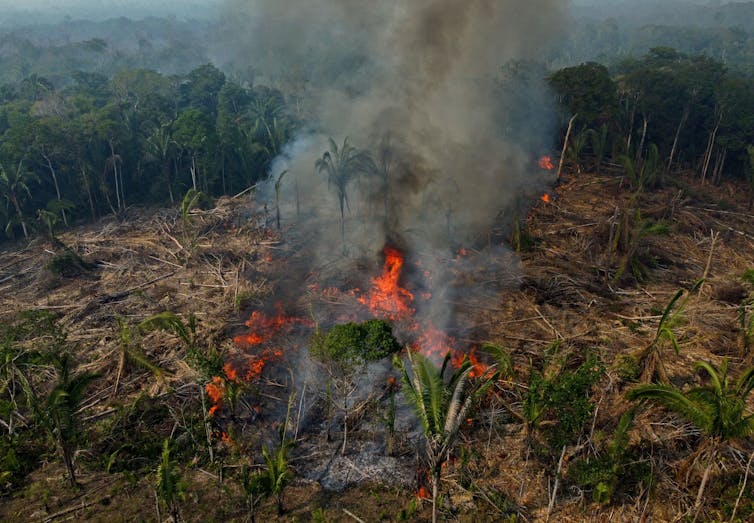
A fire is seen in a forest.
Smoke from an illegal fire in Amazon state.
Michael Dantas/AFP via Getty Images

Lawlessness is a regressive tax

No single study can capture the entirety of Brazil’s criminal economy. Still, putting together the most conservative official numbers yields a rough balance sheet.

And even a cautious estimate would put the total cost at around $239 billion to $275 billion annually – or 12% to 14% of Brazil’s GDP, by my estimate.

These costs of crime are a hidden regressive tax, falling hardest on poor Brazilians who are more exposed to violence, more dependent on public services and less able to hedge against inflation or instability.

And every dollar lost to corruption, contraband or illegal deforestation is a dollar that cannot be invested in schools, hospitals or clean energy.

Countering crime

There are, however, tentative signs that lawmakers and authorities are beginning to act on this calculus. The Finance Ministry has asked Congress to accelerate a package of bills that sharpen the definition and treatment of companies that bake systematic tax evasion into their business model, and to arm prosecutors and tax authorities with stronger tools to overcome the convoluted financial structures that shield them.

The creation of a permanent unit to fight organized crime within the Justice Ministry, bringing together federal tax authorities, federal police, public prosecutors and state-level task forces, also points to a growing recognition that criminal entities operating within the formal economy can only be reached if fiscal, financial and criminal laws are applied in a coordinated way.

In parallel, national authorities have signaled an intention to negotiate a new cooperation framework with Washington centered on information-sharing around money laundering, arms trafficking and large-scale tax fraud – embedding the fight against organized crime more explicitly in bilateral economic talks.

And recent enforcement actions offer a glimpse of what a more systemic approach looks like in practice. In August 2025, [federal and state police] cracked down on a national criminal network that used a fintech “shadow bank” and at least 40 investment funds to launder illegal transactions involving roughly 1,000 gas stations from 2020 to 2024.

Then, in November, Brazilian authorities executed 126 search and seizure warrants in five states and secured judicial orders to freeze more than $1.8 billion in assets relating to criminal activities.

These measures suggest that Brazil’s institutions – and the lawmakers who shape them – are beginning to treat crime not as an unavoidable backdrop to economic life, but as a macroeconomic distortion that can, and should, be confronted head-on.

This is a translation of an article for The Conversation Brazil. The Portuguese language version can be found here.

The Conversation

Dr. Robert Muggah is affiliated with the Igarapé Institute and SecDev.

ref. How crime in Brazil drags down the economy and heaps economic pain on the nation’s poor – https://theconversation.com/how-crime-in-brazil-drags-down-the-economy-and-heaps-economic-pain-on-the-nations-poor-271600

Even ‘weak’ cyclones are being turned into deadly rainmakers by fast-warming oceans

Source: The Conversation – UK – By Ligin Joseph, PhD Candidate, Oceanography, University of Southampton

The final week of November was devastating for several South Asian countries. Communities in Sri Lanka, Indonesia and Thailand were inundated as Cyclones Ditwah and Senyar unleashed days of relentless rain. Millions were affected, more than 1,500 people lost their lives, hundreds are still missing, and damages ran into multiple millions of US dollars. Sri Lanka’s president even described it as the most challenging natural disaster the island has ever seen.

When disasters like this happen, the blame often falls on a failure in early warnings or poor preparedness. This was the case with major floods in Kerala, south India, in 2018, which devastated my hometown.

But this time, the forecasts were largely accurate; the authorities knew the storms were coming, yet the devastation was still immense.

So, if the forecasts were good enough, why were the impacts still so severe?

Weak winds, extreme rain

One emerging explanation is that these storms were not dangerous because of their winds, but because they produced unusually intense rainfall.

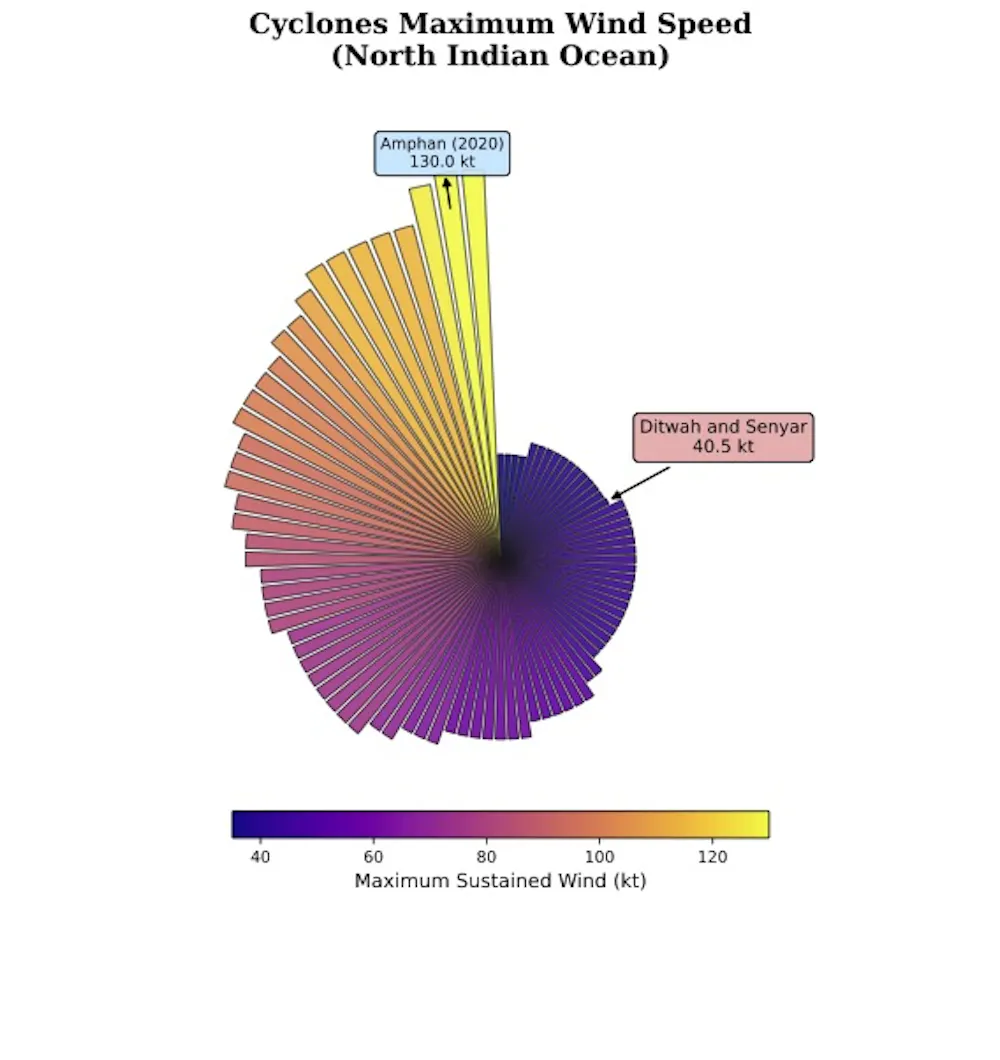
Graph of wind speeds
This graph of all cyclonic storms over the north Indian Ocean since 2001 shows Ditwah and Senyar weren’t particularly windy. (Wind speed measured in knots. 1 knot is about 1.15 mph or 1.85 kph)
Ligin Joseph (data: IBTrACS), CC BY-SA

Consider Cyclone Ditwah. Its peak winds were around 75 km/h (47 mph). That’s windy, but nothing special. In the UK, it would be classified merely as a “gale” rather than a “storm”. It was far weaker than the 220 km/h winds of the powerful 1978 cyclone that also struck Sri Lanka. Yet Ditwah still caused massive devastation.

What explains this apparent contradiction? It’s too early to say definitively, but climate change is likely a part of the story. Even when storms are not especially strong in wind terms, the amount of rain they carry is increasing.

A warmer atmosphere holds more water

A well established meteorological rule helps explain why. For every degree of global warming, the atmosphere can hold about 7% more moisture.

As the planet warms, the air above us becomes a larger reservoir, waiting to dump more water on us. When storms form, they can tap into this expanded supply, often in extremely short bursts. Even if wind speeds are modest, the rainfall alone can be catastrophic.

The oceans matter even more

Warming oceans play an even more powerful role, as cyclones draw their energy from warm ocean waters. Satellite data from late November shows just how warm the eastern Indian Ocean was, with large areas more than 1°C above normal during Ditwah and Senyar.

Coloured map of Indian Ocean and SE Asian seas
In the days before the cyclones formed (20–24 November), the oceans were even warmer than usual, creating conditions that could have fuelled and intensified the rainfall.
Ligin Joseph (Data: OISST; track positions are approximate), CC BY-SA

Such warm anomalies are no longer unusual. The oceans have absorbed more than 90% of the excess heat trapped by greenhouse gases, and long-term observations show a clear upward trend in ocean temperatures.

That doesn’t necessarily mean cyclones are becoming more frequent – their formation still depends on other ingredients, such as low wind shear (small differences in wind speed and direction with height) and the right atmospheric structure.

What warmer oceans do change, however, is the amount of energy available to any storm that does manage to form. When the ocean is warmer, cyclones have more fuel and evaporation increases, loading the atmosphere with moisture that can fall as intense rain once a storm develops. Even weak cyclones can therefore hold exceptional amounts of rain.

Coloured map of Indian Ocean and SE Asian seas
Evaporation averaged for 26–27 November. Ditwah especially travelled over warm waters supplying large amounts of moisture to the atmosphere.
Ligin Joseph (Data: ERA5), CC BY-SA

The winds near the surface help this process along. As they move across the ocean, they sweep away the moisture-filled air just above the water and replace it with drier air, allowing evaporation to continue. Put together, warmer oceans, higher evaporation, and an atmosphere that can store more moisture, these factors can significantly intensify the rainfall associated with cyclones.

Coastline hugging makes flooding worse

Local geography amplified these effects. Both Ditwah and Senyar formed unusually close to land and travelled along the coastline for an extended period. This meant they stayed over warm waters long enough to continuously draw moisture, but remained close enough to land to dump that moisture as intense rainfall almost immediately.

Cyclone Ditwah, in particular, moved slowly as it approached Sri Lanka. Slow-moving storms can be especially dangerous as they repeatedly dump rain over the same area. Even if winds are weak, this combination of warm seas, coastal proximity and slow forward speed can be devastating.

A new threat

These storms suggest that climate change – especially ocean warming – is reshaping the risks posed by cyclones. The most dangerous storms may no longer simply be the ones with the strongest winds, but also the ones with the most moisture.

Forecasting systems, including new AI-powered weather models, are getting better at predicting cyclone tracks and wind speeds. Yet rainfall-driven flooding remains far harder to forecast. As oceans continue to warm, governments and disaster agencies will need to prepare for storms that may be weak in wind but extreme in rain.

These insights are based on preliminary analysis and emerging scientific understanding. More detailed peer-reviewed studies will be needed to pinpoint exactly why Ditwah and Senyar produced such extreme rainfall. But the pattern that is emerging – weak cyclones delivering outsized floods in a warming world – must not be ignored.

The Conversation

Ligin Joseph receives funding from the UK’s Natural Environment Research Council (NERC).

ref. Even ‘weak’ cyclones are being turned into deadly rainmakers by fast-warming oceans – https://theconversation.com/even-weak-cyclones-are-being-turned-into-deadly-rainmakers-by-fast-warming-oceans-271550

New US national security strategy adds to Ukraine’s woes and exacerbates Europe’s dilemmas

Source: The Conversation – UK – By Stefan Wolff, Professor of International Security, University of Birmingham

Ukraine is under unprecedented pressure, not only on the battlefield but also on the domestic and diplomatic fronts.

Each of these challenges on their own would be difficult to handle for any government. But together – and given there is no obvious solution to any of the problems the country is facing – they create a near-perfect storm.

It’s a storm that threatens to bring down Ukrainian president Volodymyr Zelensky’s government and deal a severe blow to Ukraine’s western allies.

On the frontlines in eastern Donbas, Ukraine has continued to lose territory since Russia’s summer offensive began in May 2025. The ground lost has been small in terms of area but significant in terms of the human and material cost.

Between them, Russia and Ukraine have suffered around 2 million casualties over the course of the war.

Perhaps more importantly, the people of Ukraine have endured months and months during which the best news has been that its troops were still holding out despite relentless Russian assaults. This relentless negativity has undermined morale among troops and civilians alike.

As a consequence, recruitment of new soldiers cannot keep pace with losses incurred on the frontlines – both in terms of casualties and desertions.

Moreover, potential conscripts to the Ukrainian army increasingly resort to violence to avoid being drafted into the military. A new recruitment drive, announced by the Ukrainian commander-in-chief, Oleksandr Syrsky, will increase the potential for further unrest.

Russia’s air campaign against Ukraine’s critical infrastructure continues unabated, further damaging what is left of the vital energy grid and leaving millions of families facing lengthy daily blackouts.

The country’s air defence systems are increasingly overwhelmed by nightly Russian attacks, which are penetrating hitherto safe areas such as the capital and key population centres in south and west. It’s a grim outlook for Ukraine’s civilian population who are now heading into the war’s fourth winter. A ceasefire, let alone a viable peace agreement, remains a very distant prospect.

The political turmoil that has engulfed Zelensky and his government adds to the sense of a potentially catastrophic downward spiral. There have been corruption scandals before, but none has come as close to the president himself.

The amounts allegedly involved in the latest bribery scandal – around US$100m (£75 million) – are eye-watering at a time of national emergency. But it is also the callousness of Ukraine’s elites apparently enriching themselves that adds insult to injury.

The latest scandal has also opened a potential Pandora’s box of vicious recriminations. As more and more members of Zelensky’s inner circle are engulfed in corruption allegations, more details of how different parts of his administration benefited from various schemes or simply turned a blind eye are likely to emerge.

This has damaged Zelensky’s own standing with his citizens and allies. What has helped him survive are both his track record as a war leader so far and the lack of alternatives.

Without a clear pathway towards a smooth transition to a new leadership in Ukraine, the mutual dependency between Zelensky and his European allies has grown.

Whose side is the US on anyway?

The US under Donald Trump is no longer, and perhaps never has been, a dependable ally for Ukraine. What is worse, however, is that America has also ceased to be a dependable ally for Europe.

America’s new national security strategy, published last week, has exploded into this already precarious situation and has sent shockwaves across the whole of Europe. It casts the European Union as more of a threat to US interests than Russia.

It also threatens open interference in the domestic affairs of its erstwhile European allies. And crucially for Kyiv, it outlines a trajectory towards American disengagement from European security.


Read more:
What the US national security strategy tells us about how Trump views the world


This adds to Ukraine’s problems – not only because Washington cannot be seen as an honest broker in negotiations with Moscow. It also decreases the value of any western security guarantees. In the absence of a US backstop, the primarily European coalition of the willing lacks the capacity, for now, to establish credible deterrence against future Russian adventurism.

ISW map showing the state of the conflict in Ukraine, December 7 2025.
The state of the conflict in Ukraine, December 7 2025.
Institute for the Study of War

Efforts by the coalition of the willing cannot hide the fact that a fractured European Union whose key member states, like France and Germany, have fragile governments that are challenged by openly pro-Trump and pro-Putin populists, is unlikely to step quickly into the assurance gap left by the US. The twin challenge of investing in their own defensive capabilities while keeping Ukraine in the fight against Russia to buy the essential time needed to do so creates a profound dilemma.

Can Europe and Ukraine go it alone?

Without the US, Ukraine’s allies simply do not have the resources to enable Ukraine to even improve its negotiation position, let alone to win this war. In a worst-case scenario, all they may be able to accomplish is delaying a Ukrainian defeat.

But this may still be better than a peace deal that would require enormous resources for Ukraine’s reconstruction, while giving Russia an opportunity to regroup, rebuild and rearm for Putin’s next steps towards an even greater Russian sphere of influence in Europe.

At this moment, neither Zelensky nor his European allies can therefore have any interest in a peace deal negotiated between Trump and Putin.

A resignation by Zelensky or his government is unlikely to improve the situation. On the contrary, it is likely to add to Ukraine’s problems. Any new government would be subject to the most intense pressure to accept an imposed deal that Trump and Putin may be conspiring to strike.

Eventually, this war will end, and it will almost certainly require painful concessions from Ukraine. For Europe, the time until then needs to be used to develop a credible plan for stabilising Ukraine, deterring Russia and learning to live and survive without the transatlantic alliance.

The challenge for Europe is to do all three things simultaneously. The danger for Zelensky is that – for Europe – deterring Russia and appeasing the US become existential priorities in themselves and that he and Ukraine could end up as bargaining chips in a bigger game.

The Conversation

Stefan Wolff is a past recipient of grant funding from the Natural Environment Research Council of the UK, the United States Institute of Peace, the Economic and Social Research Council of the UK, the British Academy, the NATO Science for Peace Programme, the EU Framework Programmes 6 and 7 and Horizon 2020, as well as the EU’s Jean Monnet Programme. He is a Trustee and Honorary Treasurer of the Political Studies Association of the UK and a Senior Research Fellow at the Foreign Policy Centre in London.

Tetyana Malyarenko receives funding from the Elliott School of International Affairs, George Washington University and the Research Council of Norway (project WARPUT, 361835, implemented by Norwegian Institute of International Affairs).

ref. New US national security strategy adds to Ukraine’s woes and exacerbates Europe’s dilemmas – https://theconversation.com/new-us-national-security-strategy-adds-to-ukraines-woes-and-exacerbates-europes-dilemmas-271556

RT India: how the Kremlin is spreading its ‘west v the rest’ narrative to a global audience

Source: The Conversation – UK – By Precious Chatterje-Doody, Senior Lecturer in Politics and International Studies, The Open University

On a recent visit to India, Vladimir Putin personally announced the launch of RT India, a new Kremlin-funded broadcaster. It is part of the established RT (formerly Russia Today) network. After Russia’s full-scale invasion of Ukraine, RT lost its license to broadcast in the UK, was banned in the EU and was forced to close in the US.

But the closure of RT’s western broadcast operations did not mark the end for the network. It has been using creative tactics to reach western audiences, including allegedly covertly funding Conservative influencers in the US.

As the launch of RT India shows, it has also been reorienting towards audiences further afield. Based on our prior research, we know how RT tailors its operations for different audiences, and how it adapts to changing political realities.

This means we can start to unpack where the launch of RT India falls within Russia’s broader information strategy, and what we can expect from it.

The first important point is that RT India didn’t come from nowhere. It’s part of Russia’s broader “turn to the south”. This approach has followed the steady deterioration of relations between Moscow and western capitals, especially since the full-scale invasion of Ukraine.

RT, for its part, has targeted non-western audiences for years. RT Arabic was launched in 2007, and RT en Español – highly active in Latin America – in 2009. Yet the partial loss of western markets after the invasion of Ukraine has led RT to redirect resources from its stable budget (31 billion rubles, or about £303 million in 2025) towards new target audiences.

Sub-Saharan Africa – a Russian priority since the late 2010s – is a notable example. Both RT’s French and English-language channels have substantially increased their Africa-focused content, and dozens of cooperation agreements have been signed with African media outlets. RT Brasil, RT’s Portuguese-language site, was launched in February 2023. The @RT_India_news account on X was created in September 2022, well before the launch of the RT India television channel.

RT has spent a lot of time, effort and money honing its craft. It knows how to package its content so that it doesn’t look like a Russian influence operation.

One common strategy is platforming presenters that the audience knows and trusts. For US audiences, this included Occupy’s Abby Martin and William Shatner of Star Trek fame.

In the UK, political personalities like ex-SNP leader the late Alex Salmond (who paused his show after the full-scale invasion) and politician and former Celebrity Big Brother contestant, George Galloway, who still frequently appears on RT. On RT India, it’s Bollywood star Anupam Kher and politician and author Shashi Tharoor.

Another key objective for RT is building a shared identity with the audience. For RT America and RT UK, this was by appealing to people who saw themselves as critical thinkers, prepared to challenge the untrustworthy “establishment”. For RT India, it’s a similar idea. But the untrustworthy “establishment” isn’t domestic, it’s global – and specifically, western.

West v the rest

Our ongoing research indicates that, as with the RT channels targeting audiences in places like Latin America, Africa and the Middle East, RT India revives Russia’s Soviet-era anti-colonial strategic narrative.

This rhetoric frames contemporary Russian foreign policy as a continuation of Soviet anti-imperialist engagement, and accuses the “collective west” of neocolonial intentions. It argues for strengthening ties across the so-called “world majority” of states that see themselves as disadvantaged in an international system that favours the “collective west”.

It ignores the privileges that Russia enjoys within this system (such as permanent UN Security Council membership and veto power), and advocates for a multipolar, “de-westernised” international order.

These narratives are reflected in RT India’s advertising campaigns. In late 2023 to early 2024, its first campaign featured billboards stating, “Why does the west still see India as a third-world country?” and, “They think you believe, we believe you think,” with images of 10 Downing Street and the White House in the background.

The 2025 launch campaign for the TV channel, displayed in airports, metro stations and along major roads in Delhi, Mumbai, Kolkata, Bengaluru, Chennai and Hyderabad, presented RT as “A new voice from an old friend”. Its bio on X describes it as, “Not anti-western … just not western,” reinforcing the “west v the rest” framing.

When it comes to the war in Ukraine, RT amplifies the narratives promoted by the Kremlin and ruling Russian elites. On RT India, Russia’s aggression against Ukraine is routinely framed as a defensive “special operation” aimed at protecting Russian-speaking populations from what it calls the “Kiev regime”.

Western support for Ukraine is framed as neo-colonial warmongering. By tapping into ongoing social debates about the horrors of European colonialism, this alternative and misleading representation of the conflict becomes relatable.

It’s true that India has a history of friendly relations with Russia – and the Soviet Union before that. And the evils of European colonialism should not be denied. But Putin didn’t personally launch RT India just to make these points. What is more, the imperial nature of Russia’s relations with Ukraine is something that RT India certainly won’t acknowledge.

Now, as ever, the RT network is selectively representing the world to try and build support for the Kremlin’s international goals.

The Conversation

Precious Chatterje-Doody is PI for the ‘War and Order’ research project funded by UKRI Network Plus ‘Shifting Global Polarities: Russia, China, and Eurasia in Transition’.

Maxime Audinet is co-investigator for the ‘War and Order’ research project funded by UKRI Network Plus ‘Shifting Global Polarities: Russia, China, and Eurasia in Transition’”. His research conducted within the research chair on ‘Influence and Counter-Influence Strategies in the Digital Environment’ at INALCO is supported by the French National Research Agency (ANR) and the French Ministry of Higher Education and Research

ref. RT India: how the Kremlin is spreading its ‘west v the rest’ narrative to a global audience – https://theconversation.com/rt-india-how-the-kremlin-is-spreading-its-west-v-the-rest-narrative-to-a-global-audience-271416

As online GP use overtakes phone calls, who’s being left behind?

Source: The Conversation – UK – By Helen Atherton, Professor of Primary Care Research, University of Southampton

Pikselstock/Shutterstock.com

There are more than 1.4 million appointments a day in general practice in England. Traditionally, patients booked by telephone, braving the “8am scramble”. However, a higher proportion of people are now contacting their GP surgery online than by phone, according to new data from the Office for National Statistics.

The UK government recently instructed GP surgeries to offer online consultations from 8am to 6.30pm every day. Online consultation allows patients to explain their problem online. The online forms are checked, and patients are then spoken to on the phone or invited in for an appointment if needed.

Different GP surgeries use different online consultation tools, so you might not use the same system as friends or family.

Using online consultation requires internet access and the ability to write about your problem. This is easy for some people, but more difficult for others. Research shows that people living in the most deprived areas are less likely to be aware of or use online GP services.

This “deprivation gradient” is worrying because those who are worst off often have the greatest health needs. We cannot be sure that the increase in contacts with GP surgeries means everyone who needs care is actually getting it.

When researchers have looked at who uses online consultation, it is most popular with women, younger people, those in employment and people with long-term conditions. Having used the GP website before and being a frequent internet user also increases the likelihood of using online services. These groups probably make up a large share of those counted by the Office for National Statistics.

The NHS app on a phone screen.
The UK government instructed GPs to offer online consultations during working hours.
frank333/Shutterstock.com

Barriers

Some barriers are obvious – not having internet access or digital skills. A 2024 survey in the UK found that 38% of households struggled with digital skills and 17% lacked functional skills, such as having an email account. Other barriers are less obvious – patients are often confused by the different online options, and reception staff are not always able to guide them.

Introducing online consultation has meant big changes for GP surgeries in a short space of time. In the 2025 General Practice Patient Survey, just 51% of patients found it easy to contact their surgery via the website, and 49% via the NHS app. There is still a lot of work to make online consultation an inclusive option for everyone.

People want easier ways to see their doctor, and digital options can fit into busy routines. Now that online consultations are common, it’s important to understand who uses them and how they affect access to GPs. By looking at these patterns, we can help ensure online consultations improve access for everyone, rather than creating new barriers.

The Conversation

Helen Atherton receives funding from the NIHR.

Helen Atherton has collaborated with eConsult Ltd, a provider of online consultation software, who jointly fund a PhD studentship with the University of Warwick of which she is a PhD supervisor. The PhD is about how online consultation tools impact on clinical decision making. Helen has not worked for, consulted for or owned shares in eConsult and has not benefited financially from her association with them.

ref. As online GP use overtakes phone calls, who’s being left behind? – https://theconversation.com/as-online-gp-use-overtakes-phone-calls-whos-being-left-behind-271260