Dans les torrents, des insectes tissent de minuscules filets de pêche qui inspirent de nouveaux matériaux

Source: The Conversation – in French – By Christophe Mori, Maitre de conférences, Université de Corse Pascal-Paoli

Au fond des torrents et des ruisseaux, de petites larves d’insecte construisent des filets pour attraper leur nourriture et font preuve d’une intelligence remarquable pour s’adapter au courant. Des comportements qui inspirent nos propres innovations techniques.


Imaginez-vous au bord d’un torrent, où l’eau surgit avec une force capable d’emporter des pierres. Au fond de ce tumulte, des larves de quelques millimètres, non seulement survivent, mais prospèrent en bâtissant des pièges ingénieux pour capturer leur nourriture. Sur leurs filets de soie de 2 à 3 cm de diamètre, on les voit s’affairer, le nettoyant régulièrement des petits morceaux de feuilles, de bois, des algues et des petits organismes qui s’y piègent.

Ces larves sont des hydropsychés, des insectes de l’ordre des trichoptères. Après avoir vécu sous la forme de larve dans une rivière pendant un à deux ans, ils s’envolent une fois leur forme adulte atteinte, durant laquelle il ressemble à un petit papillon de nuit. La fin de leur vie sera alors très courte, de 10 à 20 jours seulement.

Les hydropsychés, petits ingénieurs des ruisseaux

Les hydropsychés sont des insectes aquatiques ingénieux qui construisent ces tamis de soie pour filtrer passivement leur nourriture dans les eaux courantes. Cette capacité démontre une réelle intelligence comportementale, d’autant qu’ils savent s’ajuster aux flux de nutriments et qu’elles défendent leur territoire. Les larves tricotent des mailles fines (entre 1/50 e et 1/10 e de mm) adaptées à la vitesse du courant : plus il est fort, plus elles fabriquent un filet aux mailles serrées pour résister au courant ! Et lorsqu’il est obstrué ou endommagé, par exemple par des sédiments ou un courant trop fort, elles sont capables de le reconstruire ou le modifier. Il reste à comprendre le déclencheur précis de cette adaptation – est-ce purement génétique ou influencé par l’apprentissage individuel ?

Un si petit organisme, de seulement 1 à 2 cm de long, et qui possède un cerveau de 0,3 mm3 est non seulement capable de concevoir son filet avec une maille variable, de l’ancrer au substrat et de l’orienter face au courant. Mais il est sait aussi repousser ses congénères qui pourraient s’installer trop près et lui voler sa pêche ! Pour cela, les hydropsychés utilisent des ultrasons (d’une fréquence de 64 à 100 kHz, bien au-delà de ce que l’oreille humaine peut percevoir) pour indiquer leur présence à leurs voisins.

À la manière des cigales, les larves génèrent ces sons par stridulation, en frottant certaines parties de leur corps entre elles. Cette technique acoustique facilite leur navigation dans le tumulte sonore des eaux agitées, et est associée à des signaux chimiques tels que des phéromones qui facilitent l’identification et l’interaction sociale dans des milieux agités.

Des petites larves témoin de la qualité des eaux

Dans les communautés aquatiques, les hydropsychés coexistent avec d’autres espèces filtreuses, comme des larves de diptères, pour optimiser les ressources. Elles influencent la stabilité des cours d’eau en modulant les sédiments organiques et les différents flux nutritifs. Les organismes filtreurs sont de véritables nettoyeurs des rivières et des torrents, de petits ingénieurs qui améliorent la qualité des eaux. Ils sont déterminants dans l’architecture des écosystèmes d’eaux courantes, puisqu’ils constituent des proies pour les autres organismes, et sont donc à la base des chaînes alimentaires.

D’un point de vue morphologique, les branchies spécialisées des hydropsychés leur permettent d’extraire l’oxygène même dans des conditions tumultueuses ou déficientes. Cependant, ce sont aussi des organismes fragiles. Cela en fait de bons indicateurs biologiques qui servent aux scientifiques à évaluer la qualité de l’eau et les impacts de la pollution ou du changement climatique.

De plus, les hydropsyché inspirent le biomimétisme pour des technologies filtrantes durables, des colles aquatiques et la recherche médicale. Contrairement à la soie de ver à soie ou d’araignée, celle des hydropsychés est synthétisée sous l’eau, ce qui lui confère une résistance exceptionnelle à l’humidité, une haute élasticité et une biodégradabilité contrôlée. Ces caractéristiques en font un modèle idéal pour développer des biomatériaux innovants en médecine.

Quand l’hydropsyché inspire nos propres innovations

Dans ce monde aquatique en perpétuel mouvement, ces organismes démontrent que la survie dépend d’une vigilance constante et de l’adaptation face à l’instabilité. L’humanité peut s’inspirer de cette résilience et, plus spécifiquement, des stratégies de ces petits insectes aquatiques. La soie des larves d’hydropsychés intéresse la recherche, car elle adhère facilement aux surfaces immergées tout en restant flexible. Elle présente également une résistance mécanique jusqu’à plusieurs fois celle de l’acier à poids égal, n’induit pas de réactions immunitaires fortes et est biodégradable sans laisser de résidus toxiques.

En imitant la composition de la soie des larves d’hydropsyché, les scientifiques développent des colles synthétiques qui fonctionnent en milieu humide, comme dans le corps humain. Ces adhésifs pourraient révolutionner la chirurgie en permettant de refermer des tissus mous (comme le foie ou le cœur) sans points de suture, réduisant les risques d’infection et accélérant la guérison. Des prototypes sont déjà testés pour sceller des vaisseaux sanguins ou réparer des organes internes.

Le filet adaptable des hydropsychés inspire aussi des filtres intelligents qui ajustent leur porosité selon le débit d’eau et la taille des particules, et qui seraient utiles dans les usines de traitement des eaux et les stations d’épuration. Ce composé intéresse aussi les industries marines, pour créer des matériaux qui absorberaient l’énergie des vagues sans se briser, prolongeant la durée de vie des structures. Cela pourrait notamment être exploité par le secteur de l’énergie, pour les éoliennes marines ou les hydroliennes.

Les habitants des cours d’eau : un exemple à suivre

En nous inspirant de ce petit ingénieur, nous ouvrons des voies pour des avancées concrètes. Les solutions les plus élégantes et durables ne viennent pas toujours de laboratoires, mais souvent de la nature elle-même, où l’ingénieuse simplicité du vivant surpasse notre créativité. Et à l’instar des communautés d’organismes fluviaux qui se soutiennent mutuellement, les sociétés humaines doivent établir des réseaux solidaires pour affronter l’incertitude. La remarquable résilience de ces larves nous exhorte à repenser nos modes de vie, en mettant l’accent sur une adaptation préventive plutôt que sur une réaction tardive.

En fin de compte, les hydropsychés et les organismes aquatiques en général nous offrent un exemple à suivre : dans un environnement instable, la survie réside dans la diversité des adaptations et une réelle persévérance. Dans un monde en mutation, elle n’est pas innée, mais elle peut être cultivée. Ces organismes nous montrent que même dans l’agitation structurelle permanente, la vie persiste. En protégeant les écosystèmes fluviaux, nous préservons non seulement la biodiversité, mais aussi un trésor d’inspirations pour un avenir plus résilient et innovant.


Cet article est publié dans le cadre de la Fête de la science (qui a lieu du 3 au 13 octobre 2025), dont The Conversation France est partenaire. Cette nouvelle édition porte sur la thématique « Intelligence(s) ». Retrouvez tous les événements de votre région sur le site Fetedelascience.fr.

The Conversation

Christophe Mori ne travaille pas, ne conseille pas, ne possède pas de parts, ne reçoit pas de fonds d’une organisation qui pourrait tirer profit de cet article, et n’a déclaré aucune autre affiliation que son organisme de recherche.

ref. Dans les torrents, des insectes tissent de minuscules filets de pêche qui inspirent de nouveaux matériaux – https://theconversation.com/dans-les-torrents-des-insectes-tissent-de-minuscules-filets-de-peche-qui-inspirent-de-nouveaux-materiaux-271044

From early cars to generative AI, new technologies create demand for specialized materials

Source: The Conversation – USA – By Peter Müllner, Distinguished Professor in Materials Science and Engineering, Boise State University

The development of new computing technologies drives the demand for improved materials. Yuichiro Chino/Moment via Getty Images

Generative artificial intelligence has become widely accepted as a tool that increases productivity. Yet the technology is far from mature. Large language models advance rapidly from one generation to the next, and experts can only speculate how AI will affect the workforce and peoples’ daily lives.

As a materials scientist, I am interested in how materials and the technologies that derive from them affect society. AI is one example of a technology driving global change – particularly through its demand for materials and rare minerals.

But before AI evolved to its current level, two other technologies exemplified the process created by the demand for specialized materials: cars and smartphones.

Often, the mass adoption of a new invention changes human behavior, which leads to new technologies and infrastructures reliant upon the invention. In turn, these new technologies and infrastructures require new or improved materials – and these often contain critical minerals: those minerals that are both essential to the technology and strain the supply chain.

The unequal distribution of these minerals gives leverage to the nations that produce them. The resulting power shifts strain geopolitical relations and drive the search for new mineral sources. New technology nurtures the mining industry.

The car and the development of suburbs

At the beginning of the 20th century, only 5 out of 1,000 people owned a car, with annual production around a few thousand. Workers commuted on foot or by tram. Within a two-mile radius, many people had all they needed: from groceries to hardware, from school to church, and from shoemakers to doctors.

Then in 1913, Henry Ford transformed the industry by inventing the assembly line. Now, a middle class family could afford a car: Mass production cut the price of the Model T from US$850 in 1908 to $360 in 1916. While the Great Depression dampened the broad adoption of the car, sales began to increase again after the end of World War II.

A black and white photo of two men in an old car.
Henry Ford at wheel, with John Burroughs and Thomas Edison in back seat of a Model T.
Bettmann/Contributor via Getty Images

With cars came more mobility, and many people moved farther away from work. In the 1940s and 1950s, a powerful highway lobby that included oil, automobile and construction interests promoted federal highway and transportation policies, which increased automobile dependence. These policies helped change the landscape: Houses were spaced farther apart, and located farther away from the urban centers where many people worked. By the 1960s, two-thirds of American workers commuted by car, and the average commute had increased to 10 miles.

Public policy and investment favored suburbs, which meant less investment in city centers. The resulting decay made living in downtown areas of many cities undesirable and triggered urban renewal projects.

An overhead shot of a neighborhood made up of neat lines of houses and roads.
Access to cars led to more spread-out neighborhoods, like this one in Milton, Ontario.
SimonP/Wikimedia Commons, CC BY-SA

Long commutes added to pollution and expenses, which created a demand for lighter, more fuel-efficient cars. But building these required better materials.

In 1970, the entire frame and body of a car was made from one steel type, but by 2017, 10 different, highly specialized steels constituted a vehicle’s light-weight form. Each steel contains different chemical elements, such as molybdenum and vanadium, which are mined only in a few countries.

While the car supply chain was mostly domestic until the 1970s, the car industry today relies heavily on imports. This dependence has created tension with international trade partners, as reflected by higher tariffs on steel.

The cell phone and American life

The cell phone presents another example of a technology creating a demand for minerals and affecting foreign policy. In 1983, Motorola released the DynaTAC, the first commercial cellular phone. It was heavy, expensive and its battery lasted for only half an hour, so few people had one. Then in 1996, Motorola introduced the flip phone, which was cheaper, lighter and more convenient to use. The flip phone initiated the mass-adoption of cell phones. However, it was still just a phone: Unlike today’s smartphones, all it did was send and receive calls and texts.

A large, clunky phone.
The Motorola DynaTAC 8000X was the first commercially available cellphone. With innovations and better materials, cellphones later became smaller, more lightweight and adopted touch screens.
Redrum0486/Wikimedia Commons, CC BY-SA

In 2007, Apple redefined communication with the iPhone, inventing the touch screen and integrating an internet navigator. The phone became a digital hub for navigating, finding information and building an online social identity. Before smartphones, mobile phones supplemented daily life. Now, they structure it.

In 2000, fewer than half of American adults owned a cellphone, and nearly all who did it only sporadically. In 2024, 98% of Americans over the age of 18 reported owning a cellphone, and over 90% owned a smartphone.

Without the smartphone, most people cannot fulfill their daily tasks. Many individuals now experience nomophobia: They feel anxious without a cellphone.

Around three quarters of all stable elements are represented in the components of each smartphone. These elements are necessary for highly specialized materials that enable touch screens, displays, batteries, speakers, microphones and cameras. Many of these elements are essential for at least one function and have an unreliable supply chain, which makes them critical.

An infographic showing the elements used in each component of a smartphone
Smartphones contain around 80% of all known stable chemical elements, including some rare earth metals.
Andy Brunning/Compound Interest 2023, CC BY-NC-ND

Critical materials and AI

Critical materials give leverage to countries that have a monopoly in mining and processing them. For example, China has gained increased power through its monopoly on rare earth elements. In April 2025, in response to U.S. tariffs, China stopped exporting rare earth magnets, which are used in cellphones. The geopolitical tensions that resulted demonstrate the power embodied in the control over critical minerals.

Six small piles of minerals.
Piles of rare earth oxides praseodymium, cerium, lanthanum, neodymium, samarium and gadolinium.
Peggy Greb/USDA-ARS

The mass adoption of AI technology will likely change human behavior and bring forth new technologies, industries and infrastructure on which the U.S. economy will depend. All of these technologies will require more optimized and specialized materials and create new material dependencies.

By exacerbating material dependencies, AI could affect geopolitical relations and reorganize global power.

America has rich deposits of many important minerals, but extraction of these minerals comes with challenges. Factors including slow and costly permitting, public opposition, environmental concerns, high investment costs and an inadequate workforce all can prevent mining companies from accessing these resources. The mass adoption of AI is already adding pressure to overcome these factors and increase responsible domestic mining.

While the path from innovation to material dependence spanned a century for cars and a couple of decades for cell phones, the rapid advancement of large language models suggests that the scale will be measured in years for AI. The heat is already on.

The Conversation

Peter Müllner received funding from federal, state, and private organizations including the National Science Foundation, the Department of Energy, the Department of Defense, the National Institutes of Health, the Idaho Global Entrepreneurial Mission, the Micron Foundation, and the Osher Lifelong Learning Institute.

ref. From early cars to generative AI, new technologies create demand for specialized materials – https://theconversation.com/from-early-cars-to-generative-ai-new-technologies-create-demand-for-specialized-materials-269241

Trump administration’s immigrant detention policy broadly rejected by federal judges

Source: The Conversation – USA – By Cassandra Burke Robertson, Professor of Law and Director of the Center for Professional Ethics, Case Western Reserve University

Federal agents search for undocumented immigrants in Chicago on Nov. 6, 2025. Scott Olson/Getty Images

In federal courtrooms across America, a pattern has emerged in cases in which immigrants are being rounded up and jailed without a hearing. That’s a departure from fundamental constitutional protections in the U.S. that provide the right to a hearing before indefinite imprisonment.

In response, federal judges are systematically rejecting the Trump administration’s attempt to drastically expand who can be locked up without a hearing while awaiting deportation proceedings.

The Trump White House policy has been challenged in at least 362 cases in federal district courts, according to a recent ruling by U.S. District Judge Lewis A. Kaplan. Challengers have prevailed in 350 of those cases – decided by over 160 different judges sitting in about 50 different courts across the United States.

Behind those numbers are thousands of people whose freedom hangs in the balance while courts decide whether their imprisonment is lawful.

Trump administration officials claim they are targeting only “the worst of the worst” in immigration enforcement. Yet nearly three-quarters of people detained had no criminal history at all. Of those with criminal histories, many involved only minor offenses such as traffic violations.

The immigrants are in civil immigration proceedings to determine whether they can remain in the United States. Yet under the administration’s new policy, many are being held in jail-like facilities indefinitely, including “state-run prisons located in remote areas, soft-sided tent structures, military bases, and even in prisons in other countries,” according to a report from the Migration Policy Institute think tank.

As a law professor who studies due process in immigration proceedings, I view the overwhelming judicial consensus against this policy as the federal courts performing their essential constitutional function: checking executive overreach. The courts are enforcing fundamental due process protections.

Whether this consensus will prevail, however, depends on appeals courts and, ultimately, the Supreme Court.

Men dressed in military gear stand near a car.
U.S. Customs and Border Patrol Commander Gregory Bovino, center, stands with agents in Metairie, La., on Dec. 3, 2025.
Adam Gray/AFP via Getty Images

A radical reinterpretation

The current controversy centers on a policy shift the Department of Homeland Security implemented in July 2025.

In an internal memo, DHS reinterpreted decades-old immigration law to classify virtually all undocumented immigrants in the U.S. as “applicants for admission” who are subject to mandatory detention under the Immigration and Nationality Act.

For 30 years, this provision applied primarily to people apprehended at the border shortly after entering the country. The new interpretation extends it to anyone present in the U.S. illegally. That includes people who entered years or decades ago, have established families and businesses and are pursuing legal pathways to remain in the U.S.

The practical effect of the change is that people who were previously entitled to request release on bond while their deportation cases proceeded are now subject to automatic, indefinite detention without court review of whether their imprisonment is justified.

Courts overwhelmed by petitions

Within months of the July policy announcement, more than 700 emergency habeas petitions – legal challenges to unlawful imprisonment – reached federal courts nationwide.

In Michigan alone, U.S. District Judge Hala Jarbou – a Trump appointee – received more than 100 individual cases from detainees challenging their imprisonment. Then, 97 additional detainees filed a joint lawsuit. Cases arose across the country as immigrants who were arrested at workplaces, courthouses or during routine check-ins with immigration officers asked federal courts to order their release or grant them bond hearings.

The Trump administration has fought these cases on multiple fronts. It has argued that the detention policy is lawful and that federal courts lack jurisdiction to review it at all. The government has invoked provisions of the Immigration and Nationality Act that it claims strip courts of jurisdiction over certain immigration decisions.

Protesters gather in front of a federal building.
Protesters gather outside an Immigration and Customs Enforcement processing facility in Broadview, Ill., on Nov. 21, 2025.
AP Photo/Nam Y. Huh

But federal judges have largely rejected these jurisdictional arguments. They have found that courts retain the power to review whether detentions comply with the Constitution and federal law.

As one district court judge explained, accepting the government’s position would mean the executive branch could detain noncitizens indefinitely without ever having to justify that detention to a court. It’s a result that would raise “serious constitutional concerns” about suspending habeas corpus, the fundamental right to challenge unlawful imprisonment.

Judge Kaplan similarly concluded that the “current administration’s unilateral decision that all noncitizens … are to be mandatorily detained affords to such individuals no process, let alone due process. It is unconstitutional.”

An explanation on what “due process” means.

The policy’s ripple effects extend beyond the courts.

Immigration and Customs Enforcement detained a record 66,000 people in November 2025 – more than any previous administration had ever held at one time. The American Immigration Council, which advocates for immigration rights, documented 23 deaths in ICE detention during fiscal year 2025. The previous four years combined saw 24 such deaths.

A nationwide remedy

The piecemeal nature of hundreds of individual court rulings creates its own problems. Each emergency petition requires rushed briefing and a hearing. That strains the courts and detained immigrants’ ability to secure representation. Outcomes can vary based on which judge hears a case, creating geographic disparities in who remains detained and who is released.

That’s why the November decision in Maldonado Bautista v. Santacruz is potentially transformative. U.S. District Judge Sunshine S. Sykes certified a nationwide class of noncitizens subject to the policy and separately ruled that the government’s interpretation of the law was wrong – detainees are entitled to bond hearings. Combined with the nationwide class certification, this ruling could require the Trump administration to provide bond hearings to thousands of people currently in mandatory detention.

But implementation has been uneven. Immigration judges – who are Justice Department employees, not independent federal judges – have responded inconsistently to Judge Sykes’ order.

In a recent immigration court decision in Memphis, Tenn., a judge denied a bond hearing request. The judge stated that further guidance from the Executive Office for Immigration Review, a Department of Justice office, was required before complying with Sykes’ order.

Attorneys representing the class say they’ve seen similar resistance from some immigration judges, while others have begun granting bond hearings. They plan to return to federal court in January 2026 to present evidence of this confusion and seek further relief.

The near-unanimous rejection by federal judges – insulated from political pressure by lifetime appointments – demonstrates why the Constitution grants judges life tenure. Federal courts remain the final check when executive action threatens fundamental due process rights.

The Conversation

Cassandra Burke Robertson does not work for, consult, own shares in or receive funding from any company or organization that would benefit from this article, and has disclosed no relevant affiliations beyond their academic appointment.

ref. Trump administration’s immigrant detention policy broadly rejected by federal judges – https://theconversation.com/trump-administrations-immigrant-detention-policy-broadly-rejected-by-federal-judges-271076

2026’s abortion battles will be fought more in courthouses and FDA offices than at the voting booth

Source: The Conversation – USA – By Rachel Rebouché, Professor of Law, The University of Texas at Austin

Medication abortions are increasingly common in states with abortion bans. Anti-abortion forces are pushing the courts and the White House to gut that access. Charlie Neibergall/AP Images

In 2026, the biggest battles over abortion will not be at the polls.

There will be a few contested measures on state ballots. Next year, Nevada’s government will ask residents to approve constitutional protection for abortion rights for the second time, as required by state law. The same measure passed in 2024 with just over 64% of the vote.

Virginians will likely see a similar ballot initiative. In November 2025, voters there cemented a majority for Democrats in the state legislature, and the House of Delegates is expected to put forth an abortion rights ballot measure to voters in 2026.

Anti-abortion proponents in Missouri want to undo an amendment protecting abortion rights that voters passed in 2024. They’re advancing a new measure that could strip residents of the reproductive rights that are now constitutionally enshrined.

However, the most consequential questions about abortion in 2026 could be answered at the federal level, by the Trump administration or in the courts. As a scholar of reproductive health law, I’m watching how federal judges and agencies respond to conservative efforts to restrict or end people’s access to mailed abortion medication.

Medication abortion in the courts

Over 25 years ago, the Food and Drug Administration approved mifepristone – one of two drugs commonly paired together to end a pregnancy. Since that time, medication abortion has been closely regulated by the FDA and is under attack.

In 2022, the Alliance for Hippocratic Medicine, a coalition of anti-abortion physicians, sued the FDA for approving mifepristone in 2000 and for each time the agency eased a restriction on mifepristone thereafter, in 2016 and 2021. The complaint argued that the FDA failed to consider evidence establishing the harm caused by medication abortion – claims roundly rejected by decades of rigorous, peer-reviewed research.

The Supreme Court in 2024 ruled that the Alliance for Hippocratic Medicine lacked standing to sue because FDA regulation of medication abortion caused no actual injury to the doctors it represented, who do not prescribe mifepristone or perform abortions.

Yet the case lives on in lower federal courts. There is ongoing litigation, and politicians are taking up the fight over mailed medication abortion.

Kansas, Missouri and Idaho intervened in the Alliance lawsuit in 2023, seeking to establish standing, and Louisiana sued the FDA in a separate case challenging the FDA’s regulation of mifepristone.

The pending actions focus on the FDA’s decision in 2021 to lift the requirement that patients pick up mifepristone in person, which has permitted patients to receive medication abortion by mail. These states claim this development is dangerous and threatens their right to enforce their abortion bans.

In October 2025, a federal court in Hawaii came to a different conclusion. The court concluded that because mifepristone is very safe, the FDA must reconsider whether the drug necessitates any restrictions at all.

The politics of medication abortion

The dispute over medication abortion is playing out in Washington, D.C., too.

In 2025, 51 Republican senators and 22 Republican attorneys general asked the FDA to reinstate the 2021 in-person restriction and upend the transit of abortion pills.

In response to Republicans’ push to restrict or withdraw the availanlity of mifepristone, 47 Democratic senators and 20 attorneys general issued letters supporting mifepristone’s safety. The letters questioned a pledge by Health and Human Services Secretary Robert F. Kennedy Jr. and his FDA chief to commence a “review” of the drug. The Democratic senators’ letter pressed the agency to remove all remaining restrictions on mifepristone.

In early December, Bloomberg reported that the FDA had quietly postponed its planned mifepristone “review” until after the 2026 midterm elections.

The battle over telehealth abortion care

Decades of research demonstrates that medication abortion is safe and effective. When commenced before 10 weeks’ gestation, the two-drug method is effective about 98% of the time. Complications, such as infection or hemorrhage, are rare; they occur in perhaps a fraction of a percent of all medication abortions.

Yet courts and legislators cannot agree on basic facts, in part due to widespread disinformation about abortion care, and anti-abortion forces have waged a concerted national campaign to stop mailed abortion pills.

Today, no part of the medication abortion process needs to be done in person: The patient, provider and pharmacy can all interact virtually.

Mailed medication abortion is popular nationwide, particularly in states with abortion bans. Because of mailed medication abortion, the average number of abortions nationwide has actually increased since the U.S. Supreme Court in 2022 overturned Roe v. Wade, reversing abortion protections under the U.S. Constitution.

Providers in so-called “shield” states are a key reason for this. Eight U.S. states have laws that shield providers from civil, criminal and professional consequences for delivering reproductive health care to out-of-state patients.

In these shield states, doctors may prescribe abortion medication no matter where the patient lives, so long as that care is delivered by a provider licensed and located in the shield state, complying with the shield state’s laws.

These laws are the subject of legal conflicts between anti-abortion states and shield states.

Late in 2024, Texas sued a doctor in New York, a shield state, for violating Texas abortion and licensure laws. In early 2025, Louisiana indicted the same New York physician.

Texas won its case in a Texas court and then asked New York to enforce the judgment of more than $100,000 in fines and fees. A New York court has refused to do so, citing its shield law. New York also rejected Louisiana’s request to extradite the doctor to stand trial for the same reason.

On Dec. 4, 2025, Texas officially enacted the first bill in the country that explicitly targets shield laws. Passed in September 2025, HB 7 allows private citizens to file lawsuits against a person or entity for attempting or intending to mail abortion pills into the state.

Watch the courts and the FDA

Having written about shield laws extensively, I believe these interstate conflicts will land, sooner or later, before the Supreme Court. Right now, state and federal courts are deciding the issues.

If judges determine that shield laws are unconstitutional or that the FDA acted illegally, courts could substantially alter people’s ability to gain access to medication abortion.

So could the FDA. If it reimposes an unnecessary restriction on mifepristone, meaning the drug would no longer be widely available through telehealth, that decision would curb how 1 in 4 women in the U.S. receive abortion care today.

But opinion polls indicate that the majority of Americans do not think abortion should be illegal in all circumstances, and they vote accordingly.

In November 2025, Democrats won significant elections, for example, in New Jersey, Virginia and Pennsylvania. Abortion was absent from ballots in these states this year, but these races still held significance for abortion rights.

The election of a pro-choice governor and legislature in Virginia, for example, all but guarantees that abortion will continue to be legal in the last Southern state to protect broader abortion rights. Likewise, Pennsylvanians opted to keep the state supreme court’s liberal majority, which struck down the state prohibition on Medicaid payment for abortion.

In 2024, two years after the fall of Roe v. Wade, 14 states put forth ballot initiatives to enshrine abortion as a constitutional right. Eleven passed.

With little political support to pass a nationwide abortion ban, making it illegal to mail abortion pills is the most immediate way to obstruct reproductive health care in states with abortion bans.

The question for abortion in 2026, then, is: Will courts or federal forces do what democratic processes cannot?

This story was published in collaboration with Rewire News Group, a nonprofit newsroom dedicated to covering reproductive and sexual health.

The Conversation

Rachel Rebouché does not work for, consult, own shares in or receive funding from any company or organization that would benefit from this article, and has disclosed no relevant affiliations beyond their academic appointment.

ref. 2026’s abortion battles will be fought more in courthouses and FDA offices than at the voting booth – https://theconversation.com/2026s-abortion-battles-will-be-fought-more-in-courthouses-and-fda-offices-than-at-the-voting-booth-269328

Encuentran en el asteroide Bennu claves inesperadas del origen de la vida

Source: The Conversation – (in Spanish) – By Claudia Martínez Sánchez, Biomedicine and Molecular Oncology Researcher, Universidad de Oviedo

Recreación de la sonda espacial OSIRIS-REx descendiendo hacia el asteroide Bennu para recolectar una muestra. NASA/Universidad de Arizona, CC BY

En 2023, una cápsula cayó suavemente en el desierto de Utah (Estados Unidos). Dentro viajaba algo más valioso que cualquier tesoro: polvo intacto de un asteroide llamado Bennu.

Tras meses de análisis, la comunidad científica ha confirmado un resultado sorprendente: en Bennu existen azúcares fundamentales como la ribosa y la glucosa. No son moléculas “dulces” sin más: la ribosa forma el esqueleto químico del ARN, una de las moléculas fundamentales para la vida, y la glucosa es una fuente universal de energía. Encontrarlas fuera de la Tierra es un descubrimiento sin precedentes.

Esto nos lleva a plantearnos que quizá la vida en la Tierra no empezó “desde cero”, sino con moléculas que ya existían antes, fabricadas en entornos extraterrestres como Bennu.

Un hallazgo distinto a todo lo anterior

Durante décadas se han identificado compuestos con relevancia biológica en meteoritos que han caído a la Tierra. Aminoácidos, bases nitrogenadas e incluso indicios de azúcares. Pero siempre existía una duda razonable: ¿estaban ahí desde el principio o aparecieron después? Un meteorito pasa por agua, aire, microbios e incluso por nuestras manos, procesos que pueden “contaminarlo”. Descifrar qué es terrestre y qué es extraterrestre es muy complicado.

Sin embargo, esta vez es diferente. El estudio publicado en la revista Nature Geoscience hace escasos días, demuestra que estos azúcares no vienen de la Tierra. Estaban en el asteroide mucho antes de que la cápsula tocara suelo. Las muestras fueron recogidas directamente en el espacio por la misión OSIRIS-REx, selladas al vacío, traídas a la Tierra y manipuladas en laboratorios que funcionan como quirófanos para material extraterrestre.

Un universo químicamente más fértil de lo que creíamos

Los azúcares de Bennu apuntan a una conclusión importante: la química necesaria para construir moléculas biológicas no es exclusiva de la Tierra. Puede surgir de forma natural en cuerpos pequeños, siempre que haya agua, minerales y algo de tiempo. Y Bennu tuvo todo eso.

El cuerpo original del que procede este asteroide albergó agua líquida en sus primeros millones de años. En ese entorno, moléculas simples pueden reorganizarse y transformarse en compuestos cada vez más complejos. No se necesita vida para producirlos: basta un entorno geológico activo.

Esto significa que mientras la Tierra era magma, ya existían en el sistema solar lugares donde se formaban moléculas que hoy asociamos a procesos biológicos. Moléculas que, millones de años después, podrían haber llegado a nuestro planeta en forma de meteoritos.

Ribosa sí, ADN no

Entre todos los azúcares detectados, la ribosa es la que más llama la atención. Es la base estructural del ARN, una molécula capaz de almacenar información o realizar algunas funciones similares a las de las proteínas. Antes de que existiera el ADN, el ARN pudo haber sostenido toda la química necesaria para los sistemas vivos más primitivos.

La ausencia de 2-desoxirribosa, el azúcar del ADN, es igual de interesante. Refuerza la idea de que el ADN no fue el protagonista en los primeros pasos de la vida, sino que apareció posteriormente.

Bennu aporta una pista inesperada: si la ribosa es relativamente estable y puede formarse en entornos extraterrestres, es razonable pensar que el ARN fue la primera molécula en sostener procesos propios de la vida en la Tierra primitiva. Lo que antes era solo una hipótesis teórica empieza ahora a apoyarse en observaciones directas.

¿Quiere decir esto que la vida se originó en el espacio?

No. Nadie ha encontrado vida en meteoritos ni en asteroides. Pero este descubrimiento sí fortalece una idea intermedia, más realista: la Tierra pudo recibir un aporte constante de moléculas complejas fabricadas en otros lugares.
Durante los primeros cientos de millones de años, nuestro planeta sufrió un intenso bombardeo de asteroides y cometas. Cada impacto podía liberar aminoácidos, bases nitrogenadas o azúcares formados en cuerpos como Bennu.

Estas moléculas no generan vida por sí mismas, pero hacen que el paso entre química simple y química compleja sea más sencillo. Reducen la distancia entre “casi vida” y “vida”.

No se trata de panspermia en su versión clásica –vida viajando de un planeta a otro–, sino de algo más modesto y más compatible con la evidencia: un impulso químico que aceleró los procesos que ya estaban ocurriendo en la Tierra.

Bennu como cápsula del tiempo

El momento de la aproximación de OSIRIS-REx al asteroide Bennu.
NASA, CC BY

La Tierra ha borrado casi todos los rastros de su infancia química: la tectónica, la erosión y la propia vida han reescrito continuamente su superficie. Pero Bennu, por el contrario, conserva materiales que no han cambiado desde los orígenes del sistema solar. Estudiarlo es lo más parecido que tenemos a viajar atrás en el tiempo y observar cómo era la química antes de que existieran océanos y continentes.

Por eso estas muestras son tan valiosas. Permiten comparar hipótesis, eliminar incertidumbres y entender mejor cuáles eran las condiciones reales en los primeros millones de años del sistema solar. No nos dan respuestas definitivas, pero sí un marco más claro desde el que pensar.

De regreso al cosmos

Más allá de los resultados científicos, hay algo profundamente humano en este descubrimiento. Nos invita a reconsiderar nuestro lugar en el universo. Nos recuerda que quizás no somos una excepción afortunada, sino parte de un proceso químico más amplio que lleva ocurriendo desde antes de la existencia del planeta que habitamos.

Cuando observamos las muestras de Bennu, no estamos mirando solo polvo antiguo. Estamos viendo un fragmento de una historia que la Tierra no pudo conservar. Y con él, la posibilidad de que el primer paso hacia la vida no ocurriera aquí, sino en algún pequeño cuerpo oscuro que viajó durante millones de años hasta caer en un lugar que, con el tiempo, se convertiría en nuestro hogar.

The Conversation

Claudia Martínez Sánchez no recibe salario, ni ejerce labores de consultoría, ni posee acciones, ni recibe financiación de ninguna compañía u organización que pueda obtener beneficio de este artículo, y ha declarado carecer de vínculos relevantes más allá del cargo académico citado.

ref. Encuentran en el asteroide Bennu claves inesperadas del origen de la vida – https://theconversation.com/encuentran-en-el-asteroide-bennu-claves-inesperadas-del-origen-de-la-vida-271691

How building with Lego can help teens talk about life’s big questions

Source: The Conversation – UK – By Martha Shaw, Associate Professor in Education, London South Bank University

stockphoto-graf/Shutterstock

If you’re thinking about buying Christmas presents for children, chances are a Lego set isn’t too far from your mind. The endless creativity that Lego bricks present means they can be used for far more than following instructions to build the model on the front of the box. They are even used in academic research.

Our research uses Lego to get young people talking to each other about identity, belonging and participation in society. We help young people engage with one another to think critically about their place in the world and their relationships with others.

We draw on the concept of “worldview” – beliefs and values that shape how we perceive things – and explore how our worldview (whether religious, non-religious or somewhere in between) influences how we see and interact with others and society.

In a recent study, we gave piles of Lego bricks to ten groups of young people in four secondary schools across England and asked them to build models to show their responses to questions. Besides the fact that it’s fun, building with Lego is a powerful way for people to express themselves.

Making and thinking

“Building” gives people time to reflect and can lead to more thoughtful, imaginative, and often emotional responses. The power of metaphor is particularly helpful in exploring personal or sensitive issues. It provides a sense of distance; we feel less exposed and able to discuss things that can be difficult to express.

This is a technique used in the Lego Serious Play approach: a tool developed for the workplace by the Lego Group with the idea that by “thinking through fingers” we use both sides of the brain with potential to unleash insight and imagination. We apply this to explore ideas of commonality and difference.

Students in our study explored ideas of identity by building a model to show “three things that make you, you”. Some students focused on things they like, such as hobbies, or important things for them. Many also highlighted people that mattered to them, their heritage, nation, faith, communities and nature. We asked students to explain their models and, in doing so, they explored the complex and diverse aspects of their own and others’ identities.

When building a model of “where you feel you belong”, the students considered their connections to people and places. What emerged were multiple allegiances and loyalties in which gender, ethnicity, nationality, religion, interests, aspirations and politics all intersected in complex and unpredictable ways. We asked students what connections there were between their Lego constructions, and to show this by attaching string between their own and others’ models.

Making connections

We then asked students to show and explain the things they do in these places as a way to explore their participation in social and civic life. At this point, we asked students about their religion or worldview and to sprinkle beads onto their models where this was relevant for them. This helped students think about their personal worldview and understand how this relates to identity and belonging, to their actions, and to society.

Finally, we asked the students to build together “what it means to be a citizen”. Here they combined their ideas, working together in a new and interactive way that pays attention to difference and connection. “It shows how we are all connected together in society and how in order for society to function we must work together,” one of the students said.

Our research shows that young peoples’ worldviews are complex and dynamic: they shape and are shaped by interaction in society. In other words, there is a complex interplay between worldviews, civic identity and action. The young people told us that the research process increased their understanding of themselves and each other. The experience of building and discussion built empathy, a sense of interconnectedness and shared vision for a more cohesive society. As part of our project, we’ve put together resources on this method for teachers to use.

A recent review of the national curriculum for England aims to equip young people in tackling the challenges of our changing world, and recommends increased provision of religious education and citizenship. As a research method and an educational tool, Lego or other building toys have the potential to help teachers and young people to think outside the box, whether that’s the Lego box, identity “boxes” or traditional approaches to learning.

The Conversation

Martha Shaw receives funding from Culham St Gabriel’s Trust.

Alexis Stones works for University College London (UCL) as a lecturer, researcher and subject lead for Religious Education. She has received funding from Culham St Gabriel’s Trust and previously from Templeton World Charity Foundation.

ref. How building with Lego can help teens talk about life’s big questions – https://theconversation.com/how-building-with-lego-can-help-teens-talk-about-lifes-big-questions-244113

Eternity: this clever film proves romance isn’t about choosing ‘the one’ – a philosopher of love explains

Source: The Conversation – UK – By Tony Milligan, Teaching Associate in Philosophy, University of Sheffield

In the new rom-com Eternity, Joan (Elizabeth Olsen) faces an impossible choice: spend forever with the steady husband she’s loved for years, or reunite with the dreamy first husband she married back in her carefree youth.

In this afterlife, everyone gets one shot at choosing where – and with whom – they’ll spend eternity, guided (and occasionally harassed) by an overworked Afterlife Coordinator on a strict deadline. Once the decision is made, it’s final. A few souls try to wriggle out of their choice, but escapees are hunted down and flung into the void. Not a place where anyone wants to be.

Joan can pick the dependable but unglamorous Larry (Miles Teller) or her youthful love, Luke (Callum Turner) who died a war hero. Everyone in this post-life holding area is restored to the physical age when they were happiest. Troublingly for Larry, Joan is the age she was when she married Luke, and when she kissed him goodbye before his fateful posting overseas.


Read more:
Valentine’s Day: a brief history of the soulmate – and why it’s a limited concept


On the face of it, this choice of eternities doesn’t make much sense. So much of our human love is about mortal longings, rather than immortal longings. An eternity of me would be more than I would inflict upon anyone, let alone my wife Suzanne, a woman who really deserves better. Human love only makes sense in a transitory context, just as the beauty of cherry blossom would be lessened if we could freeze dry it and secure it permanently to the tree with Gorilla glue.

But Eternity is not truly about a love that could last forever. It is about the way that love, real ordinary love, involves more than happiness, and how love shapes our decisions in ways that seem to be involve recognition rather than choice. These are familiar philosophical themes which could become quite heavy, but Eternity handles them deftly, with an upbeat humour.

The trailer for Eternity.

In the film, the afterlife is just as confusing as the regular world. God isn’t around to offer judgement. The decision about futures must be made quickly so that the system can cope without becoming overloaded. Trains are continually moving, bringing new arrivals to a massive hotel, before they depart permanently to their forever destination.

The trains do not travel on roads to freedom. Destinations offer only a themed existence. They include Paris World, with a fake rive gauche where a fake Jean-Paul Sartre and a fake Albert Camus argue passionately in a café about the finer points of existentialism before getting into a fist fight. Sure, it’s something that many philosophers would like to see – but not endlessly.

The story first appears to focus on an existentialist idea: in life, we are forced to make impossible choices without any final moral guidance. Even love, it seems, must give way to the harsh fact that our choices have no solid foundation.

And, like any good student of Sartre, Joan discovers that this is not a pleasant situation. The philosopher and political economist John Stuart Mill believed that the greatest happiness and the greatest freedom to choose must go together. Freedom to choose does not make us happy. It makes us anxious.

The turning point of the film comes when Joan starts to see that neither happiness nor choice really decides anything. Threatened with the prospect of her wandering off to Paris World, one of her husbands tries to decide for her by sacrificing his own happiness.

A husband trying to decide for his wife is, no doubt, a rare and dangerous sort of thing and it does not stick. What’s interesting about Eternity is that it doesn’t settle for this obvious “Judgment of Solomon” solution, where the man willing to sacrifice his own happiness is the one she should choose in the end.

Yes, that does turn out to be part of the story. And yes, it does help her to recognise that maximising happiness is not the same as living a good and meaningful life – a life in which happiness has its place but only alongside other things. But the film also makes a deeper move. Joan risks being cast into the void when she realises that the whole business of choice has been shadow play. While she has the body of her younger self, she has the history of her older self. And that matters.

It matters because love is not a response to the unique characteristics of others: their physique, laughter or what philosophical discussions of love jokingly refer to as “the way they wear their hat and sip their tea”. Rather, love is the recognition of a shared history of caring for one another. A recognition of who, and what, counts as home.

Joan’s struggle is not a struggle to overcome a paralysing anxiety, to make her impossible choice and then march resolutely into the future. It is simply a struggle to go home.


Looking for something good? Cut through the noise with a carefully curated selection of the latest releases, live events and exhibitions, straight to your inbox every fortnight, on Fridays. Sign up here.


The Conversation

Tony Milligan does not work for, consult, own shares in or receive funding from any company or organisation that would benefit from this article, and has disclosed no relevant affiliations beyond their academic appointment.

ref. Eternity: this clever film proves romance isn’t about choosing ‘the one’ – a philosopher of love explains – https://theconversation.com/eternity-this-clever-film-proves-romance-isnt-about-choosing-the-one-a-philosopher-of-love-explains-271647

Mini brains, big questions: science is racing ahead of ethics

Source: The Conversation – UK – By James Poulter, Associate Professor of Genomic Medicine, University of Leeds

In a little over ten years, organoid models – miniature, lab-grown clusters of cells that imitate real organs – have transformed how we study human development and disease while accelerating drug discovery. As a bonus, they’ve reduced our reliance on animal testing.

Among these models, brain organoids – 3D, brain-like structures grown from stem cells – have progressed from simple cell clusters to sophisticated models that mimic important aspects of brain development and function.

Recent breakthroughs have made them more complex: some organoids now show electrical activity similar to what is seen in a very early-stage human foetus. Others form networks of nerve cells that can send signals back and forth, in a similar way to how real brains communicate.

These advances promise deeper insights into brain disorders such as Alzheimer’s and schizophrenia, and could revolutionise drug testing and personalised medicine. Yet, as complexity grows, so does ethical unease.

Bioethicists warn that current rules for human and animal research don’t fit well for things that come from human cells, are alive, and are becoming more like real brains

Under controlled conditions, brain organoids can self-organise into layers resembling – at a very basic level – the developing human brain.

At first, organoids were basic models of the cortex. But newer methods now let scientists combine organoids that mimic different brain regions and even blood vessels, making them more complex and long-lasting. Researchers have also found ways to accelerate their development, enabling them to form working neural networks more quickly and even connect with robots.

Organoids are useful because they let scientists study human biology without invasive procedures. They can show how the brain develops in early life – something we normally can’t see inside the womb. They can also mimic conditions like Alzheimer’s and autism so researchers can understand them better and test new treatments.

Organoids provide safer, more reliable ways to test drugs and help reduce the need for animals in research, supporting global efforts to phase out mandatory animal testing.

Yet, in many ways, organoids are not really miniature brains at all. They lack sensory input, body integration and do not replicate the vast complexity of a human brain.

Brain organoids in a flask.
Human brain organoids.
NIAID/Shutterstock.com, CC BY

Still, as organoids build neural networks and show electrical activity like that seen in premature babies, an important question arises: when does this level of complexity suggest they might have some kind of feeling or experience?

This is the main ethical concern. If organoids can process information or change their behaviour in response to it, do they gain moral status?

Consciousness remains one of science’s most elusive concepts. There’s no clear definition or way to measure it. Some organoids have shown brain-like activity similar to that of premature babies, sparking headlines and public concern.

Many scientists argue that these signals just show early, immature brain activity, not actual awareness. Still, ethical cautions suggest we should consider thresholds for how complex and active organoids become before proceeding unchecked.

Regulatory limbo

Ethical frameworks for research assume two categories: human subjects and animals. However, organoids fit neither. They are human-derived but not a person; living but not sentient.

This ambiguity makes oversight of this field of research difficult. In the US and Europe, organoid research falls under general tissue-use regulations, focusing on donor consent rather than organoid welfare.

China recently introduced the first comprehensive organoid guidelines, covering things like the possibility of consciousness and mixing human and animal cells. Most other countries lack clear rules. Because of this, experts are calling for international oversight, ongoing consent mechanisms and advisory panels to keep research transparent and maintain public trust.

Brain organoids now sit at a crossroads: powerful enough to reshape neuroscience, yet complex enough to challenge our ethical comfort zones. As these models edge closer to behaviour we normally associate with living brains, the world needs clearer rules, shared standards and open dialogue.

The science is moving fast, and our ethical frameworks must evolve just as quickly if we want this revolution to benefit society responsibly.

The Conversation

James Poulter receives research funding from UK Research and Innovation.

ref. Mini brains, big questions: science is racing ahead of ethics – https://theconversation.com/mini-brains-big-questions-science-is-racing-ahead-of-ethics-269411

‘Mindful gifting’ could be the kindest thing you do for yourself and others this Christmas

Source: The Conversation – UK – By Ines Branco-Illodo, Senior Lecturer in Marketing, University of Stirling

Mr. SEPTEMBER/Shutterstock

This year’s Christmas advert from UK department store John Lewis is notable for its emotional impact and captivating storytelling. In it, a middle-aged former raver is gifted a vintage vinyl record by his son. The focus is on this fairly modest gift, which quietly speaks a language of love amid the noise and excess of the festivities.

The gift, seemingly secondhand, carries meaning far beyond its monetary value, illustrating that the social benefits of gifting are available without heavy environmental costs. This resonates with what we, in our research, have termed “mindful gifting”, where thoughtful gifts have the ability to generate immense joy and celebrate connection.

Every year, the holiday season arrives with a familiar contradiction. People want to show love, yet feel overwhelmed by the pressure to buy more, spend more and wrap everything in glittering plastic or paper.

This seasonal pressure begins earlier each year. December is now one of the most environmentally damaging months across the world. Around three in five UK adults receive unwanted Christmas gifts each year, representing an estimated £1.2 billion in wasted spending.

Consumers navigate the Christmas period bombarded with messaging around deals and the expectation to buy more. Amid the deepening climate crisis, and at a time when many people struggle with financial anxiety, the idea that having more things equates to greater happiness is becoming increasingly hard to justify.

However, our research has found that there is a way to give that genuinely supports wellbeing, for both giver and receiver.


Read more:
Christmas can be stressful for many people – here’s what can help you get through the festive season


This mindful gifting is reflected in the choices, practices and rituals of both givers and receivers that show consideration of the consequences of the gift for themselves and others (and for the planet). This approach allows giving to advance a broader social good, more closely reflecting the spirit of the season.

Mindful gifting brings together research on more thoughtful consumption and offers a practical approach to giving and receiving that signals love without the pressure of overspending and accumulating clutter.

Our research indicates that mindful giving has a greater positive effect on overall wellbeing and creates less waste than conventional festive shopping. Homemade presents, meaningful experiential gifts such as a surprise trip to a favourite place, and gifts that support the recipient (for instance, a carefully chosen book with a thoughtful dedication) or benefit others (such as a donation in their name), can boost the wellbeing of both the giver and receiver far more effectively than impulse purchases.

Likewise, thoughtfully crafted wrapping made from reused paper or fabric can show real attentiveness. When giving to others, people tend to overestimate how much recipients expect to be spent, leading to expensive gifts that create pressure, suspicion or guilt. Instead, the most-valued gifts are personalised, sentimental and grounded in empathy, particularly in difficult situations.

Mindful receiving is also important. This means gracious acceptance, regifting to those who would appreciate the item more and cutting out unnecessary packaging.

In search of the ‘perfect gift’

In earlier research, we found that the “perfect gift”, a term beloved by retailers, has little salience for gift recipients. Instead, people tend to remember “the best gift ever” as one full of personal meaning that arises from a genuine understanding of them by the giver. Often it entails experiences shared with the giver that linger long after the physical gift fades from memory.

For Faye, one of the participants in our research, the best gift ever was a Nutcracker-themed treasure hunt that her father had created with clues around the house leading to a doll under the Christmas tree. This was followed by a trip to the Nutcracker ballet.

Another interviewee still treasures a hand-me-down doll’s pram that she received as a child, just after the second world war. Although it was supposed to have been left by Father Christmas, she recognised her sister’s toy and understood the work her dad had put into repainting and restoring it for her.

These stories reflect our new findings on mindful gifting: care, awareness, attentiveness and appreciation in gift exchanges are the real drivers of the most cherished presents.

Mindful gifting does not necessarily mean giving less. It means slowing down and taking the time to find (and appreciate) gifts that carry meaning and express genuine affection. Choosing gifts more carefully might even transform the festive season from a source of stress, excessive expense and waste into one of deeper purpose and meaningful bonds. Mindful gifting is a path to connection, not to consumerism.

It is a quiet yet profound way to say that you care, as the boy in the advert and the record for his father capture so beautifully.

The Conversation

Teresa Pereira Heath receives funding from National Funds of the Portuguese Foundation for Science and Technology (FCT), and, when eligible, is co-financed by European funds, within the project UID/03182/2025, Centre for Research in Economics and Management, University of Minho. DOI: https://doi.org/10.54499/UID/03182/2025

Ines Branco-Illodo does not work for, consult, own shares in or receive funding from any company or organisation that would benefit from this article, and has disclosed no relevant affiliations beyond their academic appointment.

ref. ‘Mindful gifting’ could be the kindest thing you do for yourself and others this Christmas – https://theconversation.com/mindful-gifting-could-be-the-kindest-thing-you-do-for-yourself-and-others-this-christmas-271426

The hidden health risks of bottled water

Source: The Conversation – UK – By Muhammad Wakil Shahzad, Associate Professor and Head of Subject, Mechanical and Construction Engineering, Northumbria University, Newcastle

Art_Photo/Shutterstock

Growing mistrust of tap water has helped turn bottled water into a global staple, even in countries where public supplies are among the most rigorously tested. Marketing has positioned bottled water as purer, healthier and more convenient, but the scientific evidence tells a different story.

This perception of purity is central to bottled water’s appeal, yet studies show the product often brings its own set of risks for both health and the environment.

A 2025 study suggested that bottled water may not be as safe as many people assume. Tests on water sold in refillable jugs and plastic bottles found high levels of bacterial contamination.

The findings add to a growing body of research suggesting that in many places tap water is not only safe but often more tightly regulated and reliably monitored than bottled alternatives.

In most developed countries, tap water is held to stricter legal and testing standards than bottled water. Public supplies are monitored daily for bacteria, heavy metals and pesticides. In the UK, the Drinking Water Inspectorate publishes results openly. In the US, water suppliers must meet the National Primary Drinking Water Regulations overseen by the Environmental Protection Agency. Across Europe, water quality is governed by the EU Drinking Water Directive.

Bottled water, by contrast, is regulated as a packaged food product. It is tested less frequently and manufacturers are not required to publish detailed quality information.

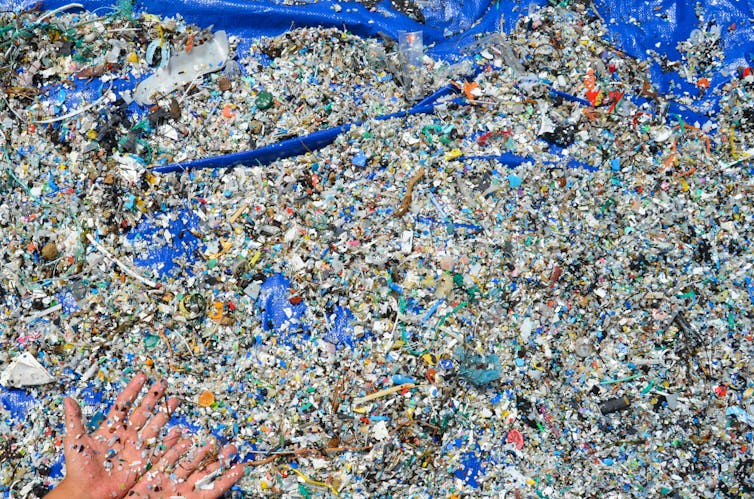
Research has identified contaminants in bottled water, including microplastics, chemical residues and bacteria. A 2024 study detected tens of thousands of plastic particles per litre in some products. Other research suggests that bottled water often contains higher concentrations of microplastics than tap water, with potential links to inflammation, hormone disruption and the build-up of particles in human organs.

Plastics and microplastics in sand on a beach in the Canary Islands
Plastic bottles break down into microplastics, and even smaller nanoplastics, over time.
IgnacioFPV/Shutterstock

Plastic bottles can also leach chemicals such as antimony, phthalates and bisphenol analogues. Antimony is a catalyst used to make PET bottles, and PET is the most common plastic used for single-use drinks. Phthalates are plasticisers that keep plastics flexible. Bisphenol analogues such as BPS or BPF are close relatives of BPA, a chemical used to harden some plastics and to line food and drink cans. These substances can migrate into the water, especially when bottles sit in warm environments such as cars, delivery vans or direct sunlight.

Scientists are concerned because some of these compounds can act as endocrine disruptors, meaning they may interfere with the body’s hormone systems. High exposure to certain phthalates and bisphenols has been linked to effects on reproductive health, metabolism and development, although levels found in bottled water are generally low and the long-term risks are still unclear. Researchers are now exploring what repeated, chronic exposure might mean over time, particularly as bottled water consumption continues to rise worldwide.

Bottled water is not sterile. Once opened, microorganisms can multiply quickly. A half-finished bottle left in a warm car can become an ideal environment for microbial growth. Reusing single-use bottles also introduces bacteria from saliva and the wider environment.

Tap water generally contains beneficial minerals, a point well documented in public health research. In the UK and other countries, fluoride is added to some supplies to prevent tooth decay. Bottled water varies widely in mineral content, and studies suggest that children who drink bottled water more frequently have higher rates of dental caries.

How green is your bottle?

Drinking too much bottled water is also hard on the planet. Global consumption is so high that around one million plastic bottles are purchased every minute.

Danish water technology company Aquaporin estimates that producing a litre of bottled water can require up to two thousand times more energy than supplying a litre of tap water. The carbon footprint is higher too, averaging around eighty grams of carbon dioxide per litre once bottling, transport and cooling are included.

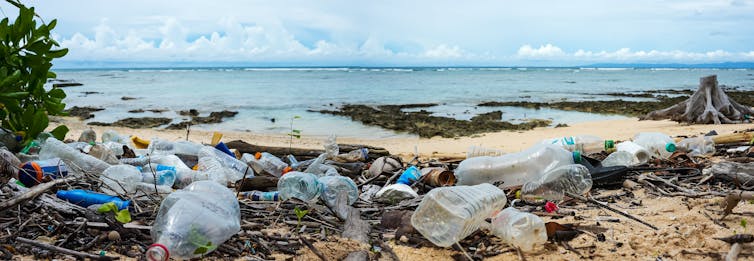
The plastic debris present in beach sediments at the remote islands of the Andaman, India
Plastic bottles are a major source of beach pollution.
Venturing wild/Shutterstock

The bottled water debate cannot be separated from the wider pressures facing global water supplies. Access to clean drinking water remains an urgent challenge worldwide. Climate change, rapid urbanisation, industrial pollution and population growth are straining freshwater resources. Unesco warns that more than two billion people already live in regions experiencing high water stress.

To offer alternatives to bottled water, I am working with a team of researchers on Solar2Water, a portable solar-powered device that generates clean drinking water directly from the air.

The system is decentralised, producing water at the point of use rather than relying on long pipelines or large treatment plants. Producing water locally helps reduce reliance on single-use plastics and eases demand on municipal systems.

As pressure on infrastructure grows, decentralised systems that produce clean drinking water at the point of use can complement existing networks. They strengthen resilience during climate shocks, reduce dependence on single-use plastics and provide options for communities where trust in tap water has been damaged.

Bottled water remains essential during emergencies or where tap water is genuinely unsafe. But in most developed countries it is neither safer nor cleaner than tap water. As climate change and pollution reshape water access, understanding the real differences between bottled and tap water matters more than ever.

The Conversation

Muhammad Wakil Shahzad is the founder and CEO of EcoTech X Team, which produces Solar 2 Water Generators. He has received funding from Northern Accelerator.

ref. The hidden health risks of bottled water – https://theconversation.com/the-hidden-health-risks-of-bottled-water-268513