Songbirds swap colorful plumage genes across species lines among their evolutionary neighbors

Source: The Conversation – USA – By David Toews, Associate Professor of Biology, Penn State

Some bird species on neighboring tips of the evolutionary tree can interbreed, with interesting genomic results. Kaleb Anderson

People typically think about evolution as a linear process where, within a species, the classic adage of “survival of the fittest” is constantly at play. New DNA mutations arise and get passed from parents to offspring. If any genetic changes prove to be beneficial, they might give those young a survival edge.

Over the great span of time – through the slow closing of a land bridge here or the rise of a mountain range there – species eventually split. They go on evolving slowly along their own trajectories with their own unique mutations. That’s the process that over the past 3.5 billion years has created the millions of branches on the evolutionary tree of life.

However, new genome sequencing data reveals an unexpected twist to this long evolutionary story. It turns out that the boundaries between species on their own branches of this tree are a little more permeable than previously thought. Rather than waiting around for new mutations to solve a particular problem, interbreeding between different species can introduce ready-made genetic advantages.

Unraveling the story of life, one genome at a time

man holds a small grey bird with red on its face up with one hand
The author with a red-faced warbler (Cardellina rubrifrons), one of the wood warbler species included in the study.
Kevin Bennett

As an evolutionary biologist, I’ve been studying the stories written in the genomes of animals for over two decades. I focus mostly on colorful songbirds called wood warblers that hail from North, Central and South America. There are approximately 115 species in total, and they come in a dazzling array of bright colors.

Some of these birds might be familiar to you, such as the brilliant Blackburnian warbler (Setophaga fusca), which lights up the tops of the pine trees in the eastern forests of the U.S. and Canada during spring and summer. Other warbler species might be less familiar, like the pink-headed warbler (Cardellina versicolor), which lives only in the highlands of Guatemala and southern Mexico.

The story of these New World warblers was written within the past 10 million years or so – relatively recently in evolutionary terms. They’re all, in effect, “evolutionary neighbors,” sitting next to each other at the tips of the crown of the tree of life. In my team’s most recent work, led by evolutionary biologist Kevin Bennett, we gathered a massive amount of data from warbler genomes – over 2 trillion base pairs, from nearly every species of warbler – to learn more about their evolutionary history.

We found that some species have unexpectedly leaped over evolutionary hurdles by sharing solutions to evolutionary problems. We are now learning from this kind of data that species aren’t just vertical, evolutionary silos, as we once thought. Instead, there is much more horizontal “cross talk” among the branches of the evolutionary tree.

These warblers now join Amazonian butterflies, cichlid fish in Africa, as well as our own hominid lineage, as exemplars of this process of evolutionary sharing.

a nest filled with baby birds, one faces up with its mouth open
Nestlings in a hybrid zone between golden-winged (Vermivora chrysoptera) and blue-winged warblers (V. cyanoptera). Hybrid chicks that grow up to ‘backcross’ with one of their parent species can introduce new genes into the mix for a population.
Abigail Valine

How does evolutionary sharing actually occur?

Genetic sharing among evolutionary neighbors all happens through hybrids: the offspring produced when individuals from two species mate. Famous hybrids include offspring between polar and grizzly bears – affectionately called “pizzly” bears – as well as mules, the offspring of horses and donkeys.

But unlike mules, which are sterile and cannot reproduce, in instances of natural warbler hybrids, we think these rare offspring can sometimes “backcross”: They breed with one of the parental species, ultimately moving genes across species boundaries. These hybrids are the genetic conduit by which genes are shared across the branches in the evolutionary tree.

But aren’t we all taught in biology class that species can’t interbreed with other species? Isn’t that what helps define a species?

In reality, biology always has its exceptions and fuzzy edges. And this is one: Species result from the very gradual process of speciation, which typically takes millions of years. The taxonomic boxes we humans like to put around “species” don’t typically capture the blurry borders around lineages early in this long process, when otherwise distinct plants and animals can still interbreed.

Indeed, my lab has described many interspecies and intergenus hybrids in warblers, including at least one arising from both. We’ve also identified “hybrid zones” between very closely related species, where hybridization is rampant.

And if the genes within these hybrids are beneficial in the recipient species, they’ll spread – just like a new, beneficial mutation passed to an offspring. In this case, it’s not just a single mutation but can be a whole new complement of mutations in multiple genes.

small bright yellow bird sits on a branch
Wood warblers need particular genes to help them process and deposit certain pigment molecules in what they eat to make brightly colored feathers, like in this yellow warbler.
Marc Guitard/Moment via Getty Images

Shared genes solve ‘evolutionary problems’

Our most recent work in wood warblers shows that the evolutionary solutions they’re sharing are related to their coloration.

In this family of birds, we previously identified genes related to their carotenoid-based coloration. Carotenoid pigments give birds their brilliant orange, yellow and red plumes – colors that are exemplified by the aptly named yellow warbler. But birds, like all vertebrates, can’t synthesize carotenoid pigments on their own. They need to obtain carotenoids from their diet and then chemically process them.

But processing carotenoids appears to be an evolutionary hurdle that not all birds have jumped and a rather difficult problem to solve. Our genome sequencing shows that these warblers have more shared carotenoid genes than other shared genes in their genome, and it’s likely that different versions of carotenoid-processing genes improve the recipients fitness.

One carotenoid-processing gene, called beta-carotene oxygenase 2, or BCO2, has been shared several times within this single family of birds. Moreover, BCO2 appears to be so popular that it shows second-order sharing: passing from one species to another, and then on to a third.

A sign of quality on the mating circuit

My colleagues and I think these genes are so popular because male warblers use these carotenoid colors to attract females that have a discerning eye. Male birds obtain carotenoids from the insects they eat. The idea is that the more colorful a male is, the higher the quality of its diet.

From across the forest, the males’ rich carotenoid colors are signaling that they’d be good dads with good genes. Biologists call this kind of display an “honest signal.” And if males obtain a new gene that allows them to process carotenoids more efficiently, it’s likely to spread faster and farther into the species, as the brighter males will potentially have greater mating success.

Our research with warblers demonstrates how evolution can shuffle genes across the thin lines between species. These close evolutionary neighbors sometimes share DNA, including potentially beneficial mutations, by mating across the species lines defined by humans’ classification systems.

We suspect that the more we look, the more we’ll find this kind of borrowing among evolutionary neighbors. As we unravel the stories told in the genomes of nature’s problem-solvers, it’s likely we’ll find that their threads are deeply intertwined.

The Conversation

David Toews works for Pennsylvania State University. He receives funding from The National Science Foundation.

ref. Songbirds swap colorful plumage genes across species lines among their evolutionary neighbors – https://theconversation.com/songbirds-swap-colorful-plumage-genes-across-species-lines-among-their-evolutionary-neighbors-268846

Jigsaw puzzles help make mathematics learning more active and fun

Source: The Conversation – Canada – By Francis Duah, Assistant Professor, Department of Mathematics, Toronto Metropolitan University

Holidays bring celebration, rest and, for many families, long stretches of indoor time. For some, this means table top games quickly reappear on kitchen tables. Games provide opportunities for learning mathematics actively.

These moments of playful learning raise a broader question: how can we support student’s mathematical learning at home without turning the holidays into formal lessons?

One answer comes from a simple but surprisingly powerful classroom learning tool: Tarsia jigsaw puzzles. These are puzzles created with free Tarsia software, from Hermitech Laboratory. The software enables people to create, print out and save customized jigsaws, domino activities and different rectangular card-sorting activities.

For the mathematics classroom, the whole sheet of a Tarsia puzzle printed on paper is typically laminated (for repeated use) before being cut into pieces.

Social and active learning that values mistakes

Canadian mathematician Anthony Bonato advises: “No matter what method is used to teach math, make it fun.” Most students would agree; joy is often missing from their experience.

As a mathematics education researcher, I add that regardless of the method used to teach mathematics, the learning should be active and social, and value mistakes as opportunities for learning. These are conditions under which learners feel safe to try, fail and try again.

Tarsia puzzles, which have been around for more than a decade and have found use in K-12 classrooms, accomplish all of this with almost no explanation for students. However, their use in university calculus classrooms appears to be rare.

My research has focused on why using Tarsia puzzles work to teach math, and their impact in the undergraduate classroom.

Matching geometric tiles

The Tarsia software allows teachers to embed mathematical relationships — fractions, functions, graphs, algebraic expressions — into geometric tiles such as triangles, rectangles or rhombus.

Learners must match the tiles so that the edges align, eventually forming a complete single shape.

The Tarsia software presents users with a variety of puzzle types to choose from.

Teachers in elementary and secondary schools use Tarsia puzzles to strengthen number sense and deepen understanding of functions, graphs and algebraic relationships. University instructors can use them to enliven topics such as limits, derivatives and integration — areas where students often feel intimidated.

Mathematical ‘prompts’

Each tile carries a mathematical “prompt” — for example, an appropriate Tarsia puzzle for elementary school learners might involve pieces marked with fractions, decimals and percentages, to help students understand equivalents like ¼ = 25 per cent.

For more advanced learning, puzzle pieces might show two equivalent fractions, a logarithmic expression and its simplified form or a function paired with its graph.

In both cases, learners assemble the puzzle by identifying which pieces belong together. When all tiles are matched correctly, a single full shape emerges.

Because Tarsia puzzles emphasize recognition and relationships rather than lengthy calculations, learners think about how ideas connect. They compare expressions, notice graphical features and reason out equivalence. In many ways, the activity mimics authentic mathematical thinking.

Tarsia puzzles require little supervision, and most of students’ learning happens in the conversations around the table — not in written solutions.

Grades 11 and 12 math students might use a Tarsia puzzle on logarithms — part of learning about exponents or “the power to which a base must be raised to yield a given number.”

Why active learning matters

Decades of research show that students learn mathematics best when they talk through problems, test ideas and make mistakes in low-pressure settings. Studies confirm that active learning improves understanding, reduces failure rates and builds confidence across STEM subjects.

Yet many mathematics classrooms still operate as one-way lectures, where students quietly copy procedures and hope to follow along.

Tarsia puzzles reverse this pattern. They create structured, collaborative problem-solving that feels more like play than assessment. A student who dreads formal proofs may still be eager to match a derivative with its graph. Another who dislikes fractions may feel less pressure when an incorrect guess simply means trying another tile.

A challenging puzzle might combine square and triangular pieces into a 10-sided figure, helping to teach limits, sequences, series and partial derivatives in multivariable calculus.

Recent study

At Toronto Metropolitan University’s active learning classroom, colleagues and I explored how Tarsia puzzles help first-year students learn calculus, relying on structured reflection and student feedback to examine our own teaching practices.

Several themes consistently emerged from the analysis of our reflective notes about students using Tarsia puzzles:

  1. Less fear: Students who were usually anxious about being wrong participated more freely. Mistakes became part of the puzzle-solving process rather than personal shortcomings.

  2. More talk: Learners debated ideas, explained reasoning and corrected each other — behaviours rarely observed in traditional tutorials.

  3. Better engagement: Students worked longer and with greater focus compared with worksheet-based tasks. Some who typically packed up early stayed to complete the puzzle.

Why parents and tutors should care

Mathematics is often portrayed as solitary work, yet mathematicians collaborate constantly — arguing, checking, revising and proposing alternatives. Students benefit from similar interactions.

At home or in small tutoring groups, a Tarsia puzzle offers a low-stakes entry into mathematical reasoning. Learners who are reluctant to speak up in class may confidently identify mismatched edges or question whether two expressions are equivalent. Misconceptions are revealed naturally through the puzzle, allowing gentle correction without embarrassment.

To try Tarsia puzzles, parents and tutors of young students could try examples suitable for upper elementary and junior high school students.

A call to developers

The Tarsia software is useful but dated. Currently, it operates on a Windows operating system.

A modern web-based version — with collaboration tools, curriculum-aligned templates, and built-in accessibility — would significantly expand its adoption. Educational technology developers looking for impactful, low-cost tools could find enormous potential here.

Mathematics becomes easier when it invites curiosity. Tarsia puzzles, modest in design but powerful in effect, encourage learners to talk, think and take intellectual risks. They help parents, tutors and instructors see students’ reasoning in real time, not merely their final answers.

Most importantly, they restore an often-forgotten truth: mathematics can be playful — and learning happens in conversation.

The Conversation

Francis Duah does not work for, consult, own shares in or receive funding from any company or organisation that would benefit from this article, and has disclosed no relevant affiliations beyond their academic appointment.

ref. Jigsaw puzzles help make mathematics learning more active and fun – https://theconversation.com/jigsaw-puzzles-help-make-mathematics-learning-more-active-and-fun-270857

Why whole-life imprisonment is rising in England and Wales

Source: The Conversation – UK – By Jake Phillips, Associate professor, University of Cambridge

In England and Wales, whole-life imprisonment is the harshest sanction available to the courts, emerging in the decades after the abolition of the death penalty. The whole-life order requires people to spend their whole lives in prison with no prospect of release, except on exceptional compassionate grounds.

From 1988, whole-life sentences (called “whole-life tariffs”) could be imposed by the home secretary and were used for handful of criminals. However, a number of legal challenges in the 1990s chipped away at the home secretary’s power to do so. In 2003, the Criminal Justice Act formally introduced whole-life orders, giving judges the power to impose them.

The European Court of Human Rights initially ruled in 2013 in response to a challenge from three people serving whole-life tariffs that these sentences breached human rights law, as they constituted inhuman and degrading treatment. A later ruling in 2017 found that the compassionate release clause (part of the 1997 Crime Act) keeps the order lawful. However, notably, no one has ever been released under it.

This punishment represents the state’s most severe power to harm its citizens. Understanding how and why it is used tells us about our appetite for punishment and the state’s power to inflict it. And evidence suggests that its use is rising.

Historically, data on whole-life orders has been difficult to come by. The Ministry of Justice has not reliably published figures on how many people are given these sentences, nor how many are serving them at a given time. Online lists of names, we have found, are inaccurate.

This is where our recent paper, published in The Howard Journal of Crime and Justice in October 2025, comes in.

We sought to understand how whole-life orders have been used since their introduction in 2003. We started by generating what we believe to be the most accurate dataset on the use of whole-life sentencing through a combination of Freedom of Information requests to the Ministry of Justice, as well as in-depth archival research drawing on court transcripts, media reports and parliamentary debates.

In analysing this dataset, we found that there are currently 74 people serving whole-life sentences. The year with the highest number of whole-life orders given was 2023, when Lucy Letby received 15 for her crimes.

Notably, 74% of all whole-life sentences imposed since 1965 were imposed after the Criminal Justice Act in 2003. This suggests that transferring the power of this sentence from the home secretary to the courts created the conditions for it to be used more widely.

Since 2003, the population serving whole-life sentences has risen significantly faster than the prison population as a whole, which has more than doubled since 1990 but remained relatively stable since 2000.

We also found that whole-life orders are being used for a wider range of offences, including those which are not on the specific list of offences for which these sentences can be imposed.

Examples include Wayne Couzens, who was given this sentence for the murder of a single person, and Letby, who received eight whole-life orders for the attempted murder of seven babies (alongside seven others for actual murder). Prior to Couzens, those who received whole-life orders for a single murder had previous convictions for serious offences.

Finally, courts are increasingly imposing more than one whole-life order on individual people. Before 2022, the maximum number of orders imposed on one person was two. Since then, Damien Bendall was given five whole-life orders for four counts of murder and rape, and Letby received 15.

In 2025, Kyle Clifford received three whole-life orders for the murders of Louise, Hannah and Carol Hunt. In most cases, this reflects the seriousness of the offending and the number of victims. It also makes appeals increasingly difficult.

Penal populism

This is not to suggest that we should not be using whole-life orders – clearly these people have caused significant harm to victims, the public and, in some cases, trust in public institutions such as the police and the NHS. But these trends raise an important question: why is this severe punishment becoming more common?

The answer doesn’t lie in a rise in the most serious offences such as homicide, which have remained stable or even declined over the last few decades. Rather, we would point to what criminologists call penal populism: the tendency of politicians to respond to perceived public opinion by introducing tougher sentences.

Over the last half a century, a series of legislative changes have led to sentence lengths significantly increasing, particularly for serious offences. This is especially relevant given recent proposals to make whole-life orders mandatory for certain crimes.


Read more:
How a doubling of sentence lengths helped pack England’s prisons to the rafters


We are also concerned about the lack of data publicly available on this topic, which makes it difficult for the government to be held to account, and raises further questions: if the whole-life order is only compliant with human rights legislation because of the possibility of release on compassionate grounds, should we not expect someone to have been released via this mechanism? And if no one has, what does that say about how human rights protections work in practice?

Human rights aside, the cost of imprisoning people on whole-life orders far exceeds that of people who are released, especially as they age and need increasing levels of care and medical treatment. And when we consider the constant problems of overcrowding in the prison system, these pressures become even more paramount.

If we are willing to accept ever-harsher punishment via sentences which do not allow for redemption or rehabilitation, then the rise of the whole-life order may seem justified. People who cause high levels of harm do – perhaps rightly – elicit anger and revulsion.

At the same time, evidence suggests that people believe in rehabilitation as an important purpose of punishment. We argue, therefore, that we need to look more closely at how and why the state is choosing to exercise its most extreme power to punish in increasing numbers of cases.

The Conversation

Nothing to disclose

Jake Phillips does not work for, consult, own shares in or receive funding from any company or organisation that would benefit from this article, and has disclosed no relevant affiliations beyond their academic appointment.

ref. Why whole-life imprisonment is rising in England and Wales – https://theconversation.com/why-whole-life-imprisonment-is-rising-in-england-and-wales-269226

Why does Netflix want to buy Warner Bros? To copy, not kill, traditional TV

Source: The Conversation – UK – By Anthony Smith, Lecturer in Television Theory, University of Salford

The recent news that Netflix has agreed to buy part of Warner Bros Discovery (WBD) for US$83 billion (£61.8 billion), followed by Paramount Global’s hostile counterbid to acquire WBD in its entirety for US US$108.4 billion, has triggered shockwaves through Hollywood and the wider entertainment industry.

Initial responses – and passionate outcries – have largely centred on fears over job cuts, subscription fee rises, anti-trust concerns regarding the increased market share either bid would create, and the potential negative impact that Netflix’s acquisition might have on the future of the film industry.

While these issues are no doubt important, one aspect of the Netflix deal has been relatively overlooked: the streamer’s decision to cut out Discovery’s portfolio of cable channels from its agreed acquisition of WBD. But this element of the deal is significant for what it reveals about the current state, and future, of the television industry.

Netflix’s decision to excise Discovery’s cable channels from the agreement indicates its desire to avoid ownership of the legacy TV infrastructure of broadcast, cable and satellite television. It also reflects the broader trend of linear TV businesses becoming less attractive to media corporations as audiences continue to migrate online. At first glance, Netflix’s exclusion of Discovery seems to confirm what we’ve been told for over a decade: streaming is killing traditional TV.

Since launching House of Cards in 2013, Netflix has cultivated an image as television’s great disruptor, a tech company that rendered the old broadcast model obsolete. What’s more, this is a reputation that journalistic and scholarly debate has often burnished.

But as we argue in our new book, Television Goes Back to the Future: Rethinking TV’s Streaming Revolution, this narrative of revolution is overstated and oversold. Beneath the rhetoric, streamers have persistently adopted, adapted, and often directly copied the conventions of legacy television.

The Netflix-WBD deal is no exception to this trend. Netflix’s own announcement celebrates combining its “innovation” with Warner Bros’ “century-long legacy of world-class storytelling”. Yet in potentially acquiring HBO, Netflix is set to buy the very cable TV innovator it originally modelled its prestige drama strategy on. This deal, then, represents less of a break from television history than prevailing narratives suggest.

Back to the evergreen future

This is evident in the rationale underpinning Netflix’s aims to acquire WBD’s vast back catalogue of film and television. For decades, channels like TBS, TNT, and in the UK, Gold and Dave, have built their business models on syndicated repeats of evergreen programming, such as studio sitcoms and police procedurals.

Streaming platforms have adopted the same approach. For example, both Suits and Lost recently became streaming hits years after their original linear TV runs ended.

When Netflix UK recently announced Friends would be leaving the platform at the end of the year, subscribers responded with uproar, revealing just how much “reruns” matter to streaming audiences. The Warner catalogue – which includes Friends – offers Netflix a ready-made library to meet this demand.

Amazon’s US$8.5 billion purchase of MGM in 2022 reflected a similar calculation, with the studio’s library alone valued at US$3.4 billion. What this tells us is that the film and TV back catalogue, long the foundation of cable television, has become equally foundational to streaming.

Should the Netflix-WBD deal succeed, it would represent another step in what industry observers call “the great rebundling”. Under the American cable model that solidified in the 1980s, viewers pay a monthly fee for a large package of channels rather than selecting them individually.

Streaming initially fragmented this model, leaving viewers to juggle competing subscriptions (and frequently cancel them). In response, platforms have begun consolidating content and brands in ways that echo the cable bundle model.

This pattern is already evident in Disney’s ongoing integration of Hulu within the Disney+ app, offering US consumers both services as part of a bundle deal. Industry commentators predict Netflix will take a similar approach with HBO.

Media analyst Rua Aguete foresees that Netflix will eventually operate as “a global gateway” for viewers, with HBO sitting as a “premium content brand within that ecosystem”, allowing Netflix to offer both services under a single subscription.

But Netflix’s embrace of traditional television practices is not new, nor limited to bundling and the reliance on much-loved TV classics. The platform spent years positioning itself against appointment viewing: watch what you want, when you want.

Yet as we show in Television Goes Back to the Future, the platform has increasingly embraced live events that create shared, simultaneous experiences in the long tradition of broadcast TV: WWE wrestling, NFL matches and comedy specials like The Roast of Tom Brady.

Netflix’s introduction of an ad-supported tier in 2022 marked a further retreat from its original promise of uninterrupted viewing – a direct adoption of commercial television’s long-established funding model.

Similar continuities are evident in how Netflix operates across borders. Streaming was supposed to make borders irrelevant: one global library, available everywhere. Instead, as media scholar Ramon Lobato argues, Netflix can be seen as “a series of national services linked through a common platform architecture”.

The company establishes local production offices, hires regional executives, and commissions programming calibrated to national audiences, resulting in culturally specific originals such as the UK’s Adolescence, Spain’s Money Heist, and South Korea’s Squid Game. Through such practices, Netflix, in some ways, mimics the practices and infrastructures of national broadcasting systems.

Should Netflix’s deal with WBD go through, it would represent not a departure from Netflix’s recent trajectory, but its logical culmination. For all its disruptive rhetoric, the platform has spent the past decade embracing the very conventions it once positioned itself against.

Purchasing WBD would simply accelerate this process, enabling Netflix to further adapt the models and logics of longstanding network and cable TV practices to online contexts.


Looking for something good? Cut through the noise with a carefully curated selection of the latest releases, live events and exhibitions, straight to your inbox every fortnight, on Fridays. Sign up here.


The Conversation

The authors do not work for, consult, own shares in or receive funding from any company or organisation that would benefit from this article, and have disclosed no relevant affiliations beyond their academic appointment.

ref. Why does Netflix want to buy Warner Bros? To copy, not kill, traditional TV – https://theconversation.com/why-does-netflix-want-to-buy-warner-bros-to-copy-not-kill-traditional-tv-271770

Visible for diversity, invisible in research: the burdens Black female academics face in universities

Source: The Conversation – UK – By Yaz Iyabo Osho, Director of Academic Professional Development, University of Westminster

Lenar Nigmatullin/Shutterstock

Black women are underrepresented in senior roles in British academia. As of May 2024, there were only 70 Black women professors.

This is less than 1% of all female professors in the UK. Black women are also more likely to be employed on fixed-term contracts in academia.

In our research, we’ve reviewed academic studies on the experiences of Black women in UK universities to identify some of the key reasons for this under-representation.

Promotion to the role of professor typically requires evidence of sustained academic excellence. This includes high-quality research, winning grant funding and publication in high-impact journals. It also requires supervising PhD students and a record of disciplinary or institutional leadership.

Many Black women academics in the UK work in newer, less research-intensive institutions where teaching and student support loads are comparatively higher. This can limit time for research and publishing.

What’s more, these opportunities for promotion are unevenly distributed. Black women are more often overburdened with pastoral care, teaching and equality, diversity and inclusion work. This is labour that’s important to the university, but undervalued in promotion criteria.

Invisible labour

Evidence suggests that Black women scholars in academia experience gendered and anti-Black racism. This can severely affect their work environments, career progression and wellbeing in academic institutional spaces.

They have to grapple with the exhausting task of proving they belong in universities that are not built with them in mind. This sense of not belonging is reinforced by structural and symbolic signals. Hallways are adorned with portraits of white male scholars, reading lists dominated by western scholarship and disciplinary norms rooted in Eurocentric assumptions.

Addressing this question of belonging often means taking a lead on work to make these spaces more equitable. Black women may find themselves supporting Black and racially minoritised students who may feel more able to connect with them than other academics.

They may carry out extra work that their colleagues don’t. This includes promoting equality, diversity and inclusion initiatives and building support networks, while trying to meet the same research and scholarship demands as others.

Black woman in meeting
Black women often take a lead in equality, diversity and inclusion initiatives.
PeopleImages/Shutterstock

Black women are often both highly visible and yet largely invisible in academia. They’re visible as they are one of a few standing out for their ethnicity – becoming symbols of diversity.

Yet their scholarship is frequently under-recognised or overlooked. At the same time, the additional labour they undertake often goes unseen and they are less like to have senior sponsorship than their peers.

The burden of being under scrutiny and engaging in emotional labour often weighs heavily on Black women. Black women also have to navigate sometimes hostile environments. This can take subtle forms, such as being excluded in meetings and being treated as less credible than non-Black colleagues.

Making connections

Despite the challenges faced by some Black women academics, there are independent networks outside of universities set up by Black academics that are dedicated to supporting women from racial minorities.

One of us (Yaz Iyabo Osho) founded Global Ethnic Majority Women in Academia. Others include the Black Female Academic Network and the Sisters in Higher Education Network. These networks collectively offer peer support and advocacy. They also run conferences, events and opportunities for development for Black women scholars.

These networks also offer vital forums for communication and collaboration. This is important for Black women academics when they encounter difficulties within their own institutions. Informal networks can also help foster social capital and peer support. This can be the difference between leaving a career in academia and staying put.

Collaborative spaces, peer networks and co-mentorship can build both professional capital and emotional resilience. These are not just discussion spaces outside of the university, but places for knowledge production, community building, and collective resistance.

Action from universities must take the intersecting oppressions Black women face seriously. Generic policies on equality, diversity and inclusion fail to account for how racism, sexism, ageism, and classism intersect in academic life.

Requiring Black women academics to do the emotional, pastoral and institutional labour of improving their own inclusion – at the expense of their career – is not true inclusion. Structural change and collective accountability is required.

The Conversation

The authors do not work for, consult, own shares in or receive funding from any company or organisation that would benefit from this article, and have disclosed no relevant affiliations beyond their academic appointment.

ref. Visible for diversity, invisible in research: the burdens Black female academics face in universities – https://theconversation.com/visible-for-diversity-invisible-in-research-the-burdens-black-female-academics-face-in-universities-260975

Bread of Angels: Patti Smith’s eloquent memoir wrestles with ‘the beauty and sorrow of a lifetime’

Source: The Conversation – UK – By Julia Toppin, Senior Lecturer, Music Enterprise and Entrepreneurship, University of Westminster

Documenting the life of an extraordinarily talented musician and writer, Bread of Angels – Patti Smith’s latest memoir, published at the age of 78 – further charts a life filled with genius, creativity, adversity and tragedy.

“It took a decade to write this book, grappling with the beauty and sorrow of a lifetime,” she wrote. “I’m hoping that people will find something they need.”

Bread of Angels follows on from Just Kids (which details her relationship with the artist Robert Mapplethorpe), M Train (which focuses on her life with her husband Fred “Sonic” Smith), and Year of the Monkey (written after a year of travelling in 2016, examining loss and ageing).

Released on the date of her late husband’s death, and close to the 50th anniversary of her seminal debut album, Horses, Bread of Angels is a deeply personal and authentic story that will provide inspiration for women trying to forge a career in the music industry.

The memoir takes the reader on a journey through the myriad roles Smith has inhabited: daughter, sister, invalid; friend, collaborator, activist; lover, poet, musician; wife, mother, widow. This moving account of a life well lived details the highs and lows of walking the earth as a woman.

Bread of Angels begins in infancy, building up a portrait of a young artistic and creative performer who gives it all up for love at the height of her fame. It ends with a rediscovery of music, writing and being on the road as a touring performer.

The six-decade rollercoaster ride that Smith describes so eloquently serves as a reminder that there is no joy without pain. And sadly, that perhaps the most creative of us are those to whom fate has been most unkind. Yet, to read how Patti Smith has lived, created, loved and lost while staying true to herself is an uplifting experience.

The blossoming of an artist

Smith endured a childhood of hardship, frailty and illness boosted by a mother who used art – from Puccini’s Madame Butterfly to Lewis Carroll’s Alice in Wonderland – to inspire her daughter to stay alive. Bread of Angels starkly illustrates the plight of a post-war working-class American family moving from place to place to stay above the poverty line.

Moving into young adulthood, Smith quickly rejects a conventional life and blossoms into an artist and key collaborator in the New York punk scene. Here she lives in the notorious Chelsea Hotel alongside contemporaries Robert Mapplethorpe, Bob Dylan, Allen Ginsberg, Janis Joplin, Jimi Hendrix and Andy Warhol. But the focus of Bread of Angels is Smith’s career as a recording artist and falling in love, marrying and forging a family.

Smith’s career as a recording artist parallels many of the challenges facing women in the music industry. It satisfyingly describes Smith’s insistence on asserting her creative independence in a male-dominated environment that seems to want to control every aspect. Smith’s refusal to submit to the patriarchal control that is still so pervasive in the industry will resonate with many women.

But more importantly, Bread Of Angels will probably embolden young female artists to reject this pressure. Smith made a brave decision to go for less money and sign with legendary A&R Clive Davis of Arista Records. Davis honoured his promise that Smith would have full creative control, which led to eight albums.

These include her groundbreaking debut Horses (produced by JJ Cale), the politically charged Radio Ethiopia (produced by Jack Douglas) and Easter (produced by Jimmy Iovine), which included Smith’s biggest hit Because The Night. It is fascinating to read the author’s recollections on how various albums were produced, including her initial ambivalence about the track written with Bruce Springsteen that would become her most well-known song.

Then there’s the startling tale of Smith’s infamous stage accident on tour in Tampa, Florida, where she tripped and fell 15ft into a concrete orchestra pit breaking several vertebrae in her neck. Once again she returns to the convalescent bed of her youth. Her recovery was a great period of reflection that allowed Smith to re-evaluate her life. To get back to music, she joined a strenuous sports rehabilitation programme while writing her first published collection of poetry entitled Babel.

At the height of her fame after the release of Easter, Smith gives it all up to go and live with the love of her life, Fred Smith. She states simply: “I did it for art. I did it for love. But most of all I did it for myself.”

She describes their instant attraction and marriage as inevitable. They make a life in Michigan, have two children and immerse themselves in reading, writing and being by the sea. Smith creates Virginia Woolf’s notion of a room of one’s own in the kitchen and allows the writer within her to fully evolve.

The penultimate section of the book is permeated with grief, loss and pain as Smiths loses several people dear to her. These include the man she describes as the “artist of her life”, Robert Mapplethorpe; the “love of her life” Fred Smith; her brother Todd; and several friends during the Aids epidemic.

A yearning for purpose following an extended period of grieving leads Smith back on the road, where this memoir ends, leaving the reader with a sense of Smith’s relentless vitality and positivity.

Bread of Angels is a beautifully life-affirming memoir. Smith’s eloquent rendering of an extraordinary life makes the ending inspiring when it could have easily been profoundly sad. Patti Smith remains, as she enters her 80th year, a touchstone for women in music everywhere.

Looking for something good? Cut through the noise with a carefully curated selection of the latest releases, live events and exhibitions, straight to your inbox every fortnight, on Fridays. Sign up here.


The Conversation

Julia Toppin does not work for, consult, own shares in or receive funding from any company or organisation that would benefit from this article, and has disclosed no relevant affiliations beyond their academic appointment.

ref. Bread of Angels: Patti Smith’s eloquent memoir wrestles with ‘the beauty and sorrow of a lifetime’ – https://theconversation.com/bread-of-angels-patti-smiths-eloquent-memoir-wrestles-with-the-beauty-and-sorrow-of-a-lifetime-271067

Exotic animal cafes: cute trend or welfare crisis?

Source: The Conversation – UK – By Samantha Ward, Professor of Zoo Animal Welfare & Legislation, Nottingham Trent University

Imagine sipping a latte while stroking an owl or watching an otter play at your feet. This is the promise of exotic animal cafes, a trend that blends coffee culture with wildlife encounters. But behind the Instagram-worthy photos lies a troubling reality – the welfare of the animals themselves.

Since the mid-2000s, animal cafes have increased in popularity with customers paying low-cost entrance fees, ranging from £8 to around £15, depending on the location and animals housed there. The concept seemed to have started with cat cafes but now include owls, meerkats, capybara, snakes and even penguins.

Taiwan, China and Japan seem to be leading the trend. But they are starting to pop up in the UK too, with plans for a capybara cafe in Norfolk announced in 2025. And there are already capybara cafes in Florida, US, that offer a “curated, slow-living experience that lets you connect with animals in a meaningful and memorable way”.

The appeal is obvious: exotic animals are fascinating. However animal rights activists have concerns about the cost to the animals. My colleagues and I recently published research on animal cafes in Japan which reveals they are failing animals on almost every welfare measure.

We visited 79 exotic animal cafes across Tokyo, Osaka, Kyoto and other regions, observing 231 mammal, bird and reptile species. We scored conditions in five areas: environment, nutrition, behaviour, restraint and visitor interactions.

Our findings showed welfare standards were consistently poor across all species.

Birds suffered most. Owls, by far the most common species, were often tethered to
perches, unable to fly. Owls are nocturnal species and therefore their natural behaviour is to hide away during daylight hours. Many were exposed to loud music and constant human contact, conditions known to cause stress to birds.

Otters didn’t have water for swimming during opening hours. Meerkats, highly social animals, were kept alone in tiny cages. Even domestic species such as rabbits scored poorly for the number of human-animal interactions and the environment that was provided for them.

Reptiles fared slightly better, probably because their spatial needs are smaller.
But many were housed in enclosures with no place for them to escape the public gaze or people tapping on their glass enclosures and had minimal enrichment.

Rabbits however did score higher on the nutrition scores. We linked this to the fact that they are domesticated, which means appropriate food is easy to purchase.

Meerkats lying on concrete floor next to wooden tables.
Do meerkats really belong in cafes?
CoreRock/Shutterstock

Poor welfare isn’t just an ethical issue, it’s a public health concern. Close contact with stressed wild animals increases the risk of bites, scratches and disease transmission, from salmonella to cryptosporidiosis, a parasitic infection that causes profuse watery diarrhoea, stomach pains, nausea or vomiting and low-grade fever for up to two weeks.

In cramped cafes, these risks multiply. A recent study and report compiled by WWF Japan found dangerous bacteria such as enterohemorrhagic Escherichia coli, salmonella, and drug-resistant bacteria in some facilities.

Another issue is where these animals are coming from. Many of the species housed in exotic cafes are of conservation importance. It might be that they are being bought and sold in violation of international animal trade laws that prohibit the movement or sale of certain animals from their original native homeland.

The bigger picture

As mentioned above, Japan isn’t an outlier, with similar opportunities in China and Taiwan. The UK has more than 40 cat cafes plus the proposed capybara cafe in Norfolk. The number of cat cafes in the UK is increasing, with a 44% surge in licences granted over the past financial year.

A report from the RSPCA and Cats Protection, two of the largest animal welfare charities in the UK, is calling for a phase-out of cat cafes. They believe that cats, “having descended from solitary, territorial, roaming wildcats” are “likely to find the enforced proximity to other felines as well as unfamiliar visitors wishing to stroke them extremely stressful.”

It’s unclear whether these types of cafe can ever meet the complex physical and psychological needs of any species that they house any species that they house, whether they are wild or domesticated animals. Our research suggests the answer is no. These environments cannot provide space, stimulation or choice – the foundations of good animal welfare.

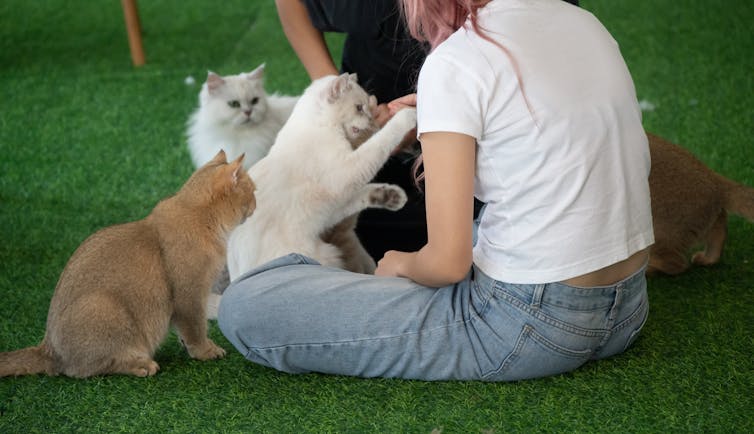
Woman sitting on artificial grass playing with cats.
Cat cafes are becoming increasingly popular.
Boyloso/Shutterstock

Animal welfare legislation around the world is complex. In a lot of countries, exotic cafes would fall under the same license as zoos. This is the case in Japan. Japan’s animal welfare law offers little specific protection for exotic species. It acknowledges animal sentience but provides little consideration to the care of captive wild animals.

In England, Scotland and Wales there are two forms of legislation that might be relevant to animal cafes. For a domestic cat cafe, The Animal Welfare (Licensing of Activities Involving Animals) (England) Regulations 2018 applies.

This includes the need for the cafe staff and owners to provide a suitable environment and diet and protect the animals from pain, suffering, injury and disease. It would also require cat cafes to monitor the animals’ behaviour, handling of the cats and interactions with customers. Inspections of these facilities do occur but are dependant on the local authorities who may or may not have animal welfare knowledge.

If cafes are to house non-domestic species, such as capybara, they would also need to have a dispensation zoo license under the Zoo Licensing Act 1981. This will mean that in the case of the proposed capybara cafe, they will need to be inspected in a similar way to a standard GB zoo but without having to contribute to conservation or education.

No matter where you are in the world or which animals they showcase, society must ask whether such cafes align with modern ethical values.

The simplest and most effective action you can take to oppose them is not to support these businesses. Every visit fuels demand for keeping wild animals in unsuitable environments.

When away from the UK, visit accredited zoos, wildlife sanctuaries, or conservation centres where animal welfare, conservation and education are prioritised. If you encounter cafés with poor conditions you should report them to local authorities or animal welfare charities such as Wild Welfare.

As these cafes gain popularity on social media, the conversation must shift from cuteness to responsibility.

The Conversation

Samantha Ward is the Research Advisor for Wild Welfare, an international animal welfare charity.

ref. Exotic animal cafes: cute trend or welfare crisis? – https://theconversation.com/exotic-animal-cafes-cute-trend-or-welfare-crisis-271147

Patients blocking A&E with minor ailments? Here’s what’s probably going on

Source: The Conversation – UK – By Robin Bailey, Assistant professor, University of Cambridge

Picture a busy A&E department on a winter evening. Among the emergencies – heart attacks, broken bones, severe injuries – sits someone with a sore throat. Another with an ingrown toenail. Last winter in England, over 200,000 people turned up to emergency departments with complaints like these, leading many to ask: are people misusing A&E – or is something else going on?

A perspective not always considered in this discussion is that the sore throat (or other seemingly minor ailment) isn’t really the problem. The problem is the terror that it might be something worse. Unfortunately, the healthcare system has no idea how to address that fear.

The term for this fear is health anxiety. A person with health anxiety constantly worries that they might be sick or have a serious disease. It’s accompanied by repeatedly checking the body for symptoms, obsessively searching online for explanations and constantly seeking reassurance – often from medical professionals.

Studies suggest that 3% of people in the general population and 20% of hospital out-patients struggle with health anxiety. And the trend appears to be moving in the wrong direction. A large international review found that health anxiety has increased over the past 30 years.

A man touching his neck, a pained look on his face.
If a patient isn’t reassured that their sore throat is nothing to worry about, they may have health anxiety.
Nenad Cavoski/Shutterstock.com

One catalyst for this trend could be the internet. Researchers call this aspect of health anxiety “cyberchondria”.

Studies find that people who worry a lot about their health tend to feel worse, not better, after searching for their symptoms, and that they are more likely to seek further reassurance from doctors and emergency departments.

A dry throat becomes a sign of a serious infection. A headache becomes a brain tumour. A rash becomes sepsis.

The more a person searches, the more alarming possibilities they find. The more alarming possibilities they find, the more urgently they seek reassurance.

Emergency departments are a natural destination for this problematic cycle. They offer rapid testing, expert authority and the promise of immediate safety.

For someone whose worry feels uncontrollable, waiting days for a routine appointment can feel like gambling with survival.

A 2025 study in Australia looked at 400 people who came to emergency care with non-urgent problems. Researchers found that people who worried most about their health were more likely to see symptoms as needing emergency attention, even when they did not.

This group also reported more emergency visits and more use of other health services over the previous six months. This suggests that worry itself, rather than the severity of the symptom, may be driving repeat visits.

Similar findings are emerging in the UK. A recent emergency department study found that severe health anxiety was common in patients well enough to walk into a hospital and was closely tied to how they interpreted and escalated symptoms.

The cost of fear

The cost of this cycle is not just emotional. A 2023 review pulled together studies from Europe and the US and estimated that untreated health anxiety costs healthcare systems between about US$857 (£644) and US$21,138 per person per year.

Although common and costly – and placing high demands on health services – health anxiety remains neglected in policy.

Although health anxiety is recognised by professionals as a real condition, the UK’s National Institute for Health and Care Excellence and the American Psychiatric Association have not published specific guidelines on how doctors should treat it.

In a recent Lancet article, I argued for health anxiety to be treated with the same seriousness as other mental disorders, and for clear routes between physical and mental health services so that health anxiety does not simply keep cycling through clinics and emergency departments.

The absence of guidance leaves doctors in an awkward position. In emergency departments, staff are trained to rule out serious physical illness quickly. But when tests suggest low risk and a patient remains intensely frightened, there is no agreed-upon clinical approach for addressing the fear that brought them in.

A review of health anxiety in hospitals suggests that, without a consistent way to recognise and explain this problem, the encounter often ends with further investigation, brief reassurance or discharge.

These responses are understandable when staff are busy and under pressure, but they don’t address the underlying anxiety and can lead to people coming back again and again.

A consistent approach would help doctors acknowledge someone’s distress without making them more worried, explain what’s happening in a clear way, and connect them to psychological support before a pattern of seeking emergency reassurance becomes established.

Researchers have begun to explore practical ways to do this.

The debate about minor ailments in emergency care is perhaps missing an important point. The issue is not always the symptom, but the meaning the symptom has become.

Until health anxiety is given the same clinical seriousness as other common disorders, emergency departments may continue to absorb a problem they were never designed to treat.

The Conversation

Robin Bailey does not work for, consult, own shares in or receive funding from any company or organisation that would benefit from this article, and has disclosed no relevant affiliations beyond their academic appointment.

ref. Patients blocking A&E with minor ailments? Here’s what’s probably going on – https://theconversation.com/patients-blocking-aande-with-minor-ailments-heres-whats-probably-going-on-271346

Growing a mix of plants in fields can save farmers money and help the environment – new research

Source: The Conversation – UK – By Caroline Brophy, Professor in Statistics, Trinity College Dublin

goodluz/Shutterstock

Farmers have increasingly sown a single type of grass in their fields over the past 100 years, and then added chemical fertiliser to increase their harvest. But new research suggests that there are alternatives that are cheaper and can increase the potential of these grasslands to feed livestock.

My research team and I were particularly interested in the potential of mixing up the species of plants grown in agricultural grasslands and what the benefits might be.

This meant the sowing of two grasses, two legumes (for instance, red clover and white clover) and two herbs (such as plantain and chicory) together in a field. These groups of species can play different roles in a grassland. For example, legumes can extract nitrogen from the atmosphere, and herbs can have deep roots.

We wanted to find out if mixing plants that differ in their ecological traits can provide a nature-based and sustainable solution to reducing chemical fertiliser use.

There was another potential benefit. If farmers could find a way to reduce their chemical fertiliser use, it would lower their operational costs, and also benefit the environment.

The price of chemical fertilisers around the world has risen in the past five years. Costs tripled from 2021 to 2022, and while they have reduced since, they are still higher than pre-2021 prices. So there’s a financial motivation to reduce use.

Chemical fertilisers also harm the environment, including by releasing greenhouse gases and leaching nitrate.

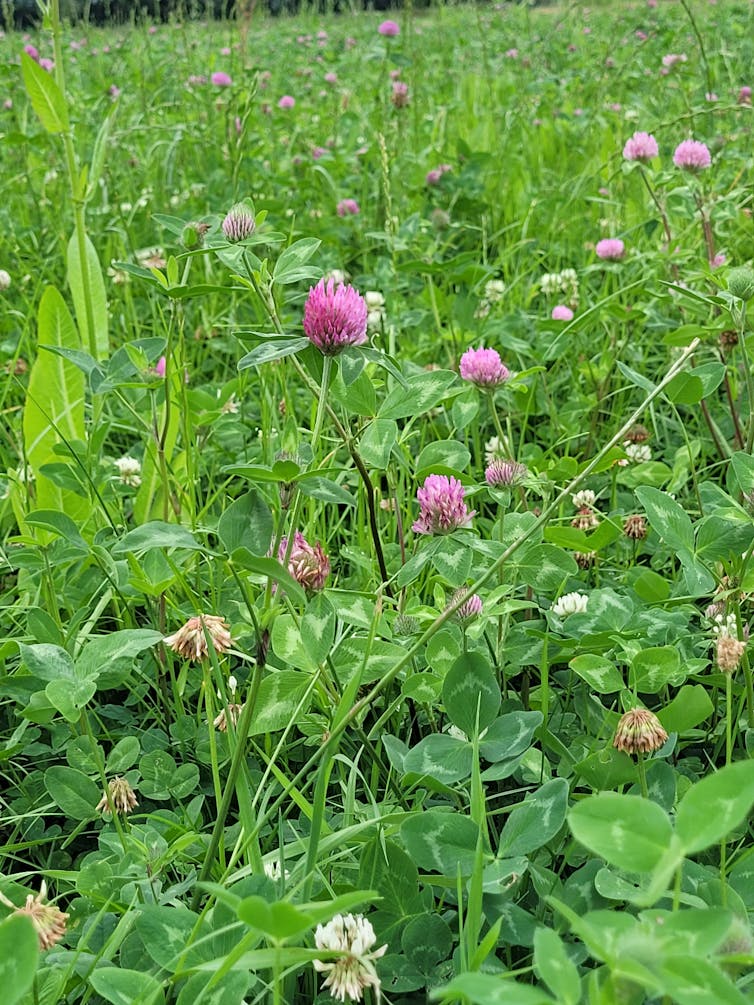
A field with a pink clover growing.
A multispecies mixture growing as part of the research.
Caroline Brophy

In our new international study published in Science, my colleagues from the LegacyNet project and I have shown that planting mixtures of different species can improve grassland yields compared to conventional practices, and crucially do so while using substantially less chemical nitrogen fertiliser.

This means farmers could save money and reduce their environmental footprint by doing this.

How was the research carried out?

The team conducted the same experiment at 26 research institutes across Europe, North America, Asia and New Zealand. At each site, we had plots sized at least three metres by five metres ranging from just one species up to six species, managed with moderate levels of chemical nitrogen fertiliser. We also had plots with a single grass species, managed with at least twice the amount of fertiliser.

In each case we measured crop yield. The research showed that planting a variety of species produced 11% higher yields than sowing a single grass, despite the single grass being treated with more than double the chemical nitrogen fertiliser.

This was in part due to the inclusion of legume species – for example, white clover and red clover, in our six-species multispecies mixtures. Legumes can extract nitrogen from the atmosphere through a natural process.

And this “free” nitrogen is released into the soil to be used by all species in the grassland. Since grass and legumes work well together, a now widespread farming practice is to sow 70% of one grass and 30% of one legume. This is often a combination of the grass perennial ryegrass and the legume white clover.

Does this mean that by growing just one grass and one legume we could get just as much yield as a multispecies mixtures? Not necessarily, because for example, herbs have deeper roots compared to grasses, which can bring benefits such as increased water uptake from lower down in the soil. Indeed, previous research has shown that multispecies mixtures can even mitigate the yield losses associated with drought conditions.

A man in a field kneeling down.
James O’Malley, a researcher, checks the crops growing from the multi species mix.
Caroline Brophy.

Our research found that there was an 18% increase in yield from using our multispecies mixture, compared to sowing 70% of one grass and 30% of one legume.

We also found that having two grasses, two legumes and two herbs was better than having just one grass, one legume and one herb.

From Roman times, agricultural grasslands have been used to feed grazing animals or as part of a crop rotation system, where farmers plant different crops in the same field in rotation, and also leave it fallow. We now know that we can improve grassland systems by combining two grasses, two legumes and two herbs in a field.

Adapting to climate challenges

Climate change poses a significant risk to farming livelihoods, agricultural production and food security. Our experiment spanned a range of climates, which allowed us to investigate the potential of multispecies mixtures to cope with rising temperatures. We found that as temperatures increased, the benefits of multispecies mixtures increased even further, compared to previous practices.

This suggests potential for farmers to increase the productivity of their lands using less fertiliser despite increasing temperatures.

Historically, farmers understood that increasing the species diversity of a grassland could improve productivity compared to sowing a single species.

But the prevalence of using a single crop and applying high amounts of chemical fertilisers has increased massively over the past century, a period ironically termed the “green revolution”. Food shortages after the second world war prompted the use of technologies such as fertilisers, herbicides, pesticides and farm machinery as ways of protecting crops.

How the research was carried out.

And yields from agricultural grasslands flourished as these technologies grew in popularity and until recently, chemical nitrogen fertilisers were relatively cheap.

However, the evidence showing how chemical nitrogen fertilisers emit the potent greenhouse gas called nitrous oxide is now much better known. Chemical fertilisers can cause other environment problems such as nitrate leaching into groundwater. Creating chemical fertilisers is an intensive industrial process that relies heavily on burning fossil fuels.

In the past two decades, scientific studies testing species diversity in agricultural grasslands began to emerge. There was evidence that mixing grass and legume species could improve the yields compared to grass species being grown on their own.

Our study further advances this knowledge to show that we can do better by planting mixtures of grasses, legumes and herbs, and with less chemical fertiliser.

This research confirming that farmers can produce more by using less fertiliser is a win for farmers’ pockets and a win for the environment.


Don’t have time to read about climate change as much as you’d like?

Get a weekly roundup in your inbox instead. Every Wednesday, The Conversation’s environment editor writes Imagine, a short email that goes a little deeper into just one climate issue. Join the 47,000+ readers who’ve subscribed so far.


The Conversation

Caroline Brophy receives funding from Research Ireland Frontiers for the Future program, grant number 19/FFP/6888; the Department of Agriculture, Food & the Marine, project ref. 21R456; and the European Union’s Horizon 2021 doctoral network program under the Marie Skłodowska-Curie grant agreement No. 101072579 (LegumeLegacy).

ref. Growing a mix of plants in fields can save farmers money and help the environment – new research – https://theconversation.com/growing-a-mix-of-plants-in-fields-can-save-farmers-money-and-help-the-environment-new-research-271432

Unions have been in decline in the UK for 50 years. A new law could begin to reverse that trend

Source: The Conversation – UK – By Steven Daniels, Lecturer in Politics, Edge Hill University

The UK’s employment rights bill will usher in major changes for workers from April 2026. But beyond promising improved rights for employees over unfair dismissal and sick pay, one of the most controversial aspects of the bill concerns the rights of trade unions.

Millions of UK workers belong to a trade union. They are found in virtually every key industry in the UK, including healthcare, education and transport. This new legislation promises to strengthen their rights – notably by forcing employers to make their staff aware that they have the right to join one.

Under the new law, employers will have to share a government-approved message with workers setting out their right to join a union and details of the unions the employer recognises. The government hopes that this will put pressure on exploitative employers to treat staff better and not to discourage union membership.

By the time the bill is fully rolled out in 2027, changes are also expected around unfair dismissal, bereavement leave, and zero-hour contracts – all changing in favour of the worker.

Politically, this milestone allows Labour to reassert its longstanding relationship with the broader trade union movement, which was vital to the founding of the party back in 1900.

The bill has been approved by both the Commons and the Lords, and when it becomes law it will represent the biggest change in favour of trade unions since the ascent of Margaret Thatcher in the late 1970s. More broadly, it could mark the start of reversing 50 years of continuous trade union decline in the UK.

My research focuses on the history of the British trade union movement since the 1980s. In the UK, unions reached the peak of their power in the 1970s, even contributing to the fall of Edward Heath’s Conservative government in 1974.

Then, the “winter of discontent” (characterised by widespread industrial action) helped usher Thatcher to electoral victory in 1979 on a promise of taking a tougher line on trade unions.

If anything, Thatcher overdelivered on this promise. Over the next decade, numerous new laws reduced the ability of unions to call disruptive strike action.

These included forcing votes to take place if any strike action was to be legal, restricting what counts as a “trade dispute”, protecting workers who refused to go on strike from reprisals, and giving employers more power to dismiss those taking part in unofficial strike action.

Tightening the screw

Subsequent Conservative governments followed this pattern, further restricting union power. In the 1990s, John Major’s government gave employers the power to decide whether to recognise a union, regardless of the size of the membership. It also mandated that unions give seven days’ notice of strike action.

David Cameron’s government doubled the notice period for strike action, and required a 50% turnout for any ballot to be legal, with strike action itself tightly regulated. Then the government of Boris Johnson allowed employers to hire temporary agency workers to undercut strike action.

Rishi Sunak’s government introduced “minimum service levels” in key industries in the event of strike action, with unions legally liable if they refused to co-operate with employers and make members go to work.

It wasn’t just the Conservatives. Even when New Labour was elected in 1997, hopes for a change in union fortunes did not materialise. The governments of Tony Blair and Gordon Brown refused to reverse or change the restrictive legislation, concerned that being seen as too pro-union would damage their re-election prospects, particularly among middle class voters.

If anything, New Labour’s policies may have inadvertently reduced union power further. Laws such as the National Minimum Wage Act reduced the need for collective bargaining.

Labour’s new bill will reverse some of these restrictions. When fully implemented, minimal service levels and the 50% turnout requirement will be abolished in favour of a simple majority. The notice period will be reduced to 10 days, and rules on union recognition and balloting will be simplified.

But the years of decline have had consequences, both for employers and staff. The number of working days lost to strike action declined significantly: having peaked at 29.5 million in 1979, it was as low as 170,000 in 2015.

This suggests that unions are increasingly unable to bring their members together and encourage them to take strike action. An increasingly restrictive legal environment probably helped employers keep pressure on workers.

Similarly, the number of workers with union membership has halved – from a peak of 13.2 million in 1979 to 6.7 million in 2023. This represents a continuous decline since 1979.

Among younger workers, those with no memory or experience of what strike action and collective bargaining can achieve, the unionisation rate is even lower. In 2022, only 3.7% of trade union members were aged between 16 and 24. As well as the long-term decline in their power and efficacy, unions have also become much less visible in the workplace.

congested traffic around the centre of paris as the result of a transport workers' strike.
Despite low membership, French unions can disrupt day-to-day lives – as happened during a transport worker walkout in 2019.
Tupungato/Shutterstock

When compared internationally, the UK’s trade union landscape is even worse. French unions wield significant influence even though a relatively low proportion of the workforce belongs to a union, and can effectively disrupt transport and even energy supplies.

Germany’s social partnership model provides formal roles for unions in both business and politics, such as giving union representatives a seat on the board, resulting in low levels of conflict and union successes.

And South Africa elected a former trade union leader, Cyril Ramaphosa, as its president in 2018 (and for a second term in 2024).

The employment rights bill will not reverse decades of union decline and marginalisation in the UK overnight – but it represents the first pro-union reform in decades. For workers, this could reverse long-term trends in wage suppression and exploitation.

However, for many unions this is not a replacement for five decades of restrictive legislation. Even when the bill receives royal assent and becomes law, unions will still be leagues away from their 1970s peak. But given what it could mean for workers’ rights and representation in the workplace, this bill is the closest thing unions have had to a political and legal “victory” in decades.

The Conversation

Steven Daniels is a member of the University and College Union (UCU).

ref. Unions have been in decline in the UK for 50 years. A new law could begin to reverse that trend – https://theconversation.com/unions-have-been-in-decline-in-the-uk-for-50-years-a-new-law-could-begin-to-reverse-that-trend-271702