Le smic protège-t-il encore de la pauvreté ?

Source: The Conversation – in French – By Hugo Spring-Ragain, Doctorant en économie / économie mathématique, Centre d’études diplomatiques et stratégiques (CEDS)

Vendredi 12 décembre 2025, le Groupe d’experts sur le smic publie un rapport sur l’impact du salaire minimum sur l’économie française. Son impact sur la pauvreté n’est cependant pas univoque. Le smic ne suffit pas à expliquer les trajectoires personnelles de plus en plus diverses. Le revenu disponible qui prend en compte les aides perçues et les dépenses contraintes est un critère plus juste.


La question revient cette année encore avec le rapport du Groupe d’experts du smic publié ce vendredi 12 décembre : le salaire minimum protège-t-il encore réellement de la pauvreté ? Pourtant, comme l’ont rappelé l’Insee et l’Institut des politiques publiques (IPP) dans plusieurs travaux plus ou moins récents, le salaire brut, seul, ne détermine pas la pauvreté. Ce qui importe, c’est le niveau de vie, c’est-à-dire le revenu disponible après transferts sociaux de toutes sortes (qui s’ajoutent), impôts et charges contraintes (qui se soustraient). Dans un contexte de renchérissement du logement (13 % d’augmentation de l’indice de référence des loyers, IRL) et d’hétérogénéité croissante des situations familiales, la question ne doit plus être posée en termes uniquement macroéconomiques.

La littérature académique reprend ce constat. Antony B. Atkinson souligne que la pauvreté ne renvoie pas simplement à un « manque de salaire », mais à un insuffisant accès aux ressources globales ; Patrick Moyes rappelle que la structure familiale modifie profondément le niveau de vie relatif. Quant à France Stratégie et l’Insee, après sa publication faisant l’état des lieux de la pauvreté en France, ils documentent la montée de ce qu’on appelle la pauvreté laborieuse, c’est-à-dire le fait de travailler sans pour autant dépasser les seuils de pauvreté et sans possibilité de profiter de l’ascenseur social.


À lire aussi :
La pauvreté de masse : symptôme d’une crise de la cohésion sociale


Un amortisseur d’inflation ?

Notre premier graphique compare l’évolution du smic, des salaires et des prix depuis 2013. On y observe très nettement que le salaire minimum a servi d’amortisseur pendant la séquence inflationniste récente : ses revalorisations automatiques l’ont fait progresser aussi vite, souvent plus vite, que l’indice des prix à la consommation.

Figure 1 – Évolution du smic, du salaire mensuel de base (SMB), du salaire horaire de base des ouvriers et des employés (SHBOE) et de l’indice des prix à la consommation (IPC) hors Tabac – Sources : Dares, Insee, Rapport GES 2025 – Graphique de l’auteur.

Ce mouvement contraste avec celui des salaires moyens, dont la progression a été plus lente. Comme le soulignent plusieurs analyses de France Stratégie et de l’Organisation de coopération et de développement économiques (OCDE), cela a eu pour effet de resserrer la hiérarchie salariale, une situation déjà documentée lors de précédentes périodes de rattrapage du smic.

L’influence du temps de travail

Mais ce constat ne dit rien d’une dimension pourtant déterminante : l’accès au temps plein car une partie des salariés au smic n’y est pas à temps complet. Comme l’ont montré plusieurs travaux de l’Insee et de la direction de l’animation de la recherche, des études et des statistiques (Dares, ministère du travail), une proportion importante de travailleurs rémunérés au salaire minimum occupe des emplois à temps partiel, et souvent non par choix mais parce qu’aucun temps plein n’est disponible. C’est ce que les économistes appellent le temps partiel contraint.

Ce temps partiel modifie radicalement l’interprétation du smic : on parle d’un salaire minimum horaire, mais, concrètement, les ressources mensuelles ne reflètent pas ce taux. Un salaire minimum versé sur 80 % d’un temps plein ou sur des horaires discontinus conduit mécaniquement à un revenu inférieur et donc à une exposition accrue à la pauvreté.

Mais si l’on s’en tenait à cette comparaison, on pourrait conclure que le smic protège pleinement les salariés les plus modestes. Or, c’est précisément ici que la question se complexifie. Car la pauvreté ne dépend pas du seul salaire : elle dépend du revenu disponible et donc de l’ensemble des ressources du ménage. C’est ce que montrent les travaux sur la pauvreté laborieuse, un phénomène en hausse en France selon l’Observatoire des inégalités, environ une personne en situation de pauvreté sur trois occupe un emploi mais les charges familiales, le coût du logement ou l’absence de second revenu maintiennent le ménage sous les seuils de pauvreté.

Du smic au revenu disponible

Pour comprendre la capacité réelle du smic à protéger de la pauvreté, il faut observer ce qu’il devient une fois transformé en revenu disponible grâce aux données de l’Insee et de la Dares, c’est-à-dire le revenu après impôts, aides et charges incompressibles.

Le graphique suivant juxtapose trois situations familiales : une personne seule, un parent isolé avec un enfant et un couple avec un enfant dont les deux adultes perçoivent le smic.

Figure 2 – Revenu disponible et seuils de pauvreté selon trois profils de ménages rémunérés au smic Sources : Dares, Insee, Rapport GES 2025 – Graphique de l’auteur.

Dans le premier panneau, on observe qu’une personne seule rémunérée au smic dispose d’un revenu disponible supérieur au seuil de pauvreté à 60 % du revenu médian. La prime d’activité joue un rôle important, mais c’est surtout l’absence de charge familiale et de coûts fixes élevés qui explique ce résultat.

Ce profil correspond à la représentation classique du smic comme filet de sécurité individuel. Comme le confirment les données de l’Insee et les travaux de France Stratégie, la pauvreté laborieuse y est encore relativement limitée. Cependant, même seul, un actif au smic pourrait avoir des dépenses contraintes extrêmement élevées dans des zones à forte demande locative.

La pauvreté laborieuse

Le deuxième panneau raconte une histoire totalement différente. Le parent isolé, même à temps plein au smic se situe clairement en dessous du seuil de pauvreté, plus grave encore, son revenu disponible ne compense plus le salaire net via les transferts. C’est ici que la notion de pauvreté laborieuse prend tout son sens. Malgré un emploi et malgré les compléments de revenu, le ménage reste dans une situation de fragilité structurelle.

Selon l’Insee, les familles monoparentales sont aujourd’hui le groupe le plus exposé à la pauvreté et notamment à la privation matérielle et sociale, non parce qu’elles travaillent moins, mais parce qu’elles cumulent un revenu unique, des charges plus élevées et une moindre capacité d’ajustement.

Dans le troisième panneau, un couple avec un enfant et deux smic vit lui aussi en dessous de la ligne de pauvreté. Ce résultat laisse penser que la composition familiale, même accompagnée de deux smic crée une pauvreté structurelle sur les bas revenus ; aussi le graphique montre-t-il que la marge est finalement assez limitée. Une partie du gain salarial disparaît en raison de la baisse des aides et de l’entrée dans l’impôt, un phénomène bien documenté par l’IPP et par le rapport Bozio-Wasmer dans leurs travaux sur les « taux marginaux implicites ». Dans les zones de loyers élevés, un choc de dépense ou une hausse de charges peut faire basculer ces ménages vers une situation beaucoup plus précaire.

ICI France 3 Hauts-de-France, 2024.

Situations contrastées

Une conclusion s’impose : le smic protège encore une partie des salariés contre la pauvreté, mais ce résultat est loin d’être uniforme. Il protège l’individu à plein temps et sans enfant, mais ne suffit plus à assurer un niveau de vie décent lorsque le salaire doit couvrir seul les charges d’un foyer, notamment dans les configurations monoparentales. Cette asymétrie est au cœur de la montée de la pauvreté laborieuse observée par l’Insee et documentée par l’Institut des politiques publiques.

Ces résultats rappellent que la pauvreté n’est plus seulement un phénomène d’exclusion du marché du travail. Elle touche des travailleurs insérés, qualifiés et en contrat stable, mais dont le salaire minimum, appliqué sur un volume horaire insuffisant ou absorbé par des dépenses contraintes, ne permet plus un niveau de vie supérieur aux seuils de pauvreté. Le smic se révèle alors davantage un plancher salarial individuel qu’un instrument de garantie sociale familiale.

À l’heure où la question du pouvoir d’achat occupe une place centrale et où la revalorisation du smic reste l’un des outils majeurs d’ajustement, ces conclusions invitent à réorienter le débat. Ce n’est pas seulement le niveau du smic qu’il faut interroger, mais sa capacité à constituer un revenu de référence pour des configurations familiales et territoriales très hétérogènes. Autrement dit, le smic joue encore sa fonction de stabilisateur individuel, mais il n’est plus suffisant seul pour protéger durablement certains ménages.

La question devient alors moins « De combien augmenter le smic ? » que « Comment garantir que le revenu disponible issu d’un emploi au smic permette effectivement d’éviter la pauvreté ? ».

The Conversation

Hugo Spring-Ragain ne travaille pas, ne conseille pas, ne possède pas de parts, ne reçoit pas de fonds d’une organisation qui pourrait tirer profit de cet article, et n’a déclaré aucune autre affiliation que son organisme de recherche.

ref. Le smic protège-t-il encore de la pauvreté ? – https://theconversation.com/le-smic-protege-t-il-encore-de-la-pauvrete-271245

England’s synthetic phonics approach is not working for children who struggle to read

Source: The Conversation – UK – By Dominic Wyse, Professor of Early Childhood and Primary Education, UCL

JPC-PROD/Shutterstock

Since 2012, England has taken an increasingly narrow approach to how primary school teachers should teach reading.

The policies on teaching reading have insisted that an approach called “systematic synthetic phonics” is the only way to teach reading. Synthetic phonics involves teaching children the 44 sounds, or “phonemes”, of language and how they are represented by letters in words.

England’s approach to teaching reading was alleged to have created “the best readers in the Western world” by the previous government, when England rose up the rankings of an international reading assessment.

Other countries and regions are now following England’s lead. For example, Australia is following many aspects of England’s approach to phonics. The US has moved towards a much greater emphasis on synthetic phonics. And New Zealand has abandoned the programme called Reading Recovery in favour of more emphasis on phonics.

These regions claim to be basing their new teaching approaches on “the science of reading”. But an accurate reading of the science shows that there are a range of different evidence-based approaches that can be taken to teaching children about phonemes and letters. If countries are following England’s lead, then we need to be sure that England’s approach is based on the most up to date research evidence.

Unfortunately the outcomes for children with reading difficulties in England, over more than a decade, tell a different story from those who claim that narrow synthetic phonics is the only approach. The proportion of children struggling to read has remained at a similar level for many years. The percentage of children not at the expected standards in reading at the age of ten or 11 has remained at about 25% since 2017.

As part of new research my colleagues and I conducted, we surveyed a group of 133 experienced teachers and special educational needs specialists in England. We also carried out a new analysis of already published research. We examined the findings of studies that tested which approaches work best for children with reading difficulties, including those with particular problems such as dyslexia.

There are hundreds of well-conducted studies that have examined how children with reading difficulties can best be taught to read. We found more than 40 systematic reviews of all of these studies. There is clear evidence that flexible teaching approaches are more effective than a narrow emphasis on synthetic phonics.

This means that teachers emphasise a range of components – such as the meanings of words and sentences to contextualise learning about phonemes and letters in real purposes for reading, and teaching writing to help reading.

Little boy reading next to adult
Motivation is a key part of children’s progression as readers.
Sokor Space/Shutterstock

Another of the components that is vital to attend to is children’s motivation for reading. The kinds of books that are used as part of the teaching is connected to this.

Systematic synthetic phonics is taught using “decodable” books that often have very limited content. But using real books is a way to motivate children through the imaginative ways that stories, poems and information are portrayed in these books. And my own research with Charlotte Hacking shows that phonics can be taught using real books.


Read more:
Phonics isn’t working – for children’s reading to improve, they need to learn to love stories


I argue that teaching reading should explicitly focus on motivating children to read. This involves understanding more about children’s interests and providing reading materials that are likely to motivate them. It also requires teachers to actively assess children’s levels of motivation, and take steps to address this as needed.

Deviating from the script

Some of the teachers that we surveyed said that if synthetic phonics was not working to teach a child to read they would try a different approach, including multi-component approaches. But more than 20% of our respondents said they would continue with synthetic phonics even if it wasn’t working, because that was the government’s policy.

Some teachers are more confident than others to innovate with their teaching, and they will have the support of head teachers to innovate. But in education systems with great pressures to conform to one particular approach all teachers find it harder to innovate.

The previous Conservative government used a variety of ways to require teachers to use only synthetic phonics for all children, including those with reading difficulties.

The phonics screening check, taken by all children in year one, and associated targets for schools, encourage a narrow focus on teaching phonics. Ofsted inspections reinforce government messages about synthetic phonics. Teachers in training and new teachers also have new tight requirements on synthetic phonics.

The Labour government has not said it will change any of this. England has just reviewed its national curriculum. No changes were proposed for the teaching of reading in primary schools.

Unless action is taken this will be a missed opportunity that will probably mean that some of our children most in need will not get the teaching based on robust research evidence that they need. However, children and schools cannot wait. The evidence shows that when synthetic phonics is not working, multi-component approaches should be tried.

The Conversation

Dominic Wyse currently receives funding from the Helen Hamlyn Trust and The Welsh Government.

ref. England’s synthetic phonics approach is not working for children who struggle to read – https://theconversation.com/englands-synthetic-phonics-approach-is-not-working-for-children-who-struggle-to-read-271344

‘Rage bait’ is the Oxford Word of the Year, showing how social media is manufacturing anger

Source: The Conversation – Global Perspectives – By Laurence Grondin-Robillard, Professeure associée à l’École des médias et doctorante en communication, Université du Québec à Montréal (UQAM)

It shouldn’t come as a surprise that the Oxford Dictionary has named “rage bait” its Word of the Year. The quantity of live-streamed drama in 2025 has made it clear that outrage is now fuelling much online content.

The death of French streamer Raphaël Graven, alias Jean Pormanove, was particularly striking in this respect. Before dying live on Kick after streaming for 298 hours, Graven had been subjected to humiliating scenes and psychological abuse from two co-streamers, according to an investigation by French news outlet Médiapart.

Although the recording of the live stream leading up to his death is no longer available, excerpts from previous broadcasts that show Pormanove being ridiculed or mistreated continue to circulate online.

A Q&A with Jean Pormanove in July 2021. He reveals a side of himself that is sometimes awkward, but also touching. (YouTube).

As an associate professor and doctoral student at UQAM’s École des médias (School of Media), I closely study the dynamics that shape digital platforms. Increasingly, platforms use rage bait to turn anger into a tool for attracting attention and advancing their commercial goals.

The Kick platform, comparable to Twitch, has been blamed for Graven’s death, and rightly so. A lack of moderation and the encouragement of gambling and games of chance are among the most frequent criticisms directed at it.

The aftermath of Graven’s death

Just a few days after Graven’s death, 23-year-old Iryna Zarutska was stabbed to death on the subway in the North Carolina city of Charlotte. Images and surveillance footage of her death went viral via X, Instagram and TikTok in a matter of hours, showing the young woman wounded, alone and without help.

The fascination with Zarutska’s slaying is nothing new. What’s more unusual, and turns this into rage bait, is how it was exploited.

Conservative YouTuber Benny Johnson accused the news media of ignoring the case, claiming that “if she were black and her killer white, the media would be talking about it non-stop.” His statement was intended to elicit a strong emotional reaction from both sides.

Beyond the reappropriation of news items to produce content designed to provoke outrage, the past year was also marked by the strategic use of videos generated by artificial intelligence for the same purpose.

One example is the sequence depicting the the president of the United States as a “king” flying over a “No Kings” protests and dropping a brown liquid resembling excrement onto the crowd. It was even shared by Donald Trump himself last October.

Word of the Year

In this highly charged context, rage bait became Oxford Dictionary’s Word of the Year, with its use reportedly tripling over the last 12 months. The term is defined as “online content deliberately designed to elicit anger,” which is “typically posted in order to increase traffic to or engagement with a particular web page or social media account.”

Oxford Words of the Year have been linked to digital culture for several years now. In 2022, it was “goblin mode,” in 2023, “rizz” won the vote and in 2024, it was “brain rot.”

This year, more than 30,000 people voted to elect the 2025 Word of the Year. The term was in competition with “aura farming” — cultivating one’s aura — and “biohack”, a set of practices aimed at optimizing the health and performance of the body and mind through changes in lifestyle, diet and technology.

From click bait to rage bait

From online clickbait, we are now moving towards rage bait, with the same objective: to gain online visibility.

The problem lies not only with content creators who use this type of bait, but also with social media platforms themselves. A decade ago, platforms were described as echo chambers, spaces where users were exposed almost exclusively to content that confirmed their interests, opinions and beliefs. It’s getting harder to say that today.

Beyond the case of the platform X — which Elon Musk has already significantly revamped since acquiring Twitter — both Meta CEO Mark Zuckerberg and TikTok CEO Shou Zi Chew also relaxed their terms of service in 2025 in the name of freedom of expression.

Zuckerberg is seeking to reconnect with the American Republican political class, while Chew is attempting to maintain TikTok’s access to the American market, which is under threat from legislative pressure. This new approach is leading to the emergence of digital spaces where controversial content, particularly rage bait, is acceptable.

TikTok claims to prohibit bloody or disturbing content, even if it is in the public interest, in addition to having a mission to “inspire creativity and bring joy.”

But this type of content generates engagement. As a result, it circulates and continues to be recommended. It remains visible thanks to its profitability.

This paradox lies at the heart of the problem: different platforms say they want to limit violence, but they profit from the elements that make violence go viral. So we’re therefore trapped in an ecosystem where outrage becomes an economic resource and where the most intense emotions fuel visibility.

A profound change in the web

In this sense, the shift from clickbait to rage bait is not just an evolution in visibility techniques. It highlights a profound change in social media.

This dynamic calls for a rethinking not only of moderation rules, but also of the business models that maintain this cycle of exposure, outrage and profitability.

In light of France’s commission of inquiry into the psychological effects of TikTok on minors and other similar work, the Oxford Dictionary’s choice seems less like a lexical tribute than an acknowledgement of social media’s failures.

The recent Words of the Year illustrate an online environment where mental exhaustion, numbness and outrage have become commonplace. Graven’s death reminds us that human lives are caught up in systems that turn vulnerability into spectacle and suffering into a product.

La Conversation Canada

Laurence Grondin-Robillard ne travaille pas, ne conseille pas, ne possède pas de parts, ne reçoit pas de fonds d’une organisation qui pourrait tirer profit de cet article, et n’a déclaré aucune autre affiliation que son organisme de recherche.

ref. ‘Rage bait’ is the Oxford Word of the Year, showing how social media is manufacturing anger – https://theconversation.com/rage-bait-is-the-oxford-word-of-the-year-showing-how-social-media-is-manufacturing-anger-271584

West Bank violence is soaring, fueled by a capitulation of Israeli institutions to settlers’ interests

Source: The Conversation – Global Perspectives – By Arie Perliger, Director of Security Studies and Professor of Criminology and Justice Studies, UMass Lowell

Israeli settlers gather near the Kiryat Arba settlement in Hebron on Dec. 10, 2025. Mosab Shawer/Middle East Images/AFP via Getty Images, CC BY

Owais Hammam was walking near his home in Khirbet Bani Harith in the West Bank on Dec. 3, 2025, when, according to media reports, he was kidnapped by Jewish settlers. Over several hours at a nearby settlement, the 18-year-old Palestinian is alleged to have endured repeated beatings, humiliation and harassment.

Israel military soldiers were reportedly involved in the incident, before they eventually released him the next morning. Hamman was hospitalized with multiple injuries and severe psychological trauma.

The alleged attack is far from isolated. The post-Oct. 7, 2023, environment has seen an escalation in settler violence, which has gone from primarily involving vandalism and property destruction to now being marked by kidnapping, prolonged abuse and apparent military complicity. In the two years to October 2025, more than 3,200 Palestinians were “forcibly displaced by settler violence and movement restrictions,” according to United Nations figures.

Violence has increased to an extent that the U.N. said October 2025 was the worst month for West Bank settler violence since it started recording incidents in 2006.

As a scholar who has studied Israeli extremist groups for over two decades, I contend that the dramatic escalation of settler violence in the West Bank reveals a profound transformation within Israel’s state institutions. Rather than serving as purported neutral enforcers of law and order, the military, Israeli police and the broader governmental apparatus have become increasingly aligned with — and at times directly complicit in — violent settler actions against Palestinians.

This institutional reluctance to address settler violence is not merely a failure of enforcement, I would argue, but a deliberate outcome of deep social, political and cultural changes that have reshaped Israeli society since at least the mid-1990s.

Settlers’ dream government

The most visible manifestation of this transformation is the composition of Israel’s current government, formed in December 2022.

For the first time, key ministerial positions are held by individuals with explicit pro-settler ideologies and personal ties to some of the most violent streams of the settlement movement. Hence, it is not surprising that prominent figures such as Finance Minister Bezalel Smotrich and National Security Minister Itamar Ben-Gvir — both settlers with what has been described as extremist ideologies — have actively implemented policies that facilitate and legitimize settler violence.

For instance, Ben-Gvir has significantly eased firearm regulations, issuing over 100,000 new gun licenses since October 2023, with settlers receiving preferential access.

Smotrich, meanwhile, has publicly distributed security equipment to illegal outposts and allocated substantial budgets for settler militias. This political backing fosters a climate in which settlers feel emboldened to act with impunity.

Men in suits gesticulate with their hands.
Itamar Ben-Gvir, left, and Bezalel Smotrich, center, talk to reporters as they visit the Sheikh Jarrah neighborhood in East Jerusalem on May 10, 2021.
Gil Cohen-Magen/AFP via Getty Images

Beyond individual ministers, the Israeli government has pursued structural reforms that systematically undermine institutional checks on settler violence.

The transfer of the main Israeli governing body in the West Bank — the Civil Administration authority — from military central command to Smotrich’s Finance Ministry represents a fundamental shift in governance. For decades, the Civil Administration coordinated the provision of West Bank services such as health and education. It also served as an instrument for coordinating with the Palestinian Authority, the body entrusted per the Oslo Accords with limited self-rule over parts of the occupied West Bank.

By placing the Civil Administration under political control rather than independent military command, the government has weakened one of the few mechanisms capable of restraining settler expansion.

Similarly, plans to subordinate the West Bank Border Police to Ben-Gvir’s Ministry of National Security threaten to dismantle the unified command structure that has been instrumental in managing tensions in the occupied West Bank since 1967.

Capitulation to settlers

Concurrent to these developments has been a blurring of lines between civilian settlers and uniformed security personnel. After Oct. 7, 2023, Israeli authorities distributed 8,000 army rifles to so-called civilian settlement defense squads and regional defense battalions.

These armed settler groups now operate alongside — and are increasingly indistinguishable from — official security forces. Settlers frequently wear official uniforms and carry army-issued weapons during attacks on Palestinians.

Security infrastructure such as police stations is often physically located within settlements, fostering close relationships between law enforcement and settler communities.

I would suggest that this geographic and institutional proximity makes neutral policing nearly impossible.

The cultural and social dimensions of this phenomenon run even deeper. Many settlers serve as army reservists, creating overlapping identities between civilian and military personnel.

Civilian security coordinators, who are responsible for coordination between the military and the settlements’ own “defense squads,” actively shape military operational policy. They help define settlement boundaries, determine areas prohibited to Palestinians and occasionally command soldiers.

Soldiers typically interpret clashes as friction between civilians rather than crimes requiring intervention. When violence intensifies, they often declare an “emergency situation” and defend settlers rather than protecting Palestinian victims.

Societal shifts

The transformation of Israeli institutions reflects broader societal changes where the settler movement has evolved from one of many societal factions to a dominant political force.

Settlers hold key positions in government and military leadership and exercise considerable political influence.

As a result, settler violence has become increasingly embedded in the operational logic of state institutions, turning law enforcement bodies from ostensibly neutral arbiters into what international observers increasingly describe as enablers or participants in systematic violence against Palestinians.

It represents, I would argue, a fundamental reorientation of state power in explicit service of settler expansionism.

Moreover, the failure to hold perpetrators of settler violence to account reveals the extent of the institutional capture. Between 2005 and 2023, more than 93% of police investigations into settler violence were closed without indictment – and only 3% resulted in convictions.

In 2021, the last year for which I was able to obtain data, Israeli authorities opened just 87 investigations for “ideologically motivated offenses,” while U.N. monitors documented 585 incidents.

The Israeli police chief in the West Bank has gone so far as to claim that reports of settler violence are fabricated by “radical left-wing anarchists.”

The erosion of judicial scrutiny

The Israeli Supreme Court has formally acknowledged that the West Bank constitutes occupied territory under international law.

Nonetheless, the judicial architecture historically accommodates settlement expansion. Settlers are subject to Israeli civilian law, including the ability to vote in Israeli elections while Palestinians face military law, producing vastly asymmetrical outcomes in cases involving violence and property rights.

The country’s Supreme Court, while occasionally striking down discriminatory measures against Palestinians, has bowed to security rationales that permit the broader settlement enterprise to proceed. For example, in 2022, the court rejected a petition to return Palestinian land in the city of Hebron, ruling that an
Israeli presence is part of the military’s “regional security doctrine.”

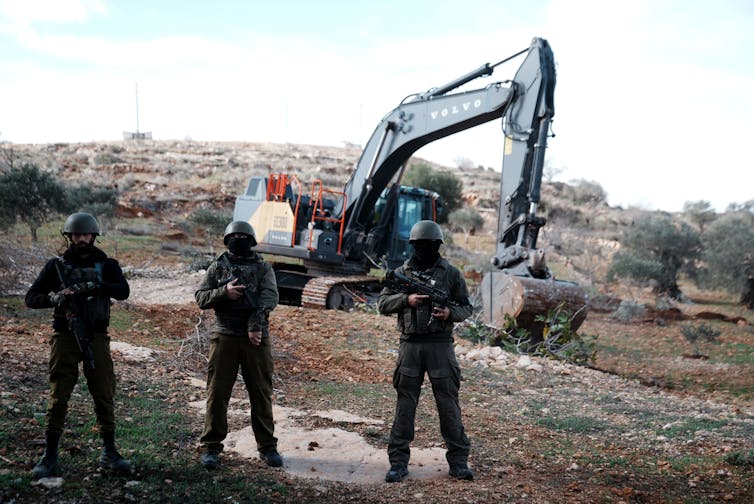
Three soldiers stand in front of a mechanical digger
Israeli soldiers stand by as Israeli construction vehicles destroy agricultural lands and uproot centuries-old olive trees in the village of Karyut, West Bank, on Dec. 8, 2025.
Issam Rimawi/Anadolu via Getty Images

Similarly, in many petitions against military policy of house demolitions, the Supreme Court has adopted a deferential stance toward security authorities.

Impact on the peace process

The implications of this institutional capitulation to settlers’ interests extend far beyond the West Bank itself. Settlers have explicitly viewed the war in the Gaza Strip as an opportunity to accelerate their agenda, forcing over 1,000 Palestinians from at least 18 communities since Oct. 7, 2023.

In addition to the humanitarian concerns, this pattern of violence-driven displacement undermines the viability of a two-state solution, which has returned to international discourse as the centerpiece of “day after” planning for Gaza. It also undermines any claim Israel might make that in lieu of a two-state solution, it can enforce the rule of law equally across people living in territories under its control.

So while international actors focus on ceasefire negotiations and reconstruction, the violence in the West Bank undermines the territorial and demographic foundations necessary for Palestinian statehood and makes the prospect of a lasting ceasefire more distant. The implications of that for a just future are indeed dire.

The Conversation

Arie Perliger does not work for, consult, own shares in or receive funding from any company or organization that would benefit from this article, and has disclosed no relevant affiliations beyond their academic appointment.

ref. West Bank violence is soaring, fueled by a capitulation of Israeli institutions to settlers’ interests – https://theconversation.com/west-bank-violence-is-soaring-fueled-by-a-capitulation-of-israeli-institutions-to-settlers-interests-269162

Sénégal : pourquoi et comment le tandem Diomaye-Sonko a déraillé

Source: The Conversation – in French – By Bamba Ndiaye, Assistant Professor, Emory University

Lors de la célébration de la Journée des martyrs et des victimes le 7 décembre 2025, à Dakar, le Premier ministre sénégalais, Ousmane Sonko, a admis sans équivoque ses divergences avec le président Bassirou Diomaye Faye. Ceci fait suite à plusieurs semaines de débat passionné au cours desquels s’est dessinée une dynamique pro-Sonko vs. pro-Diomaye, faisant craindre le risque d’un divorce politique entre les deux personnalités.

Quelques semaines auparavant, Sonko avait annoncé sur les réseaux sociaux un rassemblement “historique” prévu le 8 septembre pour ses partisans, avec pour thème : “l’État, la politique et le Pastef”, son parti.

Ce rassemblement même qu’il qualifie de “tera meeting” fut la résultante des rumeurs d’une crise au sommet de l’État. Certains parlaient même d’une possible démission ou révocation du Premier ministre. Ainsi, l’appel de Sonko a suscité de l’excitation, mais aussi de l’inquiétude. Il a en effet laissé entendre que ce rassemblement marquerait un tournant dans la vie politique du pays.

En tant que spécialistes ayant étudié [les mouvements politiques et sociaux en Afrique de l’Ouest et au Sénégal], nous analysons ici les tenants et les aboutissants de cette divergence politique naissante. Une crise qui, si elle persiste, pourrait menacer la stabilité politique du pays dans un contexte économique et financier précaire.

Une démonstration de force

Le rassemblement du 25 octobre a été une véritable démonstration de force. Sonko a saisi cette occasion pour évoquer la lourde dette cachée du Sénégal, tout en détaillant les conséquences négatives sur l’économie. Il a aussi parlé des négociations difficiles avec le Fonds monétaire international (FMI) pour résoudre la crise en insistant sur le refus d’une restructuration.


Read more:
Sénégal : la politique étrangère du tandem Faye-Sonko, rupture ou continuité ?


Devant une foule enthousiaste, il a accusé l’ancien président Macky Sall et son parti, l’APR (Alliance pour la République), de mauvaise gestion financière.

Le Premier ministre a enfin dénoncé des manœuvres en cours pour écarter l’ancienne ministre de la Famille et des Solidarités, Aïda Mbodj, comme coordinatrice de la coalition “Diomaye Président”. C’est cette coalition qui avait porté la candidature du président Faye à la présidentielle de 2024. Sonko a insinué qu’on voulait la remplacer par Aminata Touré, ancienne Première ministre de Macky Sall. Il a aussi fait allusion au fait que Mme Touré, citée dans un rapport public pour mauvaise gestion, ne dirigerait pas une coalition dominée par le Pastef.

La réaction du président

L’euphorie du meeting s’est rapidement transformée en inquiétude et indignation. Deux jours plus tard, le président Faye a signé un document. Il a limogé Aïda Mbodj et a nommé unilatéralement Aminata Touré à la tête de la coalition, avec pour mission de la restructurer et de la consolider.

Pour de nombreux partisans de Sonko et du Pastef, cette décision du président Faye est un “acte hostile”. Elle a été perçue comme un désaveu et une provocation envers le Premier ministre. Pourtant, c’est Sonko qui avait soutenu Faye comme son successeur, lui permettant d’accéder au pouvoir.

En l’espace d’une semaine, les actions contradictoires des deux hommes ont révélé une crise politique plus profonde. Une crise qui menace de créer une fracture au sein du Pastef et de briser ce duo historique, nous rappelant ainsi une crise politique similaire qui avait opposé, soixante-trois ans plus tôt, le président Léopold Sédar Senghor à son Premier ministre, Mamadou Dia.

“Diomaye n’est pas Sonko”

Depuis que ce conflit est devenu public, beaucoup parlent de “déloyauté”. Ils détournent le slogan de la campagne présidentielle de 2024, “Diomaye moy Sonko” (Diomaye est Sonko, en wolof), en “Diomaye du Sonko” (Diomaye n’est pas Sonko). Cela marque une différence fondamentale entre les deux hommes.

Sonko et le président Faye partagent pourtant un programme politique “anti-système”. Ils sont pour la transparence, la justice et de nouveaux partenariats économiques gagnant-gagnant. Mais des divergences claires sont apparues sur la méthode et les priorités.

Le président Faye semble privilégier le dialogue et la préservation de l’unité nationale. Il agit avec lenteur pour lancer des enquêtes et des poursuites contre les dignitaires de l’ancien régime. Pourtant, il s’était engagé à mener des réformes judiciaires profondes et à rendre justice aux victimes du régime de Macky Sall.


Read more:
Sénégal : les ressorts de l’ascension fulgurante du Pastef, le parti au pouvoir


Cette lenteur dans les réformes frustre l’opinion publique. Les Sénégalais voient d’anciens responsables se soustraire à la justice en se réfugiant à l’étranger ou ne pas être inquiétés pour leurs actes.

De son côté, Sonko incarne le “projet” de changement et bénéficie d’une grande popularité. Il semble amer face à une justice qui stagne et qui semble marquer le pas face aux dossiers impliquant d’anciens dignitaires du régime sortant. Il veut voir un système hérité de la colonisation entièrement démantelé et remplacé. Cela répond aux attentes de nombreux Sénégalais qui réclament des comptes et des changements concrets dans la justice, l’économie et le système politique.

Ainsi, le Premier ministre a ouvertement critiqué la crise d’autorité et la lenteur dans la reddition des comptes.

Une stratégie politique ?

Beaucoup pensent que le limogeage d’Aïda Mbodj par le président Faye est une affirmation de son autorité. Il s’agirait de se positionner face à un Premier ministre qui reste très populaire. Mais cette nomination d’Aminata Touré signifie aussi qu’il intègre des figures du système qu’il promettait de démanteler.

Faye cherche-t-il à prendre ses distances avec Sonko et le Pastef ? Le but serait-il de se présenter à la présidentielle de 2029 sous une autre bannière politique ? Une chose est claire : le Pastef reste la formation politique dominante au Sénégal. S’opposer à une version renouvelée de la coalition “Diomaye Président” sans le Pastef et Sonko pourrait être une mauvaise tactique pour assurer une longévité politique.

Aujourd’hui, la coalition “Diomaye Président” est clairement divisée. Une dynamique “Pro-Sonko” s’oppose à une dynamique “Pro-Diomaye”, ce qui aggrave la crise. Le Bureau politique du Pastef a d’ailleurs publié un communiqué réaffirmant sa volonté de restructurer “Diomaye Président” en plaçant le Pastef au centre. Il refuse de reconstruire une coalition avec des dignitaires recyclés de l’ancien régime ou des partis sans légitimité populaire.

Pour l’instant, des médiations sont toujours en cours. Mais les deux camps appellent chacun à renforcer leurs positions, ce qui creuse davantage le fossé entre Sonko et Faye. D’ailleurs, lors de la rencontre du 7 décembre, Ousmane Sonko a appelé son parti à se réinventer pour mieux faire face à la réalité politique et aux menaces internes. Dans la foulée, il a annoncé le congrés de son parti prévu au mois d’avril 2026.

Les conséquences d’une possible séparation

Après la fin du régime de Macky Sall (2012-2024), le Pastef avait clairement annoncé son intention de rester au pouvoir pendant au moins un demi-siècle. Mais l’histoire politique montre que la cohabitation de longue durée entre des figures fortes, ayant des ambitions présidentielles, est souvent irréaliste et de courte durée. Le tandem Sonko-Faye ne fait pas exception.

Si Faye décidait de se séparer du noyau dur du Pastef, sa nouvelle coalition “Diomaye Président” pourrait rencontrer d’énormes difficultés. Malgré le contrôle du pouvoir exécutif, elle aurait alors du mal à rivaliser avec la légitimité populaire d’Ousmane Sonko, au Sénégal et dans la diaspora.

De plus, sans majorité au parlement, la coalition “Diomaye Président” aurait sans doute du mal à faire voter des lois et à mettre en œuvre des réformes importantes avant la prochaine présidentielle prévue en 2029. Lors des dernières élections législatives, le Pastef, sous la direction de Sonko, a remporté 130 des 165 sièges. Beaucoup de ces députés ont affirmé leur loyauté envers le Premier ministre.

En outre, des partisans appellent déjà à l’élection de Sonko en 2029. Ce dernier a lui-même rappelé que sa potentielle candidature en 2029, ne souffre d’aucun obstacle légal. Ses partisans estiment que le président Faye est en train de s’éloigner du “projet”. Étant donné la popularité actuelle du Pastef, l’affronter pour le reste du mandat serait très difficile pour le président Faye. D’autant qu’il peine déjà à mettre en œuvre des réformes politiques, sociales ou économiques significatives.

Face à cette situation, les citoyens sénégalais sont inquiets. Ils sont pris en étau entre une grave crise économique et financière et des années d’instabilité politique, après des décennies d’efforts.

Ces prévisions inquiétantes pourraient être évitées. Il faudrait pour cela de la sagesse politique et une ambition collective pour préserver l’intérêt public en apaisant les différends.

En définitive, le Sénégal, nation jeune et démocratique, n’est pas à l’abri des crises politiques. Elles menacent souvent la stabilité du pays. L’élection présidentielle de 2024 devait marquer la fin d’un régime et annoncer la disparition de “l’État néo-colonialiste”.

Le président Faye et son Premier ministre Ousmane Sonko incarnent l’espoir d’une grande partie du peuple pour des réformes radicales. Mais leurs divergences politiques pourraient compromettre la stabilité du pays et la mise en œuvre du “projet”, dans un contexte de crise de la dette très préoccupant.

The Conversation

The authors do not work for, consult, own shares in or receive funding from any company or organisation that would benefit from this article, and have disclosed no relevant affiliations beyond their academic appointment.

ref. Sénégal : pourquoi et comment le tandem Diomaye-Sonko a déraillé – https://theconversation.com/senegal-pourquoi-et-comment-le-tandem-diomaye-sonko-a-deraille-270822

Did Donald Trump order piracy on the high seas?

Source: The Conversation – UK – By Jonathan Este, Senior International Affairs Editor, Associate Editor, The Conversation

This newsletter was first published in The Conversation UK’s World Affairs Briefing email. Sign up to receive weekly analysis of the latest developments in international relations, direct to your inbox.


Venezuelan Nobel peace laureate, María Corina Machado, plans to return home with her accolade “at the correct moment”. You have to presume the correct moment will be at such a time as her bitter political foe Nicolás Maduro is on holiday or otherwise unavoidably detained, or she certainly risks arrest as soon as she sets foot in her home country.

She told the Times of reports from a local NGO that young people were being detained for simply having the news of the Nobel prize in their phone. So she’d be well aware that the crime of being one of the most prominent opposition figureheads might place her in considerable legal jeopardy.

Perhaps that’s the point. It’s not up to us to speculate, but it’s not hard to imagine news of her arrest going down extremely badly in Washington right now. Having conducted 22 strikes on boats in the Caribbean alleged to be carrying what the US president has designed as “narcoterrorists” with the deaths of at least 87 people, closed the airspace above the country and, on December 10, intercepted and boarded an oil tanker off the coast (more of which anon), one wonders what the Trump administration’s next step might be.

Will there be a “Gulf of Tonkin incident?” The equivalent of the now-infamous confrontation between North Vietnamese and US naval forces which precipitated the Vietnam War – an episode which turned out to be wholly cooked-up by the Americans. Announcing the seizure of the oil tanker, Donald Trump told reporters, cryptically: “Other things are happening.” He did not go into details, but we’ll be watching closely as this develops.

Understandably the Venezuelans are not amused by the incident, which a government spokesman said was “barefaced robbery and an act of international piracy”. We asked Mark Chadwick, an expert in international law at Nottingham Trent University, who has written a book on piracy, for his opinion on the matter.


Read more:
What does international law tell us about the US seizure of an oil tanker off the coast of Venezuela?


Let’s avoid, for now at least, the irony of Trump’s decision to pardon a man convicted in a US court for “flooding the US with cocaine”, while instructing his military to target boats piloted by people he has designated as “narcoterrorists”.

It has been interesting to follow the coverage of these attacks and their legality, or lack of it. For the record, and in case you have missed our expert analysis, these attacks appear very risky, legally.

But it’s not as if the US – and her allies, including the UK – have’t sailed pretty close to the legal wind with “targeted killings” across the Middle East and elsewhere over past decades. Elisabeth Schweiger is an expert on international law and the use of force at the University of Stirling. She writes that the fact that there has not been more of an international outcry at these killings has created a situation where these extrajudicial killings have been almost normalised. Indeed the discussion is “beginning to shift from whether such strikes should occur to how they should be conducted, focusing on issues like target identification”.


Read more:
Donald Trump’s strikes against narcoterrorists are new but the logic behind them isn’t


One country where they will be watching what’s going on in Venezuela with close interest is China, writes Tom Harper. Harper, an expert in Chinese foreign policy at the University of East London, says that Beijing reacted to news of the closure by the US of Venezuelan airspace with an admonitory message that China “opposes external interference in Venezuela’s domestic affairs under any pretext”.

As Harper notes, Beijing has worked hard over decades to develop relations and influence with a range of Latin American countries, partly for trade reasons, partly as a counterweight to US influence. China is also one of the largest buyers of its oil. In turn, Venezuela buys Chinese arms.

But now, in its new national security strategy, the Trump administration has invoked the Monroe doctrine. This policy originating from the 19th century essentially claimed that Latin America was America’s backyard to mess around in and that any outside interference in the region would be seen as a hostile act towards US interests. It was discontinued in 2013 by the Obama administration, as the then secretary of state John Kerry declared that “the era of the Monroe doctrine is over”.

Now it’s back, in what the White House is calling the “Trump corollary”, which states that “the American people – not foreign nations nor globalist institutions – will always control their own destiny in our hemisphere”. How Beijing reacts to this remains to be seen.


Read more:
Why China is watching Trump’s Venezuela campaign closely


National security strategy

The Chinese aren’t the only people who will have read Trump’s 2025 national security statement with interest, although in the case of most of us in Europe, it’s more a case of bemusement and horror. While barely mentioning Russia and not mentioning North Korea at all, the 33-page document describes Europe’s shortcomings in lavish detail.

Europe, we read, has become weakened by allowing immigration to get out of control to the extent that it now risks “civilizational erasure”. Meanwhile Europe’s politicians have undermined free speech and suppressed democratic opposition. Ominously, the national security strategy talks of “cultivating resistance to Europe’s current trajectory within European nations”. He doubled down on that theme in an interview with the US, hinting that he might consider endorsing candidates who align better with his geopolitical vision.

Reading between the lines of the document, David Dunn and Stefan Wolff, experts in international security at the University of Birmingham, conclude that “the transatlantic alliance that was the cornerstone of European security and underpinned the liberal international order has ceased to exist”.

It’s a worrying time for Nato’s European members, they believe. Trump and some of his most senior officials have signalled that the US is no longer prepared to act as the security backstop – the principle around which the alliance was originally built. If any silver lining to this is to be found it’s that the US president’s insistence that all Nato members must increase their defence spending has already got them scrambling to adjust their budgets. And Trump’s perceived unreliability around the Ukraine war has led them to form a Europe-oriented “coalition of the willing”.

As our authors conclude: “If Nato founders, which is not now inconceivable, [this coalition] may be Europe’s best hope of surviving in a world where it is no longer one of, or aligned with, the dominant great powers of the day. But for that to become a reality, the coalition of the willing needs to become a coalition of the able. And this is a test it has yet to pass.”


Read more:
Donald Trump’s national security strategy puts America first and leaves its allies to fend for themselves


That Washington has often viewed the unwillingness of some European powers to join in with America’s foreign policy adventures as a sign of weakness is well known. When France and Germany declined to join George W. Bush’s invasion of Iraq, there were quips about “Euroweenies” and “EU-nuchs”. So it’s not surprising that the new US national security strategy focuses on this perceived shortcoming.

But, the document’s focus on the risk of “civilizational erasure” in Europe came as a surprise to many. It feels for all the world like a reheated version of the “great replacement theory” – namely the idea that indigenous Europeans are being outbred by immigrants, to the extent that “will be unrecognizable in 20 years or
less”.

The fact is, writes Roman Birke, an expert in modern European history at Dublin City University, that this has become something of an obsession for some thinkers in the US and parts of Europe. Leaders that Trump admires, such as Hungary’s Viktor Orbán, have promoted policies to get women having more children. “We Hungarians have a different way of thinking,” Orban is quoted as saying. “Instead of just numbers, we want Hungarian children. Migration for us is surrender.”

Birke believes that Trump and his Maga movement’s suspicion of Europe focuses on these issues which to them mean the Europe has become weak and decadent.


Read more:
America’s anti-European attitudes are centred on perceptions of military weakness and the decline of native populations


But you’d be mistaken if you believe Trump’s national security strategy to reveal him as an isolationist, writes Andrew Gawthorpe. Far from it. Gawthorpe, whose research has focused on the changing views of civilisation inherent in Trump’s foreign policy when contrasted with that of the great liberal US president Woodrow Wilson, thinks that Trump sees himself as “the protector of a racially and culturally defined civilisation that covers both the US and Europe”.

Gawthorpe picks out three broad themes from the national security strategy which illustrate how the US president and his top aides see the world and America’s place astride it.


Read more:
What the US national security strategy tells us about how Trump views the world


Sign up to receive our weekly World Affairs Briefing newsletter from The Conversation UK. Every Thursday we’ll bring you expert analysis of the big stories in international relations.


The Conversation

ref. Did Donald Trump order piracy on the high seas? – https://theconversation.com/did-donald-trump-order-piracy-on-the-high-seas-271881

Polar bears are adapting to climate change at a genetic level – and it could help them avoid extinction

Source: The Conversation – UK – By Alice Godden, Senior Research Associate, School of Biological Sciences, University of East Anglia

Polar bears that have moved to the south-east of Greenland where there it is warmer are showing different genetic data. Tony Campbell/Shutterstock

The Arctic Ocean current is at its warmest in the last 125,000 years, and temperatures continue to rise. Due to these warming temperatures more than two-thirds of polar bears are expected to be extinct by 2050 with total extinction predicted by the end of this century.

But in our new study my colleagues and I found that the changing climate was driving changes in the polar bear genome, potentially allowing them to more readily adapt to warmer habitats. Provided these polar bears can source enough food and breeding partners, this suggests they may potentially survive these new challenging climates.

We discovered a strong link between rising temperatures in south-east Greenland and changes in polar bear DNA. DNA is the instruction book inside every cell, guiding how an organism grows and develops. In processes called transcription and translation, DNA is copied to generate RNA (molecules that reflect gene activity) and can lead to the production of proteins, and copies of transposons (TEs), also known as “jumping genes”, which are mobile pieces of the genome that can move around and influence how other genes work.

In carrying out our recent research we found that there were big differences in the temperatures observed in the north-east, compared with the south-east regions of Greenland. Our team used publicly available polar bear genetic data from a research group at the University of Washington, US, to support our study. This dataset was generated from blood samples collected from polar bears in both northern and south-eastern Greenland.

Our work built on the Washington University study which discovered that this south-eastern population of Greenland polar bears was genetically different to the north-eastern population. South-east bears had migrated from the north and became isolated and separate approximately 200 years ago, it found.

Researchers from Washington had extracted RNA from polar bear blood samples and sequenced it. We used this RNA sequencing to look at RNA expression — the molecules that act like messengers, showing which genes are active, in relation to the climate. This gave us a detailed picture of gene activity, including the behaviour of TEs. Temperatures in Greenland have been closely monitored and recorded by the Danish Meteorological Institute. So we linked this climate data with the RNA data to explore how environmental changes may be influencing polar bear biology.

Does temperature change anything?

From our analysis we found that temperatures in the north-east of Greenland were colder and less variable, while south-east temperatures fluctuated and were significantly warmer. The figure below shows our data as well as how temperature varies across Greenland, with warmer and more volatile conditions in the south-east. This creates many challenges and changes to the habitats for the polar bears living in these regions.

In the south-east of Greenland, the ice-sheet margin, which is the edge of the ice sheet and spans 80% of Greenland, is rapidly receding, causing vast ice and habitat loss.

The loss of ice is a substantial problem for the polar bears, as this reduces the availability of hunting platforms to catch seals, leading to isolation and food scarcity. The north-east of Greenland is a vast, flat Arctic tundra, while south-east Greenland is covered by forest tundra (the transitional zone between coniferous forest and Arctic tundra). The south-east climate has high levels of rain, wind, and steep coastal mountains.

Temperature across Greenland and bear locations

A map of Greenland indicating the location of the polar bears sampled in the north and south-east of Greenland, coupled with the temperature of those locations. The temperatures were more varied and overall much warmer in the south-east
Author data visualisation using temperature data from the Danish Meteorological Institute. Locations of bears in south-east (red icons) and north-east (blue icons).
CC BY-NC-ND

How climate is changing polar bear DNA

Over time the DNA sequence can slowly change and evolve, but environmental stress, such as warmer climate, can accelerate this process.

TEs are like puzzle pieces that can rearrange themselves, sometimes helping animals adapt to new environments. In the polar bear genome approximately 38.1% of the genome is made up of TEs. TEs come in many different families and have slightly different behaviours, but in essence they all are mobile fragments that can reinsert randomly anywhere in the genome.

In the human genome, 45% is comprised of TEs and in plants it can be over 70%. There are small protective molecules called piwi-interacting RNAs (piRNAs) that can silence the activity of TEs.

Despite this, when an environmental stress is too strong, these protective piRNAs cannot keep up with the invasive actions of TEs. In our work we found that the warmer south-east climate led to a mass mobilisation from these TEs across the polar bear genome, changing its sequence. We also found that these TE sequences appeared younger and more abundant in the south-east bears, with over 1,500 of them “upregulated”, which suggests recent genetic changes that may help bears adapt to rising temperatures.

Some of these elements overlap with genes linked to stress responses and metabolism, hinting at a possible role in coping with climate change. By studying these jumping genes, we uncovered how the polar bear genome adapts and responds, in the shorter term, to environmental stress and warmer climates.

Our research found that some genes linked to heat-stress, ageing and metabolism are behaving differently in the south-east population of polar bears. This suggests they might be adjusting to their warmer conditions. Additionally, we found active jumping genes in parts of the genome that are involved in areas tied to fat processing – important when food is scarce. This could mean that polar bears in the south-east are slowly adapting to eating the rougher plant-based diets that can be found in the warmer regions. Northern populations of bears eat mainly fatty seals.

Overall, climate change is reshaping polar bear habitats, leading to genetic changes, with south-eastern bears evolving to survive these new terrains and diets. Future research could include other polar bear populations living in challenging climates. Understanding these genetic changes help researchers see how polar bears might survive in a warming world – and which populations are most at risk.

Don’t have time to read about climate change as much as you’d like?

Get a weekly roundup in your inbox instead. Every Wednesday, The Conversation’s environment editor writes Imagine, a short email that goes a little deeper into just one climate issue. Join the 47,000+ readers who’ve subscribed so far.

The Conversation

This study was funded by grants from the Natural Environment Research Council (NE/S011188/1) and the European Research Council (SELECTHAPLOID – 101001341)

ref. Polar bears are adapting to climate change at a genetic level – and it could help them avoid extinction – https://theconversation.com/polar-bears-are-adapting-to-climate-change-at-a-genetic-level-and-it-could-help-them-avoid-extinction-269852

Black-market oil buyers will push Venezuela for bigger discounts following US seizure – starving Maduro of much-needed revenue

Source: The Conversation – USA (2) – By Francisco J. Monaldi, Wallace S. Wilson Fellow in Latin American Energy Policy, Rice University

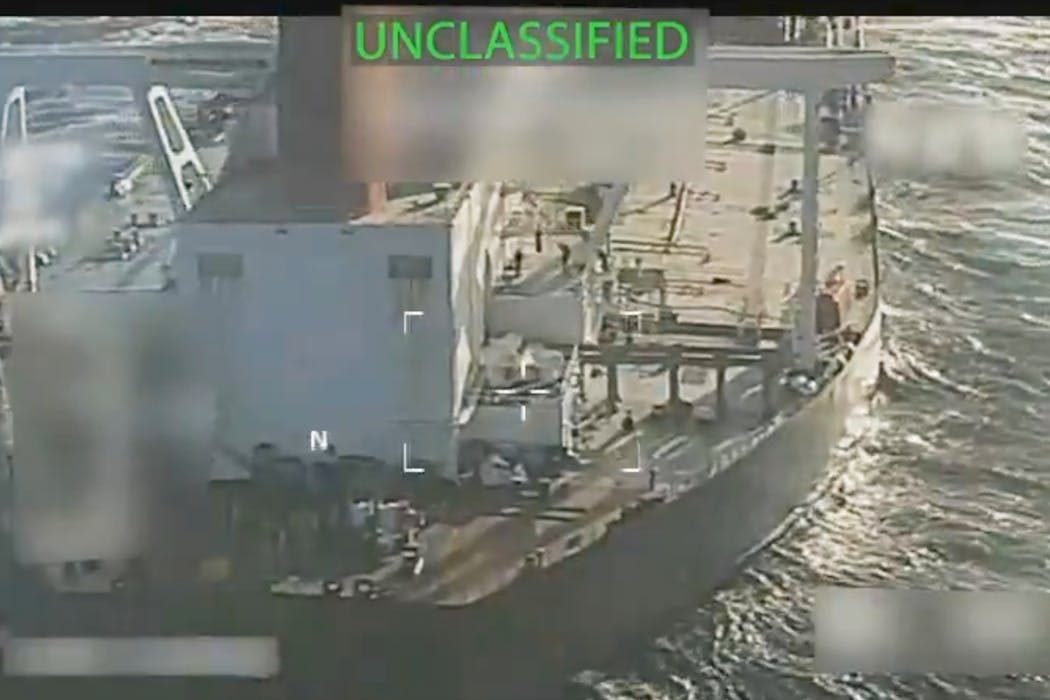
A video posted on Attorney General Pam Bondi’s X account shows the moment an oil tanker was seized by U.S. forces off the coast of Venezuela. U.S. Attorney General’s Office/X via AP

The U.S. seizure of an oil tanker off the Venezuelan coast looks designed to further squeeze the economy of President Nicolás Maduro’s country.

The Dec. 10, 2025, operation – in which American forces descended from helicopters onto the vessel – follows months of U.S. military buildup in the Caribbean and was immediately condemned by the Venezuelan government as “barefaced robbery and an act of international piracy.”

But what exactly is the Trump administraion’s aim in going after the tanker, and how could this impact the already beleaguered economy of Venezuela? The Conversation U.S. turned to Rice University’s Francisco J. Monaldi, an expert on Latin American energy policy, for answers.

What do we know about the tanker that was seized?

The seized tanker, which according to reports is a 20-year-old vessel called the Skipper, is a supertanker that can carry around 2 million barrels of oil.

According to the Trump administration, the vessel was heading to Cuba. But because of the size of the ship, I strongly suspect that the final destination was likely China – tankers the size of the seized one don’t tend to be used to take oil across the Caribbean to Cuba. The ones used for that task are far smaller.

This particular tanker was sanctioned by the U.S. Treasury in 2022 due to it carrying prohibited Iranian oil. At the time, it was claimed that the ship – then called Adisa – was controlled by Russian oil magnate Viktor Artemov and was engaged in an oil smuggling network.

Attorney General Pam Bondi released a video of the seizure on X.

So the latest U.S. seizure was, on the surface, unrelated to the sanctions placed on Venezuela by U.S. authorities in 2019 and expanded in 2020 to include secondary sanctions – that is, on countries that do business on the targeted nation or company.

As such, Venezuelan officials have said this is unprecedented. And they are largely right. While there have been a few occasions in which Iranian tankers have been seized due to sanctions busting, this is the first time that there has been a seizure of a vessel departing Venezuela and with a Venezuelan crew.

The Trump administration has signaled that it is not only seizing the cargo but the ship itself – which would represent a significant loss for the company owning the ship. The loss will be borne by the company, not Venezuela, as it was under a “Free on Board” contract, meaning that as soon as it left Venezuela the buyer takes responsibility for it.

Nonetheless, this is a significant escalation of the pressure campaign on Venezuela, which looks set to continue. Reuters has reported that around 30 other tankers near Venezuela have some kind of sanction against them. They form part of a large shadow fleet that try to skirt sanctions through hiding their identity while transporting oil from Russia, Venezuela and Iran.

The signal from U.S. officials is that they are prepared to go after more vessels and further squeeze Venezuela’s oil revenues through fresh sanctions.

How often they will seize vessels is not known, but the clear threat from the White House is that the U.S. will continue with this seizure campaign.

How important are oil exports to Venezuela?

Venezuela’s economy is tremendously dependent on oil production.

We do not have exact figures, as the Venezuela government has not published them in seven years, but most analysts believe oil constitutes north of 80% of all of the country’s exports – some even put this figure above 90%.

Most of that oil goes to the black market, and a majority ends up with independent refiners in China. State-owned enterprises in China tend not to buy this oil because they do not want to fall foul of the sanctions regime. But Beijing tends to turn a blind eye to tankers heading to non-state entities, especially if those tankers have hidden their true identity so it doesn’t look like they are coming from Venezuela.

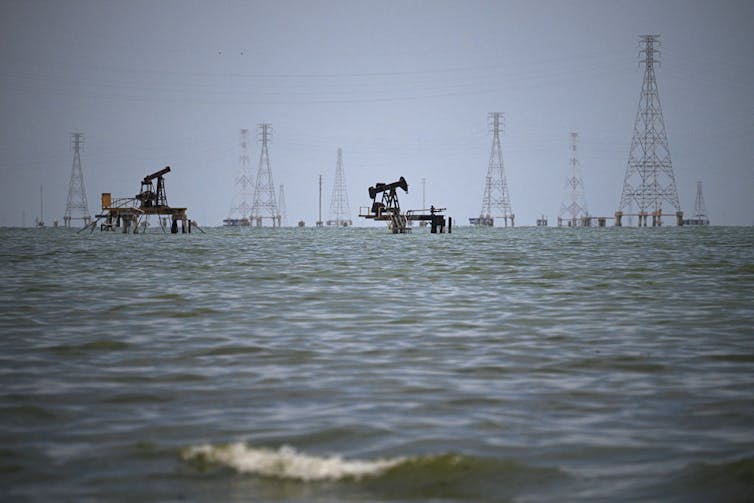
Oil rigs are seen on a large body of water.
Oil production makes up a large chunk of Venezuela’s economy.
Federico Parra/AFP via Getty Images

Around 80% of Venezuelan oil goes to China in this way; around 17% goes to the U.S. through a license awarded by the U.S. Treasury to oil giant Chevron. And 3% goes to Cuba, which tends to be subsidized by the Venezuelan government.

Venezuela’s economy itself is also very dependent on oil, with the sector making up about 20% of total GDP, more than any other industry. And when it comes to government income, the oil sector makes up north of 50%.

How have US actions affected Venezuelan oil production?

It is important to know that even before U.S. sanctions began in 2019, Venezuela’s oil production was in severe decline.

In 1998, before Hugo Chávez, the leftist military officer who became a populist president, came to power, oil production peaked at around 3.4 million barrels a day. By the time Chávez died and Maduro succeeded him in 2013, it had fallen to 2.7 million barrels a day.

When U.S. sanctions targeting the state-owned oil company, Petróleos de Venezuela, were enacted in 2019, production was down to 1.3 million barrels a day – but that had already been affected by the other financial sanctions that came in two years earlier.

The oil sanctions of 2019 closed the U.S. market, taking away half a million barrels a day that at the time headed from Venezuela to the U.S. As a result, Venezuela had to increase oil sales to India and China.

But then the 2020 secondary sanctions, which apply to countries doing business with Venezuela, came in. As a result, Europe and India stopped buying Venezuelan oil, meaning that its only markets were Cuba and China. Of course, that year also saw the onset of the COVID-19 pandemic, which resulted in a massive cooling of the oil market globally.

Venezuelan oil production collapsed to 400,000 barrels a day that year. Today it has recovered to around 1 million barrels a day. This has been helped by the U.S. allowing Chevron – which, after Petróleos de Venezuela, is the second-largest oil company operating in the country – to continue production.

How does Venezuela get around oil sanctions?

Venezuela relies on a shadow fleet to help it skirt U.S. sanctions. These vessels hide their identity by using false flags and false names.

Companies often take a tanker that is going to be retired and change the identity, put on a new coat of paint and make sure transponders – devices that transmit radio signals to give a map reading – are doctored so that it looks like the ship is in a different place altogether.

These ships arrive in Venezuela, pick up oil and then set sail. Sometimes they then transfer the cargo to another ship – which carries huge environmental risks. And then it arrives typically in Malaysia, where it takes on a Malaysian identity and on it goes to China.

What impact has this latest seizure had on the price of oil?

The seizure had little impact on global oil prices, because of exiting oversupply and due to the fact that Venezuela makes up only around 1% of the overall market. That could change, depending on how aggressive the U.S. gets. But the Trump administration will be mindful that it doesn’t want to see domestic prices rise as a result.

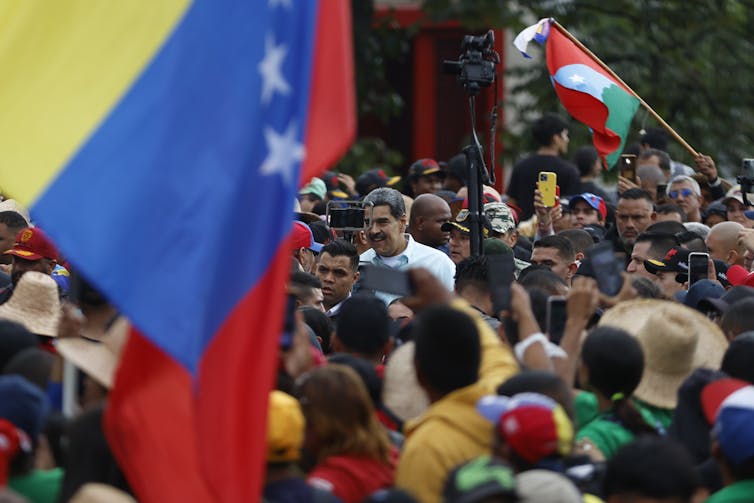
A man in white stands in the center of a large crowd.
Venezuelan leader Nicolás Maduro faces growing pressure over his country’s economic problems.
Pedro Rances Mattey/Anadolu via Getty Images

As to the price of Venezuelan oil, that could be more drastic. Venezuelan oil is already sold at a discount on the black market because of the existing risk relating to the sanctions. This latest action is likely to widen these discounts even further.

In addition, Venezuela has until now required companies to pay some of the payment for oil cargo upfront – and a lot will be unwilling to do so now, due to high costs involved in a U.S. seizure. For example, a tanker of 2 million barrels, even with the current discount, will be worth around US$100 millon – no one wants to risk that much money. So very few buyers will be willing to prepay. Instead they will expect Venezuela to share the risk.

The bottom line for Maduro is that the only way to get someone to buy Venezuelan oil amid the heightened risk of this moment is to offer higher discounts with fewer prepayments. Besides discounts, export volumes could also be affected and that in turn would lead to production cuts, which are costly to reverse.

And all this will further choke off the already limited revenue that Maduro is relying on to keep Venezuela’s government functioning.

The Conversation

Francisco J. Monaldi does not work for, consult, own shares in or receive funding from any company or organization that would benefit from this article, and has disclosed no relevant affiliations beyond their academic appointment.

ref. Black-market oil buyers will push Venezuela for bigger discounts following US seizure – starving Maduro of much-needed revenue – https://theconversation.com/black-market-oil-buyers-will-push-venezuela-for-bigger-discounts-following-us-seizure-starving-maduro-of-much-needed-revenue-271896

Why tensions between China and Japan are unlikely to be resolved soon

Source: The Conversation – Global Perspectives – By Sebastian Maslow, Associate Professor, International Relations, Contemporary Japanese Politics & Society, University of Tokyo

Though China and Japan are experienced in dealing with diplomatic crises, relations between the two neighbours appear to have reached a new low. And this time, their conflict may not be easily resolved.

What’s behind the latest crisis and what’s driving the escalation?

The current round of tensions was triggered by Japanese Prime Minister Sanae Takaichi’s remarks in the Diet (Japanese parliament) on November 7, suggesting a move by Beijing to use military force against Taiwan would trigger a Japanese military intervention.

Presented as a “worst-case scenario”, such a Chinese attempt would constitute a “survival-threatening situation” for Japan, she said, justifying its right to collective self-defence to support its US security ally in restoring peace and stability across the Taiwan Strait.

Diplomatic crisis

Taiwan was a Japanese colony from 1895 to 1945. Later, it harboured Chiang Kai-shek’s Nationalists after their defeat by Mao Zedong’s communist troops in 1949.

Today, Beijing considers Taiwan a province of China, though it has never been under the Communists’ rule. Statements to the contrary are considered an intervention in China’s domestic affairs, crossing a red line for Beijing’s elite.

Demanding a swift retraction of Takaichi’s remarks and an apology, Beijing’s brigade of “wolf warrior diplomats” launched a war of words against her. With the Japanese prime minister not backing down, Beijing then retaliated with a mix of political, economic and military pressure.

China’s Communist leadership warned its citizens against travelling to Japan, and students were told to reconsider their plans there, apparently because of safety concerns. Imports of Japanese seafood were reduced or put on hold, while concerts and movie screenings featuring Japanese artists were cancelled.

China’s Coast Guard and Navy vessels also passed through the waters of the Senkaku islands, a territory administered by Japan but claimed by China as the Diaoyu islands.

Amid all this, an international campaign to blame Japan for the current crisis was rolled out to isolate Tokyo. A formal protest was issued to the UN, and in talks with Chinese President Xi Jinping, global leaders were pressured to align with his Communist government against Japan.

The diplomatic turmoil reached a climax in early December with Chinese military planes directing their radars at Japanese fighter jets.

Tension spills into trade

China and Japan are key trading partners. This year alone, a fifth of Japan’s inbound tourism came from China. Beijing’s tightening the screws on Japan will therefore have a measurable impact on the Japanese economy. Some estimate the economic fallout could reach ¥2.2 trillion (A$14.2 billion).

Nevertheless, Beijing’s measures still fall short of past episodes of conflict between the two.

In the early 2000s, Japanese prime ministers’ pilgrimages to the Yasukuni war shrine and revisions of Japanese history textbooks triggered massive anti-Japanese protests across China.

In 2010, Beijing stopped exporting rare earth minerals to Japan in retaliation for Japanese authorities arresting a Chinese captain and his crew after they rammed their ship into a Japanese Coast Guard vessel.

Japan’s “nationalisation” of the disputed Senkaku islands in 2012, buying the isles from their private owner, triggered a significant increase in China’s military presence in the East China Sea.

In light of Japan’s wartime past and China’s economic and military rise, diplomatic disputes have been a default in Sino-Japanese relations since both countries normalised their ties in 1972.

Beijing and Tokyo, however, established a path that has skilfully avoided this from spilling over into trade and business. Japanese investments and economic aid were instrumental in driving China’s industrial modernisation, and both countries have developed close trade relations.

So, when relations hit a low in the 2000s, then-Japanese Prime Minister Shinzo Abe made a point by choosing Beijing as his first visit abroad in 2006, declaring a “mutually beneficial relationship based on common strategic interests”.

Ever since, this wording has served as the broader framework for manoeuvring tensions in Sino-Japanese relations.

No off-ramp in sight

This time, however, de-escalation and a return to the status quo may not be as easily achieved.

Takaichi has portrayed herself as an arch-conservative who has inherited her mentor Abe’s policy agenda. She has pledged to restore a “strong Japan” by beefing up Tokyo’s defence capabilities and further strengthening the alliance with the United States.

The current dispute should not come as a surprise. Takaichi has established herself as a China hawk. She has repeatedly visited Taiwan, and in April this year called for a “quasi-security alliance” with Taipei. This reflects concerns in Tokyo that have linked the security of Taiwan directly to that of Japan, and put security across the Taiwan Strait at the centre of the US-Japan alliance.

Following Russia’s invasion of Ukraine in 2022, then-Prime Minister Kishida Fumio declared “Ukraine may be the East Asia of tomorrow,” explicitly putting Taiwan at the core of international security.

Already, Takaichi has announced plans to increase Japan’s defence budget to 2% of its GDP by the end of March 2026, two years ahead of schedule. To secure the financial resources, tax hikes are part of the discussion. A nation on alert against foreign threats will help temper opposition.

Supported by Taiwan’s leadership and large portions of the island’s public, Takaichi has used the standoff with Beijing to present herself as a resolute leader. She has also redirected the public’s focus away from her party’s past scandals to the current security crisis. Two months into office, her cabinet enjoys high support.

A quick end to the crisis is not in sight. Xi’s China is more powerful than it was a decade ago, leaving it with plenty of options to escalate tensions. The weaponisation of trade and increased military exercises are the tools Beijing will likely employ.

Yet, Japan has learned from past crises. Its supply chains have become more resilient. De-risking its investments and production away from China is an established strategy.

Takaichi’s current governing coalition also does not include the Komeito party, which has strong ties to Beijing. Within her Liberal Democratic Party (LDP), members of the old guard, such as Toshihiro Nikai, who maintained channels to Beijing’s elite, have lost their influence. Figures sceptical of China’s rise, such as Taro Aso, remain at the centre of the party.

With diplomatic channels in short supply and domestic political agendas paramount, an off-ramp for the current dispute is not in sight.

Most importantly, however, geopolitical transitions have created a new context for Sino-Japanese tensions to play out. A confident China has backed Russia in its war in Ukraine and claims leadership of the Global South. The Trump administration has undermined confidence in established US alliances, accelerating polarisation in the international system. Deterring China will become an increasingly difficult task.

The Conversation

Sebastian Maslow does not work for, consult, own shares in or receive funding from any company or organisation that would benefit from this article, and has disclosed no relevant affiliations beyond their academic appointment.

ref. Why tensions between China and Japan are unlikely to be resolved soon – https://theconversation.com/why-tensions-between-china-and-japan-are-unlikely-to-be-resolved-soon-271527

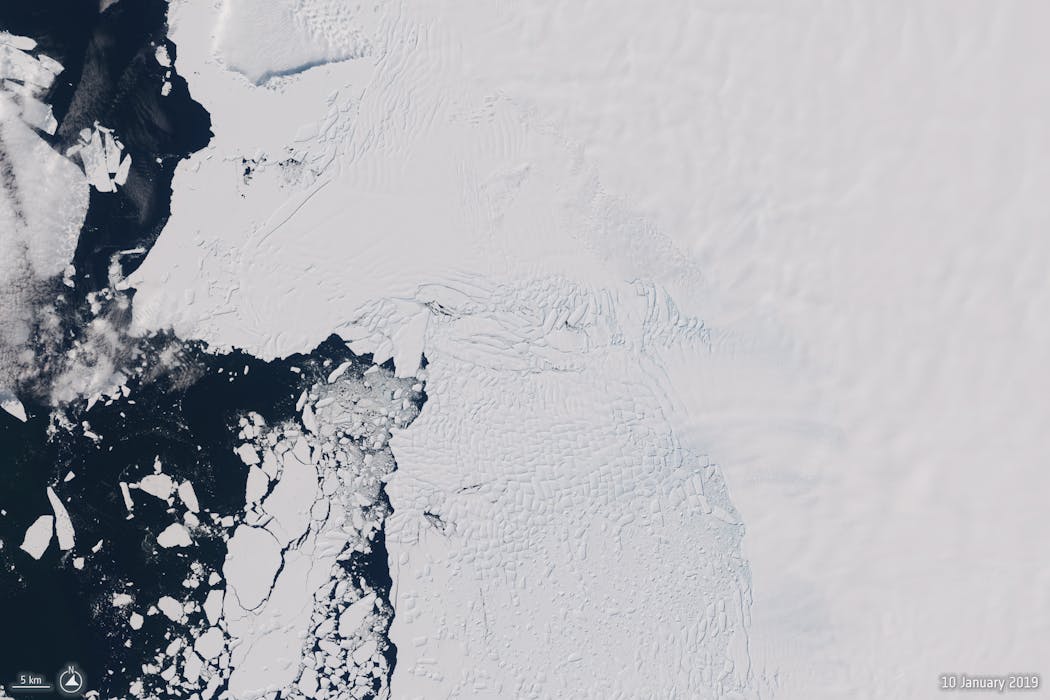
Hundreds of iceberg earthquakes detected at the crumbling end of Antarctica’s Doomsday Glacier

Source: The Conversation – Global Perspectives – By Thanh-Son Pham, ARC DECRA Fellow in Geophysics, Australian National University

Copernicus / ESA, CC BY

Glacial earthquakes are a special type of earthquake generated in cold, icy regions. First discovered in the northern hemisphere more than 20 years ago, these quakes occur when huge chunks of ice fall from glaciers into the sea.

Until now, only a very few have been found in the Antarctic. In a new study soon to be published in Geophysical Research Letters, I present evidence for hundreds of these quakes in Antarctica between 2010 and 2023, mostly at the ocean end of the Thwaites Glacier – the so-called Doomsday Glacier that could send sea levels rising rapidly if it were to collapse.

A recent discovery

A glacial earthquake is created when tall, thin icebergs fall off the end of a glacier into the ocean.

When these icebergs capsize, they clash violently with the “mother” glacier. The clash generates strong mechanical ground vibrations, or seismic waves, that propagate thousands of kilometres from the origin.

What makes glacial earthquakes unique is that they do not generate any high-frequency seismic waves. These waves play a vital role in the detection and location of typical seismic sources, such as earthquakes, volcanoes and nuclear explosions.

Due to this difference, glacial earthquakes were only discovered relatively recently, despite other seismic sources having been documented routinely for several decades.

Varying with the seasons

Most glacial earthquakes detected so far have been located near the ends of glaciers in Greenland, the largest ice cap in the northern hemisphere.

The Greenland glacial earthquakes are relatively large in magnitude. The largest ones are similar in size to those caused by nuclear tests conducted by North Korea in the past two decades. As such, they have been detected by a high-quality, continuously operating seismic monitoring network worldwide.

The Greenland events vary with the seasons, occurring more often in late summer. They have also become more common in recent decades. The signs may be associated with a faster rate of global warming in the polar regions.

Elusive evidence

Although Antarctica is the largest ice sheet on Earth, direct evidence of glacial earthquakes caused by capsizing icebergs there has been elusive. Most previous attempts to detect Antarctic glacial earthquakes used the worldwide network of seismic detectors.

However, if Antarctic glacial earthquakes are of much lower magnitude than those in Greenland, the global network may not detect them.

In my new study, I used seismic stations in Antarctica itself to look for signs of these quakes. My search turned up more than 360 glacier seismic events, most of which are not yet included in any earthquake catalogue.

The events I detected were in two clusters, near Thwaites and Pine Island glaciers. These glaciers have been the largest sources of sea-level rise from Antarctica.

Earthquakes at the Doomsday Glacier

Thwaites Glacier is sometimes known as the Doomsday Glacier. If it were to collapse completely it would raise global sea levels by 3 metres, and it also has the potential to fall apart rapidly.

About two-thirds of the events I detected – 245 out of 362 – were located near the marine end of Thwaites. Most of these events are likely glacial earthquakes due to capsizing icebergs.

The strongest driver of such events does not appear to be the annual oscillation of warm air temperatures that drives the seasonal behaviour of Greenland glacier earthquakes.

Instead, the most prolific period of glacial earthquakes at Thwaites, between 2018 and 2020, coincides with a period of accelerated flow of the glacier’s ice tongue towards the sea. The ice-tongue speed-up period was independently confirmed by satellite observations.

This speed-up could have been caused by ocean conditions, the effect of which is not yet well understood.

The findings suggest the short-term scale impact of ocean states on the stability of marine-terminating glaciers. This is worth further exploration to assess the potential contribution of the glacier to future sea-level rise.

The second largest cluster of detections occurred near the Pine Island Glacier. However, these were consistently located 60–80 kilometres from the waterfront, so they are not likely to have been caused by capsizing icebergs.

These events remain puzzling and require follow-up research.

What’s next for Antarctic glacial earthquake research

The detection of glacial earthquakes associated with iceberg calving at Thwaites Glacier could help answer several important research questions. These include a fundamental question about the potential instability of the Thwaites Glacier due to the interaction of the ocean, ice and solid ground near where it meets the sea.

Better understanding may hold the key to resolving the current large uncertainty in the projected sea-level rise over the next couple of centuries.

The Conversation

Thanh-Son Pham receives funding from the Australian Research Council.

ref. Hundreds of iceberg earthquakes detected at the crumbling end of Antarctica’s Doomsday Glacier – https://theconversation.com/hundreds-of-iceberg-earthquakes-detected-at-the-crumbling-end-of-antarcticas-doomsday-glacier-268893