¿Se puede tener a la vez déficit de atención y trastorno obsesivo compulsivo?

Source: The Conversation – (in Spanish) – By Sylvie Pérez Lima, Psicopedagoga. Psicóloga COPC 29739. Profesora tutora de los Estudios de Psicología y Educación, UOC – Universitat Oberta de Catalunya

Denis Moskvinov/Shutterstock

Cuando hablamos del trastorno del déficit de atención e hiperactividad y del trastorno obsesivo compulsivo solemos imaginar dos mundos separados: uno asociado a la impulsividad y las dificultades para mantener la atención; el otro, a la necesidad de control, la rigidez y la repetición.

Pero la realidad clínica y educativa es bastante más compleja. Un estudio reciente ha encontrado que ambos trastornos se presentan juntos con más frecuencia de la que imaginamos, y cuando lo hacen transforman la manera en que los síntomas se expresan. Condicionan la respuesta terapéutica y qué tipo de acompañamiento resulta más adecuado, tanto en la escuela como en la vida diaria.

Las personas que en la edad adulta tienen el doble diagnóstico han solido presentar un inicio más precoz. Han sido niños o adolescentes con síntomas más marcados, problemas de conducta o incluso tics, afectándoles de manera más intensa en su vida diaria.

Déficits compartidos en funciones ejecutivas

Podemos atender y acompañar mejor a los niños y niñas en los que se presentan ambos trastornos si comprendemos el origen neurobiológico de las conductas que desarrollan: los déficits compartidos en TDAH y TOC en la inhibición, flexibilidad cognitiva, planificación o atención sostenida.


Leer más:
Anatomía de una mente absorta: ‘flow’, hiperfoco y neurodiversidad


Los circuitos frontoestriatales del cerebro están en la base de estas funciones.
Recientes estudios muestran que tanto en TDAH como en TOC aparecen alteraciones en ellos, aunque en sentido contrario:

  • En el TDAH suele observarse hipoconectividad, que se traduce en impulsividad, dificultad para sostener la atención o iniciar tareas, así como una fuerte implicación de los procesos de recompensa. Es decir, en el TDAH, los circuitos cerebrales que responden a estímulos inmediatos o gratificantes están más activos o son más determinantes en la conducta. Se produce entonces una mayor sensibilidad a las recompensas inmediatas, lo que hace que resulte más fácil centrarse en actividades estimulantes y más difícil iniciar o mantener tareas que no ofrecen un beneficio rápido.

  • En el TOC predomina la hiperconectividad, que se asocia a la sobreinhibición, el perfeccionismo y la rigidez cognitiva. Esto implica una inhibición exagerada de la respuesta, que no tiene que ver con ser introvertido, sino con un exceso de control que favorece el perfeccionismo y los patrones de repetición propios del TOC. Estos patrones de hipercontrol, junto a la tendencia a frenar en exceso la propia conducta y el pensamiento, son los que dificultan el poder detener una acción o idea una vez iniciada.

Un cerebro que acelera y bloquea

La presencia simultánea de circuitos hiperactivados, característicos del TOC, y otros hipoactivados, propios del TDAH, explica por qué algunos niños y adolescentes pueden oscilar entre impulsividad y sobrecontrol. Parecen hipervigilantes con los demás y, al mismo tiempo, incapaces de regularse.

Ambos trastornos comparten parte de su vulnerabilidad genética, y existen genes o variantes que aumentan el riesgo de ambos. Pero estos mecanismos de riesgo no buscan “explicar” a la persona desde un déficit. Se trata de entender para ajustar expectativas y sostener mejor a quienes viven con un cerebro que acelera y bloquea a la vez.


Leer más:
Por qué la inclusión de los estudiantes con trastornos del neurodesarrollo no está funcionando


Lo que nos dice la investigación es que cuando TDAH y TOC coexisten no es por casualidad. Hay piezas que se cruzan: déficits en funciones ejecutivas, circuitos frontoestriatales implicados en el control cognitivo e incluso ciertos factores genéticos compartidos. Pero también hay piezas que funcionan de forma muy distinta.

Este doble movimiento, convergente y divergente a la vez, nos recuerda que, más que pensar en diagnósticos separados, necesitamos comprender cómo se organizan estos mecanismos en cada caso, porque es ahí donde se juega el acompañamiento clínico y educativo.

¿Qué observamos en casa y en el aula?

Cuando el TDAH y el TOC conviven, la clínica se mezcla, dando lugar a patrones que desconciertan tanto a las familias como al profesorado.

En el aula, podemos encontrarnos con alumnos que parecen impulsivos, pero que, al mismo tiempo, necesitan verificar constantemente todo para sentirse seguros. O con aquellos que quieren empezar una tarea, pero quedan atrapados revisando mentalmente si lo ha entendido “bien”, mientras la inquietud propia del TDAH les impide sostener la atención para avanzar.

A ojos de los demás, esta combinación puede verse así:

  • Tiempos de trabajo muy irregulares: momentos de rapidez e impulsividad seguidos de bloqueos provocados por dudas o rituales internos.

  • Cambios bruscos entre movimiento y rigidez: pasar de no parar quieto a quedarse fijado en un detalle mínimo.

  • Dificultad para iniciar tareas (por miedo a equivocarse o por falta de foco) y dificultad para terminarlas (por revisiones excesivas).

  • Errores que parecen despistes. A menudo vienen de pensamientos intrusivos, de la necesidad de sentir control o de las dificultades en sostener la atención.

  • Frustración elevada. Vivir entre la desorganización del TDAH y la autoexigencia rígida del TOC es especialmente agotador.

¿Qué ocurre en la adolescencia?

En la adolescencia, se intensifican las demandas: emocionalmente, por la propia etapa; académicamente, por el aumento de la carga escolar y social. Las obsesiones pueden volverse más intrusivas y la impulsividad más disruptiva, generando una tensión entre control y autonomía.

Este tira y afloja frecuentemente se refleja en dificultades para planificar o completar tareas largas, gestionar el estrés académico y encontrar un sentido de identidad: muchos adolescentes se preguntan por qué lo que les parece fácil a otros, a ellos les cuesta tanto.

Desde fuera, puede parecer que “hay dos versiones del mismo alumno”. Y, en parte, es cierto: el sistema ejecutivo tira en direcciones distintas —una hacia la impulsividad y la rapidez; otra hacia el control y la repetición— y la persona queda en medio intentando regular ambas fuerzas, muchas veces sin tener aún las herramientas para hacerlo.

¿Qué puede ayudar en el día a día?

Para quien acompaña (sea familia o escuela), es importante entender que no se trata de “confundir diagnósticos”, sino de reconocer su posible combinación. No basta con tratar solo el TDAH o solo el TOC, sino que puede ser necesario pensar en estrategias que respondan a su interacción. Algunas claves para esta cotidianidad son:

  • Entender qué fuerzas se mueven por dentro. Un mismo niño puede ser muy impulsivo y muy rígido. No es una contradicción: es una forma de buscar calma. Si lo entendemos, dejamos de pensar “lo hace a propósito” o “no quiere”. Conviene entonces recordar que no es elección, observar sin juzgar y pensar qué necesita regular.

  • Dar estructura sin agobiar. La estructura ha de aportar seguridad. Pero no debe ser inflexible, para no aumentar la ansiedad. Puede ser útil llevar a cabo rutinas visibles, fragmentar las tareas en pasos cortos y establecer límites claros desde la calma.

  • Evitar que el tiempo se les caiga encima. El TDAH desordena y el TOC bloquea, así que las ayudas externas deben contribuir al equilibrio. Las herramientas que nos pueden servir son: temporizadores visuales, establecer pausas programadas, anticipar los cambios de actividad o entornos, y acompañar verbalmente cuándo parar.

  • Reducir la presión por buscar la perfección. Tenemos que recordar que por dentro estos niños y niñas viven una lucha: quiero que quede perfecto, pero no puedo sostenerlo. Y eso les desgasta enormemente y puede afectar su autoestima. Les ayuda que valoremos especialmente el proceso más que el resultado y los pequeños éxitos o avances. También recordarnos en voz alta que no es necesaria la perfección y evitar comparaciones.

  • Validar lo que sienten y recuperar el control. Muchos de los bloqueos parecen desobediencia pero son miedo o saturación. Si conseguimos nombrarlo, diciendo por ejemplo “veo que esto te cuesta, vamos a hacerlo por partes”, la tensión suele bajar.
    También es importante dar las instrucciones de una en una, y evitar preguntas abiertas, ofreciendo por ejemplo alternativas. Si en vez de preguntar “qué quieres hacer”, les proponemos si hacer X o Y, pueden recuperar un control seguro y ganar en autonomía.

  • Trabajar desde el vínculo. Para favorecer la regulación es importante que haya un vínculo con los adultos de referencia. De este modo favorecemos el aprendizaje. La clave se encuentra en no entrar en confrontación.

Acompañar a un niño con TDAH y TOC no va de corregir, sino de comprender. Adoptar una perspectiva más humana, más pedagógica y más compartida entre casa, escuela y salud ayuda a entender el comportamiento para encontrar las estrategias que optimicen el acompañamiento.

The Conversation

Sylvie Pérez Lima no recibe salario, ni ejerce labores de consultoría, ni posee acciones, ni recibe financiación de ninguna compañía u organización que pueda obtener beneficio de este artículo, y ha declarado carecer de vínculos relevantes más allá del cargo académico citado.

ref. ¿Se puede tener a la vez déficit de atención y trastorno obsesivo compulsivo? – https://theconversation.com/se-puede-tener-a-la-vez-deficit-de-atencion-y-trastorno-obsesivo-compulsivo-269951
¿Aprender Matemáticas en Historia? Así se conectan asignaturas, conocimientos y experiencias

Source: The Conversation – (in Spanish) – By Paula Alejandro Garrido, Estudiante de Doctorado, Universidad de Huelva

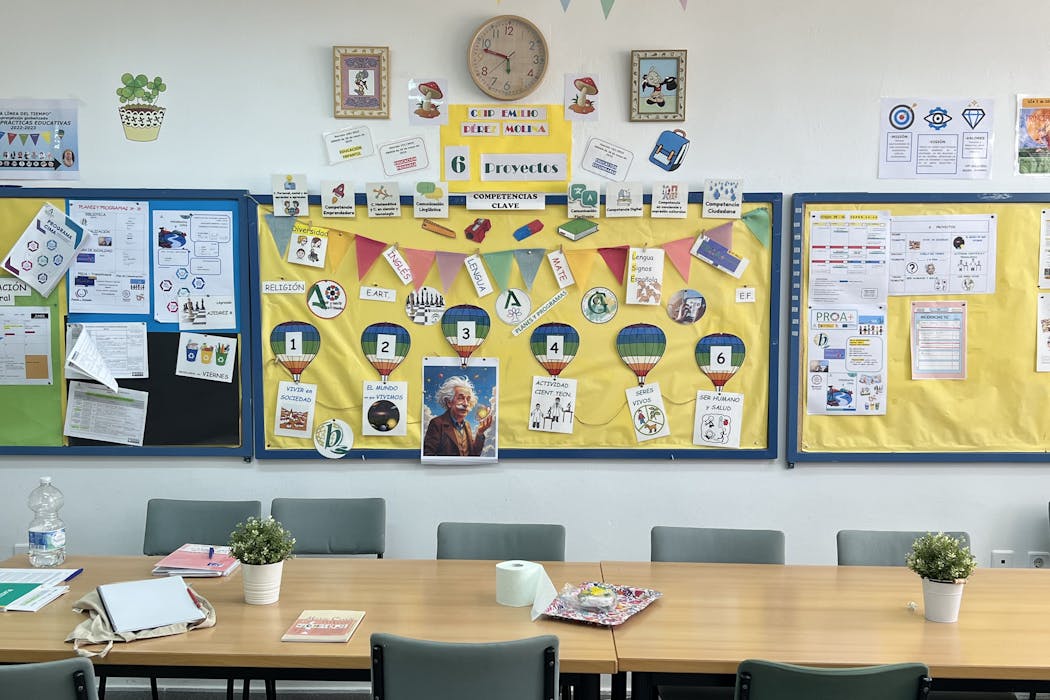
Sala de profesores del centro en el que se hizo la investigación. Paula Alejandra Garrido.

La mente no es un vaso para llenar, sino una lampara para encender, decía Plutarco. Sin embargo, en muchos países –incluido España– el modelo escolar convencional sigue centrado en llenar vasos: transmitir contenidos, seguir el libro de texto, completar fichas y evaluar con exámenes escritos. Este enfoque prioriza memorizar y volcar después esos contenidos en un papel, aunque se olvidarán con facilidad y no es siempre cómo nuestro cerebro aprende.

En una sociedad marcada por el cambio constante, esta forma de enseñar corre el riesgo de no ser útil. Por ejemplo, fragmentar el aprendizaje por áreas o asignaturas no siempre ayuda a prepararse para un mundo que nos exigirá adaptarnos a nuevas realidades, comprender la interconexión de todo y realizar un buen uso de la tecnología si no se enseñan prácticas conscientes y responsables.

Cada vez que se revisan los currículos académicos, se modifican asignaturas, contenidos, metodologías… pero ¿y si lo que necesitamos no es añadir más, sino conectar mejor? Esta es la idea que está detrás del enfoque de “currículum integrado”.

Del fragmento a la conexión

El currículum integrado no es una moda metodológica, sino una manera distinta de concebir la enseñanza. Su finalidad es superar la fragmentación del conocimiento, conectando saberes y experiencias.

Frente al enfoque disciplinar, es decir, a la división del conocimiento en diferentes áreas y asignaturas, propone trabajar problemáticas cercanas a partir de los intereses, necesidades o preguntas reales del alumnado.


Leer más:
Más allá de la especialización: las ventajas de la colaboración entre saberes en la universidad


Por ejemplo, no es lo mismo trabajar el cuidado y conservación del entorno de manera aislada, que aprovechar el comentario de un alumno acerca de ello para elaborar un proyecto.

Esto se puede conseguir a través de distintas metodologías:

  • Las WebQuest, que consisten en el empleo de recursos digitales con los que el alumnado explora y analiza información online mediante tareas diseñadas a priori por el docente. De esta manera, se prima el desarrollo de competencias digitales, habilidades de pensamiento crítico y de búsqueda de información, en un entorno controlado y seguro.

  • El “pensamiento de diseño” (design thinking) combina colaboración, creatividad y producciones tangibles buscando, de forma innovadora, abordar y solucionar problemas, delegando al docente la tarea de guía y promotor de ideas.

  • En el aprendizaje basado en proyectos se desarrollan productos que integran las diferentes áreas de conocimiento con la finalidad de potenciar tanto habilidades duras como blandas. Esta estrategia prima la colaboración y parte del contexto real teniendo en cuenta los intereses del alumnado.

Redes neuronales, experiencias y contextos

La neurociencia explica que las redes neuronales constituyen sistemas dinámicos formados por muchas unidades simples interconectadas, que aprenden a través de la contextualización y asociación de experiencias. En definitiva, se trata de un modelo que “aprende” ajustando sus conexiones internas de acuerdo a los estímulos que recibe.

El pedagogo y psicólogo estadounidense Jonh Dewey ya advertía que los aprendizajes desligados de la experiencia cotidiana acaban volviéndose inservibles a largo plazo. El conocimiento cobra sentido cuando se convierte en experiencia viva recurriendo a saberes y contenidos muy diversos.


Leer más:
¿Se aprende mejor participando en clase?


Esto no elimina el valor del trabajo disciplinar. Contenidos como la resolución formal de operaciones matemáticas o ciertos aspectos de gramática pueden abordarse de una forma más directa dentro del proyecto: calcular distancias, escribir textos vinculados a la temática o mejorar la caligrafía para elaborar un producto final. En estos casos, trabajar ciertos componentes de forma aislada facilita la comprensión de los mismos.

Estudio de un caso: una escuela que conecta

Para analizar qué ocurre al llevar estas ideas a la práctica, realizamos un estudio de caso en un centro público rural de carácter compensatorio, puesto que atiende a una población con desventajas socioeducativas significativas. En este centro, situado en la provincia de Huelva, se ha puesto en marcha un currículo basado en el aprendizaje basado en proyectos. A través de entrevistas, observaciones y documentos, recogimos las voces de docentes y estudiantes.

En el caso del curso que hemos documentado, el proyecto central que vertebraba todo el aprendizaje de ese año era La huella del tiempo, dedicado a Albert Einstein. Los demás proyectos –que se trabajan a lo largo del curso y se conectan entre sí– se organizan en cinco ejes estables: “Vivir en sociedad” (entorno y patrimonio), “El mundo en el que vivimos” (del pueblo al universo), “Actividad científica y tecnológica”, “Seres vivos” y “Ser humano y salud”.


Leer más:
Cómo sorprender en clase para fomentar el aprendizaje


Un ejemplo de esta conexión fue la canción sobre la fotosíntesis: se compuso en Música, se escribió en Lengua y se explicó en Conocimiento del Medio dentro del proyecto de “Seres vivos”, propio del tercer trimestre. Aunque no pertenece directamente al proyecto de Einstein, forma parte de esta lógica globalizadora en la que todos los proyectos se conectan y el aprendizaje fluye entre áreas y momentos del año.

Cada curso, los trabajos y creaciones del alumnado se recogen en un libro que se imprime y cada estudiante recibe un ejemplar. En el aparecen textos, fotografías, experimentos, dibujos y relatos elaborados durante los proyectos. Las familias colaboran aportando materiales, participando en actividades y contribuyendo a algunas de las creaciones. El libro se convierte así en un símbolo de unión y aprendizaje compartido entre escuela, comunidad y entorno.

Dar sentido al aprendizaje: mejorar la motivación

Una docente explicaba la importancia de este tipo de enfoques educativos en un contexto con alumnado con muy baja motivación: “No es igual que uno explique cosas aleatorias a que le demos un sentido coherente. Trabajando de esta forma, ese granito de motivación se puede transformar en algo muy grande”. Cuando los proyectos parten de la realidad cercana, los niños se implican de otra manera y los aprendizajes se vuelven significativos y duraderos.

En este curso, Einstein se volvió cercano gracias a experimentos sencillos sobre luz y energía, la recreación de su infancia y la conexión con fenómenos cotidianos. El alumnado descubría que este genio también había sido un niño curioso y con dificultades.

Ilusionar a los propios docentes

Otra profesora confesó: “Nosotras nos nutrimos de la ilusión de los niños, pero también de la nuestra propia.”. El enfoque integrado permitió a muchos redescubrieron como profesionales creativos, capaces de diseñar experiencias más vivas y menos burocráticas.

Esta ilusión se podría ver reflejada en gestos cotidianos: docentes que buscan ideas nuevas desde casa, maestras que diseñan canciones o materiales propios, equipos que se quedan por la tarde decorando pasillos para sorprender al alumnado y la energía colectiva que envuelven preparativos como la jornada de puertas abiertas.

‘Me gusta mi escuela’: la cohesión de la comunidad

El currículum integrado, en esta escuela, favorece la coordinación entre docentes, genera un clima de colaboración con las familias y refuerza la identidad del centro como comunidad educativa. Todo ello lo podemos comprobar a través de las entrevistas y la observación: las familias participan decorando espacios, asistiendo a actividades, colaborando en talleres y acompañando la lectura en casa. Los docentes destacan que esta metodología ha mejorado la comunicación con las familias y ha fortalecido el sentido de pertenencia al centro.

Las resistencias, sin embargo, existen: apego al libro de texto, miedo a perder nivel académico o dudas de algunas familias. El centro las aborda mediante el diálogo, evidencias y transparencia. Mostrar el trabajo, compartir los productos finales y observar la evolución de los estudiantes ayudan a transformar estas ideas.

Más que leyes, prácticas vivas

Desde la LOGSE (1990) hasta la LOMLOE, las leyes educativas españolas han introducido términos como globalización, interdisciplinariedad o competencias clave. La UNESCO exige currículos “más relevantes y contextualizados”, y la OCDE pide un enfoque flexible y centrado en el alumnado.

Pero, en la práctica, los marcos legales se convierten en obstáculos si no se acompañan de recursos y confianza. Las leyes deberían traducirse en tiempo, formación práctica, estabilidad de los claustros y confianza institucional para que los centros innoven sin miedo. Sin estos apoyos, los discursos sobre competencias y globalización se quedan en papel.

Un currículum integrado no es una receta mágica, pero sí una brújula. Nos recuerda que aprender tiene que ver con conectar: conectar unos conocimientos con otros, conectar al profesorado y al alumnado, conectar saberes y emociones, escuela y vida.

Volviendo a Plutarco, quizá el reto de la escuela del siglo XXI sea precisamente este: encender lámparas en lugar de llenar vasos. La experiencia analizada demuestra que, cuando se apuesta por integrar y no fragmentar, en las aulas prende la curiosidad y la creatividad y florece el sentido de comunidad.

The Conversation

Las personas firmantes no son asalariadas, ni consultoras, ni poseen acciones, ni reciben financiación de ninguna compañía u organización que pueda obtener beneficio de este artículo, y han declarado carecer de vínculos relevantes más allá del cargo académico citado anteriormente.

ref. ¿Aprender Matemáticas en Historia? Así se conectan asignaturas, conocimientos y experiencias – https://theconversation.com/aprender-matematicas-en-historia-asi-se-conectan-asignaturas-conocimientos-y-experiencias-267804

Crisis de la vivienda en España: ¿funciona premiar fiscalmente a quien alquila barato?

Source: The Conversation – (in Spanish) – By Albert Navarro García, Profesor titular de Derecho Financiero y Tributario, Universitat de Girona

Óscar González Fuentes / Shutterstock

La tensión en el mercado del alquiler ha aumentado de forma constante en los últimos años. Los precios suben, la oferta de vivienda es escasa y la competencia entre inquilinos es cada vez mayor. Ante esta situación, las Administraciones públicas han buscado nuevas fórmulas para ampliar la oferta de vivienda asequible sin depender exclusivamente de la construcción de nuevo parque público, un proceso lento y que exige grandes inversiones.


Leer más:
La gestión del suelo público y la crisis de la vivienda en España


Por este motivo, los incentivos fiscales dirigidos a propietarios privados han vuelto a ocupar un lugar central en la política de vivienda. La pregunta es evidente: ¿estos incentivos cambian realmente la conducta de los arrendadores en un mercado donde las alternativas, como el alquiler turístico o la venta, resultan más rentables y aparentemente más seguras?

La fiscalidad como herramienta de política de vivienda

La política de vivienda en España está repartida entre diferentes niveles de gobierno. Las comunidades autónomas tienen la competencia exclusiva en esta materia, pero los instrumentos fiscales más relevantes, como el IBI y el IRPF, dependen de los ayuntamientos y del Estado. Esta combinación ha generado un mapa fiscal muy diverso según el territorio.

En este contexto, las Administraciones han recurrido a tres grandes tipos de instrumentos:

  1. Las bonificaciones en el Impuesto sobre Bienes Inmuebles (IBI) destinadas a las viviendas que se incorporan a programas públicos de alquiler asequible.

  2. Las reducciones reforzadas del IRPF aplicables a los arrendadores que cumplen determinados requisitos.

  3. Los programas autonómicos que combinan ayudas directas con distintos incentivos fiscales para fomentar el alquiler a precios moderados.

La finalidad común es clara: animar a los pequeños propietarios a ofrecer viviendas en alquiler estable, con precios moderados y contratos de larga duración, evitando el desplazamiento de viviendas hacia usos más lucrativos, pero menos accesibles.


Leer más:
En la cuestión de la vivienda asequible participan pequeños y grandes propietarios, públicos y privados


El IBI: útil, pero insuficiente en solitario

El IBI es uno de los impuestos municipales más relevantes. Su regulación permite que los ayuntamientos bonifiquen hasta un 95 % la cuota cuando la vivienda se incorpora a programas públicos de alquiler asequible. Esta posibilidad, prevista en el artículo 74.6 del texto refundido de la Ley Reguladora de las Haciendas Locales, se ha utilizado con resultados desiguales.

Barcelona es el ejemplo más sólido. Allí, la bonificación del 95 % se acompaña con programas de mediación pública y garantías frente a impagos. Esta combinación ha permitido captar muchas viviendas privadas para alquiler social, generando una vía de acceso estable y con continuidad.

Sin embargo, otros municipios han logrado un impacto mucho más limitado. Málaga es un caso ilustrativo: su bonificación, además de limitarse al 50 %, se aplica exclusivamente a edificios completos de nueva construcción, destinados íntegramente al alquiler con renta limitada. Esto deja fuera a la gran mayoría del parque de viviendas ya existente y, por tanto, reduce el alcance del incentivo. La medida, por sí sola, no puede movilizar vivienda usada que podría incorporarse al alquiler asequible.

Además, los propietarios suelen valorar otros factores que no dependen del IBI: seguridad en el cobro, mediación profesional, seguros frente a impagos o daños, rapidez en los trámites y apoyo administrativo. Si estos elementos no existen, la simple bonificación resulta insuficiente para compensar el riesgo percibido.

El impacto en las finanzas municipales también es relevante. En las grandes ciudades, el coste fiscal se puede asumir mejor. En municipios medianos o pequeños, la pérdida de ingresos complica la aplicación de estas bonificaciones y exige un análisis riguroso de su sostenibilidad presupuestaria.

Reducciones en IRPF: un mecanismo potente pero poco operativo

La Ley 12/2023, de 24 de mayo, por el derecho a la vivienda creó un sistema reforzado de reducciones en el IRPF para el alquiler de vivienda habitual. El incentivo más destacado es una reducción del 90 % del rendimiento neto para nuevos contratos firmados en zonas tensionadas, siempre que exista además una rebaja del precio respecto al contrato anterior.

Sobre el papel, se trata de uno de los incentivos fiscales más ambiciosos diseñados hasta ahora para influir en el mercado del alquiler. Pero, en la práctica, su aplicación real es baja. La razón principal es simple: la reducción del 90 % solo puede aplicarse si la comunidad autónoma declara zonas tensionadas. Sin esa declaración, no puede aplicarse en absoluto. Y la mayoría de las comunidades no lo ha hecho. Entre ellas: Madrid, Comunidad Valenciana, Andalucía y Galicia, que han rechazado la declaración por motivos ideológicos, técnicos, o porque consideran que este modelo no encaja en sus políticas de vivienda.

En la práctica, esto ha dejado desactivado el incentivo en una gran parte de España.

A ello se suma la complejidad técnica de la norma. Para acceder a las reducciones reforzadas se exige acreditar la rebaja del contrato previo, cumplir requisitos formales y asumir posibles comprobaciones fiscales.


Leer más:
El precio razonable del alquiler de vivienda en España depende de la voluntad de los gobiernos autonómicos


Comunidades autónomas: cuándo los incentivos funcionan (y cuándo no)

La experiencia demuestra que los incentivos fiscales solo funcionan cuando se integran en políticas de vivienda coherentes, coordinadas y con recursos suficientes.

El País Vasco es el ejemplo más sólido. Allí se combinan deducciones fiscales relevantes, garantías públicas de cobro y programas profesionalizados como Bizigune o ASAP. Esta estructura ha permitido captar miles de viviendas privadas y reducir notablemente el riesgo para los arrendadores.

En Cataluña, especialmente en municipios como Barcelona, las bonificaciones del IBI se coordinan con mediación pública, seguros frente a impagos y trámites simples. Esta integración explica los resultados positivos en la captación de vivienda.

En cambio, el caso de Andalucía muestra las limitaciones producidas por la falta de coordinación. La Consejería de Fomento reconoce que solo un 8 % de los municipios que tienen vivienda pública de la Junta aplican la bonificación del IBI. Este nivel tan bajo de aplicación revela un desajuste entre administraciones y dificulta que incluso la vivienda pública pueda beneficiarse de los incentivos disponibles.

La fiscalidad acompaña pero no sustituye las políticas de vivienda

Los incentivos fiscales pueden contribuir a aumentar la oferta de alquiler asequible, pero solo cuando funcionan dentro de una estrategia global. La evidencia muestra que la fiscalidad no transforma el mercado por sí sola. Para que sea eficaz, necesita apoyarse en una gestión pública profesionalizada, y ofrecer seguridad jurídica y garantías reales a los propietarios.

Sin coordinación institucional, programas estables e inversión pública, los incentivos se convierten en medidas aisladas con poco impacto. La fiscalidad puede orientar comportamientos y apoyar la política de vivienda, pero no puede reemplazarla. Es un complemento necesario, no una solución suficiente.

The Conversation

Albert Navarro García no recibe salario, ni ejerce labores de consultoría, ni posee acciones, ni recibe financiación de ninguna compañía u organización que pueda obtener beneficio de este artículo, y ha declarado carecer de vínculos relevantes más allá del cargo académico citado.

ref. Crisis de la vivienda en España: ¿funciona premiar fiscalmente a quien alquila barato? – https://theconversation.com/crisis-de-la-vivienda-en-espana-funciona-premiar-fiscalmente-a-quien-alquila-barato-271330

El colonialismo visual: cómo la fotografía moldeó la mirada sobre los pueblos indígenas

Source: The Conversation – (in Spanish) – By Miguel Ángel Puig-Samper Mulero, Profesor de Investigación ad honorem en el Instituto de Historia del CSIC, Departamento de Historia de la Ciencia., Consejo Superior de Investigaciones Científicas (CSIC)

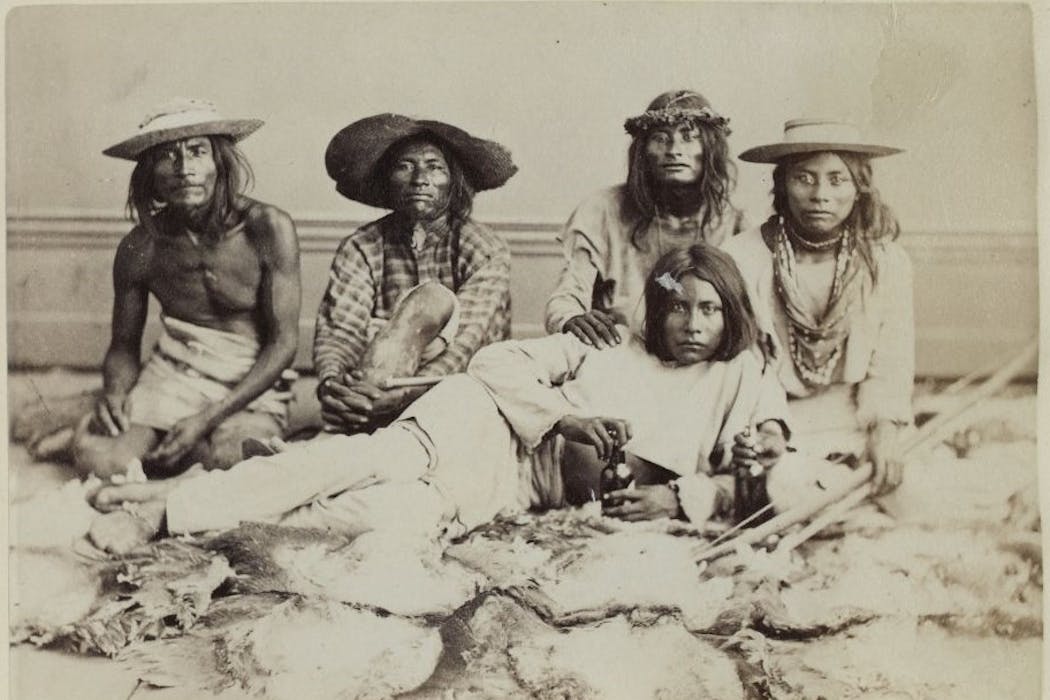
Indígenas de Seris Sonora (México) retratados por Alfredo Laurent en 1865. Archivo de la Soc. anthropologique de Paris, déposées au Muséum national d’Histoire naturelle. 155_07_0097

Desde su aparición en el siglo XIX, la fotografía se convirtió en una herramienta poderosa para documentar el mundo. Pero más allá de su función técnica, también fue un instrumento de poder. En pleno auge del colonialismo europeo, las imágenes capturadas por fotógrafos –profesionales y aficionados– ayudaron a construir una visión del “otro” que reforzaba estereotipos, jerarquías raciales y narrativas de dominación.

Durante la expansión colonial, las cámaras en manos de fotógrafos profesionales, soldados, misioneros, funcionarios y colonos registraron escenas de territorios y poblaciones sometidas. Estas imágenes no solo ilustraban relatos de viajes o informes oficiales, sino que también alimentaban la curiosidad y el control simbólico desde las metrópolis. La fotografía parecía ofrecer una “verdad objetiva”, pero en realidad reflejaba los prejuicios y aspiraciones del mundo occidental.

El “otro” en el espacio y en el tiempo

En el siglo XIX, Occidente construyó dos figuras del “otro”: el salvaje espacial, vinculado a tierras lejanas, y el humano prehistórico, asociado a un pasado remoto. Estas representaciones se difundieron en revistas ilustradas, novelas, exposiciones universales y museos, consolidando una visión racista que justificaba la exclusión social de los pueblos no occidentales.

Niños puertorriqueños en traje de domingo, de Strohmeyer & Wyman. 1900
Niños puertorriqueños en traje de domingo, de Strohmeyer & Wyman. 1900.
Archivo General de Puerto Rico ADQ.87-04-92

En América Latina, esta mirada colonial tuvo continuidad incluso después de la independencia. En países como México, Argentina, Chile, Perú o Brasil, la fotografía se usó para representar a indígenas y afrodescendientes en el marco de los proyectos de construcción nacional. La antropología, que crecía como disciplina científica, se apoyó en la imagen para clasificar y estudiar la “diferencia cultural”. Así, muchos países latinoamericanos se convirtieron en laboratorios visuales donde se buscaba definir tipos raciales y culturales, a menudo desde una perspectiva eurocéntrica.

Incluso fotógrafos locales adoptaron esta mirada colonial hacia sus propias comunidades indígenas, como ocurrió en Estados Unidos, Australia, Argentina o Chile. La colonialidad no solo se expresaba en quién tomaba las fotos, sino también en cómo se miraba y representaba al otro.

Francia: ciencia, fotografía y jerarquías raciales

Paul Broca por Pierre Petit.
Biblioteca Nacional de Francia Gallica

En Francia, desde mediados del siglo XIX, se consolidaron dos grandes escuelas antropológicas que usaron la fotografía como herramienta científica. La primera, liderada por Paul Broca, fundó la Sociedad de Antropología de París en 1859 y promovió una visión biologicista de la humanidad. La antropometría –medición del cuerpo humano– y la craneometría –medición del cráneo– eran centrales para establecer jerarquías raciales. La fotografía ayudaba a documentar estos estudios, mostrando rostros de frente y perfil, como si fueran fichas científicas.

La segunda escuela, encabezada por Jean Louis Armand de Quatrefages, también se interesó por los artefactos culturales y las costumbres de las civilizaciones “primitivas”. En 1878 se fundó el Museo de Etnografía de Trocadero, antecedente del actual Museo del Hombre, dedicado exclusivamente a la diversidad cultural.

Ambas corrientes compartían la idea de que las razas humanas podían ordenarse en una jerarquía natural. A veces se manifestaron voces muy radicales en significar la desigualdad racial, alineadas con la escuela antropológica poligenista norteamericana que encabezaban Samuel Morton, George Glidden y Josiah Nott.

Colonos de Guinea con mujeres y niña.
Archivo General de la Administración, Alcalá de Henares, 33-00797-00030-034-r

En otras ocasiones, voces diferentes defendían la posible igualdad de las distintas razas, o al menos su capacidad para progresar al considerar que las influencias ambientales, más que la herencia, eran las responsables de la diferencias raciales. Así sucedió con los hombres de la Sociedad de Etnografía Oriental y Americana. En este contexto, la fotografía antropológica se convirtió en una disciplina auxiliar para “probar” la existencia de tipos raciales distintos y estables.

Roland Bonaparte y los “zoos humanos”

Uno de los personajes más activos en la fotografía antropológica fue el príncipe Roland Bonaparte, sobrino nieto de Napoleón. Bonaparte reunió una vasta colección de imágenes, muchas tomadas por él mismo o por fotógrafos contratados. En 1882, por ejemplo, Pierre Petit fotografió a los kaliña en el Jardín de Aclimatación de París, y al año siguiente se sumaron retratos de indígenas de la Araucanía chilena, Ceilán y Siberia.

El Jardín de Aclimatación se convirtió en un escenario de exhibiciones humanas, siguiendo el modelo del empresario alemán Carl Hagenbeck, que había mostrado a un grupo de lapones en Hamburgo en 1874. En París, se presentaron africanos, inuits, fueguinos (kawésqar), cingaleses, mapuches, calmucos siberianos y nativos americanos, entre otros. Estas exhibiciones mezclaban espectáculo y ciencia, y eran documentadas con rigor fotográfico por Bonaparte y sus colaboradores.

Las imágenes se publicaban en revistas como La Nature o L’Illustration, y mostraban a los indígenas en poses estandarizadas, con adornos y armas, reforzando su exotismo. En 1885, Bonaparte fotografió a un grupo de aborígenes australianos que habían sido parte de un “zoo humano” organizado por R. A. Cunningham. De los nueve que iniciaron la gira, solo cuatro llegaron vivos a París, donde fueron alojados en el Jardín de Aclimatación y actuaron en el Folies-Bergère.

Roland Bonaparte, Australianos en Folies Berger. 1885.
Archivo de la Soc. anthropologique de Paris, déposées au Muséum national d’Histoire naturelle 155_08_0096

Estas prácticas, aunque hoy nos resultan inaceptables, fueron parte de una lógica colonial que usaba la imagen para clasificar, exhibir y controlar. La fotografía no solo capturaba rostros: construía discursos, jerarquías y fronteras entre “nosotros” y “ellos”.

La fotografía fue mucho más que una técnica de registro: fue una herramienta de poder que ayudó a consolidar el imaginario colonial. Desde los estudios antropológicos en París hasta los retratos de indígenas en América Latina, las imágenes contribuyeron a definir al “otro” como objeto de estudio, espectáculo o subordinación. Hoy, revisar este legado visual nos permite entender cómo se construyeron las desigualdades.


Este artículo surge de la colaboración con la Fundación Ignacio Larramendi, institución centrada en desarrollar proyectos relacionados con el pensamiento, la ciencia y la cultura en Iberoamérica con el objetivo de ponerlos a disposición de todo el público.

Más información aquí.


The Conversation

Miguel Ángel Puig-Samper Mulero no recibe salario, ni ejerce labores de consultoría, ni posee acciones, ni recibe financiación de ninguna compañía u organización que pueda obtener beneficio de este artículo, y ha declarado carecer de vínculos relevantes más allá del cargo académico citado.

ref. El colonialismo visual: cómo la fotografía moldeó la mirada sobre los pueblos indígenas – https://theconversation.com/el-colonialismo-visual-como-la-fotografia-moldeo-la-mirada-sobre-los-pueblos-indigenas-269530

School breaks privilege Christmas, and classroom strategies are needed to foster inclusion

Source: The Conversation – Canada – By Amina Yousaf, Associate Head, Early Childhood Studies, University of Guelph-Humber

What some school boards now call the “winter break,” over the days leading up to and after Christmas, is approaching.

But in Canada’s diverse public schools, centring one religious holiday sends a subtle message to many children: your family’s traditions don’t quite belong here.

Our publicly funded schools are designed to be welcoming to everyone. Ministries of education and school curricula acknowledge the importance of equity and inclusion in supporting student learning, yet how this is applied in different contexts and classrooms can vary widely.

The focus around Christmas — experienced as holidays that privilege this festival, and sometimes also experienced as winter-themed events that pick up Christmas aspects — can make students from different cultural and religious backgrounds feel marginalized or left out.

As educators look to best practices for implementing guidance around supporting inclusion and affirming diversity in their classrooms, there are opportunities to build in-classroom activities that genuinely reflect and embrace every learner in our vibrant pluralistic communities.

The real impact of feeling left out

When a child’s family life, traditions or identity are missing from the school environment, this can have adverse consequences.

Research shows that school social exclusion is consistently linked to poorer well‑being, higher emotional distress and even changes in adolescent brain development. Large-scale studies have also shown that exclusion undermines belonging, while belonging acts as a protective factor for mental health and engagement. In other words, inclusion isn’t optional, it is essential for students’ emotional safety and academic success.

On the flip side, when students feel they belong, they thrive. Feeling personally accepted and socially valued at school is associated with better mental health and stronger academic trajectories, including lower depression, anxiety and stress into young adulthood. Creating a truly inclusive school environment is therefore not just an extra step, it’s fundamental to student well-being.

Four simple, powerful strategies for inclusion

While overhauling the entire school calendar may be out of reach, educators can start with four classroom changes that research shows are meaningful.

1. Start a storytelling circle with a trauma-informed lens.

Where generic holiday parties exist near the end of term, instead consider a storytelling circle: invite students to share “something special I enjoy in winter,” “a tradition from my community” or “a tradition I’d like to create.”

This keeps open invitations for students who may not have stable family contexts, such as children in foster care or those who’ve experienced loss.


Read more:
What ‘The Lion King’ teaches us about children’s grief


Why storytelling? Oral storytelling, especially when culturally referenced and developmentally scaffolded, builds identity, empathy and early literacy and has shown measurable gains for Indigenous learners. Story‑based routines are also a powerful vehicle for culturally responsive teaching across subjects.

Guidance from the the National Association for the Education of Young Children, a non-profit organization in the U.S., emphasizes that holiday activities should be approached through an anti-bias lens, ensuring they affirm all children’s identities rather than privileging one tradition.

Evidence shows that storytelling circles can support both cultural identity and emotional safety when implemented thoughtfully, through predictable routines and student choice. Trauma-informed classroom frameworks emphasize safety, trust and empowerment as core principles — all of which align with open-ended storytelling prompts.

So, instead of focusing on family-centric tasks, try the following:

  • Make participation voluntary and provide alternative options;

  • Use broad prompts that don’t require family disclosures;

  • Embed predictable routines and emotional safety as recommended by trauma-informed frameworks.

2. A “celebrations wall.”

Mindful of open-ended prompts and children’s emotional safety, create a “celebrations wall” or “seasonal traditions corner” that invites students and families to share images, artifacts or descriptions of winter or year‑end traditions.

These could include religious and cultural festivals such as Hanukkah, Kwanzaa and Lunar New Year.

It could also include personal family traditions such as a special recipe or a trip.

Culturally responsive environments and tasks increase engagement and participation among diverse learners.

Feeling recognized in affirmative ways also strengthens belonging, which relates to motivation and persistence. Practical exemplars from classrooms show how inclusive displays foster voice and connection.

3. Use language that includes everyone.

Language signals who belongs. Replace event names and communications that tie activities to one tradition with neutral, inclusive terms (for example, “winter celebration,” “year‑end gathering”) alongside culturally affirming practices.

Canadian federal guidance provides explicit strategies for inclusive wording that avoids bias across gender, culture, religion and ability. Equity, diversity and inclusion resources align with these practices and emphasize mirroring how people self‑identify. Resources such as Celebrate! An Anti-Bias Guide to Including Holidays in Early Childhood Programs provide practical steps for creating inclusive celebrations.

4. Partner with communities.

Reach beyond school walls. School‑community partnerships bring cultural expertise, resources and authentic experiences into classrooms, and are associated with better attendance, engagement, social‑emotional outcomes and academics.


Read more:
If I could change one thing in education: Community-school partnerships would be top priority


This reduces the burden on educators while widening access to experiences that enrich curriculum and affirm diversity.

Examples could include nurturing community partnerships that support Indigenous storytelling, Lunar New Year presentations or settlement supports for refugee children.

A call for active inclusion

Fostering an inclusive environment is an active choice. It means examining inherited structures and building classroom cultures that affirm every student’s sense of self.

By celebrating the many narratives students bring, educators counteract the emotional toll of exclusion, strengthen resilience and equip young people to navigate a pluralistic society with confidence and respect.

The most important message schools can offer during holidays, and year round, is the certainty that every child belongs.

The Conversation

Amina Yousaf does not work for, consult, own shares in or receive funding from any company or organisation that would benefit from this article, and has disclosed no relevant affiliations beyond their academic appointment.

ref. School breaks privilege Christmas, and classroom strategies are needed to foster inclusion – https://theconversation.com/school-breaks-privilege-christmas-and-classroom-strategies-are-needed-to-foster-inclusion-271671

Spotify Wrapped reminds us even our leisure time is being surveilled and sold

Source: The Conversation – UK – By John Singleton, Lecturer in Journalism & Global Media Studies, University of Galway

Each year as Spotify Wrapped drops, social media timelines fill with neon slides declaring who we “really” are. We trade our top artists and most-played songs like postcards from a year already fading.

It feels communal, a party game to end the year of listening. But this cheerful ritual shows how deeply surveillance has woven itself into our leisure – and, how readily we accept it. It’s what the social psychologist and philosopher Shoshana Zuboff describes in her book The Age of Surveillance Capitalism the “claiming of human experience as free raw material” for predictive data.

Wrapped does more than reflect our taste. It turns private listening into public connection, and connection into content. What looks like play can instead be seen as work. And what feels like recognition of our uniqueness is a reflection of how well we have conformed to the algorithm.


No one’s 20s and 30s look the same. You might be saving for a mortgage or just struggling to pay rent. You could be swiping dating apps, or trying to understand childcare. No matter your current challenges, our Quarter Life series has articles to share in the group chat, or just to remind you that you’re not alone.

Read more from Quarter Life:


At first glance, it’s simple. You listen, Spotify counts. Then it wraps those counts in bright colours and confident language, diagnosing who you are, or who the platform imagines you to be.

Wrapped acts as an identity machine: statistics made into self-portrait. You appear as the “indie purist” or “pop maximalist”. But behind the graphics lies the attention economy, turning every pause into data. What looks like a mirror is really a map drawn to lead you back to using Spotify. That map is built from collecting data on your skipping habits, workout playlists and time-of-day listening.

Leisure once stood apart from labour. Datafication – turning everyday behaviour into trackable, monetisable data – is an answer to an old problem: how to profit from free time. Through this perspective, nearly every facet of life now includes some form of labour.

With apps like Spotify, every engagement creates the highly valuable byproduct of data. Every skip or replay generates data that can be traded and sold. Every share is free advertising. Even when we think we’re unwinding, we’re producing value for someone else.

The sociologist David Beer, who researches the role of data in social and cultural life, wrote that his Wrapped “in some ways … feels like a performance review of [his] leisure time”.

Being told you’re in the top 1% of listeners of a certain artist feels like recognition, but that pleasure masks a loss of agency. Beer felt his Wrapped was humouring him and rewarding him for being a “good listener”, which seems like a byword for “worker”.

By telling him how long and “well” he had listened, by informing him he had “found ways to grow”, he felt like it was boosting his sense of self in order to keep him coming back.

It is an effective platform strategy. Wrapped spikes app downloads and engagement each December, with Spotify crediting it as a major driver of growth.

Narrowing your tastes

Another thing to be wary of is how Wrapped and Spotify’s algorithm could be shaping your taste. Research suggests recommendation loops tend to reinforce existing habits rather than expand them, producing what scholars call “taste tautology”.


Read more:
Four ways to cultivate a unique taste in music in the age of streaming algorithms


These recommendations – new albums like the ones you love, artists spotlighted who are like your favourites – are presented on the interface so readily or built into the design. For instance, the feature where tracks chosen by the algorithm start playing immediately when the song or album you put on ends. Or “curated” playlists like Discover Weekly – described as “your shortcut to hidden gems, deep cuts, and future faves”.

But the more we click on these curated options and the more data we feed the app about our listening habits the more we teach the algorithm to serve more of the same rather than surprise us.

Engagement becomes affirmation of who we seemingly are as predictions reshape preferences, and the preferences it serves us harden into identity. Research suggests that rather than expanding your taste by introducing you to new tracks and artists, this type of algorithmic recommendation can actually narrow your taste.

What kind of individuality can exist in a system that decides what we see and rewards compliance? This subtle erosion of choice isn’t accidental. Wrapped struggles to capture eclectic or erratic listening, flattening diversity into generic categories that distort more than they reveal.

Posting your Wrapped is a small cultural performance, part taste, part humour, part self-awareness. Friends reply with theirs; brands join in. The ritual doubles as free global marketing. Each share delivers a flicker of pleasure that keeps the attention economy turning, our emotions becoming raw material.

A better use of Wrapped is to treat it as a prompt, not a verdict or refelection. Close the app, follow a friend’s suggestion, watch a band live. Keep some of your taste uncounted. Not because numbers are evil, but because taste is more than what can be measured and you deserve to find something you love off the beaten track.

The Conversation

John Singleton does not work for, consult, own shares in or receive funding from any company or organisation that would benefit from this article, and has disclosed no relevant affiliations beyond their academic appointment.

ref. Spotify Wrapped reminds us even our leisure time is being surveilled and sold – https://theconversation.com/spotify-wrapped-reminds-us-even-our-leisure-time-is-being-surveilled-and-sold-270119

Canada’s North is warming from the ground up, and our infrastructure isn’t ready

Source: The Conversation – Canada – By Mohammadamin Ahmadfard, Postdoctoral Fellow, Mechanical & Industrial Engineering, Toronto Metropolitan University

On a winter day in Northern Canada, the cold feels absolute. Snow squeaks underfoot and rivers lie silent beneath thick ice. Yet beneath that familiar surface, the ground is quietly accumulating heat.

That hidden warming is destabilizing the frozen foundation on which northern communities depend. Permafrost — the permanently frozen ground that supports homes, roads, airports and fuel tanks across much of Northern Canada — is warming as a result of climate change. The North has warmed roughly three times faster than the global average, a well-documented effect of Arctic amplification — the process causing the Arctic to warm much faster than the global average.

Permafrost does not fail suddenly. Instead, it responds slowly and cumulatively, storing the heat of warm summers year after year. Over time, that heat resurfaces in visible ways: tilted buildings, cracked foundations, slumping roads and buckling runways. Long-term borehole measurements across Northern Canada confirm that permafrost temperatures continue to rise even in places where the ground surface still refreezes each winter.

Communities in the Northwest Territories, Nunavut and the Yukon are already living with these consequences. As permafrost degrades, it undermines housing and transportation corridors and disrupts mobility and land-based activities. The impacts are uneven, with Indigenous communities often facing the greatest exposure and paying the highest costs.

A damaged access road or unstable fuel tank is not just an engineering inconvenience; it can interrupt supply chains, emergency access and daily life. What these patterns reveal is that permafrost thaw is not simply a surface problem. It’s the result of long-term, uneven warming below ground that reshapes soils, water, ice and infrastructure together, often accelerating damage well after climate warming begins.


Read more:
Collapsing permafrost is transforming Arctic lakes, ponds and streams


Permafrost failure

A map of canada with areas of the north shaded in different colours
A map showing areas of Canada with continuous permafrost (purple) and discontinuous permafrost (blue) and sporadic permafrost (green).
(Natural Resources Canada)

Monitoring and numerical modelling point to a consistent conclusion: permafrost degradation is controlled less by individual warm years than by the long-term balance of heat entering and leaving the ground. Accumulated energy, combined with the large amount of heat required to thaw ice-rich soils, explains why damage often accelerates long after warming begins.

Summer warmth penetrates deeper into the ground than winter cold can fully remove. Snow further reshapes this balance by insulating the ground, especially as a warmer, more moisture-laden atmosphere delivers heavier snow in cold regions, earlier autumn cover, longer spring persistence and uneven accumulation around infrastructure, all of which limit winter heat loss.

Buildings, foundations and buried infrastructure add their own steady sources of warmth. Each input may seem modest on its own. Over decades, their combined effect becomes decisive.

For much of the past century, northern engineering has been designed to keep heat out of frozen ground. Practices such as elevating structures on piles, minimizing ground disturbance and installing passive cooling systems like thermosyphons have proven effective under historically cold conditions. But these approaches depend on long, reliably cold winters. As winters shorten and insulating snow arrives earlier, the benefits of those practices are becoming harder to sustain.


Read more:
Heat waves, wildfire & permafrost thaw: The North’s climate change trifecta


From blocking heat to managing it

Engineers in Canada have already demonstrated ways to deliberately influence subsurface temperatures. Along northern highways and embankments, ventilated shoulders and air-convection systems have been used to increase winter heat loss from permafrost foundations, measurably cooling the ground beneath key infrastructure. These projects show that underground temperatures can be deliberately managed, not just endured.

More recently, work in the Yukon has shown that sloped thermosyphons installed beneath highway embankments can lower permafrost temperatures and raise the permafrost table, stabilizing ice-rich ground that would otherwise continue to settle. These systems are effective but only as long as winters remain cold enough to drive heat extraction.

Geothermal engineering offers a more adaptable approach. In southern Canada and elsewhere, some buildings already use foundation piles that serve two purposes: structural support and heat exchange. Rather than allowing waste heat to leak passively into surrounding soil, these systems circulate fluid to move heat in or out of the ground as conditions require.

In northern permafrost regions, the same principle could be applied differently. Instead of allowing heat from buildings, pipelines or power systems to migrate downward into thaw-sensitive soils, foundation piles could intercept some of that energy and return it to buildings during winter, when heat demand is highest. In summer, operation would focus on limiting new heat input, preserving seasonal cooling gains.

This is not about turning permafrost into an energy resource. It is about preventing uncontrolled heat leakage, sustaining the very foundations that hold northern infrastructure in place.

Protecting what holds communities together

The implications extend far beyond individual buildings. Roads, airstrips, fuel storage facilities, water treatment plants, power lines and communication systems across Northern Canada all depend on stable ground. Many also introduce persistent sources of warmth through traffic, buried utilities and electrical infrastructure.

As thaw progresses, roads deform, fuel tanks shift and runways become unsafe. A settling airport runway, for example, can ground flights that deliver food, fuel and medical supplies for weeks at a time.

For infrastructure expected to remain in service for 50 years or more, managing subsurface temperature may matter as much as structural design itself. When these systems fail, the effects ripple outward, increasing isolation, raising costs and limiting access to essential services.

Indigenous partnership is essential

The impacts of permafrost thaw are not shared equally. Indigenous communities are often the most exposed, facing disproportionate damage to housing and infrastructure that underpins mobility, food security and access to health and education services.

Many northern communities also remain heavily dependent on diesel for heat and electricity, locking in energy systems that add persistent heat to the ground and raise the long-term cost of maintaining infrastructure.

Any approach to geothermal or ground-temperature management must therefore be developed in genuine partnership with Indigenous governments and residents. Engineering solutions that stabilize the ground while reducing fuel dependence will only succeed if they align with local priorities and support long-term community self-determination.

None of this replaces the need to rapidly reduce greenhouse-gas emissions. No technology can preserve all permafrost under unchecked warming. But in Northern Canada, adaptation is no longer optional.

Research shows that long before damage becomes visible, heat accumulates underground, weakening soils and reshaping landscapes. This is where infrastructure can play a central role, by influencing how heat enters, moves throughout and leaves the ground.

Canada now faces a choice: it can continue building as if frozen ground were static, or it can design for permafrost as what it is: a sensitive thermal system with a long memory. The heat accumulated below ground over decades reflects past decisions. But how much heat we add next, and how carefully we manage it, is a choice.

The Conversation

Mohammadamin Ahmadfard receives funding from the Natural Sciences and Engineering Research Council of Canada and Mitacs Inc. for his postdoctoral research at Toronto Metropolitan University.

Ibrahim Ghalayini receives funding from the Natural Sciences and Engineering Research Council of Canada (NSERC) and Mitacs, and has also been the recipient of academic scholarships in support of his research at Toronto Metropolitan University.

Seth Dworkin does not work for, consult, own shares in or receive funding from any company or organisation that would benefit from this article, and has disclosed no relevant affiliations beyond their academic appointment.

ref. Canada’s North is warming from the ground up, and our infrastructure isn’t ready – https://theconversation.com/canadas-north-is-warming-from-the-ground-up-and-our-infrastructure-isnt-ready-272005

From record warming to rusting rivers, 2025 Arctic Report Card shows a region transforming faster than expected

Source: The Conversation – Global Perspectives – By Matthew L. Druckenmiller, Senior Scientist, National Snow and Ice Data Center (NSIDC), Cooperative Institute for Research in Environmental Sciences (CIRES), University of Colorado Boulder

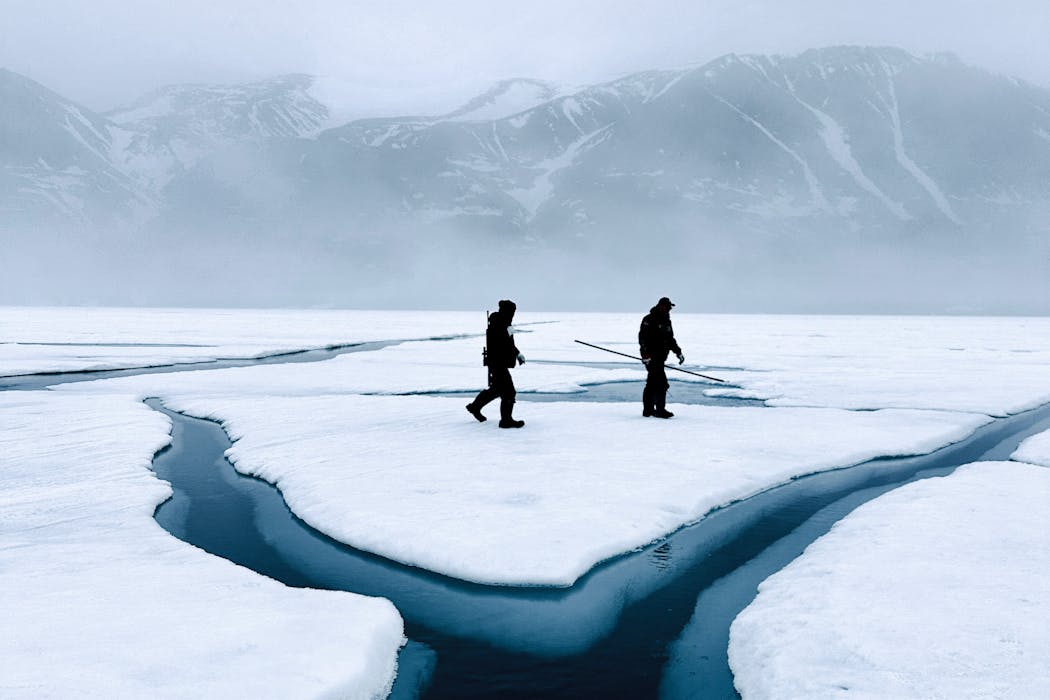
As temperatures rise, the timing of the ice thaw changes. Vincent Denarie via Arctic Report Card

The Arctic is transforming faster and with more far-reaching consequences than scientists expected just 20 years ago, when the first Arctic Report Card assessed the state of Earth’s far northern environment.

The snow season is dramatically shorter today, sea ice is thinning and melting earlier, and wildfire seasons are getting worse. Increasing ocean heat is reshaping ecosystems as non-Arctic marine species move northward. Thawing permafrost is releasing iron and other minerals into rivers, which degrades drinking water. And extreme storms fueled by warming seas are putting communities at risk.

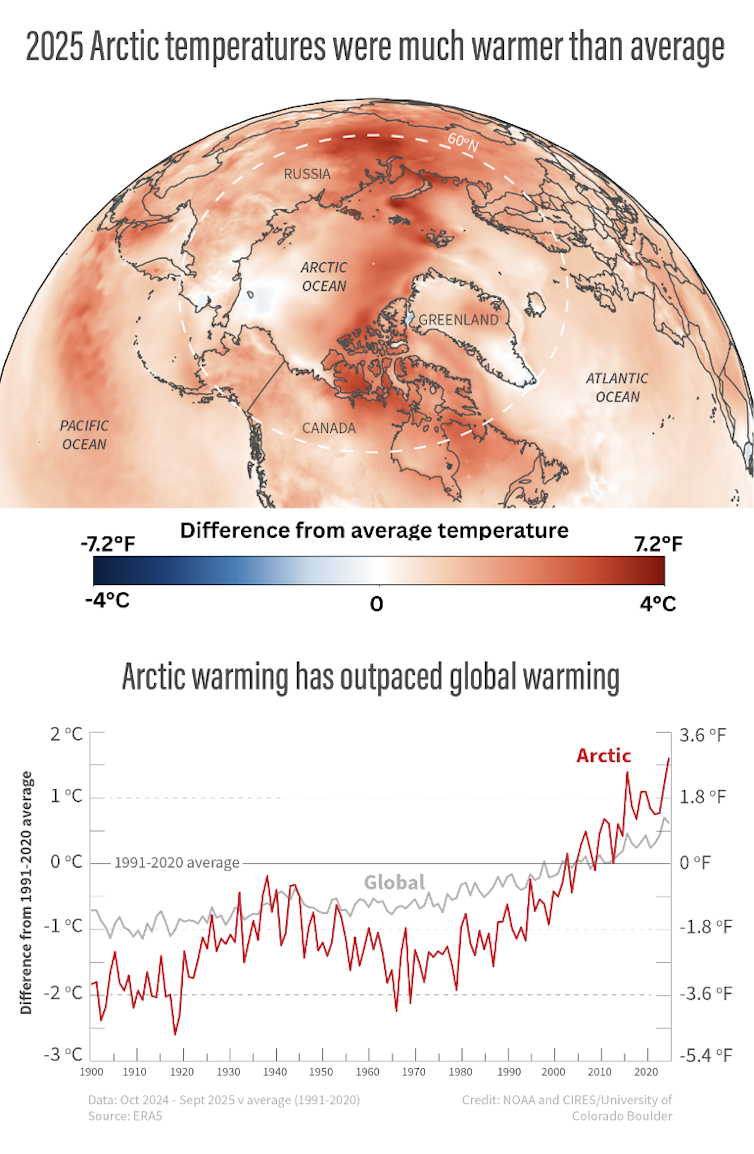
The past water year, October 2024 through September 2025, brought the highest Arctic air temperatures since records began 125 years ago, including the warmest autumn ever measured and a winter and a summer that were among the warmest on record. Overall, the Arctic is warming more than twice as fast as the Earth as a whole.

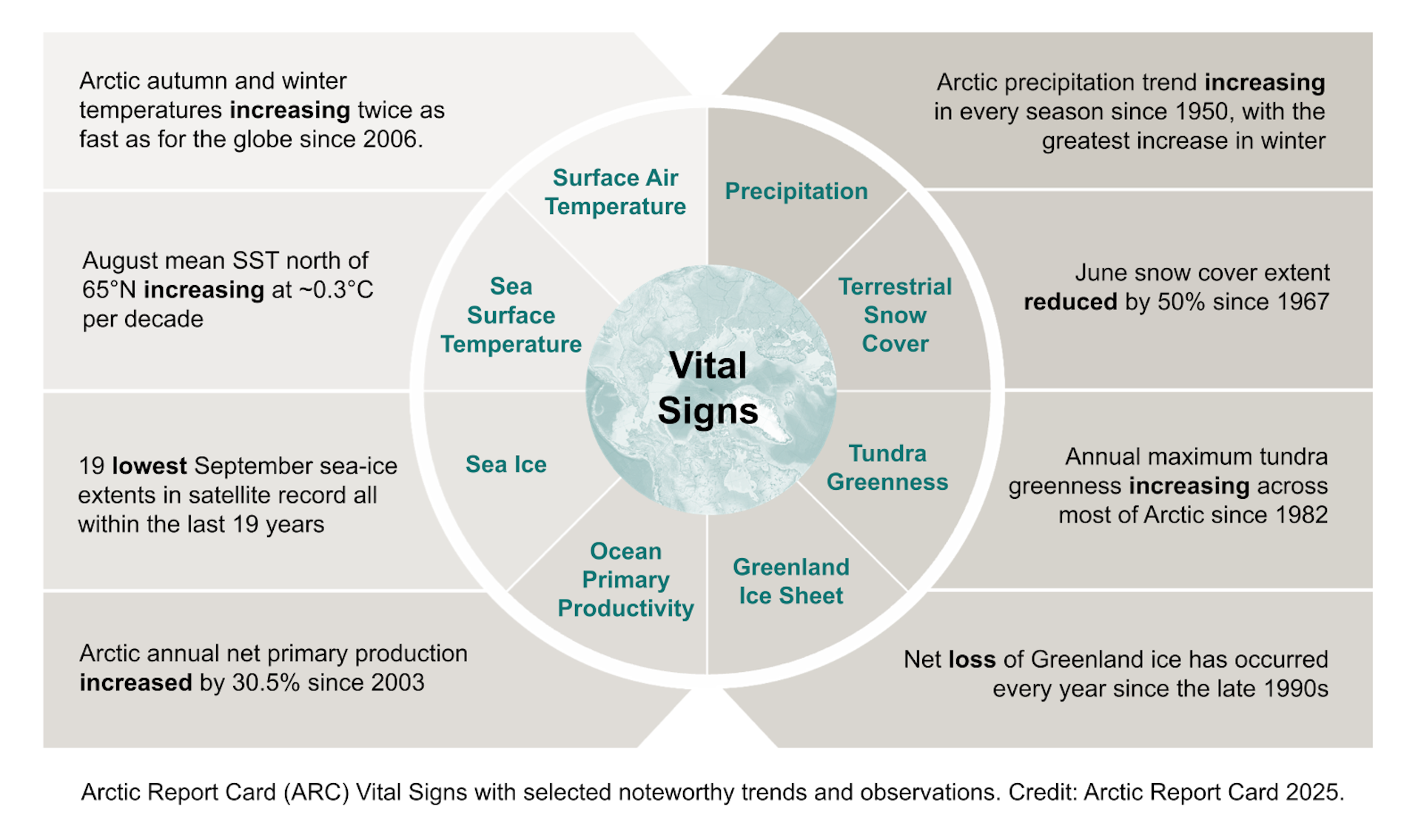
Highlights from the National Oceanic and Atmospheric Administration’s 2025 Arctic Report Card.

For the 20th Arctic Report Card, we worked with the National Oceanic and Atmospheric Administration, an international team of scientists and Indigenous partners from across the Arctic to track environmental changes in the North – from air and ocean temperatures to sea ice, snow, glaciers and ecosystems – and the impacts on communities.

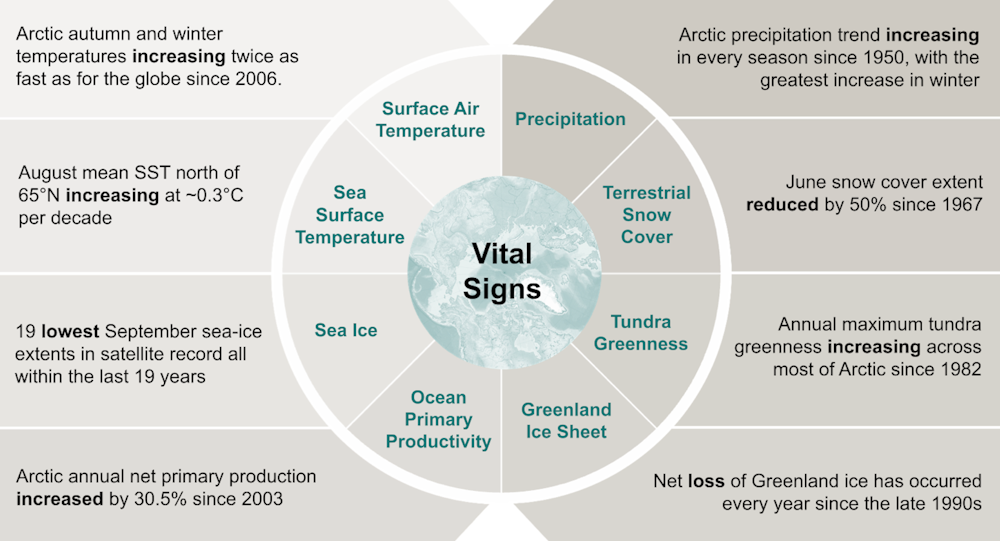
Together, these vital signs reveal a striking and interconnected transformation underway that’s amplifying risks for people who live there.

A wetter Arctic with more extreme precipitation

Arctic warming is intensifying the region’s water cycle.

A warmer atmosphere increases evaporation, precipitation and meltwater from snow and ice, adding and moving more water through the climate system. That leads to more extreme rainstorms and snowstorms, changing river flows and altering ecosystems.

Charts show how the Arctic has warmed faster than the global average.
Arctic surface air temperatures are warming much faster than the global average.
NOAA and CIRES/University of Colorado Boulder.

The Arctic region saw record-high precipitation for the entire 2025 water year and for spring, with the other seasons each among the top-five wettest since at least 1950. Extreme weather – particularly atmospheric rivers, which are long narrow “rivers in the sky” that transport large amounts of water vapor – played an outsized role.

These wetter conditions are reshaping snow cover across the region.

Snow and ice losses accelerate warming, hazards

Snow blankets the Arctic throughout much of the year, but that snow cover isn’t lasting as long. In 2025, snowpack was above average in the cold winter months, yet rapid spring melting left the area covered by snow far smaller than normal by June, continuing a six-decade decline. June snow cover in recent years has been half of what it was in the 1960s.

Losing late spring snow cover means losing a bright, reflective surface that helps keep the Arctic cool, allowing the land instead to be directly warmed by the sun, which raises the temperature.

An illustration shows changes in sea level rise, temperature, precipitation, sea ice and other vital areas.
Eight vital signs and observations in 2025 from the 20th edition of the Arctic Report Card.
Arctic Report Card 2025

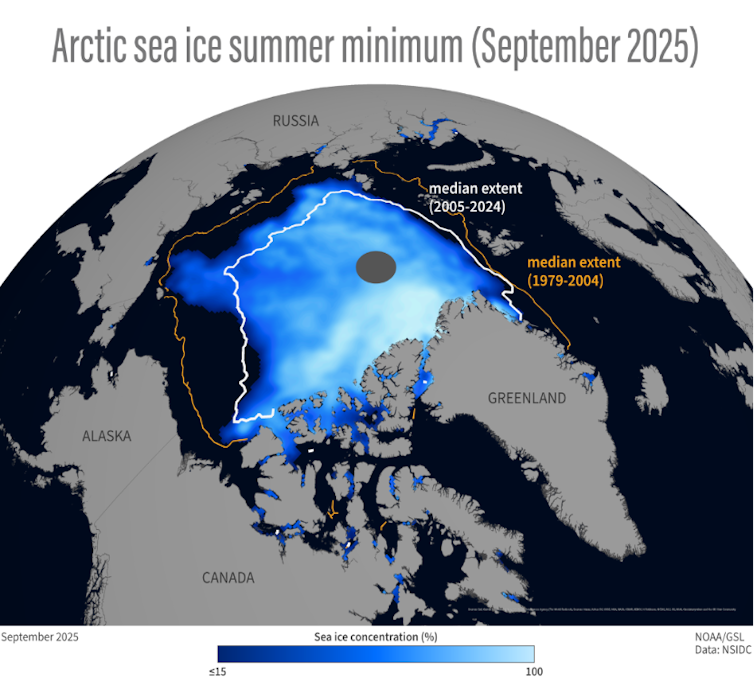
Sea ice tells a similar story. The year’s maximum sea ice coverage, reached in March, was the lowest in the 47-year satellite record. The minimum sea ice coverage, in September, was the 10th lowest.

Since the 1980s, the summer sea ice extent has shrunk by about 50%, while the area covered by the oldest, thickest sea ice – ice that has existed for longer than four years – has declined by more than 95%.

The thinner sea ice cover is more influenced by winds and currents, and less resilient against warming waters. This means greater variability in sea ice conditions, causing new risks for people living and working in the Arctic.

Map shows sea ice extent in 2025 and the 2005-2024 median is much smaller than the 1979-2004 median extent.
Arctic sea ice concentration in September 2025, during its annual minimum extent at the end of summer, was much smaller than the 1979-2004 median extent. The shades of blue reflect the concentration of sea ice.
NOAA and CIRES/University of Colorado Boulder.

The Greenland Ice Sheet continued to lose mass in 2025, as it has every year since the late 1990s. As the ice sheet melts and calves more icebergs into the surrounding seas, it adds to global sea-level rise.

Mountain glaciers are also losing ice at an extraordinary rate – the annual rate of glacier ice loss across the Arctic has tripled since the 1990s.

This poses immediate local hazards. Glacial lake outburst floods – when water that is dammed up by a glacier is suddenly released – are becoming more frequent. In Juneau, Alaska, recent outburst floods from Mendenhall Glacier have inundated homes and displaced residents with record-setting levels of floodwater.

A mountain view shows where the retreating glacier and possible permafrost thaw influenced valley walls exposed above open water.
An aerial photo shows the result of an Aug. 10, 2025, landslide at South Sawyer Glacier in Alaska. The light-colored area of the mountainside is where the slide occurred.
USGS

Glacier retreat can also contribute to catastrophic landslide impacts. Following the retreat of South Sawyer Glacier, a landslide in southeast Alaska’s Tracy Arm in August 2025 generated a tsunami that swept across the narrow fjord and ran nearly 1,600 feet (nearly 490 meters) up the other side. Fortunately, the fjord was empty of the cruise ships that regularly visit.

Record-warm oceans drive storms, ecosystem shifts

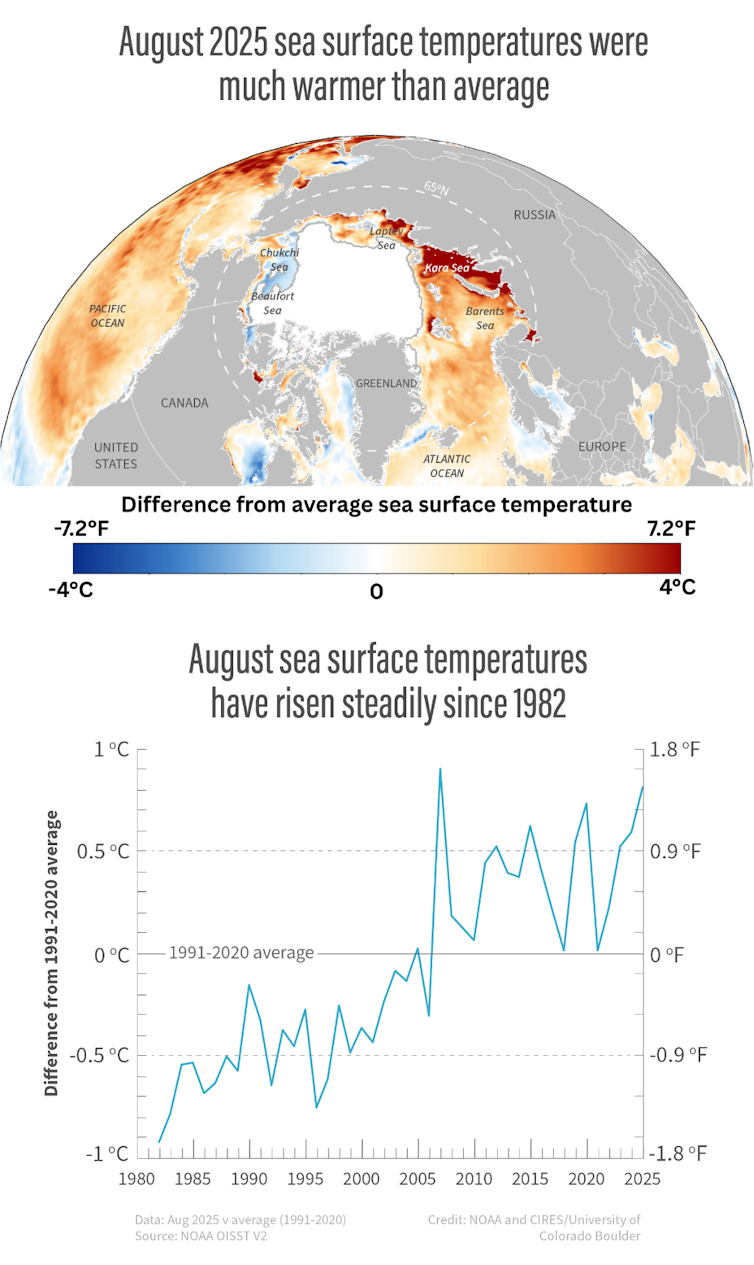
Arctic Ocean surface waters are steadily warming, with August 2025 temperatures among the highest ever measured. In some Atlantic-sector regions, sea surface temperatures were as much as 13 degrees Fahrenheit (7.2 Celsius) above the 1991-2020 average. Some parts of the Chukchi and Beaufort seas were cooler than normal.

A map and chart show temperatures rising.
Arctic sea surface temperatures are much warmer today than in past decades, as this map and chart of August 2025 sea surface temperatures shows.
NOAA and CIRES/University of Colorado Boulder.

Warm water in the Bering Sea set the stage for one of the year’s most devastating events: Ex-Typhoon Halong, which fed on unusually warm ocean temperatures before slamming into western Alaska with hurricane-force winds and catastrophic flooding. Some villages, including Kipnuk and Kwigillingok, were heavily damaged.

As seas warm, powerful Pacific cyclones, which draw energy from warm water, are reaching higher latitudes and maintaining strength longer. Alaska’s Arctic has seen four ex-typhoons since 1970, and three of them arrived in the past four years.

A town with homes surrounded by water.
The village of Kipnuk, shown on Oct. 12, 2025, was devastated by ex-Typhoon Halong. The storm displaced at least 1,500 people from across western Alaska.
Alaska National Guard

The Arctic is also seeing warmer, saltier Atlantic Ocean water intrude northward into the Arctic Ocean. This process, known as Atlantification, weakens the natural layering of water that once shielded sea ice from deeper ocean heat. It is already increasing sea ice loss and reshaping habitat for marine life, such as by changing the timing of phytoplankton production, which provides the base of the ocean food web, and increasing the likelihood of harmful algal blooms.

From ocean ‘borealization’ to tundra greening

Warming seas and declining sea ice are enabling southern, or boreal, marine species to move northward. In the northern Bering and Chukchi seas, Arctic species have declined sharply – by two-thirds and one-half, respectively – while the populations of boreal species expand.

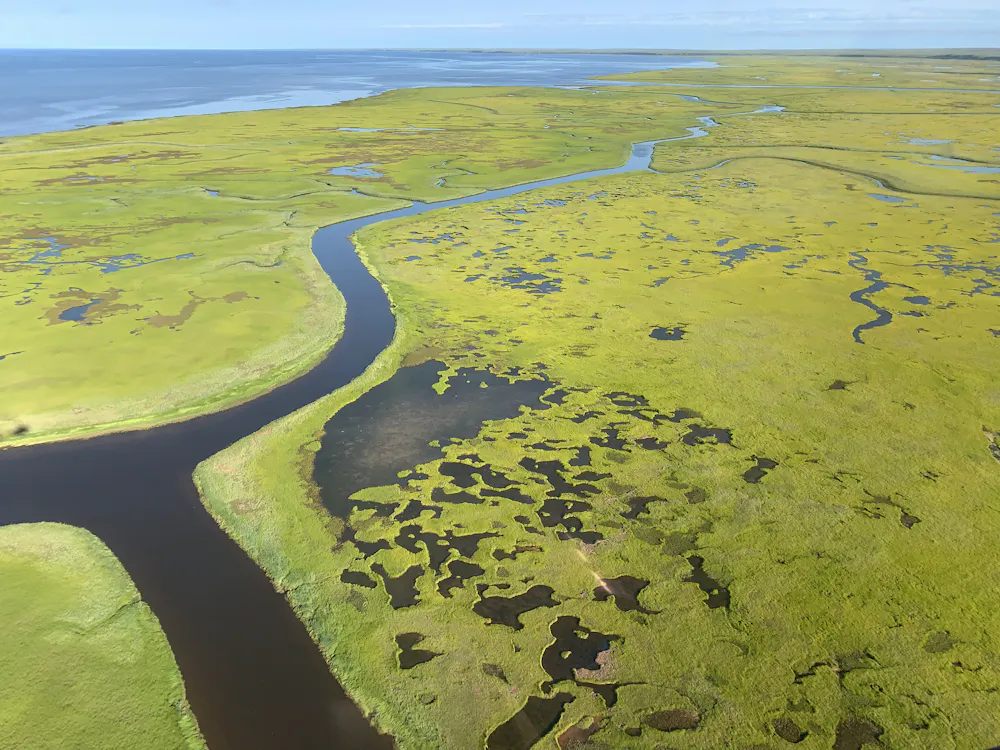
On land, a similar “borealization” is underway. Satellite data shows that tundra vegetation productivity – known as tundra greenness – hit its third-highest level in the 26-year record in 2025, part of a trend driven by longer growing seasons and warmer temperatures. Yet greening is not universal – browning events caused by wildfires and extreme weather are also increasing.

An aerial view of green land dotted with lakes and a river.
Coastal tundra vegetation on the Baldwin Peninsula of Alaska. The tundra is seeing longer growing seasons with warmer temperatures, leading to the overall ‘greening’ of the region.
G. V. Frost

Summer 2025 marked the fourth consecutive year with above-median wildfire area across northern North America. Nearly 1,600 square miles (over 4,000 square kilometers) burned in Alaska and over 5,000 square miles (over 13,600 square kilometers) burned in Canada’s Northwest Territories.

Permafrost thaw is turning rivers orange

As permafrost – the frozen ground that underlies much of the Arctic – continues its long-term warming and thaw, one emerging consequence is the spread of rusting rivers.

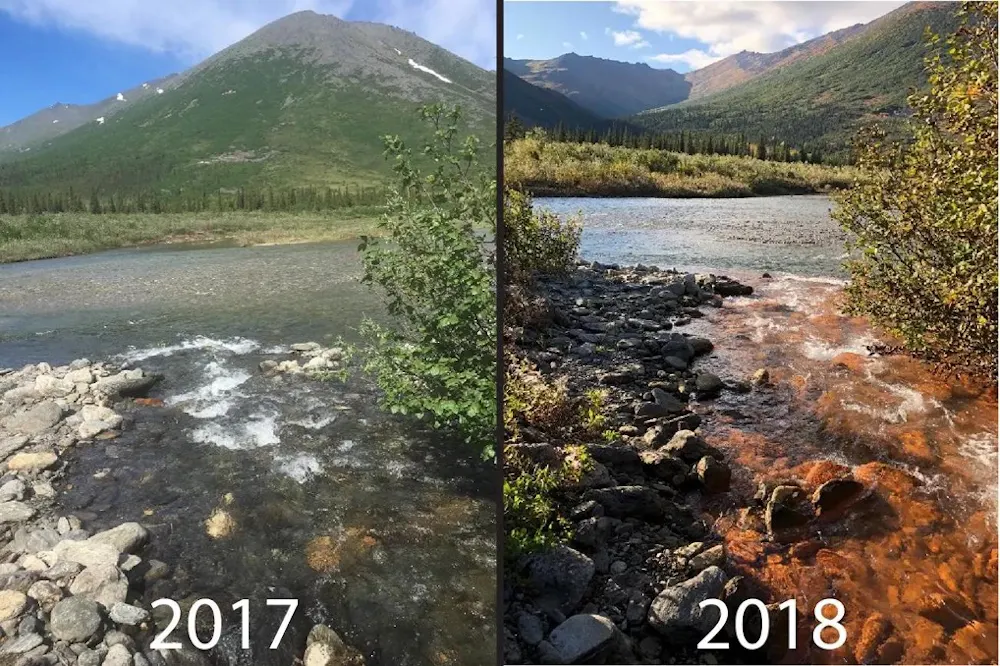
As thawing soils release iron and other minerals, more than 200 watersheds across Arctic Alaska now show orange discoloration. These waters exhibit higher acidity and elevated levels of toxic metals, which can contaminate fish habitat and drinking water and impact subsistence livelihoods.

In Kobuk Valley National Park in Alaska, a tributary to the Akillik River lost all its juvenile Dolly Varden and slimy sculpin fish after an abrupt increase in stream acidity when the stream turned orange.

Side-by-side images show the same stream a year apart, one with rust-colored water.
Rust-colored water in a tributary of the Akillik River in Kobuk Valley National Park reflects permafrost thaw releasing metals into the water.
National Park Service/Jon O’Donnell

Arctic communities lead new monitoring efforts

The rapid pace of change underscores the need for strong Arctic monitoring systems. Yet many government-funded observing networks face funding shortfalls and other vulnerabilities.

At the same time, Indigenous communities are leading new efforts.

The Arctic Report Card details how the people of St. Paul Island, in the Bering Sea, have spent over 20 years building and operating their own observation system, drawing on research partnerships with outside scientists while retaining control over monitoring, data and sharing of results. The Indigenous Sentinels Network tracks environmental conditions ranging from mercury in traditional foods to coastal erosion and fish habitat and is building local climate resilience in one of the most rapidly changing environments on the planet.

A group of people with binoculars watch the water.
Observers with the Indigenous Sentinel Network, together with National Oceanic and Atmospheric Administration scientists, monitor the population and health of northern fur seals on St. Paul Island.
Hannah-Marie Ladd, CC BY

The Arctic is facing threats from more than the changing climate; it’s also a region where concerns of ecosystem health and pollutants come sharply into view. In this sense, the Arctic provides a vantage point for addressing the triple planetary crisis of climate change, biodiversity loss and pollution.

The next 20 years will continue to reshape the Arctic, with changes felt by communities and economies across the planet.

The Conversation

Matthew L. Druckenmiller receives funding from the National Oceanic and Atmospheric Administration (NOAA) to serve as an editor for the Arctic Report Card.

Rick Thoman receives funding from the National Oceanic and Atmospheric Administration (NOAA) to serve as an editor for the Arctic Report Card.

Twila A. Moon receives funding from the National Oceanic and Atmospheric Administration (NOAA) to serve as an editor for the Arctic Report Card.

ref. From record warming to rusting rivers, 2025 Arctic Report Card shows a region transforming faster than expected – https://theconversation.com/from-record-warming-to-rusting-rivers-2025-arctic-report-card-shows-a-region-transforming-faster-than-expected-271572

Humans aren’t the only animals that gather to hunker down together at Christmas

Source: The Conversation – UK – By Anna Champneys, Senior Lecturer in Wildlife Conservation, Nottingham Trent University

Just as humans have historically gathered during winter, many animals do the same. Animals may not be exchanging presents or decorating their nests and dens but a lot of species become more social in winter – even ones that are normally solitary.

Animals have more to worry about this time of year than bickering relatives or the last date for Christmas post. Winter poses severe challenges for wildlife, from freezing temperatures to a scarcity of food. One of the main reasons animals aggregate during the winter is to keep warm. Some species avoid these harsh conditions by migrating to warmer areas, such as cuckoos in the UK overwintering in central Africa. Others grow insulating coats (like mountain hares in the Scottish highlands), or develop a thick layer of blubber (grey seals and harbour porpoises for example) to keep the cold at bay.

But some animals come together instead. Brandt’s voles inhabit the grasslands and steppe of inner Mongolian, where winter temperatures drop as low as -30 °C and strong winds and blizzards are frequent.

Portrait of a Brandt's vole carrying vegetation to its underground den.
Brandt’s vole is surprisingly tough.
Danita Delimont/Shutterstock

During the summer months, the voles are largely solitary. However, throughout the
long, harsh winters, they form small huddling groups of around four in the nesting chambers of their underground burrows to share body heat. Huddling conserves energy by reducing resting metabolic rate by up to 37% and limits heat loss.

Safety in numbers

Arctic hares live in one of the harshest environments on Earth in northern Canada
where the long winters last up to nine months and temperatures can drop to -40°C.
During this time, they abandon their solitary summer habits and form large aggregations of up to a hundred hares.

The purpose of this behaviour is not for thermoregulation, since they do not come into close contact. Rather, it is for safety against predators. When Arctic hares form winter groups, they are increasing vigilance against predators including Arctic foxes and wolves.

Arctic hare bounding across tundra.
Arctic hares have to stay alert for foxes and wolves.
Nick Dale Photo/Shutterstock

A major advantage for prey species living in a group is that each animal can spend less time on the lookout for predators (and more time feeding). This is crucial for Arctic hares in winter when food is scarce and they need more energy to keep warm.

Larger groups also cause predator confusion, making it harder for predators to target individual animals. The group dilution effect means that in the event of an attack each hare’s chance of being caught is reduced.

Information network

Rooks are highly social birds living in small flocks of typically ten or fewer unrelated birds all year round. During the winter months many small flocks will join up to form huge colonies of hundreds or thousands of birds from the surrounding area.

Buckenham Carrs woodland in Norfolk has the largest rookery in Britain where an estimated 50,000 rooks have been gathering every winter for centuries. Each evening birds travel to the roost from across the Norfolk Broads, sometimes up to 20 miles, when the bare trees become foliated with rooks.

During the day, the rooks go off in smaller foraging groups and then return to the roosts each evening. Roosting closely together not only helps reduce heat-loss but also makes it easier to find food. These large communal roosts also function as information exchange centres about where the best places to forage are.

When rooks leave their roosts in the morning, they pay close attention to inadvertent cues given by other rooks such as their body condition (as an indicator of recent foraging success) and the direction in which they fly. Less successful rooks copy their more prosperous roost mates. Group foraging is more efficient and therefore reduces exposure to danger.

Water conservation

Another example of the benefits of winter groups is water conservation. Ladybirds
enter a physiological dormancy, called diapause, which allows them to survive the
winter months without feeding. During this period, they form clusters of hundreds or even thousands of ladybirds, which helps conserve energy, as clustered individuals have lower metabolic rates.

Moreover, these aggregations create a microclimate with more stable temperatures and higher humidity, which helps reduce the risk of desiccation, as ladybirds do not consume water during overwintering.

Large numbers of ladybirds resting on log.
Ladybirds tough out winter together.
A. Saunders/Shutterstock

In addition, ladybirds gain extra protection when they form large clusters because their warning colouration, advertising their toxicity, is more obvious to predators.

In the UK, native seven-spot ladybirds aggregate under tree bark or leaf litter, whereas the non-native harlequin ladybird prefers houses and pack together in huge numbers around windows and in lofts during the winter.

Record warm temperatures for both spring and summer in the UK during 2025 may have led to a surge in insect populations. This may explain why many people have noticed large clusters of ladybirds around windows in their homes.

If you find a cluster of ladybirds in your home, it is best just to leave them alone as they pose no risk to people or wooden surfaces. Plus, long term data indicates insect populations are dwindling.

Reproductive advantage

In the cold prairies of Manitoba (Canada), red sided garter snakes congregate in
communal, overwintering dens, sometimes by the thousand. Snakes rely on existing underground structures such as the abandoned burrows of chipmunks, disused wells or limestone sink holes to overwinter. These snakes detect and follow the pheromone trails left by other snakes, which leads them directly to the communal dens.

This seasonal assembly not only increases survival rate during the winter months but also facilitates mating success come the spring. The close proximity of males and females after emergence reduces the time spent searching for a mate during the
short northern breeding season. Courtship begins immediately upon emergence from the dens. Multiple males coil around single females in a “mating ball” ensuring the chances of mating before the females disperse.

Dozens of snakes coiled together in undergrowth
Red sided garter snakes form mating balls in the spring.
Mark F Lotterhand/Shutterstock

This seasonal social behaviour are adaptations for survival in harsh conditions. Similar to many animal species, early humans likely congregated during severe winters to share warmth and resources, illustrating a shared strategy for survival in challenging environments. Understanding this behaviour is vital as climate change alters winter severity and availability of food and shelter.

The Conversation

Anna Champneys does not work for, consult, own shares in or receive funding from any company or organisation that would benefit from this article, and has disclosed no relevant affiliations beyond their academic appointment.

ref. Humans aren’t the only animals that gather to hunker down together at Christmas – https://theconversation.com/humans-arent-the-only-animals-that-gather-to-hunker-down-together-at-christmas-271015

Could your boss be lonely? Here’s why it matters more than you might think

Source: The Conversation – UK – By Karolina Nieberle, Associate Professor of Social and Organisational Psychology, Durham University

PeopleImages/Shutterstock

Loneliness is the pain we feel when our social connections fall short of fulfilling our needs. At its core, it reflects a fundamental human need: to feel close to and connected with others. But it is also often an invisible experience.

Loneliness is not just a personal issue. It is also a workplace one. Gallup’s 2025 global workplace report showed that 22% of employees felt lonely on their previous workday. Managers weren’t immune either: 23% of them reported feeling lonely.

Workplace loneliness can affect anyone and can quietly damage engagement, wellbeing and performance. For leaders, the stakes are high. When they experience loneliness, it can subtly shape how they interact with their teams. They may communicate less openly, avoid feedback or appear withdrawn. A lonely leader influences their entire workplace environment, shaping team dynamics, morale and performance.

With our colleagues, Michelle Hammond (Oakland University) and Keming Yang (Durham University), we have studied loneliness in the workplace and found that managers might feel lonely due to the demands of their role and the things they experience during the workday. These things can vary from day to day.

As managers move up the hierarchy, their status and responsibilities increase, which can create distance from both their team members and peers. Building connections depends on being able to show vulnerability. But daily pressures, tough decisions and confidentiality constraints often make it difficult for managers to open up. As a result, their need for social connection can go unmet on some days, while on other days they may feel engaged and well connected.

Our research looked at the consequences of short-term loneliness among leaders. In two independent studies with UK managers, we found that fluctuations in their loneliness levels had implications for how they approached leadership.

On days or in situations when managers felt lonely, they engaged less with their work (this could be spending time on matters unrelated to work or letting others do their tasks) and lower levels of engagement with their team members (avoiding their employees, for instance).

The consequences of short-term loneliness for managers did not stop at the end of the workday. After a day in which they felt lonely, managers distanced themselves more from others in the evening. This created a loop that perpetuated loneliness into the next workday, and it helps to explain why managers sometimes feel lonely for extended periods.

work papers scattered on a desk with a framed photo of a young child in the background.
There’s more to life than reports.
Khakimullin Aleksandr/Shutterstock

But our research uncovered a key resource outside of work that helped managers mitigate the consequences of loneliness and stopped it from affecting them for a longer period. This centred on how important their relationships with family and friends were in their life – something we called “family identity salience”.

Managers who placed greater value on their family and social connections were better able to switch off from work in the evenings, and loneliness from their workday did not spill over into their home life. Loneliness still affected their leadership at work, but it didn’t lead them to withdraw socially at home. As a result, they were able to start the next workday with a clean slate.

This “family identity salience” motivates managers to create protective boundaries between their daily work and home domains. It helps them shift out of work mode and reconnect with their friends and families after work – especially important on tough days.

Not just managers

Although managers’ loneliness has the greatest implications for the health of the workplace overall, anyone can feel lonely at work sometimes, whether or not they are a manager.

It may be helpful for workers to explore which experiences and situations make them feel lonely. They could also consider the situations when their manager might feel lonely. On the other hand, some situations might make them feel close to others, including managers. Talking to peers and sharing experiences can help to raise awareness of the issue.

To prevent occasional loneliness, workers could make themselves (and others) aware of the networks and groups that offer connection. These could be immediate team members, peers, (senior) managers, colleagues in other departments or external partners. They should think about what connects them with each of these groups and the steps they can take to strengthen their connection with them.

In addition to workplace networks, employees should invest in their relationships outside work. They can remind themselves why these relationships matter, and keep family and social goals visible (with photos, reminders or personal notes) to reinforce a sense of identity beyond work. The energy and support resources that people gain from time with friends and family outside work can unlock benefits in the professional sphere too.

Workers can also take steps to sustain and expand their relationships outside of work. For example, they might be the one who arranges dates, phone calls and shared activities with the people they value.

The best way for people to shield themselves from workplace loneliness is by not placing all their eggs in their “work basket”. Building resilience by nourishing and investing in interests and connections to places and people is a good way to celebrate all the facets of what makes us human.

The Conversation

The authors do not work for, consult, own shares in or receive funding from any company or organisation that would benefit from this article, and have disclosed no relevant affiliations beyond their academic appointment.

ref. Could your boss be lonely? Here’s why it matters more than you might think – https://theconversation.com/could-your-boss-be-lonely-heres-why-it-matters-more-than-you-might-think-272129