Medieval peasants probably enjoyed their holiday festivities more than you do

Source: The Conversation – USA (3) – By Bobbi Sutherland, Associate Professor, Department of HIstory, University of Dayton

Winter in a peasant village, painted by the Limbourg brothers and published in the medieval illuminated manuscript ‘Très Riches Heures du Duc de Berry.’ Pierce Archive LLC/Buyenlarge via Getty Images

When people think of the European Middle Ages, it often brings to mind grinding poverty, superstition and darkness. But the reality of the 1,000-year period from 500 to 1500 was much more complex. This is especially true when considering the peasants, who made up about 90% of the population.

For all their hard work, peasants had a fair amount of downtime. Add up Sundays and the many holidays, and about one-third of the year was free of intensive work. Celebrations were frequent and centered around religious holidays like Easter, Pentecost and saints’ days.

But the longest and most festive of these holidays was Christmas.

As a professor of medieval history, I can assure you the popular belief that the lives of peasants were little more than misery is a misconception. They enjoyed rich social lives – maybe richer than ours – ate well, celebrated frequently and had families not unlike our own. For them, holiday festivities didn’t begin with Christmas Eve and end with New Year’s.

The party was just getting started.

Daily life in a peasant village

A peasant was not simply a low-class or poor person. Rather, a peasant was a subsistence farmer who owed their lords a portion of the food they grew. They also provided labor, which might include bridge-building or farming the lord’s land.

In return, a lord provided his peasants with protection from bandits or invaders. They also provided justice via a court system and punished people for theft, murder and other crimes. Typically, the lord lived in the village or nearby.

Peasants lived in the countryside, in villages that ranged from a few houses to several hundred. The villages had communal ovens, wells, flour mills, brewers or pubs, and blacksmiths. The houses were clustered in the center of the village along a dirt street and surrounded by farmland.

A photo of a primitive stone house with a thatched roof.
A 14th-century thatched cottage in what is now West Sussex, England.
David C. Tomlinson/The Image Bank via Getty Images

By today’s standards, a peasant’s house was small – in England, the average was around 700 square feet (65 square meters). Houses might be made of turf, wood, stone or “waddle-and-daub,” a construction very similar to lathe and plaster, with beamed roofs covered in straw. Houses had front doors, and some had back doors. Windows were covered with shutters and, rarely, glass. Aside from the fireplace, only the Sun, Moon or an oil lamp or candle provided light.

Strange sleep habits and sex without privacy

The day was dictated by seasons and sunlight. Most people rose at dawn or a bit before; men went out to their fields soon after to grow grains like wheat and barley. Women worked in the home and yard, taking care of children, animals and vegetable gardens, along with the spinning, sewing and cooking. Peasants didn’t have clocks, so a recipe might recommend cooking something for the time it took to say the Lord’s Prayer three times.

Around midday, people usually took a break and ate their largest meal – often a soup or stew. The foods they ate could include lamb and beef, along with cheese, cabbage, onions, leeks, turnips and fava beans. Fish, in particular freshwater fish, were also popular. Every meal included bread.

A historical photo shows peasants dancing around a tree.
15th-century peasants in France celebrate May Day.
Hulton Archives via Getty Images

Beer and wine were major components of the meal. By our standards, peasants drank a lot, although the alcohol content of the beer and wine was lower than today’s versions. They often napped before returning to work. In the evening, they ate a light meal, perhaps only bread, and socialized for a while.

They went to bed within a few hours of darkness, so how long they slept depended on the season. On average, they slept about eight hours, but not consecutively. They awoke after a “first sleep” and prayed, had sex or chatted with neighbors for somewhere between half an hour and two hours, then returned to sleep for another four hours or so.

Peasants did not have privacy as we think of it; everyone often slept in one big room. Parents made love with one another as their children slept nearby. Married couples shared a bed, and one of their younger children might sleep with them, though infants had cradles. Older children likely slept two to a bed.

A colorful illustration of a musician playing an instrument before a small audience.
A musician entertains a group of peasant farmers.
duncan1890/DigitalVision Vectors via Getty Images

Dreaming of a medieval Christmas

Life certainly wasn’t easy. But the stretches of time for rest and leisure were enviable.

Today, many people start thinking about Christmas after Thanksgiving, and any sort of holiday spirit fizzles by early January.

In the Middle Ages, this would have been unheard of.

Advent – the period of anticipation and fasting that precedes Christmas – began with the Feast of St. Martin.

Back then, it took place 40 days before Christmas; today, it’s the fourth Sunday before it. During this period, Western Christians observed a fast; while less strict than the one for Lent, it restricted meat and dairy products to certain days of the week. These protocols not only symbolized absence and longing, but they also helped stretch out the food supply after the end of the harvest and before meats were fully cured.

Christmas itself was known for feasting and drunkenness – and it lasted nearly six weeks.

Dec. 25 was followed by the 12 Days of Christmas, ending with the Epiphany on Jan. 6, which commemorates the visit of the Magi to Jesus, Mary and Joseph. Gifts, often in the form of food or money, were exchanged, though this was more commonly done on New Year’s Day. Game birds, ham, mince pies and spiced wines were popular fare, with spices thought to help warm the body.

Though Christmas officially celebrates the birth of Jesus, it was clearly associated with pre-Christian celebrations that emphasized the winter solstice and the return of light and life. This meant that bonfires, yule logs and evergreen decorations were part of the festivities. According to tradition, St. Francis of Assisi created the first nativity scene in 1223.

Christmas ended slowly, with the first Monday after Epiphany being called “Plough Monday” because it marked the return to agricultural work. The full end of the season came on Feb. 2 – called Candlemas – which coincides with the older pagan holiday of Imbolc. On this day, candles were blessed for use in the coming year, and any decorations left up were thought to be at risk of becoming infested with goblins.

Many people today gripe about the stresses of the holidays: buying presents, traveling, cooking, cleaning and bouncing from one obligation to the next. There’s a short window to get it all done: Christmas Day is the only day many workplaces are required to give off.

Meanwhile, I’ll be dreaming of a medieval Christmas.

The Conversation

Bobbi Sutherland does not work for, consult, own shares in or receive funding from any company or organization that would benefit from this article, and has disclosed no relevant affiliations beyond their academic appointment.

ref. Medieval peasants probably enjoyed their holiday festivities more than you do – https://theconversation.com/medieval-peasants-probably-enjoyed-their-holiday-festivities-more-than-you-do-241328
De TikTok aux bars à loutres au Japon, comment les réseaux sociaux profitent du mal-être des animaux sauvages

Source: The Conversation – France (in French) – By Margot Michaud, Enseignante-chercheuse en biologie évolutive et anatomie , UniLaSalle

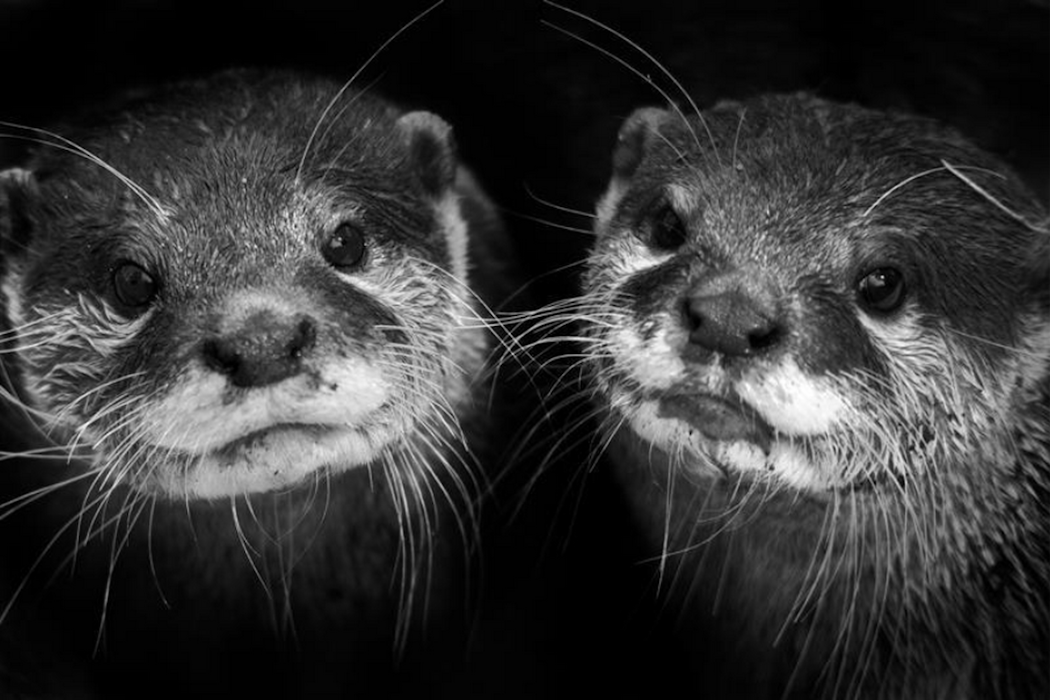
En Asie, on peut cajoler des loutres cendrées (_Aonyx cinereus_) dans des cafés qui leur sont consacrés. Mais qu’en est-il du bien-être de ces animaux sauvages qui se voient piégés dans des environnements inadaptés à leurs besoins fondamentaux ? Sara Hoummady/UniLaSalle, Fourni par l’auteur

Sur les réseaux sociaux, la popularité des animaux exotiques va de pair avec la banalisation de leur mauvais traitement. Ces plateformes monétisent la possession d’espèces sauvages tout en invisibilisant leur souffrance. Cette tendance nourrit une méprise courante selon laquelle l’apprivoisement serait comparable à la domestication. Il n’en est rien, comme le montre l’exemple des loutres de compagnie au Japon.


Singes nourris au biberon, perroquets dressés pour les selfies, félins obèses exhibés devant les caméras… Sur TikTok, Instagram ou YouTube, ces mises en scène présentent des espèces sauvages comme des animaux de compagnie, notamment via des hashtags tels que #exoticpetsoftiktok.

Cette tendance virale, favorisée par le fonctionnement même de ces plateformes, normalise l’idée selon laquelle un animal non domestiqué pourrait vivre comme un chat ou un chien, à nos côtés. Dans certains pays, posséder un animal exotique est même devenu un symbole ostentatoire de statut social pour une élite fortunée qui les met en scène lors de séances photo « glamour ».

Or, derrière les images attrayantes qui recueillent des milliers de « likes » se dissimule une réalité bien moins séduisante. Ces stars des réseaux sociaux sont des espèces avec des besoins écologiques, sociaux et comportementaux impossibles à satisfaire dans un foyer humain. En banalisant leur possession, ces contenus, d’une part, entretiennent des croyances erronées et, d’autre part, stimulent aussi le trafic illégal. En cela, ils participent à la souffrance de ces animaux et fragilisent la conservation d’espèces sauvages.


À lire aussi :
Qui est le capybara, cet étonnant rongeur qui a gagné le cœur des internautes ?


Ne pas confondre domestique et apprivoisé

Pour comprendre les enjeux liés à la possession d’un animal exotique, il faut d’abord définir les termes : qu’est-ce qu’un animal domestique et qu’est-ce qu’un animal exotique  ?

Le manul, ou chat de Pallas, est un petit félin sauvage endémique de la Mongolie, du Kazakhstan, de la Russie, du sud de l’Iran, du Pakistan et du Népal. Malgré son adorable bouille, c’est un animal territorial et solitaire qui peut être agressif.
Sander van der Wel, CC BY-SA

Force est de constater que le terme « animal exotique » est particulièrement ambigu. Même si en France l’arrêté du 11 août 2006 fixe une liste claire des espèces considérées comme domestiques, sa version britannique dresse une liste d’animaux exotiques pour lesquels une licence est requise, à l’exclusion de tous les autres.

Une licence est ainsi requise pour posséder, par exemple, un serval (Leptailurus serval), mais pas pour un hybride de serval et de chat de deuxième génération au moins, ou encore pour détenir un manul, aussi appelé chat de Pallas (Otocolobus manul).

Ce flou sémantique entretient la confusion entre apprivoisement et domestication :

  • le premier consiste à habituer un animal sauvage à la présence humaine (comme des daims nourris en parc) ;

  • la seconde correspond à un long processus de sélection prenant place sur des générations et qui entraîne des changements génétiques, comportementaux et morphologiques.

Chat Savannah (croisement entre un chat domestique et un serval) de première génération.
Flickr Gottawildside, CC BY-NC-ND

Ce processus s’accompagne de ce que les scientifiques appellent le « syndrome de domestication », un ensemble de traits communs (oreilles tombantes, queue recourbée, etc.) déjà décrits par Darwin dès 1869, même si ce concept est désormais remis en question par la communauté scientifique.

Pour le dire plus simplement : un loup élevé par des humains reste un loup apprivoisé et ne devient pas un chien. Ses besoins et ses capacités physiologiques, son comportement et ses aptitudes cognitives restent fondamentalement les mêmes que celles de ces congénères sauvages. Il en va de même pour toutes les autres espèces non domestiques qui envahissent nos écrans.


À lire aussi :
Le chien descend-il vraiment du loup ?


Des animaux stars au destin captif : le cas des loutres d’Asie

Les félins et les primates ont longtemps été les animaux préférés des réseaux sociaux, mais une nouvelle tendance a récemment émergé en Asie : la loutre dite de compagnie.

Parmi les différentes espèces concernées, la loutre cendrée (Aonyx cinereus), particulièrement prisée pour son apparence juvénile, représente la quasi-totalité des annonces de vente en ligne dans cette région. Cela en fait la première victime du commerce clandestin de cette partie du monde, malgré son inscription à l’Annexe I de la Convention sur le commerce international des espèces menacées depuis 2019.

Les cafés à loutres, particulièrement en vogue au Japon, ont largement participé à normaliser cette tendance en les exposant sur les réseaux sociaux comme animaux de compagnie, un phénomène documenté dans un rapport complet de l’ONG World Animal Protection publié en 2019. De même, le cas de Splash, loutre employée par la police pour rechercher des corps en Floride (États-Unis), montre que l’exploitation de ces animaux s’étend désormais au-delà du divertissement.

En milieu naturel, ces animaux passent la majorité de leurs journées à nager et à explorer un territoire qui mesure plus d’une dizaine de kilomètres au sein d’un groupe familial regroupant jusqu’à 12 individus. Recréer ces conditions à domicile est bien entendu impossible. En outre, leur régime, principalement composé de poissons frais, de crustacés et d’amphibiens, est à la fois extrêmement contraignant et coûteux pour leurs propriétaires. Leur métabolisme élevé les oblige en plus à consommer jusqu’à un quart de leur poids corporel chaque jour.

Privés de prédation et souvent nourris avec des aliments pour chats, de nombreux animaux exhibés sur les réseaux développent malnutrition et surpoids. Leur mal-être s’exprime aussi par des vocalisations et des troubles graves du comportement, allant jusqu’à de l’agressivité ou de l’automutilation, et des gestes répétitifs dénués de fonction, appelés « stéréotypies ». Ces comportements sont la conséquence d’un environnement inadapté, sans stimulations cognitives et sociales, quand elles ne sont pas tout simplement privées de lumière naturelle et d’espace aquatique.

Une existence déconnectée des besoins des animaux

Cette proximité n’est pas non plus sans risques pour les êtres humains. Les loutres, tout comme les autres animaux exotiques, peuvent être porteurs de maladies transmissibles à l’humain : salmonellose, parasites ou virus figurent parmi les pathogénies les plus fréquemment signalées. De plus, les soins vétérinaires spécialisés nécessaires pour ces espèces sont rarement accessibles et de ce fait extrêmement coûteux. Rappelons notamment qu’aucun vaccin antirabique n’est homologué pour la majorité des espèces exotiques.

Dans le débat public, on oppose souvent les risques pour l’humain au droit de posséder ces animaux. Mais on oublie l’essentiel : qu’est-ce qui est réellement bon pour l’animal  ? La légitimité des zoos reste débattue malgré leur rôle de conservation et de recherche, mais alors comment justifier des lieux comme les cafés à loutres, où l’on paie pour caresser une espèce sauvage  ?

Depuis 2018, le bien-être animal est défini par l’Union européenne et l’Anses comme :

« Le bien-être d’un animal est l’état mental et physique positif lié à la satisfaction de ses besoins physiologiques et comportementaux, ainsi que de ses attentes. Cet état varie en fonction de la perception de la situation par l’animal. ».

Dès lors, comment parler de bien-être pour un animal en surpoids, filmé dans des situations anxiogènes pour le plaisir de quelques clients ou pour quelques milliers de likes ?

Braconnés pour être exposés en ligne

Bien que la détention d’animaux exotiques soit soumise à une réglementation stricte en France, la fascination suscitée par ces espèces sur les réseaux ne connaît aucune limite géographique. Malgré les messages d’alerte mis en place par TikTok et Instagram sur certains hashtags, l’engagement du public, y compris en Europe, alimente encore la demande mondiale et favorise les captures illégales.

Une étude de 2025 révèle ainsi que la majorité des loutres captives au Japon proviennent de deux zones de braconnage en Thaïlande, mettant au jour un trafic important malgré la législation. En Thaïlande et au Vietnam, de jeunes loutres sont encore capturées et séparées de leurs mères souvent tuées lors du braconnage, en violation des conventions internationales.

Les réseaux sociaux facilitent la mise en relation entre vendeurs et acheteurs mal informés, conduisant fréquemment à l’abandon d’animaux ingérables, voire des évasions involontaires.

Photographie du serval qui a erré dans le département du Rhône pendant plus de six mois en 2025.
© Tonga Terre d’Accueil

Ce phénomène peut également avoir de graves impacts écologiques, comme la perturbation des écosystèmes locaux, la transmission de maladies infectieuses aux populations sauvages et la compétition avec les espèces autochtones pour les ressources.

Récemment en France, le cas d’un serval ayant erré plusieurs mois dans la région lyonnaise illustre cette réalité : l’animal, dont la détention est interdite, aurait probablement été relâché par un particulier.

Quand l’attention profite à la cause

Mais cette visibilité n’a pas que des effets délétères. Les réseaux sociaux offrent ainsi un nouveau levier pour analyser les tendances d’un marché illégal. D’autres initiatives produites par des centres de soins et de réhabilitation ont une vocation pédagogique : elles sensibilisent le public et permettent de financer des actions de protection et de lutte contre le trafic.

Il ne s’agit donc pas de rejeter en bloc la médiatisation autour de la question de ces animaux, mais d’apprendre à en décoder les intentions et les impacts. En définitive, le meilleur moyen d’aider ces espèces reste de soutenir les associations, les chercheurs et les programmes de réintroduction. Et gardons à l’esprit qu’un simple like peut avoir des conséquences, positives ou négatives, selon le contenu que l’on choisit d’encourager.

The Conversation

Les auteurs ne travaillent pas, ne conseillent pas, ne possèdent pas de parts, ne reçoivent pas de fonds d’une organisation qui pourrait tirer profit de cet article, et n’ont déclaré aucune autre affiliation que leur organisme de recherche.

ref. De TikTok aux bars à loutres au Japon, comment les réseaux sociaux profitent du mal-être des animaux sauvages – https://theconversation.com/de-tiktok-aux-bars-a-loutres-au-japon-comment-les-reseaux-sociaux-profitent-du-mal-etre-des-animaux-sauvages-268683

Young people’s social worlds are ‘thinning’ – here’s how that’s affecting wellbeing

Source: The Conversation – UK – By Eamon McCrory, Professor of Developmental Neuroscience and Psychopathology, UCL

AstroStar/Shutterstock

Between 2014 and 2024, the proportion of people aged 16–24 in England experiencing mental health issues rose from 19% to 26%.

This means over 1.6 million young people – enough to fill Wembley Stadium 18 times over – are affected by mental ill-health today.

Social media is often at the centre of conversations about what’s driving this trend. But while our increasingly digital lives are part of the story, the bigger picture is more complex. Young people are arguably spending more time online partly because the real world has less and less to offer them.

At the heart of their declining wellbeing is the hollowing out of the real-world infrastructure that supports healthy social development, with social lives becoming increasingly fragile and “thinned”.

This “social thinning”, a term we developed in research exploring trauma, includes fewer opportunities to play, take risks and build supportive relationships. This thinning, we believe, has worrying implications for development and mental health.

One of us (Eamon McCrory) is a neuroscientist who has spent years studying risk and resilience and brain systems that develop across adolescence. During this period, the brain refines the systems that help us understand others, form a clear sense of self and regulate our emotions.

Teenagers are wired to explore friendships, navigate complex social groups and practice handling conflict and rejection. These experiences help young people develop agency and independence.

But developing these abilities depends on spending time in a wide range of real social environments with different kinds of relationships, from casual interactions to close friendships.

When chances to practise these skills shrink, it can lead to loneliness and consequences for development. It can become harder to trust others, feel connected to peers or manage strong emotions.

For example, one study used the pandemic as an opportunity to test the effect of a significant reduction in social connections between teenagers. The researchers found that trust was low in adolescents during lockdown, and this in turn was associated with high levels of stress.

In other words, the evidence points to deprivation of social connection as having developmental consequences, and over time, an increased risk of mental health difficulties.

Thinning social worlds

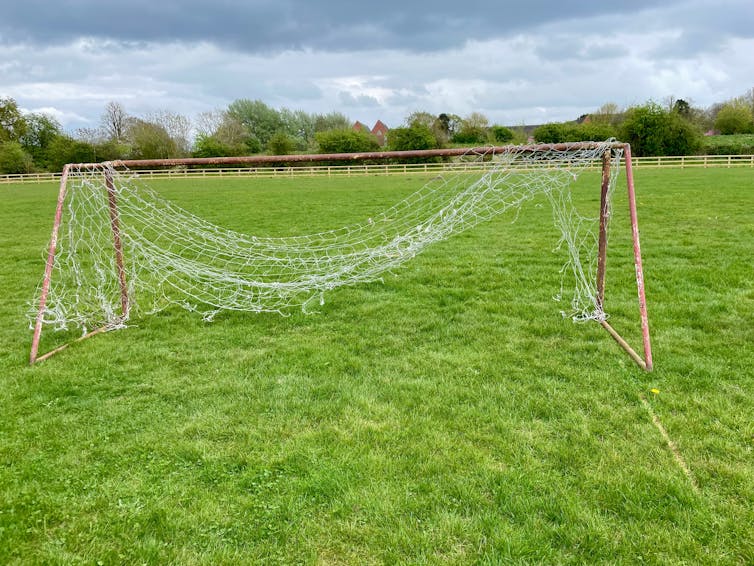
The real-world experiences that support these crucial neurological processes have been steadily declining. Between 2011 and 2023, over 1,200 council-run youth centres in England and Wales closed, and £1.2 billion has been stripped from youth service budgets since 2010 in England. Meanwhile, parks and open spaces have suffered from underinvestment.

Dilapidated goal in park
Investment in youth services has shrunk.
Knights Lane/Shutterstock

Cultural shifts have also had an impact. It has been suggested that fears about safety and a desire to minimise risks for their children have produced a “risk-averse” parenting culture. In schools, rising academic pressures and an emphasis on achievement have come at the expense of play and exploration.

Research suggests that children today have significantly less freedom to roam, play outdoors, or gather with peers than previous generations.

The environments in which young people can explore, fail safely and develop social mastery have been radically narrowed. It is into an already thinning social ecosystem that digital platforms enter.

Digital help and harm

Despite many arguments to the contrary, digital spaces are not inherently harmful. They can offer connection, self-expression and community.

This can be particularly true for those marginalised offline, with research suggesting social media can actually support the mental health and wellbeing of young LGBTQ people. Our online and offline lives are deeply intertwined, with online connections often allowing us to deepen existing relationships.

The problem is less that young people are online, and more that online life has rushed in to fill the gaps left by a shrinking offline world.

Moreover, digital platforms are built for profit, not development. Young people are shaping their identities, sense of belonging and social status within systems designed to drive constant engagement – a phenomenon which is only accelerating with the advent of AI.

Social media platforms encourage comparison, performance and rapid responses. More broadly, the digital world can pull attention away from the real world and place young people under persistent pressure. It can also affect how – across a formative period of development – they make sense of themselves and the world around them.

Solid foundations in a digital world

There is growing recognition that preventing mental ill health means investing in the social foundations of childhood. McCrory is the chief executive of the mental health charity Anna Freud, which is making a significant shift towards prevention: prioritising building strengths,reducing risks and supporting wellbeing before problems become entrenched. And, of course, positive relationships are the cornerstone of healthy development.

To reverse rising rates of mental ill health, we need to reimagine and invest in the social scaffolding that supports healthy development, ensuring children and young people grow up in socially rich environments. This requires serious investment in youth services, outdoor spaces and community infrastructure.

Schools need more time for play, creativity and extracurricular activities, not just academic performance. Families need support to create shared experiences, from outdoor play to community participation.

Digital platforms are now part of everyday life, but they must complement rather than replace experiences in the physical world. By enriching, not thinning, young people’s social worlds and giving them places and relationships that build trust, foster agency and support connection, we can strengthen the foundations for lifelong wellbeing.

The Conversation

Eamon McCrory is affiliated with UCL (Professor of Developmental Neuroscience and Psychopathology) and Anna Freud (CEO)

Ritika Chokhani is currently the recipient of a PhD studentship funded by the Wellcome Trust, focusing on similar research areas.

ref. Young people’s social worlds are ‘thinning’ – here’s how that’s affecting wellbeing – https://theconversation.com/young-peoples-social-worlds-are-thinning-heres-how-thats-affecting-wellbeing-272111

Pimple patches have hidden our blemishes for hundreds of years – historian explains

Source: The Conversation – UK – By Sara Read, Lecturer in English, Loughborough University

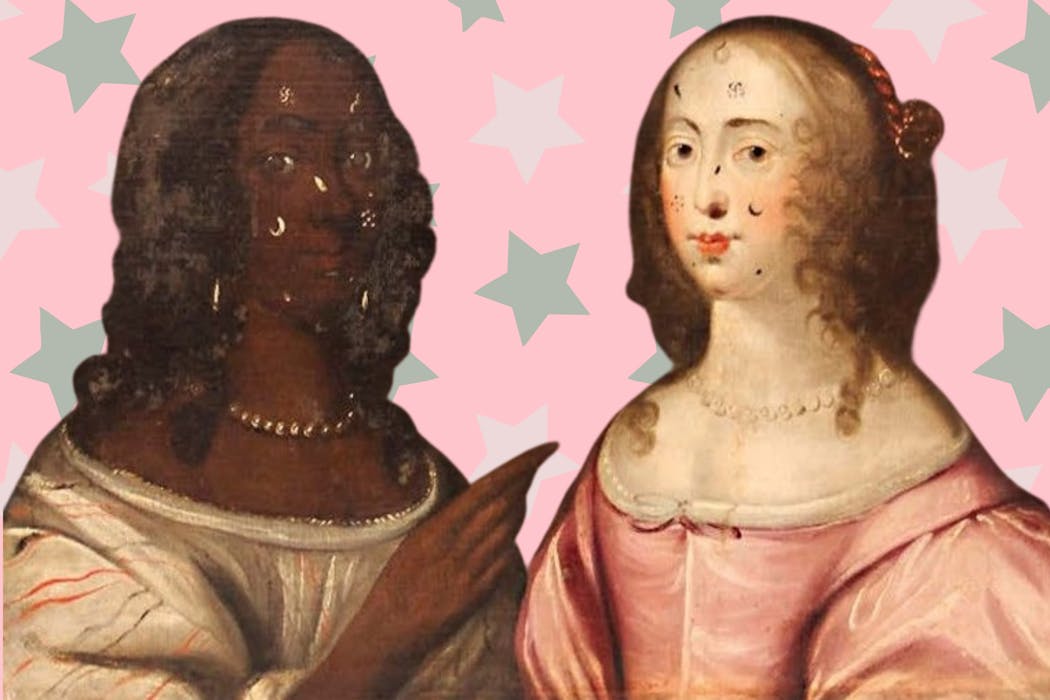
Two Women Wearing Cosmetic Patches, painter unknown (circa 1650). Compton Verney Art Gallery/Canva

You may have noticed people out and about with little stickers on their faces. Perhaps you’ve seen moons, stars, clouds or even smiley faces adorning people’s cheeks and chins. Maybe you wear them yourself. While some people do wear them as accessories, these colourful stickers are medicated “pimple patches”, designed to treat spots or acne.

Some of the patches simply contain a gel formula, which keeps the emerging blemish moist to aid healing. Some wearers opt for near-transparent film patches to get the benefit in a more inconspicuous way.

Far from a new fad, beauty patches have a long history. The trend first took off in 17th-century Europe, with patches made from paper, silk or velvet, or even fine leather, cut into lozenge shapes, stars or crescent moons.

They could be made in many colours, but black was generally preferred as it made a stark contrast to the idealised pale face of western upper-class men and women, who saw this complexion as a status symbol, showing they did not go outdoors to work. The play Blurt, Master-Constable from 1602 explains another appeal of the patches – when well applied, they could “draw men’s eyes to shoot glances at you”.

Mentions of patches occur regularly in print from the late 16th and early 17th century. Just like today, beauty patches had a dual function. In his 1601 play Jack Drum’s Entertainment, John Marston explains that: “Black patches are worn, some for pride, some to stay the rheum, and some to hide the scab.”

So, some were worn by people wanting to make themselves seem more attractive, and some – sometimes medicated – were used to dry up sores. Some patches were used to conceal blemishes like the scars left by diseases such as smallpox or even syphilis.


No one’s 20s and 30s look the same. You might be saving for a mortgage or just struggling to pay rent. You could be swiping dating apps, or trying to understand childcare. No matter your current challenges, our Quarter Life series has articles to share in the group chat, or just to remind you that you’re not alone.

Read more from Quarter Life:


This latter use was the reason moralists took issue with patches. One anonymous book from 1665 claimed a chaplain of King Charles I had given a sermon comparing beauty patches to the biblical mark of Cain. It is reported that he went so far as to suggest that wearing these accessories invited plague epidemics: “black-patches and beauty-spots … were Forerunners of other Spots, and Marks of the Plague”.

Other moralists focused on how, just like makeup, their job was to conceal and present a false front, which could trick admirers. This was a criticism that took on more weight into the 18th century, when people linked the use of patches to sexual promiscuity.

A Harlot’s Progress by William Hogarth (1731) is a series of images depicting the fall of a country girl, Moll Hackabout. Newly arrived in London, she is tricked by the real life brothelkeeper Elizabeth Needham. Needham’s face is covered with black patches.

Civil servant Samuel Pepys makes over a dozen mentions of these patches in his diary between 1660 and 1669. He first encountered “two very pretty ladies, very fashionable and with black patches, who very merrily sang all the way” on a business trip to the Hague in spring 1660.

The next day on a stroll through town, he noted how: “Everybody of fashion speaks French or Latin, or both. The women many of them very pretty and in good habits, fashionable and black spots.”

He noted that patches were often moistened with spit to hold them on. In May 1668, he recalled seeing Lady Castlemayne – mistress to Charles II – demanding a patch from the face of her maid, wetting it in her mouth and applying it to the side of her own face. We know from Pepys that James, Duke of York also favoured a patch or two.

By August that same year, Pepys noted in a diary entry that his wife Elisabeth was sporting black patches to a christening. Yet he seemed to have forgotten this when he noted in November that: “My wife seemed very pretty to-day, it being the first time I had given her leave to wear a black patch.” He sported a patch himself in September 1664 when he woke with a scabby mouth.

The fashion for wearing patches rose higher in the Restoration era (1660-1700), when returning royalist exiles from the Commonwealth brought home French fashions that they considered the height of sophistication.

English writer Mary Evelyn explained that mouches was the fashionable French name for “Flies, or, Black Patches”, since patches were called “flies” in French and sometimes in English too. Evelyn’s poem The Ladies Dressing-Room Unlock’d, published posthumously in 1690, was a biting satire on the Francophile fashions of Restoration London that Evelyn thought only the vulgar would indulge in.

While it is hard to see how people wearing spot patches nowadays might be subject to the same sorts of moralising backlash seen in the past, there are corners of the internet that mock people for going out in public with visible spot patches.

Whether they work or not, pimple patches are a harmless accessory. From the late 17th century, books begin to refer to patch boxes, ornate little containers specifically designed to hold patches.

Fashionable types came to like to be seen carrying a little silver box especially designed to hold their velvet or silk patches. Perhaps this will be the next development in the modern pimple patch craze.


Looking for something good? Cut through the noise with a carefully curated selection of the latest releases, live events and exhibitions, straight to your inbox every fortnight, on Fridays. Sign up here.


The Conversation

Sara Read does not work for, consult, own shares in or receive funding from any company or organisation that would benefit from this article, and has disclosed no relevant affiliations beyond their academic appointment.

ref. Pimple patches have hidden our blemishes for hundreds of years – historian explains – https://theconversation.com/pimple-patches-have-hidden-our-blemishes-for-hundreds-of-years-historian-explains-271013

How climate campaigns can cut through ad fatigue

Source: The Conversation – UK – By Sayed Elhoushy, Senior Lecturer in Marketing, Queen Mary University of London

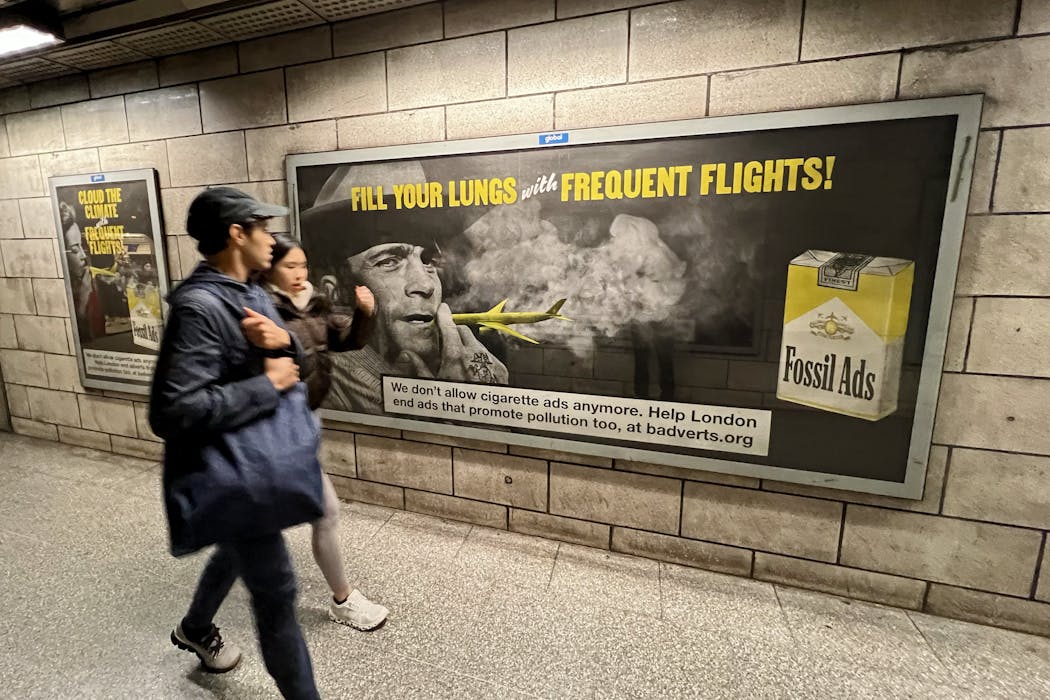
Posters at Southwark station in London ‘advertise’ fossil fuels – an example of clear and meaningful messaging. Badvertising, CC BY-NC-ND

Since November 2025, commuters at Southwark tube station in London have been passing walls lined with vintage-style posters parodying oil and gas advertising, instead of ads promoting flights or energy companies. One 1950s-style poster shows a woman holding a small yellow aeroplane as if it were a cigarette; another has the slogan: For a quicker climate crisis use … Fossil Ads.

This visibility and attention to the climate crisis is welcome. But with more campaigns competing for attention – often with conflicting messages – the effect can quickly become overwhelming. Messages designed to raise awareness or inspire action also trigger ad fatigue.

Ad fatigue is well recognised in marketing: when people encounter the same message too often, it loses impact. A growing body of research shows that repeated exposure to similar advertising messages has negative consequences within and beyond climate contexts. Climate ad fatigue refers to a decline in effectiveness when people become overexposed to climate-related messages.

Researchers like me are investigating how certain climate messages create fatigue. One study shows that people who already feel worn down by constant climate messaging can become even more fatigued after seeing one more headline. That added fatigue doesn’t only decrease their interest — it reduces compassion and reduces willingness to support climate action.

three fossil ads posters on tube station wall
Posters at Southwark station in London ‘advertise’ fossil fuels.
Badvertising, CC BY-NC-ND

Another study highlights the role of attention. Paying attention to climate change is a precondition for climate-friendly action. But attention is easily disrupted. When people are stressed, distracted or overloaded with information, climate communication becomes something to tune out rather than engage with.

Despite rising fatigue, the advertising industry is expanding rapidly. Global ad spending is expected to reach US$1.17 trillion (£0.88 trillion) in 2025 up from roughly US$792 billion in 2024. Sustainability advertising represents a growing share as brands compete to position themselves as environmentally responsible.

Oil and gas companies have increased their climate-related communication. Although many of these campaigns focus on green initiatives or future sustainability goals, critics argue that the messaging can obscure ongoing fossil-fuel operations.

Transport for London records show that hundreds of oil and gas ads have run across its network in recent years. These campaigns reach millions of commuters.

The rise of counter campaigns

Across the UK and Europe, campaign groups are pushing for limits on fossil-fuel ads in public spaces. Examples include ad-free city initiatives and petitions to prohibit such advertising altogether.

Comparisons with past tobacco advertising rules are becoming more common, with some arguing that fossil-fuel ads should face similar restrictions. The campaign at Southwark station by Badvertising, by a climate charity called Possible, reflects this wider movement.

Yet, as both sides escalate their advertising, the public risks becoming more fatigued. Research shows that people – especially children and young people – increasingly worry about the planet and often feel sad, anxious, powerless or guilty.

These emotional reactions mirror wider findings that fear-based or stress-inducing contexts often reduce responsible behaviour. Managing these emotions is important.

If climate ads are starting to grow and feel tiring, repeating the same crisis-driven messages can push people away. What keeps attention instead is relevance, creativity, and variety.

A report by thinktank ClimateXChange shows that climate messages work better when they are rooted in local realities, focused on solutions, and linked to clear, achievable actions. Storytelling plays a key role here, helping people see how climate change connects with their own lives, rather than something abstract and difficult to influence.

Creativity matters too. Research shows that creative ads, characterised by high divergence and relevance, is less likely to wear out over time. A report by a climate charity also suggests that using different frames, voices and formats – from personal stories to humour, visuals or creative perspectives – can help advertisers prevent fatigue in increasingly crowded media environments.

For the public, managing climate ad fatigue isn’t about disengaging. It is about being more selective where attention goes. People can choose to ignore climate messages that place responsibility mainly on individual behaviour, and instead engage with communications that point to systemic causes and collective solutions.

Campaigns such as the Southwark posters do this by shifting attention away from personal choice and toward the industries and regulatory systems. Public support for restrictions on fossil fuel ads, similar to those applied to tobacco, would reduce misleading messages at their source instead of placing the burden on people to filter them out.


Don’t have time to read about climate change as much as you’d like?

Get a weekly roundup in your inbox instead. Every Wednesday, The Conversation’s environment editor writes Imagine, a short email that goes a little deeper into just one climate issue. Join the 47,000+ readers who’ve subscribed so far.


The Conversation

Sayed Elhoushy does not work for, consult, own shares in or receive funding from any company or organisation that would benefit from this article, and has disclosed no relevant affiliations beyond their academic appointment.

ref. How climate campaigns can cut through ad fatigue – https://theconversation.com/how-climate-campaigns-can-cut-through-ad-fatigue-269839

Why shoppers buy fast fashion even if they disagree with it

Source: The Conversation – UK – By Yang Ding, Lecturer in Marketing, University of Reading

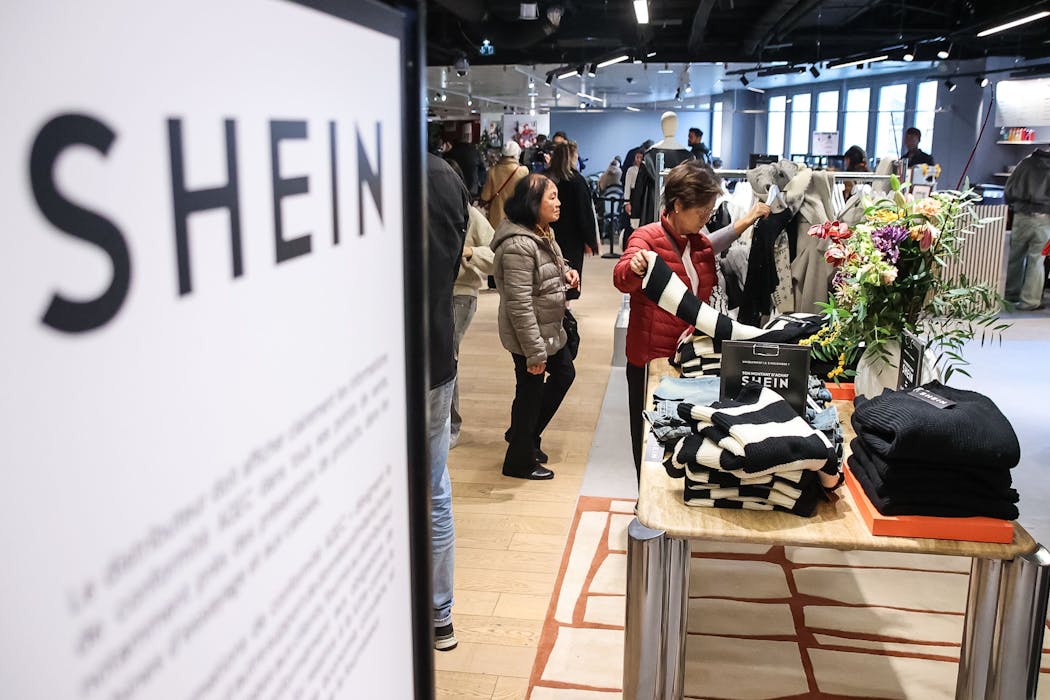
Shoppers were able to browse Shein’s range in person at its first bricks-and-mortar space in Paris. Antonin Albert/Shutterstock

Every December, many shoppers plan to buy fewer things and choose more sustainable options. Yet as the month goes on, spending rises and fast fashion becomes hard to resist. Christmas has become a moment when good intentions collide with discounts and the emotional pull of seasonal fashion.

That contradiction became unusually visible when fashion giant Shein opened its first permanent shop inside the BHV department store in Paris in November. Crowds formed as shoppers tried to get in, while protesters stood outside holding signs and shouting “shame” over concerns about its ESG (environmental, social and governance) track record.

Shein has taken rapid turnaround times and low prices to a new level, taking it beyond fast fashion to “ultra-fast fashion”.

Some other brands with retail space inside the department store announced they planned to withdraw in protest at Shein’s presence. And the opening of new Shein stores across France has been delayed.

There was more controversy. The French government demanded controls, including age verification, on parts of Shein’s online platform amid investigations into banned weapons and childlike sex dolls on its site, placing the company under more scrutiny.

When it was made aware of the products in November, a spokesman for Shein said the company was taking the issue “extremely seriously”. It disabled the part of its site where third-party sellers list their products.

At the same time, shoppers entering the Paris store found higher prices than online, which added another layer to the debate over Shein’s transparency and the wider environmental and labour concerns linked to fast fashion.

What makes Christmas such a powerful moment for fast fashion is not only seasonal marketing but also the psychological dynamics that help consumers assuage their environmental guilt. Fast fashion already accounts for a significant share of online clothing sales in France, and Shein has become one of the largest retailers by volume, despite rising public criticism.

In the UK, sales of fast fashion have reached billions of pounds, with strong annual growth, suggesting that affordability eventually outweighs ethical concerns.

Research into consumer behaviour shows that people often use moral excuses to justify questionable purchases, telling themselves that everyone else is doing the same or that the harm is distant and indirect. This softens the ethical tension long enough to make the purchase.

Beyond guilt reduction, fast fashion benefits from what marketing researchers describe as temporal discounting. This is when consumers focus on short-term enjoyment and price rather than longer-term environmental damage.

Shein’s rapid production model turns digital trends into products within days, producing instant gratification. Future harms such as waste or emissions are psychologically distant at the moment of buying. These mechanisms help explain why fast fashion continues to flourish even as climate concerns grow.

In many ways, the Christmas rush exposes a wider conflict between consumers’ ethical intentions and the realities of global retail. This paradox is not only personal. It also shapes how governments and the public respond to Shein’s growing presence.

The protests outside the Paris store echo the tension across regulatory and societal institutions, where concerns about labour conditions and environmental impact collide with the influence of a company that has become central to contemporary fashion.

Why the Paris protests matter beyond ESG

It may be tempting to see the demonstrations in Paris simply as another reaction to environmental issues. Yet concerns around Shein were already part of the public debate long before the store opened. Fast fashion has relied for decades on outsourcing to cheaper manufacturing centres with limited worker protections.

Even after the Rana Plaza disaster in 2013 when 1,134 people (mainly garment workers), were killed in Bangladesh when their factory building collapsed, many European fast fashion companies continued to face criticism about their environmental violations across global supply chains.

What distinguishes the current controversy are not the ethical problems but the challenge Shein poses to the traditional balance of power in global fashion. For much of the past century, European companies dominated the industry and shaped international tastes.

Now Shein’s algorithmically-driven and hyperresponsive model is disrupting that dominance. This speed fuels waste and environmental damage even as its low prices keep attracting millions of shoppers.

In this sense, for Shein, Paris becomes more than a retail location. Success in one of the world’s fashion capitals would mark an important moment in Shein’s global expansion and signal that it is no longer operating at the margins.

It would also test whether this new type of fashion giant can prove itself beyond its online audience, in the eyes of regulators, partner brands and in-store shoppers.

The pushback Shein faces in Paris points to a broader anxiety about who now holds influence in the fashion industry. A Chinese fast fashion giant has bypassed traditional European gatekeepers and challenged the established hierarchy of who shapes the industry’s future.

In response to a 2024 report criticising working conditions in some of the factories it uses, Shein said in a statement it was “actively working to improve our suppliers’ practices, including ensuring that hours worked are voluntary and that workers are compensated fairly for what they do”. And with regard to criticisms about its environmental impact, Shein has said its use of AI has now cut the amount of waste generated in its production processes.

The Conversation

The authors do not work for, consult, own shares in or receive funding from any company or organisation that would benefit from this article, and have disclosed no relevant affiliations beyond their academic appointment.

ref. Why shoppers buy fast fashion even if they disagree with it – https://theconversation.com/why-shoppers-buy-fast-fashion-even-if-they-disagree-with-it-271452

What the year in polls tells us about Reform’s growth – and Labour and Tory losses

Source: The Conversation – UK – By Paul Whiteley, Professor, Department of Government, University of Essex

In the year and a half since Labour won a landslide in the 2024 general election, over 400 polls have been published. Combined, these polls tell a story of a government and its traditional opposition party losing support and fringe parties gaining ground. The big question this poses is whether Reform can win the next general election.

When these polls are combined into weekly averages since the general election, they show that Labour and Reform have averaged 25% in vote intentions over this period. The Conservatives have averaged 21%, the Liberal Democrats 13% and the Greens 9%.

Vote intentions since the 2024 election:

A chart showing the fluctuations in voting intention polls since the 2024 election.
The post-2024 polling outlook.
P Whiteley, CC BY-ND

The trends show that support for Labour has declined continuously since the election. In the case of the Conservatives, they were ahead of Reform until shortly after Kemi Badenoch was elected as leader. From this point on, Nigel Farage’s Reform party moved well ahead of both Labour and the Conservatives.

It appears that Badenoch’s strategy of trying to outdo Reform in rightwing rhetoric has failed. The Liberal Democrats have remained close to their 13% support throughout. The Greens received a boost when Zack Polanski was elected leader in September 2025. The Greens are now a strong rival to Labour, hoovering up leftwing voters who supported Labour in the general election. This is particularly true if the new leftwing Your Party cannot settle its internal squabbling.

Where does the Reform vote come from?

It is interesting to know where the Reform vote comes from – and especially whether it is taking more votes from Labour or the Conservatives. One way of finding this out is to conduct a panel survey to ask the same people about their voting intentions over time, to see if it changes. Unfortunately, this cannot be done with polling data since it’s too difficult and expensive for pollsters to keep contacting the same people.

An alternative and much easier way of finding out where the vote comes from is to look at the strength of the relationship between trends in Reform voting and voting for the other parties. To do this, we need to look at the changes in support for all five parties. As an example, the correlation between changes in the Reform vote and changes in the Conservative vote over this period is -0.40.

If the correlation were -1.0 that would mean a decrease of Conservative support by 1% would produce an increase in Reform support of 1%. If the correlation was zero it would mean the Conservative vote did not influence the Reform vote at all. It appears that there is a moderately strong negative relationship between Conservative and Reform voting. Put another way, a fall of 10% in Conservative voting translates into an increase in the Reform vote of 4%. A fall of 10% in support for Labour delivers an increase of 3% for Reform.

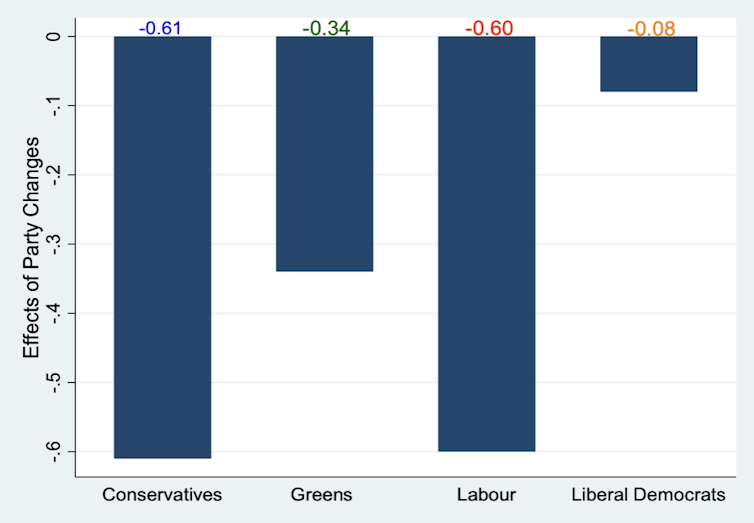
The effects of changes in vote intentions for the national parties on changes in Reform voting since the general election:

A chart showing on how voting intention has changed for four parties since the election.
It’s been downhill all the way since the election for some parties.
P Whiteley, CC BY-ND

However, there is a complication arising in the calculation when looking at each of the other parties and Reform voting separately. This approach fails to account for the relationships between these other parties.

If, for example, Reform does well against the Conservatives, this will help Labour because the Tories are a strong challenger to the Labour party. If Reform weakens support for the Tories, this could rebound to give Labour an advantage over Reform.

We need to look at the interactions between changes in support for all parties at the same time to get a clear picture.

This is done using multiple regression, which is a statistical technique that predicts changes in the Reform vote from changes in all the other party votes at the same time, thereby taking into account interactions between them.

The effects are quite strong, and they are roughly the same for Labour and the Conservatives. A fall of 10% for each of them boosts the Reform vote by 6%. The effect of Liberal Democrat voting on Reform, meanwhile, is negligible, with a coefficient of -0.08.

However, the Green vote does affect Reform, having a coefficient of -0.34. In other words, a fall of 10% in the Reform vote will boost the Green vote by about 3.4%.

The pattern observed in the polls is of Labour’s vote share continuously declining and of the Conservative vote increasing to begin with and then subsequently declining. This situation looks different when you consider their individual relationships to Reform but, in the event, when all the interactions are taken into account, they both end up losing votes to the newer party to the same extent.

This has implications for the May 2026 local elections. The leadership positions of both Keir Starmer and Badenoch are at risk if these contests turn out to be a disaster for their parties.

Unless Reform’s support starts to weaken, both parties could lose the same proportion of votes to Reform. And at the moment the party shows little sign of doing so. That said, there are four years to go at the outside to the next election – and with volatile polls like these, anything can happen.


Want more politics coverage from academic experts? Every week, we bring you informed analysis of developments in government and fact check the claims being made.

Sign up for our weekly politics newsletter, delivered every Friday.

The Conversation

Paul Whiteley has received funding from the British Academy and the ESRC.

ref. What the year in polls tells us about Reform’s growth – and Labour and Tory losses – https://theconversation.com/what-the-year-in-polls-tells-us-about-reforms-growth-and-labour-and-tory-losses-271827

I study rat nests − here’s why rodents make great archivists

Source: The Conversation – USA – By Alexandria Mitchem Hansen, Ph.D. Candidate in Anthropology, Columbia University

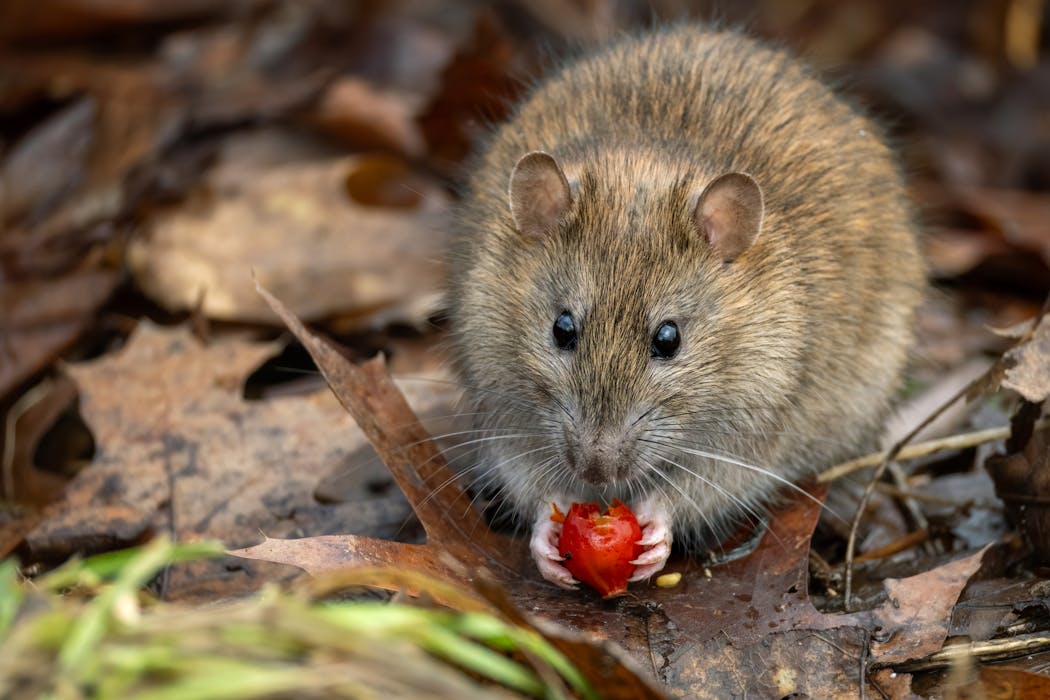
Old rat nests can contain fabrics, papers, animal bones, plant remains and other materials that have been undisturbed for hundreds of years. Andyworks/E+ Collection via Getty Images

Rats and other rodents and pests can make great archivists.

That’s because they forage food and build dens, storing fabric, paper, animal bones, plant remains and other materials under floorboards, behind walls and in attics, crawl spaces and wells. There, these materials might dry out and remain undisturbed for hundreds of years.

By analyzing the materials in these nests, archaeologists like me can learn more about the people who once lived nearby.

I studied a rat nest that was used by generations of rats over several decades and was found under the floorboards in the attic of the historic home at Bartram’s Garden in southwest Philadelphia. In 1728, Quaker farmer and naturalist John Bartram began to plant his garden, which is considered the oldest botanic garden in North America. I studied thousands of plants collected by rats and learned how the Bartram family used these plants for food, medicine, trade and study.

Exterior view of old stone building surrounded by grass and trees
A view of the Bartram family’s historic stone home.
Magpieturtle/Wikimedia Commons, CC BY

A 200-year-old nest

Rat nests are common in historic structures, particularly homes like Bartram’s that contained kitchens and buildings that were used for food storage, such as cellars.

Bartram collected plants from around eastern North America along with those sent to him by naturalists in Europe. His sons, John Jr. and William, and later his granddaughter Ann Bartram Carr, continued to expand the garden, which gained international fame during the 18th and 19th centuries.

The rat nest was discovered during historic preservation work at the Bartram home in 1977. My analysis of the materials in the nest indicates that it was formed in the late 18th and early 19th century. The materials are representative of the plants rodents would have been foraging from the Bartram home and garden.

The plants I identified weren’t restricted to those sold by the Bartram family as a part of their nursery business. Nor were they limited to plants that were traded between naturalists hoping to learn more about the flora of the American Colonies. They included crops such as wheat, buckwheat, corn, parsnips and beans grown by the family to feed themselves; herbs such as lemongrass, basil and mint used for medicine by the family; and many wild and weedy plants – for example, brambles, corn cockle, and broom and needle grasses – that were not intentionally grown by the Bartrams but were nonetheless collected by the rats on the property.

Small pentagon-shaped white trays including organic materials
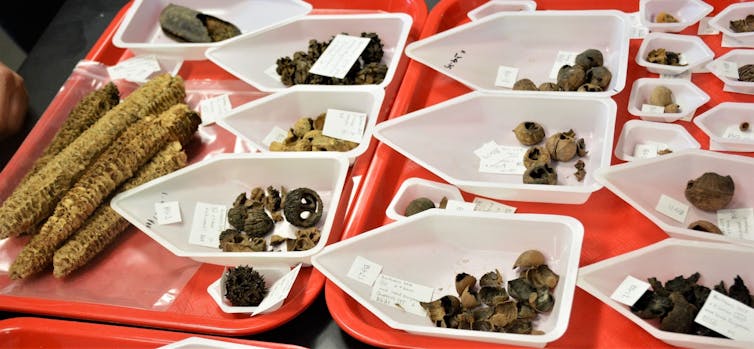
Materials from the rat nest in the process of being sorted by the author, including hickory, walnuts, acorns, corn and peanuts.
Alexandria Mitchem Hansen, CC BY-NC-SA

By studying the plants foraged by these rats, I learned not only about the important scientific and commercial plants in the garden, but also about the food and medicine the family were eating and using, including imported snacks such as peanuts and Brazil nuts, which were not grown in the garden but could have been purchased in Philadelphia.

Sorting 11 pounds of material

I am an archaeobotanist, which means I recover and identify plants from the past.

Over the course of almost three years, I sorted through over 11 pounds (5 kilograms) of material from the rat nest recovered from the Bartrams’ home and stored at the Center for the Analysis of Archaeological Materials at the Penn Museum.

Because there is often a lot of material, archaeologists divide these kinds of samples using geological sieves, which are scientific screening tools that filter samples by size. This makes the material easier to sort.

Then I used a microscope to sort and identify the plants therein. Archaeobotanists find various parts of plants, including seeds, chaff, fruit pits, nutshells and cobs. The plants I identified ranged in size from whole corncobs to weed seeds smaller than half a millimeter.

To identify the species of plants, I used reference manuals, comparative collections of plant seeds and other parts, and help from the archaeobotanists at the Penn Museum. I also studied images from herbaria, which are collections of historic plants that have been preserved and archived.

In the future, I plan to focus on the weedy plants recovered from the rat nest. The majority of invasive species in the United States were originally introduced in horticultural contexts, including botanic gardens and nurseries. Data from Bartram’s Garden will help me and other scholars better understand the timing and details of this process.

Read more of our stories about Philadelphia, or sign up for our Philadelphia newsletter on Substack.

The Conversation

Alexandria Mitchem Hansen receives funding from the McNeil Center for Early American Studies, the American Philosophical Society, the Explorer’s Club, the Society for Historical Archaeology, the Society for Ethnobiology, and Columbia University.

ref. I study rat nests − here’s why rodents make great archivists – https://theconversation.com/i-study-rat-nests-heres-why-rodents-make-great-archivists-270357

People are getting their news from AI – and it’s altering their views

Source: The Conversation – USA – By Adrian Kuenzler, Scholar-in-Residence, University of Denver; University of Hong Kong

When a bot brings you the news, who built it and how it presents the information matter. Zentangle/iStock via Getty Images

Meta’s decision to end its professional fact-checking program sparked a wave of criticism in the tech and media world. Critics warned that dropping expert oversight could erode trust and reliability in the digital information landscape, especially when profit-driven platforms are mostly left to police themselves.

What much of this debate has overlooked, however, is that today, AI large language models are increasingly used to write up news summaries, headlines and content that catch your attention long before traditional content moderation mechanisms can step in. The issue isn’t clear-cut cases of misinformation or harmful subject matter going unflagged in the absence of content moderation. What’s missing from the discussion is how ostensibly accurate information is selected, framed and emphasized in ways that can shape public perception.

Large language models gradually influence the way people form opinions by generating the information that chatbots and virtual assistants present to people over time. These models are now also being built into news sites, social media platforms and search services, making them the primary gateway to obtain information.

Studies show that large language models do more than simply pass along information. Their responses can subtly highlight certain viewpoints while minimizing others, often without users realizing it.

Communication bias

My colleague, computer scientist Stefan Schmid, and I, a technology law and policy scholar, show in a forthcoming accepted paper in the journal Communications of the ACM that large language models exhibit communication bias. We found that they may have a tendency to highlight particular perspectives while omitting or diminishing others. Such bias can influence how users think or feel, regardless of whether the information presented is true or false.

Empirical research over the past few years has produced benchmark datasets that correlate model outputs with party positions before and during elections. They reveal variations in how current large language models deal with public content. Depending on the persona or context used in prompting large language models, current models subtly tilt toward particular positions – even when factual accuracy remains intact.

These shifts point to an emerging form of persona-based steerability – a model’s tendency to align its tone and emphasis with the perceived expectations of the user. For instance, when a user describes themselves as an environmental activist and another as a business owner, a model may answer the same question about a new climate law by emphasizing different, yet factually accurate, concerns for each of them. For example, the criticisms could be that the law does not go far enough in promoting environmental benefits and that the law imposes regulatory burdens and compliance costs.

Such alignment can easily be misread as flattery. The phenomenon is called sycophancy: Models effectively tell users what they want to hear. But while sycophancy is a symptom of user-model interaction, communication bias runs deeper. It reflects disparities in who designs and builds these systems, what datasets they draw from and which incentives drive their refinement. When a handful of developers dominate the large language model market and their systems consistently present some viewpoints more favorably than others, small differences in model behavior can scale into significant distortions in public communication.

Bias in large language models starts with the data they’re trained on.

What regulation can and can’t do

Modern society increasingly relies on large language models as the primary interface between people and information. Governments worldwide have launched policies to address concerns over AI bias. For instance, the European Union’s AI Act and the Digital Services Act attempt to impose transparency and accountability. But neither is designed to address the nuanced issue of communication bias in AI outputs.

Proponents of AI regulation often cite neutral AI as a goal, but true neutrality is often unattainable. AI systems reflect the biases embedded in their data, training and design, and attempts to regulate such bias often end up trading one flavor of bias for another.

And communication bias is not just about accuracy – it is about content generation and framing. Imagine asking an AI system a question about a contentious piece of legislation. The model’s answer is not only shaped by facts, but also by how those facts are presented, which sources are highlighted and the tone and viewpoint it adopts.

This means that the root of the bias problem is not merely in addressing biased training data or skewed outputs, but in the market structures that shape technology design in the first place. When only a few large language models have access to information, the risk of communication bias grows. Apart from regulation, then, effective bias mitigation requires safeguarding competition, user-driven accountability and regulatory openness to different ways of building and offering large language models.

Most regulations so far aim at banning harmful outputs after the technology’s deployment, or forcing companies to run audits before launch. Our analysis shows that while prelaunch checks and post-deployment oversight may catch the most glaring errors, they may be less effective at addressing subtle communication bias that emerges through user interactions.

Beyond AI regulation

It is tempting to expect that regulation can eliminate all biases in AI systems. In some instances, these policies can be helpful, but they tend to fail to address a deeper issue: the incentives that determine the technologies that communicate information to the public.

Our findings clarify that a more lasting solution lies in fostering competition, transparency and meaningful user participation, enabling consumers to play an active role in how companies design, test and deploy large language models.

The reason these policies are important is that, ultimately, AI will not only influence the information we seek and the daily news we read, but it will also play a crucial part in shaping the kind of society we envision for the future.

The Conversation

Adrian Kuenzler does not work for, consult, own shares in or receive funding from any company or organization that would benefit from this article, and has disclosed no relevant affiliations beyond their academic appointment.

ref. People are getting their news from AI – and it’s altering their views – https://theconversation.com/people-are-getting-their-news-from-ai-and-its-altering-their-views-269354

The world risks forgetting one of humanity’s greatest triumphs as polio nears global eradication − 70 years after Jonas Salk developed the vaccine in a Pittsburgh lab

Source: The Conversation – USA (3) – By Carl Kurlander, Senior Lecturer, Film and Media Studies, University of Pittsburgh

Dr. Jonas Salk displays his polio vaccine, which he developed in a University of Pittsburgh laboratory.
Bettmann/Bettmann Collection via Getty Images

It was like a horror movie. The invisible polio virus would strike, leaving young children on crutches, in wheelchairs or in a dreaded “iron lung” ventilator. Each summer, the fear was so great that public pools and movie theaters closed. Parents canceled birthday parties, afraid their child might be the next victim. A U.S. president paralyzed by polio called for Americans to send dimes to the White House to support the nonprofit National Foundation for Infantile Paralysis, established by President Franklin D. Roosevelt and his lawyer, Basil O’Connor. Celebrities from Lucille Ball to Elvis were enlisted to promote this “March of Dimes,” and mothers went door to door raising funds to conquer this dreaded disease.

Some of those funds went to 33-year-old scientist Jonas Salk and his team at the University of Pittsburgh, where they worked in a lab between a morgue and a darkroom to develop the world’s first successful polio vaccine.

To prove it worked, the experimental vaccine was tested on Pittsburgh schoolchildren and then 1.8 million children from around the country as part of the largest medical field trial in history. On April 12, 1955, when the Salk polio vaccine was declared “safe and effective,” church bells rang out, kids were let out of school, and headlines around the world celebrated the victory over polio.

When asked whether he was going to patent the vaccine, Salk told journalist Edward R. Murrow it belonged to the people and would be like “patenting the sun.”

I first learned about this 20 years ago when my students and I filmed the 50th anniversary celebration of the Salk polio vaccine at the University of Pittsburgh. I had just started teaching after working in Los Angeles as a screenwriter and TV producer, and the footage became “The Shot Felt Round the World,” a documentary that featured those we met that day.

Black and white photo of nurse in white leaning over row of seated elementary school-aged children with sleeves rolled up
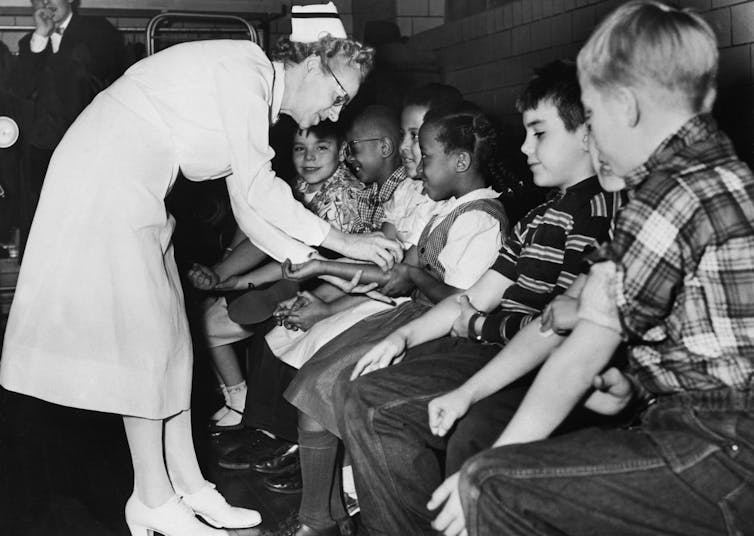
A nurse prepares children for a polio vaccine shot in February 1954 as part of a citywide testing of the vaccine on Pittsburgh elementary school students.
Bettmann/Bettmann Collection via Getty Images

The ‘Pittsburgh polio pioneers’

Among the people we interviewed was Ethyl “Mickey” Bailey, who worked in the lab pipetting the deadly polio virus by mouth, and Julius Youngner, the lab’s senior scientist who had worked on the Manhattan Project before coming to Pittsburgh. Within a decade, Youngner had worked on both the atomic bomb – which killed tens of thousands of people in just seconds in Hiroshima and Nagasaki, and hundreds of thousands more in the aftermath of the bombings – as well as the Salk vaccine, which spared millions from the scourge of “The Great Crippler.”

Three floors above the lab, Dr. Sidney Busis performed tracheotomies on 2-year-old iron lung patients, opening their windpipes so the ventilator could help them breath. The fierce Dr. Jesse Wright, an innovator in the field of rehabilitation sciences, ran the polio ward and she was also the medical director of the D.T. Watson Home for Crippled Children, where the Salk vaccine was first tested on humans. Polio victims like Jimmy Sarkett and Ron Flynn volunteered themselves as guinea pigs for a vaccine they knew would never benefit them.

Many “Pittsburgh polio pioneers,” as they called the local children who were given Salk’s still-experimental vaccine, in our documentary recalled getting the shot from Dr. Salk himself. Salk also gave it to his own children, including his eldest son Peter, then 10 years old, who later worked with his father on trying to develop an AIDS vaccine.

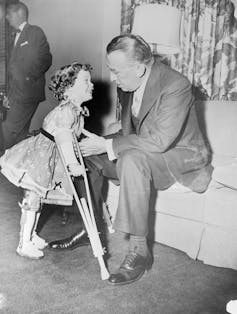
Young girl using crutches and leg braces smiles while walking to man in suit seated on a sofa
Kathy Dressel, a 3-year-old poster girl for the March of Dimes in Pennsylvania, smiles as she is greeted by Basil O’Connor, president of the National Foundation for Infantile Paralysis, in 1954.
Bettmann/Bettmann Collection via Getty Images

While Jonas Salk became the most famous scientist in the world, his relationship with the University of Pittsburgh became complicated and the administration rejected his plans for an institute. As a result, the Salk Institute for Biological Studies was built in 1963 on the coastline in La Jolla, California, where it fueled San Diego’s biotech industry.

Near the end of his life, Jonas would say sometimes he would run into people who didn’t know what polio was, and he found that gratifying. But today the world is paying a high price for those who don’t remember what life was like before these events and now question the value of vaccines. The polio virus may not be visible, but it is still with us.

The final mile to eradication

On Oct. 24, 2025, as the Salk vaccine turned 70, I was invited to screen the trailer for “The Shot Felt Round the World” at a World Polio Day event on Roosevelt Island in New York City, in a building next to the ruins of the Smallpox Hospital – a legacy of the only human disease ever eradicated.

Those present included the executive director of UNICEF, the polio director from the Gates Foundation, the U.N. representative for Rotary International, and government officials from around the world who spoke about the global coalition dedicated to eradicating this disease. Since the 1980s, the Global Polio Eradication Initiative has put tremendous resources into taking polio from being endemic in 125 countries to now just in two: Pakistan and Afghanistan. This group whom I like to call “The Avengers of Public Health,” continue to work relentlessly to make the world polio-free.

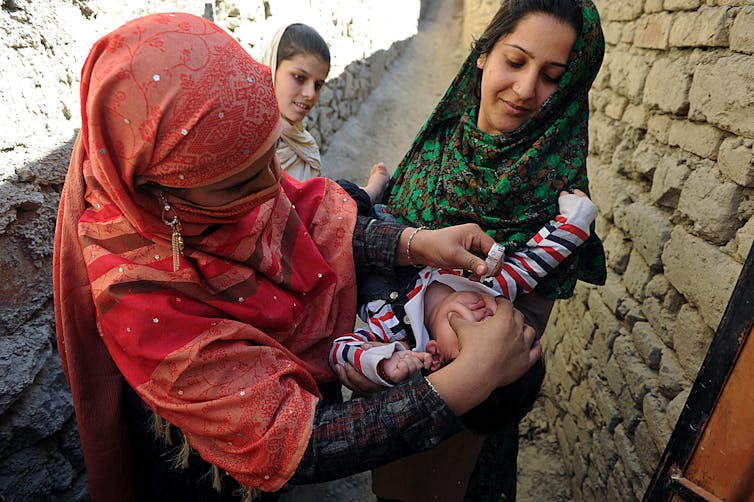
Woman in traditional Afghan dress tries to squeeze medical drops into mouth of a baby held in another woman's arms
An Afghan health worker administers polio vaccine to a child in Kabul in 2010. Afghanistan and Pakistan are the only two countries where polio has not yet been eradicated.
Shah Marai/AFP via Getty Images

My greatest fear is that when polio is finally defeated, the world won’t recognize what an extraordinary achievement it is. In our film, Dr. Jonathan Salk, Jonas Salk’s youngest son, recalls his father wondering whether the model that developed the polio vaccine could be used to conquer poverty and other social problems.

Many of the polio survivors we spoke to at the 50th anniversary are no longer with us. To ensure future generations know this story, perhaps now is the time to launch a “March of Dimes” marketing techniques to engage young people from around the world to help finish the job that began in the Salk lab in Pittsburgh.

One polio survivor who is still alive is “The Godfather” director Francis Ford Coppola, who has spoken about contracting polio as a child. Imagine him being interviewed by his granddaughter Romy Mars, a TikTok influencer, and his daughter Sophia Coppola, the film director and actress. They could make a video that features cameos from actor and comedian Bill Murray, who played Franklin D. Roosevelt in a movie and whose sister had polio, U.S. Senator Mitch McConnell, who is a polio survivor, and Secretary of State Marco Rubio, whose grandfather was crippled from polio. For such a cruel disease, polio has a strange way of bringing us together.

I pray when we finally wipe polio off the planet, a feat the Global Polio Eradication Initiative targets for 2029, the whole world will celebrate and realize the power of pulling together to defeat a common enemy.

Read more of our stories about Philadelphia and Pennsylvania, or sign up for our Philadelphia newsletter on Substack.

The Conversation

Carl Kurlander has previously received grants from the Grable Foundation, the Pittsburgh Foundation, and the R.K. Mellon Foundation years ago for the making of the polio movie. He receives no residuals or revenues from thef ilm.

ref. The world risks forgetting one of humanity’s greatest triumphs as polio nears global eradication − 70 years after Jonas Salk developed the vaccine in a Pittsburgh lab – https://theconversation.com/the-world-risks-forgetting-one-of-humanitys-greatest-triumphs-as-polio-nears-global-eradication-70-years-after-jonas-salk-developed-the-vaccine-in-a-pittsburgh-lab-270042