Seven of the best novels of 2025 – chosen by our literary experts

Source: The Conversation – UK – By Tessa Whitehouse, Reader in 18th-century Literature and Director of Queen Mary Centre for Religion and Literature, Queen Mary University of London

Reading is very subjective, but one thing most book lovers can agree on is that 2025 was a notable year for fresh, inventive, affecting storytelling. Books translated from their original language are proving increasingly popular as readers seek out global perspectives beyond their own, as evidenced in this year’s International Booker win, Heart Lamp by Banu Mushtaq, which is included here.

We also bring you five other novels our academic experts have chosen as their favourites this year. From a Mrs Dalloway for the service economy, to a dreamlike encounter between people across time, place and mortality, do our academic picks chime with yours?

Pick A Colour by Souvankham Thammavongsa

This slender little novel is both a reverie and a dash of icy water to the face that will make you think twice about tuning out from your surroundings next time you get a mani-pedi. We follow the owner of a low-price nail bar through a workday from turning on the fluorescent lights to pulling down the metal shutter.

In this Mrs Dalloway for the service economy, the painful intersections of the personal and the political are inescapable for the “Susans” (the name each employee must adopt), but as invisible as the workers themselves to many of their customers.

Slight in length, light in touch, full of humour, and closely observed, Pick A Colour can be read in a single, intense afternoon. But the troubling thoughts it raises through its memorable characters linger long after your Christmas nail polish has all chipped away.

Tessa Whitehouse is reader in English and director of Queen Mary Centre for Religion and Literature

Perfection by Vincenzo Latronico

Perfection is a curious sort of novel. There is no dialogue and almost no conflict between the two central characters, Anna and Tom, digital nomads who spend their days in Berlin designing websites and always appear together, almost like a single entity.

In a sequence of beautifully written, perfectly observed chapters, Latronico itemises and describes their apartment, their social media habits, their limited perspective on Berlin, their sex life, their futile attempts at meaningful political activism, their growing disillusionment and desire for relocation – the repetitive consumption and socially structured habits of a globalised lifestyle built around image and taste.

The result is a remarkably astute and compelling novel – social realism at its sharpest – as Latronico nails the manners of the millennial generation and that brief period of optimism, from 2006 to 2016, when we felt digital media might make a positive difference and lifestyle choices seemed imbued with an optimistic ethical resonance – soon shown to be hollow.

James Miller is a senior lecturer in creative writing and English literature

Old Soul by Susan Barker

At first, Barker’s novel seems a gorgeously written adaptation of one of my favourite gothic tropes: the vampire. The story opens with two strangers, Jake and Mariko, who meet at Osaka airport. They have both lost loved ones in strange and brutal circumstances but in common, each of the deceased encountered a mysterious, dark-haired woman just before their deaths. A woman who came looking for Mariko, and then disappeared.

As the plot advances, Barker takes familiar tropes and themes in unexpected directions, turning this novel into an unforgettable tale of cosmic horror. There is the terrifying lore of “the Tyrant”, different timelines and settings from Wales to New Mexico, not to mention a cast of unreliable narrators who become more vibrant, twisted and compelling as the novel advances. Ultimately, this is a story about our societal obsession with becoming famous and being seen – Barker’s novel goes a step further and asks: who gets to witness? Who gets to record? And for what purpose?

Inés Gregori Labarta is a lecturer in creative writing

Big Kiss, Bye-Bye by Claire-Louise Bennett

There is no shortage of contemporary novels with first-person narrators who are women, often writers, struggling to keep themselves together in the face of late capitalism, the internet and the patriarchy. Claire-Louise Bennett’s Big Kiss, Bye-Bye is narrated by a woman, a writer, but beyond that, all similarities to other works in this category disappear.

The narrator’s interior world is made up of thoughts about and responses to others – her friend and ex-lover Xavier, her old schoolteacher with whom she had a relationship as a teenager, and another old schoolteacher who has recently emailed her.

It is a novel of extraordinary noticing, but it is a noticing that has such rhythm and intensity that it enters your very bones as you read. It is as unrepeatable as a dream, and like a dream stays with you way beyond the ability of words to account for it.

Leigh Wilson is a professor of English literature

We Do Not Part by Han Kang

The English translation of We Do Not Part followed Han Kang’s 2024 Nobel Prize in Literature. Her earlier Greek Lessons (2011, translated into English 2023) considered loss of sight and speech through the arresting metaphor of burial in snow.

We Do Not Part reconsiders this metaphor, employing the destructive and creative force of a snowstorm to convey the danger of lost histories. Kyungha reluctantly agrees to house sit and look after the much-loved pet bird of her sick friend, Inseon, and travels in snow and darkness to reach her rural cabin.

The novel is at once a dreamlike encounter between people across time, place, and mortality; a recollection of the women’s friendship and childhoods; a personal history of the impact of the 1948-49 Jeju massacre (an intense period of anti-communist violence and suppression that resulted in thousands of deaths); and a portrait of the rural South Korean landscape in bleak winter. The prose is crisp and poetic, the dialogue sparse, and the protagonist introspective and self-questioning. An intelligent, graceful, bruising novel and an encounter with the rural and the local.

Jenni Ramone is an associate professor of postcolonial and global literatures

Dream Count by Chimamanda Ngozi Adichie

At a time when many literary novels are becoming shorter and increasingly opaque, the luminous Dream Count – Adichie’s first novel in a decade – bucks the trend. Expansive and richly detailed, it follows the lives of four African women, moving fluidly between the US and Nigeria.

Set at the onset of the Covid pandemic, the pause in ordinary life creates space for the women to reflect and dream, deepening the novel’s engagement with memory and personal history alongside its comparative exploration of women’s experiences in different parts of the world.

Like many recent novels, films, and television series (Conversations with Friends; Girl, Woman, Other; Derry Girls), the women here both contrast and complement one another, offering nuanced insight into what it means to be Black and female and with varying degrees of privilege.

The novel skilfully intertwines universal aspects of the female experience, such as cultural pressure to marry and produce children, with a post-#MeToo focus on sexual violence rooted in stark racial and gendered power inequalities.

Roberta Garrett is a Senior Lecturer in Literature and Cultural Studies

Heart Lamp by Banu Mushtaq

Delicately woven over a period of 33 years, this collection of 12 short stories comes from the heart of the Muslim community in southern India. Rendered nearly invisible in the nation’s literary imagination despite its substantial presence, Heart Lamp offers a necessary intervention into the silences of Indian Muslim women’s interior lives.

It maps the emotional landscapes and the intricate layers of marginalisation through caste, class and gender expectations embracing the politics of location. Mushtaq, an activist, inevitably represents Karnataka’s “Bandaya Sahitya” (Rebel Literature) movement, rooted in anti-caste, feminist and secular traditions.

The stories juxtapose modern India’s patriarchal structures with the obscured lives of women through literal and metaphorical veils where pain, suffering, injustice are critiqued through razor sharp realism mingled with sentimentality and humour. Deepa Bhasthi’s translation performs its own quiet rebellion, refusing to italicise Kannada words or append footnotes.

Prathiksha Betala is a PhD researcher in contemporary feminist dystopian fiction

This article features references to books that have been included for editorial reasons, and may contain links to bookshop.org; if you click on one of the links and go on to buy something, The Conversation UK may earn a commission.


Looking for something good? Cut through the noise with a carefully curated selection of the latest releases, live events and exhibitions, straight to your inbox every fortnight, on Fridays. Sign up here.


The Conversation

The authors do not work for, consult, own shares in or receive funding from any company or organisation that would benefit from this article, and have disclosed no relevant affiliations beyond their academic appointment.

ref. Seven of the best novels of 2025 – chosen by our literary experts – https://theconversation.com/seven-of-the-best-novels-of-2025-chosen-by-our-literary-experts-271885

En 2025, voici comment l’inflation a fragilisé la stabilité politique et sapé les fondements moraux de notre société

Source: The Conversation – in French – By Mircea Vultur, Professeur titulaire et chercheur en sociéconomie du travail et de la formation, Institut national de la recherche scientifique (INRS)

Depuis quelques années, le coût de la vie ne cesse d’augmenter. Nourriture, essence, logement : tout semble plus cher, et l’inflation dépasse les simples chiffres économiques. Elle réduit le pouvoir d’achat, brouille les signaux du marché et fragilise la confiance dans l’État, transformant une hausse des prix en véritable enjeu social et politique.

Selon la définition la plus répandue aujourd’hui, l’inflation est une hausse soutenue du niveau de prix. On la mesure par l’évolution d’un indice du prix à la consommation (IPC), calculé à partir des prix de marché d’un certain nombre de biens de consommation censés être représentatifs des habitudes de consommation de la population.

Au Canada, l’inflation est restée modérée jusqu’au début des années 2020. La pandémie de Covid-19 l’a fait chuter temporairement, avant un rebond marqué en 2021‑2022, atteignant son plus haut niveau depuis 40 ans. Depuis, elle redescend progressivement, mais reste au-dessus de la moyenne observée avant la crise, autour de 2,4 % en septembre 2025, selon Statistique Canada.

Après deux décennies de stabilité autour de 2 %, le choc inflationniste de 2021‑2023, et les risques qui subsistent, ne se limitent pas à un phénomène économique : l’inflation devient une véritable pathologie sociale, puisqu’elle affecte directement la société. Son caractère destructeur dépasse la simple hausse des prix : elle réduit le pouvoir d’achat, influence les comportements d’épargne, modifie les stratégies d’investissement et façonne la perception que les citoyens ont de l’État et des institutions financières.

À cet égard, l’inflation agit comme un révélateur. Lorsque les prix s’emballent, les fragilités économiques, institutionnelles et psychologiques d’une société apparaissent au grand jour. Ainsi, la hausse du prix du logement a transformé une donnée économique en source de stress, de renoncements et parfois d’instabilité sociale. On le voit aussi lorsque les consommateurs se précipitent pour acheter avant une nouvelle hausse de prix. Ces comportements collectifs, motivés par la peur, illustrent comment l’inflation trouble les repères sociaux.


À lire aussi :
L’inflation est en baisse, alors pourquoi le prix du panier d’épicerie continue-t-il d’augmenter ?


Une érosion silencieuse du contrat social

L’inflation agit comme une « taxe furtive » qui contourne le débat démocratique. Elle réduit le pouvoir d’achat de tous sans débat parlementaire ni avis officiel. Contrairement aux taxes « visibles » qui doivent être adoptées, argumentées et justifiées, l’inflation agit dans l’ombre. Une hausse généralisée des prix de 10 % réduit la valeur réelle de chaque dollar de 10 %, même pour ceux qui n’ont rien consommé. Aucun reçu, aucun document officiel ne signale cette perte. On se réveille un bon matin simplement moins riche.

L’inflation agit comme une redistribution invisible de richesses, mais de façon arbitraire. Certains en bénéficient, d’autres en pâtissent. Les emprunteurs y gagnent, car leurs dettes perdant de la valeur réelle, tandis que les épargnants prudents y perdent. Les actifs réels deviennent des refuges, tandis que les salaires fixes et les retraites non indexées s’érodent. Cette redistribution chaotique crée un sentiment d’injustice et dévalorise l’effort, l’épargne et la prudence.

Des signaux économiques brouillés

Dans une économie de marché, les prix servent de signal : ils indiquent si un bien est rare, très demandé ou coûteux à produire, et guident les décisions d’investissement. L’inflation brouille ces signaux. Par exemple, si le prix des loyers à Montréal augmente fortement, certains promoteurs pourraient croire que la demande est énorme et construire de nouveaux appartements, alors qu’en réalité, cette hausse reflète surtout la pression générale des prix et le coût croissant des matériaux.

Quand les prix ne reflètent plus la réalité de la demande, les investissements peuvent être mal orientés et les ressources gaspillées.

Par ailleurs, l’incertitude inflationniste décourage l’épargne et pousse les entreprises vers des stratégies court-termistes. Une société qui peine à se projeter dans l’avenir investit moins dans l’innovation, les infrastructures ou la formation, ce qui freine sa croissance économique et compromet son développement à long terme.

Méfiance de l’État et résurgence des tensions politiques

La monnaie repose sur un pacte implicite entre les citoyens et l’État : un dollar gagné aujourd’hui doit permettre une consommation quasi équivalente demain. Lorsque ce pacte est rompu, la confiance s’effrite et l’État apparaît de moins en moins comme l’agent des citoyens, mais plutôt comme un maître indigne de confiance.

Dans ce contexte, les épisodes d’inflation forte coïncident souvent avec des tensions politiques : mouvements de protestation, contestation de la classe politique, polarisation sociale, montée du populisme comme réponse. Au Canada, des appels de boycottage de supermarchés ont émergé face à la flambée des prix alimentaires, tandis que la crise du logement a entraîné des pressions pour imposer des gels et plafonds de loyers. En Argentine, l’inflation chronique alimente la défiance envers les institutions, provoque des alternances politiques brusques et renforce l’attrait pour les solutions populistes. Avec les prix de l’épicerie, du logement et de l’essence en tête, la frustration économique se transforme rapidement en colère politique.


À lire aussi :
Insécurité alimentaire : au-delà du prix des aliments, il faut s’attaquer aux obstacles systémiques


Le rôle central de la politique monétaire

Pour les économistes de l’école autrichienne, l’inflation provient d’une augmentation trop rapide de la quantité d’argent en circulation par rapport à la production réelle. Dans la perspective de l’École de Chicago, elle est toujours un phénomène monétaire : les gouvernements utilisent parfois l’impression de monnaie pour financer des dépenses, repoussant les problèmes économiques plutôt que de les résoudre directement.

L’économiste Milton Friedman comparait l’inflation à l’alcoolisme : les effets bénéfiques apparaissent d’abord, mais les conséquences négatives arrivent plus tard, et la tentation d’en faire trop est forte.

Déficits publics financés par création monétaire, banques centrales trop accommodantes et volonté politique d’alléger la dette sont des moteurs classiques de l’inflation. La solution ? Empêcher les gouvernements d’utiliser la création monétaire comme levier politique. La réforme de 1991 illustre ce principe : l’indépendance accrue de la Banque du Canada et un mandat clair de contrôle de l’inflation ont permis de maintenir durablement les prix à des niveaux bas et stables.

Dans cette perspective, il est essentiel de garantir l’indépendance des banques centrales pour les protéger des pressions politiques, d’imposer des limites strictes aux déficits publics et d’assurer une transparence totale de la politique monétaire. Pour les économistes « autrichiens » comme pour Friedman, la stabilité monétaire est la condition sine qua non de toute stabilité économique et sociale.

Qualifier l’inflation de « pathologie sociale » n’est pas exagéré. Elle érode la confiance, bouleverse l’équité, fausse l’allocation des ressources et fragilise la stabilité politique, sapant les fondements moraux d’une société. L’expansion monétaire qui la provoque est une fuite en avant, un culte du compromis, repoussant les problèmes vers les générations futures. Le choc récent et les tendances actuelles rappellent que même nos sociétés industrielles avancées restent vulnérables. Comprendre l’inflation et ses effets sociaux aide à en mesurer la portée et à mieux s’y préparer.

La Conversation Canada

Mircea Vultur ne travaille pas, ne conseille pas, ne possède pas de parts, ne reçoit pas de fonds d’une organisation qui pourrait tirer profit de cet article, et n’a déclaré aucune autre affiliation que son organisme de recherche.

ref. En 2025, voici comment l’inflation a fragilisé la stabilité politique et sapé les fondements moraux de notre société – https://theconversation.com/en-2025-voici-comment-linflation-a-fragilise-la-stabilite-politique-et-sape-les-fondements-moraux-de-notre-societe-271057

No, your brain doesn’t suddenly ‘fully develop’ at 25. Here’s what the neuroscience actually shows

Source: The Conversation – Canada – By Taylor Snowden, Post-Doctoral Fellow, Neuroscience, Université de Montréal

If you scroll through TikTok or Instagram long enough, you’ll inevitably stumble across the line: “Your frontal lobe isn’t fully developed yet.” It’s become neuroscience’s go-to explanation for bad decisions, like ordering an extra drink at the bar or texting an ex you swore not to.

The frontal lobe plays a central role in higher level functions like planning, decision-making and judgment.

It’s easy to find comfort in the idea that there’s a biological excuse for why we sometimes feel unstable, impulsive or like a work in progress. Life in your 20s and early 30s is unpredictable, and the idea that your brain simply isn’t done developing can be oddly reassuring.

But the idea that the brain, particularly the frontal lobe, stops developing at 25 is a pervasive misconception in psychology and neuroscience. Like many myths, the “age 25” idea is rooted in real scientific findings, but it’s an oversimplification of a much longer and more complex process.

In reality, new research suggests this development actually extends into our 30s. This new understanding changes how we view adulthood and suggests that 25 was never meant to be the finish line in the first place.


No one’s 20s and 30s look the same. You might be saving for a mortgage or just struggling to pay rent. You could be swiping dating apps, or trying to understand childcare. No matter your current challenges, our Quarter Life series has articles to share in the group chat, or just to remind you that you’re not alone.

Read more from Quarter Life:


Where did the ‘age 25’ myth come from?

The magic number stems from brain imaging studies in the late 1990s and early 2000s. In one 1999 tudy, researchers tracked brain changes through repeated scans in children and teens. They analyzed grey matter, which consists of cell bodies and can be thought of as the “thinking” component of the brain.

Researchers found that during the teenage years, grey matter goes through a process called pruning. Early in life, the brain builds an enormous number of neural connections. As we age, it gradually trims back the ones that are used less often, strengthening those that remain.

This early work highlighted that grey matter volume growth and loss is key for brain development.

In influential follow-up work led by neuroscientist Nitin Gogtay, participants as young as four had their brains scanned every two years. The researchers found that within the frontal lobe, regions mature from back to front.

More primal regions, like areas responsible for voluntary muscle movement, develop first, while more advanced regions that are important for decision-making, emotional regulation and social behaviour had not fully matured by the final brain scans around age 20.

Since the data stopped at age 20, researchers couldn’t say precisely when development finished. The age of 25 became the best estimation for the assumed endpoint, and eventually became enshrined in the cultural consciousness.

What newer research reveals

Since those early studies, neuroscience has moved on considerably. Rather than looking at individual regions in isolation, researchers now study how efficiently different parts of the brain communicate with one another.

A recent major study assessed efficiency of brain networks, essentially how the brain is wired, through white matter topology. White matter is made up of long nerve fibres that link different parts of the brain and spinal cord, allowing electrical signals to travel back and forth.

Researchers analyzed scans from more than 4,200 people from infancy to 90 years old and found several key periods of development including one from age nine to 32, which they coined the “adolescent” period.

For anyone well into adulthood, it may feel jarring to be told that your brain is still an “adolescent,” but this term really just signifies that your brain is in a stage of key changes.

Based on this study, it seems that during brain adolescence, the brain is balancing two key processes: segregation and integration. Segregation involves building neighbourhoods of related thoughts. Integration involves building highways to connect those neighbourhoods. The research suggests this construction doesn’t stabilize into an “adult” pattern until the early 30s.

The study also found that “small worldness” (a measure of network efficiency) was the largest predictor for identifying brain age in this group. Think of this like a transit system. Some routes require stops and transfers. Increasing “small worldness” is like adding express lanes. Essentially, more complex thoughts now have more efficient paths throughout the brain.

However, this construction doesn’t last forever. After around the age of 32, there is a literal turning point where these developmental trends switch directions. The brain stops prioritizing these “expressways” and shifts back to segregation to lock in the pathways our brains use most.

In other words, your teens and 20s are spent connecting the brain, and your 30s are about settling down and maintaining your most used routes.

Making the most of a brain under construction

If our brains are still under construction throughout our 20s, how do we make sure we are building the best possible structure? One answer lies in boosting neuroplasticity — the brain’s ability to rewire itself.


Read more:
What is brain plasticity and why is it so important?


While the brain remains changeable throughout life, the window from age nine to 32 represents a prime opportunity for structural growth. Research suggests there are many ways to support neuroplasticity.

High-intensity aerobic exercise, learning new languages and taking on cognitively demanding hobbies like chess can bolster your brain’s neuroplastic abilities, while things like chronic stress can hinder it. If you want a high-performance brain in your 30s, it helps to challenge it in your 20s, but it’s never too late to start.

There is no magical switch that turns on at age 25, or even 32 for that matter. Like your brain, you’re in a decades-long construction project. Stop waiting for the moment you become an adult and start making active choices about how to support this project. Make mistakes, but know that the concrete hasn’t set quite yet.

The Conversation

Taylor Snowden does not work for, consult, own shares in or receive funding from any company or organisation that would benefit from this article, and has disclosed no relevant affiliations beyond their academic appointment.

ref. No, your brain doesn’t suddenly ‘fully develop’ at 25. Here’s what the neuroscience actually shows – https://theconversation.com/no-your-brain-doesnt-suddenly-fully-develop-at-25-heres-what-the-neuroscience-actually-shows-271826

How can Canada become a global AI powerhouse? By investing in mathematics

Source: The Conversation – Canada – By Deanna Needell, Professor of Mathematics, UBC. Co-Director Programs, Pacific Institute for the Mathematical Sciences, University of British Columbia

This AI-generated illustration is an example of how AI is at our fingertips. But mathematics lies at the heart of AI, and investment in these mathematical foundations will help Canada become a true global AI leader. (Adobe Stock), FAL

Artificial intelligence is everywhere. In fact, each reader of this article could have multiple AI apps operating on the very device displaying this piece. The image at the top of this article is also generated by AI.

Despite this, many mechanisms governing AI behaviour remain poorly understood, even to top AI experts. This leads to an AI race built upon costly scaling, both environmentally and financially, that is also dangerously unreliable.

Progress therefore depends not on escalating this race, but on understanding the principles underpinning AI. Mathematics lies at the heart of AI and investment in these mathematical foundations is the critical key to becoming a true global AI leader.

How AI shapes daily life

AI has rapidly become part of everyday life, not only in talking home devices and fun social media generation, but also in ways so seamless that many people don’t even notice its presence.

It provides the recommendations we see when browsing online and quietly optimizes everything from transit routes to home energy use.

Critical services rely on AI because it’s used in medical diagnosis, banking fraud detection, drug discovery, criminal sentencing, governmental services and health predictions, all areas where inaccurate outputs may have devastating consequences.

Problems, issues

Despite AI’s widespread use, serious and widely documented issues continue to showcase concerns around fairness, reliability and sustainability. Biases embedded in data and models can propagate discriminatory outcomes, from facial detection methods that perform well only on light skin tones to predictive tools that systematically disadvantage underrepresented groups.


Read more:
Beyond bias: Equity, diversity and inclusion must drive AI implementation in the workplace


These failures continue to be reported and range from racist outputs of ChatGPT and other chatbots to imaging tools that misidentify Barack Obama as white and biased criminal sentencing algorithms.

At the same time, the environmental and financial costs of deploying large-scale AI systems are growing at an extremely rapid pace.

If this trajectory continues, it will not only prove environmentally unsustainable, it will also concentrate access to these powerful AI tools to a few wealthy and influential entities with access to vast capital and massive infrastructure.

Why mathematics?

To address issues with a system, whether it’s fixing a car or ensuring reliability in an AI system, it’s crucial to understand how it works. A mechanic cannot fix or even diagnose why a car isn’t operating correctly without understanding how the engine works.

The “engine” for AI is mathematics. In the 1950s, scientists used ideas from logic and probability to teach computers how to make simple decisions. As technology advanced, so did the math, and tools from optimization, linear algebra, geometry, statistics and other mathematical disciplines became the backbone of what are now modern AI systems.

These methods are certainly modelled after aspects of the human brain, but despite the nomenclature of “neural networks” and “machine learning,” these systems are essentially giant math engines that carry out vast amounts of mathematical operations with parameters that were optimized using massive amounts of data.

This means improving AI is not just about continuously building bigger computers and using more data; it’s about deepening our understanding of the complex math that governs these systems. By recognizing how fundamentally mathematical AI really is, we can improve its fairness, reliability and sustainable scalability as it becomes an even larger part of everyday life.

Canada’s path forward

So what should Canada do next? Invest in the parts of AI that turn power into dependability. That means funding the science that makes AI systems predictable, auditable and efficient, so hospitals, banks, utilities and public agencies can adopt AI with confidence.

This is not a call for bigger servers; it’s a call for better science, where mathematics is the core scientific engine.

Canada already has a national platform to advance this work: the mathematical sciences institutes the (Pacific Institute for the Mathematical Sciences, Fields Institute for Research in Mathematical Sciences, The Centre de recherches mathématiques, Atlantic Association for Research in the Mathematical Sciences, Banff International Research Station connect researchers across provinces and disciplines, convene collaborative programs and link academia with the public sector.

Together with Canada’s AI institutes (Mila, Vector, Amii) and CIFAR, this ecosystem strengthens both foundational and translational AI nationwide.

Canada’s standing in AI was built on decades of foundational research, work that preceded today’s large models and made them possible. Reinforcing that foundation would allow Canada to lead the next stage of AI development: models that are efficient rather than wasteful, transparent rather than opaque and trustworthy rather than brittle. Investing in mathematical research is not only scientifically essential, it is strategically wise and will strengthen national sovereignty.

The payoff is straightforward: AI that costs less to run, fails less often and earns more public trust. Canada can lead here, not by winning a computing power arms race, but by setting the scientific bar for how AI should work when lives, livelihoods and public resources are at stake.

The Conversation

Deanna Needell has received funding from the National Science Foundation and the Congressionally Directed Medical Research Programs (US).

Kristine Bauer receives funding from NSERC to support her research program in pure mathematics. She is affiliated with the Pacific Institute for the Mathematical Sciences.

Ozgur Yilmaz receives funding from NSERC and PIMS.

ref. How can Canada become a global AI powerhouse? By investing in mathematics – https://theconversation.com/how-can-canada-become-a-global-ai-powerhouse-by-investing-in-mathematics-271796

¿Cómo saber que un juguete no tiene tóxicos peligrosos, como plomo, retardantes de llama o ftalatos?

Source: The Conversation – (in Spanish) – By Álvaro Carmona, Coordinador académico & docente, Universidad Loyola Andalucía

tamara govedarovic OyhnXuXu Kc unsplash Tamara Govedarovic / Unsplash. , CC BY-NC-SA

El sistema europeo Safety Gate, que vigila productos peligrosos, registró en 2024 un récord histórico: 4 137 alertas desde que existe el sistema en 2003. Los juguetes fueron la segunda categoría más problemática con 609 avisos, el 15 % del total. China apareció como origen del 40 % de todas las alertas.

Pero ojo con las interpretaciones rápidas. La mayor parte de las alertas en juguetes (39 %) no tienen que ver con química peligrosa, sino con riesgo de asfixia por piezas pequeñas. Los problemas químicos vienen después: 122 avisos por ftalatos excesivos, 68 por boro y 58 por plomo.

¿Todos los juguetes chinos son peligrosos?

¿Significa eso que todos los juguetes chinos son peligrosos? No necesariamente. Un estudio científico nigeriano analizó 30 juguetes fabricados en China y encontró que todos cumplían los límites europeos para plomo, cadmio y arsénico, sin riesgo significativo para los niños. Pero estudios en Europa encuentran otra realidad: investigaciones en mercados europeos sí detectan problemas frecuentes.

La diferencia está en el canal de distribución. Los juguetes que llegan a través de importadores serios y tiendas establecidas suelen pasar controles. El problema gordo está en las plataformas online de bajo coste. En octubre de 2024, Safety Gate retiró varios juguetes de Temu por no incluir ni siquiera las advertencias de edad obligatorias.

Metales pesados: el enemigo conocido

El plomo es probablemente el contaminante más estudiado en juguetes. La Autoridad Europea de Seguridad Alimentaria (EFSA) es tajante: no existe nivel seguro para sus efectos sobre el cerebro infantil en desarrollo. El Instituto Federal Alemán de Evaluación de Riesgos (BfR) documentó que chupar o mordisquear juguetes puede aportar hasta el 50 % de la exposición al plomo que un niño recibe por los alimentos.

Con el cadmio pasa algo parecido, pues se acumula en el organismo, daña los riñones y los juguetes pueden contribuir hasta un 20 % de la exposición total.

Ftalatos: una amenaza en los plásticos blanditos

Esos juguetes de plástico suave y flexible que tanto les gustan a los bebés suelen contener ftalatos, sustancias químicas que dan flexibilidad al plástico. El problema es que son disruptores endocrinos con capacidad de afectar al correcto funcionamiento de las hormonas.

Un análisis del laboratorio QIMA encontró que aproximadamente el 25 % de los juguetes de plástico de China no cumplían con la normativa europea. En un caso extremo, un botiquín de juguete superaba 130 veces el límite permitido.

Y hay un dato inquietante sobre España: según el proyecto europeo de biomonitorización humana DEMOCOPHES, los niños españoles tienen niveles de MEP (monoetil ftalato, un metabolito de ftalatos) seis veces superiores a la media europea.

El problema que nadie esperaba: plástico reciclado tóxico

Aquí viene lo sorprendente. Un estudio europeo de 2024 descubrió que juguetes nuevos hechos con plástico reciclado contienen retardantes de llama bromados, sustancias tóxicas que vienen de residuos electrónicos viejos. De 84 juguetes analizados en mercados europeos, 11 superaban los límites legales, con concentraciones hasta de 23,5 mg/g.

Estos compuestos están en el Convenio de Estocolmo como contaminantes persistentes ultra-peligrosos. Son disruptores endocrinos, afectan la tiroides y la neurotoxicidad. Como señalan los investigadores: “al sistema endocrino de un niño no le importa si el juguete está hecho de plástico nuevo o reciclado”.

Europa aprieta las tuercas (por fin)

En noviembre de 2024, el Parlamento Europeo aprobó nuevas normas que entrarán en vigor progresivamente. Los cambios son sustanciales e implican, para empezar, pasaportes digitales obligatorios para todos los juguetes, un punto clave para el control del comercio online.

Además, incluyen la prohibición total de disruptores endocrinos de categorías 1 y 2, la prohibición de PFAS (los “químicos eternos”), restricción de 10 tipos de bisfenoles peligrosos y límite de bisfenol A reducido un 87,5 %: de 0,04 a 0,005 mg/L.

Ojo con los juguetes antiguos

Un estudio sueco de 157 juguetes encontró que el 84 % de los antiguos superaban los límites legales actuales (frente al 30 % de los nuevos). En pelotas viejas encontraron ftalatos al 40 % del peso total: 400 veces el límite legal.

Este dato plantea un dilema: ¿es buena idea heredar o comprar juguetes de segunda mano? Para bebés que se lo llevan todo a la boca, quizá no tanto.

Qué hacer como padres

España emitió solo 22 alertas en 2024, situándose en el puesto 24 de 27 países europeos. Polonia emitió 549 y Alemania 501. O los juguetes en España son milagrosamente seguros, o no estamos vigilando lo suficiente.

Para proteger a los niños, conviene actuar sin alarmismos, pero con sentido común:

-Desconfíe del precio ridículamente bajo, especialmente en plataformas online. Un juguete que cuesta tres veces menos que la competencia probablemente se ha saltado controles.

-Para bebés y niños pequeños que se lo llevan todo a la boca: priorice marcas reconocidas y juguetes con certificación clara. El marcado CE es obligatorio, pero compruebe que no sea falso.

-Cuidado con juguetes muy antiguos para menores de 3 años. Los fabricados antes de 2009 pueden contener sustancias prohibidas hoy.

Evite plásticos negros reciclados en juguetes para bebés: los estudios los asocian con mayores niveles de retardantes de llama tóxicos.

Priorice materiales nobles: madera sin tratar, algodón orgánico, acero inoxidable.

La ciencia deja claro que hay riesgos reales, pero manejables. La mayoría de juguetes en el mercado regulado son seguros, aunque existe una minoría problemática. Europa está endureciendo las normas, lo cual es buena noticia. Hasta que los controles sean más efectivos –especialmente online–, un poco de escepticismo sano no viene mal.

The Conversation

Álvaro Carmona no recibe salario, ni ejerce labores de consultoría, ni posee acciones, ni recibe financiación de ninguna compañía u organización que pueda obtener beneficio de este artículo, y ha declarado carecer de vínculos relevantes más allá del cargo académico citado.

ref. ¿Cómo saber que un juguete no tiene tóxicos peligrosos, como plomo, retardantes de llama o ftalatos? – https://theconversation.com/como-saber-que-un-juguete-no-tiene-toxicos-peligrosos-como-plomo-retardantes-de-llama-o-ftalatos-272294

China’s durian craze has turned this tropical fruit into a tool of diplomacy

Source: The Conversation – UK – By Ming Gao, Research Fellow of East Asia Studies, Lund University

Durian is a tropical fruit from south-east Asia that is known for its intensely strong and pungent odour. passkphoto / Shutterstock

Distinctive in taste and famously divisive, durian is not everyone’s choice of fruit. This was certainly the case for some Chinese explorers when they first encountered it during the Ming Dynasty’s early maritime voyages.

One record dates back to 1413, when a translator called Ma Huan travelled to what is now Malaysia on a trip with diplomat and admiral Zheng He. In his travelogue, Ma described durian as a “stinky fruit” that smelled like “rotten beef”.

But fast forward six centuries and this tropical fruit has settled into Chinese daily life. China is now the world’s top importer of durian, accounting for around 95% of global demand. Its imports surged to a record high of nearly US$7 billion (£5.2 billion) in 2024.

Such is the popularity of durian in China that governments across south-east Asia, where most of the world’s durian is produced, are using its export as a tool of political and economic influence.

For years, gifting top-quality durians to Chinese officials has been one way south-east Asian governments have sought to cultivate goodwill. On a visit to Beijing in 1975, for example, former Thai prime minister Kukrit Pramoj gifted 200 durians to Chinese leaders.

More recently, in 2024, Malaysia’s King Ibrahim offered Chinese president Xi Jinping two boxes of premium durians during a state visit. This included the prized Musang King, a variety that is often referred to in China as the “Hermès of durians” – a nod to the exclusive Hermès fashion brand, which is known in China for extreme prestige.

The Chinese premier, Li Qiang, and Malaysia’s prime minister, Anwar Ibrahim, had also been filmed earlier that year sat together tackling a durian with a knife and spoon. The traditional way to eat a durian is to open the fruit and consume the flesh by hand.

However, durian is more than just a symbol of friendship between south-east Asian states and Beijing. China’s massive demand for durians has boosted domestic economic growth across the region, turning some previously poor agricultural areas into sites of prosperity.

According to Eric Chan, a Malaysian durian farmer who was interviewed by the New York Times in 2024, revenue from durian sales to China has transformed his town. Chan said durian farmers there have been able to rebuild their houses from “wood to brick” and can now “afford to send their children overseas for university”.

South-east Asian countries have also used China’s appetite for durian to strengthen their economic relationships with Beijing. Vietnamese durian exports, for instance, have been credited with opening access to the Chinese market for other domestically produced agricultural goods.

And Malaysia’s deputy prime minister, Ahmad Zahid Hamidi, has openly announced that he sees durian exports as a way to secure follow-up Chinese investments. “Durian diplomacy is not just diplomacy – it is durian business,” said Hamidi in November. “We need to work with Chinese businessmen to further develop Musang King plantations in Malaysia, and we should also strengthen downstream industries together.”

Food silk road

For China, the durian trade is part of a broader strategy. Since taking power in 2013, Xi has repeatedly stressed that his country must safeguard its food security. Researchers describe the resulting approach as a “food silk road”, an emerging network of investments and trade agreements designed to diversify China’s food imports across many regions of the world.

Durian from south-east Asian countries is thus one part of a much wider flow. New Zealand exports most of its premium gold kiwifruit to China, with the Chinese market an equally important destination for Chilean cherries. Reports suggest that shipments of Kenyan avocados to China are also increasing.

Donald Trump’s return to the White House in January, and the subsequent global chaos that was unleashed by his sweeping tariff campaign, has enabled China to consolidate these relationships. In the first quarter of 2025, for example, Chinese imports of agricultural products from members of the Association of Southeast Asian Nations reached nearly US$7.5 billion – a 14% increase from the same period in 2024.

According to Chatham House, a UK-based international affairs thinktank, Trump’s erratic policies have led to declining perceptions of the US among south-east Asian officials. This may see countries in the region, including traditional US allies such as the Philippines and Thailand, shift further towards Beijing’s sphere of influence in the near future.

A Musang King plantation taking over rubber and oil palm farms.
A Musang King plantation in Pahang, central Malaysia, taking over rubber and oil palm farms.
Irene.C / Shutterstock

China’s durian boom has delivered rapid growth in south-east Asia, but it has also produced several unintended consequences. The establishment of new durian plantations, for example, has led to deforestation in Indonesia, Laos and Malaysia. This has disrupted local habitats and ecosystems, posing a risk to endangered animal species such as the Malayan tiger.

As the Chinese market continues to grow, south-east Asian countries will also need to prepare for rising foreign control over supply chains and regulatory uncertainty in an unstable global economy. The challenge for these states moving forward will be to capture the benefits of Chinese durian demand while managing the expansion of the industry.

The Conversation

Ming Gao receives funding from the Swedish Research Council. This research was produced with support from the Swedish Research Council grant “Moved Apart” (nr. 2022-01864). Ming Gao is a member of Lund University Profile Area: Human Rights.

Tabita Rosendal does not work for, consult, own shares in or receive funding from any company or organisation that would benefit from this article, and has disclosed no relevant affiliations beyond their academic appointment.

ref. China’s durian craze has turned this tropical fruit into a tool of diplomacy – https://theconversation.com/chinas-durian-craze-has-turned-this-tropical-fruit-into-a-tool-of-diplomacy-271675

The Battleship Potemkin at 100: why Sergei Eisenstein’s powerful silent film remains unforgettable

Source: The Conversation – UK – By Dušan Radunović, Associate Professor/Director of Studies (Russian), Durham University

A landmark film in Russian cinema, Sergei Eisenstein’s The Battleship Potemkin may have first been shown in Moscow on December 24 1925, but its enduring appeal and relevance are evident in the many homages paid by film-makers in the century that followed. So what made this film, known for its cavalier treatment of historical events, one of the most influential historical films ever made?

The story of the making of the film provides some answers. Following the success of his 1924 debut Strike, Eisenstein was commissioned in March 1925 to make a film that would mark the 20th anniversary of Russia’s revolution in 1905. This widespread popular uprising was triggered by poor working conditions and social discontent swept through the Russian Empire, posing a challenge to imperial autocracy. The attempt failed but the memory lived on.

Originally titled The Year 1905, Eisenstein’s film was envisaged as part of a nationwide cycle of commemorative public events across the Soviet Union. The aim was to integrate the progressive parts of Russian history before the 1917 Revolution – in which the general strike of 1905 assumed central place – into the fabric of the new Soviet life afterwards.

The original screenplay envisioned the film as the dramatisation of ten notable, but unrelated, historical episodes from 1905: the Bloody Sunday massacre, the antisemitic pogroms and the mutiny on the imperial battleship Prince Potemkin, among others.

The famous Odessa steps scene from The Battleship Potemkin.

Filming the mutiny, recreating the history

The principal photography started in summer 1925, but yielded little success, after which the increasingly frustrated Eisenstein moved the crew to the southern port of Odessa. He decided to drop the loose episodic structure of the script and refocus the film on just one episode.

The new screenplay was solely based on the events of June 1905, when the sailors on the battleship Prince Potemkin, at the time docked near Odessa, rebelled against their officers after they were ordered to eat rotten meat infested with maggots.

The mutiny and the follow-up events in Odessa were now to be dramatised in five acts. The opening two acts and the closing fifth corresponded to the historical events: the sailors’ rebellion and their successful escape through the squadron of loyalist ships, respectively.

The two central parts of the film, which describe the solidarity of the people of Odessa with the mutineers, were written anew and were only loosely based on historical events. Curiously, over the century of the film’s reception, its reputation as a quintessential historical narrative rests mainly on these two acts. What accounts for that paradox?

The answer may lie in the central two episodes, particularly the fourth, with its poignant depiction of a massacre against unarmed civilians – including the famous scene of a baby in a runaway pram, bouncing down the steps – that imbue the film with powerful emotional resonance and grant it a sense of moral high ground.

Also, while almost entirely fictional, the famous Odessa Steps sequence integrates many of the historically grounded themes from the original screenplay, namely those of widespread antisemitism and oppression of the Tsarist authorities against its people.

These events are then emphatically visualised through Eisenstein’s idiosyncratic use of montage, in which reiterative patterns of the suffering of the innocent foreground the theme of the faceless brutality of the Tsarist oppressor. The film’s universal moral message is thus rendered in a form that is at once visceral and widely readable.

The Battleship Potemkin can be seen as an act of collective memory that sparks and manages an emotional reaction in the viewer, through which the past and the present are negotiated in a particular way. But, a century on, Eisenstein’s negotiation of the past, so insistent on establishing an emotional rapport with the viewer and recreating history, is inseparable from our own acts of remembrance and history-making.

From the vantage point of 2025, Eisenstein’s Potemkin, with its revolutionary idealism and the promise of a better society, has lost much of its appeal in the wake of the betrayal of the same ideals, from the Stalinist purges of the 1930s to the ongoing devastation of Ukraine. What contemporary viewers need is the revitalisation of the film’s original message in new, ever-changing contexts, urging resistance to power and oppression, and expressing solidarity with the marginalised and oppressed.

Echoes in modern film

It is fitting that this year saw the BFI (the British Film Institute) release a restored version of Battleship Potemkin, for the film has had such a profound and pervasive impact on western visual culture that many viewers may not realise how deeply its language is rooted in mainstream cinema.

How the famous Odessa steps scene has been imitated by Hollywood.

Alfred Hitchcock famously adopted Eisenstein’s rapid, chaotic editing techniques in the shower scene in Psycho (1960), where the horror emerges less from what is shown than from what is suggested through montage. He also makes an explicit nod to Eisenstein in the film’s second major killing, in which the murder takes place on the staircase of the Bates house.

This was a scenario later echoed in many films, including Tim Burton’s Batman (1989) by Jack Nicholson’s Joker. Nicholson himself had earlier enacted a violent confrontation on a staircase in Stanley Kubrick’s The Shining (1980), while Todd Phillips’s Joker (2019) would become emblematic for a controversial dance sequence on a flight of public steps.

William Friedkin’s The Exorcist (1973), likewise, appears to owe a stylistic debt to Eisenstein, with two pivotal deaths occurring at the base of a now-iconic Georgetown stairway. Terry Gilliam’s Brazil (1985) gestures toward Eisenstein in parody, but it is Brian De Palma’s The Untouchables (1987) that remains the most explicit homage to the Odessa step sequence, with its baby in a runaway pram scene, which places Eisenstein’s influence centrally at the heart of modern Hollywood cinema.


Looking for something good? Cut through the noise with a carefully curated selection of the latest releases, live events and exhibitions, straight to your inbox every fortnight, on Fridays. Sign up here.


The Conversation

The authors do not work for, consult, own shares in or receive funding from any company or organisation that would benefit from this article, and have disclosed no relevant affiliations beyond their academic appointment.

ref. The Battleship Potemkin at 100: why Sergei Eisenstein’s powerful silent film remains unforgettable – https://theconversation.com/the-battleship-potemkin-at-100-why-sergei-eisensteins-powerful-silent-film-remains-unforgettable-270133

Freedom for Christmas: the extraordinary journey of an enslaved woman to Britain

Source: The Conversation – UK – By Genevieve Johnson, Associate Lecturer in history, Newcastle University

A newly unveiled statue in North Shields is casting fresh light on the extraordinary life of Mary Ann Macham – a woman whose courage carried her from the brutality of slavery in the US state of Virginia to freedom on the banks of the River Tyne on Christmas Day, 1831.

With the help of a friend in Virginia who was enslaved to the harbour master, Macham (who was enslaved on a plantation) hid beneath a tree and in the forest for six weeks while men on horses and bloodhounds searched for her. She was then smuggled to the harbour, where the second mate of a ship stowed her away with the cargo.

After many weeks at sea, including a stop in the Netherlands, Macham reached Grimsby. There she was taken by road to North Shields and welcomed by two “Miss Spences” on Christmas Day.

The Spence family were Quakers and committed abolitionists who offered her refuge and support. Macham’s story, dictated to members of the Spence family, was later published in the Christmas 1950 issue of Tynemouth Parish. Her powerful account survives today, with the original text available through the African Lives in Northern England website.

A photo of a black woman in Victorian clothing
The only known photograph of Mary Ann Macham.
I Love North Shields

Macham lived in freedom in North Shields for the next 62 years. She worked in the Spence household and married a local man, James Blyth. Though her story is little known nationally, exhibitions about her have been held at the Old Low Light Museum in North Shields and the Discovery Museum in Newcastle. Local newspapers have told her story with pride and affection.

Macham’s story is an early example of a pattern which continued for most of the century, of Black American fugitives from slavery or anti-slavery activists coming to Britain and Ireland to work, lecture, publish and live.

Other figures such as Frederick Douglass, whose legal freedom was paid for by Quakers in Newcastle, and Moses Roper, who lectured far and wide, eventually settling for a time in Wales, are fairly well known. There are several possible explanations for why Macham’s story hasn’t had the same recognition.

First, there is still a distinct lack of attention paid to Black British history in general, particularly anything before Windrush, the ship that brought the first large group of Caribbean migrants to the UK in 1948. Second, Macham was not, as far as the records show, an abolitionist or anti-slavery activist in the traditional way of public lecturing, as Douglass was. She told her story knowing it would be shared, but otherwise it seems she used her freedom in Britain as simply that – freedom.

Where she lived is another possible explanation for the relative ignorance of her story. Less attention is paid to diverse histories in north-east England compared with, for example, London.

Why people came to Britain

Several factors made Britain attractive as a place of freedom. There was no legal chattel slavery in Britain and Ireland (though much continued in the British colonies), and the landmark Somerset v Stewart case of 1772 ruled that an enslaved person must be held to be free by virtue of their presence on British soil.

Fugitive and formerly enslaved people came consistently to Britain and Ireland throughout the 19th century. Arguably, nowhere were they more warmly received and, to an extent, understood than in the most industrialised, and therefore often most deprived, areas of the country, where workers made up a large portion of the population.

In the 19th century, the north-east was a thriving hub of anti-slavery activity, playing host to many Black abolitionists and playing an active part in publishing Black literature and facilitating freedom. Examples of this include the local Quaker sisters-in-law Anna and Ellen Richardson, who raised funds for the freedom of Frederick Douglass, and the Spence family, who welcomed Macham in North Shields and helped her start her new life.

Work on Black histories in the north-east include research by the local African Lives in Northern England Project and by Northumbria University’s Brian Ward, who published a book about Martin Luther King’s visit to Newcastle in 1967 and the wider historical context.

Many workers in industrialised places in Britain in the Victorian era – such as Manchester, the coal fields of Wales and the north-east of England – also claimed to feel “enslaved”. They saw parallels between their condition and that of the American slave, an idea perpetuated in contemporary literature such as Uncle Tom’s Cabin (1852).

Of course, the experience of a white, free workforce cannot realistically be compared with the life of those in chattel slavery. However, the feeling of oppression, capitalist exploitation, poverty and mutual support among struggling people meant that regions like the north-east were ideally placed to welcome those fleeing persecution and seeking refuge.

The sentiment that fostered a welcoming atmosphere in North Shields for Macham persists to this day. Following the exhibition about her at the Old Low Light Museum in 2019, £800 was raised through fundraising to lay a stone at her grave, which previously only held the name of her husband.

The stone was laid in 2020 by students from John Spence Community High School – named after the family who helped Macham. This and the statue stand as a lasting tribute to her courage, and the hearts of the community that welcomed her on Christmas Day in 1831 and continues to honour her.


Looking for something good? Cut through the noise with a carefully curated selection of the latest releases, live events and exhibitions, straight to your inbox every fortnight, on Fridays. Sign up here.


The Conversation

Genevieve Johnson does not work for, consult, own shares in or receive funding from any company or organisation that would benefit from this article, and has disclosed no relevant affiliations beyond their academic appointment.

ref. Freedom for Christmas: the extraordinary journey of an enslaved woman to Britain – https://theconversation.com/freedom-for-christmas-the-extraordinary-journey-of-an-enslaved-woman-to-britain-272099

Can eating high fat cheese and cream reduce dementia risk, as a new study suggests?

Source: The Conversation – UK – By Eef Hogervorst, Professor of Biological Psychology, Loughborough University

photolin/Shutterstock

A large Swedish study reported a lower risk of dementia among middle-aged and older adults who consumed higher amounts of full-fat cheese and cream. The findings may sound like welcome news but they need careful interpretation.

The study followed 27,670 participants for 25 years, during which 3,208 developed dementia. Among people without a known genetic risk for Alzheimer’s disease, eating more than 50 grams of full-fat cheese per day was associated with a 13%–17% lower risk of Alzheimer’s. No such reduction was seen among people who carried genetic risk factors for the disease.

Consuming more than 20 grams of full-fat cream per day was linked to a 16%–24% lower risk of dementia overall. No associations were found for low-fat or high-fat milk, fermented or non-fermented milk, or low-fat cream.

These findings are notable given longstanding public health advice to choose low-fat dairy to reduce cardiovascular risk. This matters because heart disease and dementia share many risk factors, including high blood pressure, diabetes and obesity.

When evidence from previous studies is combined, analyses suggest that cheese consumption may also be linked to a lower risk of heart disease, and that full-fat dairy does not necessarily increase cardiovascular risk. Several other studies have explored whether similar patterns apply to brain health, but the results are mixed.

Woman sits in cafe holding a drink with a lot of whipped cream
No need to add extra cream…
Nicoleta Ionescu/Shutterstock

Evidence overall suggests that studies conducted in Asian populations are more likely to report benefits of dairy consumption for cognitive health, while many European studies do not. One possible explanation is that average dairy intake tends to be much lower in Asian countries, meaning modest consumption may have different effects than higher intakes.

For example, one Japanese study reported a reduced dementia risk among people who ate cheese, but overall consumption levels were very low and the research was sponsored by a cheese producer. In contrast, another Japanese study funded by government grants found no protective effect of cheese.

Some long-term European studies have also reported benefits. In a Finnish study of 2,497 middle-aged men followed for 22 years, cheese was the only food associated with a lower dementia risk, reduced by 28%.

Consumption of milk and processed red meat was linked to poorer performance on cognitive tests, while fish consumption was associated with better outcomes. A large UK study following nearly 250,000 people found that eating fish two to four times a week, fruit daily and cheese once a week was associated with lower dementia risk.

However, these studies have important limitations. What people eat is usually self-reported, and changes in memory can affect both eating habits and how accurately people remember what they have eaten. To deal with this, the Swedish researchers took two extra steps.

First, they excluded anyone who already had dementia when the study began. Then they repeated the same calculations after removing people who went on to develop dementia within the first ten years of the study. This did not mean starting the study again or recruiting new participants. It simply meant re-checking the results using a smaller group of people who remained dementia-free for longer.

The reason for doing this is that the early stages of dementia can subtly change behaviour long before diagnosis. People may eat differently, lose appetite or struggle to recall their usual diet. By focusing on participants who stayed cognitively healthy for many years, the researchers reduced the chance that these early changes were influencing the results.

Another important question is whether substitution played a role. Some of the apparent benefits may reflect replacing red or processed meat with cheese or cream, rather than an effect of dairy itself. Supporting this idea, the Swedish study found no association between full-fat dairy and dementia risk among participants whose diets remained stable over five years.

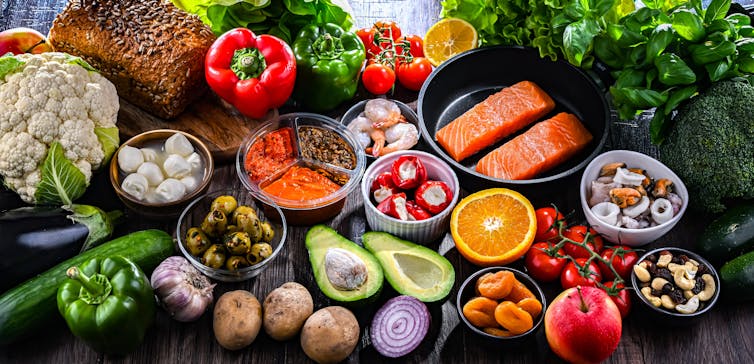
Most importantly, foods should not be considered in isolation. Dietary patterns matter more than individual ingredients. Diets such as the Mediterranean diet, which is consistently associated with lower risks of both dementia and heart disease, include cheese alongside vegetables, fish, whole grains and fruit.

In the Swedish study, people who consumed more full-fat cheese and cream were also more educated, less likely to be overweight and had lower rates of conditions linked to dementia, including heart disease, stroke, high blood pressure and diabetes. All of these factors independently reduce dementia risk.

Spread of foods included in the Mediterranean diet
Eating a healthy, varied diet can help protect brain health.
monticello/Shutterstock

This suggests that higher cheese intake tended to occur within healthier overall lifestyles, rather than alongside excess calorie consumption or poor metabolic health.

Overall, the evidence does not support the idea that full-fat dairy causes dementia, nor that fermented milk products reliably protect against it. Full-fat cheese contains several nutrients relevant to brain health, including fat-soluble vitamins A, D and K2, as well as vitamin B12, folate, iodine, zinc and selenium. These nutrients play roles in neurological function and may help support cognitive health.

That said, the data do not justify eating large amounts of cheese or cream as protective foods against dementia or heart disease. The most consistent message remains that balanced diets, moderation and overall lifestyle matter far more than any single item on the cheese board.

The Conversation

Eef Hogervorst has receives funding from grants investigating food and dementia such as Alzheimer’s Research UK, The Newton Trust/British Council and from Merck to investigate the role of omega 3 and folate to prevent dementia. She also acted as advisor on dementia, lifestyle and hormones for UK (NICE) and European (ESHRE) boards and is frequently invited to give public and scientific lectures on these topics

ref. Can eating high fat cheese and cream reduce dementia risk, as a new study suggests? – https://theconversation.com/can-eating-high-fat-cheese-and-cream-reduce-dementia-risk-as-a-new-study-suggests-272138

Why returning to sport after childbirth is tougher than it looks for triathlete mothers

Source: The Conversation – UK – By Eleri Sian Jones, Lecturer in Sport Psychology, Bangor University

Today’s sporting landscape increasingly accepts that athleticism doesn’t end when motherhood begins. High-profile athletes such as middle-distance runner Faith Kipyegon and rugby player Abbie Ward have helped redefine what’s possible after giving birth.

But for most athletic mothers, the picture is far more complicated than the stories in the media suggest. Understanding those complexities is essential if women are to receive the support they need to thrive postpartum.

Triathlon, which is built on three disciplines demanding relentless training, adds an extra layer of challenge. Mastery isn’t achieved in one arena but across swimming, cycling and running. Each aspect carries its own technical and physical load.

For many women, this intersects with another critical moment. The peak performance age in triathlon often overlaps with the average age of childbirth. In the UK, most women have their first child at around 31. This is precisely when many endurance athletes are hitting their prime. When these timelines collide, returning to training and competition becomes especially complex.

Research my colleagues and I published earlier this year explored the postpartum experiences of ten triathlete mothers, from enthusiastic amateurs to world-class competitors. Their accounts reveal a largely invisible psychological journey, including shifting identities, guilt and resilience.

When expectations meet reality

Before giving birth, most of the women we interviewed expected their return to training to be straightforward. They thought they’d wait for medical clearance, rebuild gradually and carry on. But almost all described a divide between expectation and reality. Some assumed the “rules” of postpartum recovery wouldn’t apply to them, especially those used to high-performance environments.

The challenges weren’t just physical. Many were unprepared for how mentally draining early motherhood would be – the relentless tiredness, the emotional upheaval and the unpredictability of routines that made structured training challenging.

To cope, mothers became experts in efficiency, timing childcare handovers to the minute, squeezing in short but intense sessions and reshaping long-standing training habits to meet the new constraints of family life.

For many women in our study, triathlon wasn’t just a hobby, it was a core part of their identity. Motherhood enriched that identity but also complicated it. Some felt in limbo, unsure whether they could still call themselves athletes. Others found new meaning in training, seeing each hard session as evidence of strength gained rather than strength lost.

Triathletes competing in the cycling section of the sport on a road.
Triathletes competing in the cycling section of the sport.
Martin Good/Shutterstock

Motivation changed too. Some wanted to prove that athletic ambition doesn’t end with childbirth. Others leaned on training as an essential part of their wellbeing.

Every woman in our study encountered social pressures that shaped how they viewed their training. Guilt was ever-present – guilt for leaving children to train, guilt for not training enough, guilt for wanting something outside motherhood.

This was often tied to the “ethic of care”, which is the social expectation that mothers should put everyone else’s needs ahead of their own. Even within supportive relationships, many felt that childcare defaults to them and that their training was something that required justification.

Social media added another layer. While some drew inspiration from athlete-mothers online, many also recognised how curated these stories were. Rarely did they mention childcare support, financial resources or physical setbacks. Several mothers told us they hid their own struggles to avoid appearing negative or ungrateful.

Nearly all of the women we spoke to described exercise as central to their mental wellbeing. Several felt that continuing to be physically active made them better mothers. But training could also threaten their wellbeing. Reduced training time, physical fatigue and pressure to bounce back led some to feel frustrated. A few questioned whether it was worth continuing if they could never reach their previous performance level.

What needs to change

These stories highlight an urgent need for change across the sporting landscape. Return-to-sport pathways must be holistic, recognising psychological, identity-based and social factors, not just physical clearance. Coaches need better training on postpartum realities. Understanding emotional shifts, fluctuating motivation and identity loss could dramatically improve support for returning mothers.

Partners and families also have a role. Shared responsibility and acknowledgement of the invisible labour of motherhood are essential for sustainable training. And public narratives need greater honesty. More realistic accounts of postpartum recovery, especially on social media, could help challenge comparison culture and reduce stigma.

Triathlete mothers are challenging outdated assumptions about what women can achieve after childbirth. Their stories aren’t about superhuman feats but about navigating ambition, care and physical recovery in tandem.

Returning to sport after childbirth isn’t a simple comeback. It’s a reshaping of identity and a shifting of priorities. It’s time for the systems around them to catch up and provide support that allows these women not only to return, but to thrive.

The Conversation

Eleri Sian Jones does not work for, consult, own shares in or receive funding from any company or organisation that would benefit from this article, and has disclosed no relevant affiliations beyond their academic appointment.

ref. Why returning to sport after childbirth is tougher than it looks for triathlete mothers – https://theconversation.com/why-returning-to-sport-after-childbirth-is-tougher-than-it-looks-for-triathlete-mothers-271668